Over the Jewish high holidays I noticed all over again how many women in my congregation wear a tallit, a Jewish prayer shawl. I grew up at a time when it was rare for women to wear a tallit, and rare for women to become rabbis and cantors, though there were some. At summer camp there were one or two women who wore a tallit (and a kippah and tefillin), but they were outliers. I had my Bat Mitzvah at thirteen and led the service and read from the Torah, but I wore a nice dress, blue I think, and no tallit.

A tallit, or Tallit Gadol, is worn over the shoulders at morning prayer services (and one evening service per year, on the eve of Yom Kippur), as opposed to the tallit kattan, worn by boys and men under their clothes. There are fringes at the four corners of the tallit, called tzitzit, each made of eight or so strings held together with four knots, with one blue thread. Most synagogues have extra tallitot (the plural of tallit) and kippot (the plural of kippah, or skullcap), outside the sanctuary for those who don’t have their own.


In Rabbinic Judaism, women are not obligated to wear a tallit, but Orthodox Judaism actually forbids women from wearing them, and growing up, this prohibition was front and center for me at my orthodox Jewish day school. The rabbis told us that men needed these reminders more than women did, and anyway, women would be too busy taking care of the children to get to synagogue for services on a regular basis. They explained the prohibition against women wearing tallitot as part of the prohibition against women wearing men’s clothes, which they took seriously in our school, where girls were forbidden from wearing pants. Despite my frustration with their patronizing logic, I still never thought of taking on the obligation of wearing a tallit myself.
The female rabbi at my synagogue today, though, wears a tallit, and many women in our congregation wear not only a tallit but also a kippah, traditionally the men’s head covering. We’ve had generations of Bat Mitzvah girls and adult Bat Mitzvah groups at our congregation now, so that women of all ages have gone through the process of choosing their own tallitot to fit their personalities and feel welcomed as equal members of the Jewish people. I like so many of the women’s tallitot that I’ve seen, in pinks and reds and purples, with beautiful designs and embroidery, and I love the idea that women are seen as just as important as men to the maintenance of the community. I even have my grandfather’s tallit in a cabinet, because it matters to me, but I’ve never worn it, and I’m not sure why.

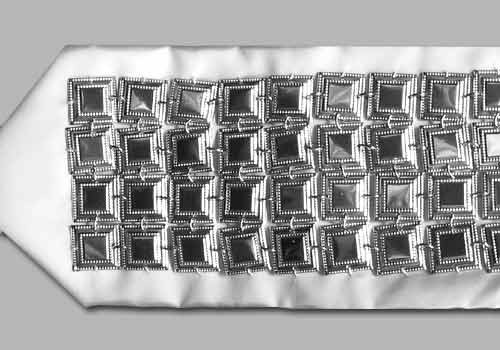
Maybe it’s just habit, after years of not wearing one; or maybe it’s because of the obligations and commitment it represents, and I’m not ready to take that on; or maybe it’s my father. I loved my father’s tallit. It was the size of a beach towel, with thick black stripes and sterling silver squares covering the atarah, or yoke, of the tallit. It was like a huge tent that could be folded over at the shoulders to give him wings, or spread over his head so he could disappear underneath it into his own personal relationship with God. I think that any tallit I might try to wear, no matter how feminine, or light, would feel like draping the power of my father over my head, and I know in my bones that instead of making me feel safe, it would suffocate me.
There are so many things like this, still, in my life, so many relics of the past that I have tried to re-value and scrub clean of their old associations. I have overcome a lot of them, through hard work, but the prevailing notion that anything is possible and all wounds can be healed, just doesn’t ring true for me. Early on in therapy I truly believed I could have a normal life, eventually, if I just put in the work, but now I know that, for me, there are some milestones that will never happen, and some wounds that will never heal, and the scars will be a part of me for the rest of my life. So far, this inability to take on the yoke of Torah, the obligation of daily rituals like wearing a tallit, is one of those unhealed wounds. It’s still possible that, one day, there will be comfort in wearing a tallit of my own, where I can create my own cocoon of time with God, but I’m not there yet.
But there is comfort in seeing so many women around me embracing their beautiful tallitot, and wearing them with pride and ease. On Yom Kippur, the longest day of the Jewish liturgical year, tallitot are worn starting from Kol Nidre, the evening service, through the next morning and afternoon and on through Neilah, the final service of the long day, at sunset. And multiple times during that long day we sing the Yevarechecha, the priest’s prayer, repurposed as a prayer for community. We drape our arms over the people on either side of us, many using their tallitot to wrap their neighbors and loved ones in a communal tent of peace. And it really is beautiful.

If you haven’t had a chance yet, please check out my Young Adult novel, Yeshiva Girl, on Amazon. And if you feel called to write a review of the book, on Amazon, or anywhere else, I’d be honored.
Yeshiva Girl is about a Jewish teenager on Long Island, named Isabel, though her father calls her Jezebel. Her father has been accused of inappropriate sexual behavior with one of his students, which he denies, but Izzy implicitly believes it’s true. As a result of his problems, her father sends her to a co-ed Orthodox yeshiva for tenth grade, out of the blue, and Izzy and her mother can’t figure out how to prevent it. At Yeshiva, though, Izzy finds that religious people are much more complicated than she had expected. Some, like her father, may use religion as a place to hide, but others search for and find comfort, and community, and even enlightenment. The question is, what will Izzy find?

 rachelmankowitz
I believe you can be healed. I never thought I could either. I am living proof that miracles exist. My biggest problem was confidence. The Jew gives me confidence. I know a lot of people don’t relate. That pure light is there and we tap into it. Knowing the Jew exists is all I needed to know ⚘️
I learn so much from you, Rachel. Thank you for sharing your knowledge and your perspectives.
Thank you!
Reading your account of Tallit wearing was enlightening. The transitions surrounding traditional practices intrigues me as an outsider.
Thank you!
I love the imagery of draping arms over each other, and wrapping each other in a shelter of peace!
It really is lovely!
Thank you, Rachel, for sharing about the traditions of your faith and in the effect they have on your life. I learn so much from you.
Thank you so much!
Thank you for sharing your faith. I once believed, too, that I might find freedom in healing but despite years of therapy, so far not completely. I still hope though.
I always hope.
I think some things just aren’t important enough to let them worry or bother you, and perhaps this is one of them? Wear what you feel comfortable with. That’s just my 3
2 cents worth.
Thank you!
Your posts consistently open my eyes to learning more each week. Thank you for your Saturday musings.
Thank you so much!
Thank you for being so honest. Your story makes people know they are not alone. I wore a tallit for the first time during Yom Kippur ( kol Nidre) this year. But it was for a goofy reason. I was wearing a wool blazer at Temple and it was so hot, but my shirt underneath was sleeveless. My daughter suggested I put on a tallit and cover my bare shoulders. It felt good! Not sure if I broke any religious rules!!
First and foremost it’s a piece of clothing. If it keeps you comfortable it’s doing it’s job.
Thanks for the explanation. I am guessing only reform is allowing women to wear these items or do conservatives as well? (Prohibited under Orthodox)
Reform, Reconstructionist, and some Conservative as far as I know.
Fascinating as always
Thank you!
As a gentile I found this insight into your faith to be fascinating. I really had no idea. Thank you for sharing.
Thank you!
Always informative, thoughtful, and insightful, Rachel. I hope you soon reach the point where you can don the symbols that enrich you–on your own terms, with comfort.
Thank you!
Thanks for explaining something I knew nothing about.
Thank you for reading!
Thank you for sharing this, Rachel. ❤
Thank you for reading!
How have you thought about the Jewish forbidding of cremation if I might ask?
My rabbi has talked about it, just saying that, as with everything else, liberal Jews do it regularly even if there are prohibitions.
Thanks for all this recent history. All new for me.
Thanks for reading!
That was such an insightful post Rachel, thank you! Tallitot are so beautiful. I love how specific types of clothing can take on such symbolic, religious, cultural and emotional importance. Learning about this was a joy 🙂
Thank you so much!
It took me a very long time to realize my idea of healing was getting to a place where it had never happened. I still bump into that fantasy from time to time as I find yet another effect. Peace to you.
Sometimes that fantasy is the only thing keeping me going.
It did get me quite a ways to healing.
A beautiful a moving read. Those fur babies are adorable ☺️
Thank you!
😊🦋