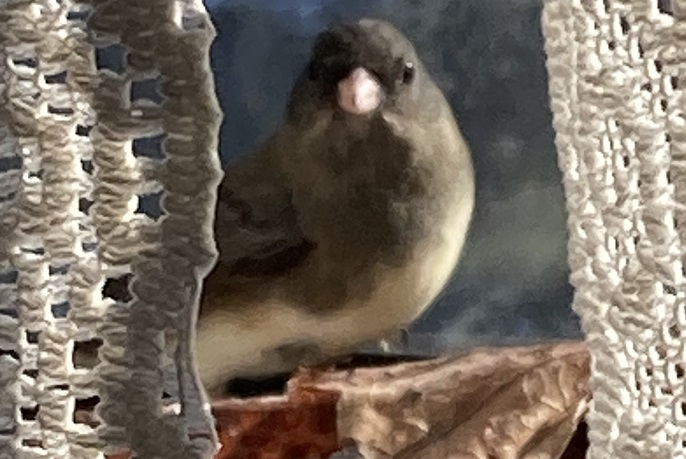
(A Note: A wild bird – a Junco – visited for a few very cold days recently and read the hard copy of my essay before publication, leaving a few responses)

As the nature of Israel’s war against Hamas changes, becoming more targeted and with fewer soldiers on the ground in Gaza, the conversation in Israel has been moving to the question of what happens the day after the war ends. (Of course there are a hundred other conversations going on at the same time, but my brain can’t process all of it. I can’t make sense of a genocide charge at The Hague, or continued terrorist attacks in Israel, or ongoing calls for Israel to stop fighting even as rockets are being fired at the north and south of Israel and the Houthis are firing on ships in the Red Sea. So, for now, I’m trying to focus on something hopeful.) Recently, I was able to watch a zoom call from the Reconstructionist Rabbinical Association called Holding on to Hope, which hosted leaders from three different Israeli organizations who have been working towards peace and coexistence between Israelis and Palestinians.
One message that came through consistently from these leaders is that the efforts that are most successful are the ones that address self-interest, rather than arguing for peace from a selfless altruism. Another theme was that what happens in Gaza impacts Tel Aviv, in terms of health, and air and water quality, as well as violence, and there are no walls high enough to change that.
One of the organizations on the zoom was a joint Jewish and Arab school in Israel called Hand in Hand. The public school system in Israel separates out Arabs and Jews into separate schools, in large part as a gesture to allow Arabs to maintain their own culture and language and not have to study Jewish subjects, but over time this separation has widened the divide between Jews and Muslims and Christians in Israel. The Hand in Hand schools bring these children together to help them learn to understand each other’s narratives and grapple with how to move society towards coexistence. There are six Hand in Hand schools in mixed Arab and Jewish towns so far: in Jerusalem, Haifa, Jaffa, Kfar Saba, Wadi Ara, and Galilee. And the schools also work at building connections among the adults in the surrounding community.
The representative of the Hand in Hand schools on this zoom was a Palestinian citizen of Israel, with a background in film in particular and the arts in general. His sense of hope for the future came from his belief that education is what will create the next generation of leaders, able to speak each other’s languages and understand each other’s cultures and see each other as companions on the same journey.

Coincidentally, I recently read about a new Israeli TV show (not yet available here) set in a Hand in Hand school (or something like it) in Jerusalem. The review I read in Kveller suggested that, because it’s a comedy, it often wraps up complex issues a little too quickly, but the fact that it can represent those complex issues in an entertaining way could make a big difference in what people begin to see as possible in the future.
The second organization represented on the zoom was Standing Together, a political action organization that brings together Jewish and Palestinian citizens of Israel, and secular and orthodox Jewish Israelis, to work on issues on which they have common cause, as a way to build consensus and community so that over time they can begin to work together on the bigger battles yet to come.
I’d seen a previous zoom, earlier in the Fall, that focused entirely on the Standing Together group, but I found it alienating, maybe because it was so soon after October 7th and everyone’s emotions were still so raw. This time around I heard a lot more acknowledgment of the pain and fear of both Jewish and Palestinian citizens of Israel, and ideas for how to bring both peoples to the table in order to create a sustainable peace.
The third organization represented on the zoom was completely new to me, called A Land for All (previously called Two States, One Homeland). It’s a think tank made up of Jewish and Palestinian citizens of Israel, and Palestinians from outside of Israel, to problem solve the nitty gritty policy issues necessary for peace. The basic idea that they’ve come up with is a two state confederation, where a Jewish State and a Palestinian State live side by side, with open borders and some joint institutions. The specifics of the proposal weren’t discussed in this zoom, but the idea that some people are ready to sit together and seek workable plans for a peaceful future is encouraging.
Except, with Israel being accused of genocide at the International Court for Justice, and Hezbollah and the Houthi rebels attacking from the north and from the sea, and hostages still being held in Gaza, I don’t know how many people within Israel are up to hearing any of this right now, which is probably why this was a zoom for American Jews.
A final peace deal between Israel and a Palestinian state has been so elusive, in part, because the two sides can’t even agree on the preconditions for sitting down to talk. Palestinian leadership wants all new Jewish settlements in the West Bank stopped, and preferably for all of the existing ones to be removed as well, as a precondition for discussing peace with Israel. And Israelis have wanted reliable promises that the terrorism will stop before they discuss the settlements, let alone final agreements on where the borders of a future Palestinian state should be. Many Palestinians and their supporters seem to believe that terrorism is the only way their voices will be heard, by Israel and by the world at large, but every terrorist attack has pushed the Israeli public further away from any belief that peace is possible, and therefore from any willingness to make difficult compromises for that unreachable peace.
When I discussed the concept of peace recently with my synagogue school students, they weren’t thinking about Israel or even peace between countries, instead they looked at peace through the lens of family life, saying that there has to be a lot of room within peace and coexistence for disagreement, and even some bloodshed (their point of reference was fights with their siblings, so, hopefully not too much blood). They spend a lot of their time working towards peace in their daily lives, managing disputes with their friends and family, dealing with hurt feelings, and learning how to compromise, but all of that feels possible for them because they know they are safe in their homes and that people care about them and are listening to them.
In all of the coverage on the news, and in all of the opinion articles that I’ve read and international voices I’ve heard, no one has offered a workable plan for peace that addresses what is actually happening right now. No one has come up with a way to disempower Hamas and destroy the tunnels without causing unacceptable damage to the structures and the people above ground in Gaza. In fact, the UN refuses to call Hamas a terrorist organization, and since Gaza is not considered a state and has not signed agreements to follow international law, they can’t be held officially responsible for their actions, but Israel, which is an acknowledged state and has signed these agreements, is being brought to The Hague for fighting back against Hamas. The international community has not addressed this invisibility of organizations like Hamas, Hezbollah, or the Houthi rebels, who are acting as proxies for Iran’s interests in the Middle East, and Hamas has taken full advantage of its political invisibility to press its war against Israel, which certainly didn’t start on October 7th.
The fact that Israel is under attack from, basically, all sides, has not changed the rhetoric around the world that has portrayed Israel as a lone menace in the Middle East, causing all of the trouble.
All three of these Israeli organizations are working towards long term goals that will require consistent commitment and ongoing efforts and will not be put in place within the next few months, but the world, and the combatants on both sides, are too impatient for that slow growing peace process, and the extremists on both sides keep taking advantage of that impatience and offering apocalyptic solutions that will only work for one side or the other. Every time I watch the news I hear this ticking clock, and the absence of hope, but I know there are people out there who are thinking and breathing and working for peace, and that’s what I want to hear more about, because that’s where a livable future will come from.
A Land for All – https://www.alandforall.org/english/?d=ltr
Hand in Hand – https://www.handinhandk12.org/
Standing Together – https://www.standing-together.org/en

If you haven’t had a chance yet, please check out my Young Adult novel, Yeshiva Girl, on Amazon. And if you feel called to write a review of the book, on Amazon, or anywhere else, I’d be honored.
Yeshiva Girl is about a Jewish teenager on Long Island, named Isabel, though her father calls her Jezebel. Her father has been accused of inappropriate sexual behavior with one of his students, which he denies, but Izzy implicitly believes it’s true. As a result of his problems, her father sends her to a co-ed Orthodox yeshiva for tenth grade, out of the blue, and Izzy and her mother can’t figure out how to prevent it. At Yeshiva, though, Izzy finds that religious people are much more complicated than she had expected. Some, like her father, may use religion as a place to hide, but others search for and find comfort, and community, and even enlightenment. The question is, what will Izzy find?

 rachelmankowitz
IMO, integration is ultimately the answer. I like the think tank that includes representatives from both sides. At least peace has a foot in the door.
There are definitely voices all around searching for a real peace. Not a lot, but they exist.
Very thought provoking article. And how nice that you had a bird friend come to keep you company for awhile.
Thank you! It was so nice to have an animal presence in the apartment again.
🙄😡 wish I had more to say but the neverending circular conversations on peace talks rile me.
I hear ya.
A very interesting post and great analysis. Like the Economist (British middle of the road magazine) stated, Israel being accused of genocide at the International Court for Justice is political. It is not based on facts. That the UN has not deemed Hamas a terrorist organization is beyond belief. Things like that make it so I don’t trust the UN. UN does not represent democracies and people wanting human rights, at least not well.
I wish the UN could be relied on as a neutral arbiter, but maybe the idea of such a thing being agreed on by the whole world was always utopian.
Thank you for this profoundly insightful essay. To my mind, the UN has become its own kind of Demi-god and no longer has an objective voice, in anything. To not recognize terrorists for what they are is absurd. Your weaving the bird’s eye view is lovely. Yes, hope is the thing with feathers.
Thank you!
Good to know about the schools. Thanks for the links.
Thank you! The Hand in Hand schools were the most interesting to me too. I hope the tv show ends up being available here.
Emily understood how hope is both resilient and fragile, just like a bird.
Yes!
Yes indeed
Best wishes ☺
Thank you!
Welcome
Best wishes ☺
As always an interesting and informative post, thank you Rachel.
Thank you!
Rachel, I only hear what the news — mostly NPR — says. It’s so helpful to get the benefit of your own knowledge from various sources. Thank you for addressing this. And some way, somehow, may there be peace.
Thank you!
Thank you for this post. It helps me to understand some of the intricacies of solving the conflict.
Thank you!
I appreciate reading this post. I am not Jewish, but I grew up in a Chicago suburb that was 90% Jewish at the time. That said, I have wrestled with the madness of this situation and wept over the loss and injuries of the innocents on both sides. I read an online article recently that told about a program led by an Israeli woman, a Palestinian Israeli, and a Palestinian whose mission is to train other mental health professionals in the treatment of children whose mental health has been and will be profoundly damaged. I don’t have the link, but it’s one small step showing professionals from both sides anticipating the difficulty healing will be after this nightmare. I can’t write more. I just hold too much anger and frustration.
I hear you.
Such a good overview, Rachel. We must hope that those who seek compromise and acknowledge their shared humanity are the strongest and most consistent voices.
And your birdie announcer is delightful.
Thank you!
There are no easy answers because the root cause of this war is spiritual. You might appreciate a post by Ron Whited called “Selective Outrage?” https://ronwhited.wordpress.com/2024/01/21/selective-outrage/.
Thank you.
Lovely photographs Rachel. There is always hope.
Thank you!
You’re welcome
Bring… home… the hostages!!! (Love the bird photos.)
Thank you!
Most thoughtful analysis I’ve read or heard. A long time ago (1971) I read Michener’s “The Source” which he wrote not long after the 1967 war. I thought then, and now, there is no solution. Mainly because of human nature and the question of: “Whose land is it?”
But maybe that’s not so (no solution). Reading your piece gives me a smidgen of hope.
Thank you so much!
I read The Source MANY decades ago. I must read it again. Thanks for the reminder.
I found the statement, “the efforts that are most successful are the ones that address self-interest” hopeful, and I like the idea of “hand in hand ” schools. The punishment of people, the horrific bombings are stirring up so much hatred that I fear there will be no solution. I hope the hostages are still alive , and will return home. I hope that people can find treaties and peace, the kind that comes from talking and negotiating, not fighting. I have read books that told the story of facilitators meeting with two groups that hated each other, but started working on what they had in common, which softened their view of one another, and some became lifelong friends. Two states? Change the “no, never” into what “is possible.”
Fingers crossed.
I would find hope in the contributions you make as a teacher to help resolve such intractable conflict among people with different cultural backgrounds. That’s something you can possibly control.
Maybe not control, but work towards, definitely.
Control is difficult to find I agree .
Thank you for this post,, especially for sharing about those organizations. This is such an insanely complex situation, but I think most people just want simple answers and simple solutions (like choosing one side as the bad guy). I think there is hope, and we might even get to see some positive outcomes in our lifetimes.
That would be wonderful!
What a remarkable visitor! Great pictures.
Thank you!