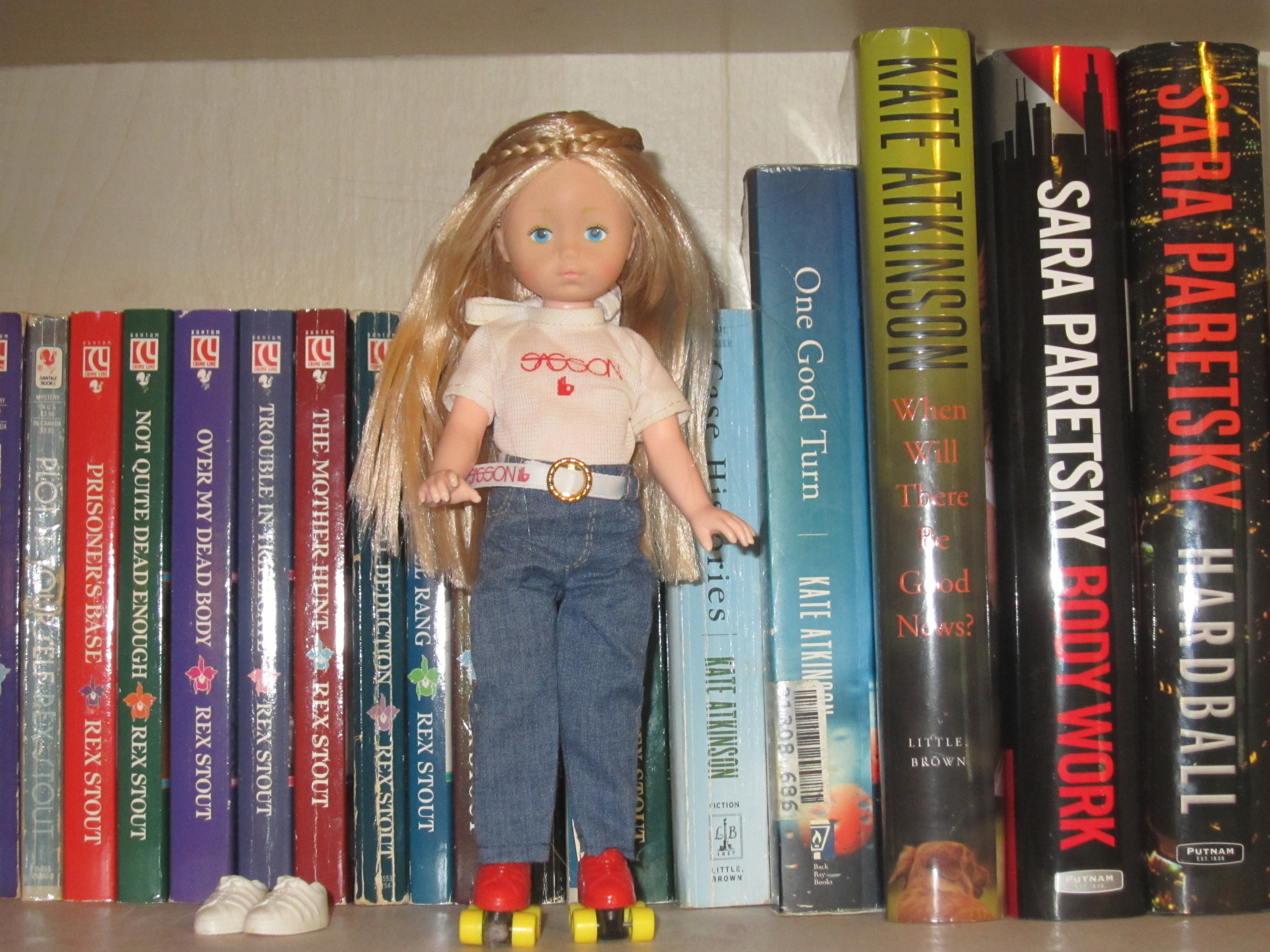
I don’t remember if I ever had a set of Matryoshka dolls (Russian nesting dolls) of my own when I was younger, but I definitely saw them and played with them somewhere along the way. There was something magical about how each doll hid another doll, and another, and another, except, there wasn’t much to do with these “dolls.” You couldn’t dress them up, or hug them, and none of them had roller skates (like my Ginny doll). And they were so static: their eyelids didn’t open and close, and their arms and legs didn’t move. And yet, they still drew my attention. I haven’t thought about those dolls very much over the years, but recently I saw a set of them on TV, and my first thought was that they would be a very helpful metaphor for the way we carry our old stories within us, even as we try to grow beyond them.
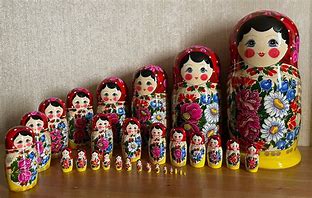
I was sure that everyone must see the same thing in them as I did, but when I went looking for more background on the dolls, I found out that everyone sees something a little different, depending on where they are in their lives and what lens they are looking through.
Originally, the dolls were made as a children’s toy, in 1890, possibly inspired by a nesting doll from Japan, and they were meant to highlight Russian femininity, with the dolls wearing a sarafan, a long, shapeless traditional Russian peasant dress, and the figures inside representing her children, of both genders, with the smallest being a baby, made of a single piece of wood.

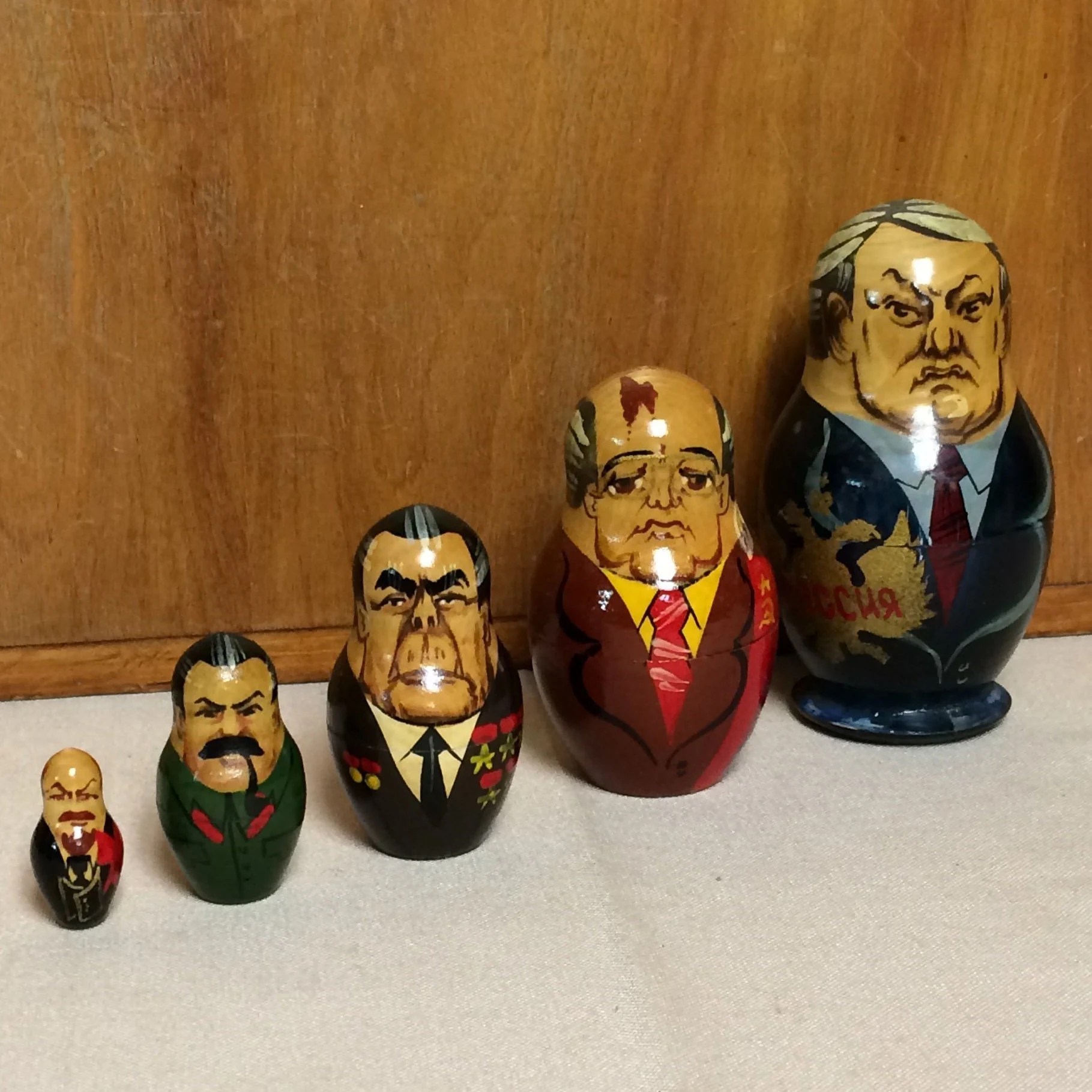
But somewhere along the way the dolls became a favorite souvenir for tourists, and then a way to represent famous Russian politicians, and how each generation of politicians was influenced by the ones who came before. Some people have even repurposed the dolls to represent complicated corporate structures used to avoid paying taxes, like shell companies.
But when I look at these dolls, I see myself, and the way each of my previous selves stays inside of me. My layers don’t peel off, like an onion, or slough off, like the skin of a snake; I hold onto everything, whether I want to or not. I would have thought, given all of that, that I would feel some relief at seeing each doll standing separately on its own “feet,” but instead, the separated dolls seem hollow to me, even forlorn. Despite the pain of holding onto the past, I feel stronger, and more fully myself, with all of my selves held together.
And there’s something powerful about having a metaphor that I can see and touch and move around in space; because when all I have are words to help me organize my thoughts, the chaos can become overwhelming.
When I went looking for images of Matryoshka dolls, I found all kinds of different sets – five doll sets and ten doll sets, people and animals, dolls that look exactly the same at each size, and dolls that are completely different from one another – but the most intriguing thing I found were blank sets of dolls that you can paint however you like. And it occurred to me that, if I had any artistic talent at all, which I don’t, it would be really meaningful to create the figures to represent my own layers, or the important people who have influenced me over time, to help me really see all of my pieces.

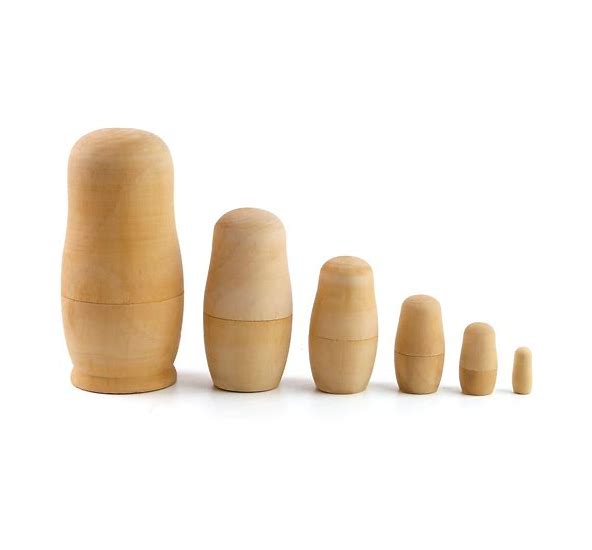
And then I thought about how I could use those blank doll sets with my students, to help them visualize how each generation influences the next, and how who they are today is connected to everyone who came before. And then I thought about the costs of all of the materials involved, and the difficulty of getting my boss on board, and then the work of explaining to the kids exactly what I was looking for, so they wouldn’t just paint all of the dolls as different sized poops; and then I fell into a black hole of self-recriminations about all of the ways I suck as a teacher, and a therapist, and a person overall.
And yet, despite the waterfall of thoughts and worries and self-loathing that washed over me, I still think the Matryoshka dolls have a lot to offer, though maybe they should come with a warning label: open at your own risk, objects inside may be a lot more complicated than you expect.

If you haven’t had a chance yet, please check out my novel, Yeshiva Girl, on Amazon. And if you feel called to write a review of the book, on Amazon, or anywhere else, I’d be honored.
Yeshiva Girl is about a Jewish teenager on Long Island, named Isabel, though her father calls her Jezebel. Her father has been accused of inappropriate sexual behavior with one of his students, which he denies, but Izzy implicitly believes it’s true. As a result of his problems, her father sends her to a co-ed Orthodox yeshiva for tenth grade, out of the blue, and Izzy and her mother can’t figure out how to prevent it. At Yeshiva, though, Izzy finds that religious people are much more complicated than she had expected. Some, like her father, may use religion as a place to hide, but others search for and find comfort, and community, and even enlightenment. The question is, what will Izzy find?

 rachelmankowitz
I’ve never seen these dolls, but they sound like a great therapy tool!
They’re fascinating!
my father bought a set of those for me from the New York World’s Fair. I no longer have them (too many house moves), but i remember thinking how exotic and pretty they were.
I remember going to the New York world’s fair!!! I may have even gone with my elementary school?!
Awesome!
Now, I need to hunt up the set that was given to me several years ago by a Russian friend. I never occured to me to use them as a tool for introspection. That’s a great idea.
I had no idea how many varieties there are!
Great analysis. I did not know about some of these variations, and now I wish I had artistic talent to paint the blank ones for the progression of my own life. Oh, well. My imagination will have to fill in! It will be a good thought experiment, at least.
I’ve always wished I could draw or paint, but I can barely create images in my head unless I’ve seen them and studied them.
Reminds me of getting to the ‘cat in the hat Z 🙂
Your COMMENT section asks for my email. I provided it but your site still not allowing me to comment?
Claude
Weird!
Such a great analysis of the nesting dolls. You really opened my eyes. My parents bought me a beautiful set when they went to Europe now. I just opened them up again.
Was trying to send a photo but there isn’t a way
There are so many beautiful varieties!
I love your idea of Russian staking dolls being a metaphor for our memories. I’d never thought of that, but it’s perfect. Thanks, Rachel.
Thank you!
Family tree idea would be cool. There is a store in New York in a barn that sells nesting dolls among other things. Much of what they sell is from Russia, but some from Ukraine etc. They really do have some great alternative nesting sets now.
Awesome!
I love this so much, Rachel. I have always been fascinated by these dolls, and as a teacher I absolutely get it about the way an idea can get your teacher mind so excited! I love the blank ones and the animal ones! They are new to me.
Thank you!
I know what you mean about the nesting dolls; I used to play with them too. You wrote some interesting ideas about them here.
Thank you!
Visiting the Soviet Union as a tourist several times, the nesting dolls made a nice gift for me to take home fro relatives. I still have a ’15’ nest like the one in the top photo, and one of the political sets from 1987 similar to the one you show. They are stored in a box in the loft.
Best wishes, Pete.
The fifteen piece set looks amazing!
I have two sets of these dolls in a glass door cupboard but have never thought so deeply about them. I will rethink their presence in my life. Sorry for what you are going through that rabbit hole of self recrimination. I know you are very good at what you do.
Thank you so much!
I laughed out loud at the thought of your students painting them like different poops! Then I felt bad about your rabbit hole of self recrimination! I have a couple sets of those dolls my husband gave me, but I never had such profound thoughts about them. Excellent post.
Thank you! The kids never tire of the poop jokes. Rolling on the floor laughing is a real thing at that age.
I vaguely recall playing with those as a kid, someone in the family had a set be it my Grandmother or my Great Aunt (both of of which were Syrian). Idk if you could get people on board with your idea, I think you should go for it.
It might work better for teenagers, especially if they have artistic skill, or if we could print pictures of their family members on stickers…
Beautifully thought out. Thanks you
Thank you!
A relative brought me a set of nesting dolls after a business trip to Moscow when I was a kid. I don’t remember what happened to them, though.
I wonder what would happen if you had a few different sets and swapped some of the inner dolls. Would they fit?
That’s a good question (the tiniest one was always my favorite–so cute)!
I love how you unpacked the dolls, created meaning for yourself and put them back in order to provide stability. Don’t give up on the idea of including them in a class project. Perhaps in groups of five, each student could have one doll and ask their family about a relative/a story that could be visually represented on the doll. Each group of five could share the stories out to the whole class. Maybe more complicated, however such a great idea to use them somehow!
Such an interesting idea! Thank you!
What a great analogy!
Thank you!
First, I never. Realized they had a name other than Russian nesting dolls although I guess I always should have supposed that they should had at least in Russian. And now to the important point, how wonderful how you were able to create so many mental images to savor based on these nesting collections. I love the idea of using them as a teaching tool. Agreed it would be cost prohibitive or close to it to outfit an entire class with their own sets of paintable dolls, but I’m sure somewhere in the internet world there is a set of prophets portrayed by them. I know, it’s easy for me to say, but I think you’d be the on the short list for creative teacher of the year with nesting prophets in your toolbox!
That would be awesome!
If you try it, let me know how they like it!
I’ve heard of these dolls, and had no idea about all the variations, even blank ones. As usual, your insight is spot on!
Thank you!
Hubby bought me a set a couple of years ago. There are six in mine, each one hand painted.
Such a lovely gift!
They are lovely.
How beautifully you’ve used this metaphor to teach, Rachel. And in Yeshiva Girl too, I suspect, as a metaphor for all the nesting Matryoshka dolls that represent the hidden you.
Yes! Thank you!
Russian nesting haven’t seen those in years
Can’t say I’ve ever critically analysed the dolls quite as in-depth as you’ve done here. Most intriguing! Must say I like the idea of the presentation to your students – so many life variations on offer in one set of dolls. Perhaps pictures may suffice without the actual physical dolls. Save a lot of trouble!
Good idea!
I am Russian on my dad’s side and have a couple of Matryoushka dolls. I am in the process of recreating or redefining my life right now and I really like the analogy of the dolls being the different parts of our life and how they create the newer, outer layer with each ‘new’ face. I’m going to wrap my brain around this! Thanks 🙂
I hope it’s helpful! You’ve already lived so many lives, you’ll probably need one of the fifteen piece sets to even get started!
🙂 You’re right!!!
There really is something about the nesting dolls. I purchased a set of nesting dolls from a Russian woman at a craft show here in the states. Probably in the late 80’s. I was so impressed that she had painted each set exactly the same, down to the very last tiny doll. I still have them on a shelf and take them out occasionally and open them all up.
I also have the Sasson Ginny doll, in blonde and brown hair. No roller skates, but I do have a moped 😉
A moped?!!!!!!!!
Not sure your budget, but I see 10 sets of 5 dolls on the internet for $65.00. Depending on how you wanted the kids to use them, you could cut costs by using magazines. As a reusable teaching tool they could tape faces (cut out from magazines) on . . . for them to keep they could glue. And I imagine that people looking similar to who you want the doll to represent couldn’t be too off/far from a child trying to paint that person. If you planned on just letting them use the dolls for your class session then the $65.00 would be amortized out over all the sessions you use them for. With your insight into what the dolls could represent there are so many ways you could do it. Maybe even just paper dolls could get your idea across. Have an actual set and then students just have paper “nesting dolls” not as fun, but again, it is the lesson/idea you are trying to convey.
“Lot of 10 Set by 5 pcs Blank Nesting Dolls – Unfinished Unpainted Russian Nesting Dolls – Blank Doll – Nesting Doll DIY – Unfinished Wooden Doll”. Wood Art Supply is the seller but their site directs you to Amazon. (I didn’t want to include the link, but can if you want.)
Oh, here is the link. I was able to find a shorter version: https://www.amazon.com/dp/B0B63STCT6?tag=woodartsupp00-20&linkCode=ogi&th=1&psc=1
Wow! Thank you!
Thank you!
Wonderful collections! Thanks for sharing with us!
Thank you!
Love Lambchop, your dog’s friend. Keith
I’ve always liked those nesting dolls and your book sounds fantastic!
Thank you so much!