Category Archives: dogs

Cricket in the City

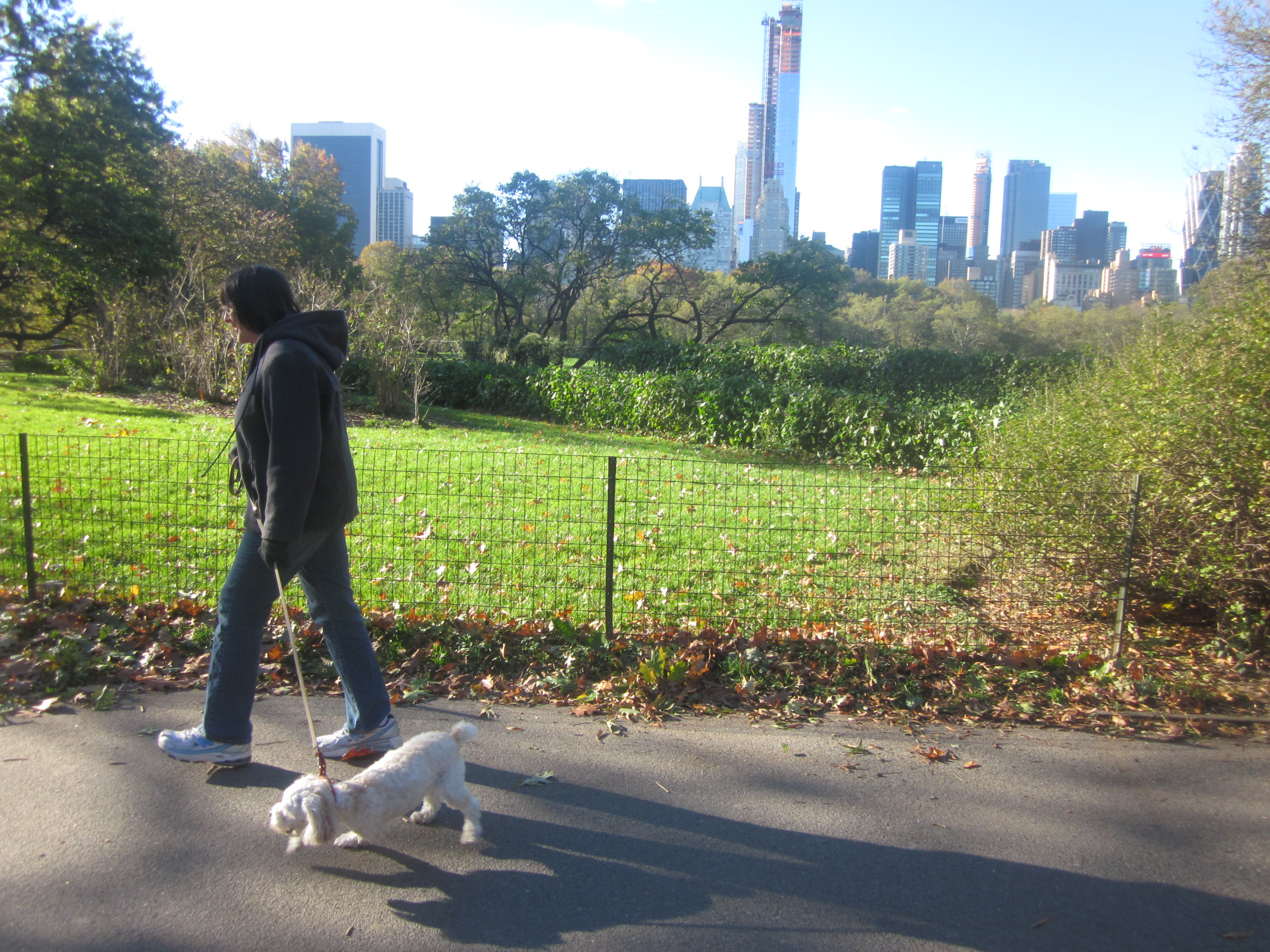
Cricket in Central Park


I live on the North Shore of Long Island and I was lucky during Hurricane Sandy to only lose power. There was no flooding or fire or downed trees at my house, though I only had to walk a few blocks to see power lines draped across the roads and horizontal trees where fences used to be. I was doubly lucky then, when a cousin of my Mom’s offered us her apartment in the city until our power returned. We drove in on the Wednesday after the storm and started out before anyone realized it was gridlock day. We were in the car for six hours on a trip that would usually take less than an hour. Six hours with Cricket climbing behind my neck and barking at trucks and all of us really needing to pee.

When we arrived at the building and found a magical parking spot only two blocks away, my first priority was, of course, to pee. And then I had to find and turn on the TV. I am a TV addict. I may have to write a whole blog on that someday, but suffice it to say that going a full day without TV leaves me strung out, two days and I’m shaking.

But really, what the TV offered was a better idea of what Hurricane Sandy had done. Listening to the radio on and off didn’t make it clear, pictures did. It was the flooding that I couldn’t have imagined without the pictures. The houses snapped in half and pulled off their foundations. The only sign of the storm damage in the Upper West Side neighborhood I was temporarily living in was that Central Park was closed, so all of the runners and the dogs had to crowd onto the sidewalks.

Cricket is my anxiety dog, in that she shows the anxiety I feel. She shook and cried under my legs during the storm itself. And then in the aftermath, she was scared of the dark. We always leave the living room light on, or a light in the hallway, but without electricity, the only light came from candles and flashlights and those were only where the humans were. And she became even more of a Velcro dog than usual.

In the city, she was overwhelmed by all of the new people and smells and configurations. At first she wasn’t ready to poop or pee in a strange place, then, once she’d mastered that, she started to bark at everyone – in the elevator, in the lobby, on the sidewalk. She was clearly the country dog among city dogs. She weaved from side to side, sniffing every pee spot along the sidewalk, turning her head at every new dog, hiding behind my legs as every clique of marathoners ran by. The city dogs were polite, and somewhat jaded. They kept their eyes forward, did their business, and went on their way.
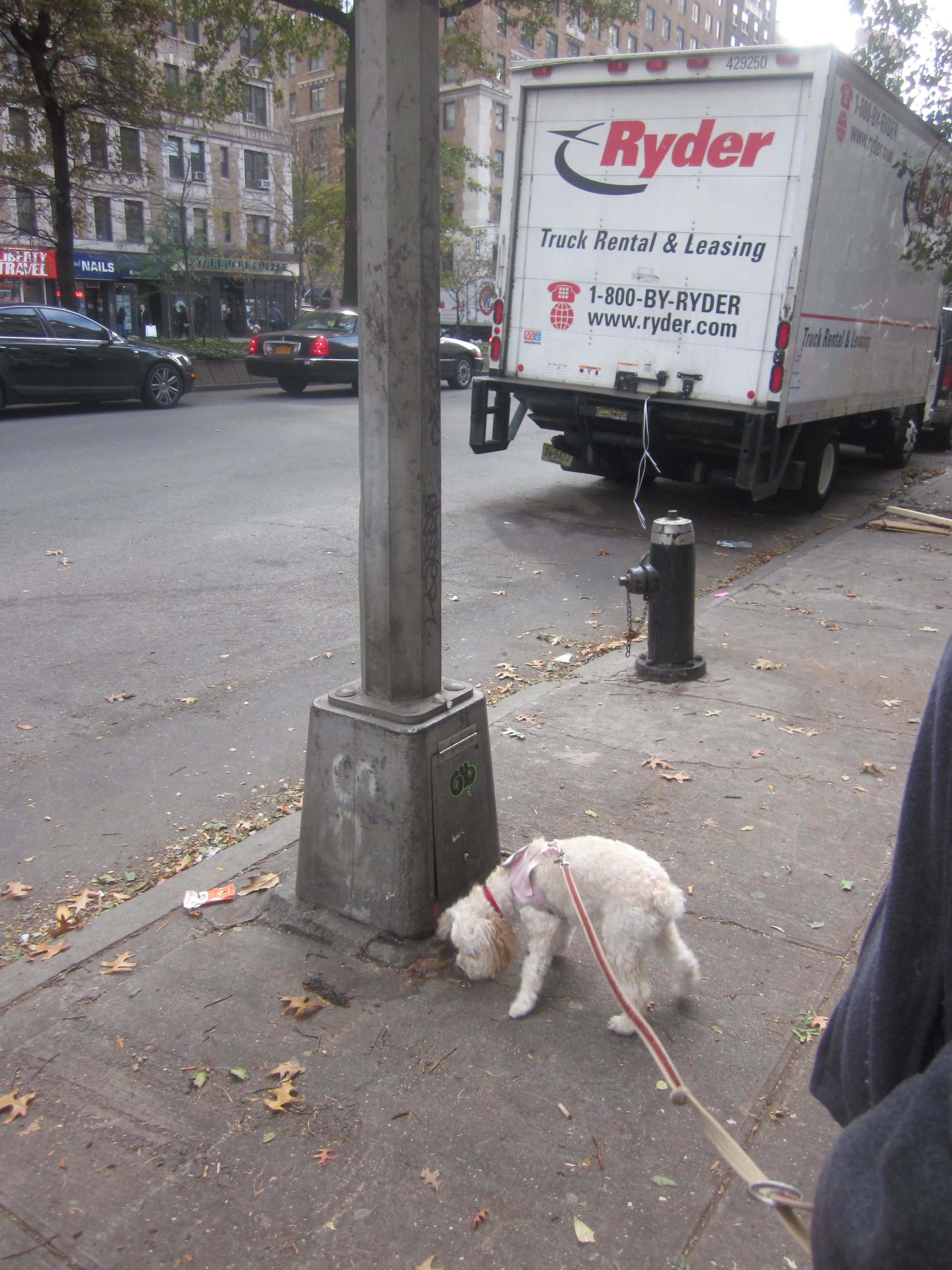
 

Cricket sniffing the city

We walked everywhere. They had a Fairway and a Trader Joe’s just like on Long Island, but more cramped and with escalators filled with people. I tend to panic in crowds, and that’s what happened when I tried to go into stores in the city. Everything was too close together and I couldn’t think, or breathe. But the crowds on the sidewalk were half dogs, so they didn’t scare me. It’s as if dogs mitigate the panic for me. If I could go to school, or work, or synagogue or the doctor with dogs, I’d have a much more active life.

Wouldn’t it be wonderful if dogs were allowed at the DMV?

I liked having doormen there at all hours. Taking Cricket out to pee at ten PM and being surrounded by light and people was very different from home, where it is dark and haunted by six o’clock this time of year, even with the power on. You only know other people are around because there are lights in the windows.

The power came back on in our neighborhood by Friday, so Saturday morning we were ready to go home. But first, Central Park was finally open and Cricket needed to walk. I’d seen so many dogs and runners on the grassless sidewalks that I’d assumed that was their natural habitat, but no, they belonged in Central Park, with the dogs finally free to run off leash and chase balls and grab sticks, and the runners on their own separate paths.

We met a woman and her dog who had been there from the first opening of the gates, when at least a hundred people and their dogs were waiting impatiently to get in. She said that once the gates were opened, the dogs ran like mad to get inside. After a week of being city dogs, they let loose and became dogs again.


Cricket taking center stage
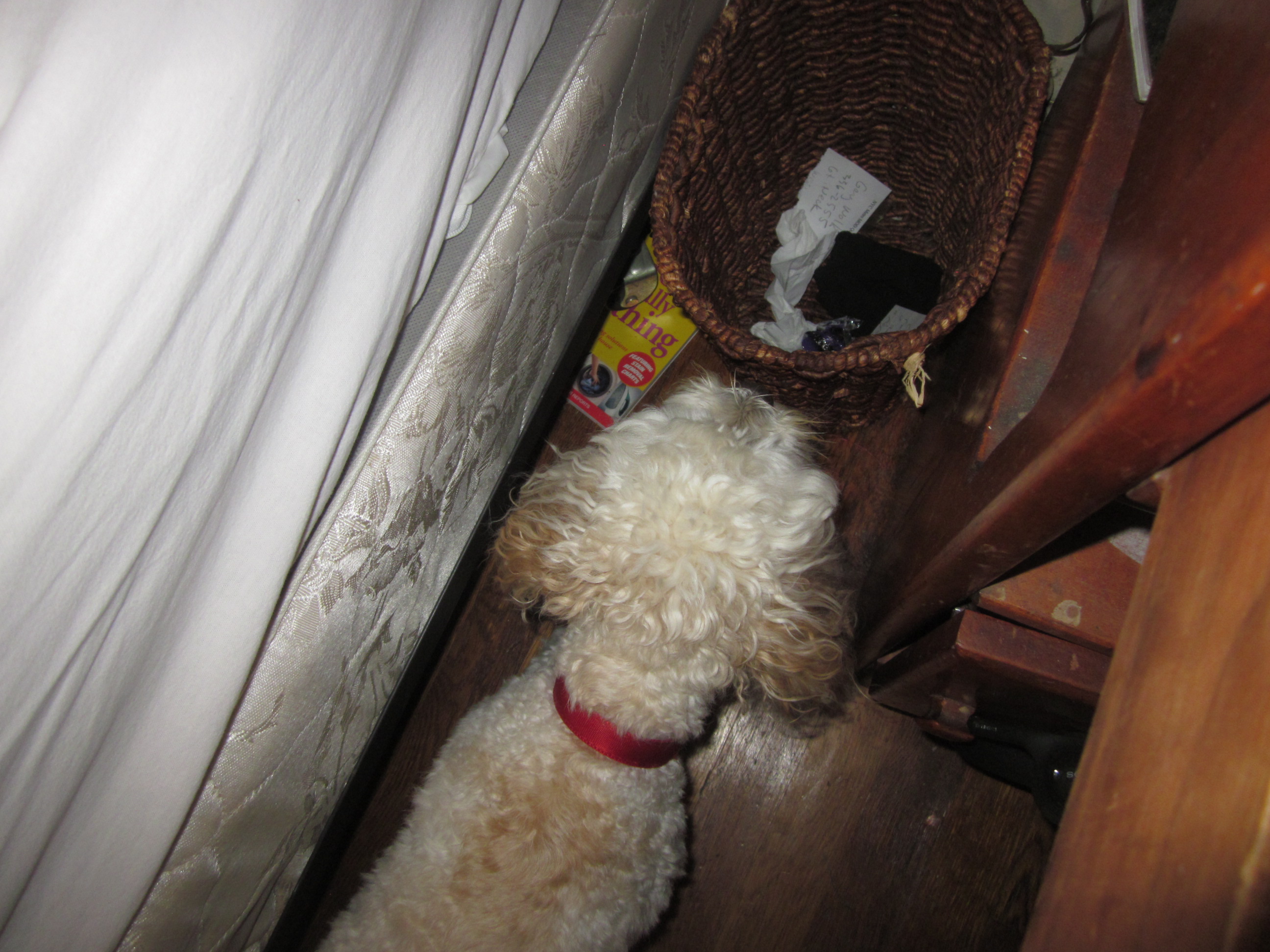
 

The Tissue Thief


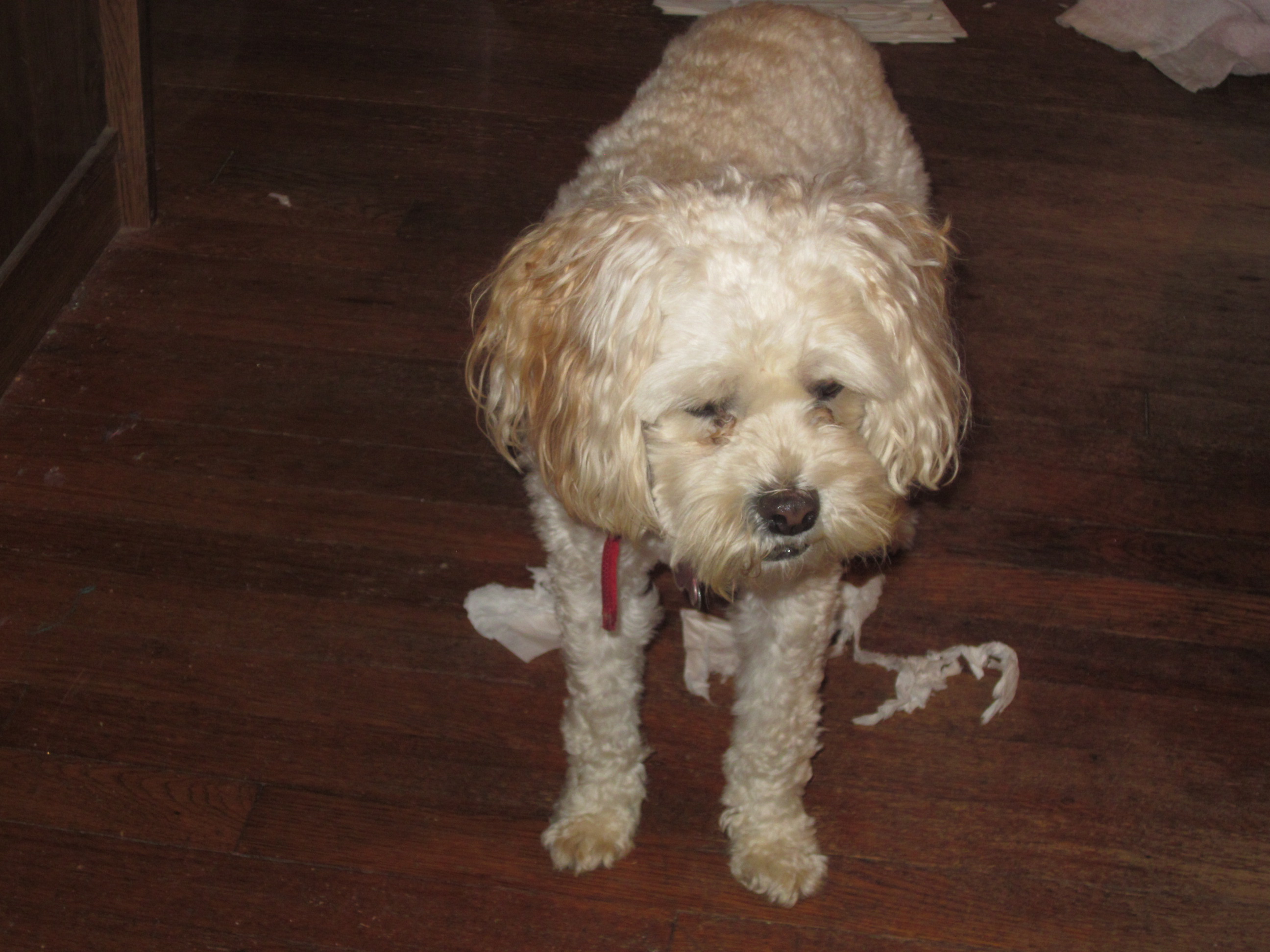
Cricket is a tissue thief. Cricket used to stalk a tissue like it was a wild beast. She’d lower herself into a bow, like she was about to play a very serious game of twister. Then she’d grab the tissue with her teeth and run to a safe place to dismantle it. She could have been sleeping when the sound of a tissue being pulled from the box woke her up. And if she couldn’t get the tissue directly from my hand, she’d jump off the bed and try to get the tissue on its way to the garbage can.

The thing is, it has to be a used tissue, and I have allergies, so Cricket has a lot of used tissues to choose from. Sometimes I am lazy and leave a couple of tissues on my bedside table before forcing myself to sit up and throw them all away in a clump. Cricket can’t reach the top of the bedside table, but she can leap off the bed, walk slowly between the bed and the table and gradually rise up on her toes to see where the tissues went and calculate whether she can reach them with her teeth before she loses her balance.

In my room, the garbage can is two feet tall and elevated on a file box another foot in the air, so that Cricket can’t shove her paws through the top and remove stray tissues. But it doesn’t stop her from trying.

The garbage can in the living room even has a locking mechanism on it.

Some time in Cricket’s first year, after I’d been thinking that for sure she was devouring the tissues whole, we discovered her stash behind the TV. There wasn’t just a tissue or two back there. There were dozens, maybe a hundred tissues, piled together where I couldn’t see them as I walked past. And yes, I’m sure I should have been a better housekeeper, pulling the TV center forward to dust behind it more than once a year, but I didn’t, and Cricket was skinny enough to squeeze herself back there and secrete her treasures there for later use.

It’s the same way she buries crackers or bones or pieces of cheese in various corners of chairs and couches and under beds, certain she’ll find a use for them later.

Cricket is a hoarder, that’s what I’m trying to say.

My mother is stubborn. She has kept her two short, open-topped, garbage cans, one plastic and one wicker, in her bedroom. Predictably, any time a tissue is used and dropped into either garbage can, Cricket jumps off the bed, pushes her nose inside and pulls out the tissue with her teeth. Then she’ll either jump back onto the bed with her treasure, or slink under the bed to her “apartment” where no human can disturb her.

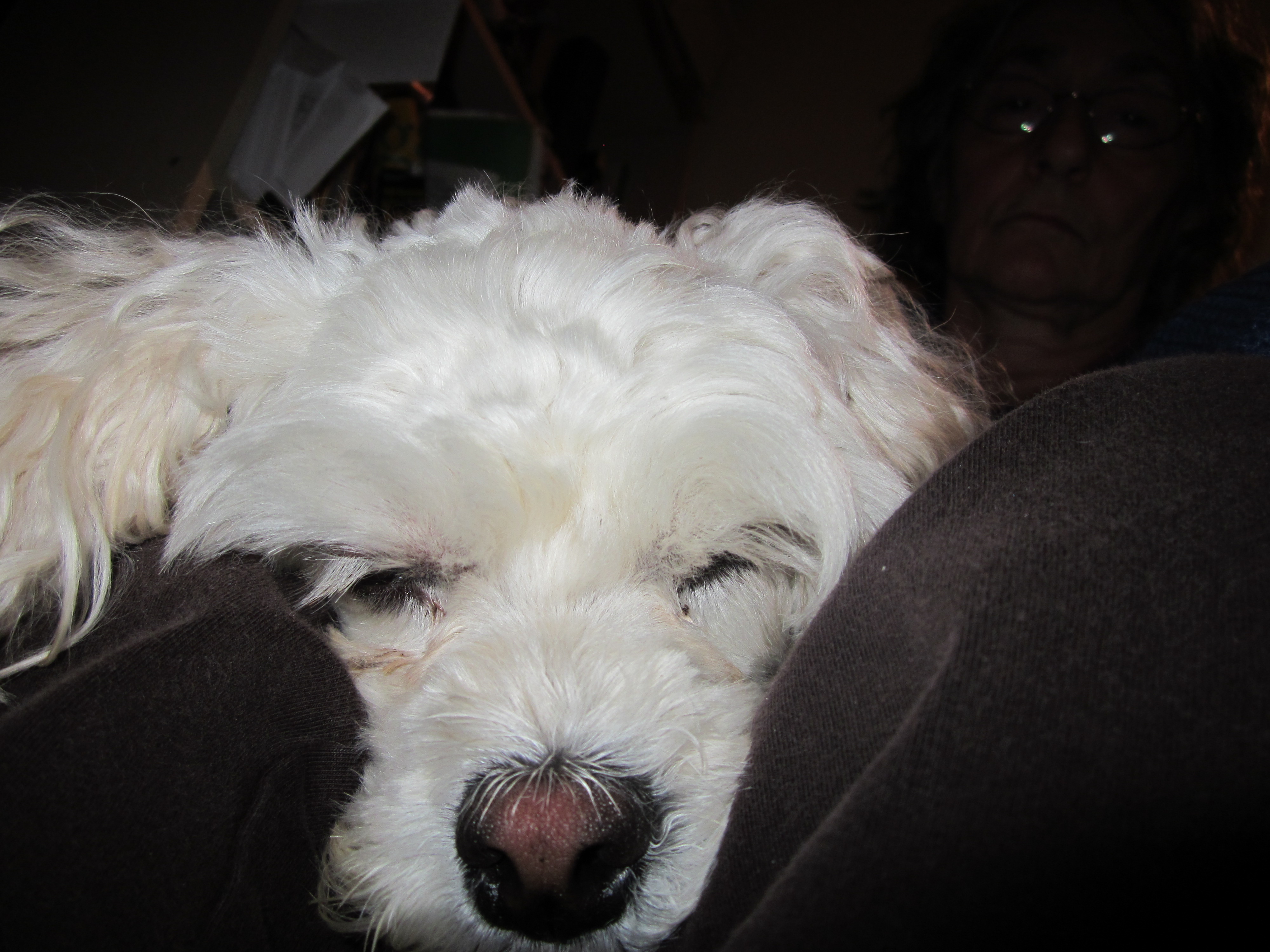
There are times, not many, when it is safe to blow my nose. These are the times when she is too exhausted to even lift her head, and she closes her eyes and just dreams of the all the tissues she’d like to eat. I can only imagine the magical tower of tissue boxes she climbs in her dreams. She is a very happy puppy.

Samson and Why I Hate Halloween


When I was six years old we had a dog named Samson. We adopted him as an eight week old puppy from the shelter. We were used to more aggressive or standoffish dogs, but Samson was a black Labrador mix and had the Lab personality through and through. My brother and I would race off the bus from school to see Samson and play with him. He was the happiest dog we’d ever had and we loved him.

It could just be that he was still a baby, and hadn’t settled into dogdom yet, or maybe he just didn’t have time to cause trouble before he died.

We only had him for two months, until he was hit by a car, on Halloween. I’ve built up a long list of reasons why I hate Halloween: monster movies scare me; I had to touch peeled grape “eyeballs” in the dark at a Halloween party; I don’t like knocking on strangers’ doors; I prefer to choose my own candy; and I have PTSD, so every time someone knocks on our door or rings the doorbell to trick or treat, I feel like hiding under the bed.

I sound like the Grinch who stole Halloween, I know.

But the bottom line is that Samson was hit by a car on Halloween, and the two events have always been paired in my mind.

Mom’s not sure how he got out of the house, but she blames herself. She thinks she must have left the door open when she took the garbage out. When she realized he wasn’t in the house, she ran outside to look for him and a group of kids told her he’d been hit by a car and they’d carried him to the side of the road. His body was still warm, but starting to get stiff by the time Mom brought him up to the porch. I don’t know why he ran out into the street. Maybe he was following the trick or treaters. I don’t know. I was already in my pajamas and probably asleep.

My father insisted that my brother and I not be told that night, so we found out the next morning, after they’d already buried him in the backyard.

Something about the Samson story still feels unresolved, like a haunting. And I don’t know what it is. The traumatic event happened off screen. I didn’t see him getting hit by the car, and I didn’t see him die. I worry that Samson could have been saved if only I’d known that he needed me. I don’t have many narrative memories of him, just a feeling. Not so much a body memory as a soul memory. I feel, in some indistinct place in my heart, my face, my hands, that he was a joyful place in my life. And he was fleeting.

Cricket’s Knee Surgeries


When Cricket was about a year old, we noticed that she sometimes limped, always lifting the same back leg. At first, I checked her foot for a burr or a nut shell stuck in her paw, but there was nothing. The limping was infrequent, at first, and then it was less infrequent. We took her to the vet and he gave her a vitamin supplement, like the one humans take for their bad knees. But it made her vomit.

Cricket didn’t seem to mind having walking problems. She’d just hitch up her leg, and keep going on three legs. But we couldn’t take her on long walks anymore and she couldn’t run and she couldn’t jump onto beds or laps. People kept telling me the problem would resolve on its own, but it didn’t.

The vet recommended doing an x-ray, to see the extent of the problem. Doing an x-ray meant putting her under anesthesia in the morning, then taking the scans and waiting for her to wake up. By the time we picked her up, she was dragging the vet tech down the hall to get back to us, scrabbling her toes on the slick floors, trying to go faster without much of a grip.

The vet showed us on the x-rays that the ligaments holding Cricket’s knee in place were stretched like an old rubber band, and the other knee was starting to show trouble as well. It’s a problem of little dogs, he told us, that the groove in the knee isn’t deep enough so the bones keep slipping out of place and stretching the ligaments that support it until they have no spring left.

The x-ray itself was scary to look at. My puppy splayed out like a dead frog in a specimen box. But, I saw the loosening tendons on the second knee and I was afraid that if we didn’t get her surgery on the first knee soon, she’d get to a point where she couldn’t walk at all.

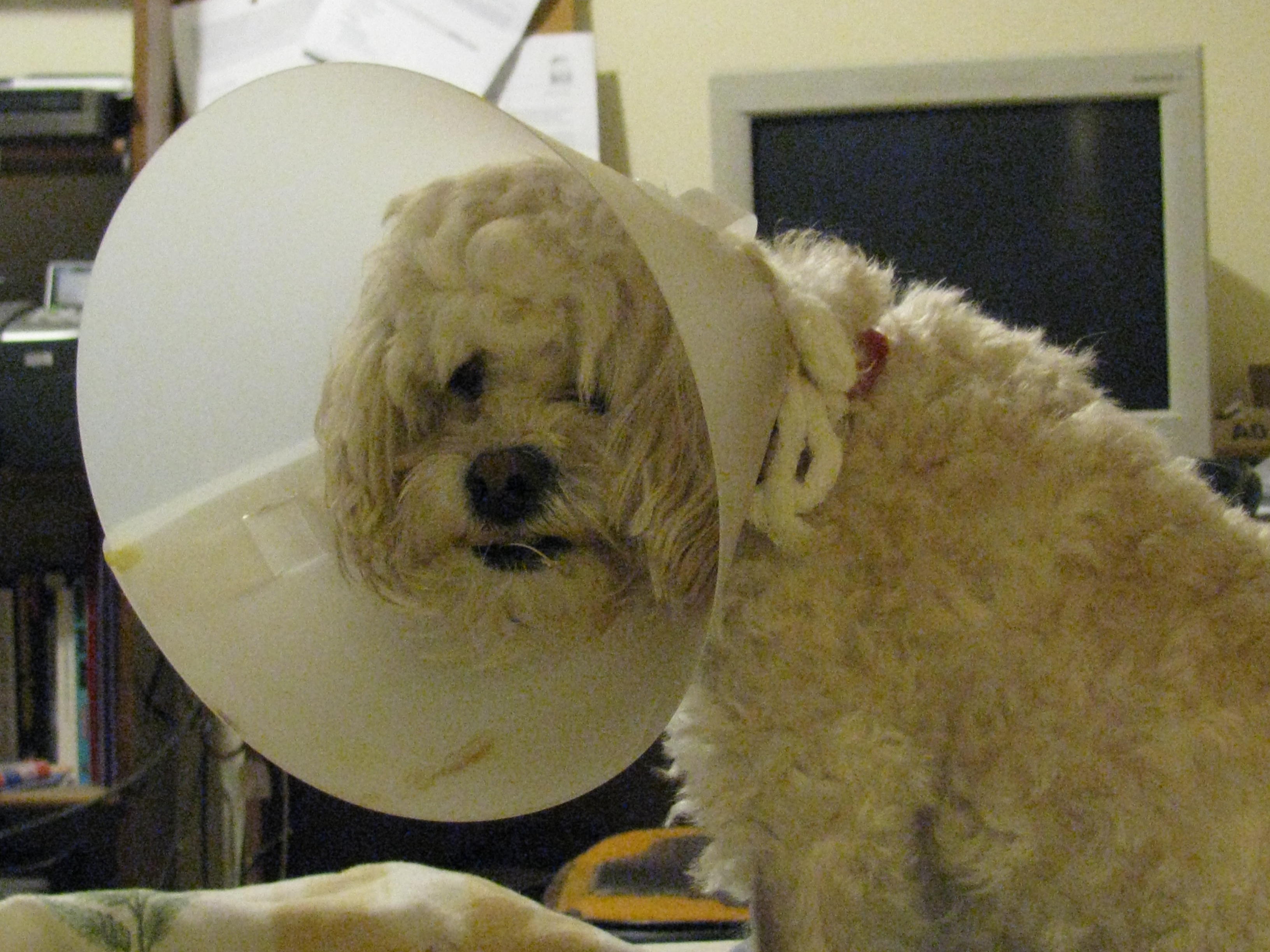
The surgery itself was only a one day affair. No eating after eight PM the night before, go in first thing in the morning, anesthesia, shave the leg, paint it with yellow antiseptic, cut it open, build a groove in the knee so it fits like a lock and key, tighten the ligament, sew with black thread. Her bare leg was grisly and yellow for a few days after the surgery. And she was drugged and woozy and wearing the Elizabethan collar to keep her from chewing at her stitches.


It took about two weeks for her to start putting her foot down, then a few weeks more to build back muscle tone, because the bad leg was skinny and the good leg was getting muscle bound and tight.

I started doing massage on her after her stitches were out and her bad foot was willing to bear weight. We started with gentle stretching, hamstrings, quads, but mostly hips, where there was extra strain from compensating for the weak leg. By six weeks, she was running and jumping better than she had since she was a puppy.

For the next eight or nine months she was great. She got a lot of exercise and play time and I felt really good about how she was doing. But by September she was limping on the other leg. Mom wanted to wait, to see if we could get pet health insurance that would cover the second surgery (we couldn’t) and maybe look into another modality, like pet acupuncture or pet physical therapy. But Cricket was gradually limping more often and for longer stretches. When we finally took Cricket in for another x-ray, the surgery was scheduled for the following day.

Mom had a bad cold and as soon as Cricket was safely home, drugged to the gills, they both fell asleep. I went in occasionally to bring peanut butter covered pills for Cricket and Robitussin or soup for mom. I carried Cricket outside to pee and deposited her back up on the bed.

Cricket’s knees are perfect now. The only sign of the surgery is that her knees stop her before she can straighten her legs out fully, but it’s barely noticeable.

Whenever I think, maybe we shouldn’t have spent the money or put her through the pain of surgery, I just have to watch my mother take Cricket out for her morning joy run across the front lawn. It’s a reason to wake up each day, for all of us.

Cricket’s Second Training Class


We tried another training class when Cricket was a year and a half old. She’d been getting bad reports from the groomers for biting and general recalcitrance, and Mom had heard about this teacher from a friend of a friend and we decided to make the effort to try again.

The new teacher ran her school out of a small store front. The floor was rubbery and easy to clean, and the room was big enough to take six dogs per class with two owners each, with a row of chairs for the non participating owners.

The teacher had a long haired German shepherd who came in for the first class to demonstrate what the training could accomplish. He stayed quietly in his crate until he was called. She showed us how they played tug of war with a flexible flying saucer, but as soon as she said drop it, he did, and sat down like a gentleman. Then she showed us some of his tricks, like being shot and playing dead and coming back to life. But most of all she showed us that he listened to her. He was well behaved and happy. She never yelled at him or, God forbid, hit him, or sprayed him with a water bottle.

She talked about how to teach a behavior by capturing it as it happened and naming it and rewarding it. So instead of forcing him into a sit or lie down, she’d wear her treat bag and click when he did what she wanted and name the behavior until he recognized the name.

She wore the treat bag attached to her belt loop. It looked like a mini-fanny pack, but she wore it in front so she could reach the treats easily. She showed us how to press the clicker and immediately feed the treats to the dog to reward the correct behavior.

I already felt like a failure before the class started, because most of the other students were continuing on directly from puppy class in the fall. Cricket was older than the other dogs, but she didn’t mind. She’s not much of a shame puppy.

There was a Golden Retriever, who liked to roll over into submissive position every few minutes, and a German shepherd who wore a kerchief at his neck. There was a black lab, second to the Golden in submissiveness, but more playful. And then there was the Mastiff, this enormous bull of a dog, with a chain collar around his neck, because he was stronger than both of his parents. His bark was deep and loud, especially in the small room. And then there was Cricket, the oldest and smallest dog in the class.

The teacher sent us home with a list of things to buy, including a new harness for Cricket, which would be our third attempt to switch over to a harness from a collar and leash. Cricket has a Houdini-like talent for escaping the little vests in the middle of the street.

Cricket actually enjoyed training, at home. She loved the treats. We finally discovered one brand of chicken treats that worked every time, even when everything else was hit or miss, so we bought in bulk. But once we got to class, it was as if the treats had gone rancid, even though I’d cleaned the treat bag and filled it with fresh treats right before class. Cricket would sit there and pant at me and not hear any of my instructions, and even if she took a treat in her mouth, she’d spit it onto the floor.

Oh, and she climbed out of her new harness within the first few minutes of class.

The teacher called Cricket relentless. It wasn’t a compliment. She also said that I wasn’t holding my ground enough. I wasn’t matching her relentlessness the way I should be.

Cricket learned how to sit and stay and, sometimes, to lie down on command. She learned that she loves chicken treats. I learned that teaching new skills to a reluctant student is torture, and that I’m not good at being consistent. I learned that I hate the sound of the clicker and that I’m not built to be a dog trainer.

My one real success, though, was mat training. I placed the mat on the floor and gave Cricket her treat when she stood on it, even with one paw. Then she got treats for sitting on the mat. Then, she got treats for staying on the mat. Cricket loved this game. She loved the endless treats she could get just for sitting there and staring at me. She could stay on the mat for almost two minutes at a time, as long as I gave her a days worth of treats to make it worth her while, and as long as nothing more exciting came along, like the mailman.


Cricket and the Cat

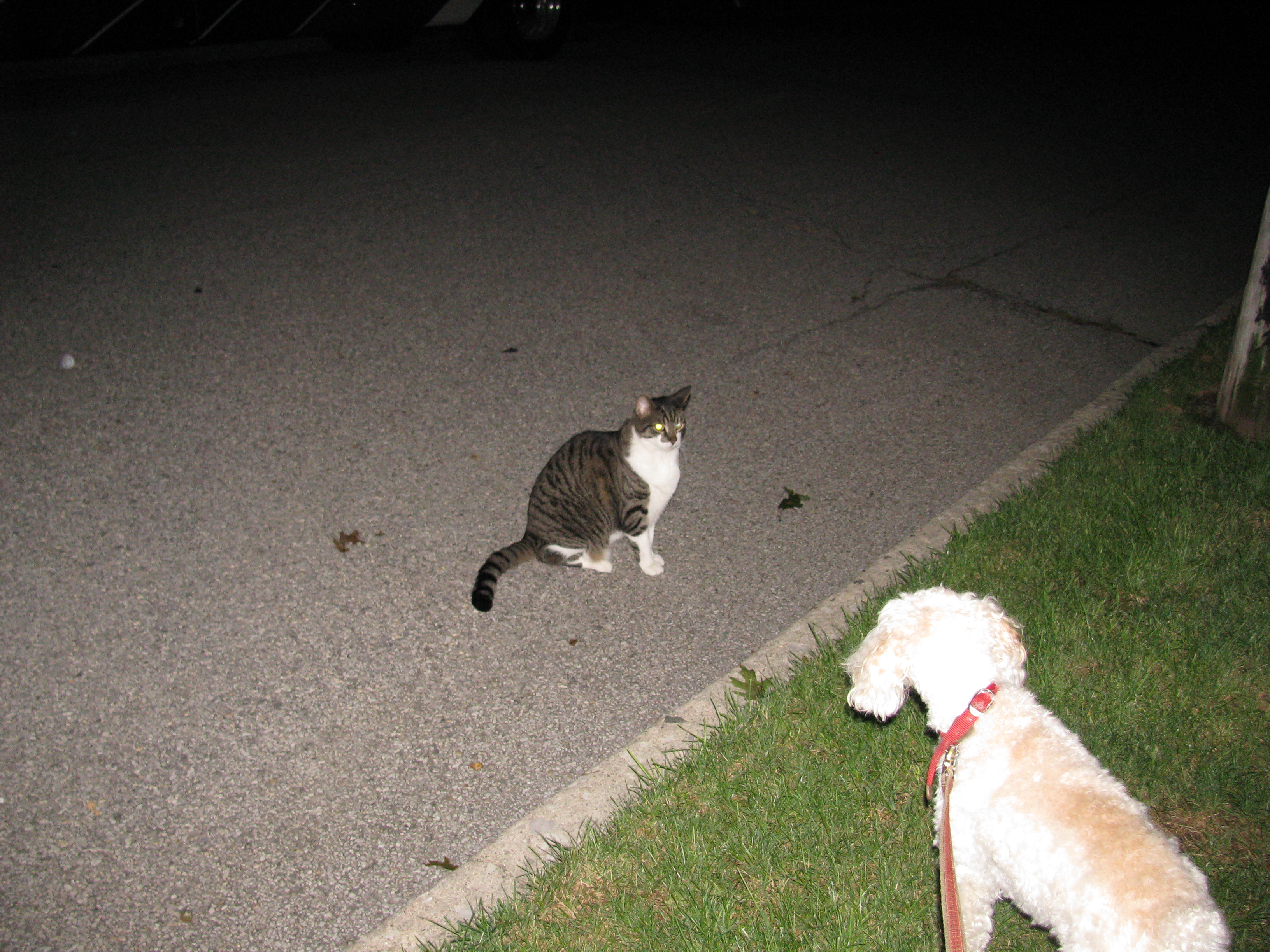
            Cricket had a crush on the male cat down the street a few years ago. He would stand on his corner, and she would pull on her leash trying to reach him, and in response he’d do a long, slow, stretch next to the fire hydrant. Sometimes he’d stretch out in the middle of the road and roll on his back to scratch against the pebbles, while she watched from the sidewalk, stuck with me on her leash.

I had never really noticed the cat until Cricket noticed him. He was black and white and grey and his belly was too big for him. His day was filled with rambles from house to house, looking for food or adventure. He was in no hurry, though he could run when he had to, like when the mourning doves suddenly dive bombed at him one day for reasons known only to them. He was basically the same size as Cricket, small for a dog, but big for a cat. Sometimes, I’d see him standing on his front porch, waiting for someone to open the door, but then I’d look again and it was really the cat statue my neighbors keep on their porch.

I don’t know what Cricket would do if the cat actually accepted her attentions. He used to let her sniff his butt as he walked slowly across the street. He wasn’t interested in her butt, though. Do cats sniff butts the way dogs do?

I admire his nonchalance. I admire the way he seems to feel so comfortable in his skin, so unrushed in his life. He visits with people and doesn’t worry about being rejected.

It’s odd how much Cricket likes cats, when she can be so standoffish with other dogs, or frightened by them. It is almost impossible for Cricket to like a dog who likes her. The other dog’s interest and affection seems like aggression to her. She reads enthusiasm as attack.

One night, when Cricket was out on her walk, she saw the cat a hundred feet ahead of her, standing on the sidewalk in front of his house. He saw her, too, and instead of turning away, he ran straight towards her, but then right at the end, he veered off and jumped up onto a neighbor’s lawn.

I don’t know if he meant to come to her and got scared off at the last moment, or if he meant to taunt her, or to run past her but misjudged how close he got.

I felt so hurt for her, for this unrequited love, this come-here-go-away cat. I wanted her to be the princess at the ball, loved by the cat of her choice. I was absolutely over identifying with my dog.

Even now, when she sees the cat stretched out on his lawn, she pulls to get across the street to him. He lazes on his back, like a cat centerfold, and looks away.

The Scratchy Glutton

Cricket requires pretty significant scratching sessions every day. She jumps onto my chest while I’m sleeping or reading, and stands tall on all four legs, and if I don’t get the message quickly enough, she paws or noses my face or my hand to get things started.

Usually, just because I think I’ve been thorough does not mean the session is over. And she lets me know I’ve been precipitate by scratching at my hand or face again, climbing off my chest to find the errant hand if necessary. She seems to know that extra scratchies make her brain feel better and make her whole self more relaxed.

She makes a point of moving around to make different points available. First, her face itches. She has allergies, so under her eyes and around her nose and near her ears all need extensive scratching. Then the top of her head and around her neck. Then she’ll lie back and lift one arm so her chest is available to be scratched. She does not like her feet touched. This is an important rule.  Her back and sides need scratching next. Then I stretch her ears and rotate them a bit. I stretch her arms up and do some hamstring and quad stretches. She can go forty five minutes, at last count, though it’s been a while since I’ve had the patience to do such a thorough job. If she’s standing on her own four feet, she tends to walk forward, about an inch at a time, like she’s walking though a car wash to make sure every inch gets thoroughly scratched.

Cricket would be a perfect candidate for a full on massage session, with candles and oils and soft music, as long as no one goes near her toes or her ears or tries to remove poop or eye goop.

I worry that Cricket is especially itchy. She gets a runny nose during allergy season and scratches her head on my sheets while making a kind of desperate foghorn sort of noise. It’s almost as if she’s sneezing and barking and crying all at once, and I can hear her paws scratching fiendishly. I’m surprised my sheets have lasted so well, really, with all the time she spends trying to dig through to the mattress.

I never had a dog who sat on my lap and asked for scratchies this much. Sometimes I think she’s very attached to her people, and in need of a lot of love and affection from us, but then other times, I think she’s just damned itchy and looking for some relief.


Delilah’s Diabetes

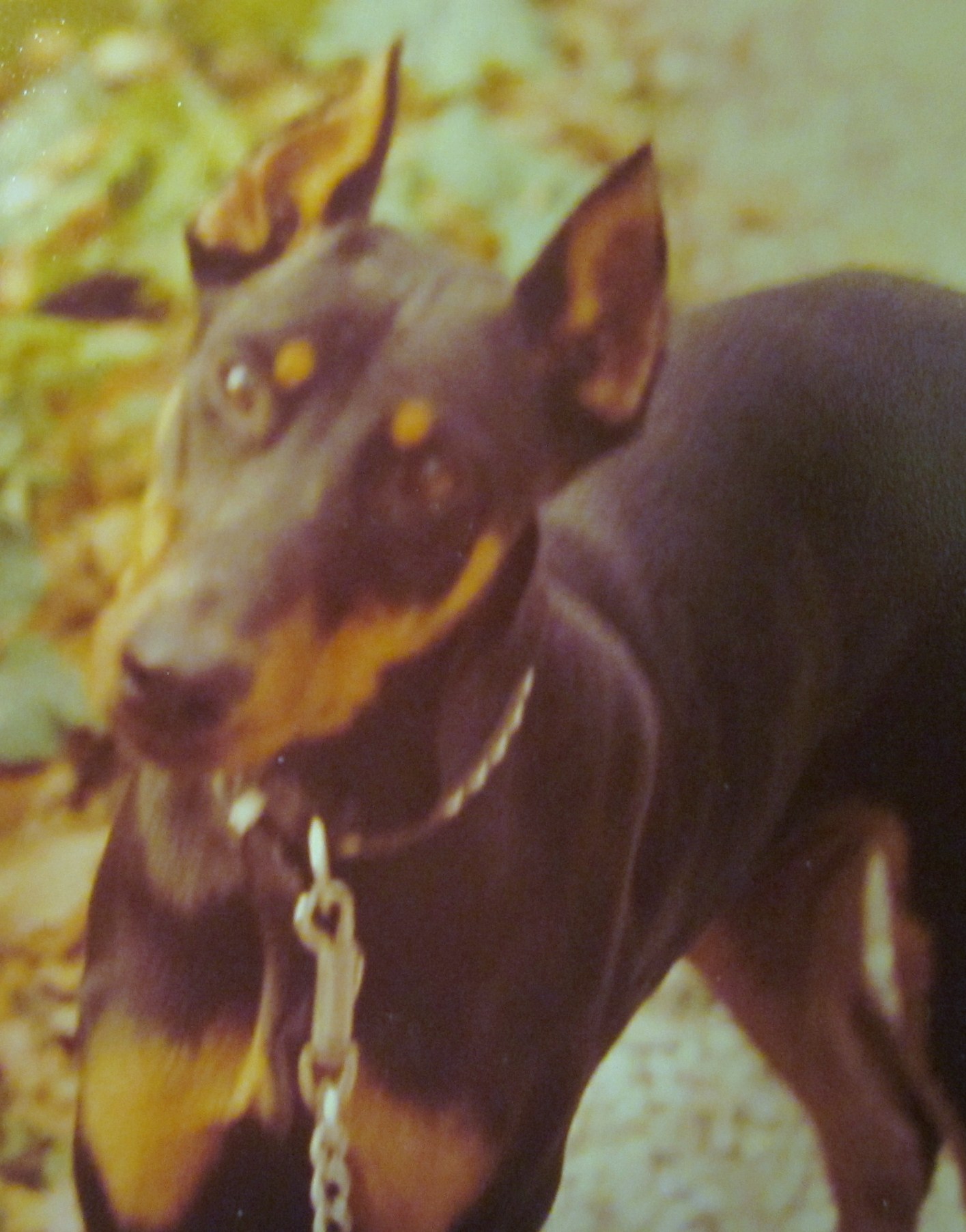
When Delilah was about eight years old, and I was fourteen, she developed diabetes. I don’t know how we discovered it, but we were sensitive to certain signs because my father had been diagnosed with type-two diabetes about four years earlier. Delilah was a healthy, if skinny, Doberman Pinscher until she got sick. She wasn’t the most energetic creature, but as soon as the door bell rang, she would start to bark, like the guard dog she was born to be. Except that, as the person entered the house, Delilah would walk backward up the stairs, and continue to bark from a safe distance.

She spent a lot of time out in the backyard. Mom would leave the back door open, with the screen door in place, so if Delilah wanted to go outside she could push the door open with her nose, and if she wanted to come back in she could bark once or twice. But more often than not she’d just rest on the back porch.

I never saw Delilah jump off the porch, I only heard about it, that this mostly quiet dog could get so worked up over the little birds who nested under the roof of the garage that she would stand on the porch with her front feet on the railing and then leap into the air to catch a bird. The drop from the porch railing looked steep to me, but Delilah was an athlete and took it in stride.

And then she got sick. The vet sent Mom home with hypodermic needles, alcohol wipes, and vials of insulin. She had to get the shots daily, with Mom learning how to pinch an inch of skin and plunge in the needle where Delilah was least likely to feel it.

Delilah was on insulin for almost a year before she died. I don’t even remember her showing signs of deterioration by the time summer came.

I had a habit of waking up early on Saturday mornings to clean the kitchen before my parents woke up. I generally woke up anxious, and scrubbing counter tops calmed me down. One Saturday morning in July, I was halfway down the stairs when I saw Delilah on the floor of the dining room. There was a greenish grey aura around her, like a dark version of the chalk outline the police on TV draw around dead bodies. This dog who had been brown and black, now seemed grey. I knew she was dead, and I panicked and ran back upstairs to hide in my room and let someone else find her.

By the time I came back downstairs a few hours later, my parents were there. They’d found her, wrapped her in a blanket, and moved her body to the back porch, because nothing could be done while it was still the Sabbath.

It was summer, so it was past nine o’clock by the time the Sabbath was over. It was dark by then, and raining. Suddenly, my father thought burying her was an immediate necessity. It couldn’t wait until the morning. It couldn’t be handled by the vet. He couldn’t ask friends to come and help. I had to help carry the blanket covered dog down the porch steps, to the back corner of the backyard, dig a hole, put her in, and cover the hole with dirt.

Mom tells me it was more common back then to bury a dog yourself, but by the time I was fifteen, it didn’t feel common at all, it felt illegal and disturbing. I was crying and shaking and my father was yelling at me to hurry up and to shut up.

It wasn’t a good way to say goodbye to someone who had been family to me for more than half of my life. And it was too dramatic for Delilah. She would have preferred something quiet and peaceful, with the TV on in the background and a few gentle pats on the head.

Solomon, the dastardly Doberman


            Solomon was the first significant dog in my life. We have no pictures of him, probably because he was never stationary long enough to be caught on film. He was a Doberman Pinscher with clipped ears and tail, and he was mythological in personality. He was a puppy when I was still in diapers, and he used to grab the used cloth diapers away from my mother before she could clean them.

It was odd, looking back, for my Jewish father to be drawn to a pure bred, German dog. He came from a generation of Jewish people who refused to even buy a German car. But he liked the idea of a guard dog to protect his house, or his castle.

As Solomon got older, he was a very handsome dog, but not kid friendly. He was eighty pounds of muscle and he only did what he wanted to do. He didn’t like cuddles or playing catch. He certainly didn’t want to play dress up with me. He had a habit of escaping from the backyard and leading a parade of cars trying to catch him as he ran down the street.

One time, he ran away and took over someone’s lawn. He wouldn’t let the family into or out of their house for a whole day, until they were able to get to his name tag and call my parents to come get him. That’s probably when my parents called a trainer to help them manage him better. But the trainer said that my father’s aggressive response, jerking Solomon’s chain and yelling at him, and my mother’s very opposite submissive response, were the problem. And my parents knew they couldn’t change each other any more than they could change Solomon, so that was the last of the trainer.

When Solomon was four years old, and I was five, he was diagnosed with Parvo. I looked up the parvovirus online recently, and the symptoms didn’t sound good: bloody diarrhea, vomiting, anorexia, lethargy, fever, and severe weight loss. He stayed overnight at the vet and they sent him home with medication and an uncertain prognosis.

A few days later he was stretched out on our kitchen floor, listless. Our kitchen was very seventies, with orange and yellow wallpaper and a lot of light coming through the windows and the open back door. I sat on the floor with him. He was still alive but this vigorous, aggressive creature was wiped out by his disease. He was still and silent and he watched me solemnly as if he was finally seeing me. I don’t know what he was trying to communicate. Maybe he was asking me why he had to be so sick. Maybe he hoped I could make him better. Maybe he was just relieved to have someone with him while he died.

My mother covered him with a yellow knitted blanket, and stayed with us in the kitchen. I don’t remember if she was cleaning the kitchen or making dinner but it seemed like she was keeping busy because she was too sad to look at him. I sat there next to him and patted his head and looked into his eyes and I felt like we were together in this.

People underestimate what children can feel and understand, because children don’t have the words yet to tell you what they know. But I felt his grief and I stayed with him until he was gone, because that’s what I would have wanted him to do for me.

Image

The Yarn Exploits


I started knitting when my brother’s fourth child was about to be born and needed a blanket of his own. This was about four and a half years ago. I ordered a copy of Knitting for Dummies, because Mom knew how to knit but wasn’t sure how to explain it all to me.

Cricket was still teething. She was five months old and had just finished unraveling a wicker garbage can and eating her way through a miniature pumpkin. So when I dropped my pretty wooden knitting needles on the floor, she saw them as an extra special gift, for her. I kept the remaining shard of wooden needle to remind me to use metal or plastic in the future.

Then Cricket moved on to the yarn. She jumped onto my lap and grabbed the ball of yarn in her teeth and ran with it into my mother’s room. She ran under the bed, leaving a lengthening trail of yarn in her wake, creating a cat’s cradle that wound around the legs of the bed, over to the sewing machine and, eventually, ended up wrapped around Cricket herself, until she couldn’t move for the string around her legs.

That was at least better than when a ball of yarn fell to the floor and I didn’t notice, so instead of running away with it, Cricket chewed on it in peace under my feet, and used her paws and teeth to unravel it until she’d made the yarn into a nice comfy, wet pillow for her head.

Cricket can be anywhere in the apartment, and if I start to knit, within seconds, she’s at my knees, asking me to make room on my lap. Then she leans against my belly and lifts a paw, to push the knitting away. I wonder if she thinks the sweater I’m working on is the equivalent of another dog that I am petting, instead of her, because she asks for scratchies and hugs and if I try to go back to knitting, she puts her paw up again and pushes the yarn and needles away.

I’ve made a lot of knitted blankets and sweaters since then and in every one there are strands of Cricket’s hair, or drops of her spit; like a blessing.