I have felt, for a long time now, that I have mourning to do, without the rituals with which to do it. My grandfather died when I was eight years old and I was not required, or even allowed, to say the Mourner’s Kaddish for him. I have lost dogs, but there is no ritual of Jewish mourning for a dog. There is also no mourning ritual after a betrayal or divorce. There are rituals for birth, coming of age, marriage, and death, but there are more events in life than that.
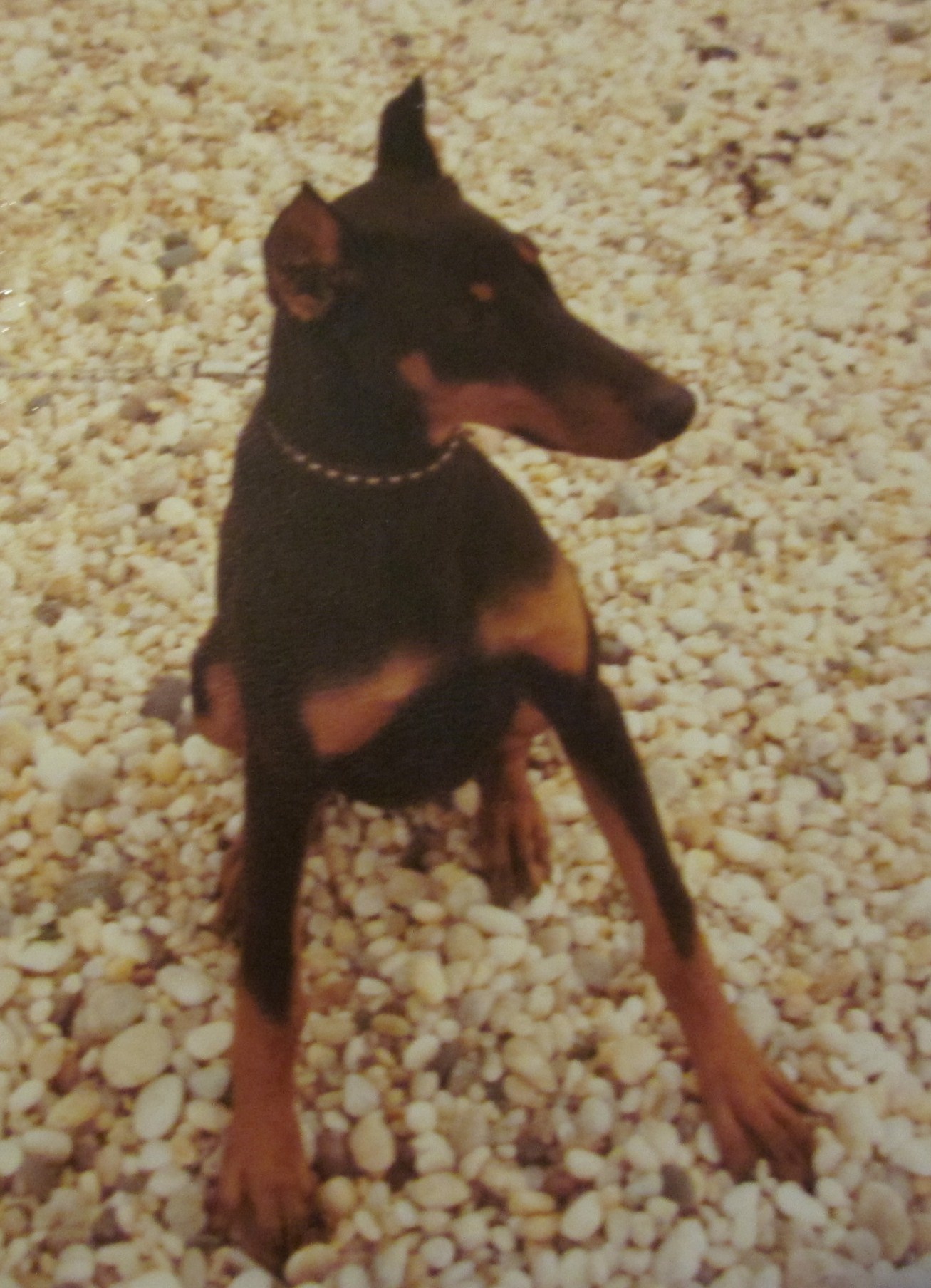
Delilah at the beach.

Dina loved peanut butter.
The Mourners Kaddish is not actually about death, it is about reiterating faith in God. The prayer is mostly in Aramaic, rather than Hebrew. I never studied ancient Aramaic, so I only really understand this prayer because of the English translation. But the sound of the words, sung or spoken, has power, maybe because it sounds different from the largely Hebrew prayers in the rest of the service. It’s almost like the words have magic because of their otherness, as if secrets are hidden within them.
My favorite line of the prayer is a long list of the types of praise we offer. From the Artscroll Siddur: “Blessed, praised, glorified, exalted, extolled, mighty, upraised, and lauded be the name of the Holy One, blessed is He beyond any blessing and song, praise and consolation that are uttered in the world.”
It sounds better in the Aramaic, but it’s this long list of the ways we express love. And yes, we say them about God, but I think of them as being about us, about each other. These are all of the ways we experience and express our love for each other – with glory or comfort, with praise or song, and yet we can never capture all of that love in words because it is beyond the words we have available to describe it. So, yes, we are being reminded to have faith in God at our lowest moment, when we might feel as if God has forsaken us, but for me, it is a moment to acknowledge the love we still feel for the person we have lost, and for the people we still have.

Cricket, giving thanks for a leaf.

Butterfly, in silent prayer, for chicken.
The Mourner’s Kaddish can only be said with a quorum (ten Jews, some congregations still count only men) as part of the service. People who would otherwise say a hasty version of their morning prayers at home before work, will, for the year of mourning, make a point of finding an early service at their own or another synagogue, and hope that at least ten people will show up in time.
The Mourner’s Kaddish is said at the end of the service, not at the beginning, and I can think of a couple of reasons for this: one, so that the mourners will stay for the whole service in order to maintain the quorum and allow for all of the communal prayers to be said; and two, because there is healing energy in being there for the regular daily prayers, with your community, and in deep mourning you may not be able to believe that and choose it for yourself if it were not required.
At my current congregation the custom is, basically, for mourners to stand and the rest of us to sit, for the Mourner’s Kaddish. But over the years the instructions have become more convoluted and the rabbi has had to come up with a paragraph-long list of instructions: if you are in a period of mourning, or have a yahrzeit (the anniversary of the death of a loved one), or are supporting a friend who is in mourning, or think this is a good time to stand and remember…
Earlier in the service, a shortened version of the same prayer is sung, rather than spoken (as it is for the Mourner’s Kaddish) and the feeling is more joyful and light, with the same exact words. It seems to me that using the same prayer for both purposes is a way to gently remind mourners that they used to sing this song, and some day they will again. Until then, they will speak the words with the community, be part of and apart from them, and know that they are seen and that they are not alone.
Most of Jewish ritual is meant to be practical. When it’s not practical, it is either out of date for its original purpose, or the practical purpose is a little more hidden and requires some time and repetition to discover. So I wonder what the ancient rabbis meant by leaving other losses unritualized and unmourned. Maybe some of the prayers just didn’t make it into the canon, or were lost along the way. Maybe one day there will be an excavation of a little town outside of Jerusalem, and inside of an ancient stone dog house they will find the lost book of prayers for how to mourn a beloved dog. I think a lot of people would appreciate that.

I found this stone dog house online. I especially like the potted plant in the window.
 rachelmankowitz