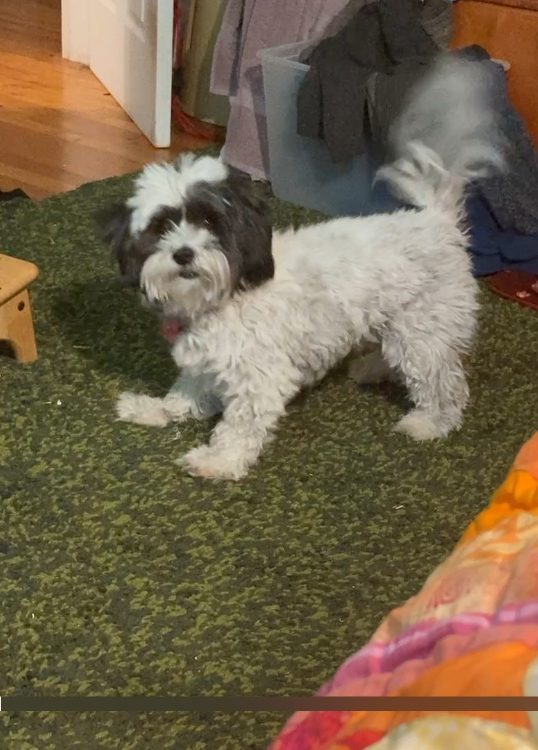
At long last, after a series of singing cries (because Grandma had run out of treats), Tzipporah barked! She surprised us, but even more than that she surprised herself, and ran back to her bed in the living room empty-pawed. Even the next day, she still seemed exhausted by the whole experience. What was that noise? Did it really come from me? And how is it possible for Grandma to run out of treats?!
It was a lone bark, at least so far, and even her cries have been muted in the aftermath (it’s possible that Grandma has been handing out extra treats without telling me), but it’s good to know that her barking machinery works, should she want to use it at some point.
But I keep getting impatient. She still has no idea why I sometimes pick her up just to hold her for a little while (we watched an episode of a crime drama set among puppy mills in France and it almost broke me, and I needed a hug). But I can hold her for just a little while before she starts looking for any possible escape route. And then, when she finally gets free, she starts running back to her bed, stops and turns around to give me a dirty look, and then continues on her way.
I got a little bit desperate at one point and picked up her stuffed puppy to hold it on my lap for a while. I gave the stuffed puppy some ear-scratches and head pats, and then set it down in the second doggy bed and gently covered it with one of the doggy blankets. Tzipporah found the whole drama fascinating, but I’m not sure what she learned from it, except that her mommy is weird, which she already knew.
I have to keep reminding myself that any progress Tzipporah makes is miraculous and we’re not on a clock here, but I still have no idea what she’s thinking when she stares at me endlessly. Is she watching me so closely because she likes me and wants to know me better? Or because she’s wary of me and needs to be on her guard? Or because I’m just that fascinating? She sees me staring at the TV quite a lot, though, so maybe she’s just mimicking me.
The thing is, Tzipporah really does keep making progress, even if the pace feels slow to me. During her first visit to the groomer, back in the winter, she panicked when they tried to trim the hair on her front paws, so we were told to give her some ACE (doggy Xanax) before her next visit. So this time, before we brought her for her second visit to the groomer last week, Mom broke an ACE in half and stuffed it into a piece of chicken, which Tzipporah ate with gusto. When we went to pick Tzipporah up later in the day, the groomer said everything went well, even though Tzipporah needed a “summer cut” to deal with the knots (I haven’t wanted to bother her with too much combing), which meant she was mostly shaved down to the nubs. And then, instead of handing her directly to us, the groomer put Tzippy on the floor. I was about to say, no, don’t do it, she’ll never come to me and we’ll have to chase her around the room, but Tzippy walked straight over to me without hesitation. I almost cried, because she never does that in real life! She doesn’t respond to her name, or to any other command, but there, given the choice to roam free or find one of her people, she chose a people. Which means she knows who I am, and at least prefers me to the person wielding the scissors. She even showed signs of trying to climb into the front seat of the car on the way home (her doggy seatbelt stopped her from getting too far).
When we got home, I found the half pill of ACE sitting next to her bed, untouched. So, next time we can go with peanut butter, or maybe she doesn’t need the ACE at all. In just those few months, she’s made so much progress that she managed her haircut completely unmedicated, and without panic.
And, since she has very little hair right now, I decided to add hair combing to her daily routine, along with the tooth brushing. She still thinks the toothbrush is a chicken paste delivery system and doesn’t understand why I insist on rubbing it into her teeth, but even combing the hair on her ears made her look at me like I was Cruella Deville. And yet I persisted.
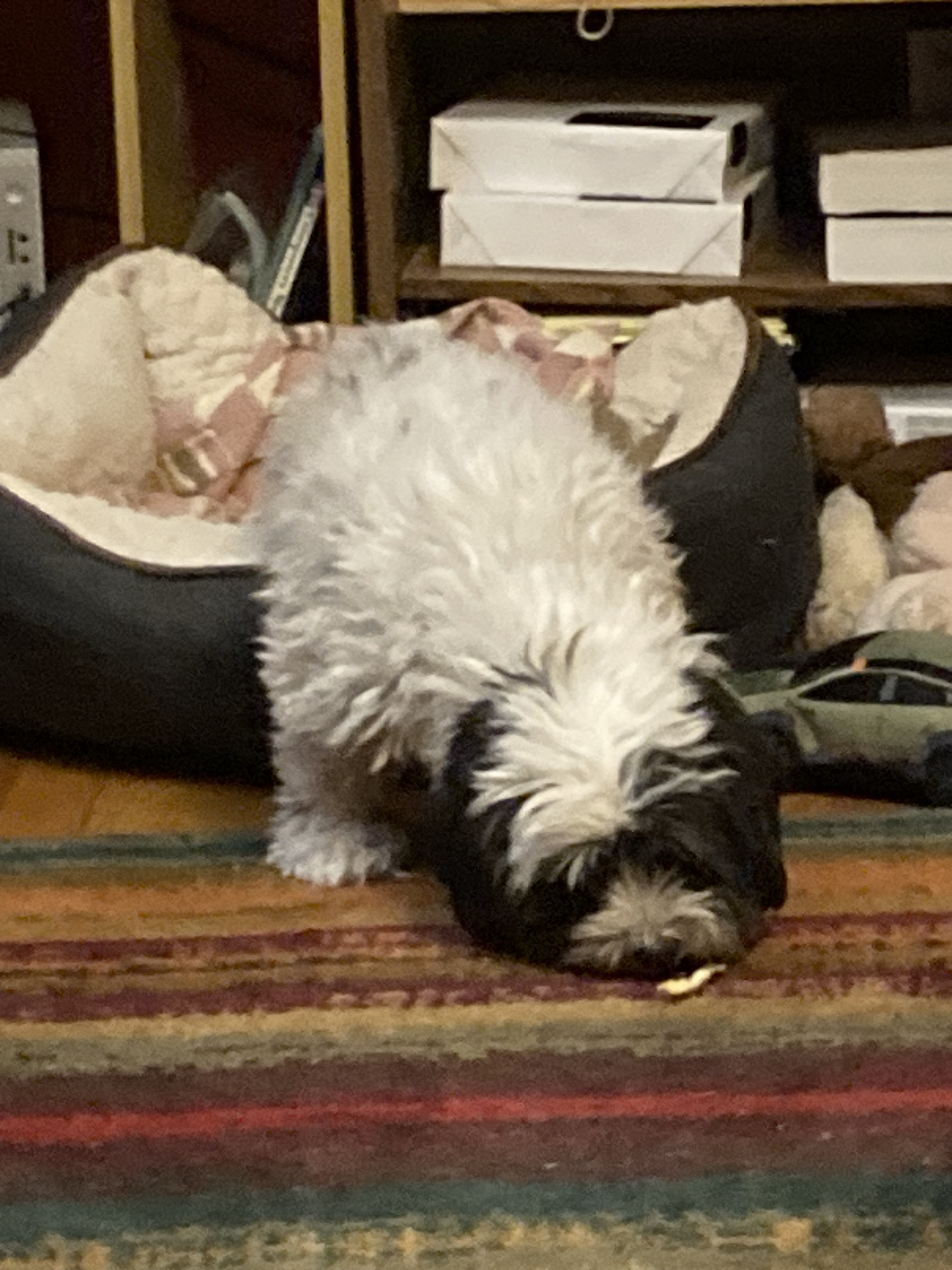
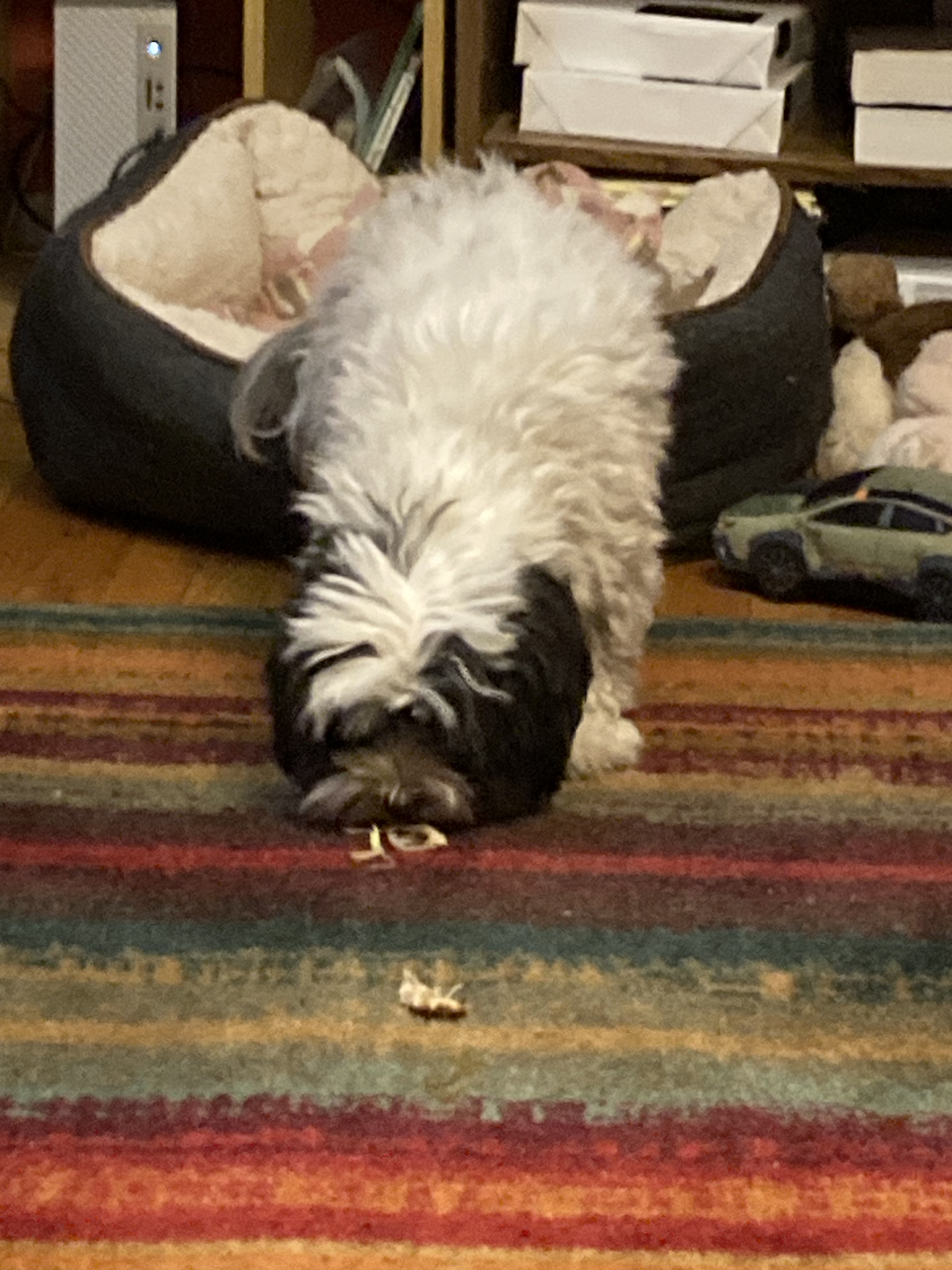
Oh, and there was another big step forward! One night when we had chicken for dinner, I saved some for her, but instead of just handing it all to her at once, I gave her a small piece of chicken in her bed, to hook her, and then I scattered pieces at various distances from her bed. It took her a little while to gather her courage, but eventually she found the pieces of chicken that were within two feet of her bed (three feet away was still too far), and just seeing her get out of bed while I was still sitting there in front of her was exhilarating.
I have to keep reminding myself that all of this effort is worth it, because even if I’m feeling impatient or grumpy, as long as I keep trying, progress keeps happening. For both of us.
If you haven’t had a chance yet, please check out my novel, Yeshiva Girl, on Amazon. And if you feel called to write a review of the book, on Amazon, or anywhere else, I’d be honored.
Yeshiva Girl is about a Jewish teenager on Long Island, named Isabel, though her father calls her Jezebel. Her father has been accused of inappropriate sexual behavior with one of his students, which he denies, but Izzy implicitly believes it’s true. As a result of his problems, her father sends her to a co-ed Orthodox yeshiva for tenth grade, out of the blue, and Izzy and her mother can’t figure out how to prevent it. At Yeshiva, though, Izzy finds that religious people are much more complicated than she had expected. Some, like her father, may use religion as a place to hide, but others search for and find comfort, and community, and even enlightenment. The question is, what will Izzy find?
I’m back in my online Hebrew classes and it is such a relief. I didn’t realize how much I missed this imaginary place, this zoom class that exists somewhere outside of space and which I can get to without leaving my apartment. After almost a year away – and such a year – I feel so much gratitude to be back.
Up until the moment class started, though, I wasn’t sure how I would feel. I was already feeling guilty for spending the money on this instead of on ten other things that seemed more important, and I felt needy and silly for wanting to be taught instead of teaching, and I felt ridiculous for not having been to Israel yet after so many years of wanting to go.
And then, because I was out of practice with the time difference between New York and Israel, I thought the class started at 2:30 PM and was surprised when I checked my email and found out that the class had already started, at 1:30, and I was late. I still had to set up my computer and brush my hair and change my shirt (I wear my pajamas all day every day when I’m not at work) and log into the new learning system the school had created while I was away, and by the time I finally popped up on screen I was fifteen minutes late.
But I was fine. No, better than fine.
The class (or the screen) was full and there were some familiar faces, but mostly the faces were new to me, including the teacher. And yet I was able to keep up, and my Hebrew was much closer to the tip of my tongue than I’d feared. We didn’t talk about the news, much, instead we focused on the things we could control, like how to be kind and generous with each other and leave room for making mistakes. I’m a big fan of being treated like a big puppy dog when I make mistakes, instead of hit over the head with a hammer.
“No ouchies for me!”
During my first week back in class I went to every practice group I could get to, which ended up being more than I’d gone to in the two years I’d spent in the program before. I wanted to challenge myself, socially and with my Hebrew, to get back into the stream as quickly as possible. And I didn’t realize until afterwards how easy it was, compared to even a year ago, to manage the social anxiety and fear of the unknown that comes with the practice groups – especially in week one when I had no idea who my teachers or fellow classmates would be. In our regular classes things are more predictable: you get a class list ahead of time, and an introduction from your teacher, and that’s your group for the semester. But in practice groups we’re dropped into breakout rooms with random strangers to discuss random topics and then we’re being tested on things we’ve learned in previous semesters, generally using vocabulary I forgot long ago.
I don’t think I’ll be able to do this many groups every week, both because I have doctors’ appointments coming up and other things I need to get done this summer, but I’d really like to work harder this summer than in the past and push myself and my Hebrew as far as possible.
Except, despite all of the progress I’ve made on my mental health, somewhere around the third or fourth practice group the negative voices in my head returned: Why am I such a loser that I have to pay people to spend time with me and laugh at my jokes, why is everyone else so much more impressive and successful than me, why does everyone else get to be married and have children and travel around the world and have so much more energy and good health than me?
I’m not sure why the negative voices were on pause for the first few days, but at least that gave me a few moments to revel in the joy of being back in class. But then the avalanche of pain made me realize that this was probably why I’d decided to stop taking classes last year. I thought, at the time, that I had run out of ambition to learn more Hebrew, but I think it was more that the classes were bringing up too much internal noise that I couldn’t handle and couldn’t drown out.
The anxiety I used to be so focused on, around making mistakes and saying the wrong thing, seems to have been hiding a much deeper pool of anxiety around all of the things I want to have in my life and believe I can’t have. Being in class seems to bring up so much longing – to go to Israel, to have more friends, to be more successful in my career, and to be in love – and when all of that longing comes up to the surface, my deeply felt belief is that none of that is possible for me.
In the past, when these feelings overwhelmed me, my answer was to turn off the faucet altogether, usually without realizing what I was doing. But now, it seems like my brain is telling me that I am ready for more, or should be, and therefore it’s time to let me know that I want more; but I still feel like the things I long for are impossible, and I don’t know why my brain believes I’m closer to ready.
So, in the midst of seeing real progress, and feeling real joy, I’m also feeling awful at the same time, and it sucks. I’m so frustrated by how long it takes to make progress in my life, and how often I have to stomp the brakes to avoid falling off cliffs that seem to come out of nowhere. I wish I knew how long each step forward would take, and which goals would actually be reachable, because then I could plot it all out on a calendar and be comforted that it’s all going to happen when it needs to happen; but instead I have no idea what will be possible next week, let alone next year.
My brain remains mysterious to me, and I don’t understand what it is about Hebrew in particular that has opened this door for me, but I am committed to continuing to go forward in whichever ways feel possible. So I will make as much of this summer of Hebrew as possible, enjoying the laughter and the challenges and the friendships, and I will also try to make sense of the pain and confusion that come along with them. And I will keep trying to remind myself that this is what progress looks like and feels like, for me, even if I wish it could be different.
“Hiding is always a good idea.”
If you haven’t had a chance yet, please check out my Young Adult novel, Yeshiva Girl, on Amazon. And if you feel called to write a review of the book, on Amazon, or anywhere else, I’d be honored.
Yeshiva Girl is about a Jewish teenager on Long Island, named Isabel, though her father calls her Jezebel. Her father has been accused of inappropriate sexual behavior with one of his students, which he denies, but Izzy implicitly believes it’s true. As a result of his problems, her father sends her to a co-ed Orthodox yeshiva for tenth grade, out of the blue, and Izzy and her mother can’t figure out how to prevent it. At Yeshiva, though, Izzy finds that religious people are much more complicated than she had expected. Some, like her father, may use religion as a place to hide, but others search for and find comfort, and community, and even enlightenment. The question is, what will Izzy find?
I thought I was done with panic attacks. It’s not that I was free of anxiety or depression, but for a long time now I’ve felt like I could handle the difficult things that came up without shattering into a million pieces or becoming paralyzed, but something changed in the past few weeks. I’m pretty sure it started when I tried a new Rheumatological medication (Methotrexate), which was meant to lessen my overall body pain and allow me to exercise more, but instead made me even more exhausted and exacerbated my pre-existing depression and anxiety.
At first, I had no idea where the extra depression was coming from: was it from thinking about adopting a new dog? From watching the news? The exhaustion of doctor visits? Discovering that weight loss medication would remain out of reach? I don’t remember now what finally made me believe that it was the Methotrexate that was sending me into the deep dark, but after weeks of worsening depression I decided to stop taking it and see if things improved, and, gradually, I started to feel better and able to think and write and plan and hope again.
When I called the Rheumatologist to tell her what was going on, she said to wait a few weeks before trying the next medication, which shouldn’t have any of those side effects, and since I wanted to believe her and finally see some improvement in the overall body pain that has seriously restricted my life, I agreed.
But since I’d been taking the Methotrexate weekly, instead of daily, the timeline for it to leave my system was very slow, and in the meantime, I had my first panic attack: a small one, at Whole Foods. I used to have food panic all the time, because of the thousands of different diets I’ve been on, and because of old conflicts around keeping kosher, but after years of working on Intuitive Eating a lot of that noise had calmed down. Except, at Whole Foods (a ridiculously high priced store that rarely has the things I need, but always has fun stuff I want), I got all mishkebobbled by the prices and the choices and I had no idea what to buy. Eventually, I chose a few small things and got out of there as quickly as possible. It was only a small echo of my old panic attacks though, and I was mostly okay.
The second panic attack, also small, also happened around food, this time at the enormous supermarket near my house. I blamed it on Passover, because there was a large section of Passover foods that made me feel like I should buy jars of borscht and boxes of cake mix and cans of chocolate chip macaroons that I would never eat. But, again, the panic passed quickly, and when the effects of the Methotrexate finally wore off I thought I was stable enough to try the second rheumatological medication.
And then the car battery died. This had happened once before, because one of the lights above the driver’s seat goes on accidentally at times and if I don’t notice it right away, and don’t drive the car for a few days, by the time I get back to the car the battery is dead.
This time it happened when I needed to take Mom for a medical procedure, an endoscopic ultrasound of her heart (called a TEE), but the car wouldn’t start and there was no one around to help, and instead of being able to problem solve, or even think, I panicked. Mom told me that she would call a cab, and then call AAA or the maintenance men at our co-op to help me charge the battery, and the idea that I would have to interact with strangers scared me so much that I left my mother and my pocketbook in the car and race-walked back to the apartment to curl up on my bed and hide.
Mom called me from the parking lot a few minutes later to say that the cab was on its way, and that the maintenance men would be able to help with the car in about half an hour, but in the meantime I should come back outside and get my pocketbook, because it wouldn’t be safe to leave it in the car. She didn’t seem to be upset with me, or to understand that I was curled up on my bed in an altered state, but I couldn’t think for myself so I did as I was told and went out to the car for my pocketbook. I was able to give Mom a hug just as the cab arrived, and then I walked back up to the apartment, resumed my curled up position, and cowered in my room.
There was a knock at the door a while later and I jumped out of bed and put on my jacket and answered the door on automatic pilot; some part of me was able to function enough to make chit chat and ignore the bad jokes about my lack of car knowledge. When the guys said I should drive the car around for ten or fifteen minutes before turning it off (and then on again), I did as I was told, even though my pocketbook, with my driver’s license, was still upstairs.
To fill the time, I decided to do a practice drive to the hospital where Mom was having her test done, to make sure I’d know where to pick her up later, and I got stuck in traffic for forty minutes, worrying the whole time that the car would stop suddenly or that I’d get into an accident and have no identification on me. But I made it home safely and turned off the car and waited a few minutes, as I’d been told, and then turned the car back on, successfully (which meant I wouldn’t have to call the maintenance guys again, which was good because I didn’t have their phone numbers). While I was still in the car, taking my first deep breath in more than an hour, Mom called from the hospital to ask if the car was working, because they’d been delaying her procedure until she could assure them that I would be able to pick her up when it was over, and I spoke to the nurse on the phone and reassured her that I would be there on time.
I survived the rest of the afternoon on automatic pilot and picked Mom up from the hospital and got her home safely. I felt awful for having had a panic attack when she needed me, and really scared that this would be my new normal, but most of all I was exhausted and needed sleep. When I woke up from my nap a few hours later I started to wonder if there might be a connection between starting the second rheumatological medication the night before and this latest, much more significant, panic attack. But my brain was telling me that I was always this useless, and I couldn’t come up with a convincing argument to fight back.
Two days later, Mom and I went to a dog rescue event, because my therapist had suggested (insisted) that I go, and because the depression was getting so dark again that I didn’t have the energy to think for myself. We got the address of the rescue event wrong, twice, but finally found it by following the crowd of cars. Once we’d parked and walked over to the row of tents and tables advertising all of the different rescue organizations, I was overwhelmed by all of the noise and people and dogs, and I couldn’t make sense of what I was supposed to do or where I was supposed to go.
We eventually found an enclosure filled with many small and hypoallergenic dogs, along with some full-sized Poodles and Golden Retrievers and a horse-sized Siberian Husky. But none of the volunteers seemed to know how their adoption process worked, or which dogs were still available for adoption, and no one knew about age and weight and health status, except that all of the dogs were probably around three years old and had been rescued from dog meat festivals in Asia (that’s hard to type, let alone to say out loud).
There was a little black poodle mix who was already on one of the rescue’s leashes outside of the enclosure, but when I asked about him a very possessive older woman glared at me and said she was considering adopting him, which seemed to mean he was off limits. Then we saw a little butter-colored dog who looked like the perfect size for us, but another woman had picked him up and held him tight while she looked for a volunteer to help her with the adoption; when she finally found the volunteer-in-the-know it turned out that that dog was already spoken for by someone else. I was getting more and more overwhelmed by the confusion and heat of the day and part of me wanted to leave (or escape), but part of me felt like it was my job to stay there and tough it out.
Finally, one of the volunteers asked me if I’d like to meet one of the dogs and I looked around and saw a little white dog who looked very much like Butterfly, and I chose her. I held her for a while and she was very calm, to the point where she didn’t even make eye contact or react to much of anything. When I put her down on the ground though, she freaked out at a noise I couldn’t hear and almost strangled herself trying to get out of her leash. The volunteer put her back into the enclosure with the other dogs and she sat down against the fencing, near where I was standing, and seemed to calm down again. She wasn’t the dog I was looking for, especially because she looked so much like Butterfly and was triggering all of the old grief and responsibility, rather than the love, but I couldn’t untangle my feelings or get myself to leave her behind in the chaos either. Mom finally found someone who could explain the adoption process, including the $2,000 adoption fee, which is basically what it would cost to buy a puppy from a breeder, and by then the Butterfly look-alike was sitting patiently on a little girl’s lap, so we took a brochure and finally walked away.
The whole time we’d been near the enclosure I’d been beyond thinking, unable to figure out what I wanted to do or what I thought I should do, except that I knew I should adopt all of the dogs, including the big dogs, because what kind of monster leaves a dog behind just because of money or because the world is tilting, or for any other clearly not-good-enough reason. As we got further away from the dogs I started to be able to hear my own thoughts a little more clearly, but I still felt sick and dizzy and angry and confused. I was able to drive home safely, but hopelessness and the long list of things that were wrong with me was rushing through my mind and refused to shut up.
Hours later, on Mom’s prompting, I looked up the side effects for the second rheumatological medication, and depression and anxiety were at the top of the list, despite the doctor’s assurances that this medication would not be a problem, so I emptied the rest of the pills from my pre-filled weekly pill box and crossed my fingers.
It took a couple of days for the worst of the hopelessness to wane, but in a way the damage had already been done. I’d forgotten how bad things could get, and now it was right in the front of my mind. It didn’t help that the day after the rescue event Mom got the results of her TEE and told me that she would probably need surgery to repair or replace her mitral valve (her fourth surgery in three years).
I’m frustrated that these medication trials, which were supposed to help me function better, sent me so close to the brink; and I’m frustrated that this is how it’s been with so many medications over the years; and I’m angry that the one medication that was helping (Ozempic) was taken away; and I’m angry that the doctors still have no name for what’s wrong with my health, let alone any solutions.
But at least I can think again.
I called the Rheumatologist to tell her that I wouldn’t be trying the third medication on her list, at least not right now, because I needed to be in the best frame of mind possible to help Mom through her surgery, and the expected three months of recovery.
Only time will tell if the panic attacks were solely caused by the rheumatological medications, or if, with enough stress, they will return. I’m trying to be hopeful that I’ll be able to handle everything that comes my way this summer, but part of me is worried, remembering how bad it can get. Another part of me, though, is remembering Cricket’s insistent strength, and Ellie’s insistent belief in me and my strength, and holding those memories as close as possible, to inspire me and help me through.
If you haven’t had a chance yet, please check out my Young Adult novel, Yeshiva Girl, on Amazon. And if you feel called to write a review of the book, on Amazon, or anywhere else, I’d be honored.
Yeshiva Girl is about a Jewish teenager on Long Island, named Isabel, though her father calls her Jezebel. Her father has been accused of inappropriate sexual behavior with one of his students, which he denies, but Izzy implicitly believes it’s true. As a result of his problems, her father sends her to a co-ed Orthodox yeshiva for tenth grade, out of the blue, and Izzy and her mother can’t figure out how to prevent it. At Yeshiva, though, Izzy finds that religious people are much more complicated than she had expected. Some, like her father, may use religion as a place to hide, but others search for and find comfort, and community, and even enlightenment. The question is, what will Izzy find?




 rachelmankowitz