Tag Archives: pawpaw

Cricket’s Yahrzeit

            In Jewish tradition, about eleven months after a funeral you have an unveiling, where you finally put up the permanent headstone at the gravesite, with a small ceremony to mark the end of the official mourning period. The unveiling is actually supposed to take place after thirty days (for most relatives) and after eleven months (for a parent), but in the United States most unveilings take place after eleven months no matter how close the relationship with the dead.

            We have two blue gift bags sitting on the low bookcase (where we used to keep the chicken treats), each holding a sympathy card from the vet’s office and a container of ashes: Cricket died in October 2023, and Ellie died in December, two very short months later. My hope was that, after eleven months, I would finally be ready to spread Cricket’s ashes around the base of the paw paw tree (which was born just a few months before Cricket herself), but I wasn’t ready. And even now, after the yahrzeit (literally “year time,” the anniversary of her death), I’m still not ready.

            The one thing I felt ready to do, though, was to mark Cricket’s yahrzeit with light. Of course, I didn’t think ahead and buy an official yahrzeit candle (a twenty-four-hour candle in protective glass), but Mom found two leftover beeswax candles from last Chanukah, and we placed them in a jar in front of Cricket’s picture and watched the flames burn down. I really wanted the two candles to intertwine in some way, to represent how Cricket is still so intertwined in our lives, but the way the two candles split apart and seemed to mimic her flying ears was a wonderful surprise.

            Maybe when we reach the anniversary of Ellie’s death, in December, I’ll feel more ready to let go of both of them, or maybe not. I’m trying to be patient with myself and to trust my feelings to tell me what I can handle and what I can’t, because I miss them both so much. I don’t just miss having “a dog” in my house, but these two particular dogs. They are still knotted up in my life and my thoughts, as if there’s more they need to teach me.

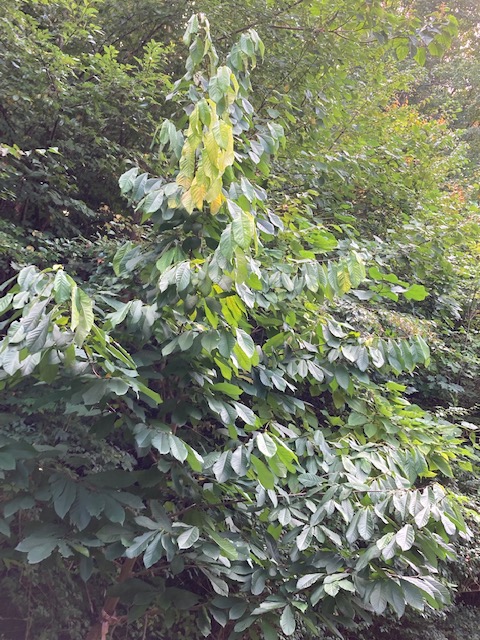
            In a strange symmetry, the pawpaw tree seems to also be in mourning this year. Early in the summer, we were thrilled to find out that, despite some of the lower branches being cut off by the gardeners (again!), we still had four pawpaws growing on our tree. We were hopeful that this year would yield the biggest, healthiest fruit yet, and so we decided to wait as long as possible before picking them, to give them time to fully ripen. But we waited too long. One day in September, when I looked up at the pawpaw tree, I couldn’t find any of the pawpaws. I was used to struggling to see one or two of them, behind those big green leaves, so I told myself I’d just try again later. But when I checked again, and then a third time, there were no pawpaws visible on the tree, and then I checked the ground and found what looked like two small carcasses with their guts spilling out. I looked away automatically, thinking some horrible death had come to two tiny birds, but when I forced myself to look back I realized they really were the pawpaws, or two of them anyway.

One of the pawpaws, in July

            I didn’t cry. I mean, they’re just fruit, right? Just because they are vivid symbols of love, and now of my dogs in particular, doesn’t mean they are, or were, truly alive. Right?

            I never found the other two pawpaws. My hope is that the squirrels (it’s always the squirrels) actually enjoyed the other two pieces of fruit and they didn’t all go to waste.

            In a way, having a fruitless year, or at least a year without pawpaws, is fitting. The loss of the dogs, and the grief and anger and fear and confusion around the war in Israel cries out for some kind of symbolism; some kind of acknowledgment that everything is not okay. Its kind of like when you’re feeling awful and the sky breaks open and the rain pours. It almost helps, in a way.

            Maybe next year, our pawpaw tree will be full of fruit and we will have more than enough to share with all of our woodland creatures. And, hopefully before then, we will also find a new dog ready to come home with us and start on a whole new adventure together. But in the meantime, the mourning cotinues.

Miss Cricket
Miss Ellie

If you haven’t had a chance yet, please check out my novel, Yeshiva Girl, on Amazon. And if you feel called to write a review of the book, on Amazon, or anywhere else, I’d be honored.

            Yeshiva Girl is about a Jewish teenager on Long Island, named Isabel, though her father calls her Jezebel. Her father has been accused of inappropriate sexual behavior with one of his students, which he denies, but Izzy implicitly believes it’s true. As a result of his problems, her father sends her to a co-ed Orthodox yeshiva for tenth grade, out of the blue, and Izzy and her mother can’t figure out how to prevent it. At Yeshiva, though, Izzy finds that religious people are much more complicated than she had expected. Some, like her father, may use religion as a place to hide, but others search for and find comfort, and community, and even enlightenment. The question is, what will Izzy find?
The Flowers on the Pawpaw Tree

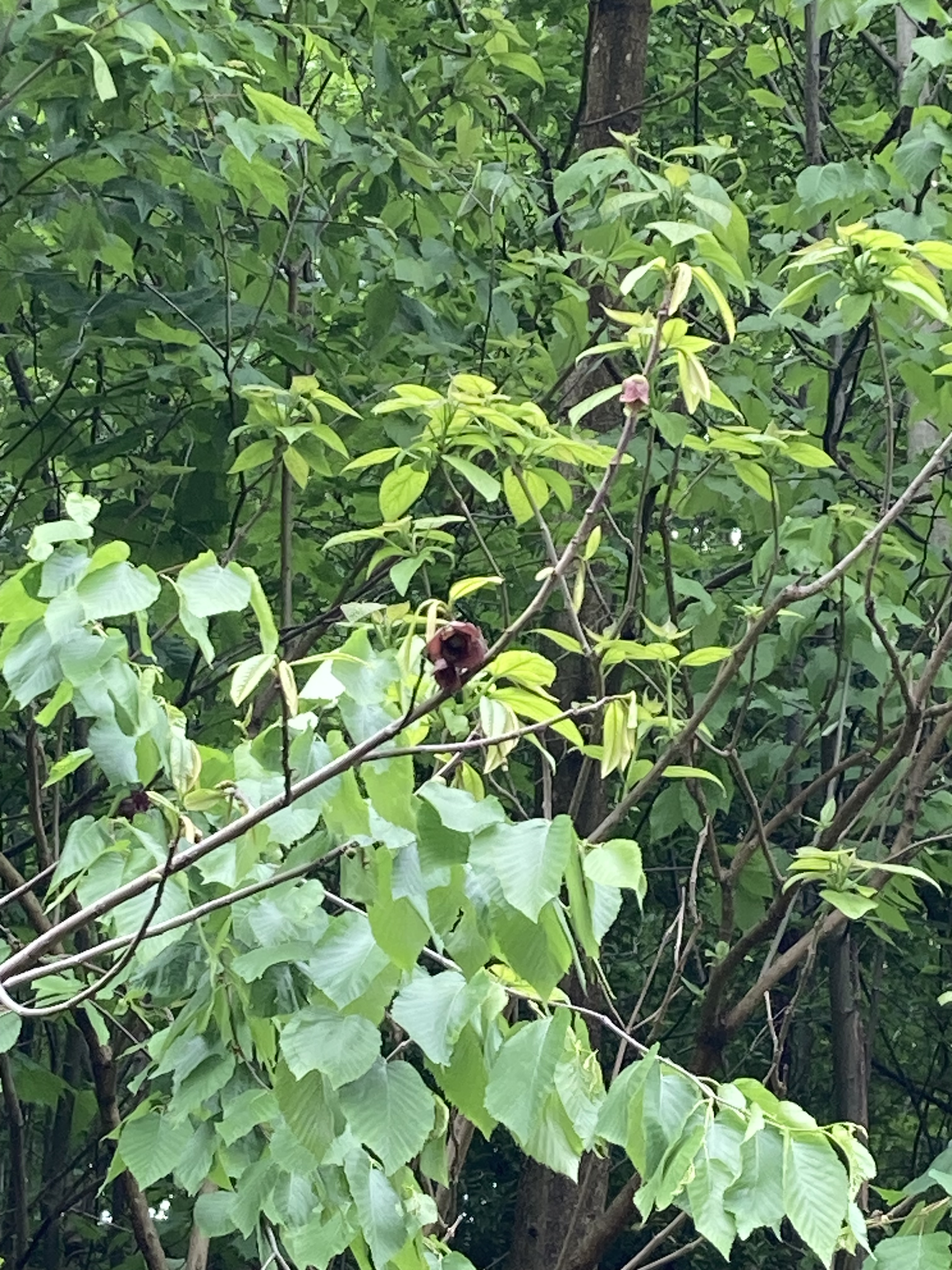
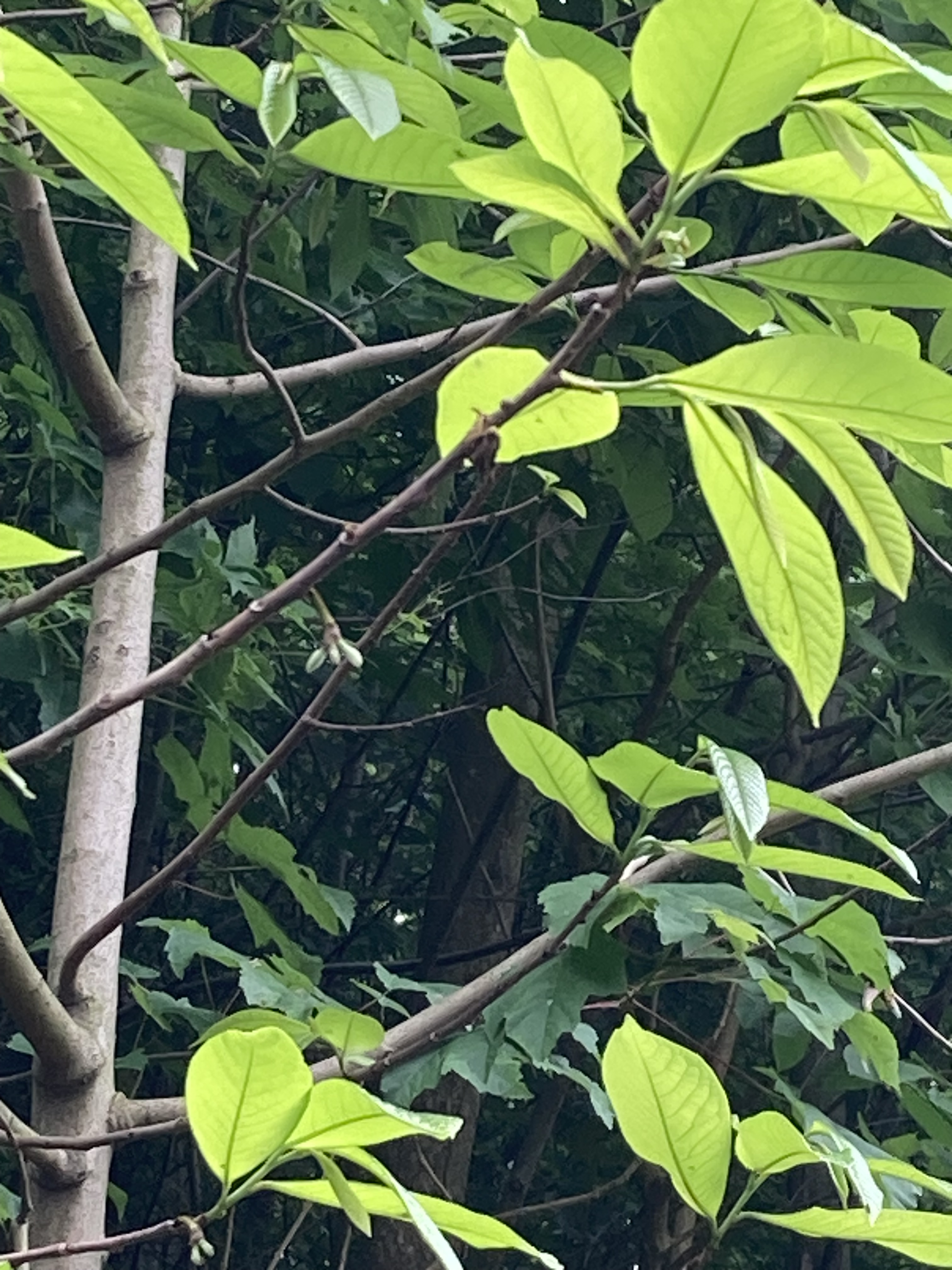
            The Pawpaw tree has flowered again. Actually, some of the flowers have already bloomed and fallen away, exposing the tiny fruit getting ready to grow. There’s endless inspiration in watching this pawpaw tree go through its cycle of life and death and renewal each year. In the winter, when all I can see is the bare tree with no leaves or buds or fruit or flowers, it would be easy to imagine that there is no life left, but I know better. I know that spring always comes again.

The reddish brown pawpaw flowers
Can you see the three little fruits in a clump?

            When Cricket died in October, I put her collar around the trunk of the pawpaw tree, not because I thought she might come back to life herself in the spring, but because I hoped her life would be an inspiration to the tree, to keep growing. Ellie’s collar was added in December and in a way it made the tree seem more whole, because now it had both the quiet joy of Ellie and the loud vibrancy of Cricket to help it along.

This picture was taken in December, when the Pawpaw tree was still sleeping.

            I don’t know why this small gesture has been so meaningful to me, but every time I see their collars there on the pawpaw tree I feel a sense of comfort and reassurance. I still hear the dogs in the apartment all the time, and I see shadows and imagine that one of them is running past my door. It still surprises me how solid these memories feel, of all of the dogs and people I’ve loved and lost. It’s not that “I see dead people,” but I feel their presence in my mind and in my heart in a way that is so much more substantial than the words “ghost” or “spirit” would suggest.

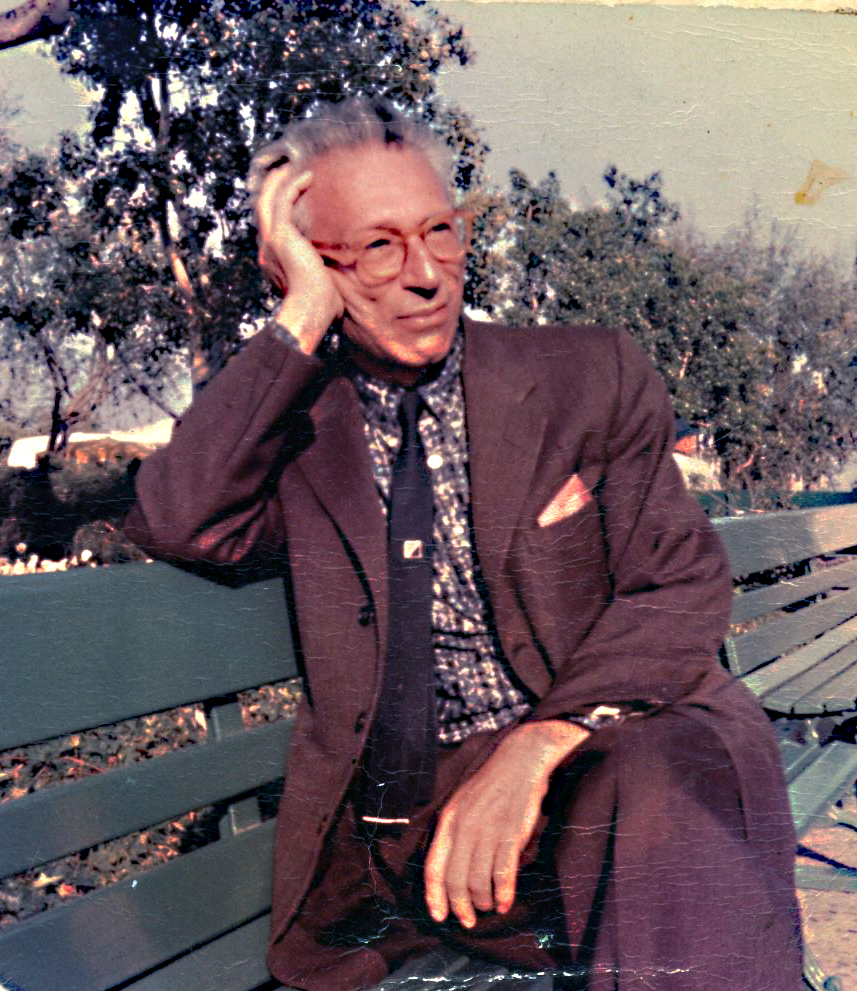
            My grandfather, who died when I was eight years old, is still a daily presence in my life: his smile and his laugh and the strength of his attention bolster me through so many difficult days. The same is true of some of the less positive characters from my past too, unfortunately, but there’s at least reassurance in knowing that my memories remain a part of me, and none of that time was wasted.

Grandpa

            However temporary nature may be, with flowers blooming and wilting, and dogs coming into my life and passing away, I know that I will never really lose them. It all remains. And I think that’s a gift, even if at times a bittersweet one.

We’ll always be here, Mommy.”

If you haven’t had a chance yet, please check out my Young Adult novel, Yeshiva Girl, on Amazon. And if you feel called to write a review of the book, on Amazon, or anywhere else, I’d be honored.

            Yeshiva Girl is about a Jewish teenager on Long Island, named Isabel, though her father calls her Jezebel. Her father has been accused of inappropriate sexual behavior with one of his students, which he denies, but Izzy implicitly believes it’s true. As a result of his problems, her father sends her to a co-ed Orthodox yeshiva for tenth grade, out of the blue, and Izzy and her mother can’t figure out how to prevent it. At Yeshiva, though, Izzy finds that religious people are much more complicated than she had expected. Some, like her father, may use religion as a place to hide, but others search for and find comfort, and community, and even enlightenment. The question is, what will Izzy find?

Tu Bishvat, the New Year of the Trees

            Tu Bishvat is a Jewish holiday marking the New Year of the Trees, and this year it took place from sundown Wednesday January 24th to sundown Thursday January 25th. In ancient times, Tu Bishvat, or the fifteenth day of the Hebrew month of Shvat, was simply the day set aside as the birthday of all trees born in that year. This was important information to have, because it was forbidden to eat from a fruit tree in the first three years of its life, and in the fourth year you had to bring the fruit of the tree the Temple in Jerusalem. Only in year five did the fruit belong to the farmer.

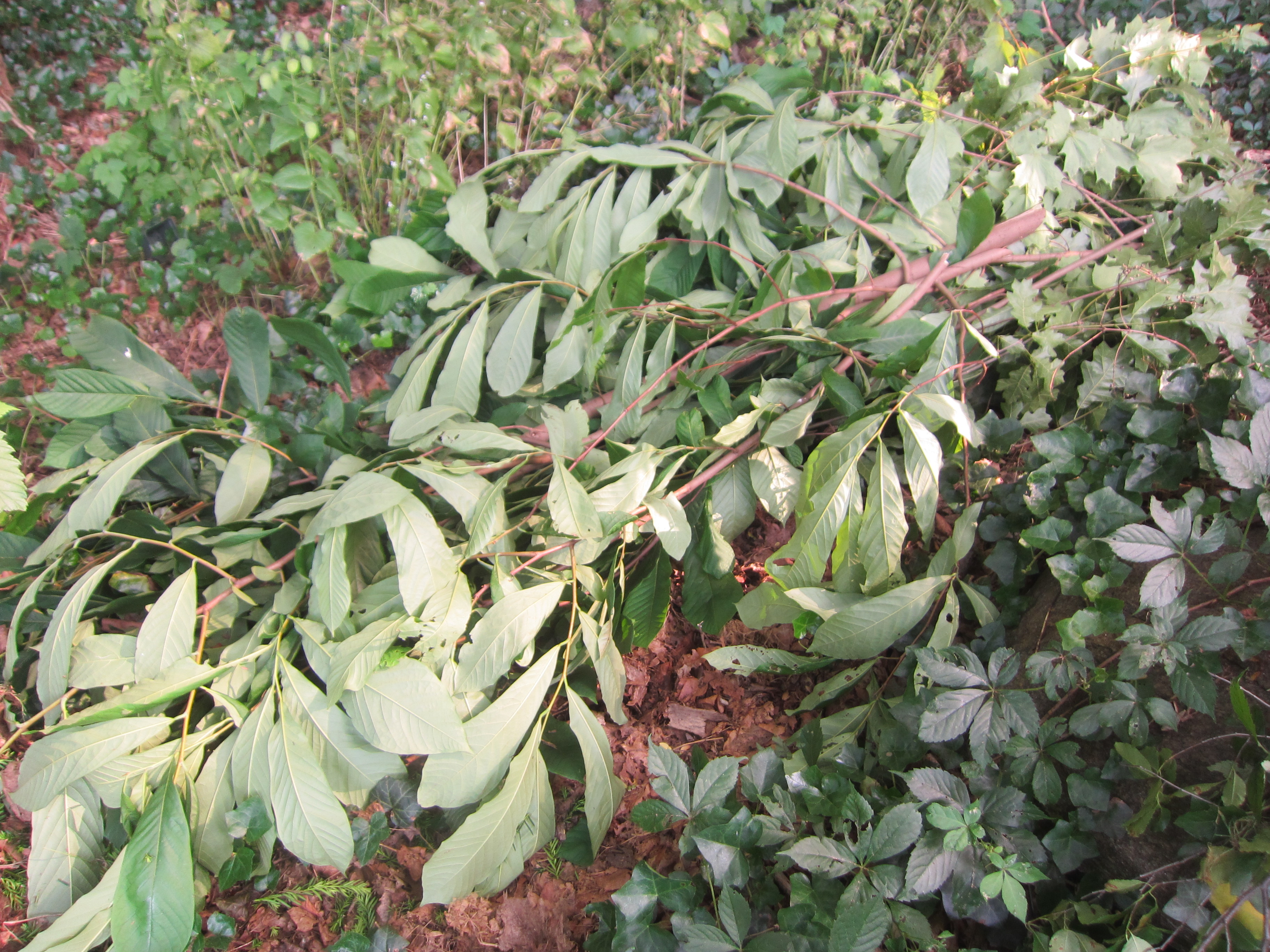
            Trees have always been important in Judaism: like the tree of Knowledge of Good and Evil in the story of the Garden of Eden, or the Torah itself (the Hebrew Bible) being referred to as a tree of life. I read recently (on Ritualwell) that in ancient Israel a tree was planted when a child was born, and as the child grew he or she would care for their tree and then eventually use its branches for their wedding canopy. Even the Rabbis were tree-centric, with a quote from Rabbi Eliezer saying,    “When a tree is wantonly cut down, its voice rings from one end of the earth to another,” which makes me think of my Pawpaw tree, which really did seem to set off communal keening among all of the trees in our backyard when it was cut down, and then sent out saplings to take its place.

Poor Pawpaw
Pawpaw saplings

            But it wasn’t until the 16th century that Isaac Luria (a Kabbalist, or Jewish mystic) and his followers in Safed transformed Tu Bishvat from a date on the calendar into a festival celebrating the fruits of Israel. They believed that the spark of the divine was as present in trees as it was in people, and they believed that eating the fruits of those trees would release the divine sparks into the world (I’m pretty sure they did not use the same technique for releasing the divine sparks from people. We have our demons and dybbuks and Golems, but as far as I know cannibalism has never taken off in the Jewish tradition).

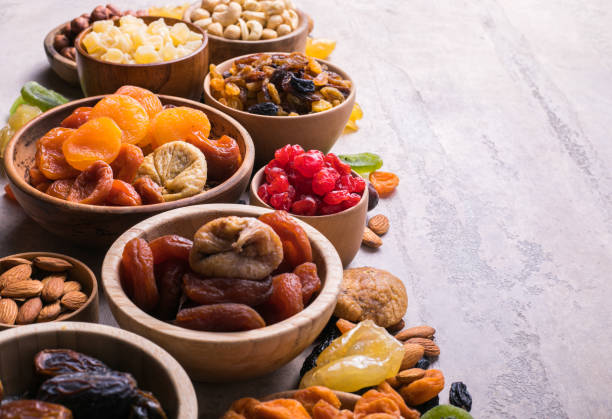
            The Kabbalists, being good obsessive compulsive Jews, decided to create a Tu Bishvat Seder, modeled on the Passover Seder, to celebrate four types of fruits (and four glasses of wine to go with them). There are many different versions of the Tu Bishvat Seder, but this is one of them: The first fruit is one that is hard on the outside and soft on the inside (like almonds, walnuts or coconuts), and they can remind us of the protection the earth gives us, or the ways we keep ourselves separate and protected from one another, hiding the divine spark within; the second fruit is soft, with a pit in the center (like olives, dates, peaches or cherries) and they can symbolize the spiritual strength within each of us, or the potential inside of us that has not yet been tapped; fruit number three is soft throughout and completely edible (like figs, grapes, blueberries and raspberries) and I’m not sure what mystical significance they have, but they are certainly yummy; the fourth fruit has a tough skin on the outside and sweet fruit within (like mangos, bananas, avocados and pawpaws) and they are all about the mysteries of our world and our hunger to uncover the juicy secrets.

            The four cups of wine for the Tu Bishvat Seder are drunk in a specific order and in varying shades of red, pink, and white, to represent the cycle of life and the four seasons, but just like on Passover, you can get away with varying shades of grape juice, in case you need to drive home afterwards.

            When I was in elementary school they never mentioned a Tu Bishvat Seder to us, but each class got a tray of fruits and nuts common in Israel, especially carob, which was almost impossible to eat but traditional, because it was one of the few fruits from Israel that could make the long trip to the European shtetls of my Ashkenazi ancestors without spoiling. Oranges and pomegranates were much harder to get.

A Tu Bishvat spread (not my picture)
Carob (not my picture)

Tu Bishvat changed again in the late 19th century, when Jews were able to buy land in Palestine (because the Ottoman Empire ended its ban on selling land to Jews), and European Jews established agricultural settlements and planted trees to re-green the land and plant deep symbolic roots. The Jewish National Fund was established in 1901 to buy property in Palestine, and Tu Bishvat tree planting ceremonies became an annual event.

            Today, Tu Bishvat is celebrated in all of those ways, but also as a Jewish Earth day: a chance to celebrate nature and learn how to take care of the earth. It’s celebrated in Israel as a full holiday, with tree planting ceremonies and special ecological awareness programs and, of course, lots of food.

            Recently, some of the families whose loved ones were killed by Hamas at the music festival in southern Israel on October 7th joined with the Jewish National Fund to plant trees on the concert site. Around a thousand people came together to plant 200 seedlings, both to celebrate Tu Bishvat, but more importantly to try to bring new life, and hope, to land suffused with death. And so the meaning of the holiday continues to grow and change, as we change.

            When I asked my synagogue school students why we would have a special holiday to celebrate the birthday of the trees, they said that it would be very difficult to keep track of the birthday of each individual tree, remembering to send a card or bake a cake, so having one day to celebrate all of the trees is much easier. They took for granted that, of course, you should celebrate trees; that wasn’t even a question.

            We also talked about why now? Why celebrate trees in the middle of winter? I told them that the date had been chosen because it was the end of the rainy season in ancient Israel, a propitious time to plant a tree in rich soil, but, really, maybe celebrating trees in winter, when they are at their most naked and vulnerable, and least beautiful, is the perfect time to throw them a party; just like we celebrate light in December when the days are at their shortest and the dark of night feels endless.

            And maybe we can learn from this idea of celebrating trees when they are at their most fragile, or light when it is most rare; maybe that’s why we should keep praying for peace even when it seems most impossible. We need to believe that spring and light and peace can return in order for our faith to sustain us through the hard times, and through the hard work that needs to be done to reach peace.

            My students have decided that Tu Bishvat should be celebrated by hugging a tree, or singing it a song, or knitting it a sweater to survive the coldest days, though I’m still a fan of eating as celebration myself. Let’s hope the trees feel all of our love this week, and that God hears our prayers, and that we all hear each other and our hopes for a peaceful future.

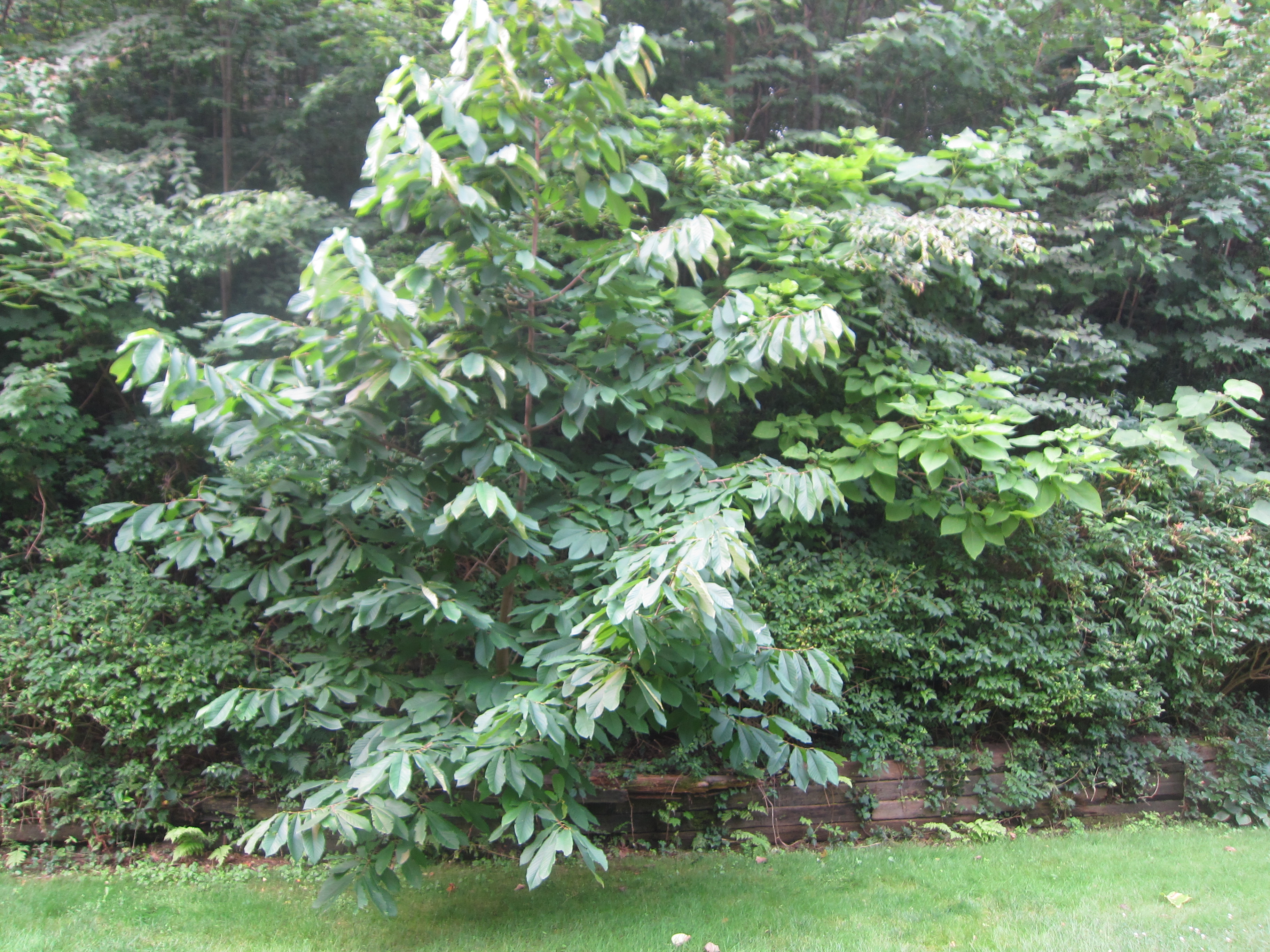
Pawpaw tree in summer

If you haven’t had a chance yet, please check out my Young Adult novel, Yeshiva Girl, on Amazon. And if you feel called to write a review of the book, on Amazon, or anywhere else, I’d be honored.

            Yeshiva Girl is about a Jewish teenager on Long Island, named Isabel, though her father calls her Jezebel. Her father has been accused of inappropriate sexual behavior with one of his students, which he denies, but Izzy implicitly believes it’s true. As a result of his problems, her father sends her to a co-ed Orthodox yeshiva for tenth grade, out of the blue, and Izzy and her mother can’t figure out how to prevent it. At Yeshiva, though, Izzy finds that religious people are much more complicated than she had expected. Some, like her father, may use religion as a place to hide, but others search for and find comfort, and community, and even enlightenment. The question is, what will Izzy find?
My First Homegrown Pawpaw Fruit

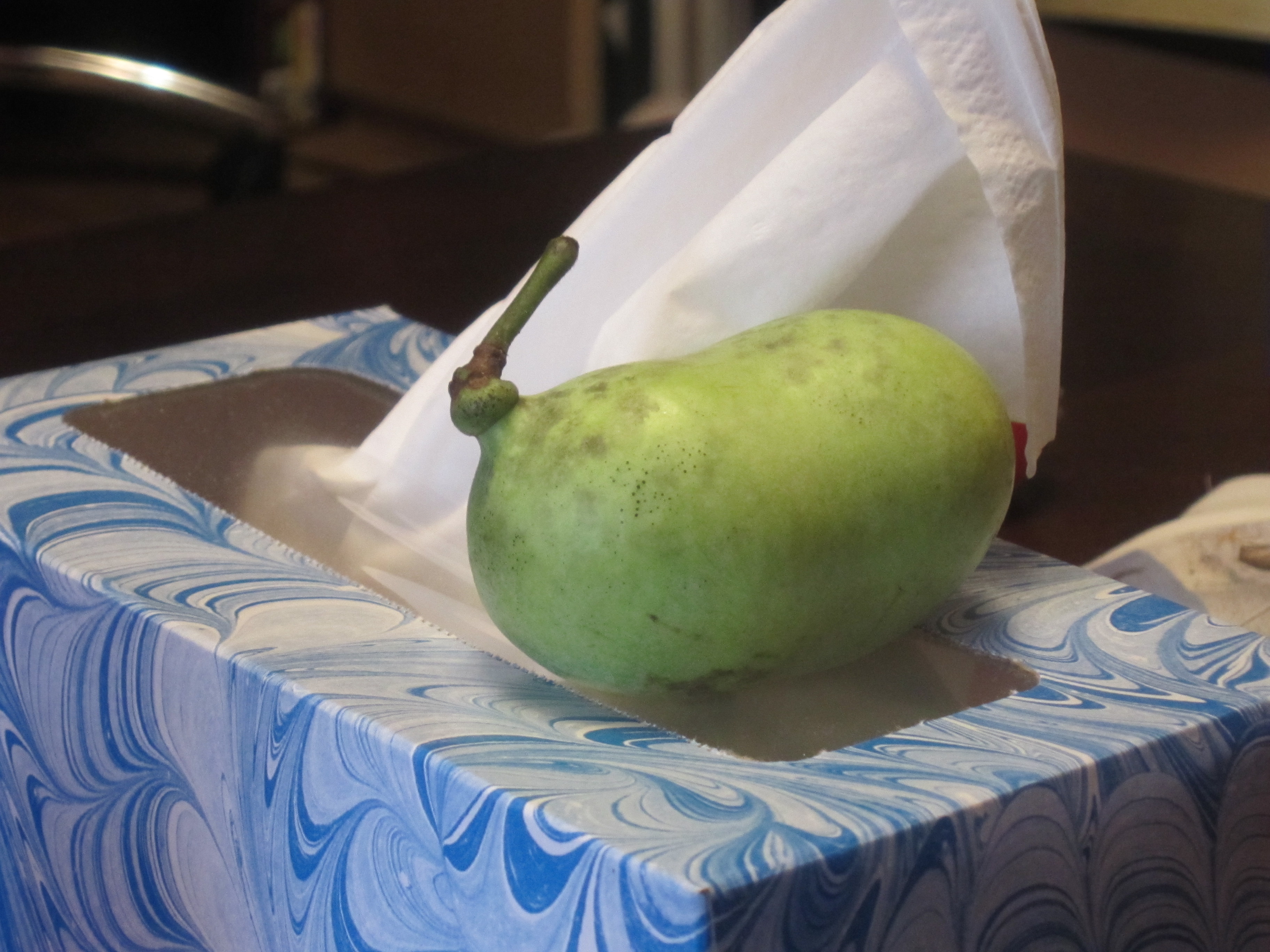
            The one and only Pawpaw fruit fell from the big Pawpaw tree during a recent rain storm; not even the most vigorous storm, which meant the fruit was almost ready to fall on its own. It was still a little too green and a little too hard to eat, so we waited a few more days to let it ripen. With only one fruit from a whole tree it almost felt too precious to eat, and I worried I’d do something wrong: forget to take pictures, cut it open too soon, eat it all myself!

My first homegrown pawpaw fruit (tissue box shown for size reference)

            I waited, impatiently, touching it once a day to see if it had gotten softer, but mostly waiting until I could smell it; that was the real test. At first only the dogs could smell that distinct pawpaw aroma coming from the fruit, but then, if I put my nose almost against the green, mottled skin, I could start to smell it too. When I could finally smell the pawpaw from a few feet steps away, I knew it was ready. Or at least I hoped.

Cricket sniffing the pawpaw

            I dithered, though, because I was afraid that I’d exaggerated the memory of the pawpaw fruit in my mind. It had been fifteen years since my last bite and I worried that I had distorted the reality of it into something better than it could possibly be.

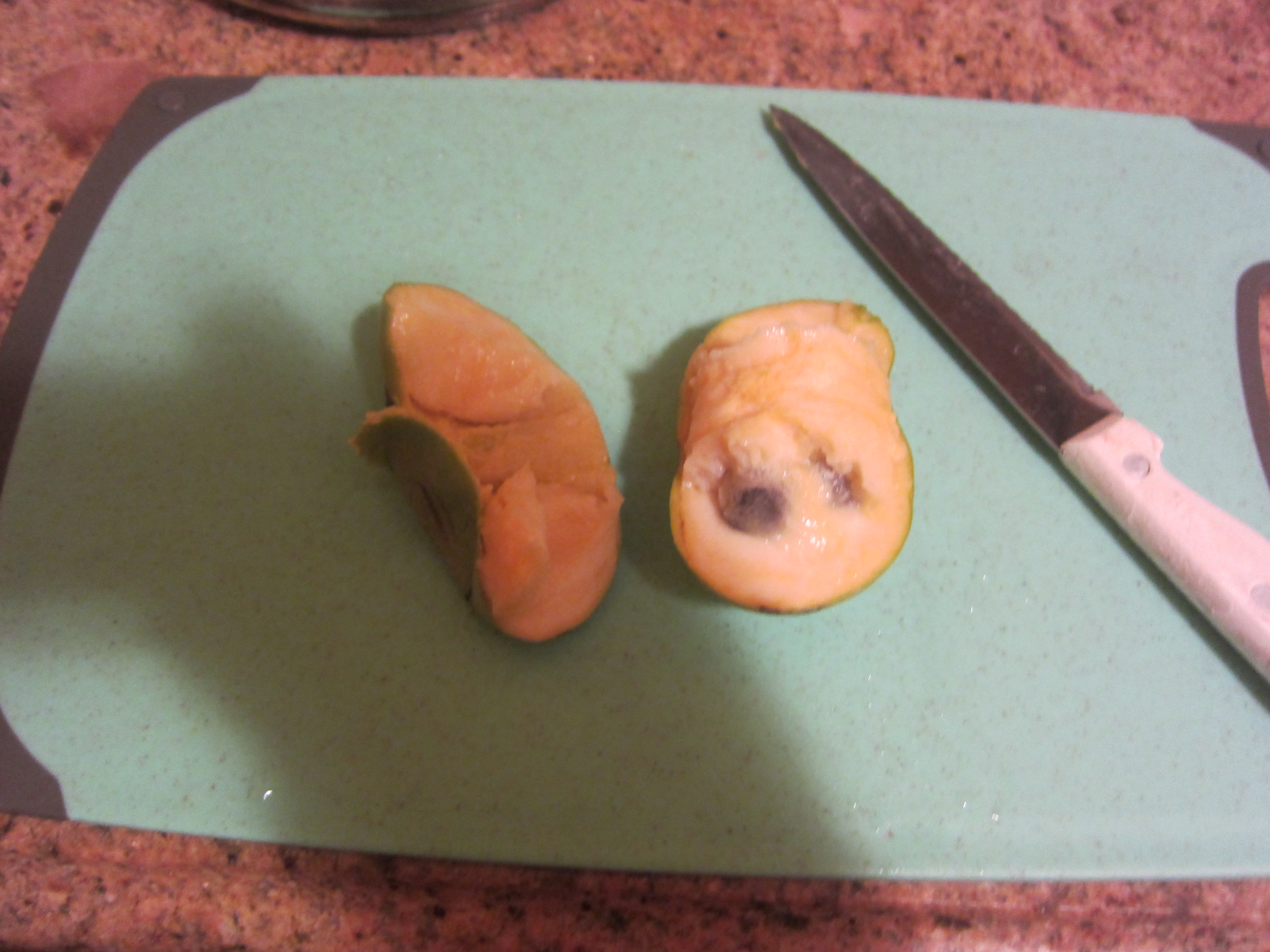
            But I didn’t want to let it sit there so long that it would rot, so I finally brought it into the kitchen and placed it on a cutting board, and, of course, took a picture. I tried to cut it in half, because I wanted to share it equally with Mom, but the seeds made it impossible to cut straight through. I had to accept that there is no fairness in the splitting of pawpaws, and, also, I was impatient, so I cut around the seeds and gave a small piece to Mom, and took a small piece for myself, and finally got to taste a pawpaw again.

Cut pawpaw, in bad lighting
Pawpaw seeds

            And it was delicious! The sweetness was more gentle and complex than I’d remembered, and the texture was perfect, soft but firm, and not slimy or mealy at all. It was perfect.

            The only problem was that in such a small pawpaw there were more seeds than fruit, or so it seemed, and after I’d removed the five almond-sized seeds and peeled the skin and shared half with Mom, there were only a few bites left. And then there was a wave of sadness, that the experience was over and that I’d have to wait another year, at least, to try it again. But after fifteen years of waiting for this one piece of fruit, and realizing that it was worth the wait, and knowing now that my tree could produce fruit, I decided that I could wait another year for my next bite.

            In the meantime, I cleaned the seeds and packed them in a Ziploc bag in the fridge (the article Mom found online said that we needed to add moss, not too damp and not too dry, to create the perfect pawpaw seed environment in the bag, but I left that part to her). So now the seeds are sitting in their bag in the fridge, waiting until they’re ready to be planted. And my wild pawpaw grove is building its strength as the saplings learn to stand straighter and taller every day. And the big pawpaw tree is readying for winter, its leaves starting to turn light green with a little bit of yellow here and there. Soon the leaves will all turn yellow, and then fall to the ground, and the tree will shiver through winter and start to leaf again in the spring.

Pawpaw Tree Fall 2021

And maybe next year we will have more than one fruit, so we can share the pawpaws with our friends, which is, really, the whole point.

If you haven’t had a chance yet, please check out my Young Adult novel, Yeshiva Girl, on Amazon. And if you feel called to write a review of the book, on Amazon, or anywhere else, I’d be honored.

            Yeshiva Girl is about a Jewish teenager on Long Island, named Isabel, though her father calls her Jezebel. Her father has been accused of inappropriate sexual behavior with one of his students, which he denies, but Izzy implicitly believes it’s true. As a result of his problems, her father sends her to a co-ed Orthodox yeshiva for tenth grade, out of the blue, and Izzy and her mother can’t figure out how to prevent it. At Yeshiva, though, Izzy finds that religious people are much more complicated than she had expected. Some, like her father, may use religion as a place to hide, but others search for and find comfort, and community, and even enlightenment. The question is, what will Izzy find?

My Pawpaw Tree is Tilting

            During one of the summer storms, my fourteen-year-old Pawpaw tree went from gently leaning into the yard, to bowing down, leaves almost touching the grass.

            At first, I thought it was temporary, like the way the hydrangeas get heavy with moisture and look like they’re exhausted and wilting, and the next day, as they dry off, they lift back up. But even while all of the other flowers and trees in the yard started to rise back up to standing, the Pawpaw stayed tilted.

            Part of the problem is that the Pawpaw tree was planted in the retaining wall, rather than straight in the ground, and the retaining wall is not in the greatest of health. There are all kinds of bushes and trees around the Pawpaw competing for space, and the wooden slats that keep each level of the wall in place are rotting.

            But still. The Pawpaw tree has been there for nine of its fourteen years, long enough to have deep roots, so I didn’t expect it to fall down and never get up again.

            Mom said it could be about the quality of the soil in the retaining wall; it’s gotten spongy. She has plans to buy special soil to add into the wall around the tree, to help support it, but if it’s the soil, then why is it only the Pawpaw that’s struggling to stay upright?

            I get a teensy bit paranoid about my tree, obviously.

“Obviously.”

            We put some rocks around the trunk and leaned a garden fork against it with the teeth dug into the ground as a counterweight, but that was only a short term solution.

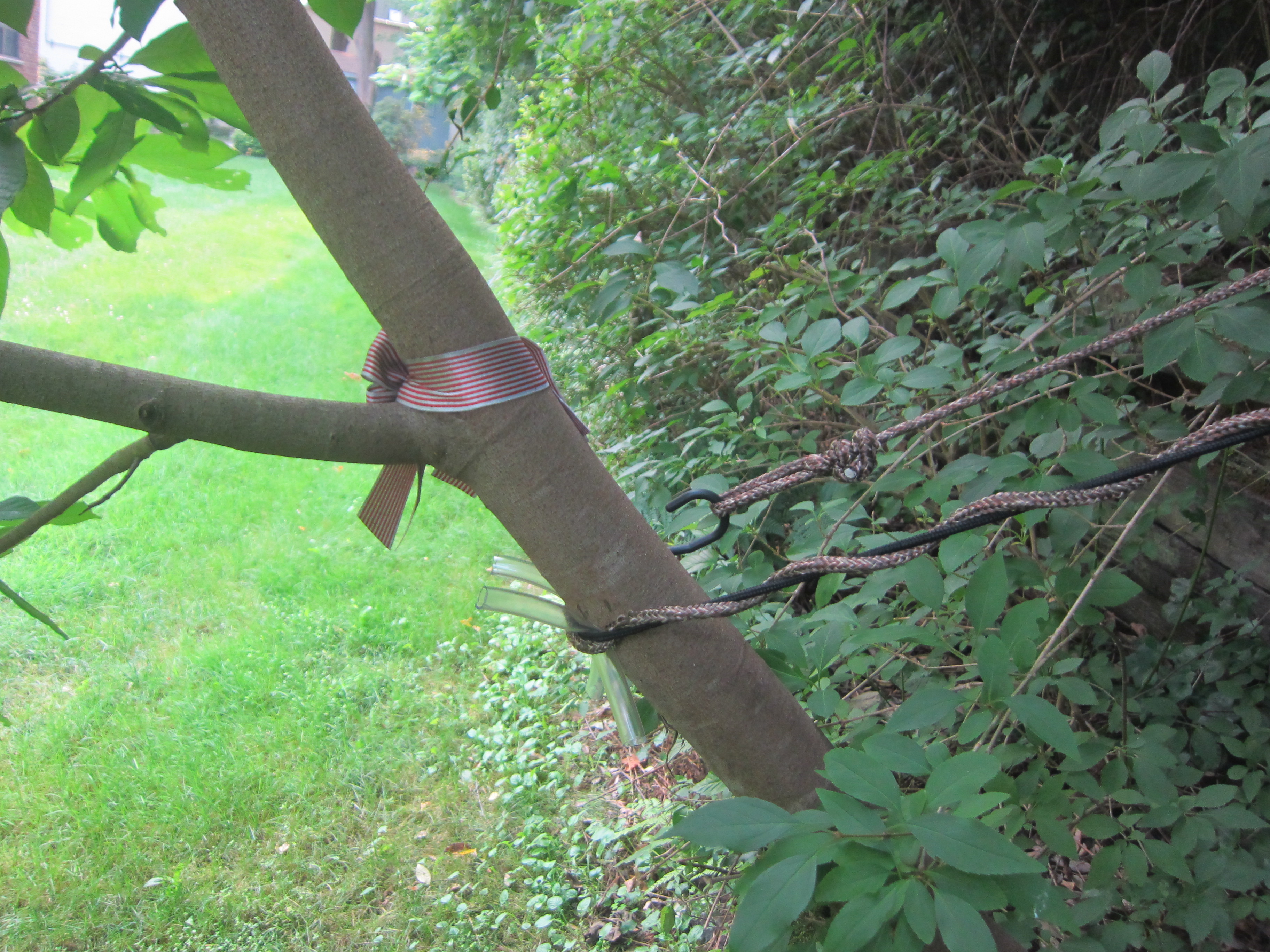
            Then Mom went to the home improvement store and bought a heavy rope and a bungee cord. My job was to climb up into the retaining wall (with a big stick for balance and to push tangled vines and branches out of my way) and wrap the rope around two solid trees a few levels up into the wall. Then the bungee cord went around the trunk of the Pawpaw, as taut as possible, to give the tree some extra support, so at least it won’t tilt further in the next storm.

            I don’t know how Mr. Pawpaw feels about wearing a back brace, as well as the bowtie that marks him out as off limits to the gardeners, but I hope he agrees that survival is more important than vanity.

            So now I wait and see. There’s still one Pawpaw fruit growing on one of the higher branches (out of reach) and the leaves look healthy, so I’m hopeful.

            I’m not thrilled with all of the drama that comes of loving a tree; but it certainly gives me something to write about.

“Oy.”

If you haven’t had a chance yet, please check out my Young Adult novel, Yeshiva Girl, on Amazon. And if you feel called to write a review of the book, on Amazon, or anywhere else, I’d be honored.

            Yeshiva Girl is about a Jewish teenager on Long Island, named Isabel, though her father calls her Jezebel. Her father has been accused of inappropriate sexual behavior with one of his students, which he denies, but Izzy implicitly believes it’s true. As a result of his problems, her father sends her to a co-ed Orthodox yeshiva for tenth grade, out of the blue, and Izzy and her mother can’t figure out how to prevent it. At Yeshiva, though, Izzy finds that religious people are much more complicated than she had expected. Some, like her father, may use religion as a place to hide, but others search for and find comfort, and community, and even enlightenment. The question is, what will Izzy find?
Gardening Puppy

Cricket has her paws on the red handled trowel

Cricket has her paws on the red handled trowel


            Cricket loves to dig. She has adopted a small red handled trowel as her own and whenever her grandma is using it, Cricket goes over to bark at it and try to steal it. She hasn’t figured out how to make it dig, but then maybe that’s not her intention. She’s angry at it for taking her job.

"You can't have it, Grandma!"

“You can’t have it, Grandma!”

            When she’s out with Grandma, doing the gardening, her job is to pull out roots and weeds. She’ll dig first with her paws and then grab with her teeth and pull. Then she runs back into the house, with four black feet and a black chin with a little bit of her original white hair showing through, and then she spreads the dirt around, leaving her water bowl muddy and her face smiley.

            She was getting impatient with the long winter this year and decided to dig random holes in the lawn. I had to watch her carefully to catch the crazy digging before she was a foot down into the earth. And then we had to replace the divots and stomp them down, like we were at a polo match.

            Ideally, Cricket would have her own garden, or a sandbox, to play in. But the endless baths that would result wouldn’t make mommy or puppy very happy. And she doesn’t just want to dig aimlessly, she wants to accomplish something.

Cricket's after-bath twist

Cricket’s after-bath twist

            Cricket and Grandma have different ideas on gardening. Their aesthetics are in opposition. Cricket likes holes. She likes digging through the top layer of grass to explore the rich, meaty underbelly of dirt. She likes to remove things from the ground, rather than add them. We have to keep her at a distance from anything freshly planted, because she will unplant it with relish.

            When we moved recently, we lost a full lawn of gardening space where Mom had planted berry bushes, and pawpaw trees, a full vegetable box, and sunflowers, and lilies, and hydrangeas, and strawberries, and on and on.

            In our new place there isn’t as much space and it has to be shared, which means, most of all, that gardening puppy does not get to participate. I’d love to be able to put her on the long lead out in the yard, but I’m afraid that would bother my new neighbors and I’m not ready to alienate anyone, yet.

For Mother’s day we went to the gardening store and bought four different kinds of tomato plants, and a purple pepper plant, to plant along with the things we brought from our last home. But Cricket keeps trying to climb into the new vegetable plot to “help.”

Butterfly likes to sniff the flowers, but she’s delicate about it. The only time she likes to dig is when she’s standing next to her food bowls, scratching at the wood floor as if she thinks more food is hidden underneath.

Butterfly, considering the mysteries of the universe

Butterfly, considering the mysteries of the universe

Hopefully, Cricket will be able to find an outlet for her gardening passions, one that doesn’t include unplanting the tomatoes, or rolling in the patches of poison oak the way the local cats like to do. But I think, for now, she’s happy that her Grandma is gardening again, getting excited about new vegetables and flowers, as long as Cricket gets to sniff each and every one and give her bark of approval.