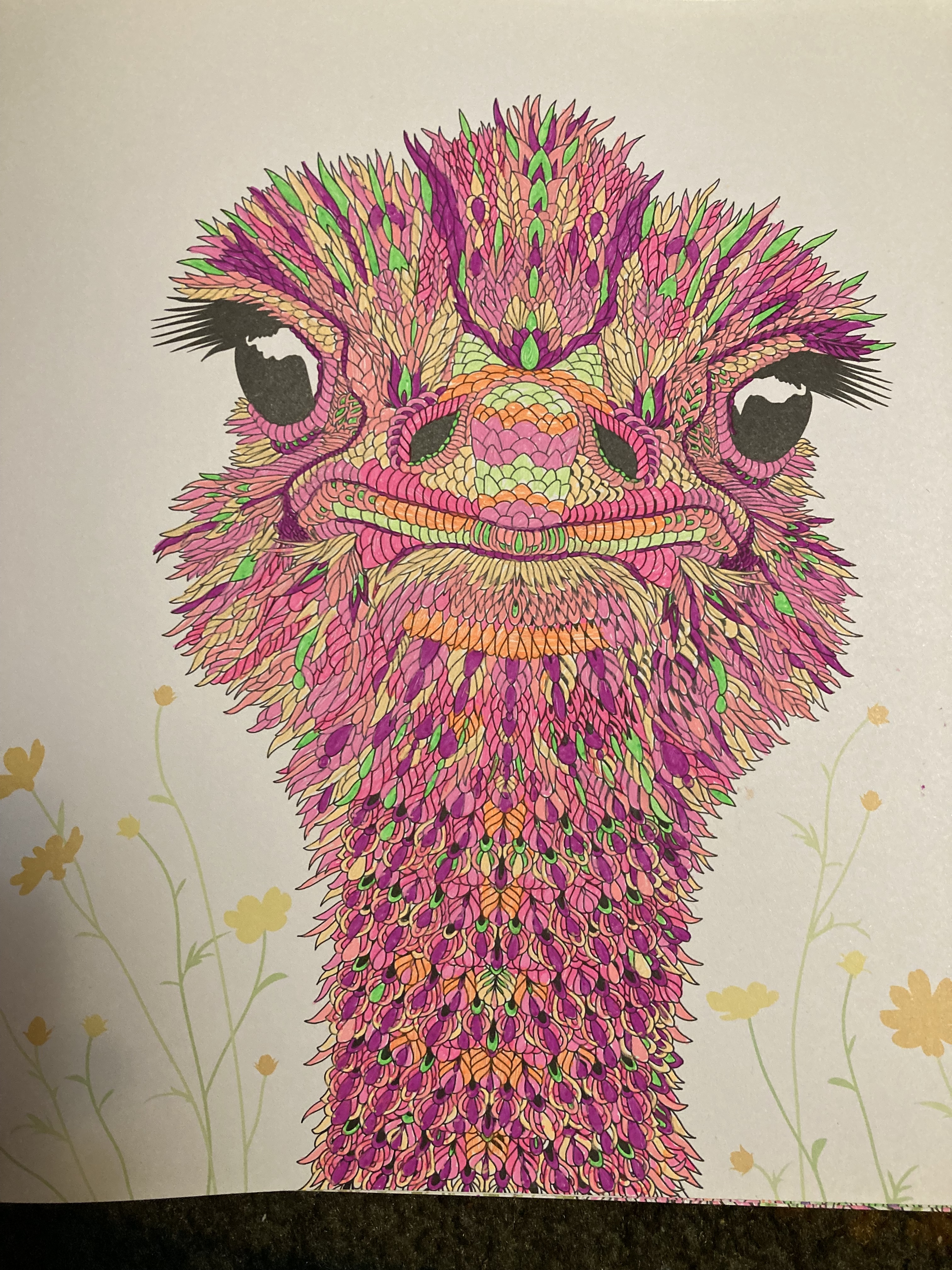
I have been coloring a lot lately. In coloring books. They are “adult” coloring books, so the designs are more complicated and intricate than my old Little Mermaid coloring books, but I’m struggling to stay within the lines just like I used to as a kid, and I feel silly for needing to do this instead of creating something of my own from scratch. I used to knit and crochet as a way to calm down, but I haven’t had the mental energy to focus on a project like that. When I received a handful of gift cards for Chanukah, from my students, I decided to buy coloring books and markers, as a way to de-stress. And they worked. I’ve always needed distractions like this to help with anxiety, but since the presidential election in the United States, and then even more so since the inauguration of our current president, the anxiety in the air and the onslaught of news each day has been overwhelming me.
I haven’t been writing much about our current political climate, in the United States, in Israel, or in the world at large, because there’s too much to process each day, even each hour sometimes, and I feel like I have nothing to add that hasn’t been said a hundred times already. I’m frightened, and overwhelmed, and feeling helpless, and all of the suggestions for how to take action have overwhelmed me even more, because they assume I have resources (like energy and money) that I don’t have.
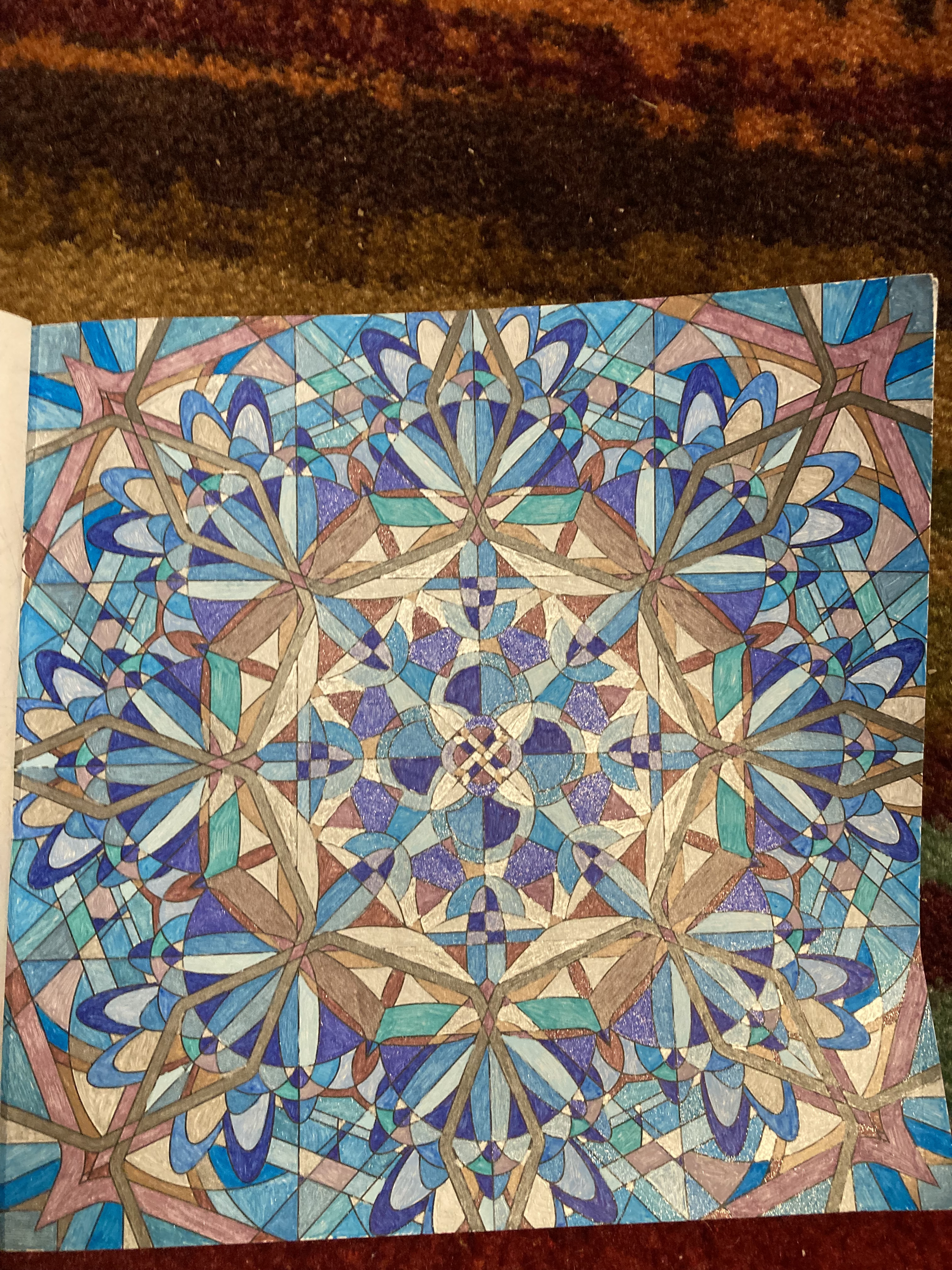
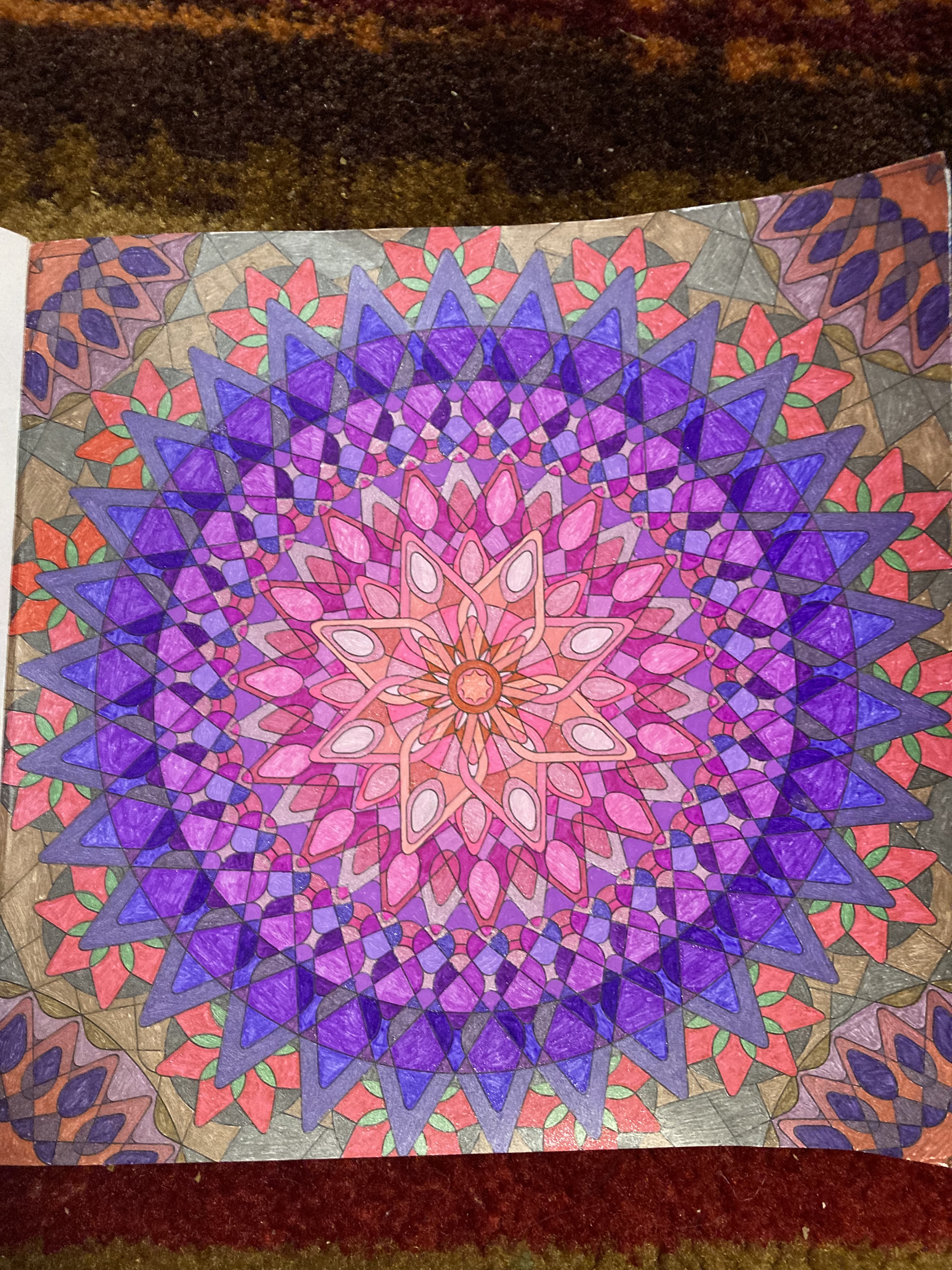
So, I color. I’m on my third coloring book, and I’ve graduated from simple markers to gel pens in every shade. I started with pictures of animals in general, then birds in particular, and then I moved on to abstract designs. I’ve also been watching tons of Hallmark and Hallmark-like movies on YouTube, and the combination of the movies and the coloring have been helping, somewhat.
I’m still writing and teaching and going to my Hebrew classes and taking care of Tzipporah and going to doctors’ appointments and listening to podcasts and Israeli music and forcing myself to watch and read the news, but I’m depending more and more on my hours of coloring each day to help me organize my brain, following the lines someone else has created and trying to figure out which colors will make the patterns become clear to me.
I wish I was up to doing something more. I wish I could get more writing done each day, or knit a few sweaters, or go out into the streets, or just fix the world snip snap, but this seems to be what I can do for now. It feels selfish to spend money on pens and coloring books instead of sending that money to various organizations supporting reproductive rights or immigrants’ rights or children in Ukraine, but I can’t help anyone else when I feel so lost. I wake up feeling like everything is out of control and the world is breaking apart like pieces in a kaleidoscope, and then I turn on a Hallmark movie and open a coloring book and I feel a little bit more together and a little bit more capable of doing the things I need to do.
I don’t know how everyone else is coping. Maybe there are even people who don’t feel stressed at all by the current state of affairs, though I don’t know them. People keep telling me that we just have to survive through the next four years, but I don’t have confidence that I will survive four years of this, or that this will only last four years, and that level of fear makes it hard to plan ahead. If the rules change every day, and I have no idea what the new rules will be, it’s hard to believe that I will ever be able to play the game. I remember this feeling from my childhood, where the only way my father could feel safe and secure was if he pulled the rug out from underneath me, or someone else. His security and mine existed on a seesaw, and that’s how it feels with our current president, that the things that make him feel better will inevitably make me feel worse.
I wish I could fix this, or go back in time to prevent it somehow, or create a world of my own that I could crawl into and avoid the news completely, but I don’t know how to do any of those things. So, I color, and I get by, and that’s the best I can do, for now.
Tzipporah prefers naps to coloring.
If you haven’t had a chance yet, please check out my novel, Yeshiva Girl, on Amazon. And if you feel called to write a review of the book, on Amazon, or anywhere else, I’d be honored.
Yeshiva Girl is about a Jewish teenager on Long Island, named Isabel, though her father calls her Jezebel. Her father has been accused of inappropriate sexual behavior with one of his students, which he denies, but Izzy implicitly believes it’s true. As a result of his problems, her father sends her to a co-ed Orthodox yeshiva for tenth grade, out of the blue, and Izzy and her mother can’t figure out how to prevent it. At Yeshiva, though, Izzy finds that religious people are much more complicated than she had expected. Some, like her father, may use religion as a place to hide, but others search for and find comfort, and community, and even enlightenment. The question is, what will Izzy find?
All of the recent rhetoric, and actions, on mass deportation of migrants in the United States has made me think about what I believe is right, or wrong, or complicated, around the issue of immigration. There are people who believe that there should be no borders at all, and that all deportations are wrong, and there are others who think that anyone who speaks Spanish instead of English while in the United States should be on the ICE deportation list, no matter what their citizenship status may be. I know I don’t agree with either of those extreme points of view, but I’m not sure what I do believe.
We have a tendency to simplify and generalize in our public discourse, relying on pithy sayings that can fit in a hashtag or on a protest sign, instead of having in-depth discussions about what we believe is right. And especially now, when we are being told that the only solution to illegal immigration is to hunt down anyone with questionable status, guns blazing, in hospitals and schools and houses of worship, it is even more important to take a breath and take responsibility for figuring out who we are and who we want to be, and why.
I teach the Book of Leviticus in synagogue school, so I spend an unreasonable amount of time marinating in the Hebrew Bible and what it has to say about who our ancestors were, and where they went wrong, and which lessons they did and didn’t learn from those mistakes. So, when I am confused about a moral issue, the Hebrew Bible is one of the first places I look for edification (other than Hallmark movies, of course). And we are reminded over and over again in the Hebrew Bible that we were strangers in Egypt, and therefore we should be compassionate to others in the same position. It is said so many times that we almost don’t hear it anymore, like we miss the birds chirping outside our windows, or the nagging inner voice telling us to exercise, because it is just so ubiquitous. And, to be honest, I’m not sure I ever spent much time thinking about what it means to be kind to the stranger, or even who qualifies as a stranger in our modern, globally connected world.
But in a recent bible study session, my rabbi told us that even though the word Ger in the Hebrew Bible is often translated into English as “stranger,” it actually meant something more like “sojourner” in biblical times, and referred to someone who was a migrant from somewhere else, without land of his own in ancient Israel.
We are told, in Leviticus 19:34-35: “When strangers reside with you in your land, you shall not wrong them. The strangers who reside with you shall be to you as your citizens; you shall love each one as yourself, for you were strangers in the land of Egypt.”
So, first of all, don’t wrong the stranger. Don’t do anything to the stranger/sojourner that would be abhorrent to you, like making them into your slave, or stealing from them, or hurting or killing them. Basically, recognize that the laws of good behavior are not nullified in your interactions with the stranger as if they are less than human. But why tell us to treat the stranger as if he is a citizen? If there’s not supposed to be a difference between how we treat a citizen and a non-citizen, then why not just say, treat everyone the same?
In fact, the Hebrew Bible has a separate law for how we should treat someone who isn’t a stranger. In Leviticus 19:18, it says: “Love your neighbor as yourself,” or in another translation, “Love your fellow human being as you love yourself.” If there’s no difference between a stranger and a neighbor, why are the two laws stated separately?
If we assume that every word in the Hebrew Bible is there for a reason, which not everyone assumes, but hear me out, then just like “stranger” really refers to a sojourner or non-citizen, maybe the “neighbor” or “fellow human being” here refers to the opposite of the stranger/sojourner, AKA a citizen. So, we are being given guidance on how to treat a fellow citizen and on how to treat a non-citizen.
Before settling in the land of Israel, the ancient Israelites were wanderers, and slaves, so they knew about being sojourners in other lands more than they knew about being landowners. And once they owned land, they needed to learn how to treat each other all over again, and how to treat outsiders, given these new blessings and responsibilities. But as their past experiences started to fade from their everyday thoughts, they had to actively remind themselves that they didn’t want to be the kind of landowners they’d known in the past. They wanted to retain their empathy for the outsider, without losing the rights and freedoms they had so recently won for themselves.
One of the important things to remember about the sojourners in ancient Israel, is that they were not bound by all of the same laws as the Israelites (like keeping kosher, or celebrating the Sabbath, or giving of the produce of their land to the Levites, or to the widow or orphan), though they were bound by certain laws that applied to everyone equally (Don’t kill, steal, etc.).
But if the sojourner is so different from the neighbor, why do the laws about how to treat them sound so similar? Or do they? Further along in the Hebrew Bible we get a little more detail on how we are supposed to treat the stranger/sojourner. In Deuteronomy 10:18-19, it says: “[God] upholds the cause of the fatherless and the widow, and befriends the stranger, providing food and clothing. You too must befriend the stranger, for you were strangers in the land of Egypt.”
Here we are being told to befriend the stranger (which is pretty vague), and to supply food and clothing to the stranger, the way one would for anyone else in the community who is in need. This suggests that we’re not being told to treat the stranger the same way we would treat a fellow citizen, but rather to be generous to the stranger in the same way we would be generous to anyone in our own community who is in need, specifically, someone who lacks food or clothing. It’s interesting, and maybe significant, that the law doesn’t mention offering shelter to the stranger, which I would have thought of as a primary need, especially for someone without land of their own.
In ancient Israel, those who owned land were members of the twelve tribes of Israel. Period. These are people who, maybe like us, were worried about losing the property and the rights and the freedoms they had so recently won. And they were struggling with their competing desires to keep what was newly theirs and to be generous to those who were not as lucky.
As I often remind my synagogue school students, we don’t have laws in the Hebrew Bible for things we would already do without being told. And I think the two laws, for how to treat the sojourner and how to treat the neighbor, are a way to remind us that both our relationships with our fellow citizens and our relationships with non-citizens will be complicated, and that we will make mistakes, and we will struggle to know what is right or fair, and we will struggle with our own greed and generosity. We need these laws to remind ourselves that we should still strive to treat everyone with respect, especially if they are different from us, or have different status from us. And, maybe more importantly, we need to be reminded that being a stranger is not a character flaw, or a status below that of other human beings. The reality of needing to leave home in order to survive is a vulnerable state to be in, and usually reached through no fault of one’s own, like the Israelites having to leave the land of Isreal during a famine and travel to Egypt. We may not be obligated to the migrant to the same degree as we are obligated to our fellow citizens, but we are still required to see them as people who need and deserve our respect and generosity.
We are struggling with all of this in the United States right now. We are struggling both with how to treat our fellow citizens, when they are different from us, in gender, sexuality, religion, race, culture, belief systems, etc., and how to treat sojourners in our land, those who are here legally or otherwise. We are not sure we can afford to be generous, financially or emotionally, even with our own communities, let alone with outsiders.
And the fact that there are separate laws for the neighbor and the stranger in the Hebrew Bible tells me that my ancestors understood that struggle. They knew that everyone wouldn’t be treated the same, and that maybe they couldn’t, or even shouldn’t, always be treated the same. We are human beings, after all, and we will never be perfect, whatever that is. But there’s also a clear sentiment among the ancient Israelites, at least in their published works, that no matter how flawed and imperfect we may be, we should always be striving to do better, rather than worse.
Right now, it feels like we, as a collective, are doubling down on our deepest fears about the other. And it’s important to recognize that these fears are deep and pervasive and sometimes even accurate. The impulse to protect ourselves, even at the expense of someone else, will always be there within us, and is not, in itself, wrong or evil. It just is. The question is, can we survive and thrive if we feed only the most frightened parts of ourselves? Can we, maybe, also feed the more generous, compassionate, curious, and empathetic parts of ourselves as well, and let them help us make our decisions about who we want to be and what we want to do? Our ancestors believed that if we made an effort, we could do both: take care of ourselves and take care of others. And I’d like to believe that they were on to something.
“I am a stranger in a strange land, too. But I think I like it here.”
If you haven’t had a chance yet, please check out my novel, Yeshiva Girl, on Amazon. And if you feel called to write a review of the book, on Amazon, or anywhere else, I’d be honored.
Yeshiva Girl is about a Jewish teenager on Long Island, named Isabel, though her father calls her Jezebel. Her father has been accused of inappropriate sexual behavior with one of his students, which he denies, but Izzy implicitly believes it’s true. As a result of his problems, her father sends her to a co-ed Orthodox yeshiva for tenth grade, out of the blue, and Izzy and her mother can’t figure out how to prevent it. At Yeshiva, though, Izzy finds that religious people are much more complicated than she had expected. Some, like her father, may use religion as a place to hide, but others search for and find comfort, and community, and even enlightenment. The question is, what will Izzy find?
Watching the Ken Burns documentary, The U.S. and the Holocaust, the week before Rosh Hashanah (the Jewish New Year) was hard. The three night, six-hour documentary was advertised as being about America’s reaction to the treatment of Jews in Germany leading up to and during the Holocaust, and the ways our own prejudices and the resulting immigration restrictions we set up at the time, kept the United States from being a haven for those escaping Hitler. I felt myself shaking with rage and pain and frustration, and I started to yell at the TV (similar to the way I felt when Trump took that first trip down the escalator onto the world stage). But however difficult it was for me to sit with the pain and horror of the documentary, it was even more validating. The timeline of the film, and the clarity it brought to the questions of when people in the United States knew what was happening op the Jews in Germany, and how they chose to respond to that information, was edifying; some failed to act because of their ingrained anti-Semitism, but others were afraid that if they took action to help the Jews of Europe it would set off even more (!!!!!) antisemitism around the world, and especially at home. It’s painful, but important, to remember how prevalent anti-Semitism was at the time.
Antisemitism has come racing back in the last decade, but it’s still not seen as much of a problem by the wider world, maybe because Jews are perceived as powerful and white and part of the majority, rather than as a very small minority with an outsized place in history. Jews have been blamed for things like the black plague, failed governments, and poverty, whenever a convenient scapegoat has been needed. Maybe the Jews are easy to blame because we are a small enough group that people think we can be easily removed, like a tumor, but even after expelling the Jews, converting the Jews, or killing the Jews, it has always become clear, again and again, that the Jews weren’t the problem in the first place.
I felt strongly that I needed to watch this documentary as it aired, rather than recording it and watching it later, because I wanted to feel like I was watching it with other people. I needed that feeling of support. So when the second night of the documentary was postponed in favor of a recap of Queen Elizabeth’s funeral, for anyone who may have missed more than a week’s coverage of every detail leading up to and through the funeral on multiple channels, I felt minimized and pushed aside. I definitely took it personally.
“Me too.”
There are around 7.6 million Jews in the United States today (according to Google), less than there were in Europe before World War Two, and we are only about 2.4 percent of the U.S. population, and yet, when the White Supremacists marched in Charlottesville they shouted “Jews will not replace us,” as if we are a threat to their place in the world.
So when PBS aired the second episode, a day later than expected, I sat down in front of the television with my mom and crossed my fingers, hoping a crowd would be watching with us and that something would come of it.
“We’re watching with you, Mommy.”
There were times when the documentary seemed to equivocate, trying very hard to soften its criticism of America, and especially of president Roosevelt. And there wasn’t much reference to the way the British actively kept Jewish refugees out of Palestine, leading up to and during the Holocaust, despite knowing full well that they were sending boats full of refugees back to Germany to die. But I appreciated the way the filmmakers bookended the documentary with the Anne Frank story, which is so familiar to the American audience, and then delved deeper into her real life than we usually see in discussions of her edited diary. Her former classmate, who went through very similar circumstances as Anne but survived the Holocaust, talked about the famous line in the diary where Anne says that she still believes people are essentially good, but she pointed out that it was written before the Franks were captured by the Gestapo, and before Anne was taken to Auschwitz, and before she and her mother and her sister died there. The optimism of that line has captured American hearts for generations but it has always bothered me, because many people are NOT essentially good, and Anne Frank’s life and death are proof of that. But the sugar coating of her story is very American, where we don’t just need a spoonful of sugar to make the medicine go down, but a cup, or five.
“I love sweet things!”
The thing the documentary did best was to address the tendency of majorities to blame their problems on powerless minorities, and it made a clear connection between how the United States dealt with African Americans and Native Americans, and how the Nazis treated the Jews. Hitler is so often portrayed as an outlier in his hatred for Jews, and the disabled, and homosexuals, and the Romany, and on and on and on, but he was following models he’d seen in other countries, including ours, and the fact that most countries in the world refused to take in refugees from Hitler, allowing them no safe place to escape to, was a secondary cause of so many deaths.
In the film, Freda Kirchway, who wrote for the Nation magazine in 1943, was quoted as saying, “We had it in our power to rescue this doomed people and we did not lift a hand to do it, or perhaps it would be fairer to say that we lifted one cautious hand encased in a tight-fitting glove of quotas and visas and affidavits, and a thick layer of prejudice.”
Even after Americans knew what had happened to the Jews in the Holocaust, and saw the concentration camps and their survivors, only 5% of Americans were willing to let in more Jews.
I don’t know why this documentary aired in September, instead of around Yom HaShoah (Holocaust Remembrance Day, in the spring), but a week later, a far right leader, with direct connections to Mussolini’s fascist party, won the election in Italy, so it turned out to be very timely after all.
There are people who, endlessly, deny that the Holocaust happened, despite all of the evidence. Right now, we’re watching the Ukrainians fight a war and at the same time have to document the atrocities done to them in granular detail, because they know they will need this evidence to prove what really happened, and even then, the people who don’t want to know will continue to deny it; believing what their minds can tolerate instead of what is demonstrably true.
This phenomenon of disbelief haunts us. Most Jews had the same trouble believing that such a thing could happen, because no one wants to believe things that make them feel uncomfortable, or frightened, or guilty, or any of the other emotions we hate to sit with. Humans are great at forgetting or minimizing or compartmentalizing the knowledge we can’t deal with.
People can’t take in a number like six million people killed. And when they can, they often choose to believe that the Jews were to blame for their own killings; that they were complicit, or weak, or evil, and that’s why they were targeted and killed in such large numbers. There were something like nine million Jews in Europe before World War Two, and six million of them were killed. Most of the rest left Europe, to escape Hitler, or to escape their neighbors who didn’t want them around even after the war.
It’s a painful thing to look at all of that hatred and horror, but it’s necessary, and I’m grateful to Ken Burns and his colleagues for making an attempt to bring this history back to the forefront, and to remind America of the dangers we face when we refuse to believe the evidence in front of us. And in the aftermath of watching the documentary, I hoped to hear that everyone in the world, or at least in America, had been watching with me, but I only saw a few responses, and those mostly from within the Jewish community. I hope that when the documentary airs again, and again, more people will choose to see it. But even with the lack of public response, what I still feel most deeply is gratitude, to Ken Burns, Lynn Novick, Sarah Botstein and the rest of their team, and to all of the people who participated in the documentary, and to the people who chose to air it.
Thank you for being willing to see what really happened. Thank you for making it feel real instead of like it’s a bad dream or an exaggeration or so long in the past as to be irrelevant. Thank you for seeing the parallels in the world today. Thank you for saying that these horrifying things have to be looked at and acknowledged, over and over again, to combat the natural human desire to forget.
If you haven’t had a chance yet, please check out my Young Adult novel, Yeshiva Girl, on Amazon. And if you feel called to write a review of the book, on Amazon, or anywhere else, I’d be honored.
Yeshiva Girl is about a Jewish teenager on Long Island, named Isabel, though her father calls her Jezebel. Her father has been accused of inappropriate sexual behavior with one of his students, which he denies, but Izzy implicitly believes it’s true. As a result of his problems, her father sends her to a co-ed Orthodox yeshiva for tenth grade, out of the blue, and Izzy and her mother can’t figure out how to prevent it. At Yeshiva, though, Izzy finds that religious people are much more complicated than she had expected. Some, like her father, may use religion as a place to hide, but others search for and find comfort, and community, and even enlightenment. The question is, what will Izzy find?
I don’t want to write about antisemitism. I don’t even want to think about it. I have been lucky to live in the United States, and in New York, and especially on Long Island, because for most of my life anti-Semitism was a vague noise in the background, or a lesson from history, instead of an everyday reality for me. Even in High School, when I knew that my Jewish school was receiving bomb threats, I still didn’t take it in as a real danger. I was comfortable being an American Jew. It seemed normal, just like being a Catholic or a Methodist, or nothing. If anything, I experienced more conflicts within the Jewish community, especially between liberal and Orthodox Jews, than without. I knew I was part of a religious minority, but it didn’t seem to matter. Yet.
“Uh oh. That sounds like foreshadowing.”
I’d heard about the blood libels in previous centuries, when Jewish people were accused of killing Christian babies in order to use their blood to make matzah. Setting aside the obviously unbelievable claim that Jews were killing babies for ANY reason, it’s important to know why this accusation would actually make religious Jews laugh. Jews who keep kosher salt their meat (this is where the name Kosher Salt comes from) in order to remove as much blood as possible before cooking, because blood isn’t kosher. And matzah, which is eaten at Passover, is made under very strict conditions, using only flour and water, under rigid time limits, so that the idea that anyone would add anything to the matzah, let alone human blood, is unthinkable.
“Matzah is boring.”
But I remember, after 9/11, when an outspoken minority of people blamed Israel for the attacks on the World Trade Center, either with wild conspiracy theories about Mossad agents disguising themselves as Muslim Terrorists, or arguments saying that if Israel had never existed then terrorists would never have targeted the United States. The rhetoric made me anxious, but I didn’t see many people taking them seriously. And the extreme backlash against anyone who looked like they could be from the Middle East, or who seemed to be practicing Islam, was much more of an issue. It seemed wrong to focus on some anti-Semitic theories, when there was anti-Muslim violence going on all around me.
Maybe things started to change with the onset of the Boycott, Divestment, and Sanction (BDS) movement, an umbrella movement that included groups that were specifically protesting the presence of Jewish settlers in the occupied territories, and groups that believed Israel had no right to exist, the Holocaust never happened, and Jews should be pushed into the sea. As the BDS movement became more popular on college campuses, I heard more stories about Jewish college kids facing demonstrations against Israel on campus that supposedly focused on anti-Zionism as separate from anti-Semitism. The problem with that argument is that Zionism started as a movement to save Jews from life threatening situations in Europe, especially in Russia, in the 19th century, and grew in intensity after six million Jews were killed in the Holocaust, just for being Jews. If the criticism had focused on the policies of the current government of Israel, without bleeding into a criticism of the existence of Israel, I could understand; just like you can be a patriotic American, or a friend of the United States, and disagree with the policies of the Trump administration. But anti-Zionism, if it means antagonism to the existence of the state of Israel, and unwillingness to recognize what led to the creation of the state by the United Nations, IS anti-Semitism.
None of this is to say that the Palestinians have been treated well, by the British, or the Jordanians, or the Egyptians, or the Israeli government; damage has been done and continues to be done. But if activists refuse to look at the causes of the complicated and painful current reality in the Middle East, and instead decide that everything is the fault of the Jews, for being there in the first place, then they are falling into old tropes that lead us all back into the darkness. When voices at the edges started to say, out of anger or ignorance, that the word Zionist was comparable to the word Nazi, they crossed a line that is hard to ignore, or forgive.
“Grr.”
But, even with all of that rhetoric, I still felt safe at home, in America. And then, neo-Nazi and white supremacist groups grew in strength, and terrorist attacks took place in Europe, and then white supremacists carried their tiki torches in Charlottesville, to protest the removal of confederate statues (that shouldn’t have even been there in the first place), and they yelled, “Jews will not replace us.” Wait, what? What do Jews have to do with this?
And then I started to hear about swastikas on bathroom walls, in Long Island schools, and then synagogues in the United States were attacked. But… so were mosques and churches and schools and movie theaters, and the news people said that it was terrorism in general, not anti-Semitism in particular, no matter what the shooters, or the internet trolls, were saying. I wasn’t sure what to think, or how to feel. I had never directly experienced antisemitism. Microaggressions, sure. Lack of knowledge, or insensitivity about Jewish issues, or lack of historical memory, sure, but nothing like what I’d heard from older Jews, about how it used to be, even in America, when Jews were excluded from professions and schools and towns and clubs just for being Jewish, before and after the Holocaust took six million Jewish lives.
But still, I thought, I’m an American. Three out of four of my grandparents were born in the United States. That should make me safe.
“Safe, American Cricket.”
And then, a few weeks ago, for the first time, someone left anti-Semitic comments on my blog. I couldn’t read those comments from a distance, as if it were news that had nothing to do with me, because it was on MY blog, and it was directed at me. Reading those comments, three by the same author, highlighted for me the fact that I had never been targeted like that before, not on my blog, and not in person, ever. I was always more worried that I would alienate readers by writing about Jewish stuff on my blog because it would be too niche, or boring, than I was worried about facing antisemitism. I was able to remove the comments from my blog easily, and there has been no recurrence, but, I couldn’t forget about them.
I still feel safe, or as safe as I am capable of feeling. But, anti-Semitism is real to me now in a way it wasn’t before. And the lessons of the Holocaust (be wary of hatred and targeting of people because of their race, religion, sexuality, gender, disabilities, or ethnic group) are more prominent again, for everyone.
It is so easy to blame someone, some group, some minority that you don’t identify with, when things start to fall apart. It’s so easy to project your own self-loathing and guilt and fears onto someone else who is not you, when you feel overwhelmed and hopeless. And it is shockingly easy for a leader in trouble, or seeking more power, to target vulnerable groups and aim societal anger and fear like a firehose in order to gain even more power.
I didn’t realize how easy it was to create baseless hatred, honestly. But now I do. And that really does scare the crap out of me. Because it could all happen again.
“Uh oh.”“Don’t worry, Mommy. I only hate people who deserve it.”
If you haven’t had a chance yet, please check out my Young Adult novel, Yeshiva Girl, on Amazon. And if you feel called to write a review of the book, on Amazon, or anywhere else, I’d be honored.
Yeshiva Girl is about a Jewish teenager on Long Island, named Isabel, though her father calls her Jezebel. Her father has been accused of inappropriate sexual behavior with one of his students, which he denies, but Izzy implicitly believes it’s true. As a result of his problems, her father sends her to a co-ed Orthodox yeshiva for tenth grade, out of the blue, and Izzy and her mother can’t figure out how to prevent it. At Yeshiva, though, Izzy finds that religious people are much more complicated than she had expected. Some, like her father, may use religion as a place to hide, but others search for and find comfort, and community, and even enlightenment. The question is, what will Izzy find?













 rachelmankowitz