Monthly Archives: April 2024

The Four Sons

            As part of our preparation for Passover this year, my students and I looked at different elements of the Haggadah, the book used to guide the Passover Seder. We tried to figure out the mysteries of the ten plagues (What’s so terrible about frogs? Why do you need Lice and locusts? What does it mean that God hardens Pharaoh’s heart against letting the Israelites go and yet also sends plague after plague to convince him to let them go? Does this mean that God wants to cause Pharaoh pain? And if so, why must all of the Egyptians suffer along with their leader?); and we looked at the objects on the Seder plate (does anyone actually eat the parsley dipped in salt water? Couldn’t we just substitute pickles for the green vegetable and the salt water, all in one convenient package?); and, why is the Seder so freakin’ long?

I bought a roll of these stickers for my students last year. Lice was a favorite.

            But the part that always gets to me most is when we read about the four sons (the wise, the wicked, the simple, and the one who doesn’t know how to ask) and how the rabbis recommended we answer their questions.

            There are many reasons to find fault with this section of the Hagaddah, but first and foremost my reasons are personal: my father always chose for me to read what the wicked son had to say. He thought it was hysterical that every year he could call me evil in front of guests and get away with it. But having read that passage so many times has focused my attention on the question: what’s so wicked about the wicked son wondering what this whole Exodus story has to do with him?

            I’ve seen dozens of revised versions of the four sons: changing it to the four children to include the other half of the population; renaming the wicked son to the rebellious child; and imagining the four children as four parts of all of us.

            I actually love the idea that the rabbis thought to add a section to the Hagaddah where we are told to look at the children at the table and try to figure out how to answer their questions. It’s just that the rabbis gave terrible advice, and their method of categorizing the children is both vague and judgmental and still doesn’t really help us figure out what to say to them.

            Earlier in the Seder, the youngest child recites the official Four Questions, chosen by the rabbis long ago and usually answered before Passover even begins by your friendly neighborhood synagogue school teacher. Why Matza? Because the Israelites had to rush to bake bread the night they escaped from Egypt and the bread had no time to rise, or because we used to rely on sympathetic magic at this time of year to encourage the harvest, and preventing the bread from rising was a way to reserve all of the fecundity for the crops. Why bitter herbs? Because slavery is bitter. Why dip a green vegetable in salt water? Because the green vegetable (often parsley) represents spring and the salt water reminds us of the tears of our ancestors. Why do we recline at the Seder? Because free people are able to relax while they eat and somehow don’t mind the resulting heartburn.

            The recital of those four basic questions is supposed to be the beginning, and not the end, of the questions people ask at the Seder, and in the same way I wish we could portray (at least) four different kinds of children at our Seders in a way that would inspire us to be more curious about the actual children in our lives and to come up with ways to spark their imaginations.

            What if instead of labeling the child who agrees with us as wise, and the one who disagrees as wicked, we could listen to them long enough to figure out the who behind the concerns they are bringing up?

            In that spirit, I asked my students which children they would choose if they were writing the Hagaddah today, and they had a lot of ideas. They thought about the depressed child and the bored child, the discombobulated child and the hungry child, the happy child and the lonely child, the frightened child and the curious child, the constipated child (too much Matza), the self-absorbed child, and the brave child. And really they could have gone on and on. What they didn’t do was to describe the children in the judgmental and external ways the rabbis had done. They focused on who the child is to him or herself: she feels sad, he feels uncomfortable, she’s shy around so many strangers, and he wants to see what happens if he feeds horseradish to the cat.

             The central obligation at the Passover Seder is not to eat Gefilte fish or hide the Afikomen, but to re-tell the story of the Exodus, because we recognize the power of this story to help us find meaning in our lives: to teach us to have hope even in dark times, to learn how to stand up to bullies, to remind us that we can ask for help and that we should help others on the journey when we can. This yearly retelling also teaches us to remember our own individual traumas, and name them, and embrace the ways they have made us who we are today. If we pretend that life is beautiful all the time we won’t search for new ways to solve our problems and will remain stuck in Egypt. The mantra to “never forget” has been associated with the Holocaust in modern times, but the lesson is thousands of years old and stems from the Exodus story and the command to retell it. Our ancestors knew the power of memory and the need for storytelling to help us shape those memories into life lessons.

The Israelites are never portrayed as perfect people in the Hebrew Bible, they are intentionally portrayed as human and flawed so that we can see ourselves in them and learn the lessons they learned from their lives. The four children can be seen as part of this tradition too: the one who complains all the time (Manna? Again?!), the one who is always jealous of someone else’s share (why does Moses get to be in charge all the time?), the one who is afraid to cross the sea (why does everything have to be so difficult?), and the one who has the faith to take the first step and lead the rest to freedom. They are all part of the same whole; they are us.

Splitting of the Sea, from Chabad.org
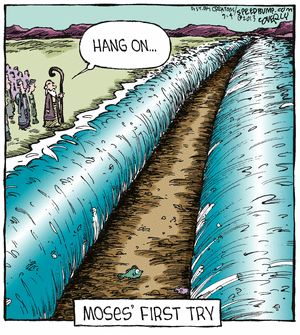
Moses’ first try, from The Jew In You

If you haven’t had a chance yet, please check out my Young Adult novel, Yeshiva Girl, on Amazon. And if you feel called to write a review of the book, on Amazon, or anywhere else, I’d be honored.

            Yeshiva Girl is about a Jewish teenager on Long Island, named Isabel, though her father calls her Jezebel. Her father has been accused of inappropriate sexual behavior with one of his students, which he denies, but Izzy implicitly believes it’s true. As a result of his problems, her father sends her to a co-ed Orthodox yeshiva for tenth grade, out of the blue, and Izzy and her mother can’t figure out how to prevent it. At Yeshiva, though, Izzy finds that religious people are much more complicated than she had expected. Some, like her father, may use religion as a place to hide, but others search for and find comfort, and community, and even enlightenment. The question is, what will Izzy find?

A Dayenu Person

            Dayenu means “it would have been enough” in Hebrew, and it is the title, and refrain, of a song that is sung every year at the Passover Seder. It’s an upbeat tune that lists all of the things we are grateful to God for in the Exodus story. Dayenu is over a thousand years old, and appears in the first medieval Hagaddah (the book used to guide the Passover Seder), so it has staying power.

            There are fifteen stanzas, all in the same format, for example: If God had only brought us out from Egypt, and had not carried out judgements against our oppressors – it would have been enough; If God had split the sea for us, and had not taken us through it on to dry land – it would have been enough; If God had given us the Torah, and had not brought us to the land of Israel – it would have been enough.

Dayenu

            The mystery of the song, for me, has always been: how can any of these things have been enough when all of them were necessary for the survival of the Jewish people? What is “enough” supposed to mean? Do we really mean it would have been enough if God had split the sea and then not allowed us to reach dry land?

I’ve been listening to the podcast For Heaven’s Sake, from the Shalom Hartman Institute, ever since October 7th, not because it gives me answers on how to view what’s going on in Israel and Gaza, but because it helps me to formulate my questions; and recently, Rabbi Doctor DonnielHartman referred to himself as a “Dayenu person” in the course of a conversation with Yossi Klein Halevy, who pronounced himself definitely not a Dayenu person, which started me thinking about what they meant by a Dayenu person, and what the tradition means by Dayenu overall.

I think what they mean by a Dayenu person is someone who is able to accept the limits of what’s possible, and to celebrate what’s achievable in the moment, even in the face of wanting, or even needing, more. If I’m using Rabbi Hartman as the model, then being a Dayenu person wouldn’t have to mean that you’ve stopped hoping for, or recognizing the need for more, because he always talks about wanting more from himself and for the Jewish people. But I think that in order to be a Dayenu person, you’d have to have faith that more good things will come, so that pausing to be grateful for your incomplete gifts wouldn’t leave you worrying that that’s all there’s ever going to be. And that sort of leaves me out.

I used to call myself an optimistic realist, because while I could see the suffering and pain in the world, I totally believed that my problems and the problems around me could eventually be solved. And I still act as if I am optimistic, but internally my expectations for my life and for the world around me have been lowered significantly; and not in the I-accept-you-as-you-are sort of way, but in the I’m-screwed sort of way.

But, the idea of being a Dayenu person resonates for me. I really do crave the feeling of having enough, and the faith that everything will be okay. I just don’t know how to get there from where I am. It feels impossible to pause in the middle of a raging sea and be grateful that I have a boat: a very small, very rickety boat. And I’ve always heard the words of Dayenu as a command to act grateful and act satisfied even when I’m not, in order to please someone else; in this case, God. But what if there’s another way to read the words of the song? What if the song is, inadvertently or intentionally, telling us that we can be grateful for each step of the journey only because we already know that all of the steps took place and we reached the Promised Land? As we sing through all fifteen verses the song can teach us how to toggle between the two mindsets: gratitude for what we have, and willingness to keep working for what needs to come next.

            One of the primary purposes of the Seder every year is to help us feel as if we personally experienced the Exodus from Egypt, and I’ve always thought that meant reminding us to be content with what we have, and not be so jealous of what someone else has been given; but I wonder if it’s also about reminding us that there is a path forward. So that if we feel like we are in the middle of a raging sea, with only a dinky little boat to cling to, singing Dayenu can remind us that this crisis moment is not the end of the journey, or even the beginning, it’s the middle; we’ve already come a long way, and, the song tells us, there are still many gifts ahead to help us on the journey.

            Maccabeats Dayenu – https://youtu.be/CZgDNPGZ9Sg?si=BOmJAcAW91Y29L4K

If you haven’t had a chance yet, please check out my Young Adult novel, Yeshiva Girl, on Amazon. And if you feel called to write a review of the book, on Amazon, or anywhere else, I’d be honored.

            Yeshiva Girl is about a Jewish teenager on Long Island, named Isabel, though her father calls her Jezebel. Her father has been accused of inappropriate sexual behavior with one of his students, which he denies, but Izzy implicitly believes it’s true. As a result of his problems, her father sends her to a co-ed Orthodox yeshiva for tenth grade, out of the blue, and Izzy and her mother can’t figure out how to prevent it. At Yeshiva, though, Izzy finds that religious people are much more complicated than she had expected. Some, like her father, may use religion as a place to hide, but others search for and find comfort, and community, and even enlightenment. The question is, what will Izzy find?

The Dog I Want

            My ideal next dog would be a Maltipoo (Maltese/Poodle mix), ten pounds or less (small enough for Mom to be able to pick him or her up), non-shedding and hypoallergenic (as much as possible), and healthy enough so that I would have him or her for a long time (because having less than five years each with Butterfly and Ellie was heartbreaking). Ideally the next dog would also be a rescue, but I may have to accept that the ideal dog for me will have to come from a home breeder again, like Cricket did, rather than a rescue organization.

            My biggest anxiety, dog-wise, is the cost; because I’m not sure I can really afford a dog long term, and all of the vet care and grooming costs involved, on top of the adoption/rescue fees. I still have a lot of medical debt to pay off, and I’m afraid it’s selfish to risk getting another dog without knowing for sure where the money to take care of them is going to come from. And yet, I really need a dog, or two, to make life worth living.

            Back when we got Cricket, sixteen and a half years ago, we were still recovering from the death of our Lab/mix, Dina, who had died half a year earlier, at sixteen years and two months old, after a long but difficult life. She’d had false pregnancies for years, and for the first eight years, while we still lived in my father’s house, he refused to let us get her spayed to relieve her suffering. Either as a result of that, or just along with that, Dina had a lot of fears: separation anxiety that made it very hard for me to leave her home alone; fear of children and other moving objects; and fear of bridges and water and all kinds of sounds and smells. I learned an enormous amount from Dina about how to care for my own limitations with more creativity and compassion, because she couldn’t just “get over it” the way people always insisted I should be able to do, but by the end I was exhausted, and I just wanted an easy dog, a small dog, a happy and healthy dog.

My Dina

            I researched breeds and temperaments and sizes and on and on and decided on a Cockapoo, and we found a home breeder in New Jersey that we liked and went to see the puppies in person, and Cricket chose us. She turned out to be cheaper than we’d expected because she had an underbite, which, the breeder told us, meant that Cricket couldn’t be a show dog. Fine with me.

            Except, I discovered quickly that I am a terrible groomer. I spent two years trying to teach myself how to manage her and her hair, but in the meantime, and then forever after, she needed regular professional grooming, an expense I’d never thought of before. And when Cricket was a year old she started to limp, and we discovered that she needed knee surgery, first on one knee and a year later on the other one.

            But most importantly, Cricket, who was supposed to be our easy dog, ended up having all kinds of behavioral problems, most likely as a result of neurological problems caused by being the runt of her litter. She spent sixteen years teaching me how to love someone who is difficult, someone who is capable of biting the ones she loves over and over again, and someone who needs to be protected from her own impulses most of the time. She taught me that not all of the people who need your help will inspire your sympathy, or even be grateful for your help. And she reminded me that being smart (and Cricket was very very smart) does not protect you from struggling with even the smallest challenges in life. She also taught me that it is possible to be so cute that even the people who know you best will keep forgetting what a jerk you are.

I was adorable. It’s true.

            Maybe the most important lesson I’ve learned from all of the dogs I’ve had is that no matter what you think you are getting when you adopt a dog, each dog who comes into your life will teach you something you didn’t expect. You will be challenged and you will grow, whether you like it or not.

            Butterfly, an eight-year-old breeding momma rescued from a puppy mill, taught me a kind of love I didn’t know I could feel. Even from the first time I saw her, dirty from the newspapers lining her cage in the shelter, and missing teeth, I refused to let her go, even though we’d gone to the shelter that day on a whim, with no intention of bringing a dog home right away. I learned from Butterfly that I can take care of someone else, very well, and with an enormous amount of patience, when necessary. And I credit Cricket, who was six years old by the time we adopted Butterfly, with making it possible for me to believe that I might be able to manage the challenges Butterfly presented, healthwise.

“I knew you were the one, Mommy.”

            Then, Ellie came to us by luck, when Cricket’s groomer called us to say that she’d rescued a dog she couldn’t keep, because her previous rescue and the new one were not getting along. Ellie was four or five years old and had just been spayed, after spending years as a breeding momma at a home-ish breeder. I didn’t have the immediate “love at first sight” reaction to Ellie that I’d had with the other dogs, maybe because I didn’t choose her myself, but Ellie taught me that love can grow and become just as deep and strong, even without that coup de foudre at the beginning. I’m still too close to the loss of Ellie to take a full accounting of all of the things she taught me, but the realization that my heart can stretch and stretch, to sizes I could never have imagined ahead of time, is one of her gifts to me. And I also learned, in losing her, that a stretched out heart needs a lot of time to heal.

“Don’t worry, Mommy. Cricket’s keeping an eye on me.”

            I have no idea what I will learn from my next dog, or how he or she will challenge me. I guess, first, I will need to learn how to feel like I deserve the next dog at all, and to believe that I will be able to live up to the challenges that come along with all of the love and joy and comfort. I hope that this part of the work doesn’t take too long, because life is pretty lonely without a dog.

“There’s always room for another dog.”

If you haven’t had a chance yet, please check out my Young Adult novel, Yeshiva Girl, on Amazon. And if you feel called to write a review of the book, on Amazon, or anywhere else, I’d be honored.

            Yeshiva Girl is about a Jewish teenager on Long Island, named Isabel, though her father calls her Jezebel. Her father has been accused of inappropriate sexual behavior with one of his students, which he denies, but Izzy implicitly believes it’s true. As a result of his problems, her father sends her to a co-ed Orthodox yeshiva for tenth grade, out of the blue, and Izzy and her mother can’t figure out how to prevent it. At Yeshiva, though, Izzy finds that religious people are much more complicated than she had expected. Some, like her father, may use religion as a place to hide, but others search for and find comfort, and community, and even enlightenment. The question is, what will Izzy find?

The Trip I Want to Take

            My synagogue had planned a big trip this spring – to Germany, Israel, and Jordan. It was originally planned for 2020, and then Covid hit; and it was rescheduled for this spring, and then October 7th happened. The plan for the trip was still up in the air for months, as the clergy watched to see how long the war would last, and what conditions would be like for tourism, but somewhere along the way the decision was made that they would just do the Germany leg of the trip this year, for the people who were still interested in going. A small group of congregants went to Berlin, with the same tour guide who was going to lead the big trip, to experience the different ways Germany has memorialized the Holocaust, and how they are dealing with Jews and anti-Semitism today.

            I was not planning to go on the trip this Spring, even if October 7th hadn’t happened, because I wasn’t interested in the Jordan and Germany legs of the trip, and because it was going to take place during the school year and I hate missing time with my students if I can help it, and probably most of all because it was going to be expensive and I am still paying off steep medical loans and I feel guilty being in so much debt at one time.

            But if the synagogue group had gone to Israel, in this post October 7th landscape, I would have been jealous of everyone who was able to go.

            I have wanted to go to Israel for a long time now, and I’ve gone over and over all of my internal conflicts around the costs, the weather, the social issues, the health issues, and the security issues, without really coming to any conclusions. But post October 7th the drive to go to Israel has increased tenfold.

            Don’t get me wrong, I’m not blind to the security issues, or to the parts of the country that are still off limits because they are under direct attack by Hezbollah; and I still have money issues, and health limitations, and I still worry about being lonely and feeling lost and alienated while I’m there. But the part of me that wants to be there, not to see the Western Wall or the Dead Sea or other touristy things, but just to be there in solidarity and offer my presence and compassion and love, feels newly strong. Maybe because, until now, I felt like I had nothing to offer my Israeli cousins; I even expected them to reject me, because of so many of the clichés about Israelis, that they feel superior and look down on weakness, be it emotional, or physical, or psychological.

            But on and after October 7th it became clear to me that Israelis aren’t really the image they project to the world, or at least they’re not only that; they are human like the rest of us. Yes they are courageous, but they are also frightened. Yes, many of them are adventurous and confident, but a lot of their bravado is a defense mechanism against lives lived in a very small country surrounded by people who hate them and keep trying to kill them.

            I wish, with all my heart, that this unveiling of their true selves had happened any other way, but I am truly grateful to feel more connected to them and to learn more about who they really are. There are, of course, some people who are so frightened and defensive, like Benjamin Netanyahu and his fellow politicians on the far right, that they never let the facade drop, even on October 7th itself.

            I am also aware of, and overwhelmed by, the news about the war itself and how it is being conducted. It has been especially difficult to watch the news about the seven aid workers from World Central Kitchen who were killed by an Israeli airstrike in Gaza. It’s painful and disheartening to see something so awful happen to people who are there only to offer help to those who need it. And I don’t understand how a mistake like this could have happened when the aid workers and the IDF say they had deconflicted their itinerary ahead of time to keep the workers safe. But it’s also heartbreaking to hear people insist that this was an intentional, rather than accidental, killing. I don’t believe that the Israeli army would target innocent aid workers intentionally, but, given the complications of managing a war in this territory, with so many voices pulling in different direction, I don’t understand how the army hasn’t become more and more careful over time, and I don’t understand why mistakes like this are still possible. At the beginning, when they were first trying to figure out how to fight a war like this, the mistakes in targeting and choice of munitions that led to so many civilian deaths was horrifying, but maybe understandable. But now? I don’t know what to think.

            And yet, with all of my questions, and however conflicted I may feel about how the war is being waged, and interpreted, Israel and Israelis themselves are still very close to my heart. If I could plan the perfect trip right now I would want to visit my niece at her school and go with her and her friends to volunteer somewhere, picking clementines or folding uniforms or whatever volunteer activity the girls are doing now; and I would want to stay with my best friend from high school, and hear from her kids and their friends about what their lives are like right now; and I’d want to sit on trains and buses and listen to the conversations around me; and I’d also want to go to every concert in every venue possible; and visit my teachers in Tel Aviv, and finally taste real Chummus, since I’ve been told over and over that the Chummus I can get in New York is a pale imitation of the real thing.

            Knowing me, though, I would be too shy to really talk to anyone, or to ask the questions I really want to ask, and I would spend half my time beating myself up for not having the courage to go and do and say what I want. But that’s still the trip I’d want to take, if I could. Those are the experiences I wish I could collect and bring back home with me.

            For now, accepting my own limitations and the state of the war, my plan is to take another online class through the Hebrew language school in Tel Aviv, where I’ve taken classes in the past. That way I can continue to build my confidence in speaking Hebrew and listening to Israelis, for when I’m ready to go in person. And, through the zoom screen at least, I will still be able to make some of the connections I’ve been looking for, with my teachers and classmates, and through the music and stories and culture of Israel.

            As always, I’m listening to podcasts and music to try to understand what’s going on. The latest podcast episode of For Heaven’s Sake, hosted by Donniel Hartman and Yossi Klein Halevy, is an honest accounting of how things feel for Israelis after six months of war.

For Heaven’s Sakehttps://podcasts.apple.com/us/podcast/for-heavens-sake/id1522222281

            And I’ve been listening to a lot of music by Idan Amedi, an Israeli musician who was injured while serving in the reserves in this war. He wrote a song twelve years ago about how hard it is to talk about the pain and memories of life as a soldier, even to the ones you love most, and the song still resonates.

Idan Amedi – The Pain of Warriorshttps://youtu.be/cBlqSLXgZG8?si=j8WXSN0tt8lfOqEW

If you haven’t had a chance yet, please check out my Young Adult novel, Yeshiva Girl, on Amazon. And if you feel called to write a review of the book, on Amazon, or anywhere else, I’d be honored.

            Yeshiva Girl is about a Jewish teenager on Long Island, named Isabel, though her father calls her Jezebel. Her father has been accused of inappropriate sexual behavior with one of his students, which he denies, but Izzy implicitly believes it’s true. As a result of his problems, her father sends her to a co-ed Orthodox yeshiva for tenth grade, out of the blue, and Izzy and her mother can’t figure out how to prevent it. At Yeshiva, though, Izzy finds that religious people are much more complicated than she had expected. Some, like her father, may use religion as a place to hide, but others search for and find comfort, and community, and even enlightenment. The question is, what will Izzy find?