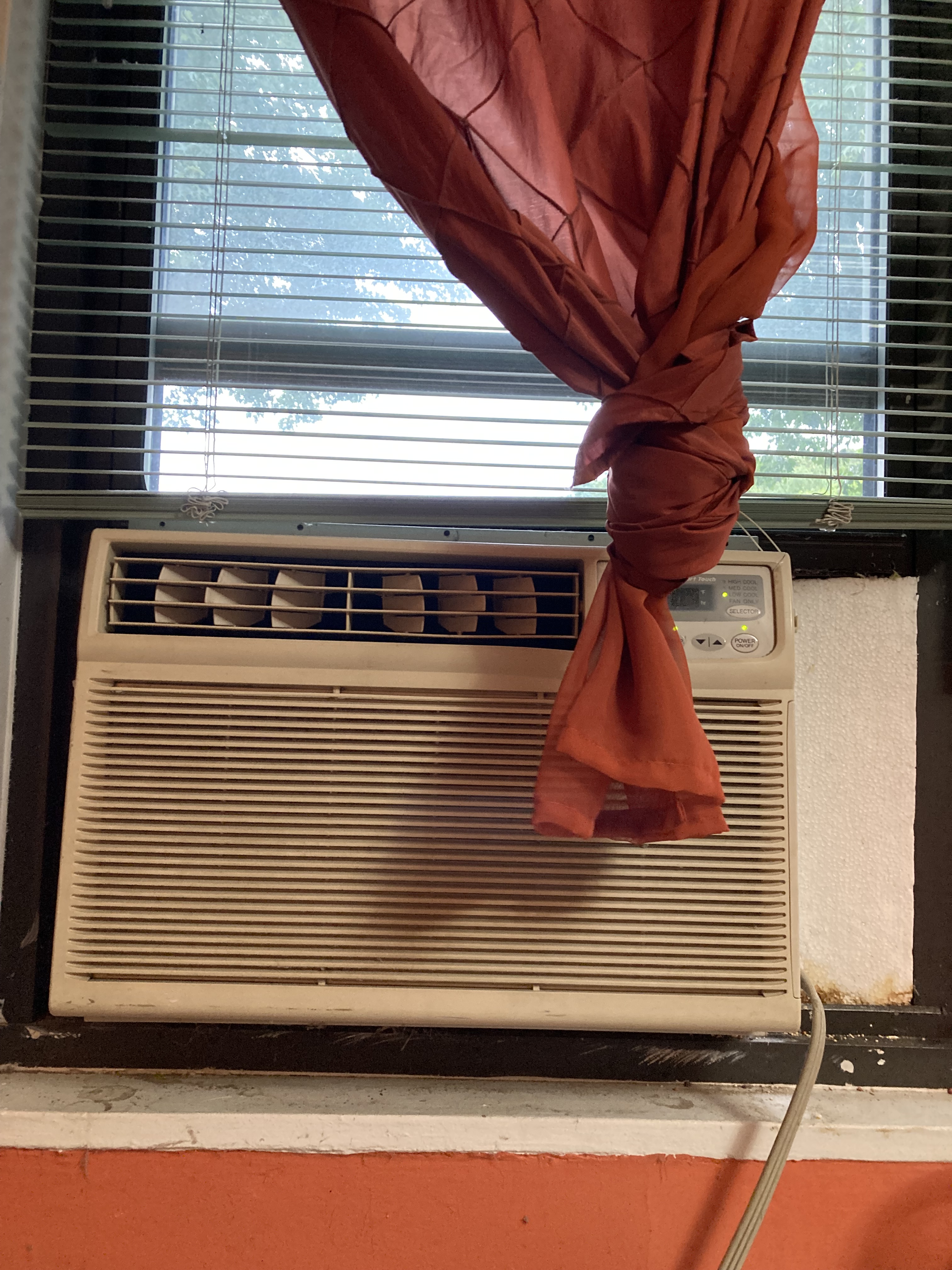
We need a new air conditioner in the living room. For the past few summers we’ve just taken it for granted that every few days we would mistakenly use the microwave in the kitchen while two air conditioners were on at the same time, and blow the circuits, and have to go over to the basement in the next building to reset the main circuit breaker. We had an electrician in at some point to see if there was anything we could do to get more electricity into the apartment, but he told us that it would be a very extensive and expensive job, because he’d have to first get more electricity into our building overall and only then focus on our apartment in particular. So we accepted our fate and tried harder to remember to turn off one of the air conditioners before using the microwave.
Ye Olde Air Conditioner
This summer, though, the power kept going out even without the microwave, or any other possible source of trouble. It didn’t happen as soon as two air conditioners were on at the same time, and it only happened when one of the air conditioners was the big one in the living room, so at first we weren’t sure what the problem was. The worst problems came during the hottest week, when the local electric company was using brownouts to manage the higher than usual usage, so, we realized, each time a brownout happened, and two air conditioners were on, and one of them was the air conditioner in the living room, we lost power.
But knowing that we had no way of fixing the problem, except to sit in the heat with no relief, was not comforting. After blowing the circuits three days in a row, Mom decided that the problem was probably coming from the big air conditioner in the living room which was getting old. She reached out to a friend of my cousin’s, who happens to be an electrician, and was told that, one, older model air conditioners are less energy efficient, and two, as air conditioners get older they use more power. She suggested that we get a newer, more energy efficient one, and, hopefully, that would solve the problem.
So we ordered the new air conditioner, and we hope that once it’s in place we won’t have to traipse outside and into the next building and down to the basement to reset the circuit breaker in the heat of the summer. And who knows, we may even discover that the new air conditioner will even allow us to use the microwave every once in a while.
The problem is, it costs money. And we didn’t have this on our list of expected repairs for this year. Nor did we have the faucet in the bathroom sink on the list, or the new car battery, or the higher cost of groceries, or the latest federal court decision that might mean I have to go back to making regular payments on my student loan, on top of the medical loan.
One of my projects this summer has been to educate myself about all of the bills and home details Mom has been taking care of for so many years, so that if, God forbid, Mom can’t take care of things, I will know what to do. This idea came up as a result of Mom’s second hip replacement, and the heart scare, and a very, very gradual realization that I am not a teenager anymore. I took the project seriously, and in my turtle slow way, I filled a binder with files for each category of responsibility: the car, the apartment (including the mortgage and maintenance and insurance), the appliances, the monthly bills, etc., and I was quickly overwhelmed by how much money it takes to just to keep things copacetic. I have a whole folder on what to do if different appliances and fixtures and furniture break down (with phone numbers for repair people and warranties and preferred brands), but this past month has made it clear that no matter how organized I try to be there will always be unknown costs that pop up. And you know what I can do about that? Nothing. Except raise the dose of my antidepressant, when necessary, and trust that I will be able to figure it out when the time comes.
I just want to say: Phooey. This adulting stuff really sucks. I give it one star, at most.
The new air conditioner is so much quieter!
If you haven’t had a chance yet, please check out my Young Adult novel, Yeshiva Girl, on Amazon. And if you feel called to write a review of the book, on Amazon, or anywhere else, I’d be honored.
Yeshiva Girl is about a Jewish teenager on Long Island, named Isabel, though her father calls her Jezebel. Her father has been accused of inappropriate sexual behavior with one of his students, which he denies, but Izzy implicitly believes it’s true. As a result of his problems, her father sends her to a co-ed Orthodox yeshiva for tenth grade, out of the blue, and Izzy and her mother can’t figure out how to prevent it. At Yeshiva, though, Izzy finds that religious people are much more complicated than she had expected. Some, like her father, may use religion as a place to hide, but others search for and find comfort, and community, and even enlightenment. The question is, what will Izzy find?
Over the past few decades, most liberal Jewish congregations in North America have emphasized Tikkun Olam (usually translated as “Repairing the World”), especially the social action/giving-to-charity interpretation of Tikkun Olam, instead of the particular rituals of Judaism. And more recently, many liberal Jews have seen Tikkun Olam as almost interchangeable with progressive American politics, supporting movements like Black Lives Matter, LGBTQ rights, efforts against Climate Change, etc.
(Two Tikkun Olam images I found online)
In a way, this narrowing of American Jewish values down to Tikkun Olam made it easier for parents to explain to their children what it means to be Jewish, though it left a lot out, and also left out a large portion of the Jewish people who, like me, find meaning and solace in the religious aspects of being Jewish, like prayer and study and rituals and history. But, for the most part, my own liberal Jewish congregation was able to bridge the gaps, accommodating the Jews who wanted to have both a particular Jewish identity and to play a role in the repair of the world overall, and I thought that’s what was happening everywhere else too.
Until October 7th. Many American Jews were caught off guard when their fellow progressives saw Israel, and the Jews who supported Israel, as the enemy. These were Jews who had been raised to see progressive politics and being Jewish as basically the same thing, and couldn’t imagine their lives outside of these movements for social change. Over the next weeks and months, many of these Jews felt alienated and abandoned by their fellow progressives, while others took on the anti-Israel values of their friends; maybe because they’d done their own research and found that they agreed with the progressive stance against Israel, or maybe because they knew very little about the long history of anti-Semitism, and the history of why and how the modern state of Israel came to be and didn’t feel like it was worth losing friends over, or maybe because they identified so much more strongly with their fellow liberal Americans than with the eight million Jews living in Israel (mostly refugees from pogroms and then the Holocaust and then from the surrounding Middle Eastern countries, or the descendants of those refugees), who they knew very little about. I don’t know.
But when I heard from Jews who called themselves anti-Zionists, or distanced themselves from their Jewish communities over conflicting views around Israel, in the aftermath of October 7th, what I heard over and over again was that they were living up to the Jewish values they’d been raised with, especially Tikkun Olam, and that made me think that I needed to better understand the concept of Tikkun Olam and where it came from and how it came to be understood the way so many Jews understand it today.
The first use of the term Tikkun Olam that I could find was in the Mishnah (a commentary on the Hebrew Bible written between 200 and 500 CE), where the rabbis invoked the idea of Tikkun Olam, or repairing the world, when they considered how their legal rulings would impact society overall (by which they meant Jewish society, because that was all they had any control over). Often these legal rulings were focused on small details about how to make the laws clearer and easier to follow. I love the idea that just by making road signs clearer you are improving the world and I love this lower case interpretation of tikkun olam, which basically says that by doing your individual job well, whatever it is, or being patient with others, or taking other people into consideration, you are fulfilling the Mitzvah (good deed or commandment from God, depending on your point of view) of Tikkun Olam.
Maimonides, a medieval Jewish sage, later defined Tikkun Olam as made up of three specific parts: studying Torah, doing acts of kindness, and following the ritual commandments. Many of the small diaspora Jewish communities over the millennia have practiced Tikkun Olam, but most referred to it by its component parts, defining their efforts to help their fellow Jews, by caring for the poor and disabled and elderly in their communities as act of loving kindness (or G’milut Chasadim in Hebrew), rather than referring to them as acts of Tikkun Olam.
The concept of Tikkun Olam overall got a boost from Rabbi Isaac Luria and the kabbalists of the 16th century, when they spoke of how God had contracted part of God’s light in order to create the world, and then created vessels into which to pour God’s light, but the vessels weren’t strong enough to hold all of that power and they shattered. The kabbalists determined that, therefore, our role as Jews, or just as human beings overall, is to collect the shards of those vessels and the sparks of God’s light, like a big jigsaw puzzle, in order to repair the world. But the way we collect those divine sparks, they said, was pretty much the same as Maimonides had prescribed: studying Torah, doing acts of kindness, and following the ritual commandments.
And then, as Jews began to thrive in places like the United States, where they were free to live and work where they wanted to, many of their G’milut Chasadim efforts to help one another (creating hospitals, social work agencies and charities) grew into more universal organizations meant to help all Americans, Jews and non-Jews alike. At the same time, many Jews were also stripping away the particularly Jewish aspects of their identities in order to fit in with the larger American culture, which they were now free to do, and encouraged to do. And many Jewish congregations and organizations therefore made an effort to keep those more marginally connected Jews in the fold by emphasizing the Jewish value of Tikkun Olam, and redefining Tikkun Olam in a way that allowed these less connected Jews to see their charitable giving and political activism as distinctly Jewish and therefore able to be done in place of the old traditions.
One of the things that started to bother me about the modern take on Tikkun Olam was that it became very prescriptive and rigid. In part because , from what I’ve seen, when people focus their ethical behavior singularly on social activism, at both the left and the right extremes, they begin to harden their hearts as their goals becomes more important than any individual people involved, and their ideals eventually calcify into weapons. Because, really, it takes a lot of self-knowledge to create real empathy with someone else’s struggle, and to know how to be genuinely helpful, and that wasn’t a value that was being emphasized in these social action movements.
In the midst of my wrestling with this concept of Tikkun Olam, and feeling torn and bruised by the battle, my rabbi happened to mention another phrase that I hadn’t heard before: Tikkun HaLev, which roughly translates to “repairing the heart.” He said it offhand during a bible study session and I wrote it down, without context. When I looked back at my notes, and realized I didn’t know what it referred to, I went to my friend Google to find out. But I only found a few references, most of which emphasized that repairing the heart is a way to improve your ability to practice repair of the world. I struggled to find any references to what the rabbis themselves meant by the term, or if they had even used it. So I went back to my rabbi and asked him what he’d been referring to when he talked about Tikkun HaLev, and he didn’t even remember saying it, let alone what he’d meant by it.
What all of that said to me was that I was free to translate Tikkun HaLev however I wanted. I could envision a little stick figure character with a broom sweeping the dirt away from a big red heart, or I could imagine a heart-shaped character lifting weights at the gym, or getting surgery, or at least stitches. Or, I could think of the kind of work I’ve been doing in therapy forever, which is about healing my own pain and, only as a side effect, growing my ability to have compassion for others. But the most enduring image that came to mind when I thought of repairing the heart was of the hundreds of times my mom picked up a dog toy from the floor, where its fluffy white guts were spilling out after yet another vigorous play session, and gently re-stuffed and resewed that beloved toy, so that whichever dog it belonged to could continue to play with it and love it.
Miss Ellie, surrounded by her repaired toys.
If I were going to create my own practice of Tikkun HaLev, or repairing the heart, I would focus on the small details that I actually have some control over, and the ways that fixing those small things improves not just my own life but the lives of the people around me. I can smile at a neighbor, pet a dog, plant a tree, or a flower, practice being patient when a friend tells a rambling story, and take the time to listen and make eye contact when someone needs to complain about the cost of medication. And adding repair of the heart into my vision of how to repair the world could also allow me to be more humble in my assumptions about what needs to be done and what is actually possible.
In my own version of all of this, I would also want to include outward signs of my Jewish identity, to remind myself and others that being proud of my Jewishness doesn’t mean that I reject the modern and secular world at large, that I can value both at the same time. But that’s just me.
We are at a point in history where the need to repair our world has become obvious to almost everyone, and we have many different ideas for how that repair should be done. My hope is that we can take some of this energy to repair our hearts as well, and to grieve our losses, and try to be more generous, to ourselves and others, as we go through this process together.
“Shh. Don’t tell anyone I’m up here on the computer. I don’t like the idea of surgery.”
If you haven’t had a chance yet, please check out my Young Adult novel, Yeshiva Girl, on Amazon. And if you feel called to write a review of the book, on Amazon, or anywhere else, I’d be honored.
Yeshiva Girl is about a Jewish teenager on Long Island, named Isabel, though her father calls her Jezebel. Her father has been accused of inappropriate sexual behavior with one of his students, which he denies, but Izzy implicitly believes it’s true. As a result of his problems, her father sends her to a co-ed Orthodox yeshiva for tenth grade, out of the blue, and Izzy and her mother can’t figure out how to prevent it. At Yeshiva, though, Izzy finds that religious people are much more complicated than she had expected. Some, like her father, may use religion as a place to hide, but others search for and find comfort, and community, and even enlightenment. The question is, what will Izzy find?
This past winter and spring, I was busy writing something new. I had wanted to work on revisions for the second Yeshiva Girl novel, which has been in the works for way too long, or add to the draft of the synagogue mystery that I’ve also been mulling over for years, but instead a new story burbled up. By May, I had a 220 page first draft of a novel, tentatively titled Hebrew Lessons, about a young woman who takes online Hebrew classes (like me) and falls in love with her Israeli teacher (that part is fiction. Sorry). It was fun to write and also gave me a chance to think about the relationship between Jews in America and Jews in Israel, which has always been complicated, and has become even more so since October 7th.
The problem is, now that I have to start re-reading the draft and planning revisions, I can’t make myself do it.
While I was writing the first draft I was able to shut out the big, noisy critics in my head, for the most part, with a gentle “Shut the fuck up!” But now that I’m ready for revisions I need to keep the door open to critiques, and the big, noisy, nasty voices in my head keep pushing their way in through the open door.
Even looking in the direction of the manuscript, which is sitting on a pile of books next to my bed, brings up all of the nasties: How dare you write a story with an Israeli character when you’ve never been to Israel? What the hell do you know about love? No agent will touch a book with a Jewish character now, let alone an Israeli! Everything you write gets rejected so why waste your time? Your writing is too serious, silly, sentimental, simple, stupid, etc. You should be ashamed of yourself for thinking your voice even matters. You should be doing something more responsible, selfless, constructive, etc. with your time. If you actually finish the book you’ll have to write query letters and face rejection, and you’ll be embarrassed when people see your imagination written out on the page, like an x-ray of your inner self.
At first I thought I just needed a few weeks away from the book to get some perspective, but then weeks passed and, if anything, the voices got louder, and nastier, and I couldn’t do anything to stop the flood.
Eventually, an image came to mind from the first Superman movie (with Christopher Reeve), where the bad guys (General Zod and his two henchmen) are sentenced to jail and trapped in these flat/see-through boxes where they can be seen, but not heard, for eternity. And I thought, that would be awesome!
Mom found me a jar (she collects them for art projects) and I labeled it “Unhelpful Critics” and started to fill it with slips of paper slathered with critical messages. But the voices kept coming, threatening to overflow the jar, and my resistance to reading the draft stayed just as strong.
I’m sure that part of the problem is my inability to convince myself that it’s okay to ask to be treated with kindness, so when a critique is hurtful and I want to shove it in the jar, I worry that I’m being too easy on myself and ignoring a painful reality that I really should force myself to face. There’s also the issue that it’s been hard to separate out a specific, technical criticism (the pacing is too fast or slow, the details of the setting are too sparse or vague) from the big bad feelings that stick to every criticism and feel like a punch in the gut. It’s as if the nasty, destructive voices in my head attach themselves to even the mildest suggestions for improvement, and make it all into a toxic mess.
But I really wanted the jar, or anything, to work, so I kept filling out these strips of paper, until I had to graduate to an oatmeal container, and then until I couldn’t capture them in words anymore, but they were still coming, constantly.
It took me too long to start to wonder why all of this pain was coming up around the novel, and yet I’ve been able to write weekly blog posts forever without being swamped this way. And I had to ask myself, why is writing fiction, in particular, bringing all of this up?
I have always loved fiction, writing it and reading it, for the way it can organize reality, and improve on it, and create safer containers for all of the experiences that overwhelm me in real life. But maybe, at least in this case, imagining a better version of my life, and myself, means facing all of the grief I feel that that isn’t my life, and the jealousy I feel that this imaginary young woman gets to live that life. There’s also, interestingly, a deep fear of the unknown, because in living vicariously through her, and facing difficulties and opportunities I’ve never faced, I’m overwhelmed with anxiety about how to solve these unfamiliar problems, in love and life and work. And I feel guilty that I don’t have the tools to protect her from that pain.
I think there’s another aspect to this as well. When I write my short essays I imagine my blog readers, who are so kind and curious and generous, and so much nicer to me than I am to myself, and that allows me to feel safe enough to write difficult things. But when I write longer things, like the novel, or something else that I expect to send out to literary magazines or agents or editors, I hear the cold, dismissive, and destructive voices I’ve faced so many times over the years, in graduate school and beyond, and those voices set off my inner critics and it becomes a wildfire.
Maybe, if I could find a way to think of the novel as a very long blog post, or just imagine my blogging friends as my primary readers, the nasty voices would step aside, or at least quiet down, but I don’t know how to make that switch. If I tell myself that I’m not going to send the novel out to be judged by the industry, then either I won’t believe it, or I’ll believe it and that will set off a whole other kind of grief, because I’m not ready to give up on the possibility of being a successful author, not yet.
But the thing is, I really loved writing the first draft of this book, and I want to get back to that feeling, and I also want to finish the book so I can see if other people like it as much as I do. I feel like just writing this essay has gotten me most of the way there, but I’m not quite there yet, and I’m not sure what else to try.
“Curling up in a ball works for me. Just a suggestion.”
If you haven’t had a chance yet, please check out my Young Adult novel, Yeshiva Girl, on Amazon. And if you feel called to write a review of the book, on Amazon, or anywhere else, I’d be honored.
Yeshiva Girl is about a Jewish teenager on Long Island, named Isabel, though her father calls her Jezebel. Her father has been accused of inappropriate sexual behavior with one of his students, which he denies, but Izzy implicitly believes it’s true. As a result of his problems, her father sends her to a co-ed Orthodox yeshiva for tenth grade, out of the blue, and Izzy and her mother can’t figure out how to prevent it. At Yeshiva, though, Izzy finds that religious people are much more complicated than she had expected. Some, like her father, may use religion as a place to hide, but others search for and find comfort, and community, and even enlightenment. The question is, what will Izzy find?
It was time to renew my social work license, five years after earning it, five years during which I haven’t been working in the field at all, and I felt torn. I mostly thought I should renew it, even if it cost money and took time, in case I wanted to work as a social worker again one day, but part of me wanted to burn that bridge, so I would have no choice but to focus on teaching and writing, without the option of an escape hatch.
I received the renewal notice by email a few weeks ago, and kept looking at it, wishing it would go away. Partly, I was afraid that the process of renewing my license would be complicated or stressful, asking embarrassing questions about why I wasn’t actually working as a social worker. And I was afraid that renewing my license would cost a lot of money, or require me to reach out to former bosses, or current bosses, for documentation, or that I’d find out that I need to do a lot more expensive and time consuming trainings in order to qualify for license renewal in the first place. But I was also afraid of finally giving up on the idea of being a therapist.
The thing is, my decision not to seek a job as a social worker was not simple. It came after six months of applying for jobs and getting nowhere, even with personal contacts or recommendations. The biggest problem seemed to be that, despite being a beginning social worker, I could only work part time, or less, because of my health issues, and, at least at that time, the jobs that allowed for flexibility and limited hours were not available to beginners. But I was also not sure I was actually ready to be a social worker/therapist.
Towards the end of my time in graduate school I had been telling my teachers and bosses and advisors that I didn’t feel prepared and that what I really wanted was a third internship to help me figure out where in the field I belonged, but they all said that I shouldn’t need such a thing and it wasn’t possible anyway, so just get off your ass and get a job. And I couldn’t.
I liked the idea of myself as someone who could help people heal. And I liked the image of myself as a respectable and responsible adult who goes to an office and actually makes enough money to buy nice clothes and go on vacations. And I wanted to fight for better insurance coverage for mental health, and to argue against the ubiquitous manualized, supposedly evidence-based short term therapy that only actually helps if you have a short term problem. But the reality of social work, eh, I didn’t love it. I hated the phone calls, and the office politics, and the paperwork, and the long hours, and the clothes I had to wear, and the constant criticism from bosses and clients and client’s families, and I hated the staff meetings and the family drama and on and on.
Oy.
When I was first offered the job teaching after school synagogue school, five years ago, I accepted with relief, thinking that it would be a good first step, and allow me to accumulate experience working with children while I continued to pursue every available avenue to improve my health and eventually get to work as a therapist, and I kept taking one or two trainings each year to keep up my skills, just in case. But five years later, my health is worse, not better, and more importantly, when I think about adding more hours to my work week I tend to think about more teaching and more writing, not social work.
And then the renewal notice came, and it took me five read-throughs to realize that it wasn’t even due for another five months (when I’m anxious I tend to skim things and miss important information), but I still felt like I had to hurry up and get it done. So after a lot of handwringing, I went to the website and opened the renewal form, and one of the first things they asked if I’d like to go on “inactive” status, which would be free, and could be reversed at any time. And I thought, “Oh! I didn’t know that was an option!” It sounded perfect and I felt much better, for a second, especially about the money I would not have to spend, but then the relief went away and the nagging worries returned, because it’s hard to let go of something that once seemed like the answer to everything, even when it didn’t seem like the answer to anything anymore.
And yet, I couldn’t convince myself to close the door on social work, given all of the time and money and hope I’d invested in that goal for so many years. So, I filled out the renewal form, which mostly consisted of checking a few boxes and paying the fee, and then I set to work planning more training classes, because, I don’t know, I guess I’m kind of stubborn.
If you haven’t had a chance yet, please check out my Young Adult novel, Yeshiva Girl, on Amazon. And if you feel called to write a review of the book, on Amazon, or anywhere else, I’d be honored.
Yeshiva Girl is about a Jewish teenager on Long Island, named Isabel, though her father calls her Jezebel. Her father has been accused of inappropriate sexual behavior with one of his students, which he denies, but Izzy implicitly believes it’s true. As a result of his problems, her father sends her to a co-ed Orthodox yeshiva for tenth grade, out of the blue, and Izzy and her mother can’t figure out how to prevent it. At Yeshiva, though, Izzy finds that religious people are much more complicated than she had expected. Some, like her father, may use religion as a place to hide, but others search for and find comfort, and community, and even enlightenment. The question is, what will Izzy find?








 rachelmankowitz