The latest experiment in my journey to convince Tzipporah that I’m not so bad, has been to place chicken treats at the entrance to my room at bedtime, trying to catch her attention while she’s on her way to or from her Midnight Snack with Grandma. It is an attempt at bribery, pure and simple, but so is most of the clicker training I learned back when we were trying to convince Cricket that she was not the boss of everyone (unsuccessfully, of course).
There is an old Jewish tradition of giving honey to young students when they first start studying the Hebrew Bible, so that they’ll pair study with sweetness forever after (though the version I heard had the rabbis putting honey on the student’s slates, and the student would lick off the honey with the chalk of the Hebrew letters, which does not sound delicious, or sanitary, so I tend to give my students lollipops instead), and since Tzipporah is much more of a savory girl than a sweets aficionado, I have built my current experiment on the treats she most craves – chicken jerky.
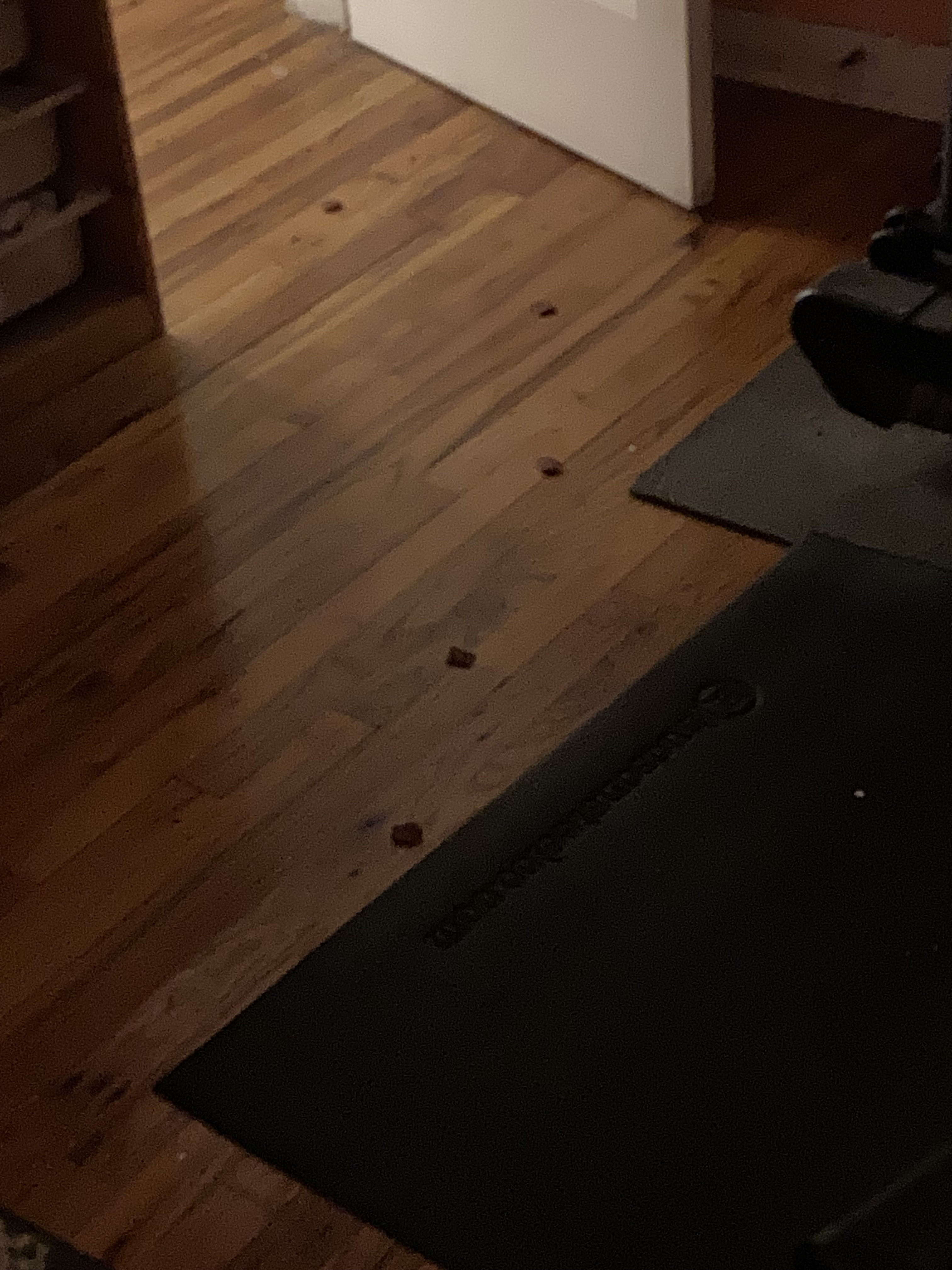
Each night, I break one piece of chicken jerky into smaller and smaller pieces, and spread them further apart so she has to actually walk into my room to find them all. And since she believes in only taking one treat at a time, no matter how small they may be, she now comes in at least five times to get through the whole trail, usually more than five, because she’s ever hopeful that more will appear. She’s still not looking up and acknowledging my presence, but we both know I’m there.
The trail of treats
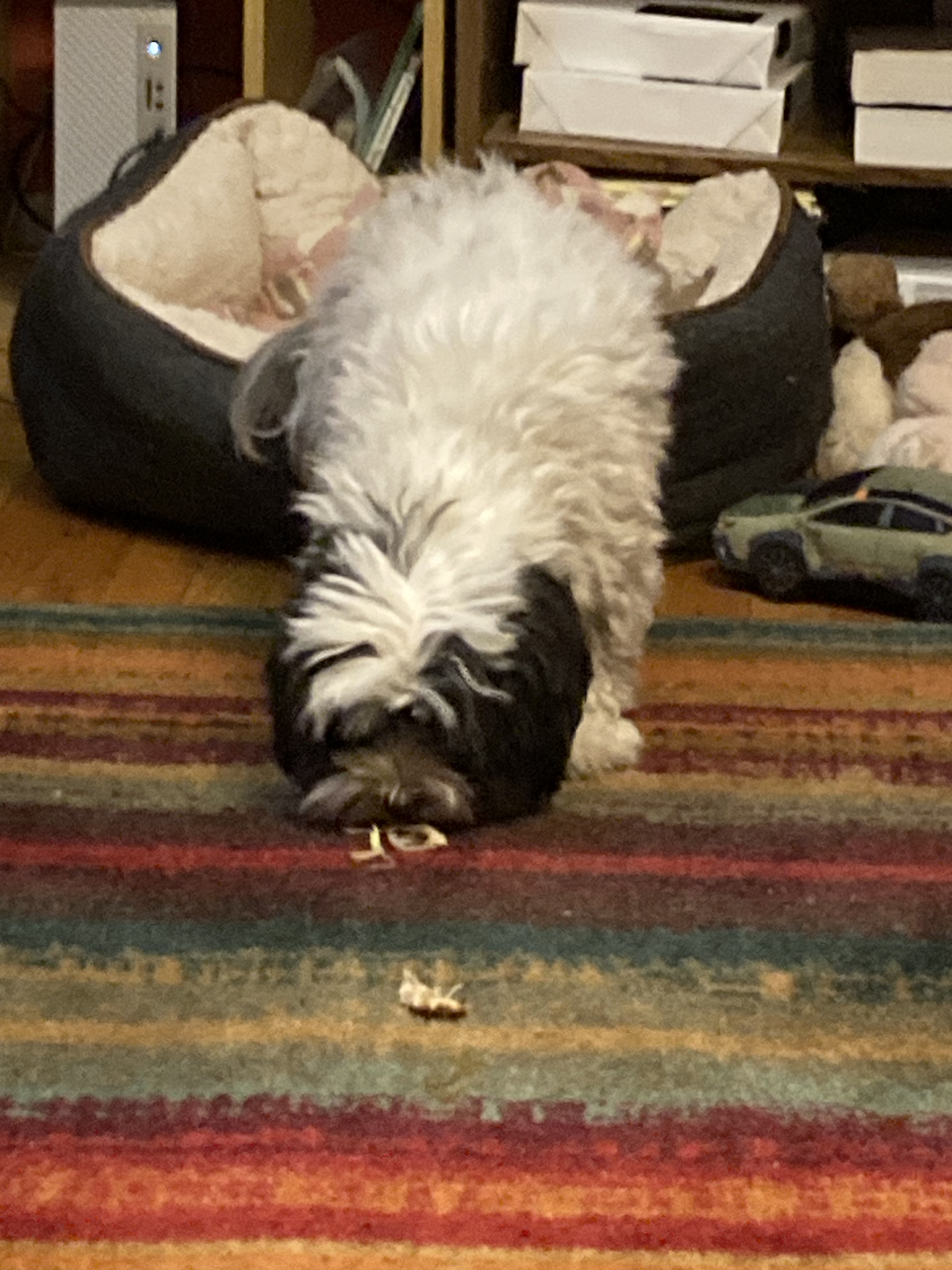
The elusive Tzippy, caught on camera
There may need to be a second part to this experiment, because getting her into the room doesn’t equal coming directly to me for treats, or thinking of me as a safe person, but I haven’t thought that far ahead.
But at least now, she has learned to stop and check my doorway as she passes by, and even to linger and check more carefully in case she missed something, rather than just taking a cursory sniff and moving on. She does this at least once at night and once during the day (if I’m in my room instead of sitting in the living room with her). Not only do the chicken treats draw her attention, but they also seem to help mute her anxiety at entering my room while I am present. In the past (last week), Tzipporah would come to my door, see me seeing her, and immediately bolt; but with her nose to the ground searching for treats, she’s less concerned, or at least less aware, of where I am and what I’m doing (I am, of course, watching her and trying to get pictures).
It’s hard not to compare how much farther along Tzipporah has gotten in her relationship with my mom (her grandma) than in her relationship with me. Mom can even hold out a treat, sometimes, and Tzipporah will gently take it from her hand. But, I figure, why not learn the lesson, and tap into the thing that has been working for them all along (being super generous with treats) and see if I can catch up. So far, Tzipporah doesn’t seem to mind.
“Where are the rest of my treats?”
If you haven’t had a chance yet, please check out my novel, Yeshiva Girl, on Amazon. And if you feel called to write a review of the book, on Amazon, or anywhere else, I’d be honored.
Yeshiva Girl is about a Jewish teenager on Long Island, named Isabel, though her father calls her Jezebel. Her father has been accused of inappropriate sexual behavior with one of his students, which he denies, but Izzy implicitly believes it’s true. As a result of his problems, her father sends her to a co-ed Orthodox yeshiva for tenth grade, out of the blue, and Izzy and her mother can’t figure out how to prevent it. At Yeshiva, though, Izzy finds that religious people are much more complicated than she had expected. Some, like her father, may use religion as a place to hide, but others search for and find comfort, and community, and even enlightenment. The question is, what will Izzy find?
According to Google, cognitive dissonance is a “psychological phenomenon where a person holds two or more conflicting beliefs, attitudes, or behaviors simultaneously. This inconsistency creates discomfort and tension, motivating the individual to resolve the dissonance.”
This concept came to mind recently while I was watching the first season of 911 (after a marathon binge of the show, starting in season three, that left me really curious about how the series began). I was especially interested in the romance between Abby, a 42-year-old 911 operator, and Buck, a 26-year-old rookie firefighter, because it set up the whole structure of the show, where they follow 911 calls through to their resolutions. But almost immediately, I felt queasy about the age difference between the two characters. I had to remind myself that, even though he was immature, Buck was an adult, and even though Abby was 42, she was at a vulnerable stage in her life and not in a position to take advantage of any perceived power differences between the two of them. They were both so obviously in need of love, and specifically in need of the kind of love the other had to offer, but…
Maybe because of the low stakes (it’s a TV show after all), I was able to sit with the dissonance and let it simmer for a while (a day or two, actually, because I watched the first season all in one go), and I realized that even though these moments of cognitive dissonance can be uncomfortable, or worse, they are also an opportunity for deeper understanding, of ourselves and of others.
When we see this kind of cognitive dissonance in our politicians, we tend to call it hypocrisy. How can you say you care about the poor and then fight so hard to cut Medicaid?How can you say you are an advocate for survivors of sexual abuse and then ignore the sexual offences of your favorite politician? In our private lives, it can show up maybe as wanting to save money for retirement, and then going on Amazon to buy ten things we don’t need.
“I needed all of it, Mommy!”
Like many psychological terms and theories, cognitive dissonance feels like a judgement being made on other people, a negative way of naming how we behave, without bothering to understand why we do it or having compassion for the struggle. Psychologists and therapists, and many other helping professionals, tend to feel overwhelmed by the chaos their patients or clients bring into the room and rely heavily on the intellectual distance of naming things to keep the chaos from seeping into their own lives.
The emphasis in the cognitive dissonance articles I was able to find, was on how we tend to resolve our dissonances, often with defense mechanisms, like: avoiding the dissonance altogether by staying away from discussions or situations that bring it up; delegitimizing the person or group or situation that highlighted the dissonance (this is fake news!); or minimizing the impact by telling yourself that you didn’t really go against your beliefs, or you just did it one time. Rarely, the articles seemed to suggest, do we actually choose to change our behavior or reassess our value systems in order to resolve the dissonance.
I’m not comfortable with the judgment (name calling) underlying all of this, and the assumption that we are all lying to ourselves all the time in order to resolve our discomfort, but I still think Cognitive Dissonance can be a useful concept, if we use it as a way to identify a problem that needs further attention. Ideally, if I feel guilty for doing something I didn’t plan to do, I can be curious instead of judgmental. And if I find myself minimizing, rationalizing, ignoring new information, or dismissing research out of hand, I can be curious rather than self-loathing. I can choose to look at the dissonance as a mystery worth exploring, a part of myself that deserves more of my attention and respect, rather than my judgment or impatience.
Just like in music, dissonance can catch your attention in a way that harmony may not, and it can tell you that something important is happening: it could be a mistake (you played the wrong note); or it could be the entrance of a new character, or a change in mood; or it could be the start of a disaster.
The Abby and Buck story on 911 tapped into two of my strongly held, and in this case opposing, beliefs: 1) that age/power/status differences between people can lead to abuse if we’re not careful about setting clear boundaries, and 2) love is a wonderful and healing thing. The way the show dealt with the dissonance in the relationship was both to minimize the weirdness of the age difference (by rarely mentioning it), and, in the end, by sending Abby off on a trip around the world until Buck could get over her. The un-stated conclusion was that two people who are at two very different places in their lives (either because of age or status or something else) may be able to spend time together and do each other good, but only for so long. The creators of the show chose not to sit with the discomfort inherent in such an age difference for more than a season, maybe because it made them that uncomfortable, or maybe because they discovered that it made their audience uncomfortable. And in season two, they replaced Abby’s character in the ensemble with Jennifer Love Hewitt, playing Buck’s older sister, suggesting that Buck was drawn to Abby in the first place in part because he was missing his sister, or missing the supportive role she played in his life, helping to ground him and give him perspective.
Even though I really liked the character of Abby, and especially the actress who played her (Connie Britton), I was relieved when she left the show and the void was filled with two new characters, Maddie (Buck’s sister) and a separate love interest. The dissonance that Abby and Buck’s relationship brought up for me, and for others, it turned out, was fundamentally not resolvable. I do wonder, though, what would have happened if the writers had made a different decision, and allowed that relationship to play out over a longer period of time. Would that have offered me an opportunity to delve more deeply into my own beliefs and feelings about power gap relationships, or would I have had to stop watching the show because it just made me too uncomfortable? (It’s also worth considering how the storyline would have been treated differently if the 42-year-old character had been male and the 26-year-old female. Would they have even told us their ages? Would I have thought to be bothered by it?)
While I was researching cognitive dissonance, I also came across the related quote, attributed to F. Scott Fitzgerald, that “Intelligence is the ability to hold two opposing ideas in mind.” The quote suggests that it’s a sign of intelligence to be able to entertain conflicting theories or facts without becoming overwhelmed or paralyzed, but I think the ability to face your cognitive dissonance is more about emotional strength, or intellectual bravery, rather than intelligence itself. I know a lot of highly intelligent people who, when faced with opposing ideas or desires within themselves, or facts in contradiction to a well-loved theory, resort to ever more inventive defense mechanisms to try to deny the existence of the conflict.
And I am no different. Recently, I was listening to a podcast by Haviv Rettig Gur, an Israeli journalist who writes and speaks in English to reach an audience outside of Israel. He was responding to an article in Haaretz (Israel’s venerable left-wing newspaper), that claimed Israeli soldiers were intentionally shooting at Gazans seeking aid. My first response, when I saw the article in my newsfeed, was disbelief, and then anger that they would even repeat such claims. How dare they suggest that the IDF would deliberately kill civilians, especially after telling me over and over again that the IDF does its best to avoid civilian casualties. But Haviv Rettig Gur, as a journalist, was able to sit with the dissonance (between believing that the IDF tries to avoid killing civilians and the reports that they were doing just that), and what he came to understand, or believe, was that, yes, the shootings were happening (though probably not in the numbers reported by Hamas), not because the soldiers intended to randomly kill civilians, but rather because these young soldiers were being tasked with protecting aid locations without being trained for the task. Most of the soldiers involved had been taken from nearby battlegrounds, where they were under attack from Hamas soldiers wearing civilian clothes, facing booby-trapped buildings and roadside bombs and all kinds of dangers around every corner, and then suddenly they were told to guard aid sites, where the signage was unclear and it was inevitable that civilians would go the wrong way at the wrong time and the soldiers were going to see them as a threat.
The problem, as Haviv Rettig Gur saw it, was caused both by the presence of Hamas in the aid areas and by the expectation of Israeli politicians that these soldiers could be tasked with protecting the aid sites without adequate training or support. Those politicians, especially the ones with little to no military experience (which is a significant deficit in Israel, where army service or an equivalent form of civil service is required for the majority of the population, but the fight over whether or not the ultra-orthodox have to serve is ongoing), probably thought they could order the army to do whatever they wanted, like ordering a special hamburger off menu. And when the army’s leadership said they couldn’t do it, the politicians probably assumed that they were lying for some reason, because that’s what the politicians themselves would have done. Are some of those politicians okay with killing civilians? Yeah. Some of the far-right politicians have basically stated their disinterest not only in the lives of Palestinian civilians but in the lives of Israeli soldiers and Israeli hostages as well. Should they still have their jobs? Not at all, but Netanyahu appeases them in order to keep his coalition government afloat. Is this the best way to run a country, especially during a war? Not even a little. But when the attorney general or the supreme court in Israel have tried to intervene, the government has threatened to dismantle the whole system of checks and balances (this is what led to the year long protests across Israel in the year leading up to October seventh), and being attacked by Hamas didn’t fix the underlying hypocrisy and graft in the government that is now tasked with protecting its people from further attacks.
The dissonance between Israel’s stated dual values of protecting civilian lives and eliminating Hamas has been there from the beginning, and ideally those conflicts would have been openly addressed and debated, with deep discussions as to the value of human life and the needs of a populace to feel secure, but instead the conflicts have been minimized and denied, to disastrous effect.
Another example. When it became obvious to the people around Joe Biden that he was losing his faculties, yet still insisted on running for President again, they could have been open, with him and with the American people (or at least with the higher ups in the Democratic party), about their concerns. There could have been discussions about how to prevent a Trump presidency (with all of its inherent dangers to democracy), while also pursuing an open Democratic primary, and a contest of ideas leading to the best possible candidate, or at least an open acknowledgment that our country is still not ready for a woman of color as our president; but instead, they rationalized and made excuses and got defensive, and therefore they could not solve the problem at all, until it exploded.
Unfortunately, we are living in a time when defense mechanisms are being chosen over reality, not just by some people but by most people, and especially by those in power. Republican congressmen are ignoring their cognitive dissonance around the “Big, beautiful bill,” with its severe Medicaid cuts and inevitable growth of the national debt, because they seem to be too afraid of Trump to vote their stated values. And many Israelis, at least at the beginning of the war with Hamas, seemed to be willing to ignore the suffering in Gaza because they thought empathy for the civilians would get in the way of their goal of removing Hamas as an existential threat. Most Israelis have, as far as I can tell, grown throughout the war in their empathy and willingness to face a complicated reality, including the realization that removing the threat of Hamas entirely may be impossible.
The acknowledgement of a cognitive dissonance, between what you may have hoped to be true and what is really happening, or who you thought you should be and who you really are, can be painful and frightening, and can lead to hopelessness and despair, which explains why we have found so many creative ways of avoiding the dissonance. At times it can feel like the dissonance is unresolvable, because it may be, and therefore that there’s no point in facing it. And sometimes we really do need the respite that denial and minimization can provide, until we feel strong enough and capable enough and supported enough, to face the truth. But it’s only when we allow ourselves to see all of the facts, and to face all of the conflicting facets of ourselves, that we have any real chance of finding solutions, or at least of processing our grief when solutions are found to be impossible.
“Is it treat time yet?!”
If you haven’t had a chance yet, please check out my novel, Yeshiva Girl, on Amazon. And if you feel called to write a review of the book, on Amazon, or anywhere else, I’d be honored.
Yeshiva Girl is about a Jewish teenager on Long Island, named Isabel, though her father calls her Jezebel. Her father has been accused of inappropriate sexual behavior with one of his students, which he denies, but Izzy implicitly believes it’s true. As a result of his problems, her father sends her to a co-ed Orthodox yeshiva for tenth grade, out of the blue, and Izzy and her mother can’t figure out how to prevent it. At Yeshiva, though, Izzy finds that religious people are much more complicated than she had expected. Some, like her father, may use religion as a place to hide, but others search for and find comfort, and community, and even enlightenment. The question is, what will Izzy find?
I never learned how to play chess. My father tried to teach me at some point, but for a man who made his living as a teacher, he was crap at teaching me: he was impatient, he blew up, he forgot to how to teach and just gave me the instructions you might find on the back of a cereal box. When my older nephews started to play chess, to the point of taking lessons and competing, I still didn’t get involved. I would play a game of make believe with them or go on any nature walk they wanted, but I could not and would not play chess.
But recently, after adding yet another language to my Duolingo list (Arabic), and struggling to figure out the alphabet and how the letters change when they are at the beginning, middle or end of a word, I got a notification that Duolingo now teaches chess, and just as an escape, I decided to try it.
In general, I like the way Duolingo approaches teaching. I like that it’s fun and the lessons are short and that you learn by doing rather than by reading, but they often go too fast for me, jumping through the early stages of a language or skill, and leaving out necessary steps or repetitions. Given all of that, I enjoyed the first few chess lessons, where they showed me what each piece on the chessboard is allowed to do and gave me a chance to practice, but too quickly, they moved on to lessons on strategy (move your knight here to block a potential attack, convince your bishop to die to save his queen, if all else fails run away). Of course, I made a million mistakes, and since I only have the free version of Duolingo, I had to watch a million ads to earn enough lives to redo the lessons, over and over, until they started to make even a little bit of sense.
As with Arabic, and Yiddish and German and Spanish before it, I resent that Duolingo gives me so few points for reviewing lessons, and so many for constantly moving forward. It mimics real life, where speed of progress seems to be more important than knowledge retention, or mastery, or sanity, and just like in real life, it leaves me feeling like a failure.
I was always a smart kid, so people assumed that I could pick up any new material easily, and sometimes I could, but when I needed more time or explanation to figure something out, teachers got impatient with me. I remember loving my math workbooks as a kid, because for each lesson there were pages of exercises, and I could practice until I not only understood what I was being taught but could do it automatically. Ideally, I would have had a stack of workbooks for every skill I’ve needed to learn, like how to open a bank account, or pay bills, or buy a car. Why is it assumed that people will just know how to do all of these things on their own? Even with Professor Google around to give us endless information, we still need support and advice and time to master new skills. Don’t we?
“We also need chicken treats. A lot of them.”
Anyway, the shame I keep feeling at the things I don’t know how to do, and don’t know how to learn how to do, keeps getting in my way, and what I seem to need, whenever a skill seems too complicated or overwhelming, is to be able to break it down into bite-sized lessons and practice all of them until I feel confident enough to move on to the next. So, I’ve been practicing how to give myself that time and compassion with chess: repeating the same lessons over and over again, for very few points, until I feel secure enough to move forward, no matter how little reward Duolingo chooses to give me for my efforts. And, no, I don’t think that learning how to play chess will fix my brain, or my life, but maybe building these habits while learning how to do this thing that in every other way is meaningless to me, might help me figure out how to learn the things that really matter to me, helping me map out the steps I need to take, rather than the steps that other people assume should be enough.
The problem is that, in Duolingo as in life, I keep forgetting my overall goal in favor of wanting to win at the current game. I crave the validation that comes with earning points and rewards, or praise and acceptance, and I forget that that’s not the goal I was shooting for in the first place. It’s kind of like how I can start the day planning to eat the right balance of protein, fat, and carbs and then I’ll see a box of cookies and completely lose my way. But that’s what practice is for, right? So that even if I go off on a cookie tangent every once in a while, I’ll remember how to get back on track. Though, right now, all I can see in my mind is a road paved with chocolate chip cookies, coated in milk chocolate, and colored sprinkles.
“Where is this road?”
If you haven’t had a chance yet, please check out my novel, Yeshiva Girl, on Amazon. And if you feel called to write a review of the book, on Amazon, or anywhere else, I’d be honored.
Yeshiva Girl is about a Jewish teenager on Long Island, named Isabel, though her father calls her Jezebel. Her father has been accused of inappropriate sexual behavior with one of his students, which he denies, but Izzy implicitly believes it’s true. As a result of his problems, her father sends her to a co-ed Orthodox yeshiva for tenth grade, out of the blue, and Izzy and her mother can’t figure out how to prevent it. At Yeshiva, though, Izzy finds that religious people are much more complicated than she had expected. Some, like her father, may use religion as a place to hide, but others search for and find comfort, and community, and even enlightenment. The question is, what will Izzy find?
At long last, after a series of singing cries (because Grandma had run out of treats), Tzipporah barked! She surprised us, but even more than that she surprised herself, and ran back to her bed in the living room empty-pawed. Even the next day, she still seemed exhausted by the whole experience. What was that noise? Did it really come from me? And how is it possible for Grandma to run out of treats?!
It was a lone bark, at least so far, and even her cries have been muted in the aftermath (it’s possible that Grandma has been handing out extra treats without telling me), but it’s good to know that her barking machinery works, should she want to use it at some point.
But I keep getting impatient. She still has no idea why I sometimes pick her up just to hold her for a little while (we watched an episode of a crime drama set among puppy mills in France and it almost broke me, and I needed a hug). But I can hold her for just a little while before she starts looking for any possible escape route. And then, when she finally gets free, she starts running back to her bed, stops and turns around to give me a dirty look, and then continues on her way.
I got a little bit desperate at one point and picked up her stuffed puppy to hold it on my lap for a while. I gave the stuffed puppy some ear-scratches and head pats, and then set it down in the second doggy bed and gently covered it with one of the doggy blankets. Tzipporah found the whole drama fascinating, but I’m not sure what she learned from it, except that her mommy is weird, which she already knew.
I have to keep reminding myself that any progress Tzipporah makes is miraculous and we’re not on a clock here, but I still have no idea what she’s thinking when she stares at me endlessly. Is she watching me so closely because she likes me and wants to know me better? Or because she’s wary of me and needs to be on her guard? Or because I’m just that fascinating? She sees me staring at the TV quite a lot, though, so maybe she’s just mimicking me.
The thing is, Tzipporah really does keep making progress, even if the pace feels slow to me. During her first visit to the groomer, back in the winter, she panicked when they tried to trim the hair on her front paws, so we were told to give her some ACE (doggy Xanax) before her next visit. So this time, before we brought her for her second visit to the groomer last week, Mom broke an ACE in half and stuffed it into a piece of chicken, which Tzipporah ate with gusto. When we went to pick Tzipporah up later in the day, the groomer said everything went well, even though Tzipporah needed a “summer cut” to deal with the knots (I haven’t wanted to bother her with too much combing), which meant she was mostly shaved down to the nubs. And then, instead of handing her directly to us, the groomer put Tzippy on the floor. I was about to say, no, don’t do it, she’ll never come to me and we’ll have to chase her around the room, but Tzippy walked straight over to me without hesitation. I almost cried, because she never does that in real life! She doesn’t respond to her name, or to any other command, but there, given the choice to roam free or find one of her people, she chose a people. Which means she knows who I am, and at least prefers me to the person wielding the scissors. She even showed signs of trying to climb into the front seat of the car on the way home (her doggy seatbelt stopped her from getting too far).
When we got home, I found the half pill of ACE sitting next to her bed, untouched. So, next time we can go with peanut butter, or maybe she doesn’t need the ACE at all. In just those few months, she’s made so much progress that she managed her haircut completely unmedicated, and without panic.
And, since she has very little hair right now, I decided to add hair combing to her daily routine, along with the tooth brushing. She still thinks the toothbrush is a chicken paste delivery system and doesn’t understand why I insist on rubbing it into her teeth, but even combing the hair on her ears made her look at me like I was Cruella Deville. And yet I persisted.
Oh, and there was another big step forward! One night when we had chicken for dinner, I saved some for her, but instead of just handing it all to her at once, I gave her a small piece of chicken in her bed, to hook her, and then I scattered pieces at various distances from her bed. It took her a little while to gather her courage, but eventually she found the pieces of chicken that were within two feet of her bed (three feet away was still too far), and just seeing her get out of bed while I was still sitting there in front of her was exhilarating.
I have to keep reminding myself that all of this effort is worth it, because even if I’m feeling impatient or grumpy, as long as I keep trying, progress keeps happening. For both of us.
If you haven’t had a chance yet, please check out my novel, Yeshiva Girl, on Amazon. And if you feel called to write a review of the book, on Amazon, or anywhere else, I’d be honored.
Yeshiva Girl is about a Jewish teenager on Long Island, named Isabel, though her father calls her Jezebel. Her father has been accused of inappropriate sexual behavior with one of his students, which he denies, but Izzy implicitly believes it’s true. As a result of his problems, her father sends her to a co-ed Orthodox yeshiva for tenth grade, out of the blue, and Izzy and her mother can’t figure out how to prevent it. At Yeshiva, though, Izzy finds that religious people are much more complicated than she had expected. Some, like her father, may use religion as a place to hide, but others search for and find comfort, and community, and even enlightenment. The question is, what will Izzy find?








 rachelmankowitz