As usual, my self-consciousness came roaring back on Sunday morning, day six of my Israel trip, as I checked my reflection in the mirror and judged every little thing about my face and my clothes and my hair: I should have lost more weight, bought new clothes, and come up with a whole makeup routine before daring to leave my house, let alone travel to a whole other country.
The plan for the day was to go north to Caesaria, which meant that my friend had to drive again, whether she liked it or not, because public transportation to the area isn’t convenient. It was no longer raining; in fact, the sun was brighter than it had been during the whole trip up to that point. Our first stop was a beach next to the ruins of a Roman aqueduct, with beautiful views of the water. A few people were actually swimming, even though there was no lifeguard in sight, but I wasn’t tempted; swimming generally requires bathing suits, and no matter how brave I was trying to be, wearing a bathing suit would have been ten steps too far.


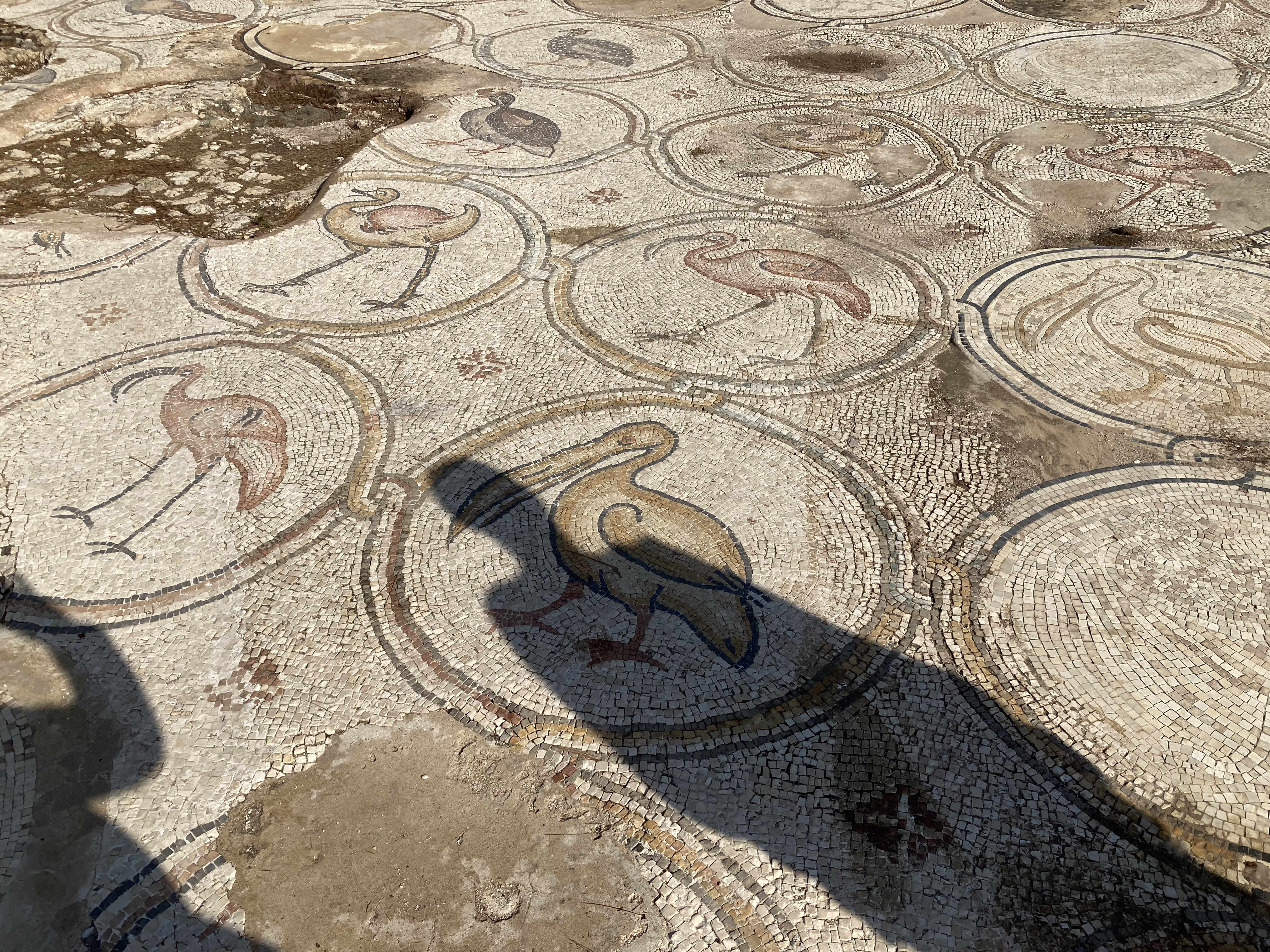
My friend is a history buff, and she’d taken her kids to all kinds of historical sites around the country and knew her way around, so after the aqueduct we visited a refurbished mosaic from the Byzantine era, which used to be the floor of a rich man’s house, and then she showed me the completely natural outcropping of rocks, organized in a half circle, where she and her kids sat together to eat lunch a couple of years earlier.
The big destination, though, was the national park at the harbor ruins. Caesaria was built by King Herod, when Judea became a Roman province and the capitol was moved north from Jerusalem. A large school group was already visiting when we arrived, with the same bored looks as the groups at the Kotel, except that this group of kids spoke Arabic, and my friend told me that all Israeli schools do these day trips to historical sites around the country, they just choose different places to visit based on the makeup of their student body.

We found a kosher restaurant by the water, where the food was fresh and delicious and the cats were watching us like we were a movie. The waiters eventually brought out the fish leftovers for the cats to eat, which temporarily distracted them from watching us, but only for a little while. Inspired by the bravery of the cats, once we were finished eating, I decided to try to walk through the ruins to look at the mosaics and the ancient mikvah and the works of art scattered here and there. I made it as far as the beginning of the hippodrome (basically a long running track for ancient horses), and for the first time on the whole trip, I started to have trouble. I was actually surprised that it had taken so long to kick in, honestly. I’d been taking all of my medications, plus extra pain killers, but by day six my body was starting to rebel, and my legs, especially, just didn’t seem to be able to hear my instructions as clearly as before.

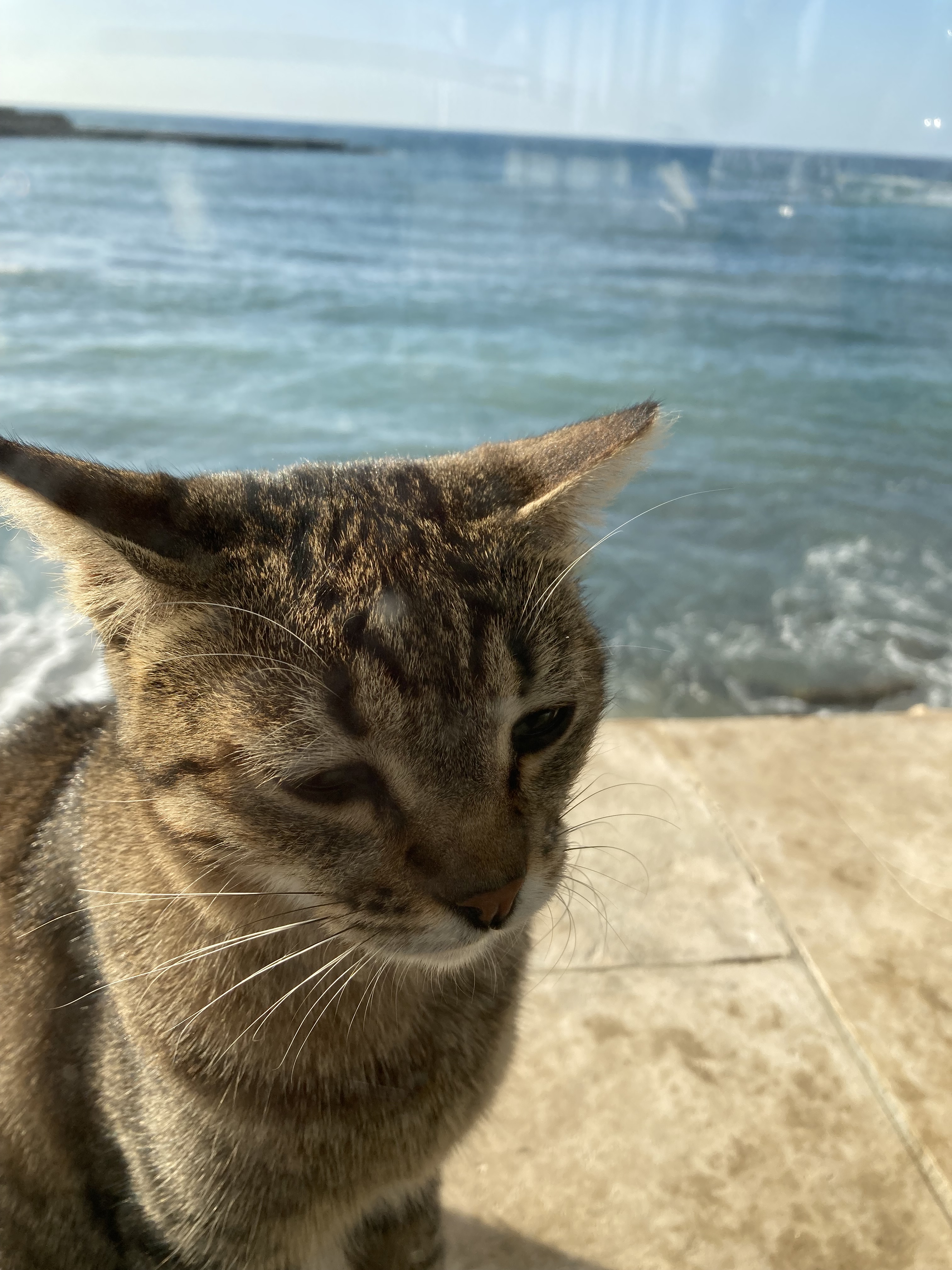
We took a break from walking to visit the little on-site museum, where they showed a movie about the building of Caesaria and all of the family drama behind the scenes (attempted murder, treason, death sentences, etc.), and then we looked at some of the relics that had been collected in the area, and some multi-media exhibits. I know I was supposed to be fascinated by all of this, but, honestly, my favorite part of the day so far was the cats.
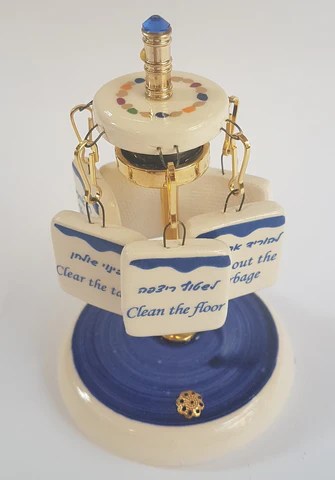
I still wanted to experience as much as possible, though, so my friend suggested that instead of trying to walk all the way across the hippodrome to the famous amphitheater (which is still used today for outdoor concerts), we could go back to the car and drive down to the other end. Unfortunately, by the time we’d reached the other entrance we discovered that they had just closed the gates for the afternoon. If I’d been up to walking the length of the hippodrome, we would have made it to the amphitheater in time, but driving over and entering through a different gate was not going to be allowed. My friend was disappointed for me, and while she tried to find a manager who might let us in, I wandered around to avoid having to talk to anyone, and I noticed a shop called The Dreydel House. Immediately, I realized that I’d actually seen it before, in a video in one of my classes, years ago. I’d thought about that video, and the artisan who made ceramic dreidels and dreidel-adjacent paraphernalia, when we were planning the trip, but since I couldn’t remember where it was located and wasn’t even really sure if it was real, I’d left it off my to-do list; and yet here it was. My friend came back from her mission, still frustrated that they wouldn’t let us in, and met me over by the storefront, where, it turned out, the Dreydel House was closed for the day too. I guess it makes sense that a shop run by one guy, filled with all kinds of things he has to make himself, wouldn’t have a lot of open hours per day. But, harrumph.
Our next stop was a nearby resort town called Zikhron Yaakov, which was the site of one of the first new settlements of Jewish immigrants in Palestine. In 1882, a group of Jewish pioneers from Romania bought land to build an agricultural moshav. A year or so later, when they were inevitably struggling to make a go of it, they received funding and support from Edmund de Rothschild and renamed the town in honor of his father.
The first Israeli winery was also established in Zikhron Yaakov, and there were still a number of wineries nearby, but I’m not a wine person so we decided to visit the historic city center instead, where there was a pedestrian mall filled with restored historic buildings and boutiques. We stopped in to look around in a little store that sold crafts made by local female artists, and then we ate some gelato in the café next door as the sun went down, and then it was time to head home.
I don’t know if it was the long drive, or the more obvious signs of my vulnerable health, but my friend and I started sharing more and more personal stories, things that hadn’t gone right for each of us, ways that we were struggling; discussions we wouldn’t have known how to have back in high school.
Despite that, I was still too shy to ask if I could do a load of laundry when we got back that night. I was thinking that I would try to work up the courage over the next few days, or just, you know, wear dirty clothes, when my friend asked if I wanted to do some laundry and showed me how to use her washer and dryer, brought with her from the States way back when and still working away.
The next morning, freshly dressed in my warm-from-the-dryer favorite shirt, I was ready to attempt our next adventure: taking the train back to Tel Aviv to visit Old Jaffa, the original port city where most of the Jewish immigrants had arrived in Ottoman era and then Mandate Palestine. While we were waiting for our train, we listened to someone playing the piano, really well, and then he popped up and ran for his train, another traveler just like us.

Once we arrived in Tel Aviv, we took a bus down to the beach and then walked up, up, up to Old Jaffa. The sun was bright and I could feel my arms starting to burn, despite the SPF 60 I’d slathered on that morning, and every morning of the trip. I also I noticed that I needed to sit down even more frequently than the day before, and that there were an enormous number of steps to climb. When we reached the clock tower plaza, we sat down to rest, again, and met a friendly dog. I was really tempted to just stay there for the rest of the day and commune with the dog, but we had an agenda, so I forced myself up to my feet while my friend checked her phone for directions to Shuk HaPishpashim, the famous local flea market.


I needed to sit again when I saw all of the steps ahead of us, some going up and some going down, and no clear signs telling us which ones to take, and while I was resting, a random guy asked my friend to watch his double-parked car. He seemed to be helping his girlfriend move, though each box they carried looked like it was about to fall apart and had been filled willy nilly at the last second, so I’m not sure if she was leaving an apartment, or an art studio, or just stealing someone else’s stuff, but I didn’t have the brain power to think about it.
My friend dutifully called out to them when the police arrived, because his car was blocking an already narrow street, and with her pre-warning he was able to talk his way out of a ticket. When he came back to thank her, my friend asked him how to get to Shuk HaPishpashim and he said “just go straight,” as did the next three people we asked, but the roads in the area went every which way but straight, so it took us a while to find our way. We passed a bunch of small art galleries and antique shops, and dogs out walking their people, and even a shop that specialized in refurbishing old doors, until we finally found the covered section of the shuk.
Loud music was playing over the loudspeakers as we walked through small aisles where vendors had their goods laid out on the ground: broken doll parts, and old shoes, and other random things that made me grateful that I was up to date on my tetanus shots. Eventually we reached the more permanent storefronts, where you could buy board games and Persian rugs and all kinds of souvenir knick knacks. I was tempted by the small drums and bangles and other middle eastern musical instruments, but I’m not a good shopper and couldn’t choose just one thing. It was a relief when we left the shuk and found a kosher restaurant for lunch. We ordered as many Salatim (salads and spreads) as they could fit on our table and did our own taste tests, comparing and contrasting the eggplant with the beets with the tomatoes with the chummus. As we were sitting there, I finally got to hear my first Muezzin’s call of the trip. There are mosques all over Israel, but this was the first time we’d been in an Arab neighborhood at the right time to hear the call to prayer. I’d heard the Muezzin’s call in tons of videos, but there was something special about hearing it in person and knowing that people all around me were hearing the same voice.
On the train back to Modiin, struggling to keep my eyes open, I realized that I had burned my arms but good. I used to get sun poisoning every summer at sleepaway camp, but it had been a long time since I’d done such a number on myself. What with the burns, and the walking, and seeing so many things in such a short time, I was truly wiped out by the time my friend’s husband picked us up from the train, and he looked at me like he was worried they’d have to drop me off at a hospital. He and my friend had a quiet conversation once we got back to the apartment, and I magically received a cup of hot cocoa, and one of the real Strauss-brand Krembos that had finally arrived in the local stores, and curled up on the couch to recover.

There was something really lovely about being able to witness a good, working marriage on this trip. I didn’t grow up in a home with a good relationship at its core, so watching my friend and her husband negotiate their different strengths and weaknesses, and manage the insistent demands of their different children, and their houseguest, while still finding time to just be a couple, was reassuring. I loved that they insisted on doing the New York Times Spelling Bee together every day, no matter what (they diverge on the other word games: she does the crossword, like my mom, and he does the Wordle). There was a comfortable, lived in quality to their home, and their relationship that made it clear that they’d had all of the inevitable fights along the way, and weathered them, and had decided over and over again that it was worth all the trouble. There was also something magical to me in seeing how their family had taken shape over the years; even though the kids were mostly strangers to me before this visit, they were also really familiar, each echoing aspects of my friend’s personality and mannerisms and way of being in the world.
I had clearly hit a wall, though, sitting there on their couch, losing track of time and struggling to find words, in English or in Hebrew, so my friend suggested that we stay in Modiin for the following day, instead of heading back to Jerusalem or wherever else. That would give me a chance to rest up before our big trip north on Wednesday, to see the Kineret (the sea of Galilee) and the kibbutz where her older daughter was spending the year. In the meantime, we ate our Krembos, and probably had dinner at some point, and then I went to bed early for the first time the whole trip, out of words but feeling warm and safe and cared for.

If you haven’t had a chance yet, please check out my novel, Yeshiva Girl, on Amazon. And if you feel called to write a review of the book, on Amazon, or anywhere else, I’d be honored.
Yeshiva Girl is about a Jewish teenager on Long Island, named Isabel, though her father calls her Jezebel. Her father has been accused of inappropriate sexual behavior with one of his students, which he denies, but Izzy implicitly believes it’s true. As a result of his problems, her father sends her to a co-ed Orthodox yeshiva for tenth grade, out of the blue, and Izzy and her mother can’t figure out how to prevent it. At Yeshiva, though, Izzy finds that religious people are much more complicated than she had expected. Some, like her father, may use religion as a place to hide, but others search for and find comfort, and community, and even enlightenment. The question is, what will Izzy find?

 rachelmankowitz
Thank you for sharing photos of your whirlwind day. I understand how you could become fatigued by the amount of activity you took in. I’d like to visit Old Jaffa, someday, in the not to distant future.
There’s so much more there than I had the energy to see; definitely worth another visit.
that’s an incredible amount of stuff, in one day. I’d be catatonic. Do you think you’ll go again?
Yes. I’m not sure when, but definitely.
You had a busy day. I hope you felt better later and continued to enjoy your visit. 🙂
Thank you!
Whew! No wonder you were tired, Rachel! But thank you for the photos of the cats. And the dog. Oh, dear. OK, maybe not the dog…😬
But the dog was so sweet!
I thought so too!
I’m glad your friend and her family noticed your fatigue and took it seriously. Hopefully a lot of sleep and a slower pace allowed you to have more fun later! 💕
They are very kind people!
l am enjoying the trip through your eyes. Do a lot of dogs and cats hang out in the streets? Those stones on the ground are beautiful, I am wondering how old they might be.The vaulted ceilings are striking! That is an exhausting schedule, glad you had a good rest at the end of the day.I
There are a lot of cats all around the country. I know there was a reason why they showed up, but I can’t remember the story. Dogs, on the other hand, are usually pets, rather than feral, and usually on a leash. My sense with the dog at the clock tower was that it belonged to one of the shops on the plaza and acted as a greeter, and a moocher when people had snacks.
Mooch…what dogs do best, but you got to love them!I look forward to hearing more of your travels.
Thank you!
Love the cats and the dog was adorable. Worn out by a great trip is a happy kind of tired. I’m glad for you.
Thank you!
I hope you’re enjoying Hanukkah in Israel, Rachel. ❤
Thank you!
What a great trip and whirlwind experience. Great photos and memories to sustain you! 💕
Thank you!
The aqueduct, the mosaics…wow….
There’s so much more that I couldn’t absorb in one go; in Israel they live surrounded by history.
In Scotland a company called Tunnock’s makes Krembo like things. They are called Tunnock’s Teacakes, and I’ve never seen them anywhere else before. I wonder who thought of them first?
I have a vague memory of someone saying they have something like it in Germany, but it’s a brilliant, so chances are that more than one person had the same idea.
Bathing suits should maybe renamed ‘braving suits.’
I’ve been loving these reports back.
Thank you!
Just looking at those stone arches reminded me of how much I wanted to visit Caesaria when in Israel but I never had the chance. Nice narrative of a great day trip; sorry that you felt so tired.
Definitely worth a visit!
Your photos are wonderful! I loved reading about your busy day!
Thank you!
Exhausting, to be sure. I often feel, after a holiday, any holiday, we need to return home to rest. Hopefully, your day of rest restored you somewhat.
Thank you!
Awesome trip pics and info! Looks like a wonderful time.
Art
Thank you!
wow! I’m exhausted, just reading what you’re doing!!!!
what a phenomenal experience!!
the landscape photos, and the cat photos and Tzipp refusal to look at you!
I collect Dreidels and will check out the name of the store you mentioned
thanks for sharing
Vickie
Thank you!!!
I am very much with you on wearing a bathing suit. I also enjoyed the cats. 😉
They are adorable!
I love this! Those cats, though! 🙂 This is the trip of a lifetime, for sure. Good for you!!!
Thank you!!!
Just think how much you’ve done, are doing, and will continue to do, Rachel. I hope you realize that you’ve surpassed your expectations of what you can handle. And it’s all so interesting and fun to read!
Thank you so much!
Your stories really make me feel like I’m there, too. Rest up!
Thank you so much!
I love ancient sites and thinking about the people who walked in that spot centuries earlier.
It can be hard for me to make those connections, but when I can it’s truly magical.
Very interesting post about interesting stuff
Thank you!
As someone who is also energy-challenged, especially these days, I appreciate your labors in getting around, particularly when around was up. Nonetheless, you’re making it to a number of sites where ancient and contemporary come together culturally, if not always harmoniously (in the past or present). I admire your take on the marriage and the family. You describe how it should go, I think. Shared and separate interests, continually realizing the value in what is shared. But, like you, I might have enjoyed the most the communing with the cats and dog (apologies to Tzipporah). So much is so impressively old there, while the cats and dog are now. I trust you will go as carefully as possible.
I like the idea that the cats and dogs are present tense in a place that’s suffused with the past.
Dear Rachel, we love reading your posts, they are amazing!
Thank you so much!
Happy Hanukkah Rachel
Thank you!
As always, I love your sense of humor. You make me chuckle when you choose the perfect words for your photos. I’m happy that you got to experience this trip. Peace be to you. 🙂
Thank you!
You’re welcome!
I like your photos! Glad you had good weather ^_^
Thank you!
Your photos are stunning! Thrilled the weather played nice for such gorgeous shots. 🌟
Thank you so much!