Now that I have my official Singing Straw (The brand I found is actually called Sound Straw), I have to search for opportunities to use it each day, either doing specific straw phonation exercises or randomly singing a song through the straw. The idea behind it is either to build vocal strength or improve voice placement, or both, so the fact that I can feel the break between my chest voice and head voice gradually smoothing out suggests it’s accomplishing something. I’m also doing lip trills and humming and adding some Zinga Zinga Zah exercises for good measure. I’m still not sure if I’m doing all the right things, but I do know that I’m making progress, in my breathing and range and clarity, so something’s working.
After doing ten or fifteen minutes of vocal exercises, I try to sing along with seven or eight songs from my YouTube list (current favorites: The Story and The Joke by Brandi Carlile, Someone You Loved by Lewis Capaldi, Sweet Creature by Harry Styles, When I Fall in Love by Nat King Cole, Lose You To Love Me by Selena Gomez, and Piece by Piece and Mine by Kelly Clarkson), and that’s helping me build a sense of which songs fit my voice best and which ones are a little too challenging (or say things I don’t want to hear myself sing). The side effect of listening to all of these songs is that it’s re-activating my desire to write songs myself, but I still feel too intimidated by all of the music theory I don’t understand and I don’t have a piano or a keyboard anymore, so I’ve been a little lost. Along the way, though, I had an idea for an elective to do with my students, where we would write new lyrics to existing songs (AKA macaroni songs), based on Jewish holidays or Jewish values I want them to focus on, and I realized that what I really wanted was to write macaroni songs for myself, to help me get song structure into my head. We did writing exercises like that back in graduate school sometimes, where the teacher would give us a model sentence from a famous writer and we had to copy the structure of it in our own words. It was a good way to stretch our minds in new directions, or at least to learn how to use a semi-colon, even though sometimes it felt like we were being told to copy and paste someone else’s superior style onto our own.
I learned the term “Macaroni song” from my rabbi years ago when we were reading the Psalms in Bible Study and he told us that a lot of the psalms were meant to be sung, and some of the psalms even listed the instruments that would be played or the popular melodies the psalms would be sung to. There was something very comforting about imagining my ancestors standing in the courtyard of the Temple in Jerusalem singing prayers to the equivalent of the latest Taylor Swift song.
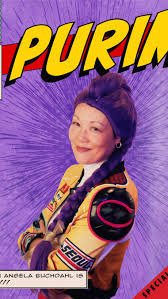
Macaroni songs are ubiquitous in the Jewish world. I remember writing them for color war in high school, and the cantor at my synagogue writes a bunch every year for the Purim spiel, and there are a ton of Jewish acapella groups that put out songs for Chanukah and Passover where they tell the story of the Maccabees or the Exodous to the tune of a song from Hamilton or Star Wars or Uptown Funk. This year, almost every synagogue did a version of K-Pop Demon Hunters for their Purim spiel, re-naming the show K-Pop Haman Hunters, and you can even find pictures of Angela Buchdahl, the Korean American senior rabbi at Central Synagogue in NYC, dressed up for the occasion, living out all of her identities at once.
I’m not up to singing “Golden” (the big hit from K-Pop Demon Hunters) yet, if I ever will be (it’s really, really high), and I still haven’t written my first macaroni song, but I feel like I’m going in the right direction, singing through good days and bad days, discovering the sounds that speak to me, and even forgetting, sometimes, to keep my voice down.
If you haven’t had a chance yet, please check out my novel, Yeshiva Girl, on Amazon. And if you feel called to write a review of the book, on Amazon, or anywhere else, I’d be honored.
Yeshiva Girl is about a Jewish teenager on Long Island, named Isabel, though her father calls her Jezebel. Her father has been accused of inappropriate sexual behavior with one of his students, which he denies, but Izzy implicitly believes it’s true. As a result of his problems, her father sends her to a co-ed Orthodox yeshiva for tenth grade, out of the blue, and Izzy and her mother can’t figure out how to prevent it. At Yeshiva, though, Izzy finds that religious people are much more complicated than she had expected. Some, like her father, may use religion as a place to hide, but others search for and find comfort, and community, and even enlightenment. The question is, what will Izzy find?

 rachelmankowitz
Wow! Rachel. I’ve never heard of a singing straw. I’ve learned something new today. Thanks for enlightening me, and good luck with your voice practice.
You can do the exercises with a regular plastic drinking straw too, even better if it’s in a glass of water because blowing bubbles is ridiculously fun.
I’d never heard of macaroni songs. When I saw your title, my first thought was of the song “Yankee Doodle.” It tells the tale of a fellow who stuck a feather in his cap and called it Macaroni. The explanation of the lyrics is fascinating. Maybe you should add “Yankee Doodle” to your repertoire!
I think there’s a connection between Yankee Doodle and the term Macaroni songs, but I can’t remember what it is.
helloSent from my Galaxy smartphone.
Breath regulation via diaphram control is not only helpful for singing, it’s useful for speaking. I learned something similar, but not with a straw, in broadcasting class.
So many benefits! Singing itself supposedly calms the Vagus Nerve and has all kinds of psychological benefits.
Singing Straw and macaroni songs sounds like the kind of fun I would need to have in order to learn. Good luck, Rachel. I’ll bet your students have a good time with this lesson.
Oh, it always has to be fun!