Tag Archives: friendship

My Israel Trip – Shuk to Shuk

            The plan for day two of my Israel trip was to go back to Jerusalem, by train this time, and focus on Mahane Yehuda (the big shuk/market in Jerusalem). My friend’s husband helped me figure out how to use the moovit app on my phone to pay for the ticket, and then he drove us to the train station and sent us on our way. It took me a minute to get used to the app, and to having to put my bag (and myself) through airport-style scanners as we entered the train station, but the train ride itself was comfortable and fast, and my friend was in charge of telling me where to go, so I didn’t have to think too hard.

The transition to the light rail from the train just required us to go outside and open the moovit app again, and then wait a few minutes for the train to appear in the middle of the street.  Every seat was filled, even though we were far from rush hour, so we stood by the doors and held on for dear life. I was fascinated by the announcements, written and spoken, in Hebrew, Arabic, and English every time, and the passengers being such a wild mix of people: a girl in a sports bra and sweat pants, next to a man in a black coat and hat, next to a woman with a head covering and long skirt, next to a woman in a hijab; all just getting on with their to-do lists.

When we got off at the stop for Mahane Yehuda, we took a few moments to breathe before diving back into the crowds. I took a picture of a store called “English Cake,” because the sign in Hebrew next to it also sounded out the words “English Cake” in Hebrew letters. There was so much English, everywhere. Once we entered the shuk, there were so many storefronts, and alleyways going in every direction, that it was a bit overwhelming. There were, of course, other tourists like me, but there were also native Jerusalemites, and groups of soldiers in training, and older people rolling shopping baskets through the crowd, and couples doing the family shopping. There was no one type of person in the shuk – people spoke different languages, dressed in every different way, and each one moved at their own unique pace.

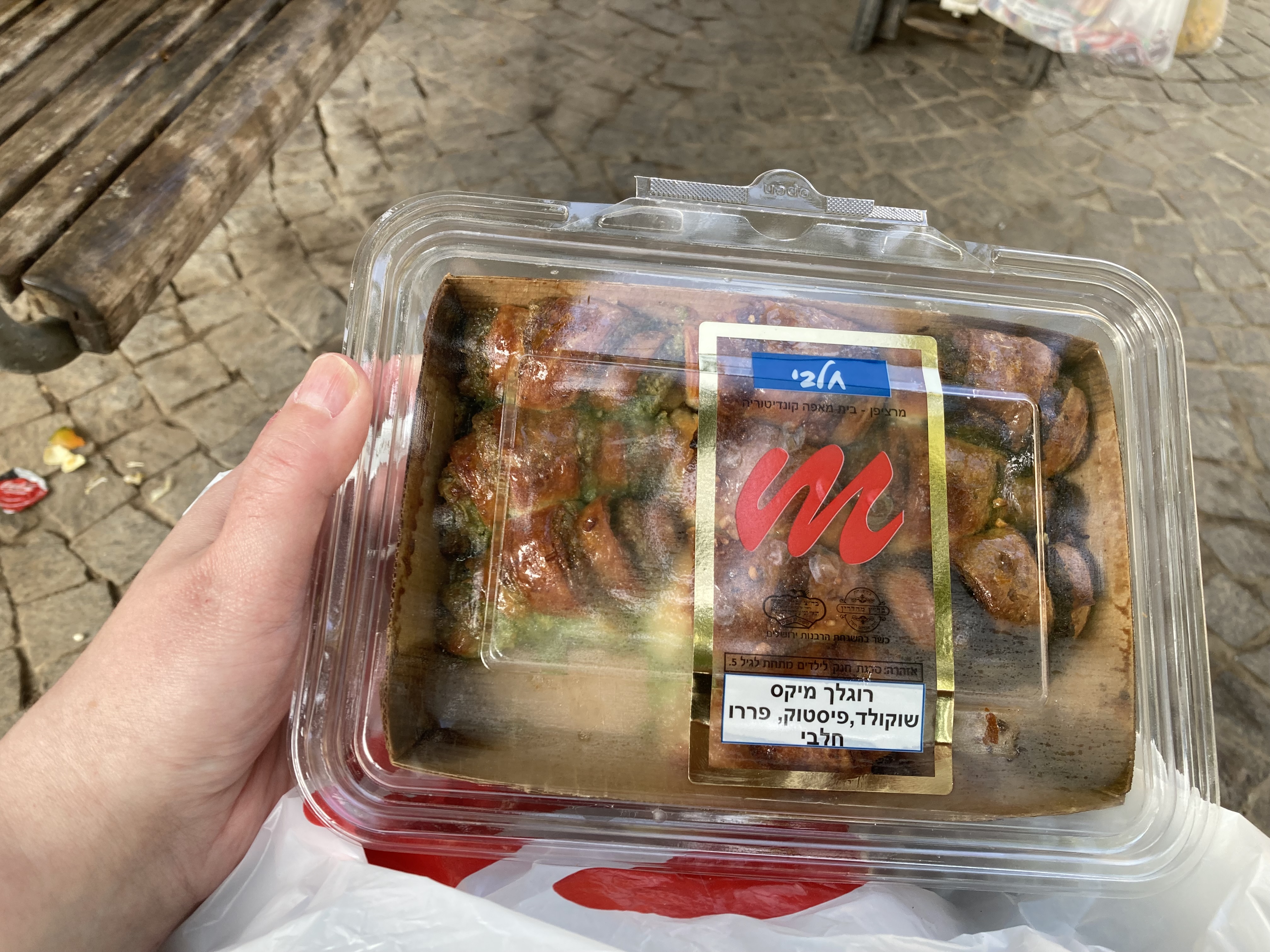
            We stopped at one of the fruit stalls to get a smoothie (Mango Tango), because I was low on sugar and already a bit dizzy from the heat of the day (not too hot by Israeli standards, but much warmer than it had been when I’d packed my suitcase in New York). And once I was sufficiently cooled down and sugared up, our first priority was to go to Marzipan bakery. The one thing my brother and nephews had agreed on in their recommendations for where to go in Israel, was that I needed to try the chocolate rugelach at Marzipan bakery; everything else, even the Kotel, was an afterthought. The bakery was relatively small compared to American shops, but big enough to hold an enormous number of cakes and cookies and customers. Along with all of the rugelach, in multiple flavors, there were sufganyiot (donuts for Hanukkah), and cheesecakes, and cookies, and all manner of other wonderful looking things. But I was committed; I needed to try the rugelach or else I wouldn’t be able to return home, so I chose a box with pistachio, chocolate, and chocolate hazelnut varieties, with enough to bring back for my friend’s kids as a bribe, since I was stealing their mom’s attention for days on end.

We found a little park nearby, a few steps away from the shuk, where the cats had already congregated, waiting for us and the rest of the human visitors to stop by with snacks. I had to try a chocolate rugelach first, because that’s the classic, and I discovered that what makes these rugelach so special is that they are incredibly moist, and sweet. The ones I’m used to in New York, which are very good, are made with a soft cookie-like dough and filled with things like chocolate, apricot, or raspberry jam. These, on the other hand, were like a cross between a regular rugelach and baklava, because they are basically marinated in sugar syrup, before and after baking. One was my limit, though, and then I needed to drink a lot of water to chase it down. While I communed with the local cats (I was missing my dog a lot already), my friend volunteered to take a picture for a family on a day trip to Jerusalem. My friend was able to guess which part of Israel they’d come from, just by the way they dressed, but for me it was all still a mystery. She’d told me once that you could tell which town a boy came from by the style of kippah (yarmulke) he wore, but it would take me more than one visit to start to see all of the variations.
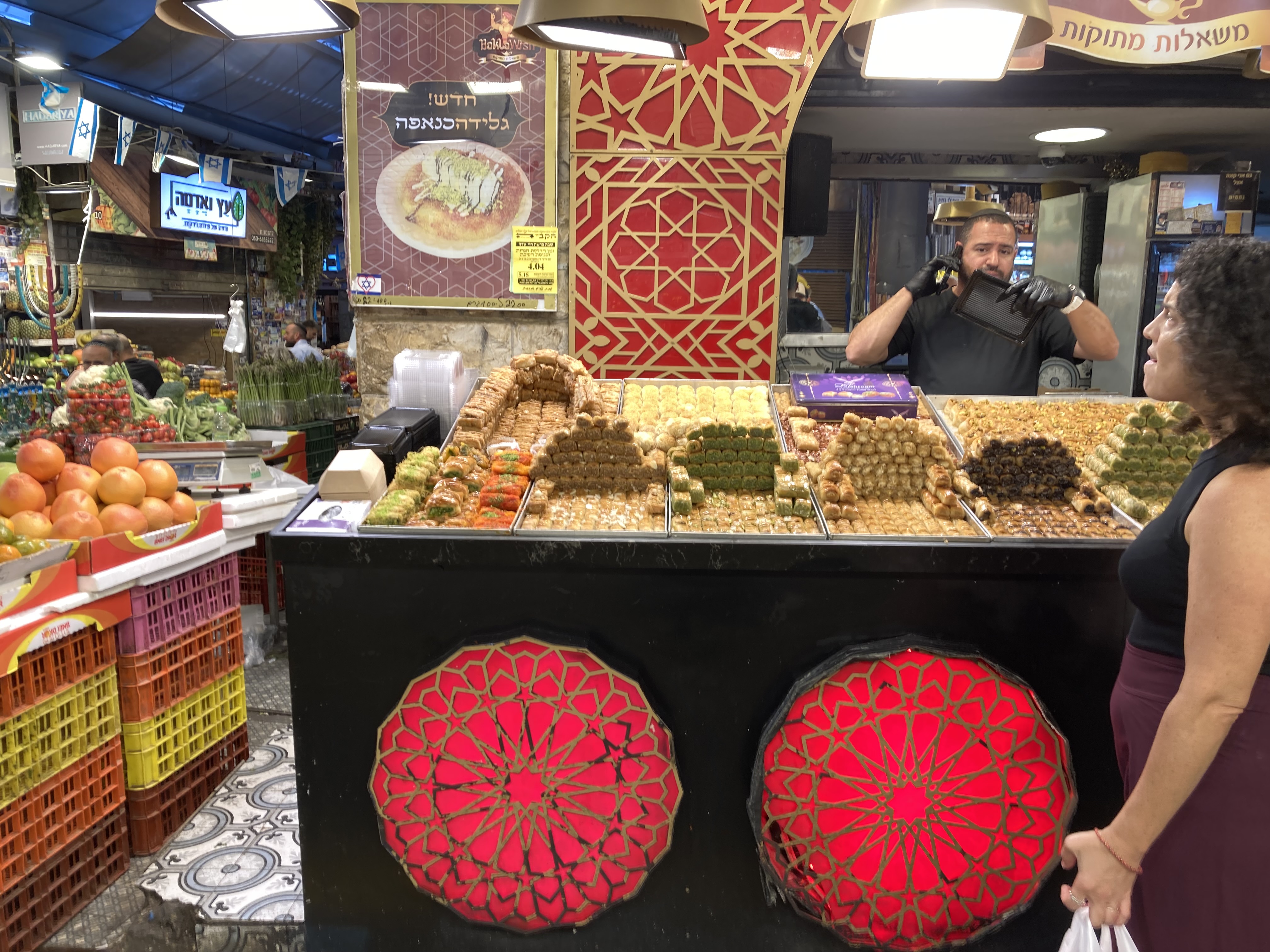
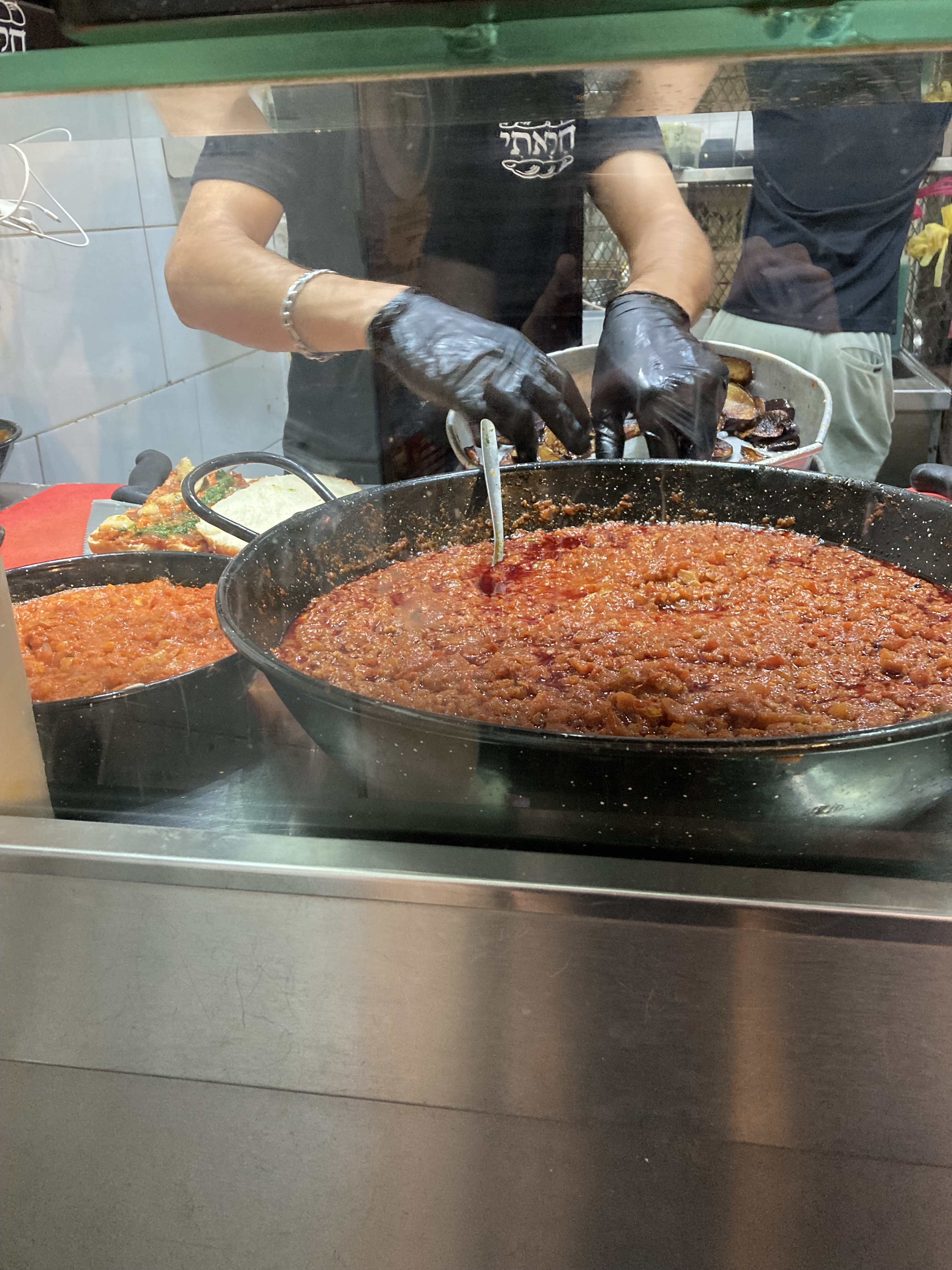
Once we were sufficiently rested and hydrated, we headed back into the shuk to find actual lunch-like food. My friend’s older daughter had given us instructions for how to find the best kosher places in the shuk, but we got lost anyway, and wandered through the alleyways, past enormous mangoes, and bright red pomegranates, and every kind of baklava and halva and knafe (another middle eastern dessert), until we found the little storefront for Halaty, where they specialized in chicken schnitzel on a challah roll, plus five or six sauces. We got one sandwich, cut in half, and since neither of us likes spicy food, we only sampled four or five of the sauces. I have no idea what they all were, but they were mostly yummy, except for one sour lemon sauce that was really not my thing.
            As we ate our sandwiches, a tour group came by, with the leader wearing a microphone and speaking in rapid, incomprehensible Hebrew while sandwiches were handed out across the group. I was relieved to be sitting at one of the few tables, chewing at my own pace, instead of having to rush along with a tour group, trying to hear the tour guide over the crowd. I was also starting to wonder if my Hebrew really wasn’t that good after all, since I couldn’t make out a word the tour guide was saying, but my friend said that she was having trouble hearing anything over the noise of the shuk too, so at least we were in it together.

            We continued on our way, past Moroccan sweets in every color, and breads and cheeses and fruits and vegetables. When we had finally hit our limit, on walking and noise and choices, we found a place to sit at an outdoor café, with umbrellas for shade over each table. No one seemed to mind that we were taking up space without ordering anything, so we were able to relax and focus on all of the people bustling around us.

            A couple passed by wearing their rifles like forgotten guitars bouncing against their backs. I’d been warned ahead of time that I would see a lot of soldiers carrying guns, but I hadn’t realized that so many of them would be out of uniform. It turned out that they had to carry their rifles with them, even on leave, because they weren’t allowed to leave their guns home unattended. We also saw girls dressed in sweaters and long pleated skirts, despite the heat, and my friend told me they were seminary girls, studying for the year in Jerusalem before starting national service. And then there was a young mom carrying her baby in her arms, while her husband (I assumed) pushed the baby carriage, filled with plants.
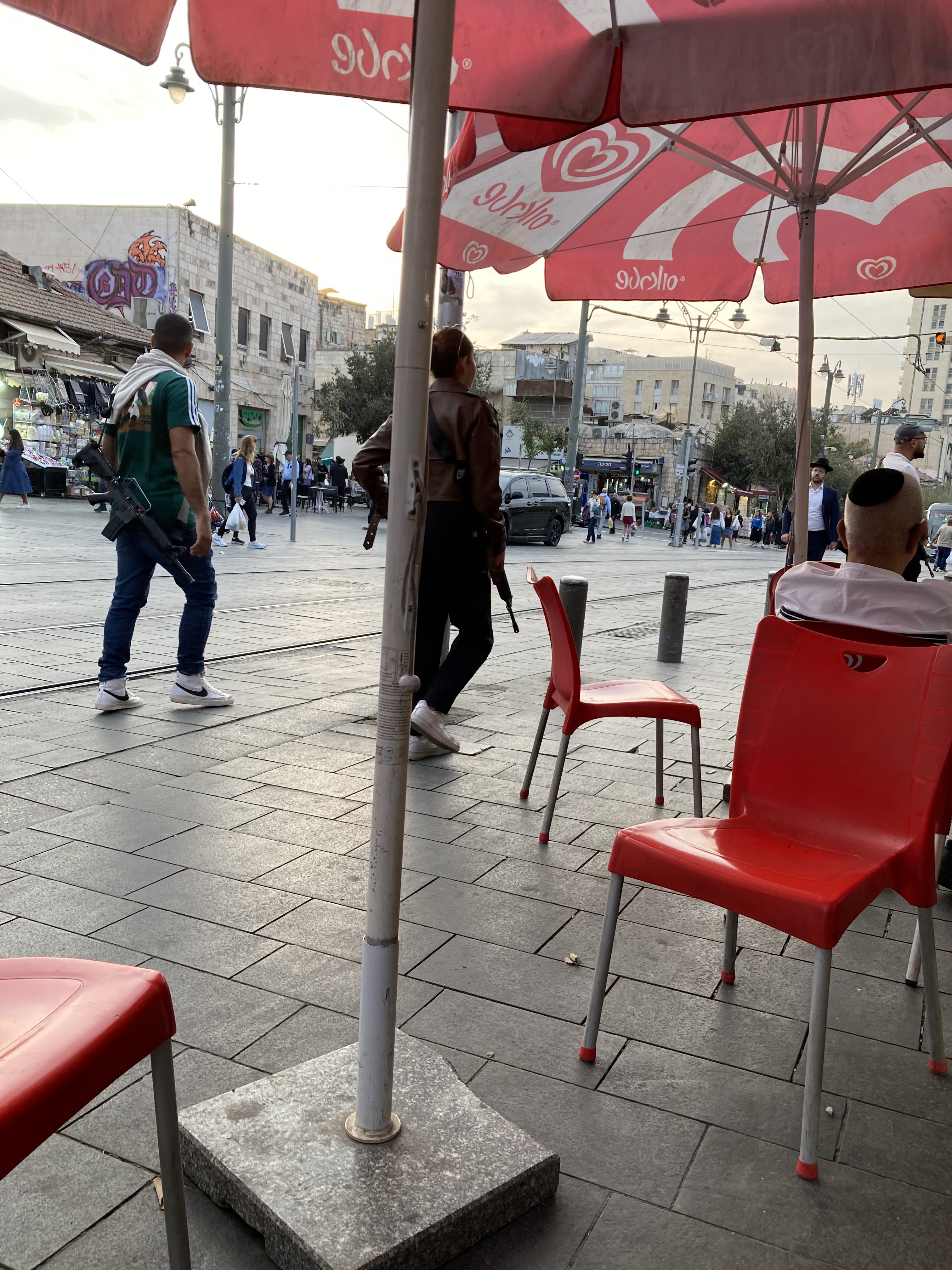
In the middle of all this, two police officers arrived on motorcycles. They stopped by the side of the café and almost immediately they were deep in conversation with a group of young men in t-shirts and shorts, also carrying rifles over their shoulders. It looked like the young men were getting a ticket for some reason, and I was fascinated by the idea that these young men with guns, were casually accepting tickets from police officers, with no sign of danger. But after a while we saw another group of young people arrive to talk to the police officers, and we realized that they were all participating in some kind of scavenger hunt. They seemed to need a paper signed by an officer in order to move on to the next challenge on their list, and the police officers seemed to be happy to play along.

The streets in Jerusalem are so skinny that most people were walking, or riding bikes or scooters, or motorcycles like the police, or taking the light rail like us, rather than driving cars. And there was something magical about the whole scene; like we were outside of time and the normal parameters of modern city life, with young men flying by on their scooters, their tzitzit waving behind them.

As the light started to fade, we made our way back to the light rail, and then to the train back to Modiin. For some reason, I hadn’t realized that the days would be just as short in Israel as they are in New York at this time of year. Somehow, I’d thought the heat would make the days longer, but as we reached Modiin, we caught one of the most beautiful sunsets I’ve ever seen.

Our chauffeur (my friend’s husband) picked us up from the train station, in between pickups and drops offs of the kids, and we started to make our plan for the next day: Tel Aviv and the Carmel Market (Shuk HaCarmel), to compare and contrast one shuk with another. My next big accomplishment was taking a shower, and then we had dinner and rugelach, and my friend and I stayed up late talking, even though we’d been talking all day long.

            Of course, overnight my self-consciousness/anxiety came roaring back, and I was critiquing the clothes I’d brought with me (too plain, too shapeless, too warm, etc.), and I was worried about Shabbat coming up (I hadn’t spent a Shabbat at a religious person’s house in a very long time, and I was sure I’d forgotten some of the rules along the way and would do something stupid or offensive without meaning to). But I shook it off the best I could, and let my friend’s husband make me breakfast (I’m so generous!), and then we headed into Tel Aviv, driving this time instead of taking the train. We passed so many McDonald’s signs along the way that it was hard to believe we weren’t in New York, but the road signs were in English, Hebrew, and Arabic, so we were clearly still in Israel. After a few trips around the neighborhood, my friend was able to find a tiny parking lot around the corner from the shuk, and we headed off on our next adventure.

            Shuk HaCarmel/Carmel Market felt less crowded than Mahane Yehuda, if only because the alleyways were wider, so there was more room to move. There was yet another scavenger hunt going on, and this time we got to see it from the beginning as a large group of youngish people were divided into three teams. They seemed more like a work group this time, since there were no obvious guns, but I didn’t have the nerve to ask.

There were more clothing and tchotchke stalls at Shuk HaCarmel than I’d seen in Mahane Yehuda (though it’s possible I’d missed some of the meandering alleyways in Jerusalem the day before), and I was surprised by how few places in the shuk were kosher enough for my Modern Orthodox friend to eat at. I’d always thought one of the reasons to live in Israel was to make it easier to be Jewish overall, and it certainly is a lot easier, but in a country where 20 percent of the population isn’t Jewish, and even among the Jewish population at least half are not religious at all, and the rest have multiple/conflicting ideas for the right way to be Jewish, I should have known it would be more complicated.

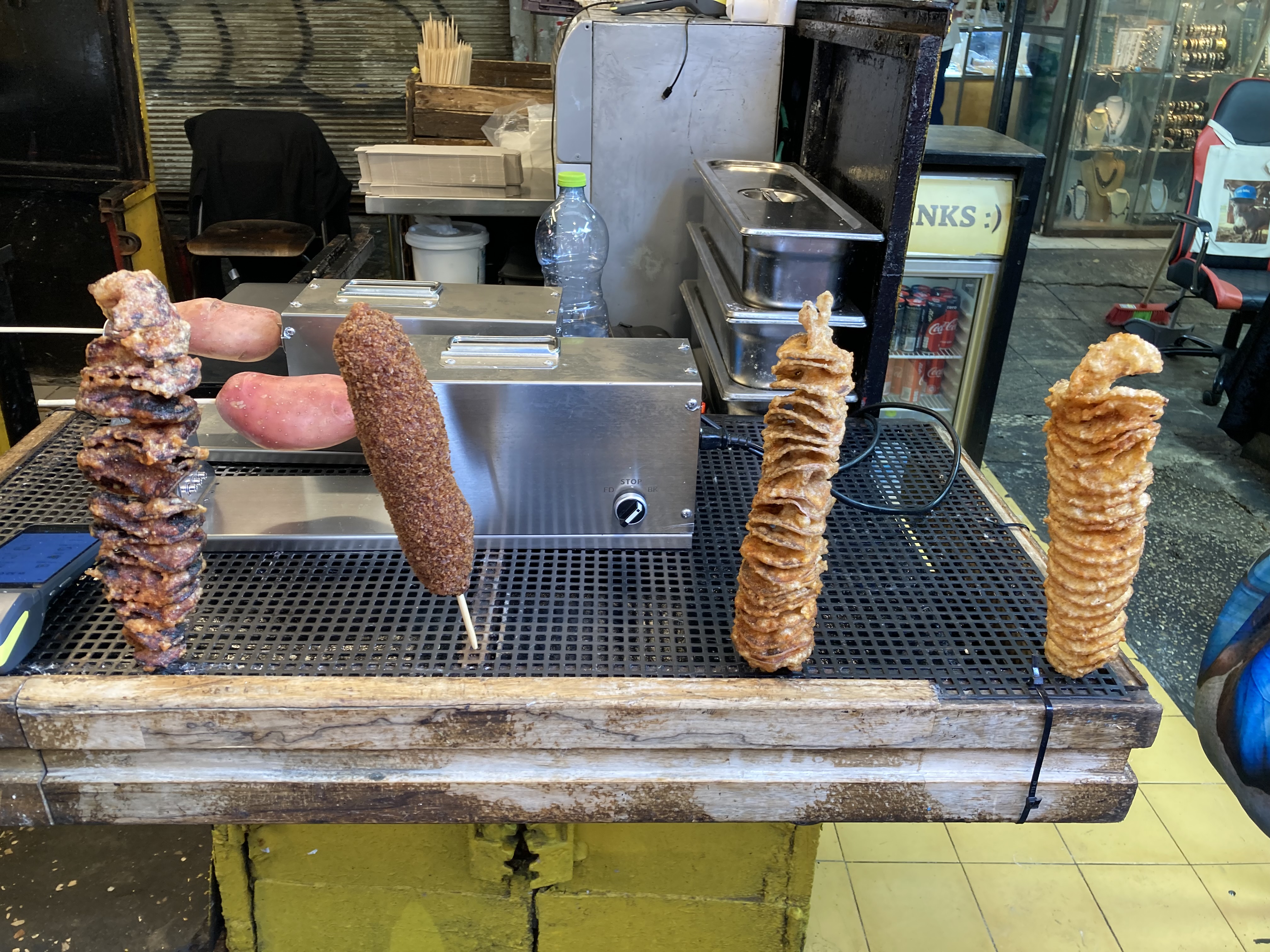
            We stopped at one stall to watch the process of spiral cutting a baking potato, and then deep frying it, like one long curly French fry, and then we gawked at all kinds of touristy stalls, filled with t-shirts and jewelry and other kitschy things. The crowd in Tel Aviv seemed to be more homogeneous than in Jerusalem: mostly young to middle-aged, mostly wearing t-shirts and jeans or shorts, with fewer overtly religious people, and fewer older people. Somewhere along the way, I also realized that I wasn’t seeing all of the beggars I’d seen in Jerusalem, but there were still a ton of babies. It’s one of the things you notice right away in Israel, after the stray cats: babies are everywhere. There’s a lot of encouragement to have children in Israel, with socialized medicine, and free public schools, and healthcare that covers fertility treatments, etc., but it’s more than that: children are welcomed almost everywhere, at any age, and no matter how independent they become as they grow up, they are always expected home for Shabbat.
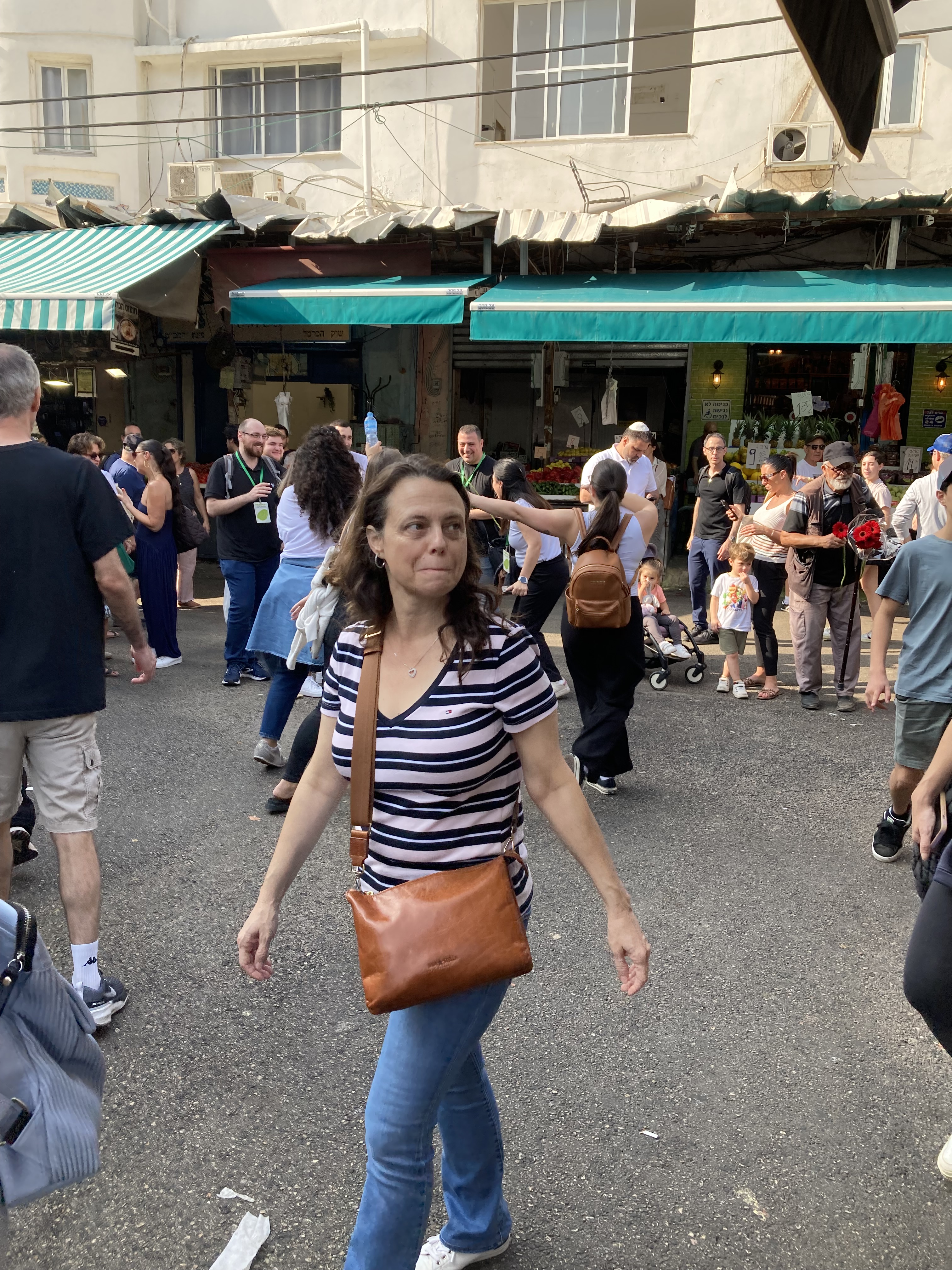
            I was enjoying the window shopping, and the people watching, and then we arrived at the Malawach stand my friend’s daughter had recommended, situated at a little intersection in the shuk. Israeli music was playing from the speakers, and when a popular old Israeli dance song came on (Od Lo Ahavti Dai), the whole crowd started to sing along, and a group of women automatically created a circle to do the dance, as if their bodies couldn’t help it. The circle dissolved just as quickly as it had formed, but that moment, when everyone just stopped to sing and dance together, was magical. The Malawach guy refused to cut one sandwich in half for us to share this time, so I had to take a whole one for myself. Malawach is a layered, fluffy, Yemeni bread, filled with much more oil than your standard pita, and rolled up in each Malawach there were hardboiled eggs and tomatoes and chummus, and maybe some other things I don’t remember, and it was possibly the best thing I’ve ever eaten.

            Eventually, we left the shuk and walked over to Rothschild Blvd., a wide-open street with space to sit and relax, or ride a bike or a scooter, down the middle of the divider. My friend had looked up the address for my online Hebrew language school for me, because I’d said that I might want to see it in person, but I was dragging my feet. My social anxiety is no joke, and I was trying to come up with as many excuses as possible not to visit the school, and potentially have to make a fool of myself, but my friend dragged me into the building, and up to the right floor, where the offices for the school were located in a shared workspace (they look so much bigger in the pictures!). Luckily, no one was in the offices at the time, so I didn’t have to come up with anything brilliant to say, and yet I could still say that I went there and did that. Check!

After that accomplishment, we headed back to the car, and then spent the next hour and a half in the famous Tel Aviv traffic. Traffic has become one of the enduring topics of the sentences they teach us in Hebrew class (Pkok, in Hebrew. It’s also really fun to say), so, I got to check yet another important Israel experience off my list. Though, lesson learned, if we decided to go back to Tel Aviv, we’d take the train.

            But honestly, I didn’t mind the long drive. One, because I didn’t have to do the driving, and two, because it gave us more time to talk. It’s been a long time since my friend and I have been able to spend an extended period of time together, the way we used to do in high school. On her visits to the states, we tend to get a couple of hours to chat, which barely scratches the surface, but spending all of this time together let us get to all of the conversations we’d missed out on over the years: the deeper truths, the background information, the assumptions we’d made about each other, and the questions we’d never asked. And somewhere along the way, I started to realize that even though visiting Israel was my stated goal, seeing my friend and getting to know her again was the real joy of the trip.

            When we got back to Modiin, I was introduced to yet another Israeli staple: Krembo. Except, the store where my friend’s husband had been shopping didn’t have the real Strauss brand Krembo in stock, they only had something called Membo. Krembo is iconic in Israel: with a cookie base, a ton of soft meringue filling, and covered with a thin layer of chocolate. It’s what a Mallomar might be like, if it were three times the size and much much fluffier. Even the Membos were impressive, though I was assured that the real Krembo was even better.

Krembo (not my picture)

            We were still finishing the rugelach, to go with the Membos, and then we had hamburgers and French fries for dinner, which the kids actually ate on their way to and from different activities, and as I failed to stuff one more French fry into my mouth, it was a relief to know that Shabbat was coming, which meant we had an excuse to stay close to home for the next two days. There was still so much to see and do, but I was ready for a break from all of the walking and traveling and sight-seeing. The weather was also starting to shift into their version of winter (the rainy season), and I was looking forward to some cooler air, and the rain, and the chance to rest and start to process everything I’d seen so far.
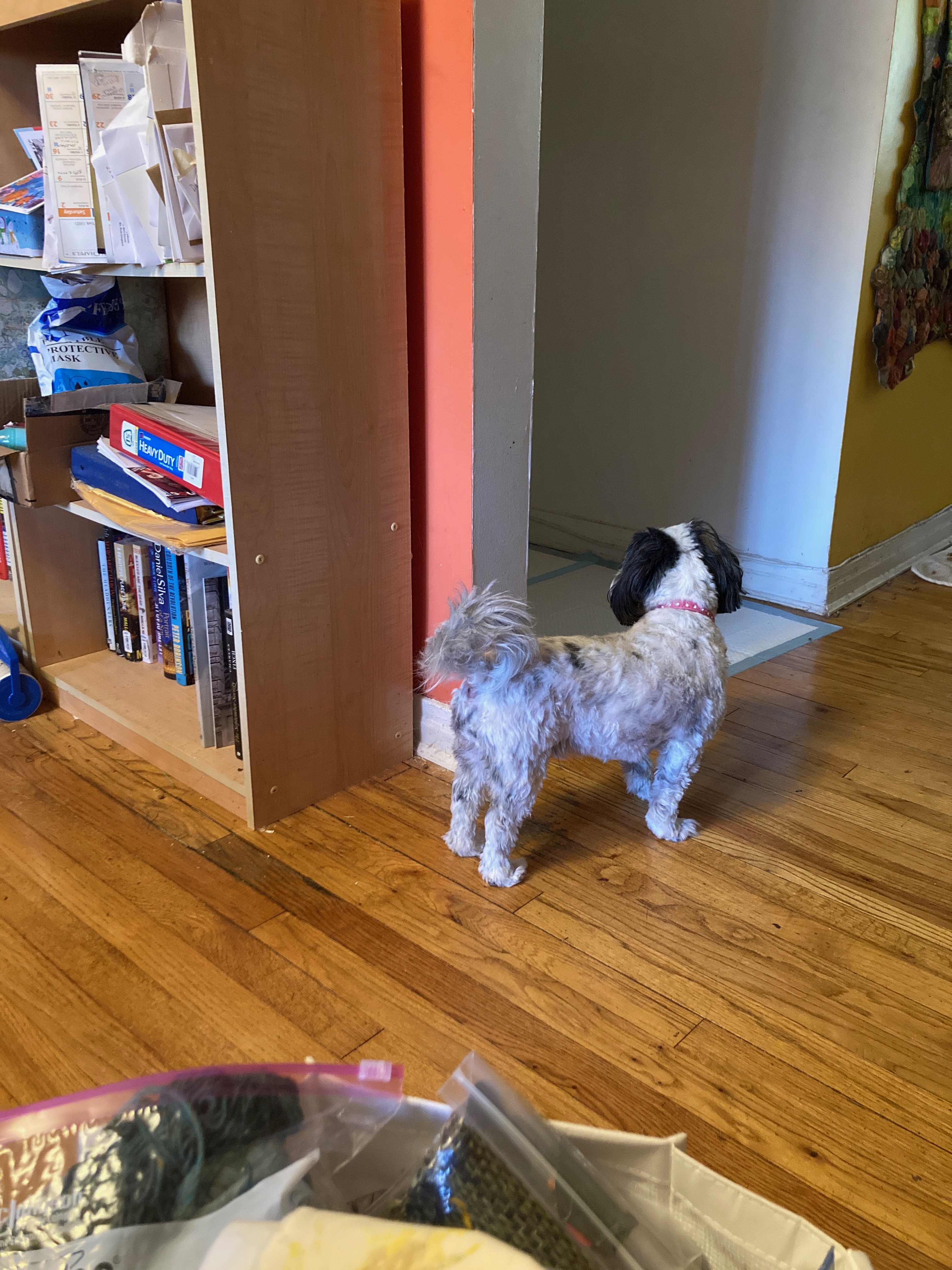
“When is my mommy coming home?”

If you haven’t had a chance yet, please check out my novel, Yeshiva Girl, on Amazon. And if you feel called to write a review of the book, on Amazon, or anywhere else, I’d be honored.

            Yeshiva Girl is about a Jewish teenager on Long Island, named Isabel, though her father calls her Jezebel. Her father has been accused of inappropriate sexual behavior with one of his students, which he denies, but Izzy implicitly believes it’s true. As a result of his problems, her father sends her to a co-ed Orthodox yeshiva for tenth grade, out of the blue, and Izzy and her mother can’t figure out how to prevent it. At Yeshiva, though, Izzy finds that religious people are much more complicated than she had expected. Some, like her father, may use religion as a place to hide, but others search for and find comfort, and community, and even enlightenment. The question is, what will Izzy find?

My Israel Trip: Day One

            From the beginning, it was something of an out of body experience. I took a car service to the airport, waving goodbye to Mom in the parking lot of our co-op, chatting with the driver about all manner of things (gardening, mothers, compression socks, and, of course, traffic at the airport). When I arrived at Terminal Four at JFK, I was immediately overwhelmed: people were rushing in different directions and there were no clear signs, that I could see, telling me where to go. I had already checked in online, so I was pretty sure I didn’t need to stop at a check-in kiosk, but beyond that I was lost. I asked a man in uniform (hopefully he actually worked there), and he directed me to a woman who was checking boarding passes. I showed her my electronic boarding pass and she let me through, and then I had to show my electronic boarding pass (AKA my phone) to two more women as I followed the crowd around cones and other obstacles onto the security line. I tried to do exactly what everyone else on the line was doing, showing my passport, lugging my carry-on and my personal bag into the gray buckets and pushing them towards the scanner, but I must have missed some of the instructions because my personal bag was pulled aside and I had to wait on another line until they could hand check it, and tell me that I was supposed to have taken my laptop computer out before putting the bag through the scanner. Live and learn.

“You should have stayed home with me.”

            When they sent me on my way, I still wasn’t sure where I was supposed to go next. People were wandering in a bunch of different directions, and signs listed different lounges and gates and floors, but nothing said: this is the way to EL AL. I followed an elderly couple to the elevator, which said “to all gates,” and followed them in, and, luckily, when the doors opened there was finally a big screen listing the destinations and flight times and gates, and I found my flight on the list and followed the arrows to my gate. At least, I thought I was following the arrows in the right direction. I walked past endless toy stores and candy stores and restaurants and people waiting at other gates for other planes, but I couldn’t find my gate. Eventually, I found another nice man in a uniform (this time I was pretty sure he worked for the airport, or at least for one of the airlines), and he directed me to go back to where I’d started and then keep going in that direction. Finally, after walking through what felt like the whole airport, I found my gate and sat down in the waiting area – two hours before boarding was set to begin. They say to get to the airport three hours before your flight, just in case.

            I spent the next two hours people watching, and texting with Mom. There were casually dressed couples (jeans and t-shirts like me) carrying babies, and Haredi men in long back coats with special boxes to carry their hats, and Yeshiva boys in khakis and polo shirts and black suede kippot studying and eating together at a work table. There were also enough other solo female travelers to make me feel less conspicuous than I’d expected, and people reading actual hardcover books like the one hiding at the bottom of my bag while I stole a few last looks at my phone. At some point, there was a group of men on the other side of the waiting area saying the afternoon prayers, and then ten minutes later, after sunset I assume, another group gathered to say the evening prayers, and then our flight was called to start boarding.

            I showed my electronic boarding pass to the woman guarding the line to board the plane, but she said, “Oh no, I will not look at that. You need a paper boarding pass.” Luckily the line at the EL AL desk was short, and I only had to go through a short security interview (Do you understand Hebrew? Are you sure? Why are you going to Israel? Where are you staying?), and then they scanned my passport, and handed me my paper boarding pass and sent me through to the plane.

            The last flight I’d been on was years earlier, and barely two hours long, so I was anxious about the 11-hour flight, without Wi-Fi and with no one to talk to. When I found my seat, a nice man (no uniform this time) helped me lift my carry-on suitcase into the overhead compartment, and then I discovered that my personal bag didn’t actually fit under the seat in front of me, the way all the videos said it would, and there was no more room in the storage compartments, so I was going to have to sit with my legs on an angle for the whole flight. At least I had an aisle seat, though. I’ve been watching Stephen Colbert do his Colbert Questionnaire for a very long time, so I knew I was supposed to get an aisle seat, rather than a window seat, to avoid having to climb over someone else to get to the bathroom.

            I felt some panic just before takeoff, thinking about every possible thing that could go wrong on the trip, and feeling trapped because getting back home would be so much harder midair, but it passed, eventually. I watched my seatmate to find out how to use the entertainment system in front of my seat, and I found a bunch of Israeli TV shows, in Hebrew, which I hoped would help me acclimate to all of the Hebrew I’d be hearing in Israel. I ended up finding a really interesting interview show and watched episode after episode: with an Israeli actress, a past Minister of communications, a former head of Mossad, an Arab Israeli reporter, a comedian who specialized in doing impressions (including of Netanyahu), and the current head of the opposition in the Knesset. We were served dinner about an hour into the flight, and I had to watch my seatmate to figure out where to find the folding tray table hidden in the armrest, but I never figured out how to turn on a light to be able to read my book once the overhead lights were turned down.

They served breakfast about an hour before we landed in Israel, and at that point, a lot of the men on the plane got up to pray the morning prayer, even though it still felt like the middle of night to me.

I’d heard horror stories about people being pulled from the security line and interviewed by customs officials for hours upon landing at Ben Gurian airport, but when we landed, I barely had to wait on line before my passport was checked and I was sent on through. Then I followed a big family through the maze of hallways until I finally reached the arrivals lounge, where I had just enough time to switch my phone to my temporary Israeli telephone number before my friend arrived to pick me up.

            I hadn’t slept at all on the plane, but somehow, I wasn’t tired, so she drove us straight to the Western Wall (The Kotel) in Jerusalem. I’d been promised that I would feel inspired just entering Jerusalem, and that being at the Kotel (the only outer wall remaining after the destruction of the Second Temple in 70 CE) would be profound, but as we walked through the alleyways of the old city, past endless groups of Israeli school children on day trips with their teachers, and groups of soldiers in training, also on day trips with their teachers, I didn’t feel much of anything.

Don’t those kids look inspired?!

It was a long walk on hard stone, down steps and around corners, until we were at the Kotel, and my first impression of this ancient holy place was, eh, it’s kind of dinky. I mean, it’s a wall, with some greenery growing out of it, and pieces of paper stuck in every crevice, but it didn’t glow or anything, and no great voice called down from the heavens telling me that I was home. I’d been warned that I would need to wear a skirt to go to the Kotel, and that there were women guarding the entrance who would insist on wrapping me in a scarf to cover my pants, but it turned out those women were out for the day, or distracted, and I was able to walk in wearing my jeans and t-shirt from the plane. The women’s section was significantly smaller than the men’s section, but one of the men had already climbed up to peer over the divider to see what the women were doing.

            There were plastic chairs set up for us to sit in, but many more women were standing right up against the wall, holding their prayer books and shuckling back and forth. A lot of the women wore long skirts, and elaborate scarves wrapped multiple times around their heads, and prayed with great feeling, but I just sat there and watched. I was fascinated by a pigeon with a peg leg. I don’t actually know if he actually had a peg leg or if he was just missing his foot, but he walked like a pirate and kept scanning the ground for crumbs. A little boy nearby was carrying a bag of snack chips, even though my friend told me you weren’t supposed to bring food to the area, so the bird was on the right track.

            I didn’t feel like praying, or writing a note to shove into the wall. I’d always imagined that there would be a notepad and pen set up nearby, and ladders, so you could put your note into a crevice away from public view, but no. The notes were all homemade and folded into tiny shapes in order to fit into the tiniest spaces in the wall, and you had to really look closely in order to see them. The most interesting thing, to me, was the way many of the women would back away from the wall as they left, and when I asked my friend about it, she said it was a sign of respect, because you shouldn’t turn your back on God. For my own safety, I didn’t risk the maneuver myself, because I was sure I would trip over my feet, or a spare child, so I walked out facing forward while my friend walked out backwards. I hope God understands.

            On our way back up the steps, I finally saw my first Israeli cats (they have stray cats everywhere) and took a picture to send to Mom as my first missive from the holy land. Then we wound our way back through the alleyways, passing little shops and food stalls and tour groups, and many men and women carrying paper cups, asking for money. They didn’t look like the unhoused people I used to see in the subway in New York, more like this was their job and they were proud of it. I could picture them finishing a long day of begging for money from strangers and returning home to their modest Jerusalem apartments to put their feet up and watch TV. At one point, there was a cat stretched out on a low wall, next to a discarded paper cup, but he didn’t make a move to ask for spare change. He seemed confident that someone would feed him eventually.

I’d read all about Jerusalem Syndrome, and how so many people went crazy and started to think they were God just because they were breathing the air in Jerusalem, but I guess I’m immune. I should have known that I wouldn’t be a good candidate for delusions of grandeur.

After visiting the old city, we drove around Jerusalem while my friend played tour guide. She’d lived in Jerusalem when she first made Aliyah, in her 20’s, so it was all very familiar and homey for her. She drove us through the different neighborhoods and past the Israel museum and the Knesset and the Supreme court and the National Library – everywhere a bus tour would have taken us – and then she pointed out the hotel where she’d had her wedding (which I missed, of course), and the neighborhood where her parents were living, though they were out of the country at the moment. And as we drove around Jerusalem, and then out towards her home, my friend and I started to catch up. We’d seen each other every few years when she came to visit family in the States, and of course we’d chatted through email and then WhatsApp, but this was, already, the most time we’d spent together in years, and I started to remember why we became friends in the first place: no matter how shy and anxious and out-of-body I felt, she was able to make to me feel seen and heard and comfortable. I’d been worried that I would feel like a burden, or that we’d have nothing to say to each other, but she was doing everything she could to let me know that I was welcome, and that she was looking forward to our next adventure.

            When we arrived in Modiin, about thirty minutes outside of Jerusalem, it was still light out, and I was surprised to find that the city looked suspiciously like White Plains, NY – with all of the newness and crispness of an upper middle-class enclave. It’s a very young, planned city, so it doesn’t have the tiny alleyways of Jerusalem, or the crowded streets, and the wide-open spaces made it easier to breathe.

First view of Modiin

            My friend’s four-bedroom apartment was huge, and in the process of being cleaned by her Yemeni Israeli house cleaner, whose rapid-fire Hebrew was matched by my friend’s equally rapid-fire Israeli-accented Hebrew – all too fast for me to follow. Of course, I knew that my friend spoke Hebrew – I mean, she’d lived in Israel for decades – but I hadn’t realized she would sound like someone who’d been born there. Up until that point, and on all of our visits in the States, we’d only spoken to each other in English.

            I was set up in her older daughter’s room (since she was away doing national service), and, as I unpacked I, of course, fell back into my out-of-body, what-am-I-doing-here state of mind. I was trying to hide from the cleaning lady, who was busy mopping the living room floor with what looked like a squeegee, because she’d already asked me ten or fifteen personal questions, in Hebrew, about my career and family and where my friend and I knew each other from, and I was afraid the questions were going to get steadily more intrusive. I checked my email and found out that I’d received another rejection from one of my agent queries, which I guess is better than the silence I was getting in response to most of the others, but it didn’t feel great. I focused on unpacking and getting my bearings, and when the house cleaner was finished my friend introduced me to the two kids who were still living at home, and her husband (who I’d met briefly a few times over the years) and the family rabbit, Choo, who spent most of his time meditating in his cage, or wandering out in the yard, on the look out for stray cats so he could rush back to safety at any moment.

Choo, the rabbit

            I don’t remember what we ate for dinner that first night, or what I did or said for the rest of the evening, until it was time to go to bed. I’d been awake for something like 36 hours by then, but I was still too keyed up to sleep, so when everyone went to bed, I went to my room and watched hours of Glee videos on my phone, spending some time with Cory Monteith, the lead actor on Glee, until his untimely death from an accidental overdose. For some reason he felt like a good friend, even though I’d never met him. It was an odd sensation, to find so much comfort in someone I didn’t even know, and who was no longer around, as if my brain was able to manufacture this reassuring presence to help manage my anxiety.

            Eventually, I fell asleep, and slept well. I woke up late the next morning when my friend knocked on my door, after already having done the laundry and emptying and filling the dishwasher and sending the kids off to school and getting a few hours of work done. I washed and dressed quickly, took my meds, ate some breakfast, and, with a few more deep breaths, I was ready to start day two.

“Wait, all of that was just day one? This is going to take forever.”

If you haven’t had a chance yet, please check out my novel, Yeshiva Girl, on Amazon. And if you feel called to write a review of the book, on Amazon, or anywhere else, I’d be honored.

            Yeshiva Girl is about a Jewish teenager on Long Island, named Isabel, though her father calls her Jezebel. Her father has been accused of inappropriate sexual behavior with one of his students, which he denies, but Izzy implicitly believes it’s true. As a result of his problems, her father sends her to a co-ed Orthodox yeshiva for tenth grade, out of the blue, and Izzy and her mother can’t figure out how to prevent it. At Yeshiva, though, Izzy finds that religious people are much more complicated than she had expected. Some, like her father, may use religion as a place to hide, but others search for and find comfort, and community, and even enlightenment. The question is, what will Izzy find?

My Passport Arrived

            It took me three or four years from the first time I printed out a passport application until finally, a few months ago, I went to the post office with my pre-filled-out application, had my official picture taken, and paid all of the fees. The impetus that finally pushed me on my way was the possibility of going on my synagogue’s trip to Israel, and even though I realized that this particular trip was not for me, I realized it was time to apply for my passport anyway, just in case.

            And then, a couple of days after I posted about the-trip-I-couldn’t-take on the blog, my best friend from high school renewed her offer to host me at her home in Israel, and take time off from work to travel around the country with me, wherever I wanted to go. I’d actually forgotten that she’d suggested such a trip a few years ago. At the time, I don’t think I believed her offer was real, or I thought it shouldn’t be, because she has her own business, and family, and a full life of her own, and I just couldn’t imagine interrupting all of that. But looking back, I think the real reason I didn’t accept the offer was because I just wasn’t ready. I couldn’t have told you why I wasn’t ready, or what would have to change to make me more ready, but this time, when she offered, I believed her, and I said yes. And, when my passport arrived in the mail a few weeks ago, I realized that I am really, finally, going to Israel.

You can’t have it, Mommy.”

            Of course, being me, now I’m thinking about all of the things that could go wrong on the trip. I printed out a pile of articles on what to pack, and where to go, and what to wear, and I filled my YouTube watchlist with videos on how to pack medications and what to put in your carry on and what to wear on the plane, and yet, I still haven’t scared myself out of going on the trip. It helps that I have some time to prepare. We chose November for my visit because that’s when she has a lighter workload, and the weather is more manageable for me, and flights are cheaper, and there are no big Jewish holidays to complicate things. I feel guilty for planning to go during the school year, and missing one or two classes with my students as a result, but even that guilt hasn’t been enough to derail me, so far.

            There’s still so much research to do, and so many decisions to make, and so many opportunities for the panic to overwhelm me. I worry that airport security will want to see all of the prescriptions for my meds, in case I’m hiding opiates in the midst of all of my other pills; and what if I can’t make sense of the Gett app (their version of uber), or the currency exchange rate, or public transportation, and I end up having a panic attack in the middle of the light rail in Jerusalem? And then I wonder if I should make the trip shorter, to reduce the potential causes of anxiety, or if it should be longer, so I can take more time to settle in before trying to do anything too exciting. And then I wonder what I should bring back for my students, and a little voice inside keeps asking, why can’t mommy come with me? And then I think, wouldn’t it be better to win the lottery first, or to wait for a group trip so that someone else can make all of the decisions for me?

            With all of my research, I now know that I will need flight insurance, and travel insurance, but I want to know where I can get mental health insurance, or better yet, an app that will figure out when I’m spiraling and send help when I fall apart in the middle of the Carmel market.

            I’m trying to keep my expectations for the trip low, so I won’t fall into a deep depression when I inevitably fail to make it the best experience of my entire life. I’d like to think of this more as the first in a series of trips, and a chance to acclimate to the country and plan future adventures. That way, as long as I get the chance to walk through one of the outdoor markets, and shop for new-to-me foods in the supermarket, and sit by the beach or in a café, listening to the different accents swirling all around me, everything beyond that will just feel like a bonus.

            The reality is, going on this trip with my good friend is the best part of the plan, because she won’t expect me to suddenly have the energy to climb Masada or swim in the Dead Sea. And if what I really want to do one day is go to the supermarket to search for new snacks and then watch Israeli TV all day, she’ll be right there with me. And, really, if I have a panic attack in the middle of Tel Aviv, I won’t need a mental health app to scoop me up, because she’ll be there to look me in the eye and remind me that the earth not going to swallow me up and with a few deep breaths, and maybe a nap, I really will be okay, and probably better than okay, even on my own power.

            Now, back to worrying about what to pack.

“Can I fit in the carry on?”

If you haven’t had a chance yet, please check out my novel, Yeshiva Girl, on Amazon. And if you feel called to write a review of the book, on Amazon, or anywhere else, I’d be honored.

            Yeshiva Girl is about a Jewish teenager on Long Island, named Isabel, though her father calls her Jezebel. Her father has been accused of inappropriate sexual behavior with one of his students, which he denies, but Izzy implicitly believes it’s true. As a result of his problems, her father sends her to a co-ed Orthodox yeshiva for tenth grade, out of the blue, and Izzy and her mother can’t figure out how to prevent it. At Yeshiva, though, Izzy finds that religious people are much more complicated than she had expected. Some, like her father, may use religion as a place to hide, but others search for and find comfort, and community, and even enlightenment. The question is, what will Izzy find?

Magic Spells to Try

            A good friend of mine sent me an unexpected early birthday present. She’d posted tons of pictures of her summer trip with her son to Universal Studios in California, but it turns out she left out the picture of the replica of Hermione’s magic wand she bought for me at the Harry Potter store.

            I had no idea this was coming. She’d sent me surprise care packages early in the summer to help me through my second oral surgery, but I’m still not used to this kind of care, so when I opened this package and found the long box with a wand nestled inside, as if it had come directly from Ollivander’s wand shop, I was speechless and struggled even to take it all in..

            My first thought when I finally held the wand in my hand was that I should point it at Ellie’s heart – to heal her. I know it doesn’t work that way, but not so deep inside of me there’s a little girl who wants to believe in magic and really doesn’t want to lose another family member so soon, or ever. My next thought was of how, during my first year teaching synagogue school, I brought the kids pretzel sticks and showed them how to use them as magic wands, as part of a lesson on prayer, as a way to emphasize the power of words to create our reality.

            My next thought was that I really needed to try some spells, not only because I wanted to believe they could work, but to see if I could create some healing ritual, some way to remind myself that I’m really not so alone. I went online and googled “Hermione’s Spells” and found a long list of the spells she’d performed throughout the books and the movies. She had spells to open doors and fill a cup with water and disarm an enemy and freeze someone in place. She used practical spells, like making Harry’s glasses impervious to rain, or creating a fire to cook with, and powerful spells, like confusing enemies or making them forget what they’d just experienced. She used her words to cause harm, and to protect, and even to knit small hats for house elves, but I couldn’t find a spell to heal heartbreak, or anything I could use to stop Ellie from dying, or to bring peace to Israel and the Palestinians. I guess even Hermione wouldn’t presume to have that kind of power.

            I’m pretty sure that Ellie spends a lot of her time, when she’s sitting in front of the bookcase that holds her treats, whispering her own version of the summoning charm, hoping that chicken treats will start to fly directly into her mouth. Maybe if she had her own wand those summoning charms would really work. I wish that for her, and for me. I think we could all use a little more magic in our lives.

If you haven’t had a chance yet, please check out my Young Adult novel, Yeshiva Girl, on Amazon. And if you feel called to write a review of the book, on Amazon, or anywhere else, I’d be honored.

            Yeshiva Girl is about a Jewish teenager on Long Island, named Isabel, though her father calls her Jezebel. Her father has been accused of inappropriate sexual behavior with one of his students, which he denies, but Izzy implicitly believes it’s true. As a result of his problems, her father sends her to a co-ed Orthodox yeshiva for tenth grade, out of the blue, and Izzy and her mother can’t figure out how to prevent it. At Yeshiva, though, Izzy finds that religious people are much more complicated than she had expected. Some, like her father, may use religion as a place to hide, but others search for and find comfort, and community, and even enlightenment. The question is, what will Izzy find?         

The Gang of Cats

            There is a group of cats that has taken to visiting the backyard of my co-op. So far I know there are at least three of them, a grey one with white feet, and a white one with black markings, and a black one with white markings, though there may be more. It’s hard to count them because they often come around one at a time during the day. When they see Ellie coming out of our door they start to run, and Ellie chases them until they jump up into the retaining wall, out of her reach. For some reason, they have a habit of “hiding” on the third or fourth tier of the retaining wall, behind a single flimsy branch, as if Ellie would be able to see them up there if they weren’t camouflaged by this wondrous work of nature. Except, Ellie can’t see them at all, because she’s a dog and has limited vision and can’t really see things unless they are nearby and/or moving. Generally, Ellie prowls around at ground level searching for clues of the cat’s whereabouts, while I stand right in front of the hidden cat and try to make conversation.

Not one of the current cats, but probably an ancestor.

            The cats never answer my questions, though, which is very disappointing. I keep asking them where they live, and how they’re doing, and they just ignore me and watch the dreaded Ellie down below. Cricket isn’t interested in the cats at all at this point in her life. In fact, she has given up on cats and squirrels and birds altogether and has focused all of her attention on trying to get Kevin, the Mini-Golden-Doodle who lives two buildings over, to play with her.

            Eventually, after Ellie has forgotten about the cat in the retaining wall, and Cricket has, reluctantly, accepted that Kevin isn’t going to come out to play, the dogs let me take them back inside and the cats go back to what they were doing before, usually hanging out under the bushes in front of my building, because it’s the best place from which to spy on the mourning doves, who spend a lot of time near there (my neighbor is very generous with bird seed). A few times we’ve found piles of grey and white feathers in the yard, with no sign of the bird who used to wear them. I try to believe that the bird has survived the attack from the cats, somehow, because there’s no sign of the body or bones or blood, but half a bird’s worth of feathers is a lot, especially when there’s so much of the soft fluff that comes from the layer closest to the bird’s body.

“I didn’t do it. I was sleeping the whole time.”

I don’t know if these cats have homes, or humans to take care of them, and I don’t know if they are really hungry, or if they are more like Ellie, who feels like she’s starving two minutes after a breakfast of kibble, cheese, and chicken treats. They look pretty healthy, so it’s possible that they are house cats who are allowed out whenever they want, either that or there are a lot of people in my neighborhood who like to feed stray cats. It would be easier for me to accept the cats’ hunting behavior if they are feral, though it would still be hard to forgive. Those mourning doves are so awkward and well-fed that they really don’t stand a chance against a gang of cats.

One of the Mourning Doves searching for snacks.

            And yet, despite all of that, I still look forward to seeing the cats. Part of me even wishes that the cats would realize that Ellie isn’t a threat to them, and would see her as a potential friend, because she needs one (Cricket doesn’t count as a friend; she’s a sister, which, if you ask Cricket, is a whole other thing). Ellie would love to catch up to one of the cats and have a loud conversation with them, or teach them one of her special dances (hop, hop, slide, hop, twirl, prance, jump, spin). But they don’t know that Ellie would never hurt another creature and is no threat to them; though she’s been known to hurt Kevin’s feelings when she “hides” on our stoop every time Kevin comes around.

“I wasn’t hiding, I was waiting for you to let me back into the house so I could escape from, Kevin.”

I’m allergic to cats, so I can’t have one of my own, either for my sake or for Ellie’s, but I wish I could. I miss my old friend Muchacho, the cat who lived here when we first moved in about ten years ago. He lived in one of the apartments nearby, with his human, but he came and went through the window as he pleased. He was so friendly that he’d let me pet him, and even pick him up once or twice. It was a real loss when he died, because even though I still have neighbors with cats, they are all indoor cats and I rarely see them. These visiting cats are nothing like Muchacho, of course, and they are unlikely to let me get anywhere near petting them, but part of me believes that if I’m friendly enough they will change their minds. I even worry about them when they’re not here, almost as much as I worry about the wellbeing of the birds when the cats are here. I wonder what the cats are thinking, and where they go when they aren’t in our yard, and if they have human families, or feline ones, or enough food or shelter. I haven’t, yet, tried to chase them up into the retaining wall the way Ellie does, hoping for answers to all of my questions. But I’ve been tempted.

Muchacho

If you haven’t had a chance yet, please check out my Young Adult novel, Yeshiva Girl, on Amazon. And if you feel called to write a review of the book, on Amazon, or anywhere else, I’d be honored.

            Yeshiva Girl is about a Jewish teenager on Long Island, named Isabel, though her father calls her Jezebel. Her father has been accused of inappropriate sexual behavior with one of his students, which he denies, but Izzy implicitly believes it’s true. As a result of his problems, her father sends her to a co-ed Orthodox yeshiva for tenth grade, out of the blue, and Izzy and her mother can’t figure out how to prevent it. At Yeshiva, though, Izzy finds that religious people are much more complicated than she had expected. Some, like her father, may use religion as a place to hide, but others search for and find comfort, and community, and even enlightenment. The question is, what will Izzy find?

Planning My (Eventual) Trip to Israel

            Ever since my High School best friend visited from Israel, back in January, I’ve been thinking about what we’ll do when I finally get to Israel. I think the biggest result of my almost two years of online Hebrew classes from Tel Aviv, and watching so many Israeli TV shows to practice my Hebrew, is that I’m much more interested in visiting smaller neighborhoods and meeting the people than I am in going to the traditional tourist sites. For example, I really don’t want to get up early in the morning to hike Masada, or even take a cable car to the top to watch the sunrise, because I’ve seen more than enough pictures of the view, and because I’m not sure I want to celebrate a place where so many Jews felt like their only option was to commit suicide in order to avoid being captured.

I’m reluctant to go to the Dead Sea (Yam HaMelach in Hebrew), because… bathing suits, and because I usually have one wound or another and the salt stings. But I wouldn’t mind going further south, to Eilat, because there’s supposed to be a spectacular underwater preserve, where you can snorkel or go on a glass bottom boat ride to see fish and coral, and then you can go to the Dolphin Reef to swim with dolphins. But again, bathing suits, or a wet suit, which is just as bad.

Of course, I’ll need to go to Jerusalem for a few days, just to see if I fall under its spell. I’m kind of hoping I will, because it sounds like an incredible high the way people describe it, though I don’t want to get the official version of Jerusalem Syndrome, which includes psychotic breaks and believing you are Moses or Jesus or someone like that. More likely than not, I’ll get to the Wailing Wall, look around, realize I’ve seen it all in pictures and videos already, and then spend the rest of my time at the Mahane Yehuda Market.

“Do they have food?”

            Time of year will make a huge difference in what kind of trip I can take, because if I have to go in the summer I will not be able to spend much time outdoors. I’ll just go from one taxi/bus/train to another, and one hostel to another, carrying buckets of ice to toss over my head in case of emergencies.

            I found an Israeli tour guide on YouTube, named Oren, who does tons of videos: on how to plan trips to Israel in general; and how to manage public transportation, and how to navigate the weather, and the people, and the supermarkets, etc. He’s an opinionated guy, and I don’t always agree with his point of view on politics, but he’s knowledgeable and detailed, and funny, and he really loves Israel.

Some things I’ve learned from Oren: they don’t stamp passports in Israel, because then it would be difficult for people to travel on to Arab countries, so instead you get a paper called an Electronic Gate Pass that you have to keep track of; the New Israeli Shekel, Known as NIS or “Shach,” equals about thirty to thirty five American cents; you need an adapter for any American electronics (hair dryer, electric toothbrush, etc,); you will need an Israeli provider’s sim card for your cellphone in order to have Wi-Fi, outside of a hotel/hostel that provides it for you; March and April are the best time to go to Israel, but any time after October is okay, because the winters are mild; The preflight security interview at El Al can be intimidating and annoying, but you’ll survive; buy traveler’s insurance; keep the Jewish holidays in mind when planning your trip, because there’s no public transport on Shabbat and holidays in most of the country, and flights into the country are more expensive leading up to the big holidays; only go to the Negev in the winter, otherwise you will burn to a crisp; you need a guide of some kind in order to visit the old city of Jerusalem, but there are group tours, apps, and guide books if private tours are too expensive, and keep in mind that Jewish and Christian tours are very different; in an emergency dial 101; don’t be surprised to find yourself standing next to an Israeli soldier carrying an Uzi.

            Recently, I’ve been getting really interested in seeing the north of Israel, because I know so much less about it, and because it is not as hot as the south, but Oren has fewer videos about the north, so far, so I had to go to Wikipedia and other sites for information.

            Haifa is the big city in the north of Israel, and there’s an Israeli saying that goes, “Haifa works, Jerusalem prays, and Tel Aviv plays,” which doesn’t make it sound very exciting, but it has the only underground rapid transit system in Israel, called the Carmelit (Tel Aviv is in the process of building its own). And it’s also one of Israel’s mixed cities, with a significant population of Arabs and Jews living in the same place, with Arab Christians, Arab Muslims, Druze and Bahai communities, plus a lot of immigrants from the former Soviet Union, and even an ultra-orthodox minority. So it seems like it’s worth a visit, and it could be a good jumping off point for visiting other parts of the North. Haifa is also one of the few cities in Israel where buses operate on Shabbat.

I want to see Tsfat (Safed), which is known for art and mysticism; and Akko (Acre), which is an ancient city with remnants from the Hellenistic-Roman period, and the Crusader period, and the Ottoman period; and then there’s Tiberius, which was founded in 20 CE by Herod Antipas, the son of Herod the Great, and became a hub for Jews after the destruction of the second temple (and where the Jerusalem Talmud was put together); and there’s Mount Hermon, bordering Lebanon, which is the one place in Israel that gets enough snow for skiing in the winter (but since I don’t ski I’m not sure why I’d go there, except to cool off); and then there are a lot of Kibbutzim and Moshavim to visit, with fruits and vegetables and cheeses and mushrooms galore.

“I like cheese!”

But it’s all still up in the air, especially when it’s so much easier to watch videos of all of these places on TV. And I’m still dragging my feet about getting my passport renewed, though, partly because of my reluctance to have my picture taken, and partly because it’s one more appointment I’ll have to make and organize and get to. And the thing is, I don’t really want to go to Israel alone, or plan a whole trip by myself, and I can’t expect my friend to abandon her family for weeks at a time just to keep me entertained. My synagogue is planning an Israel trip next year, in the spring I think, but it’s bound to be expensive and involve a lot of walking, and visiting places I don’t particularly want to go, and it would require me to make up my mind far in advance, which I seem incapable of doing.  So, in the meantime, I’m watching Israeli movies and TV shows: on my Kan 11 app, or the Izzy streaming channel, or just on YouTube. At the very least, by the time I get to Israel I’ll know the best places to go for Chummus.

“Have them send all of the food here!”

Some of Oren’s Israel videos:

The 10 Most ISRAELI Things You Don't See On the News (14:33) https://youtu.be/q4lmXwqGDHg
The Israeli Supermarket (11:54) https://youtu.be/OFUximyJ3rI
Running the Dead Sea Marathon (10:14) https://youtu.be/THKJDJQUww4

If you haven’t had a chance yet, please check out my Young Adult novel, Yeshiva Girl, on Amazon. And if you feel called to write a review of the book, on Amazon, or anywhere else, I’d be honored.

            Yeshiva Girl is about a Jewish teenager on Long Island, named Isabel, though her father calls her Jezebel. Her father has been accused of inappropriate sexual behavior with one of his students, which he denies, but Izzy implicitly believes it’s true. As a result of his problems, her father sends her to a co-ed Orthodox yeshiva for tenth grade, out of the blue, and Izzy and her mother can’t figure out how to prevent it. At Yeshiva, though, Izzy finds that religious people are much more complicated than she had expected. Some, like her father, may use religion as a place to hide, but others search for and find comfort, and community, and even enlightenment. The question is, what will Izzy find?
The Ways of Waze

            My best friend from high school came in from Israel for a family visit recently, and my only job was to find a way to get to where she was staying in order to catch up. It seems like it should be easy to get from one part of Long Island to another, to see an old friend I rarely get to see, but I’m me, so…

“Uh oh.”

            I downloaded WAZE on my phone, per Mom’s instructions, and also printed out a hard copy of the directions from Google Maps to study ahead of time. I’d managed a trip out to the Far Rockaway area a couple of years ago without WAZE, for a visit with the same friend, but it’s a route I rarely drive and I wanted to be prepared.

            And then I had a flare, or a worsening of my symptoms, or whatever I’m supposed to call it. My symptoms have been bad for a while now (exhaustion, pain, brain fog, Psoriasis and Lichen Planus outbreaks, walking trouble, breathing trouble, headaches, etc.), but on the Thursday before the visit things got even worse, to the point where Mom had to drive me to and from work to avoid a possible disaster on the road.

“I can’t watch.”

            I still thought the flare would pass by the day of the visit, though, and I avoided anything stressful or difficult in the days leading up to it, in hopes of recovering in time. But when I got up that Sunday morning, I knew I couldn’t do the drive; I could barely figure out how to open WAZE on my phone and make the directions appear. So Mom volunteered to drive me.

            It’s embarrassing to be an adult who needs her Mom to drive her to a get together, or to what my students would call “a play date,” but it was either be embarrassed or miss the visit altogether.

            Mom and I had both programmed our phones for the route, out of an abundance of caution and anxiety, so even after we’d decided to just use my phone, held aloft in the passenger seat so I could repeat the directions as many times as necessary to avoid missing our exits, Mom’s phone kept talking, in an echo. I finally figured out how to shut down her phone completely in order to make the echoing stop (later I realized that I could just have pressed stop on the WAZE screen, but, as I said, brain fog).

            We still had a hard time following the directions, of course, missing a few turns here and there, and then WAZE told us about a hazard up ahead, too late for us to turn around and change the route, and we found ourselves driving through a lake in the middle of the road. The car swam for twenty feet or so before getting to dry road on the other side, but it survived again.

            In my job as holder of the phone, I also discovered that WAZE likes to put little smiley faced icons all over the screen, which look suspiciously like the hidden pictures in one of my phone apps that I’m trained to tap with my finger until they are all removed and I win lots of points. I was just barely able to stop myself from pressing all the icons, so I have no idea what would have happened to the directions if I’d given in. We’d probably have ended up in Brooklyn.

            But we managed to get to our destination on time and safely, and it was a joy to see my friend again. Mom dropped us off at a coffee place to chat and then spent the next two hours on her own, taking pictures of big rocks and collecting shells at the beach, and then we dropped my friend off back at her sister’s house, with lots of hugs, and started up the WAZE again, a little more hopeful that the drive home would be uneventful. And despite some interesting “short cuts,” leading us behind factories and through one way roads that seemed more like driveways (probably to avoid the lake in the road), we made it safely home to the dogs, just in time for their afternoon walk.

            Ellie was thrilled to see us and zoomed around the yard in circles and figure eights, with breaks to come back and give us hugs and kisses, and Cricket spent her time sniffing scientifically at small patches of grass, searching for messages from her friend Kevin, the mini Golden Doodle, and looking longingly at the steps in front of his building, to no avail.

“He peed here. I know it!”

            And then we were back inside, home, with WAZE silenced and no more left turns to make across traffic, and I was relieved. The fact is, I was incredibly lucky to have Mom there to drive me, and WAZE to help us get there safely, and a good friend to meet with and catch up on all of the life events that can’t be shared in a text. Life has so many moving parts, with so many hazards along the way, but every once in a while the puzzle pieces actually come together. And it’s wonderful!

Home.

If you haven’t had a chance yet, please check out my Young Adult novel, Yeshiva Girl, on Amazon. And if you feel called to write a review of the book, on Amazon, or anywhere else, I’d be honored.

            Yeshiva Girl is about a Jewish teenager on Long Island, named Isabel, though her father calls her Jezebel. Her father has been accused of inappropriate sexual behavior with one of his students, which he denies, but Izzy implicitly believes it’s true. As a result of his problems, her father sends her to a co-ed Orthodox yeshiva for tenth grade, out of the blue, and Izzy and her mother can’t figure out how to prevent it. At Yeshiva, though, Izzy finds that religious people are much more complicated than she had expected. Some, like her father, may use religion as a place to hide, but others search for and find comfort, and community, and even enlightenment. The question is, what will Izzy find?

The Carolina Wren(s)

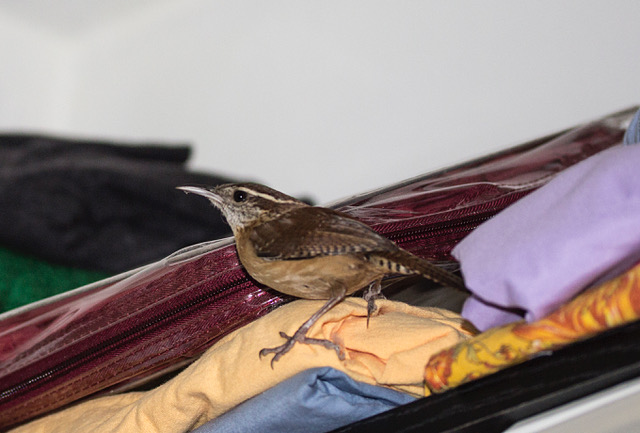
            For the past few years, ever since my Mom’s friend Olivia died one January, a Carolina Wren has taken to visiting the apartment over the winter. The first visit, within days of Olivia’s death, felt like a spiritual visit from Olivia herself, to let us know that she was okay, and to say goodbye. When the wren (or a different wren) returned the next year, it seemed like Olivia was checking in on us, and letting us know that her spirit was flying free.

“This is my good side.”

            This year has been different. A Carolina Wren has come into the apartment four or five times already, usually on the coldest, snowiest days. She (I always assume she’s a she) sometimes stays overnight, flying from one room to another, sampling the kibble, taking a bath in the water bowls, singing a few songs, leaving poop on the curtains and then heading out.

            The dogs never seem to mind the visits, even when the little bird is singing full out or flying over their heads.

“Go ahead. Eat as much kibble as you want.”

            On her third visit this winter, in the middle of a snowstorm, a second Carolina Wren came in with her. I don’t know if it was her mate (he was a little fatter than she was), or another bird, curious about where she kept escaping to when everyone else was freezing. Our Carolina Wren did not seem to appreciate the company. The bigger bird perched on the top of my bookcase while the little one did gymnastics on the curtain rod, and tried and failed to land on a bare lightbulb, and two-stepped her way down the curtain in my room. Finally the bigger bird decided to leave, but our little Wren stayed a while longer.

“Does this color make my foot look big?”

During her next visit, when I was practicing the alto part for a choir recording, she decided to sing with me. She didn’t sing the tune I was singing, she sang her own, but she sang it in answer to me and along with me, insistently; maybe trying to figure out why I was singing the wrong song. Her voice was much bigger than mine, despite her tiny size, and it filled the whole apartment. There wasn’t much harmony between her song and mine, but there was a magic to it anyway. There was communication and echoing and solidarity and questioning; and it was beautiful.

            It reminded me of how my old black lab mix, Dina, would hear us singing at Friday Night dinner and add her howl to the song. I found out that if I hit certain notes, usually higher up in my register, it would set her off. And even if we weren’t singing the same song, we were singing together; and even if it didn’t sound right, it sounded like love.

My Dina.

            I don’t know what it means that the Wren is visiting us more often, or even if it’s the same Wren each time. Maybe we’re listed on the Wren-airbnb site; maybe she’s looking for a nest, or for nesting materials (we have an enormous collection of fabric scraps); maybe she needs a respite from her mate and we seem friendly enough; or maybe there really is some communication between the spirit and bird worlds, and old friends are coming to visit in bird form. I’m not an expert on the afterlife, or on birds, but it’s nice to be visited, and it was nice to have someone to sing with in person, in this year of social distancing.

“I can play while you sing, Mommy.”

If you haven’t had a chance yet, please check out my Young Adult novel, Yeshiva Girl, on Amazon. And if you feel called to write a review of the book, on Amazon, or anywhere else, I’d be honored.

            Yeshiva Girl is about a Jewish teenager on Long Island, named Isabel, though her father calls her Jezebel. Her father has been accused of inappropriate sexual behavior with one of his students, which he denies, but Izzy implicitly believes it’s true. As a result of his problems, her father sends her to a co-ed Orthodox yeshiva for tenth grade, out of the blue, and Izzy and her mother can’t figure out how to prevent it. At Yeshiva, though, Izzy finds that religious people are much more complicated than she had expected. Some, like her father, may use religion as a place to hide, but others search for and find comfort, and community, and even enlightenment. The question is, what will Izzy find?

Goodbye, My Friend

Teddy

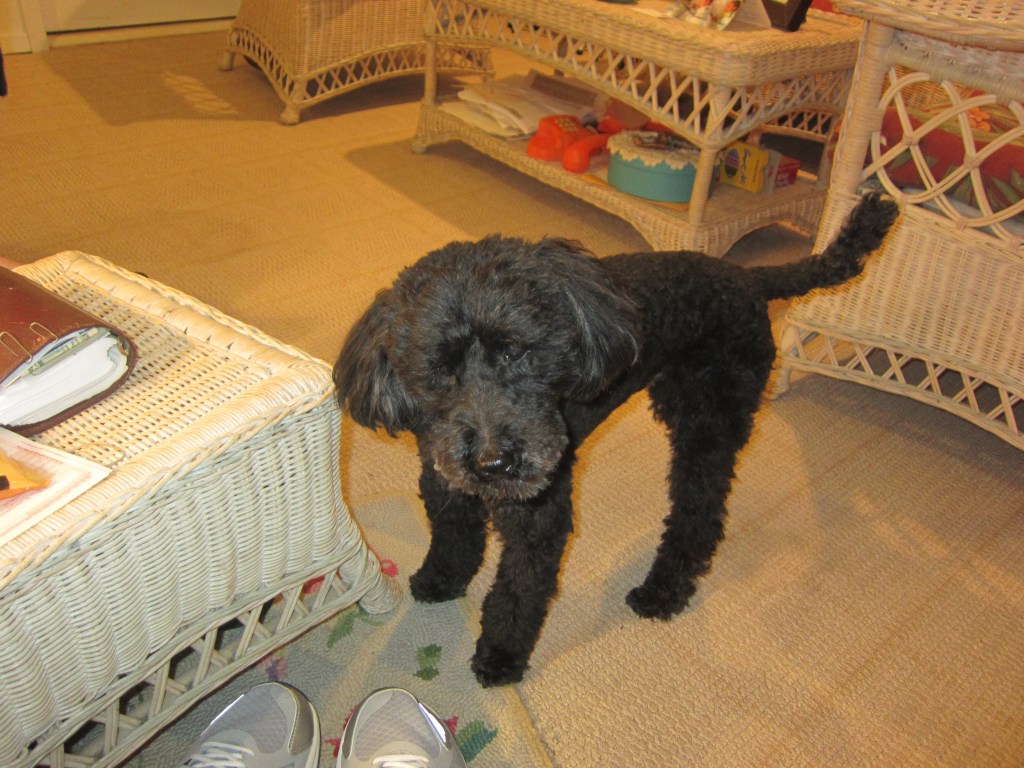
            A good friend of mine died recently. He was a black-haired, gentle-souled miniature poodle named Teddy and I miss him very much. I hadn’t seen him in a while, but just knowing that he was still there, still climbing through his doggy door and sleeping on his Mommy’s lap, was reassuring and made the world feel whole.

            He was fifteen and a half, I think, two and a half years older than Cricket, my cocker spaniel/miniature poodle mix, who adored him from the get-go. He was long-legged and skinny, with hair that quickly covered his eyes between grooming session. He could leap like a ballet dancer, pointed toes and all, or just race full steam ahead to play with a toy. He was full of joy, and love, and seriousness. He was a gentleman, in the way he held himself and in the boundaries he set around himself. If he could have spoken, he would have had a faint French accent, nothing too broad, more like the head waiter at a high-end restaurant.

Gentleman Pose

            Over the past few years he grew blind and deaf, relying on his younger sister to alert him to noises he needed to respond to, and by the end, to alert him to meal time as well. He had been slowing down for a while, but took great joy in his resurgence on CBD oil, it gave him a zest for life and an appetite and the energy to be his athletic self once again. But his final illness came on quickly, shutting down his kidneys. Treatment only relieved his symptoms temporarily, and when the symptoms inevitably returned he was even more confused than before, and unable to feel like his true self. When he stopped eating, his sister stopped eating too, to keep him company, to express her grief at what she instinctively knew was coming, and because when your loved ones are in pain, you feel the pain too.

            He died with dignity, in a way we don’t often allow our human loved ones to do, surrounded by love and by the knowledge that he had lived a full life, a generous life, and a satisfying life. I imagine that when he crossed the rainbow bridge he did a few leaps and arabesques and then raced towards his two golden sisters who were waiting for him on the other side. He would have had so much to tell them about the world they’d left behind, and they would have had so much to tell him about what comes after.

            We tend to think that our role models and teachers will be human, but Teddy was one of my best teachers, and he was truly, and fully, a dog, in the best possible way.

            Teddy was my therapy dog. Not only because he was my therapist’s dog, but because he offered his own version of therapy: a nonverbal, relationship-based therapeutic technique that they don’t teach in school. He modeled for me how to respect your own emotions and your own boundaries even while reaching out to others. He modeled how to be fully yourself and respectful of others at the same time. He, like Cricket, taught me that there is no shame in speaking up when you feel strongly about something. And that there is honor and strength in accepting your own limitations and not forcing yourself into situations where you don’t feel safe.

“I want out!”

            He was a picky little man, with specific tastes in food and people and dog friends, and he chose me. He trusted me, and I felt the honor of that deeply. Teddy taught me that it’s not arrogant or selfish to hold your own views, or to love only who you love. He showed me that you can have those preferences, and know yourself, while still being respectful and polite to those who don’t fit for you – unless they scare you or piss you off, and then you can scream.

“Let’s get ready to rumble!”

            He showed me that you can express your fear and pain, and if you express it fully and truthfully, there is then room for other feelings to come in. He taught me that there is no shame in asking for affection when you need it, and he taught me that there are people, and dogs, who will be honored that you’ve asked for their affection.

            His acceptance of me, his love for me, and his trust of me, was healing on a very deep level. He reflected me back to myself as I really am. He told me that I am kind, I am trustworthy, and I am loveable. And I believed it, from him. I think the fact that he could never communicate in words, which are my stock in trade, also played a role. He reached the parts of me that can’t speak and they heard him and felt comforted by him.

            I know there were times when it wasn’t easy being Teddy. There were a limited number of people that made him feel comfortable, and when he couldn’t be with those people he suffered. I can relate to that, completely.

            He stayed with me a couple of times, in the period after Butterfly died and before Ellie arrived, and after a short period of vocal grief and longing for his Mom, he settled in with us. He set his boundaries with Cricket early on, and she respected those boundaries, and appreciated his respect for her space too. They went on walks together, and ate dinner together and took naps together peacefully, as long as I was there to referee. By the time he had to leave Cricket was forlorn, sleeping in his makeshift bed until the scent of him dissipated.

Teddy on his bed

            The most important lesson I learned from Teddy is that love is a gift. His love for me was a gift. And the love I felt for him in return made me feel strong enough to raise Cricket with love, and then Butterfly, and now Ellie. He taught me that having enough of what you need makes you feel like you are enough.

            Dogs, maybe because they live such short lives, focus in on the most important things: love, food, joy, and safety. They don’t get distracted by appearances or wear the masks we humans wear to get through our days.

Cricket and Teddy napping with Grandma

            I will miss Teddy, but I will also keep Teddy with me, as part of me, for the rest of my life, as a guide, and as a source of energy for the lessons I still want and need to learn.

            Goodbye, my friend. May you feel all of the love you have inspired throughout your short life, and find peace and community on the other side.

If you haven’t had a chance yet, please check out my Young Adult novel, Yeshiva Girl, on Amazon. And if you feel called to write a review of the book, on Amazon, or anywhere else, I’d be honored.

            Yeshiva Girl is about a Jewish teenager on Long Island, named Isabel, though her father calls her Jezebel. Her father has been accused of inappropriate sexual behavior with one of his students, which he denies, but Izzy implicitly believes it’s true. As a result of his problems, her father sends her to a co-ed Orthodox yeshiva for tenth grade, out of the blue, and Izzy and her mother can’t figure out how to prevent it. At Yeshiva, though, Izzy finds that religious people are much more complicated than she had expected. Some, like her father, may use religion as a place to hide, but others search for and find comfort, and community, and even enlightenment. The question is, what will Izzy find?

The Fourth Year Dreams

Up until recently, my dreams kept throwing me back into the fourth year of high school, telling me that I still had credits to finish in order to graduate, even though I have three master’s degrees in real life.

The literal truth of the dreams is that, when I went there, my high school had a three year program. It was an Orthodox Jewish high school, and the idea was to graduate us a year early so we’d feel obligated to spend a year in Israel before college. The other literal truth is that I fell apart during my last (third) year of high school, and even though I went to college the next fall (at age sixteen), I was unable to stay there.

Looking back, I think part of the reason for the dreams was wish fulfillment. I wanted to go back to high school and do a fourth year, because I wanted to believe that my collapse in college was caused by not being old enough to handle it. Maybe, I hoped, if I could go back and finish that last year of high school, I would be all better.

067

“Hmm.”

And in those early versions of the dreams, my orthodox Jewish high school had a drama department, and art classes, and a therapist (none of which we had in real life). But the dreams still focused mostly on the anxiety and stress of high school, with all of the social failures, and the tests in math, or physics, or social studies that I was wildly unprepared to take.

The dreams kept going, even as I got older and worked to get better. It was frustrating to keep returning to high school as I slept, because when I was awake I knew how much progress I’d made in therapy, in writing, in self-awareness, and in my overall mental health. But the dreams kept reminding me of all of the things I still couldn’t do. With each year I fell further behind my peers: in relationships, and work, and money, and independence. I never stopped trying to move forward, but for every mile my peers traveled I made it about a foot into the future.

Ellie and the Afikomen

“Every step counts, Mommy.”

There’s a theory that if you can work through the issues behind your dreams, then you’ll stop having those dreams, but for a long time I felt like these fourth year dreams were going to haunt me for the rest of my life. And the thing is, along with all of the anxiety and failure and humiliation of the dreams, there was also a sense of possibility; that I could have another chance to learn what I couldn’t learn the first time through.

Gradually, even during the dreams, I was able to remember the work I’d done, and the degrees I’d earned in the real world. And then, after graduating with my Masters’ degree in social work last year, the dreams changed again, and even though I was still back in my fourth year of high school, this time I was surrounded by my former classmates, all at our current ages, and all trying to finish those last few credits. And then, sometime this past fall, around the same time I started teaching synagogue school a few hours a week, my high school best friend appeared in the fourth year dreams with me, despite being married with four children and living in Israel, and it was such a relief to have her there with me, and to feel like we were in this fight together, even if it was just a dream.

IMG_1412

And I started to realize that I’m not alone in this unfinished feeling. When I looked at everyone else’s lives on social media, they seemed to be overachieving and rushing ahead and having a great time, but the dreams were telling me that maybe we each had our own unfinished tasks that we needed to go back and work on. Because we’re all still trying to figure out how to be okay. I started to think that maybe all of those kids I grew up with were having the same fourth year dreams that I kept having, stuck back in those old classrooms while they were sleeping, and maybe that’s why I saw them there so often.

281

“Hmm.”


I haven’t had a fourth year dream in a while now, and that seems to be a sign that I’ve passed a marker of some kind, and filled a void that needed to be filled. Unfortunately, other bad dreams fill that space now, with other unresolved issues that need my attention, and they seem to think I need to be hammered over the head on a constant basis so that I won’t forget that there’s more work to be done. And, really, I know that there’s still a mountain of work left to do, but it’s nice to take a moment and celebrate that some of that mountain may have finally been chipped away.

010

“Did you say chips?”


If you haven’t had a chance yet, please check out my Young Adult novel, Yeshiva Girl, on Amazon. And if you feel called to write a review of the book, on Amazon, or anywhere else, I’d be honored.

Yeshiva Girl is about a Jewish teenager on Long Island, named Isabel, though her father calls her Jezebel. Her father has been accused of inappropriate sexual behavior with one of his students, which he denies, but Izzy implicitly believes it’s true. As a result of his problems, her father sends her to a co-ed Orthodox yeshiva for tenth grade, out of the blue, and Izzy and her mother can’t figure out how to prevent it. At Yeshiva, though, Izzy finds that religious people are much more complicated than she had expected. Some, like her father, may use religion as a place to hide, but others search for and find comfort, and community, and even enlightenment. The question is, what will Izzy find?