Tag Archives: love

Grandpa’s Memoir

            Recently, I realized that while I had typed up all of my grandfather’s letters back and forth with his father (despite many of my great grandfather’s responses being in Yiddish and broken English) and my grandmother’s travel diaries (listing all of the things she hated about each country she visited) and all of the children’s stories my grandfather had written for his grandchildren, or at least the ones that I could find, I hadn’t typed up his forty some odd page memoir, even though I was sure I had. We’ve had copies of his handwritten memoir forever, and maybe that’s why I assumed it had been typed up or at least scanned into the computer at some point, but no.

Grandpa’s memoir

            So, since I’m on summer break from work, I decided to type the memoir and give myself the opportunity to hear my grandfather’s voice once again.

            I had four grandparents, of course, but my father’s parents were both difficult people with not-so-great English who were unlikely to write down their thoughts in any language. And my mother’s mother, who wrote quite a lot, was not the most generous soul, so reading through her poems and essays, can be, at the very least, claustrophobic.

            But my mother’s father was a writer (as well as a teacher) and towards the end of his life he decided to sit down and write an account of his childhood, specifically for his grandchildren. He wrote, early in the pages, that he wished he’d had such an account from his own grandparents, and so he wanted to make sure to do that for us.

            For the past few weeks, whenever I’ve had time, and energy, I’ve been sitting in front of the computer transcribing a few pages of my grandfather’s handwriting – hearing his unique voice and how he played with punctuation (a dash here, a comma there, often both at the same time) and how he often repeated words for emphasis, like hard hard, for very hard, or much much, for very much. Interestingly, I’ve noticed this same pattern in Modern Hebrew, where le’at le’at (or slow slow) means very slowly, and maher maher (or fast fast) means very quickly.

            I was sure I remembered everything important from having read the memoir years ago, but of course there were so many things I’d forgotten: like his descriptions of the outhouse behind the tenement across the street, and how lucky his family was to live in a tenement that had two indoor toilets per floor; or his description of all of the wonderful food his mother made for holidays, or the deep anxiety she lived with year round and that was finally echoed by everyone else during the High Holidays; and there were all of the stores he accompanied his mother to, when he was only four years old, because his English was better than hers; and the way he described his childhood synagogue on Yom Kippur, where the Cantor would close the windows, to avoid catching a cold from the breeze, leaving many people struggling with the heat, and fainting from the combination of the heat and the hunger from fasting.

            My grandfather was a wonderful storyteller; I’ve always known that. And he had strong feelings about the ways his childhood orthodoxy no longer fit him as he grew up and began thinking through his Judaism for himself. And I knew that he loved language and food and his family. None of the information or the wisdom in these pages is new to me, but I am so grateful for the opportunity to dawdle over these pages again and to take my time as I type (because I am a very slow typist) and visit with him again.

Grandpa

            In the midst of the typing, my great aunt Ellen, my grandfather’s baby sister, died at the age of one hundred and eight. She had outlived the rest of her siblings by decades, taking on the mantle of family elder and family glue. And with her death it feels like a whole generation is disappearing at once, except for all of the memories they’ve left behind, including this memoir my grandfather wrote just a few years before he died. These forty short pages are giving me a chance to have conversations with him that we never got to have when he was alive, and I am so grateful to have these words to help keep his memory alive, and the memory of his baby sister whom we loved very much, and, who, as a result, we will never really lose.

Ellen (right) with her sister Susie

If you haven’t had a chance yet, please check out my Young Adult novel, Yeshiva Girl, on Amazon. And if you feel called to write a review of the book, on Amazon, or anywhere else, I’d be honored.

            Yeshiva Girl is about a Jewish teenager on Long Island, named Isabel, though her father calls her Jezebel. Her father has been accused of inappropriate sexual behavior with one of his students, which he denies, but Izzy implicitly believes it’s true. As a result of his problems, her father sends her to a co-ed Orthodox yeshiva for tenth grade, out of the blue, and Izzy and her mother can’t figure out how to prevent it. At Yeshiva, though, Izzy finds that religious people are much more complicated than she had expected. Some, like her father, may use religion as a place to hide, but others search for and find comfort, and community, and even enlightenment. The question is, what will Izzy find?


Back in Hebrew Class

            I’m back in my online Hebrew classes and it is such a relief. I didn’t realize how much I missed this imaginary place, this zoom class that exists somewhere outside of space and which I can get to without leaving my apartment. After almost a year away – and such a year – I feel so much gratitude to be back.

            Up until the moment class started, though, I wasn’t sure how I would feel. I was already feeling guilty for spending the money on this instead of on ten other things that seemed more important, and I felt needy and silly for wanting to be taught instead of teaching, and I felt ridiculous for not having been to Israel yet after so many years of wanting to go.

            And then, because I was out of practice with the time difference between New York and Israel, I thought the class started at 2:30 PM and was surprised when I checked my email and found out that the class had already started, at 1:30, and I was late. I still had to set up my computer and brush my hair and change my shirt (I wear my pajamas all day every day when I’m not at work) and log into the new learning system the school had created while I was away, and by the time I finally popped up on screen I was fifteen minutes late.

            But I was fine. No, better than fine.

            The class (or the screen) was full and there were some familiar faces, but mostly the faces were new to me, including the teacher. And yet I was able to keep up, and my Hebrew was much closer to the tip of my tongue than I’d feared. We didn’t talk about the news, much, instead we focused on the things we could control, like how to be kind and generous with each other and leave room for making mistakes. I’m a big fan of being treated like a big puppy dog when I make mistakes, instead of hit over the head with a hammer.

“No ouchies for me!”

            During my first week back in class I went to every practice group I could get to, which ended up being more than I’d gone to in the two years I’d spent in the program before. I wanted to challenge myself, socially and with my Hebrew, to get back into the stream as quickly as possible. And I didn’t realize until afterwards how easy it was, compared to even a year ago, to manage the social anxiety and fear of the unknown that comes with the practice groups – especially in week one when I had no idea who my teachers or fellow classmates would be. In our regular classes things are more predictable: you get a class list ahead of time, and an introduction from your teacher, and that’s your group for the semester. But in practice groups we’re dropped into breakout rooms with random strangers to discuss random topics and then we’re being tested on things we’ve learned in previous semesters, generally using vocabulary I forgot long ago.

I don’t think I’ll be able to do this many groups every week, both because I have doctors’ appointments coming up and other things I need to get done this summer, but I’d really like to work harder this summer than in the past and push myself and my Hebrew as far as possible.

            Except, despite all of the progress I’ve made on my mental health, somewhere around the third or fourth practice group the negative voices in my head returned: Why am I such a loser that I have to pay people to spend time with me and laugh at my jokes, why is everyone else so much more impressive and successful than me, why does everyone else get to be married and have children and travel around the world and have so much more energy and good health than me?

            I’m not sure why the negative voices were on pause for the first few days, but at least that gave me a few moments to revel in the joy of being back in class. But then the avalanche of pain made me realize that this was probably why I’d decided to stop taking classes last year. I thought, at the time, that I had run out of ambition to learn more Hebrew, but I think it was more that the classes were bringing up too much internal noise that I couldn’t handle and couldn’t drown out.

            The anxiety I used to be so focused on, around making mistakes and saying the wrong thing, seems to have been hiding a much deeper pool of anxiety around all of the things I want to have in my life and believe I can’t have. Being in class seems to bring up so much longing – to go to Israel, to have more friends, to be more successful in my career, and to be in love – and when all of that longing comes up to the surface, my deeply felt belief is that none of that is possible for me.

            In the past, when these feelings overwhelmed me, my answer was to turn off the faucet altogether, usually without realizing what I was doing. But now, it seems like my brain is telling me that I am ready for more, or should be, and therefore it’s time to let me know that I want more; but I still feel like the things I long for are impossible, and I don’t know why my brain believes I’m closer to ready.

            So, in the midst of seeing real progress, and feeling real joy, I’m also feeling awful at the same time, and it sucks. I’m so frustrated by how long it takes to make progress in my life, and how often I have to stomp the brakes to avoid falling off cliffs that seem to come out of nowhere. I wish I knew how long each step forward would take, and which goals would actually be reachable, because then I could plot it all out on a calendar and be comforted that it’s all going to happen when it needs to happen; but instead I have no idea what will be possible next week, let alone next year.

            My brain remains mysterious to me, and I don’t understand what it is about Hebrew in particular that has opened this door for me, but I am committed to continuing to go forward in whichever ways feel possible. So I will make as much of this summer of Hebrew as possible, enjoying the laughter and the challenges and the friendships, and I will also try to make sense of the pain and confusion that come along with them. And I will keep trying to remind myself that this is what progress looks like and feels like, for me, even if I wish it could be different.

“Hiding is always a good idea.”

If you haven’t had a chance yet, please check out my Young Adult novel, Yeshiva Girl, on Amazon. And if you feel called to write a review of the book, on Amazon, or anywhere else, I’d be honored.

            Yeshiva Girl is about a Jewish teenager on Long Island, named Isabel, though her father calls her Jezebel. Her father has been accused of inappropriate sexual behavior with one of his students, which he denies, but Izzy implicitly believes it’s true. As a result of his problems, her father sends her to a co-ed Orthodox yeshiva for tenth grade, out of the blue, and Izzy and her mother can’t figure out how to prevent it. At Yeshiva, though, Izzy finds that religious people are much more complicated than she had expected. Some, like her father, may use religion as a place to hide, but others search for and find comfort, and community, and even enlightenment. The question is, what will Izzy find?
The Dog I Want

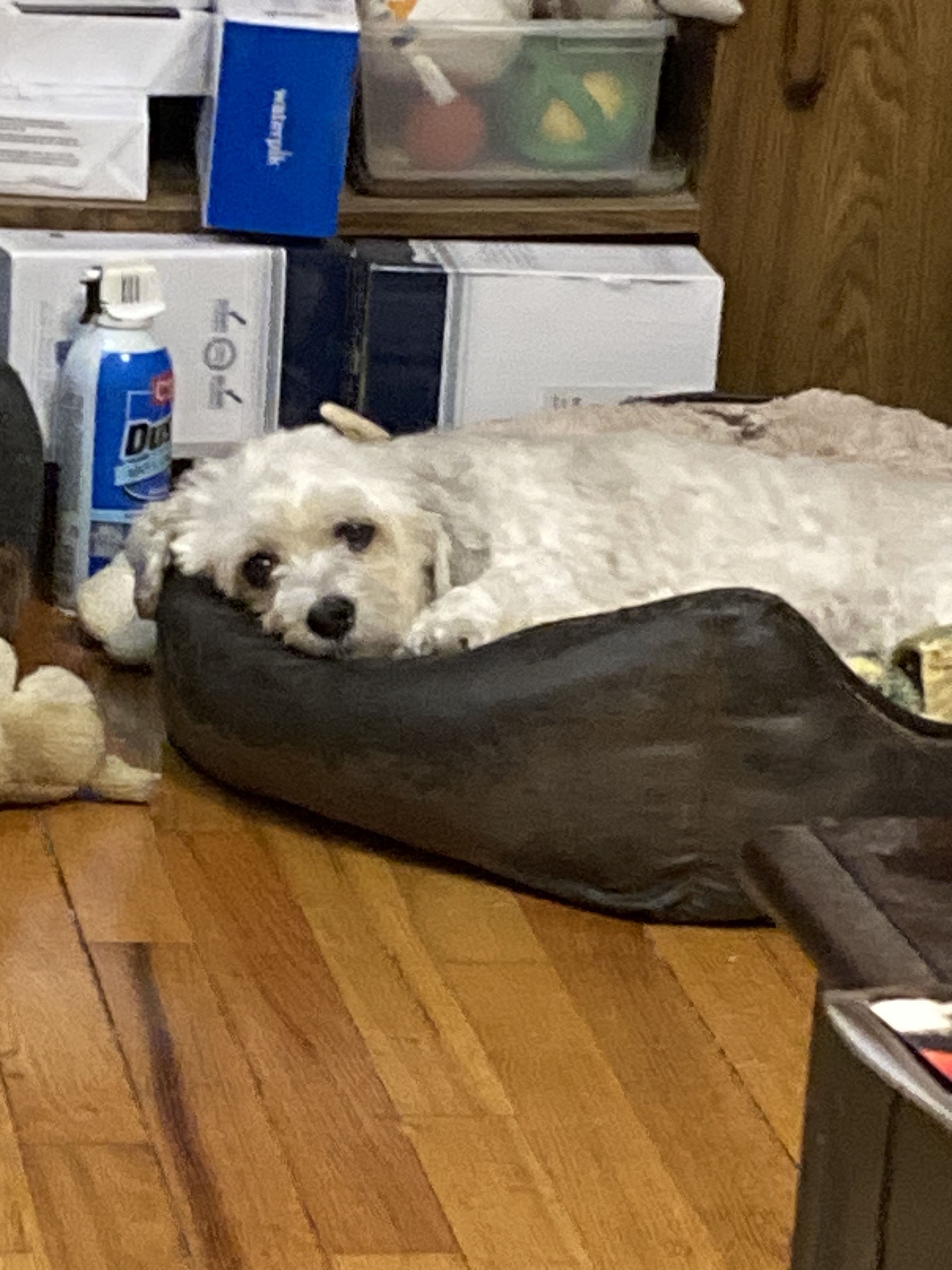
            My ideal next dog would be a Maltipoo (Maltese/Poodle mix), ten pounds or less (small enough for Mom to be able to pick him or her up), non-shedding and hypoallergenic (as much as possible), and healthy enough so that I would have him or her for a long time (because having less than five years each with Butterfly and Ellie was heartbreaking). Ideally the next dog would also be a rescue, but I may have to accept that the ideal dog for me will have to come from a home breeder again, like Cricket did, rather than a rescue organization.

            My biggest anxiety, dog-wise, is the cost; because I’m not sure I can really afford a dog long term, and all of the vet care and grooming costs involved, on top of the adoption/rescue fees. I still have a lot of medical debt to pay off, and I’m afraid it’s selfish to risk getting another dog without knowing for sure where the money to take care of them is going to come from. And yet, I really need a dog, or two, to make life worth living.

            Back when we got Cricket, sixteen and a half years ago, we were still recovering from the death of our Lab/mix, Dina, who had died half a year earlier, at sixteen years and two months old, after a long but difficult life. She’d had false pregnancies for years, and for the first eight years, while we still lived in my father’s house, he refused to let us get her spayed to relieve her suffering. Either as a result of that, or just along with that, Dina had a lot of fears: separation anxiety that made it very hard for me to leave her home alone; fear of children and other moving objects; and fear of bridges and water and all kinds of sounds and smells. I learned an enormous amount from Dina about how to care for my own limitations with more creativity and compassion, because she couldn’t just “get over it” the way people always insisted I should be able to do, but by the end I was exhausted, and I just wanted an easy dog, a small dog, a happy and healthy dog.

My Dina

            I researched breeds and temperaments and sizes and on and on and decided on a Cockapoo, and we found a home breeder in New Jersey that we liked and went to see the puppies in person, and Cricket chose us. She turned out to be cheaper than we’d expected because she had an underbite, which, the breeder told us, meant that Cricket couldn’t be a show dog. Fine with me.

            Except, I discovered quickly that I am a terrible groomer. I spent two years trying to teach myself how to manage her and her hair, but in the meantime, and then forever after, she needed regular professional grooming, an expense I’d never thought of before. And when Cricket was a year old she started to limp, and we discovered that she needed knee surgery, first on one knee and a year later on the other one.

            But most importantly, Cricket, who was supposed to be our easy dog, ended up having all kinds of behavioral problems, most likely as a result of neurological problems caused by being the runt of her litter. She spent sixteen years teaching me how to love someone who is difficult, someone who is capable of biting the ones she loves over and over again, and someone who needs to be protected from her own impulses most of the time. She taught me that not all of the people who need your help will inspire your sympathy, or even be grateful for your help. And she reminded me that being smart (and Cricket was very very smart) does not protect you from struggling with even the smallest challenges in life. She also taught me that it is possible to be so cute that even the people who know you best will keep forgetting what a jerk you are.

I was adorable. It’s true.

            Maybe the most important lesson I’ve learned from all of the dogs I’ve had is that no matter what you think you are getting when you adopt a dog, each dog who comes into your life will teach you something you didn’t expect. You will be challenged and you will grow, whether you like it or not.

            Butterfly, an eight-year-old breeding momma rescued from a puppy mill, taught me a kind of love I didn’t know I could feel. Even from the first time I saw her, dirty from the newspapers lining her cage in the shelter, and missing teeth, I refused to let her go, even though we’d gone to the shelter that day on a whim, with no intention of bringing a dog home right away. I learned from Butterfly that I can take care of someone else, very well, and with an enormous amount of patience, when necessary. And I credit Cricket, who was six years old by the time we adopted Butterfly, with making it possible for me to believe that I might be able to manage the challenges Butterfly presented, healthwise.

“I knew you were the one, Mommy.”

            Then, Ellie came to us by luck, when Cricket’s groomer called us to say that she’d rescued a dog she couldn’t keep, because her previous rescue and the new one were not getting along. Ellie was four or five years old and had just been spayed, after spending years as a breeding momma at a home-ish breeder. I didn’t have the immediate “love at first sight” reaction to Ellie that I’d had with the other dogs, maybe because I didn’t choose her myself, but Ellie taught me that love can grow and become just as deep and strong, even without that coup de foudre at the beginning. I’m still too close to the loss of Ellie to take a full accounting of all of the things she taught me, but the realization that my heart can stretch and stretch, to sizes I could never have imagined ahead of time, is one of her gifts to me. And I also learned, in losing her, that a stretched out heart needs a lot of time to heal.

“Don’t worry, Mommy. Cricket’s keeping an eye on me.”

            I have no idea what I will learn from my next dog, or how he or she will challenge me. I guess, first, I will need to learn how to feel like I deserve the next dog at all, and to believe that I will be able to live up to the challenges that come along with all of the love and joy and comfort. I hope that this part of the work doesn’t take too long, because life is pretty lonely without a dog.

“There’s always room for another dog.”

If you haven’t had a chance yet, please check out my Young Adult novel, Yeshiva Girl, on Amazon. And if you feel called to write a review of the book, on Amazon, or anywhere else, I’d be honored.

            Yeshiva Girl is about a Jewish teenager on Long Island, named Isabel, though her father calls her Jezebel. Her father has been accused of inappropriate sexual behavior with one of his students, which he denies, but Izzy implicitly believes it’s true. As a result of his problems, her father sends her to a co-ed Orthodox yeshiva for tenth grade, out of the blue, and Izzy and her mother can’t figure out how to prevent it. At Yeshiva, though, Izzy finds that religious people are much more complicated than she had expected. Some, like her father, may use religion as a place to hide, but others search for and find comfort, and community, and even enlightenment. The question is, what will Izzy find?

The Trip I Want to Take

            My synagogue had planned a big trip this spring – to Germany, Israel, and Jordan. It was originally planned for 2020, and then Covid hit; and it was rescheduled for this spring, and then October 7th happened. The plan for the trip was still up in the air for months, as the clergy watched to see how long the war would last, and what conditions would be like for tourism, but somewhere along the way the decision was made that they would just do the Germany leg of the trip this year, for the people who were still interested in going. A small group of congregants went to Berlin, with the same tour guide who was going to lead the big trip, to experience the different ways Germany has memorialized the Holocaust, and how they are dealing with Jews and anti-Semitism today.

            I was not planning to go on the trip this Spring, even if October 7th hadn’t happened, because I wasn’t interested in the Jordan and Germany legs of the trip, and because it was going to take place during the school year and I hate missing time with my students if I can help it, and probably most of all because it was going to be expensive and I am still paying off steep medical loans and I feel guilty being in so much debt at one time.

            But if the synagogue group had gone to Israel, in this post October 7th landscape, I would have been jealous of everyone who was able to go.

            I have wanted to go to Israel for a long time now, and I’ve gone over and over all of my internal conflicts around the costs, the weather, the social issues, the health issues, and the security issues, without really coming to any conclusions. But post October 7th the drive to go to Israel has increased tenfold.

            Don’t get me wrong, I’m not blind to the security issues, or to the parts of the country that are still off limits because they are under direct attack by Hezbollah; and I still have money issues, and health limitations, and I still worry about being lonely and feeling lost and alienated while I’m there. But the part of me that wants to be there, not to see the Western Wall or the Dead Sea or other touristy things, but just to be there in solidarity and offer my presence and compassion and love, feels newly strong. Maybe because, until now, I felt like I had nothing to offer my Israeli cousins; I even expected them to reject me, because of so many of the clichés about Israelis, that they feel superior and look down on weakness, be it emotional, or physical, or psychological.

            But on and after October 7th it became clear to me that Israelis aren’t really the image they project to the world, or at least they’re not only that; they are human like the rest of us. Yes they are courageous, but they are also frightened. Yes, many of them are adventurous and confident, but a lot of their bravado is a defense mechanism against lives lived in a very small country surrounded by people who hate them and keep trying to kill them.

            I wish, with all my heart, that this unveiling of their true selves had happened any other way, but I am truly grateful to feel more connected to them and to learn more about who they really are. There are, of course, some people who are so frightened and defensive, like Benjamin Netanyahu and his fellow politicians on the far right, that they never let the facade drop, even on October 7th itself.

            I am also aware of, and overwhelmed by, the news about the war itself and how it is being conducted. It has been especially difficult to watch the news about the seven aid workers from World Central Kitchen who were killed by an Israeli airstrike in Gaza. It’s painful and disheartening to see something so awful happen to people who are there only to offer help to those who need it. And I don’t understand how a mistake like this could have happened when the aid workers and the IDF say they had deconflicted their itinerary ahead of time to keep the workers safe. But it’s also heartbreaking to hear people insist that this was an intentional, rather than accidental, killing. I don’t believe that the Israeli army would target innocent aid workers intentionally, but, given the complications of managing a war in this territory, with so many voices pulling in different direction, I don’t understand how the army hasn’t become more and more careful over time, and I don’t understand why mistakes like this are still possible. At the beginning, when they were first trying to figure out how to fight a war like this, the mistakes in targeting and choice of munitions that led to so many civilian deaths was horrifying, but maybe understandable. But now? I don’t know what to think.

            And yet, with all of my questions, and however conflicted I may feel about how the war is being waged, and interpreted, Israel and Israelis themselves are still very close to my heart. If I could plan the perfect trip right now I would want to visit my niece at her school and go with her and her friends to volunteer somewhere, picking clementines or folding uniforms or whatever volunteer activity the girls are doing now; and I would want to stay with my best friend from high school, and hear from her kids and their friends about what their lives are like right now; and I’d want to sit on trains and buses and listen to the conversations around me; and I’d also want to go to every concert in every venue possible; and visit my teachers in Tel Aviv, and finally taste real Chummus, since I’ve been told over and over that the Chummus I can get in New York is a pale imitation of the real thing.

            Knowing me, though, I would be too shy to really talk to anyone, or to ask the questions I really want to ask, and I would spend half my time beating myself up for not having the courage to go and do and say what I want. But that’s still the trip I’d want to take, if I could. Those are the experiences I wish I could collect and bring back home with me.

            For now, accepting my own limitations and the state of the war, my plan is to take another online class through the Hebrew language school in Tel Aviv, where I’ve taken classes in the past. That way I can continue to build my confidence in speaking Hebrew and listening to Israelis, for when I’m ready to go in person. And, through the zoom screen at least, I will still be able to make some of the connections I’ve been looking for, with my teachers and classmates, and through the music and stories and culture of Israel.

            As always, I’m listening to podcasts and music to try to understand what’s going on. The latest podcast episode of For Heaven’s Sake, hosted by Donniel Hartman and Yossi Klein Halevy, is an honest accounting of how things feel for Israelis after six months of war.

For Heaven’s Sakehttps://podcasts.apple.com/us/podcast/for-heavens-sake/id1522222281

            And I’ve been listening to a lot of music by Idan Amedi, an Israeli musician who was injured while serving in the reserves in this war. He wrote a song twelve years ago about how hard it is to talk about the pain and memories of life as a soldier, even to the ones you love most, and the song still resonates.

Idan Amedi – The Pain of Warriorshttps://youtu.be/cBlqSLXgZG8?si=j8WXSN0tt8lfOqEW

If you haven’t had a chance yet, please check out my Young Adult novel, Yeshiva Girl, on Amazon. And if you feel called to write a review of the book, on Amazon, or anywhere else, I’d be honored.

            Yeshiva Girl is about a Jewish teenager on Long Island, named Isabel, though her father calls her Jezebel. Her father has been accused of inappropriate sexual behavior with one of his students, which he denies, but Izzy implicitly believes it’s true. As a result of his problems, her father sends her to a co-ed Orthodox yeshiva for tenth grade, out of the blue, and Izzy and her mother can’t figure out how to prevent it. At Yeshiva, though, Izzy finds that religious people are much more complicated than she had expected. Some, like her father, may use religion as a place to hide, but others search for and find comfort, and community, and even enlightenment. The question is, what will Izzy find?

Mom’s Surgery

            As expected, I spent the weeks leading up to Mom’s second hip replacement living in existential dread, afraid she would die on the table and I would be left alone in the world with no one to fight off the gardeners trying to cut down my paw paw tree. And then, as everyone around me seemed to know it would be, the surgery was successful and Mom came through with all of her humor and energy intact.

            The days leading up to the surgery were full of worry, both because of the pre-surgical clearances coming down to the wire, but also because Mom’s hip was deteriorating incredibly quickly and she was struggling just to get from one room to the other, especially after the ban on NSAIDS was put in place five days before the surgery.

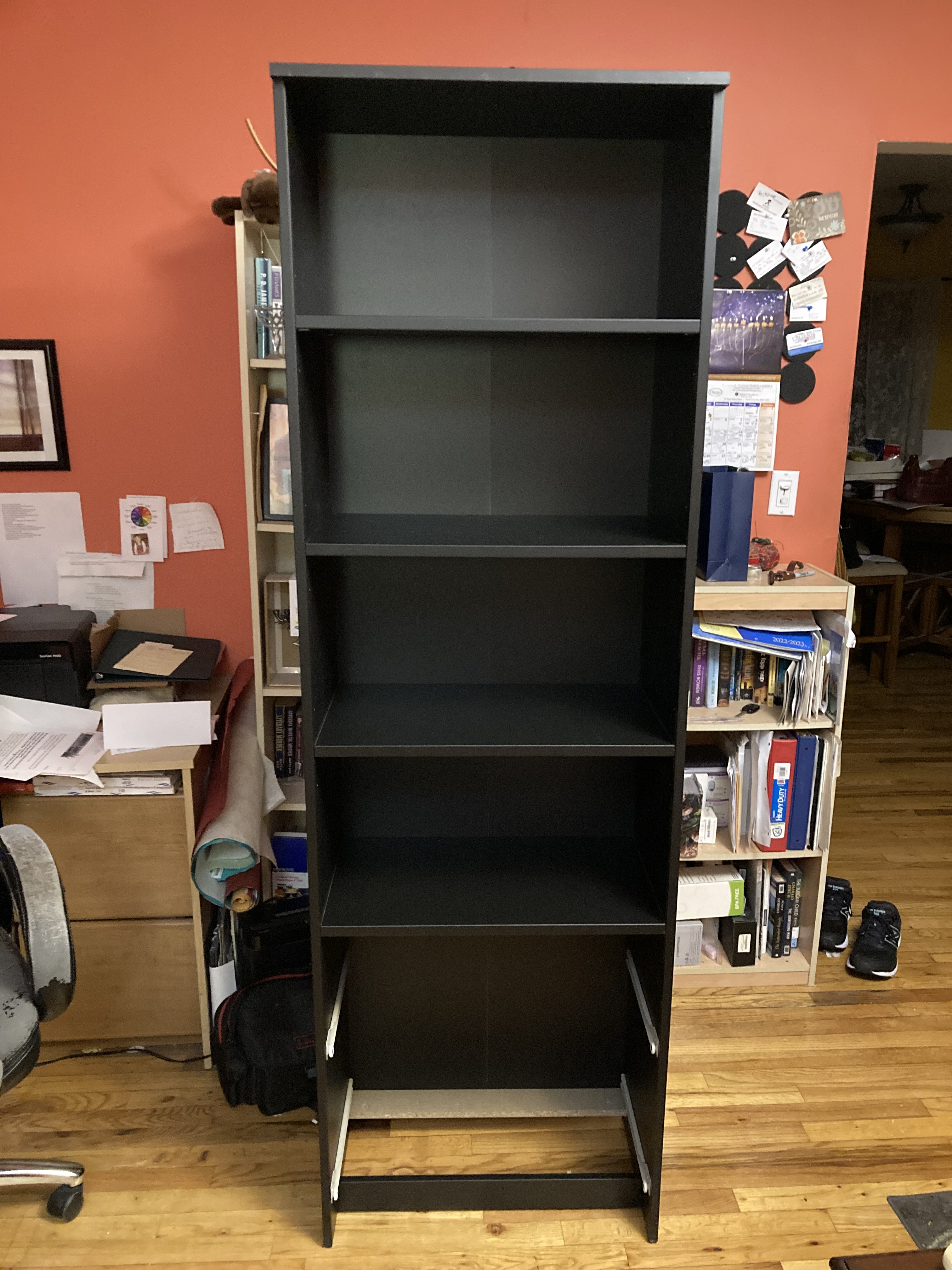
            I filled the time preparing: filling the freezer and the pantry with prepared meals; organizing all of the random crap in the apartment that might get in her way when she came home with the walker; carrying boxes of books to the thrift store, and bags and cans of dog food to the animal shelter; and finally replacing the old crooked bookcase with a new, slightly crooked bookcase (put together by moi – which explains why its wonky), so that she wouldn’t be toppled by falling books and sent back to the hospital.

New bookcase, before the wonky drawers were put in.

            We still have new rugs waiting to be put down, after we removed the un-cleanable rugs from the last months of Cricket and Ellie’s lives, but I’m going to wait on that until Mom’s walking is steadier and she doesn’t need the walker anymore; hopefully the neighbors will be patient with the uncovered floors for a bit longer.

            The need to clean has been profound since losing Ellie. When both dogs were still here I didn’t mind a few extra boxes here and there, but in the quiet I keep wanting to clean and find order and make things neat, as if making the apartment more orderly will heal the grief (though it doesn’t really work).

My Ellie

            It was so strange to be in the apartment alone. For two days it was just me, no Mom, no dogs, and I don’t know how to describe the stillness in the air. I kept hearing noises and thinking Ellie was coming back down the hallway after a midnight snack, or Mom was getting up in the middle of the night for a midnight snack (Mom and the dogs seemed to have a club I was not invited to). But no one was actually there.

Thank God, the surgery itself went well, and now that Mom’s back home, everything feels like its back to normal, where the noises around the apartment are real instead of phantoms, and even on pain meds and using a walker, she’s more energetic and busy than I am, always texting with someone or planning something. I think the lesson here is that I am a very boring person on my own.

            Next up is physical therapy and occupational therapy and nurse’s visits and keeping track of all of the post-op medications and worrying about something else going wrong. But Mom is in a surprisingly good mood so far, and I’m feeling hopeful again.

            Oh, and we got a note from the board of our co-op saying that from now on there won’t be a pet fee charged each month for each (or any) pet you own, so when the time comes I can clearly get as many dogs as I can fit into the apartment. Five sounds like a good number to me. It’s possible that Mom will disagree, so, shh, don’t tell her.

“One dog is always enough.”

If you haven’t had a chance yet, please check out my Young Adult novel, Yeshiva Girl, on Amazon. And if you feel called to write a review of the book, on Amazon, or anywhere else, I’d be honored.

            Yeshiva Girl is about a Jewish teenager on Long Island, named Isabel, though her father calls her Jezebel. Her father has been accused of inappropriate sexual behavior with one of his students, which he denies, but Izzy implicitly believes it’s true. As a result of his problems, her father sends her to a co-ed Orthodox yeshiva for tenth grade, out of the blue, and Izzy and her mother can’t figure out how to prevent it. At Yeshiva, though, Izzy finds that religious people are much more complicated than she had expected. Some, like her father, may use religion as a place to hide, but others search for and find comfort, and community, and even enlightenment. The question is, what will Izzy find?

The Amaryllis

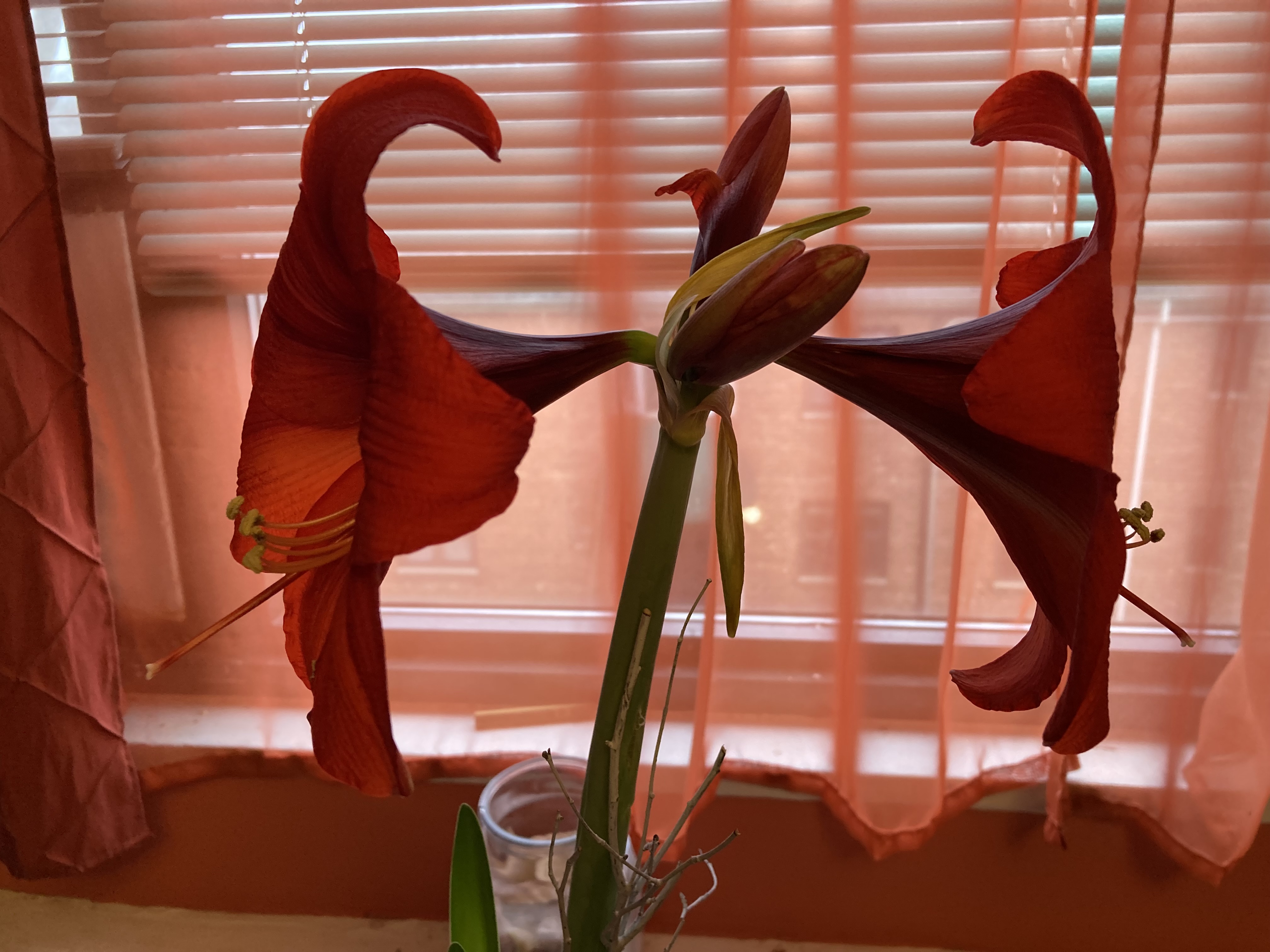
            After Ellie died one of the many practical, and depressing, things we had to do was to contact Chewy and cancel our standing dog food delivery. A few days later an Amaryllis appeared at our front door, with a card from the Chewy team sending their condolences.

            For a while the plant looked kind of sad sitting on the coffee table in the living room, with no flowers and a bend in its green spine. The plant came with a brace (with a twig and some twine), and Mom moved it into place above the curve, and gradually, the spine of the plant started to straighten, and then, slowly, the flowers started to bloom. The red of the petals is so vivid and the size and number of the blossoms keeps growing so there’s no way to ignore it now.

            The shape of the flowers, like a speaker on an old Victrola, makes it seem like the plant has something to say, though try as I might I can’t hear the words. And while there are no new puppies growing from this magical plant, there is life: beautiful, bright, and temporary.

            I know that I will always miss Cricket and Ellie, but this little (or not so little) plant has given me hope that my heart will be able to make room for new love, when the time comes.

“We still get veto power.”

If you haven’t had a chance yet, please check out my Young Adult novel, Yeshiva Girl, on Amazon. And if you feel called to write a review of the book, on Amazon, or anywhere else, I’d be honored.

            Yeshiva Girl is about a Jewish teenager on Long Island, named Isabel, though her father calls her Jezebel. Her father has been accused of inappropriate sexual behavior with one of his students, which he denies, but Izzy implicitly believes it’s true. As a result of his problems, her father sends her to a co-ed Orthodox yeshiva for tenth grade, out of the blue, and Izzy and her mother can’t figure out how to prevent it. At Yeshiva, though, Izzy finds that religious people are much more complicated than she had expected. Some, like her father, may use religion as a place to hide, but others search for and find comfort, and community, and even enlightenment. The question is, what will Izzy find?

Goodbye, My Ellie

            Ellie died at home early Monday morning, after not eating much the previous day. She had her final bedtime hugs and scratches and then went to get a drink of water and rest by her wee wee pad, and by morning she was gone

A friend suggested that Cricket was getting bored alone in heaven and tapped Ellie on the shoulder, telling her to come sooner. I can believe that of Cricket, and I can believe Ellie would do that for her sister, but she is so deeply missed here on earth.

            It’s hard to find words for the loss of Ellie, on top of the loss of Cricket just two months ago, which has left the apartment so completely dogless. My greatest consolation is that Ellie knew how deeply she was loved, and we know how completely she loved us.

Meeting Ellie
Ellie’s first sleep at home
Ellie’s first complaint
Freedom from the harness
Ellie in therapy
Cricket and Ellie team up
Ellie in the snow
Happy Ellie
Ellie the gardener
Goodbye my Ellie. I will always miss you.


Ellie’s Tenth Birthday

            A week after seeing the substitute vet, and being told not to spend more money on tests, we were able to get an appointment with Ellie’s regular vet and he recommended an ultrasound, to see if her distended belly was filled with fluid or with something else; and he confirmed that it was all fluid. He recommended against trying to poke around with needles to empty the fluid, because it could stress her literally to death, and because the fluid would come back in a few days anyway. Instead, he raised her diuretic dose a little bit and sent us home, saying that, like with Cricket, if Ellie doesn’t eat for three or four days, she’s suffering.

            It certainly wasn’t the news we wanted to hear, but it is what we expected, and it was a relief to know for sure what we were dealing with.

            The raised dose of the diuretic helped a little bit, at least enough to allow Ellie to feel hungrier and to enjoy her food again. She especially liked the Chinese food we got for my birthday dinner. Her belly is still full of fluid, and she spends most of her time resting on her side, but her joy in eating is wonderful to see.

“Where are you hiding the Chinese food?”

            When we were looking through her papers recently (which makes it sound like she has her own filing cabinet and a small business to run, but we were just looking for her exact birthday so we could celebrate it with her), we realized that she is turning ten this year, not nine like I thought. There’s a little bit of relief in knowing she’s made it all the way to ten, just like there was relief in seeing Cricket pass the sixteen year mark, but it’s still not enough.

            We didn’t plan anything special for her birthday, because every day she’s still with us feels special and important, and really an act of will on her part. Just seeing her eat, and take all of her medication, and enjoy getting her back scratched, feels like a celebration to me. I’m so grateful that she wants to stay with us for as long as she can, and I’m especially grateful that we’ve been able to have this time with her, after Cricket’s death, to shower her with as much love and attention as she can absorb, so that she knows what it’s like to be the center of everything, at least for a little while. Even Cricket would have wanted that for Ellie, though not as much as she wanted it all for herself.

            Now we’re just going day by day, trying to accept that we won’t have that much more time with her. Her sweet spirit still shines through, even when she’s tired, or worried, or struggling to catch her breath, and we know how lucky we’ve been to have her this long.

            Happy birthday dear sweet Miss Ellie, my beautiful girl!

“I need more chicken, Mommy.”

If you haven’t had a chance yet, please check out my Young Adult novel, Yeshiva Girl, on Amazon. And if you feel called to write a review of the book, on Amazon, or anywhere else, I’d be honored.

            Yeshiva Girl is about a Jewish teenager on Long Island, named Isabel, though her father calls her Jezebel. Her father has been accused of inappropriate sexual behavior with one of his students, which he denies, but Izzy implicitly believes it’s true. As a result of his problems, her father sends her to a co-ed Orthodox yeshiva for tenth grade, out of the blue, and Izzy and her mother can’t figure out how to prevent it. At Yeshiva, though, Izzy finds that religious people are much more complicated than she had expected. Some, like her father, may use religion as a place to hide, but others search for and find comfort, and community, and even enlightenment. The question is, what will Izzy find?

Cricket’s Last Weeks

            This past Monday morning, after watching her decline throughout the weekend, we brought Cricket to the vet to end her life. She was sixteen years, two months and three and a half weeks old.

So many times over the past weeks and months we had thought Cricket was nearing the end, and we told ourselves that if she was in the same state in the morning we’d take her to the vet and put her to sleep. Almost every time, Ellie would sleep in Mom’s room overnight, instead of mine, watching over her sister, but when morning came, Cricket would wake up ready to try again; demanding to try again.

            Except, in the last few weeks, each time Cricket bounced back, she was a little shakier and a little more uncertain than the time before. We held onto what the vet had said, that if she didn’t eat for three days she was suffering, as our guide, because we didn’t want her to suffer, but we also didn’t want to cut short her life, even a day sooner than necessary.

            She still needed the ACE (doggy valium) in order to tolerate her daily subcutaneous fluids (I still have the bite marks from the few times I tried to do it without the ACE, even in her last week), and I was able to take advantage of her time on the ACE to do some grooming that she would never have allowed otherwise: making sure she was clean, and could see as clearly as her foggy eyes would allow, and could grip the floor with her feet, even if she didn’t have perfect control of her legs.

            So many people who would never think of assisted suicide for a family member, think it is the only compassionate thing to do for a pet, and I see their point, and even agree with it most of the time, but each time someone hinted to me that it was time to let Cricket go, I disagreed. Dogs can’t speak the way we can, but after sixteen years I knew Cricket, and I knew she wanted to stay as long as possible and she wouldn’t appreciate us making that decision for her, even if it was made with love and compassion and a wish to save her from further pain. But also, however much I want to believe in the Rainbow Bridge, and heaven, and the persistence of the soul beyond the body, I know that death is final. Even if there is something that persists after death, it’s not the same as the life we know.

            And I kept thinking of Dina, our lab mix who died at sixteen years and two months of age. Dina couldn’t hold herself up anymore by her last day, but she was still eating, folding herself around her bowl of food. At the time, the decision to let her go was made because Mom was going away to New Zealand for a few weeks and I would be left alone to care for a dog who couldn’t see or hear and was crying in pain. But it still felt too early. If Mom hadn’t been leaving, we wouldn’t have gone to the vet on that particular day. We would have waited. It may have only been one or two more days, or a week, but I felt guilty for that decision. I still don’t know if it would have been right or wrong to wait longer. Maybe there’s no right or wrong in this.

Dina

            Our goal with Cricket was to make her as comfortable as possible; to maximize her happiness and minimize her pain. The prolonged hospice period was hardest on Mom, because Cricket insisted on sleeping next to her Grandma, and if she couldn’t wake up in time to get to the floor, she’d pee on Mom’s bed (we had a special set up to protect the bedding, with a wee wee pad and towels and mats, but it wasn’t always enough). But even with all of that, Mom didn’t want to let her go either. So we waited, and we did our best. We spent a lot more time holding her, and wrapping her in towels and blankets to keep her cozy. Her bones were sharp under her warm t-shirts, but we worked hard to hear everything Cricket was saying, about what she wanted, and what she could tolerate.

            At a faculty meeting for synagogue school, the week before Cricket died, we did an exercise for the holiday of Sukkot where we passed the Etrog (the citron that’s used as one of the four species for the holiday) around the room. The Etrog, this oversized, lumpy cousin of a lemon, is said to represent the heart, so each of us was asked to hold the Etrog to our chests and say what we were holding close to our hearts right then – a goal, a person, a moment of joy, a realization, etc. – and I said Cricket, I’m holding my dying dog to my heart, and then I went home and literally held her next to my heart for hours.

            That night, or the next, when we carried Cricket outside to join Ellie for her evening walk, her friend Kevin, the mini-Goldendoodle, heard us and came running, and Cricket’s little tail wagged and wagged, and she pushed herself to walk faster to get to him, to follow him, to sniff him. After a little while she got worn out and came over to rest by my leg, to let me know she was ready to go back inside; but just seeing her with him, perking up and finding joy in his presence again even for a few minutes, reassured me that we were doing right by her.

            And then, a few days later, she stopped eating, and then she stopped drinking. She couldn’t stand up on her own anymore, even though she desperately wanted to, and we knew it was time. Her life was so full and rich and complicated and true, and she gave us every last drop of herself and squeezed everything she could out of her one life, but it still felt too soon to let go. Maybe it always will.

            When we came home from the vet, I started to clean: doing load after load of laundry, picking up the wee wee pad path, folding Cricket’s t-shirts and sweaters and putting them away in the closet. And the apartment felt so quiet without her; so big and empty. But then there was Ellie. She was confused, sniffing the places where her sister should have been, looking to us for an explanation, and then climbing up onto the couch for comfort, keeping us close to her so she wouldn’t lose anyone else.

Lonely Ellie

            It will take all of us some time to get used to a world without Cricket. It doesn’t seem real, or even possible, that she’s gone. I think part of me believed that Cricket would live forever, because she wanted to, and because her spirit was so indomitable. The idea that she, like all of us, was mortal, just feels impossible. Her presence is everywhere is our lives, and her absence is everywhere too. But I take great comfort in the knowledge that she knew, all her life, no matter what, that she was loved.

Cricket’s indomitable spirit

If you haven’t had a chance yet, please check out my Young Adult novel, Yeshiva Girl, on Amazon. And if you feel called to write a review of the book, on Amazon, or anywhere else, I’d be honored.

            Yeshiva Girl is about a Jewish teenager on Long Island, named Isabel, though her father calls her Jezebel. Her father has been accused of inappropriate sexual behavior with one of his students, which he denies, but Izzy implicitly believes it’s true. As a result of his problems, her father sends her to a co-ed Orthodox yeshiva for tenth grade, out of the blue, and Izzy and her mother can’t figure out how to prevent it. At Yeshiva, though, Izzy finds that religious people are much more complicated than she had expected. Some, like her father, may use religion as a place to hide, but others search for and find comfort, and community, and even enlightenment. The question is, what will Izzy find?

Ellie’s Belated Return to the Groomer

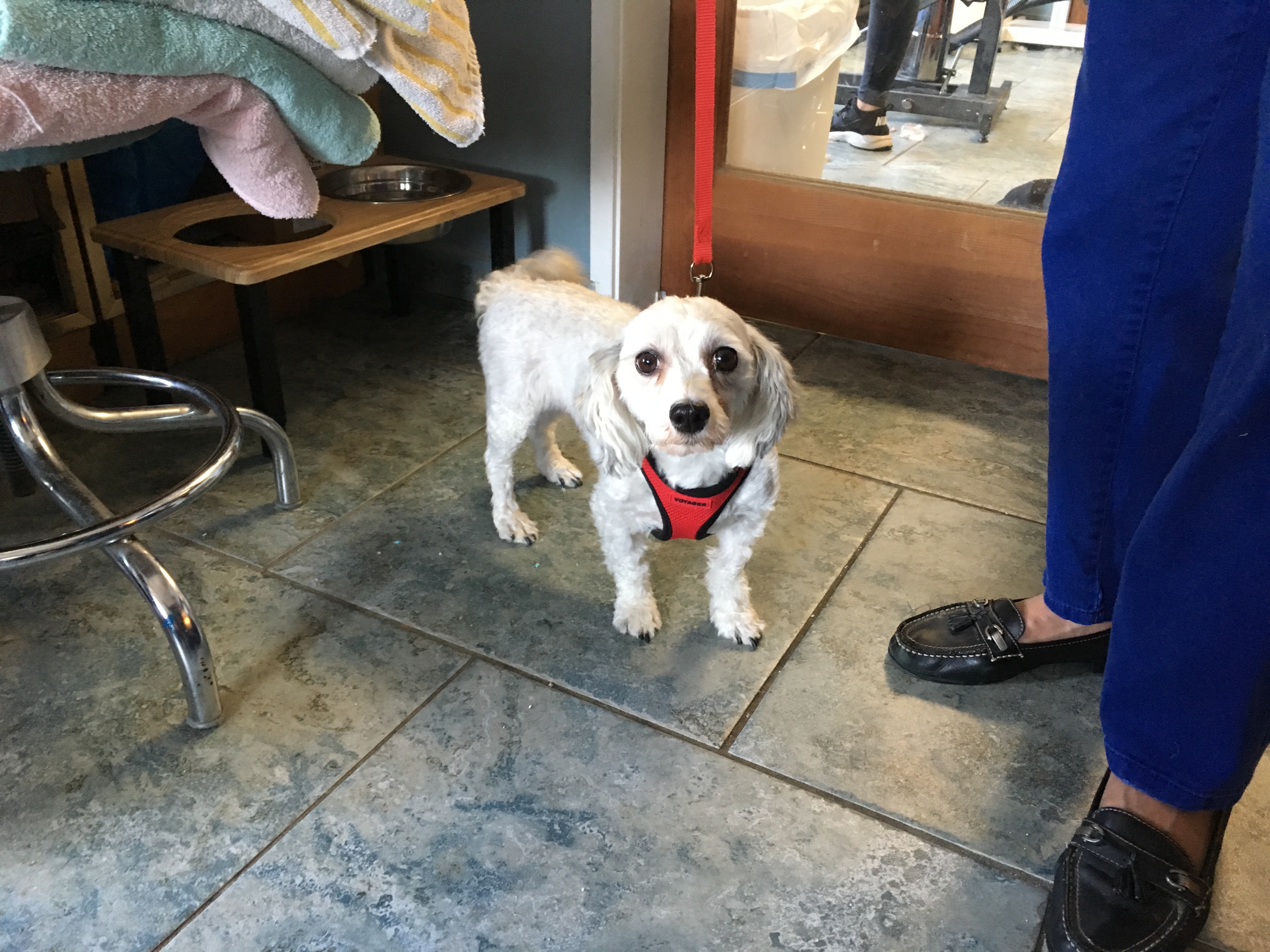
After months of worrying symptoms and doctor visits and medication, Ellie’s heart failure has stabilized enough so that we finally felt safe taking her to the groomer to deal with her very overgrown mop of hair. It was also Ellie’s first visit to the groomer alone since she’s been with us (four years!), because Cricket doesn’t need much grooming and I didn’t think she would be up to the stress of it anyway.

“I’m perfect just as I am.”

            As we were leaving the apartment, I made sure to give Cricket a Greenie (a green dog treat, shaped like a toothbrush, with questionable teeth cleaning capabilities) to keep her occupied while Ellie had her leash put on, and immediately, Ellie snapped her teeth on the Greenie, already in Cricket’s mouth! They stood there fighting silently over that Greenie with all of their might, and somehow Cricket managed to hold on to it until I could convince Ellie to let go and follow me to the front door.

And I was sort of in shock.

Ellie, my calm, loving, usually submissive sweetie pie, had actually tried to steal food from her grumpy, stubborn, aged sister’s mouth?!

“Who, me?”

            I was laughing out loud as I led Ellie outside, thrilled both that Ellie’s appetite was back in full force, and that Cricket still had the strength to fight for what was hers.

            Once outside, Ellie ran gleefully to the car, seemingly forgetting that she’d missed out on a treat, possibly because she’d finally remembered that she’d had a full breakfast just moments earlier.

            On the drive to the groomer, Mom sat in the backseat with Ellie to keep her company and defuse her car anxiety and the weirdness of not having Cricket there with her. When we dropped Ellie off at the groomer, I started to feel more anxious about leaving her there, out of my sight, for hours. She still coughs every once in a while, even though her medications seem to be managing most of her heart failure symptoms. But I tried to be positive and focused on driving Mom to her Neurologist’s office, where she would hopefully find some relief for the pain in her legs and feet, if not a cure for the numbness that has prevented her from driving lately. And then, while sitting in the waiting room at the doctor’s office, I was preoccupied with worrying about Mom, and worrying about leaving Cricket alone at home for so long, and then worrying about fifteen or twenty other things swirling in my mind, and there wasn’t much room to worry about Ellie, who, at the very least, was not alone.

After the doctor’s appointment we had to stop off at CVS to pick up prescriptions, and to drop off one for Ellie (because one of her medications is only available at the human pharmacy), and then we went to the market that always has chicken livers, unlike our regular supermarket, because when Cricket is refusing to eat anything else she will still eat chicken livers. She’s often not hungry in the morning, but that’s when we need to give her the doggy Xanax to help her calm down enough to receive her subcutaneous fluids to manage her kidney disease. Chicken livers, and cinnamon buns, oddly, seem to be our most reliable treats when the wet dog food isn’t tempting enough.

And then we were back at the groomer to pick up Ellie, who was now less than half the dog she’d been a few hours earlier, and thrilled to be going home.

            Cricket was standing at the door waiting for us when we returned home, and she thoroughly examined her shorn sister, to see what fresh hell she’d been through, but more importantly, to find out if she’d had any secret treats (she had, her groomer loves to give her treats!).

            And then the dogs banded together to beg Grandma for even more treats, eventually running out of steam and deciding to start their favorite afternoon activity, sleep tourism, wherein they proceed to take naps in as many different places throughout the apartment as possible. And then I was able to relax too, knowing we’d all made it through another challenging day. Together.

If you haven’t had a chance yet, please check out my Young Adult novel, Yeshiva Girl, on Amazon. And if you feel called to write a review of the book, on Amazon, or anywhere else, I’d be honored.

            Yeshiva Girl is about a Jewish teenager on Long Island, named Isabel, though her father calls her Jezebel. Her father has been accused of inappropriate sexual behavior with one of his students, which he denies, but Izzy implicitly believes it’s true. As a result of his problems, her father sends her to a co-ed Orthodox yeshiva for tenth grade, out of the blue, and Izzy and her mother can’t figure out how to prevent it. At Yeshiva, though, Izzy finds that religious people are much more complicated than she had expected. Some, like her father, may use religion as a place to hide, but others search for and find comfort, and community, and even enlightenment. The question is, what will Izzy find?