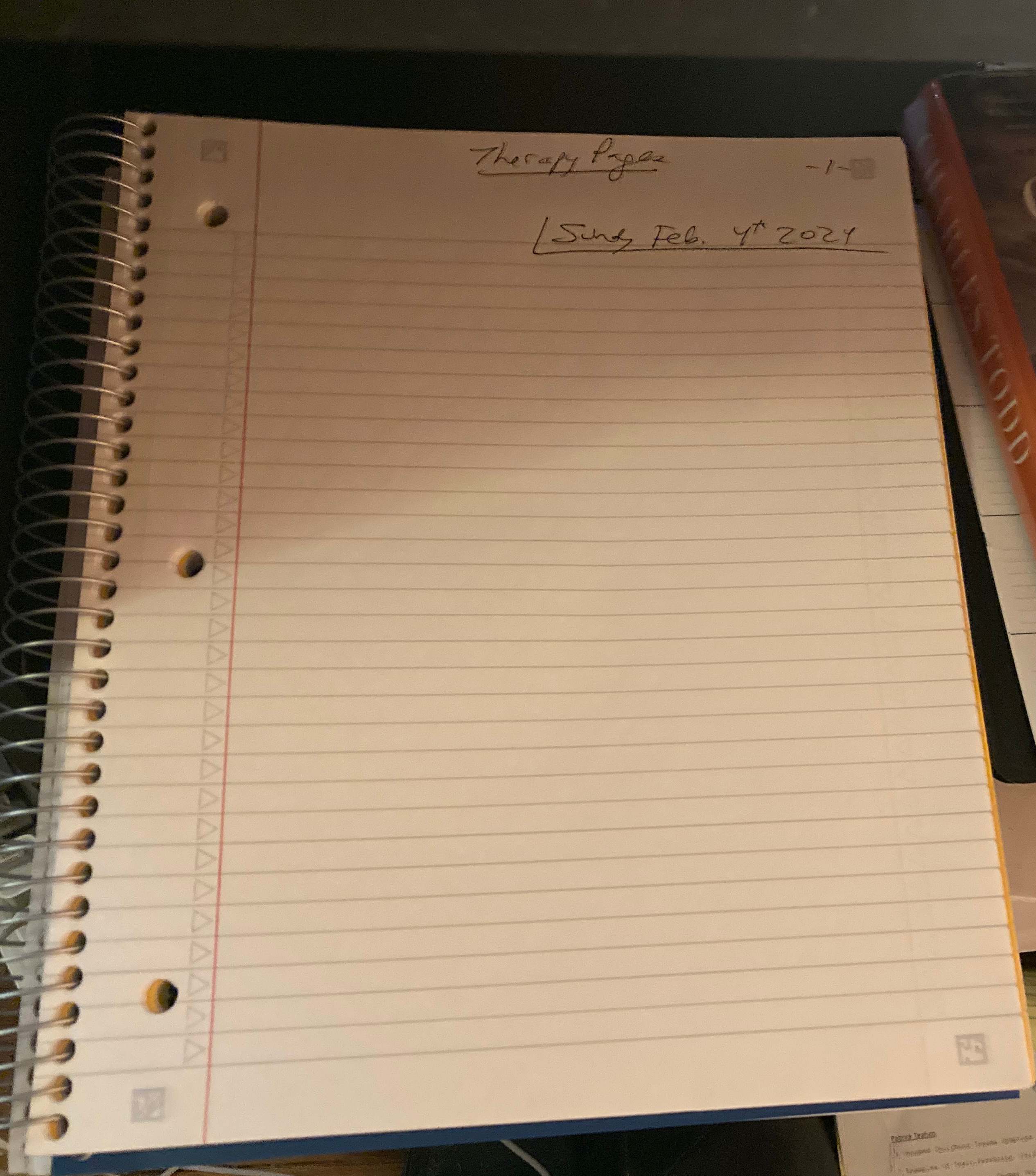
About a million years ago, I read Julia Cameron’s The Artist’s Way for the first time and committed to doing Morning Pages every day (writing three stream of consciousness pages as soon as you wake up). I didn’t always do them in the morning, and I almost never stopped at three pages, so instead of calling them morning pages I called them my therapy pages, and I have a stack of boxes in my closet filled with old notebooks to show for it. But at some point, I stopped the practice, in all but name. I kept the notebooks nearby – there’s also always a five subject college ruled spiral bound notebook on my bedside table, with the day and date at the top of the page, but some days I forget to write anything, and others I just write a paragraph or two about my day before going to sleep, like sending a postcard to a good friend to keep up the connection, but not sitting down for a good long chat.

I was actually proud of myself for taking longer to finish each notebook, because it seemed so self-absorbed to keep writing so much just for myself, and because I have no more room in my closet to stack boxes of notebooks.
There’s also the thing I did early on that is a big no-no in Morning Pages, according to Julia Cameron. I started writing my Therapy Pages around the same time as I started seeing my therapist, and when I got frustrated by how little I could tell her in forty-five minutes per week that I told her about my Therapy Pages and she asked if she could read them and I said yes.
On one hand, my therapist got to know me really well really quickly, because I didn’t go back to edit the pages before handing them to her, but inevitably, knowing that she would be reading them, my internal editor took over and stopped me from writing things I didn’t feel comfortable having her read. And one more thing happened: my therapist told me that my Therapy Pages were better than anything else I’d written, because I’d also made the mistake of giving her my short stories to read and she wasn’t impressed; just like she wasn’t impressed years later with my novels, or essays. But she loved my Therapy Pages and she wanted me to publish them – this was before Amazon self-publishing became a thing – and she would not listen to me when I said, a) no one would publish them and b) I wouldn’t want to publish them, because they were supposed to just be for me.
I built up the nerve to stop showing her my pages pretty early on (probably also because I felt guilty for giving her so much work to do outside of our regular sessions), but the feeling of having someone reading over my shoulder, and judging me, never went away. Neither did the feeling that I was an utter disappointment as a writer, and/or a coward, and/or ten other horrible things.
Recently, I found out that Julia Cameron had actually continued to write more books after The Artist’s Way, and I ordered one of them, called The Listening Path. I can’t remember why Julia Cameron came up as a recommendation on Amazon that day: maybe someone had mentioned her name to me, or there was some random confluence of events in the Amazon algorithm while I was looking for something else. But even then, I just put the book on my pile of books to read and went on with whatever else I was doing. I was kind of reluctant to open the book, honestly. I’m so tired of advice on how to be better and I’m tired of being told to do something other than what I’m already doing. I’m just really, really tired, full stop.

But when I finished the latest book on my reading pile – an odd little middle grade fantasy about kabbalah, set at a Jewish sleepaway camp, by Ari Goelman – the next book on the pile was The Listening Path and I couldn’t avoid the book without openly acknowledging, to myself, that I was trying afraid of it. So I started reading. And within the first few pages of the introduction, reminding the reader about Morning Pages and Artist’s Dates and other advice from previous books, some part of my brain perked up and said, hey, why am I not doing Therapy Pages anymore?
I won’t go through the whole grumpy internal argument that ensued, but, after a few more pages of reading, and grumping, I picked up my five subject spiral bound notebook and started to write again, telling myself that I couldn’t stop writing until I’d done three pages, instead of the three or four lines I’d gotten used to. And it felt right. Not easy, or comfortable, to be honest, but right.
I still haven’t finished reading the introduction to The Listening Path, so I can’t say anything meaningful about the book itself, and already her insistence on the magical power of Morning Pages to get you unstuck and help you hear your inner self and blah blah blah is annoying the crap out of me, because where does she get off telling me what to do and acting like everyone is the same and can follow the same prescription to a better life, and on and on and on. Except, I think, for me, for this, she’s 100% right. I need this kind of stream-of-consciousness/required writing in order to hear myself again.
I need it for me, not for my novels, though it could also help me get back on track with writing the damned novels. But I’m terrified of what will come up in these Therapy Pages of mine – which is probably the real reason why I started letting myself avoid them in the first place. I’m afraid of all of the crummy things I might say to myself, and all of the ways I will feel challenged, and not good enough, and pushed to do things I’m not ready to do; and I’m really worried about turning that spigot back on. But somewhere along the way I stopped listening to myself, and even if it has made me feel safer, it has also made me feel less, of everything.
So, we’ll see how it goes. If a week’s worth of three pages a day re-opens the hellmouth in my brain, at least I’ll know what not to do.
Wish me luck.
If you haven’t had a chance yet, please check out my Young Adult novel, Yeshiva Girl, on Amazon. And if you feel called to write a review of the book, on Amazon, or anywhere else, I’d be honored.
Yeshiva Girl is about a Jewish teenager on Long Island, named Isabel, though her father calls her Jezebel. Her father has been accused of inappropriate sexual behavior with one of his students, which he denies, but Izzy implicitly believes it’s true. As a result of his problems, her father sends her to a co-ed Orthodox yeshiva for tenth grade, out of the blue, and Izzy and her mother can’t figure out how to prevent it. At Yeshiva, though, Izzy finds that religious people are much more complicated than she had expected. Some, like her father, may use religion as a place to hide, but others search for and find comfort, and community, and even enlightenment. The question is, what will Izzy find?
 rachelmankowitz