Tag Archives: news

The Hope Muscle

            A few weeks ago, I was talking to my rabbi about the High Holiday readings (because I spell check/copy edit every year), and he told me that the clergy team at our synagogue has decided to focus on hope and comfort for this year’s high holiday services (in late September), rather than the usual emphasis on what we could be doing better, or what’s going on in the world that we need to pay more attention to. The decision was made a few months ago, when it had already become clear that people had hit their limit on pain and suffering and couldn’t take much more, and the news has only gotten worse since then.

There’s some relief in knowing that I am not alone in needing more hope, but that conversation made me realize that, actually, I still have a pretty big reservoir of hope to rely on. I’ve spent a lifetime learning how to find hope where it shouldn’t exist, and to build it up out of almost nothing. It’s like strengthening any other muscle, just that this one creates a spiritual ache from the effort, rather than a physical one. But even before I began the daily work of lifting myself up out of despair, I had a foundation of hope that came from years of being taught to think in terms of millennia, rather than centuries or decades. From lessons in Jewish history and the Hebrew Bible, I was taught to see people who lived 3,000 years ago as my family, and to see their life experiences as my own, and the lesson I learned from all of those family stories is that there is always a way forward, even if it’s difficult and messy and confusing, there is always a next step.

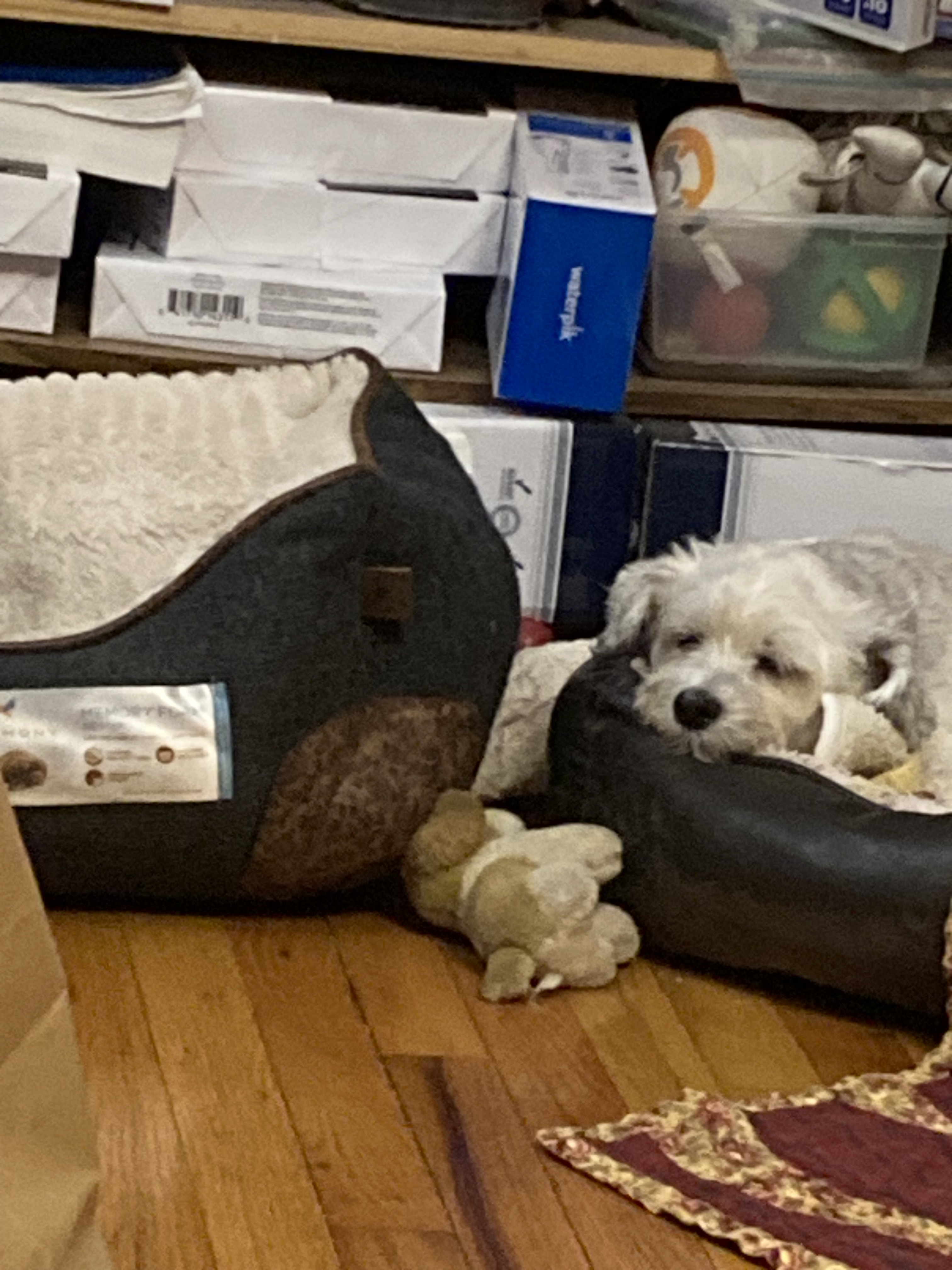
“I’m ready.”

            The Hebrew Bible is not full of success stories, where the heroes are perfect and everything goes their way, not at all, these are people who try, and make mistakes, and suffer from their own bad choices, and suffer from other people’s bad choices, but find a way to keep going anyway. In fact, they are always doing Teshuva (repentance or return), making amends for the stupid or selfish decisions of the past, because they believe it is possible to repair the damage you’ve done, and the damage that has been done to you.

The ancient Israelites became slaves, and spent generations in slavery, and even resisted freedom out of fear of the unknown; and they fought wars and lost a lot of them; and they worshiped other gods and got punished for it over, and over again. They lived on their own land, and lived in exile; they survived by devotion to the old traditions and by seeking out new ones. There has been no generation of Jews that got everything right, or that got to live in a world full of only light and love, and the lesson I’ve learned from all of this, is that you need hope in order to take those next steps out of despair. You need hope to continue going through the knee-deep swampy water, or to drag yourself through the desert in the blazing heat. It’s not about certainty. My ancestors rarely knew the right thing to do at every moment and never followed the recipe (or the Torah) to the letter, but they held onto the hope that if they made the wrong choice or did the wrong thing, they could always try again.

            Even though my ancient ancestors taught me all of this, my more recent ones, like my father, believed that there was a right way to do everything, and that if I was smart enough, and worthy enough, I’d just figure it out on my own. My teachers also held onto this one-right-answer idea, writing every test with the assumption that there was only one right answer to every question, and that most of my ideas were wrong. Having faith that there is one-right-answer, and that you already know what it is, meant that they didn’t need hope. They had certainty. But for me, who never seemed to know what that one right thing might be, I had to rely on the hope that something I would do, anything I would do, would turn out to be right.

At times, I’ve had to build my hope muscle out of magical thinking and imagination, and out of whatever leaves and twigs and feathers I could find; and along the way, I’ve discovered that it doesn’t matter where the hope comes from, or what it’s made of, as long as it’s there when you need it. But pick a day, for example a day when there are pictures everywhere of starving children in Gaza and it feels like everyone is lying about the situation on the ground – Hamas, Israel, the UN, the journalists – and the despair makes it hard to breathe. And even in these impossible moments, the only way I know to keep moving forward is to rely on hope, even unreasonable and unfounded hope, that somewhere up ahead there will be an oasis of peace. I just have to keep going and I will get there, someday.

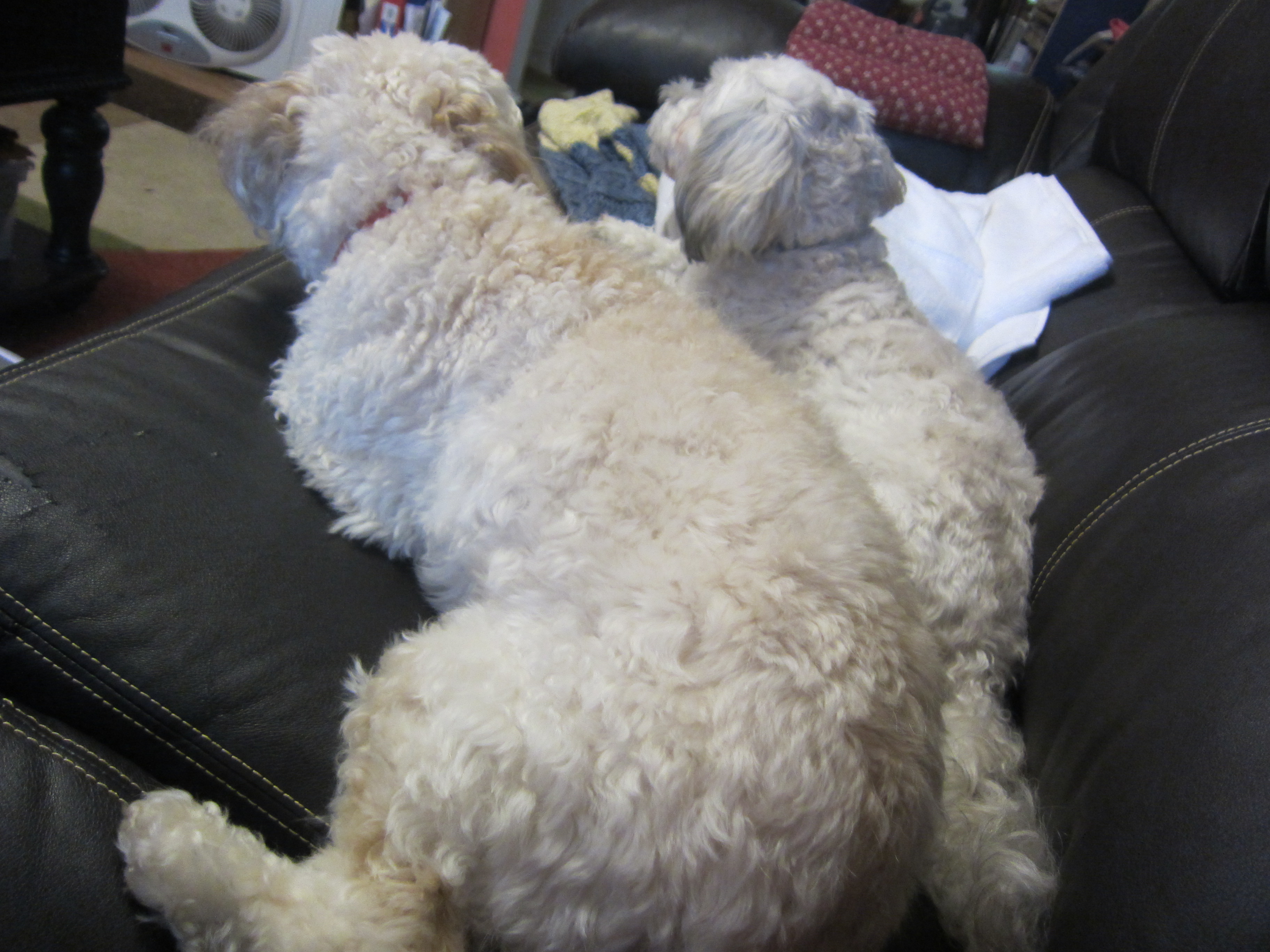
Tzipporah is waiting impatiently.

If you haven’t had a chance yet, please check out my novel, Yeshiva Girl, on Amazon. And if you feel called to write a review of the book, on Amazon, or anywhere else, I’d be honored.

            Yeshiva Girl is about a Jewish teenager on Long Island, named Isabel, though her father calls her Jezebel. Her father has been accused of inappropriate sexual behavior with one of his students, which he denies, but Izzy implicitly believes it’s true. As a result of his problems, her father sends her to a co-ed Orthodox yeshiva for tenth grade, out of the blue, and Izzy and her mother can’t figure out how to prevent it. At Yeshiva, though, Izzy finds that religious people are much more complicated than she had expected. Some, like her father, may use religion as a place to hide, but others search for and find comfort, and community, and even enlightenment. The question is, what will Izzy find?

Listening to Israeli Music in the Car

            When Mom and I bought our Subaru Crosstrek last summer, the car salesman demonstrated how to link an iPhone to the car’s computer in order to answer phone calls hands free. But as soon as Mom’s phone was linked to the car’s computer, a podcast or a phone call or a voice mail came bursting out of the speakers at us, and we had to press every button in the car before we could finally make it stop. And as a result we decided, as we often do, that this latest technological advance was not for us.

            But then, a few months ago, when I was listening to music on my phone in the car because I was tired of hearing the same Olivia Rodrigo and Taylor Swift songs on the radio over and over, I noticed that the battery was low and plugged my phone into the car charger, and suddenly my Spotify account was playing over the car’s speakers. And it was wonderful! So now, as soon as I get into the car, I put my phone on the car charger and open my Spotify app and my music fills the whole car instead of just the cup holder next to me.

            Of course, I still pay attention to the news, but only when I feel like I have the energy to deal with it because trying to make sense of the different narratives of what’s going on in the Middle East (and here), as reported by different outlets through varying lenses feels like trying to untangle a pile of fishhooks. But listening to Israeli music, with a playlist that has ballooned to over 300 songs, has become my sanctuary. Especially when I’m on my way to school to teach my students, listening to Israeli music instead of news about Israel helps me get into a mindset where I can have hope for the future, so I can be the person I need to be for my students.

            Alas, I only have a free Spotify account, which means I can only listen to my playlist on shuffle, and I still have no idea how Spotify decides to shuffle the songs. Luckily, even though my Israeli music playlist is ridiculously long, it is filled with songs I really like, so even if the shuffle decides I need to hear the same song on the drive to and from work, or jumps from one style of music to a very different style of music, it’s all good. And there’s actually something comforting about having the app choose which song to listen to next, because it makes me feel like I’m not really alone in the car; like there’s a tiny DJ in there, somewhere, keeping me company and telling me everything’s going to be alright.

Four songs on a theme:

David Broza - It'll be Alright – Hebrew with English Subtitles https://youtu.be/qtI7h5A9eEQ?si=EHnP_sG13WAKC92E
Yasmin Moellem – It Will Be Good - Hebrew https://youtu.be/qvdQ4mGMVkg?si=8SnxkJslFPMKPUfv
Cafe Shahor Hazak - It Will be Okay – Hebrew https://youtu.be/PQp2a_yunmM?si=KWPCfyJyFLvq0qbU
Lior Narkis – In the end it will be Okay – Hebrew https://youtu.be/SNsBoZLyIAk?si=Q3lf1MrHvXShQdwY
David Broza
Yasmin Moellem
Cafe Shahor Hazak
Lior Narkis

If you haven’t had a chance yet, please check out my Young Adult novel, Yeshiva Girl, on Amazon. And if you feel called to write a review of the book, on Amazon, or anywhere else, I’d be honored.

            Yeshiva Girl is about a Jewish teenager on Long Island, named Isabel, though her father calls her Jezebel. Her father has been accused of inappropriate sexual behavior with one of his students, which he denies, but Izzy implicitly believes it’s true. As a result of his problems, her father sends her to a co-ed Orthodox yeshiva for tenth grade, out of the blue, and Izzy and her mother can’t figure out how to prevent it. At Yeshiva, though, Izzy finds that religious people are much more complicated than she had expected. Some, like her father, may use religion as a place to hide, but others search for and find comfort, and community, and even enlightenment. The question is, what will Izzy find?

On the Coverage of the War in Israel and Gaza

            I have been trying to write my thoughts on this for weeks, but I’ve been afraid of getting things wrong, or of bringing down anger from any and all directions. I have a fourteen page draft of a blog post that seems more like a thesis than a personal essay, but I’m not an expert on the history of Israel, or military tactics, or academic jargon, or even anti-Semitism; I care about those things, and am impacted by them, but other people will do a much better job of holding forth on those subjects than I ever could.

“Don’t look at me.”

            What I can write about is how it has felt to watch the news lately, and be on social media, being told by so many people what I should think, or do, or say in the aftermath of the Hamas attack on Israel on October 7th, a day after the fiftieth anniversary of the Yom Kippur war. I don’t believe that Jews, or Israel, should be immune to criticism; I also don’t believe that Hamas is anything but a terrorist group (calling them a liberation group suggests a real misunderstanding both of their mission and of how they have governed Gaza for the past decade and a half). What I know for myself is that hearing about the massacres on October 7th made me worry about family and friends in Israel, but watching the gradually more toxic responses around the world, and especially on American college campuses, has been frightening. I thought for sure that the chants of “from the river to the sea,” which is a demand for the eradication of the State of Israel and its current population of more than eight million Jews, plus two million non-Jews, would convince people that this pro-Hamas reaction is morally wrong, but that hasn’t happened. I thought it was the norm to recognize the difference between Hamas and Palestinians in general, and that everyone knew the difference between Israelis living within the internationally accepted borders of Israel (like the ones who were massacred and kidnapped), and Jewish settlers in the West Bank, but no. In fact, a lot of the terminology being thrown around about Israel (colonialist, apartheid, genocide) has become mainstream in a way I never expected. Social media is powerful in creating false narratives, and even more successful in advancing partial narratives that are misleading.

            An enormous number of Israelis who spent the past year protesting against Benjamin Netanyahu’s far right government and its attempts to peel away layers of democracy are now fighting for their country’s survival, both in the military and in thousands of volunteer efforts to help the survivors from the south, who had to escape Hamas and Islamic Jihad rockets, and evacuees from the north, escaping Hezbollah rockets. I am proud of how quickly Israelis were able to find their way forward, and worried about the choices of the military and the government, and frightened by the lack of critical thinking and journalistic ethics that seem to abound right now when facts would be really helpful. I am proud of the Haredi (ultra-orthodox) Jews in Israel who are joining the army for this war, despite a very contentious law that allows them to avoid military service in favor of study, and I’m angry at some Jewish settlers in the West Bank who think they have a religious right to hurt their Palestinian neighbors.

            But I can’t fix any of those things. I cannot vote in Israel, and I can’t call every reporter who takes Hamas’ word without evidence and remind them that that’s just stupid. I can only be here, living my own little life in New York, and sending prayers to my family and friends who really need it right now.

“I pray all the time, Mommy.”

            At my synagogue, on Long Island, we’ve spent a lot of time talking about how we find comfort right now, since that’s really all we can control. We’ve had speak ups, to share our grief and confused feelings, and vigils, for the survivors and the dead and the missing and all those on the ground who are still in danger. One of the rabbis from my synagogue joined a group of New York rabbis for a short trip to Israel, to show solidarity and to learn more about what’s going on. I think, right now, many American Jews, because we are further away from the danger and, in most cases, experiencing less direct trauma, are wishing for ways to reach peace. But we, I, have no idea what the military realities are, and what it will take to make Israelis safe again. I refuse to tell Israel what they should do, though, of course, I have questions.

            I have a lot of trouble with people who equate the horror of a massacre perpetrated on civilians and a war conducted, or at least trying to be conducted, under the set rules of war.

            My focus has been on finding podcasts and articles that can help me understand more of what it feels like to be in Israel right now, so that I can be more empathetic, and to reassure me that Israel is a real place and not this cardboard cutout of evil that often gets portrayed by Pro-Palestinian activists on American college campuses.

            Israel Story, a great podcast in English that shares stories from all segments of Israeli society, has been posting short interviews with Israelis in different sectors during the current war. In the past, Israel Story has covered many Palestinian stories with empathy and clarity, humanizing and coloring in details of lives we often don’t get to hear about. The archives are full of those stories, but right now the most powerful of the short interviews I’ve heard was with a father who rescued his teenage son from the music festival in the South of Israel after the massacre had begun. www.israelstory.org/episode/sivan-avnery/                I’ve also been listening to podcasts from a school in Jerusalem called the Shalom Hartman Institute which has done a lot of work bringing together religious and secular, American and Israeli, and finding ways to have difficult conversations that are productive and even inspiring. I also watched a webinar interview with Yehuda Kurtzer, the president of the Institute in North America, that addressed what it feels like in Israel right now, and how liberal American Jews are dealing with the current news environment. https://youtu.be/Glia_tSZqmo?si=g3Fr8T4XR_D7Qkwk

            I go to the Forward and the Times of Israel and the Atlantic for articles that help me understand the issues involved. Here are links to two of the many articles that I’ve found helpful: https://blogs.timesofisrael.com/why-is-israel-being-blamed-for-the-hamas-massacre/

            I go to Kveller and Nosher and My Jewish Learning for a break from the news and a chance to remember that there is still Jewish joy and silliness, and comfort food, and so much to learn about being Jewish that has nothing to do with politics or war.

            But most of all I go to music. I have a ridiculously long Israeli music playlist on Spotify filled with music from Ishai Ribo and Hanan Ben Ari and Yuval Dayan and Keren Peles and Jane Bordeaux and Ofra Haza and Arik Einstein and David Broza and Hadag Nachash and Hatikva 6, and I keep finding more musicians and more music to remind me that there is more to Israel than this war.

Hanan Ben Ari – https://youtu.be/z27MZP_4P_U?si=uu7wqn1pEn6cRdd8

Ishai Ribo – https://youtu.be/7mmu6EzLZfM?si=egySHSIHEU0ckn7t

Jane Bordeaux – https://youtu.be/5t59s1sa1oc?si=o2XozKDDdpCiaSFA

Yuval Dayan – https://youtu.be/V4qsi4V-NFY?si=FqlWyWA40AIKhBYA

            So that’s where I’m at right now. I’m still trying to write out my thoughts on the war itself, and the history that led to it, mostly for my own clarification, but the rest of the time I’m taking a lot of deep breaths, and listening to voices across the spectrum, when I’m up to it, and listening to music when I’m not.

            I wish everyone Besorot Tovot, good news to come, and comfort and understanding until that time comes.

“Paws crossed.”

If you haven’t had a chance yet, please check out my Young Adult novel, Yeshiva Girl, on Amazon. And if you feel called to write a review of the book, on Amazon, or anywhere else, I’d be honored.

            Yeshiva Girl is about a Jewish teenager on Long Island, named Isabel, though her father calls her Jezebel. Her father has been accused of inappropriate sexual behavior with one of his students, which he denies, but Izzy implicitly believes it’s true. As a result of his problems, her father sends her to a co-ed Orthodox yeshiva for tenth grade, out of the blue, and Izzy and her mother can’t figure out how to prevent it. At Yeshiva, though, Izzy finds that religious people are much more complicated than she had expected. Some, like her father, may use religion as a place to hide, but others search for and find comfort, and community, and even enlightenment. The question is, what will Izzy find?
The Opioid Epidemic


Recently, the media has been filled with glee around the guilt of the Sackler family (Purdue Pharma) in the origins of the Opioid Epidemic. I have no interest in arguing on their behalf, because the avarice and lack of compassion in their decisions is obvious and really not up for debate. But it interested me that they were singled out, and that the media was willing to simplify the whole epidemic down to the choices of one, rich, Jewish family. I am sensitive to the specter of anti-Semitism, because of the endless role it has played in history, and this struck me as worth examining.

E pre groom

“Are you sure we need to discuss this?”

The Sackler family is responsible for OxyContin, one of the opiates that flooded the market in the nineties, and they attempted to downplay the risks of addiction in their marketing campaigns and ignored misuses of their drugs in favor of making an enormous amount of money, but they could have accomplished none of this on their own. Doctors, who knew that opiates were addictive (Morphine has been around for a long time, Opium for much longer), over-prescribed these medications, and some even made an illegal business out of the underground market for opiates (though most did not). Pharmacies and distributors bought larger amounts of opiates than could ever be used responsibly, knowing they were feeding addiction and illegal markets and doing it anyway. We, as a society, defunded and underfunded addiction treatment, ignoring and demonizing substance abusers so that they could not find a way out, even if they’d wanted to. Families ignored, friends ignored, schools ignored, government ignored, and the FDA approved more and more variations of opiates for the marketplace.

It’s also important to recognize that the Opioid Epidemic has become national and world news in the last few years largely because of the rise of Fentanyl, and then Carfentanyl, both of which are more lethal than Heroin, and have led to many overdose deaths. And Fentanyl has nothing to do with the Sacklers. It’s also important to see that when people of color were losing the war against drugs we didn’t call it an epidemic, instead we blamed the addicts themselves for their problems. This time it is young white people who have been dying, and that seems to have made a difference in the coverage.

Another big difference for the current epidemic is the growth of social media, and technology in general. In the past, a teenager might have had to drive forty minutes to the bad side of town to buy drugs. Now, with a text, you can have anything brought to you in ten minutes. Anything. You don’t have to go to the bad part of town, or spend a lot of money; sometimes all you have to do is open the medicine cabinet in your friend’s house. If we are having an opioid epidemic, then we are having a Benzodiazepine and Marijuana Tsunami, with an alcohol chaser. Vapes, which are everywhere now, can easily be adapted for use with all kinds of different, hard, drugs, and used out in the open. In middle school.

IMG_0930

“You can’t take my Benzos!”

The question is, why did this happen? Why were we so eager to believe the lie that opiates could be made non-addictive? Or that addiction is a small price to pay for pain relief? Or that the market can be trusted to make moral decisions?

This is our culture. American culture. The Sacklers were certainly not acting on Jewish law and morality in their decision making; they were, actually, following the prevailing American value that money is good, and drugs are good, and let’s not think too hard about the downsides, or address the complexities, or look at the people who are struggling, because, really, it’s their own fault if they can’t pull themselves up by their bootstraps.

There are reasons other than Anti-Semitism to explain the hatred and blame of the Sackler family in particular. One, there was a recent document release from their trial, and the information in it was really juicy and obnoxious and therefore caught people’s attention. Even more important, a lot of Americans recognized in the Sacklers a stand-in for the Trumps, and there is great satisfaction in seeing a similarly rich, and corrupt, family being brought down.

But their Jewishness made me nervous. It’s always scary for me to see a Jewish person in the news for criminal, immoral, or unjust behavior – not just because what they did is upsetting, but also because of my fear that their crimes will be used against the whole of the Jewish people. The Holocaust is not as far in the past as some people would like to believe, and we’re seeing an upsurge in anti-Semitism everywhere.

I still don’t know if anti-Semitism played any role in the coverage of this. The origins of the Opioid Epidemic are complex and interwoven and need to be addressed from multiple directions. Simplifying it all down to the greed of one company, and one family, felt good for a moment, because it made us feel like we finally had a handle on what happened. But the epidemic is still happening. We still have a lot of work ahead of us to change our laws and policies and culture, in order to prevent more overdose deaths and lives lost to addiction in all kinds of ways. We want to blame someone, like the Sacklers, or Central American migrants, or corrupt doctors, because we want it to be someone else’s fault, and therefore someone else’s responsibility to fix. But that won’t work. This is our problem, and it belongs to all of us.

012

“Is she serious, Ellie? This is so not my fault.”

011

“Just pretend to be sleeping, Cricket. It always works for me.”

If you haven’t had a chance yet, please check out my Amazon page and consider ordering the Kindle or Paperback version (or both!) of Yeshiva Girl. And if you feel called to write a review of the book on Amazon, or anywhere else, I’d be honored.

Yeshiva Girl is about a Jewish girl on Long Island named Izzy. Her father has been accused of inappropriate sexual behavior with one of his students, which he denies, but Izzy implicitly believes is true. Izzy’s father decides to send her to a co-ed Orthodox yeshiva for tenth grade, out of the blue, as if she’s the one who needs to be fixed. Izzy, in pain and looking for people she can trust, finds that religious people are much more complicated than she had expected. Some, like her father, may use religion as a place to hide, but others search for and find comfort, and community, and even enlightenment. The question is, what will Izzy find?

My Snow Day


Up until the middle of this week, I was working on a post about how little snow we’ve gotten on Long Island this winter. It is therefore possible that Thursday’s massive Thunder-snow-bomb-aggedon was my fault.

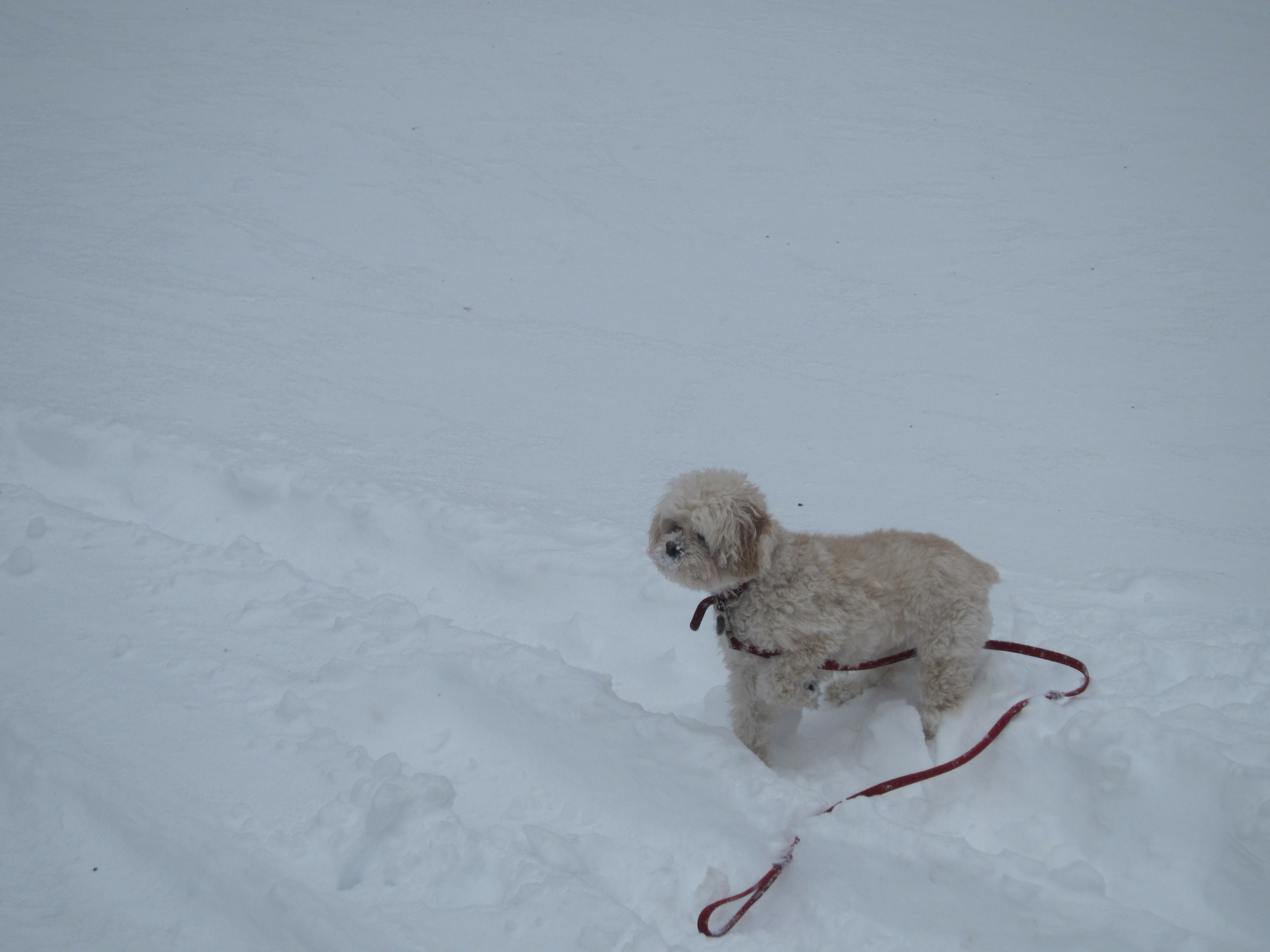
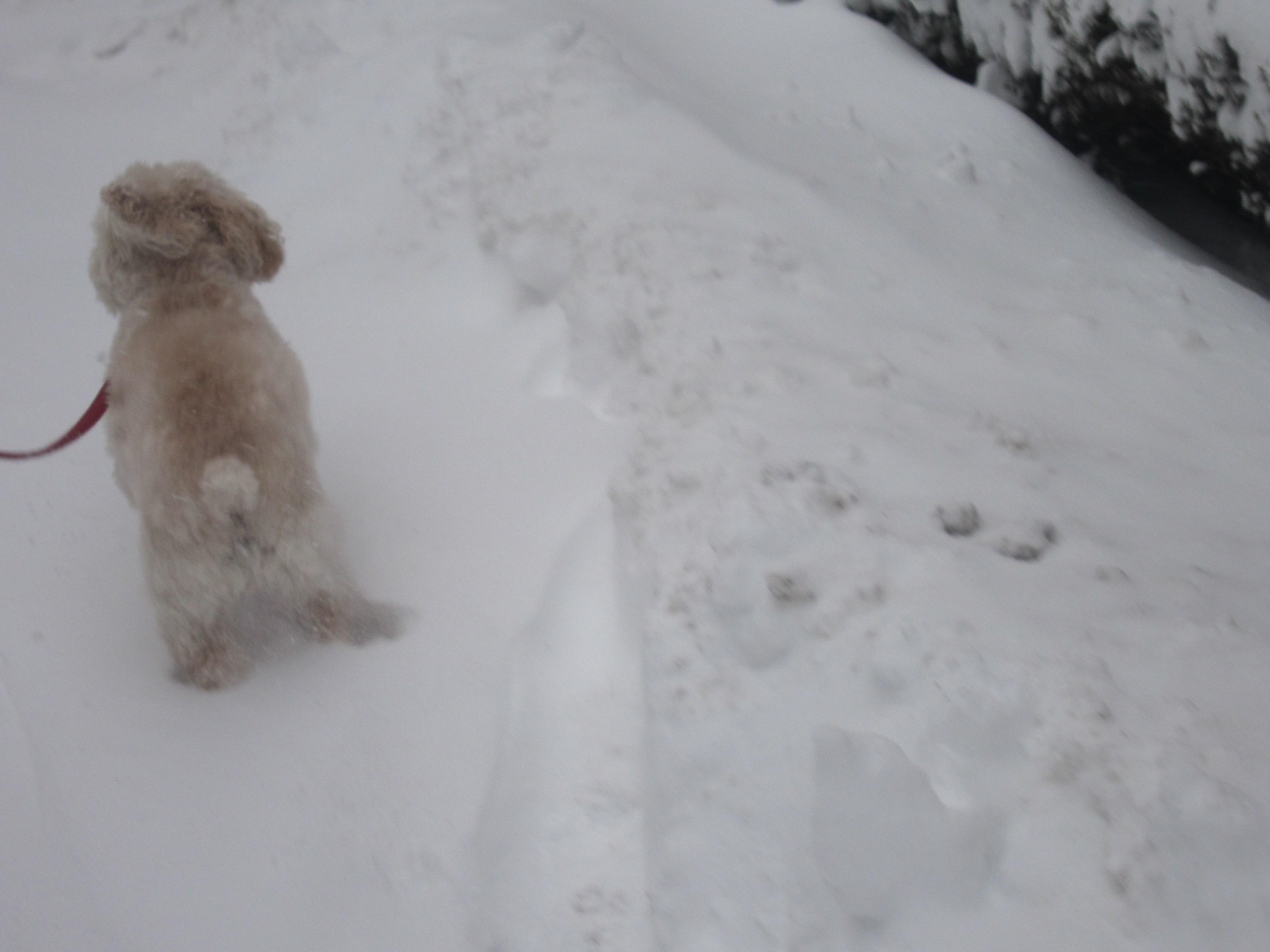
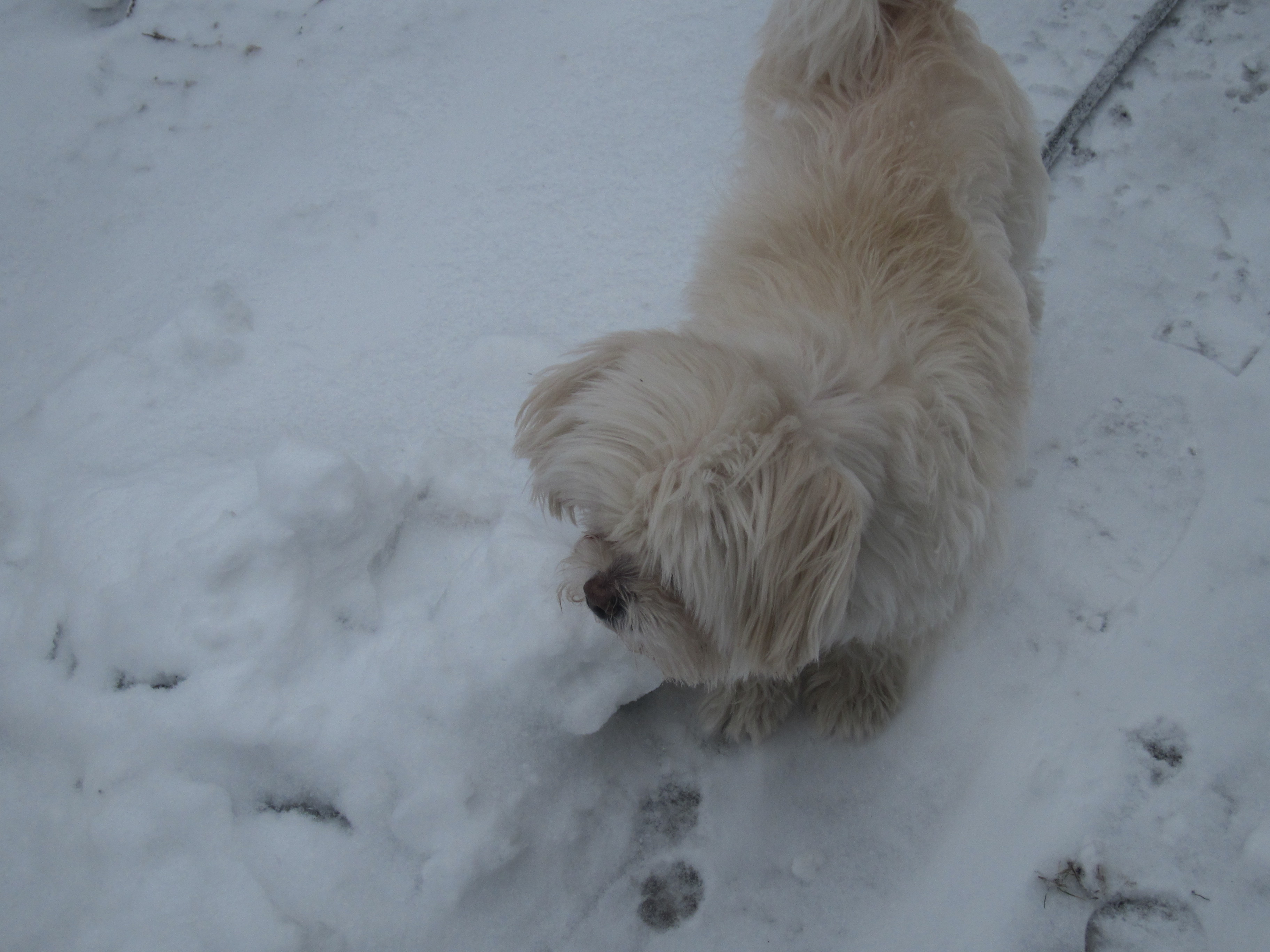
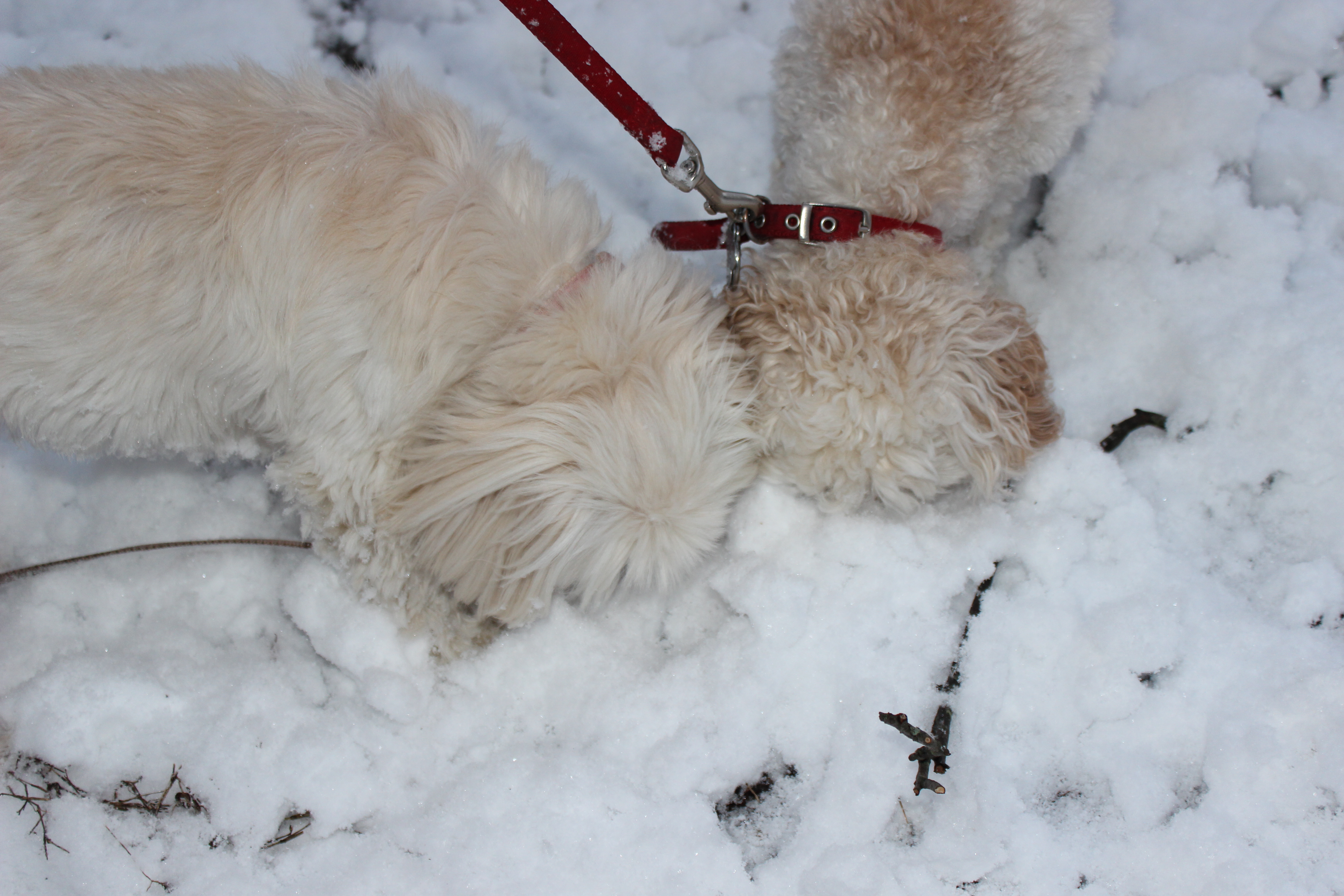
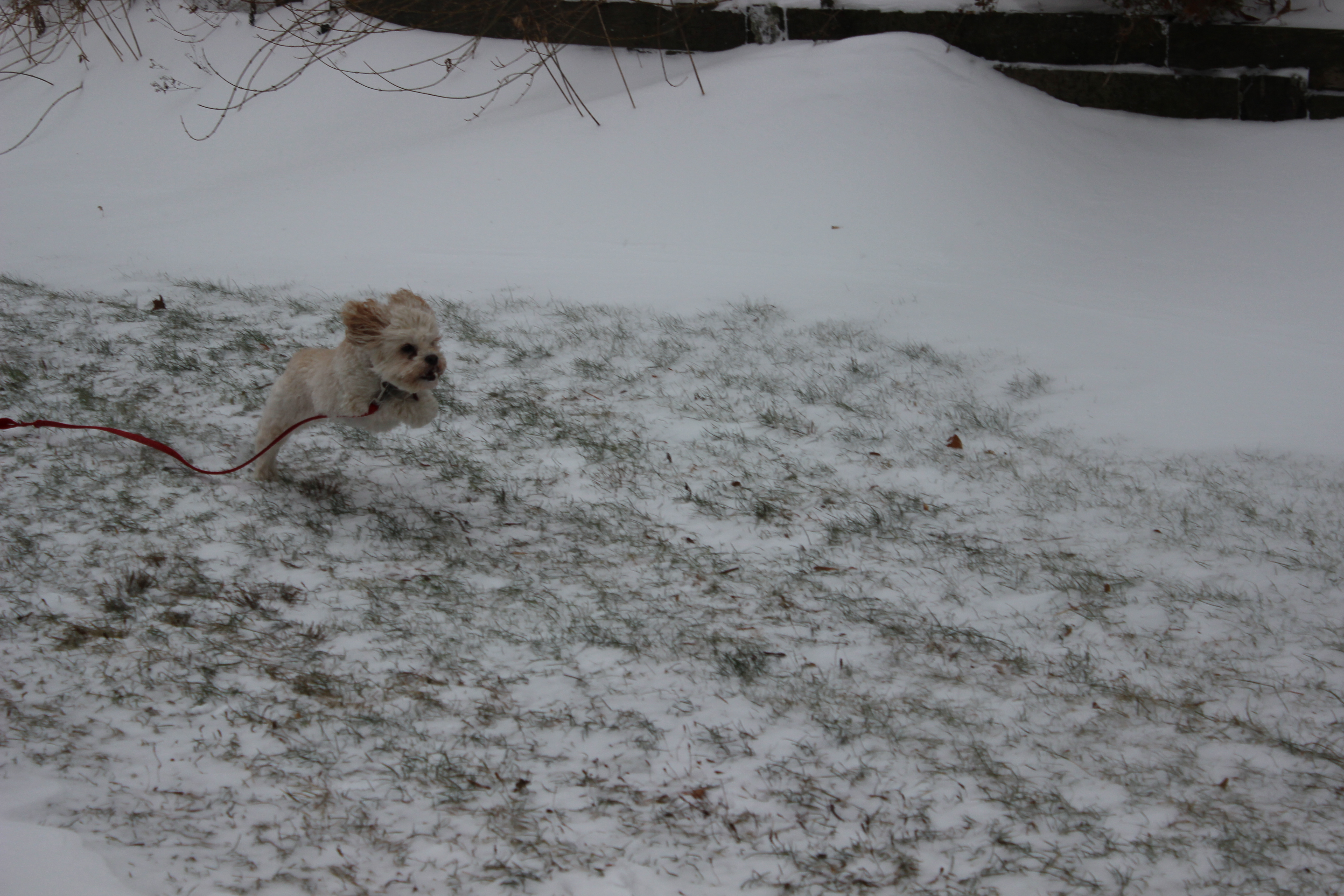
The thing is, I like snow. Even more than that, I like snow days, when the whole world seems to be at home watching the same news shows, and not a word of politics is spoken. Theoretically. I love zipping up my tall boots and taking the dogs out for picture time. I love watching Cricket hop through the snow searching for treasures (a leaf!!!!!). And I even like trying to console Butterfly about the weird texture of the ground under her paws.

026

“I see something!!!!!!!”

041

“Now I see it over there!”

027

“Mommy, why can’t I feel my toes?”

We were having all of the negatives of winter: the severe cold, the biting wind, the gloomy lighting, and every kind of cold and flu imaginable, without the benefit of snowball fights and hot cocoa to lighten the load. Even Cricket and Butterfly had to suffer through the short daylight hours, and even shorter walks, and the plinking rain on their heads, with no reward.

We had one day, recently, when the air was full of snowflakes that blurred the world, but added up to almost nothing on the ground. I had to drive carefully, and wear a warm jacket, scarf, and gloves, but I still had to go to work. I felt cheated.

Summer will come along too soon, and it will be relentlessly hot and humid and full of smog and sweat and swarms of bugs. I just wanted a few snow days in my memory bank, to shore me up for those long months of heat, when I would barely be able to go outside and would have to sit with my head right up against the air conditioner just to be able to think.

It’s not that I’m thrilled with having to shovel my car out of the deep snow. I would actually like to have a magical shovel that removes the snow without any help from me. And I could do without the black ice on the roads, and the slippery walkways, and the bad headache that inevitably comes with extreme changes in air pressure. But the snowstorm was a relief just the same. I could turn on the TV and watch weather for as long as I wanted to, with only short breaks to hear about the national political dramas. Every local newsperson was out in the snow, wearing silly hats, and asking random snow-covered strangers some very silly questions. My local government officials were all too busy keeping people safe, and making sure the snow was getting removed from the roads, to cause trouble. One mayor was even driving the snow plow himself, with a reporter along for the ride to make sure the event was recorded for posterity.

I need days like that. I need a few days each year when all of the pain and disorder are muted under Mother Nature’s snowy blanket. Now if only we could convince her to lift up the blanket of snow again once we’ve rested, and not leave it to me to remove pounds of wet snow with my non-magical shovel, then I wouldn’t need three days in bed to recover from my beautiful snow day.

019

“We’re going back inside now, Cricket.”

045

“I can’t go inside yet, Butterfly. There’s still a leaf under here. I’m sure of it!”

Cultural Competence


I seem to have developed a growl reflex. It started a few weeks ago. At first, I thought I had a cough, or some kind of breathing disorder that would kill me at any moment. Butterfly looked at me with a wait-a-minute stare, as if I had finally spoken in her language, but it was my Mom who noticed that it only happened when the news was on.

008

“You finally learned my language!”

There’s something dissonant about studying to become a social worker, with all of the inherent multi-culturalism and looking out for the vulnerable and oppressed that comes with that, and then turning on the news and being told that all of these values are passé. There’s a free-for-all feeling to the news in America since the election, as if no one’s quite sure how to cover the President-elect and still be “objective.” Every day is unpredictable.

For a long time now, we’ve lived in a country where white supremacy and neo-Nazi propaganda was beyond the pale, and now, not only is it main stream news, TV news people are tying themselves up in knots trying to discuss these people and their beliefs “objectively” and “without prejudice.”

Note the irony.

Since when did objectivity require the removal of your backbone and integrity? When did this mass surgical procedure take place, and can it be reversed?

I’m trying to find out when we as a society decided that talking about racism became “identity politics,” and therefore something to be avoided. There seems to be a consensus in the main stream media that the Democrats lost the presidency because they were too focused on identity politics – aka the needs and issues of minorities and oppressed and vulnerable groups within our society. The solution offered seems to be that we should not think in terms of groups and differences at all, but only of society as a whole.

This, pardon me, is nonsense. We come together in groups when we have shared issues that need to be addressed, and know that the larger our group, the louder we can be, and the better chance we have of being heard. If we can’t come together and speak as a group, we are effectively being silenced.

pix-from-eos-002

The lessons people keep trying to take from this election are bizarre: it’s Hillary’s fault, because she wasn’t likable enough; it’s “identity politics” fault, because it made white people feel left out; or, it’s Black Lives Matter’s fault (a group which, by the way, has become invisible on the news since the election, though I can’t imagine that unfair treatment of black and brown people at the hands of the police has suddenly vanished in the warm glow of the anticipated Trump presidency).

The backlash against the Black Lives Matter movement may be as realistic an explanation for the election of Donald Trump as any, because while some Americans woke up to the reality of unfair treatment of minorities by the police and criminal justice system, because they could finally see the video evidence with their own eyes, many other Americans saw the resulting protests as a threat to peace and safety, and they wanted to shut it down.

The media has decided to take Trump’s election as a mandate to stop covering certain issues, and to stop advocating certain values, that had seemed to be universal in America. The media also seems to have decided to take Trump’s word for it that Steve Bannon, despite being the voice of the Alt-right, in his own words, is really not a racist, misogynist, anti-Semite. No, he’s just misunderstood.

My only consolation is that I have the loudest, most aggressive protester in the world living in my own household. Her name is Cricket, and she is a fourteen pound bundle of fluffy outrage. If things continue to get worse, I may have to pack Cricket into the car and bring her to Washington, DC to have her voice heard. I’ll just put her at the front of whichever march is underway at the moment: the women’s march (she is female, after all), or the rights of immigrants march (as far as I know, there is no such thing as legal citizen ship for canines, so her outrage would be real). She’d be willing to fight for a lot of different groups.

img_0510

“I have something to say!”

But watch out KKK. Cricket may be a white dog, but she does not like bed sheets. You have been warned!

IMG_0238

The Gossip Couch

Dogs love gossip. They collect their gossip by sniffing pee puddles and seeking out the butts of other dogs for important information. This one’s in heat, that one just had puppies, the other one had pizza for lunch, this one and that one had playdate in a yard filled with something stinky. Dogs do not care about world news. The whole idea of world news would just seem silly to a dog. Their minds are completely local. Neighborhood news, family news, that’s what they want.

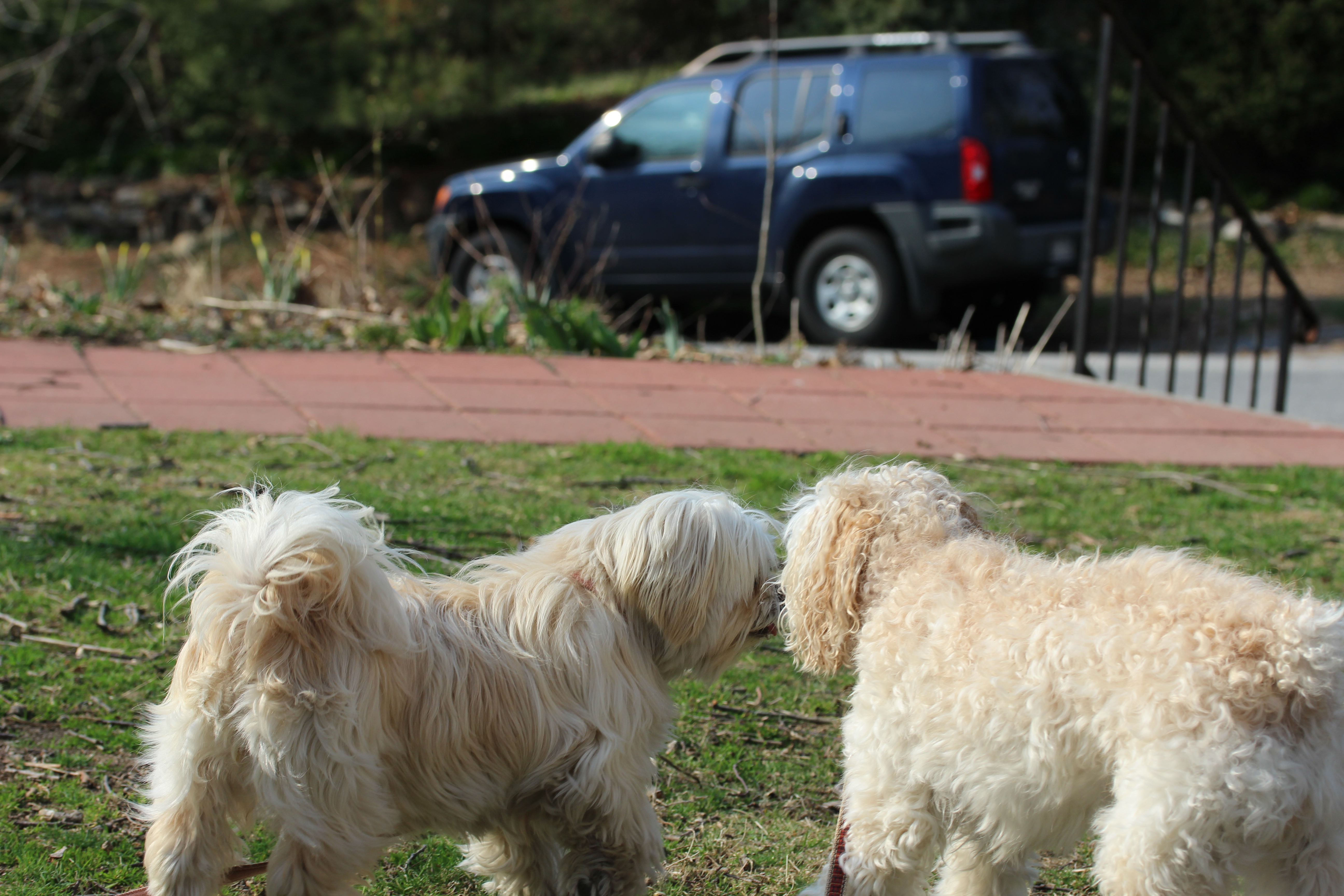
Cricket and Butterfly sniff in with each other regularly.

Cricket and Butterfly sniff in with each other regularly.

Cricket's traditional news-gathering pose.

Cricket’s traditional news-gathering pose.

We believe that it is important for us to know what’s happening in the country, and in the world at large, so we teach ourselves to read the New York Times or the Wall Street Journal, or listen to Public Radio, or watch CNN, but it takes time and effort to build up a tolerance for serious news. Gossip, on the other hand, is a natural instinct. I remember people whispering to each other in nursery school, about who was a poopy pants, and who still needed a sippy cup. The idea that we get much more excited to find out what our neighbors are doing with their free time than about the latest government snafu, is embarrassing to us, but to dogs, it’s a given.

My last graduate program was a low residency writing program. We’d go to campus for a week at a time, twice a year, and then the rest of the work would be done online, from home. But that one week was packed with gossip. Of course there were lectures and readings and writing workshops, but there was also drama and intrigue and a lot of alcohol. I’m not much of a drinker (or not a drinker at all) but watching how other people act when they are drinking can be very entertaining.

Every night after dinner, and more student readings, some people would head out to the same bar, the one closest to campus so we could all walk there. For most of the residencies, I went back to my room and got work done and maybe went out once or twice during the week. But at my last residency there was no work to do, and no workshops to go to, because I was there to graduate. I committed myself to going to the bar, every night, to people watch. But my favorite part of the night was getting back to the dorms, and sitting on the gossip couch, catching up on what everyone else saw at the bar. Many people forgot that they were married, and forgot to take their meds, and forgot that they were there to write, and therefore provided quite a lot of material for the rest of us to chew on.

Whenever the most recent returnee from the bar got off the elevator, we had to question him or her about the latest news, and each subsequent arrivee was drunker, and better informed.

Yes, gossip can be mean, and cruel, and about feeling superior to the other guy, but it’s also about feeling connected to the actual world you live in, to the day to day people you interact with. Sharing personal news and knowing what’s going on in our community makes us feel grounded and connected and a part of the world, instead of separate from it. I hate when everyone else seems to know something and I’m on the outside. And sharing gossip with someone, especially if it is juicy gossip, can bond you, as if you are showing your vulnerable belly to that friend, admitting you care about such things.

People use the word “gossip” as a judgment against particular pieces of news. It means, your news is petty compared to the important news of the day. We know so much about what’s going on in the world, that it’s hard to place importance on our own lives within that enormous picture. But gossip can fix that. Gossip focuses in on all of those small details in our daily lives, it focuses on us, and our friends and enemies. It reminds us that we matter too. However small we may seem in the larger, worldwide, scheme of things.

Cricket and Butterfly gossip with each other all day. Butterfly sniffs Cricket’s ear, Cricket sniffs Butterfly’s butt, they listen to the birds and the neighbors and share significant looks. They know that this one smokes and that one’s on a low carb diet and the other one eats too many onions. They know which dogs have personality problems and which cats hide behind which bushes. They keep track of the comings and goings of the squirrels and the birds and the neighbors and the mailman. It’s like a twenty-four-hour-a-day soap opera with all of the repetition and long drawn out dramas you would expect from a daily serial. And they love it.

News-gathering must be done, no matter the weather.

News-gathering must be done, no matter the weather.

Butterfly checks in with the print media, when she can.

Butterfly checks in with the print media, when she can.

I try to remember this when I’m writing and start worrying that what I’m writing about is too trivial compared to what someone else has written. We need the big and the small, the weighty and the trivial, to balance each other out and give us perspective.

The Snow Opera


When we are expecting a blizzard or snowpocalypse, the news shows start to take over the airwaves, covering each snowflake as it falls from the sky. And it’s exciting! It’s as if we’re all in the middle of a soap opera, waiting for each new drama to pop up. It makes me feel important when what’s going on outside my window has made national news. It’s something like what would happen if aliens invaded the earth. The level of drama and rhetorical hysteria is pretty similar.

The subways have stopped!

Don’t leave your house!

All of the bread is gone!

It's snowing!!!!!

It’s snowing!!!!!

Mom’s favorite thing about snowy days is the opportunity to watch our neighbors through the blinds of the living room windows. We can see the maintenance guys plowing the parking lot with their little golf cart, and neighbors shoveling their cars out with what look like plastic beach shovels. There’s a lot of yelling, from the louder of the two maintenance men, because people dare to walk on the walkways before they’ve been shoveled and salted, or try to drive to work before the parking lot is completely cleaned.


Butterfly is flying!

Butterfly is flying!

Because Cricket is coming after her!

Because Cricket is coming after her!

Mom finds it all very entertaining. There was the night when one of our neighbors shoveled out her car, for hours, even though it was expected to snow two times as much over night and her car was buried again by morning. Then there’s the woman who thinks that as long as she bundles up, she should be able to walk to the library in any blizzard. Some of the men help with the shoveling. One even has a plow on the front of his pickup truck and helps out when they need him. Then there are the alcoholics. We don’t see much of them in the winter.

Cricket, dressed up for the snow party.

Cricket, dressed up for the snow party.

The first snow day of the season was exciting. The whole world was planning to shut down for a day or two, and mayors and governors were on the news, with dramatic sign language interpreter’s doing modern dance routines at their sides. Suddenly, I had to make chicken soup, and bread, and cookies. I wasn’t even that hungry, but it reminded me of weather events from my childhood, spent in the kitchen with my mother and brother, drinking hot cocoa after building an igloo on the front lawn. Of course the food outlasted the snow by days.

"Where's the rest of the snow?"

“Where’s the rest of the snow?”

I remember a book called Smilla’s Sense of Snow, a mystery, I think, but what I remembered most were all of the different words for snow in Smilla’s mother’s language. So far this winter there’s been: a heavy, wet snow that comes from a rain/snow mix, and makes each shovel full almost impossible to lift; there’s been icy rain that lands in hard pellets on my head and then creates black ice within seconds so I can’t figure out where to put my feet; there’s been soft, powdery snow; and snow that develops a hard crack surface, so that the dogs seem to be breaking pieces of candy with each step; we’ve had tall, hard piles of snow; and lacy, bumpy layers of ice; and then there’s the slush, where it feels like someone poured their sorbet onto the sidewalk and it’s turning into soup as I walk through it.

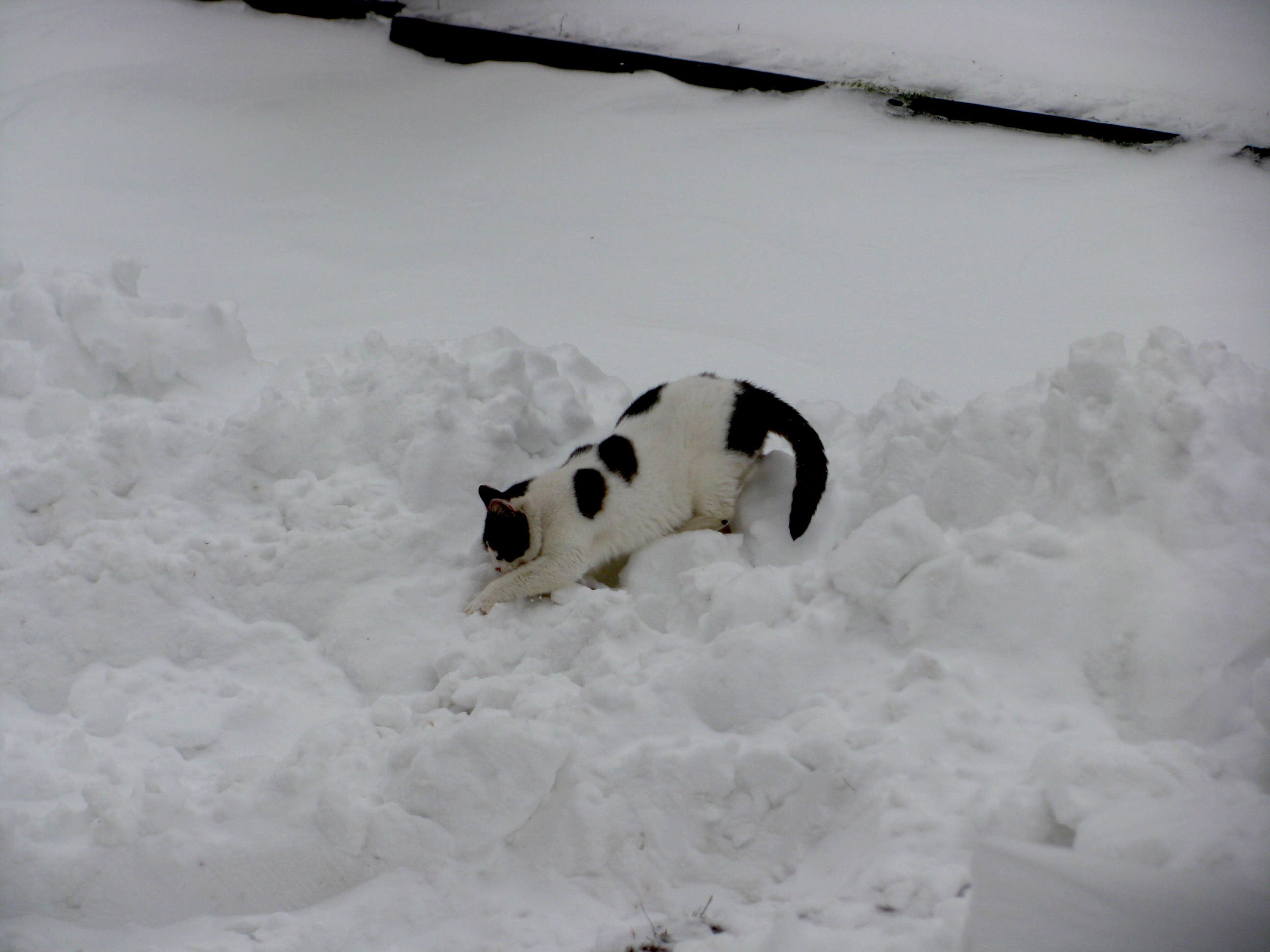
Cricket has discovered a wonderful new game this winter – it is the cat poop treasure hunt. One of the feral cats has taken to climbing onto the snow mountains in the backyard, pooping, and then burying the poop with a little extra pile of snow. Cricket, with her very effective sniffer, discovered the first of these magic pellets before I knew anything about it. She came in from a walk with Grandma, jumped up onto my bed to wake me up, and pawed my face with cat pooped paws. It certainly woke me up – and then shocked her, because she landed in the bathtub immediately, along with my bed linens and pajamas. She was horrified, and confused. Here she’d brought me this wonderful gift and I was angry? Why?

Hershey, placing the treasure.

Hershey, placing the treasure,

and burying it.

and burying it.

Each time we go outside now, I watch Cricket carefully, and if that nose gets too interested in one spot or another, yank goes the leash. She tries to jump up onto the snow mountains herself, and then falls down the side when her paws fail to grip. She’s tried to poop on top of the cat poop, but she doesn’t think to hide her poop, and anyway, I’m always watching, and ruining her fun, removing her poop before she can bury it and create her own treasure hunt for later.

Someone tossed birdseed onto the back lawn one day and then it snowed, just a dusting, and you could see hundreds of bird footsteps in the snow, and now Cricket can’t stop sniffing. Those little feet must smell good.

The most upsetting thing this winter has been when they’ve promised me a snowmageddon, and it ends up being a little bit of rain. Rain?! What happened to all of that promised snow? I feel bereft. Now what am I going to do for entertainment?

"What's next?"

“What’s next?”