At my most recent visit to the endocrinologist (thyroid issues, etc.), the doctor told me that Lilly has decided to offer Zepbound (a variation on Ozempic) for a discounted price to patients whose insurance companies won’t cover the GLP-1 weight loss medications. The average price for these medications, in the United States, is about $1,000 a month, though in other countries they can be bought for $100 or less, which has come up in contentious congressional hearings of late. My health insurance still refuses to cover these medications for anyone without type two diabetes or a severe heart condition, and I have been waiting impatiently for them to decide to cover GLP-1 medications for Non-alcoholic fatty liver disease, which I was diagnosed with last year, but who knows when that will happen.
Last year, the endocrinologist told me about a program that discounted Zepbound to half price, but only for people without any insurance coverage, which did not include me. But now, they are making it available to people like me who have health insurance that doesn’t cover the medications. The cost is $400 a month, which is a lot for me, but for the sake of my health I really can’t say no. My hope is that, if the Zepbound works for me, these medications will soon be covered under my health insurance and I won’t have to pay this much for long. Ideally, losing weight will improve the health of my liver and reduce the need for heart medications. I don’t think it will give me more energy, or reduce overall body pain, but you never know.
To be completely honest, though, what I really want from this medication is to lose enough weight to feel like a normal person. Yes, I want to reduce my risk of liver and heart disease. And yes, I would love to find out that losing weight could give me more energy and allow me to actually live more of my life, but, since childhood, I have been self-conscious about my weight, and I am so tired of feeling like a mutant. I know weight loss won’t change my life miraculously, because I’ve lost weight in the past, when I was able to exercise enough to lose weight on my own. And I’m sure I will still feel uncomfortable in my body, and struggle with pain and depression and anxiety and exhaustion. But it would be great to be able to go to my doctors and tell them my symptoms and NOT have them blame everything on my weight.
I was on a low dose of Ozempic last year, when my insurance was still allowing it, and I lost fifteen pounds. But as soon as the FDA cracked down on off label use of Ozempic, I was cut off, and within three months I’d gained the weight back. So, one, I know the meds can work, and two, I know I will have to be on them forever.
There’s a lot of fear for me around starting the Zepbound, actually. For some reason, the discounted Zepbound comes in a vial, with separate needles, instead of in pre-dosed pens, so I’m afraid it will hurt more and/or I will do it wrong. I’m afraid I won’t be able to lose enough weight to make a difference in my health, or I’ll get cut off again, because the price will go up or supplies will run out. I’m afraid I’ll be sick to my stomach for the rest of my life (though that’s not very different from how I feel now, to be honest), or that the Zepbound won’t work, or that I’ll lose the weight but I’ll look like a deflated balloon instead of looking, and feeling, healthy.
Maybe most of all, I’m afraid that having to spend $400 a month on this for the foreseeable future, on top of paying off my medical debt, will mean that I can’t really afford a new dog, with all of the vet bills and adoption fees and toys and treats involved. And going too much longer without a dog in the house feels like a risk to my mental health (and to Mom’s). It feels so unfair to have to choose between my physical health and my mental health, especially when they are so intertwined. But here’s hoping I won’t have to choose, and a little, hypoallergenic rescue dog will come along soon, and congress will decide to cover GLP-1 meds for Non-alcoholic fatty liver, and all medical debt will be wiped out, and we will all live in peace and harmony, forever and ever, amen.
A girl can dream. Right?
“I’ll eat whatever you’re not eating. You’re welcome.”
If you haven’t had a chance yet, please check out my novel, Yeshiva Girl, on Amazon. And if you feel called to write a review of the book, on Amazon, or anywhere else, I’d be honored.
Yeshiva Girl is about a Jewish teenager on Long Island, named Isabel, though her father calls her Jezebel. Her father has been accused of inappropriate sexual behavior with one of his students, which he denies, but Izzy implicitly believes it’s true. As a result of his problems, her father sends her to a co-ed Orthodox yeshiva for tenth grade, out of the blue, and Izzy and her mother can’t figure out how to prevent it. At Yeshiva, though, Izzy finds that religious people are much more complicated than she had expected. Some, like her father, may use religion as a place to hide, but others search for and find comfort, and community, and even enlightenment. The question is, what will Izzy find?
I had this past week off, like most teachers in the United States, for Presidents’ week, and I really needed the break. But one week of vacation was just long enough to remind me of all of the things I wanted to get done, and not long enough to actually do them. Especially since the first thing on my to-do list really took over.
My to do list: SLEEP; put the new rugs down; think through all of the requirements for our next dog(s), and look for rescue organizations that will let us adopt without a fenced in yard; finish three novels and start two more, though one or more may end up being a memoir instead of fiction; read through my ten boxes of Therapy Pages notebooks and plan how to use them; start exercising again (for the fiftieth time); clean the kitchen and get back to cooking (instead of microwaving); read all of the books on my bedside table and piled haphazardly on my shelves; buy more bookcases; finish translating another ten Israeli pop songs and try not to add more to the list right away; work on lesson plans for the rest of the school year; get a haircut (or find a good excuse for why I shouldn’t have to ever cut my hair again); read through my hundred-page-plus draft of an “essay” on the history of the modern state of Israel, and see how many more books I will need to read before I can convince myself that I’m in over my head; watch every webinar I’ve downloaded from YouTube, on writing and therapy and music and Israel and whatever else; oh, and don’t fall into a deep depression as a result of the isolation and loneliness, if possible.
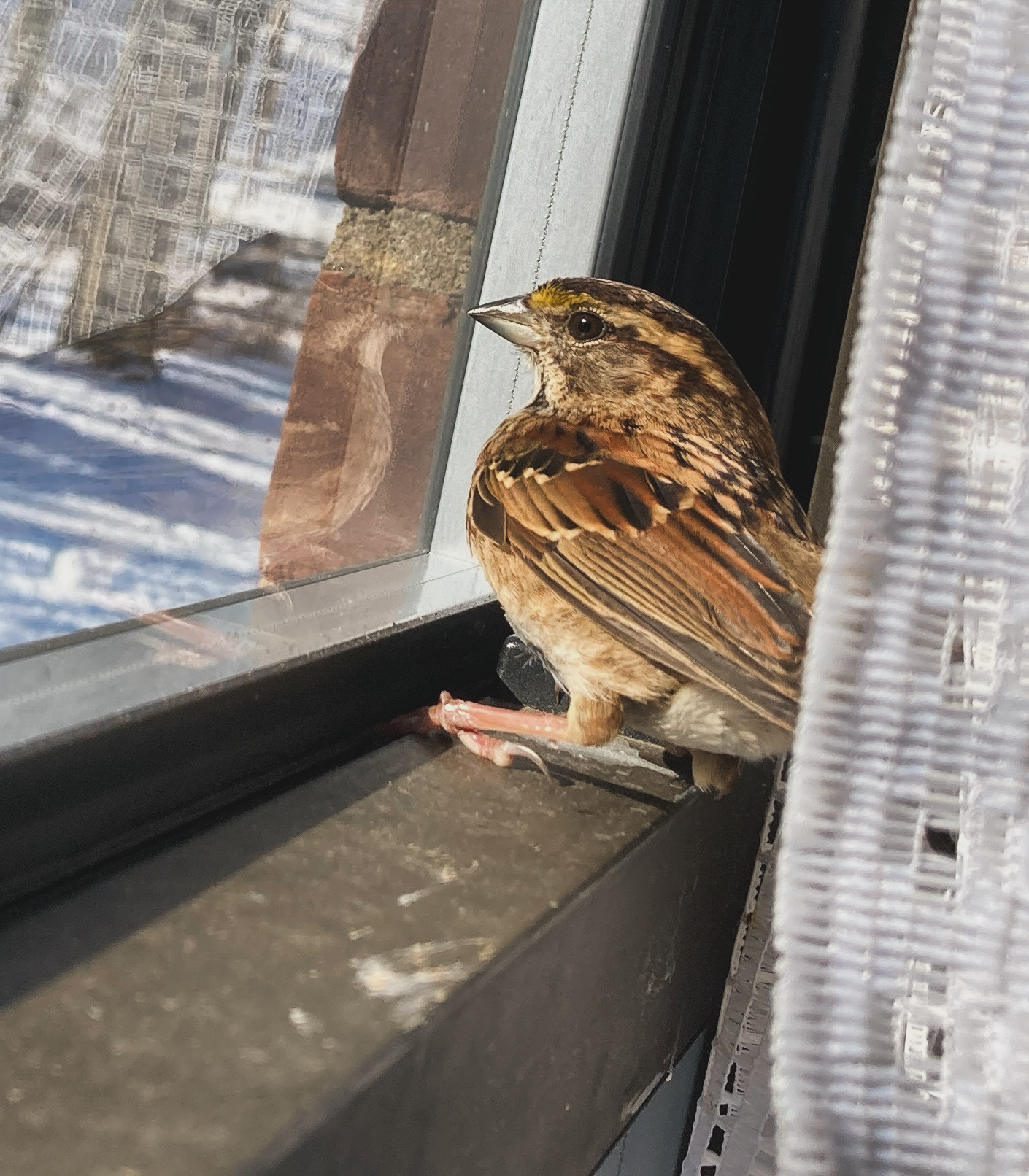
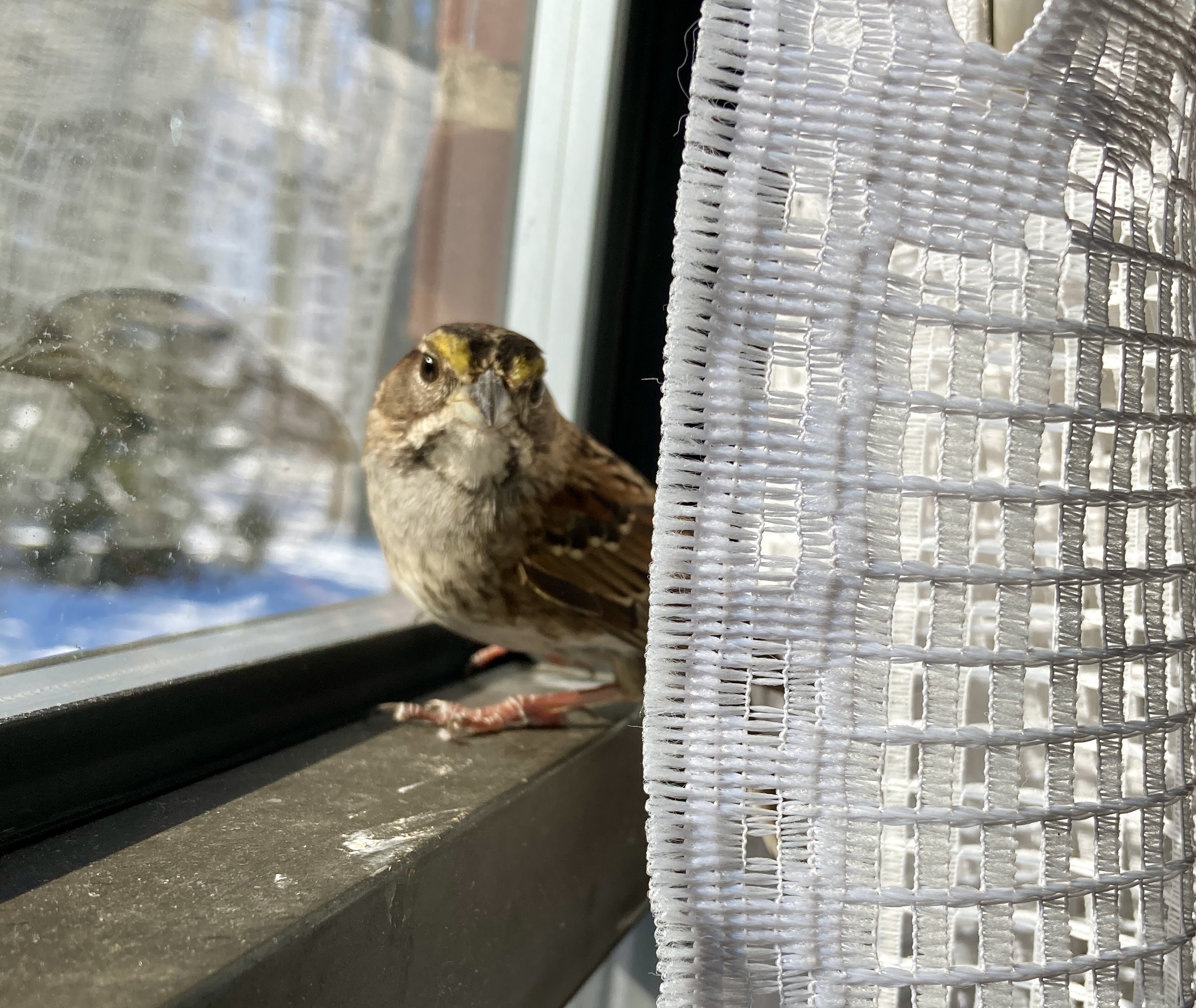
One nice thing happened before the actual vacation started which gave me hope: we had another birdie visitor. This time it was a young white-throated sparrow who either had ADD or a panic disorder and kept flying and pacing relentlessly around the apartment. Mom got some great pictures of him in the few moments when he was able to remain still.
But then, right after the bird left, I heard from my pharmacy that the FDA is clamping down on off label prescriptions for Ozempic (anything other than a type-two diabetes diagnosis), and then my doctor told me that my insurance won’t cover any of the other weight loss medications (Wegovy, etc.), so if I wanted to keep taking weight loss medication it would cost at least $1,000 per month. So, after six months of slow weight loss, the experiment is suddenly over. There’s a bill in the US congress to try to get weight loss medications covered by health insurance, but who knows how long it will take to get it approved; relying on the smooth workings of the United States government has never been a good life strategy.
If the weight I’d already lost had improved my overall health, then maybe I would feel better about stopping here, but, if anything, I’m more exhausted now than I was six months ago. Which is why the first thing on my to-do list overwhelmed everything else I wanted to accomplish this week, and most of my vacation was spent sleeping, or at the very least, lying down. I also watched a bunch of webinars (and managed to download even more), and got some reading and writing and typing done. But vacation is almost over and my to-do list is, if anything, longer than it was at the beginning of the week. How is that even possible?
Here’s hoping that the rest I’ve been able to get this week will help me get through until the next short vacation, and that somewhere along the way some more birdies will come along to remind me that all of this is worth the effort – even if my to-do list never, ever, gets done.
If you haven’t had a chance yet, please check out my Young Adult novel, Yeshiva Girl, on Amazon. And if you feel called to write a review of the book, on Amazon, or anywhere else, I’d be honored.
Yeshiva Girl is about a Jewish teenager on Long Island, named Isabel, though her father calls her Jezebel. Her father has been accused of inappropriate sexual behavior with one of his students, which he denies, but Izzy implicitly believes it’s true. As a result of his problems, her father sends her to a co-ed Orthodox yeshiva for tenth grade, out of the blue, and Izzy and her mother can’t figure out how to prevent it. At Yeshiva, though, Izzy finds that religious people are much more complicated than she had expected. Some, like her father, may use religion as a place to hide, but others search for and find comfort, and community, and even enlightenment. The question is, what will Izzy find?
I spent more than two years working on Intuitive Eating being superconscious of hunger and fullness levels and fighting with myself to stick to smaller portions, but after three months of gradually raising the dose of Ozempic, I realized that, beyond weight loss, Ozempic has made Intuitive Eating much easier. Now I can eat half of my breakfast and put the rest aside for later, without thinking about it or arguing with myself. Is this what normal people feel like around food? Because I still enjoy eating, and I still have cravings for this or that, but it’s just not overwhelming anymore.
“Chicken!”
So, of course, as soon as I was fully on board with Ozempic, and ready to go up to the optimal dose of 2 mg a week, I found out that I wasn’t immune to the Ozempic shortage.
The pharmacy had had no trouble getting the lower doses, so as I got used to a faint sense of nausea and more sensitivity to acidic foods, there was no stress around getting the weekly .25 mg, .5mg, and 1 mg doses. But it turned out that I should have become aware of the shortage when my doctor moved me up to 1 mg a week, because my pharmacy didn’t fill that prescription. Except I didn’t notice, because I still had three boxes of the lower dose pens, so I just took two .5 mg shots to make up the 1 mg dose, assuming that’s what I was supposed to do. So when the doctor raised my dose to the full 2 mg, and told me that there might be difficulty getting it, I was surprised to hear it. She told me that if the pharmacy couldn’t get the higher dose I should just stay at 1 mg. I didn’t hear anything from my pharmacy after the 2 mg dose had been called in, so when I went in to pick up a few other refills I asked for the 2 mg prescription of Ozempic and the kid at the counter sent me over to the pharmacist for the bad news. Not only couldn’t they get the 2 mg dose, they couldn’t get the 1 mg dose, and couldn’t give me the available smaller doses to make up the higher dose (I guess it’s an insurance thing). He said they would let me know if a supply of either the 1 mg or 2 mg dose came in, but he had no idea when, or if, it would.
I called the doctor’s office to let her know about the problem and to ask if there was another medication she could switch me to, and the secretary, who’d heard it all before, said no, just call around to different pharmacies until you find one with a supply of Ozempic, and then call us back and we’ll send a new prescription.
I still had 1.5 mg left at home, so I made plans to make it last two weeks, taking .75 mg each week, and crossing my fingers that the pharmacy would come through by then; because I didn’t want to have to call a million pharmacies, and then call the doctor’s office each time someone said they might have an extra dose for me; but also because I couldn’t quite believe that it was an emergency. I couldn’t believe that my doctor would have started me on Ozempic if there was a real, even reliable, chance that I wouldn’t be able to keep taking it after the first few months. That just seemed crazy.
When I told my nutritionist, and my therapist, and Mom, that my plan was just to wait, they said absolutely not. You must be more proactive! You must keep calling and running around to get this medication that is actually helping you! But I couldn’t do it. I felt like a black hole was opening up under my feet at even the thought of chasing down Ozempic doses across Long Island. I couldn’t even put into words why it felt so awful, but I’m pretty sure I made sad puppy dog eyes, just like Ellie, because Mom volunteered to call around for me. She found a big pharmacy a few towns away that was expecting to get a shipment after the weekend. All I had to do, they said, was call my doctor for the prescription on Monday morning and it would all be fine.
So on Monday morning I called my doctor’s office and the secretary said that the doctor would call in the prescription. I called the pharmacy every few hours to see if they had filled the prescription, but each time the automated operator said they didn’t have my name and number in their system yet and I should call back later. After eight PM, when I’d given up, Mom called one more time and got the notification that my prescription had been filled and a four week supply of the 2 mg dose of Ozempic would be waiting for me in the morning. I was so relieved, and so exhausted just thinking about having to go through this again in a month.
I was still up at one thirty in the morning, anxious and preoccupied about Ellie’s health and the war in Israel and Gaza, and trying to read a mystery to distract myself. I’d finished yet another chapter and decided to check my email for a break, and that’s when I found the notification from the new pharmacy saying they had run out of Ozempic and couldn’t predict when they would get the next shipment in.
“Oy.”
I don’t know exactly what happened. Maybe there was enough Ozempic at eight o’clock, when they put it into the computer, but by the time the pharmacy had closed an hour later it was all gone. Or maybe someone stole a box of Ozempic out of the back door after midnight. But it was starting to seem like Ozempic was being doled out on a first-come-first-serve basis, or some sort of Hunger-Games-style competition with no rules at all.
I’m not good at fighting for what I need, or racing to get places faster than someone else. Even the thought of competing for scarce resources exhausts me down to the bones. I’ve spent so many years trying to manage my weight, and spending enormous amounts of money and time on diets and nutritionists and programs and apps and on and on. And I’ve spent so many years being criticized by doctors for not being at the right weight, and for not trying hard enough, and finally there’s a medication that actually seems to be helping me, but I struggle with the idea that I should get something when someone else needs or wants it too. I don’t believe that I should be the first on anyone’s list to get Ozempic when people with type two diabetes, the original patients the drug was made for, are struggling to get their medication. I can’t make an argument for why I should get what I want in a way that convinces me, let alone anyone else.
For days, this huge, raw, unhealed wound full of self-loathing and hopelessness opened up and practically swallowed me whole, and I just wanted to cover it with duct tape and wait for the Ozempic shortage to end on its own. But, gradually, the weight of it started to recede, just enough for me to be able to hear Mom say that someone at our regular pharmacy had suggested calling independent pharmacies in the area, instead of the big name ones.
I dragged myself over to the computer and googled independent pharmacies near me. I made a list of about ten places, including the one down the block that had been closed for a long time but was supposed to reopen under new management any day. But making the list was the most I could manage at that point, especially at ten o’clock at night, and I planned to start calling another day, when I’d built up another dose of hope.
The next day we had to take Ellie for another echocardiogram to see how she was doing on her meds. They raised the dose of one of her medications and said to bring her back in four months, which felt more hopeful than at our last vet visit; and then I had to go teach, and as I was leaving Mom said, do you want me to make those calls for you?
Of course I do, Mommy!!!!!
By the time I got home from teaching, all I needed to do was send a picture of my insurance card to the just-re-opened pharmacy down the block and they said they would have a four week supply of the 1 mg dose of Ozempic ready for me the next day. I wasn’t sure I believed it, though. I had to wait until the phone call came the next morning and we drove over and became the first customers to pick up a prescription from the newly opened family run pharmacy (all three staff members standing behind the desk smiling at me).
I have no idea what will happen in four weeks when I need a refill, and I have no idea if I will ever be able to go up to the 2 mg dose, and I don’t know what lesson to learn from this. Have faith in humanity? Support local small businesses? Trust that even deeply felt, unbearable hopelessness will eventually pass? Let Mommy handle everything?
I don’t really understand why a small pharmacy was able to get the 1 mg dose of Ozempic when my big chain store couldn’t get it; and I don’t understand why the second big chain store was able to get the un-gettable 2 mg dose, or where it went between the time they told me they’d filled my prescription and the time they told me they couldn’t.
But I do understand why Ozempic is so popular with so many people, in a world where even an extra five pounds is counted against a person’s character, and doctors believe that extra weight is the cause of all disease, even when it’s not.
I wish I didn’t need to take this medication. I wish my body could self-regulate to the perfect weight without any intervention. I wish I didn’t need any medication at all: for pain, for depression, for a faulty thyroid, for high blood pressure, or for my weight. But I do. And I’m afraid this whole thing is going to happen again, and again, and I don’t know that I will be any more prepared to manage the waves of emotion next time. But for now, I have my medication, and Ellie has her medication, and we both have my Mom nearby for support when we get overwhelmed.
As for anything else, we’ll just have to take it day by day, because thinking ahead is too freakin’ hard right now.
“It’s nap time, Mommy.”
If you haven’t had a chance yet, please check out my Young Adult novel, Yeshiva Girl, on Amazon. And if you feel called to write a review of the book, on Amazon, or anywhere else, I’d be honored.
Yeshiva Girl is about a Jewish teenager on Long Island, named Isabel, though her father calls her Jezebel. Her father has been accused of inappropriate sexual behavior with one of his students, which he denies, but Izzy implicitly believes it’s true. As a result of his problems, her father sends her to a co-ed Orthodox yeshiva for tenth grade, out of the blue, and Izzy and her mother can’t figure out how to prevent it. At Yeshiva, though, Izzy finds that religious people are much more complicated than she had expected. Some, like her father, may use religion as a place to hide, but others search for and find comfort, and community, and even enlightenment. The question is, what will Izzy find?
Two and a half years ago, I started to work with a nutritionist who specialized in Intuitive Eating. I really wanted to believe that Intuitive Eating would be the answer for me, because I was starting to believe that I would have to be on starvation diets for the rest of my life, and I knew I couldn’t live like that. The nutritionist worked with The Intuitive Eating Workbook, by Evelyn Tribole and Elyse Resch, and had a lot of experience working with people with trauma backgrounds, and autoimmune disorders, and a history of eating disorders, so she seemed like the right person to help me feel safe with food, and feel comfortable in my body, and be able to maintain a healthy weight.
“I can help. Just give me all your food.”
We worked through all of the exercises in the Intuitive Eating Workbook together, charting my hunger and fullness levels, writing down all of my destructive thoughts around food and learning how to reframe them, and overall trying accept that dieting, or restricting food in particular, was not a good long term answer to my problems, given all of the evidence that diets lead to more eventual weight gain. I worked hard at balancing my meals, adding more protein to breakfast, and more vegetables to lunch, and more fat here and there so that I would feel full at the end of each meal. But despite all of my efforts, my weight continued to go up, a little bit at a time, until I’d gained back everything I’d lost on Weight Watchers five years before. The nutritionist said that, given all of my efforts, she was sure I would have been more successful with Intuitive Eating if only I hadn’t been suffering from so many other health problems at the same time, and I tried to believe her, and kept trying.
And then, a few months ago, I started to get a series of out of range blood test results. First my Adrenal values were high, and the endocrinologist sent me for a CT scan of my abdomen to see if there were nodules on my adrenal glands causing the raised numbers. But my adrenals were clear, and a repeat blood test showed that my Adrenal levels were back to normal, but now my liver values were high. So I was sent to the gastroenterologist, who sent me for an ultrasound of my liver and redid the blood tests, again. The new blood tests said that my liver values were normal, but the ultrasound showed a severe nonalcoholic fatty liver, and both the gastroenterologist and the endocrinologist said that weight loss was the only currently accepted treatment for a fatty liver, and if I didn’t address it now I could end up needing a kidney transplant down the line. But after so many years of trying every diet and non-diet available, I felt hopeless, so they suggested weight loss medication. In the past, the options for weight loss medications were generally too dangerous or unreliable to be recommended by most doctors, but with recent advancements in the field there has been more hope, or at least more things to try. And after all of the doctors’ visits and variable blood test results and finding out about the fatty liver, I was desperate enough to agree to try Ozempic.
I thought that my nutritionist would be against the whole idea of a weight loss medication, since it goes against the accept-your-body-as-it-is principles of Intuitive Eating, but she was on board immediately, for the sake of my overall health. But I still felt uncomfortable. I’d heard all kinds of the stories about the gastrointestinal side effects of Ozempic and other drugs like it, and there has been so much shame in the air around celebrities taking Ozempic, either because people think that taking a weight loss drug is frivolous or because they think it’s a sign of weak character. I was also worried that my health insurance wouldn’t cover the medication, or that I’d be one of the people who didn’t lose weight on Ozempic, or worse, that taking Ozempic would destroy my ability to enjoy eating, which I rely on heavily to get me through so many other things in my life.
“Puppy kisses help too, right?”
But my health insurance paid for the Ozempic prescription, and I took that as a sign to move forward with it. I started at a low dose a few weeks ago, and so far there haven’t been any side effects, or any impact at all. I’m okay with taking it slowly, and building up the dose at a pace that my body can handle, but I’m still worried that as the dose goes up so will the side effects, and that even on a higher dose I won’t lose weight, since so many medications that seem to work for other people haven’t worked for me.
But all I can do now is wait and see what happens, if the Ozempic works for me or not, and if weight loss will return my liver to a healthier state or not. In the meantime, I haven’t given up on Intuitive Eating, because even if it hasn’t changed my body, it has done a lot to change my mind, calming the noise in my head around food and weight and body type, and that relative quiet has left room for more positive thoughts to creep in. And as a result of that realization, I’ve started to adapt some of the Intuitive Eating exercises to see if they can help me create more calm in my mind around writing, where the noise has been even louder than it ever was around food.
Whatever happens, I’m hopeful that progress will continue from all of my efforts, even if I’m not sure what that progress will look like.
“We’re ready.”
If you haven’t had a chance yet, please check out my Young Adult novel, Yeshiva Girl, on Amazon. And if you feel called to write a review of the book, on Amazon, or anywhere else, I’d be honored.
Yeshiva Girl is about a Jewish teenager on Long Island, named Isabel, though her father calls her Jezebel. Her father has been accused of inappropriate sexual behavior with one of his students, which he denies, but Izzy implicitly believes it’s true. As a result of his problems, her father sends her to a co-ed Orthodox yeshiva for tenth grade, out of the blue, and Izzy and her mother can’t figure out how to prevent it. At Yeshiva, though, Izzy finds that religious people are much more complicated than she had expected. Some, like her father, may use religion as a place to hide, but others search for and find comfort, and community, and even enlightenment. The question is, what will Izzy find?



 rachelmankowitz