Tag Archives: recovery

Tzipporah Has Eyes Again

            We finally took Tzipporah to our groomer for the first time, a few weeks ago. I was nervous about how she would manage being with strangers, but other than a small panic attack when the groomer got to her front paws (she told us to pre-medicate Tzipporah with doggy Xanax next time), she did surprisingly well. The best part is that I can see her eyes again, and that means I can see how much her facial expressions have changed since she first came home. She looks curious and interested now, instead of frightened and exhausted.

“I see you. Mommy!”

I was so inspired by how well Tzipporah did at the groomer, that I brought her to therapy with me the next day, to show off her new haircut and to test her ability to sit in the car by herself (instead of with Grandma holding her). She survived the short trip by flattening herself on the backseat, totally unlike Cricket’s habit of climbing every which way while I was driving (though I’m still planning to get a car harness for her, just in case), and then she sat on my lap during therapy, and listened intently to what ended up being a long conversation about how freakin’ cute she is.

And, yes, she is still spending most of her time marinating in her bed, but she’s usually awake now and looking around intently for clues about her new world. She even twists around in her bed to watch me when I leave the room, or, God forbid, leave the apartment altogether. She still hasn’t barked, but she makes the most of her soft voice, waking us up in the morning with her persistent cry, like a tiny car alarm. She’s usually looking for Grandma, to give her breakfast or a treat, but sometimes she even comes looking for me, and then she waits until she’s made eye contact and then runs back to the living room, expecting me to follow. 

After her success with the groomer, I decided to move her food and water bowls halfway to the kitchen, rather than near her bed, to encourage her to walk around more often. And I even added toothbrushing into her daily routine (she loves the chicken flavored toothpaste!), and she seems to be tolerating the indignity quite well.
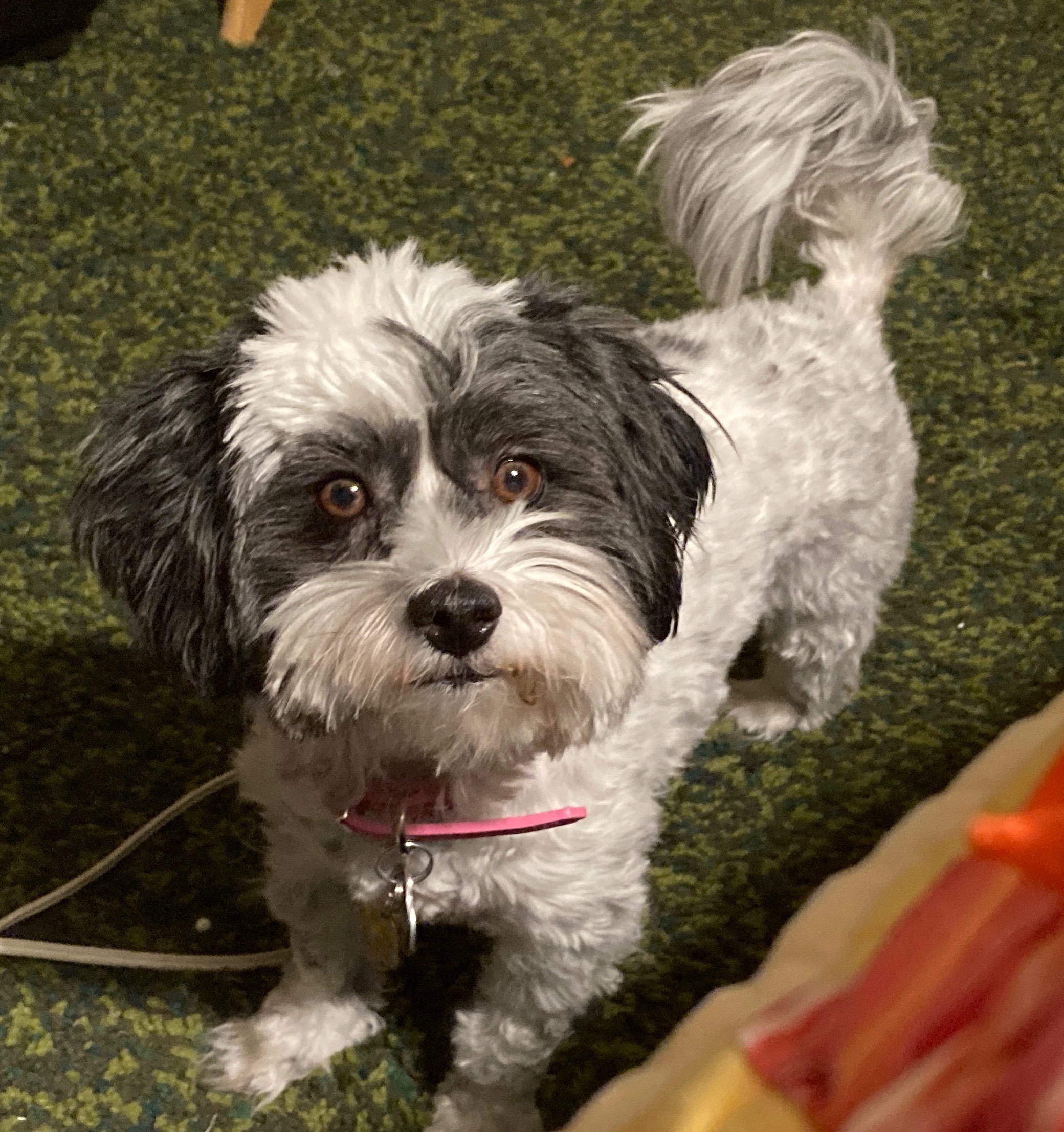
“Wait, that was toothpaste?!”

            As the weather warms up, the next big challenge will be teaching her how to tolerate walks. She still looks at the leash like it’s a boa constrictor about to strangle her, and when I try to put her on the ground out in the yard, she shakes, so there’s a lot of work ahead. Maybe she’ll have to take some doggy Xanax for walks, as well as for the groomer. In my imagination, I see her running along the beach in the wind, and playing with Kevin-the-Golden-Doodle in the backyard, the way Cricket used to do (except without the violence), but that might be asking too much. We’ll see.

I’m trying to moderate my expectations and just be happy whenever she makes progress, but then I worry that I haven’t challenged her enough or given her enough opportunities for growth. With that in mind, I brought one of Kevin’s squeaky tennis balls into the apartment one day, hoping the smell of him would interest her. I threw the ball a few times, and squeezed it to make it squeak, but Tzipporah just watched intently, with no signs of wanting to participate. She hasn’t quite figured out that life is supposed to be interactive, instead of a movie to be watched from the cozy seats, but I have the same problem, so really, who am I to criticize?

“These are the best seats in the house!”

If you haven’t had a chance yet, please check out my novel, Yeshiva Girl, on Amazon. And if you feel called to write a review of the book, on Amazon, or anywhere else, I’d be honored.

            Yeshiva Girl is about a Jewish teenager on Long Island, named Isabel, though her father calls her Jezebel. Her father has been accused of inappropriate sexual behavior with one of his students, which he denies, but Izzy implicitly believes it’s true. As a result of his problems, her father sends her to a co-ed Orthodox yeshiva for tenth grade, out of the blue, and Izzy and her mother can’t figure out how to prevent it. At Yeshiva, though, Izzy finds that religious people are much more complicated than she had expected. Some, like her father, may use religion as a place to hide, but others search for and find comfort, and community, and even enlightenment. The question is, what will Izzy find?

Food Insecurity?

            I was talking to my nutritionist about how I panic when I do the experiment where I have to stop eating mid-meal to check in on my hunger levels, and she said, you are food insecure.

            Huh?

            I thought food insecurity only referred to people who legitimately don’t have access to enough food, because of poverty, or living in a food desert. It felt melodramatic to think of dieting as a cause of food insecurity on that level – but the more I thought about it the more I realized that the nutritionist was right.

            Being on a diet means imposing food insecurity on someone who should not otherwise lack nutrition; imposing scarcity on someone who lives in a world that is full of good food. Why are we willing to do this? Why are doctors willing to encourage this?

“Why?!”

            There is something unnatural, even cruel, in imposing a diet that doesn’t match the food that is readily available (gluten free food for millions of people who have no actual allergy to gluten, anyone?). It’s like saying to someone who lives on the beach, you should never swim. Or to someone who lives in the Alps, you should never ski; and you are a terrible, ugly, gluttonous person for even wanting to ski. And so many diets are based on passing fads and half-finished research, rather than on any real understanding of the role food plays in our lives, so that the rules we have to follow aren’t just cruel, they are also, often, wrong. The fact is, food has never been simply about nutrition. If we forget that, we forget large parts of who we actually are and where the disorders in our eating habits even come from.

            Each time I have regretted taking on the no-diet rule of Intuitive Eating this year, because I’ve been gaining weight instead of losing it, I’ve checked in with myself and realized that I did not want to return to the constant panic and deprivation that comes with diets – whether they are low calorie, low carb, or low anything else. The severe diet I tried over the summer – to deal with stomach pain symptoms – was all the reminder I needed that dieting is no way to live.

“We agree. No diets for us.”

            But thinking about food insecurity as being caused by something other than actual food scarcity made me think about all of the other artificial scarcity situations we create as human beings. Simple things, like forcing ourselves to work sixty hours a week when we don’t need to, or forcing ourselves not to cry because it looks weak, or forcing ourselves to be fiercely independent instead of relying on the people around us when we need help.

            I grew up in a middle class home. We were never poor, and yet, we frequently couldn’t afford the things we wanted, or needed, because my father withheld the money. He had it, he just chose not to spend it on us when he wasn’t in the mood (other times he would spend money on us, but only on things he wanted for us). We also went to school with a lot of people who were upper middle class, and compared to them we were poor. We got small presents for each night of Hanukah, while some of our classmates got presents worth hundreds of dollars each night. But we were not poor. We were abused and neglected by our father, but we were not poor.

            The fact is that abuse and neglect lead to an experience that is so similar to poverty that it can be hard to tell the difference. If you are food insecure, love insecure, and safety insecure, what good does it do to know that your father could afford to pay the bills if he chose to?

            The work I’ve been doing with Intuitive Eating this year has most often been about teaching myself to understand that food is always available, and never off limits, so that I can learn to decide what and when to eat based on actual hunger, rather than on the fear that the food will disappear if I don’t eat it right away. This work has taken much longer than I’d hoped, and, of course, the food represents so much more than just food. My panic at deprivation is so deep that it feels as if I’m being threatened with death, rather than just momentary hunger, when I choose to stop eating a little bit early.

“Hunger is awful.”

            The work of recovery is ongoing, and seems endless at times, but just when I think I’ll never untie a difficult knot, it loosens, and five other knots loosen with it, like magic. So I will keep working on this, and working on reminding myself that I don’t have to live in scarcity, because the things I want are available now. It’s such a hard lesson to learn, though, and food is just the first step.

“We could eat.”

If you haven’t had a chance yet, please check out my Young Adult novel, Yeshiva Girl, on Amazon. And if you feel called to write a review of the book, on Amazon, or anywhere else, I’d be honored.

            Yeshiva Girl is about a Jewish teenager on Long Island, named Isabel, though her father calls her Jezebel. Her father has been accused of inappropriate sexual behavior with one of his students, which he denies, but Izzy implicitly believes it’s true. As a result of his problems, her father sends her to a co-ed Orthodox yeshiva for tenth grade, out of the blue, and Izzy and her mother can’t figure out how to prevent it. At Yeshiva, though, Izzy finds that religious people are much more complicated than she had expected. Some, like her father, may use religion as a place to hide, but others search for and find comfort, and community, and even enlightenment. The question is, what will Izzy find?