Tag Archives: school

The Phantom of the Apartment

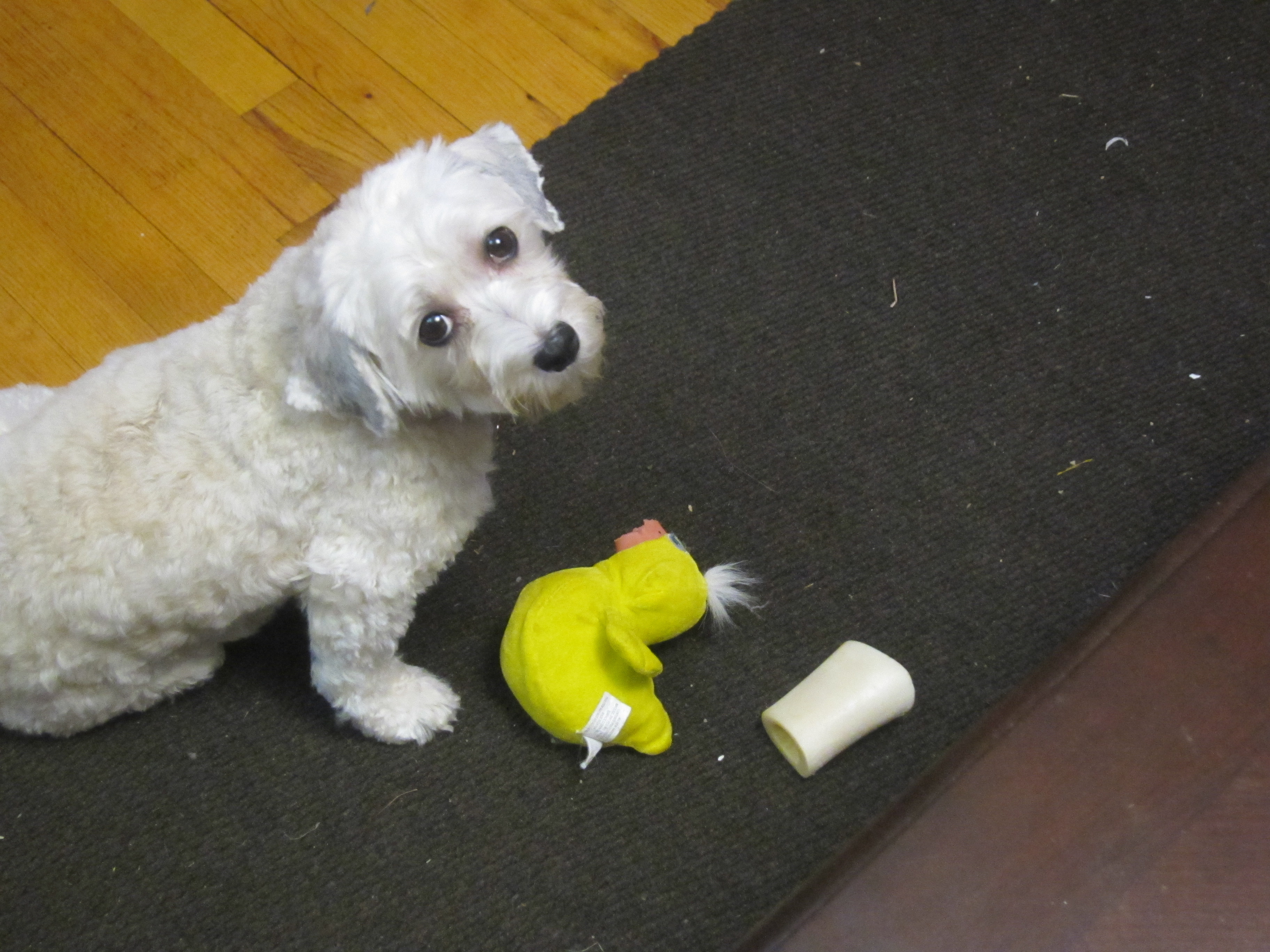
            You might remember that a while back I decided to set out a trail of treats for Tzipporah, to encourage her to spend more time in my room. Well now, multiple times during the day and night, Tzipporah sneaks into my room like a phantom, ignoring me completely, looking for her trail of treats; even after she’s eaten all of the treats I’ve carefully placed around the room, she comes back again and again, hoping, expecting, that new treats will have sprouted from the floor. But even though she had a traumatic early life in the puppy mill, I’m pretty sure she’s not living a double life as a murderous phantom taking out her trauma on unsuspecting victims, though one can never be sure.

“Where’d you hide the treats?”

            I wish I could convince her that I am friendly and harmless, but I’m also the one who insists on cleaning her tushy when she has an accident, and combs through her hair when she has knots, so she has legitimate reasons for doubt. But even though she doesn’t play with me, or sing at me, like she does with her grandma, she does watch me carefully and sit by my side at the computer, so even if I’m scary, I seem to be fascinating too, which is nice.

            She sat with me this summer while I sent out my query letters to potential agents, and while I collected the rejections; and she sat with me as I watched The Rachel Maddow Show each Monday night, and tried to believe her when she said that we can survive the current situation in the United States; and Tzippy was with me when I found out that The Late Show with Stephen Colbert got cancelled (though the show isn’t over until next May, so there’s still some comfort left); and she was with me while I watched the news of the Catholic school shooting in Minnesota, which felt dangerously close to home because I teach in a synagogue that has been under threat for years now, with ever increasing security measures as antisemitism and violence in general have continued to grow.

            I’ve been overwhelmed with anxiety this summer, from every direction, but the biggest anxiety seems to come up around planning and packing for my trip to Israel in November. Somehow, I’ve become obsessed with the fear that I’m going to overpack and have my suitcases taken away at the airport, or that I’ll forget to pack something essential that can’t be bought in Israel, though I have no idea what that might be. But my automatic response, when it feels like there are too many things outside of my control, is to try to control the little things, like making sure I have everything I could possibly need for the trip, which means I’ve been spending a lot of time scrolling through Amazon, looking for things I definitely need but have never heard of before.

Now that September has arrived, I’m going to have less time to spend on Amazon, and focus more of my energy on my students, and trying to come up with ways to make my classroom fun and welcoming, so we can keep the world at bay for a couple of hours at a time. I wish I could bring Tzipporah with me to class, but her anxiety skyrockets as soon as she leaves the apartment.

            When I think about it, I’m not sure if Tzipporah is the Phantom of the apartment, or if I am, or if there’s some invisible threat that we both feel radiating from the world around us. I’m not even sure if I’m really more anxious than usual, or if there are just so many more echoes of my anxiety in the world around me that it all seems louder and more pervasive.

            There was one nice break from the anxiety last week. The weather was nice enough that I was able to take Tzipporah outside to socialize with the neighbors, and Kevin the mini-Goldendoodle did his best to reassure her that he’s a nice boy and only wanted to sniff her nose and invite her to play. She wasn’t any more convinced by him than by me, at the beginning, but by the end of the visit she had relaxed on my lap, and stopped shaking, and she was able to watch Kevin run across the lawn chasing his favorite ball. It was only a few moments, but it was progress, though I’m pretty sure Tzippy’s favorite part of the outing was when we returned to the apartment, and she ran straight to her bed, and, magically, found a chicken treat sitting there waiting for her. That apartment phantom knows my little girl very well.

“I’m not that complicated, Mommy.”

If you haven’t had a chance yet, please check out my novel, Yeshiva Girl, on Amazon. And if you feel called to write a review of the book, on Amazon, or anywhere else, I’d be honored.

            Yeshiva Girl is about a Jewish teenager on Long Island, named Isabel, though her father calls her Jezebel. Her father has been accused of inappropriate sexual behavior with one of his students, which he denies, but Izzy implicitly believes it’s true. As a result of his problems, her father sends her to a co-ed Orthodox yeshiva for tenth grade, out of the blue, and Izzy and her mother can’t figure out how to prevent it. At Yeshiva, though, Izzy finds that religious people are much more complicated than she had expected. Some, like her father, may use religion as a place to hide, but others search for and find comfort, and community, and even enlightenment. The question is, what will Izzy find?


Our Imperfect Canopy of Peace

            After Rosh Hashanah and Yom Kippur – the big Jewish holidays where even unaffiliated Jews go to synagogue, or fast for a day, or at least eat brisket in a nod to tradition – comes Sukkot, the holiday where Jews build huts in their yards and eat under the stars for a week. This used to be the biggest Jewish holiday of the year, back in ancient Israel. It was a celebration of the harvest, with everyone traipsing to Jerusalem to see and be seen. Today, among liberal Jews in America, Sukkot doesn’t get much attention, coming as it does four days after Yom Kippur, when everyone is sick of being Jewish, or at least of going to synagogue. And that’s unfortunate, because Sukkot is meant to be a happy holiday, with Sukkah Hops (visiting everyone else’s sukkot/huts to eat cake and cookies and just hang out and gossip), and waving palm fronds, and sniffing citrons (etrogim), and all kinds of weird traditions that keep things interesting and happily silly.

            But a year after the October 7th Hamas attack on Israel, which took place during the later days of the holiday of Sukkot, celebrations of the holiday are more complicated. It’s hard to celebrate when Israel is at war (with Hamas, Hezbollah, the Houthis, and, ultimately, of course, with Iran), 101 hostages are still being held in Gaza, and antisemitism is rising around the world. But celebrating Sukkot is an obligation, and one of the other names for this holiday is Zman Simchateinu (the time of our happiness), so we are obligated not only to go through the motions of erecting a sukkah and saying the blessings over the Lulav and Etrog, but to find moments of true joy as well.

Lulav and etrog

            At my synagogue, we build a sukkah each year (well, someone builds it), and we try to have as many services and events and classes as possible in the sukkah, in order to give everyone a taste of the holiday, since most of us aren’t building our own sukkot at home. And at the synagogue school, we try to make a big deal out of the sukkah in the courtyard, and to engage the students in seeing the holiday through different perspectives. This year’s theme is looking at the connection between the sukkah we build for the holiday of Sukkot, and the more figurative Sukkat Shalom, or Canopy of Peace, that we sing about each week in the Hashkivenu prayer at Friday night services.   The most obvious connection is the word “sukkah,” which can be translated to mean booth or hut, as it is for the holiday of Sukkot, or canopy, as it is in the Hashkivenu prayer, where we ask God to cover us with a canopy of peace; but even more so this year, we are looking for a connection, or hoping for a connection, between these days of Sukkot and peace.

In Leviticus 23:41-43, we are told that living in a sukkah for a week each year is a reminder of the Exodus from Egypt, and the forty years our ancestors spent in the desert afterwards before entering the promised land. But, given that we remember the splitting of the Sea of Reeds in our daily prayers, and spend the whole week of Passover remembering the Exodus from Egypt, the fact that Sukkot is also a time for remembering the Exodus is often forgotten, in favor of the lulav and the etrog and the sukkah and all of the food. But this is a Jewish holiday, and there is no such thing as a simple Jewish holiday; even at a Jewish wedding we manage to remind ourselves of tragedy (stepping on the glass to remember the destruction of the temple in Jerusalem, and/or to scare away evil spirits). So, it’s not surprising that even during this holiday of happiness, even during a year when we’re not in mourning, we are still called to reexperience suffering.

The sukkah, which really looks ridiculous if you think about it, with its open door and barely covered roof, is a representation of the fragility of life and our imperfect safety in the world, and in both of those ways it is meant to remind us of our dependance on God. And yet, we are commanded to enjoy life in this sukkah, and invite friends and strangers inside to eat with us. We are called to practice creating joy even in the midst of difficulty, because that’s a time when it feels unnatural but is essential to remember that joy is possible.

a sukkah

And I think that may also be the lesson with our Sukkat Shalom, our figurative canopy of peace: that even with God’s protection our lives will be imperfect, and our experience of peace will be imperfect, and temporary.

            And that sucks. I have always wanted to believe in a future filled with an idyllic peace – a world full of comfort and kindness and all of our needs being met – despite never actually experiencing such a thing; even the hope of such peace in the future has been enough to keep me going. But what if this imperfect peace, filled with moments of suffering and fear and open doors and leaky roofs, is the only kind of peace that’s really possible? What if our prayers for peace have already been answered, but because we were looking for something more perfect we can’t recognize it?

We tend to think of peace as an absolute: we are either at peace or at war. But what if peace is complicated, or exists along a spectrum? American Jews are facing a dramatic rise in antisemitism, and grief and confusion and anger over what’s happening in Israel, but even before October 7th peace in Israel and for American Jews was never perfect (Israel was in the middle of yet another ceasefire with Hamas when the attack occurred, after all, and the past few years in America have not been free of antisemitic acts by any means). There is no time in history free of all difficulty. And maybe these holidays, which we are obliged to celebrate every year no matter what circumstances we are living through, are not about keeping us on our guard, or depressed about our lack of safety, but to teach us that even in an imperfect world we can, and must, live our lives as joyfully as possible, as fully as possible.

            It’s a hard lesson to learn, and even harder to teach, honestly. But Sukkot gives us a yearly opportunity to practice living in and appreciating an imperfect peace. We can sit in our fragile shelter and feel the chill in the air and watch our napkins fly off the table, and still eat good food and laugh with our friends and sing together, feeling gratitude for what we have, and grief for what we don’t have, at the same time.

Feeling multiple things at once isn’t the only lesson of Sukkot, but it might be the most useful one for this particular moment in Jewish history. And, it may actually be the key to all of the other life lessons we want our students to learn. We often think of resilience and mental health as the ability to focus only on the positive, but in reality, resilience is the ability to accept life as it is, and continue on. Like it says in Ecclesiastes, there’s a time for everything, a time to plant and time to uproot, a time to mourn and a time to dance, a time for peace and a time for war. We are meant to live in all of it, eyes open, taking it in and seeing it for what it is. And even, or most importantly, saying a blessing over what we see.

If you haven’t had a chance yet, please check out my novel, Yeshiva Girl, on Amazon. And if you feel called to write a review of the book, on Amazon, or anywhere else, I’d be honored.

            Yeshiva Girl is about a Jewish teenager on Long Island, named Isabel, though her father calls her Jezebel. Her father has been accused of inappropriate sexual behavior with one of his students, which he denies, but Izzy implicitly believes it’s true. As a result of his problems, her father sends her to a co-ed Orthodox yeshiva for tenth grade, out of the blue, and Izzy and her mother can’t figure out how to prevent it. At Yeshiva, though, Izzy finds that religious people are much more complicated than she had expected. Some, like her father, may use religion as a place to hide, but others search for and find comfort, and community, and even enlightenment. The question is, what will Izzy find?

Back to School

            For my first day back teaching, I was a whirling dervish of energy. I followed along with the Israeli teenager who led us in a TikTok style dance; I taught Hebrew through Movement, which involved a lot of standing up and sitting down and walking, walking, walking; and then I taught my two classes and met (most of) my new students, which meant a lot more standing and dancing and crazy hand gestures and funny breathing exercises. At the time, I was sure I was going to be fine. I mean, it’s not like I was running around the building, or doing pratfalls for laughs (like my students).

            But a couple of hours after I got home, my body started to stiffen and the pain began to set in. By the next morning, I could barely move.

“Hey! I can’t move either!”

            It took me a few days to recover. And, if possible, the second day of teaching was even more challenging. So now, I’m scared. I’m not sure if this physical response is worse than last year’s, or if I just got out of the habit of feeling like I’d been run over by a truck a few times a week. And I’m frustrated, because I spent the whole summer trying to build up strength and endurance in the hopes that I would start the new school year feeling more resilient, and, at the very least, it didn’t work.

            It was wonderful to see my students from last year, and to meet the new kids and hear their unique stories and start to untangle all of the drama among them (this will clearly take all year). And I can see a lot of interesting discussions and tons of silliness in my future, but there’s a voice in the back of my head warning me, you may not last the whole year.

            The fact is, I know I will do everything I can to be there for my students and to live up to all of my commitments – but it’s going to be harder, and it’s going to hurt.

            A few weeks ago, my therapist said, in passing, that my disease/disorder/undiagnosed chronic illness, is degenerative. She didn’t say, “it may be degenerative,” she said “it is.” For many years, she didn’t even believe that there was anything physically wrong with me. She was convinced that all of the pain and exhaustion was psychological, and therefore hard work in therapy would fix everything. But after decades of intensive therapy, and obvious progress in my mental and emotional heath, my physical issues have only worsened, and, finally, her theory of the case had to change.

            But there are so many things I still want to do! I want to teach more, not less. I want to write more, and meet more people, and travel, and dance, and sing. I was really hoping that this summer’s home-made physical therapy regimen was going to make a difference, and I’m so disappointed that it hasn’t helped. To be fair, it’s possible that without all of that work over the summer I would have been in even worse shape for the start of the school year. But for many years now, I’ve been trying everything I could think of: every medication and supplement doctors have suggested, and every exercise and treatment and strategy I could find. But I’m going to have to accept that it’s possible that this is as good as my health is going to get, and find a way to deal with that.

            But really, I don’t wanna. I want to throw a tantrum and scream and kick the floor and just cry. It seems to make my students feel a whole lot better, so, maybe it’s the next thing I should try. It couldn’t hurt! Much.

” I love a good tantrum!”

If you haven’t had a chance yet, please check out my novel, Yeshiva Girl, on Amazon. And if you feel called to write a review of the book, on Amazon, or anywhere else, I’d be honored.

            Yeshiva Girl is about a Jewish teenager on Long Island, named Isabel, though her father calls her Jezebel. Her father has been accused of inappropriate sexual behavior with one of his students, which he denies, but Izzy implicitly believes it’s true. As a result of his problems, her father sends her to a co-ed Orthodox yeshiva for tenth grade, out of the blue, and Izzy and her mother can’t figure out how to prevent it. At Yeshiva, though, Izzy finds that religious people are much more complicated than she had expected. Some, like her father, may use religion as a place to hide, but others search for and find comfort, and community, and even enlightenment. The question is, what will Izzy find?

On Boredom

            One of the most painful things I can hear from my students is “I’m bored.” I can work with “I don’t understand,” or “I don’t like to draw/read/write/sing/play.” But “I’m bored” feels like a condemnation of my ability to be the fun teacher.

            And I hear it all the time.

“That means you’re boring.”

            So, okay, that’s clearly one of my own issues. I want to be loved. I want to be the favorite. I want to be the teacher everyone thinks back on as the best, most insightful, blah blah blah. And I do need to work on that.

            But there might also be something going on with the students, something I need to help them work on. Because, first of all, walking into the class and saying “I’m bored,” as if the teacher is supposed to keep you entertained from the word go, with never a blank moment, is just not possible, let alone good for you.

            Some people say that kids have become more entitled, more used to having things done for them and given to them, and more used to having access to passive entertainment and whole worlds of TV and video to keep them from being bored. But I’m wondering if there’s more to it.

            I wonder if, for some of the kids, “I’m bored” means, I really need to be distracted from the low grade depression and anxiety that I live with on a daily basis, because I don’t see it letting up anytime soon. Or, I need you to keep me entertained because I feel under-loved and I equate your constant attention and energy with love. Or, what I really am is tired, overwhelmed, hungry, sad, or lonely – but no one responds when I say those things.

I remember being bored as a kid. I remember sitting in my bedroom on the weekends and not knowing how to fill my time when I didn’t have homework or a play date or something to read or something to watch on TV. We didn’t have smartphones and 24 hour TV and internet back then, so I really was left to my own devices if Mom was busy (and she was always busy keeping those plates spinning).

“Is plate spinning fun?

            But looking back, I was a kid with a lot of internal resources and interests, so it’s unlikely that I was legitimately bored. I was much more likely to be depressed, lonely, sad, angry, frightened, hurt, etc. I just assumed that the name for my problem was boredom. I would gladly do math homework or read social studies or do chores around the house, just to avoid having to sit with my own feelings for long enough to feel bad.

            And then, when I first started going to a commuter school for college, my classes were all packed into two days a week, because I couldn’t drive so I had to be dropped off in the morning and picked up at night, and I had classes starting at nine in the morning and ending at five or six at night, except, there was an hour and a half break in the afternoon with nothing to do and nowhere to go. If I’d been at home during that hour and a half it would have been fine; I could read, or exercise, or watch TV, or do my homework, or go for a walk, or whatever. But trapped on campus, in full view of other people, I could barely concentrate and I felt like there was a video camera on me at all times, judging my use of time, my personality, my outfit, my food intake, and on and on and on. That’s what I think of when I think of boredom: that overwhelmed state where I think I need to be accomplishing everything at once, and yet I can’t concentrate for five seconds at a time. But I don’t know if that’s what the kids are feeling.

Sometimes when my students say they’re bored, I think what they mean is that they resent having to be at synagogue school, and I know this because when I ask what they’d rather be doing they say, sitting in front of the TV at home, with the dog, eating pizza. And I wonder if what they’re actually saying is that they feel overstimulated and need a break from being productive and social. School, by its very nature, requires them to be both.

            Or maybe some of my students are bored because they really do need more of a challenge, or because they need activities that are better tailored to their specific abilities and interests, or because they need more structure and guidance from me. I don’t want to assume that I’m not at fault. But sometimes I have to accept that the task we are working on in class may be less exciting than they want it to be, but is still necessary. There are certain prayers they need to learn, and lessons from the Hebrew Bible, and that just may not be something they value at this point in their lives.

“I’m shocked.”

            I keep reminding myself that just because boredom was a sign of toxic things in my own childhood, that’s not necessarily true for my students. A little bit of boredom can be a spur to creativity, or at the very least be a manageable annoyance. But I feel bad when they seem bored, or distracted, or annoyed by what we’re doing in class, and it doesn’t feel safe to just let it go and assume it’s healthy or manageable boredom when it could be a sign that they are in pain or that I am failing them as a teacher.

            I remember, years ago, when my cousin’s son came to visit from France with his grandmother. He was five years old and learning English but still very French. We were sitting at a table full of adults and even though there was another child there, he was barely two years old and sitting at the other end of the table. And then there was me. I was twenty-three years old and not sure where I fit in. The five year old was sitting next to me and at one point he mumbled something under his breath in French that I couldn’t quite hear and I asked him to repeat it, because I was curious, and because I wanted to see if I could understand his French, but then he told me, louder, and in English, that he was bored. Immediately, his grandmother, sitting across form us, corrected him, saying that in French the term is reflexive, which is more correct, because you make yourself bored. And I got really annoyed and said, no, he’s bored because he’s five years old and sitting at a table full of adults speaking in a foreign language, talking about things he doesn’t understand or care about, and he needs something age-appropriate to do so he can feel engaged. I hope I said it a little less aggressively than that, but I was remembering so many times when my needs had been ignored, and it just pressed my buttons. And then, of course, I was volunteered to take him, and the toddler, into the living room to find toys to play with. The five year old, of course, complained that what he really wanted was to watch TV, and not to play with some baby, but at least he was smiling when he said it, and he wasn’t complaining about being bored anymore.

            That experience taught me that sometimes boredom is about not feeling heard, and not feeling like you are being taken into account, and I try to keep that in mind with my students. But it’s hard to balance everyone’s feelings at once, especially when most of them start out angry that they have to be at synagogue school in the first place, and nothing I say can convince them that learning Hebrew is more fun than watching TV and playing with their dog while eating pizza. Weird.

“We want pizza too.”

If you haven’t had a chance yet, please check out my Young Adult novel, Yeshiva Girl, on Amazon. And if you feel called to write a review of the book, on Amazon, or anywhere else, I’d be honored.

            Yeshiva Girl is about a Jewish teenager on Long Island, named Isabel, though her father calls her Jezebel. Her father has been accused of inappropriate sexual behavior with one of his students, which he denies, but Izzy implicitly believes it’s true. As a result of his problems, her father sends her to a co-ed Orthodox yeshiva for tenth grade, out of the blue, and Izzy and her mother can’t figure out how to prevent it. At Yeshiva, though, Izzy finds that religious people are much more complicated than she had expected. Some, like her father, may use religion as a place to hide, but others search for and find comfort, and community, and even enlightenment. The question is, what will Izzy find?

The New School Year

            I’m the only teacher wearing a mask this year at synagogue school, so far. And I know that part of the reason I chose to keep wearing it is because I’m self-consciousness about my teeth, post-surgery, but mostly it’s because I wear a mask to go to the supermarket, and the doctor, and the dentist, and the drug store, and it seems odd to take the mask off just when I’m faced with a room full of children. I don’t want to get sick, and even more important, I don’t want to get Mom sick, especially after the breathing issues she’s been having this summer.

            I have even less energy than I had when school ended last spring, but I’m hoping that that’s a temporary result of the oral surgery, just like the numbness and tingling on the right side of my face, and that I’ll start feeling better soon. I don’t think my exhaustion shows in the classroom, though, because I tend to go into performance mode, spending two hours making weird noises (we all pretended to be shofars on day one!), and acting things out, and making funny faces (which probably go unnoticed under the mask, now that I think about it). I definitely feel the pain later, but in the moment, when the adrenaline takes over, I feel like I can do pretty much anything.

“I can fly!”

            The rest of the time, my mind is still full of noise: worrying about my health, and Mom’s; worrying that I’m a terrible teacher/friend/daughter/human; worrying that I will always be in debt, and always be disabled, and always be worried.

            Mom has been feeling better, thank God, but now she’s so busy that when I want to whine about one thing or another I have to wait until she’s done with her physical therapy/board meeting/photography exhibit/quilting meeting just to get a word in. Harrumph.

“You must listen to me.”

            But, really, it was so exciting to meet my new students! And I have so many ideas for how to teach things more clearly this year, and to add more music and fun and creativity to my classroom. I’ve learned so much from my fellow teachers, and from the kids and the teenage teacher’s aides, and I hope I’ll be a better teacher this year as a result. But no matter how much I plan ahead, as soon as class starts I feel like I’ve been shot out of a cannon, and my feet don’t touch the ground until I leave the building and take off my mask. That’s when my brain kicks back in and I start to remember all the things I meant to do, and all of the things I actually did, and my head starts to spin and the pain and exhaustion start to seep in, and I feel lucky to make it home safely before I can’t stand up straight anymore. But even then, sitting on the couch for hours trying to recover, incapable of doing anything else, I still love my job.

            Crazy.

“Yep. She’s crazy.”

If you haven’t had a chance yet, please check out my Young Adult novel, Yeshiva Girl, on Amazon. And if you feel called to write a review of the book, on Amazon, or anywhere else, I’d be honored.

            Yeshiva Girl is about a Jewish teenager on Long Island, named Isabel, though her father calls her Jezebel. Her father has been accused of inappropriate sexual behavior with one of his students, which he denies, but Izzy implicitly believes it’s true. As a result of his problems, her father sends her to a co-ed Orthodox yeshiva for tenth grade, out of the blue, and Izzy and her mother can’t figure out how to prevent it. At Yeshiva, though, Izzy finds that religious people are much more complicated than she had expected. Some, like her father, may use religion as a place to hide, but others search for and find comfort, and community, and even enlightenment. The question is, what will Izzy find?

End of the Synagogue School Year

            I need time to stop again. I keep needing time to stop; keep needing a chance to catch up with my life, because it’s running too far ahead of me.

“I’ll catch it for you, Mommy!”

            I’m looking forward to the end of the semester, and the beginning of summer vacation, because I need a break; but it’s sad that this will be the end of working with this particular group of kids, and probably this particular teacher’s aide, all of whom have had so much to teach me. There’s so much more I want them to learn, too.

            I feel pretty good about what my students have learned this year in Judaic Studies – both the ethical lessons from Leviticus and our virtual travels around the world to visit different communities of Jews throughout history. I keep finding more places and more eras where Jews have lived interesting and unexpected lives, and I love that I get to share all of this with the kids, and help them build a wider and deeper and more flexible idea of what it can mean to be Jewish. But their Hebrew needs work, and there are so many lessons I’ve had to cut from my lesson plans in favor of something else – a holiday, a musical event, etc. – and could never find time to add back in.

            But also, I get anxious before each class: worried I’ll leave something out, or miss something that’s going on with them. My expectations of what I should be able to do two afternoons a week, in eight or nine months, is out of whack with what’s truly possible, but still I always feel like I’m falling short.

“Did you just call me short?”

            Of course, part of my summer vacation will be spent revising lesson plans to see how I can fit more in, and teach things more effectively. I need to work on my ability to teach through games – especially games like Jeopardy, which my teacher’s aide did with the kids twice this year to spectacular effect. And I need to figure out how to repeat lessons more often, but in different ways, until the material really sticks, for most of them rather than just for some of them. And I want to revise my readings to better fit their current reading levels.

            But before I do that, I need a nap. And I need a chance to refocus on my own work and my own learning process and getting my own stories told. I tend to live in a state of high anxiety during the school year, and I need to transition out of that into something more sustainable that allows for more creativity and imagination.

“And you need to take your dogs for more walks.”

            But, I’m worried that my teenage teacher’s aide – a fourteen year old boy with the sense of responsibility of someone much older, and a really lively curiosity and comfort level with the kids, and of course, an endless supply of ideas for how to gamify learning and keep the kids on their toes – won’t come back next year; that he’ll go on to teach his own class, or leave the synagogue school completely in favor of brighter pastures, like, I don’t know, the school play, or an after school tech club, or starting his own business out of his parent’s garage. And I’m worried about all of the unknowns for next year – whether I’ll have a classroom of my own or stay in the cavernous social hall, whether I’ll have a teacher’s aide at all, and what new and unexpected challenges my next group of students will bring with them. And I’m excited that the kids from my first ever class are going into their B’nei Mitzvah year, and every other week I will get to see them coming into their own and claiming their Jewishness, surrounded by their friends and families. And I’m hopeful about our new educational director and all of the energy and ideas and collaborative spirit she will bring with her.

            But right now, I really need a nap. I need to rest and recover from all of the lessons I’ve learned over the past three years. I just need time to stop for a little while, so I can catch up with myself, and feel rested and ready for whatever comes next.

“Ah, nap time.”

If you haven’t had a chance yet, please check out my Young Adult novel, Yeshiva Girl, on Amazon. And if you feel called to write a review of the book, on Amazon, or anywhere else, I’d be honored.

            Yeshiva Girl is about a Jewish teenager on Long Island, named Isabel, though her father calls her Jezebel. Her father has been accused of inappropriate sexual behavior with one of his students, which he denies, but Izzy implicitly believes it’s true. As a result of his problems, her father sends her to a co-ed Orthodox yeshiva for tenth grade, out of the blue, and Izzy and her mother can’t figure out how to prevent it. At Yeshiva, though, Izzy finds that religious people are much more complicated than she had expected. Some, like her father, may use religion as a place to hide, but others search for and find comfort, and community, and even enlightenment. The question is, what will Izzy find?

Back to School

            Before we started the new synagogue school year, I had a million ideas for how to improve my teaching – lessons learned from my two years of teaching synagogue school so far, and from reading and googling, and from my online Hebrew classes and virtual tours of Israel. I had too many ideas to fit into the few hours a week that I would get with my students.

            I wanted them to learn more about Jewish history than the Holocaust: like the Babylonian Exile in 587 BCE and how it taught the ancient Israelites that they could bring God with them wherever they went; like the transition to Rabbinic Judaism, after the destruction of the Second Temple in 70 CE, when all seemed lost without the Temple, and yet the rabbis found a way forward by canonizing the Hebrew Bible and continuing the traditions in study and prayer and laws and customs; like the Spanish Inquisition and the forced conversions and the massacres and endless exiles of the Jews from one European country after another that spread the Jews around the world, where they were able to learn from different cultures and bring the world’s customs into Judaism; to Modern Israel, where Jews from around the world have been able to make a home and attempt to blend different cultures and races and customs and foods into one country; to modern antisemitism, and antizionism, and conflicts between Jews and Palestinians, and conflicts between different branches of Judaism. There’s so much for them to know!

“It’s too much.”

And I wanted them to have a sense of what’s in the Hebrew Bible, and that they have a right to question any and everything in it, and I wanted them to be able to sound out Hebrew words, and begin to understand Hebrew when they heard it, and begin to build a love for the language. I wanted them to be familiar with the prayers, but more than that, I wanted them to feel empowered to create their own prayers and to know that their own thoughts are just as valuable as those of the rabbis who wrote our prayer books. And I wanted them to have fun and make friends and be silly and feel like part of a community that embraces them as they are.

“We’re perfect!”

My first in-person day of Synagogue School, back in September, was a bit chaotic, but not terrible. We were in a nursery school classroom, because our space was being used for the High Holiday services, so I told myself that any excess difficulty I was having with the kids came from being in a crowded space, with too many toys (there’s something about toys meant for younger kids that makes the older kids lose their minds). I also had thirteen students, with more boys than girls for the first time, and when I told people that I had a boy-heavy class this year they looked horrified and said things like, better you than me. But the boys I had in my class last year were wonderful; they were thoughtful, and creative, and kind, so I thought that if even a few of this year’s boys were anything like last year’s I would be very happy. I wasn’t too worried.

            And during the break from in-person classes we continued to have zoom classes, which went really well. I was a little bit nervous about going back to in-person classes after a three week break, especially because we’d be returning to our regular “classroom” in the social hall, but I still thought everything would be okay.

The kids dribbled in one or two at a time for our second in-person class, in October, so we got a sort of relaxed start to class, but as time passed and more kids showed up I realized I’d forgotten how hard it is to hear in the social hall, and how much space there is for the kids to get into trouble. And I was at sea. The kids were screaming and wandering around and struggling to concentrate on the lesson. But I still wanted to believe that it was the fault of the room, and the long break between in-person classes, and that it would get better on its own.

I had a short break from my class, to teach an elective to my students from last year, and then I walked back into my classroom and I saw my students sitting calmly and listening to the teacher who had been working with them for the past half hour, handling the same exact kids with the same exact problems; and I suddenly realized that the problem was me.

“Uh oh.”

After I got over the humiliation, somewhat, I emailed the teacher who had performed this miracle, and asked for her help. And she was wonderful. She’s been teaching for a long time, both in Synagogue School and before that in regular school, and she said, first and foremost you need to create structure in the classroom so that the kids can feel safe. She said, they need to know what’s expected from them, or else the world feels chaotic and they don’t know what to do. Kids don’t come pre-programmed, they need help building the skills to stay focused and be kind to each other, and to me.

            The master teacher calmed me as successfully as she had calmed my students, setting clear guidelines for what I needed to do, and explaining the reasons for each behavior, and helping me problem solve different situations while firmly sticking to her overall goal: create structure so the kids know what’s expected of them.

            But it’s hard. I tend to take everything the kids say to heart. When they tell me they’d rather be anywhere than in synagogue school, I think it’s my fault, because I’m boring. And when they can’t sit still, I feel like I’m evil for making them sit instead of letting them run around. When they drag their feet through an activity, or want to always do something else, I take that as a sign that I’m teaching the wrong things, rather than that they need some reinforcement that the lesson I’m teaching is worth their time.

            So now I am starting again; not from scratch though. I need to remind myself that I am the adult in the room and I actually do know what to do, even when the kids tell me that I don’t. And I need to remind myself that structure and discipline do not equal abuse or squashing of potential, if done with careful intention and empathy. But most of all, I need to keep reminding myself that I cannot be perfect and it’s not even required. I can make mistakes and learn from them, and I can choose what to teach, based on what matters to me and what I’m good at, and that doesn’t make me a meanie or a bad teacher.

“Mommy’s a meanie!”

            And maybe that’s one of the best lessons I can teach my students; that we don’t have to do everything and be everything and learn everything right away, or ever. We can each be our own imperfect selves and, maybe together, as a whole, we can get where we want to go.

            With all of my hopes at the beginning of the school year for what I could teach the kids, I think if I could teach them that they are enough as they are, that would be enough. But first I have to learn it myself.

“We’ll help you, after our nap.”

            If you haven’t had a chance yet, please check out my Young Adult novel, Yeshiva Girl, on Amazon. And if you feel called to write a review of the book, on Amazon, or anywhere else, I’d be honored.

            Yeshiva Girl is about a Jewish teenager on Long Island, named Isabel, though her father calls her Jezebel. Her father has been accused of inappropriate sexual behavior with one of his students, which he denies, but Izzy implicitly believes it’s true. As a result of his problems, her father sends her to a co-ed Orthodox yeshiva for tenth grade, out of the blue, and Izzy and her mother can’t figure out how to prevent it. At Yeshiva, though, Izzy finds that religious people are much more complicated than she had expected. Some, like her father, may use religion as a place to hide, but others search for and find comfort, and community, and even enlightenment. The question is, what will Izzy find?

The Hebrew Class, Continued

            The night before my online Hebrew class started, I suddenly got anxious. I had the link to the class ready, and the WhatsApp group set up on my phone, but I still wasn’t sure what to expect. I had nightmares that night about racing around Long Island trying to get to my class on time, and, of course, continually missing the class. And when I woke up, the anxieties just multiplied. What if the class was too hard? Or too easy? What if I didn’t like the teacher? Or my classmates? What if I couldn’t stay focused for 90 minutes at a time? What if there were too many students in the class and it was too easy to fade into the background? Or what if there were too few students and I felt like I was being watched and judged the whole time? What if the teaching method overwhelmed me? Or I forgot all of my Hebrew? Or I got bored? Or I was already exhausted by the time the class started and couldn’t keep my eyes open?

Huh?”

            The hours leading up to the class dragged by, and I couldn’t concentrate on anything except the endless worries. But, when I sat down in front of my computer and logged into class, it was fine. There were ten students, not too few or too many, and the teacher was friendly; she made sure everyone could participate and she repeated conjugations and sentences as many times as necessary for us to catch on. The class felt a little bit easy, but that was a relief for day one. The only real problem was trying to figure out the tech (I didn’t understand how to use the WhatsApp group or the Quizlet flashcards), but I survived, and the nightmares went away.

Sweet Dreams

            The second class, a few days later, was more challenging and moved faster, and I started to feel like a spigot was opening up in my brain and my long dormant Hebrew vocabulary was starting to flow again. Except, I felt kind of bad about how easy it all was, as if I’d taken the easy way out by accepting the level I’d been put in, instead of challenging myself to go into the next level up. And I felt lazy for not pushing myself to study more between classes, or watch more movies in Hebrew, or seek out random Israelis to talk to.

            The thing is, I still forget words in Hebrew that I should know, like the word for “to study,” or I confuse the conjugations for You (f) and She. And I feel the squeeze in my gut, and the beginning of humiliation that after all these years I still can’t master Hebrew. And then there’s this old feeling, where I worry that I’m showing off too much and that if I make a stupid mistake my classmates and my teacher will say, Gotcha, you’re not so great after all. But, actually, that hasn’t happened in this class, at all.

            Even in the practice groups, on different days, with different teachers and classmates, the overall vibe is eager but non-judgmental; everyone is trying and everyone is making mistakes and it’s kind of great.

“Yeah!”

            We spend a lot of time in our class just repeating the words the teacher gives to us, both asking the set questions and giving the set responses in turn; so not only are we saying the words, but we’re hearing them over and over, creating a sort of muscle memory for common phrases.

            My favorite thing is how much we’re learning about the Tel Avivians who created the class materials through the sentences they have us saying. We learn how to say: my back hurts, my teeth hurt, or my legs hurt because I was walking all day; I didn’t get to it because I had a crazy day; I missed the party because the traffic was crazy; and I’m tired because I work all day every day including the weekend. You can get a pretty good idea of a culture from the kinds of things they teach newcomers how to say.

“Woof.”

One of my favorite new phrases is Al HaPanim which translates as “on the face,” or “falling on my face” which basically means, I feel terrible. I definitely want to teach that one to my synagogue school students. By the time they get to class, after a full day at regular school, they really, really love to complain; why not give them a chance to do it in Hebrew?!

            My social anxiety is still an issue. I feel embarrassed when I have to make conversation about my life and my answers sound childish or uncool. I’m also self-conscious about the way I look on screen, especially because my living room is warm in the summer, even with the air conditioner on (it’s a big room and the air conditioner is far away from my desk), so I get kind of sweaty. Ideally, I would be the kind of person who blow dries her hair and puts on make-up before every class, but I am not, so my hair is usually up in a ponytail and my bangs are either stuck to my forehead or floating in the air willy nilly. So be it.

“MY hair looks fine.”

            I still get anxious before every class, of course, and I still hurry up and do my homework right away out of fear that I’ll forget everything I learned within minutes. I’m still me; but I’m trying. And even when I’m anxious or overwhelmed, learning Hebrew still seems to fill up an important place in my heart where my kindergarten self is always hungry for more; so it’s worth the trouble.

My hope is that all of this practice speaking Hebrew, and making mistakes and moving on anyway, will help create circuits in my brain that will be useful in other parts of my life as well. That’s always the goal – that each time I challenge myself to learn something new I’m actually healing my brain, and becoming more fully myself.

“Like me!”

If you haven’t had a chance yet, please check out my Young Adult novel, Yeshiva Girl, on Amazon. And if you feel called to write a review of the book, on Amazon, or anywhere else, I’d be honored.

            Yeshiva Girl is about a Jewish teenager on Long Island, named Isabel, though her father calls her Jezebel. Her father has been accused of inappropriate sexual behavior with one of his students, which he denies, but Izzy implicitly believes it’s true. As a result of his problems, her father sends her to a co-ed Orthodox yeshiva for tenth grade, out of the blue, and Izzy and her mother can’t figure out how to prevent it. At Yeshiva, though, Izzy finds that religious people are much more complicated than she had expected. Some, like her father, may use religion as a place to hide, but others search for and find comfort, and community, and even enlightenment. The question is, what will Izzy find?

Hebrew Through Movement

            This year at the synagogue school we are trying out a new way of teaching Hebrew, called Hebrew Through Movement (HTM). The idea behind HTM, and James J. Asher’s Total Physical Response before it, is to try to follow the process by which infants acquire their first language. The examples Asher gives are: parents will say “take the bottle” and then put the bottle in the baby’s hand, or they’ll say “wave bye bye” and then model how to wave a hand. The child then responds physically, rather than verbally, with a long silent period before words are spoken out loud.

I watched a ton of videos on how to teach Hebrew through Movement, and I read the background articles exploring the whys and wherefores, and I studied the official curriculum multiple times to create my lesson plans, but I still wasn’t sure if it would work in real life. I even tried to practice with the dogs ahead of time, but they were not especially enthusiastic. Cricket resented having to follow any command at all, and Ellie was constantly in a distracted (squirrel!) frame of mind, and I was worried that their reactions were a harbinger of things to come.

“Who me?”

            So, I was nervous on the first day of synagogue school, when I would have to try out HTM on actual children. I modeled stand up and sit down, while saying the commands in Hebrew, and then I asked for volunteers to try the actions with me, but no one raised a hand. I took a deep breath and smiled and asked one of my teenage teacher’s aides to do the actions with me instead, so the kids could see someone else following along and not falling on her face. The kids started to follow along, anxiously. Part of the problem was the mask muffling my voice, and part was that we’re in a social hall instead of a classroom this year to allow for social distancing, which also creates an echo, but most of the issue was stage fright with their new teacher. Me.

            One girl in the back of the room told me straight out that she wouldn’t be participating, and I told her that was fine, because I always accept No as an answer. I want synagogue school to be fun, but more importantly, since we don’t have tests or homework or grades, I don’t really have the leverage to convince someone to participate if they don’t want to, and I refuse to yell or shame someone into going along.

            Gradually, I added the commands for walk, and stop, and the kids decided that stop meant stop exactly where you are, even if one foot is up in the air and you are about to fall over. When the giggling started I knew we were onto something. Within a few more minutes everyone was participating, including the girl in the back who definitely didn’t want to participate, and it had become a game, and fun!

            When we went outside for a mask break a while later, we did another session of Hebrew through Movement, adding the commands for run and spin to our repertoire. We added balletic arms to our spins, and funny faces to our walks, and each time I said the Hebrew word for run the kids acted like they’d been shot out of a cannon.

“Wheeeeeeeeeeeeeeeeee!!!!”

            The only downside was that, with all of the standing and sitting and walking and stopping and running and spinning, my body started to rebel and I got very close to throwing up a few times, despite filling my thermos with gingerale before I left home. When I finally left the building for the day, I felt like I’d been run over by a truck.

            But still, it was so much fun!

            By week three I was getting into trouble for the noise level, because the kids really like to shriek while they are running, and then they fall on the floor and giggle hysterically, but it’s such a joy to see them having fun that I’m reluctant to tell them to keep the noise down.

            When I realized that my remote students were having trouble participating (even for our in-person day we still have some kids who zoom into class), I planned some doll-participation exercises, and suddenly stuffed animals were launching into the air, spinning themselves dizzy. I don’t think the kids even noticed that they were learning Hebrew, because they were so busy putting face masks on their Sloths and Teddy Bears and action figures, and racing around their bedrooms.

“I didn’t do anything.”

            Eventually we’ll move on to more complex sentences, like, walk slowly to the door, or run to the window and touch your head, or point at the Rabbi, laugh, bark, and run away, but for now we’re still on simple commands.

            I would love to invest in cushioned Hazmat suits, with helmets, for the in-person students, or better yet, full bubble wrap for each kid, and sound proofing for the walls so we can make as much noise as we want, but that’s a little bit beyond our budget, and some of the parents might object. Party poopers.

“Harrumph.”

If you haven’t had a chance yet, please check out my Young Adult novel, Yeshiva Girl, on Amazon. And if you feel called to write a review of the book, on Amazon, or anywhere else, I’d be honored.

            Yeshiva Girl is about a Jewish teenager on Long Island, named Isabel, though her father calls her Jezebel. Her father has been accused of inappropriate sexual behavior with one of his students, which he denies, but Izzy implicitly believes it’s true. As a result of his problems, her father sends her to a co-ed Orthodox yeshiva for tenth grade, out of the blue, and Izzy and her mother can’t figure out how to prevent it. At Yeshiva, though, Izzy finds that religious people are much more complicated than she had expected. Some, like her father, may use religion as a place to hide, but others search for and find comfort, and community, and even enlightenment. The question is, what will Izzy find?

I want to be back in the classroom in September, not on Zoom

            The staff of the synagogue school where I work is spending the summer, just like every other school, planning for the unknown. We’re doing curriculum development and lesson planning, for every scenario, and we’re building our technical abilities, and looking for ways to re-interpret our current ways of teaching for a two dimensional world.

            But it sucks.

“Harrumph.”

            I mean, I’m grateful that we’re doing all of this preparation, so that it won’t feel like we’re being dropped into a sea of ice cold water, again. And I’m grateful that the technology exists, both to allow us to work together from afar all summer, and to build up our online classrooms into more interesting places. But I want to see my kids. I want to hear them; without one person’s microphone blocking out everyone else’s, or all of their voices coming at me through a delay, or some of the kids not coming through at all because their internet connections are spotty or because every member of their family is online at once. I want to be able to talk with one of my kids privately, if they seem upset, without everyone else noticing or listening in. I want to be able to make eye contact with the quiet kid in the corner who thinks he’s invisible.

“Can you see me, Mommy?”

            Zoom, even with all of the bells and whistles, and integration with other apps and games and videos, is not the real world. I miss being able to talk to my students and forget what I look like, or what I’m wearing, or how silly I look when I’m trying to dance. I miss seeing all of the other kids in the hallways, and catching the eye of another teacher as we silently ask each other “are you okay?” And I miss being able to shut the door of my car at the end of the day and feel the transition from work to home starting to sink in.

“Be quiet. I’m sleeping.”

            But I really miss being able to close the door of my classroom and knowing that it’s just me and the kids for a while, with no one looking over our shoulders, or recording our conversations, or judging each move we make or each word we say.

            It’s not that my classroom is so awful that it can’t withstand the scrutiny (I hope), but there’s something intimidating about having so many virtual doors and windows open at all times, and not knowing who’s listening in or watching from two feet out of camera range.

“Is somebody watching me?”

            Zoom is so public.

            We had a Zoom class just before Mother’s Day, and I was helping the kids create blessings for their mothers (and fathers, since school was going to end before Father’s Day), and one of the kids started miming at the screen, and then messaged me privately that she couldn’t answer with her mom in the room. Up until that second I had no idea that her mother had been there, just out of range, for the previous forty-five minutes.

            I can be silly with kids in a way I can’t with adults, at least adults I don’t know. I can play the role of the-one-who-knows-things with the kids, whereas with other adults around I’d be more self-conscious, recalibrating each time a new person came in. Just like I would feel different, and probably act differently, with my boss in the room.

I’m the boss.”

            And the kids are different too.

            A lot of the things the kids would have said in the classroom could barely even be thought when they were at home; not because they were unsafe at home (though I don’t know), but because they are different people at home than at synagogue school, and they are much more aware of being overheard, and of being their home-selves; being the big sister, or the good kid, or the chatterbox they are presumed to be when they are at home.

            In the classroom they can try on new behaviors, and say things they wouldn’t say with an audience. At home, even with Mom and Dad in a separate room, their internal censors are on and they are much more careful.

            I don’t really care if I ever step into a shopping mall again, and while I miss movie theaters, I actually like the variety and control and cost of streaming better. I do miss going to synagogue in person, but the alternate-universe-Zoom-synagogue has been a pretty good substitute. But, I miss my classroom, and my kids.

            And it sucks.

“Harrumph.”

If you haven’t had a chance yet, please check out my Young Adult novel, Yeshiva Girl, on Amazon. And if you feel called to write a review of the book, on Amazon, or anywhere else, I’d be honored.

            Yeshiva Girl is about a Jewish teenager on Long Island, named Isabel, though her father calls her Jezebel. Her father has been accused of inappropriate sexual behavior with one of his students, which he denies, but Izzy implicitly believes it’s true. As a result of his problems, her father sends her to a co-ed Orthodox yeshiva for tenth grade, out of the blue, and Izzy and her mother can’t figure out how to prevent it. At Yeshiva, though, Izzy finds that religious people are much more complicated than she had expected. Some, like her father, may use religion as a place to hide, but others search for and find comfort, and community, and even enlightenment. The question is, what will Izzy find?