Monthly Archives: July 2023

Ellie’s Cough

            A few weeks ago, maybe after the apocalyptic day in New York, when the skies turned orange and everything smelled of smoke because of the Canadian wildfires, Ellie started to cough.

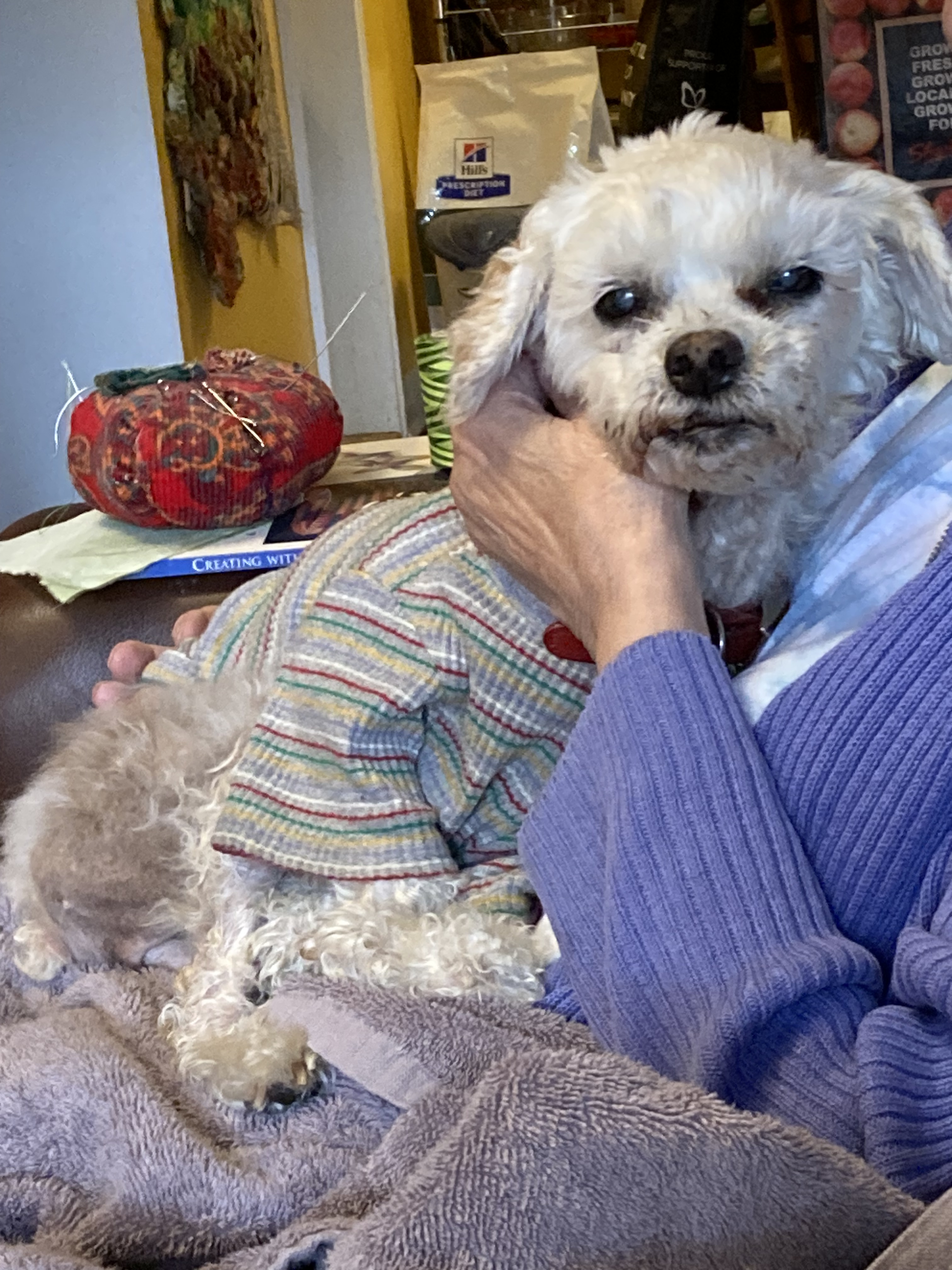
“Are you talking about me?”

            It’s not that she’d never coughed before. In fact, she has a full menu of interesting coughs and sneezes to her name: including the how-dare-you-pull-on-my-leash cough, which sounds like a frog is jumping out of her throat; and the excuse-me-where’s-my-dinner cough, which is more like a whisper, with her head turned away for deniability. But this cough was something new. It sounded like she was choking on something, or suffocating, and then she’d sort of cough up whatever it was and collapse as if she’d run a marathon.

            The first time I witnessed this, I was afraid she was going to die right in front of me. I may have taken it more seriously as a result of the debarking surgery that was done when she was still a breeding dog, because the scar tissue from that surgery has made her throat more constricted than it should be.

            It was a few days before I witnessed another coughing attack, and I was shocked by it again, especially by the way she seemed almost paralyzed for a couple of minutes afterward, but then she was fine, and I was relieved. She started to cough more frequently after that, but with less seriousness, and I wondered if maybe it was just an allergy, exacerbated by the air quality, and, really, I was distracted. Cricket had been diagnosed with kidney disease and needed fluids every day, and we’d had a car accident and had to buy a new car, and I’d had to go to five or ten doctors’ appointments, and prep for my second oral surgery (the follow-up to last year’s surgery), and that’s only the top line of the chaos that was going on around here, and there was no way to keep up with all of it, so each time Ellie stopped coughing and seemed to be breathing and walking and eating okay, I just breathed a sigh of relief and let it go.

            But last week, when Cricket had to go back to the vet for a follow up blood test, and I was between medical appointments, it seemed like a good opportunity to bring Ellie in to be seen as well.

            Of course, as soon as we made the appointment for both of them, Cricket, who had been doing surprisingly well, had a downturn. She couldn’t eat and she was woozy, even without the calming meds, to the point where she allowed me to insert the needle for the fluids without a fight. We all went to bed that night thinking this was the end, and we’d have to leave Ellie home the next day, and bring Cricket in to the vet for the last time.

            But in the morning, my little phoenix rose from the ashes again, climbed up and down the stairs herself, ate her breakfast and demanded more.

“I’m hungry!!!!!”

            So we went, all together, to the vet, me as the chauffeur in the front seat, Mom sitting in the back with both dogs, so that Ellie wouldn’t have to sit alone back there (Cricket has never tolerated sitting in the backseat. When we would put her in a harness early on in her life, she’d escape within thirty seconds and make her way up to the driver’s seat). With Cricket and Grandma sitting next to her, Ellie got through the ride without crying once, though she was still breathing heavily.

            I carried Cricket into the vet’s waiting room, not wanting to have her walk on the hot ground (Ellie refused to be carried), and the vet took Cricket out first, to take the blood, and then focused on Ellie and her cough. I tried to reenact the cough for him, so he’d know what he was dealing with, and he gave me a look and said, “Can you do that again?” It took me a second to realize he was joking. If he has a sense of humor it is very, very dry. He checked Ellie’s heart and looked in her mouth and took her temperature (which she found horrifying), and he gave her an anti-inflammatory shot and sent us home with antibiotics and a cough suppressant for her to take twice a day, and he said to call him in a few days and let him know if she was coughing any less (because if not, he’d want to follow up with an x-ray).

            And we were free. This visit, which, for a few hours there had seemed like it would be the last time I ever saw my Cricket, turned out to be routine and quick. When we got home we were all ready for an afternoon nap, maybe me more than everyone else, to be honest.

“Oy.”

            Both dogs were thrilled with their treats (with their separate meds hidden inside) once the naps were over: Cricket discovered a great love for sardine juice, and Ellie discovered that she had no such great love and stuck with pieces of chicken.

            Ellie coughed less for a few days, though she became more and more picky every day about the treats within which we could hide her pills, but then the coughing came back, and Ellie was barely eating anything at all. We called the vet and he said to stop the antibiotics, because they might be causing her lack of appetite, but keep up the cough suppressants for a few more days and then call back.

Pretty quickly, though, it was clear that Ellie was getting worse. She was breathing heavily, leaving treats uneaten (where Cricket could easily steal them), and refusing to walk more than a few feet at a time. So we called the vet for an emergency appointment this morning and brought her in, and as soon as he saw her he said she didn’t look good at all. He took an x-ray and said her heart was huge and misshapen, and there was fluid collecting around her heart. He gave her a shot of a diuretic and told us he would send the x-rays on to a specialist and then let us know what medication she could take going forward. But, he said, she could collapse at any time. He couldn’t explain how she’d gone from having a little bit of a cough to being in heart failure within a week, but most likely the cough had been caused by the enlarged heart in the first place, pressing on her trachea.

Ellie’s home now, still breathing heavily, but peeing rivers, which will hopefully relieve some of the pressure on her heart. But my heart is overwhelmed. Cricket is oblivious: sleeping on Grandma’s lap, eating well, and barking her frustration at all of the attention her sister has been getting. And now we wait, to see what comes next.

If you haven’t had a chance yet, please check out my Young Adult novel, Yeshiva Girl, on Amazon. And if you feel called to write a review of the book, on Amazon, or anywhere else, I’d be honored.

            Yeshiva Girl is about a Jewish teenager on Long Island, named Isabel, though her father calls her Jezebel. Her father has been accused of inappropriate sexual behavior with one of his students, which he denies, but Izzy implicitly believes it’s true. As a result of his problems, her father sends her to a co-ed Orthodox yeshiva for tenth grade, out of the blue, and Izzy and her mother can’t figure out how to prevent it. At Yeshiva, though, Izzy finds that religious people are much more complicated than she had expected. Some, like her father, may use religion as a place to hide, but others search for and find comfort, and community, and even enlightenment. The question is, what will Izzy find?

Azazel

My first experience with the word Azazel was as an epithet in Hebrew – Lech LeAzazel, meaning, “Go to hell.” I don’t know where I heard this, though most likely from my father. And I’m pretty sure I confused it with Azriel, the name of Gargamel’s cat on the Smurfs.

“Did you say ‘cat’?”

            Recently in Bible study we came across the Azazel references in Leviticus 16, where it describes the ancient version of Yom Kippur, as opposed to the 25-hour fast and pray and self-flagellate fiesta we have today. In this ancient ritual, two goats of equal size and worth are chosen, and then, by lots, one goat is marked for God, as a sacrifice, and one is marked for “Azazel,” to be sent into the wilderness.

The goat chosen to be sacrificed to God is a familiar ritual, especially in Leviticus where we’ve just learned, in extremely boring detail, how animals are chosen and prepared and sacrificed to God on the altar by the High Priest. But this sending of a goat “to Azazel” is something altogether different. And before the goat is sent away, the High Priest lays both hands on the head of the goat and transfers all of the sins of the Israelite people onto the goat, so that the goat can take the sins away from the community with him.

            In English we translate the “Azazel” goat as the “scapegoat.”

            One interpretation of the word Azazel is that it was the name of a Pagan God, the God who goes beyond civilization, and so this goat would be sent to a demon God that predates the Israelite religion. This seems unlikely, given the constant drumbeat of God as the only God in the Hebrew Bible. But this idea of a god-who-goes-beyond-civilization made me think about how our vision of hell isn’t other people, as Sartre would have it, but as a life without other people in it. And what we call evil, or the devil, is what happens when we stop valuing civilization or mutual responsibility. Hell isn’t a separate place, it’s a different mindset that people can fall into, one that takes them outside of the human social contract.

“What about the canine social contract?”

            The other, and more common, way of interpreting the word Azazel is as two Hebrew words stuck together – Az and Azel – meaning, “the goat” that “goes away.” In the Hebrew Bible itself, the scapegoat is only sent away, though later commentators say that the goat was not just sent into the wilderness but thrown off a cliff. The reality, though, is that being sent out of community would have been a death sentence in itself in the Ancient Near East, with no one to provide food or water or shelter, either for a goat or for a human being.

            Maimonides, a Medieval Jewish sage (1134-1204), makes sure to remind us that you can’t really transfer your sins to someone or something else, and that this ritual is symbolic; and of course it’s symbolic, but it is a powerful symbol because it taps into some of our deepest feelings and wishes. We want to imagine that our sins can be transferred out of our own bodies and into someone or something else. And we really want to be able to blame someone else for what we’ve done.

“It was her fault.”

            There’s a lot of resonance for me in this idea of a scapegoat, because my father actively tried to transfer his own feelings of guilt and self-loathing, from his own abusive childhood, onto me. And that transfer was emotional, intellectual, and physical in nature. He literally put his hands on me, but he also tried to convince me of my own guilt with his words. He did a very thorough job of it, so much so that many years later I’m still dealing with the aftermath of all of the pain and mistrust and guilt he transferred onto me and created in me.

            I think, usually, when we think of a scapegoat we think in more societal terms, like African American slaves being made the scapegoats of all of the self-loathing and guilt felt by their white enslavers, so that the “master” class could feel superior and divorce itself from any of the feeling of helplessness or guilt or vulnerability they were feeling in the new world. Or when Jews were scapegoated in Germany, and blamed for the economic crises in the country, to the point where Germans really believed that if they got rid of all the Jews their lives and their economy would flourish.

            But I’m really interested in this idea that we can transfer emotions or deeds through touch, the way the High Priest puts his hands on the head of the goat and transfers the sins of the people through his hands. We tend to dismiss touch as every day and meaningless: we shake hands with strangers, and hug our friends hello without a thought. Even sex, in our culture, is often minimized and treated as a sport or a casual pursuit. But the Azazel ritual recognizes that when we touch each other we literally or figuratively leave something of ourselves in the hands of the other.

            We rely on each other, for basics like food and shelter and protection, but also for human touch and connection. And if there’s anything this scapegoat ritual tells us, it’s that the worst thing that can happen to us, or that we think can happen to us, is to be sent outside of the community to survive alone. It’s not death that we fear most, but excommunication and isolation. Even today, when it’s much easier to move from one community to another, and to leave a family of origin behind in search of a family of choice, we still feel these cutoffs viscerally.

            I am still very sensitive to touch, very aware of it and resistant to initiating it. I don’t hug easily. I don’t even shake hands easily. And with my dogs, I can see how important touch can be in creating a shared emotion, in communicating love and security and care – or inspiring fear.

“We prefer love.”

            I wonder what it was like for the goat who was sent to Azazel, if there was a sense of freedom at first, before the reality of exile kicked in, or if he felt the burden of the sins on his head right away and understood his fate. I hope he didn’t understand. I hope that for as long as possible, he believed that he was the lucky one, the one who got away.

“I hope so too, but I’m skeptical.”

If you haven’t had a chance yet, please check out my Young Adult novel, Yeshiva Girl, on Amazon. And if you feel called to write a review of the book, on Amazon, or anywhere else, I’d be honored.

            Yeshiva Girl is about a Jewish teenager on Long Island, named Isabel, though her father calls her Jezebel. Her father has been accused of inappropriate sexual behavior with one of his students, which he denies, but Izzy implicitly believes it’s true. As a result of his problems, her father sends her to a co-ed Orthodox yeshiva for tenth grade, out of the blue, and Izzy and her mother can’t figure out how to prevent it. At Yeshiva, though, Izzy finds that religious people are much more complicated than she had expected. Some, like her father, may use religion as a place to hide, but others search for and find comfort, and community, and even enlightenment. The question is, what will Izzy find?   

Cricket is the Most Stubborn Person I Know

            A few weeks ago I was afraid Cricket was on the edge of life, diagnosed with kidney disease, struggling to walk, knocking into things. We started giving her subcutaneous fluids on the off chance that it would help extend her life, and it’s actually working. Though in order to give her the fluids we have to medicate her with a combination of gabapentin and ACE, which makes her woozy for hours. At times, she seems like a wraith, her feet slipping out from under her, not even protesting when the needle slips under her skin.

            Ideally, she would have gotten used to the whole procedure by now, and she wouldn’t try to pull off the muzzle, or lift up her head to get away from the needle. Ideally, I’d never have to give her any calming meds at all and she would just accept the fluids as a necessary evil and get it over with and get back to living her life. But then she wouldn’t be Cricket, and all of this effort is to make sure she gets to be Cricket for as long as possible.

“Oh, I can be even more Cricket-y. Just wait.”

            Every day, at the beginning of all of this, I was afraid she was going to die overnight, and when she actually woke up in the morning, and ate her breakfast, I was surprised, and afraid to be hopeful. But with each day she seems to improve a little bit. The meds make her into a rag doll, yes, but then the next morning, after she’s slept it off, it’s like she’s been brought back to life, refilled with her fluids and her spirit, and ready to sniff the whole world again.

            It’s still nerve-wracking to watch her skin fill up with the fluids. I even worry sometimes that her neck is going to explode (I’ve seen too many movies), and I worry that I’m going to put the needle in the wrong place and puncture something vital. I was worried for a while that I was inserting the needle the wrong way and causing scar tissue to form because I could feel these quarter-sized bumps under her skin and I was afraid I would run out of loose skin and not be able to give her the fluids anymore, but then the bumps started to dissolve, and that worry, at least, went away. So much of this is trial and error and the circumstances seem to change every day. It feels like a magic trick each time she wakes up in the morning and walks and barks and eats and acts like herself, but a magic trick that is unreliable and hard won.

            I’ve been thinking about my friend Teddy, the miniature poodle, who died from kidney disease a few years ago. His death came as a surprise, at least to me. He hadn’t been diagnosed with the disease ahead of time, and by the time they caught it he was too far gone to be helped by fluids or anything else. When Cricket was diagnosed I was afraid it would be the same thing, and every day, even though I knew her case was different, I expected the same results.

            Some days are better than others. Every once in while she has a bad night, her breathing is shallow, she pees on the floor because she can’t get to the wee wee pad in time, or she’s not up to climbing the stairs, but other days she seems to be getting better, growing stronger, and enjoying her life.

I was telling myself that I just needed Cricket to reach her sixteenth birthday, but now that she’s accomplished that goal, I need more. I need to feel like I did everything I could possibly do for her. I need to not have any regrets, and not feel like if only I had been stronger or smarter or kinder or more loving, she would have lived longer.

I’m also doing my best to make sure Ellie doesn’t feel left out, and gets extra hugs and scratchies and treats to make up for all of the attention her sister is getting. But when Cricket feels better she goes back to taunting Ellie, so then I feel guilty for taking such good care of Cricket and, at the same time, I feel guilty for not taking good enough care of her.

“If I keep my eyes closed she won’t bother me. Right?”

            The thing is, Cricket isn’t giving up. She doesn’t think sixteen years is enough, even if each day is a little harder than it used to be.  And if she’s going to be this stubborn, then I guess I’m going to have to be stubborn too.

If you haven’t had a chance yet, please check out my Young Adult novel, Yeshiva Girl, on Amazon. And if you feel called to write a review of the book, on Amazon, or anywhere else, I’d be honored.

            Yeshiva Girl is about a Jewish teenager on Long Island, named Isabel, though her father calls her Jezebel. Her father has been accused of inappropriate sexual behavior with one of his students, which he denies, but Izzy implicitly believes it’s true. As a result of his problems, her father sends her to a co-ed Orthodox yeshiva for tenth grade, out of the blue, and Izzy and her mother can’t figure out how to prevent it. At Yeshiva, though, Izzy finds that religious people are much more complicated than she had expected. Some, like her father, may use religion as a place to hide, but others search for and find comfort, and community, and even enlightenment. The question is, what will Izzy find?

Another Summer of Hebrew

            I started a new online Hebrew class for the summer, and my new Hebrew teacher is down to earth and clear and friendly, so I am hopeful that the class will be good and productive. But this is going to be my last Hebrew class for a while, because it’s expensive, and with another oral surgery coming up, and the pause on student loan debt repayment ending in August, I need to keep costs down; but also, I feel like I can’t focus on the classes during the school year anymore. I need more rest days, in order to recover from my work days, or else I won’t be able to work much longer.

“You should just stay home with us all the time.”

            I still love learning Hebrew, and I’m hoping that this last class will give me more confidence to continue learning new vocabulary on my own. Maybe I’ll even start writing in Hebrew and see how my voice translates.

            Writing in Hebrew is one of the few things we haven’t worked on in these classes from Tel Aviv, where the focus is on conversation skills and reading newspapers and watching TV. I think I would write poetry in Hebrew, because the language is so conducive to poetry, with all of the rhyming words and onomatopoeia and the leanness of the language overall. I gave up on writing poetry in English after too many discouraging teachers telling me to write like someone else, but maybe with Hebrew I could start again with a blank slate.

            I still want to become fluent in Hebrew, but I think if I take more classes I’d like to move towards Jewish learning in general, rather than Hebrew in particular. The focus in these classes has been on how Hebrew is spoken in Tel Aviv, with very little discussion of things that are recognizably Jewish, rather than Israeli. For me, Hebrew and Judaism are deeply intertwined, but Modern Hebrew has become a secular language, used for every mundane and profound purpose in daily life in Israel, and it feels like, as a result, some of the meaning has been stripped away.

I still want to learn more vocabulary, but I wonder if the words I really want to understand are the ones in the Hebrew Bible, or in the prayers, so that I don’t have to rely on someone else to tell me what they mean. I don’t want to lose sight of Modern Hebrew, and the way it has embraced so many different cultures and absorbed words from Arabic and English and French and Russian and more, I just want to re-invest in the connection to the past, where it all comes from.

I’m still not sure where all of this learning and exploring will take me, or how, or if, I will make use of it in my writing or my teaching, but sometimes learning is worth the effort just for its own sake, for the way it challenges our perceptions and widens our vision of the world and ourselves.

And maybe next summer, or when/if I start feeling better and have more energy, it will lead me to something more.

“Just make sure you take us with you wherever you go.”

If you haven’t had a chance yet, please check out my Young Adult novel, Yeshiva Girl, on Amazon. And if you feel called to write a review of the book, on Amazon, or anywhere else, I’d be honored.

            Yeshiva Girl is about a Jewish teenager on Long Island, named Isabel, though her father calls her Jezebel. Her father has been accused of inappropriate sexual behavior with one of his students, which he denies, but Izzy implicitly believes it’s true. As a result of his problems, her father sends her to a co-ed Orthodox yeshiva for tenth grade, out of the blue, and Izzy and her mother can’t figure out how to prevent it. At Yeshiva, though, Izzy finds that religious people are much more complicated than she had expected. Some, like her father, may use religion as a place to hide, but others search for and find comfort, and community, and even enlightenment. The question is, what will Izzy find?

Cricket and the Big Needle

            Cricket has kidney disease. She had a really bad day recently: she fell down the stairs when she was coming in from a walk, and had to be carried up and down the rest of the day. By the next morning, she was back to herself, climbing the stairs and eating her breakfast and barking at the UPS guy, but we took her to the vet anyway and he checked her out and took blood and the next morning he called to say it was her kidneys, but he’d need a pee sample to know if she also had an infection. I had to follow her around all day with a ladle, collecting a teaspoon of pee at a time and storing it in the fridge until we had enough to bring to the vet. Thank god, Mom didn’t take the picture she threatened to take of this particular activity. The results: no infection, but very watery pee, confirming kidney disease, so we’d have to go back to the vet and learn how to give her sub-cutaneous fluids once a day. With a very big needle.

“I hate needles!”

            Cricket only weighs 9.5 pounds now, down from her original 14 pounds, and she looks like a naked chicken from the neck down, but she still has her rebellious spirit. So as soon as I knew I would have to put a needle under her skin every day, I started searching everywhere for her muzzle. We’d never actually used it before, but we had it somewhere, just in case, because she is a biter. I finally found the muzzle hidden behind her old harnesses and winter sweaters in the hall closet, and she let me put it on her, for a moment, before she started trying to pull it off.

            At our next appointment, the vet demonstrated how to hang the fluid bag on the door, and hold Cricket still, and pull up the extra neck skin like a tent and insert the needle, and Cricket calmly let him do all of this. We watched her neck swell up like a balloon, which he said was totally normal, and then he removed the needle and pinched the skin so that the fluid wouldn’t spritz out. Then he showed me how to change out the old needle for a new one, easy peasy. By the time we got home, Cricket was feeling so good that she skipped down the lawn on her way to the front door.

            My first attempt at giving her the fluids myself, the next morning, went almost as easily as when the vet did it, even with the big needle and the bite-prone Cricket, but on the second day, she rebelled. She bared her teeth at me, and pulled away from the needle, and then she bit me, three times. I tried again later in the day and managed to get the needle under her skin and a small ball of fluid in her neck, before she bit me again.

“You bit me first!”

            On the morning of day three, we tried giving her food during the procedure, to keep her distracted, but she turned the bowl over and spread the food all over the floor and hopped over it to get away from the needle. So, in desperation, we gave her a quarter of a doggy valium, and waited. An hour later I was able to put the muzzle on her, and insert the needle under her skin, and give her the rest of the fluids she should have had the day before. The only problem was that we had no more doggy valium. So off to the vet we went to get more medication, and incidentally, to make sure it was okay for her to take it every day. It was, but even that small amount of ACE (the doggy Valium) made her stumble around and wiped her out for the rest of the day.

“It helps to have somewhere to put my head.”

            A week after starting the fluids, we took her to the vet for another round of blood tests, to see if the fluids were helping, but when the doctor called the next morning, it turned out that her kidney numbers were worse. He told us to keep doing the fluids, with some added B vitamins, and he gave us Gabapentin to try instead of the ACE, to see if the combination would give her more good days. He had no prediction for how much time she has left. He just told us to keep an eye on her eating habits, and if she doesn’t eat for three days in a row then that would mean she’s suffering and it will be time to let her go.

            We tried the gabapentin to no effect, so we went back to the ACE, but decided to give it, and then the fluids, at night, so that she could sleep it off and wake up feeling better, and that seems to be working better for her.

            I don’t have high expectations, but I’d like for her to enjoy the end of her life as much as possible, and I’d really like to have a little more time.

“Where’s the rest of the chicken?”

If you haven’t had a chance yet, please check out my Young Adult novel, Yeshiva Girl, on Amazon. And if you feel called to write a review of the book, on Amazon, or anywhere else, I’d be honored.

            Yeshiva Girl is about a Jewish teenager on Long Island, named Isabel, though her father calls her Jezebel. Her father has been accused of inappropriate sexual behavior with one of his students, which he denies, but Izzy implicitly believes it’s true. As a result of his problems, her father sends her to a co-ed Orthodox yeshiva for tenth grade, out of the blue, and Izzy and her mother can’t figure out how to prevent it. At Yeshiva, though, Izzy finds that religious people are much more complicated than she had expected. Some, like her father, may use religion as a place to hide, but others search for and find comfort, and community, and even enlightenment. The question is, what will Izzy find?