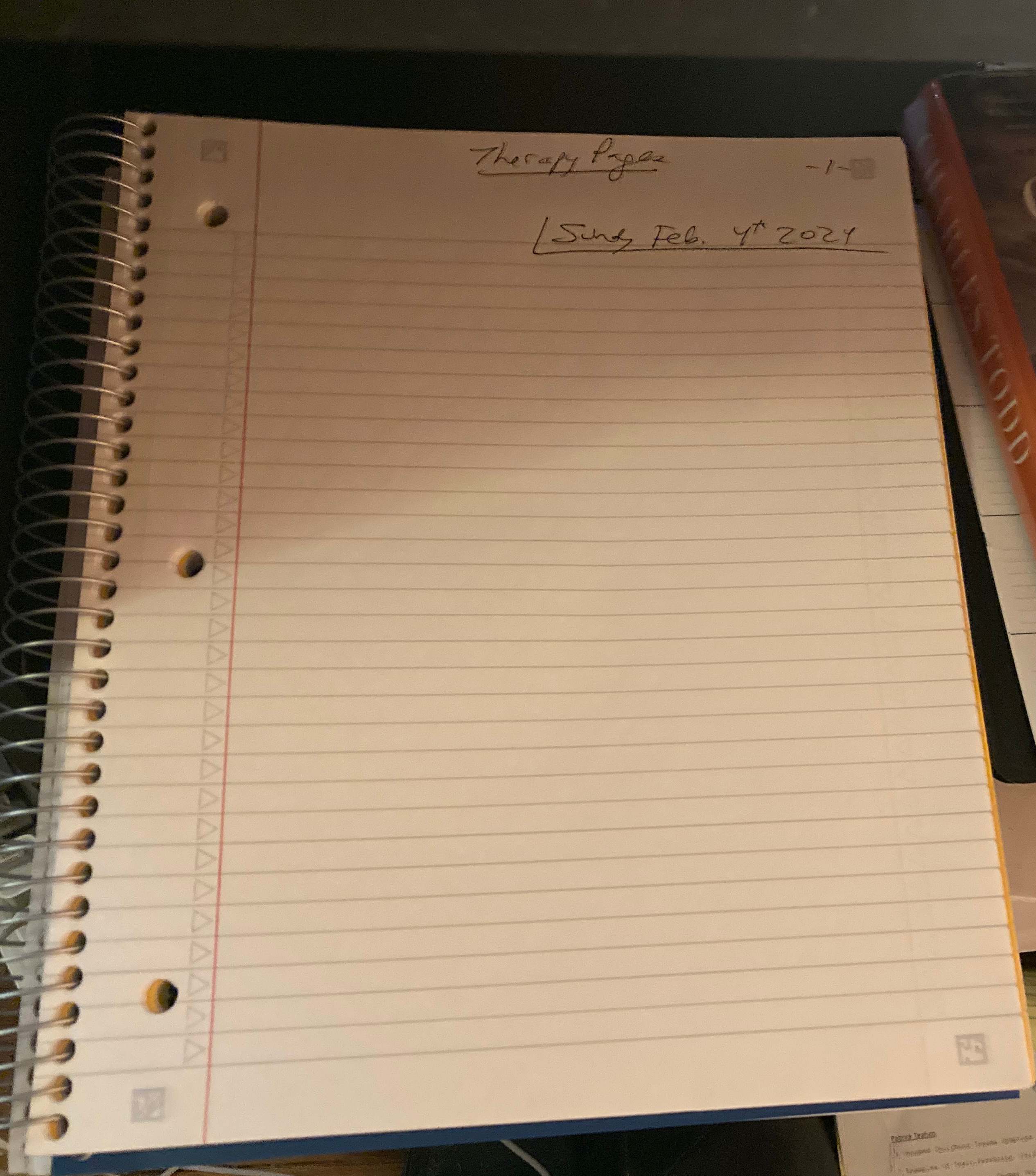
About a million years ago, I read Julia Cameron’s The Artist’s Way for the first time and committed to doing Morning Pages every day (writing three stream of consciousness pages as soon as you wake up). I didn’t always do them in the morning, and I almost never stopped at three pages, so instead of calling them morning pages I called them my therapy pages, and I have a stack of boxes in my closet filled with old notebooks to show for it. But at some point, I stopped the practice, in all but name. I kept the notebooks nearby – there’s also always a five subject college ruled spiral bound notebook on my bedside table, with the day and date at the top of the page, but some days I forget to write anything, and others I just write a paragraph or two about my day before going to sleep, like sending a postcard to a good friend to keep up the connection, but not sitting down for a good long chat.

I was actually proud of myself for taking longer to finish each notebook, because it seemed so self-absorbed to keep writing so much just for myself, and because I have no more room in my closet to stack boxes of notebooks.
There’s also the thing I did early on that is a big no-no in Morning Pages, according to Julia Cameron. I started writing my Therapy Pages around the same time as I started seeing my therapist, and when I got frustrated by how little I could tell her in forty-five minutes per week that I told her about my Therapy Pages and she asked if she could read them and I said yes.
On one hand, my therapist got to know me really well really quickly, because I didn’t go back to edit the pages before handing them to her, but inevitably, knowing that she would be reading them, my internal editor took over and stopped me from writing things I didn’t feel comfortable having her read. And one more thing happened: my therapist told me that my Therapy Pages were better than anything else I’d written, because I’d also made the mistake of giving her my short stories to read and she wasn’t impressed; just like she wasn’t impressed years later with my novels, or essays. But she loved my Therapy Pages and she wanted me to publish them – this was before Amazon self-publishing became a thing – and she would not listen to me when I said, a) no one would publish them and b) I wouldn’t want to publish them, because they were supposed to just be for me.
I built up the nerve to stop showing her my pages pretty early on (probably also because I felt guilty for giving her so much work to do outside of our regular sessions), but the feeling of having someone reading over my shoulder, and judging me, never went away. Neither did the feeling that I was an utter disappointment as a writer, and/or a coward, and/or ten other horrible things.
Recently, I found out that Julia Cameron had actually continued to write more books after The Artist’s Way, and I ordered one of them, called The Listening Path. I can’t remember why Julia Cameron came up as a recommendation on Amazon that day: maybe someone had mentioned her name to me, or there was some random confluence of events in the Amazon algorithm while I was looking for something else. But even then, I just put the book on my pile of books to read and went on with whatever else I was doing. I was kind of reluctant to open the book, honestly. I’m so tired of advice on how to be better and I’m tired of being told to do something other than what I’m already doing. I’m just really, really tired, full stop.

But when I finished the latest book on my reading pile – an odd little middle grade fantasy about kabbalah, set at a Jewish sleepaway camp, by Ari Goelman – the next book on the pile was The Listening Path and I couldn’t avoid the book without openly acknowledging, to myself, that I was trying afraid of it. So I started reading. And within the first few pages of the introduction, reminding the reader about Morning Pages and Artist’s Dates and other advice from previous books, some part of my brain perked up and said, hey, why am I not doing Therapy Pages anymore?
I won’t go through the whole grumpy internal argument that ensued, but, after a few more pages of reading, and grumping, I picked up my five subject spiral bound notebook and started to write again, telling myself that I couldn’t stop writing until I’d done three pages, instead of the three or four lines I’d gotten used to. And it felt right. Not easy, or comfortable, to be honest, but right.
I still haven’t finished reading the introduction to The Listening Path, so I can’t say anything meaningful about the book itself, and already her insistence on the magical power of Morning Pages to get you unstuck and help you hear your inner self and blah blah blah is annoying the crap out of me, because where does she get off telling me what to do and acting like everyone is the same and can follow the same prescription to a better life, and on and on and on. Except, I think, for me, for this, she’s 100% right. I need this kind of stream-of-consciousness/required writing in order to hear myself again.
I need it for me, not for my novels, though it could also help me get back on track with writing the damned novels. But I’m terrified of what will come up in these Therapy Pages of mine – which is probably the real reason why I started letting myself avoid them in the first place. I’m afraid of all of the crummy things I might say to myself, and all of the ways I will feel challenged, and not good enough, and pushed to do things I’m not ready to do; and I’m really worried about turning that spigot back on. But somewhere along the way I stopped listening to myself, and even if it has made me feel safer, it has also made me feel less, of everything.
So, we’ll see how it goes. If a week’s worth of three pages a day re-opens the hellmouth in my brain, at least I’ll know what not to do.
Wish me luck.
If you haven’t had a chance yet, please check out my Young Adult novel, Yeshiva Girl, on Amazon. And if you feel called to write a review of the book, on Amazon, or anywhere else, I’d be honored.
Yeshiva Girl is about a Jewish teenager on Long Island, named Isabel, though her father calls her Jezebel. Her father has been accused of inappropriate sexual behavior with one of his students, which he denies, but Izzy implicitly believes it’s true. As a result of his problems, her father sends her to a co-ed Orthodox yeshiva for tenth grade, out of the blue, and Izzy and her mother can’t figure out how to prevent it. At Yeshiva, though, Izzy finds that religious people are much more complicated than she had expected. Some, like her father, may use religion as a place to hide, but others search for and find comfort, and community, and even enlightenment. The question is, what will Izzy find?

 rachelmankowitz
I wish you perserverence and good luck. Your words also reminded me to restart my journaling habit.
Thank you!
Your commitment is amazing, Rachel. I can’t imagine committing to writing three pages or more every day.
Thank you!
I think I’m going to have to take a look at these books myself. Wishing you much luck, Rachel.
Thank you!
When I was a single mom (80s-90s) I started writing that way. Only my arm couldn’t keep up so I bought a used little typewriter. I had not found a therapist I liked/ could trust/ who I thought cared, so those pages were all I had to empty myself on. I still have them. I’m afraid to read them though. I recall a lot of anger in those days.
But good luck! You seem more civilized than I was.
Having compassion for the person you used to be is a big part of the healing process. Those journals could be very helpful, when you’re ready.
Sounds like a good practice. You were so successful before doing this. Why the doubt now? You’ll be great!
Thank you!
If you are already back to journaling and you haven’t even read through the introduction, I think you are BACK, Rachel! Good luck to you.
Thank you!
Hi Rachel, I have a lot of writer friends that swear by morning pages and that book. I haven’t done it but I have recently started doing writing sprints with a group where we commit to an hour of quiet writing time online but we barely interact. I think showing up and knowing friends in the group is all the incentive I need. The host shares a writing prompt which you can use or ignore. It’s been motivating. I think whatever works is best. Wishing you luck!
Thank you!
I’d wish you good luck but I don’t think you need it for this project. You already know this will work for you. The words between your words told me. But just to make things certain, good luck!
Thank you!
Wishing you luck. And I like the idea of writing therapy pages 😊
Thank you!
I wish you luck. I used to journal every day. But one day my family decided to read my journal and I learned that if I wanted something to be private to not write it down. I miss being able to have that honest discussion with my other self.
I had a friend who had the same experience. There are ways to get more privacy now, with technology. Maybe it’s worth revisiting.
You’re very brave to let others read your journals. I used to write a journal as well, but the ADD got in the way. But I admire your discipline.
I’ve seen a lot of people with ADD who are more successful with other formats: shorter assignments, more visual media, walking and talking and recording it on your phone. Best of luck!
I’m sure you are prolific enough to do this! I was going to add “and do it well,” but there is no right or wrong and you are a great writer. But before coffee????? Nah!
Ha!
My two -bits’ worth – write things down if it helps you, but write them for yourself. Don’t overthink life. Just live, Rachel. You are okay. Just live. Be you.
Thank you!
I read The Artists Way years ago and loved it. Morning Pages became a habit and freewriting escape that led to other writing. However, I also stopped for some forgotten reason. I miss doing it and have tried to pick it up again to no avail. Maybe this reminder will get me started again.
I have not yet read The Listening Path and just bought it. Thank you for the recommendation and good luck with your writing.
PS – I loved Yeshiva Girl and look forward to more.
Thank you so much!
I wrote morning pages, and went on dates with myself to the Dollar store. It was fun. Go ahead, Rachel, go with the flow. I commend you for that.
Thank you! I never really figured out the artist dates. Mostly I went to the beach with one of the dogs.
Works for me!
I like how you took ownership of the exercise by not stopping at three pages, and calling them your “therapy pages.” Good luck with your journaling!
Thank you!
You know you kind of bare your soul already with your blog but that is a lot to let out if you had a closet full of nootbooks. That’s commendable, if it’s another healing step that has helped in the past then you should revisit it 😊
What you said about your therapist being so critical on your life work goals and in turn praising that you give to the world what you give to them. How selfish of them. That sounds lije a terrible therapist. Are you seeing someobe different ?
Either way this was an enlightening read. My wife journals almost nightly and it seems to help help her get it out and in turn self motivate. I wish you great luck in returning to this pratice. I thoroughly enjoyed Yeshiva Girl and hope to read more down the line.
Thank you so much!
Good luck
Thank you!
I wish you well with it. Maybe I should read those books. I need a boost in my creativity and my life!!
There are a lot of good books out there to try! Good luck!
Therapy pages, a great name, I love it! Good luck restarting them!
Thank you!
Wishing you loads of good luck. Hopefully, this is the kick-up-the-backside motivation (Australian expression for encouragement) that you needed.
Ha! Thank you!
I’m not sure I could do that (writing three or more ‘therapy pages’ into a notebook). Don’t think I’m brave enough, to be honest- I think once it started pouring out it wouldn’t stop and it’d possibly do more harm than good, proving what a mess things are and just depressing me. But good luck, it clearly works well for many and hopefully will for you too. I commend your braveness.
There’s a lot to be said for creating a safe container for the messier emotions, whether it’s a certain number of pages or some other boundary.
Wishing you luck!!
Thank you!
I borrowed The Artist’s Way from a friend and tried the Morning Pages for a while. Eventually I stopped because it was all moaning and seemed to be going over the same things over and over. Then I tried free-writing fiction, which was a lot more fun, but for some reason I stopped doing that as well. I think we do these things when the time is right and it’s ok to take a break for a while.
Good luck with the therapy pages!
Agreed! The best plan is to be ready to adapt as your needs change.
Hi, I started the Morning pages in 2000 – the book was a gift from my father. Still doing it. But, for sure, not 3 pages. Sometimes, yes.
As to therapy. My Psych-girl would never do that. It’s a violation of her ethics and boundaries. Our “professional relationship”. I can read to her during a session; but that’s it. I have to prioritize. Same goes for the Morning pages.
Additionally, against Cameron’s guidance – I do go back and read what I wrote. It’s history. Helps me make sense of things. And prioritize. Move toward contentment (happiness) and reduce behaviors that hinder what I want.
I forgot that she said not to reread; I always re-read!
I have done three pages every morning with few exceptions for 10 years. Then I started my blog and just had my 10 year anniversary. As for the notebooks, I toss them in the recycling bin when I’m done with them. I feel grounded after writing, walking and prayer. I think having your internal editor come out because your therapist was reading your morning pages was counter productive to the purpose of them.
I agree. I used to love walking as another way to do my pages. There’s something about the repetitive motion, and being in nature, that brings up all the words!
Yes, that’s so true!
I think the practice or the discipline of writing every day can have many significant benefits. If I started doing something like that, I would never show the notebook to anyone. I might talk about the practice and how I felt about it, but I think it is OK and positive to keep some things for just you.
I agree. I’m hoping that the more I write the more I’ll be able to write. That’s the goal.
Dare I say? Yes I do….
Good Luck! If you have three pages of ‘stuff’ to write about every day (or so) then that’s what paper is for. Isn’t it?
Yes!
Good luck, Rachel. That book, of which you have only read a few lines, did it’s job.
It really did!
Aha, a judgmental literary critic therapist who made you feel unworthy as a writer—what’s wrong with this picture? You’re a wonderful writer, Rachel; follow your instincts and your heart.
Thank you so much!
I wish you luck with your writing! Whenever I tried something similar, I found that I repeated myself more than I realized. You must have a prolific and creative mind to fill so many pages!
Oh, repetition is essential to the process!
Wishing a favorable outcome for you Rachel. 🙂
Thank you!
This sounds really interesting, but I can understand why you’re a little concerned about what will come out. I know that sometimes when I focus on my shortcomings, or the difficulties I’ve endured, or the people (and pets) I’ve lost, it can send me into a depression spiral that is hard to recover from. However, it sounds like it was truly beneficial for you, so I hope with as much good will as I can send your way that you find it therapeutic and cathartic. The therapist that told you that she liked your journals better than your short stories is in the wrong business. You are a far better therapist for yourself.
Thank you so much!
If I was writing a therapy notebook, I would always think of practical ways to test out its usefulness.
Your teaching efforts now come too mind for me.
Interesting!
Many years ago I went through an old banker box, which contained everything from small notepads, index cards, hand-written and typed papers, and even post notes of my thoughts and potential short stories and novels. Eventually I organized it all into computer files: some of which I now use on my blog; others went into failed submissions to publishers; while the rest I keep on hand for anything else (for me, it’s hard to just throw away stuff like this. I included some short stories in a menu on my blog for anyone interested.) Anyway, you being the writer you are, polishing up and turning your Therapy Pages into a submission for others to read would be awesome. You could even write it so that the sessions were about someone else, so as to protect your own personal experiences. Anyway, this was an awesome posting, Rachel. Peace.
Art
Interesting ideas! Thank you!
As I read this post I thought, “My blog is my “therapy pages.” Wishing you the best of luck getting started with it again. 🙂
I love that!!!
Thanks. 🙂
I wish your therapist had been more helpful about why the therapy pages were better than your other writing. There must be a middle ground in there somewhere.
I agree.
For whatever reason, I haven’t received your WordPress posts to my email, and you’re not the only one. It just dawned on me that I hadn’t read or responded to your posts for a while. So here I am. Love it that you are grazing the ideas and going to see what works for you. Hugs!
Thank you!!!!
Have you ever thought of applying to private corporations like McGraw Hill and Pearson with education clout for grants to test out new teaching ideas? Just a thought.
I didn’t even know such a thing existed. Time to google!!
Yes companies are always looking for new teaching ideas especially in the online realm. You could serve as a reviewer for new textbooks. McGraw Hill is my favorite.
Following my deconstruction, i quickly learned i could still find much value in pursuits others would qualify as spiritual. I identify very strongly w/your struggles and grumpery, here. Thank you for sharing this.
Thank you!
I tried morning pages but struggled a bit. Mostly because of the idea of doing them in the morning. I rarely managed to write three pages. My therapist has encouraged me a couple of times to journal but would never want to read them. I think I might try it again (won’t do them in the morning though that’s for sure). I picked up card readings. I’m still learning but I find it much easier to stick to than journalling. I got encouraged after listening to the podcast Witch by BBC Sounds. India Rakusen talked to Jen Cownie and Fiona Lensvelt, the authors of Wild Card – Let the Tarot Tell Your Story. Although they acknowledge how tarot has different connections to spiritual practices and witchcraft, they consider it as a narrative tool with therapeutic qualities. A tool for self-reflection. I just got the book via the library but already love it.
Whatever works!