In the past, when I’ve tried to take Tzipporah for a walk she just sat on the ground and shivered, and if I dared to tug on her leash she fought like a wild animal to get away, burrowing under the bench by the retaining wall or trying to climb the wall itself. I was still taking her with me to therapy once a week, but I hadn’t tried putting her toes on the ground in months, and then last weekend something changed. Usually when we return home from therapy, Tzippy is exhausted, waiting just long enough to eat her chicken treat before stretching out in her bed for a long nap, but the day before the big blizzard she seemed more awake and aware, as if she was waiting for her next adventure.
I’m not sure what convinced me to try again, maybe just knowing that we would be snowed in for the next few days, but I bundled her back up in her winter coat, and put her leash back on, and carried her down the stairs and outside. At first, when I put her down on the walkway, she just sat down and waited as usual, shivering and looking around in alarm. But when Grandma started to walk ahead of us, Tzippy actually followed her. She only took a few steps before sitting back down again, but when I gave her some head scratches and encouragement, she took another few steps, and then a few more and a few more.


We managed the equivalent of one block – between our front door and the next building in the complex – and then she sat down more firmly and refused to go any further. I was sure I’d have to carry her, but when I turned back towards home Tzippy stood up and followed me, taking five steps at a time instead of three. She finally hit her limit about ten feet away from our front door, and then she sat down in front of me and refused to go another step. I picked her up and gave her kisses and so much praise for her amazing accomplishment, and she seemed to understand that she’d done something special, but she was also exhausted. As soon as I carried her upstairs and gave her a treat, she ran back to her bed to eat it and then stretched out for a long nap.
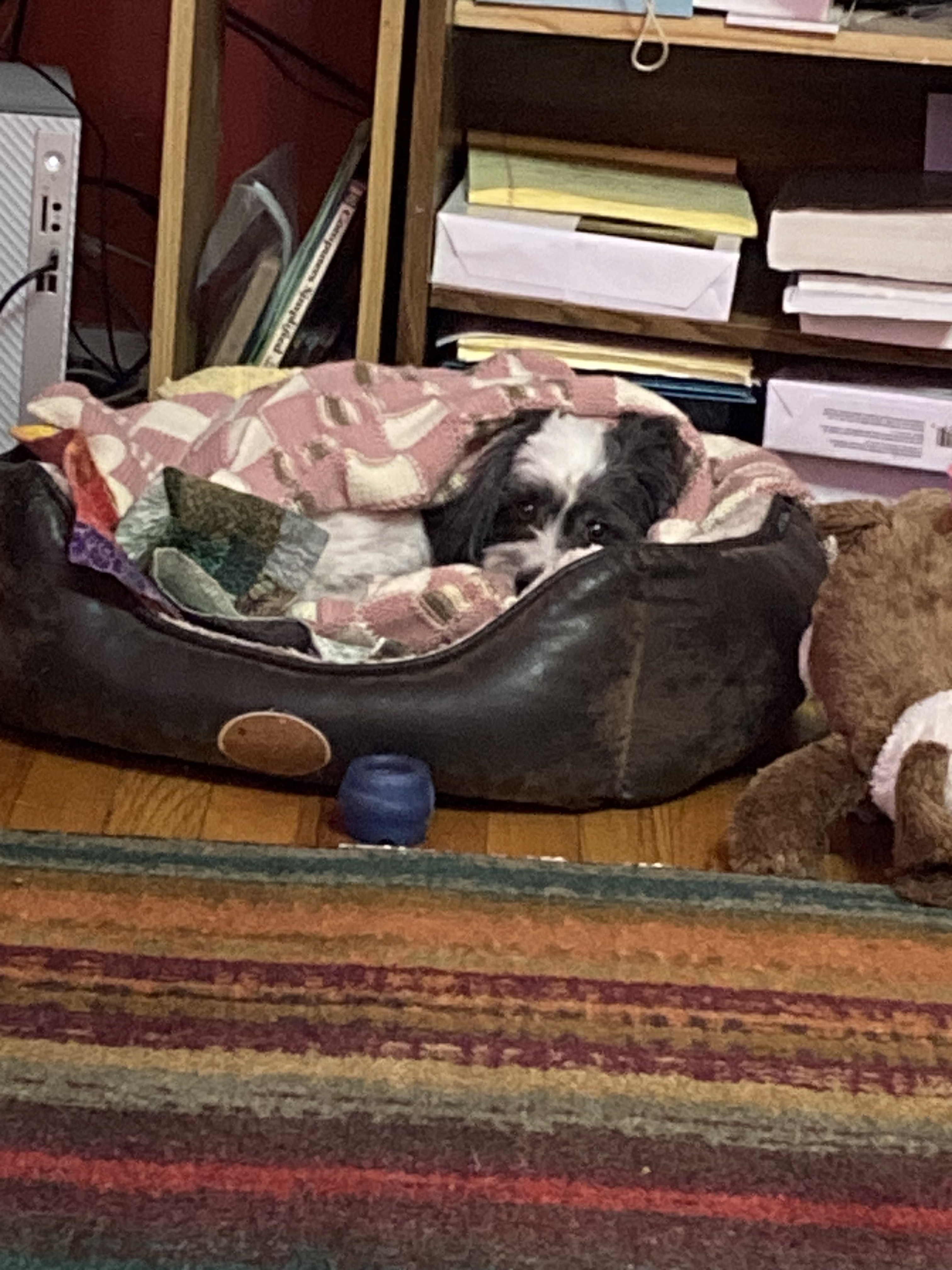
I’m sure it sounds like the tiniest of accomplishments, but it felt like a huge breakthrough. I’d almost given up on the possibility of change after more than a year of trying everything, and I have no idea what made this breakthrough possible; maybe it was all of those hours in therapy, or maybe her new food changed something, or maybe she was just ready.
The next day, after the snow had started to fall but before the real blizzard kicked in, we decided to try another walk just to see if the first one was a fluke. Tzippy was not at all sure about putting her paws down on the snowy walkway, but once again, when Grandma walked ahead of her, Tzippy followed. We walked twice as far, because Grandma insisted, but Tzippy wasn’t thrilled with the extra distance and kept trying to crawl under and through my legs to convince me to pick her up. With frequent breaks for head scratches and encouragement, we made it all the way back to our building, but the two steps up to the door were a no-go. When I picked her up, I touched her toes to each step to show her how it was done, but she was not at all interested and just wanted to get back inside.
Once the blizzard kicked in, we were content to stay indoors for the duration, and we didn’t go back outside until all of the shoveling and plowing had been done (by other people). But then we tried walking again. The third walk was short, and Tzippy was not enthusiastic, but she did it, so as the snow melts, I see a lot of short walks in Tzippy’s future. And if she needs to complain, I’m sure my therapist is ready to listen, and Grandma will hand out chicken treats by the handful as needed. I just hope it doesn’t take another year before Tzippy is ready to try the stairs.

If you haven’t had a chance yet, please check out my novel, Yeshiva Girl, on Amazon. And if you feel called to write a review of the book, on Amazon, or anywhere else, I’d be honored.
Yeshiva Girl is about a Jewish teenager on Long Island, named Isabel, though her father calls her Jezebel. Her father has been accused of inappropriate sexual behavior with one of his students, which he denies, but Izzy implicitly believes it’s true. As a result of his problems, her father sends her to a co-ed Orthodox yeshiva for tenth grade, out of the blue, and Izzy and her mother can’t figure out how to prevent it. At Yeshiva, though, Izzy finds that religious people are much more complicated than she had expected. Some, like her father, may use religion as a place to hide, but others search for and find comfort, and community, and even enlightenment. The question is, what will Izzy find?




 rachelmankowitz