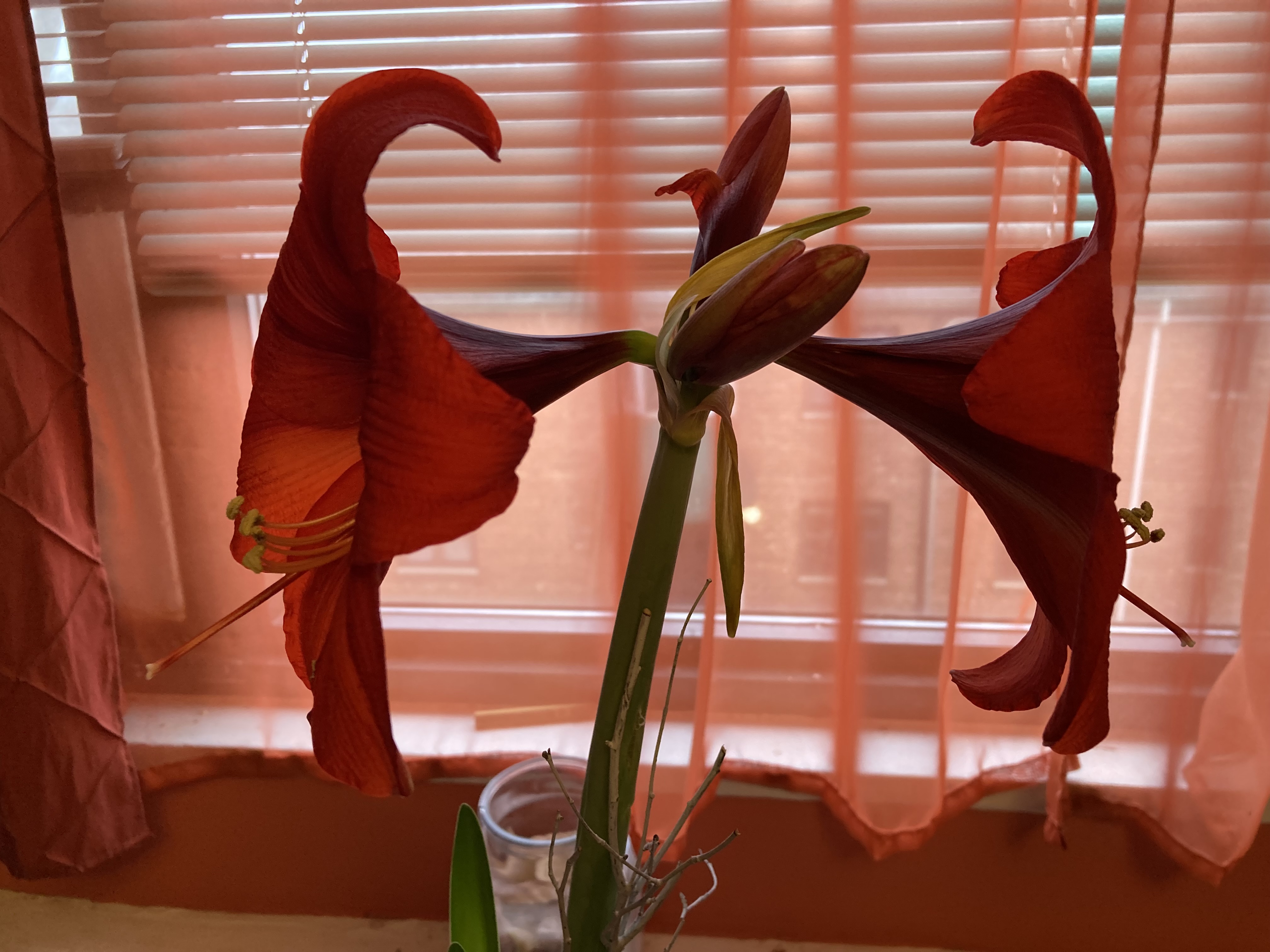
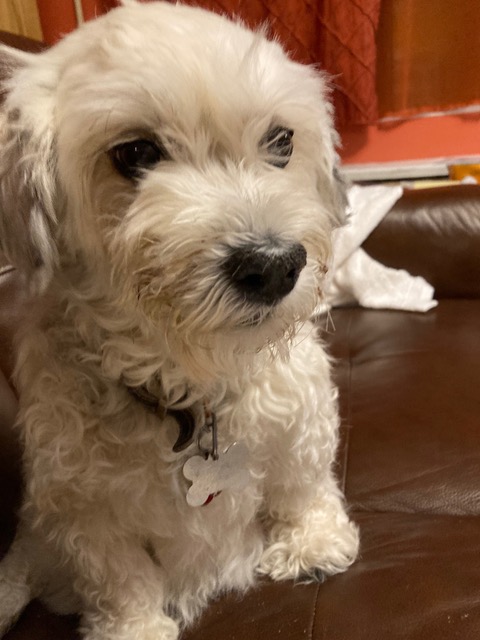
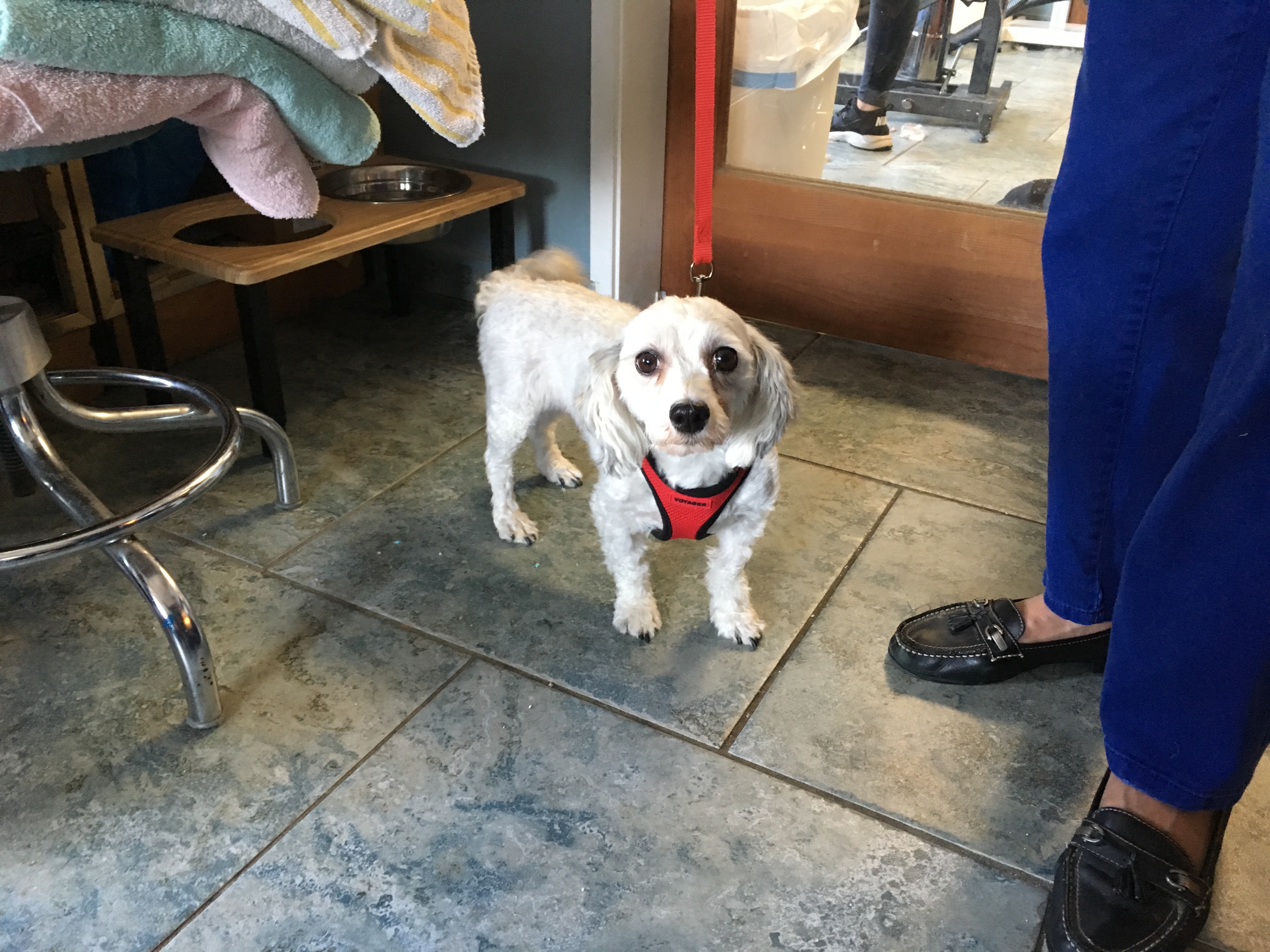
After Ellie died one of the many practical, and depressing, things we had to do was to contact Chewy and cancel our standing dog food delivery. A few days later an Amaryllis appeared at our front door, with a card from the Chewy team sending their condolences.
For a while the plant looked kind of sad sitting on the coffee table in the living room, with no flowers and a bend in its green spine. The plant came with a brace (with a twig and some twine), and Mom moved it into place above the curve, and gradually, the spine of the plant started to straighten, and then, slowly, the flowers started to bloom. The red of the petals is so vivid and the size and number of the blossoms keeps growing so there’s no way to ignore it now.
The shape of the flowers, like a speaker on an old Victrola, makes it seem like the plant has something to say, though try as I might I can’t hear the words. And while there are no new puppies growing from this magical plant, there is life: beautiful, bright, and temporary.
I know that I will always miss Cricket and Ellie, but this little (or not so little) plant has given me hope that my heart will be able to make room for new love, when the time comes.
“We still get veto power.”
If you haven’t had a chance yet, please check out my Young Adult novel, Yeshiva Girl, on Amazon. And if you feel called to write a review of the book, on Amazon, or anywhere else, I’d be honored.
Yeshiva Girl is about a Jewish teenager on Long Island, named Isabel, though her father calls her Jezebel. Her father has been accused of inappropriate sexual behavior with one of his students, which he denies, but Izzy implicitly believes it’s true. As a result of his problems, her father sends her to a co-ed Orthodox yeshiva for tenth grade, out of the blue, and Izzy and her mother can’t figure out how to prevent it. At Yeshiva, though, Izzy finds that religious people are much more complicated than she had expected. Some, like her father, may use religion as a place to hide, but others search for and find comfort, and community, and even enlightenment. The question is, what will Izzy find?
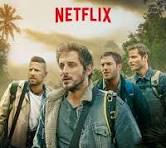
I decided to rewatch When Heroes Fly, a fantastic one season Israeli drama (with English subtitles), because I found out that it was about to leave Netflix in January. The first time I’d watched the show was for my online Hebrew class, almost two years ago, with Hebrew subtitles, but it was so vivid and powerful that I understood most of what was going on, despite missing a few words here and there (and everywhere).
When Heroes Fly follows four guys in a reserves unit who lose their leader in war. Each one deals with the loss, and the trauma of war, in a different way, but the main character, Aviv, truly falls apart. He’s away getting help when his ex-girlfriend, Yaeli, goes on a trip to South America that he was supposed to go on with here, and, it seems, dies in a car accident.
The mystery that has to be solved, years later, is whether Yaeli actually survived the accident after all, and if so, where is she, and does she want to be found? That’s the frame of the show, but the real drama is in how each of these four men work through their past mistakes and confront themselves and each other.
What got to me the first time I watched this show was how completely Aviv’s character resonated for me – his inability to heal, despite so much effort and time, and his self-loathing, and how others judged him for being such a mess. His physical expressions of depression and self-loathing, and that sense of truly falling apart – that was me. Even two years ago, after a lifetime of therapy, it all still felt deeply true for me. And yet now, despite grieving both of my dogs, and still having “issues,” and still feeling frightened and incapable at times, I don’t feel that wracking whole body depression anymore. It’s been receding for a long time, but until I watched this show again I didn’t realize how long it’s been since that was my daily, and then weekly, and then monthly experience of life.
Another thing I relate to, deeply, in this show is how much these friends need each other and yet can’t quite connect or hear each other through the fog of their own trauma responses. We want to believe that if we try hard enough and love hard enough we can fix anything, but sometimes our need to help is the problem, stopping us from seeing the real person in front of us who is in so much pain.
A new character is introduced late in the series, an Israeli detective with her own deep trauma who has to find the four men and Yaeli as part of a larger case. But she isn’t cut off from her pain, or completely lost in it, she’s strong and broken at the same time. I want to be this woman, this strong, capable woman who is also deeply attached to herself and to reality. I get the feeling that a lot of people think I already am this women. I’m not, yet, but just seeing her on screen makes it seem more possible.
But the biggest revelation for me in watching this show now is the impact of collective trauma, which goes beyond each individual’s experience of trauma, when they are all experiencing the trauma together. As an American Jew I can try to take an “objective” view on the current war, because my family isn’t running to shelters at any moment as rockets fall, and I’m not grieving a loved one who died in the massacre or was taken hostage, and no one in my family is a soldier in this war, risking their life every day. I am Jewish, but as an American Jew I have the privilege of not feeling the depth of the collective trauma that is tormenting Israelis, and Palestinians, as they try to figure out what happens next.
When I watch the news and do my deep dives into the history to try and understand what I’m seeing, I still find much of it incomprehensible, because I can’t see it through their eyes; I can’t feel it in my body and know the darkness that prevents clear sight on things that, from here, seem obvious. I keep trying to understand anyway, and I try not to judge the decisions and opinions I can’t understand, because I know that people who are not under the influence of trauma think a lot of things should be possible that people within the trauma can’t fathom and can’t choose.
Interestingly, while the English title of this show is When Heroes Fly, which suggests that these four men are clearly heroic, as if they are morally unambiguous and selfless and always know what to do, the title in Hebrew is For Her Heroes Fly, suggesting that heroic behavior has to come from somewhere, from some internal motivation, beyond the theoretical goodness and righteousness we keep expecting from our heroes. These are not men with infinite courage and a willingness to die for a cause; these are men who are willing to fight for the people they love.
People want to believe that Israel only has a right to exist, that Jews only have a right to exist, because we are supposed to be a beacon of light to the nations; and some Jews try very hard to live up to that ideal, but most of us are just people, like everyone else. Requiring Israel to meet standards of behavior that no one else can live up to is unfair and inhumane. No one gets through wars unscathed, and Israel has had to face war after war, and then terrorist act after terrorist act, throughout her short existence. Israeli soldiers, like all soldiers, are capable of mistakes in judgment and tactics and behavior. When three hostages were accidentally killed by the IDF, Israel had to deal with that reality, because Israel itself has inhuman expectations of its soldiers and its military, just like the world at large seems to have. Israel, this tiny country, with soldiers culled from all walks of life, drafted into service as teenagers, is meant to be a perfect military machine, capable of fighting tunnel warfare without making mistakes and hurting non-fighters, even when the Hamas fighters wear civilian clothes and embed in civilian neighborhoods and buildings. The Israeli soldiers who killed those three hostages, and the soldiers who have killed Palestinian civilians when aiming for Hamas, are all going to have to live the rest of their lives with that burden of guilt and failure, not out of choice but out of necessity, because they have to fight for the survival of their tiny country. The trauma that results will last a lifetime, and will alter everything that comes next.
We, on the outside of all of this, can have whatever hopes and dreams and judgements we want, but it is the people on the ground who will have to make it happen, and that means we have to accept who they are and what feels possible to them, as they carry this war, and every previous war, with them into the future.
If you haven’t had a chance yet, please check out my Young Adult novel, Yeshiva Girl, on Amazon. And if you feel called to write a review of the book, on Amazon, or anywhere else, I’d be honored.
Yeshiva Girl is about a Jewish teenager on Long Island, named Isabel, though her father calls her Jezebel. Her father has been accused of inappropriate sexual behavior with one of his students, which he denies, but Izzy implicitly believes it’s true. As a result of his problems, her father sends her to a co-ed Orthodox yeshiva for tenth grade, out of the blue, and Izzy and her mother can’t figure out how to prevent it. At Yeshiva, though, Izzy finds that religious people are much more complicated than she had expected. Some, like her father, may use religion as a place to hide, but others search for and find comfort, and community, and even enlightenment. The question is, what will Izzy find?
Since the Israel/Hamas war started, our congregation has looked for as many ways as possible to help us express all of our mixed feelings and get educated about what’s going on and how it impacts our Jewish lives in the United States. Recently, since tourism has all but stopped in Israel, the Israeli tour guide who led the synagogue’s last few trips to Israel has been doing zooms for us once a week, way too early on Sunday mornings, to give our congregation a connection to an Israeli point of view.
The Israeli tour guide knows a lot of my fellow congregants from the trips, and they know him, but he was mostly a stranger to me. Except, when he saw my name on the screen he said he almost cried, because his mother’s family were Mankowitzes too. I have no idea if we are actually related, because I’ve found a few different Mankowitz families on Facebook over the years who have been scattered around the world, but it was nice to feel that connection. I’ve never been able to afford to go on our synagogue’s trips to Israel, but I’ve seen pictures and heard stories and felt the pangs of jealousy.
One of the first things our tour guide told us was that, despite the danger he and his children and grandchildren face in Israel right now, he is grateful not to be in the US or Europe, where anti-Semitism has been making a roaring comeback. Instead, he’s surrounded by people who understand the existential threat to Jewish life, and the danger of living in such close proximity to a terrorist organization, and he doesn’t have to explain his complex feelings of grief and anger and empathy and fear, because his neighbors are feeling all of the same things.
They can see the same things we are seeing on social media, where some people are calling Hamas “freedom fighters” and denying the reality of rape and murder on October 7th. They too are hearing the UN be unwilling to condemn Hamas, and the International Red Cross say they can’t do anything to check on the wellbeing of the hostages in Gaza. And they can see Hamas’ lies being taken as truth by so many, even after evidence to the contrary has been presented, both by Israel and the United States government. And just like us, they are hearing Jews being called Nazis and vermin and being accused of genocide, and seeing huge protests calling for ceasefires, even during the temporary ceasefire, where people who have to know that Hamas will never stop attacking Israel are demanding that Israel stop fighting back.
The recent accidental killing of three hostages by the IDF, who mistook them for terrorists despite waving white flags, broke so many hearts in Israel and opened the door, a crack, to questioning the tactics of this war and if it will really bring the hostages home. Though I don’t know if the Israelis are questioning the efficacy of the airstrikes the way Americans are. I saw a report that said more than half of Israel’s airstrikes were made with “dumb bombs,” and I’m not a military expert but I assume that means that US critics believe Israel could be using “smarter” bombs that are able to be more carefully targeted and less likely to cause civilian casualties and collateral damage. If that’s true, I want to know why the IDF has chosen the strategy they’ve chosen. If they are capable of limiting collateral damage, why wouldn’t they do that? If they’re not capable of limiting collateral damage, why are their friends suggesting it’s possible?
I want to believe that the Israeli military is doing everything possible to limit civilian deaths and injuries, because I see them warning civilians to leave targeted buildings, and setting up safe escape routes, and bringing in humanitarian aid. But then why are whole families dying in Gaza? And journalists? And aid workers? These are my questions, and I don’t have the answers. Part of the problem is that there are no international journalists in Gaza right now. There are Israeli journalists embedded with the IDF and there are Gazan journalists, but none of the images coming out of Gaza show Hamas militants, and certainly don’t show Hamas fighters in the act of fighting. It’s as if they are invisible. And maybe they are, because they are in the tunnels, but the images from this war are incomplete, and the reporting of facts is incomplete and that leaves a lot of people retreating to their safe corners and believing what they want to believe is true, rather than being able to judge for themselves.
The almost unanimous calls for ceasefire from the United Nations General Assembly, despite the fact that Hamas refuses to return the rest of the hostages and has never stopped sending rockets into Israel, and has been stealing humanitarian aid and preventing the escape of civilians, confuses me. Is the rest of the world ignoring the existence of Hamas and seeing Israel invade Gaza with only civilians as their targets? Because if that’s what people believe, I can understand why they would demand a ceasefire from Israel alone. I just don’t know why the world would believe that.
With all of the noise in the outside world, our once a week zooms have been a respite. Our tour guide has children serving in the army, and so do most of his left-leaning friends in Israel, and he has grandchildren who could easily have been killed or taken hostage on October 7th, but he remains a progressive, believing in equal rights for Arabs and Israelis, and women and LGBTQ people. But his liberal point of view is informed by his service in the Israeli army and his knowledge of the many peace deals that have been attempted and have fallen apart over the past seventy five years.
He is as frustrated as we are by the settlers in the West Bank who keep attacking Palestinians, and he is as disillusioned as we are, no, more, by the current government of Israel and its anti-democratic leanings. He, like so many Israelis, has dreamt of peaceful coexistence with the Palestinian people for so long, looking for reliable partners to live side by side with, but they know that that has never been the goal of Hamas or Islamic Jihad.
So I dutifully set my alarm clock each Saturday night, and try to remember to brush my hair in the morning before logging onto the zoom, and I listen to our Israeli tour guide lead us through the latest events in the news and how Israelis like him are experiencing them on the ground: like the incredible relief of seeing the first hostages come home; and the joy of finally being able to laugh again, even for a moment; and the horror of the IDF accidentally killing three hostages; and the frustration when the hostage negotiations broke down; and the reassurance of knowing that so many Israelis are working together to take care of the evacuees from the north and the south of Israel who had to leave with barely the clothes on their backs amidst rocket fire from Hamas and Hezbollah.
Recently, a young college student from our congregation came to the weekly zoom to tell us what it feels like to be a Zionist on campus who is also sympathetic to the pain of the Palestinians. She said that everyone on campus seems to have chosen sides and if you are not completely in one camp or the other it can be very lonely, but she has friends in every group and is doing her best to see the complexity of the disagreements and hold onto her empathy and connection even when those emotions are overwhelming. We were all crying, listening to her, but also feeling really hopeful because her ability to hold on to her own identity and point of view while also respecting and even loving people who disagree with her is a powerful thing.
There’s this funny thing about Israelis where it seems like everyone calls everyone else by their first name, or by their nickname, whether they know each other or not. Everyone is “brother,” and all of the hostages belong to everyone’s families, even when some members of the family, like Bibi, are deeply infuriating and would never be invited to Friday night dinner. And I have to admit that I don’t feel that way about the American Jewish community; we are much more spread out and divided than Israelis, or at least that’s how it feels to me. But I keep looking for ways to connect, and to feel less alone with my grief and fear and confusion over what’s true and what’s possible in the future. My hope is that the large majority of American Jews who both care about Israel and about liberal values can find a way forward, together with non-Jews who care about the same things.
As always, there have been a few articles and videos and songs that have given me hope:
If you haven’t had a chance yet, please check out my Young Adult novel, Yeshiva Girl, on Amazon. And if you feel called to write a review of the book, on Amazon, or anywhere else, I’d be honored.
Yeshiva Girl is about a Jewish teenager on Long Island, named Isabel, though her father calls her Jezebel. Her father has been accused of inappropriate sexual behavior with one of his students, which he denies, but Izzy implicitly believes it’s true. As a result of his problems, her father sends her to a co-ed Orthodox yeshiva for tenth grade, out of the blue, and Izzy and her mother can’t figure out how to prevent it. At Yeshiva, though, Izzy finds that religious people are much more complicated than she had expected. Some, like her father, may use religion as a place to hide, but others search for and find comfort, and community, and even enlightenment. The question is, what will Izzy find?
As if things around here haven’t been dramatic enough, Mom finally went to see a new orthopedist in November, to check on the pain in her left leg, and the new doctor confirmed that the left hip is now at the bone on bone stage and needs to be replaced, like, now.
I keep having flashbacks to two summers ago when Mom had her right hip replaced, and ended up needing a second surgery six weeks later to fix the mistakes of the first surgery, and then had to be hospitalized again a few weeks later when fluid filled her lungs as a result of the two anesthesias. I spent that whole summer feeling like the world was crashing down, and now, after losing two dogs in two months and with Mom going in for surgery again, my existential dread is back in the danger zone.
And then came Covid.
The day before Ellie died, Mom and I went for our yearly Covid shots and quickly forgot about them in our grief. Within a week I had what I thought was a cold, and it made sense to me that I would get sick given how awful I felt at losing Ellie, so I didn’t question it. Though I do remember thinking, huh, this is the first cold I’ve had since before the whole Covid thing started.
When I finally had the energy to go out and do my chores I wore a KN95 face mask, thinking I just didn’t want to spread what was left of my cold. I went to the drug store and did some food shopping, and then I went home to take five naps. The symptoms of the cold (sneezing and coughing and nausea and feeling like my limbs were about to fall off) seemed to be over, but I still thought I should wear my mask when I went to teach the kids, just in case.
I’ve been organizing things around the living room, since Ellie’s death, so when I got home from teaching that day and was too tired to move from the couch, my eye caught on a box of Covid home tests across the room and I thought, huh, maybe I should just check. I don’t know why this thought didn’t occur to me before I went out, but it didn’t. Honestly, I’d taken so many tests over the past few years, each time I had a bad allergy day or heard about someone who’d gotten Covid, and the tests had always been negative, so it just seemed like a science experiment, and a way to use up the leftover home tests now that they were a month or two out of date.
I took the test, and it was positive. So I took another test, and it was positive too. Then Mom took a test and she was positive too, and I felt like shit. I wrote to my boss to let her know I had Covid, expecting her to be in a rage that I’d been so stupid to not think of taking the tests before coming to work, but, of course, she was kind and just asked how I was feeling and what she should teach when she subbed for my class.
I have never missed work since I started this job. It’s a very part time job, so that’s probably not as big of an achievement as it seems, but to me it’s a big deal, because I am often very, very tired and I always impress myself when I get up and out and actually manage to drive safely and even teach. I had on my KN95 mask for the two hours I’d been at school with the kids, and most of my symptoms were already gone, so, fingers crossed, I didn’t get anyone sick. But even knowing all of that, I felt like a mass murderer (I’ve been watching the news a lot, and the way the world seems to think every Jew is killing people just by being Jewish has hit me hard. My father made it clear that, as a female, I was the cause of all evil in the world, and now large swaths of the world seem to think that being born Jewish makes me the cause of all evil too, so…I’m feeling it).
I don’t know where I got Covid from, and the fact that I gave it to Mom, who was already suffering with her hip pain, just sucks. But we spent the next few days at home, rescheduling Mom’s pre-op testing appointments, and hoping for the best.
And now that we’ve both been feeling better, at least Covid-wise, I’m back to grieving for Ellie, and being consumed by the news about Israel, and worrying about all of the doctors’ appointments coming up, and having nightmares about what will happen during the surgery, and after.
In normal, and even not so normal times, Mom does everything she can to make things easier for me, often too much. But she won’t be able to help with anything for a while – not cooking or cleaning, certainly not errands and laundry and food shopping; and there’s no dog to help lift my spirits and put things in perspective, and it’s so dark and it’s getting cold and the world is such a scary place and…
I know I’m supposed to be an adult, with all kinds of inner resources and strengths to manage things like this, and I’m doing my best, watching as many Christmas movies as possible to distract myself, and taking each challenge one at a time, but I’m not okay. I want Ellie back and I want Mom to be healthy and I want the war to be over. Now.
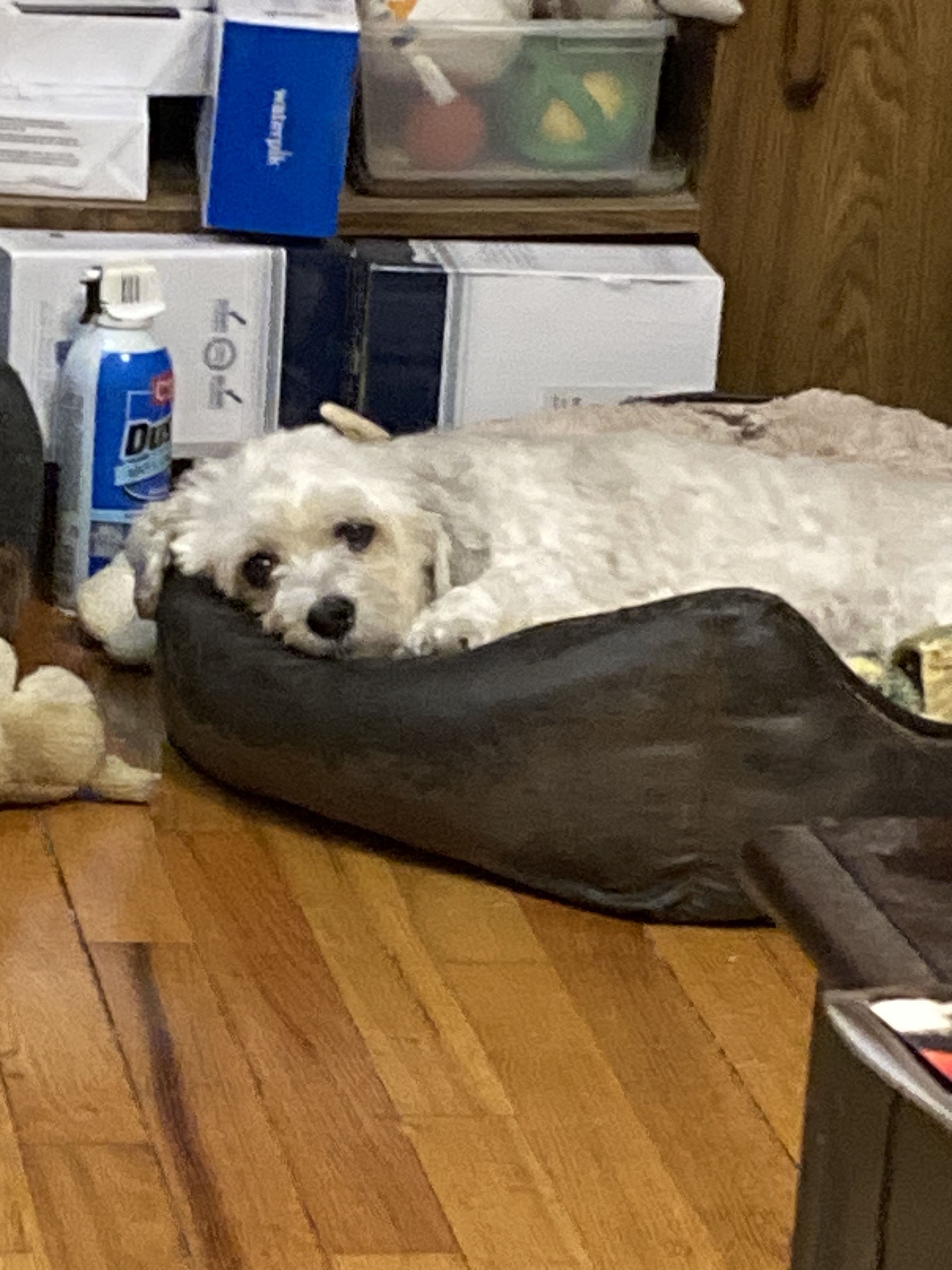
The stuffed animals are keeping the dog beds warm.
If you haven’t had a chance yet, please check out my Young Adult novel, Yeshiva Girl, on Amazon. And if you feel called to write a review of the book, on Amazon, or anywhere else, I’d be honored.
Yeshiva Girl is about a Jewish teenager on Long Island, named Isabel, though her father calls her Jezebel. Her father has been accused of inappropriate sexual behavior with one of his students, which he denies, but Izzy implicitly believes it’s true. As a result of his problems, her father sends her to a co-ed Orthodox yeshiva for tenth grade, out of the blue, and Izzy and her mother can’t figure out how to prevent it. At Yeshiva, though, Izzy finds that religious people are much more complicated than she had expected. Some, like her father, may use religion as a place to hide, but others search for and find comfort, and community, and even enlightenment. The question is, what will Izzy find?
Ellie died at home early Monday morning, after not eating much the previous day. She had her final bedtime hugs and scratches and then went to get a drink of water and rest by her wee wee pad, and by morning she was gone
A friend suggested that Cricket was getting bored alone in heaven and tapped Ellie on the shoulder, telling her to come sooner. I can believe that of Cricket, and I can believe Ellie would do that for her sister, but she is so deeply missed here on earth.
It’s hard to find words for the loss of Ellie, on top of the loss of Cricket just two months ago, which has left the apartment so completely dogless. My greatest consolation is that Ellie knew how deeply she was loved, and we know how completely she loved us.
A week after seeing the substitute vet, and being told not to spend more money on tests, we were able to get an appointment with Ellie’s regular vet and he recommended an ultrasound, to see if her distended belly was filled with fluid or with something else; and he confirmed that it was all fluid. He recommended against trying to poke around with needles to empty the fluid, because it could stress her literally to death, and because the fluid would come back in a few days anyway. Instead, he raised her diuretic dose a little bit and sent us home, saying that, like with Cricket, if Ellie doesn’t eat for three or four days, she’s suffering.
It certainly wasn’t the news we wanted to hear, but it is what we expected, and it was a relief to know for sure what we were dealing with.
The raised dose of the diuretic helped a little bit, at least enough to allow Ellie to feel hungrier and to enjoy her food again. She especially liked the Chinese food we got for my birthday dinner. Her belly is still full of fluid, and she spends most of her time resting on her side, but her joy in eating is wonderful to see.
“Where are you hiding the Chinese food?”
When we were looking through her papers recently (which makes it sound like she has her own filing cabinet and a small business to run, but we were just looking for her exact birthday so we could celebrate it with her), we realized that she is turning ten this year, not nine like I thought. There’s a little bit of relief in knowing she’s made it all the way to ten, just like there was relief in seeing Cricket pass the sixteen year mark, but it’s still not enough.
We didn’t plan anything special for her birthday, because every day she’s still with us feels special and important, and really an act of will on her part. Just seeing her eat, and take all of her medication, and enjoy getting her back scratched, feels like a celebration to me. I’m so grateful that she wants to stay with us for as long as she can, and I’m especially grateful that we’ve been able to have this time with her, after Cricket’s death, to shower her with as much love and attention as she can absorb, so that she knows what it’s like to be the center of everything, at least for a little while. Even Cricket would have wanted that for Ellie, though not as much as she wanted it all for herself.
Now we’re just going day by day, trying to accept that we won’t have that much more time with her. Her sweet spirit still shines through, even when she’s tired, or worried, or struggling to catch her breath, and we know how lucky we’ve been to have her this long.
Happy birthday dear sweet Miss Ellie, my beautiful girl!
“I need more chicken, Mommy.”
If you haven’t had a chance yet, please check out my Young Adult novel, Yeshiva Girl, on Amazon. And if you feel called to write a review of the book, on Amazon, or anywhere else, I’d be honored.
Yeshiva Girl is about a Jewish teenager on Long Island, named Isabel, though her father calls her Jezebel. Her father has been accused of inappropriate sexual behavior with one of his students, which he denies, but Izzy implicitly believes it’s true. As a result of his problems, her father sends her to a co-ed Orthodox yeshiva for tenth grade, out of the blue, and Izzy and her mother can’t figure out how to prevent it. At Yeshiva, though, Izzy finds that religious people are much more complicated than she had expected. Some, like her father, may use religion as a place to hide, but others search for and find comfort, and community, and even enlightenment. The question is, what will Izzy find?
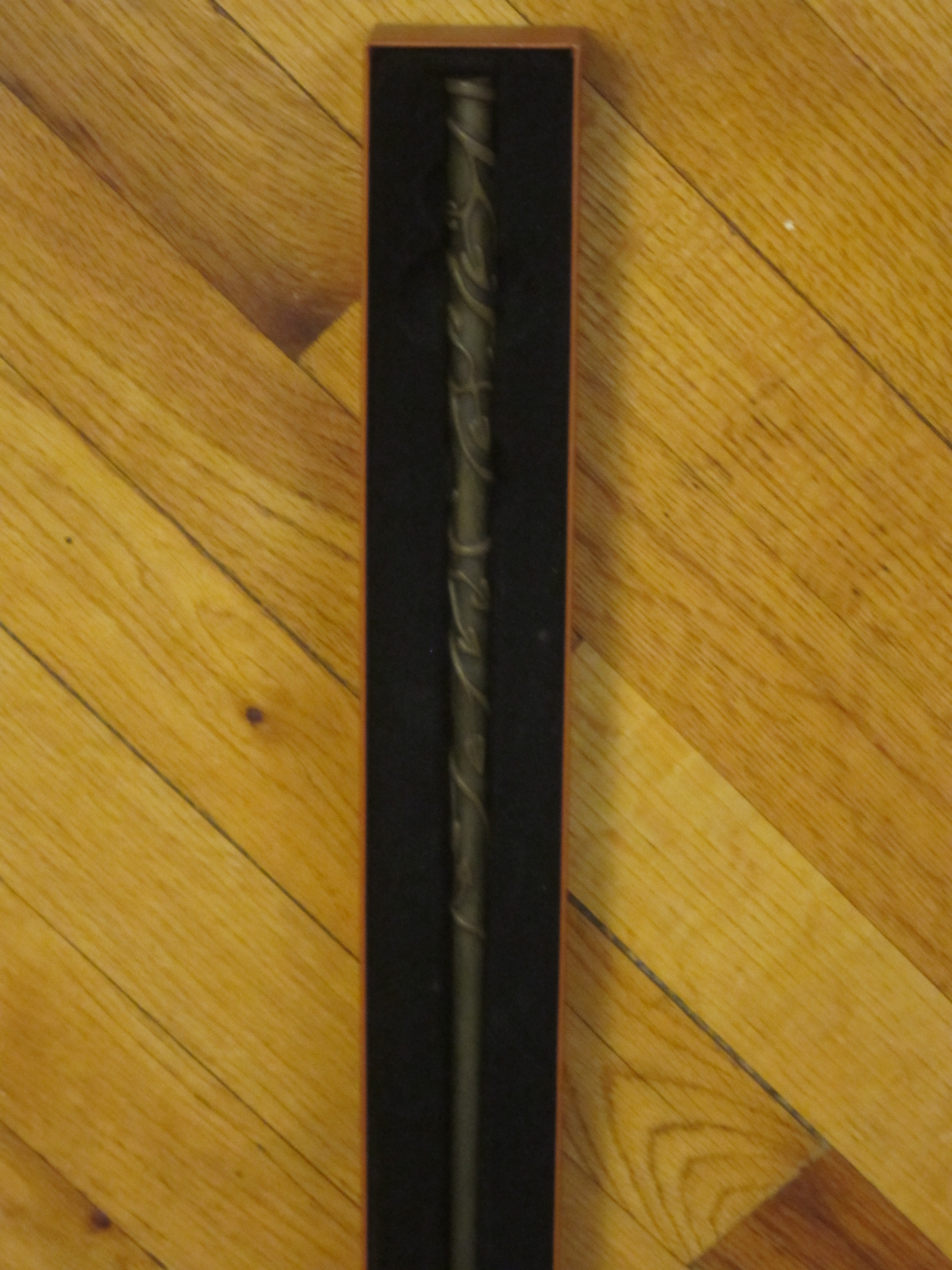
A good friend of mine sent me an unexpected early birthday present. She’d posted tons of pictures of her summer trip with her son to Universal Studios in California, but it turns out she left out the picture of the replica of Hermione’s magic wand she bought for me at the Harry Potter store.
I had no idea this was coming. She’d sent me surprise care packages early in the summer to help me through my second oral surgery, but I’m still not used to this kind of care, so when I opened this package and found the long box with a wand nestled inside, as if it had come directly from Ollivander’s wand shop, I was speechless and struggled even to take it all in..
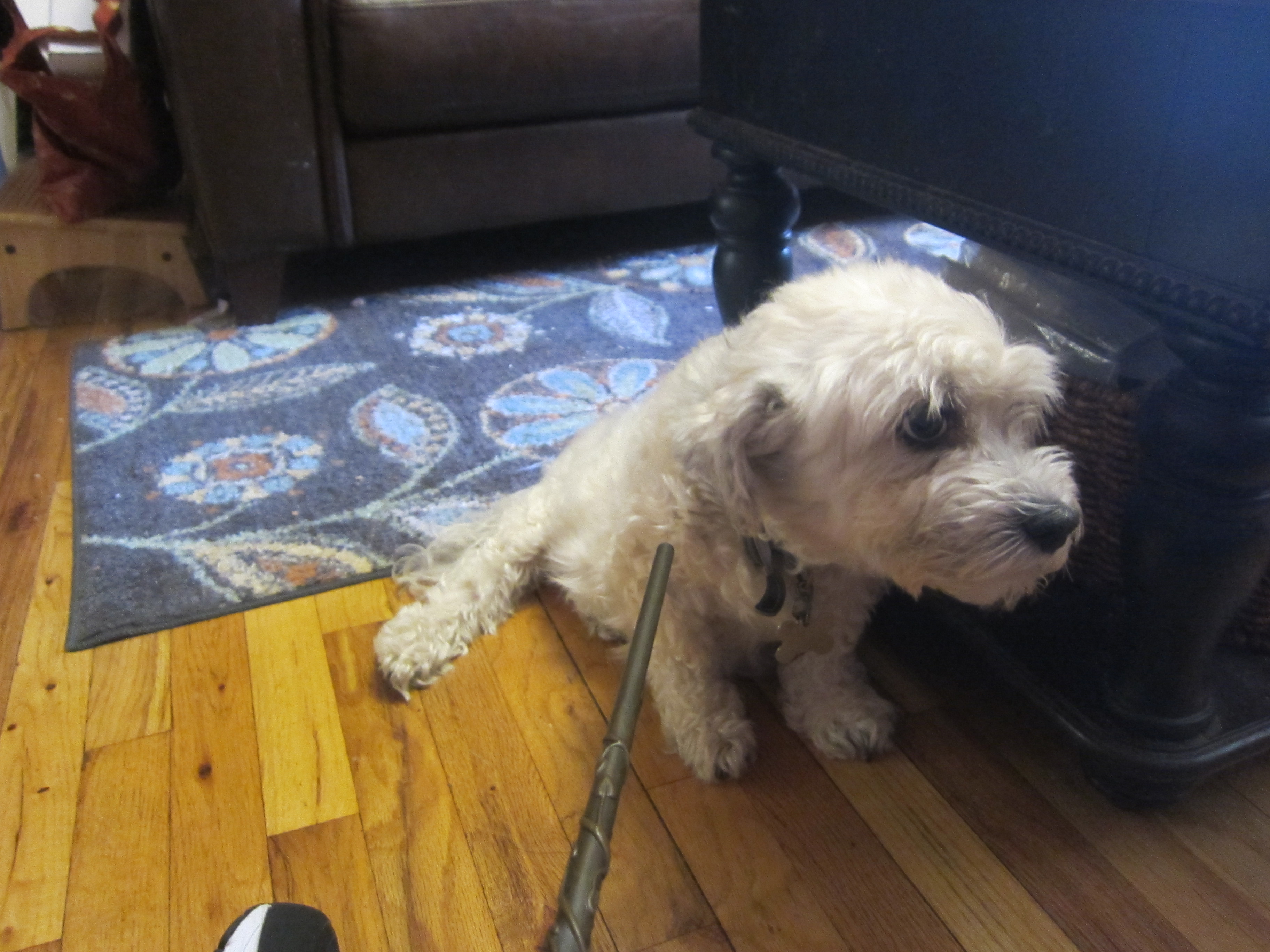
My first thought when I finally held the wand in my hand was that I should point it at Ellie’s heart – to heal her. I know it doesn’t work that way, but not so deep inside of me there’s a little girl who wants to believe in magic and really doesn’t want to lose another family member so soon, or ever. My next thought was of how, during my first year teaching synagogue school, I brought the kids pretzel sticks and showed them how to use them as magic wands, as part of a lesson on prayer, as a way to emphasize the power of words to create our reality.
My next thought was that I really needed to try some spells, not only because I wanted to believe they could work, but to see if I could create some healing ritual, some way to remind myself that I’m really not so alone. I went online and googled “Hermione’s Spells” and found a long list of the spells she’d performed throughout the books and the movies. She had spells to open doors and fill a cup with water and disarm an enemy and freeze someone in place. She used practical spells, like making Harry’s glasses impervious to rain, or creating a fire to cook with, and powerful spells, like confusing enemies or making them forget what they’d just experienced. She used her words to cause harm, and to protect, and even to knit small hats for house elves, but I couldn’t find a spell to heal heartbreak, or anything I could use to stop Ellie from dying, or to bring peace to Israel and the Palestinians. I guess even Hermione wouldn’t presume to have that kind of power.
I’m pretty sure that Ellie spends a lot of her time, when she’s sitting in front of the bookcase that holds her treats, whispering her own version of the summoning charm, hoping that chicken treats will start to fly directly into her mouth. Maybe if she had her own wand those summoning charms would really work. I wish that for her, and for me. I think we could all use a little more magic in our lives.
If you haven’t had a chance yet, please check out my Young Adult novel, Yeshiva Girl, on Amazon. And if you feel called to write a review of the book, on Amazon, or anywhere else, I’d be honored.
Yeshiva Girl is about a Jewish teenager on Long Island, named Isabel, though her father calls her Jezebel. Her father has been accused of inappropriate sexual behavior with one of his students, which he denies, but Izzy implicitly believes it’s true. As a result of his problems, her father sends her to a co-ed Orthodox yeshiva for tenth grade, out of the blue, and Izzy and her mother can’t figure out how to prevent it. At Yeshiva, though, Izzy finds that religious people are much more complicated than she had expected. Some, like her father, may use religion as a place to hide, but others search for and find comfort, and community, and even enlightenment. The question is, what will Izzy find?
Ellie isn’t doing well. We had hoped that after her urinary tract infection cleared up, and her heart medications were adjusted, she would get some of her energy back, and it seemed to be working for a few days. But then, after eating her breakfast and taking her medications one morning, she threw it all up. We didn’t worry too much, until the same thing happened again later in the day. We called the vet’s office, too late to bring Ellie in, and the substitute vet told us that if Ellie kept vomiting we should take her to an emergency clinic, but don’t spend too much money, the vet said, because Ellie doesn’t have much time left. She left us some anti-nausea medication at the front desk (a liquid, because Ellie was still resisting her pills) and by the next day the vomiting had stopped.
“Mommy, I don’t feel so good.”
But Ellie was still refusing any food soft enough for us to hide her medications, so we had to crush her meds into chicken broth and use the medicine dropper (from the anti-nausea medication) to get them into her mouth, or at least near her mouth. After she’d had her medication she was willing to eat some chicken treats and a Greenie, but when we took her outside for a walk she just sat on the grass catching her breath, looking frightened. I had to carry her back inside and then she just stretched out on the floor for hours. I don’t know when it started, but by the next morning we noticed that her belly was bigger than usual, despite her recent weight loss and limited diet.
So we called the vet again. Our regular vet seems to have cut down on his hours, so we had to see the substitute vet again, even though I didn’t like what she’d said about spending money on Ellie. Why tell us to take her to an emergency vet clinic, notorious for overcharging for every pill, and then tell us not to spend too much money? But we were really worried about Ellie, so we went in and sat in the waiting room for an hour until the substitute vet could see us. As soon as we went into the examination room, the vet used a needle to check if Ellie’s abdomen was filled with fluid, and found nothing. She was so sure that fluid retention had to be the cause of the distention, but another needle stick came up empty too. She told us that it could still be fluid but she just wasn’t finding the right spot, or it could be something else, and she’d have to do an x-ray to see the cause of the swelling. But, really, you shouldn’t spend too much money on diagnostics given how little time she has left, she said, contradicting her own advice, again. I tried not to scream at her, because it wouldn’t have changed anything, so I just asked what she would be looking for on the x-ray and if she could just treat the possible outcomes either way. She gave Ellie a shot of the diuretic she takes in pill form every day, and suggested Gas-x in case the swelling was caused by excess air in her belly. She also recommended an appetite stimulant, which finally sounded like a good idea, and the vet tech demonstrated how to get the pills down Ellie’s throat in a way that they would actually stay down. The vet tech also gave us a week’s worth of Gas-x, to go with the liquid version of the appetite stimulant, and we paid for the meds and went on our way.
Mom sat with Ellie in the backseat of the car while I drove, all of us shell-shocked by the message the vet couldn’t stop repeating, that Ellie was going to die very soon. When we got home, Mom went to take a nap but I sat on the couch, staring blankly at the TV, holding Ellie in my lap (at least until she pulled away and stretched out on her own, she’s not a big cuddler).
Within a few hours the appetite stimulant had kicked in and Ellie was able to take all of her medications with pieces of chicken, and she even ate a full portion of her wet dog food, which she hadn’t been willing to eat in weeks.
“Wait, that was dog food?”
The next morning, though, even with a new dose of the appetite stimulant, Ellie wasn’t very eager to eat and only swallowed a few of her pills with her chicken. I had to give her the last two pills the way the vet tech had demonstrated (shoving them down her throat, closing her mouth and massaging her throat. The vet tech also blew into Ellie’s nose, but I skipped that part). Finally, by dinner time, Ellie was ready to eat again and we were able to give her all of her medications, though she turned her nose up at the wet dog food all over again. Her belly was still distended, despite the diuretic and the Gas-x, but she was able to walk down the stairs and outside for a short walk.
I have no idea what our time line is. Ellie hasn’t been coughing for weeks now, which was the original symptom leading to the diagnosis of heart failure. Instead, her breathing is labored, and even a short walk wears her out for hours.
It has only been a little more than a month since Cricket’s death, so this all just seems too soon. The other day, Mom and I went to the beach to find stones to put on Cricket’s grave marker. We are planning to scatter her ashes around the bases of the paw paw trees, and leave a few stones to mark her presence there. Cricket loved going to the beach. She loved the way the wind blew through her hair and the smell of the seagull poop and the feel of the sand in her paws, as long as she didn’t have to go into the water, so I did my best to channel Cricket as I searched for stones: bumpy pink ones and flat grey ones and smooth white ones, and one red stone shaped like a heart. I filled a bag with them all so that we will have enough to choose from when we are ready to let Cricket go, which isn’t yet.
Cricket at the beach
The same beach today
It feels like I can’t finish grieving for Cricket while I’m worrying so much about Ellie. For now, our priority is helping Ellie to feel as comfortable as possible, by making sure she can take all of her medications, and finding the foods she loves the most on any given day. And, when Ellie is up to it, we take her outside so she can sit on the grass, or sit with her grandma on the Birthday Bench, and listen to all of the sounds of the world swirling around her. She really seems to like taking a time out just to listen to the birds and the honking cars and the planes flying overhead. She’s still curious, and capable of joy, even if there are fewer of those moments than there used to be.
My Ellie
If you haven’t had a chance yet, please check out my Young Adult novel, Yeshiva Girl, on Amazon. And if you feel called to write a review of the book, on Amazon, or anywhere else, I’d be honored.
Yeshiva Girl is about a Jewish teenager on Long Island, named Isabel, though her father calls her Jezebel. Her father has been accused of inappropriate sexual behavior with one of his students, which he denies, but Izzy implicitly believes it’s true. As a result of his problems, her father sends her to a co-ed Orthodox yeshiva for tenth grade, out of the blue, and Izzy and her mother can’t figure out how to prevent it. At Yeshiva, though, Izzy finds that religious people are much more complicated than she had expected. Some, like her father, may use religion as a place to hide, but others search for and find comfort, and community, and even enlightenment. The question is, what will Izzy find?
I spent more than two years working on Intuitive Eating being superconscious of hunger and fullness levels and fighting with myself to stick to smaller portions, but after three months of gradually raising the dose of Ozempic, I realized that, beyond weight loss, Ozempic has made Intuitive Eating much easier. Now I can eat half of my breakfast and put the rest aside for later, without thinking about it or arguing with myself. Is this what normal people feel like around food? Because I still enjoy eating, and I still have cravings for this or that, but it’s just not overwhelming anymore.
“Chicken!”
So, of course, as soon as I was fully on board with Ozempic, and ready to go up to the optimal dose of 2 mg a week, I found out that I wasn’t immune to the Ozempic shortage.
The pharmacy had had no trouble getting the lower doses, so as I got used to a faint sense of nausea and more sensitivity to acidic foods, there was no stress around getting the weekly .25 mg, .5mg, and 1 mg doses. But it turned out that I should have become aware of the shortage when my doctor moved me up to 1 mg a week, because my pharmacy didn’t fill that prescription. Except I didn’t notice, because I still had three boxes of the lower dose pens, so I just took two .5 mg shots to make up the 1 mg dose, assuming that’s what I was supposed to do. So when the doctor raised my dose to the full 2 mg, and told me that there might be difficulty getting it, I was surprised to hear it. She told me that if the pharmacy couldn’t get the higher dose I should just stay at 1 mg. I didn’t hear anything from my pharmacy after the 2 mg dose had been called in, so when I went in to pick up a few other refills I asked for the 2 mg prescription of Ozempic and the kid at the counter sent me over to the pharmacist for the bad news. Not only couldn’t they get the 2 mg dose, they couldn’t get the 1 mg dose, and couldn’t give me the available smaller doses to make up the higher dose (I guess it’s an insurance thing). He said they would let me know if a supply of either the 1 mg or 2 mg dose came in, but he had no idea when, or if, it would.
I called the doctor’s office to let her know about the problem and to ask if there was another medication she could switch me to, and the secretary, who’d heard it all before, said no, just call around to different pharmacies until you find one with a supply of Ozempic, and then call us back and we’ll send a new prescription.
I still had 1.5 mg left at home, so I made plans to make it last two weeks, taking .75 mg each week, and crossing my fingers that the pharmacy would come through by then; because I didn’t want to have to call a million pharmacies, and then call the doctor’s office each time someone said they might have an extra dose for me; but also because I couldn’t quite believe that it was an emergency. I couldn’t believe that my doctor would have started me on Ozempic if there was a real, even reliable, chance that I wouldn’t be able to keep taking it after the first few months. That just seemed crazy.
When I told my nutritionist, and my therapist, and Mom, that my plan was just to wait, they said absolutely not. You must be more proactive! You must keep calling and running around to get this medication that is actually helping you! But I couldn’t do it. I felt like a black hole was opening up under my feet at even the thought of chasing down Ozempic doses across Long Island. I couldn’t even put into words why it felt so awful, but I’m pretty sure I made sad puppy dog eyes, just like Ellie, because Mom volunteered to call around for me. She found a big pharmacy a few towns away that was expecting to get a shipment after the weekend. All I had to do, they said, was call my doctor for the prescription on Monday morning and it would all be fine.
So on Monday morning I called my doctor’s office and the secretary said that the doctor would call in the prescription. I called the pharmacy every few hours to see if they had filled the prescription, but each time the automated operator said they didn’t have my name and number in their system yet and I should call back later. After eight PM, when I’d given up, Mom called one more time and got the notification that my prescription had been filled and a four week supply of the 2 mg dose of Ozempic would be waiting for me in the morning. I was so relieved, and so exhausted just thinking about having to go through this again in a month.
I was still up at one thirty in the morning, anxious and preoccupied about Ellie’s health and the war in Israel and Gaza, and trying to read a mystery to distract myself. I’d finished yet another chapter and decided to check my email for a break, and that’s when I found the notification from the new pharmacy saying they had run out of Ozempic and couldn’t predict when they would get the next shipment in.
“Oy.”
I don’t know exactly what happened. Maybe there was enough Ozempic at eight o’clock, when they put it into the computer, but by the time the pharmacy had closed an hour later it was all gone. Or maybe someone stole a box of Ozempic out of the back door after midnight. But it was starting to seem like Ozempic was being doled out on a first-come-first-serve basis, or some sort of Hunger-Games-style competition with no rules at all.
I’m not good at fighting for what I need, or racing to get places faster than someone else. Even the thought of competing for scarce resources exhausts me down to the bones. I’ve spent so many years trying to manage my weight, and spending enormous amounts of money and time on diets and nutritionists and programs and apps and on and on. And I’ve spent so many years being criticized by doctors for not being at the right weight, and for not trying hard enough, and finally there’s a medication that actually seems to be helping me, but I struggle with the idea that I should get something when someone else needs or wants it too. I don’t believe that I should be the first on anyone’s list to get Ozempic when people with type two diabetes, the original patients the drug was made for, are struggling to get their medication. I can’t make an argument for why I should get what I want in a way that convinces me, let alone anyone else.
For days, this huge, raw, unhealed wound full of self-loathing and hopelessness opened up and practically swallowed me whole, and I just wanted to cover it with duct tape and wait for the Ozempic shortage to end on its own. But, gradually, the weight of it started to recede, just enough for me to be able to hear Mom say that someone at our regular pharmacy had suggested calling independent pharmacies in the area, instead of the big name ones.
I dragged myself over to the computer and googled independent pharmacies near me. I made a list of about ten places, including the one down the block that had been closed for a long time but was supposed to reopen under new management any day. But making the list was the most I could manage at that point, especially at ten o’clock at night, and I planned to start calling another day, when I’d built up another dose of hope.
The next day we had to take Ellie for another echocardiogram to see how she was doing on her meds. They raised the dose of one of her medications and said to bring her back in four months, which felt more hopeful than at our last vet visit; and then I had to go teach, and as I was leaving Mom said, do you want me to make those calls for you?
Of course I do, Mommy!!!!!
By the time I got home from teaching, all I needed to do was send a picture of my insurance card to the just-re-opened pharmacy down the block and they said they would have a four week supply of the 1 mg dose of Ozempic ready for me the next day. I wasn’t sure I believed it, though. I had to wait until the phone call came the next morning and we drove over and became the first customers to pick up a prescription from the newly opened family run pharmacy (all three staff members standing behind the desk smiling at me).
I have no idea what will happen in four weeks when I need a refill, and I have no idea if I will ever be able to go up to the 2 mg dose, and I don’t know what lesson to learn from this. Have faith in humanity? Support local small businesses? Trust that even deeply felt, unbearable hopelessness will eventually pass? Let Mommy handle everything?
I don’t really understand why a small pharmacy was able to get the 1 mg dose of Ozempic when my big chain store couldn’t get it; and I don’t understand why the second big chain store was able to get the un-gettable 2 mg dose, or where it went between the time they told me they’d filled my prescription and the time they told me they couldn’t.
But I do understand why Ozempic is so popular with so many people, in a world where even an extra five pounds is counted against a person’s character, and doctors believe that extra weight is the cause of all disease, even when it’s not.
I wish I didn’t need to take this medication. I wish my body could self-regulate to the perfect weight without any intervention. I wish I didn’t need any medication at all: for pain, for depression, for a faulty thyroid, for high blood pressure, or for my weight. But I do. And I’m afraid this whole thing is going to happen again, and again, and I don’t know that I will be any more prepared to manage the waves of emotion next time. But for now, I have my medication, and Ellie has her medication, and we both have my Mom nearby for support when we get overwhelmed.
As for anything else, we’ll just have to take it day by day, because thinking ahead is too freakin’ hard right now.
“It’s nap time, Mommy.”
If you haven’t had a chance yet, please check out my Young Adult novel, Yeshiva Girl, on Amazon. And if you feel called to write a review of the book, on Amazon, or anywhere else, I’d be honored.
Yeshiva Girl is about a Jewish teenager on Long Island, named Isabel, though her father calls her Jezebel. Her father has been accused of inappropriate sexual behavior with one of his students, which he denies, but Izzy implicitly believes it’s true. As a result of his problems, her father sends her to a co-ed Orthodox yeshiva for tenth grade, out of the blue, and Izzy and her mother can’t figure out how to prevent it. At Yeshiva, though, Izzy finds that religious people are much more complicated than she had expected. Some, like her father, may use religion as a place to hide, but others search for and find comfort, and community, and even enlightenment. The question is, what will Izzy find?
I have been trying to write my thoughts on this for weeks, but I’ve been afraid of getting things wrong, or of bringing down anger from any and all directions. I have a fourteen page draft of a blog post that seems more like a thesis than a personal essay, but I’m not an expert on the history of Israel, or military tactics, or academic jargon, or even anti-Semitism; I care about those things, and am impacted by them, but other people will do a much better job of holding forth on those subjects than I ever could.
“Don’t look at me.”
What I can write about is how it has felt to watch the news lately, and be on social media, being told by so many people what I should think, or do, or say in the aftermath of the Hamas attack on Israel on October 7th, a day after the fiftieth anniversary of the Yom Kippur war. I don’t believe that Jews, or Israel, should be immune to criticism; I also don’t believe that Hamas is anything but a terrorist group (calling them a liberation group suggests a real misunderstanding both of their mission and of how they have governed Gaza for the past decade and a half). What I know for myself is that hearing about the massacres on October 7th made me worry about family and friends in Israel, but watching the gradually more toxic responses around the world, and especially on American college campuses, has been frightening. I thought for sure that the chants of “from the river to the sea,” which is a demand for the eradication of the State of Israel and its current population of more than eight million Jews, plus two million non-Jews, would convince people that this pro-Hamas reaction is morally wrong, but that hasn’t happened. I thought it was the norm to recognize the difference between Hamas and Palestinians in general, and that everyone knew the difference between Israelis living within the internationally accepted borders of Israel (like the ones who were massacred and kidnapped), and Jewish settlers in the West Bank, but no. In fact, a lot of the terminology being thrown around about Israel (colonialist, apartheid, genocide) has become mainstream in a way I never expected. Social media is powerful in creating false narratives, and even more successful in advancing partial narratives that are misleading.
An enormous number of Israelis who spent the past year protesting against Benjamin Netanyahu’s far right government and its attempts to peel away layers of democracy are now fighting for their country’s survival, both in the military and in thousands of volunteer efforts to help the survivors from the south, who had to escape Hamas and Islamic Jihad rockets, and evacuees from the north, escaping Hezbollah rockets. I am proud of how quickly Israelis were able to find their way forward, and worried about the choices of the military and the government, and frightened by the lack of critical thinking and journalistic ethics that seem to abound right now when facts would be really helpful. I am proud of the Haredi (ultra-orthodox) Jews in Israel who are joining the army for this war, despite a very contentious law that allows them to avoid military service in favor of study, and I’m angry at some Jewish settlers in the West Bank who think they have a religious right to hurt their Palestinian neighbors.
But I can’t fix any of those things. I cannot vote in Israel, and I can’t call every reporter who takes Hamas’ word without evidence and remind them that that’s just stupid. I can only be here, living my own little life in New York, and sending prayers to my family and friends who really need it right now.
“I pray all the time, Mommy.”
At my synagogue, on Long Island, we’ve spent a lot of time talking about how we find comfort right now, since that’s really all we can control. We’ve had speak ups, to share our grief and confused feelings, and vigils, for the survivors and the dead and the missing and all those on the ground who are still in danger. One of the rabbis from my synagogue joined a group of New York rabbis for a short trip to Israel, to show solidarity and to learn more about what’s going on. I think, right now, many American Jews, because we are further away from the danger and, in most cases, experiencing less direct trauma, are wishing for ways to reach peace. But we, I, have no idea what the military realities are, and what it will take to make Israelis safe again. I refuse to tell Israel what they should do, though, of course, I have questions.
I have a lot of trouble with people who equate the horror of a massacre perpetrated on civilians and a war conducted, or at least trying to be conducted, under the set rules of war.
My focus has been on finding podcasts and articles that can help me understand more of what it feels like to be in Israel right now, so that I can be more empathetic, and to reassure me that Israel is a real place and not this cardboard cutout of evil that often gets portrayed by Pro-Palestinian activists on American college campuses.
Israel Story, a great podcast in English that shares stories from all segments of Israeli society, has been posting short interviews with Israelis in different sectors during the current war. In the past, Israel Story has covered many Palestinian stories with empathy and clarity, humanizing and coloring in details of lives we often don’t get to hear about. The archives are full of those stories, but right now the most powerful of the short interviews I’ve heard was with a father who rescued his teenage son from the music festival in the South of Israel after the massacre had begun. www.israelstory.org/episode/sivan-avnery/ I’ve also been listening to podcasts from a school in Jerusalem called the Shalom Hartman Institute which has done a lot of work bringing together religious and secular, American and Israeli, and finding ways to have difficult conversations that are productive and even inspiring. I also watched a webinar interview with Yehuda Kurtzer, the president of the Institute in North America, that addressed what it feels like in Israel right now, and how liberal American Jews are dealing with the current news environment. https://youtu.be/Glia_tSZqmo?si=g3Fr8T4XR_D7Qkwk
I go to Kveller and Nosher and My Jewish Learning for a break from the news and a chance to remember that there is still Jewish joy and silliness, and comfort food, and so much to learn about being Jewish that has nothing to do with politics or war.
But most of all I go to music. I have a ridiculously long Israeli music playlist on Spotify filled with music from Ishai Ribo and Hanan Ben Ari and Yuval Dayan and Keren Peles and Jane Bordeaux and Ofra Haza and Arik Einstein and David Broza and Hadag Nachash and Hatikva 6, and I keep finding more musicians and more music to remind me that there is more to Israel than this war.
So that’s where I’m at right now. I’m still trying to write out my thoughts on the war itself, and the history that led to it, mostly for my own clarification, but the rest of the time I’m taking a lot of deep breaths, and listening to voices across the spectrum, when I’m up to it, and listening to music when I’m not.
I wish everyone Besorot Tovot, good news to come, and comfort and understanding until that time comes.
“Paws crossed.”
If you haven’t had a chance yet, please check out my Young Adult novel, Yeshiva Girl, on Amazon. And if you feel called to write a review of the book, on Amazon, or anywhere else, I’d be honored.
Yeshiva Girl is about a Jewish teenager on Long Island, named Isabel, though her father calls her Jezebel. Her father has been accused of inappropriate sexual behavior with one of his students, which he denies, but Izzy implicitly believes it’s true. As a result of his problems, her father sends her to a co-ed Orthodox yeshiva for tenth grade, out of the blue, and Izzy and her mother can’t figure out how to prevent it. At Yeshiva, though, Izzy finds that religious people are much more complicated than she had expected. Some, like her father, may use religion as a place to hide, but others search for and find comfort, and community, and even enlightenment. The question is, what will Izzy find?