Kosher Food

When I was nine or ten years old, not long after my family started to keep kosher, we went to a hotel up in the Catskills for Presidents’ weekend. It was a skiing resort, basically, and it was kosher. I’ve worked hard to block out the skiing portion of the trip because it was truly harrowing, but there was also an outdoor ice skating rink, and an indoor pool, and a theatre where the last gasp of the Borscht Belt came to perform. But most of all, there was the food. They made fake scallops from halibut, cut into rounds, and whenever they were on the menu, that’s what I ate. The waiters were convinced I was lying about my age, because I could have had a hamburger and French fries, or spaghetti and meatballs and I chose this?

But I’d grown up on seafood, at my best friend’s house; mussels and clams and lobster and crab legs were normal for me, and I missed them so much.

Seafood! (not my picture)

Seafood! (not my picture)

I discovered fake shrimp when my school took us on a class trip to a kosher foods expo when I was twelve. The fake shrimp was at the first table as we walked through the door. It didn’t actually look like shrimp, more like a distant cousin. And it was sweeter, and didn’t have the right texture. But I loved it. It had been only three or four years, by then, that I’d been without shrimp and lobster, but it felt like a lifetime. And just the idea that someone in the Jewish world seemed to feel my pain, and wanted to offer me a substitute, felt very kind.

There is a lot of internal conflict within the Jewish community about how to keep kosher. I couldn’t have school friends over at my house in junior high and high school because my family’s level of Kashrut was not high enough for the orthodox kids. We had only one sink and one dishwasher, so that even though we had separate dishes for meat and milk, they were all washed together. We bought strictly kosher meat and cheese, but we only waited an hour after a meat meal to eat dairy, and my classmates waited six hours.

I would like to give the ancient Jews the benefit of the doubt that the purpose of kashrut was to look out for the health of their people, by avoiding pork which would have carried trichinosis, and using salt to drain the blood from meat to preserve it. They were also thinking about the most humane way to kill an animal for food, and checking carefully to make sure their people would not eat meat from an animal who may have been diseased. But over time, other things were added in by the rabbis and sometimes it’s hard to know why.

How did “don’t cook a calf in her mother’s milk” become don’t eat any dairy for six hours after eating any meat? Not only can’t you eat meat and milk together at the same meal, you can’t, ever, eat them on the same dishes. Just washing the dishes with soap and hot water between meals is not enough, you need to have separate dishes, and pots, and pans, and utensils, and silverware. Wine has to be watched over to make sure it hasn’t been used for a sacrament in another religion, which would make it unkosher for Jews. (Wine, it seems, absorbs blessings more tenaciously than any other substance). And what the, pardon me, freaking hell is Cholov Yisroel? Jewish milk? Really?

When I hear about gluten free diets and wheat free, nut free, dairy free diets, and vegan and vegetarian and lacto-ovo, and only organic and no preservatives…I think this is probably what it was like with the early Jews. Everyone had their own weird rules around food and the rabbis wanted to put everyone on the same diet so they could eat together. Because that’s what it’s all about, you want people in your community to trust each other and eat in each other’s houses instead of each family eating alone in their own homes and guarding their own individual rules. The fact that kashrut has become one of the primary things that separates different groups of Jews from each other was probably not what the rabbis had in mind.

My current synagogue is a lot less strict than what I grew up with. I would call it “kosher style” or “Kosherish” if I were going to give it a name. No one is bringing in crab or pork or non-kosher meat into the building, but food can be brought in from homes or restaurants where non-kosher food is also prepared.

Our rabbi waxes nostalgic, not usually during services, about side trips to discover lobster flavored ice cream (disgusting, just so you know) and Philly cheese steaks (much better!) on his way home from one religious conference or another.

From early on, my father insisted that my brother and I had to try all of the foods he remembered from his childhood. We’d go to a kosher delicatessen for turkey and chopped liver on rye, or knishes, or knockwurst, or hot pastrami with mustard. I assumed that Jewish food was always kosher, and that any food served in a kosher restaurant must be Jewish, like Moo Goo Gai Pan, and sushi.

One day, my father brought home ptcha, calves foot jelly, a cloudy white mass served with lemon juice, and it was abhorrent (much as you might think). Then there was Kasha Varnishkas – buckwheat with bowtie pasta, which tastes kind of like sawdust and dirt, with onions. Stuffed cabbage was better, because we could remove the slimy cabbage and just eat the chopped meat and rice mixture inside.

Ptcha (not my picture, Thank God)

Ptcha (not my picture, Thank God)

Kasha (not my picture)

Kasha (not my picture)

The kosher butcher always has aisles of things to try – like potato knishes, and blueberry blintzes, sour pickles, Israeli pickles, Gefilte fish, Matzo ball soup, noodle kugel, and kishka (which used to be made with cow’s intestine and stuffed with yummy stuff, until they realized that no one could get past the intestinal coating and another coating was chosen). The last time I checked, though, they did not sell kosher dog food. This was the excuse orthodox families used, when I was growing up, for not getting their kids a dog: animals bring treyf into the house.

My father tried to make that argument at our house as he became more religious, and we said we were fine with feeding Delilah, our Doberman pinscher, all of the steak in the freezer, if that’s what he wanted. Delilah was also a big fan of hamburgers and brisket and grilled chicken breast and sausages. When there was no steak left in the freezer for my father’s Friday night dinner, he gave in on the anti-dogfood argument.

"Steak?"

“Steak?”

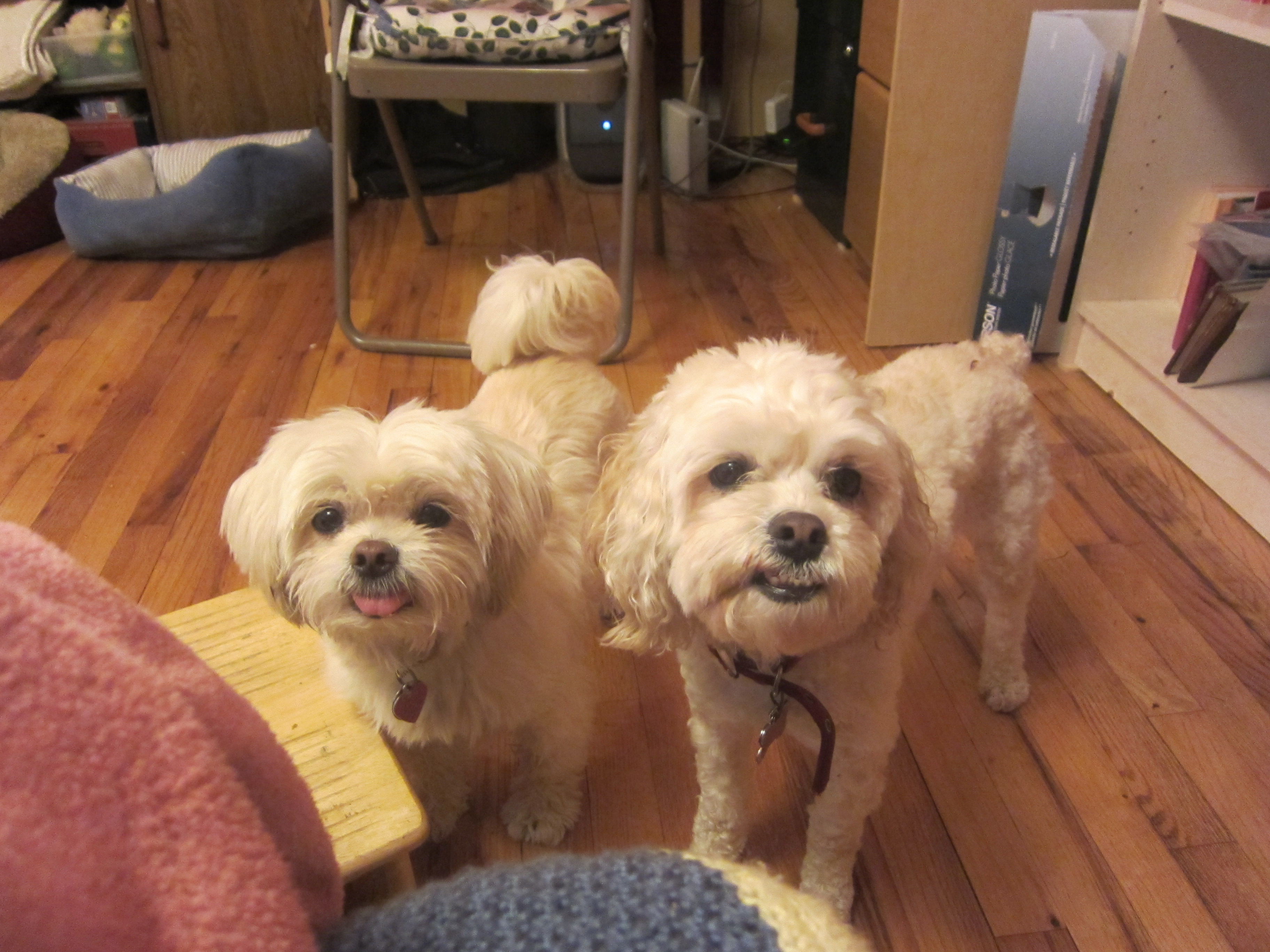
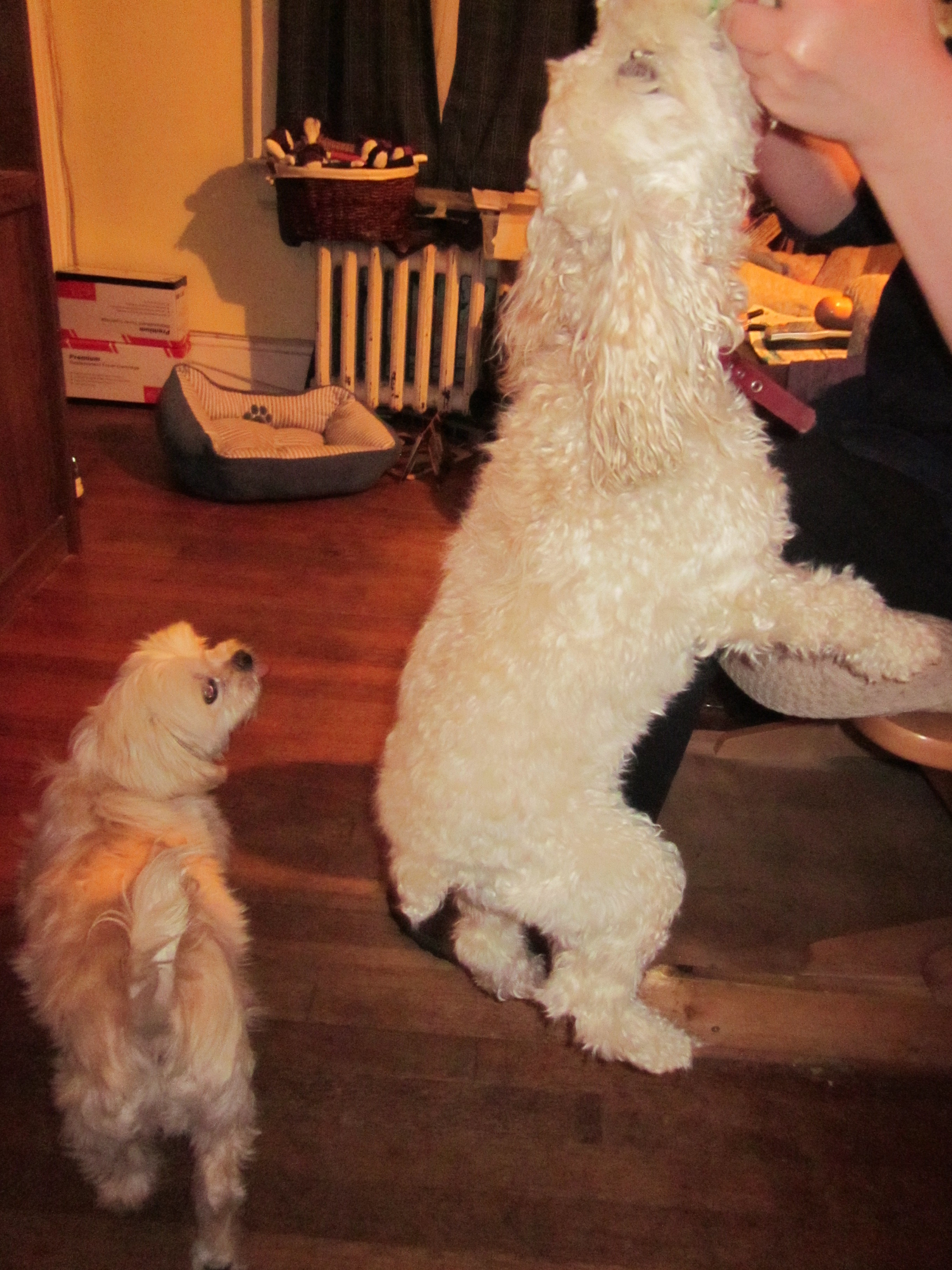
If Cricket could decide what was kosher and what wasn’t, I think she’d outlaw kibble altogether. She doesn’t believe in the need for fiber or a balanced diet. She would also declare that all meals should be shared with your dog, or else the meal will not be considered kosher. If you eat that whole pancake, and your dog has not had at least two bites, you have sinned.

"I deem this dish: Kosher!"

“I deem this dish: Kosher!”

And Cricket said, "It was good!"

And Cricket said, “It was good!”
Tennis with Dogs

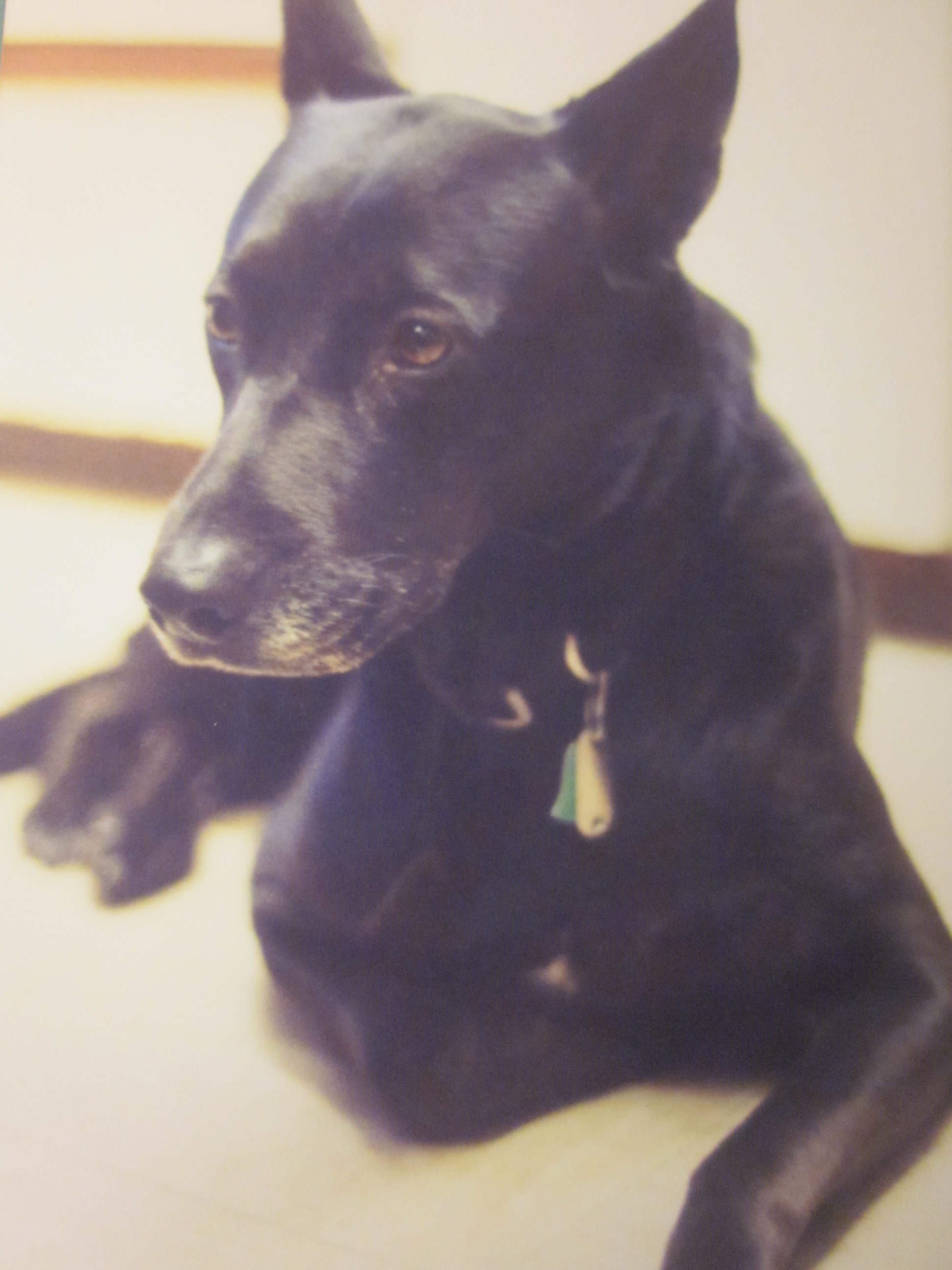
I had one leftover can of tennis balls, and a bucket of dusty balls in my closet, for years after I stopped playing tennis. I tried to get Dina, my black lab mix, to play catch with me, but she’d watch the yellow ball fly past her ear, or roll right up to her foot, and look at me like I’d gone crazy.

Dina

Dina

Peanut butter over tennis balls every time.

Peanut butter over tennis balls every time.

I used to play tennis, a long time ago. I started when I was seventeen years old, and stopped by nineteen, but during that time, I played almost every day. It was an obsession. I wanted to hit an inside out forehand like Jim Courier, and storm the net like Martina Navratilova. I started watching tennis during the U.S. Open the fall when I was seventeen, because there was nothing else on TV. I’d never liked Tennis before. In fact, when I was eight years old, I went to a local day camp and took a tennis elective in the afternoons, and I hated it. I have a hazy memory of bright sun and hot courts and not being able to see the ball clearly because I didn’t have my glasses on.

But something about those night matches at the US Open captivated me. I signed up for an adult education tennis class at the local high school gym, and my brother and his best friend volunteered to practice with me. My brother’s idea of playing tennis was to hit the ball as far as he could, not just over the net but over the back fence of the middle school tennis courts down the block from our house. His best friend had played on his high school tennis team, so when he “practiced” with me he used a wicked back spin and dropped the ball just over the net, plunk, where I could never reach it.

Over the next few months, I took more classes and lessons and practiced serves on my own at those middle school courts. I ruined my right rotator cuff with all of those practice serves, but I didn’t care. I’d carry my basket of tennis balls up the block and hit serves until the basket was empty, then cross to the other side of the net, collect the balls into the basket, and serve to the other side until the basket was empty again.

I started to practice with my college team in the spring, and over the summer I spent all of my scholarship money on tennis camp. I was eighteen, and the oldest camper there, but I was determined to become a tennis player. In the morning we practiced volleys and groundstrokes, serves and footwork, and in the afternoon we played matches. I could never figure out strategy, though. I was too busy trying to retrieve the ball myself to ever figure out how to make it harder for the girl on the other side of the net. My strength as a tennis player was my persistence and consistency. I didn’t give up, and I didn’t play differently each day. When I learned something, I added it to my game, and it stuck.

That fall, after tennis camp, I became a full-fledged member of my college tennis team and I went to all of the practices and played in real matches. I played sixth singles and I even won a match or two. I took more lessons and practiced religiously, and in the spring, the coach had me play a set against the girl who was currently playing fifth singles. We were evenly matched, because even though she was faster and in better shape than I was, I never gave up. Every game was hard fought and I won the set in a tie break, and won the fifth singles slot on the team. It was the best match I’d ever played, and the last, I think.

My back went out at the beginning of my next official match and I had to default. My mother took me to a doctor of osteopathy and he twisted me like a pretzel and gave me pain killers and muscle relaxants. But the back injury was one injury too many. I’d made it through the torn rotator cuff, strained hamstrings and upper back, a thousand blisters on my feet and hands, but when my back went out it just refused to go back in. And I was relieved. The desperate need to make up for years of not playing tennis was overwhelming me. I kept getting better so quickly that people forgot how recently I couldn’t play at all, and expected too much from me. Most of all, I expected too much from myself. I always do.

I tried to play tennis again a few years after the injury, but I was too tentative about twisting at the waist, and my timing was gone. I’d either hit the ball with the rim of the racket, or so flat that it landed four feet beyond the court. I knew I wasn’t up to practicing enough to get my strokes back, and I couldn’t imagine just playing for fun.

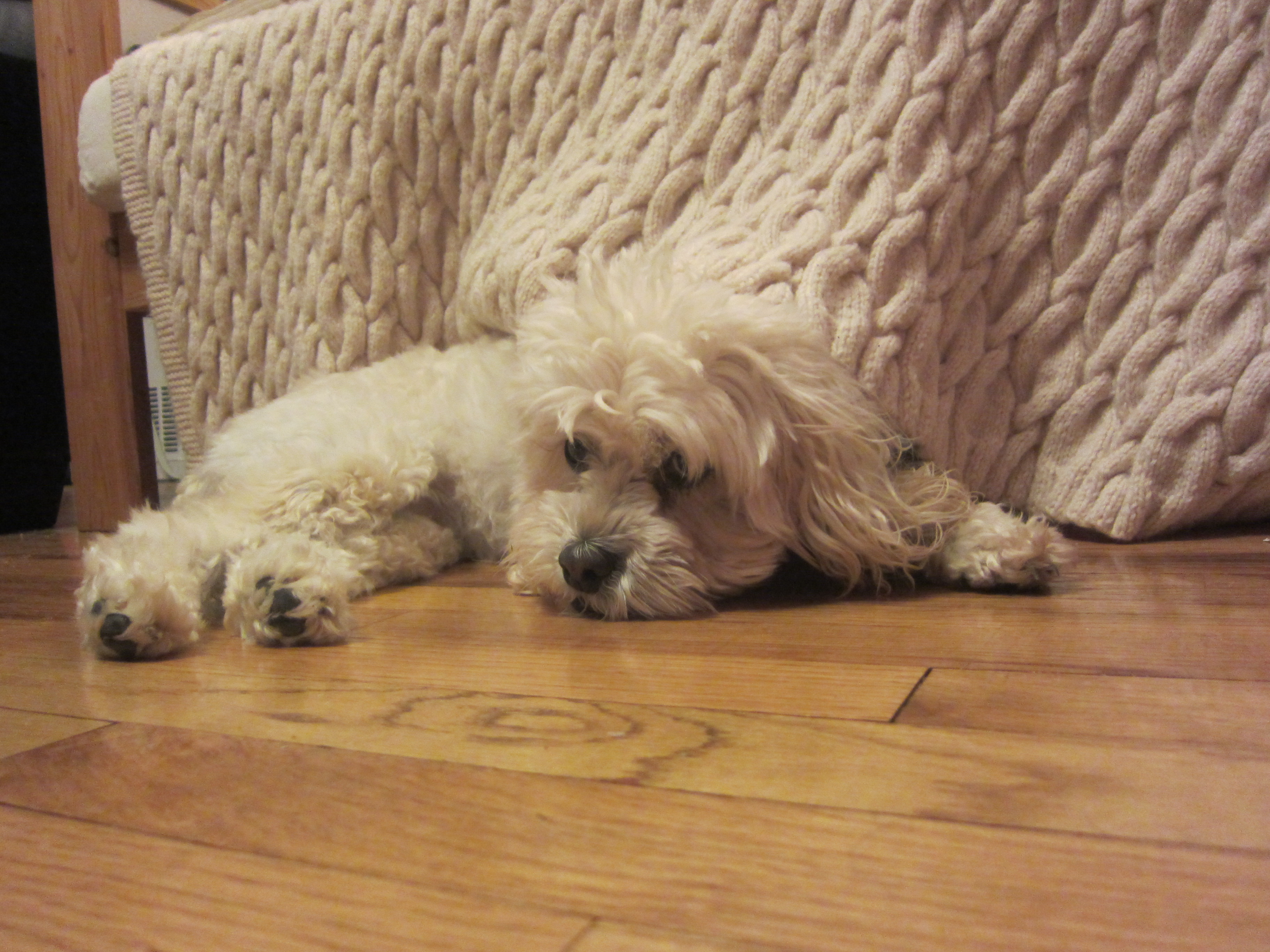
I wish I could be more like my dogs. Butterfly only expects herself to do what she can. She takes a long time to learn new skills, and does them only as much as she wants to. Cricket pushes past her own limits all the time, not to impress anyone else but because she just wants to do what she wants to do. Neither one of them is as much of a people pleaser as I’ve been, Thank God.

Butterfly takes her own sweet time.

Butterfly takes her own sweet time.

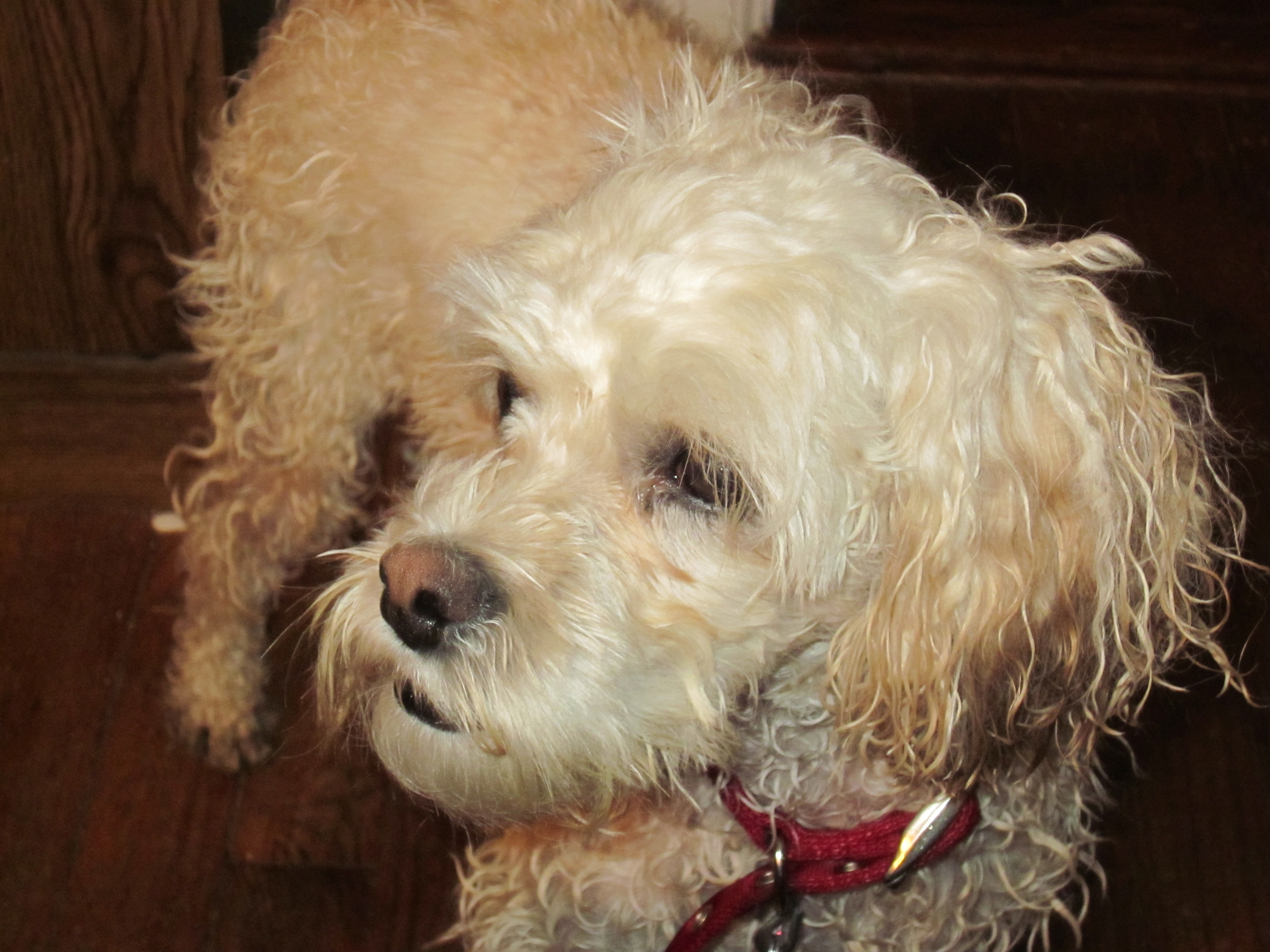
Cricket is NOT a people pleaser.

Cricket is NOT a people pleaser.

Maybe if I could convince the girls to play tennis with me now, it might be different. I do miss the sound of the ball hitting the racquet – whomp – right in the middle, and I miss the feeling of my whole body working together to line up the ball just right and follow through.

Butterfly would make a great tennis player, if the court were a little bit smaller and no rackets were required. She practices her split step before every pee squat and she’s very light on her feet. Cricket almost always runs on a diagonal, so her court coverage would be fantastic, and she would also be great at intercepting shots at the net, but she might try to catch the ball before it gets to her side of the net, which would be frowned upon.

She's so light on her feet she can barely stay on the ground.

She’s so light on her feet she can barely stay on the ground.

Cricket can jump!

Cricket can jump!

Their ideal would be me standing on one side of the net with a bucket of tennis balls and a racquet, hitting directly to them, and never expecting any of the balls to be returned. The game would be over as soon as the bucket was empty and then Butterfly would head off to take a nap, and Cricket would growl and beg for chicken treats, just like any other day.

Cricket is very good at begging.

Cricket is very good at begging.

And Butterfly is very good at napping.

And Butterfly is very good at napping.

Assistive Technology for Dogs

I want someone to create a device for me. It needs to be big enough to accommodate paw sized buttons, with pictures on them and maybe even sounds attached. Cricket needs a device like this, next to the front door, so that when she races across the apartment barking her head off, she can press a button to identify the source of horror. Is it the mailman? A neighbor? A leaf in the wind?

“Why don’t you understand me?!

“I am a very articulate barker!”

The device would have to be on the wall, rather than the floor, to avoid the possibility that Butterfly would pee on it.

“You want me to pee on something?”
I read about assistive technologies in a class about exceptional children, by which they meant children with disabilities in vision or hearing or cognition or other physical limitations that required adaptive methods for communication. But what if some of these adaptations could enhance the other kids’ educations as well? What if using pictures as part of education for longer than we do, or concrete objects for examples, or music, would create more thorough and sustaining connections in children’s minds? Just because a child can jump to the theoretical level, and imagine an apple or the color red without seeing it in front of her, doesn’t mean she would no longer benefit from those inputs. What if your understanding of a poem or a story would be richer if you could see a picture of the ocean, or smell the sea air, or hear the sound of the waves that you’re reading about on the page?

I think Cricket would benefit from having these more concrete connections available to help her organize her thoughts. If she hears the mailman, she can run to the front door and press the picture of the mailman with her paw and hear the word “Mailman” ring out. This would also help me, because instead of barking in the abstract, I would hear the word mailman, or “Bird! Neighbor! Leaf! Car passing by!” And I’d have a better idea of what she wanted to communicate, or complain about.

My fear, though, is that we would just replace the incessant barking with a chorus of “Mailman! Mailman! Mailman!” all afternoon long.

“Where’s that mailman?”

I don’t think Butterfly particularly wants to talk, like Cricket, but maybe she could have a little music center so she could press a button to pick a song that matches her mood. One time when we were watching Dancing with the Stars (don’t judge me) Patti Labelle was dancing to “When You Wish upon a Star” and Butterfly was entranced. She likes Princess Songs. But sometimes her mood is darker, so she’d have to have a button to press for punk rock, or singer song writers on acoustic guitar for her sad days.

But really, the only assistive device she wants is one that gets her extra food. Her ideal would be to have a room full of treat dispensers, one for cheese, one for peanut butter, one for chicken, etc. She’d at least get exercise running back and forth between her favorite treats.

“Treats? Where?”

What I really need, more than assistive technology, is another person to take over with the girls when I’m tired, or run out of ideas. Someone to take Cricket for long walks, or bring Butterfly to the zoo, or spend an hour a day teaching them new skills.

This is the level of exhaustion I'm looking for.

This is the level of exhaustion I’m looking for.

Oooh! That’s it! I need a robot to train the girls! I’m sure someone is working on this right now. Would the robot be human sized or dog sized? Maybe a robot in the shape of a golden retriever? The robot could be programmed to take them for walks and maybe have an attached pooper scooper?

Do you think this would work? (not my picture)

Do you think this would work? (not my picture)

“I think Mommy’s gone crazy.”

I Sound Like Elmo

For more than a month now, I have sounded like Elmo from Sesame Street. Sometimes, instead, I sound like a twelve year old boy whose voice is changing. I’ve always felt like there was a hand around my throat, but I’ve never sounded like it before. It’s like there’s a damper pedal muting at least half of my vocal chords and I have no way of making it let up. I can hit a handful of notes in the upper part of my range, and sometimes a low note will drop in and then disappear again. That’s it.

“Did you say something?”

I did have a cold three months ago, for about a week. And my voice was hoarse, which meant that my voice was actually lower than usual and it was the upper notes that were muted. But when the cold resolved my voice went back to normal. I assumed that this current vocal constriction was a sign of a cold coming on again, but the cold never showed up.

So I went to my primary care doctor. She stuck a tongue depressor in my mouth and said that my throat “could be” red. She wrote out a prescription for antibiotics, and a referral to an Ear Nose and Throat specialist, to use only if the antibiotics made no difference. I hate antibiotics, they wipe me out and never seem to actually kill off any of the bad stuff, only the good stuff. And they didn’t do anything for me this time either.

I went to the ENT next, and the first thing he did was to spray something evil into my nose, to numb my throat. It tasted bitter, and the spraying device was sharp, and when I responded like a normal human by pulling away, the doctor said I was going to hurt myself, as if I were the one holding the metal skewer and he had nothing to do with it.

After the spray started to numb my throat, he took a garden-hose-like device (only a slight exaggeration) and started to feed it into my right nostril, telling me to sniff, swallow, and sing at different points, until I was afraid I would swallow the garden hose entirely. And then he did the same thing down my left nostril.

Once he was done he said that that my sinuses were “pristine,” and there were no nodules, or polyps, or cancer, and there wasn’t even mucus on my vocal chords. He said that my nervous system was messing with me.

When we got home, Mom googled and found out that vocal constriction is yet another weird symptom that’s been associated with MS – Multiple Sclerosis – which all of the tests say I do not have. If I go back to the neurologist with this new symptom, he’ll just tell me it’s Fibromyalgia, or a psychogenic disorder, and he’ll ask me if something is going on in my life that I’m converting into a physical symptom. And I will have to kill him. So I’m not calling.

The dogs don’t seem to have noticed the change in my voice, which bothers me. I’ve always thought that the girls found my voice soothing, but when I talk to them in my cartoon character screech, I get the same reactions as before.

“I didn’t notice anything. Did you?”

My vocal weirdness hasn’t kept me quiet. I still speak up at Friday Night discussions at synagogue and talk to neighbors and friends. But I am nervous about meeting new people with this voice, and having them think that this is who I really am. People who already know me can ignore it, but new people will use my voice as one of the ways to get to know me, and they will make assumptions and get impressions of me that can’t be right.

What would happen if Butterfly, whose voice is very low and resonant, suddenly shrieked in a high soprano? Would it change who I think she is? Or even change how she thinks of herself? Her rumbling bass represents something essential about her personality, just like Cricket’s high trill gives you a clue to her emotional life. Who would Cricket even be without her shriek?

IMG_1142

Butterfly

IMG_0441

Cricket

No one has actually commented on my voice. Sometimes I’ll mention it, but mostly I let it speak for itself, and no one asks what’s wrong. Either people are very polite, or they assume I have laryngitis.

Almost everything I say in my high pitched voice sounds funnier than usual, and I don’t mind that. I like that I can make Mom laugh without even trying. But when I’m trying to talk about something serious, or just ask if the dogs have gone out for a walk, I still sound like I’m trying to be funny and it’s hard even for me to take myself seriously.

Sometimes during the day now, my voice is closer to normal. And last night at Friday night services, I was able to sing most of the regular notes – though I did have to shift octaves a few too many times. But, inevitably, by the end of the night, my voice was up in Elmo territory again, and the older people have trouble hearing anything pitched that high, so I had to repeat myself a lot.

Losing my voice, no matter how temporary the loss may be, seems symbolic, and ominous. I keep accumulating these odd, non-specific, undiagnosable symptoms that make doctors shrug and treat me like I have no voice at all. Luckily, the dogs understand me even when I can’t talk. They always think I have something important to say, whether it’s about chicken treats, or walks, or naps, or how much I love them.

The doctor said that my voice would probably go back to normal on its own, but he prescribed speech therapy just in case it doesn’t. And Cricket is chomping at the bit to be my vocal coach. We’ll start with growling exercises, to warm up my low notes, and then move into barking, to build vocal strength, and then, maybe someday, I’ll be to the full up and down, loop to loop, of arguing for a piece of chicken that is not yet mine. Though, and I think Cricket would agree with me, that would be quite advanced.

"Grrr. Now you try."

“Grrr. Now you try.”

“You can do it, Mommy!”

MSW

For the past few years, I’ve been taking psychology courses, to see if I liked them, and to work towards applying to a PhD or PsyD program in psychology. My therapist, an MSW, has spent a lot of her career being bossed around by people who had nothing like her level of experience and expertise, simply because they had doctorates, and she wanted better for me.

Sometime in the fall of 2014, though, it became clear to me that a doctoral program, of any kind, would not be possible right now. I would have to commit to full time coursework, plus field work, and my body just can’t take it, and neither can my mind. So then the question was, do I continue to float, taking more undergraduate psychology classes at the community college, or do I accept my current circumstances and apply to a social work program, most of which can be done part time, and after which I would be able to work in that field. (A Masters in psychology, at least in New York, wouldn’t qualify me for a job. This is a “social work state.”)

Cricket would prefer that I work towards a degree in Cricket Care. We could do three hours a day of training exercises, massage and physical therapy, plus an hour long walk at the beach. She’d be willing to give me a degree for that, or at least a certificate. I think Butterfly would rather we fostered dogs from the animal shelter, or set up a doggy hospital in the apartment, so that she could help nurse them back to health. The idea that I’ve chosen a course of study that doesn’t involve her, or make use of her talents, feels very selfish.

Cricket's exercise plan.

Cricket’s exercise plan.

Cricket’s walking plan.

Starting in December, after my last undergraduate psychology class ended, I put all of my energy into my application for graduate school in social work, including: writing my essay, asking for recommendations, and requesting transcripts from the different schools I’ve attended over the years. I kind of hoped I’d be rejected, though, because I wasn’t sure I wanted to go. The whole idea of preparing for any career that isn’t writing really bothers me. I know it’s the most practical option – since years of hard work have not yet led to becoming a published author, and because I have a deep interest in psychology and social issues. But, down to my core, I’m a writer. I’m a novelist and a memoirist. I write because I have to, and because I love it, and because it’s the most necessary thing in my life, next to breathing. Sometimes before breathing.

Butterfly understands. Sometimes ducky gets in the way of breathing too.

Butterfly understands. Sometimes ducky gets in the way of breathing too.

The program I chose accepted me for fall 2015, and it will take me four years to finish, instead of two, and the course work will be online, to leave me energy to do the field work in person. But I’m worried that the coursework will be boring, or even antagonizing, and bring on despair about the state of the world that even the puppies won’t be able to joy me out of. I’ve already started reading one of the textbooks and it is full of gobbeldy gook. Anything you could say in five words must be stretched out and twisted into fifty pages of verbiage. It’s a rule.

Maybe I should give my textbooks to Butterfly.

Maybe I should give my textbooks to Butterfly.

The girls are not readers, it’s just not their thing, and they see no value in collecting degrees, but they would love to spend more time each day learning and doing things. We have a new community garden at our co-op and four of the five plots haven’t been claimed yet. Cricket would love to have a plot of her own to work in. She’d probably end up planting chicken treats and chewy bones in her plot, but still, the digging would be very satisfying.

The social worker idea has grown on me over time, especially during the past three years at my synagogue, where, to a certain extent, social work is their religion, but I think both dogs have helped lead me here, too. Nine years of working with Cricket’s psychological issues has taught me tolerance and patience. She has taught me that even if someone will never be fully healed, you still do your best to help them live their best life. I would have wanted perfection for her, and Cricket has taught me that there is no such thing, or if there is, it’s really boring.

“Hi Mommy!”

But, but, but…I still don’t want to go. I want to write this blog, and walk my dogs, and revise my novels over and over again (okay, maybe not that last one). I want the life I promised myself, the life I recognize myself in. I’m afraid I will have to be a completely different person to succeed as a social worker, and I don’t want to be a completely different person. I kind of like who I am.

“We love you just the way you are, Mommy. Where are the treats?”

The Dishwasher Debacle

Out of nowhere, sometime in May, our dishwasher stopped washing the dishes. Mom called a repairman, and when he looked the machine over, he said that what we’d been told was a fairly new dishwasher (when we moved in two years ago), was actually on its last legs. But, he could replace a few bits and pieces and give us another year of use, if we wanted. Mom wasn’t sure what to do. Should we buy a whole new dishwasher, or squeeze out another year with this one? The decision was made when he told her that the fee for the diagnosis of the dishwasher would be put towards the cost of repair, if we did the repair. Otherwise we’d be out that money, plus all of the costs that would come with a new dishwasher.

What Mom didn’t tell me, because she didn’t know, was that it would end up taking three or four weeks before the new parts even arrived, and only then would we be able to make an appointment to have the repairman back to fix the dishwasher.

I’d forgotten all about drying racks, and how water pools on plates and bowls when they dry right side up on the counter. I’d forgotten how much I hate washing dishes, and how leaning over the sink makes my back feel like it’s being stabbed with cleavers. And I’d forgotten how much panic I can feel about a strange man coming into the apartment.

I don’t actually remember the repairman’s first visit. I don’t know if I slept through it, or if I was away from home when he came. I just know that I would have done anything to avoid it.

We finally heard back from the repair company that the missing parts had been located and the repairman would be coming to fix the dishwasher “sometime after one o’clock in the afternoon.” When we got the call that he would definitely be there by 2:30 PM, I thought that was pretty good, as these things go. But he didn’t arrive until 5:30 PM, and by then my anxiety had transformed into a strong belief that the world was ending, and I just had to sit there and wait for it to happen.

“Why do we have our leashes on indoors?”

There was drama about where he would park his van, and while Mom went out to move our car so that he could use our parking spot, I corralled the girls into my room and closed the door. And then the sky went dark and the rains came, and then the thunder. I wish I were being melodramatic here, but no. It felt like the apocalypse to me, and to the girls too, well, mostly Cricket. I couldn’t hear the dishwasher repair guy’s arrival over Cricket’s barking.

“Why are you letting the mailman IN THE HOUSE?!!!!!”

I picked the girls up one at a time and put them on my bed, hoping that would calm them down somewhat. And calm me too. But Cricket stood on my legs and then paced across the bed. Her eyes were shiny and she couldn’t breathe without rasping. When Butterfly ran down her doggy steps to guard the door of my room, Cricket jumped off the bed to follow her, and then they scratched at the door together, and restarted their barking duet.

They were NOT this calm.

They were NOT this calm.

I attempted to intervene five or six more times before I gave up on trying to calm them down. The fact is, I was in no real position to calm anyone. My brain felt like it was stuck in a Panini press; I was sick to my stomach, and dizzy and frightened; and I couldn’t talk myself out of my fear. All I could do was to make myself feel guilty for being such a baby and for leaving Mom to manage on her own. Guilt, I can do.

At some point, Mom slipped chicken treats under my door to quiet the girls down and, while Butterfly actually rested in front of the door for a few minutes to wait for more treats to appear, Cricket could not calm down.

Butterfly, on her way back to the door for treats.

Butterfly, looking for treats.

Then the power went out, not from the storm, but because the dishwasher guy was testing out the fuse box to see which fuses went with which appliances. Mom had tried to warn me, but couldn’t make herself heard over the barking, and couldn’t risk opening my door lest Cricket run out and chew on the repair man.

After the power came back on, there was a big crack of thunder, and a rush of rain outside the window, and Cricket stood on the rug next to my bed, stared into my eyes, and peed. This was not like her at all, at least the peeing part anyway.

When I peered out the window to check on the rain, I saw that the repair man was leaving the parking lot, and I gratefully let the girls out of my room. They checked the rest of the apartment for leftover signs of repair man and once they were satisfied that he was really gone, it was time for more treats, and pee removal spray for my rug, and a trip outside to walk, very quickly, in the rain.

“Where’d he go?”

We had survived. And the dishwasher worked again. And a crazed maniac had not killed my mother while I hid in my bedroom. But, I was still shaky, and so was Cricket. I didn’t feel relieved as much as exhausted by the whole ordeal. I worry that pretty soon something else is going to break and we’ll have to go through the whole drama again, and maybe Mom won’t be available to take care of it.

I don’t know what I’ll do in that case. Maybe Butterfly could talk to the repairman for me?

“I don’t think so, Mommy.”

The Dance Recital

The Dance Recital

I didn’t even know that my niece was taking dance classes. All year I’d been hearing about a final show at her gym, where we’d finally be allowed to see her doing gymnastics full out instead of jumping off couches and risking life and limb doing back tucks in the living room. We asked every few weeks, when would it be, where would it be, but no answer. Finally, on a Friday afternoon, we were told she had her dance recital on Sunday.

Dance? Not gymnastics?

Gymnastics would be later, on another unknown day, at an unknown time, and place, that we’d be told about at the last possible second.

The dance recital was held on the huge campus of a public high school in her neighborhood, in a stand-alone auditorium building, with a lobby filled with little girls in adorable dresses and pictures to order and very expensive tickets. The program for the show was huge, with thirty two dances overall, and my niece was in one at the beginning and one towards the end, so we were in for a long haul.

Most of the performances were by the girls from the school who were on the various dance teams, and I was afraid they would be intimidating, or upsettingly sexy for young girls, or too fake, but the feeling that came from the stage, for the most part, was that these girls had become family to each other. They loved dancing together. And they didn’t all come from the same backgrounds. There were a few other Jewish girls like my niece, a handful of black girls, Asian girls, Latinas, multiracial combinations, and girls of different sizes and shapes. There was a girl with Down syndrome in one of the younger groups and she looked like she was having a blast.

I loved the little girls who couldn’t remember the steps and kept looking to the side of the stage where their teachers were demonstrating the steps for them. Four little girls. All looking to the right or the left, doing maybe one out of every six steps in the dance. One of the littlest ones had to leave the stage because she was so overwhelmed. I felt her pain.

One of my niece’s routines was called “The Bling Bling” dance and there was a lot of jumping around involved. When we got back to her house afterwards I suggested that she teach Lilah, their black lab, how to do the dance, but she didn’t take me up on it. Lilah would have loved to wear some bling around her neck and jump around the living room with her human sister. I guess that’s kind of her daily life, though, now that I think about it.

Lilah and her bling!

Lilah and her bling!

Butterfly would like to go to ballet class. They’d have to lower the bar a bit for her, and adapt some of the positions to her unique body type, but she would love to twirl and spin and jump with the other little girls. She does a very impressive Russian split when I hold her up in the air. Or maybe she could take tap! Can you imagine the noise four tiny tap shoes could make on Butterfly’s feet? Or eight, if Cricket joined in?

Butterfly doing her ballet stretches.

Butterfly doing her ballet stretches.

Cricket practices ballet, with a prop.

Cricket practices ballet, with a prop.

I think they’d both enjoy going to dance classes, actually. Moving to the music, following the teacher, running across the dance floor with their friends. I wonder if anyone runs a ballet school for dogs. I’ll have to look into that.

Cricket loves to run!

Cricket loves to run!

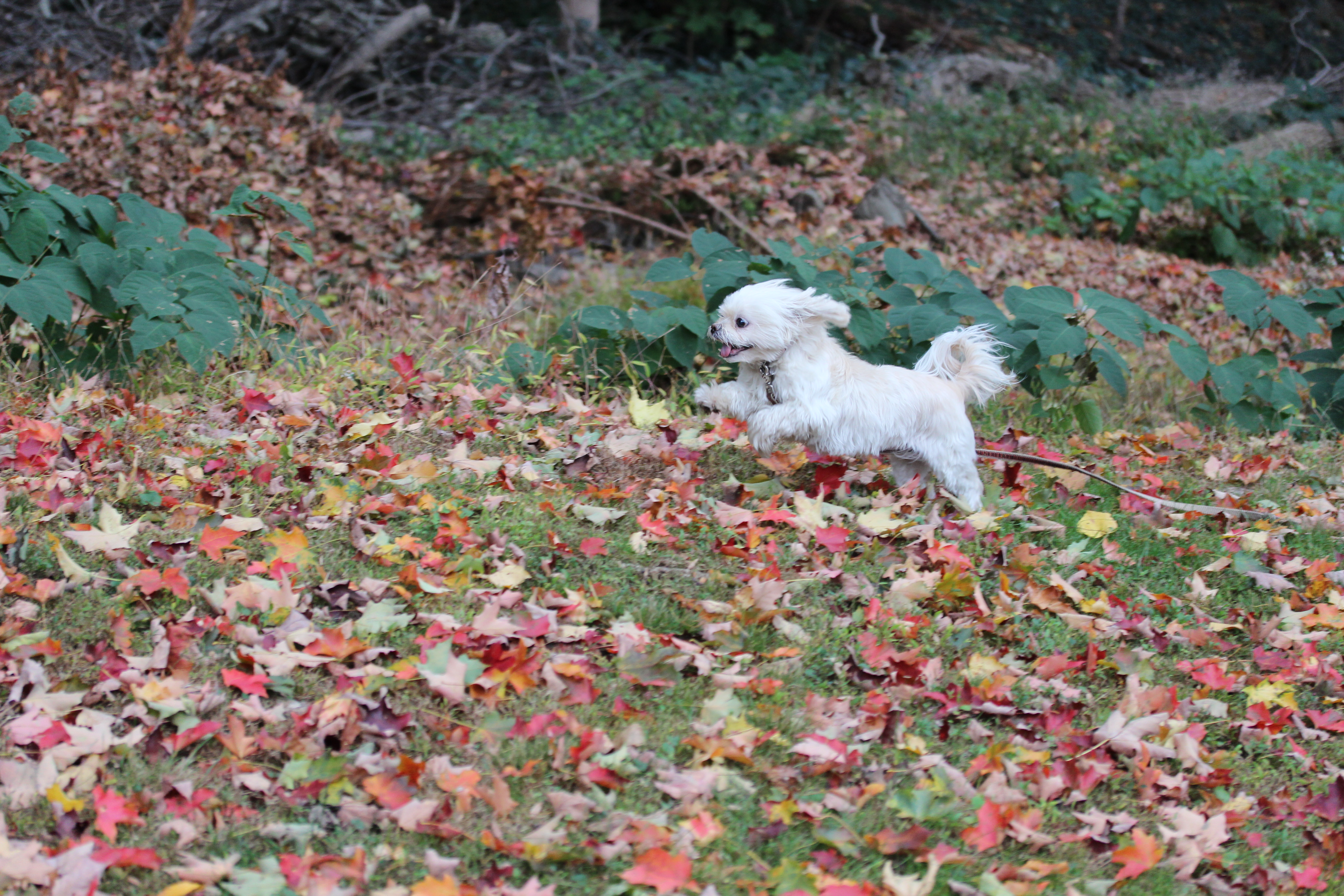
Butterfly thinks grass and leaves would make a wonderful ballet surface!

Butterfly thinks grass and leaves would make a wonderful ballet surface!

I kind of like the idea of dance classes over obedience training for dogs. They could build up their core muscles and have fun and make friends. I never really saw the point of teaching my dogs how to walk at my heel. I’d rather they got to listen to music than listen to clickers. And the tutus would be adorable!

Wouldn't Butterfly look cute in this outfit? (not my picture)

Wouldn’t Butterfly look cute in this outfit? (not my picture)

How do I make the blog into a book?

What I like most about writing this blog is that it leads to conversations with people all around the world. I get advice, and sympathy, and connection, and crankiness, and humor, and on and on, until my three page investment turns into days of feeling like I am not at all alone.

pix from eos 006

“Look at all of our friends!”

The blog has taken the shape it has as a result of both the comments I get and the blogs I read. I’m not isolated or impervious; I absorb what I read and what I see and, mostly unconsciously, I challenge myself in response. The community aspect of blogging is so satisfying, but I still feel like a second tier writer, because I haven’t been accepted by the cool kids at the publishing houses and literary magazines.

“So not cool.”

I’ve been getting rejection letters from agents and publishers, telling me that I am a wonderful, talented, exquisite writer, but… but what? Isn’t that what I’ve spent my life working towards? Isn’t that the point? I can’t even begin to understand the market forces that turned publishing into this quagmire, whether there are just too many writers trying to get published, or too few publishers willing to take a risk.

When I was first looking for a graduate program in creative writing, and collecting rejections from the schools I’d applied to, I was told that MFA programs weren’t interested in my writing ability, they were interested in the uniqueness of my story. The writing, they believed, they could teach me, but they couldn’t teach me how to be interesting. I think agents and editors have taken the same view. They’re looking for a hook, a unique story, something the world is currently clamoring for, and if they have to rewrite every word, so be it. Most of them have graduate degrees in writing themselves.

It has been suggested to me that I try to make this blog into book, because dogs are popular lately, because people seem to like my blog posts, and because my novels are not getting picked up. But I don’t know. It feels like I’d be trying to make a piano into a guitar.

I’ve been reading through my blog posts from the beginning, and I’m not as disappointed as I was afraid I would be, but I’m also not magically coming up with an idea for how to structure it. Is it a book about writing the blog, or is it a book of the blog, not self-conscious, not even revised so much as sewn together?

My Delilah

Delilah is perplexed.

When I first started the blog, I was squeamish about memoir writing. One of the things I like most about writing fiction is that I can change things for the better. I can make up lives that I would want to live. It took me a while of writing blog posts to get desperate enough and brave enough to put more memoir and risk into the posts; to tell people who I really am, when I’m not just trying to be acceptable. And a lot of people reached out to me as a result, and showed deep understanding and compassion for me that I would never have gotten if I’d left out the painful parts.

Samson chewing on my brother.

Samson chewing on my brother.

I had a creative non-fiction teacher who said that the best way to write an essay is to bring two separate ideas together, and the drama and surprise will come from the place where the two ideas meet. I kept that in the back of my mind, not really getting it, until maybe a year into writing this blog. I started to notice that no matter how unrelated my chosen topic seemed to be to the theme of the blog – dogs – as soon as I forced myself to find a connection, the essay came together. For some reason, just writing about each topic that interests me can get bogged down, tedious, and flat, but when I try to combine it with the dogs, I find new things, new angles, that I didn’t know were there.

Dina

Dina always had her own way of seeing things.

Miss Butterfly.

Miss Butterfly brings socks and warmth.

Miss Cricket.

Miss Cricket makes everything more interesting.

I feel like every six months or so, I let myself reach down another level, admitting things that are scary to admit in public, showing another layer. And I’ve needed to do it this way, at this pace. I can only push my boundaries a little bit at a time, and only when I feel ready. I think there’s still a lot of room for me to grow, and that makes me worry about turning this into a memoir too soon.

I don’t want to lose this.

Harrumph.

Harrumph.

Cricket is an Honorary Human Now

In her early middle age (she is almost nine years old), Cricket has developed the most common human disorder, lower back pain. She has always known she was a human, and now she has proof. Unfortunately, when she first started to exhibit symptoms, I had no idea what I was looking at and started to imagine the worst.

Cricket, the pulling machine.

Cricket, the pulling machine.

First she threw up during her mid-day walk, which isn’t that unusual for her, but then, out on a walk she did this funny thing where she walked backwards three steps and sat down, demurely, on top of her back feet. As soon as we returned to the apartment she ran under the couch, to her apartment, and stayed there. Even when chicken treats were offered, she didn’t leave her apartment. I had to bring her room service. Normal, for Cricket, is staring at the treat bag until it opens, then jumping up and trying to climb my leg to get to the treats. This sad looking dog under the couch was someone I didn’t know.

couch dog.

couch dog.

"Ouchy."

“Ouchy.”

I did a full body check on her to see if any particular part was sore, but she didn’t yelp or grumble at any particular point. She seemed to recover a bit on her next walk, running and barking at our neighbors, but still, she was strangely subdued indoors, and not up to jumping on the bed that night.

The next morning, Friday, we called the vet’s office and they said that Cricket’s regular doctor wouldn’t be available until Monday morning, and since Cricket seemed to be doing better we decided that would be soon enough.

We went out to Friday night services, after a day of watching Cricket go almost back to normal. I even thought we might be able to cancel her doctor’s appointment. But when we came back home, Cricket jumped up to greet her Grandma, and started to cry in pain. I sat down on the floor with her, but she walked backwards and kept crying; until she saw her sister sneak out the open front door of the apartment and start down the stairs. Cricket immediately stopped crying and ran to the top of the steps to catch Butterfly, but then she balked again.

I carried Cricket down the stairs and outside for her walk, but she just kept sitting down on her feet and looking very frightened. I had to carry her back up to the apartment. Her whole body was vibrating, and she was gulping air. I put her on my bed and she struggled to find a comfortable position to sleep in, dragging her back legs behind her to each new location. I had nightmares about dying dogs all night long.

"Mommy, I don't feel good."

“Mommy, I don’t feel good.”

When I took the girls out early Saturday morning, Cricket still looked frightened and her back feet started to twist, as if she was walking more like a ballet dancer in toe shoes than like her usual tomboy self.

The thing is, I kept worrying that her symptoms were neurological, because of the walking backwards, and the twisted feet, and the fear in her eyes. I was afraid we’d find out that she had Lyme disease (because she’d been bitten by a tick two months earlier when I forgot to give the girls their monthly meds). I was pretty sure the whole thing was my fault.

We called the vet to see if Cricket could have an emergency appointment, and they scheduled us in for Sunday morning.

All day Saturday, Cricket’s symptoms only got worse, and it was a relief when it was finally Sunday morning, and we could take her to the doctor. Well, it was a relief to me. Cricket hid under the bench in the vet’s waiting room as usual, and had to be dragged out to stand on the scale and check her weight. She’s vain, and that scale is so public!

In the examining room, she did her best to hide behind me, which is normal for her, and the vet tech was able to, easily, put the blue muzzle over her head for the exam, which is not normal at all. In the past, Cricket has been able to pop those things off with one paw grab, and a defiant twist of her head, but not this time.

The doctor did a neurological exam to see how Cricket walked and stood and responded to being in different positions, and she said that, neurologically, everything was fine. But I wasn’t ready to believe her. She wanted to do an x-ray, to make sure there was no arthritis or orthopedic issues, and help her to make a diagnosis, and I agreed whole heartedly with the plan.

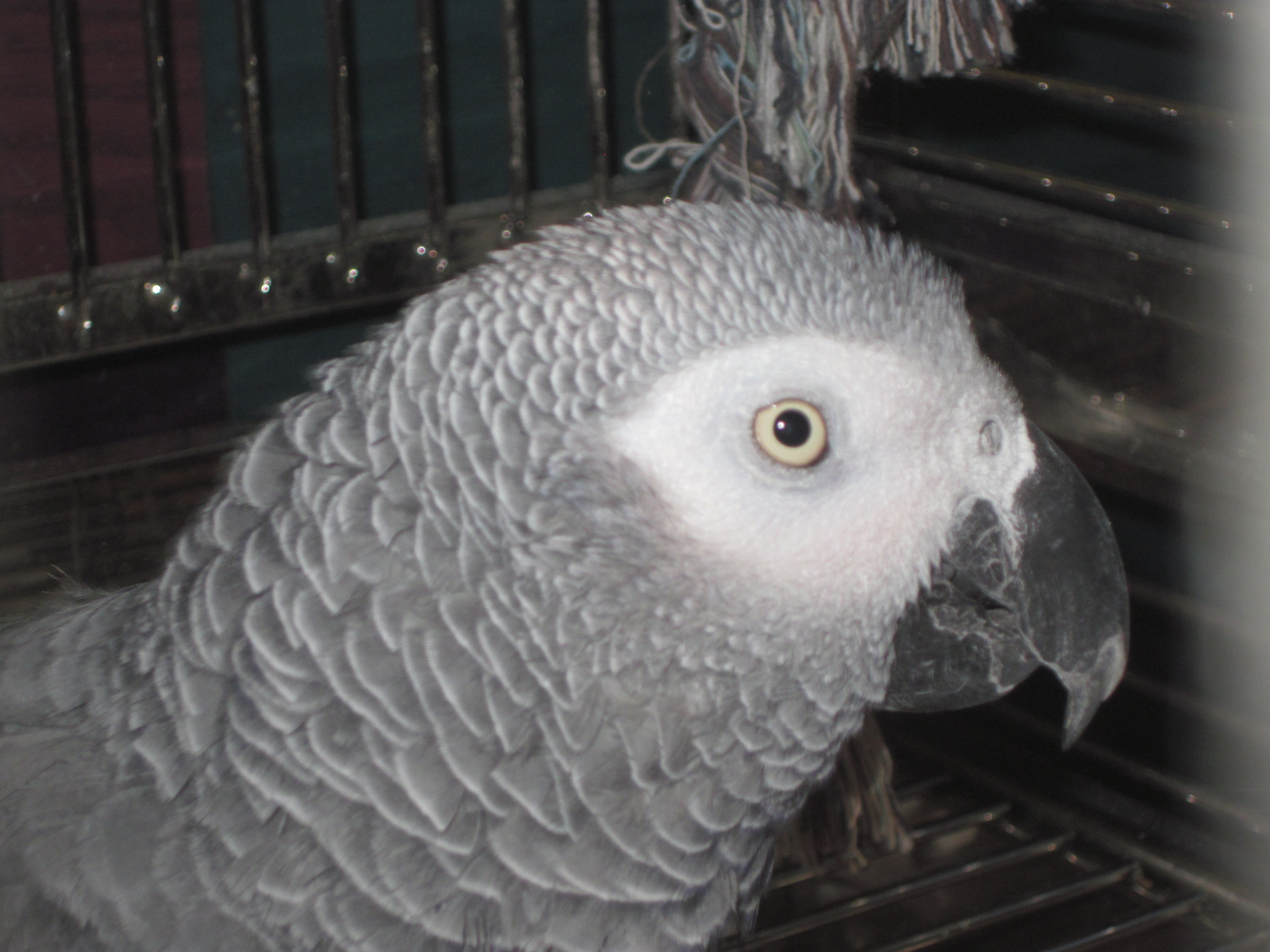
The doctor gave Cricket a shot of a pain reliever that would calm her enough to allow them to do the x-ray, and then we all waited in the waiting room, with Boopy the African Grey parrot, until the meds kicked in. Boopy is a scratchy glutton, just like Cricket. He stood right next to the bars of his cage and stared at me, then lowered his head for scratching. When I was too slow to comply, he stomped one of his feet, and then lowered his head again.

Boopy is very demanding.

Boopy is very demanding.

"I'm waiting, human."

“I’m waiting, human.”

Cricket’s x-rays were perfect, meaning they showed no arthritis and no other issues with her hips or legs, which meant that we could assume the problem was with a disc in her back. I still didn’t believe it, though. I don’t mean that I argued with the vet, or refused the meds she prescribed (Prednisone and Gabapentin), I just wasn’t sure any of it would help.

The doctor told us to limit Cricket’s movement, either by keeping her in her crate (which we gave away years ago because she used to climb up the sides trying desperately to get out), or keeping her in a small room where she couldn’t crawl under or climb over anything (there is no such room in our apartment). The vet also said that Cricket shouldn’t crawl under her couch, and I just couldn’t imagine that. The only place Cricket had felt safe for the last few days was under her couch.

A cozy couch, and a soft tushy to lean on, that's what Cricket needs.

A cozy couch, and a soft tushy to lean on, that’s what Cricket needs.

When we came home, of course, Butterfly sniffed Cricket all over, in her armpit, under her ears, to find out where she’d been and what Butterfly had missed. Clearly it was nothing good, so Butterfly could relax on the floor, knowing she’d had the better part of the deal.

"What is that smell?"

“What is that smell?”

We gave Cricket the first dose of Prednisone right away, with a big serving of peanut butter, and pretty soon, she thought she should be able to jump off beds again. She still couldn’t jump onto the beds or climb the stairs, but whatever independence she could manage she wanted to have. The frightened look was gone. The vet really had got it right, thank god.

The vet warned us that the Prednisone would make Cricket eat and drink more, and therefore pee and poop more, and within a few days, Cricket became the queen of poop, outperforming her sister, by a lot. She was feeling better every day, by literal leaps and bounds, and she was convinced it was because of the peanut butter, and therefore I should give her more.

Peanut butter heals everything.

Peanut butter heals everything.

Pretty soon, I’ll need to start her on a physical therapy regimen to build up her core muscles. For some reason, the physical therapists for humans are unwilling to work with Cricket, so I will have to do this myself, with the aid of many many chicken treats.

I guess being an honorary human doesn’t count with some people. Harrumph.

"What do you mean, I'm not human?!"

“What do you mean, I’m not human?!”

Children’s Television

When I was seven years old, I inherited my parents’ old black and white television set. I could never fall asleep as early as everyone else in the house, so I watched whatever was on until Johnny Carson at 11:30 PM, when I could relax. I felt like he could see me through the TV, and therefore I wasn’t alone. I’d leave the TV on as a night light, waking up at Three AM to the buzz of the target on the screen.

I had a philosophy teacher in college who told us that people who leave the TV on for company are fooling themselves, but I didn’t like him anyway.

Delilah, my childhood Doberman pinscher, used to sleep on my bed during the day, so she watched TV with me sometimes. I don’t think she cared much for it though. Maybe she liked the steady hum of the TV in the background of her dreams. She just liked being with me, especially if I had snacks in my room, or was up in the middle of the night. In a way, I was the TV show she watched.

My Delilah

My Delilah

From an early age, I would read through my TV guide with a highlighter and count up how many shows I could look forward to in the coming week. My favorite issues of the magazine were the ones at the end of the summer that previewed the new shows for the fall. It was just like getting my new school books in August and being able to preview all of the potentially exciting homework for the year ahead, and similarly disappointing by October and November when school and TV turned out not to be as wonderful as I’d hoped.

“Rachel, someone peed on these hastas! This is much more interesting than your TV shows.”

I never felt satisfied by children’s television. There were times, watching The Smurfs, where I saw glimpses of my real life, in the tininess of the smurfs compared to the enormous Gargamel, but most of the time, shows for children portrayed us as super powered beings, as if the average eight-year old could overcome abuse and war and neglect without any help. I needed Wonder Woman to come to my house and help me, not to always be helping the government. I needed the Bionic Woman to hear me with her super hearing, and run to scoop me up, and jump out of the window with me in her arms. And I needed some explanation of how these children on TV were able to survive, because it didn’t make sense to me.

I didn’t like the way the adult characters in kid’s shows talked so slowly and with such simple language, as if I were an idiot. That’s not how real people talked. I liked Cookie Monster, though, because he would start out counting and then just start shoving cookies in his mouth and losing control. This I could relate to.

My Dina, the peanut butter monster!

My Dina, the peanut butter monster!

I watched mostly shows meant for adults, instead. I felt like these were my teachers. In school we never talked about real life. There was no discussion of how often to take showers, or which clothes to wear, or how to earn money, or how to make friends. There was an endless list of rules that everyone else seemed to live by automatically, and I couldn’t find the list anywhere.

“Hygiene is overrated, Mommy.”

I loved The Love Boat. I didn’t understand that it was unrealistic. I thought the floating, fizzy feeling of the show was completely possible in real life. Even when dark things happened, the tone of the show was never dark. And a little girl got to live on the ship, and be doted on all the time, and her Dad was the captain, and there was a cruise director planning activities, and everyone was so happy to be there.

For some reason I really liked The Fall Guy with Lee Majors as a bounty hunter. I liked that his job was to catch bad guys, and that he worked so hard to do it. In my real life, the adults I knew would have given up as soon as it started to look difficult or dangerous. I loved his persistence.

My favorite shows were the ones that made better lives seem possible. Like on Kate and Allie, where these two divorced Moms, with three kids, shared a house. I loved the idea that friends could be your family, and that you could depend on them and not have to survive on your own. On One Day at a Time, a divorced woman moved out with her two teenage daughters to live in an apartment in the city, and it was not sugar coated at all. The point of the show seemed to be that women can do this; they can start over, even when it’s hard, even when things go wrong along the way. And I wanted to believe in that.

I still believe in the transformative power of TV shows, but I think we need a better idea of how to present it. Two dimensional images on a screen are not enough. Maybe the images could be projected, like holograms, into the room. Cricket and Butterfly would love that! We’d need a less furnished room to watch TV in, so that the characters wouldn’t be projected onto the coffee table or impaled by a lamp. And maybe there could be a device we’d wear, like a sensor on our foreheads that would see how we’re feeling and pick a show to fit our needs. Cricket would get a laser light show, so she could chase the lights around the room until she was exhausted, and then there’d be soothing music to help her take a nap. Butterfly would get bird songs, in stereo, all around the room. And she’d need some smell-o-vision, and a treat dispenser, and maybe an automatic scratchy hand she could go over to when she’s itchy.

Butterfly and her buddies are ready to watch TV.

Butterfly and her buddies are ready to watch TV.

Cricket's not so sure about this arrangement.

Cricket’s not so sure about this arrangement.

And for me, as a kid, I would have loved to have recognition that I was there in the room, and that I mattered; that the TV show only came to life because someone was watching it. Even better, a character on the TV could wave to me, and say, Rachel looks tired, maybe we shouldn’t have a smash ‘em up car chase right now, let me go get my acoustic guitar.

“I like acoustic guitar too, Mommy.”