My glasses broke. I’ve had the same pair of glasses for a very long time, because I like the frames and because my prescription hasn’t really changed in years, so I got lulled into believing they would last forever. As soon as the frames broke, and one of the lenses fell into my lap, I panicked: It’s the end of the world! God hates me! I will never see clearly again! I’ll have to feel my way across Israel in a fog!
“Oy. Mommy’s losing it.”
I tried taping the frames, and then Mom went the extra step and tried gluing them, but it was hopeless, until Mom asked if I had a back up pair and I remembered that there was an old pair of glasses in my cabinet-of-lost-things and when I put the glasses on, I could at least see where I was going.
This all happened on Saturday night, early Sunday morning, so I had plenty of time to wallow in my helplessness and ruminate on my inability to function in the real world and think about how useless I would be out in the wild (I don’t know where the idea came from that I would be dropped out into the wild, possibly by helicopter, to survive on my own, but I have always had this image in mind and have always been convinced that it would not go well).
The next morning, we went to the Pearle Vision Center nearby (almost around the corner, though I’d never noticed it before), and asked if they could fix the frame (yes, but it would take two weeks and the fix would only be temporary), and then if I could get a new pair of glasses a bit sooner than that (since I would be leaving for my trip in fifteen days), and they said they could get the glasses done by Tuesday or Wednesday, depending on when I could get them a copy of my prescription.
I chose frames, and then the woman in charge immediately chose different frames for me (probably more expensive, but much nicer than the ones I’d chosen for myself, and I was in no mood to quibble), and then she gave me a store card and wrote out the email address and told me to have my eye doctor send them my prescription as soon as possible.
When we got home, I was actually able to find my prescription from the original-now-broken glasses, and I was able to send it to her right away and pay for the glasses over the phone, and she told me I’d get a text when the glasses were ready.
In the meantime, everything was a little blurry. I’m nearsighted, so even with the out-of-date prescription, writing and reading up close were fine, but there was no way I could read subtitles on TV, and individual figure skaters looked like fuzzy twigs. Fortunately, Hallmark movies, with all of their bright colors and constant sound were perfect. Driving was also, surprisingly fine, though I didn’t risk taking any long trips.
It was lucky that this happened now, instead of when I’m away in Israel, but it also reminded me of all of the things that could go wrong and set off waves of panic. Except, while my internal experience of all of this felt chaotic and frightening, Mom said I was handling it all really well, asking the right questions, speaking clearly, making solid decision, etc. I wish my internal experience reflected that, but it’s reassuring to know that even if I’m freaking out, I seem okay on the outside. I just wish I could feel as calm as I look, because then there’d be so much more I could do. Anxiety is really exhausting.
“This is news to you?”
If you haven’t had a chance yet, please check out my novel, Yeshiva Girl, on Amazon. And if you feel called to write a review of the book, on Amazon, or anywhere else, I’d be honored.
Yeshiva Girl is about a Jewish teenager on Long Island, named Isabel, though her father calls her Jezebel. Her father has been accused of inappropriate sexual behavior with one of his students, which he denies, but Izzy implicitly believes it’s true. As a result of his problems, her father sends her to a co-ed Orthodox yeshiva for tenth grade, out of the blue, and Izzy and her mother can’t figure out how to prevent it. At Yeshiva, though, Izzy finds that religious people are much more complicated than she had expected. Some, like her father, may use religion as a place to hide, but others search for and find comfort, and community, and even enlightenment. The question is, what will Izzy find?
In anticipation of my Israel trip, and to try to allay some of my overall anxiety, I decided to do a practice run at packing. I planned it for the two-week Sukkot break from teaching (after the Jewish High Holidays), on the assumption that full days would be filled with perseverating and procrastinating, which they were.
Earlier in the summer, I went through a marathon effort to research everything for the trip, watching endless videos about where to go and what to bring and how to pack it correctly, and then I spent way too much time on Amazon buying all kinds of things I was sure I would need. In my defense, the high level of anxiety made it very hard for me to think clearly, which also explains why I ended up with multiples of a bunch of things, because I forgot what I’d already ordered.
“Why couldn’t you have forgotten to take me to the groomer?
The goal of the practice packing was to : 1) figure out if I could take just a carry on and a personal bag, or if I’d need a bigger suitcase that I would have to check in (which all of the videos told me not to do); and 2) to see if there was anything I’d forgotten to buy (like quart-sized Ziploc bags, for packing liquids and medications, according to the rules).
But first I had to recover from my Yom Kippur cold, and then watch guiltily as Mom suffered from her own version of the cold, and then I had to catch up on errands that I’d had to put off during the holidays and the ensuing sick-in (like laundry and food shopping and multiple trips to the drug store). And then I had no more excuses. Except, I still couldn’t even look at the pile of stuff from Amazon that had been living on my treadmill for months, or at the packing list I’d made after watching and rewatching and summarizing and analyzing all of those videos.
I tried to think of ways to make the task more manageable, to Bird-by-Bird it, the way I do with everything else that overwhelms me (I know that Anne Lamott meant her wisdom to be used specifically for writing projects, breaking down a big project into smaller tasks, bird by bird, but for me it has become a helpful way to portion out all kinds of difficult tasks). But even the thought of looking at my packing list, or opening the bag of compression packing cubes, set off images in my mind of being pulled out of the security line by giant men with mustaches (for some reason), and stun guns.
Finally, in a moment of desperation, I poured all of the Amazon items onto my bed, so I could go through them and see what I had actually bought. The two extra crossbody bags and the extra power adaptor made me feel silly, it’s true, but it wasn’t as bad as I’d feared. Most of the things I’d bought were useful, if not strictly necessary. And I was able to use the packing cubes (multiple sizes of mesh zipper bags) to help keep things organized, and allow me to pack one small bag at a time instead of a whole suitcase.
The easiest place to start was to pack the things I wouldn’t need to use in the next few weeks, like the travel-size Waterpik, and the long skirt, and the foldable water bottle (why did I think I’d need such a thing?). And then I added in socks and underwear to fill out the bag, and because I remembered my high school friend (the one I’m going to visit in Israel) telling me about a long trip she took where she made sure to pack thirty pairs of socks for thirty days (her father owned a sock store), I threw in a few extra pairs of socks, for luck.
I knew I couldn’t pack my prescription meds until the last minute, especially because I’d decided to go with the strictest recommendations, which said to bring the actual bottles instead of pre-packing pill cases and bringing the prescription labels, so I typed up the (also recommended) list of all of my medications, and doses, and doctors names, and phone numbers. And then I filled a pill case with all of the over-the-counter medications I might need on the trip (allergy meds, Tylenol, probiotics, etc.), and labeled each compartment so I wouldn’t accidently confuse the Benadryl with the probiotic. And then I packed an empty day-by-day pill case, to fill once I get there. The very specific, and endless, rules around how to pack medications and liquids make me worry that if I do something even a little bit wrong, I’ll be arrested and accused of drug trafficking, because I am clearly planning to smuggle anti-depressants and thyroid medication to sell on the black market in Tel Aviv.
By the time I’d finished practice packing the meds, and the liquids (in flexible silicone bottles that came with their own labels too!), I was exhausted, but at least I had a better idea of what I’d forgotten to buy (the Ziploc bags), and I’d resolved some of the conundrums I’d left hanging for months (should I bring the prescription bottles or just the labels and a pill case). I just took a few more minutes to shove a few outfits into my suitcase to see how much would fit, and then I declared myself finished.
It still doesn’t feel real that I’m going to be in Israel in a few weeks, though. Just like it doesn’t feel real that all of the living hostages are finally home. It takes me a long time to process things like this, and it doesn’t help that I’m already seeing reports about Hamas reasserting itself in Gaza, and killing their Palestinian enemies in the streets. I’m also not hearing much optimism about Hamas actually returning all of the bodies of the murdered hostages or agreeing to disarm. But I can’t do anything about that, or about many of the other things that are causing me so much anxiety, but I can pack my suitcase, and unpack it and repack it, and make sure I have enough socks and Tylenol and shampoo to make it through my trip. For now, I guess, that will have to be enough.
“You could order more chicken treats. I’m sure that would make you feel better.”
If you haven’t had a chance yet, please check out my novel, Yeshiva Girl, on Amazon. And if you feel called to write a review of the book, on Amazon, or anywhere else, I’d be honored.
Yeshiva Girl is about a Jewish teenager on Long Island, named Isabel, though her father calls her Jezebel. Her father has been accused of inappropriate sexual behavior with one of his students, which he denies, but Izzy implicitly believes it’s true. As a result of his problems, her father sends her to a co-ed Orthodox yeshiva for tenth grade, out of the blue, and Izzy and her mother can’t figure out how to prevent it. At Yeshiva, though, Izzy finds that religious people are much more complicated than she had expected. Some, like her father, may use religion as a place to hide, but others search for and find comfort, and community, and even enlightenment. The question is, what will Izzy find?
I’ve been reading through piles and piles of notebooks, and files and files on the computer, to see which of my writing projects still spark my interest; and unfortunately, they all do. I can sort of prioritize one, or two (or five) above the rest, but it’s like trying to choose my favorite dog and having to ignore all of the others. How can you look away from that sweet, lonely, hungry little dog?! What kind of monster are you?!
There are novel ideas in the notebooks, and novel drafts on the computer, and drafts of long essays and short essays, and children’s stories, and short stories, and mysteries, and even a science fiction story or two. And along with all of the writing projects, I also have lesson plans to write, and a ton of therapy work I still need to do in order to become the kind of functional adult who doesn’t need to crawl under the bed and hide (which hurts my back, honestly).
This is what happens when I try to open the creaky, dusty, long-closed doors in my brain. I know I have to do this every once in a while, if only to make sure I’m not leaving something important behind, but it’s overwhelming. And, of course, there are endless internal arguments over which ideas have the best chance of getting published, and which ones will be an exhausting waste of time, and why do I have to be a writer at all when I really should be doing something more useful with my life, or at least more practical. But I’ve been a writer since I first learned how to hold one of those fat red pencils in nursery school, and if I stopped writing it would feel like I’d stopped breathing. And, really, even if it looks like I’m standing still, I am frantically kicking my feet under the surface, like a duck; and yet I judge myself only by what other people can see.
At some point, hopefully soon, I will finish this reassessment period and be able to choose a few manageable goals to work towards and put the rest aside. And then maybe I can put off the next reassessment for a while, or at least make sure I’m better medicated by then.
“Chicken fixes everything.”
If you haven’t had a chance yet, please check out my novel, Yeshiva Girl, on Amazon. And if you feel called to write a review of the book, on Amazon, or anywhere else, I’d be honored.
Yeshiva Girl is about a Jewish teenager on Long Island, named Isabel, though her father calls her Jezebel. Her father has been accused of inappropriate sexual behavior with one of his students, which he denies, but Izzy implicitly believes it’s true. As a result of his problems, her father sends her to a co-ed Orthodox yeshiva for tenth grade, out of the blue, and Izzy and her mother can’t figure out how to prevent it. At Yeshiva, though, Izzy finds that religious people are much more complicated than she had expected. Some, like her father, may use religion as a place to hide, but others search for and find comfort, and community, and even enlightenment. The question is, what will Izzy find?
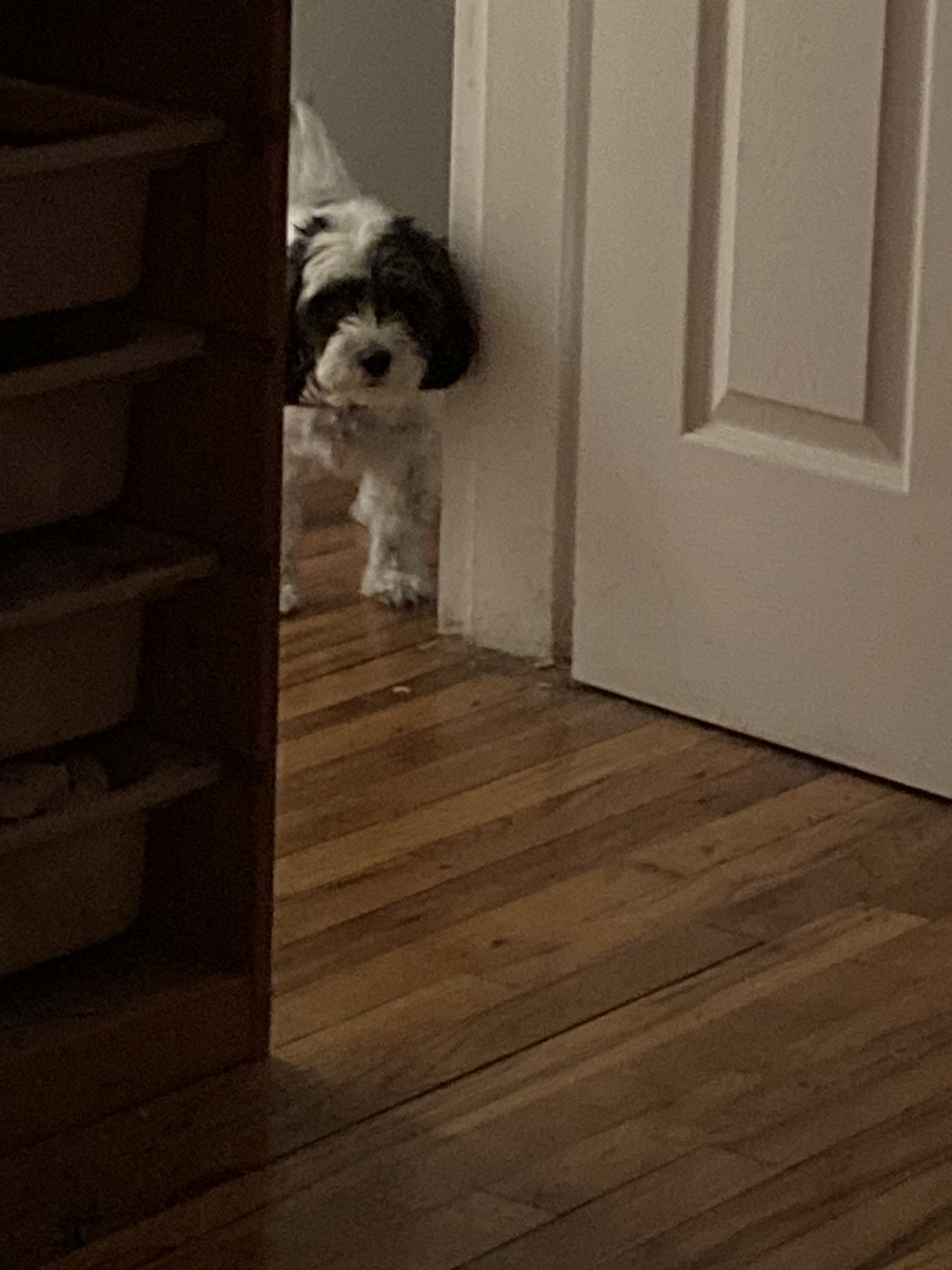
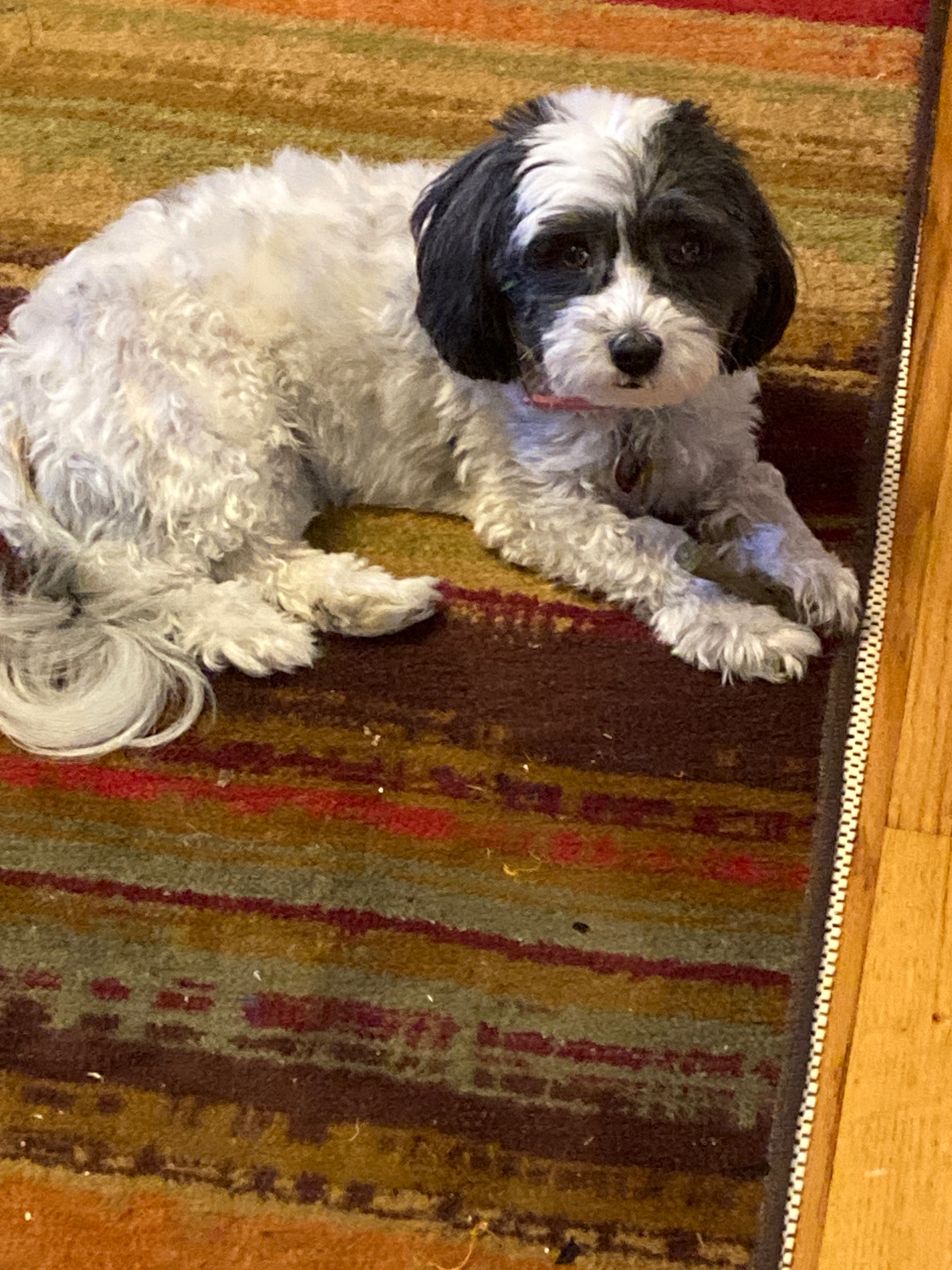
You might remember that a while back I decided to set out a trail of treats for Tzipporah, to encourage her to spend more time in my room. Well now, multiple times during the day and night, Tzipporah sneaks into my room like a phantom, ignoring me completely, looking for her trail of treats; even after she’s eaten all of the treats I’ve carefully placed around the room, she comes back again and again, hoping, expecting, that new treats will have sprouted from the floor. But even though she had a traumatic early life in the puppy mill, I’m pretty sure she’s not living a double life as a murderous phantom taking out her trauma on unsuspecting victims, though one can never be sure.
“Where’d you hide the treats?”
I wish I could convince her that I am friendly and harmless, but I’m also the one who insists on cleaning her tushy when she has an accident, and combs through her hair when she has knots, so she has legitimate reasons for doubt. But even though she doesn’t play with me, or sing at me, like she does with her grandma, she does watch me carefully and sit by my side at the computer, so even if I’m scary, I seem to be fascinating too, which is nice.
She sat with me this summer while I sent out my query letters to potential agents, and while I collected the rejections; and she sat with me as I watched The Rachel Maddow Show each Monday night, and tried to believe her when she said that we can survive the current situation in the United States; and Tzippy was with me when I found out that The Late Show with Stephen Colbert got cancelled (though the show isn’t over until next May, so there’s still some comfort left); and she was with me while I watched the news of the Catholic school shooting in Minnesota, which felt dangerously close to home because I teach in a synagogue that has been under threat for years now, with ever increasing security measures as antisemitism and violence in general have continued to grow.
I’ve been overwhelmed with anxiety this summer, from every direction, but the biggest anxiety seems to come up around planning and packing for my trip to Israel in November. Somehow, I’ve become obsessed with the fear that I’m going to overpack and have my suitcases taken away at the airport, or that I’ll forget to pack something essential that can’t be bought in Israel, though I have no idea what that might be. But my automatic response, when it feels like there are too many things outside of my control, is to try to control the little things, like making sure I have everything I could possibly need for the trip, which means I’ve been spending a lot of time scrolling through Amazon, looking for things I definitely need but have never heard of before.
Now that September has arrived, I’m going to have less time to spend on Amazon, and focus more of my energy on my students, and trying to come up with ways to make my classroom fun and welcoming, so we can keep the world at bay for a couple of hours at a time. I wish I could bring Tzipporah with me to class, but her anxiety skyrockets as soon as she leaves the apartment.
When I think about it, I’m not sure if Tzipporah is the Phantom of the apartment, or if I am, or if there’s some invisible threat that we both feel radiating from the world around us. I’m not even sure if I’m really more anxious than usual, or if there are just so many more echoes of my anxiety in the world around me that it all seems louder and more pervasive.
There was one nice break from the anxiety last week. The weather was nice enough that I was able to take Tzipporah outside to socialize with the neighbors, and Kevin the mini-Goldendoodle did his best to reassure her that he’s a nice boy and only wanted to sniff her nose and invite her to play. She wasn’t any more convinced by him than by me, at the beginning, but by the end of the visit she had relaxed on my lap, and stopped shaking, and she was able to watch Kevin run across the lawn chasing his favorite ball. It was only a few moments, but it was progress, though I’m pretty sure Tzippy’s favorite part of the outing was when we returned to the apartment, and she ran straight to her bed, and, magically, found a chicken treat sitting there waiting for her. That apartment phantom knows my little girl very well.
“I’m not that complicated, Mommy.”
If you haven’t had a chance yet, please check out my novel, Yeshiva Girl, on Amazon. And if you feel called to write a review of the book, on Amazon, or anywhere else, I’d be honored.
Yeshiva Girl is about a Jewish teenager on Long Island, named Isabel, though her father calls her Jezebel. Her father has been accused of inappropriate sexual behavior with one of his students, which he denies, but Izzy implicitly believes it’s true. As a result of his problems, her father sends her to a co-ed Orthodox yeshiva for tenth grade, out of the blue, and Izzy and her mother can’t figure out how to prevent it. At Yeshiva, though, Izzy finds that religious people are much more complicated than she had expected. Some, like her father, may use religion as a place to hide, but others search for and find comfort, and community, and even enlightenment. The question is, what will Izzy find?
It took me three or four years from the first time I printed out a passport application until finally, a few months ago, I went to the post office with my pre-filled-out application, had my official picture taken, and paid all of the fees. The impetus that finally pushed me on my way was the possibility of going on my synagogue’s trip to Israel, and even though I realized that this particular trip was not for me, I realized it was time to apply for my passport anyway, just in case.
And then, a couple of days after I posted about the-trip-I-couldn’t-take on the blog, my best friend from high school renewed her offer to host me at her home in Israel, and take time off from work to travel around the country with me, wherever I wanted to go. I’d actually forgotten that she’d suggested such a trip a few years ago. At the time, I don’t think I believed her offer was real, or I thought it shouldn’t be, because she has her own business, and family, and a full life of her own, and I just couldn’t imagine interrupting all of that. But looking back, I think the real reason I didn’t accept the offer was because I just wasn’t ready. I couldn’t have told you why I wasn’t ready, or what would have to change to make me more ready, but this time, when she offered, I believed her, and I said yes. And, when my passport arrived in the mail a few weeks ago, I realized that I am really, finally, going to Israel.
“You can’t have it, Mommy.”
Of course, being me, now I’m thinking about all of the things that could go wrong on the trip. I printed out a pile of articles on what to pack, and where to go, and what to wear, and I filled my YouTube watchlist with videos on how to pack medications and what to put in your carry on and what to wear on the plane, and yet, I still haven’t scared myself out of going on the trip. It helps that I have some time to prepare. We chose November for my visit because that’s when she has a lighter workload, and the weather is more manageable for me, and flights are cheaper, and there are no big Jewish holidays to complicate things. I feel guilty for planning to go during the school year, and missing one or two classes with my students as a result, but even that guilt hasn’t been enough to derail me, so far.
There’s still so much research to do, and so many decisions to make, and so many opportunities for the panic to overwhelm me. I worry that airport security will want to see all of the prescriptions for my meds, in case I’m hiding opiates in the midst of all of my other pills; and what if I can’t make sense of the Gett app (their version of uber), or the currency exchange rate, or public transportation, and I end up having a panic attack in the middle of the light rail in Jerusalem? And then I wonder if I should make the trip shorter, to reduce the potential causes of anxiety, or if it should be longer, so I can take more time to settle in before trying to do anything too exciting. And then I wonder what I should bring back for my students, and a little voice inside keeps asking, why can’t mommy come with me? And then I think, wouldn’t it be better to win the lottery first, or to wait for a group trip so that someone else can make all of the decisions for me?
With all of my research, I now know that I will need flight insurance, and travel insurance, but I want to know where I can get mental health insurance, or better yet, an app that will figure out when I’m spiraling and send help when I fall apart in the middle of the Carmel market.
I’m trying to keep my expectations for the trip low, so I won’t fall into a deep depression when I inevitably fail to make it the best experience of my entire life. I’d like to think of this more as the first in a series of trips, and a chance to acclimate to the country and plan future adventures. That way, as long as I get the chance to walk through one of the outdoor markets, and shop for new-to-me foods in the supermarket, and sit by the beach or in a café, listening to the different accents swirling all around me, everything beyond that will just feel like a bonus.
The reality is, going on this trip with my good friend is the best part of the plan, because she won’t expect me to suddenly have the energy to climb Masada or swim in the Dead Sea. And if what I really want to do one day is go to the supermarket to search for new snacks and then watch Israeli TV all day, she’ll be right there with me. And, really, if I have a panic attack in the middle of Tel Aviv, I won’t need a mental health app to scoop me up, because she’ll be there to look me in the eye and remind me that the earth not going to swallow me up and with a few deep breaths, and maybe a nap, I really will be okay, and probably better than okay, even on my own power.
Now, back to worrying about what to pack.
“Can I fit in the carry on?”
If you haven’t had a chance yet, please check out my novel, Yeshiva Girl, on Amazon. And if you feel called to write a review of the book, on Amazon, or anywhere else, I’d be honored.
Yeshiva Girl is about a Jewish teenager on Long Island, named Isabel, though her father calls her Jezebel. Her father has been accused of inappropriate sexual behavior with one of his students, which he denies, but Izzy implicitly believes it’s true. As a result of his problems, her father sends her to a co-ed Orthodox yeshiva for tenth grade, out of the blue, and Izzy and her mother can’t figure out how to prevent it. At Yeshiva, though, Izzy finds that religious people are much more complicated than she had expected. Some, like her father, may use religion as a place to hide, but others search for and find comfort, and community, and even enlightenment. The question is, what will Izzy find?
I’m back in my online Hebrew classes and it is such a relief. I didn’t realize how much I missed this imaginary place, this zoom class that exists somewhere outside of space and which I can get to without leaving my apartment. After almost a year away – and such a year – I feel so much gratitude to be back.
Up until the moment class started, though, I wasn’t sure how I would feel. I was already feeling guilty for spending the money on this instead of on ten other things that seemed more important, and I felt needy and silly for wanting to be taught instead of teaching, and I felt ridiculous for not having been to Israel yet after so many years of wanting to go.
And then, because I was out of practice with the time difference between New York and Israel, I thought the class started at 2:30 PM and was surprised when I checked my email and found out that the class had already started, at 1:30, and I was late. I still had to set up my computer and brush my hair and change my shirt (I wear my pajamas all day every day when I’m not at work) and log into the new learning system the school had created while I was away, and by the time I finally popped up on screen I was fifteen minutes late.
But I was fine. No, better than fine.
The class (or the screen) was full and there were some familiar faces, but mostly the faces were new to me, including the teacher. And yet I was able to keep up, and my Hebrew was much closer to the tip of my tongue than I’d feared. We didn’t talk about the news, much, instead we focused on the things we could control, like how to be kind and generous with each other and leave room for making mistakes. I’m a big fan of being treated like a big puppy dog when I make mistakes, instead of hit over the head with a hammer.
“No ouchies for me!”
During my first week back in class I went to every practice group I could get to, which ended up being more than I’d gone to in the two years I’d spent in the program before. I wanted to challenge myself, socially and with my Hebrew, to get back into the stream as quickly as possible. And I didn’t realize until afterwards how easy it was, compared to even a year ago, to manage the social anxiety and fear of the unknown that comes with the practice groups – especially in week one when I had no idea who my teachers or fellow classmates would be. In our regular classes things are more predictable: you get a class list ahead of time, and an introduction from your teacher, and that’s your group for the semester. But in practice groups we’re dropped into breakout rooms with random strangers to discuss random topics and then we’re being tested on things we’ve learned in previous semesters, generally using vocabulary I forgot long ago.
I don’t think I’ll be able to do this many groups every week, both because I have doctors’ appointments coming up and other things I need to get done this summer, but I’d really like to work harder this summer than in the past and push myself and my Hebrew as far as possible.
Except, despite all of the progress I’ve made on my mental health, somewhere around the third or fourth practice group the negative voices in my head returned: Why am I such a loser that I have to pay people to spend time with me and laugh at my jokes, why is everyone else so much more impressive and successful than me, why does everyone else get to be married and have children and travel around the world and have so much more energy and good health than me?
I’m not sure why the negative voices were on pause for the first few days, but at least that gave me a few moments to revel in the joy of being back in class. But then the avalanche of pain made me realize that this was probably why I’d decided to stop taking classes last year. I thought, at the time, that I had run out of ambition to learn more Hebrew, but I think it was more that the classes were bringing up too much internal noise that I couldn’t handle and couldn’t drown out.
The anxiety I used to be so focused on, around making mistakes and saying the wrong thing, seems to have been hiding a much deeper pool of anxiety around all of the things I want to have in my life and believe I can’t have. Being in class seems to bring up so much longing – to go to Israel, to have more friends, to be more successful in my career, and to be in love – and when all of that longing comes up to the surface, my deeply felt belief is that none of that is possible for me.
In the past, when these feelings overwhelmed me, my answer was to turn off the faucet altogether, usually without realizing what I was doing. But now, it seems like my brain is telling me that I am ready for more, or should be, and therefore it’s time to let me know that I want more; but I still feel like the things I long for are impossible, and I don’t know why my brain believes I’m closer to ready.
So, in the midst of seeing real progress, and feeling real joy, I’m also feeling awful at the same time, and it sucks. I’m so frustrated by how long it takes to make progress in my life, and how often I have to stomp the brakes to avoid falling off cliffs that seem to come out of nowhere. I wish I knew how long each step forward would take, and which goals would actually be reachable, because then I could plot it all out on a calendar and be comforted that it’s all going to happen when it needs to happen; but instead I have no idea what will be possible next week, let alone next year.
My brain remains mysterious to me, and I don’t understand what it is about Hebrew in particular that has opened this door for me, but I am committed to continuing to go forward in whichever ways feel possible. So I will make as much of this summer of Hebrew as possible, enjoying the laughter and the challenges and the friendships, and I will also try to make sense of the pain and confusion that come along with them. And I will keep trying to remind myself that this is what progress looks like and feels like, for me, even if I wish it could be different.
“Hiding is always a good idea.”
If you haven’t had a chance yet, please check out my Young Adult novel, Yeshiva Girl, on Amazon. And if you feel called to write a review of the book, on Amazon, or anywhere else, I’d be honored.
Yeshiva Girl is about a Jewish teenager on Long Island, named Isabel, though her father calls her Jezebel. Her father has been accused of inappropriate sexual behavior with one of his students, which he denies, but Izzy implicitly believes it’s true. As a result of his problems, her father sends her to a co-ed Orthodox yeshiva for tenth grade, out of the blue, and Izzy and her mother can’t figure out how to prevent it. At Yeshiva, though, Izzy finds that religious people are much more complicated than she had expected. Some, like her father, may use religion as a place to hide, but others search for and find comfort, and community, and even enlightenment. The question is, what will Izzy find?
I thought I was done with panic attacks. It’s not that I was free of anxiety or depression, but for a long time now I’ve felt like I could handle the difficult things that came up without shattering into a million pieces or becoming paralyzed, but something changed in the past few weeks. I’m pretty sure it started when I tried a new Rheumatological medication (Methotrexate), which was meant to lessen my overall body pain and allow me to exercise more, but instead made me even more exhausted and exacerbated my pre-existing depression and anxiety.
At first, I had no idea where the extra depression was coming from: was it from thinking about adopting a new dog? From watching the news? The exhaustion of doctor visits? Discovering that weight loss medication would remain out of reach? I don’t remember now what finally made me believe that it was the Methotrexate that was sending me into the deep dark, but after weeks of worsening depression I decided to stop taking it and see if things improved, and, gradually, I started to feel better and able to think and write and plan and hope again.
When I called the Rheumatologist to tell her what was going on, she said to wait a few weeks before trying the next medication, which shouldn’t have any of those side effects, and since I wanted to believe her and finally see some improvement in the overall body pain that has seriously restricted my life, I agreed.
But since I’d been taking the Methotrexate weekly, instead of daily, the timeline for it to leave my system was very slow, and in the meantime, I had my first panic attack: a small one, at Whole Foods. I used to have food panic all the time, because of the thousands of different diets I’ve been on, and because of old conflicts around keeping kosher, but after years of working on Intuitive Eating a lot of that noise had calmed down. Except, at Whole Foods (a ridiculously high priced store that rarely has the things I need, but always has fun stuff I want), I got all mishkebobbled by the prices and the choices and I had no idea what to buy. Eventually, I chose a few small things and got out of there as quickly as possible. It was only a small echo of my old panic attacks though, and I was mostly okay.
The second panic attack, also small, also happened around food, this time at the enormous supermarket near my house. I blamed it on Passover, because there was a large section of Passover foods that made me feel like I should buy jars of borscht and boxes of cake mix and cans of chocolate chip macaroons that I would never eat. But, again, the panic passed quickly, and when the effects of the Methotrexate finally wore off I thought I was stable enough to try the second rheumatological medication.
And then the car battery died. This had happened once before, because one of the lights above the driver’s seat goes on accidentally at times and if I don’t notice it right away, and don’t drive the car for a few days, by the time I get back to the car the battery is dead.
This time it happened when I needed to take Mom for a medical procedure, an endoscopic ultrasound of her heart (called a TEE), but the car wouldn’t start and there was no one around to help, and instead of being able to problem solve, or even think, I panicked. Mom told me that she would call a cab, and then call AAA or the maintenance men at our co-op to help me charge the battery, and the idea that I would have to interact with strangers scared me so much that I left my mother and my pocketbook in the car and race-walked back to the apartment to curl up on my bed and hide.
Mom called me from the parking lot a few minutes later to say that the cab was on its way, and that the maintenance men would be able to help with the car in about half an hour, but in the meantime I should come back outside and get my pocketbook, because it wouldn’t be safe to leave it in the car. She didn’t seem to be upset with me, or to understand that I was curled up on my bed in an altered state, but I couldn’t think for myself so I did as I was told and went out to the car for my pocketbook. I was able to give Mom a hug just as the cab arrived, and then I walked back up to the apartment, resumed my curled up position, and cowered in my room.
There was a knock at the door a while later and I jumped out of bed and put on my jacket and answered the door on automatic pilot; some part of me was able to function enough to make chit chat and ignore the bad jokes about my lack of car knowledge. When the guys said I should drive the car around for ten or fifteen minutes before turning it off (and then on again), I did as I was told, even though my pocketbook, with my driver’s license, was still upstairs.
To fill the time, I decided to do a practice drive to the hospital where Mom was having her test done, to make sure I’d know where to pick her up later, and I got stuck in traffic for forty minutes, worrying the whole time that the car would stop suddenly or that I’d get into an accident and have no identification on me. But I made it home safely and turned off the car and waited a few minutes, as I’d been told, and then turned the car back on, successfully (which meant I wouldn’t have to call the maintenance guys again, which was good because I didn’t have their phone numbers). While I was still in the car, taking my first deep breath in more than an hour, Mom called from the hospital to ask if the car was working, because they’d been delaying her procedure until she could assure them that I would be able to pick her up when it was over, and I spoke to the nurse on the phone and reassured her that I would be there on time.
I survived the rest of the afternoon on automatic pilot and picked Mom up from the hospital and got her home safely. I felt awful for having had a panic attack when she needed me, and really scared that this would be my new normal, but most of all I was exhausted and needed sleep. When I woke up from my nap a few hours later I started to wonder if there might be a connection between starting the second rheumatological medication the night before and this latest, much more significant, panic attack. But my brain was telling me that I was always this useless, and I couldn’t come up with a convincing argument to fight back.
Two days later, Mom and I went to a dog rescue event, because my therapist had suggested (insisted) that I go, and because the depression was getting so dark again that I didn’t have the energy to think for myself. We got the address of the rescue event wrong, twice, but finally found it by following the crowd of cars. Once we’d parked and walked over to the row of tents and tables advertising all of the different rescue organizations, I was overwhelmed by all of the noise and people and dogs, and I couldn’t make sense of what I was supposed to do or where I was supposed to go.
We eventually found an enclosure filled with many small and hypoallergenic dogs, along with some full-sized Poodles and Golden Retrievers and a horse-sized Siberian Husky. But none of the volunteers seemed to know how their adoption process worked, or which dogs were still available for adoption, and no one knew about age and weight and health status, except that all of the dogs were probably around three years old and had been rescued from dog meat festivals in Asia (that’s hard to type, let alone to say out loud).
There was a little black poodle mix who was already on one of the rescue’s leashes outside of the enclosure, but when I asked about him a very possessive older woman glared at me and said she was considering adopting him, which seemed to mean he was off limits. Then we saw a little butter-colored dog who looked like the perfect size for us, but another woman had picked him up and held him tight while she looked for a volunteer to help her with the adoption; when she finally found the volunteer-in-the-know it turned out that that dog was already spoken for by someone else. I was getting more and more overwhelmed by the confusion and heat of the day and part of me wanted to leave (or escape), but part of me felt like it was my job to stay there and tough it out.
Finally, one of the volunteers asked me if I’d like to meet one of the dogs and I looked around and saw a little white dog who looked very much like Butterfly, and I chose her. I held her for a while and she was very calm, to the point where she didn’t even make eye contact or react to much of anything. When I put her down on the ground though, she freaked out at a noise I couldn’t hear and almost strangled herself trying to get out of her leash. The volunteer put her back into the enclosure with the other dogs and she sat down against the fencing, near where I was standing, and seemed to calm down again. She wasn’t the dog I was looking for, especially because she looked so much like Butterfly and was triggering all of the old grief and responsibility, rather than the love, but I couldn’t untangle my feelings or get myself to leave her behind in the chaos either. Mom finally found someone who could explain the adoption process, including the $2,000 adoption fee, which is basically what it would cost to buy a puppy from a breeder, and by then the Butterfly look-alike was sitting patiently on a little girl’s lap, so we took a brochure and finally walked away.
The whole time we’d been near the enclosure I’d been beyond thinking, unable to figure out what I wanted to do or what I thought I should do, except that I knew I should adopt all of the dogs, including the big dogs, because what kind of monster leaves a dog behind just because of money or because the world is tilting, or for any other clearly not-good-enough reason. As we got further away from the dogs I started to be able to hear my own thoughts a little more clearly, but I still felt sick and dizzy and angry and confused. I was able to drive home safely, but hopelessness and the long list of things that were wrong with me was rushing through my mind and refused to shut up.
Hours later, on Mom’s prompting, I looked up the side effects for the second rheumatological medication, and depression and anxiety were at the top of the list, despite the doctor’s assurances that this medication would not be a problem, so I emptied the rest of the pills from my pre-filled weekly pill box and crossed my fingers.
It took a couple of days for the worst of the hopelessness to wane, but in a way the damage had already been done. I’d forgotten how bad things could get, and now it was right in the front of my mind. It didn’t help that the day after the rescue event Mom got the results of her TEE and told me that she would probably need surgery to repair or replace her mitral valve (her fourth surgery in three years).
I’m frustrated that these medication trials, which were supposed to help me function better, sent me so close to the brink; and I’m frustrated that this is how it’s been with so many medications over the years; and I’m angry that the one medication that was helping (Ozempic) was taken away; and I’m angry that the doctors still have no name for what’s wrong with my health, let alone any solutions.
But at least I can think again.
I called the Rheumatologist to tell her that I wouldn’t be trying the third medication on her list, at least not right now, because I needed to be in the best frame of mind possible to help Mom through her surgery, and the expected three months of recovery.
Only time will tell if the panic attacks were solely caused by the rheumatological medications, or if, with enough stress, they will return. I’m trying to be hopeful that I’ll be able to handle everything that comes my way this summer, but part of me is worried, remembering how bad it can get. Another part of me, though, is remembering Cricket’s insistent strength, and Ellie’s insistent belief in me and my strength, and holding those memories as close as possible, to inspire me and help me through.
If you haven’t had a chance yet, please check out my Young Adult novel, Yeshiva Girl, on Amazon. And if you feel called to write a review of the book, on Amazon, or anywhere else, I’d be honored.
Yeshiva Girl is about a Jewish teenager on Long Island, named Isabel, though her father calls her Jezebel. Her father has been accused of inappropriate sexual behavior with one of his students, which he denies, but Izzy implicitly believes it’s true. As a result of his problems, her father sends her to a co-ed Orthodox yeshiva for tenth grade, out of the blue, and Izzy and her mother can’t figure out how to prevent it. At Yeshiva, though, Izzy finds that religious people are much more complicated than she had expected. Some, like her father, may use religion as a place to hide, but others search for and find comfort, and community, and even enlightenment. The question is, what will Izzy find?
When I first received a jury questionnaire in the mail, back in the spring, I wrote in the space provided about my various health issues and why it would be difficult for me to manage a full day of jury duty, let alone several days of a trial, and asked to be excused. When I didn’t hear back from them with a request for more information, I thought I’d done enough to be let off the hook. But the jury summons came anyway, on the same day that I’d gotten clearance from the Pulmonologist for my oral surgery, and the summons was dated for the week of the surgery itself.
“Oh, come on, people!”
I was able to postpone the summons for a few weeks, but I didn’t even try to get out of it completely; partly because I felt guilty trying to get out of jury duty, and partly because I didn’t want to go through the humiliation of trying to prove to my doctor that my disabilities are significant. I’d gotten out of jury duty a while back with a doctor’s note, when they were going to send me to Brooklyn (an hour and a half trip each way, by train, in the summer), but I had a doctor I trusted back then, and I knew for sure that I wouldn’t have been able to handle that trip, no matter how hard I’d tried. But this time, it was different, or I kept thinking it was.
I told myself that I’d only have to drive twenty minutes each way, because the court complex is nearby, and I knew the route, and even if the weather was disgusting, I’d be inside most of the time, and sitting. And then my surgery was postponed too, with jury duty coming first instead of second, so I really didn’t see any way out of it.
One of the more stressful things about jury duty, in my area at least, is that instead of being told to come in on a specific day, you are put on call for a week, meaning that every day at five o’clock you have to check the website to see if your number has been called for the following day. But I was lucky, this time, because when I checked the website the Friday before my summons week, I found out that I was being called for Monday, which meant I had the whole weekend to prepare: do the food shopping and the laundry, take extra naps, fill up my book bag with all of the things I’d need, and thank god I didn’t have to wait until five o’clock each day, for the rest of the week, to find out if I’d have to go in the next morning.
“But who’s gonna take me out to pee?!”
I feel like I should be one of the people who is actively interested in every part of the justice system, and in doing my civic duty, and I keep thinking that I should use jury duty as a way to research future novels and learn about police procedure and all that. And, beyond that, I feel like jury duty is an obligation, like voting, and I don’t want to be one of the people who lies to get out of jury duty and then laughs about how juries are all made up of the stupid people who can’t get out of it. But I don’t have much energy, and I have a lot of social anxiety issues that make things like this ten times harder than they should be, and, whenever I’m near a police officer or inside of a court building, I think I’m going to be arrested.
My mom has only been called for jury duty once in her life, and, so far, I’ve been called five or six times. I don’t know how I got so lucky. The first time I’d just graduated from college, and I was really nervous, but also kind of excited. I went through the voir dire, where the lawyers ask potential jurors all kinds of questions to see if they’ll be a good juror for the case, and when they asked if I’d ever been the victim of a crime, I had to say, uh, yeah, and the guilty party got away with it. I thought about saying no, just to see what it would be like to be chosen for a jury, but I’m not a good liar. Another time, I vaguely remember that we were given damp sandwiches and bused to another location that looked like a repurposed elementary school, but I was scratched, again, when they got to the victim-of-a-crime question. There was another time when I had to call in each day, for a week, to find out if they needed me, and they never did. That was probably the worst.
“Waiting sucks.”
Even during my short stints at jury duty, though, it’s become clear that the lawyers just aren’t as interesting as the ones on TV, and the cases aren’t as dramatic or convoluted, and there’s almost never a twist ending, which is just disappointing. Instead it’s a lot of sitting around and waiting. If only I could bring one of the dogs with me for company – though there’s a very good chance that Cricket would get me arrested.
I should have asked for a doctor’s note, because I’m just so tired all the time, and because Mom was still recovering from her second hip surgery, and because the dogs needed me, and because I needed to keep the apartment relatively livable, but I was too chicken. So I went.
I packed diligently: phone, phone charger, jury summons, extra mask, book to read for fun, book to read for serious, notebooks and pens, oatmeal in a thermos (with a spoon), gingerale (in case of nausea caused by anxiety), and wet wipes.
I got to the courthouse a few minutes early and found a seat in a corner of the central jury room, which was, thankfully, well air-conditioned and big enough to leave room for social distancing. Most people wore face masks, even though we were allowed to show our vaccination cards to get out of it, and after a little while of sitting there and staring around the room at each other, we watched a few videos: about jury service in New York and about implicit bias (how we fill in a picture when it is incomplete, based on assumptions that may not be true). And then we waited. A bunch of names were called while I played with my phone: sent an email and a text, did some water sorting and some Duolingo. And then we waited some more. I finished reading my book-for-fun (Rhys Bowen’s God Rest Ye Royal Gentlemen) and another group of names were called, and then we waited again. My phone was running out of power, but I was too scared to go wandering around looking for a place to charge it, so I got some writing done, and read some of the serious book (Karen Armstrong’s The Case for God), and then some more names were called and then we waited again. It was getting close to lunch time by then, and my neck and back hurt, and I was wondering if we would be sent to a cafeteria or let out for the hour and a half for lunch, and wishing I could go home and take a nap. And then my name was called. A whole group of us were led into a smaller, less well air-conditioned room, and I was really worried that we would be sent to do a voir dire right away and miss our lunch break altogether, and my headache would keep getting worse and I’d end up crying, or yelling at someone, or getting myself arrested, somehow. And then a non-descript man came into the room with a big pile of papers and told us that the rest of the cases for the day had been settled, and we would be going home early. There were quite a few hoots and hollers and Praise Gods and then we were called up one by one to get our printed sheet confirming that we had completed our jury service. And that was it.
It had rained at some point while we were deep inside the court building, far from any windows, but the air outside still felt wet and thick as I walked across the street to my hot car, but…I was free!
But even as I was driving home, hours earlier than expected, I wasn’t quite able to process what had happened. Time had slowed down so thoroughly in that big, isolated, jury room, with all of the empty spaces filled with anxiety about what might happen next, and not trusting myself to know how to answer the lawyers’ questions if I was called in to try out for jury and worried I would end up on a five week trial because I was too scared to say no. And then, suddenly, I was free, and I was still awake and aware enough to drive home without needing to pull over to rest, and even though I was a little bit shaky with fatigue, I was actually okay.
And then I was home. Mom and the dogs met me at the door and I was able to take a nap in my own room, with puppies for company, and eat whatever I wanted to eat instead of whatever I could fit into a thermos. It wasn’t the easiest day of the summer, but it wasn’t the hardest one either, after all. All summer long there’s been one challenge after another, and even if it hasn’t been easy, each challenge has been met, somehow. And even though I’d much rather not be in survival mode endlessly, it’s good to know that if I need to survive, I can do it. I just hope I won’t get another jury summons too soon, and Mom won’t need another new hip for a while, and things will start to calm down a little bit.
But…I’m not holding my breath.
If you haven’t had a chance yet, please check out my Young Adult novel, Yeshiva Girl, on Amazon. And if you feel called to write a review of the book, on Amazon, or anywhere else, I’d be honored.
Yeshiva Girl is about a Jewish teenager on Long Island, named Isabel, though her father calls her Jezebel. Her father has been accused of inappropriate sexual behavior with one of his students, which he denies, but Izzy implicitly believes it’s true. As a result of his problems, her father sends her to a co-ed Orthodox yeshiva for tenth grade, out of the blue, and Izzy and her mother can’t figure out how to prevent it. At Yeshiva, though, Izzy finds that religious people are much more complicated than she had expected. Some, like her father, may use religion as a place to hide, but others search for and find comfort, and community, and even enlightenment. The question is, what will Izzy find?
Sometimes I just can’t force myself to do certain things, even if I don’t understand why not, and no one else can understand why not. But I’ve learned to trust that internal voice telling me that I’m not ready, or that I’m going down the wrong path, or that I won’t be able to do what’s being asked of me. I’ve learned to listen for the intensity of the I Don’t Wanna voice, because that can help me figure out if I can overcome it, or if I shouldn’t even try to overcome it.
“What took you so long?”
The problem has been that my therapist (and teachers and friends) can’t hear that voice, and they don’t trust me to assess its accuracy on my own, and they tell me, meaning well, that I should ignore it and do what needs to be done, whether I want to or not, and whether I think I can do it or not. They think I can and should ignore the I Don’t Wanna voice, because they think of it as selfish, or self-destructive, or weak, or whatever else they say to themselves about their own I Don’t Wanna voices. And I hear their judgements and their impatience and their distrust of me, and it feels bad, but that doesn’t change what I can and can’t do.
But I’ve noticed, over time, that the better I get at hearing and trusting the I Don’t Wanna voice, the more clearly I can begin to hear the I Wanna voice. It turns out that I wanna teach synagogue school, even though I don’t know why. I can’t explain it, especially after spending three and a half years and a lot of money getting a degree in social work. And I wanna take online Hebrew classes, even though I can’t see the logic in it, or make a good argument for why this is the right good step forward in my life. I just know that the I wanna voice keeps getting stronger the more that I listen to it and trust that it knows what it’s talking about.
“I wanna have chicken treats!”
I was better at hearing these voices when I was a kid: when I knew I wanted chocolate frosting but not the cake it was sitting on, or I knew I wanted to do more math homework, even if I never got extra credit for it. But I was told so many times not to listen to myself and just do what I was supposed to do: eat what I was supposed to eat, take the classes I was supposed to take, accept the friendships I was offered; and never trust my feelings to tell me what was best. And as a result, I lost track of the I Wanna and I Don’t Wanna voices, and for a long time all I could hear was what other people wanted me to do, and their endless judgments when I couldn’t live up to those expectations, and my own confusion about why I couldn’t do what I was supposed to be able to do.
It has been a very long road back to hearing, and trusting, my own internal voices, and it’s still a struggle. There’s so much more than the I Wanna and I Don’t Wanna voices to listen to, but they all seem to crash around in my head at once, becoming noise without much meaning. I’ve been working so hard on Intuitive Eating for the past year and a half, endlessly trying to hear these subtle voices of hunger and fullness before they become shouts, instead of relying on what I think I should eat to please the diet gods, whoever they may be on a given day. But I still fall into the abyss, almost every day, thinking that my own feelings are untrustworthy and selfish and self-destructive and should be ignored. But, in favor of what?
I guess I’ve reached the point in the journey where I know there’s no other path to follow, even though I still feel all of the guilt and self-loathing for not being able to do what I’m supposed to do. I’ve accepted that I have real limitations and I’ve learned to trust them, instead of pushing forward anyway and just waiting for the inevitable disaster. One sign that I’m on the right track is that even though I still have a lot of anxiety, it’s been a long time since I’ve had an actual panic attack, or even a deep dive into depression.
Part of the internal noise I keep having to fight with is that I so desperately want to be a rational creature, with explanations for everything I do and don’t do, but given how much I don’t understand (about myself, about the world, about science and math and the energies in the universe), sometimes my gut feelings are the only map I have left to follow. I wish I could say that I understand how all of the levers and pulleys of my brain work, and that I know for sure that I’m interpreting my thoughts and feelings correctly, but I can’t. All I can do is keep listening for the I Wanna and I Don’t Wanna voices, as they whisper to me, and show them, through my actions, that I am trustworthy, and that if I choose to ignore them, I have good reasons.
“There is no good reason to ignore me.”
I wish the guilt and self-loathing would shut up already, but I guess they count as internal voices too, at this point. They may have come from the outside to start with, but they are part of my gears and wires now and I need to find a way to respect them too.
Ugh.
“Ugh.”
If you haven’t had a chance yet, please check out my Young Adult novel, Yeshiva Girl, on Amazon. And if you feel called to write a review of the book, on Amazon, or anywhere else, I’d be honored.
Yeshiva Girl is about a Jewish teenager on Long Island, named Isabel, though her father calls her Jezebel. Her father has been accused of inappropriate sexual behavior with one of his students, which he denies, but Izzy implicitly believes it’s true. As a result of his problems, her father sends her to a co-ed Orthodox yeshiva for tenth grade, out of the blue, and Izzy and her mother can’t figure out how to prevent it. At Yeshiva, though, Izzy finds that religious people are much more complicated than she had expected. Some, like her father, may use religion as a place to hide, but others search for and find comfort, and community, and even enlightenment. The question is, what will Izzy find?
I applied for a fellowship related to my teaching gig at the synagogue, which would have included a free trip to Israel this summer, but I didn’t get it. It was a long shot, because I didn’t have all of the prerequisites, but I applied anyway, because my boss recommended me for it, and because I wanted to go to Israel. It was a big reach, though, and I pushed myself to fight for it, and pushed myself to imagine that I could handle the trip to Israel in the heat of the summer, and I got as far as being wait-listed, which isn’t bad. I know I can apply again next year, and, really, three weeks in the heat of the summer in Jerusalem was probably more than my body could have handled, but…rejection is rejection.
“You were going to go to Israel without us?!”
It was painful to feel all of that wanting again, too. I’ve almost gotten numbed to all of the hope and rejection around my writing, but this was a new kind of thing and the anxiety and pressure and hope of it didn’t sit well in my particular nervous system. It’s easier just to not think anything big or new is possible, because then I can go along day by day, living in the present, and managing my small amounts of energy while working on long term goals one step at a time. But hope and excitement and possibility revved me up again, and got me thinking about the future, and all of the things I want (and don’t have yet), and all of the things I can’t have and can’t do.
It’s as if there’s a certain amount of hope my body can tolerate and anything bigger than that is overwhelming and sets up a roller-coaster ride I don’t want to be on. And I’m realizing that I’ve been actively stopping myself from trying a lot of different things, for fear of getting on the hope-and-rejection-rollercoaster. And that’s not good.
“Would I like rollercoasters?”
I envy people who can tolerate more anxiety than I can, because they can take more risks in life without worrying as much about the mental health consequences if they fail. I want to become one of those people.
The sadness I’m feeling now, for the most part, is that I don’t have a plan for how to get to Israel yet, and I really want to go. But this opportunity came up out of nowhere, so maybe others will too. And in the meantime I can continue working on my Hebrew, and saving money to pay for the eventual trip, and most of all working hard to build up my tolerance for the hope-and-rejection-rollercoaster, so I’ll be ready to take the risk when the next opportunity arrives.
“I’ll just rest here while we wait.”
If you haven’t had a chance yet, please check out my Young Adult novel, Yeshiva Girl, on Amazon. And if you feel called to write a review of the book, on Amazon, or anywhere else, I’d be honored.
Yeshiva Girl is about a Jewish teenager on Long Island, named Isabel, though her father calls her Jezebel. Her father has been accused of inappropriate sexual behavior with one of his students, which he denies, but Izzy implicitly believes it’s true. As a result of his problems, her father sends her to a co-ed Orthodox yeshiva for tenth grade, out of the blue, and Izzy and her mother can’t figure out how to prevent it. At Yeshiva, though, Izzy finds that religious people are much more complicated than she had expected. Some, like her father, may use religion as a place to hide, but others search for and find comfort, and community, and even enlightenment. The question is, what will Izzy find?










 rachelmankowitz