Tag Archives: family

The Trail of Treats

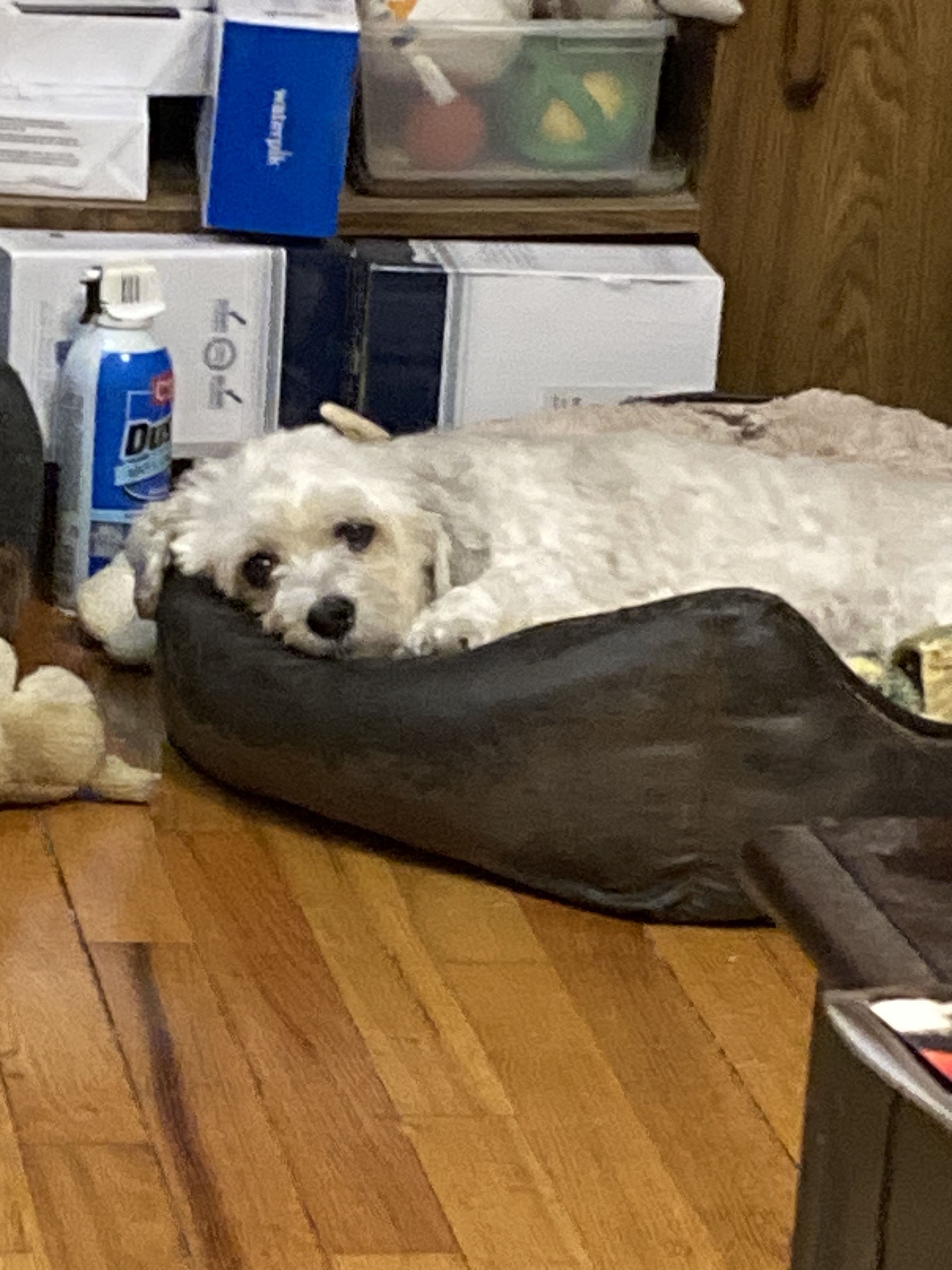
            The latest experiment in my journey to convince Tzipporah that I’m not so bad, has been to place chicken treats at the entrance to my room at bedtime, trying to catch her attention while she’s on her way to or from her Midnight Snack with Grandma. It is an attempt at bribery, pure and simple, but so is most of the clicker training I learned back when we were trying to convince Cricket that she was not the boss of everyone (unsuccessfully, of course).

            There is an old Jewish tradition of giving honey to young students when they first start studying the Hebrew Bible, so that they’ll pair study with sweetness forever after (though the version I heard had the rabbis putting honey on the student’s slates, and the student would lick off the honey with the chalk of the Hebrew letters, which does not sound delicious, or sanitary, so I tend to give my students lollipops instead), and since Tzipporah is much more of a savory girl than a sweets aficionado, I have built my current experiment on the treats she most craves – chicken jerky.

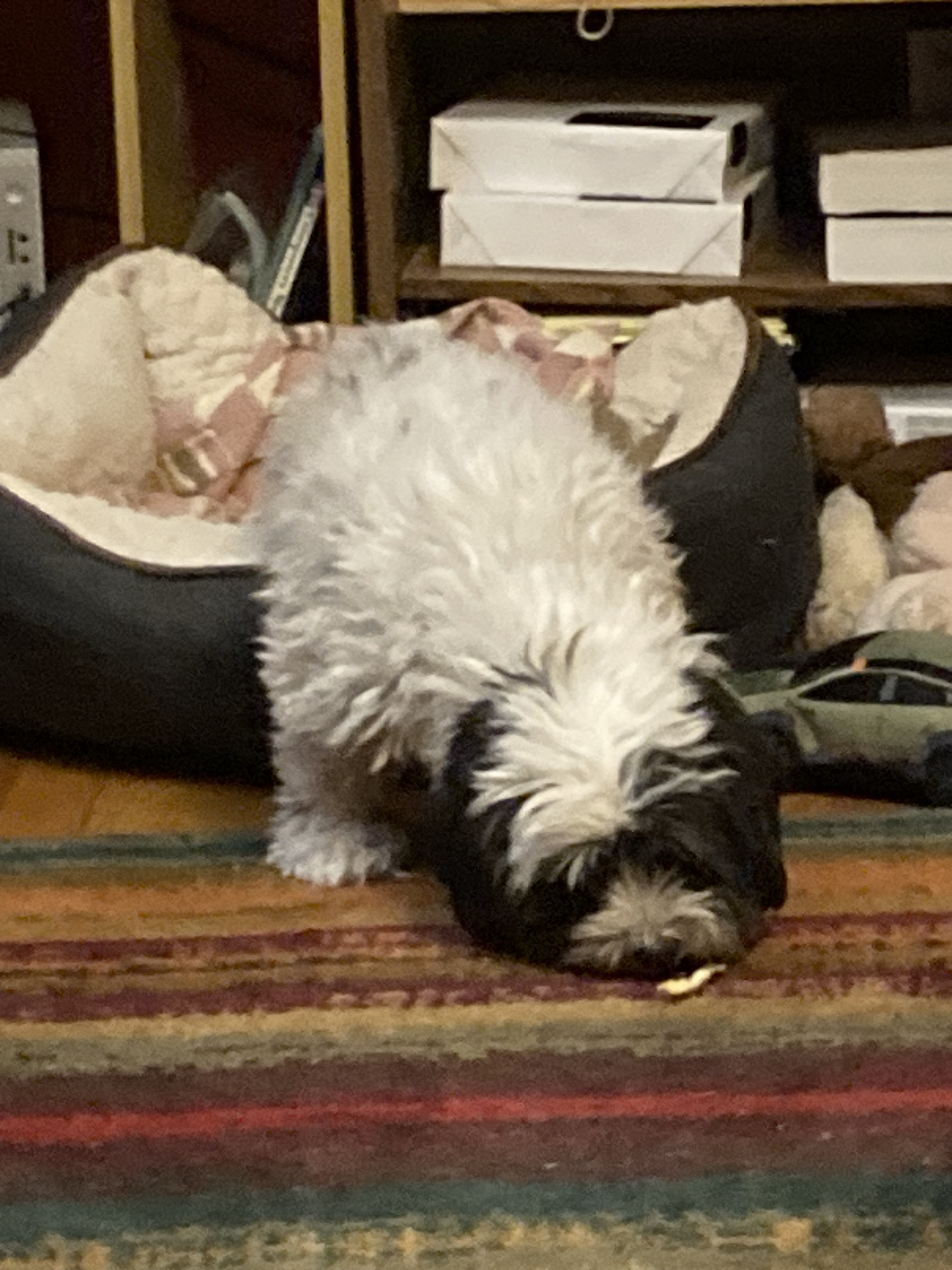
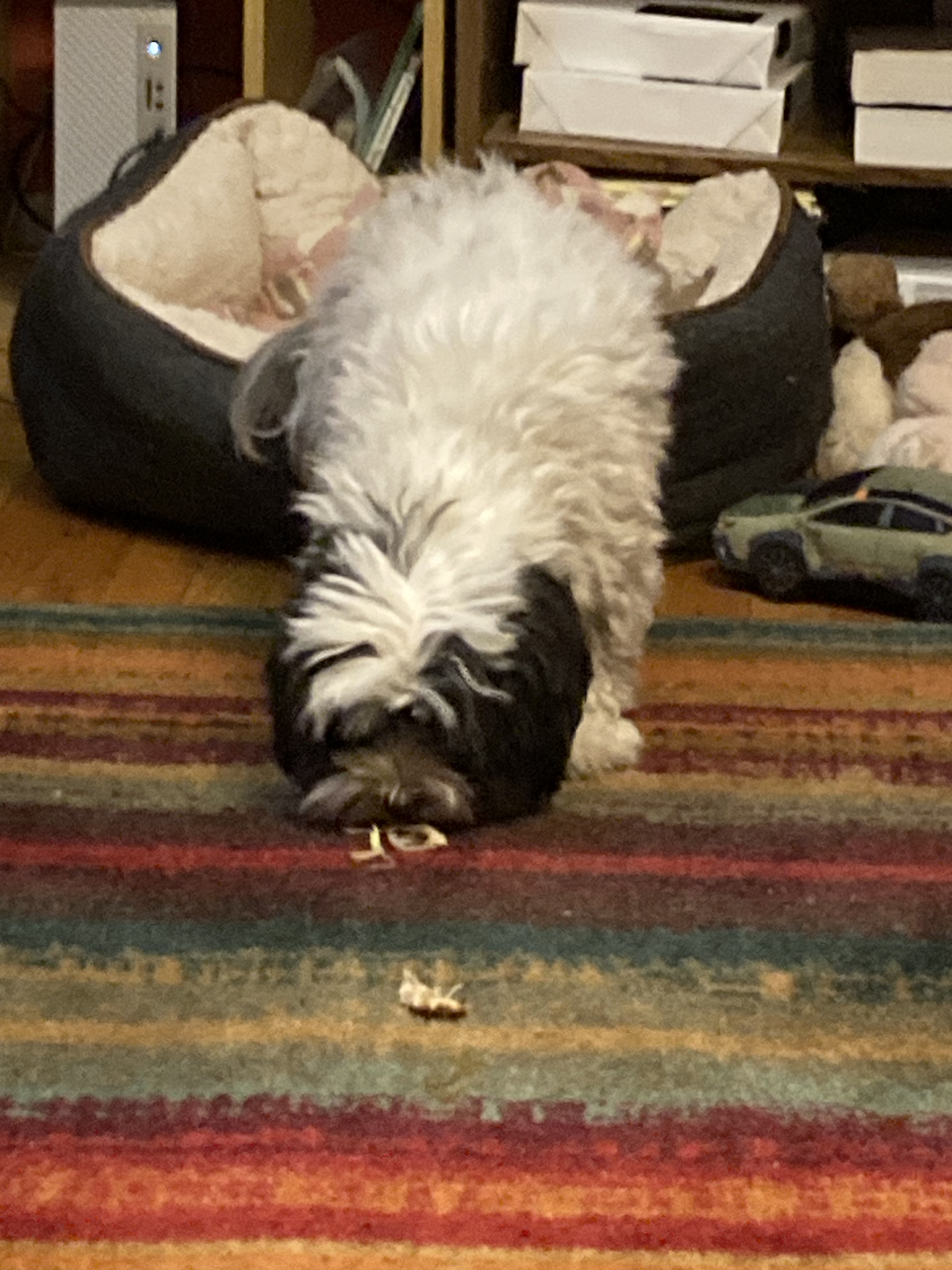
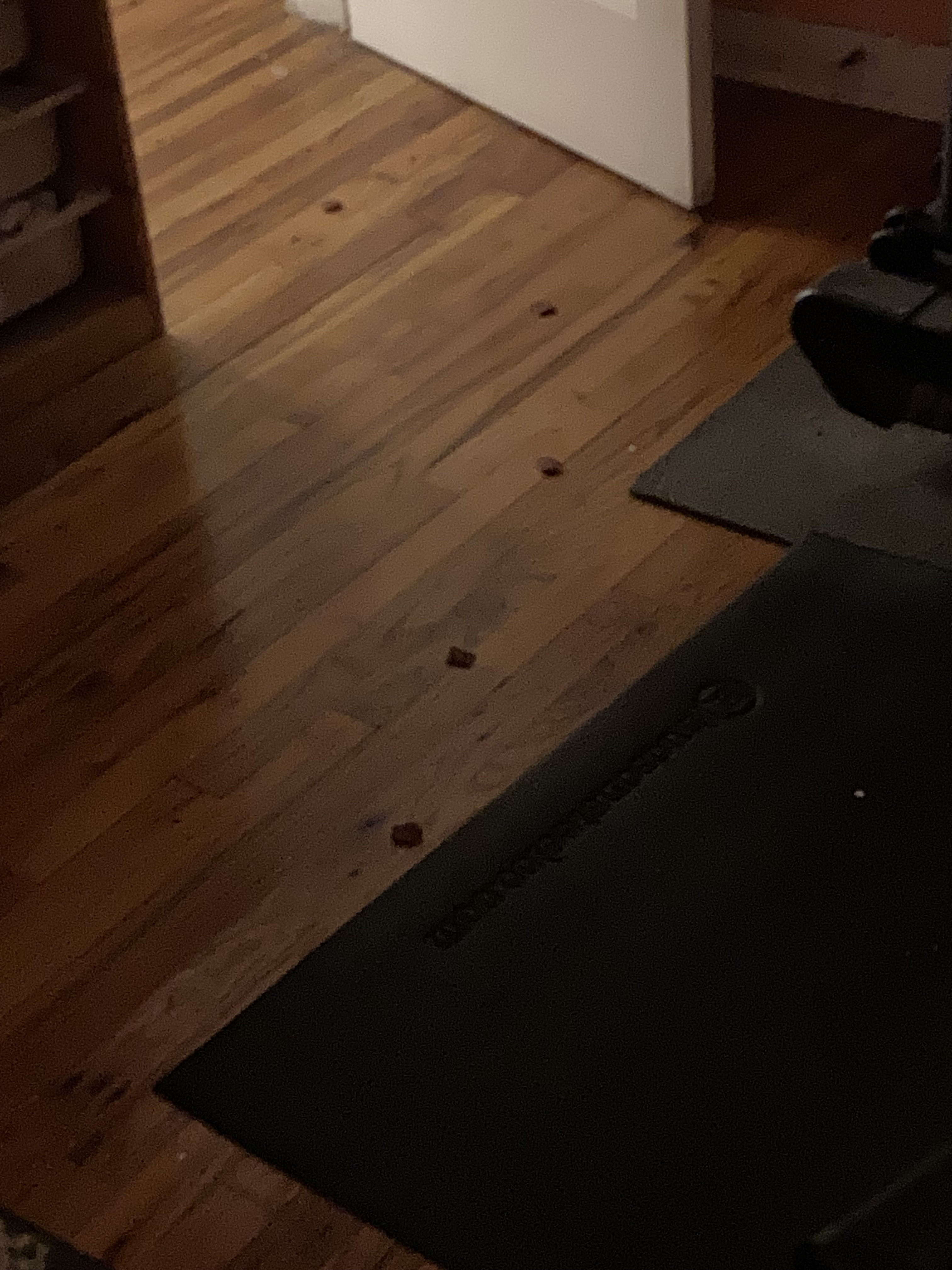
            Each night, I break one piece of chicken jerky into smaller and smaller pieces, and spread them further apart so she has to actually walk into my room to find them all. And since she believes in only taking one treat at a time, no matter how small they may be, she now comes in at least five times to get through the whole trail, usually more than five, because she’s ever hopeful that more will appear. She’s still not looking up and acknowledging my presence, but we both know I’m there.

The trail of treats
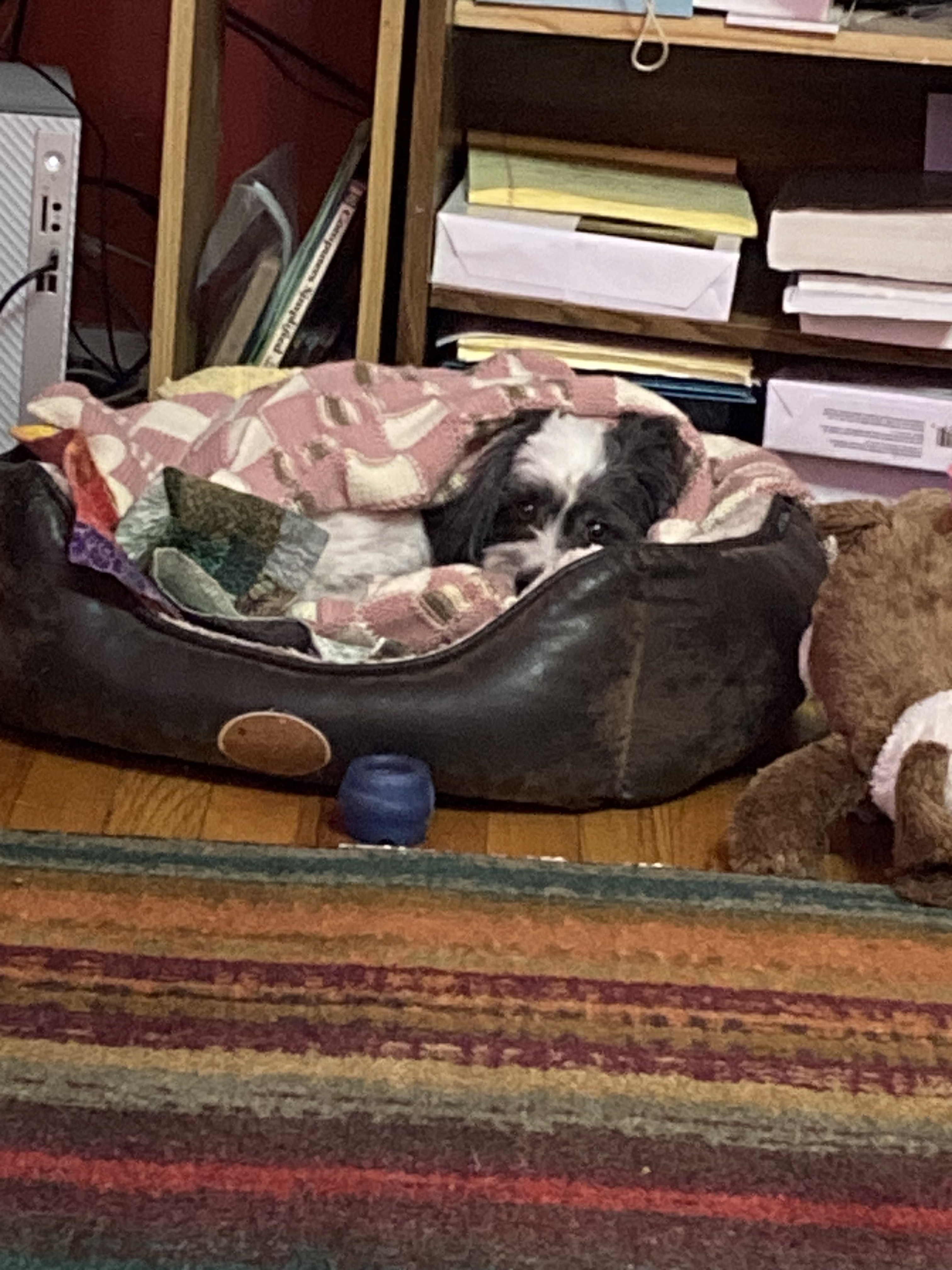
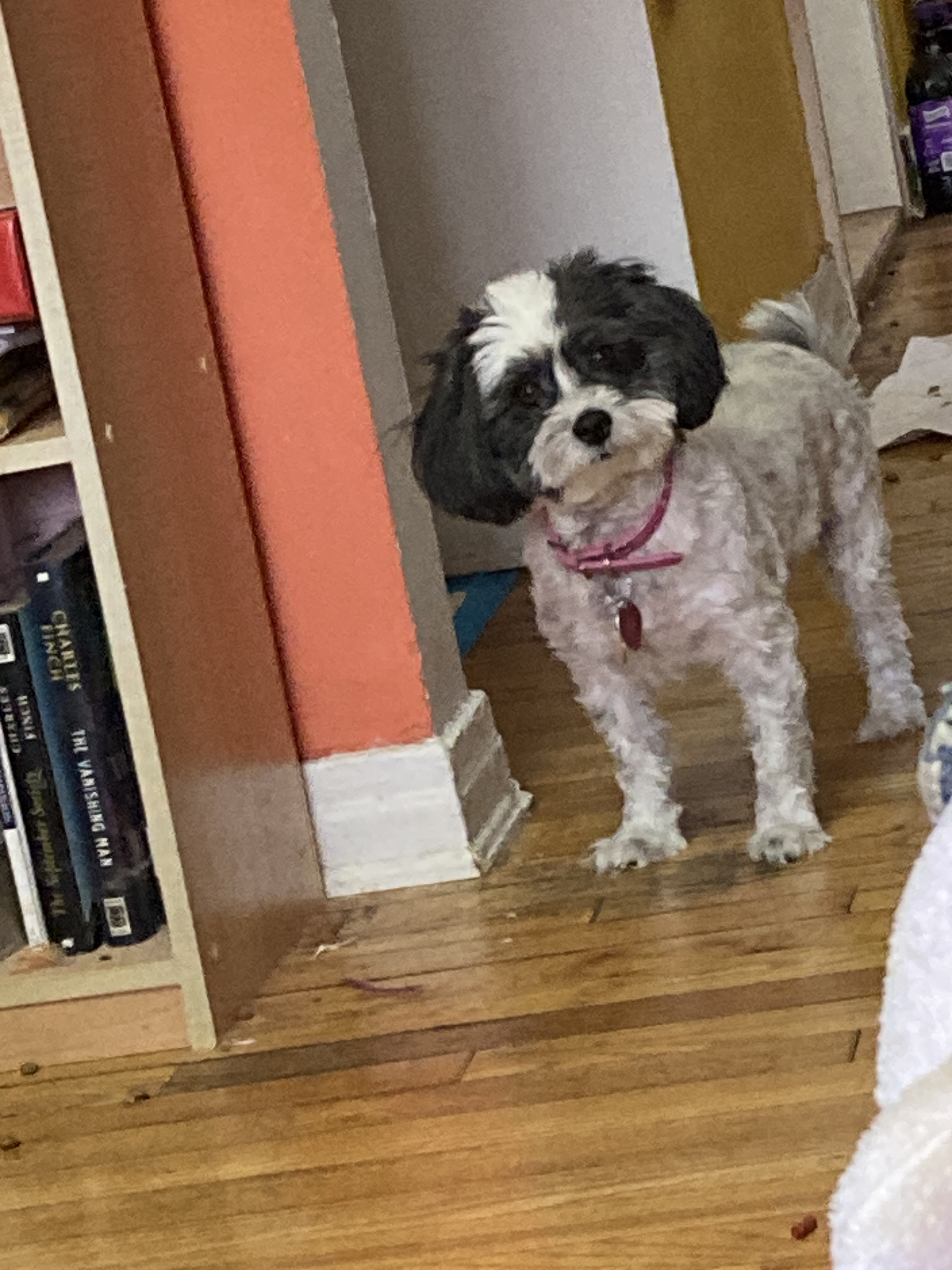
The elusive Tzippy, caught on camera

            There may need to be a second part to this experiment, because getting her into the room doesn’t equal coming directly to me for treats, or thinking of me as a safe person, but I haven’t thought that far ahead.

            But at least now, she has learned to stop and check my doorway as she passes by, and even to linger and check more carefully in case she missed something, rather than just taking a cursory sniff and moving on. She does this at least once at night and once during the day (if I’m in my room instead of sitting in the living room with her). Not only do the chicken treats draw her attention, but they also seem to help mute her anxiety at entering my room while I am present. In the past (last week), Tzipporah would come to my door, see me seeing her, and immediately bolt; but with her nose to the ground searching for treats, she’s less concerned, or at least less aware, of where I am and what I’m doing (I am, of course,  watching her and trying to get pictures).

            It’s hard not to compare how much farther along Tzipporah has gotten in her relationship with my mom (her grandma) than in her relationship with me. Mom can even hold out a treat, sometimes, and Tzipporah will gently take it from her hand. But, I figure, why not learn the lesson, and tap into the thing that has been working for them all along (being super generous with treats) and see if I can catch up. So far, Tzipporah doesn’t seem to mind.

“Where are the rest of my treats?”

If you haven’t had a chance yet, please check out my novel, Yeshiva Girl, on Amazon. And if you feel called to write a review of the book, on Amazon, or anywhere else, I’d be honored.

            Yeshiva Girl is about a Jewish teenager on Long Island, named Isabel, though her father calls her Jezebel. Her father has been accused of inappropriate sexual behavior with one of his students, which he denies, but Izzy implicitly believes it’s true. As a result of his problems, her father sends her to a co-ed Orthodox yeshiva for tenth grade, out of the blue, and Izzy and her mother can’t figure out how to prevent it. At Yeshiva, though, Izzy finds that religious people are much more complicated than she had expected. Some, like her father, may use religion as a place to hide, but others search for and find comfort, and community, and even enlightenment. The question is, what will Izzy find?
She Barked!

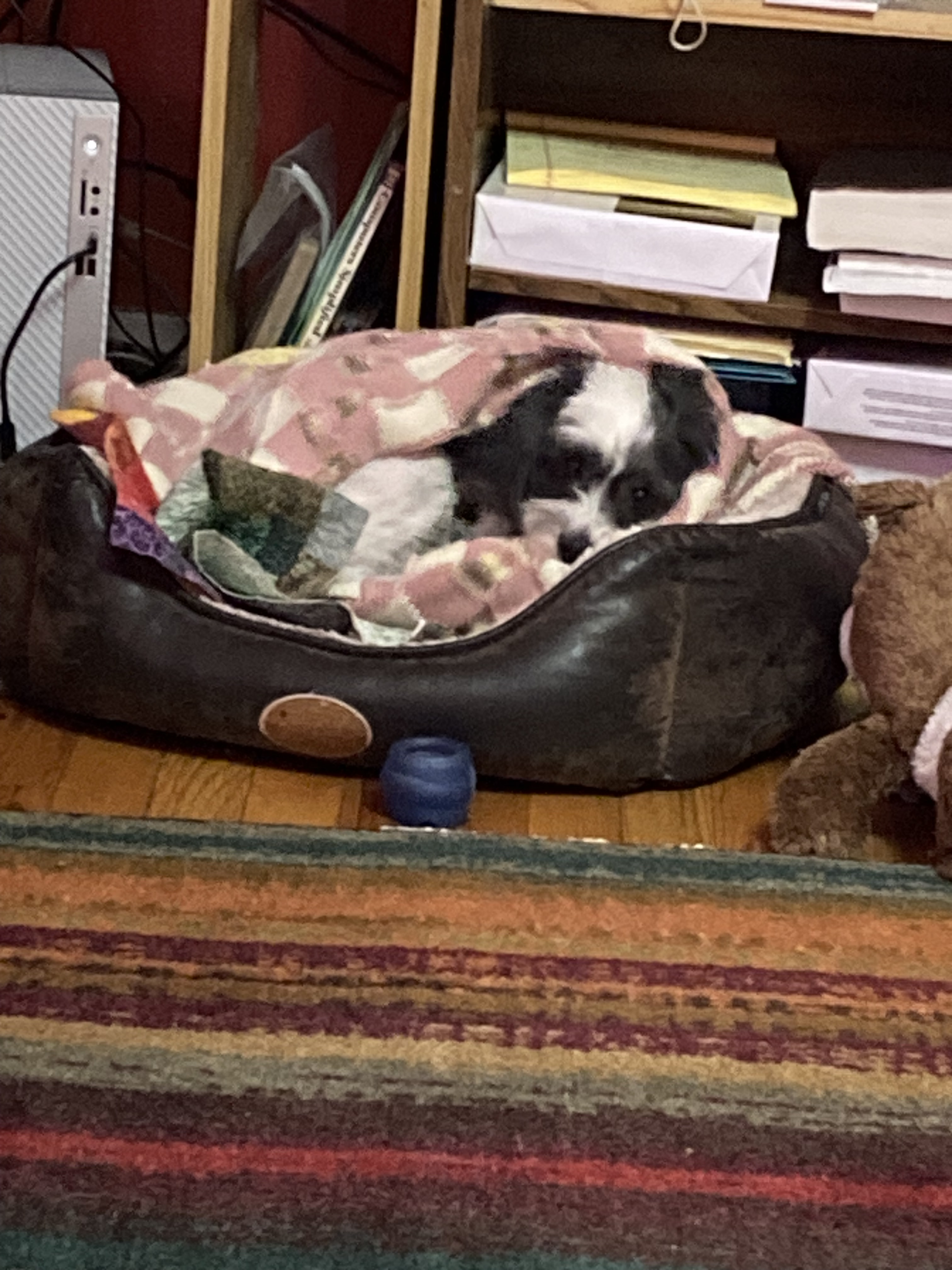
            At long last, after a series of singing cries (because Grandma had run out of treats), Tzipporah barked! She surprised us, but even more than that she surprised herself, and ran back to her bed in the living room empty-pawed. Even the next day, she still seemed exhausted by the whole experience. What was that noise? Did it really come from me? And how is it possible for Grandma to run out of treats?!

            It was a lone bark, at least so far, and even her cries have been muted in the aftermath (it’s possible that Grandma has been handing out extra treats without telling me), but it’s good to know that her barking machinery works, should she want to use it at some point.

            But I keep getting impatient. She still has no idea why I sometimes pick her up just to hold her for a little while (we watched an episode of a crime drama set among puppy mills in France and it almost broke me, and I needed a hug). But I can hold her for just a little while before she starts looking for any possible escape route. And then, when she finally gets free, she starts running back to her bed, stops and turns around to give me a dirty look, and then continues on her way.

            I got a little bit desperate at one point and picked up her stuffed puppy to hold it on my lap for a while. I gave the stuffed puppy some ear-scratches and head pats, and then set it down in the second doggy bed and gently covered it with one of the doggy blankets. Tzipporah found the whole drama fascinating, but I’m not sure what she learned from it, except that her mommy is weird, which she already knew.

            I have to keep reminding myself that any progress Tzipporah makes is miraculous and we’re not on a clock here, but I still have no idea what she’s thinking when she stares at me endlessly. Is she watching me so closely because she likes me and wants to know me better? Or because she’s wary of me and needs to be on her guard? Or because I’m just that fascinating? She sees me staring at the TV quite a lot, though, so maybe she’s just mimicking me.

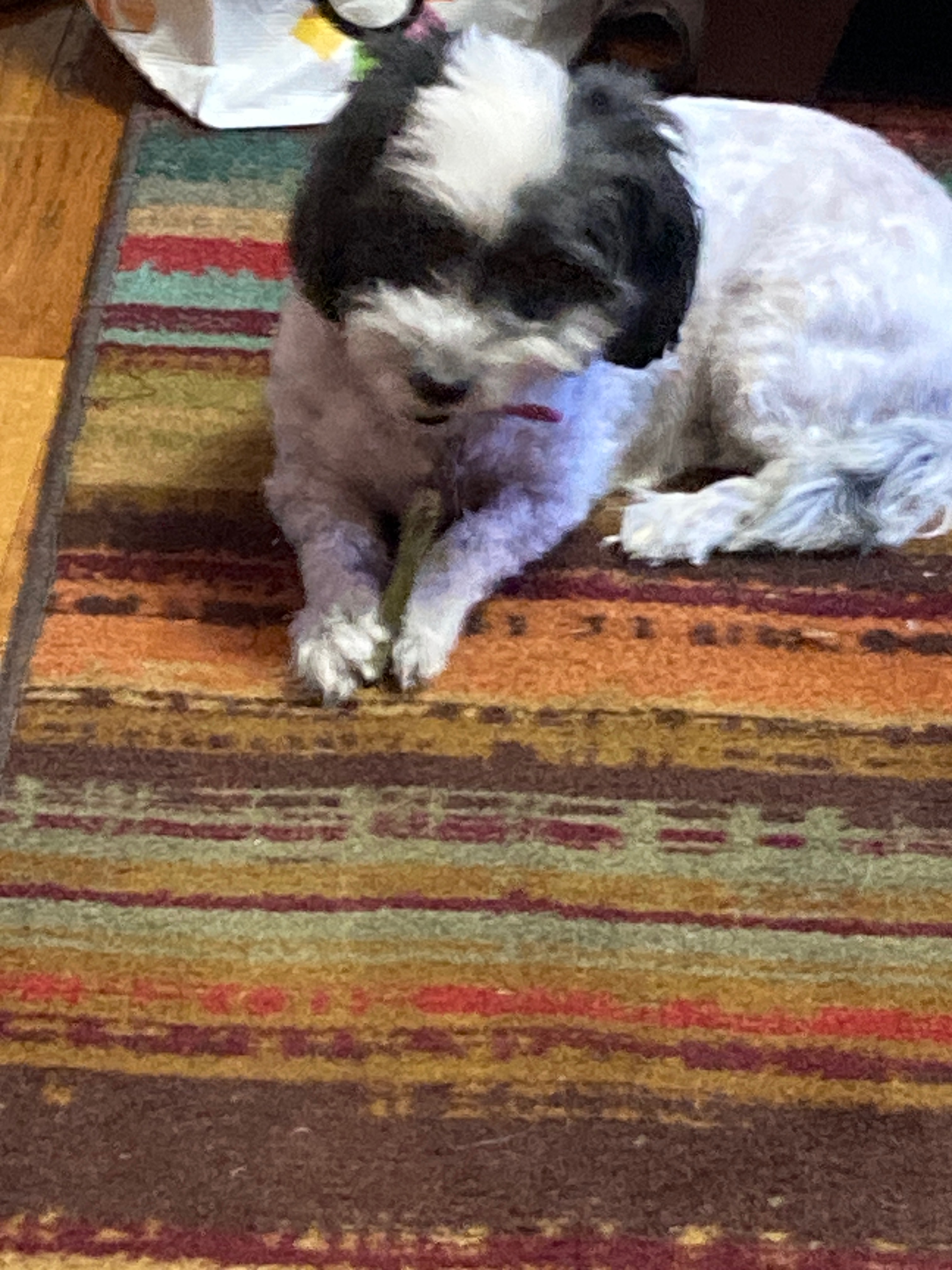
            The thing is, Tzipporah really does keep making progress, even if the pace feels slow to me. During her first visit to the groomer, back in the winter, she panicked when they tried to trim the hair on her front paws, so we were told to give her some ACE (doggy Xanax) before her next visit. So this time, before we brought her for her second visit to the groomer last week, Mom broke an ACE in half and stuffed it into a piece of chicken, which Tzipporah ate with gusto. When we went to pick Tzipporah up later in the day, the groomer said everything went well, even though Tzipporah needed a “summer cut” to deal with the knots (I haven’t wanted to bother her with too much combing), which meant she was mostly shaved down to the nubs. And then, instead of handing her directly to us, the groomer put Tzippy on the floor. I was about to say, no, don’t do it, she’ll never come to me and we’ll have to chase her around the room, but Tzippy walked straight over to me without hesitation. I almost cried, because she never does that in real life! She doesn’t respond to her name, or to any other command, but there, given the choice to roam free or find one of her people, she chose a people. Which means she knows who I am, and at least prefers me to the person wielding the scissors. She even showed signs of trying to climb into the front seat of the car on the way home (her doggy seatbelt stopped her from getting too far).

When we got home, I found the half pill of ACE sitting next to her bed, untouched. So, next time we can go with peanut butter, or maybe she doesn’t need the ACE at all. In just those few months, she’s made so much progress that she managed her haircut completely unmedicated, and without panic.

            And, since she has very little hair right now, I decided to add hair combing to her daily routine, along with the tooth brushing. She still thinks the toothbrush is a chicken paste delivery system and doesn’t understand why I insist on rubbing it into her teeth, but even combing the hair on her ears made her look at me like I was Cruella Deville. And yet I persisted.

            Oh, and there was another big step forward! One night when we had chicken for dinner, I saved some for her, but instead of just handing it all to her at once, I gave her a small piece of chicken in her bed, to hook her, and then I scattered pieces at various distances from her bed. It took her a little while to gather her courage, but eventually she found the pieces of chicken that were within two feet of her bed (three feet away was still too far), and just seeing her get out of bed while I was still sitting there in front of her was exhilarating.

I have to keep reminding myself that all of this effort is worth it, because even if I’m feeling impatient or grumpy, as long as I keep trying, progress keeps happening. For both of us.

If you haven’t had a chance yet, please check out my novel, Yeshiva Girl, on Amazon. And if you feel called to write a review of the book, on Amazon, or anywhere else, I’d be honored.

            Yeshiva Girl is about a Jewish teenager on Long Island, named Isabel, though her father calls her Jezebel. Her father has been accused of inappropriate sexual behavior with one of his students, which he denies, but Izzy implicitly believes it’s true. As a result of his problems, her father sends her to a co-ed Orthodox yeshiva for tenth grade, out of the blue, and Izzy and her mother can’t figure out how to prevent it. At Yeshiva, though, Izzy finds that religious people are much more complicated than she had expected. Some, like her father, may use religion as a place to hide, but others search for and find comfort, and community, and even enlightenment. The question is, what will Izzy find?
Tzipporah is Dancing Behind my Back

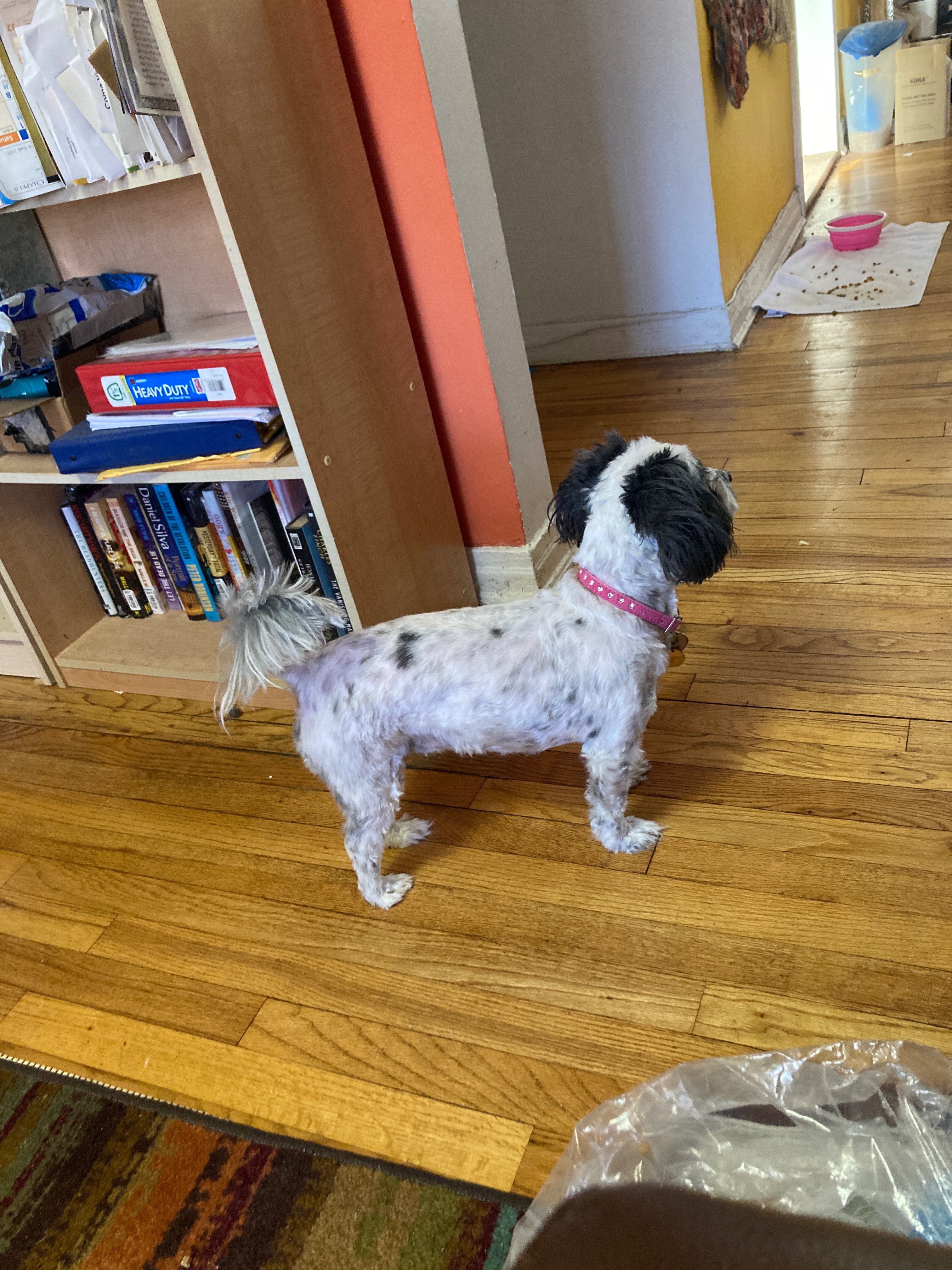
            For the most part, when I walk into the living room, anytime during the day or night, Tzipporah is sitting up in her bed, head tilted, watching me carefully. I knew that she was getting out of her bed when she was alone, to eat and drink and pee, and I knew that she left her bed at night to explore the apartment and to beg for chicken treats from her grandma (I love to hear the tippy tappy sound of her paws dancing down the hallway to get her midnight snacks, and sometimes I get to hear her sing the song of her people when her grandma runs out of treats). But, I thought, as long as there was a human in the living room with her, Tzipporah stayed glued to her bed.

            But then Mom started to tell me stories about Tzipporah stretching and running around the living room in the morning, as soon as she heard me getting up. At first, I was skeptical about those reports, thinking Mom must be exaggerating as a way to get me to believe Tzipporah was excited to see me. But then I was hurt. Why was Tzipporah willing to get out of her bed and stretch and relax only when I wasn’t in the room? What’s so great about Mom that she can be trusted and I can’t? (Okay, I know what’s so great about my mom. I’m just jealous.)

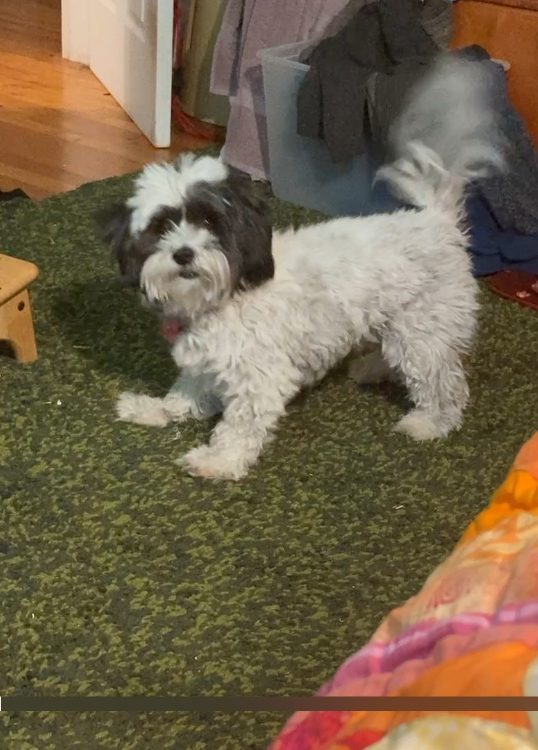
            After a few days of trying to describe the whole routine to me, while Tzipporah sat staring at me from her bed, Mom was finally able to get some pictures, and even a video; and I was able to see my quiet, solemn little dog dancing and wagging her tail and hopping around, impatiently staring towards the hallway, waiting for me. And yet, as soon as I actually walked into the living room, she would rush back to her bed as if the floor had suddenly turned to lava, and then she would sit in her bed and stare at me again.

I’d like to believe that the new dance is a sign that Tzipporah loves me, since she’s acting the same way I tend to act when I really like someone (desperate to see them and then tongue-tied when I actually get the chance), but I worry that she’s just taking her last opportunity to stretch her legs before I appear. I mean, if I can turn a previously safe and comfortable living room floor into lava, I must be pretty scary.

            Honesty, it’s a relief to know that Tzipporah isn’t just staying in her bed all day, though now I feel guilty for ever hanging out in the living room, because it forces her to stay in her bed and not to pee or drink or eat until I leave. My hope is that Tzipporah’s prolonged dance routine each morning is the beginning of a new phase, wherein she is eventually willing to leave her bed while I am still in the room. But, if she decides that only Grandma is allowed to see her dance, at least I’ll know that she has these wonderful moments of joy, and I’ll have the pictures to prove it.

If you haven’t had a chance yet, please check out my novel, Yeshiva Girl, on Amazon. And if you feel called to write a review of the book, on Amazon, or anywhere else, I’d be honored.

            Yeshiva Girl is about a Jewish teenager on Long Island, named Isabel, though her father calls her Jezebel. Her father has been accused of inappropriate sexual behavior with one of his students, which he denies, but Izzy implicitly believes it’s true. As a result of his problems, her father sends her to a co-ed Orthodox yeshiva for tenth grade, out of the blue, and Izzy and her mother can’t figure out how to prevent it. At Yeshiva, though, Izzy finds that religious people are much more complicated than she had expected. Some, like her father, may use religion as a place to hide, but others search for and find comfort, and community, and even enlightenment. The question is, what will Izzy find?

Russian Nesting Dolls

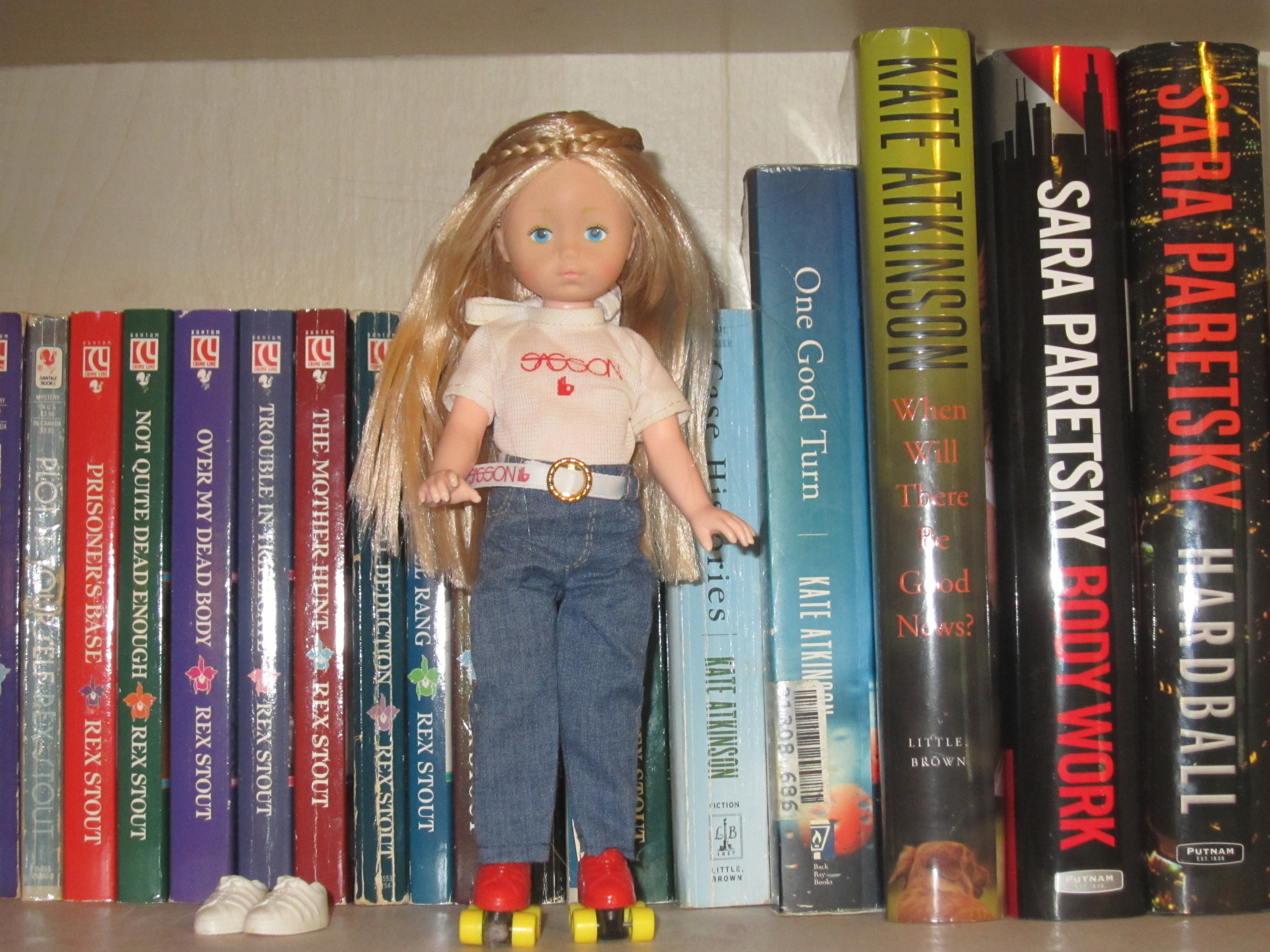
            I don’t remember if I ever had a set of Matryoshka dolls (Russian nesting dolls) of my own when I was younger, but I definitely saw them and played with them somewhere along the way. There was something magical about how each doll hid another doll, and another, and another, except, there wasn’t much to do with these “dolls.” You couldn’t dress them up, or hug them, and none of them had roller skates (like my Ginny doll). And they were so static: their eyelids didn’t open and close, and their arms and legs didn’t move. And yet, they still drew my attention. I haven’t thought about those dolls very much over the years, but recently I saw a set of them on TV, and my first thought was that they would be a very helpful metaphor for the way we carry our old stories within us, even as we try to grow beyond them.

Traditional Russian nesting dolls (not my picture)
My Ginny doll is a reader.

            I was sure that everyone must see the same thing in them as I did, but when I went looking for more background on the dolls, I found out that everyone sees something a little different, depending on where they are in their lives and what lens they are looking through.

            Originally, the dolls were made as a children’s toy, in 1890, possibly inspired by a nesting doll from Japan, and they were meant to highlight Russian femininity, with the dolls wearing a sarafan, a long, shapeless traditional Russian peasant dress, and the figures inside representing her children, of both genders, with the smallest being a baby, made of a single piece of wood.

A smaller set (not my picture)

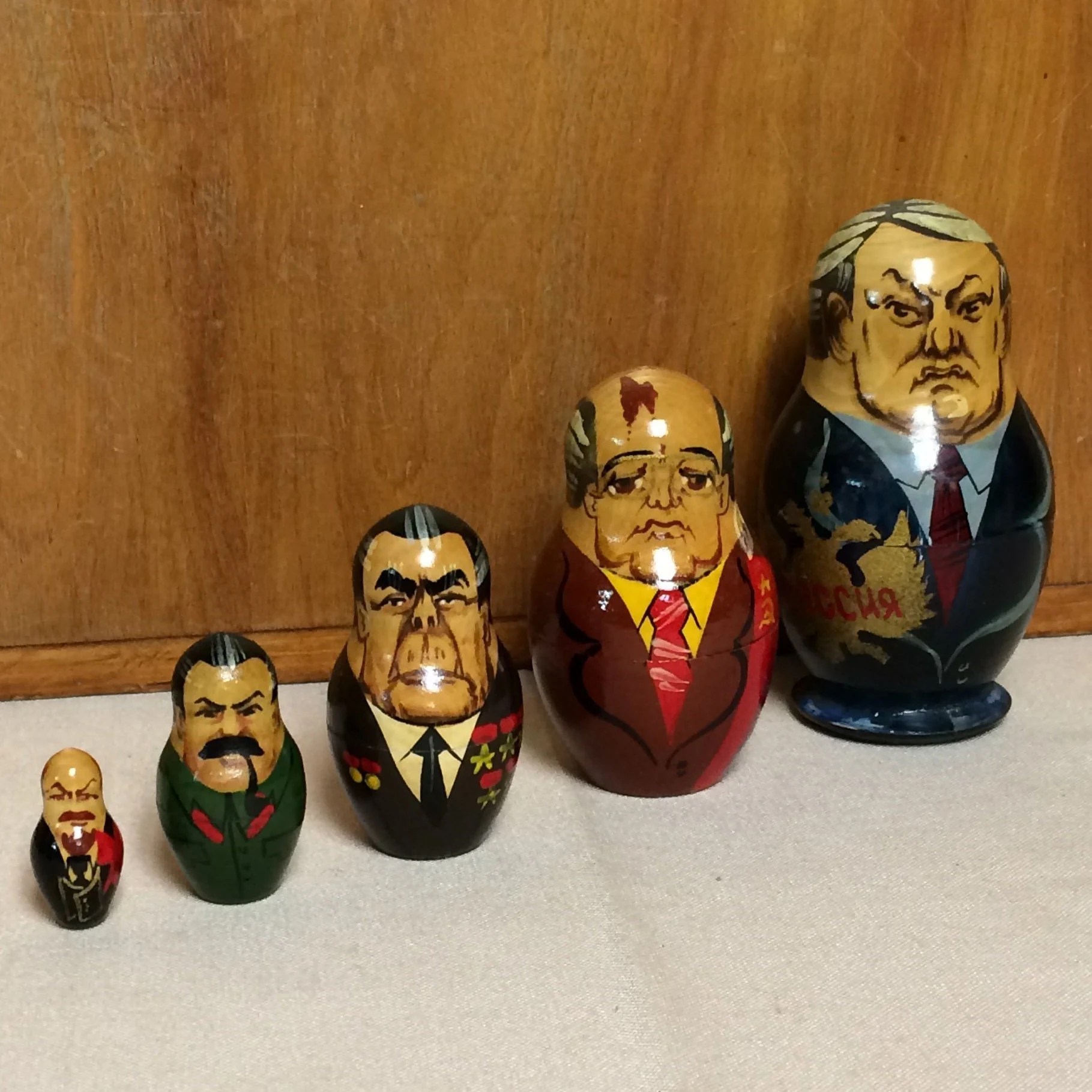
But somewhere along the way the dolls became a favorite souvenir for tourists, and then a way to represent famous Russian politicians, and how each generation of politicians was influenced by the ones who came before. Some people have even repurposed the dolls to represent complicated corporate structures used to avoid paying taxes, like shell companies.

Political Russian nesting dolls (not my picture)

But when I look at these dolls, I see myself, and the way each of my previous selves stays inside of me. My layers don’t peel off, like an onion, or slough off, like the skin of a snake; I hold onto everything, whether I want to or not. I would have thought, given all of that, that I would feel some relief at seeing each doll standing separately on its own “feet,” but instead, the separated dolls seem hollow to me, even forlorn. Despite the pain of holding onto the past, I feel stronger, and more fully myself, with all of my selves held together.

            And there’s something powerful about having a metaphor that I can see and touch and move around in space; because when all I have are words to help me organize my thoughts, the chaos can become overwhelming.

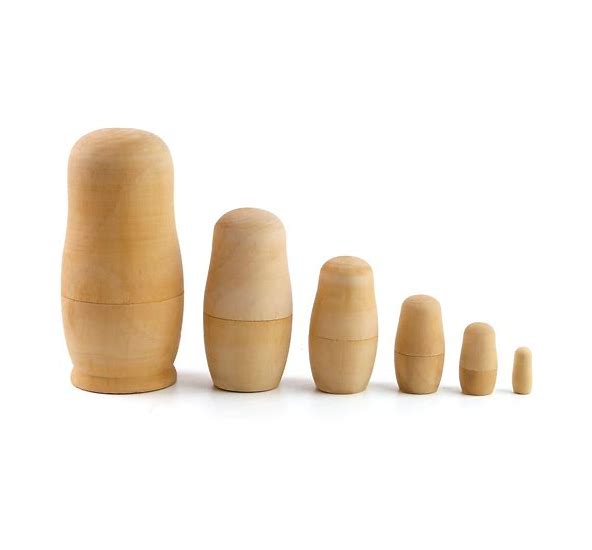
            When I went looking for images of Matryoshka dolls, I found all kinds of different sets – five doll sets and ten doll sets, people and animals, dolls that look exactly the same at each size, and dolls that are completely different from one another – but the most intriguing thing I found were blank sets of dolls that you can paint however you like. And it occurred to me that, if I had any artistic talent at all, which I don’t, it would be really meaningful to create the figures to represent my own layers, or the important people who have influenced me over time, to help me really see all of my pieces.

Animal nesting dolls (not my picture)
Blank nesting dolls (not my picture)

And then I thought about how I could use those blank doll sets with my students, to help them visualize how each generation influences the next, and how who they are today is connected to everyone who came before. And then I thought about the costs of all of the materials involved, and the difficulty of getting my boss on board, and then the work of explaining to the kids exactly what I was looking for, so they wouldn’t just paint all of the dolls as different sized poops; and then I fell into a black hole of self-recriminations about all of the ways I suck as a teacher, and a therapist, and a person overall.

And yet, despite the waterfall of thoughts and worries and self-loathing that washed over me, I still think the Matryoshka dolls have a lot to offer, though maybe they should come with a warning label: open at your own risk, objects inside may be a lot more complicated than you expect.

“Just like me!”

If you haven’t had a chance yet, please check out my novel, Yeshiva Girl, on Amazon. And if you feel called to write a review of the book, on Amazon, or anywhere else, I’d be honored.

            Yeshiva Girl is about a Jewish teenager on Long Island, named Isabel, though her father calls her Jezebel. Her father has been accused of inappropriate sexual behavior with one of his students, which he denies, but Izzy implicitly believes it’s true. As a result of his problems, her father sends her to a co-ed Orthodox yeshiva for tenth grade, out of the blue, and Izzy and her mother can’t figure out how to prevent it. At Yeshiva, though, Izzy finds that religious people are much more complicated than she had expected. Some, like her father, may use religion as a place to hide, but others search for and find comfort, and community, and even enlightenment. The question is, what will Izzy find?
Jacob and Israel

            At a recent Friday night service, because the Torah portion for the week was about our forefather Jacob wrestling with an angel of God, our rabbi told us that Jacob is renamed Israel because Israel means “to struggle with God and to prevail.” And my inner voice woke up and said, huh?

            My whole life I’d been taught that the name Israel means “to struggle with God.” Period. No prevailing included. The idea that to be Jewish means to welcome the struggle with God, and to always ask questions, without ever knowing if you will succeed or fail, or even focusing on success as a goal, has been essential to my sense of self as a Jew, and as a person overall. I don’t have to win, or be successful, in order to have a meaningful life; I just have to be willing to engage in the struggle.

            But here was the rabbi saying that, no, we struggle and we prevail, and that’s what makes us the People of Israel.

            So, of course, I had to look into this, and it turned out that we were both right. The traditional translation for the name Israel is “to struggle with God,” but when the angel tells Jacob about his new name, he says that Jacob is given this name because “he struggled with God and he prevailed.” So, the “prevailed” part of the name is silent, but implied.

            I still couldn’t wrap my head around this sea change in what it might mean to be part of the nation of Israel, aka Jewish. Aren’t we supposed to be the underdogs? Hasn’t that been our identity and our history for, I don’t know, two millennia? What would it mean to suddenly see myself as a member of a group that, supposedly, always prevails? And why do I find that idea so incredibly uncomfortable?

            I kept researching and was able to find an alternate translation for the name Israel: instead of “struggles with God” it could also mean “empowered by God.” But that translation felt even worse, because I’ve never felt empowered, by God or anyone else, and if my people is identified as those guys who are empowered by God, and I feel distinctly unempowered by God, doesn’t that make me an outsider even to my own group?

            Of course, it’s a tiny bit silly to get so caught up in an argument about the meaning of a name given to one of my ancestors three millennia in the past. But I think we all do this. Whether it’s identifying with a bible story, or with a more recent ancestor, or with the stories our families have told us about ourselves, we find our identities in the stories we are told and we are often reassured by the shape they give to our lives.

            I’m also thinking about this in relation to the current situation in the Middle East (if current implies the last century or so), where the stories of the Hebrew bible resonate not only with the Jews, and the Christians, but with the Muslims as well, who read their own retellings of stories from the Hebrew Bible in the Koran. It’s significant that Muslims traditionally see themselves as the descendants of Ishmael, the first-born son of Abraham in the Hebrew Bible, who is disinherited in favor of Isaac, his younger half-brother. In fact, this pattern of the older brother being disinherited in favor of the younger brother happens two times in a row, so it’s clearly a story that has resonated for a lot of people for a very long time. And in the second iteration, with the twins, Jacob and Esau, Jacob steals the blessing from his older brother, through trickery, rather than just benefiting from the prejudices of his parents, the way Isaac does.

            It is not a coincidence, then, that given events that could have been interpreted in multiple different ways, many Muslims interpreted the return of the Jews to the land of Israel, and the decision of the United Nations in 1948 to divide the land of Palestine between the Jews and the Arabs, as the Jews receiving a blessing they did not deserve, whether through trickery or prejudice. And the Jews, viewing history through the lens of Jacob, continue to see ourselves as the underdogs, fighting for our small share against a stronger brother, despite having grown in strength and influence along the way. Obviously, this isn’t the only lens through which we all see these conflicts; it’s much more like a kaleidoscope where our lens keeps changing every moment and any one perspective is hard to hold onto for long. But breaking out of our old biblical roles, in order to see each other as we actually are in the present, becomes even more difficult when we are obligated to read and re-read these same stories on a regular basis.

            It’s significant that, in those same stories, Esau becomes a successful landowner, despite seemingly losing his birthright to Jacob. In fact, when the brothers meet again, years later, Esau forgives his little brother, who is still struggling to forgive himself. That story is in there too, and could be a model for how to create a road towards peace. But for some reason, we remain stuck in the first half of the story. Or worse, we fall back into the earlier story, where neither Ishmael nor Isaac have much agency at all in creating their own life stories.

            It interests me that even though Jews see Abraham, Isaac, and Jacob, equally, as our forefathers, it’s only the children of Jacob (the Israelites, or the children of Israel) who eventually become the Jews. Why doesn’t Jewishness extend to both sons of Abraham? Why aren’t we all called Abrahamites? Why does the Hebrew Bible insist on telling us about these stories of family ruptures to help us understand who we are?

            There’s one more lesson in this story that seems relevant to me: when Abram and Sarai’s names are changed by God (each getting an H added, to symbolize the addition of God into their lives and selves), they become Abraham and Sarah, and their old names are never used again in the text. But after Jacob wrestles with the angel, and is renamed Israel, he is still called both Jacob and Israel in the text; both Jacob and Israel continue to exist, with neither one canceling out the other. And I can relate to that; I can relate to having internal conflicts, and being different at different times, and sometimes feeling empowered or imbued with God, and other times, not so much.

            I think these stories stay with us because we are never finished struggling with God, or with ourselves. We are never done with our past, or with the parts of ourselves who have struggled and failed in one way or another. The hope is that we can also make room for newer parts of ourselves, parts who have wrestled with God and prevailed, and found that there is something better, stronger, and sweeter on the other side.

“I like sweet things too. Like chicken.”

If you haven’t had a chance yet, please check out my novel, Yeshiva Girl, on Amazon. And if you feel called to write a review of the book, on Amazon, or anywhere else, I’d be honored.

            Yeshiva Girl is about a Jewish teenager on Long Island, named Isabel, though her father calls her Jezebel. Her father has been accused of inappropriate sexual behavior with one of his students, which he denies, but Izzy implicitly believes it’s true. As a result of his problems, her father sends her to a co-ed Orthodox yeshiva for tenth grade, out of the blue, and Izzy and her mother can’t figure out how to prevent it. At Yeshiva, though, Izzy finds that religious people are much more complicated than she had expected. Some, like her father, may use religion as a place to hide, but others search for and find comfort, and community, and even enlightenment. The question is, what will Izzy find?

Ellie’s Tenth Birthday

            A week after seeing the substitute vet, and being told not to spend more money on tests, we were able to get an appointment with Ellie’s regular vet and he recommended an ultrasound, to see if her distended belly was filled with fluid or with something else; and he confirmed that it was all fluid. He recommended against trying to poke around with needles to empty the fluid, because it could stress her literally to death, and because the fluid would come back in a few days anyway. Instead, he raised her diuretic dose a little bit and sent us home, saying that, like with Cricket, if Ellie doesn’t eat for three or four days, she’s suffering.

            It certainly wasn’t the news we wanted to hear, but it is what we expected, and it was a relief to know for sure what we were dealing with.

            The raised dose of the diuretic helped a little bit, at least enough to allow Ellie to feel hungrier and to enjoy her food again. She especially liked the Chinese food we got for my birthday dinner. Her belly is still full of fluid, and she spends most of her time resting on her side, but her joy in eating is wonderful to see.

“Where are you hiding the Chinese food?”

            When we were looking through her papers recently (which makes it sound like she has her own filing cabinet and a small business to run, but we were just looking for her exact birthday so we could celebrate it with her), we realized that she is turning ten this year, not nine like I thought. There’s a little bit of relief in knowing she’s made it all the way to ten, just like there was relief in seeing Cricket pass the sixteen year mark, but it’s still not enough.

            We didn’t plan anything special for her birthday, because every day she’s still with us feels special and important, and really an act of will on her part. Just seeing her eat, and take all of her medication, and enjoy getting her back scratched, feels like a celebration to me. I’m so grateful that she wants to stay with us for as long as she can, and I’m especially grateful that we’ve been able to have this time with her, after Cricket’s death, to shower her with as much love and attention as she can absorb, so that she knows what it’s like to be the center of everything, at least for a little while. Even Cricket would have wanted that for Ellie, though not as much as she wanted it all for herself.

            Now we’re just going day by day, trying to accept that we won’t have that much more time with her. Her sweet spirit still shines through, even when she’s tired, or worried, or struggling to catch her breath, and we know how lucky we’ve been to have her this long.

            Happy birthday dear sweet Miss Ellie, my beautiful girl!

“I need more chicken, Mommy.”

If you haven’t had a chance yet, please check out my Young Adult novel, Yeshiva Girl, on Amazon. And if you feel called to write a review of the book, on Amazon, or anywhere else, I’d be honored.

            Yeshiva Girl is about a Jewish teenager on Long Island, named Isabel, though her father calls her Jezebel. Her father has been accused of inappropriate sexual behavior with one of his students, which he denies, but Izzy implicitly believes it’s true. As a result of his problems, her father sends her to a co-ed Orthodox yeshiva for tenth grade, out of the blue, and Izzy and her mother can’t figure out how to prevent it. At Yeshiva, though, Izzy finds that religious people are much more complicated than she had expected. Some, like her father, may use religion as a place to hide, but others search for and find comfort, and community, and even enlightenment. The question is, what will Izzy find?

Cricket and the Wee Wee Pad Path

A couple of weeks ago, when Cricket lost the ability to hold off peeing until she could reach the wee wee pad by the front door, we created a yellow brick road of wee wee pads, from Grandma’s bed to the front door, to help her out. And, either as a result of the Gabapentin and ACE she takes every day (in order to tolerate the subcutaneous fluids for kidney disease), or because of incipient dementia, Cricket has started to pace around the apartment at all hours, peeing along her wee wee pad path, especially in the middle of the night.

            After she’s jumped off Grandma’s bed, to get a drink of water and to pee, Cricket will come to my room, sometime around four o’clock in the morning, and bark at me for the mommy-elevator up onto my bed, where she wanders around and around in search of the perfect sleeping spot, which is often elusive. For some reason, Ellie has decided that instead of staying in my room at night, the way she used to, she prefers the wee wee pads – at least the as yet unused ones – as her favorite place to sleep.

“Are you telling my secrets, Mommy?”

When I accept the inevitable and finally get up, around 7 AM, Cricket and Ellie are ready to go outside, walking down the stairs together if Cricket is up to it. Neither one of them can run and play the way they used to, but Ellie gets a lot of enjoyment just by standing still and listening to the sounds of the neighborhood, while her sister wanders around the yard sniffing all the smells.

When we get back inside it’s time for Ellie’s medication, carefully stuffed into small pieces of chicken or chicken liver, with a few pieces going to Cricket as well. And, if she’s willing, Cricket gets her ACE and Gabapentin in her food too, so we can get her fluids done early and give her time to pee it all out during the day, instead of needing to walk her path so much overnight.

“Give me more fluids and I’ll be swimming down the hallway!”

We’re still in the trial and error phase with all of this, constantly adapting their diets and schedules and adapting our expectations of what they can and can’t do, based on how things are going each day. Ellie is mostly consistent, though she needs new high value treats every few days to help her tolerate all of her pills. Cricket is the wild card. Some days she seems like she could go at any moment, and other days she seems so normal that we almost get complacent. Almost.

We’ve started to get rid of rugs that have been peed on too often, by both of them, and we’re doing a lot of extra laundry, but we love them, so we walk the wee wee pad path, replacing one pad here and there as we go along, trying to keep them happy and comfortable. I wouldn’t have chosen this, but I wouldn’t want to miss a day of having them in my life either, so this is what love looks like right now.

If you haven’t had a chance yet, please check out my Young Adult novel, Yeshiva Girl, on Amazon. And if you feel called to write a review of the book, on Amazon, or anywhere else, I’d be honored.

            Yeshiva Girl is about a Jewish teenager on Long Island, named Isabel, though her father calls her Jezebel. Her father has been accused of inappropriate sexual behavior with one of his students, which he denies, but Izzy implicitly believes it’s true. As a result of his problems, her father sends her to a co-ed Orthodox yeshiva for tenth grade, out of the blue, and Izzy and her mother can’t figure out how to prevent it. At Yeshiva, though, Izzy finds that religious people are much more complicated than she had expected. Some, like her father, may use religion as a place to hide, but others search for and find comfort, and community, and even enlightenment. The question is, what will Izzy find?
Cricket is the Most Stubborn Person I Know

            A few weeks ago I was afraid Cricket was on the edge of life, diagnosed with kidney disease, struggling to walk, knocking into things. We started giving her subcutaneous fluids on the off chance that it would help extend her life, and it’s actually working. Though in order to give her the fluids we have to medicate her with a combination of gabapentin and ACE, which makes her woozy for hours. At times, she seems like a wraith, her feet slipping out from under her, not even protesting when the needle slips under her skin.

            Ideally, she would have gotten used to the whole procedure by now, and she wouldn’t try to pull off the muzzle, or lift up her head to get away from the needle. Ideally, I’d never have to give her any calming meds at all and she would just accept the fluids as a necessary evil and get it over with and get back to living her life. But then she wouldn’t be Cricket, and all of this effort is to make sure she gets to be Cricket for as long as possible.

“Oh, I can be even more Cricket-y. Just wait.”

            Every day, at the beginning of all of this, I was afraid she was going to die overnight, and when she actually woke up in the morning, and ate her breakfast, I was surprised, and afraid to be hopeful. But with each day she seems to improve a little bit. The meds make her into a rag doll, yes, but then the next morning, after she’s slept it off, it’s like she’s been brought back to life, refilled with her fluids and her spirit, and ready to sniff the whole world again.

            It’s still nerve-wracking to watch her skin fill up with the fluids. I even worry sometimes that her neck is going to explode (I’ve seen too many movies), and I worry that I’m going to put the needle in the wrong place and puncture something vital. I was worried for a while that I was inserting the needle the wrong way and causing scar tissue to form because I could feel these quarter-sized bumps under her skin and I was afraid I would run out of loose skin and not be able to give her the fluids anymore, but then the bumps started to dissolve, and that worry, at least, went away. So much of this is trial and error and the circumstances seem to change every day. It feels like a magic trick each time she wakes up in the morning and walks and barks and eats and acts like herself, but a magic trick that is unreliable and hard won.

            I’ve been thinking about my friend Teddy, the miniature poodle, who died from kidney disease a few years ago. His death came as a surprise, at least to me. He hadn’t been diagnosed with the disease ahead of time, and by the time they caught it he was too far gone to be helped by fluids or anything else. When Cricket was diagnosed I was afraid it would be the same thing, and every day, even though I knew her case was different, I expected the same results.

            Some days are better than others. Every once in while she has a bad night, her breathing is shallow, she pees on the floor because she can’t get to the wee wee pad in time, or she’s not up to climbing the stairs, but other days she seems to be getting better, growing stronger, and enjoying her life.

I was telling myself that I just needed Cricket to reach her sixteenth birthday, but now that she’s accomplished that goal, I need more. I need to feel like I did everything I could possibly do for her. I need to not have any regrets, and not feel like if only I had been stronger or smarter or kinder or more loving, she would have lived longer.

I’m also doing my best to make sure Ellie doesn’t feel left out, and gets extra hugs and scratchies and treats to make up for all of the attention her sister is getting. But when Cricket feels better she goes back to taunting Ellie, so then I feel guilty for taking such good care of Cricket and, at the same time, I feel guilty for not taking good enough care of her.

“If I keep my eyes closed she won’t bother me. Right?”

            The thing is, Cricket isn’t giving up. She doesn’t think sixteen years is enough, even if each day is a little harder than it used to be.  And if she’s going to be this stubborn, then I guess I’m going to have to be stubborn too.

If you haven’t had a chance yet, please check out my Young Adult novel, Yeshiva Girl, on Amazon. And if you feel called to write a review of the book, on Amazon, or anywhere else, I’d be honored.

            Yeshiva Girl is about a Jewish teenager on Long Island, named Isabel, though her father calls her Jezebel. Her father has been accused of inappropriate sexual behavior with one of his students, which he denies, but Izzy implicitly believes it’s true. As a result of his problems, her father sends her to a co-ed Orthodox yeshiva for tenth grade, out of the blue, and Izzy and her mother can’t figure out how to prevent it. At Yeshiva, though, Izzy finds that religious people are much more complicated than she had expected. Some, like her father, may use religion as a place to hide, but others search for and find comfort, and community, and even enlightenment. The question is, what will Izzy find?

The Mother’s Day Mushrooms

            Mother’s day traditionally marks the beginning of the gardening season, even when the gardening has already been going on for a while, and most years Mom and I spend Mother’s day morning at a gardening store, filling up the trunk of the car with all of the plants and seeds and mulch and tools she might need, at least for the next week or two. But for Mother’s day breakfast this year, my brother and his eldest son came to visit, with bagels and cream cheese and lox, to celebrate Mom. My brother brought a bouquet of colorful yarn, and my nephew brought a big box of mushroom starters: three huge white blocks, one for Blue Oyster mushrooms, one for Lion’s Mane, and one for something called Piopino, each in their own bags, with a special instruction booklet.

The yarn bouquet, after some of the yarn had already been unwound.

            When my brother’s kids were younger we used to go for nature walks all the time, with Mom in the lead, and then the kids, and then me. We’d walk down by the river near their house, and the kids would climb trees, and collect rocks and leaves and whatever else they could find, unless Grandma warned them off of something yucky or poisonous. And when it was too cold to be outside, she taught them how to make little boats out of empty walnut shells and float them in a bowl of water; just because. As a result, my oldest nephew has his own vegetable and herb garden, with birds who call it their home, and for Mother’s day, he thought the best gift he could give his Grandma would be the chance to watch mushrooms grow, and he was right.

            And after breakfast, my nephew and his Dad braved the woods behind our building, and the uncertain ground under a huge fallen tree trunk, to pluck two giant mushrooms, still connected to each other, just so Mom could see them up close and then put them in her garden, to inspire the other plants to grow big and strong.

Mushrooms on the dead tree trunk

            My Mom’s love of gardening came from her father, whose yard was filled with flowers, and birds, and dastardly squirrels, and contraptions to keep the squirrels away from the bird feeders. But she didn’t do much gardening at the house I grew up in, partly because she was busy working and doing other creative things, but also because it just didn’t feel like a place where good things would blossom. Almost as soon as she divorced my father, and we moved to a new home, she started to garden. She planted her father’s lilies, and then strawberries and tomatoes and marigolds, and one year she planted pumpkins that took over the whole yard. And now she gardens all year long, planting seeds indoors and seedlings outdoors, and if she’s not planting, she’s weeding or preparing the ground for more planting later on. And she loves it! And Cricket loves it! And Ellie and I sit on the bench and watch them, and listen to the birds, and shrug, happy for them, though mostly bewildered.

“What’s your problem?”

            Within days of the Mother’s day visit, the new mushrooms were sprouting, magically, from those plain white blocks, and our neighbor was deep cleaning her bird bath to accommodate all of the birds returning to the yard, and there were pink and orange tulips, and magenta rhododendrons, and purple irises, and red azaleas, and green everywhere, including on the pawpaw tree.

Piopino
Lion’s Mane
Blue Oyster

            We are now in pawpaw counting season. First the red flowers had to appear on the tree, and darken to crimson and then to a reddish dark brown, and then, as the flowers died and fell away, the baby pawpaws appeared from the wreckage. So now starts the long summer of watching the pawpaws grow, and worrying that they will be eaten by passing birds, or squirrels, or that they’ll fall off in the rain, or die off for lack of nutrition. The counting becomes even more difficult as the leaves grow to their full size and obscure the growing pawpaw fruit, but I try to accept it, because the leaves are doing their best to protect those baby pawpaw fruits from disaster.

Baby pawpaw fruit

            It’s funny, just as Mom spends her summers tending her garden, I kind of do the same with my writing. We plant our seeds and nurture them and weed out the overgrowth and anything that’s getting in the way, and hope that something comes of all of the worry and the work. And each year we overplan, and barely get through half of what we hoped to accomplish. I can’t make the summer expand to give me the time and patience to do everything I want to do, just like Mom can’t use the whole yard, and then some, to plant all of the flowers and vegetables she dreams of harvesting in the fall. But we do what we can do.

“Isn’t it nap time yet?”

If you haven’t had a chance yet, please check out my Young Adult novel, Yeshiva Girl, on Amazon. And if you feel called to write a review of the book, on Amazon, or anywhere else, I’d be honored.

            Yeshiva Girl is about a Jewish teenager on Long Island, named Isabel, though her father calls her Jezebel. Her father has been accused of inappropriate sexual behavior with one of his students, which he denies, but Izzy implicitly believes it’s true. As a result of his problems, her father sends her to a co-ed Orthodox yeshiva for tenth grade, out of the blue, and Izzy and her mother can’t figure out how to prevent it. At Yeshiva, though, Izzy finds that religious people are much more complicated than she had expected. Some, like her father, may use religion as a place to hide, but others search for and find comfort, and community, and even enlightenment. The question is, what will Izzy find?

Oral Surgery, Interrupted

            At my most recent visit with the dentist, about a month ago, I finally asked her about the oral surgeon’s recommendation that I get a full implant to replace my upper teeth – with screws in my cheek bones to stabilize it – and the dentist said it was the best option for me, despite the cost. She said that I will lose more teeth, more rapidly, in the near future, because of the progression of gum recession and bone loss. She was definite, and the hygienist, who I’ve been going to for about twenty years (she worked with my previous dentist too), agreed with the dentist’s assessment, and said that I’d be in good hands with this particular oral surgeon. My mother had also done her research, with friends in the dental field and of course on Google, and she felt that this was the right plan too. And, Mom said, as a result of my father’s death last fall she would be getting a larger social security check from now on, so, in a way, my father would be helping to pay for it.

            I was still scared, though, of the cost of the procedure and the radical nature of it; but I was more scared of not doing it, or of not doing it in time, and losing more teeth without having something to replace them.

As soon as we called the oral surgeon to say yes, the process started to move forward at high speed. The office manager at the oral surgeon’s office had to do a credit check to see if I qualified for a loan, and then I needed to go into the office to sign the loan papers, and get x-rays and a lot of pictures of my smile, and intra-oral pictures to cover every centimeter of my mouth, so that the surgery could be planned out and the temporary and permanent implants designed. The doctor’s assistant, who did all of the pictures, some even with her cell phone while I used the retractors to hold my mouth open, also gave me a rundown of what to expect after the surgery: a lot of pain (with a prescription for Percocet, just in case), and bruising on my face for ten days to two weeks, and oh yeah, it might be difficult to get used to eating and talking with the temporary implant (the permanent one would come in three months and be made of less bulky and more long-lasting materials), and I’d have to be on a soft food diet for the whole three months to protect the temporary implant, and probably not eat much at all for the first few days while my gums healed, before they could even put the temporary implant in place.

I went home with a gift bag (a Water Pik, signed loan papers, cough drops, and colorful plumes of paper), and a lot of fear. I knew I had to follow through with this, not just because of the loan papers, but because this would be my best option to feel like a viable person in the future, but I had a lot of nightmares: teeth being pulled out of my mouth with rusty plyers, monsters shoving things down my throat while I’m under anesthesia, etc.

“Monsters?”

A day or two later, I got an email from the Anesthesiologist’s office telling me what I’d need to do for medical clearance before the surgery: I’d need an EKG and blood tests and an overall exam from my primary care doctor, and an okay from a pulmonologist. But my primary care doctor didn’t have any appointments available until the week after the surgery, and it took a while before one of the schedulers at her office offered to let me see the nurse practitioner there who had an opening. And then I called the office of a pulmonologist I’d seen five or six years ago, for shortness of breath, and his scheduler said he didn’t have appointments available until October.

So, back to the primary care doctor’s office for a referral to another pulmonologist, and, wonder of wonders they had a name ready and he had an appointment available within an hour. And he was lovely. He read through my test results from five years ago, and checked my breathing, and took a short history, and gave me his okay for surgery. He told me that he’d had a similar situation where he’d needed pulmonary clearance for surgery, and they wouldn’t take his own medical word for it, so he’d gone to the pulmonologist I’d seen before (the one with no appointments until October) to get his clearance done.

            After that, I was finally able to take a deep breath. It seemed like things were going to be okay, and there were even nice people in the world who understood what I was going through, and then I got home and found a jury summons in the mail, for the week of the surgery.

            Really God? Really?!

            I had to email the jury commissioner’s office directly because the only postponement options offered online were for during the school year, and luckily they were able to give me a new date in August (by which time my bruises would, hopefully, be less visible).

            At the same time, I was preparing for the trip to the hospital in Philadelphia (which turned out to be a virtual visit at the last minute, thank God), and worrying about whether or not to take the next semester of my online Hebrew class over the summer, knowing I’d have to miss a couple of class sessions, and possibly stay off camera for a few others, what with bruises on my face and lispy, awkward speech. But the idea of not having those classes, and only having the pain to look forward to, seemed too awful, so I stuck with it. And then I needed to go for a Covid test and pick up the meds from CVS that I was supposed to start three days before the surgery, and…

And then Mom’s hip replacement popped out. Her hip had been sore for a few days, but the doctor wasn’t worried and just recommended more rest. But when I came in from walking the dog’s Saturday morning Mom said, “I have some bad news,” or something equally as understated, and she told me she could feel something protruding under the skin and she was ready to throw up from the pain. I raced around looking for the doctor’s phone number, which was probably in plain sight somewhere, and eventually found it online, and the doctor said to call for an ambulance and go to the emergency room. The dogs barked up a storm from behind my bedroom door when the paramedics arrived, but Mom was really calm and just needed some help getting her shoes on before they guided her down the stairs in a wheelchair and out to the ambulance.

“Why can’t we go with Grandma?”

The ER was crowded with Covid patients, so I wasn’t allowed to go in and had to wait for news at home. And I still wasn’t allowed to go in later in the day, after they’d decided to transfer her to the hospital in the city where she’d had the original surgery, so I had to drop off her clothes and phone charger with a very nice security guard, without seeing her at all. And then I went home and called the oral surgeon’s office and left a message (it was the weekend) telling him that I would have to postpone the surgery, which was supposed to have taken place that Thursday. And then I had to sit and wait.

Up until that moment I’d felt like I was on a speeding train with all of the doctors’ appointments and the upcoming oral surgery and jury duty and then getting Mom to the emergency room and bringing her clothes. And then the world just stopped, and all I could do was sit by the phone.

“I’ll sit with you, Mommy.”

But Mom’s second surgery finally took place mid-week, and it went well, though the surgeon sounded more humble on the phone this time around, explaining exactly what he’d done to make the hip replacement more stable. And then I heard from the oral surgeon’s office manager that my new surgery date wouldn’t be until late in August, dangerously close to the beginning of the synagogue school year (though I’m hopeful that with the latest Covid sub-variant going around, I will be able to wear a mask in the classroom and not feel too self-conscious).

Now that Mom’s home, and safe, I should be feeling better, but I’m afraid of what will happen when the world starts moving again and I have to rush to the drug store, or see doctors, or go to jury duty, or prepare for my own surgery, or go back to teaching in the fall. I feel like a stopped clock that has to be reset, and my arms will flail out of control as I start to speed forward through the hours again. But for now, there’s a calm in our house, as Cricket climbs back up onto her grandma’s bed, and even lets Ellie sit nearby (though not for long); we can all breathe a sigh of relief, knowing we are home, together, where we belong.

If you haven’t had a chance yet, please check out my Young Adult novel, Yeshiva Girl, on Amazon. And if you feel called to write a review of the book, on Amazon, or anywhere else, I’d be honored.

            Yeshiva Girl is about a Jewish teenager on Long Island, named Isabel, though her father calls her Jezebel. Her father has been accused of inappropriate sexual behavior with one of his students, which he denies, but Izzy implicitly believes it’s true. As a result of his problems, her father sends her to a co-ed Orthodox yeshiva for tenth grade, out of the blue, and Izzy and her mother can’t figure out how to prevent it. At Yeshiva, though, Izzy finds that religious people are much more complicated than she had expected. Some, like her father, may use religion as a place to hide, but others search for and find comfort, and community, and even enlightenment. The question is, what will Izzy find?