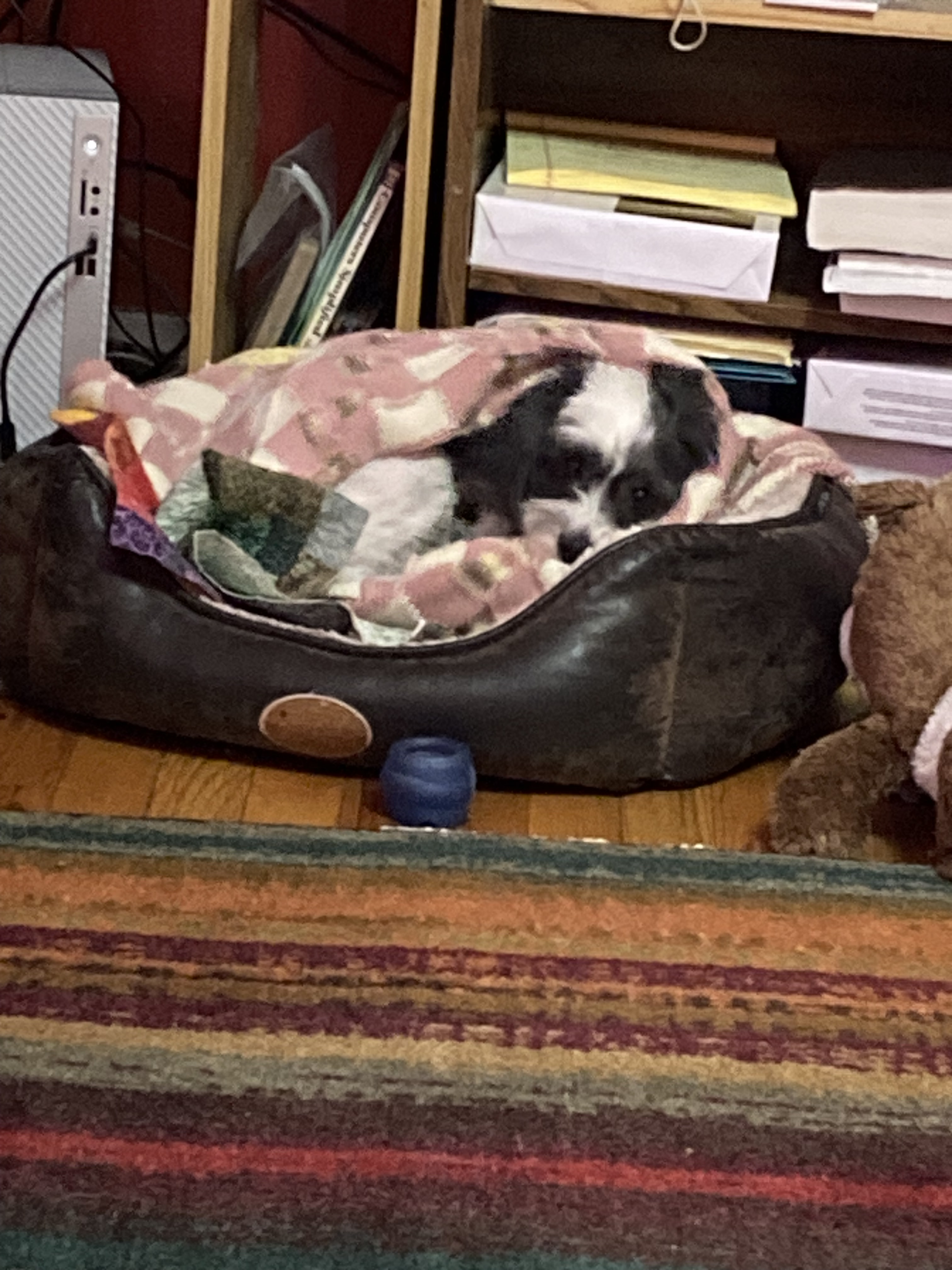
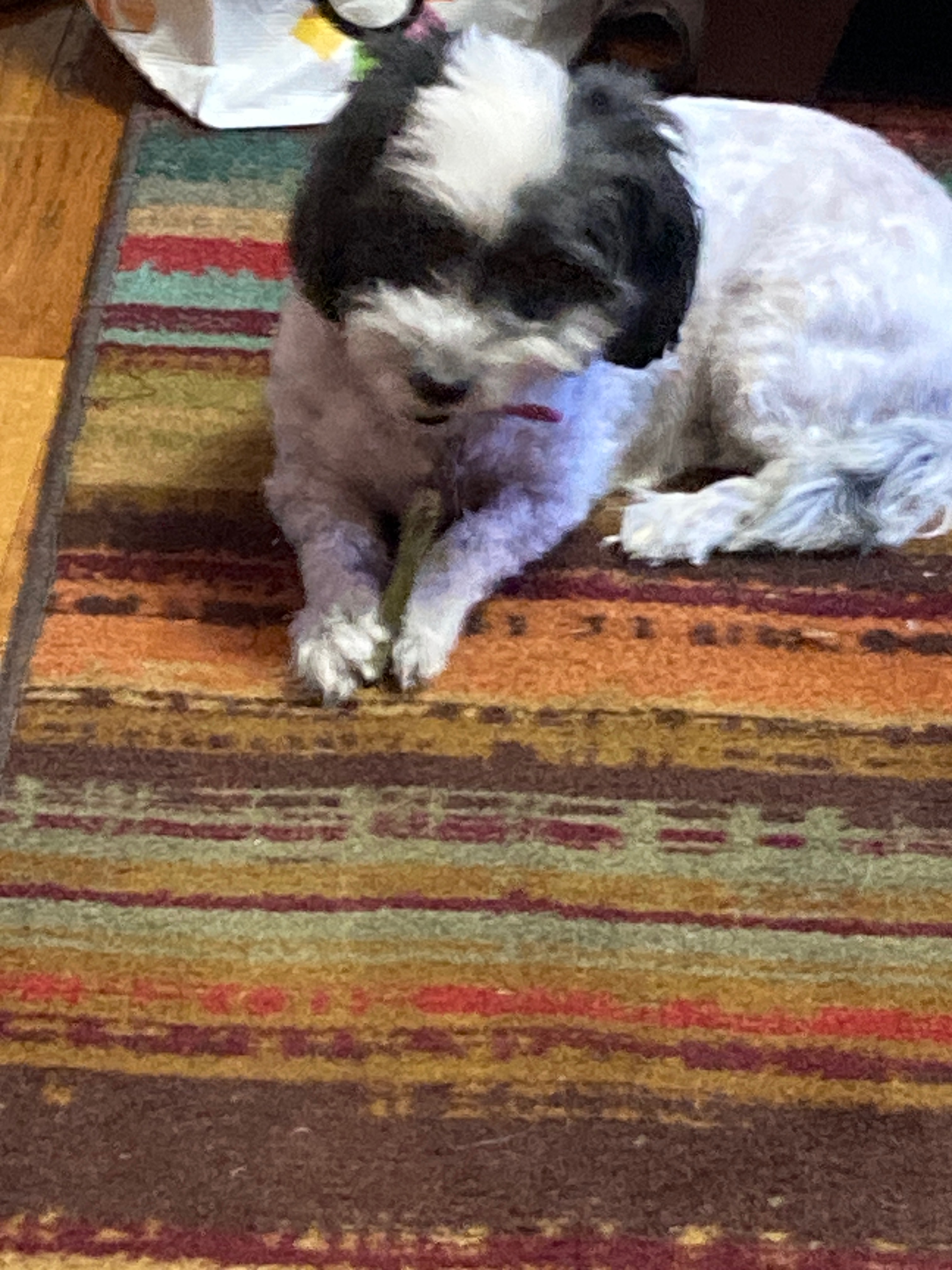
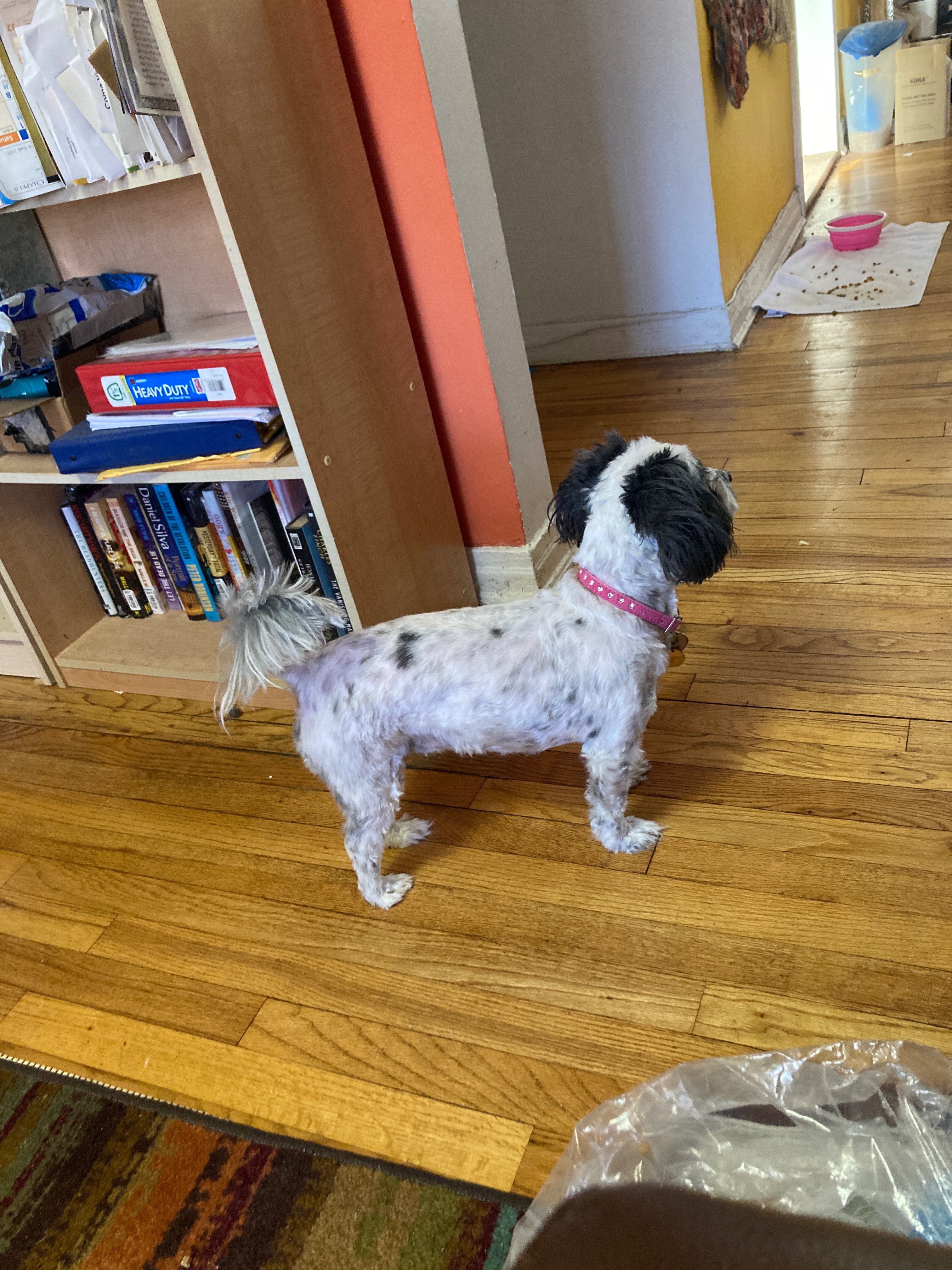
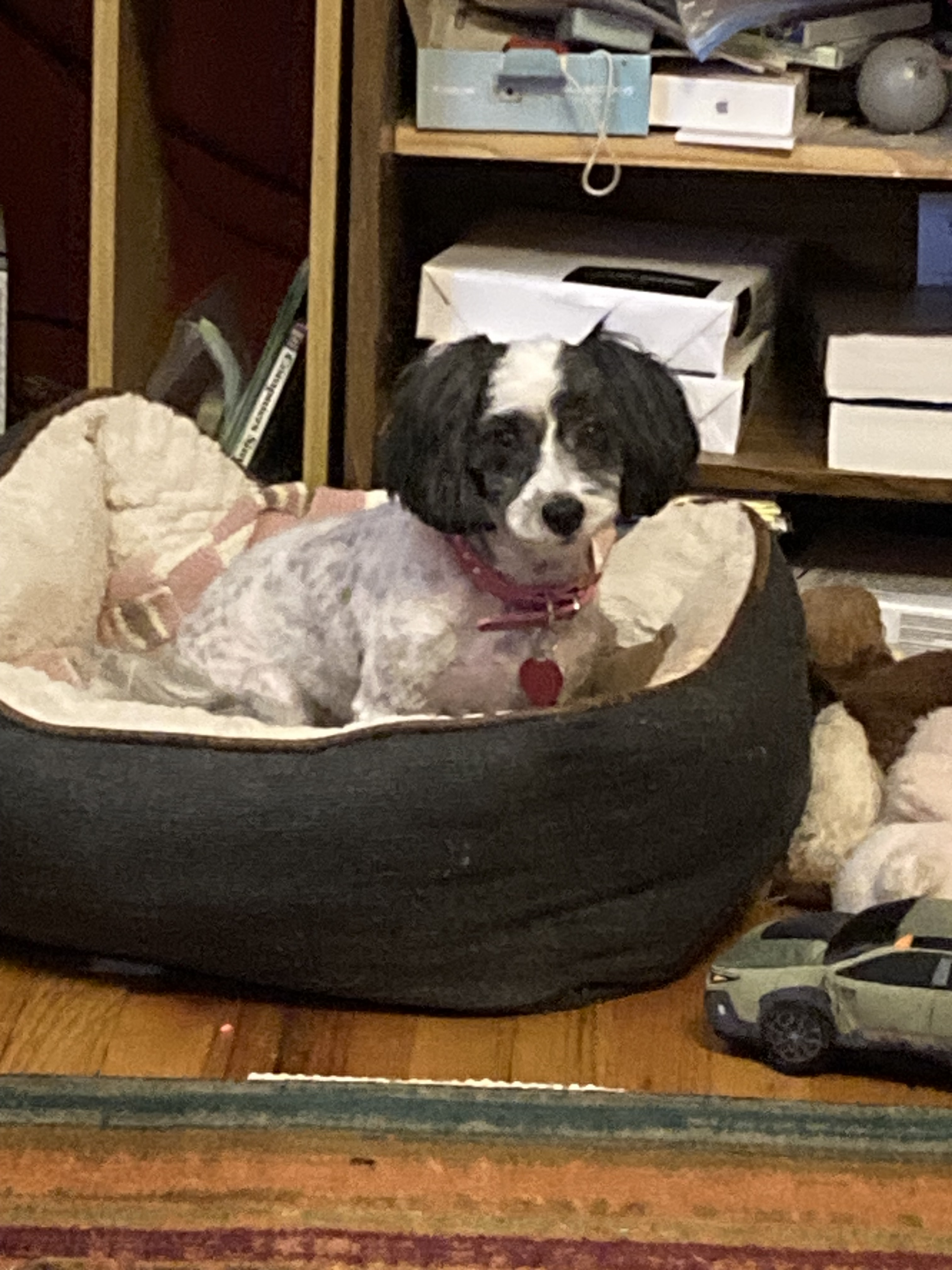
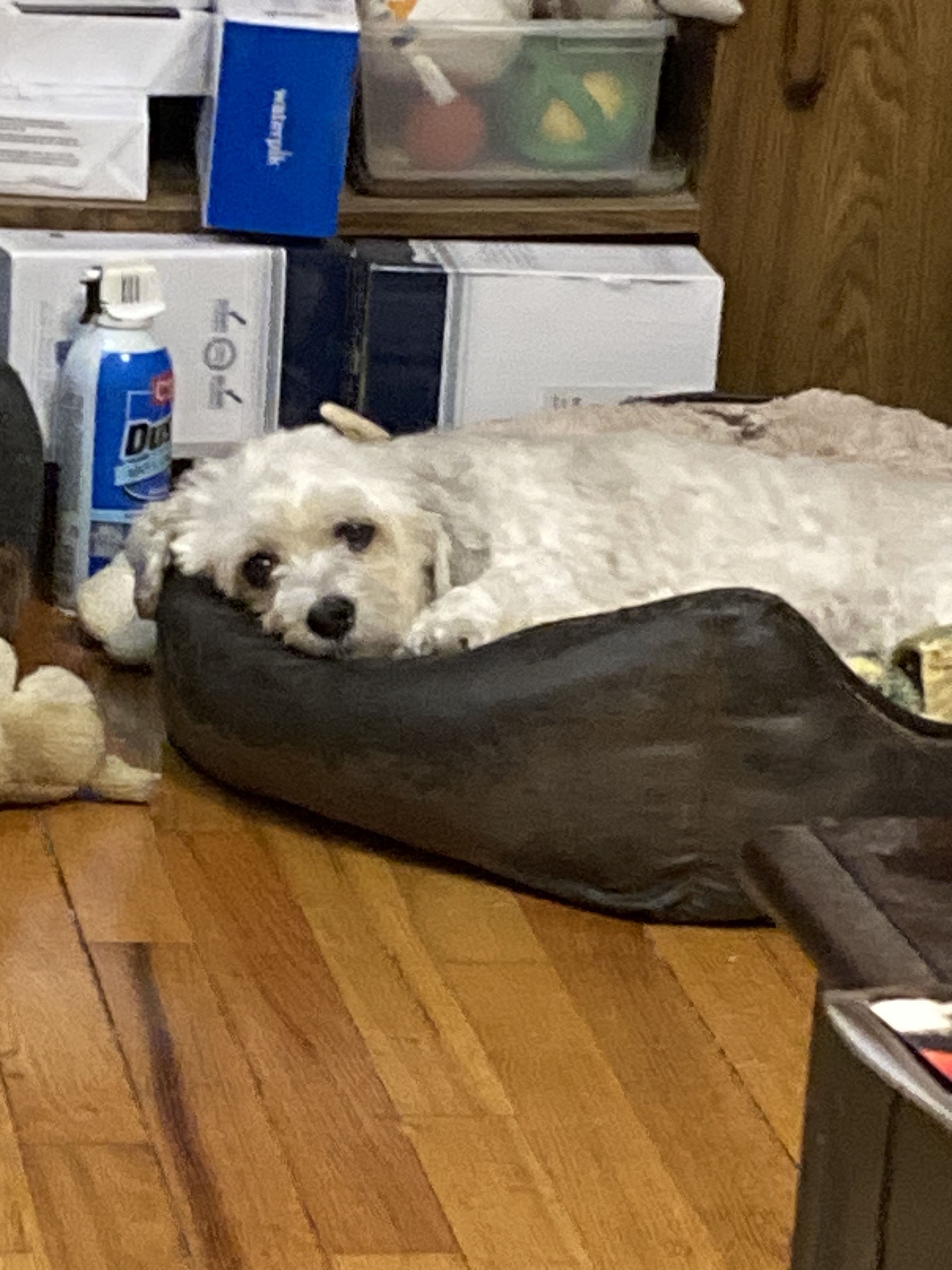
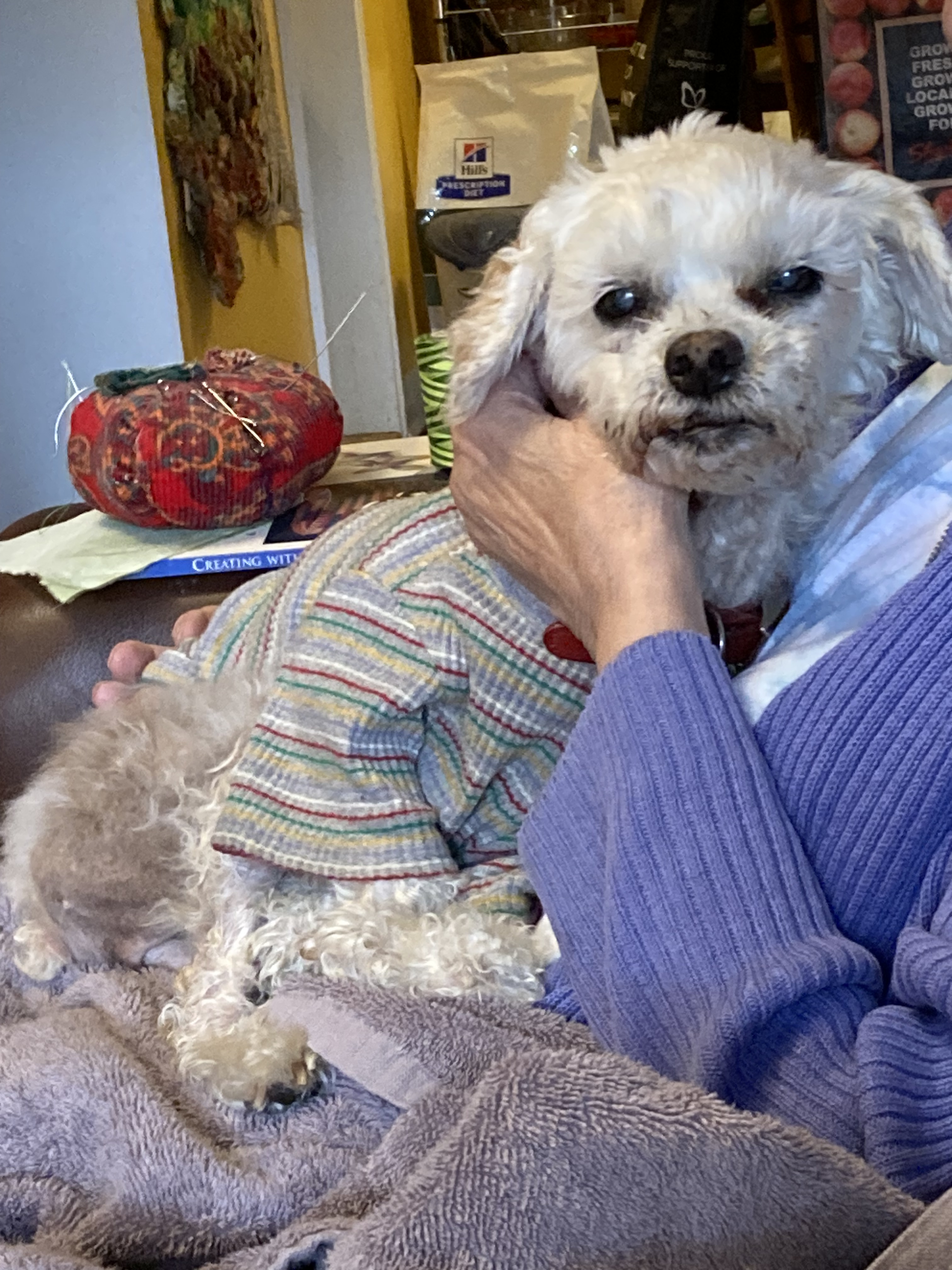
A week after seeing the substitute vet, and being told not to spend more money on tests, we were able to get an appointment with Ellie’s regular vet and he recommended an ultrasound, to see if her distended belly was filled with fluid or with something else; and he confirmed that it was all fluid. He recommended against trying to poke around with needles to empty the fluid, because it could stress her literally to death, and because the fluid would come back in a few days anyway. Instead, he raised her diuretic dose a little bit and sent us home, saying that, like with Cricket, if Ellie doesn’t eat for three or four days, she’s suffering.
It certainly wasn’t the news we wanted to hear, but it is what we expected, and it was a relief to know for sure what we were dealing with.
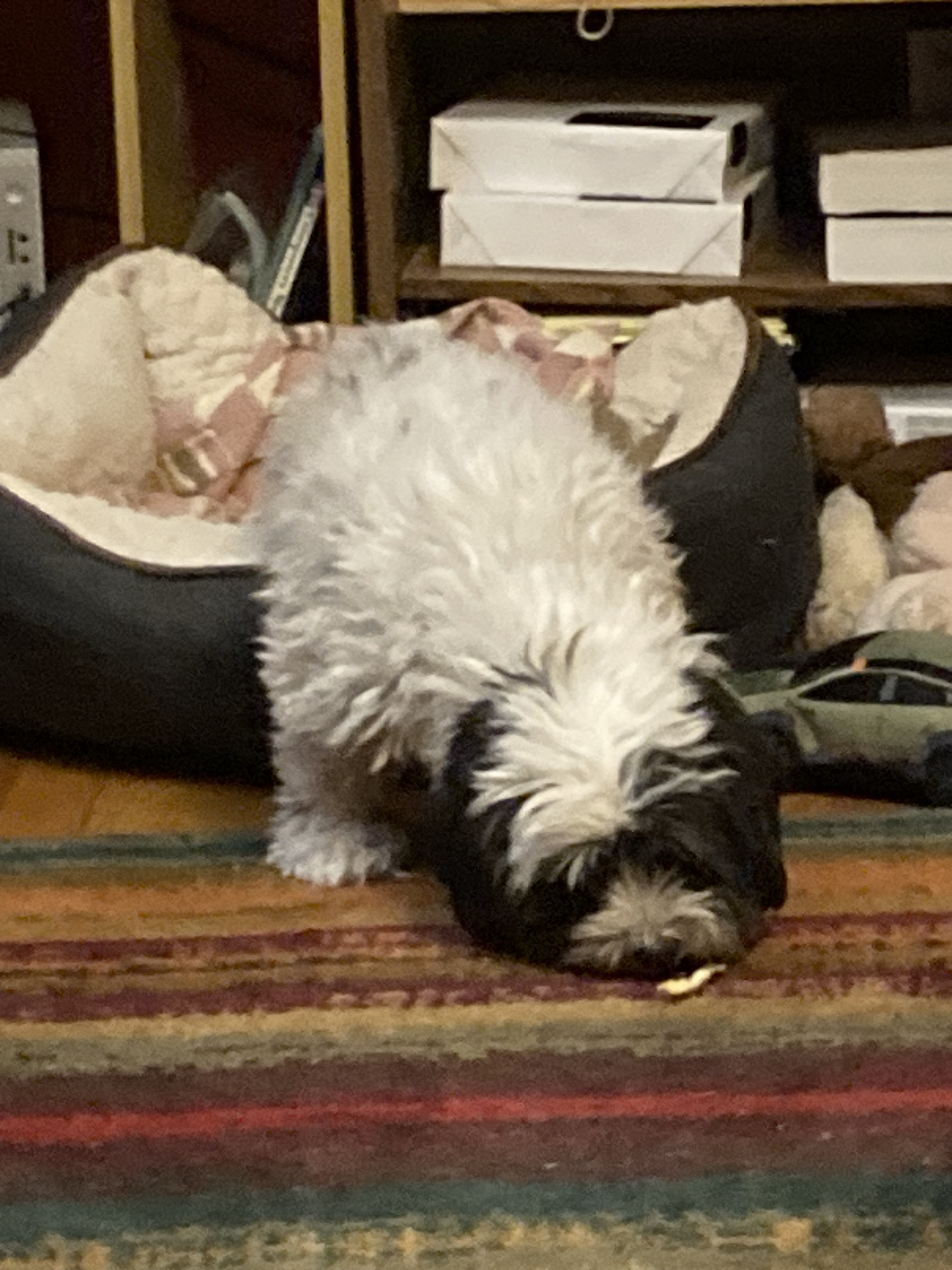
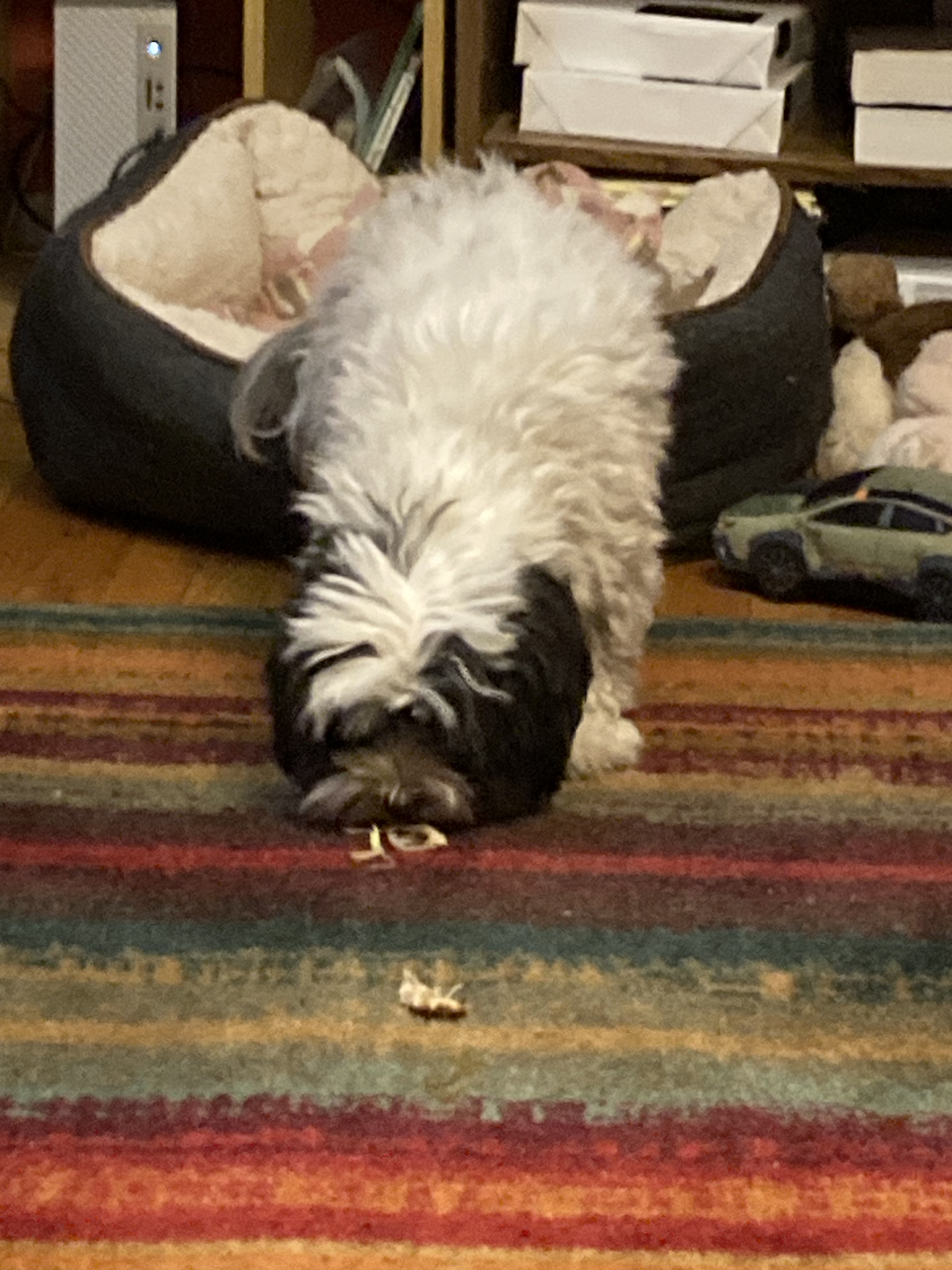
The raised dose of the diuretic helped a little bit, at least enough to allow Ellie to feel hungrier and to enjoy her food again. She especially liked the Chinese food we got for my birthday dinner. Her belly is still full of fluid, and she spends most of her time resting on her side, but her joy in eating is wonderful to see.
“Where are you hiding the Chinese food?”
When we were looking through her papers recently (which makes it sound like she has her own filing cabinet and a small business to run, but we were just looking for her exact birthday so we could celebrate it with her), we realized that she is turning ten this year, not nine like I thought. There’s a little bit of relief in knowing she’s made it all the way to ten, just like there was relief in seeing Cricket pass the sixteen year mark, but it’s still not enough.
We didn’t plan anything special for her birthday, because every day she’s still with us feels special and important, and really an act of will on her part. Just seeing her eat, and take all of her medication, and enjoy getting her back scratched, feels like a celebration to me. I’m so grateful that she wants to stay with us for as long as she can, and I’m especially grateful that we’ve been able to have this time with her, after Cricket’s death, to shower her with as much love and attention as she can absorb, so that she knows what it’s like to be the center of everything, at least for a little while. Even Cricket would have wanted that for Ellie, though not as much as she wanted it all for herself.
Now we’re just going day by day, trying to accept that we won’t have that much more time with her. Her sweet spirit still shines through, even when she’s tired, or worried, or struggling to catch her breath, and we know how lucky we’ve been to have her this long.
Happy birthday dear sweet Miss Ellie, my beautiful girl!
“I need more chicken, Mommy.”
If you haven’t had a chance yet, please check out my Young Adult novel, Yeshiva Girl, on Amazon. And if you feel called to write a review of the book, on Amazon, or anywhere else, I’d be honored.
Yeshiva Girl is about a Jewish teenager on Long Island, named Isabel, though her father calls her Jezebel. Her father has been accused of inappropriate sexual behavior with one of his students, which he denies, but Izzy implicitly believes it’s true. As a result of his problems, her father sends her to a co-ed Orthodox yeshiva for tenth grade, out of the blue, and Izzy and her mother can’t figure out how to prevent it. At Yeshiva, though, Izzy finds that religious people are much more complicated than she had expected. Some, like her father, may use religion as a place to hide, but others search for and find comfort, and community, and even enlightenment. The question is, what will Izzy find?
A couple of weeks ago, when Cricket lost the ability to hold off peeing until she could reach the wee wee pad by the front door, we created a yellow brick road of wee wee pads, from Grandma’s bed to the front door, to help her out. And, either as a result of the Gabapentin and ACE she takes every day (in order to tolerate the subcutaneous fluids for kidney disease), or because of incipient dementia, Cricket has started to pace around the apartment at all hours, peeing along her wee wee pad path, especially in the middle of the night.
After she’s jumped off Grandma’s bed, to get a drink of water and to pee, Cricket will come to my room, sometime around four o’clock in the morning, and bark at me for the mommy-elevator up onto my bed, where she wanders around and around in search of the perfect sleeping spot, which is often elusive. For some reason, Ellie has decided that instead of staying in my room at night, the way she used to, she prefers the wee wee pads – at least the as yet unused ones – as her favorite place to sleep.
“Are you telling my secrets, Mommy?”
When I accept the inevitable and finally get up, around 7 AM, Cricket and Ellie are ready to go outside, walking down the stairs together if Cricket is up to it. Neither one of them can run and play the way they used to, but Ellie gets a lot of enjoyment just by standing still and listening to the sounds of the neighborhood, while her sister wanders around the yard sniffing all the smells.
When we get back inside it’s time for Ellie’s medication, carefully stuffed into small pieces of chicken or chicken liver, with a few pieces going to Cricket as well. And, if she’s willing, Cricket gets her ACE and Gabapentin in her food too, so we can get her fluids done early and give her time to pee it all out during the day, instead of needing to walk her path so much overnight.
“Give me more fluids and I’ll be swimming down the hallway!”
We’re still in the trial and error phase with all of this, constantly adapting their diets and schedules and adapting our expectations of what they can and can’t do, based on how things are going each day. Ellie is mostly consistent, though she needs new high value treats every few days to help her tolerate all of her pills. Cricket is the wild card. Some days she seems like she could go at any moment, and other days she seems so normal that we almost get complacent. Almost.
We’ve started to get rid of rugs that have been peed on too often, by both of them, and we’re doing a lot of extra laundry, but we love them, so we walk the wee wee pad path, replacing one pad here and there as we go along, trying to keep them happy and comfortable. I wouldn’t have chosen this, but I wouldn’t want to miss a day of having them in my life either, so this is what love looks like right now.
If you haven’t had a chance yet, please check out my Young Adult novel, Yeshiva Girl, on Amazon. And if you feel called to write a review of the book, on Amazon, or anywhere else, I’d be honored.
Yeshiva Girl is about a Jewish teenager on Long Island, named Isabel, though her father calls her Jezebel. Her father has been accused of inappropriate sexual behavior with one of his students, which he denies, but Izzy implicitly believes it’s true. As a result of his problems, her father sends her to a co-ed Orthodox yeshiva for tenth grade, out of the blue, and Izzy and her mother can’t figure out how to prevent it. At Yeshiva, though, Izzy finds that religious people are much more complicated than she had expected. Some, like her father, may use religion as a place to hide, but others search for and find comfort, and community, and even enlightenment. The question is, what will Izzy find?
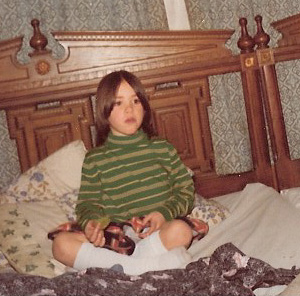
A few weeks ago I was afraid Cricket was on the edge of life, diagnosed with kidney disease, struggling to walk, knocking into things. We started giving her subcutaneous fluids on the off chance that it would help extend her life, and it’s actually working. Though in order to give her the fluids we have to medicate her with a combination of gabapentin and ACE, which makes her woozy for hours. At times, she seems like a wraith, her feet slipping out from under her, not even protesting when the needle slips under her skin.
Ideally, she would have gotten used to the whole procedure by now, and she wouldn’t try to pull off the muzzle, or lift up her head to get away from the needle. Ideally, I’d never have to give her any calming meds at all and she would just accept the fluids as a necessary evil and get it over with and get back to living her life. But then she wouldn’t be Cricket, and all of this effort is to make sure she gets to be Cricket for as long as possible.
“Oh, I can be even more Cricket-y. Just wait.”
Every day, at the beginning of all of this, I was afraid she was going to die overnight, and when she actually woke up in the morning, and ate her breakfast, I was surprised, and afraid to be hopeful. But with each day she seems to improve a little bit. The meds make her into a rag doll, yes, but then the next morning, after she’s slept it off, it’s like she’s been brought back to life, refilled with her fluids and her spirit, and ready to sniff the whole world again.
It’s still nerve-wracking to watch her skin fill up with the fluids. I even worry sometimes that her neck is going to explode (I’ve seen too many movies), and I worry that I’m going to put the needle in the wrong place and puncture something vital. I was worried for a while that I was inserting the needle the wrong way and causing scar tissue to form because I could feel these quarter-sized bumps under her skin and I was afraid I would run out of loose skin and not be able to give her the fluids anymore, but then the bumps started to dissolve, and that worry, at least, went away. So much of this is trial and error and the circumstances seem to change every day. It feels like a magic trick each time she wakes up in the morning and walks and barks and eats and acts like herself, but a magic trick that is unreliable and hard won.
I’ve been thinking about my friend Teddy, the miniature poodle, who died from kidney disease a few years ago. His death came as a surprise, at least to me. He hadn’t been diagnosed with the disease ahead of time, and by the time they caught it he was too far gone to be helped by fluids or anything else. When Cricket was diagnosed I was afraid it would be the same thing, and every day, even though I knew her case was different, I expected the same results.
Some days are better than others. Every once in while she has a bad night, her breathing is shallow, she pees on the floor because she can’t get to the wee wee pad in time, or she’s not up to climbing the stairs, but other days she seems to be getting better, growing stronger, and enjoying her life.
I was telling myself that I just needed Cricket to reach her sixteenth birthday, but now that she’s accomplished that goal, I need more. I need to feel like I did everything I could possibly do for her. I need to not have any regrets, and not feel like if only I had been stronger or smarter or kinder or more loving, she would have lived longer.
I’m also doing my best to make sure Ellie doesn’t feel left out, and gets extra hugs and scratchies and treats to make up for all of the attention her sister is getting. But when Cricket feels better she goes back to taunting Ellie, so then I feel guilty for taking such good care of Cricket and, at the same time, I feel guilty for not taking good enough care of her.
“If I keep my eyes closed she won’t bother me. Right?”
The thing is, Cricket isn’t giving up. She doesn’t think sixteen years is enough, even if each day is a little harder than it used to be. And if she’s going to be this stubborn, then I guess I’m going to have to be stubborn too.
If you haven’t had a chance yet, please check out my Young Adult novel, Yeshiva Girl, on Amazon. And if you feel called to write a review of the book, on Amazon, or anywhere else, I’d be honored.
Yeshiva Girl is about a Jewish teenager on Long Island, named Isabel, though her father calls her Jezebel. Her father has been accused of inappropriate sexual behavior with one of his students, which he denies, but Izzy implicitly believes it’s true. As a result of his problems, her father sends her to a co-ed Orthodox yeshiva for tenth grade, out of the blue, and Izzy and her mother can’t figure out how to prevent it. At Yeshiva, though, Izzy finds that religious people are much more complicated than she had expected. Some, like her father, may use religion as a place to hide, but others search for and find comfort, and community, and even enlightenment. The question is, what will Izzy find?
Mother’s day traditionally marks the beginning of the gardening season, even when the gardening has already been going on for a while, and most years Mom and I spend Mother’s day morning at a gardening store, filling up the trunk of the car with all of the plants and seeds and mulch and tools she might need, at least for the next week or two. But for Mother’s day breakfast this year, my brother and his eldest son came to visit, with bagels and cream cheese and lox, to celebrate Mom. My brother brought a bouquet of colorful yarn, and my nephew brought a big box of mushroom starters: three huge white blocks, one for Blue Oyster mushrooms, one for Lion’s Mane, and one for something called Piopino, each in their own bags, with a special instruction booklet.
The yarn bouquet, after some of the yarn had already beenunwound.
When my brother’s kids were younger we used to go for nature walks all the time, with Mom in the lead, and then the kids, and then me. We’d walk down by the river near their house, and the kids would climb trees, and collect rocks and leaves and whatever else they could find, unless Grandma warned them off of something yucky or poisonous. And when it was too cold to be outside, she taught them how to make little boats out of empty walnut shells and float them in a bowl of water; just because. As a result, my oldest nephew has his own vegetable and herb garden, with birds who call it their home, and for Mother’s day, he thought the best gift he could give his Grandma would be the chance to watch mushrooms grow, and he was right.
And after breakfast, my nephew and his Dad braved the woods behind our building, and the uncertain ground under a huge fallen tree trunk, to pluck two giant mushrooms, still connected to each other, just so Mom could see them up close and then put them in her garden, to inspire the other plants to grow big and strong.
Mushrooms on the dead tree trunk
My Mom’s love of gardening came from her father, whose yard was filled with flowers, and birds, and dastardly squirrels, and contraptions to keep the squirrels away from the bird feeders. But she didn’t do much gardening at the house I grew up in, partly because she was busy working and doing other creative things, but also because it just didn’t feel like a place where good things would blossom. Almost as soon as she divorced my father, and we moved to a new home, she started to garden. She planted her father’s lilies, and then strawberries and tomatoes and marigolds, and one year she planted pumpkins that took over the whole yard. And now she gardens all year long, planting seeds indoors and seedlings outdoors, and if she’s not planting, she’s weeding or preparing the ground for more planting later on. And she loves it! And Cricket loves it! And Ellie and I sit on the bench and watch them, and listen to the birds, and shrug, happy for them, though mostly bewildered.
“What’s your problem?”
Within days of the Mother’s day visit, the new mushrooms were sprouting, magically, from those plain white blocks, and our neighbor was deep cleaning her bird bath to accommodate all of the birds returning to the yard, and there were pink and orange tulips, and magenta rhododendrons, and purple irises, and red azaleas, and green everywhere, including on the pawpaw tree.
Piopino
Lion’s Mane
Blue Oyster
We are now in pawpaw counting season. First the red flowers had to appear on the tree, and darken to crimson and then to a reddish dark brown, and then, as the flowers died and fell away, the baby pawpaws appeared from the wreckage. So now starts the long summer of watching the pawpaws grow, and worrying that they will be eaten by passing birds, or squirrels, or that they’ll fall off in the rain, or die off for lack of nutrition. The counting becomes even more difficult as the leaves grow to their full size and obscure the growing pawpaw fruit, but I try to accept it, because the leaves are doing their best to protect those baby pawpaw fruits from disaster.
Baby pawpaw fruit
It’s funny, just as Mom spends her summers tending her garden, I kind of do the same with my writing. We plant our seeds and nurture them and weed out the overgrowth and anything that’s getting in the way, and hope that something comes of all of the worry and the work. And each year we overplan, and barely get through half of what we hoped to accomplish. I can’t make the summer expand to give me the time and patience to do everything I want to do, just like Mom can’t use the whole yard, and then some, to plant all of the flowers and vegetables she dreams of harvesting in the fall. But we do what we can do.
“Isn’t it nap time yet?”
If you haven’t had a chance yet, please check out my Young Adult novel, Yeshiva Girl, on Amazon. And if you feel called to write a review of the book, on Amazon, or anywhere else, I’d be honored.
Yeshiva Girl is about a Jewish teenager on Long Island, named Isabel, though her father calls her Jezebel. Her father has been accused of inappropriate sexual behavior with one of his students, which he denies, but Izzy implicitly believes it’s true. As a result of his problems, her father sends her to a co-ed Orthodox yeshiva for tenth grade, out of the blue, and Izzy and her mother can’t figure out how to prevent it. At Yeshiva, though, Izzy finds that religious people are much more complicated than she had expected. Some, like her father, may use religion as a place to hide, but others search for and find comfort, and community, and even enlightenment. The question is, what will Izzy find?
At my most recent visit with the dentist, about a month ago, I finally asked her about the oral surgeon’s recommendation that I get a full implant to replace my upper teeth – with screws in my cheek bones to stabilize it – and the dentist said it was the best option for me, despite the cost. She said that I will lose more teeth, more rapidly, in the near future, because of the progression of gum recession and bone loss. She was definite, and the hygienist, who I’ve been going to for about twenty years (she worked with my previous dentist too), agreed with the dentist’s assessment, and said that I’d be in good hands with this particular oral surgeon. My mother had also done her research, with friends in the dental field and of course on Google, and she felt that this was the right plan too. And, Mom said, as a result of my father’s death last fall she would be getting a larger social security check from now on, so, in a way, my father would be helping to pay for it.
I was still scared, though, of the cost of the procedure and the radical nature of it; but I was more scared of not doing it, or of not doing it in time, and losing more teeth without having something to replace them.
As soon as we called the oral surgeon to say yes, the process started to move forward at high speed. The office manager at the oral surgeon’s office had to do a credit check to see if I qualified for a loan, and then I needed to go into the office to sign the loan papers, and get x-rays and a lot of pictures of my smile, and intra-oral pictures to cover every centimeter of my mouth, so that the surgery could be planned out and the temporary and permanent implants designed. The doctor’s assistant, who did all of the pictures, some even with her cell phone while I used the retractors to hold my mouth open, also gave me a rundown of what to expect after the surgery: a lot of pain (with a prescription for Percocet, just in case), and bruising on my face for ten days to two weeks, and oh yeah, it might be difficult to get used to eating and talking with the temporary implant (the permanent one would come in three months and be made of less bulky and more long-lasting materials), and I’d have to be on a soft food diet for the whole three months to protect the temporary implant, and probably not eat much at all for the first few days while my gums healed, before they could even put the temporary implant in place.
I went home with a gift bag (a Water Pik, signed loan papers, cough drops, and colorful plumes of paper), and a lot of fear. I knew I had to follow through with this, not just because of the loan papers, but because this would be my best option to feel like a viable person in the future, but I had a lot of nightmares: teeth being pulled out of my mouth with rusty plyers, monsters shoving things down my throat while I’m under anesthesia, etc.
“Monsters?”
A day or two later, I got an email from the Anesthesiologist’s office telling me what I’d need to do for medical clearance before the surgery: I’d need an EKG and blood tests and an overall exam from my primary care doctor, and an okay from a pulmonologist. But my primary care doctor didn’t have any appointments available until the week after the surgery, and it took a while before one of the schedulers at her office offered to let me see the nurse practitioner there who had an opening. And then I called the office of a pulmonologist I’d seen five or six years ago, for shortness of breath, and his scheduler said he didn’t have appointments available until October.
So, back to the primary care doctor’s office for a referral to another pulmonologist, and, wonder of wonders they had a name ready and he had an appointment available within an hour. And he was lovely. He read through my test results from five years ago, and checked my breathing, and took a short history, and gave me his okay for surgery. He told me that he’d had a similar situation where he’d needed pulmonary clearance for surgery, and they wouldn’t take his own medical word for it, so he’d gone to the pulmonologist I’d seen before (the one with no appointments until October) to get his clearance done.
After that, I was finally able to take a deep breath. It seemed like things were going to be okay, and there were even nice people in the world who understood what I was going through, and then I got home and found a jury summons in the mail, for the week of the surgery.
Really God? Really?!
I had to email the jury commissioner’s office directly because the only postponement options offered online were for during the school year, and luckily they were able to give me a new date in August (by which time my bruises would, hopefully, be less visible).
At the same time, I was preparing for the trip to the hospital in Philadelphia (which turned out to be a virtual visit at the last minute, thank God), and worrying about whether or not to take the next semester of my online Hebrew class over the summer, knowing I’d have to miss a couple of class sessions, and possibly stay off camera for a few others, what with bruises on my face and lispy, awkward speech. But the idea of not having those classes, and only having the pain to look forward to, seemed too awful, so I stuck with it. And then I needed to go for a Covid test and pick up the meds from CVS that I was supposed to start three days before the surgery, and…
And then Mom’s hip replacement popped out. Her hip had been sore for a few days, but the doctor wasn’t worried and just recommended more rest. But when I came in from walking the dog’s Saturday morning Mom said, “I have some bad news,” or something equally as understated, and she told me she could feel something protruding under the skin and she was ready to throw up from the pain. I raced around looking for the doctor’s phone number, which was probably in plain sight somewhere, and eventually found it online, and the doctor said to call for an ambulance and go to the emergency room. The dogs barked up a storm from behind my bedroom door when the paramedics arrived, but Mom was really calm and just needed some help getting her shoes on before they guided her down the stairs in a wheelchair and out to the ambulance.
“Why can’t we go with Grandma?”
The ER was crowded with Covid patients, so I wasn’t allowed to go in and had to wait for news at home. And I still wasn’t allowed to go in later in the day, after they’d decided to transfer her to the hospital in the city where she’d had the original surgery, so I had to drop off her clothes and phone charger with a very nice security guard, without seeing her at all. And then I went home and called the oral surgeon’s office and left a message (it was the weekend) telling him that I would have to postpone the surgery, which was supposed to have taken place that Thursday. And then I had to sit and wait.
Up until that moment I’d felt like I was on a speeding train with all of the doctors’ appointments and the upcoming oral surgery and jury duty and then getting Mom to the emergency room and bringing her clothes. And then the world just stopped, and all I could do was sit by the phone.
“I’ll sit with you, Mommy.”
But Mom’s second surgery finally took place mid-week, and it went well, though the surgeon sounded more humble on the phone this time around, explaining exactly what he’d done to make the hip replacement more stable. And then I heard from the oral surgeon’s office manager that my new surgery date wouldn’t be until late in August, dangerously close to the beginning of the synagogue school year (though I’m hopeful that with the latest Covid sub-variant going around, I will be able to wear a mask in the classroom and not feel too self-conscious).
Now that Mom’s home, and safe, I should be feeling better, but I’m afraid of what will happen when the world starts moving again and I have to rush to the drug store, or see doctors, or go to jury duty, or prepare for my own surgery, or go back to teaching in the fall. I feel like a stopped clock that has to be reset, and my arms will flail out of control as I start to speed forward through the hours again. But for now, there’s a calm in our house, as Cricket climbs back up onto her grandma’s bed, and even lets Ellie sit nearby (though not for long); we can all breathe a sigh of relief, knowing we are home, together, where we belong.
If you haven’t had a chance yet, please check out my Young Adult novel, Yeshiva Girl, on Amazon. And if you feel called to write a review of the book, on Amazon, or anywhere else, I’d be honored.
Yeshiva Girl is about a Jewish teenager on Long Island, named Isabel, though her father calls her Jezebel. Her father has been accused of inappropriate sexual behavior with one of his students, which he denies, but Izzy implicitly believes it’s true. As a result of his problems, her father sends her to a co-ed Orthodox yeshiva for tenth grade, out of the blue, and Izzy and her mother can’t figure out how to prevent it. At Yeshiva, though, Izzy finds that religious people are much more complicated than she had expected. Some, like her father, may use religion as a place to hide, but others search for and find comfort, and community, and even enlightenment. The question is, what will Izzy find?
The one rule that I have never been able to stick to in every diet I’ve ever been on, is don’t eat in front of the TV. The reasoning for the rule is that when you watch TV you go into a dissociative state – you are focusing on the TV characters or the story or the horrible news, or the sound effects, and not on yourself – and therefore you are likely to overeat. But distracting myself from myself is pretty much the point of watching TV. I find my own thoughts overwhelming, especially my own thoughts around food.
I haven’t had a problem with other aspects of dieting – I can drink enough water, and exercise, and use small plates, and eat-this-but-not-that, and reduce portion sizes – but I can’t turn off the TV. If I were only allowed to eat at the dining room table, with no distractions, I think I might starve to death – because food just isn’t worth that kind of suffering.
“I don’t understand.”
This sounds crazy, I know. But I think the problem started because nightly family dinners were one of the most consistently awful parts of my childhood. And it was consistent. My parents, who didn’t believe in regular chores or bed times, believed in eating dinner together as a family, every night, no matter what. I couldn’t escape to eat alone in my room, or say I wasn’t hungry, or even leave the table early. Those were just not options in our house. When I found out that other families didn’t always eat dinner together, I was shocked.
“Sometimes I like to eat alone too. So, stop following me.”
We didn’t eat “kid food.” I heard about families where the kids ate fish sticks, or chicken nuggets, or refused to eat vegetables, or only ate white food, but I thought those were fairy tales. There was only one menu for dinner and it had to fit what my father wanted to eat and that was that. There was a time when my brother tried to be a picky eater, keeping his peas away from his meatloaf on the plate, or refusing to eat cream cheese and jelly sandwiches because they just didn’t go together, but that didn’t last. He trained himself to eat whatever was put in front of him, whether he liked it or not.
My father also had a habit of throwing dishes (if they had minor chips in them), or yelling about having to eat chicken twice in one week, or just yelling because he was in the mood to yell. Otherwise, dinner conversation was most often focused on my father’s problems at work, or arguments about paying the bills, or other adult problems that needed to be solved. There were so many times when all I wanted to do was to crawl under the table and sit with the dog, whichever dog we had at the time, but I wasn’t allowed to do that either.
I remember Friday night dinners, the worst of the worst of family dinners each week, when we had to stay at the table for hours, with guests, and discuss the news (Jeffrey Dahmer), and the gossip from our synagogue (ugh, don’t ask), and the latest unfairness my father had experienced at work (where they were all out to get him), and listen to my father’s childhood stories, where the moral of every story seemed to be that he could get away with doing any crazy shit he wanted. Everyone acted like all of this was normal, but I didn’t want to hear about the serial killer who ate his victims, or the rabbi’s affairs, or my father’s paranoia. And when I didn’t join in with the laughter or sympathy the way I was supposed to, I became the problem. That was when I became the target of jokes about my sensitivity, my looks, my eating habits, etc. I was a rich target, they told me, because I always “overreacted.”
I remember a few times in my teens when I desperately wanted to leave the table, and leave behind yet another endless argument about whether murder is really wrong, or monogamy is necessary, or sexual harassment is actually a thing. I was the only one on my side of every argument (Mom abstained, excusing herself from the table to serve food or fill the dishwasher or do pretty much anything else). As the awfulness continued, I actually fell to the floor hiccupping with high pitched giggles, unable to catch my breath.
I still wasn’t allowed to leave the table, though Mom came over to rub my back and give me a glass of water (which I promptly snorted through my nose).
My eating habits were already disturbed by then. I was sneaking food past my mother after school, and alternately starving myself and binging on cookies I didn’t even like (either because my father liked them and if I ate them he couldn’t have them, or because they were the only cookies in the pantry).
I tried, once, as an adult, to force myself to eat at the kitchen table in the old apartment. I put a notebook next to me so that I could write down whatever came to mind, and I sat solemnly in my seat, alone, staring at my food. But I couldn’t eat, or write, or breathe, really. I persisted, one meal a day for a week. If it had led to pages and pages of writing, and insight, and recognition of the emotions behind it all, I might have continued the experiment, but none of that happened. Everything in me just shut down, and all I could do was force myself to sit there and fork food into my mouth, but I couldn’t taste anything.
So when the week was over, I let myself eat all of my meals in the living room again, in my comfy chair in front of the TV, and color came back into my life and food tasted good again. I knew I was choosing to dissociate from my body, and most of my mind, as I sat there eating in front of the TV, but I also knew that that was the best I could do at that moment.
“We could use a snack.”
I still struggle to taste the food when I eat at a table with other people. The anxiety is too big and I just eat mindlessly, unaware of hunger or taste or how much I want to eat.
With my Intuitive Eating project, I didn’t even bother trying to eat away from the TV, even though it’s high on the list of rules, or suggestions. I told myself, and my nutritionist, that this was one rule I knew I couldn’t follow, and if she insisted on it then I wouldn’t be able to continue. But she accepted it. She said that you should only challenge yourself as much as is helpful, because pushing past your limits is counterproductive.
So, I eat while I’m watching the news, or Christmas movies, or Law & Order. I eat with a towel on my lap, to protect the couch and my clothes. I eat with my dogs surrounding me, begging for my food with their eyes, and then with their voices. And the food tastes good. Maybe someday I will be able to eat dinner at the dining room table (I’ll have to move the dog treats, box of wee wee pads, and containers of snacks first, though), and maybe not.
“What are you eating now, Mommy?”
In the meantime, I hope I can come to some kind of peace with food, even if I can’t come to peace with the dining room table.
“Tables are overrated.”
If you haven’t had a chance yet, please check out my Young Adult novel, Yeshiva Girl, on Amazon. And if you feel called to write a review of the book, on Amazon, or anywhere else, I’d be honored.
Yeshiva Girl is about a Jewish teenager on Long Island, named Isabel, though her father calls her Jezebel. Her father has been accused of inappropriate sexual behavior with one of his students, which he denies, but Izzy implicitly believes it’s true. As a result of his problems, her father sends her to a co-ed Orthodox yeshiva for tenth grade, out of the blue, and Izzy and her mother can’t figure out how to prevent it. At Yeshiva, though, Izzy finds that religious people are much more complicated than she had expected. Some, like her father, may use religion as a place to hide, but others search for and find comfort, and community, and even enlightenment. The question is, what will Izzy find?
I am thankful for my Mom, who makes everything possible.
I am thankful for my dogs, present and past, who fill my life with joy and laughter.
“What do you mean dogs plural?
I am thankful for my blogging friends and my friends-in-real-life who listen and give so much of themselves.
I am thankful for my students, who challenge me and entertain me and teach me and keep me on my toes.
“Like us!!!!”
I am thankful for my family, near and far, who keep me connected to the past and the future.
I am thankful for my Hebrew teachers and fellow students who keep bringing me closer to the dream of seeing and hearing and feeling Israel for myself.
I am thankful for books and TV shows and movies for keeping me informed and entertained and alternately distracted from and attached to the world around me.
I am thankful for good food, especially yummy food like pizza and sushi and chocolate frosting, for making life so rich.
“Did you say pizza?”
I am thankful for my memories, because they make me who I am.
My Dina
I am thankful for rainy days and talkative birds and flowers and leaves of every color and I am thankful for dreams of snow days yet to come.
My Butterfly
And I am thankful for hope, because it has gotten me through so many rotten days when nothing seemed okay, because it allowed me to always, always, imagine something wonderful up ahead.
“I always have hope, Mommy!”
I hope everyone had a wonderful (entertaining, complicated, meaningful, delicious, and peaceful) Thanksgiving.
And a Happy Chanukah to come for those who celebrate!
“Happy Chanukah!”
“I’ll have to think about it.”
If you haven’t had a chance yet, please check out my Young Adult novel, Yeshiva Girl, on Amazon. And if you feel called to write a review of the book, on Amazon, or anywhere else, I’d be honored.
Yeshiva Girl is about a Jewish teenager on Long Island, named Isabel, though her father calls her Jezebel. Her father has been accused of inappropriate sexual behavior with one of his students, which he denies, but Izzy implicitly believes it’s true. As a result of his problems, her father sends her to a co-ed Orthodox yeshiva for tenth grade, out of the blue, and Izzy and her mother can’t figure out how to prevent it. At Yeshiva, though, Izzy finds that religious people are much more complicated than she had expected. Some, like her father, may use religion as a place to hide, but others search for and find comfort, and community, and even enlightenment. The question is, what will Izzy find?
The first thing I thought of when Mom told me she would be having surgery on her wrist (outpatient for Carpal Tunnel) was – who’s going to cook? I cook once in a while, but I generally don’t have the energy to do much of it, and with all of the extra chores I’d be responsible for with Mom’s right (dominant) hand out of commission, I was worried we’d starve. Or have to live on peanut butter and Jelly sandwiches, or something.
“Peanut butter sounds good to me.”
I’m sure I was also in a panic about the risks of anesthesia, and problems with the surgery itself, and Covid, and Mommy is going to die and leave me all alone! But on the surface, mostly, I was worried about the food. And having to take the dogs out for all four walks each day, especially first thing in the morning. Ugh, and I’d have to wash dishes and fill and empty the dishwasher, and vacuum and clean, on top of doing the laundry and the food shopping as usual. Just thinking about it all was exhausting, and Mom was (selfishly) just worried about her potential pain, and how would she survive without sewing until her wrist healed. Harrumph.
(Don’t worry, we went to the freezer section of the supermarket two days before the surgery was scheduled and loaded up on cauliflower crust pizza, and veggie stir-fry’s, and ice cream. I’m sure that’s what you were most worried about.)
I don’t think of myself as lazy, per se, but I do get very grumpy about doing chores. Mostly I curse quietly to myself. But not always.
Of course, as we got closer to the day of the surgery, and all of the prep work was done, we were both getting anxious about the day of: Mom about the surgery itself and the potential pain in the aftermath, and me about the driving. I always get nervous about driving to new places, or to places I haven’t been to in a while. And I would have to drive early in the morning (originally we were told she’d have to be there by 7:30, but in the end it was a more reasonable 9 AM).
Mom has a map of Long Island (and all of New York and probably the Tristate area) tattooed on her brain; me, not so much. I drive because I have to, and I resent it. It just seems like a game of Frogger brought to life, except that I don’t identify with the frog who keeps stupidly trying to cross a busy street in the middle of traffic; instead I identify with the poor drivers who can’t dodge the enormous frog in the road, and have to feel guilty when the frog goes splat.
But, once we got going on the morning of the surgery, I realized that I mostly knew the route. I couldn’t picture it on paper, or by the street names, but in person it looked familiar. I was sort of relieved that the Covid protocols prevented me from going into the hospital with Mom, because if I had to sit there doing nothing but worry for hours I would have been swamped with anxiety. But I also felt guilty for dropping Mom off like a package at the front door, and I worried about her the same way I worry when I have to drop one of the dogs off at the vet instead of going in with them. What’s happening in there? Will Mommy/Ellie/Cricket/Butterfly/Dina ever come out again? Why didn’t I go to medical/veterinary school so I could take care of these things myself?
“Could I go to medical school?”
As soon as I arrived home, the dogs insisted on going out to pee again, and to sniff Grandma’s footsteps along the walkway. Cricket gave me dirty looks for the next few hours, because, clearly, it was my fault Grandma was not home, and I could never be trusted to leave the house again.
I was too anxious to take a nap, so I worked at the computer while I waited to hear that Mom was ready to come home. Mom had said the surgery would be over by around one o’clock and that she would call to let me know when to pick her up, but I didn’t hear from anyone until after two o’clock, and the wait felt more like a week than just an extra hour. I imagined every possible disaster, including: problems with the anesthesia, accidental amputation and catastrophic blood loss, a sudden outbreak of Covid taking over the whole hospital, a bomb, a meteor, aliens…My brain can do a lot in an hour.
But a nurse finally called and said that everything went fine and I could come in an hour or so to pick Mom up. Of course I left early, because I was afraid I’d get lost, or stuck in traffic, or something, and I called Mom’s cell phone as soon as I arrived at the front of the hospital. She was rolled out in a wheelchair ten minutes later, and I worried when the man guiding the wheelchair said that I should help her into the car and make sure she didn’t fall, as if she was much more fragile than usual, but it turned out that he was just being extra careful. Mom’s hand was wrapped to the size of an oven mitt, and she was a little tired and dizzy, but otherwise not too bad.
When we got home I found out about more of my duties, including medicine-bottle-opener, and ice-cube-bag-filler. I got used to filling both of our ice cube trays every few hours, and then pounding them on the counter to try to make the ice cubes come out. Ice cubes are stubborn creatures, until they break free, and then they can really fly.
After seventy-two hours I was able to drop the ice-cube-breaking and replace it with Mommy-Watching, because Mom seemed to think she could do all kinds of things with her wrapped hand that she clearly was not supposed to do, like creating power point presentations. Each day, I had to watch her more closely to make sure she wasn’t secretly carrying heavy packages or chopping vegetables. She found the whole thing very frustrating. And boring. And clearly I was the meanie keeping her from doing anything fun.
“Don’t be a meanie.”
After ten days I drove her to her follow up visit with the doctor and, since Mom did not want me to go in to the appointment with her, I asked her to get a clear plan from the doctor for how she could gradually return to normal activities. I sat in the waiting room watching a live action Chipmunk movie that I will never be able to unsee, and eventually she came out with a much smaller bandage on her hand and a smile on her face. It seemed that the doctor had said the most wonderful thing that a doctor could say: sewing is good therapy. As soon as we got home she was on the computer telling all of her quilting friends that the doctor recommended that she spend MORE time sewing, and they all cheered.
We still had a few frozen meals left, but Mom was eager to get back to cooking. By the next afternoon she had prepped a soup for the slow cooker, walked the dogs on her own twice, and was planning to go out and do some errands; because, where my instinct is always to rest, hers is to DO SOMETHING. I had to intervene and drive her for the errands so she wouldn’t overdo it on her first day back in action, and then I really needed a nap. Watching her do so much stuff is exhausting.
“For us too.”
It will be a few months before her hand is back to full use, and I’m expecting many tantrums as Mom struggles to survive on only five or six hours of sewing a day. (Don’t worry, the dogs and I will do our best to avoid the living room when Mom gets grumpy. I’m sure that’s what you were most worried about.)
“Is it safe to go back to the living room yet?”
If you haven’t had a chance yet, please check out my Young Adult novel, Yeshiva Girl, on Amazon. And if you feel called to write a review of the book, on Amazon, or anywhere else, I’d be honored.
Yeshiva Girl is about a Jewish teenager on Long Island, named Isabel, though her father calls her Jezebel. Her father has been accused of inappropriate sexual behavior with one of his students, which he denies, but Izzy implicitly believes it’s true. As a result of his problems, her father sends her to a co-ed Orthodox yeshiva for tenth grade, out of the blue, and Izzy and her mother can’t figure out how to prevent it. At Yeshiva, though, Izzy finds that religious people are much more complicated than she had expected. Some, like her father, may use religion as a place to hide, but others search for and find comfort, and community, and even enlightenment. The question is, what will Izzy find?
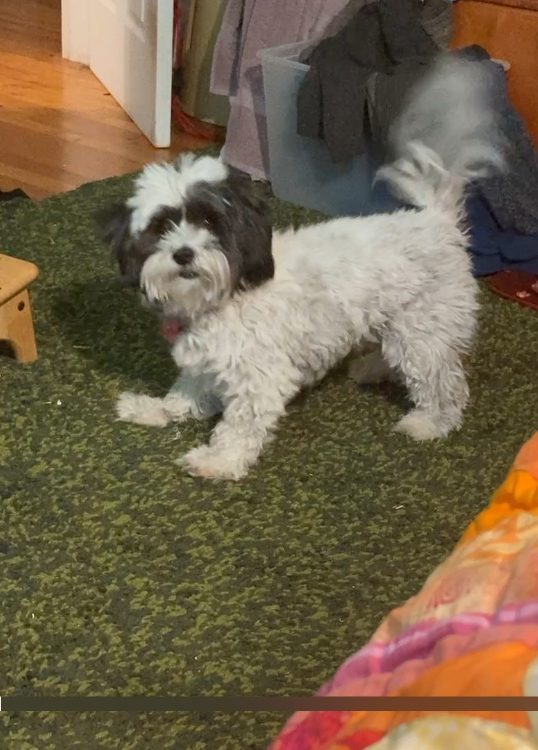
We put off Ellie’s yearly check-up with the Vet in July, hoping that the Covid restrictions would end soon enough that we wouldn’t have to drop Ellie off from the car window. But, alas, Covid has remained and we finally gave in and made an appointment with the Vet last month. As expected, I still had to hand my baby off to the Vet Tech through the open door of the car, with Cricket screaming in my ear, warning her sister to run for her life and/or bring back treats. The appointment went quickly, and we paid the bill, and had Ellie safely back in the car, when the Vet came to tell us that, oh by the way, Ellie would need a dental cleaning. She’d had one two years ago, soon after we’d first adopted her, and now, he said, it was time for a re-do.
“Run!”“Why?”
I nodded my head, closed the window, and took off my mask, trying not to think about it as Mom drove us home. But I couldn’t stop thinking about it. I’ve heard too many horror stories about dogs dying from anesthesia during regular dental cleanings. But, bad teeth can lead to all kinds of medical issues that I didn’t want Ellie to have to deal with either, and the Vet was insistent that she needed this procedure.
It took us another few weeks, but we finally made the appointment for Ellie’s dental cleaning and drove back to the Vet’s parking lot. When the Vet Tech came to pick Ellie up from the car, this time without Cricket nearby sending smoke signals, she had me sign a form that said I understood the risks of anesthesia. I had a much harder time letting Ellie go after that.
“Mommy?”
Mom and I went food shopping right away, just to keep busy, but I still couldn’t block out the endless scenarios filling my brain, including complications from the anesthesia and lost teeth and then progressing to mixed up name tags and accidentally removed limbs. By the time we got home and put away the groceries, I was exhausted, but still too worried to sleep. Eventually, the Vet called to tell us that Ellie was fine, and would be ready for pick up in a few hours, but, by the way, they’d had a hard time getting the tube down her throat, because the scar tissue from her de-barking surgery had grown. It’s possible that Ellie’s attempts to bark along with her sister have been irritating her throat and exacerbating the scar tissue from the surgery done by her breeder long ago (which is unspeakable). That could also explain the proliferation of her snoring habit, which has become operatic of late. The Vet said not to worry about the scar tissue, which of course made me worry about the scar tissue more, but knowing that Ellie had survived this procedure was enough of a relief that I was able to sleep for a while, with only a few nightmares about Ellie losing her voice to an evil wizard.
“Did you say something?”
We brought Cricket with us to pick up Ellie, because leaving her at home that morning had not gone over well, and as soon as Ellie was brought to the car she was placed on her grandma’s lap, blurry eyed from the drugs. We’d already paid, and the chat with the dental specialist went quickly, and I wanted to race out of there before one of the Vet Techs could decide that Ellie needed to go back inside for some reason, except, Cricket didn’t like the seating arrangements. Cricket believes that Grandma’s lap belongs to her, so she kept trying to push her confused sister off the lap. It took a while to convince Cricket that she could be just as comfortable owning another part of Grandma’s real estate (in this case, behind Grandma’s neck) for the short ride home.
“Stay away from my Grandma!”
In the meantime, even in her drugged haze and with Cricket’s drama all around her, Ellie managed to find the chicken treats hidden deep in Grandma’s jacket pocket and gobble them down before anyone could stop her. We’d been warned that Ellie’s gut would be a little slow for the next day or so, and that she should eat only half as much as usual, but she clearly didn’t get that message. By the time we got home, Ellie was uninterested in eating her delayed breakfast (either the kibble or the wet stuff), and she was ready for a nap. Cricket generously ate the late breakfast for her, and then took a nap of her own.
Ellie did a lot of heavy raspy breathing for the next day or so, which kept me anxious, but pretty quickly she was back to running around the backyard, visiting with her squirrel friends, eating her meals, and showing off her pearly white teeth.
“Any more treats?”
I can still feel the worry, though, as if every time she goes to sleep there’s a chance that her scar tissue will expand and start to choke her. It’s probably an unreasonable fear, and I will likely forget how harrowing the whole thing was, until next time.
For now, the next thing on our to-do list is to schedule Cricket’s yearly check-up. I’m not sure how that’s going to work, though. She may have to be sedated BEFORE we get to the Vet’s parking lot, because the prospect of handing Cricket through a car window, to an unsuspecting Vet Tech wearing only a fabric mask and plastic gloves, instead of full armor, does not bode well for any of us. I’m sure Cricket would vote to send Ellie in again in her stead, but the vaccinations and ear cleaning that Cricket needs can’t be done by proxy, and at thirteen and a half she really can’t be skipping her regular checkups, Covid or no Covid. It’s a good thing we have a month or so before she has to go in, though, because we really need to build up our strength for the ordeal.
“I have no idea what you’re talking about.”
If you haven’t had a chance yet, please check out my Young Adult novel, Yeshiva Girl, on Amazon. And if you feel called to write a review of the book, on Amazon, or anywhere else, I’d be honored.
Yeshiva Girl is about a Jewish teenager on Long Island, named Isabel, though her father calls her Jezebel. Her father has been accused of inappropriate sexual behavior with one of his students, which he denies, but Izzy implicitly believes it’s true. As a result of his problems, her father sends her to a co-ed Orthodox yeshiva for tenth grade, out of the blue, and Izzy and her mother can’t figure out how to prevent it. At Yeshiva, though, Izzy finds that religious people are much more complicated than she had expected. Some, like her father, may use religion as a place to hide, but others search for and find comfort, and community, and even enlightenment. The question is, what will Izzy find?
Cricket will turn thirteen later this summer, and I have been wondering how best to mark this monumental birthday. For humans of the Jewish persuasion, thirteen means it’s time for a Bar or Bat Mitzvah, to mark the onset of adolescence (Orthodox Jewish girls may have a Bat Mitzvah at age twelve instead). But, what about for a Jewish dog?
Cricket at (almost) thirteen
To be honest, thirteen seems too young for a transition into adulthood, at least for humans. A hundred years ago, kids might have left school at thirteen and gone out to work, but now that’s not even legal, and certainly not practical. But we’ve kept the Bar and Bat Mitzvah celebrations at the onset of puberty, or thereabouts, because…tradition. And because it would be impossible to convince kids to stay in Hebrew school for even more years before they can have their big party.
But dogs, even Jewish dogs, are a different story. If anything, the age of thirteen would mark old age, rather than the first steps into adulthood. And a lot of dogs don’t make it to thirteen, especially the larger breeds. I don’t understand how a religion that has rituals for almost everything, has missed the opportunity to designate lifecycle events for our pets, so I’m stuck with this somewhat inappropriate and misleading event that has come to be called, at least on social media, the Bark Mitzvah.
“Is that a celebration of barking?!”
When we first brought Cricket home, twelve and three-quarter years ago, I looked up Cockapoos on an aging chart and it said she could live eighteen to twenty years. Dina, my Labrador mix, had lived a miraculous sixteen years, twice as long as the Doberman who had preceded her. But twenty? That’s more like a cat!
“Hey! I’m not a cat!”
At almost thirteen, Cricket is showing signs of aging, with a little cloudiness in her eyes and a habit of hearing things that aren’t there, and a tiny bit of slowing down (though not much). But she has amassed an enormous amount of knowledge in her thirteen years, and many useful skills: she can beg, and guilt, and manipulate; she can bully and wheedle and whine; she can love and cuddle and sniff like a scientist; she could have been a gardener or an archeologist or a detective very easily, if we lived in a world that allowed dogs to go to school, and she has always been the de-facto Sherriff at our home. She has also been a surprisingly effective big sister, to Butterfly, and now to Ellie, who both needed mentoring in how to be dogs after growing up under less than ideal conditions as breeding mamas. Cricket has even learned how to offer comfort, rather than just to receive it, and can, on very rare occasions, even share food with her loved ones (though she would rather not).
“Cricket never shares food. Never.”
There’s no escaping that thirteen is old age for a dog, but maybe that’s what we could celebrate with Cricket’s Bat Mitzvah. She has accomplished an enormous amount and now she is graduating into the last third of her life; finally becoming the wise old crone she has always wanted to be.
“I am very wise, it’s true.”
I don’t think Cricket is prepared for the rigors of a traditional Bat Mitzvah, though. She understands quite a few words in Hebrew, but she has trouble with articulation, and her sense of melody is iffy (though she is, at this very moment, singing the song of her people. I think I can make out the words “chicken” and “I want”). And, really, no one with any sense would ever let Cricket into the sanctuary or anywhere near a Sefer Torah (the holy scroll, kept in the sanctuary, that Bar and Bat Mitzvah kids dread having to read from at their services). But that actually works out well this year, since all of the Bar and Bat Mitzvah services at my synagogue are being streamed, while we can’t attend in person. Maybe Cricket’s Bat Mitzvah could be in our backyard, with the support of the big Paw Paw tree (also turning thirteen this year, coincidentally). They could have a service of their own, to mark their individual, and complex, journeys to their current stages of life. A very short service.
“Grandma, how did Mister Paw Paw get so much taller than me? Rude.”
The fact is, Cricket could care less about having a Bat Mitzvah to celebrate her accomplishments, and her quirks, or to set a hopeful tone as she marches into her senior years. She just wants the food. So I will have to stock up on chicken treats and liver and all of the other good stuff she loves to eat. In moderation, of course, because I want her senior years to last a very long time.
“Did you say food?”
If you haven’t had a chance yet, please check out my Young Adult novel, Yeshiva Girl, on Amazon. And if you feel called to write a review of the book, on Amazon, or anywhere else, I’d be honored.
Yeshiva Girl is about a Jewish teenager on Long Island, named Isabel, though her father calls her Jezebel. Her father has been accused of inappropriate sexual behavior with one of his students, which he denies, but Izzy implicitly believes it’s true. As a result of his problems, her father sends her to a co-ed Orthodox yeshiva for tenth grade, out of the blue, and Izzy and her mother can’t figure out how to prevent it. At Yeshiva, though, Izzy finds that religious people are much more complicated than she had expected. Some, like her father, may use religion as a place to hide, but others search for and find comfort, and community, and even enlightenment. The question is, what will Izzy find?