For some reason, Thanksgiving has never been my holiday. Maybe it’s because of that one extreme rabbi at my high school who called this secular American holiday a Shanda (a shame/a scandal), and yelled at us to avoid eating even one turkey sandwich; or maybe it’s because I can’t resonate with a holiday that’s all about gratitude when I’m used to Jewish holidays, where we grump at least as much as we celebrate; but most of all, it’s probably because the Thanksgiving-themed TV shows and movies I watched when I was growing up were all about the torture of family get-togethers, as opposed to the Christmas movies, which were full of romance and joy and candy and toys.
As for the events of the day itself: I’m not a parade person, or a football person, or a dog show person; and I’m really, really not a turkey person.
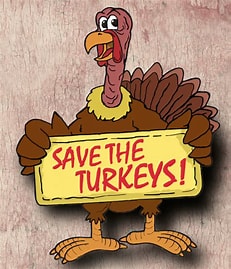
I saw a meme on Facebook recently that suggested we stop eating turkey for Thanksgiving and switch over to brisket, and while I’m sure it was created either by a Save-the-Turkeys group or by the Cattlemen-of-America, I wasn’t upset by the idea. Trying to cook even a small turkey for just me and Mom would mean eating turkey sandwiches for the next month, and even though I’ve been told that there are ways to cook a turkey to make it taste better, I’m pretty sure that’s just fantasy fiction.
Of course, Thanksgiving’s big claim to fame, other than turkey and a now-controversial origin story, is that it’s a day for expressing gratitude (it may only be a coincidence that Thanksgiving comes a few weeks after election day each year, when people are still stewing over those results). And for me, Thanksgiving is a time when I feel compelled to remind people that there is such a thing as toxic positivity, and that forcing gratitude out of grumpy people is just cruel. But, of course, I am also extremely vulnerable to peer pressure, so I end up searching through my life for the things I can be grateful for every year anyway. So, this year:
I’m glad that I was able to start writing poems again, and that I actually finished two drafts of my new novel (the third draft is taking its time); and I’m thrilled that I returned to online Hebrew classes this past summer with renewed joy and inspiration; and I’m grateful that I’m still able to teach, and that I have wonderful students again this year; and I’m grateful for my thoughtful friends and loving family.
But, of course, all of that hopeful, positive energy inevitably stirs up memories of all of the things I’m not grateful for: I keep getting older, and so does Mom; doctors still have no idea what’s wrong with me, but the copays keep coming in larger and larger doses; Israel is still at war and there are still 101 hostages being kept in Gaza (alive or dead, no one seems to know); and then there’s the fact that a majority of voters in the United States chose a predatory criminal as our president, despite mountains of evidence of his crimes, against our country, and against women in particular.
So, yeah, it’s a mixed bag. My hope is that I will be able to survive the next month of teaching, by relying on Christmas movies and French murder mysteries to keep me going, and then I will be able to rest and recover over winter break. My plan, then, is to watch as little news as possible, and write as much as possible, and start the new year with my feet solidly on the ground and my heart filled with (some) hope.

We’ll see how it goes.
p.s. Someone arrived the day after Thanksgiving and is waiting to be introduced to everyone. Next week.

If you haven’t had a chance yet, please check out my novel, Yeshiva Girl, on Amazon. And if you feel called to write a review of the book, on Amazon, or anywhere else, I’d be honored.
Yeshiva Girl is about a Jewish teenager on Long Island, named Isabel, though her father calls her Jezebel. Her father has been accused of inappropriate sexual behavior with one of his students, which he denies, but Izzy implicitly believes it’s true. As a result of his problems, her father sends her to a co-ed Orthodox yeshiva for tenth grade, out of the blue, and Izzy and her mother can’t figure out how to prevent it. At Yeshiva, though, Izzy finds that religious people are much more complicated than she had expected. Some, like her father, may use religion as a place to hide, but others search for and find comfort, and community, and even enlightenment. The question is, what will Izzy find?






 rachelmankowitz