Each year, I read Behind the Bookcase: Miep Gies, Anne Frank, and the Hiding Place (by Barabara Lowell and Valentina Toro) with my synagogue school students for Holocaust Remembrance Day (Yom HaShoah). This picture book is a retelling of the Anne Frank story, through the eyes of Miep Gies, one of the women who helped to hide her and her family from the Nazis. I love the gentle way the book introduces difficult themes to young children, and the way the pictures allow my students to connect to real people and how they feel; but I think the biggest reason why I chose this particular book, out of a pile of just-as-good books on the subject, is because the idea of a bookcase that hides a secret door has always resonated with me. Because, in the house I grew up in, we actually had a bookcase that hid a secret door.

The secret room in my house, wasn’t an attic, or a place to hide Jews, it was actually just a workroom for my mom’s home graphics business. I guess it’s possible that we could have hidden in our secret back room off of the living room, if robbers or Nazis, had entered the house, except that we rarely closed the bookcase door. Generally, it stood partly open, connecting the back room to the living room in general, which was filled with built-in bookcases on every wall, a grand piano in the corner, and a huge fireplace that we rarely used, even after the home business closed a decade later.
My father, who planned out our living room himself as part of a years’ long renovation, was a fan of hiding places and secrets in general, to the point of paranoia. I found out later that he hid all kinds of things around the house, in his sacred books, and in ceiling tiles; things he didn’t want us to find, or didn’t want to know about himself.
The deep resonance of hiding places and secret doors has stayed with me, to the point where I envision my brain as being made up of hidden tunnels and secret passageways that need to be explored and excavated. Hidden rooms show up in my dreams all the time, with lost puppies and long-lost toys and treasure troves of documents, and, you know, treasure, hidden behind secret doors and only discovered years later. Hidden rooms and crawl spaces are also a constant theme in the mysteries I like to read, including priest holes, where catholic priests were hidden from priest hunters in 1500’s England, and the hiding places used by the underground railroad in the US, that hid escaping slaves on their way to freedom, and, of course, the basements and attics and barns and holes in the wall where Jews were hidden by their neighbors during the Holocaust.
My feelings about these hidden rooms teeters between a desire to be hidden away and a desire to open every secret door to the light. I remember when I first read the Harry Potter books, I couldn’t understand why Harry hated his cupboard room under the stairs. Yes, it was tiny, and he was being treated like a pile of rags while his cousin had two bedrooms upstairs for his own use, but the idea of that tiny space, with low ceilings, and very little light, always seemed comforting to me.
There’s still so much hidden away in my memory, cordoned off because it feels too dangerous for me to look at, or held safely in isolation, where it won’t have to face the harsh light, or both at the same time. I can see shadows under the floorboards and cozy blankets piled high in corners, and I know that there’s more that I need to discover, but also that some of it can wait, while the frightened parts of me stay in their safe, warm corners a little bit longer.
The whole idea of the hidden rooms came back to me when I watched videos of Israeli families in their safe rooms, during the recent 12-day war with Iran, and I thought of the room behind the bookcase in my old house, and how useless it would have been as a saferoom, because there were tons of windows and anyone could have seen in from the outside, and bombs would have shattered those thin walls from miles away.
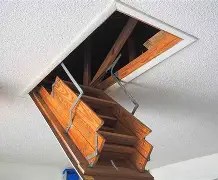
My ideal of a secret room, or a safe room, would have been one that I could have accessed from the closet in my childhood bedroom. I would have been able to push the clothes aside, pull a rope that released a hidden stairway, and then I would have climbed up to my hidden room, filled with stuffed animals, and piles of books, and a freezer full of ice cream just for me, and finally, I would have felt safe.

If you haven’t had a chance yet, please check out my novel, Yeshiva Girl, on Amazon. And if you feel called to write a review of the book, on Amazon, or anywhere else, I’d be honored.
Yeshiva Girl is about a Jewish teenager on Long Island, named Isabel, though her father calls her Jezebel. Her father has been accused of inappropriate sexual behavior with one of his students, which he denies, but Izzy implicitly believes it’s true. As a result of his problems, her father sends her to a co-ed Orthodox yeshiva for tenth grade, out of the blue, and Izzy and her mother can’t figure out how to prevent it. At Yeshiva, though, Izzy finds that religious people are much more complicated than she had expected. Some, like her father, may use religion as a place to hide, but others search for and find comfort, and community, and even enlightenment. The question is, what will Izzy find?











 rachelmankowitz