Tag Archives: hope

The Hope Muscle

            A few weeks ago, I was talking to my rabbi about the High Holiday readings (because I spell check/copy edit every year), and he told me that the clergy team at our synagogue has decided to focus on hope and comfort for this year’s high holiday services (in late September), rather than the usual emphasis on what we could be doing better, or what’s going on in the world that we need to pay more attention to. The decision was made a few months ago, when it had already become clear that people had hit their limit on pain and suffering and couldn’t take much more, and the news has only gotten worse since then.

There’s some relief in knowing that I am not alone in needing more hope, but that conversation made me realize that, actually, I still have a pretty big reservoir of hope to rely on. I’ve spent a lifetime learning how to find hope where it shouldn’t exist, and to build it up out of almost nothing. It’s like strengthening any other muscle, just that this one creates a spiritual ache from the effort, rather than a physical one. But even before I began the daily work of lifting myself up out of despair, I had a foundation of hope that came from years of being taught to think in terms of millennia, rather than centuries or decades. From lessons in Jewish history and the Hebrew Bible, I was taught to see people who lived 3,000 years ago as my family, and to see their life experiences as my own, and the lesson I learned from all of those family stories is that there is always a way forward, even if it’s difficult and messy and confusing, there is always a next step.

“I’m ready.”

            The Hebrew Bible is not full of success stories, where the heroes are perfect and everything goes their way, not at all, these are people who try, and make mistakes, and suffer from their own bad choices, and suffer from other people’s bad choices, but find a way to keep going anyway. In fact, they are always doing Teshuva (repentance or return), making amends for the stupid or selfish decisions of the past, because they believe it is possible to repair the damage you’ve done, and the damage that has been done to you.

The ancient Israelites became slaves, and spent generations in slavery, and even resisted freedom out of fear of the unknown; and they fought wars and lost a lot of them; and they worshiped other gods and got punished for it over, and over again. They lived on their own land, and lived in exile; they survived by devotion to the old traditions and by seeking out new ones. There has been no generation of Jews that got everything right, or that got to live in a world full of only light and love, and the lesson I’ve learned from all of this, is that you need hope in order to take those next steps out of despair. You need hope to continue going through the knee-deep swampy water, or to drag yourself through the desert in the blazing heat. It’s not about certainty. My ancestors rarely knew the right thing to do at every moment and never followed the recipe (or the Torah) to the letter, but they held onto the hope that if they made the wrong choice or did the wrong thing, they could always try again.

            Even though my ancient ancestors taught me all of this, my more recent ones, like my father, believed that there was a right way to do everything, and that if I was smart enough, and worthy enough, I’d just figure it out on my own. My teachers also held onto this one-right-answer idea, writing every test with the assumption that there was only one right answer to every question, and that most of my ideas were wrong. Having faith that there is one-right-answer, and that you already know what it is, meant that they didn’t need hope. They had certainty. But for me, who never seemed to know what that one right thing might be, I had to rely on the hope that something I would do, anything I would do, would turn out to be right.

At times, I’ve had to build my hope muscle out of magical thinking and imagination, and out of whatever leaves and twigs and feathers I could find; and along the way, I’ve discovered that it doesn’t matter where the hope comes from, or what it’s made of, as long as it’s there when you need it. But pick a day, for example a day when there are pictures everywhere of starving children in Gaza and it feels like everyone is lying about the situation on the ground – Hamas, Israel, the UN, the journalists – and the despair makes it hard to breathe. And even in these impossible moments, the only way I know to keep moving forward is to rely on hope, even unreasonable and unfounded hope, that somewhere up ahead there will be an oasis of peace. I just have to keep going and I will get there, someday.

Tzipporah is waiting impatiently.

If you haven’t had a chance yet, please check out my novel, Yeshiva Girl, on Amazon. And if you feel called to write a review of the book, on Amazon, or anywhere else, I’d be honored.

            Yeshiva Girl is about a Jewish teenager on Long Island, named Isabel, though her father calls her Jezebel. Her father has been accused of inappropriate sexual behavior with one of his students, which he denies, but Izzy implicitly believes it’s true. As a result of his problems, her father sends her to a co-ed Orthodox yeshiva for tenth grade, out of the blue, and Izzy and her mother can’t figure out how to prevent it. At Yeshiva, though, Izzy finds that religious people are much more complicated than she had expected. Some, like her father, may use religion as a place to hide, but others search for and find comfort, and community, and even enlightenment. The question is, what will Izzy find?

Hope for the Future

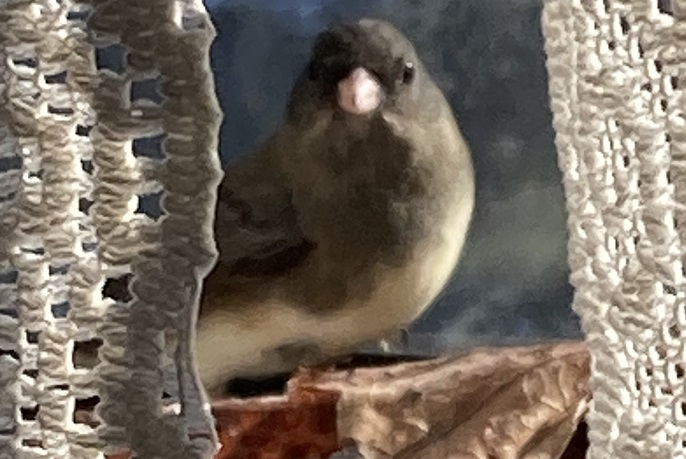
            (A Note: A wild bird – a Junco – visited for a few very cold days recently and read the hard copy of my essay before publication, leaving a few responses)

“I have a few notes.”

            As the nature of Israel’s war against Hamas changes, becoming more targeted and with fewer soldiers on the ground in Gaza, the conversation in Israel has been moving to the question of what happens the day after the war ends. (Of course there are a hundred other conversations going on at the same time, but my brain can’t process all of it. I can’t make sense of a genocide charge at The Hague, or continued terrorist attacks in Israel, or ongoing calls for Israel to stop fighting even as rockets are being fired at the north and south of Israel and the Houthis are firing on ships in the Red Sea. So, for now, I’m trying to focus on something hopeful.) Recently, I was able to watch a zoom call from the Reconstructionist Rabbinical Association called Holding on to Hope, which hosted leaders from three different Israeli organizations who have been working towards peace and coexistence between Israelis and Palestinians.

            One message that came through consistently from these leaders is that the efforts that are most successful are the ones that address self-interest, rather than arguing for peace from a selfless altruism. Another theme was that what happens in Gaza impacts Tel Aviv, in terms of health, and air and water quality, as well as violence, and there are no walls high enough to change that.

“Walls? Pfft.”

One of the organizations on the zoom was a joint Jewish and Arab school in Israel called Hand in Hand. The public school system in Israel separates out Arabs and Jews into separate schools, in large part as a gesture to allow Arabs to maintain their own culture and language and not have to study Jewish subjects, but over time this separation has widened the divide between Jews and Muslims and Christians in Israel. The Hand in Hand schools bring these children together to help them learn to understand each other’s narratives and grapple with how to move society towards coexistence. There are six Hand in Hand schools in mixed Arab and Jewish towns so far: in Jerusalem, Haifa, Jaffa, Kfar Saba, Wadi Ara, and Galilee. And the schools also work at building connections among the adults in the surrounding community.

            The representative of the Hand in Hand schools on this zoom was a Palestinian citizen of Israel, with a background in film in particular and the arts in general. His sense of hope for the future came from his belief that education is what will create the next generation of leaders, able to speak each other’s languages and understand each other’s cultures and see each other as companions on the same journey.

“A feather in feather school would be nice.”

            Coincidentally, I recently read about a new Israeli TV show (not yet available here) set in a Hand in Hand school (or something like it) in Jerusalem. The review I read in Kveller suggested that, because it’s a comedy, it often wraps up complex issues a little too quickly, but the fact that it can represent those complex issues in an entertaining way could make a big difference in what people begin to see as possible in the future.

            The second organization represented on the zoom was Standing Together, a political action organization that brings together Jewish and Palestinian citizens of Israel, and secular and orthodox Jewish Israelis, to work on issues on which they have common cause, as a way to build consensus and community so that over time they can begin to work together on the bigger battles yet to come.

            I’d seen a previous zoom, earlier in the Fall, that focused entirely on the Standing Together group, but I found it alienating, maybe because it was so soon after October 7th and everyone’s emotions were still so raw. This time around I heard a lot more acknowledgment of the pain and fear of both Jewish and Palestinian citizens of Israel, and ideas for how to bring both peoples to the table in order to create a sustainable peace.

            The third organization represented on the zoom was completely new to me, called A Land for All (previously called Two States, One Homeland). It’s a think tank made up of Jewish and Palestinian citizens of Israel, and Palestinians from outside of Israel, to problem solve the nitty gritty policy issues necessary for peace. The basic idea that they’ve come up with is a two state confederation, where a Jewish State and a Palestinian State live side by side, with open borders and some joint institutions. The specifics of the proposal weren’t discussed in this zoom, but the idea that some people are ready to sit together and seek workable plans for a peaceful future is encouraging.

            Except, with Israel being accused of genocide at the International Court for Justice, and Hezbollah and the Houthi rebels attacking from the north and from the sea, and hostages still being held in Gaza, I don’t know how many people within Israel are up to hearing any of this right now, which is probably why this was a zoom for American Jews.

A final peace deal between Israel and a Palestinian state has been so elusive, in part, because the two sides can’t even agree on the preconditions for sitting down to talk. Palestinian leadership wants all new Jewish settlements in the West Bank stopped, and preferably for all of the existing ones to be removed as well, as a precondition for discussing peace with Israel. And Israelis have wanted reliable promises that the terrorism will stop before they discuss the settlements, let alone final agreements on where the borders of a future Palestinian state should be. Many Palestinians and their supporters seem to believe that terrorism is the only way their voices will be heard, by Israel and by the world at large, but every terrorist attack has pushed the Israeli public further away from any belief that peace is possible, and therefore from any willingness to make difficult compromises for that unreachable peace.

            When I discussed the concept of peace recently with my synagogue school students, they weren’t thinking about Israel or even peace between countries, instead they looked at peace through the lens of family life, saying that there has to be a lot of room within peace and coexistence for disagreement, and even some bloodshed (their point of reference was fights with their siblings, so, hopefully not too much blood). They spend a lot of their time working towards peace in their daily lives, managing disputes with their friends and family, dealing with hurt feelings, and learning how to compromise, but all of that feels possible for them because they know they are safe in their homes and that people care about them and are listening to them.

            In all of the coverage on the news, and in all of the opinion articles that I’ve read and international voices I’ve heard, no one has offered a workable plan for peace that addresses what is actually happening right now. No one has come up with a way to disempower Hamas and destroy the tunnels without causing unacceptable damage to the structures and the people above ground in Gaza. In fact, the UN refuses to call Hamas a terrorist organization, and since Gaza is not considered a state and has not signed agreements to follow international law, they can’t be held officially responsible for their actions, but Israel, which is an acknowledged state and has signed these agreements, is being brought to The Hague for fighting back against Hamas. The international community has not addressed this invisibility of organizations like Hamas, Hezbollah, or the Houthi rebels, who are acting as proxies for Iran’s interests in the Middle East, and Hamas has taken full advantage of its political invisibility to press its war against Israel, which certainly didn’t start on October 7th.

The fact that Israel is under attack from, basically, all sides, has not changed the rhetoric around the world that has portrayed Israel as a lone menace in the Middle East, causing all of the trouble.

All three of these Israeli organizations are working towards long term goals that will require consistent commitment and ongoing efforts and will not be put in place within the next few months, but the world, and the combatants on both sides, are too impatient for that slow growing peace process, and the extremists on both sides keep taking advantage of that impatience and offering apocalyptic solutions that will only work for one side or the other. Every time I watch the news I hear this ticking clock, and the absence of hope, but I know there are people out there who are thinking and breathing and working for peace, and that’s what I want to hear more about, because that’s where a livable future will come from.

A Land for All – https://www.alandforall.org/english/?d=ltr

Hand in Hand – https://www.handinhandk12.org/

Standing Together – https://www.standing-together.org/en

“Hope is the thing with feathers, right?”

If you haven’t had a chance yet, please check out my Young Adult novel, Yeshiva Girl, on Amazon. And if you feel called to write a review of the book, on Amazon, or anywhere else, I’d be honored.

            Yeshiva Girl is about a Jewish teenager on Long Island, named Isabel, though her father calls her Jezebel. Her father has been accused of inappropriate sexual behavior with one of his students, which he denies, but Izzy implicitly believes it’s true. As a result of his problems, her father sends her to a co-ed Orthodox yeshiva for tenth grade, out of the blue, and Izzy and her mother can’t figure out how to prevent it. At Yeshiva, though, Izzy finds that religious people are much more complicated than she had expected. Some, like her father, may use religion as a place to hide, but others search for and find comfort, and community, and even enlightenment. The question is, what will Izzy find?

All Those Cooking Shows

            I’ve been watching a lot of cooking shows lately (mostly in Hebrew, as language practice) but I haven’t been doing much cooking, to Cricket’s great frustration. I am a messy cook, and as I chop, many pieces of red pepper and carrot and sometimes even chicken land on the floor right in front of her, where she is, conveniently, waiting. Instead, I am microwaving frozen meals, and all she can do is fight with her sister for the leftover sauce in the bowl (Cricket always wins).

“It’s all mine!”

            It’s not that the cooking shows aren’t inspiring. In fact, I feel like I should be making long lists of ingredients to search for, and printing out recipes for Shakshuka with eggplant and Kibbeh, or five kinds of Chummus, and instead I’m eating oatmeal for breakfast, and peanut butter and jelly sandwiches for lunch, and anything I can warm up from the freezer for dinner (unless I’m lucky and Mom does the cooking, but she is not a messy cook, sorry Cricket).

“Harrumph.”

            I should at least be ordering out from Wild Fig (a Turkish restaurant with multiple locations nearby), or buying readymade Falafel or Bourekas from the international supermarket, but I’m not doing either one, and I’m not sure why.

            My first theory for why I was struggling was that most of the recipes, like the shows, are in Hebrew and measure in grams, which makes them largely incomprehensible. So I went online to look for similar recipes in English and found a treasure trove on Jamie Gellar’s site (she’s an orthodox, kosher cook who covers a wide range of styles of cooking, including Israeli).

But now I have a pile of new recipes that I have no energy to make.

            I don’t think it’s depression that’s holding me back, if only because once I take my afternoon (or morning) nap my moods are pretty good, even if my energy level still stinks. But there’s something about knowing how little energy I’m likely to have tomorrow, or next week, that has changed my calculations for what kinds of plans to make, if any.

“Plan to take a nap.”

            I’d like to believe that I’ll be able to do some cooking over the summer, when I won’t need all of my energy for teaching, but there’s also a long list of writing projects and exercise goals and doctor visits and household tasks that I need to catch up on over the summer, and even then, we don’t have air-conditioning in the kitchen to make it bearable, just a fan that tends to read between 80 and 95 degrees all summer long.

But I keep watching these cooking shows and wishing I could just walk down the hall to the kitchen and make an Israeli salad, or bake my own pitas on the top of the stove. I need to believe that something will improve soon so that I’ll be able to use all of this inspiration to actually make plans and follow through on them, or else I’m afraid I’ll get so stuck in my reality that I’ll forget how to hope for more.

Some links:

From Jamie Geller – Machane Yehuda Recipes (in English) (10 min.) https://youtu.be/lgjdy7VQJ0I

From Piece of Hebrew (with English subtitles) A SABICH recipe (14:18) https://youtu.be/nY29TRUh_MY

From Anachnu Al HaMapit with chef Michael Solomonov in Philadelphia (mostly in English with Hebrew subtitles) (53:15)https://youtu.be/EH-WpezAOTg

If you haven’t had a chance yet, please check out my Young Adult novel, Yeshiva Girl, on Amazon. And if you feel called to write a review of the book, on Amazon, or anywhere else, I’d be honored.

            Yeshiva Girl is about a Jewish teenager on Long Island, named Isabel, though her father calls her Jezebel. Her father has been accused of inappropriate sexual behavior with one of his students, which he denies, but Izzy implicitly believes it’s true. As a result of his problems, her father sends her to a co-ed Orthodox yeshiva for tenth grade, out of the blue, and Izzy and her mother can’t figure out how to prevent it. At Yeshiva, though, Izzy finds that religious people are much more complicated than she had expected. Some, like her father, may use religion as a place to hide, but others search for and find comfort, and community, and even enlightenment. The question is, what will Izzy find?

The Mama Bird

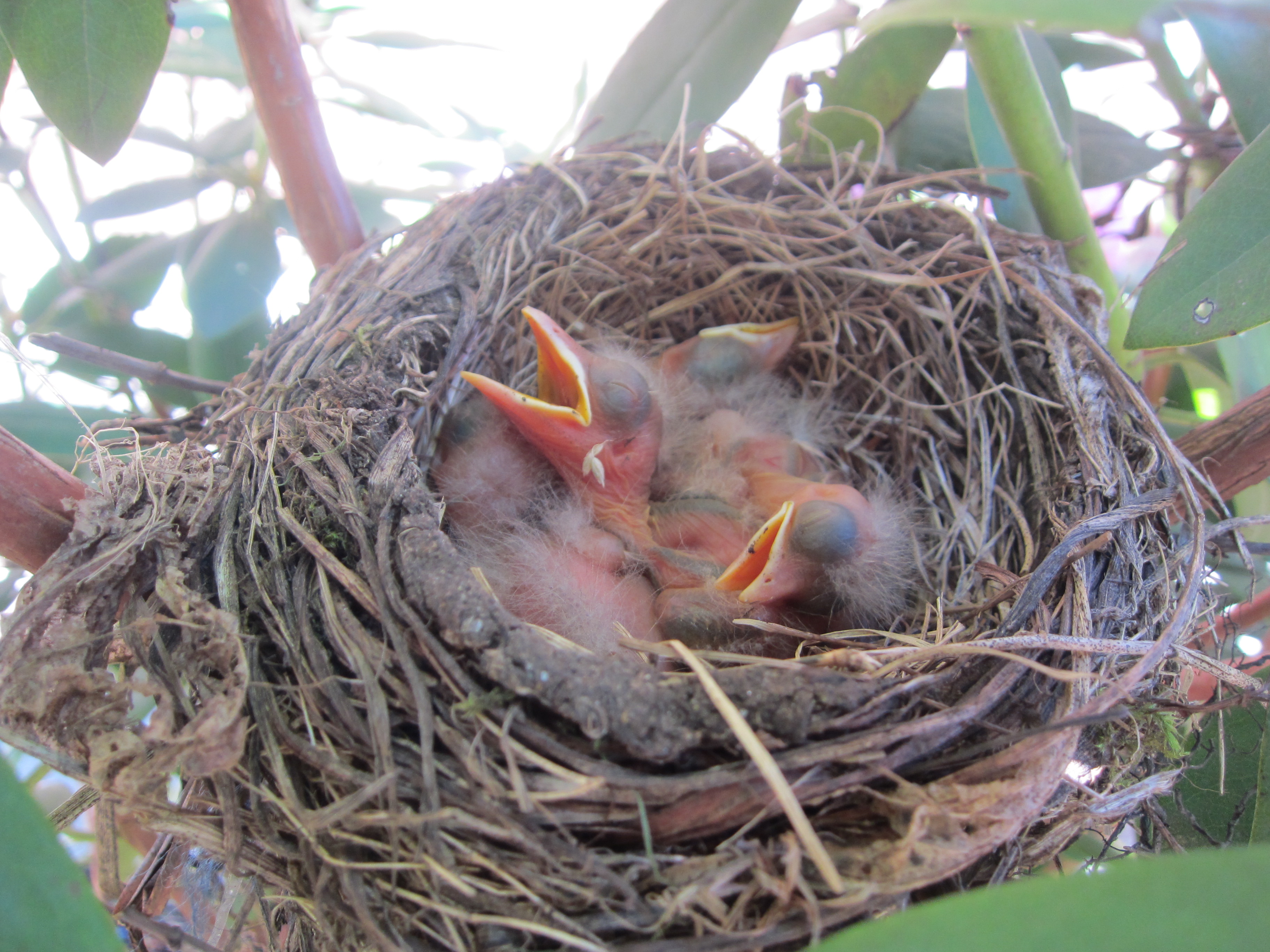
            There was a mama bird in the rhododendron bush again. I have pictures, from years ago, of a robin’s nest in the same bush: from the little blue eggs to the baby birds as they grew and stretched and learned how to fly. But the rhododendron bush has grown much bigger over the years, and the current robin built her nest further inside and a little too high for me to get a glimpse inside the nest, even with my phone. But I loved watching her build her nest, and watching it grow taller and sturdier each day. She mostly wove in branches, but she also took other materials from the yard to add softness to the inside.

The previous robin family

            I could see the mama bird throughout the day, each time I took the dogs out for a walk, and she would be sitting on her nest, chin up at one side, tail up at the other side, so proudly guarding and warming her eggs, turning like a sundial throughout the day. I made a point of greeting her each time, and wishing her good luck, and asking her when the babies would be born, though she never answered me. There’s something about baby birds and their rubbery, alien-like vulnerability that makes me feel so hopeful.

            My neighbors and I would check in with each other to share news of the mama bird, sharing our thoughts about her marvelous nest building skills, and her ability to ignore our dogs. No one else was able to get a picture of her either, as far as I know.

            But then she was gone. One neighbor was tall enough to check inside the nest, after a few days of not seeing her, and he said that there were no broken egg shells, no signs of habitation at all. He said he hoped that meant she had taken her eggs somewhere else, maybe somewhere further out of human reach; but she’d spent so much time building the nest, and she’d spent so much time sitting on the nest, that it seemed unlikely, to me, that she would pack up the whole family and move at such a late date.

            I don’t know what happened. Maybe another bird came along and stole her eggs, or maybe the eggs fell out of the nest and another animal carried them off. Or maybe it was a false pregnancy from the beginning. When I was younger, I had a dog who had a lot of false pregnancies. Dina, a black lab mix, would create a nest for herself underneath my parents’ bed, scratching the carpet for nesting material until all that was left of the carpet was the webbing underneath. She was convinced that she was about to have puppies, and she even produced some milk, but there were never any puppies. The repeating cycle of expectation and loss overwhelmed her, with the hormones rushing through her body making her eyes glassy with confusion. I felt Dina’s grief in my own body and it has always stayed with me.

Miss Dina in later life

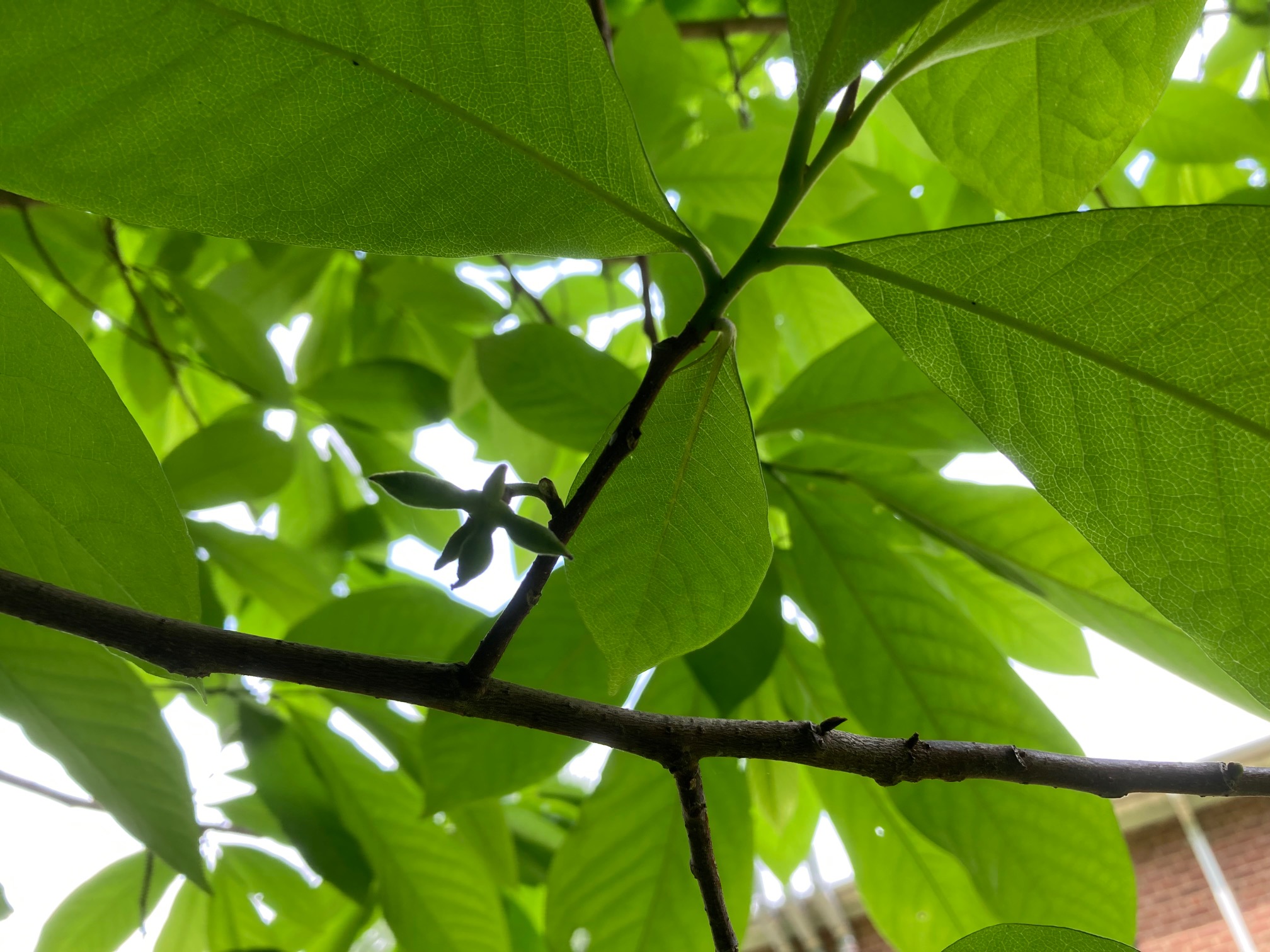
            Around the same time that the mama bird was creating her nest this spring, and beginning to roost, flowers blossomed on the pawpaw tree, twenty or so feet away. And then, after the mama bird disappeared, the deep red pawpaw flowers fell to the ground, leaving behind the beginnings of pawpaw fruit, little clusters that looked like hands starting to stretch out. We had our first homegrown, ripe, paw paw fruit last year, and I’d like to think this year we might have two, or even three.

The pawpaw hand.

            It’s painful to feel hopeful so often and have my hopes dashed, like Dina and her false pregnancies, and yet I’ve found that it’s even more painful to try to live without hope. It’s sad to think that the mama bird lost her babies, or never had them in the first place, but it would be even harder to have never seen her sitting on her nest, dreaming of her future, in the first place. And watching the small pawpaw fruit start to appear fills me with wonder, independent of whether or not they become full grown fruit; though I’d prefer to have a small harvest by the end of the growing season, of course. But just the harvest, without the hours and days and months of hope leading up to it, wouldn’t be enough. The feeling of hope, more than anything else, is really the point.

“Uh, we prefer the food.”

If you haven’t had a chance yet, please check out my Young Adult novel, Yeshiva Girl, on Amazon. And if you feel called to write a review of the book, on Amazon, or anywhere else, I’d be honored.

            Yeshiva Girl is about a Jewish teenager on Long Island, named Isabel, though her father calls her Jezebel. Her father has been accused of inappropriate sexual behavior with one of his students, which he denies, but Izzy implicitly believes it’s true. As a result of his problems, her father sends her to a co-ed Orthodox yeshiva for tenth grade, out of the blue, and Izzy and her mother can’t figure out how to prevent it. At Yeshiva, though, Izzy finds that religious people are much more complicated than she had expected. Some, like her father, may use religion as a place to hide, but others search for and find comfort, and community, and even enlightenment. The question is, what will Izzy find?         

Disappointment

            I applied for a fellowship related to my teaching gig at the synagogue, which would have included a free trip to Israel this summer, but I didn’t get it. It was a long shot, because I didn’t have all of the prerequisites, but I applied anyway, because my boss recommended me for it, and because I wanted to go to Israel. It was a big reach, though, and I pushed myself to fight for it, and pushed myself to imagine that I could handle the trip to Israel in the heat of the summer, and I got as far as being wait-listed, which isn’t bad. I know I can apply again next year, and, really, three weeks in the heat of the summer in Jerusalem was probably more than my body could have handled, but…rejection is rejection.

“You were going to go to Israel without us?!”

            It was painful to feel all of that wanting again, too. I’ve almost gotten numbed to all of the hope and rejection around my writing, but this was a new kind of thing and the anxiety and pressure and hope of it didn’t sit well in my particular nervous system. It’s easier just to not think anything big or new is possible, because then I can go along day by day, living in the present, and managing my small amounts of energy while working on long term goals one step at a time. But hope and excitement and possibility revved me up again, and got me thinking about the future, and all of the things I want (and don’t have yet), and all of the things I can’t have and can’t do.

            It’s as if there’s a certain amount of hope my body can tolerate and anything bigger than that is overwhelming and sets up a roller-coaster ride I don’t want to be on. And I’m realizing that I’ve been actively stopping myself from trying a lot of different things, for fear of getting on the hope-and-rejection-rollercoaster. And that’s not good.

“Would I like rollercoasters?”

            I envy people who can tolerate more anxiety than I can, because they can take more risks in life without worrying as much about the mental health consequences if they fail. I want to become one of those people.

            The sadness I’m feeling now, for the most part, is that I don’t have a plan for how to get to Israel yet, and I really want to go. But this opportunity came up out of nowhere, so maybe others will too. And in the meantime I can continue working on my Hebrew, and saving money to pay for the eventual trip, and most of all working hard to build up my tolerance for the hope-and-rejection-rollercoaster, so I’ll be ready to take the risk when the next opportunity arrives.

“I’ll just rest here while we wait.”

If you haven’t had a chance yet, please check out my Young Adult novel, Yeshiva Girl, on Amazon. And if you feel called to write a review of the book, on Amazon, or anywhere else, I’d be honored.

            Yeshiva Girl is about a Jewish teenager on Long Island, named Isabel, though her father calls her Jezebel. Her father has been accused of inappropriate sexual behavior with one of his students, which he denies, but Izzy implicitly believes it’s true. As a result of his problems, her father sends her to a co-ed Orthodox yeshiva for tenth grade, out of the blue, and Izzy and her mother can’t figure out how to prevent it. At Yeshiva, though, Izzy finds that religious people are much more complicated than she had expected. Some, like her father, may use religion as a place to hide, but others search for and find comfort, and community, and even enlightenment. The question is, what will Izzy find?

Pawpaw Fruit

Big Bird the Pawpaw Tree

            In May, after reading my pawpaw essay out loud in a zoom, and then posting it on the blog, I continued to check on my pawpaw trees, as usual. I watched my pawpaw grove starting to leaf, the skinny little trees swarmed the area; their trunks ranged from a fingernail wide to the size of a dime, but they were there.

One tiny pawpaw tree starting to leaf

            And then I went over to the big, fourteen-year-old pawpaw tree that looms over the back yard, searching for sun and attention. It kind of reminds me of a Sesame Street creature, like a shaggy green version of Big Bird that prefers to stay in one place. As the big tree was starting to leaf, I noticed that there were some green clumps that weren’t growing into leaves; instead they looked suspiciously like tiny pawpaw fruits. That seemed so unlikely though, since we did nothing special to fertilize the pawpaw flowers this year, like moving the sticky pollen from one flower to another with a Q-tip, now that we only had one mature tree to work with.

Pawpaw fruit?

            But I kept watching, and at one point I counted eight clumps, some with only one green bump, and some with six or seven protrusions. As the pawpaw leaves grew bigger, the little fruit clumps became harder to see, but I could still count maybe five, and then maybe three; and I could still see that one big clump with what looked, now, like four or five green protrusions on it.

Pawpaw fruit or bird foot?

            I checked every few days, but especially after a storm or a visit from the gardeners, and by late June I could only find one fruit, not even a clump, just a single green bump on one of the lower branches of the tree. Mom reassured me that there were probably more on the higher branches, hidden by the now-enormous leaves, but I wasn’t convinced.

            Instead, I checked on my one pawpaw fruit every day – despite the old adage, revised a bit, that a watched pawpaw never grows. I watched it just to make sure it was still there, worried that a heavy rain, or a bird, or a visit from the gardeners would knock it down. And it kept growing – like a long thin balloon gradually filling up with air, growing a belly almost like a fat green banana.

Fat Green Banana Pawpaw

            And then, one day, when I went out to visit my one pawpaw fruit and take a picture to mark its growth – like a proud parent marking a child’s height against the kitchen door – I looked up and saw another pawpaw fruit. It was high up and half hidden by the leaves, but it was much, much bigger than the one on the lower branch, and instead of one pregnant belly it had two bellies, like a big green peanut. Even zooming in as close as my camera could get, every picture of the newly found pawpaw fruit was blurry and unconvincing, and I worried that it was just a trick of the light, but each day I found it again, with wonder.

Big Green Peanut Pawpaw hiding

            I’m sure I give too much metaphorical weight to these pawpaws – and therefore give them too much power to disappoint me – but the hope I feel when I see the new trees sprouting up, or now when I look at these slow growing pawpaw fruit, I think: good things are possible. I think: patience will be rewarded. I think: maybe the good stuff is just around the corner, and if I keep putting one foot in front of the other I will get there.

            The danger of the metaphor is that these two lone pawpaw fruits will die prematurely, or taste disgusting, or some other catastrophe will come along and convince me that my hope was misplaced and I should relax into my natural cynicism and just raise my dose of antidepressants and get on with survival. But the fact that I make these metaphors at all tells me something about my deeply ingrained hope – it’s there, and it will be there. My instincts will always lead me on a search for signs of possibility, for something to hope for. And if I can’t find it in the pawpaws, I’ll find it somewhere else.

After another storm, I went out to check on the pawpaw fruit, and the smaller one, the fat green banana, was gone. It was probably knocked loose by the rain and then carried off by one of the many animals that make our backyard their home (squirrels, birds, raccoons, voles, cats, and of course, Cricket and Ellie). But the big green peanut was still there, and, who knows, maybe there will be more pawpaw fruits hiding in the upper branches. Or maybe not. Either way, I’ll find my hope wherever I can get it.

“We didn’t eat the pawpaw. We prefer chicken.”

If you haven’t had a chance yet, please check out my Young Adult novel, Yeshiva Girl, on Amazon. And if you feel called to write a review of the book, on Amazon, or anywhere else, I’d be honored.

            Yeshiva Girl is about a Jewish teenager on Long Island, named Isabel, though her father calls her Jezebel. Her father has been accused of inappropriate sexual behavior with one of his students, which he denies, but Izzy implicitly believes it’s true. As a result of his problems, her father sends her to a co-ed Orthodox yeshiva for tenth grade, out of the blue, and Izzy and her mother can’t figure out how to prevent it. At Yeshiva, though, Izzy finds that religious people are much more complicated than she had expected. Some, like her father, may use religion as a place to hide, but others search for and find comfort, and community, and even enlightenment. The question is, what will Izzy find?

Ellie’s Magic Carpet


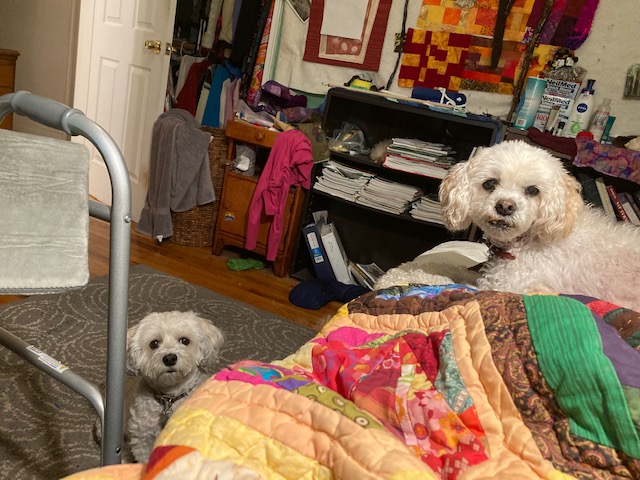
For a year now, Ellie has struggled to jump up onto the living room couch. It seemed odd, since she can easily jump up onto my bed, which is significantly higher off the ground, but Mom pointed out that there is a rug surrounding my bed, and no rug next to the couch (because when Ellie first moved in she peed through the rugs in the living room and hallway to the point where we were afraid to replace them).

028

“Oops.”

But it’s been a year, and we were at Costco recently and saw a (very) cheap area rug that would fit right in front of the couch. It wouldn’t be a terrible loss if the flood of pee returned to wash it away, but, maybe, we thought, it could be the magic trick to allow Ellie to jump up onto the couch instead of needing the Mommy elevator (that would be me) every time.

I was not especially optimistic: one, because Ellie still pees on the exercise mat in my room on occasion, and two, because I didn’t really understand Mom’s logic about wood floor versus rug as effective transport up to the couch. But it was worth a try.

We got home from Costco too exhausted to set up the new rug (this is a constant. I always look forward to going to Costco and I always come home feeling like I ran a marathon in cement shoes), but later in the day Mom set out the area rug, trapping it in place under the coffee table (or whatever you call a low table on wheels that sits in front of the couch and holds all kinds of miscellaneous tchotchkes).

At first, Ellie didn’t seem to notice the new rug. She saw Cricket sitting up on the couch and came over to me, as usual, with her front paws up in the air, asking for the Mommy elevator. But Mom said not to lift her up. “Encourage her to do it herself,” Mom said, sounding loving and sweet despite the horrible cruelty she was asking me to carry out.

032.JPG

“But why, Mommy?”

I got distracted by something (dinner, TV show, news alert, whatever) and then noticed that Ellie was stretched out next to me on the couch, with Cricket looking extra grumpy next to her.

003

“Harrumph.”

And that was it. The magic carpet had done its job! Ellie has been up and down, with no help from me, dozens of times since then. She still can’t figure out how to jump up onto Grandma’s bed – which is no higher than mine and surrounded by a fluffy rug – but I think that has more to do with Cricket’s dirty looks. It is, after all, Cricket’s bed. She kindly allows Grandma to sleep on it, out of noblesse oblige, but that courtesy clearly does not extend to her sister.

There have been no pee puddles on the new rug so far. It’s possible that Ellie has finally figured out that wee wee pads and carpets are not the same thing. Now if only that knowledge could extend to exercise mats…We’ll have to see how things develop.

I might also have to carry a piece of rug with me to place next to the car, so that Ellie will remember that she can jump onto the backseat by herself. Usually she only jumps in after she’s seen her sister doing it, but maybe the rug could work its magic there too.


In the meantime, I started to think that this metaphor might fit me too. Just like Ellie only needed one extra, small step to allow her to make a big step forward, something to help her feel a bit more secure and supported, would the same trick work for me?

006

Will it work for Platypus?

I’ve been struggling with the social work job search ever since I passed my licensing exam in the spring. I’ve written cover letters and sent out resumes like a good girl, but inside I’m terrified that someone will actually offer me a job, or even an interview, and call my bluff. This next step just seems too enormous to me. Internships and classwork and graduation and the licensing exam were all big things, but they seemed doable. This next jump feels more like jumping off a cliff.


But after watching Ellie’s transformation into a jumping bean, I started to think about what could serve as my area rug, or magic carpet, to make the next step in my life seem more possible. And then I got an email from one of the rabbis at my synagogue, asking if I’d be interested in teaching in the synagogue school this fall. They’d only need me for two hours a week, to teach Hebrew language and Jewish holidays, and I thought about it, for maybe a second, and wrote back: Yes!!!!

249.jpg

“Yes!”

I couldn’t believe I’d written that, and I was even more shocked when I went in for my meeting with the rabbi and couldn’t stop smiling. Teaching? Me? Children?


It’s only two hours a week, so that explains some of the doable-ness, but I think the real magic is that the job is at my synagogue. That’s my safe place. I’ve always been able to do things there that feel impossible everywhere else.

Of course, after I accepted the job, the anxiety flowed in and I started feeling like I had to write out all of my lesson plans for the year within the first twenty-four hours, and all of my internal monsters had to have their say: about what could go wrong, and how badly I could fail, and who would hate me, and on and on. But, surprisingly, but I still wanted to do it. How strange!

067

“Very strange.”

It’s possible that some part of me is thinking that this two hour a week job will be instead of a part-time/twenty-hour a week job in social work, but I think it’s more that a deal has been struck internally, if I can have this, then you can have social work. I didn’t even know I wanted to do this, or that I could do it. Just like Ellie didn’t know she needed an area rug to get up onto the couch.

I don’t know where any of this will lead, and it’s possible that I will need a few more metaphorical area rugs to get to the long term goal of becoming a therapist, but now I think they might actually be out there, waiting for me to be ready for them, or waiting for me to imagine them into existence.

We’ll have to see. But for now, I really need to memorize the Alephbet (Hebrew alphabet) song, and practice my Hebrew print writing, and figure out what a lesson plan might be. Wish me luck!

If you haven’t had a chance yet, please check out my Amazon page and consider ordering the Kindle or Paperback version (or both!) of Yeshiva Girl. And if you feel called to write a review of the book on Amazon, or anywhere else, I’d be honored.

Yeshiva Girl is about a Jewish teenager on Long Island, named Izzy. Her father has been accused of inappropriate sexual behavior with one of his students, which he denies, but Izzy implicitly believes it’s true. Izzy’s father then sends her to a co-ed Orthodox yeshiva for tenth grade, out of the blue, as if she’s the one who needs to be fixed. Izzy, in pain and looking for people she can trust, finds that religious people are much more complicated than she had expected. Some, like her father, may use religion as a place to hide, but others search for and find comfort, and community, and even enlightenment. The question is, what will Izzy find?


The Christmas Quandary

I like the smell of burning wood, and the Snowflake lights, and the chill of the beginning of winter. I like hot cocoa, and eggnog, and any excuse to top things with whipped cream. But I have mixed feelings about Christmas, because I’m Jewish and it’s not my holiday. We didn’t talk much about Christmas in my Jewish Day School growing up, but every show I watched on TV at this time of year (and I watched a lot of TV) had a Christmas themed episode, and it was, as intended, enchanting.

cricket-in-snow-2

“I love whipped cream!”

If you look through a list of the creators of Christmas movies and Christmas music, you’ll find tons of Jewish names. It could be a coincidence, but I think it’s because, as outsiders, Jews were desperate to feel that sense of magic and belonging. The whole town comes together to celebrate, with food and drink and sparkling lights. Who wouldn’t want to be a part of that? The idea that some magical character will know exactly what I need, and provide it, is every child’s wish. As is the idea that being a good and kind person should pay off.

But then I’m reminded, by this or that song, that this is not my holiday. I do not sing songs about Jesus. I don’t believe in the virgin birth. I am not the target audience for movies about the crucifixion, or stories about how Jews add the blood of gentile children to their matzot at Passover (where did that idea even come from?). These stories remind me that there are large groups of people who think I have horns coming out of my head.

IMG_0523

“What?!”

And then I watch an ice skating show on TV, or hear someone singing Silent Night (or singing a Jewish prayer to the tune of Silent Night, at Friday night services at my synagogue), and I change my mind again. There’s something so peaceful and kind about the intentions behind Christmas: the generosity of reaching out to strangers who need help; families returning to each other; angels bringing miracles to people who need them.

030

“Dear Santa, can I have more chicken?”

I’ve been watching all of the Christmas movies on the Hallmark Channel again this year, because they soften the edges of a harsh world for a little while, with all of that love and magic and inevitable good fortune. But they also force me to see all of the holes in my life, where things and people are missing. I see a cozy family in front of the fire, or a bright shining star in the sky, and I think of my Butterfly, and how she embodied all of the sweetness and light the world could offer, and I miss her terribly. And I miss the good fortune that all of these two dimensional heroes and heroines on TV are experiencing, getting everything they’ve ever dreamed of. And it hurts.

IMG_0433

My Butterfly


And then it changes again, and I feel hopeful that some of that magic is still out there for me, and it will find me, no matter what my religion or culture or skin color or gender, when I’m ready. I’d really like to believe in that.

IMG_0876


Magical Thinking


Up until a few years ago, I was a very hopeful person. It wasn’t necessarily reasonable hope; some of it was fantasy-like, and full of magical thinking, but it got me through. The hopefulness started to recede as my health got worse, and as rejections piled up for my writing. And as the hope seeped away, I started to realize how necessary it had been.

"I believe there will be chicken in my future."

“There will be chicken in my future, right?”

Hope doesn’t have to be reasonable or rational. Hope is like a dream: it can defy gravity and space and time. I think it takes some amount of magical thinking to be a writer, or to remain in therapy, or to even plan ahead and imagine that things can be different in the future, instead of continuing as they are now, indefinitely.

"If I dream about a walk, it will come."

“If I dream about a walk, it will come.”

Butterfly gives me hope, because of how sweet she is, despite eight years of being used and abused at a puppy mill. I believe that Butterfly survived her ordeal by believing in magic, and dreaming of a place, far away, where she could run and play and eat as much as she ever wanted. Even if that fantasy had never come true, the dreaming of it still would have made her days easier to bear.

Butterfly's first day home

Butterfly’s first day home

Dogs are role models for hopefulness. They wake up in the morning believing there will be walks and cuddles and food and excitement. They give us hope that life can be good even if its parameters are small; even if the gifts available are small. They give us hope that a life filled with love might be enough.

"I have Mommy's sock and that means I have Mommy."

“I have Mommy’s sock and that means I have Mommy.”

Dogs are trying so hard to teach us happiness, and we are stubbornly resisting the lessons and holding on to our pessimism. They must be so frustrated with us.

"Treats?!"

“Treats?!”

Magical thinking is supposedly bad for me, like chocolate cream pie, or fried chicken. It’s a vice, a drug, a crutch that has deleterious effects on my mental health. But magical thinking is also where my hope comes from, when reality can’t supply it. If my life had been lucky, and most of my efforts had paid off in success, and most of my dreams and goals had been realized, maybe I wouldn’t need magical thinking. But I don’t know anyone whose life is like that.

Even under the worst circumstances, it’s the hopelessness that will destroy you. Being too realistic, too practical, too down to earth, can kill a person.

"What's next?"

“Treats?”

Cricket always believes that she will get a plateful of whatever we are eating for dinner, and that she could eat a whole rotisserie chicken on her own without any bad after effects. There’s something about magical thinking that is vital to our well being. It’s what allows us to believe in things that don’t yet exist. It allows us to go beyond what we’ve been told in school, or by our parents, and imagine something different for ourselves.

"Yummy!"

“It’s my turn next, right?”

Maybe I haven’t lost my hopefulness after all.

Sweet dreams.

Sweet dreams.