I was really discouraged during my most recent online Hebrew class; most of my fellow students were more advanced than me, and much more confident, and I struggled to keep up with the discussions and the homework and even getting to class by the end of the semester. When my teacher suggested that I sign up for a fluency class next, instead of continuing at my current level, I agreed in the hopes that a class focused on speaking (instead of on learning new vocabulary) might be the right next step for me. But it was a relief when I found out that I’d have to wait two months for the next fluency class to start. I’ve also found lots of excuses to skip weekly Hebrew practices, and I haven’t really looked over my notes from the last class, which, honestly, might as well have been in Greek.
“I don’t understand a word you’re saying.”
I keep wishing that language acquisition – and all learning, really – could be more straight forward for me: read A, write B, take tests C, D, and E, and then you know it. But even back in school, when that was the dominant learning model, it didn’t actually work for me. I could get straight A’s in class, or spend months writing a paper on the symbolism of birds in hieroglyphics, and I would still forget most of the material by the next semester. I was surprised by how little math I actually remembered from high school when I took the Graduate Record Exam (GRE) ten years later. I had to re-learn all of the math from scratch, and quickly forgot it all again when the test was over. Tests always seemed arbitrary to me, like I was being judged on my ability to guess what this or that particular teacher wanted from me, rather than being tested on my actual mastery of the material.
Over time, I’ve tried to approach learning in a more comprehensive way, coming at it from as any different directions as possible in order to build solid connections in my brain that might last longer than a moment, but I’m still struggling. I know I’ve learned a lot of Hebrew over the past few years, but I feel like crap for not being confident enough to speak much when I was in Israel, and I feel stupid for needing more classes. I’ve never been able to figure out the best way for my particular brain to learn, so most of the time I feel like I’m making do with methods that are built for a brain that isn’t mine; like trying to use lefty scissors as a right-hander, or trying to paint with a toothbrush. I wish I knew for sure what would help me get to the next level, in Hebrew and in everything else, but all I can do is guess at the right path forward and take a leap.
So tomorrow, I’m going to my first fluency class. It will probably take me a while to warm back up after my break, and I’m sure I’ll be anxious and self-conscious all over again, staring at my face on screen and wondering who that alien might be, but hopefully something in the new format will help me find the words when I need them, or at least calm my anxiety when I can’t think of anything to say. Fingers and neurons crossed.
“And paws too.”
If you haven’t had a chance yet, please check out my novel, Yeshiva Girl, on Amazon. And if you feel called to write a review of the book, on Amazon, or anywhere else, I’d be honored.
Yeshiva Girl is about a Jewish teenager on Long Island, named Isabel, though her father calls her Jezebel. Her father has been accused of inappropriate sexual behavior with one of his students, which he denies, but Izzy implicitly believes it’s true. As a result of his problems, her father sends her to a co-ed Orthodox yeshiva for tenth grade, out of the blue, and Izzy and her mother can’t figure out how to prevent it. At Yeshiva, though, Izzy finds that religious people are much more complicated than she had expected. Some, like her father, may use religion as a place to hide, but others search for and find comfort, and community, and even enlightenment. The question is, what will Izzy find?
At our first professional development of the year, we were asked which sound most characterized our summer, and I realized that mine was laughter, because the laughter in my online Hebrew class this summer was constant, even when we were on mute and could only see each other’s laughing faces. We became a tight knit group, with our young Israeli teacher, able to cover all of the emotional ground that came our way, without ever getting too depressed, because we knew we would be laughing again soon.
But actually, I spent even more time in Hebrew practice groups this summer than in the class itself, because I had the time and because I finally felt like I could handle the social anxiety that comes with meeting so many strangers and making mistakes in front of them. It was all under the safe canopy of the same online Hebrew language program as my class, but in the practice groups I was meeting dozens of people from different Hebrew levels, and time zones, and ages and cultures.
There are so many strange topics for discussion in the practice groups. Of course there are the standards: favorite food, favorite movie, what would you bring to a desert island. But then they start to get creative: what’s the weirdest food you’ve ever eaten (Ptcha – calf’s foot jelly); how would you solve global warming? (teach everyone how to fly: Laoof, like a bird, instead of Latoos, on a plane); how many languages can you speak (this one gets very competitive, and more than a few people have tried to count Spanish because they know how to say “Hola.”)
“I can teach you how to fly, if you want.”
But we are always free to talk about something else in the breakout rooms, as long as we say it in Hebrew, so I’ve had long conversations about my dogs, or teaching, or growing up Jewish on Long Island. And if we’re pretty sure the teacher isn’t about to pop into the breakout room, we can discuss our favorite and least favorite teachers. You’d be amazed how diligently we can stick to Hebrew in the midst of a good gossip session. Because, you know, we’re studying here. We take it very seriously.
The way the teachers lurk in the breakout rooms is always a topic of conversation. First of all, because they just appear and disappear without warning, like spies. But also, they keep their cameras off, as if we’re supposed to pretend they’re not really there. So, if I make a point of saying hello to the other students in the breakout room and don’t specifically say hello to the teacher, a disembodied voice might say, “Whatever, I’m not here, just ignore me,” which means, Hey, how dare you ignore me!
Sometimes we’ll talk directly to the teacher – or to the box on the screen with the school logo on it – and ask for the Hebrew word for this or that, and the teacher will pop up on screen to answer “in person.” One time, a friend of mine asked her question, got her answer, and then said, “okay, you can go back into your little box now.”
We get to meet a lot of teachers in the practice groups and see what their styles are – how they do corrections, how rigidly (or not) they follow their lesson plans, whether or not they have a sense of humor – and I’ve been able to get a much better idea of what works for me and what doesn’t, so that when a teacher’s style starts to get on my nerves, or leaves me feeling stupid, I’m less likely to assume it’s my fault (but only a little less likely).
Our young Israeli teachers have also introduced us to something called pitzuchim – which literally translates to cracking nuts or seeds, but is used in Hebrew to refer to the way Israelis are always trying to figure out where they might know each other from (among American Jews this is called Jewish geography). It turns out that a lot of the teachers and students in the program have connections, through second cousins or long lost neighbors or who knows what else. So far, though, I have cracked no nuts or seeds on these zooms, which is kind of disappointing. Getting to Israel would be so much easier if I discovered a long lost wealthy relative with an empty apartment by the beach.
(Not my picture)
This time spent in breakout rooms used to be the most stressful part of practice groups for me, and the reason why I avoided them so assiduously for years, but now, after the first few twinges of anxiety, I’ve come to really enjoy hearing everyone’s stories, and I’m less self-conscious about my broken Hebrew (though I still feel grumpy each time I make a mistake, which happens often).
The most stressful part for me now is when we have to translate sentences from English to Hebrew, often using words I haven’t practiced recently (because I’m visiting practice groups at different levels from my own); but I’m getting used to laughing at my mistakes, and I’ve noticed that when I screw up, and laugh at myself, other people start to relax about their own mistakes. It’s almost like I’m doing a service.
In some of the practice groups, after we go over some grammar from previous levels, we’ll read short articles together, or even just headlines, from online Hebrew language newspapers – often about food or travel or popular culture, so we can learn words we wouldn’t come across in class, like how to say “laundering money” in Hebrew. The words that are hardest to read in these articles are often borrowed from other languages. So, more often than not, our Israeli teachers will start to giggle when we can’t figure out how to pronounce “Mexico,”when it’s written in Hebrew letters.
One of the lowest stress exercises that we do in practice group – though I can make anything feel stressful without really trying – is when the teacher puts an article on the screen and instead of asking us to read, and, God forbid, translate it, we just have to find one word at a time. It reminds me of being in first grade or so and realizing that there were English words I could just recognize on the page, without needing to sound them out, because they had become so familiar to me just by their shape.
As a result of all of this time in the practice groups, I sometimes hear myself speaking in Hebrew, without having planned what to say ahead of time; the words just come out of my mouth, and I kind of look around the room, wondering who said that.
And, really, during a summer where, aside from Mom, most of my in-person human interactions were at supermarkets or doctors’ offices, these practice groups gave me the chance to meet and chat with and learn from dozens of real people, who are fascinating and funny and weird and challenging. It’s still strange to me how real a community can feel, even when it only exists online; but in a way, the boundaries created by the computer (of time, and purpose, and mute buttons) creates a sense of safety that allows me to say what I really mean more often. Now, if only I could translate those safe boundaries into the real world…
“Pfft. Who needs the real world?”
If you haven’t had a chance yet, please check out my novel, Yeshiva Girl, on Amazon. And if you feel called to write a review of the book, on Amazon, or anywhere else, I’d be honored.
Yeshiva Girl is about a Jewish teenager on Long Island, named Isabel, though her father calls her Jezebel. Her father has been accused of inappropriate sexual behavior with one of his students, which he denies, but Izzy implicitly believes it’s true. As a result of his problems, her father sends her to a co-ed Orthodox yeshiva for tenth grade, out of the blue, and Izzy and her mother can’t figure out how to prevent it. At Yeshiva, though, Izzy finds that religious people are much more complicated than she had expected. Some, like her father, may use religion as a place to hide, but others search for and find comfort, and community, and even enlightenment. The question is, what will Izzy find?
This year at the synagogue school we are trying out a new way of teaching Hebrew, called Hebrew Through Movement(HTM). The idea behind HTM, and James J. Asher’s Total Physical Response before it, is to try to follow the process by which infants acquire their first language. The examples Asher gives are: parents will say “take the bottle” and then put the bottle in the baby’s hand, or they’ll say “wave bye bye” and then model how to wave a hand. The child then responds physically, rather than verbally, with a long silent period before words are spoken out loud.
I watched a ton of videos on how to teach Hebrew through Movement, and I read the background articles exploring the whys and wherefores, and I studied the official curriculum multiple times to create my lesson plans, but I still wasn’t sure if it would work in real life. I even tried to practice with the dogs ahead of time, but they were not especially enthusiastic. Cricket resented having to follow any command at all, and Ellie was constantly in a distracted (squirrel!) frame of mind, and I was worried that their reactions were a harbinger of things to come.
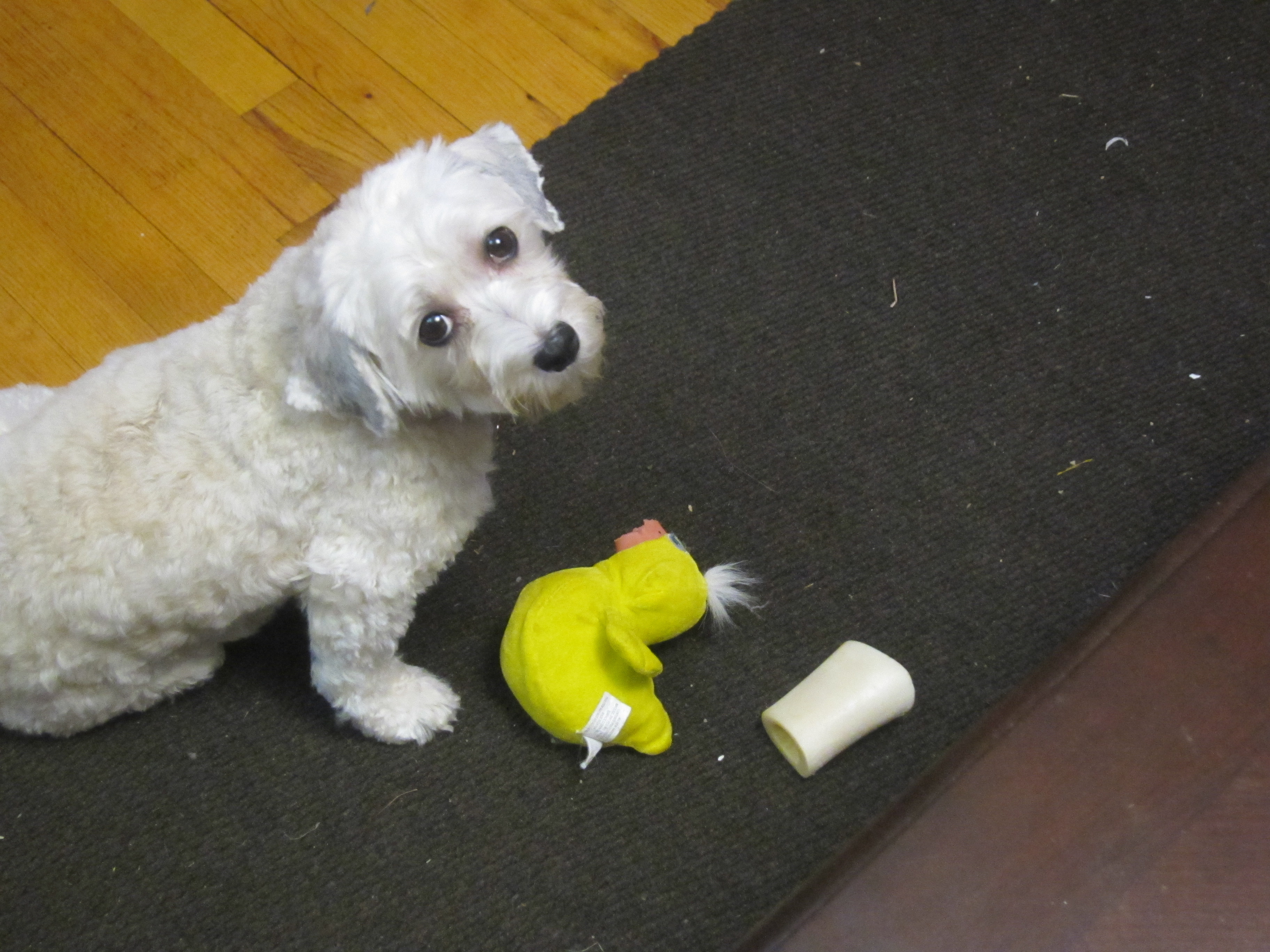
“Who me?”
So, I was nervous on the first day of synagogue school, when I would have to try out HTM on actual children. I modeled stand up and sit down, while saying the commands in Hebrew, and then I asked for volunteers to try the actions with me, but no one raised a hand. I took a deep breath and smiled and asked one of my teenage teacher’s aides to do the actions with me instead, so the kids could see someone else following along and not falling on her face. The kids started to follow along, anxiously. Part of the problem was the mask muffling my voice, and part was that we’re in a social hall instead of a classroom this year to allow for social distancing, which also creates an echo, but most of the issue was stage fright with their new teacher. Me.
One girl in the back of the room told me straight out that she wouldn’t be participating, and I told her that was fine, because I always accept No as an answer. I want synagogue school to be fun, but more importantly, since we don’t have tests or homework or grades, I don’t really have the leverage to convince someone to participate if they don’t want to, and I refuse to yell or shame someone into going along.
Gradually, I added the commands for walk, and stop, and the kids decided that stop meant stop exactly where you are, even if one foot is up in the air and you are about to fall over. When the giggling started I knew we were onto something. Within a few more minutes everyone was participating, including the girl in the back who definitely didn’t want to participate, and it had become a game, and fun!
When we went outside for a mask break a while later, we did another session of Hebrew through Movement, adding the commands for run and spin to our repertoire. We added balletic arms to our spins, and funny faces to our walks, and each time I said the Hebrew word for run the kids acted like they’d been shot out of a cannon.
“Wheeeeeeeeeeeeeeeeee!!!!”
The only downside was that, with all of the standing and sitting and walking and stopping and running and spinning, my body started to rebel and I got very close to throwing up a few times, despite filling my thermos with gingerale before I left home. When I finally left the building for the day, I felt like I’d been run over by a truck.
But still, it was so much fun!
By week three I was getting into trouble for the noise level, because the kids really like to shriek while they are running, and then they fall on the floor and giggle hysterically, but it’s such a joy to see them having fun that I’m reluctant to tell them to keep the noise down.
When I realized that my remote students were having trouble participating (even for our in-person day we still have some kids who zoom into class), I planned some doll-participation exercises, and suddenly stuffed animals were launching into the air, spinning themselves dizzy. I don’t think the kids even noticed that they were learning Hebrew, because they were so busy putting face masks on their Sloths and Teddy Bears and action figures, and racing around their bedrooms.
“I didn’t do anything.”
Eventually we’ll move on to more complex sentences, like, walk slowly to the door, or run to the window and touch your head, or point at the Rabbi, laugh, bark, and run away, but for now we’re still on simple commands.
I would love to invest in cushioned Hazmat suits, with helmets, for the in-person students, or better yet, full bubble wrap for each kid, and sound proofing for the walls so we can make as much noise as we want, but that’s a little bit beyond our budget, and some of the parents might object. Party poopers.
“Harrumph.”
If you haven’t had a chance yet, please check out my Young Adult novel, Yeshiva Girl, on Amazon. And if you feel called to write a review of the book, on Amazon, or anywhere else, I’d be honored.
Yeshiva Girl is about a Jewish teenager on Long Island, named Isabel, though her father calls her Jezebel. Her father has been accused of inappropriate sexual behavior with one of his students, which he denies, but Izzy implicitly believes it’s true. As a result of his problems, her father sends her to a co-ed Orthodox yeshiva for tenth grade, out of the blue, and Izzy and her mother can’t figure out how to prevent it. At Yeshiva, though, Izzy finds that religious people are much more complicated than she had expected. Some, like her father, may use religion as a place to hide, but others search for and find comfort, and community, and even enlightenment. The question is, what will Izzy find?









 rachelmankowitz