I’ve become more reluctant than ever to write about politics lately, given how extreme our discourse has become, in the United States and seemingly everywhere else as well. Other people seem to be better at dealing with this, or at least more willing to embrace the fight, and I keep sitting here, listening to people conflate so many things, as if all the pages of their books are glued together, and I feel like I’m losing my mind. I don’t remember politics being this stupid, or this futile, before. We seem to have reached the point where you can present solid evidence, and make a thorough and convincing argument, and still be knocked out by someone without any facts on their side, because they’re louder, and more persistent, and willing to blow raspberries into the wind.
“Sounds like I win.”
It feels like people on either end of the political spectrum have decided that the truth doesn’t matter, and the winning argument is the one that can fit into a hashtag or be repeated over and over like the chorus in a Tik Tok video. And I’m exhausted. I keep trying to engage with the world with an open mind, and curiosity and fairness, to challenge myself by reading and watching and listening to a wide array of media and opinions and develop a more comprehensive and nuanced view of what’s going on in the world around me. And every time, the simplistic, usually incorrect, but oft-repeated mantra wins out over the nuance and becomes common wisdom. And I’m tired. I’m tired of having to make sense of nonsense. I’m tired of being told that everything is fine when it’s not, and being told that A equals Z when it doesn’t.
The noise of it all is overwhelming, and I’ve been struggling to find anything calm and reasonable in the middle of it all, and feeling like I don’t have the skills to fight the kind of war that’s being waged right now.
But in the midst of yet another week full of stupid political theater, I remembered that I’d sent myself a video a couple of weeks ago, to watch when I feel this way. When I first watched Renee Good’s brothers give testimony in congress about the killing of their sister by ICE, I felt something shift. Instead of screaming, or blowing raspberries, which they had every right to do, they gave a eulogy for their sister that stopped me in my tracks and made me listen. The love, and hope, in their voices was shattering, and the politicians had to just sit there and listen, and allow us to listen, to remind us that we are still capable of being kind, and poetic, and reasonable, and inspiring. I sent myself this video to remind me that I can choose to listen to voices like these. There are so many things in our lives today that we have no choice about, but I can choose to hear the voices of people who make life seem worth living. While I still have a choice, I choose this.
If you haven’t had a chance yet, please check out my novel, Yeshiva Girl, on Amazon. And if you feel called to write a review of the book, on Amazon, or anywhere else, I’d be honored.
Yeshiva Girl is about a Jewish teenager on Long Island, named Isabel, though her father calls her Jezebel. Her father has been accused of inappropriate sexual behavior with one of his students, which he denies, but Izzy implicitly believes it’s true. As a result of his problems, her father sends her to a co-ed Orthodox yeshiva for tenth grade, out of the blue, and Izzy and her mother can’t figure out how to prevent it. At Yeshiva, though, Izzy finds that religious people are much more complicated than she had expected. Some, like her father, may use religion as a place to hide, but others search for and find comfort, and community, and even enlightenment. The question is, what will Izzy find?
As usual, my self-consciousness came roaring back on Sunday morning, day six of my Israel trip, as I checked my reflection in the mirror and judged every little thing about my face and my clothes and my hair: I should have lost more weight, bought new clothes, and come up with a whole makeup routine before daring to leave my house, let alone travel to a whole other country.
The plan for the day was to go north to Caesaria, which meant that my friend had to drive again, whether she liked it or not, because public transportation to the area isn’t convenient. It was no longer raining; in fact, the sun was brighter than it had been during the whole trip up to that point. Our first stop was a beach next to the ruins of a Roman aqueduct, with beautiful views of the water. A few people were actually swimming, even though there was no lifeguard in sight, but I wasn’t tempted; swimming generally requires bathing suits, and no matter how brave I was trying to be, wearing a bathing suit would have been ten steps too far.
Aqueduct beach
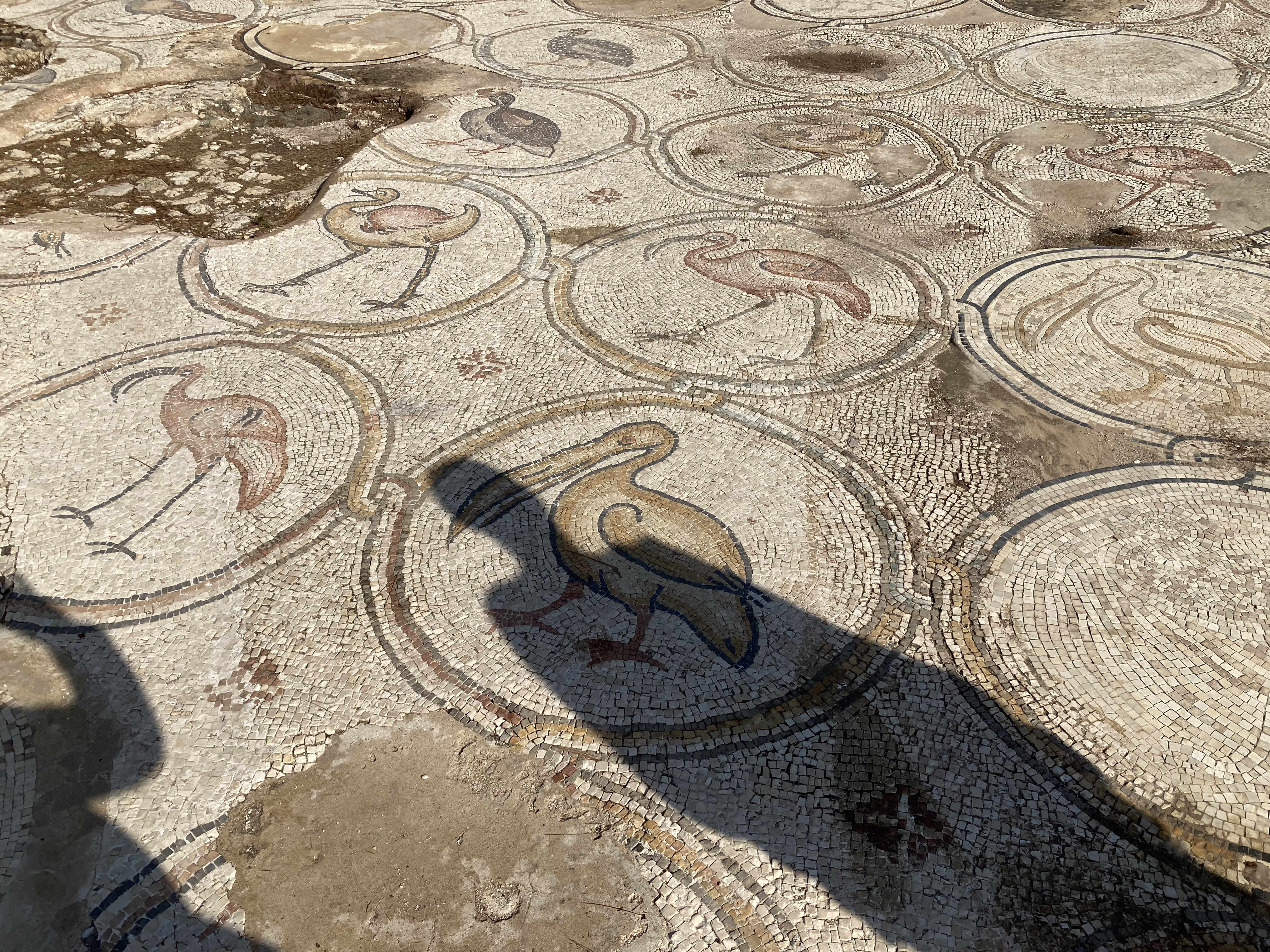
My friend is a history buff, and she’d taken her kids to all kinds of historical sites around the country and knew her way around, so after the aqueduct we visited a refurbished mosaic from the Byzantine era, which used to be the floor of a rich man’s house, and then she showed me the completely natural outcropping of rocks, organized in a half circle, where she and her kids sat together to eat lunch a couple of years earlier.
The Bird Mosaic
The big destination, though, was the national park at the harbor ruins. Caesaria was built by King Herod, when Judea became a Roman province and the capitol was moved north from Jerusalem. A large school group was already visiting when we arrived, with the same bored looks as the groups at the Kotel, except that this group of kids spoke Arabic, and my friend told me that all Israeli schools do these day trips to historical sites around the country, they just choose different places to visit based on the makeup of their student body.
We found a kosher restaurant by the water, where the food was fresh and delicious and the cats were watching us like we were a movie. The waiters eventually brought out the fish leftovers for the cats to eat, which temporarily distracted them from watching us, but only for a little while. Inspired by the bravery of the cats, once we were finished eating, I decided to try to walk through the ruins to look at the mosaics and the ancient mikvah and the works of art scattered here and there. I made it as far as the beginning of the hippodrome (basically a long running track for ancient horses), and for the first time on the whole trip, I started to have trouble. I was actually surprised that it had taken so long to kick in, honestly. I’d been taking all of my medications, plus extra pain killers, but by day six my body was starting to rebel, and my legs, especially, just didn’t seem to be able to hear my instructions as clearly as before.
“Are you finished with that?”
“Did you know that I like food?”
We took a break from walking to visit the little on-site museum, where they showed a movie about the building of Caesaria and all of the family drama behind the scenes (attempted murder, treason, death sentences, etc.), and then we looked at some of the relics that had been collected in the area, and some multi-media exhibits. I know I was supposed to be fascinated by all of this, but, honestly, my favorite part of the day so far was the cats.
I still wanted to experience as much as possible, though, so my friend suggested that instead of trying to walk all the way across the hippodrome to the famous amphitheater (which is still used today for outdoor concerts), we could go back to the car and drive down to the other end. Unfortunately, by the time we’d reached the other entrance we discovered that they had just closed the gates for the afternoon. If I’d been up to walking the length of the hippodrome, we would have made it to the amphitheater in time, but driving over and entering through a different gate was not going to be allowed. My friend was disappointed for me, and while she tried to find a manager who might let us in, I wandered around to avoid having to talk to anyone, and I noticed a shop called The Dreydel House. Immediately, I realized that I’d actually seen it before, in a video in one of my classes, years ago. I’d thought about that video, and the artisan who made ceramic dreidels and dreidel-adjacent paraphernalia, when we were planning the trip, but since I couldn’t remember where it was located and wasn’t even really sure if it was real, I’d left it off my to-do list; and yet here it was. My friend came back from her mission, still frustrated that they wouldn’t let us in, and met me over by the storefront, where, it turned out, the Dreydel House was closed for the day too. I guess it makes sense that a shop run by one guy, filled with all kinds of things he has to make himself, wouldn’t have a lot of open hours per day. But, harrumph.
From the Dreydel House website
Our next stop was a nearby resort town called Zikhron Yaakov, which was the site of one of the first new settlements of Jewish immigrants in Palestine. In 1882, a group of Jewish pioneers from Romania bought land to build an agricultural moshav. A year or so later, when they were inevitably struggling to make a go of it, they received funding and support from Edmund de Rothschild and renamed the town in honor of his father.
The first Israeli winery was also established in Zikhron Yaakov, and there were still a number of wineries nearby, but I’m not a wine person so we decided to visit the historic city center instead, where there was a pedestrian mall filled with restored historic buildings and boutiques. We stopped in to look around in a little store that sold crafts made by local female artists, and then we ate some gelato in the café next door as the sun went down, and then it was time to head home.
I don’t know if it was the long drive, or the more obvious signs of my vulnerable health, but my friend and I started sharing more and more personal stories, things that hadn’t gone right for each of us, ways that we were struggling; discussions we wouldn’t have known how to have back in high school.
Despite that, I was still too shy to ask if I could do a load of laundry when we got back that night. I was thinking that I would try to work up the courage over the next few days, or just, you know, wear dirty clothes, when my friend asked if I wanted to do some laundry and showed me how to use her washer and dryer, brought with her from the States way back when and still working away.
The next morning, freshly dressed in my warm-from-the-dryer favorite shirt, I was ready to attempt our next adventure: taking the train back to Tel Aviv to visit Old Jaffa, the original port city where most of the Jewish immigrants had arrived in Ottoman era and then Mandate Palestine. While we were waiting for our train, we listened to someone playing the piano, really well, and then he popped up and ran for his train, another traveler just like us.
The obligatory piano in the middle of the train station
Once we arrived in Tel Aviv, we took a bus down to the beach and then walked up, up, up to Old Jaffa. The sun was bright and I could feel my arms starting to burn, despite the SPF 60 I’d slathered on that morning, and every morning of the trip. I also I noticed that I needed to sit down even more frequently than the day before, and that there were an enormous number of steps to climb. When we reached the clock tower plaza, we sat down to rest, again, and met a friendly dog. I was really tempted to just stay there for the rest of the day and commune with the dog, but we had an agenda, so I forced myself up to my feet while my friend checked her phone for directions to Shuk HaPishpashim, the famous local flea market.
Jaffa Clock Tower
My new friend
I needed to sit again when I saw all of the steps ahead of us, some going up and some going down, and no clear signs telling us which ones to take, and while I was resting, a random guy asked my friend to watch his double-parked car. He seemed to be helping his girlfriend move, though each box they carried looked like it was about to fall apart and had been filled willy nilly at the last second, so I’m not sure if she was leaving an apartment, or an art studio, or just stealing someone else’s stuff, but I didn’t have the brain power to think about it.
My friend dutifully called out to them when the police arrived, because his car was blocking an already narrow street, and with her pre-warning he was able to talk his way out of a ticket. When he came back to thank her, my friend asked him how to get to Shuk HaPishpashim and he said “just go straight,” as did the next three people we asked, but the roads in the area went every which way but straight, so it took us a while to find our way. We passed a bunch of small art galleries and antique shops, and dogs out walking their people, and even a shop that specialized in refurbishing old doors, until we finally found the covered section of the shuk.
Loud music was playing over the loudspeakers as we walked through small aisles where vendors had their goods laid out on the ground: broken doll parts, and old shoes, and other random things that made me grateful that I was up to date on my tetanus shots. Eventually we reached the more permanent storefronts, where you could buy board games and Persian rugs and all kinds of souvenir knick knacks. I was tempted by the small drums and bangles and other middle eastern musical instruments, but I’m not a good shopper and couldn’t choose just one thing. It was a relief when we left the shuk and found a kosher restaurant for lunch. We ordered as many Salatim (salads and spreads) as they could fit on our table and did our own taste tests, comparing and contrasting the eggplant with the beets with the tomatoes with the chummus. As we were sitting there, I finally got to hear my first Muezzin’s call of the trip. There are mosques all over Israel, but this was the first time we’d been in an Arab neighborhood at the right time to hear the call to prayer. I’d heard the Muezzin’s call in tons of videos, but there was something special about hearing it in person and knowing that people all around me were hearing the same voice.
On the train back to Modiin, struggling to keep my eyes open, I realized that I had burned my arms but good. I used to get sun poisoning every summer at sleepaway camp, but it had been a long time since I’d done such a number on myself. What with the burns, and the walking, and seeing so many things in such a short time, I was truly wiped out by the time my friend’s husband picked us up from the train, and he looked at me like he was worried they’d have to drop me off at a hospital. He and my friend had a quiet conversation once we got back to the apartment, and I magically received a cup of hot cocoa, and one of the real Strauss-brand Krembos that had finally arrived in the local stores, and curled up on the couch to recover.
Krembo (not my picture)
There was something really lovely about being able to witness a good, working marriage on this trip. I didn’t grow up in a home with a good relationship at its core, so watching my friend and her husband negotiate their different strengths and weaknesses, and manage the insistent demands of their different children, and their houseguest, while still finding time to just be a couple, was reassuring. I loved that they insisted on doing the New York Times Spelling Bee together every day, no matter what (they diverge on the other word games: she does the crossword, like my mom, and he does the Wordle). There was a comfortable, lived in quality to their home, and their relationship that made it clear that they’d had all of the inevitable fights along the way, and weathered them, and had decided over and over again that it was worth all the trouble. There was also something magical to me in seeing how their family had taken shape over the years; even though the kids were mostly strangers to me before this visit, they were also really familiar, each echoing aspects of my friend’s personality and mannerisms and way of being in the world.
I had clearly hit a wall, though, sitting there on their couch, losing track of time and struggling to find words, in English or in Hebrew, so my friend suggested that we stay in Modiin for the following day, instead of heading back to Jerusalem or wherever else. That would give me a chance to rest up before our big trip north on Wednesday, to see the Kineret (the sea of Galilee) and the kibbutz where her older daughter was spending the year. In the meantime, we ate our Krembos, and probably had dinner at some point, and then I went to bed early for the first time the whole trip, out of words but feeling warm and safe and cared for.
“I saw that dog. I refuse to look at you.”
If you haven’t had a chance yet, please check out my novel, Yeshiva Girl, on Amazon. And if you feel called to write a review of the book, on Amazon, or anywhere else, I’d be honored.
Yeshiva Girl is about a Jewish teenager on Long Island, named Isabel, though her father calls her Jezebel. Her father has been accused of inappropriate sexual behavior with one of his students, which he denies, but Izzy implicitly believes it’s true. As a result of his problems, her father sends her to a co-ed Orthodox yeshiva for tenth grade, out of the blue, and Izzy and her mother can’t figure out how to prevent it. At Yeshiva, though, Izzy finds that religious people are much more complicated than she had expected. Some, like her father, may use religion as a place to hide, but others search for and find comfort, and community, and even enlightenment. The question is, what will Izzy find?
The latest experiment in my journey to convince Tzipporah that I’m not so bad, has been to place chicken treats at the entrance to my room at bedtime, trying to catch her attention while she’s on her way to or from her Midnight Snack with Grandma. It is an attempt at bribery, pure and simple, but so is most of the clicker training I learned back when we were trying to convince Cricket that she was not the boss of everyone (unsuccessfully, of course).
There is an old Jewish tradition of giving honey to young students when they first start studying the Hebrew Bible, so that they’ll pair study with sweetness forever after (though the version I heard had the rabbis putting honey on the student’s slates, and the student would lick off the honey with the chalk of the Hebrew letters, which does not sound delicious, or sanitary, so I tend to give my students lollipops instead), and since Tzipporah is much more of a savory girl than a sweets aficionado, I have built my current experiment on the treats she most craves – chicken jerky.
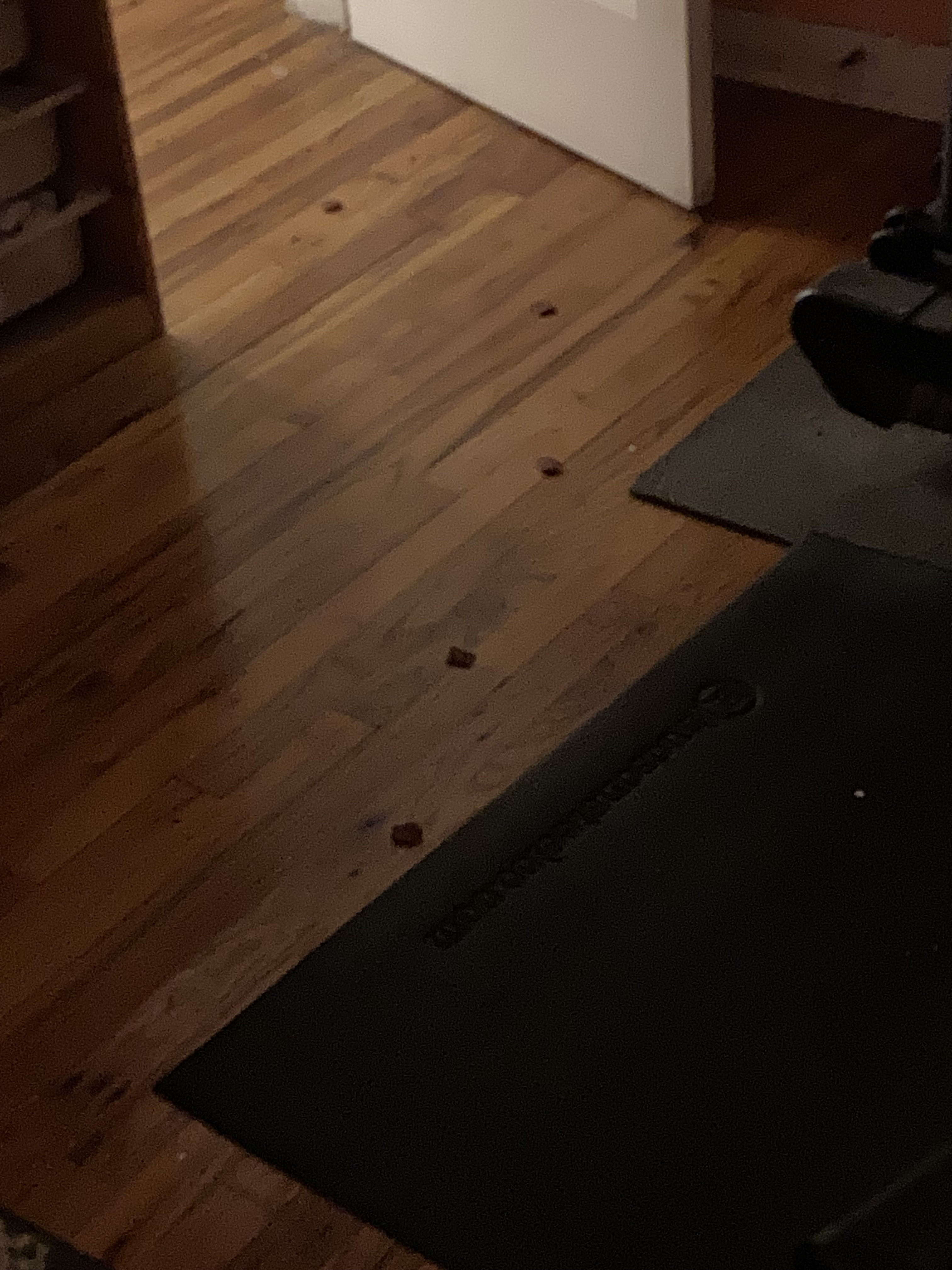
Each night, I break one piece of chicken jerky into smaller and smaller pieces, and spread them further apart so she has to actually walk into my room to find them all. And since she believes in only taking one treat at a time, no matter how small they may be, she now comes in at least five times to get through the whole trail, usually more than five, because she’s ever hopeful that more will appear. She’s still not looking up and acknowledging my presence, but we both know I’m there.
The trail of treats
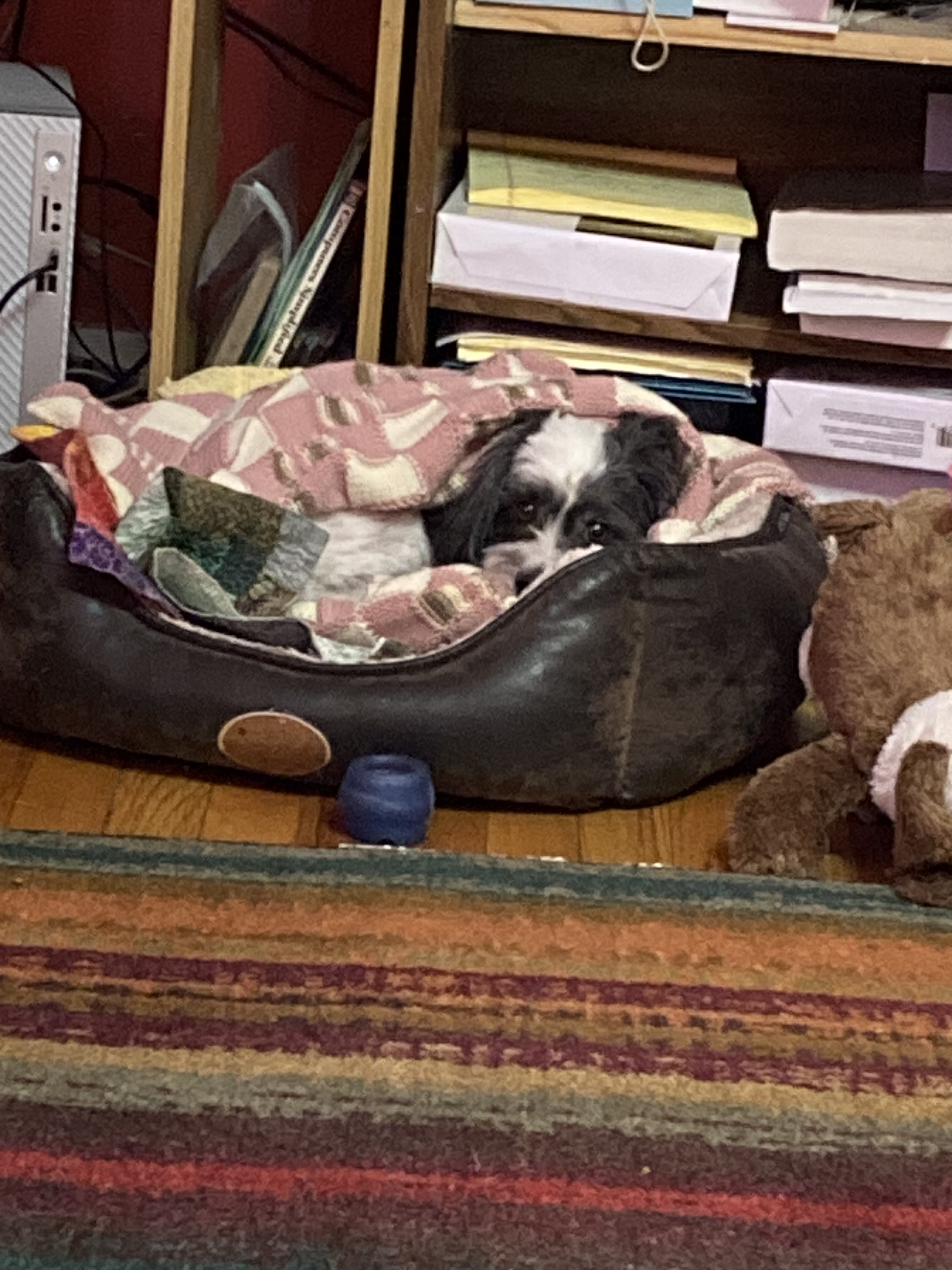
The elusive Tzippy, caught on camera
There may need to be a second part to this experiment, because getting her into the room doesn’t equal coming directly to me for treats, or thinking of me as a safe person, but I haven’t thought that far ahead.
But at least now, she has learned to stop and check my doorway as she passes by, and even to linger and check more carefully in case she missed something, rather than just taking a cursory sniff and moving on. She does this at least once at night and once during the day (if I’m in my room instead of sitting in the living room with her). Not only do the chicken treats draw her attention, but they also seem to help mute her anxiety at entering my room while I am present. In the past (last week), Tzipporah would come to my door, see me seeing her, and immediately bolt; but with her nose to the ground searching for treats, she’s less concerned, or at least less aware, of where I am and what I’m doing (I am, of course, watching her and trying to get pictures).
It’s hard not to compare how much farther along Tzipporah has gotten in her relationship with my mom (her grandma) than in her relationship with me. Mom can even hold out a treat, sometimes, and Tzipporah will gently take it from her hand. But, I figure, why not learn the lesson, and tap into the thing that has been working for them all along (being super generous with treats) and see if I can catch up. So far, Tzipporah doesn’t seem to mind.
“Where are the rest of my treats?”
If you haven’t had a chance yet, please check out my novel, Yeshiva Girl, on Amazon. And if you feel called to write a review of the book, on Amazon, or anywhere else, I’d be honored.
Yeshiva Girl is about a Jewish teenager on Long Island, named Isabel, though her father calls her Jezebel. Her father has been accused of inappropriate sexual behavior with one of his students, which he denies, but Izzy implicitly believes it’s true. As a result of his problems, her father sends her to a co-ed Orthodox yeshiva for tenth grade, out of the blue, and Izzy and her mother can’t figure out how to prevent it. At Yeshiva, though, Izzy finds that religious people are much more complicated than she had expected. Some, like her father, may use religion as a place to hide, but others search for and find comfort, and community, and even enlightenment. The question is, what will Izzy find?
For the most part, when I walk into the living room, anytime during the day or night, Tzipporah is sitting up in her bed, head tilted, watching me carefully. I knew that she was getting out of her bed when she was alone, to eat and drink and pee, and I knew that she left her bed at night to explore the apartment and to beg for chicken treats from her grandma (I love to hear the tippy tappy sound of her paws dancing down the hallway to get her midnight snacks, and sometimes I get to hear her sing the song of her people when her grandma runs out of treats). But, I thought, as long as there was a human in the living room with her, Tzipporah stayed glued to her bed.
But then Mom started to tell me stories about Tzipporah stretching and running around the living room in the morning, as soon as she heard me getting up. At first, I was skeptical about those reports, thinking Mom must be exaggerating as a way to get me to believe Tzipporah was excited to see me. But then I was hurt. Why was Tzipporah willing to get out of her bed and stretch and relax only when I wasn’t in the room? What’s so great about Mom that she can be trusted and I can’t? (Okay, I know what’s so great about my mom. I’m just jealous.)
After a few days of trying to describe the whole routine to me, while Tzipporah sat staring at me from her bed, Mom was finally able to get some pictures, and even a video; and I was able to see my quiet, solemn little dog dancing and wagging her tail and hopping around, impatiently staring towards the hallway, waiting for me. And yet, as soon as I actually walked into the living room, she would rush back to her bed as if the floor had suddenly turned to lava, and then she would sit in her bed and stare at me again.
I’d like to believe that the new dance is a sign that Tzipporah loves me, since she’s acting the same way I tend to act when I really like someone (desperate to see them and then tongue-tied when I actually get the chance), but I worry that she’s just taking her last opportunity to stretch her legs before I appear. I mean, if I can turn a previously safe and comfortable living room floor into lava, I must be pretty scary.
Honesty, it’s a relief to know that Tzipporah isn’t just staying in her bed all day, though now I feel guilty for ever hanging out in the living room, because it forces her to stay in her bed and not to pee or drink or eat until I leave. My hope is that Tzipporah’s prolonged dance routine each morning is the beginning of a new phase, wherein she is eventually willing to leave her bed while I am still in the room. But, if she decides that only Grandma is allowed to see her dance, at least I’ll know that she has these wonderful moments of joy, and I’ll have the pictures to prove it.
If you haven’t had a chance yet, please check out my novel, Yeshiva Girl, on Amazon. And if you feel called to write a review of the book, on Amazon, or anywhere else, I’d be honored.
Yeshiva Girl is about a Jewish teenager on Long Island, named Isabel, though her father calls her Jezebel. Her father has been accused of inappropriate sexual behavior with one of his students, which he denies, but Izzy implicitly believes it’s true. As a result of his problems, her father sends her to a co-ed Orthodox yeshiva for tenth grade, out of the blue, and Izzy and her mother can’t figure out how to prevent it. At Yeshiva, though, Izzy finds that religious people are much more complicated than she had expected. Some, like her father, may use religion as a place to hide, but others search for and find comfort, and community, and even enlightenment. The question is, what will Izzy find?
Though Tzipporah, my four-year-old Havanese rescue dog, has learned to pee on the wee wee pads, she often pees just off the edge (my feet are on the pad, though!), or she’ll pee on the rug by the front door, as a form of protest when we dare to go out and leave her behind for more than five seconds. I thought I was doing a good job of keeping up with all of the pee, sopping it up with paper towels and cleaning each spot as quickly as possible, but then came a week of wet weather and the pee smell seemed to rise up from the rugs to fill the air.
“You’re telling everyone?”
I ordered some high-powered anti-pee carpet cleaner, because I can’t for the life of me remember how to use the carpet shampooer we bought ten years ago (and haven’t used since), but before it could even arrive, Mom agreed to get rid of the rugs in the hallway. We’re still crossing our fingers, and paws, that the living room rug is salvageable, but we’ll see.
Unfortunately, Tzipporah is still nowhere near ready to pee outdoors. We’ve been taking her outside a few times a week, to help her get used to the grass, and the leash, but it’s been slow going. I’ve also been taking her with me to therapy once a week, to acclimate her to travelling in the car, if nothing else, and, of course, my therapist decided that if Tzippy was going to come to therapy, she might as well do some therapy work. Her goals for Tzippy are to come when called, to walk on a leash, and to accept treats from a human hand (other than Grandma’s). I was pretty happy with Tzippy’s growing ability to sit calmly in the car, and then on my lap for forty-five minutes in the office, but what do I know.
One very exciting development came when we took Tzipporah outside for one of her get-used-to-the-grass-adventures, and Kevin the mini-Goldendoodle came over and dropped his tennis ball at her feet, four times! Tzipporah had no idea what to do with the ball, but she seemed to recognize that he wasn’t a threat and allowed him to sit next to her on the grass for minutes at a time.
Kevin’s dad took this wonderful picture
Tzipporah is decidedly different from any of the dogs we’ve had before, especially in her insistence on staying in her bed whenever we’re nearby, and never, ever, barking. And yet, I’ve caught myself almost calling her “Ellie” a number of times. It may just be that Ellie’s name comes to mind because she was our most recent dog before Tzipporah, or because Ellie was also a Havanese (though with different coloring). And it shouldn’t bother me so much, but it does. It’s not that I feel guilty for misnaming Tzippy, because I usually catch myself in time, it’s more that I’m afraid I’m forgetting Ellie too quickly, as if she’s so easily replaceable by someone else.
The problem is, while I can never forget Cricket, even for a moment, I sometimes struggle to remember stories and moments from Ellie’s life. My memories of Cricket are so full-bodied that it feels like Cricket is actually in the room with me when I think of her, as if I can summon her at will. Cricket was in my life for sixteen years, from puppyhood, and she imprinted herself deep into every cell of my body, but I only had Ellie for five years, and I’m afraid my memories of her, which are just whispers at this point, will soon disappear.
“Hey, I’m full bodied too.”
But, now that I think about it, we had to get rid of our rugs after Ellie’s first few months with us too, and I took her with me to therapy for two years (more for my sake than for hers, to be honest, but the process seemed to help her relax and bond anyway). So Maybe Ellie’s name comes to mind because she is still here with us, and here with Tzipporah. Cricket was Ellie’s trainer, pushing her to bark and run and beg for treats like a “real” dog, and maybe Ellie is doing her own version of big-sister-ing with Tzipporah from the other side of the rainbow bridge, letting her know it’s okay for things to take time and that she will be loved no matter what.
“I’m still here, Mommy.”
Ellie never became a Velcro dog, like Cricket, but she knew she was loved and safe. So, if even an echo of her is still present in the apartment, whispering in Tzipporah’s ear, maybe everything really will be okay.
“I’m never alone.”
If you haven’t had a chance yet, please check out my novel, Yeshiva Girl, on Amazon. And if you feel called to write a review of the book, on Amazon, or anywhere else, I’d be honored.
Yeshiva Girl is about a Jewish teenager on Long Island, named Isabel, though her father calls her Jezebel. Her father has been accused of inappropriate sexual behavior with one of his students, which he denies, but Izzy implicitly believes it’s true. As a result of his problems, her father sends her to a co-ed Orthodox yeshiva for tenth grade, out of the blue, and Izzy and her mother can’t figure out how to prevent it. At Yeshiva, though, Izzy finds that religious people are much more complicated than she had expected. Some, like her father, may use religion as a place to hide, but others search for and find comfort, and community, and even enlightenment. The question is, what will Izzy find?
So, I finished writing a novel. It’s called Hebrew Lessons, and it’s a love story between an American Jew and an Israeli Jew, including all of the cultural divides that have to be overcome, or can’t be overcome. I’m really happy with the story, and my Beta readers gave it a thumbs up, but now that means I have to go on the agent search again, and I’m dragging my feet. The publishing world has not been an especially welcoming place for me, and I’m dreading the rejection, and the critiques, and the roller coaster of hope and disappointment that I went through last time, with Yeshiva Girl.
But before I can even get to all of that, I have to sit down and write a query letter, and a plot summary, and research potential agents, and my brain is not letting me go there. I’ve come so close to acceptance by the literary world, but never close enough, and there’s no guarantee that this time will be any different. Part of me wants to just self-publish the novel and maybe get a few nice responses and leave it at that. Another part wishes I could hand the book off to someone else – to query agents and write a synopsis and copy edit, etc. – and move on to writing the next novel. But I’ve worked hard on this novel, and I want to give it the best chance to be read, and loved, if at all possible.
I wish I had the self-confidence to send my work out as consistently as other people seem to be able to do, but it takes me a long time to recover between bouts, and each small step feels like hiking a mountain range. Even the tiny steps I’ve already taken to research the changes in the marketplace have been overwhelming; there has been an explosion of critiquing sites, and self-publishing companies, and writing and publishing blogs with wildly contradictory advice that have appeared since the last time I investigated all of this, and it feels impossible to figure out what’s legitimate and what’s a scam, what’s necessary and what’s irrelevant.
I don’t understand how other authors make their way through all of this chaos, but then again, the publishing world has never really made sense to me. I’ve never been able to understand the rules of the business of writing: the very specific categories each book needs to fit into, or why one author gets lauded and another can’t even get published. Despite years of effort, the mysteries of the publishing world are still mysteries to me, and yet, I can’t stop being a writer and I can’t stop wanting people to read my work. Believe me, I’ve tried. So, I guess I’m diving back into the deep, dark, possibly shark-infested waters.
Wish me luck!
“Did you say sharks?!”
If you haven’t had a chance yet, please check out my novel, Yeshiva Girl, on Amazon. And if you feel called to write a review of the book, on Amazon, or anywhere else, I’d be honored.
Yeshiva Girl is about a Jewish teenager on Long Island, named Isabel, though her father calls her Jezebel. Her father has been accused of inappropriate sexual behavior with one of his students, which he denies, but Izzy implicitly believes it’s true. As a result of his problems, her father sends her to a co-ed Orthodox yeshiva for tenth grade, out of the blue, and Izzy and her mother can’t figure out how to prevent it. At Yeshiva, though, Izzy finds that religious people are much more complicated than she had expected. Some, like her father, may use religion as a place to hide, but others search for and find comfort, and community, and even enlightenment. The question is, what will Izzy find?
We don’t know what set it off, but Tzipporah was sick for a week. One afternoon she had a loose poop, and the next poop was even more liquidy, and the next was all liquid, and then she was vomiting, in her bed. Right away, I was having flashbacks to the last few months of Cricket’s life, when she was suffering from kidney disease and we had to spread wee wee pads everywhere. But I tried to stay calm, and when I gave Tzipporah her first bath-at-home, and she hated it, the energy with which she fought off the washcloth and the water made me hopeful. And then we gave her some Pepto Bismol, enrobed in peanut butter, to see if we could stop the flow in its tracks, and she ate the newly crunchy peanut butter gleefully, and then threw it all up. The next morning, she didn’t eat her breakfast at all, so we called the animal shelter’s clinic and they gave us an emergency appointment. Tzipporah needed to have her butt washed one more time before her appointment, which she hated, again, and then we wrapped her in a towel and brought her to the car.
“I don’t feel so good.”
She sat shaking in my arms in the waiting room at the clinic, leaning her head under my chin to hide. When we were called into the examination room, she let me place her on the exam table, but she stayed as close to me as possible, and then, when the vet came in to examine her, she tried to climb me like a tree. But she survived, and even let me hand her off to the vet tech, who took her away for blood tests and an x-ray, and then brought her out to us in the waiting room wrapped in a wee wee pad, because she’d had another accident during the x-ray.
I held her close and whispered to her and scratched her ears, and she started to relax. And I realized that somewhere along the way Tzipporah has decided that I am her Mommy. There was no one moment that clinched it for her, as far as I could tell, it was just a gradual realization that I can be trusted to feed her, and wash her, and comb her hair, and to comfort her when things go wrong.
When we were called back into the exam room, the vet told us that there was nothing in the blood tests to worry about, except some small elevations caused by stress, but the x-ray showed that Tzipporah’s large intestine was swollen, which could be a sign of a blockage, or not. The vet wanted us to come back the next day for a follow up x-ray, hopefully to find that the swelling had reduced, but if not, she said, we might need to think about surgery. She sent us home with a few medications (all in liquid form, in case Tzipporah still wasn’t up to eating solid food), and a lot of anxiety.
When we got home, I gave Tzipporah yet another bath while Mom cooked up her newly prescribed bland diet (boiled chicken and rice), and then we gave her the prescribed appetite stimulant and she gobbled up her lunch and even let me give her the rest of her meds, sort of. And then she and Mom rested while I went out to teach.
Tzipporah happily ate her dinner later that night, and there was no more vomiting, but she did continue to have diarrhea overnight. The next morning, we were only allowed to give her a little bit of food to go with her meds, because the doctor wanted the second x-ray to be as clear as possible. And then I gave her yet another half-bath and we were off to the vet again.
These visits to the animal shelter clinic, the same one where we used to take Butterfly (our first puppy mill mama), were bringing up a lot of grief and fear, and it was hard to remember that this was probably just a blip, not an illness, yet, and not fatal. When Butterfly came to us, she was eight years old and had significant health issues, so we spent a lot of time in and out of that clinic, especially towards the end of her life, almost five years later. That clinic was a god-send, honestly, and helped us keep Butterfly for much longer than we’d ever have expected, but the grief has never really faded. And watching Tzipporah, another puppy mill mama, going into those same exam rooms, was a lot.
Miss Butterfly
Tzipporah’s second x-ray was better than the first one, with signs that the inflammation was passing, but the vet said to keep an eye out and if she vomited again, we should take her to the emergency vet for an ultra-sound, all of which sounded terrifying and expensive. Thank God, Mom had thought ahead and bought health insurance for Tzipporah the day we adopted her, which, after a deductible, would give us 80% of the cost back.
Before we left the clinic for the day, two vet techs gave Tzipporah subcutaneous fluids and a B12 shot (which also reminded me way too much of Cricket’s final months), and the doctor prescribed another medication to add to her cocktail, and we went home.
Miss Cricket
I spent the rest of that day doing laundry (both dog beds, a whole pile of towels and blankets and toys, and all of the clothes I’d worn to the vet and while giving Tzipporah her many baths), and Tzipporah spent the rest of the day eating and sleeping.
By the next day, there were no more signs of diarrhea or vomiting. It still took her a few more days for her to get back to normal (AKA running down the hall to beg Grandma for chicken treats), and even longer for us to stop watching her anxiously, but we eventually began to add some kibble back into her diet, and she had the energy and presence of mind to toss the kibble out of the bowl and focus in on the chicken and rice.
The whole experience was overwhelming, especially because of the memories it brought up, but something good came out of it too: when Tzipporah was sick and needed help, I had to help her, whether she liked it or not. I’d been so careful with her through her first few months with us, because I didn’t want to re-traumatize her, and I wanted to give her time to acclimate to life with people, and because I was afraid of making mistakes. But when she was sick, I stopped worrying about all of that and gave her the care she needed, and she responded by leaning on me, and asking to be picked up, and looking to me for reassurance. She’s still suspicious of me, of course, but she seems to understand that I can be trusted. I’m also realizing that I was probably too careful, worried that she would reject me or worried that I would love her and lose her too soon. Cricket and Ellie’s deaths last year, within months of each other, left a deep mark on me, and I think some part of me was holding Tzipporah at arm’s length, just like she was holding me at paw’s length for her own reasons.
Cricket and Ellie
But she looks at me now, and communicates in her own unique way, and even recognizes me as a particular person, who she might even like. We still don’t know what set all of this in motion, maybe a stray piece of chocolate or a dropped pill or something else she managed to find on the floor during her nightly wanderings. But whatever it was, it passed, and she seems more confident in the aftermath. And I think we’re more confident too, and willing to be more proactive with her, even when she looks at us with suspicion. It’s still a work in progress, and we still have a long way to go, but we’re finally getting somewhere, and she even seems to be a little bit happy to be here. Sometimes.
“But only sometimes, Mommy.”
If you haven’t had a chance yet, please check out my novel, Yeshiva Girl, on Amazon. And if you feel called to write a review of the book, on Amazon, or anywhere else, I’d be honored.
Yeshiva Girl is about a Jewish teenager on Long Island, named Isabel, though her father calls her Jezebel. Her father has been accused of inappropriate sexual behavior with one of his students, which he denies, but Izzy implicitly believes it’s true. As a result of his problems, her father sends her to a co-ed Orthodox yeshiva for tenth grade, out of the blue, and Izzy and her mother can’t figure out how to prevent it. At Yeshiva, though, Izzy finds that religious people are much more complicated than she had expected. Some, like her father, may use religion as a place to hide, but others search for and find comfort, and community, and even enlightenment. The question is, what will Izzy find?
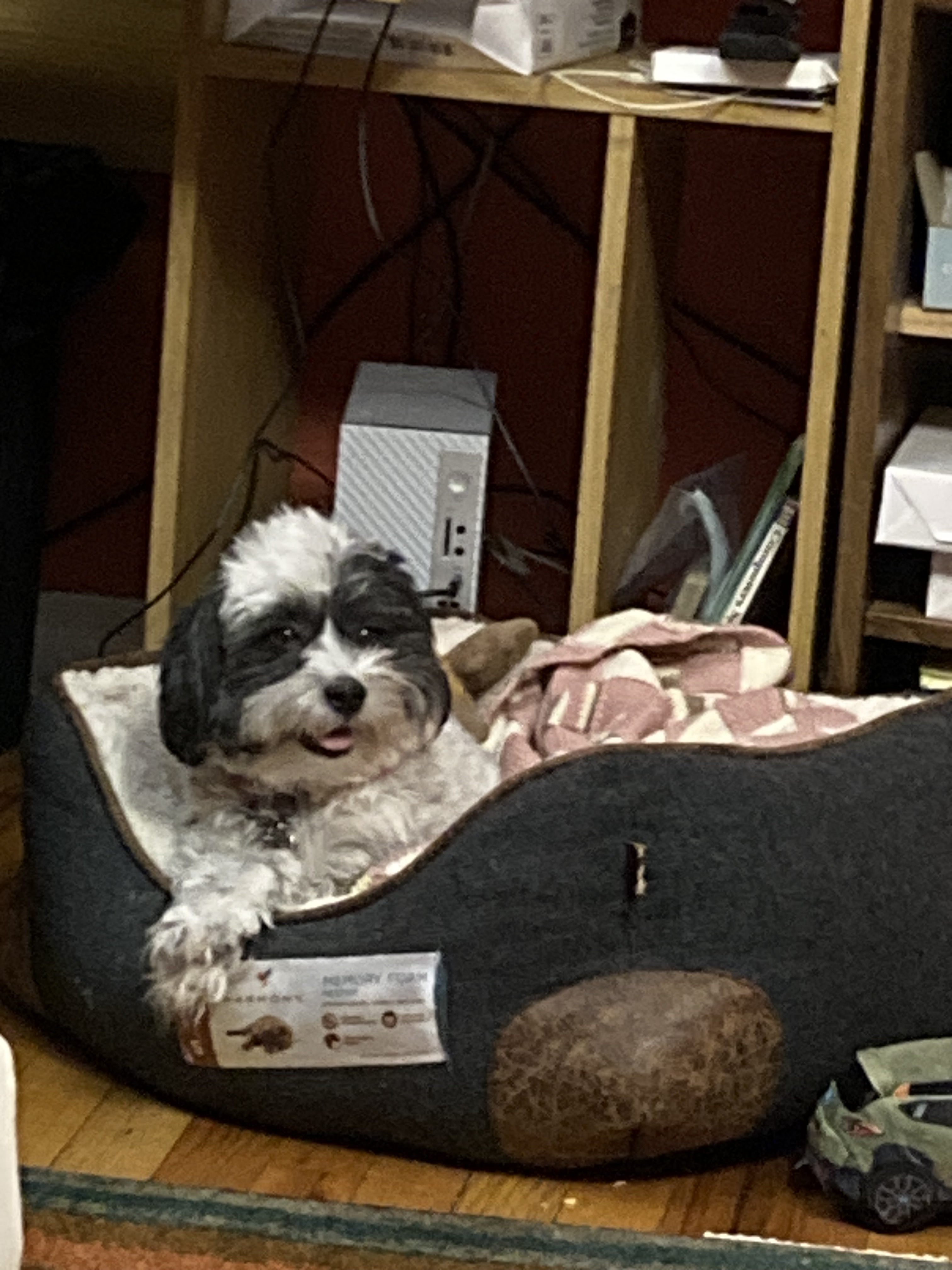
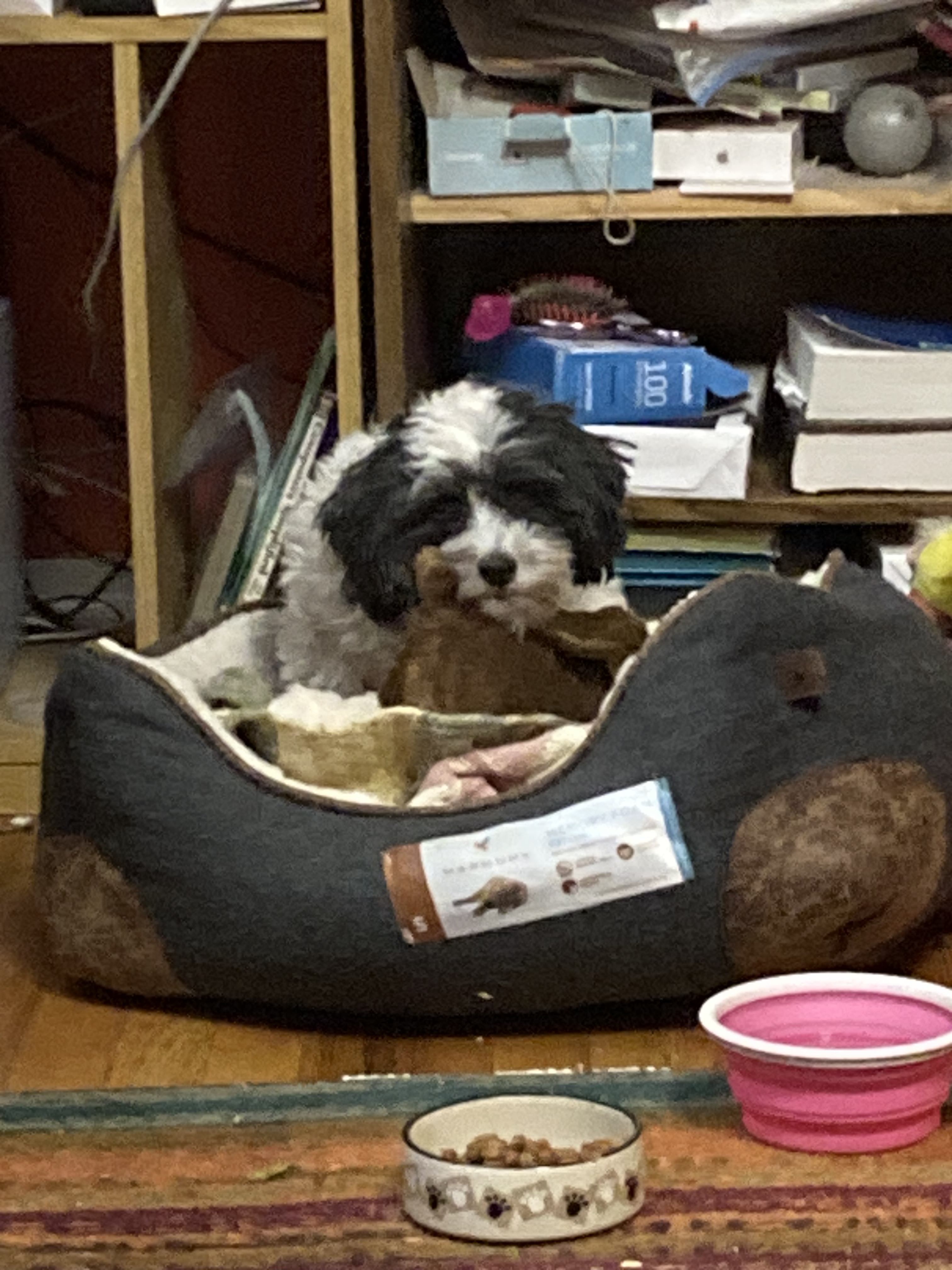
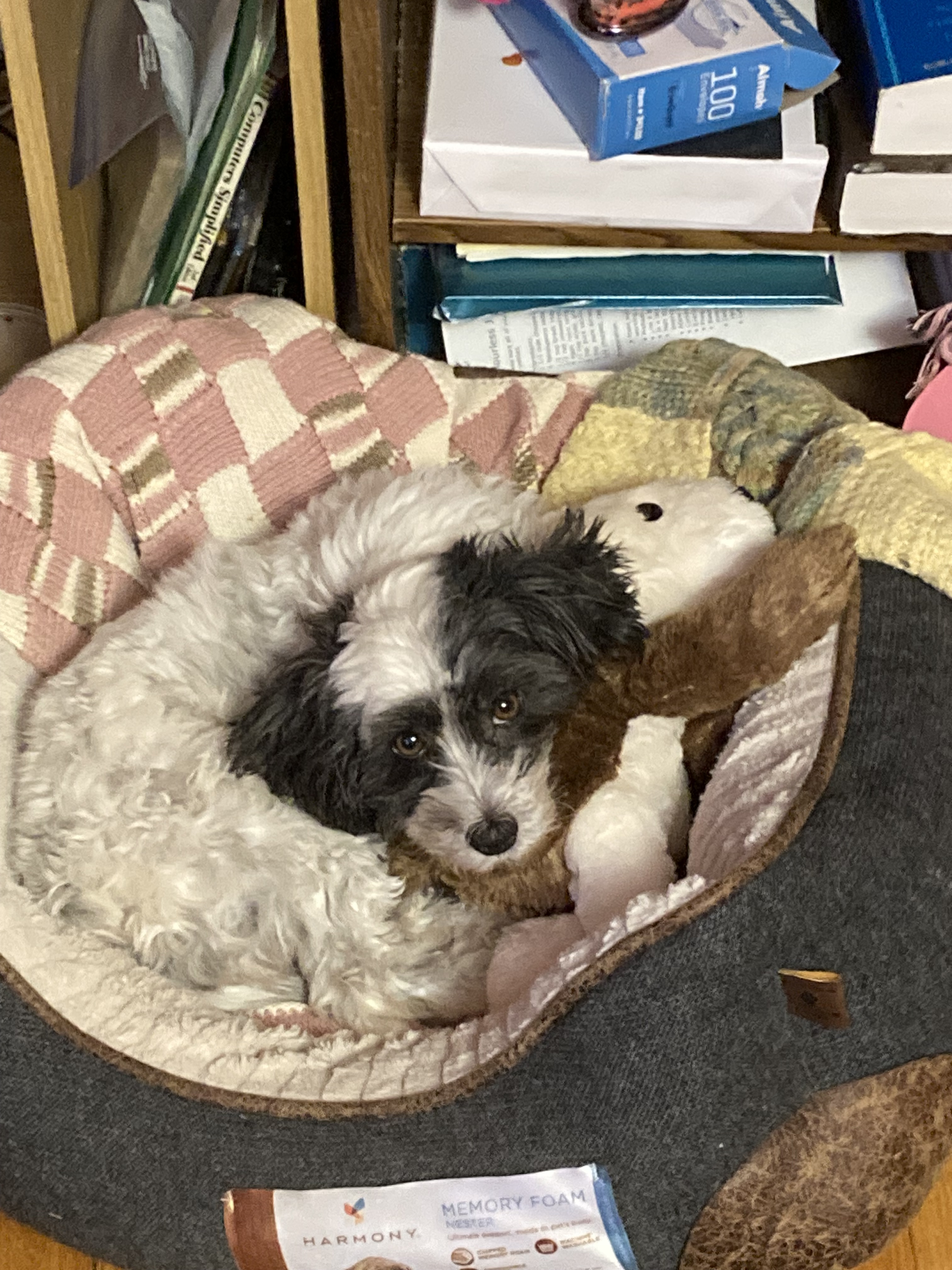
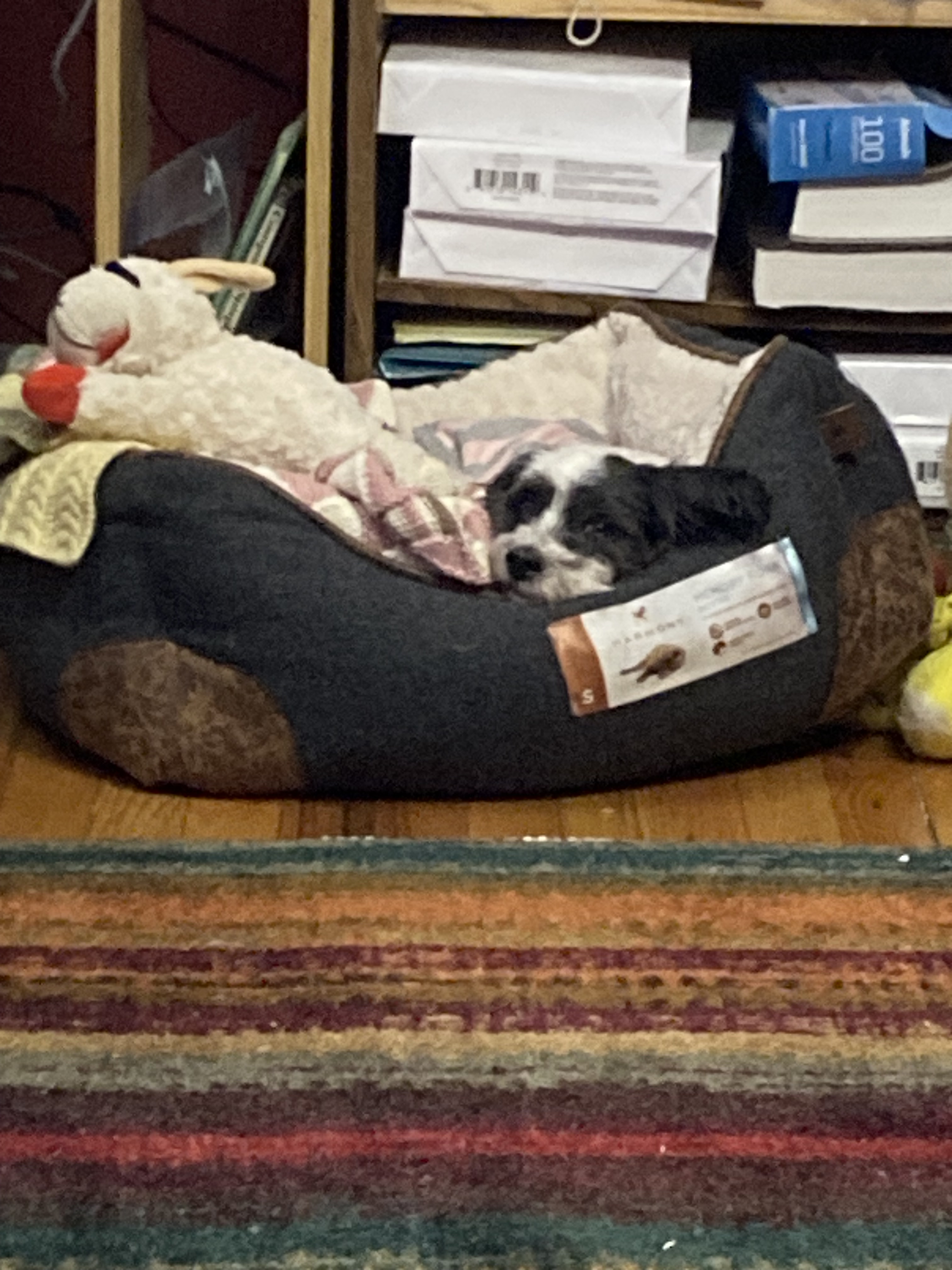
For Tzipporah, it seems, bed is life. When we come back to the apartment, from a visit to the vet or a visit to the backyard, she tries desperately to jump out of my arms, and once she hits the ground she runs straight to her bed. Safe. Once she’s recovered from her outing, though, she relaxes: stretching out, rolling on her back, sticking out her tongue, and dangling her head over the side of the bed.
But now, seven or eight weeks into having her with us, we’re getting worried that she only feels safe in her bed, and everything else is lava. When we are all together in the living room, she rarely leaves her bed; it’s only when the humans leave the room that Tzipporah is willing to walk away from her safe place for more than a second. There have been times when, seemingly, she hasn’t left her bed for half the day, not even to pee or get a drink of water from the kitchen. At night, though, she tends to wander around the apartment, investigating her new home, but when she sees any movement from the supposed-to-be-sleeping humans, she runs back to the living room and straight to her bed.
When she first came home, it wasn’t like this, she would sleep on the rug in her grandma’s room, or on the cushions in my room, or in her bed in the kitchen, or in either one of the dog beds in the living room, moving from one sleepy place to another throughout the day and night. So, I put wee wee pads in every room, and the hallway, to give her the best chance to learn that pee goes on the wee wee pad and not the rugs. When she peed near any of the wee wee pads, I would sop up the pee, place the wet paper towels on the wee wee pad, and then move the wee wee pad closer to the spot where she’d peed. And she would then, maybe half the time, start peeing on the wee wee pad instead. But as the weeks have passed, she has gradually decided on the living room as her home base, and on the one dog bed she likes best, and I’ve been able to remove the other wee wee pads one by one, and focus more on rewarding her for peeing and pooping on the wee wee pad in the living room, with some success.
Basically, she was doing well, but I started to get anxious about her bed-o-philia and worried I wasn’t doing enough to help her make progress, leaving her to calcify in her bed.
So, given her only-dog status, and my fears about her fears, I ordered a heartbeat puppy (a stuffed animal with an insert in the belly that mimics a heartbeat), and Tzipporah took to it right away, snuggling with it in her bed. When Mom wanted to see if Tzipporah could sit on the couch with us, to watch TV, I brought her and her heartbeat puppy (in her bed) to the couch, so she could feel as safe as possible in the new location. I tried to give her a treat while her bed was on the couch, but she was too anxious to eat it. After a little while, I returned her bed to its regular spot, and suddenly she noticed the chicken treat and ate it happily.
She’s made a lot of progress, when I look back at where we started. She’s now willing to stay in the dog bed next to me when I sit at my computer, instead of running away to escape the scary human monster, the way she used to. And she’s been getting used to being petted, and even having her hair combed, as long as there are treats involved.
She surprised us by doing well when her first “strangers” (aka my aunt and cousin) visited the apartment, in large part because my cousin brought a bag of freshly cut cheese and chicken cubes for the occasion (there were also salami slices, but even though Tzipporah gave them a lick, she wasn’t sure how to eat them).
Tzipporah also, finally, had her second visit with Kevin, the mini golden doodle, after weeks of everyone hiding inside because of the cold weather. She was still terrified of being on the ground outside, but she tolerated being sniffed by Kevin, and then she sat on my lap while Kevin sat quietly next to us, and I petted him, and then let Tzipporah smell my hand, and then petted her. Over and over. It’s hard to know if my completely scientific experiment worked, but Kevin certainly enjoyed it.
She still doesn’t talk much; she only cries at night when she thinks she’s alone, and she has only barked once in her sleep, but it was a very light bark, more like a yip. On the other hand, she has become more and more expressive with her eyes, staring at us as dramatically as possible to let us know she could use more treats.
The fact is, she is healing as fast as she can and becoming more herself every day. Really, it’s miraculous that Tzipporah feels safe anywhere, after four years in a cage in a puppy mill; that she can stretch out in her bed and show her belly, and not worry about being hurt, is a testament to how much she trusts us already. The only real problem here is my need for her to be all better right away. I have the same impatience with myself. I forget how much progress I’ve (we’ve) made, always focusing on how things should be, instead of recognizing the effort it took to get where we are. Maybe Tzipporah will be the one who finally teaches me how to celebrate how things really are, instead of always worrying about how things are supposed to be. Or maybe we’ll just bond over our shared love of treats (chicken for her and chocolate chip cookies for me) and be satisfied with that. We’ll see.
If you haven’t had a chance yet, please check out my novel, Yeshiva Girl, on Amazon. And if you feel called to write a review of the book, on Amazon, or anywhere else, I’d be honored.
Yeshiva Girl is about a Jewish teenager on Long Island, named Isabel, though her father calls her Jezebel. Her father has been accused of inappropriate sexual behavior with one of his students, which he denies, but Izzy implicitly believes it’s true. As a result of his problems, her father sends her to a co-ed Orthodox yeshiva for tenth grade, out of the blue, and Izzy and her mother can’t figure out how to prevent it. At Yeshiva, though, Izzy finds that religious people are much more complicated than she had expected. Some, like her father, may use religion as a place to hide, but others search for and find comfort, and community, and even enlightenment. The question is, what will Izzy find?
A new pattern has emerged. Some time in the middle of the night, for three nights now, I have woken up to a plaintive cry. Each time, I have gone to look for Tzipporah, assuming the cry was hers, and found her standing in the middle of the living room, surrounded by stuffies, silent. I guess it’s possible that the cries have been coming from outside, from another animal, or even a person, but most likely it is from Tzipporah. The strange thing is that it is just one cry and that’s it, there’s no long sequence of cries, and no obvious behavior to go along with the cry.
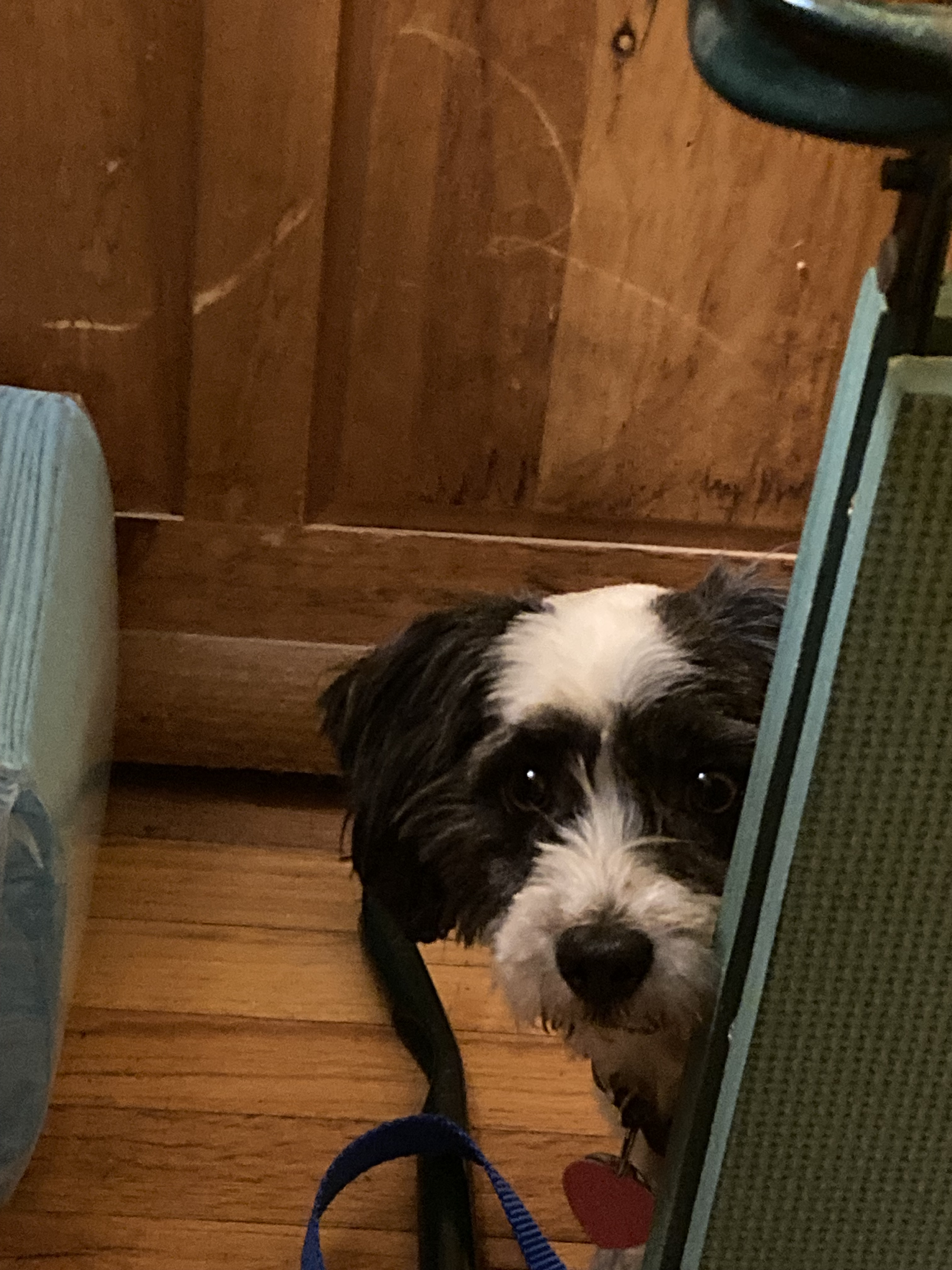
Tzipporah’s four years at the puppy mill are a mystery to me, but her terror gives me clues. Inside the apartment she has found safe spaces: she likes to switch from one dog bed to the other after a few hours, and then take a nap on the rug in Mom’s room, or on the cushion in my room, for variety; and she will let me pick up her whole bed and bring her into the kitchen at night, though she refuses to stay there; and she even lets me put her leash on and pick her up to take her outside, but once we’re outside she sits on the grass and shivers (even wearing a sweater), and when I try to pick her back up she pulls and jerks at the leash, bucking this way and that like a tiny unbroken horse.
Despite all of this, Tzipporah seems to be progressing. She stretches out in her bed, and she even rolled onto her back a few times while I was in the room. She accepts food (chicken and peanut butter so far) directly from our hands, sometimes, and she makes eye contact much more than when she first came home. She doesn’t know how to play yet, but when I press on the belly of one of her stuffies and it squeaks, or barks, she listens carefully and leans in to sniff.
But in two weeks, those ghost-like cries – as if she is just now testing her voice and is still afraid to be heard for long – are the only sounds she’s made.
I know that she has started to heal, and that her life will continue to improve as she learns that she is safe now, but I don’t know what’s behind her bone deep fear, and I don’t know if it will ever go away. There’s something deeply healing, for me, in bringing home these special dogs and helping them find their way out of the darkness; but there is also, maybe, too much resonance in the realization that some hurts may never fully heal.
If you haven’t had a chance yet, please check out my novel, Yeshiva Girl, on Amazon. And if you feel called to write a review of the book, on Amazon, or anywhere else, I’d be honored.
Yeshiva Girl is about a Jewish teenager on Long Island, named Isabel, though her father calls her Jezebel. Her father has been accused of inappropriate sexual behavior with one of his students, which he denies, but Izzy implicitly believes it’s true. As a result of his problems, her father sends her to a co-ed Orthodox yeshiva for tenth grade, out of the blue, and Izzy and her mother can’t figure out how to prevent it. At Yeshiva, though, Izzy finds that religious people are much more complicated than she had expected. Some, like her father, may use religion as a place to hide, but others search for and find comfort, and community, and even enlightenment. The question is, what will Izzy find?
She doesn’t love me, yet. I remember this feeling from when Ellie first came home, worried that she would never love me and I would never love her. I’m also having flashbacks to the night Ellie died, when she was struggling to breathe and asked to be put down on the floor, and so I did as she asked, and the next time I saw her she was dead. I worry that the new baby could be sick in some unforeseen way, and that I will wake up in the morning to find her dead. In a way, I think I’m feeling the parts of the grief I couldn’t stand feeling before. It’s not really a coincidence, but more of a blessing, that “someone” arrived a few days before the year anniversary (the Yahrzeit) of Ellie’s death.
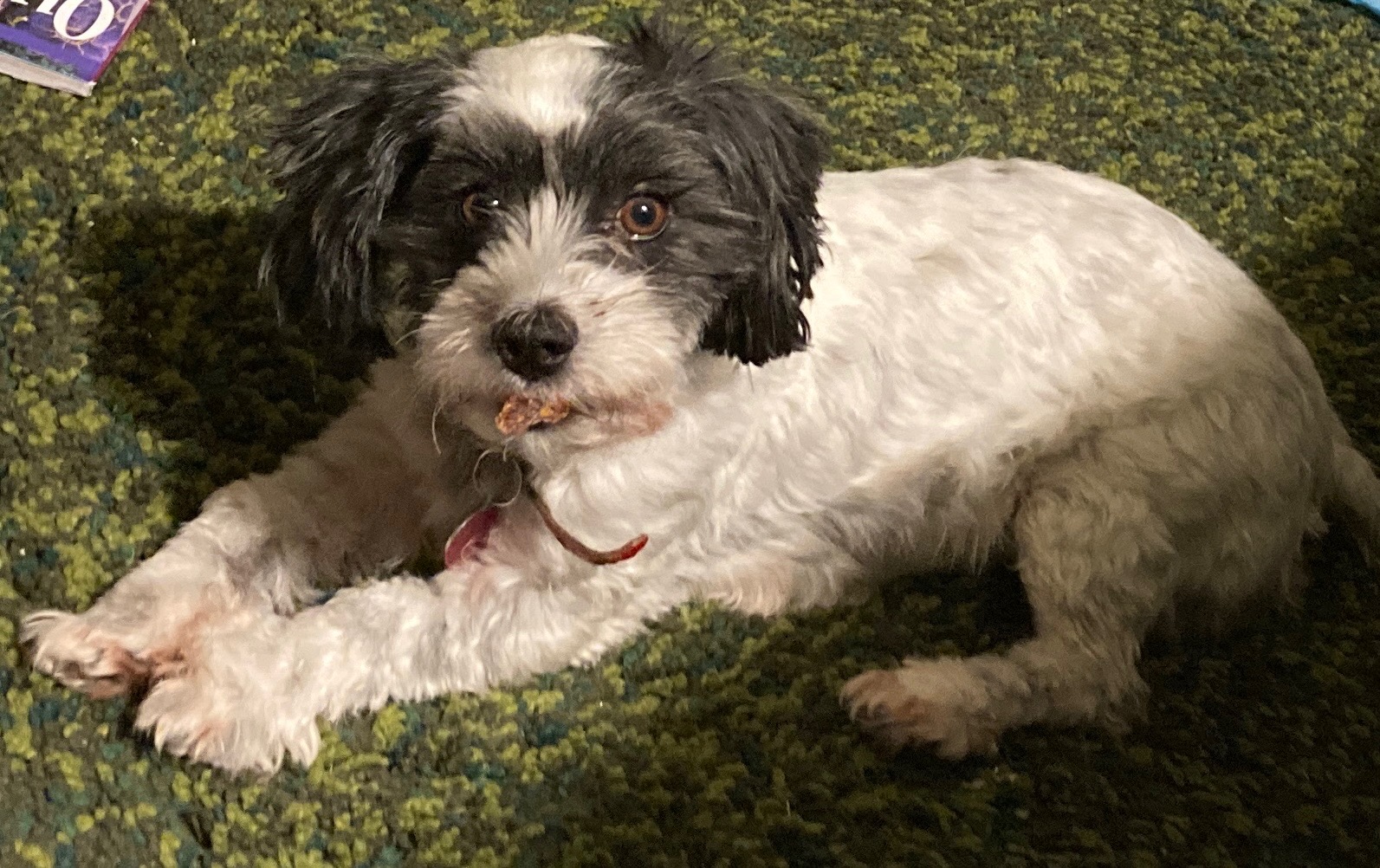
“Someone” is a four-year-old Havanese, former breeding mama, just like Ellie, though with her black and white coloring, she doesn’t remind me of Ellie too much, thank God. She hasn’t barked at all yet, and for the first few days the only thing I could see in her eyes was fear. But as time has passed, I’ve seen more and more curiosity. She’s eating well, and pooping in all the wrong places, but they are healthy poops. She spends most of her time sleeping, as if she is beyond exhausted and needs to fill up a tank that has never really been filled before.
Two weeks before we adopted her, she was driven up from a puppy mill in Missouri that had decided to “retire” a bunch of mamma dogs (I assume all of the puppies had already been sold). Mom had been calling the shelter (North Shore Animal League America, of Late Show with Stephen Colbert fame) for months, and then daily since news of the rescue of the little dogs. On the Tuesday before Thanksgiving, Mom was told that the dogs wouldn’t be ready for adoption until after Thanksgiving, but by Wednesday, adoption day was scheduled for Friday morning at ten (technically after Thanksgiving, but just barely). My brother and one of my nephews came along with us, because it was the only time they could come for a Thanksgiving visit, and because, you know, dogs. We weren’t the first ones online, but we weren’t the last either. For our entertainment, or just because, the shelter workers kept walking past the line of potential adopters with different dogs, including two Shiba Inu puppies who seemed to be dancing and doing a comedy act. At some point, one of the shelter workers came out to tell us to make two lines, one for dogs and one for cats, and no one moved. We were clearly all there waiting for the small dogs, and I was convinced that there would be no dogs left by the time we got inside.
But thankfully, I was wrong.
The way the shelter is set up, you have to walk through the long hallway of big dogs in order to get to the small dogs, in the hopes that someone will fall in love along the way and forget that they live in an apartment.
When we got to the small dog room, the first dog I noticed was a ten-year-old miniature poodle who was standing on her back legs and demanding attention from everyone who walked by. The dogs were kept in little glass-fronted apartments, with description cards on each door describing the dog or dogs inside: age, breed, gender, health issues, and any specifications (good with kids, needs to be with other dogs, needs to be an only dog, etc.). There were already a bunch of adorable little dogs being held by various humans, seemingly claimed. Then we saw the two Shiba Inu puppies, playing and laughing together, and my nephew said he’d want one of them, if only he wasn’t still living in a college dorm. The two five-month-old Shiba Inu brothers were the exception, though, because most of the dogs were former breeding mamas, from age four to age twelve (I can’t even fathom why a puppy mill still had a twelve-year-old breeding dog). I felt dizzy and overwhelmed by the noise and chaos, but then I saw a six-year-old apricot and white miniature poodle, who looked way too much like Cricket for my comfort, and just behind her, in the same little apartment, was a black and white Havanese. The card said she was four years old and that her name was “Bandita.” Both of the dogs were sleeping, but I asked to see “Bandita” anyway.
The reason for her name became clear right away, with her raccoon-like eye markings, and she looked terrified, but as soon as she was in my arms I was not willing to give her back. I was still curious about the other dogs in the room, of course, and started wondering if I could adopt two or three dogs at once, or if that would be selfish, given all of the other people still waiting in line. It took me just a minute or two to get the volunteer’s attention and tell her that we had chosen our new dog.
And then came the paperwork. They had to take “Bandita” from me and put her in another room, so she wouldn’t be claimed by anyone else, and then we waited on line and were given a three-page form to fill out in pencil, and then we waited on line again to review it all with one of the shelter workers, in pen. They needed names and phone numbers for three references, and our vet, and the manager of the co-op where we live. They also wanted information about our previous dogs: health, training habits, living conditions, etc. The shelter worker passed over the fenced-in yard requirement quickly, thank God, and told us that at four years old, “Bandita” qualified for the same senior to senior program under which we’d adopted Butterfly ten years earlier, which meant that the already low adoption fee would be reduced again, down to $25, and any health care provided by the clinic at the shelter would be subsidized. And then we were sent away while they checked through all of our information, in order to decide if we were qualified to adopt a puppy mill survivor.
Miss Butterfly
We sat at home for two hours waiting for the phone call, trying to distract ourselves, worried they’d find a reason to deny the adoption. In the meantime, I started thinking about names. I had promised myself I would give our next dog a Hebrew name, and my first thought was Tikvah, which means “hope.” But I was worried that calling her “hope” would put too much weight on her tiny shoulders, so I started researching Hebrew girl names: Aviva (spring), Ilana (young tree), Tzipporah (bird), Shir (song or poem), Yaffa (beautiful), Yofi (beauty), Dvash (honey), Rina (singing and joy), Osher (happiness), Adina (gentle), Dafna, Dahlia, Tiferet, Hadassah, and on and on.
When we finally got the call that “Bandita” was ours, I was thrilled! I didn’t expect to be so happy. I thought I would only feel relieved, or even trepidatious, but I was giddy. It was puppy time!!!
When we got back to the shelter, all of the parking spots within six blocks were taken by other potential adopters, so I dropped Mom at the front door and drove up the hill to find a spot on a side street.
While I was parking, Mom signed us up for pet insurance that would cover 80% of her health care, no matter where we chose to take her, and by the time I arrived it was time to read and sign a ton more paperwork, and visit with the vet tech to make sure we understood her health situation (spayed, still has a small scar, had a dental and would need one every year, would need two more vaccinations in two weeks), and then we were loaded up with gifts from the shelter’s corporate sponsors (a Swiffer wet jet, a bag of Rachel Rae dog food, and a dog toy from Subaru and one from a coffee company I didn’t recognize).
There was so much to carry that I left Mom with the baby, to take an adoption picture and buy some wet dog food, while I dragged all of the loot back to the car. Mom and puppy were waiting for me when I returned, and then they were safely ensconced next to the Swiffer box in the back seat, and we made our way home.
The first person we met in the back yard at the co-op was Kevin, the mini-goldendoodle who loved (and was very much loved by) Cricket, and he was very enthusiastic about sniffing the new dog and telling her all the news. She was, of course, terrified, of him, and of the grass, and of the leash, and of me, but she made a point of sniffing Kevin’s butt anyway.
As soon as we got into the apartment, I sat down on the couch, still wearing my winter jacket, and held her on my chest for the next few hours, afraid to move. When I finally put her down on the floor (because I really had to go to the bathroom), she ran for the smallest hiding spot she could find, which turned out to be Mom’s garden kneeler, which was sitting on its side in a corner of the dining room. She peeked out from behind the bench of the kneeler and then curled up behind it, using it as a shield.
We’d thought we still had a pet gate in storage, and had planned to put her and her food and bed and wee wee pad in the kitchen, but without the pet gate we couldn’t reinforce the boundary, so even though she started her first night in her bed in the kitchen, she quickly found her way down the hall to a little round rug on Grandma’s bedroom floor, where she spent the rest of the first night.
Without the pet gate, trying to explain to her where to pee and poop has been difficult (or impossible), but she’s been making progress anyway. We take her outside a few times a day, even though she has no idea what to do out there and just sits on the grass, waiting to be picked up and brought back inside.
By Sunday morning, we’d narrowed the name choices down to Tzipporah, Tikvah and Shir (or Shira or Shiri), but I still couldn’t quite figure out who she was, and I was afraid of getting her name wrong, forever and ever amen.
By Monday afternoon, she wasn’t shaking anymore, though she was still skittish when the humans came too close. Pretty quickly, she found the two dog beds, filled with Cricket and Ellie’s toys and blankets, and spent many hours making herself cozy in the midst of her sisters’ smells. We set up a cushion and blanket for her in my room., so she could feel safe and welcome there too, and she was beginning to venture further into the corners of the apartment, examining all of the smells and sounds and textures of her new world. She was starting to stretch out and try different sleeping spots and positions, instead of always being curled in a ball on the round rug in Mom’s room. She even started to look at us, and to continue eating while we were in the room. By then, I had narrowed the choices to Tikvah and Tzipporah. I was leaning more towards Tzipporah (bird), because the sound of it seemed to fit her, and because I could already see her yearning to fly. But I was still holding onto the idea of “hope,” for myself, and wasn’t quite ready to let it go.
By midweek, when we lit the (vanilla scented) candle for Ellie’s Yahrzeit, and sat with that grief again, something had shifted inside of me and I decided that I was ready to let go of my expectations, and hopes, and “someone” finally became Tzipporah (Tzippy for short).
Ellie’s Yahrzeit
Her fears are still prominent. She had an encounter with the vacuum cleaner the other day, a previously unknown evil, that sent her back to bed for half a day. She refused to crawl out from under her blankets for anything, even dinner. But we can already see a glimmer of her adventurous spirit hidden underneath the fear. Step by step, chicken treat by chicken treat, I hope that she will eventually decide that she was adopted by the right family, and she’ll discover that good things really are possible, especially love.
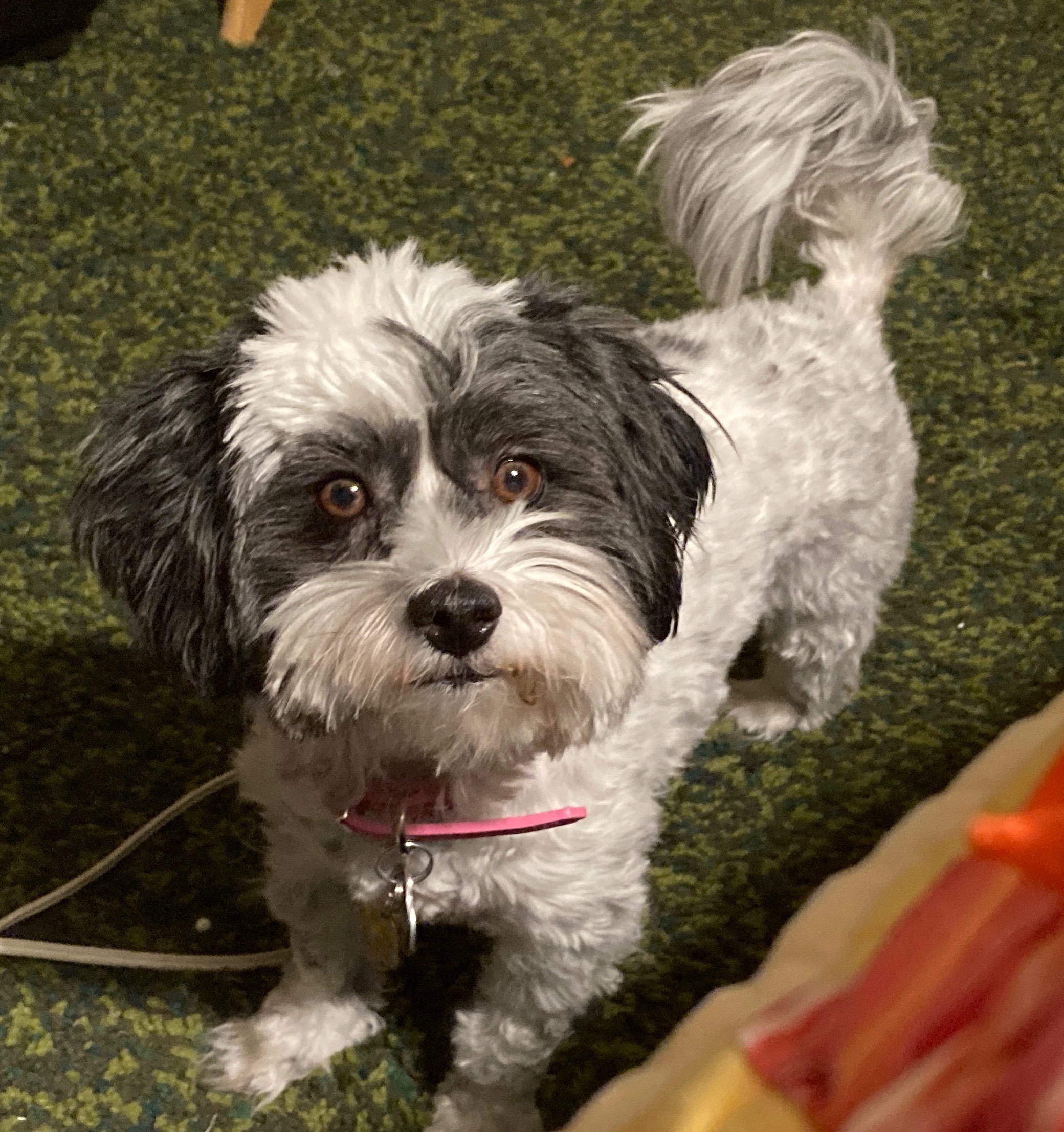
Tzipporah
If you haven’t had a chance yet, please check out my novel, Yeshiva Girl, on Amazon. And if you feel called to write a review of the book, on Amazon, or anywhere else, I’d be honored.
Yeshiva Girl is about a Jewish teenager on Long Island, named Isabel, though her father calls her Jezebel. Her father has been accused of inappropriate sexual behavior with one of his students, which he denies, but Izzy implicitly believes it’s true. As a result of his problems, her father sends her to a co-ed Orthodox yeshiva for tenth grade, out of the blue, and Izzy and her mother can’t figure out how to prevent it. At Yeshiva, though, Izzy finds that religious people are much more complicated than she had expected. Some, like her father, may use religion as a place to hide, but others search for and find comfort, and community, and even enlightenment. The question is, what will Izzy find?





















 rachelmankowitz