A couple of weeks ago, when Cricket lost the ability to hold off peeing until she could reach the wee wee pad by the front door, we created a yellow brick road of wee wee pads, from Grandma’s bed to the front door, to help her out. And, either as a result of the Gabapentin and ACE she takes every day (in order to tolerate the subcutaneous fluids for kidney disease), or because of incipient dementia, Cricket has started to pace around the apartment at all hours, peeing along her wee wee pad path, especially in the middle of the night.
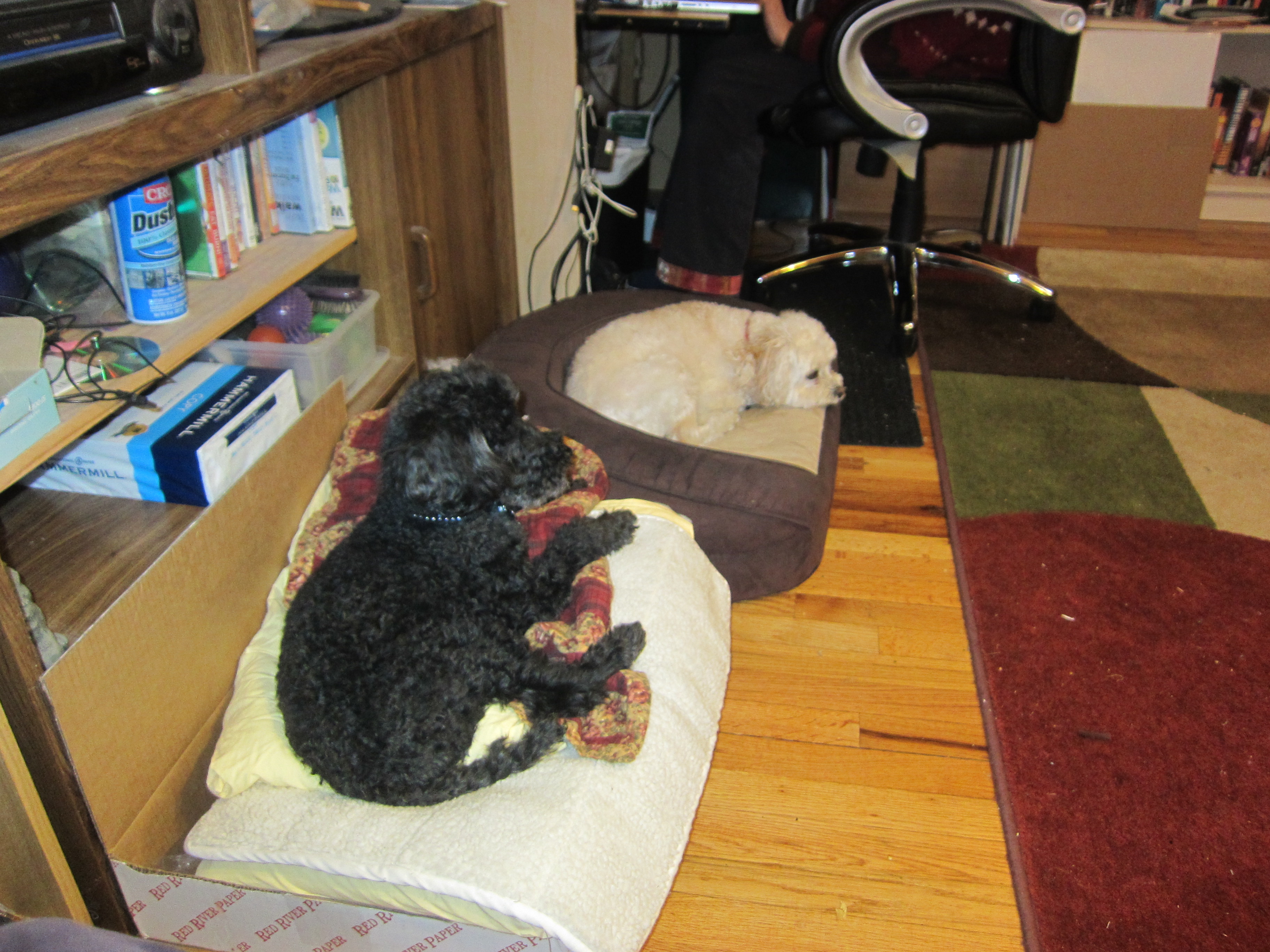
After she’s jumped off Grandma’s bed, to get a drink of water and to pee, Cricket will come to my room, sometime around four o’clock in the morning, and bark at me for the mommy-elevator up onto my bed, where she wanders around and around in search of the perfect sleeping spot, which is often elusive. For some reason, Ellie has decided that instead of staying in my room at night, the way she used to, she prefers the wee wee pads – at least the as yet unused ones – as her favorite place to sleep.
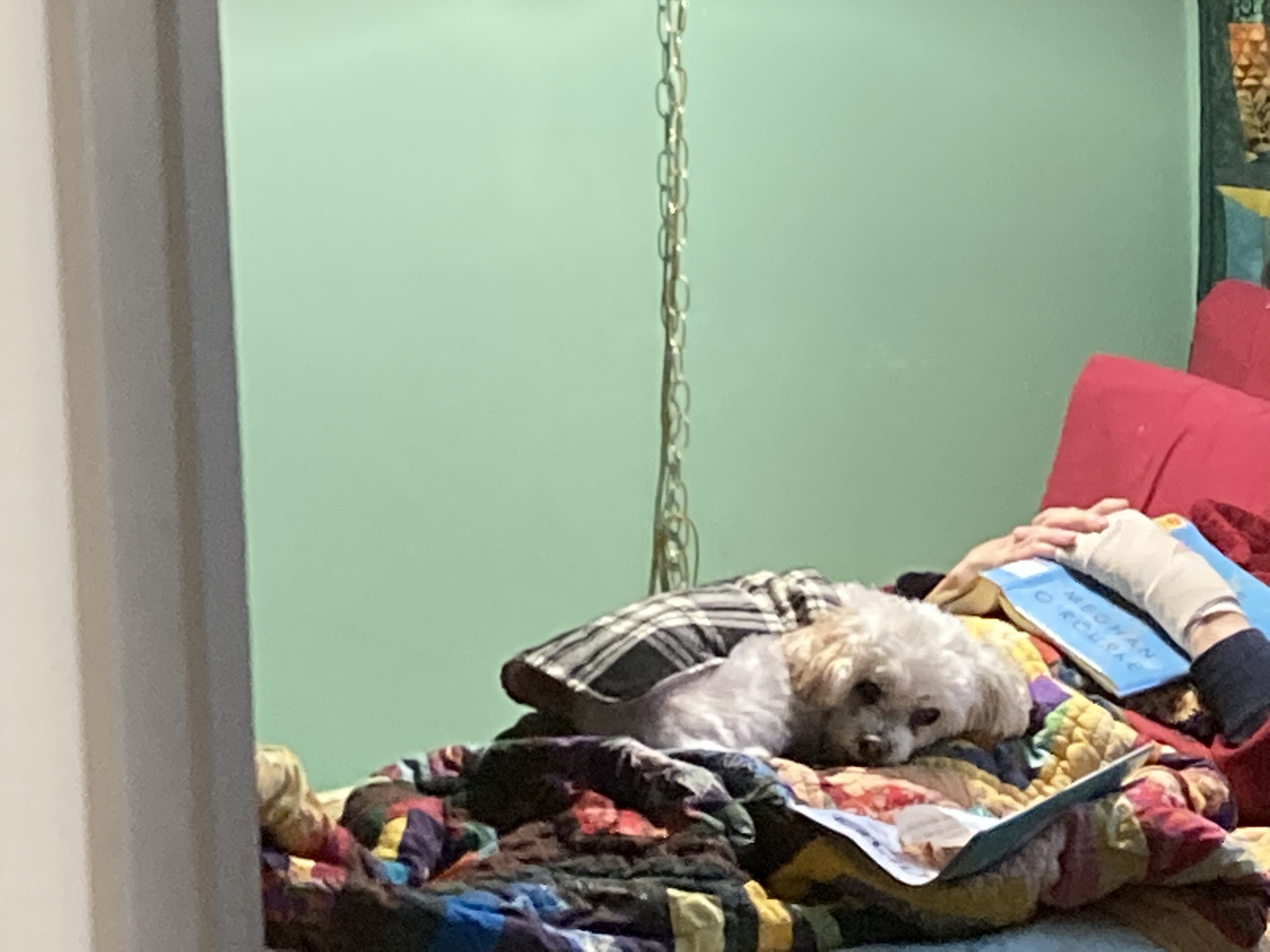
“Are you telling my secrets, Mommy?”
When I accept the inevitable and finally get up, around 7 AM, Cricket and Ellie are ready to go outside, walking down the stairs together if Cricket is up to it. Neither one of them can run and play the way they used to, but Ellie gets a lot of enjoyment just by standing still and listening to the sounds of the neighborhood, while her sister wanders around the yard sniffing all the smells.
When we get back inside it’s time for Ellie’s medication, carefully stuffed into small pieces of chicken or chicken liver, with a few pieces going to Cricket as well. And, if she’s willing, Cricket gets her ACE and Gabapentin in her food too, so we can get her fluids done early and give her time to pee it all out during the day, instead of needing to walk her path so much overnight.
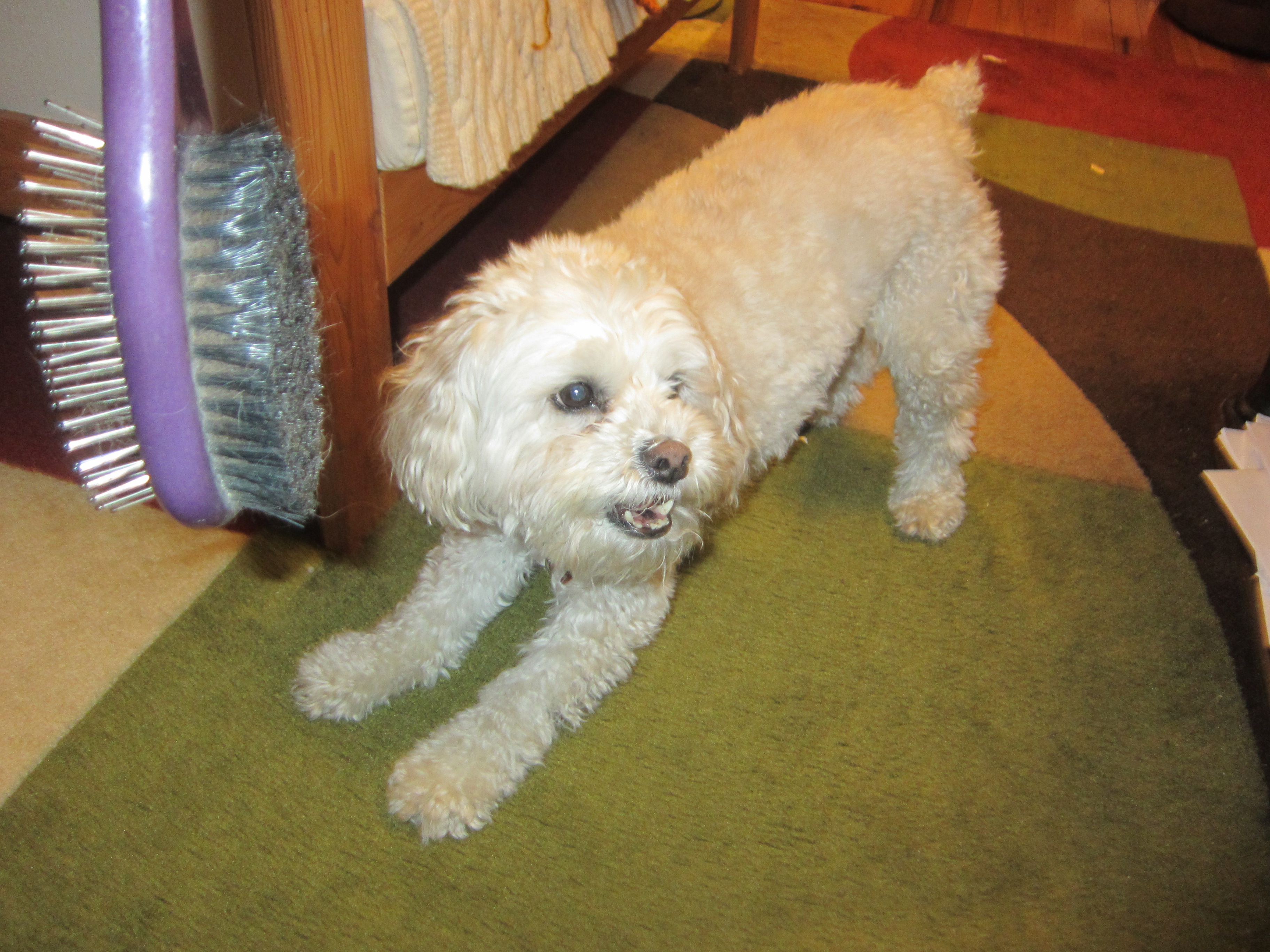
“Give me more fluids and I’ll be swimming down the hallway!”
We’re still in the trial and error phase with all of this, constantly adapting their diets and schedules and adapting our expectations of what they can and can’t do, based on how things are going each day. Ellie is mostly consistent, though she needs new high value treats every few days to help her tolerate all of her pills. Cricket is the wild card. Some days she seems like she could go at any moment, and other days she seems so normal that we almost get complacent. Almost.
We’ve started to get rid of rugs that have been peed on too often, by both of them, and we’re doing a lot of extra laundry, but we love them, so we walk the wee wee pad path, replacing one pad here and there as we go along, trying to keep them happy and comfortable. I wouldn’t have chosen this, but I wouldn’t want to miss a day of having them in my life either, so this is what love looks like right now.
If you haven’t had a chance yet, please check out my Young Adult novel, Yeshiva Girl, on Amazon. And if you feel called to write a review of the book, on Amazon, or anywhere else, I’d be honored.
Yeshiva Girl is about a Jewish teenager on Long Island, named Isabel, though her father calls her Jezebel. Her father has been accused of inappropriate sexual behavior with one of his students, which he denies, but Izzy implicitly believes it’s true. As a result of his problems, her father sends her to a co-ed Orthodox yeshiva for tenth grade, out of the blue, and Izzy and her mother can’t figure out how to prevent it. At Yeshiva, though, Izzy finds that religious people are much more complicated than she had expected. Some, like her father, may use religion as a place to hide, but others search for and find comfort, and community, and even enlightenment. The question is, what will Izzy find?
A few weeks ago, maybe after the apocalyptic day in New York, when the skies turned orange and everything smelled of smoke because of the Canadian wildfires, Ellie started to cough.
“Are you talking about me?”
It’s not that she’d never coughed before. In fact, she has a full menu of interesting coughs and sneezes to her name: including the how-dare-you-pull-on-my-leash cough, which sounds like a frog is jumping out of her throat; and the excuse-me-where’s-my-dinner cough, which is more like a whisper, with her head turned away for deniability. But this cough was something new. It sounded like she was choking on something, or suffocating, and then she’d sort of cough up whatever it was and collapse as if she’d run a marathon.
The first time I witnessed this, I was afraid she was going to die right in front of me. I may have taken it more seriously as a result of the debarking surgery that was done when she was still a breeding dog, because the scar tissue from that surgery has made her throat more constricted than it should be.
It was a few days before I witnessed another coughing attack, and I was shocked by it again, especially by the way she seemed almost paralyzed for a couple of minutes afterward, but then she was fine, and I was relieved. She started to cough more frequently after that, but with less seriousness, and I wondered if maybe it was just an allergy, exacerbated by the air quality, and, really, I was distracted. Cricket had been diagnosed with kidney disease and needed fluids every day, and we’d had a car accident and had to buy a new car, and I’d had to go to five or ten doctors’ appointments, and prep for my second oral surgery (the follow-up to last year’s surgery), and that’s only the top line of the chaos that was going on around here, and there was no way to keep up with all of it, so each time Ellie stopped coughing and seemed to be breathing and walking and eating okay, I just breathed a sigh of relief and let it go.
But last week, when Cricket had to go back to the vet for a follow up blood test, and I was between medical appointments, it seemed like a good opportunity to bring Ellie in to be seen as well.
Of course, as soon as we made the appointment for both of them, Cricket, who had been doing surprisingly well, had a downturn. She couldn’t eat and she was woozy, even without the calming meds, to the point where she allowed me to insert the needle for the fluids without a fight. We all went to bed that night thinking this was the end, and we’d have to leave Ellie home the next day, and bring Cricket in to the vet for the last time.
But in the morning, my little phoenix rose from the ashes again, climbed up and down the stairs herself, ate her breakfast and demanded more.
“I’m hungry!!!!!”
So we went, all together, to the vet, me as the chauffeur in the front seat, Mom sitting in the back with both dogs, so that Ellie wouldn’t have to sit alone back there (Cricket has never tolerated sitting in the backseat. When we would put her in a harness early on in her life, she’d escape within thirty seconds and make her way up to the driver’s seat). With Cricket and Grandma sitting next to her, Ellie got through the ride without crying once, though she was still breathing heavily.
I carried Cricket into the vet’s waiting room, not wanting to have her walk on the hot ground (Ellie refused to be carried), and the vet took Cricket out first, to take the blood, and then focused on Ellie and her cough. I tried to reenact the cough for him, so he’d know what he was dealing with, and he gave me a look and said, “Can you do that again?” It took me a second to realize he was joking. If he has a sense of humor it is very, very dry. He checked Ellie’s heart and looked in her mouth and took her temperature (which she found horrifying), and he gave her an anti-inflammatory shot and sent us home with antibiotics and a cough suppressant for her to take twice a day, and he said to call him in a few days and let him know if she was coughing any less (because if not, he’d want to follow up with an x-ray).
And we were free. This visit, which, for a few hours there had seemed like it would be the last time I ever saw my Cricket, turned out to be routine and quick. When we got home we were all ready for an afternoon nap, maybe me more than everyone else, to be honest.
“Oy.”
Both dogs were thrilled with their treats (with their separate meds hidden inside) once the naps were over: Cricket discovered a great love for sardine juice, and Ellie discovered that she had no such great love and stuck with pieces of chicken.
Ellie coughed less for a few days, though she became more and more picky every day about the treats within which we could hide her pills, but then the coughing came back, and Ellie was barely eating anything at all. We called the vet and he said to stop the antibiotics, because they might be causing her lack of appetite, but keep up the cough suppressants for a few more days and then call back.
Pretty quickly, though, it was clear that Ellie was getting worse. She was breathing heavily, leaving treats uneaten (where Cricket could easily steal them), and refusing to walk more than a few feet at a time. So we called the vet for an emergency appointment this morning and brought her in, and as soon as he saw her he said she didn’t look good at all. He took an x-ray and said her heart was huge and misshapen, and there was fluid collecting around her heart. He gave her a shot of a diuretic and told us he would send the x-rays on to a specialist and then let us know what medication she could take going forward. But, he said, she could collapse at any time. He couldn’t explain how she’d gone from having a little bit of a cough to being in heart failure within a week, but most likely the cough had been caused by the enlarged heart in the first place, pressing on her trachea.
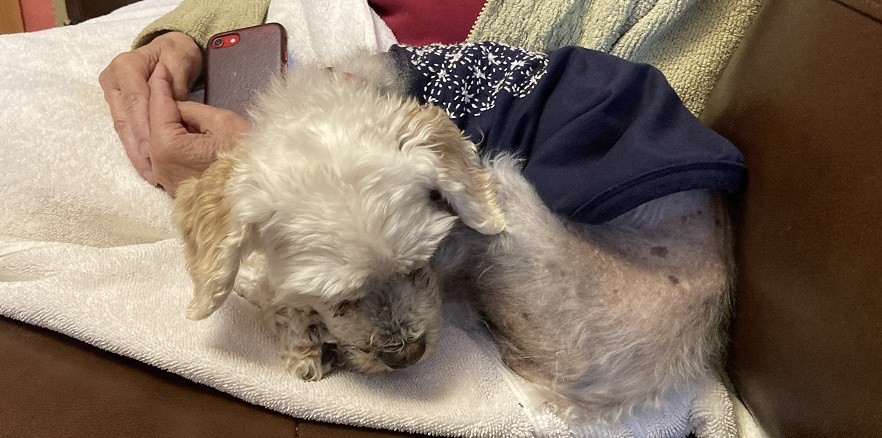
Ellie’s home now, still breathing heavily, but peeing rivers, which will hopefully relieve some of the pressure on her heart. But my heart is overwhelmed. Cricket is oblivious: sleeping on Grandma’s lap, eating well, and barking her frustration at all of the attention her sister has been getting. And now we wait, to see what comes next.
If you haven’t had a chance yet, please check out my Young Adult novel, Yeshiva Girl, on Amazon. And if you feel called to write a review of the book, on Amazon, or anywhere else, I’d be honored.
Yeshiva Girl is about a Jewish teenager on Long Island, named Isabel, though her father calls her Jezebel. Her father has been accused of inappropriate sexual behavior with one of his students, which he denies, but Izzy implicitly believes it’s true. As a result of his problems, her father sends her to a co-ed Orthodox yeshiva for tenth grade, out of the blue, and Izzy and her mother can’t figure out how to prevent it. At Yeshiva, though, Izzy finds that religious people are much more complicated than she had expected. Some, like her father, may use religion as a place to hide, but others search for and find comfort, and community, and even enlightenment. The question is, what will Izzy find?
A few weeks ago I was afraid Cricket was on the edge of life, diagnosed with kidney disease, struggling to walk, knocking into things. We started giving her subcutaneous fluids on the off chance that it would help extend her life, and it’s actually working. Though in order to give her the fluids we have to medicate her with a combination of gabapentin and ACE, which makes her woozy for hours. At times, she seems like a wraith, her feet slipping out from under her, not even protesting when the needle slips under her skin.
Ideally, she would have gotten used to the whole procedure by now, and she wouldn’t try to pull off the muzzle, or lift up her head to get away from the needle. Ideally, I’d never have to give her any calming meds at all and she would just accept the fluids as a necessary evil and get it over with and get back to living her life. But then she wouldn’t be Cricket, and all of this effort is to make sure she gets to be Cricket for as long as possible.
“Oh, I can be even more Cricket-y. Just wait.”
Every day, at the beginning of all of this, I was afraid she was going to die overnight, and when she actually woke up in the morning, and ate her breakfast, I was surprised, and afraid to be hopeful. But with each day she seems to improve a little bit. The meds make her into a rag doll, yes, but then the next morning, after she’s slept it off, it’s like she’s been brought back to life, refilled with her fluids and her spirit, and ready to sniff the whole world again.
It’s still nerve-wracking to watch her skin fill up with the fluids. I even worry sometimes that her neck is going to explode (I’ve seen too many movies), and I worry that I’m going to put the needle in the wrong place and puncture something vital. I was worried for a while that I was inserting the needle the wrong way and causing scar tissue to form because I could feel these quarter-sized bumps under her skin and I was afraid I would run out of loose skin and not be able to give her the fluids anymore, but then the bumps started to dissolve, and that worry, at least, went away. So much of this is trial and error and the circumstances seem to change every day. It feels like a magic trick each time she wakes up in the morning and walks and barks and eats and acts like herself, but a magic trick that is unreliable and hard won.
I’ve been thinking about my friend Teddy, the miniature poodle, who died from kidney disease a few years ago. His death came as a surprise, at least to me. He hadn’t been diagnosed with the disease ahead of time, and by the time they caught it he was too far gone to be helped by fluids or anything else. When Cricket was diagnosed I was afraid it would be the same thing, and every day, even though I knew her case was different, I expected the same results.
Some days are better than others. Every once in while she has a bad night, her breathing is shallow, she pees on the floor because she can’t get to the wee wee pad in time, or she’s not up to climbing the stairs, but other days she seems to be getting better, growing stronger, and enjoying her life.
I was telling myself that I just needed Cricket to reach her sixteenth birthday, but now that she’s accomplished that goal, I need more. I need to feel like I did everything I could possibly do for her. I need to not have any regrets, and not feel like if only I had been stronger or smarter or kinder or more loving, she would have lived longer.
I’m also doing my best to make sure Ellie doesn’t feel left out, and gets extra hugs and scratchies and treats to make up for all of the attention her sister is getting. But when Cricket feels better she goes back to taunting Ellie, so then I feel guilty for taking such good care of Cricket and, at the same time, I feel guilty for not taking good enough care of her.
“If I keep my eyes closed she won’t bother me. Right?”
The thing is, Cricket isn’t giving up. She doesn’t think sixteen years is enough, even if each day is a little harder than it used to be. And if she’s going to be this stubborn, then I guess I’m going to have to be stubborn too.
If you haven’t had a chance yet, please check out my Young Adult novel, Yeshiva Girl, on Amazon. And if you feel called to write a review of the book, on Amazon, or anywhere else, I’d be honored.
Yeshiva Girl is about a Jewish teenager on Long Island, named Isabel, though her father calls her Jezebel. Her father has been accused of inappropriate sexual behavior with one of his students, which he denies, but Izzy implicitly believes it’s true. As a result of his problems, her father sends her to a co-ed Orthodox yeshiva for tenth grade, out of the blue, and Izzy and her mother can’t figure out how to prevent it. At Yeshiva, though, Izzy finds that religious people are much more complicated than she had expected. Some, like her father, may use religion as a place to hide, but others search for and find comfort, and community, and even enlightenment. The question is, what will Izzy find?
Cricket has kidney disease. She had a really bad day recently: she fell down the stairs when she was coming in from a walk, and had to be carried up and down the rest of the day. By the next morning, she was back to herself, climbing the stairs and eating her breakfast and barking at the UPS guy, but we took her to the vet anyway and he checked her out and took blood and the next morning he called to say it was her kidneys, but he’d need a pee sample to know if she also had an infection. I had to follow her around all day with a ladle, collecting a teaspoon of pee at a time and storing it in the fridge until we had enough to bring to the vet. Thank god, Mom didn’t take the picture she threatened to take of this particular activity. The results: no infection, but very watery pee, confirming kidney disease, so we’d have to go back to the vet and learn how to give her sub-cutaneous fluids once a day. With a very big needle.
“I hate needles!”
Cricket only weighs 9.5 pounds now, down from her original 14 pounds, and she looks like a naked chicken from the neck down, but she still has her rebellious spirit. So as soon as I knew I would have to put a needle under her skin every day, I started searching everywhere for her muzzle. We’d never actually used it before, but we had it somewhere, just in case, because she is a biter. I finally found the muzzle hidden behind her old harnesses and winter sweaters in the hall closet, and she let me put it on her, for a moment, before she started trying to pull it off.
At our next appointment, the vet demonstrated how to hang the fluid bag on the door, and hold Cricket still, and pull up the extra neck skin like a tent and insert the needle, and Cricket calmly let him do all of this. We watched her neck swell up like a balloon, which he said was totally normal, and then he removed the needle and pinched the skin so that the fluid wouldn’t spritz out. Then he showed me how to change out the old needle for a new one, easy peasy. By the time we got home, Cricket was feeling so good that she skipped down the lawn on her way to the front door.
My first attempt at giving her the fluids myself, the next morning, went almost as easily as when the vet did it, even with the big needle and the bite-prone Cricket, but on the second day, she rebelled. She bared her teeth at me, and pulled away from the needle, and then she bit me, three times. I tried again later in the day and managed to get the needle under her skin and a small ball of fluid in her neck, before she bit me again.
“You bit me first!”
On the morning of day three, we tried giving her food during the procedure, to keep her distracted, but she turned the bowl over and spread the food all over the floor and hopped over it to get away from the needle. So, in desperation, we gave her a quarter of a doggy valium, and waited. An hour later I was able to put the muzzle on her, and insert the needle under her skin, and give her the rest of the fluids she should have had the day before. The only problem was that we had no more doggy valium. So off to the vet we went to get more medication, and incidentally, to make sure it was okay for her to take it every day. It was, but even that small amount of ACE (the doggy Valium) made her stumble around and wiped her out for the rest of the day.
“It helps to have somewhere to put my head.”
A week after starting the fluids, we took her to the vet for another round of blood tests, to see if the fluids were helping, but when the doctor called the next morning, it turned out that her kidney numbers were worse. He told us to keep doing the fluids, with some added B vitamins, and he gave us Gabapentin to try instead of the ACE, to see if the combination would give her more good days. He had no prediction for how much time she has left. He just told us to keep an eye on her eating habits, and if she doesn’t eat for three days in a row then that would mean she’s suffering and it will be time to let her go.
We tried the gabapentin to no effect, so we went back to the ACE, but decided to give it, and then the fluids, at night, so that she could sleep it off and wake up feeling better, and that seems to be working better for her.
I don’t have high expectations, but I’d like for her to enjoy the end of her life as much as possible, and I’d really like to have a little more time.
“Where’s the rest of the chicken?”
If you haven’t had a chance yet, please check out my Young Adult novel, Yeshiva Girl, on Amazon. And if you feel called to write a review of the book, on Amazon, or anywhere else, I’d be honored.
Yeshiva Girl is about a Jewish teenager on Long Island, named Isabel, though her father calls her Jezebel. Her father has been accused of inappropriate sexual behavior with one of his students, which he denies, but Izzy implicitly believes it’s true. As a result of his problems, her father sends her to a co-ed Orthodox yeshiva for tenth grade, out of the blue, and Izzy and her mother can’t figure out how to prevent it. At Yeshiva, though, Izzy finds that religious people are much more complicated than she had expected. Some, like her father, may use religion as a place to hide, but others search for and find comfort, and community, and even enlightenment. The question is, what will Izzy find?
Cricket has a big mouth. I don’t mean anatomically, because she is a pretty small dog, eleven pounds or so, but she just won’t shut up. She barks at anyone and everyone who dares to enter her yard (it’s a shared yard, for the whole co-op, so people are always coming and going), and she yells at us for all manner of sins: like, not giving her more treats when she’s already had three, or not taking her out as soon as she wants to go, or not being able to figure out what she wants when she’s explicitly barked it at us twelve times in a row.
“How do you not understand me?!!!!!”
She doesn’t bark at her friend Kevin, the one year old mini-Goldendoodle. She usually just swats at him with her paws to try to get him to pay attention to her when he dares to lie down on the grass and chew on a stick. But she barks at her sister, Ellie, and at pretty much anything that moves.
If Cricket were more trainable (and she has proven to be distinctly untrainable), I would get her some of those floor buttons that have become popular recently in so many videos, where dogs are able to express themselves in English by pressing specific buttons with their paws.
The problem is that, if she could actually be trained to use the buttons, she’d stomp on them so hard, and so often, that she’d break the buttons for ‘out’ ‘treat’ and ‘lap’ on the first day.
Our neighbors, even the ones who like us, say, oh yeah, we heard Cricket through the window. We always know what Cricket is thinking.
But then, she curls up on her grandma’s lap, or next to Grandma on the couch, or in tiny ball in her own doggy bed, and she looks like the sweetest puppy on the planet. Even with her little pink cauliflower growths, and age spots, and thinning hair, she still looks angelic and adorable and incapable of being difficult.
But only when she’s sleeping.
I’m afraid of what’s going to happen when Mom comes home from her hip surgery in a few weeks. I’m pretty sure that I will be the lucky recipient of most of Cricket’s anger when I try to put the dogs in my room to protect the visiting nurse, or when Mom closes her bedroom door at night to protect her new hip from being used as Cricket’s sleeping spot. I don’t know how Cricket is going to survive, or how my hearing will survive, really.
It’s hard to be wholly negative about Cricket’s big mouth, though, even though she’s also used it to bite me a few times over the years (for daring to bathe her or comb her hair). She is a perfect example of how you can love someone who is deeply flawed. I may not love the barking itself, but I do love how adamant she is about being herself, no matter what, and I love that she knows what she wants and makes sure to ask for it. And while it would be nice if she could lower the volume, or learn from her mistakes, or compromise every once in a while, I know that’s not going to happen. And that’s okay.
The fact is, Cricket is going to be fifteen years old this July, and she is exactly the same as she was at six months. She has only intensified over the years, like a really stinky cheese. Luckily for both of us, I love cheese.
“Me too!”
If you haven’t had a chance yet, please check out my Young Adult novel, Yeshiva Girl, on Amazon. And if you feel called to write a review of the book, on Amazon, or anywhere else, I’d be honored.
Yeshiva Girl is about a Jewish teenager on Long Island, named Isabel, though her father calls her Jezebel. Her father has been accused of inappropriate sexual behavior with one of his students, which he denies, but Izzy implicitly believes it’s true. As a result of his problems, her father sends her to a co-ed Orthodox yeshiva for tenth grade, out of the blue, and Izzy and her mother can’t figure out how to prevent it. At Yeshiva, though, Izzy finds that religious people are much more complicated than she had expected. Some, like her father, may use religion as a place to hide, but others search for and find comfort, and community, and even enlightenment. The question is, what will Izzy find?
Cricket had to get her teeth cleaned, and I was scared. The doctor first mentioned to us that Cricket’s teeth needed cleaning around two years ago, I think. It’s possible he’d mentioned it earlier, but if so, I blocked it out. We were able to put it off at that point, because Cricket was dealing with other health issues that were more pressing, but since she’s been doing better the doctor’s insistence has been growing. Both Mom and I have been concerned about putting Cricket through such a procedure, because of her age and because we’ve heard so many horror stories about dogs dying from regular teeth cleanings, because of the anesthesia. The doctor has tried to reassure us, and at Cricket’s most recent checkup he gave her a battery of tests to make sure she would be safe undergoing anesthesia, and the doctor said that he was confident Cricket would be fine. I wanted to be as confident as he was, and I wasn’t, but Mom and I decided to go through with the procedure anyway, because Cricket’s quality of life was in the balance. The pain in her mouth, especially when she was eating, and the bacteria running through her system, weren’t doing her any good. But I was still scared.
Cricket is fourteen and a half years old, and as of her latest checkup she was three pounds lighter than the fourteen pounds she’s weighed for most of her life; also, her eyes are a bit blue from cataracts, she’s on medication for incontinence, she seems to hear things that aren’t there, her hair is thinning, and, of course, she has bad teeth. When we first adopted her, I saw a chart that said that a Cockapoo her size would live around 20 years, but given the way she’s been aging lately, I’ve had to recalibrate my expectations. But even so, I’m nowhere near ready to lose her.
“I am a puppy. I don’t know what you’re talking about.”
Cricket is a difficult dog, she demands what she wants in life and never tolerates no for an answer. She is prickly and feisty and temperamental and adorable, and she has only recently discovered the joys of play (with a Golden Doodle puppy named Kevin who lives in our complex). And no matter how often she gets on my nerves, I can’t imagine my life without her.
But I trust her doctor, and he was getting more and more insistent that a teeth cleaning was necessary for her overall health, and I could see his point.
Ellie was still skeptical.
I didn’t want to think about the small chance that she wouldn’t come back from the doctor’s office, but that was all I could think about. Cricket has never been a good patient. She resents both the illness and the treatment, and she absolutely blames me for whatever awfulness she’s feeling. I couldn’t even check her teeth myself, to see if the doctor was exaggerating about how bad it was in there, because she’d bite my fingers off. I wish I were exaggerating, but she recently bit me, hard enough to break through the skin on my thumb, just because I dared to try and wipe the goop from under her eye.
We made an appointment for the dental procedure for during the winter break and I crossed my fingers – or braided them like a challah – in the hopes that Cricket would come back from the vet, and come back in better shape than she’d been in for a while, ready to chew and bark and play for all she was worth. That was the result I wanted, and I did my best to follow Cricket’s lead and refuse to accept no for an answer.
“No is my favorite word, but only when I say it.”
The night before the procedure we had to put the food and water bowls away at nine pm, but Cricket barely noticed. Ellie on the other hand found the whole thing upsetting. And so did I. I had nightmares that whole night, and when it was time to leave in the morning, Ellie and I were wrecks, but Cricket was still fine. She was thrilled when Mom took her out to the car (so that I could put the food and water bowls out for Ellie), but Ellie was freaking out. Instead of eating or drinking, she stood by the door and cried as I left to catch up with Mom and Cricket.
I wasn’t freaking out, Mommy. I was just expressing my opinion.”
Cricket was her usual anxious self in the car, shivering behind my neck, because she knew she was either going to the vet or the groomer and both are horrifying. And, of course, I had a hard time handing her off to the vet tech once we arrived, especially after signing the card that said I knew she would be undergoing anesthesia and recognized the risks. I watched the vet tech carry Cricket inside (the vet still doesn’t let people in the building, only pets, because of Covid) and tried not to panic.
“What are we doing at the vet?”
By the time we got home, Ellie had pooped up a storm in the quilting area, and even after three treats and a lot of cuddles she still couldn’t settle down, shivering and breathing heavily in my lap. We both tried to take a nap, but the anxiety made it difficult.
The call came around Noon that Cricket was “Great” and that we could pick her up between three and five pm. I watched TV and did jigsaw puzzles and tried to believe that Cricket was fine, but I had convinced myself so thoroughly that her life was at risk that I really couldn’t take in the idea that she was okay.
We got to the vet at 2:45 pm, but the vet tech understood. The vet came out to give us the bill (oy), and told us that they’d had to remove 7 rotten teeth, and that Cricket would need to take antibiotics and painkillers for a few days. And then there was Cricket, trying to jump out of the vet tech’s arms to get into the car. We thanked the vet and the vet tech and Cricket climbed all over me and her grandma, ready to get the hell out of there. She may have been a little high from her painkillers, but she was herself, and kept climbing all over me, and around my neck, and back down to my lap through the whole drive, until her leash was wrapped tight around my neck, twice.
I’m sure it was unintentional. Or, I hope it was.
When we got home, Ellie had to check Cricket out and sniff her everywhere, while Cricket kept pushing her sister out of the way so she could get to the water bowl (though she was only allowed a few sips of water at a time). And then Cricket spent the rest of the afternoon barking and complaining, as usual, because she wanted more water, and she wanted treats, and she wanted…everything.
After all of the anxiety, and really expecting to get bad news from the vet, the idea that my fourteen and a half year old dog came through anesthesia with flying colors, and almost no after effects, feels like a miracle. And now she seems to be eating more and even starting to gain some of the weight back, and giving me hope that the original chart that said she would live to age twenty, might not have been so far off after all.
I really needed a miracle right about now, to keep me going. Leave it to curmudgeonly Cricket to make it happen.
“I’m looking cute.”
If you haven’t had a chance yet, please check out my Young Adult novel, Yeshiva Girl, on Amazon. And if you feel called to write a review of the book, on Amazon, or anywhere else, I’d be honored.
Yeshiva Girl is about a Jewish teenager on Long Island, named Isabel, though her father calls her Jezebel. Her father has been accused of inappropriate sexual behavior with one of his students, which he denies, but Izzy implicitly believes it’s true. As a result of his problems, her father sends her to a co-ed Orthodox yeshiva for tenth grade, out of the blue, and Izzy and her mother can’t figure out how to prevent it. At Yeshiva, though, Izzy finds that religious people are much more complicated than she had expected. Some, like her father, may use religion as a place to hide, but others search for and find comfort, and community, and even enlightenment. The question is, what will Izzy find?
I am thankful for my Mom, who makes everything possible.
I am thankful for my dogs, present and past, who fill my life with joy and laughter.
“What do you mean dogs plural?
I am thankful for my blogging friends and my friends-in-real-life who listen and give so much of themselves.
I am thankful for my students, who challenge me and entertain me and teach me and keep me on my toes.
“Like us!!!!”
I am thankful for my family, near and far, who keep me connected to the past and the future.
I am thankful for my Hebrew teachers and fellow students who keep bringing me closer to the dream of seeing and hearing and feeling Israel for myself.
I am thankful for books and TV shows and movies for keeping me informed and entertained and alternately distracted from and attached to the world around me.
I am thankful for good food, especially yummy food like pizza and sushi and chocolate frosting, for making life so rich.
“Did you say pizza?”
I am thankful for my memories, because they make me who I am.
My Dina
I am thankful for rainy days and talkative birds and flowers and leaves of every color and I am thankful for dreams of snow days yet to come.
My Butterfly
And I am thankful for hope, because it has gotten me through so many rotten days when nothing seemed okay, because it allowed me to always, always, imagine something wonderful up ahead.
“I always have hope, Mommy!”
I hope everyone had a wonderful (entertaining, complicated, meaningful, delicious, and peaceful) Thanksgiving.
And a Happy Chanukah to come for those who celebrate!
“Happy Chanukah!”
“I’ll have to think about it.”
If you haven’t had a chance yet, please check out my Young Adult novel, Yeshiva Girl, on Amazon. And if you feel called to write a review of the book, on Amazon, or anywhere else, I’d be honored.
Yeshiva Girl is about a Jewish teenager on Long Island, named Isabel, though her father calls her Jezebel. Her father has been accused of inappropriate sexual behavior with one of his students, which he denies, but Izzy implicitly believes it’s true. As a result of his problems, her father sends her to a co-ed Orthodox yeshiva for tenth grade, out of the blue, and Izzy and her mother can’t figure out how to prevent it. At Yeshiva, though, Izzy finds that religious people are much more complicated than she had expected. Some, like her father, may use religion as a place to hide, but others search for and find comfort, and community, and even enlightenment. The question is, what will Izzy find?
Cricket has changed a lot since she started taking the DES (Diethylstilbestrol – a non-steroidal estrogen medication) last winter. First of all, the incontinence problem disappeared, which was the point of the medication in the first place. She takes her pill – buried in hamburger – every other night, and she hasn’t had an accident in months. But there are other changes too. For some reason, her voice is higher pitched than before. She’s always been loud and barky and anxious about strangers, but now when she screams at them her voice gets even higher. She’s also clingier, if that’s possible. She used to make do with sleeping next to her Grandma, attached like a barnacle, but now she tries to sleep on top of her, like a cat (she’s fourteen pounds, at most, so no bones have been broken in the process). She’s been very attached to Grandma since she was a puppy, but it’s a little more intense now. She even sits on Grandma’s lap at the computer now, instead of just on the couch, where it’s easy.
Cricket, the barnacle.
The big change, though, came up recently, when a new mini Golden Doodle puppy arrived at our co-op. Well, he arrived a few months ago as a little red ball of fluff, but he had to wait until he had all of his shots and did his potty training before he could meet everyone.
This is not Kevin, or my picture. But Kevin is this cute.
Then Mom came in one morning a few weeks ago, after taking the girls for their first walk of the day, and she said in wonder – Cricket was playing!
Cricket is fourteen years old and she has never played with another dog. Dogs have tried to play with her, doing their play bows and zooming around her, but she would just stand still and wait for it to be over, or hide behind one of her people, or just raise an eyebrow in disdain at the strange creature and walk away to sniff someone else’s pee.
“Harrumph.”
Butterfly and Ellie had both tried to play with Cricket over the years, and learned quickly that she couldn’t be bothered. And when we had other dogs over to visit, or she met dogs at the dog park or in the yard, she’d just sniff and be sniffed and then look off in the distance, bored, or confused about why the dog was still there, staring at her.
This is as close as Butterfly (top) and Cricket (bottom) came to playing.
The closest she came to playing was with her friend Teddy – a black miniature poodle she’d known since puppyhood – but they tended to play consecutively rather than together. Teddy would throw his toy in the air and zoom around the room and scratch his back on the floor, and then he’d go lie down and watch while Cricket did her own play routine.
Teddy and Cricket, tandem napping.
But with Kevin, the five month old mini-Golden Doodle, Cricket actually went into her own version of a play bow and hopped around with him. No one watching her could believe she was fourteen years old. Ellie, meanwhile, who’d had more than enough of boy dogs when she was a breeding mama, stayed back and waited for it to be over. She allowed Kevin to sniff her a little bit, but she really really wasn’t interested.
“Ugh. Boys.”
Kevin is a very social dog, and especially social with other dogs. He’ll tolerate a scratch on the head from a human, but he’s really dog-centric. His humans say that they struggle to train him with treats because he’s not food-motivated, but he’ll do anything for a trip outside. I’m sure Kevin’s playful personality plays a role in how Cricket is reacting to him, but I’m pretty sure the DES has changed something for her.
The thing is, Cricket had her spaying surgery when she was six months old, so she never had the surge of hormones rushing through her body. Now, the advice would be to wait until a dog is a little older before spaying or neutering, because it’s healthier for the dog to go through a few hormone cycles, but that wasn’t the advice when Cricket was little. So when she started taking the synthetic estrogen (DES) to solve the incontinence problem, that was her body’s first real experience with Estrogen, and one of the side effects, it seems, is that she’s learned how to play.
Cricket has had a full life with her people, and she’s had rich, complicated relationships with her sisters (Butterfly and Ellie), and she’s eaten all kinds of interesting foods and barked in all kinds of different places and sniffed a million different smells, and she chased sticks, and ran like the wind, and rolled in the mud, but I always felt bad that playing with other dogs wasn’t in the cards for her.
I had some theories: about her being the runt of her litter and therefore under attack from her brothers from day one and therefore not trusting of other dogs; or about her being the runt of her litter and therefore suffering from an unfinished nervous system that caused lifelong neurological issues that made her too hypervigilant and suspicious to play.
And now she’s fourteen, and she’s discovering how to play. She still has a lot of energy and, despite a number of signs of aging, she’s still young at heart, and my hope is that she’ll have plenty of years left to figure out what else these synthetic hormones can do for her and take them out for a spin.
Cricket practicing her play bow with the grooming brush.
Every once in a while I notice those signs that she’s aging – the thinning of her hair, the age spots and cauliflower-like growths on her skin, her skinniness despite eating plenty, the missing teeth in her smile – and I feel this void readying to open up, this reminder that Cricket won’t always be here. And then she barks at a leaf and hops across the lawn like a rabbit and then, out of nowhere she learns how to play (!!!!), and, for a few moments, she’s a puppy again, or better, she’s ageless and she seems like she will live forever.
These are my favorite moments.
Cricket is ready for more!
If you haven’t had a chance yet, please check out my Young Adult novel, Yeshiva Girl, on Amazon. And if you feel called to write a review of the book, on Amazon, or anywhere else, I’d be honored.
Yeshiva Girl is about a Jewish teenager on Long Island, named Isabel, though her father calls her Jezebel. Her father has been accused of inappropriate sexual behavior with one of his students, which he denies, but Izzy implicitly believes it’s true. As a result of his problems, her father sends her to a co-ed Orthodox yeshiva for tenth grade, out of the blue, and Izzy and her mother can’t figure out how to prevent it. At Yeshiva, though, Izzy finds that religious people are much more complicated than she had expected. Some, like her father, may use religion as a place to hide, but others search for and find comfort, and community, and even enlightenment. The question is, what will Izzy find?
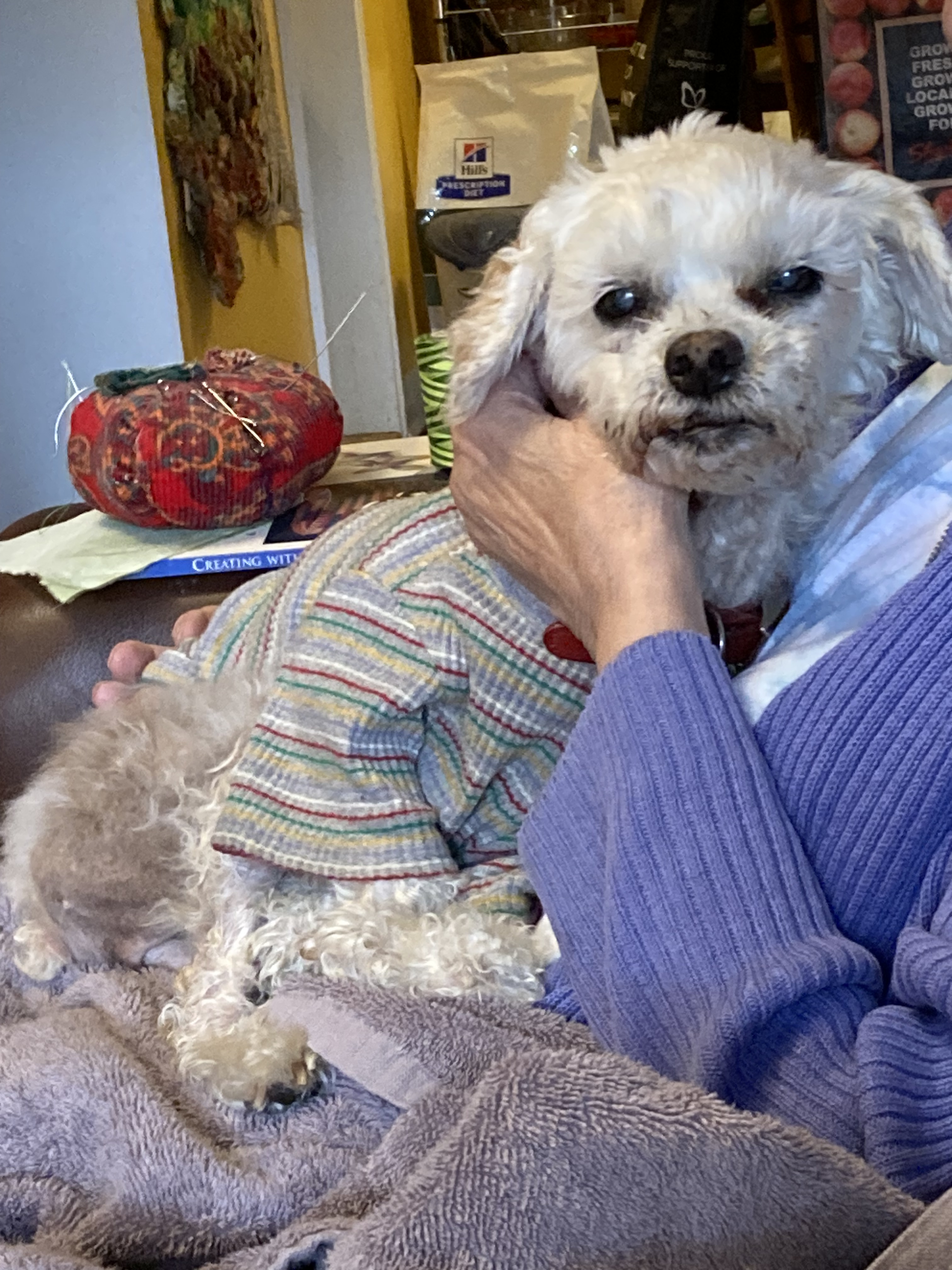
During one of the summer storms, my fourteen-year-old Pawpaw tree went from gently leaning into the yard, to bowing down, leaves almost touching the grass.
At first, I thought it was temporary, like the way the hydrangeas get heavy with moisture and look like they’re exhausted and wilting, and the next day, as they dry off, they lift back up. But even while all of the other flowers and trees in the yard started to rise back up to standing, the Pawpaw stayed tilted.
Part of the problem is that the Pawpaw tree was planted in the retaining wall, rather than straight in the ground, and the retaining wall is not in the greatest of health. There are all kinds of bushes and trees around the Pawpaw competing for space, and the wooden slats that keep each level of the wall in place are rotting.
But still. The Pawpaw tree has been there for nine of its fourteen years, long enough to have deep roots, so I didn’t expect it to fall down and never get up again.
Mom said it could be about the quality of the soil in the retaining wall; it’s gotten spongy. She has plans to buy special soil to add into the wall around the tree, to help support it, but if it’s the soil, then why is it only the Pawpaw that’s struggling to stay upright?
I get a teensy bit paranoid about my tree, obviously.
“Obviously.”
We put some rocks around the trunk and leaned a garden fork against it with the teeth dug into the ground as a counterweight, but that was only a short term solution.
Then Mom went to the home improvement store and bought a heavy rope and a bungee cord. My job was to climb up into the retaining wall (with a big stick for balance and to push tangled vines and branches out of my way) and wrap the rope around two solid trees a few levels up into the wall. Then the bungee cord went around the trunk of the Pawpaw, as taut as possible, to give the tree some extra support, so at least it won’t tilt further in the next storm.
I don’t know how Mr. Pawpaw feels about wearing a back brace, as well as the bowtie that marks him out as off limits to the gardeners, but I hope he agrees that survival is more important than vanity.
So now I wait and see. There’s still one Pawpaw fruit growing on one of the higher branches (out of reach) and the leaves look healthy, so I’m hopeful.
I’m not thrilled with all of the drama that comes of loving a tree; but it certainly gives me something to write about.
“Oy.”
If you haven’t had a chance yet, please check out my Young Adult novel, Yeshiva Girl, on Amazon. And if you feel called to write a review of the book, on Amazon, or anywhere else, I’d be honored.
Yeshiva Girl is about a Jewish teenager on Long Island, named Isabel, though her father calls her Jezebel. Her father has been accused of inappropriate sexual behavior with one of his students, which he denies, but Izzy implicitly believes it’s true. As a result of his problems, her father sends her to a co-ed Orthodox yeshiva for tenth grade, out of the blue, and Izzy and her mother can’t figure out how to prevent it. At Yeshiva, though, Izzy finds that religious people are much more complicated than she had expected. Some, like her father, may use religion as a place to hide, but others search for and find comfort, and community, and even enlightenment. The question is, what will Izzy find?
For the past few years, ever since my Mom’s friend Olivia died one January, a Carolina Wren has taken to visiting the apartment over the winter. The first visit, within days of Olivia’s death, felt like a spiritual visit from Olivia herself, to let us know that she was okay, and to say goodbye. When the wren (or a different wren) returned the next year, it seemed like Olivia was checking in on us, and letting us know that her spirit was flying free.
“This is my good side.”
This year has been different. A Carolina Wren has come into the apartment four or five times already, usually on the coldest, snowiest days. She (I always assume she’s a she) sometimes stays overnight, flying from one room to another, sampling the kibble, taking a bath in the water bowls, singing a few songs, leaving poop on the curtains and then heading out.
The dogs never seem to mind the visits, even when the little bird is singing full out or flying over their heads.
“Go ahead. Eat as much kibble as you want.”
On her third visit this winter, in the middle of a snowstorm, a second Carolina Wren came in with her. I don’t know if it was her mate (he was a little fatter than she was), or another bird, curious about where she kept escaping to when everyone else was freezing. Our Carolina Wren did not seem to appreciate the company. The bigger bird perched on the top of my bookcase while the little one did gymnastics on the curtain rod, and tried and failed to land on a bare lightbulb, and two-stepped her way down the curtain in my room. Finally the bigger bird decided to leave, but our little Wren stayed a while longer.
“Does this color make my foot look big?”
During her next visit, when I was practicing the alto part for a choir recording, she decided to sing with me. She didn’t sing the tune I was singing, she sang her own, but she sang it in answer to me and along with me, insistently; maybe trying to figure out why I was singing the wrong song. Her voice was much bigger than mine, despite her tiny size, and it filled the whole apartment. There wasn’t much harmony between her song and mine, but there was a magic to it anyway. There was communication and echoing and solidarity and questioning; and it was beautiful.
It reminded me of how my old black lab mix, Dina, would hear us singing at Friday Night dinner and add her howl to the song. I found out that if I hit certain notes, usually higher up in my register, it would set her off. And even if we weren’t singing the same song, we were singing together; and even if it didn’t sound right, it sounded like love.
My Dina.
I don’t know what it means that the Wren is visiting us more often, or even if it’s the same Wren each time. Maybe we’re listed on the Wren-airbnb site; maybe she’s looking for a nest, or for nesting materials (we have an enormous collection of fabric scraps); maybe she needs a respite from her mate and we seem friendly enough; or maybe there really is some communication between the spirit and bird worlds, and old friends are coming to visit in bird form. I’m not an expert on the afterlife, or on birds, but it’s nice to be visited, and it was nice to have someone to sing with in person, in this year of social distancing.
“I can play while you sing, Mommy.”
If you haven’t had a chance yet, please check out my Young Adult novel, Yeshiva Girl, on Amazon. And if you feel called to write a review of the book, on Amazon, or anywhere else, I’d be honored.
Yeshiva Girl is about a Jewish teenager on Long Island, named Isabel, though her father calls her Jezebel. Her father has been accused of inappropriate sexual behavior with one of his students, which he denies, but Izzy implicitly believes it’s true. As a result of his problems, her father sends her to a co-ed Orthodox yeshiva for tenth grade, out of the blue, and Izzy and her mother can’t figure out how to prevent it. At Yeshiva, though, Izzy finds that religious people are much more complicated than she had expected. Some, like her father, may use religion as a place to hide, but others search for and find comfort, and community, and even enlightenment. The question is, what will Izzy find?