Tag Archives: politics

Cognitive Dissonance

            According to Google, cognitive dissonance is a “psychological phenomenon where a person holds two or more conflicting beliefs, attitudes, or behaviors simultaneously. This inconsistency creates discomfort and tension, motivating the individual to resolve the dissonance.”

            This concept came to mind recently while I was watching the first season of 911 (after a marathon binge of the show, starting in season three, that left me really curious about how the series began). I was especially interested in the romance between Abby, a 42-year-old 911 operator, and Buck, a 26-year-old rookie firefighter, because it set up the whole structure of the show, where they follow 911 calls through to their resolutions. But almost immediately, I felt queasy about the age difference between the two characters. I had to remind myself that, even though he was immature, Buck was an adult, and even though Abby was 42, she was at a vulnerable stage in her life and not in a position to take advantage of any perceived power differences between the two of them. They were both so obviously in need of love, and specifically in need of the kind of love the other had to offer, but…

Maybe because of the low stakes (it’s a TV show after all), I was able to sit with the dissonance and let it simmer for a while (a day or two, actually, because I watched the first season all in one go), and I realized that even though these moments of cognitive dissonance can be uncomfortable, or worse, they are also an opportunity for deeper understanding, of ourselves and of others.

            When we see this kind of cognitive dissonance in our politicians, we tend to call it hypocrisy. How can you say you care about the poor and then fight so hard to cut Medicaid? How can you say you are an advocate for survivors of sexual abuse and then ignore the sexual offences of your favorite politician? In our private lives, it can show up maybe as wanting to save money for retirement, and then going on Amazon to buy ten things we don’t need.

“I needed all of it, Mommy!”

            Like many psychological terms and theories, cognitive dissonance feels like a judgement being made on other people, a negative way of naming how we behave, without bothering to understand why we do it or having compassion for the struggle. Psychologists and therapists, and many other helping professionals, tend to feel overwhelmed by the chaos their patients or clients bring into the room and rely heavily on the intellectual distance of naming things to keep the chaos from seeping into their own lives.

            The emphasis in the cognitive dissonance articles I was able to find, was on how we tend to resolve our dissonances, often with defense mechanisms, like: avoiding the dissonance altogether by staying away from discussions or situations that bring it up; delegitimizing the person or group or situation that highlighted the dissonance (this is fake news!); or minimizing the impact by telling yourself that you didn’t really go against your beliefs, or you just did it one time. Rarely, the articles seemed to suggest, do we actually choose to change our behavior or reassess our value systems in order to resolve the dissonance.

            I’m not comfortable with the judgment (name calling) underlying all of this, and the assumption that we are all lying to ourselves all the time in order to resolve our discomfort, but I still think Cognitive Dissonance can be a useful concept, if we use it as a way to identify a problem that needs further attention. Ideally, if I feel guilty for doing something I didn’t plan to do, I can be curious instead of judgmental. And if I find myself minimizing, rationalizing, ignoring new information, or dismissing research out of hand, I can be curious rather than self-loathing. I can choose to look at the dissonance as a mystery worth exploring, a part of myself that deserves more of my attention and respect, rather than my judgment or impatience.

            Just like in music, dissonance can catch your attention in a way that harmony may not, and it can tell you that something important is happening: it could be a mistake (you played the wrong note); or it could be the entrance of a new character, or a change in mood; or it could be the start of a disaster.

            The Abby and Buck story on 911 tapped into two of my strongly held, and in this case opposing, beliefs: 1) that age/power/status differences between people can lead to abuse if we’re not careful about setting clear boundaries, and 2) love is a wonderful and healing thing. The way the show dealt with the dissonance in the relationship was both to minimize the weirdness of the age difference (by rarely mentioning it), and, in the end, by sending Abby off on a trip around the world until Buck could get over her. The un-stated conclusion was that two people who are at two very different places in their lives (either because of age or status or something else) may be able to spend time together and do each other good, but only for so long. The creators of the show chose not to sit with the discomfort inherent in such an age difference for more than a season, maybe because it made them that uncomfortable, or maybe because they discovered that it made their audience uncomfortable. And in season two, they replaced Abby’s character in the ensemble with Jennifer Love Hewitt, playing Buck’s older sister, suggesting that Buck was drawn to Abby in the first place in part because he was missing his sister, or missing the supportive role she played in his life, helping to ground him and give him perspective.

Even though I really liked the character of Abby, and especially the actress who played her (Connie Britton), I was relieved when she left the show and the void was filled with two new characters, Maddie (Buck’s sister) and a separate love interest. The dissonance that Abby and Buck’s relationship brought up for me, and for others, it turned out, was fundamentally not resolvable. I do wonder, though, what would have happened if the writers had made a different decision, and allowed that relationship to play out over a longer period of time. Would that have offered me an opportunity to delve more deeply into my own beliefs and feelings about power gap relationships, or would I have had to stop watching the show because it just made me too uncomfortable? (It’s also worth considering how the storyline would have been treated differently if the 42-year-old character had been male and the 26-year-old female. Would they have even told us their ages? Would I have thought to be bothered by it?)

            While I was researching cognitive dissonance, I also came across the related quote, attributed to F. Scott Fitzgerald, that “Intelligence is the ability to hold two opposing ideas in mind.” The quote suggests that it’s a sign of intelligence to be able to entertain conflicting theories or facts without becoming overwhelmed or paralyzed, but I think the ability to face your cognitive dissonance is more about emotional strength, or intellectual bravery, rather than intelligence itself. I know a lot of highly intelligent people who, when faced with opposing ideas or desires within themselves, or facts in contradiction to a well-loved theory, resort to ever more inventive defense mechanisms to try to deny the existence of the conflict.

And I am no different. Recently, I was listening to a podcast by Haviv Rettig Gur, an Israeli journalist who writes and speaks in English to reach an audience outside of Israel. He was responding to an article in Haaretz (Israel’s venerable left-wing newspaper), that claimed Israeli soldiers were intentionally shooting at Gazans seeking aid. My first response, when I saw the article in my newsfeed, was disbelief, and then anger that they would even repeat such claims. How dare they suggest that the IDF would deliberately kill civilians, especially after telling me over and over again that the IDF does its best to avoid civilian casualties. But Haviv Rettig Gur, as a journalist, was able to sit with the dissonance (between believing that the IDF tries to avoid killing civilians and the reports that they were doing just that), and what he came to understand, or believe, was that, yes, the shootings were happening (though probably not in the numbers reported by Hamas), not because the soldiers intended to randomly kill civilians, but rather because these young soldiers were being tasked with protecting aid locations without being trained for the task. Most of the soldiers involved had been taken from nearby battlegrounds, where they were under attack from Hamas soldiers wearing civilian clothes, facing booby-trapped buildings and roadside bombs and all kinds of dangers around every corner, and then suddenly they were told to guard aid sites, where the signage was unclear and it was inevitable that civilians would go the wrong way at the wrong time and the soldiers were going to see them as a threat.

The problem, as Haviv Rettig Gur saw it, was caused both by the presence of Hamas in the aid areas and by the expectation of Israeli politicians that these soldiers could be tasked with protecting the aid sites without adequate training or support. Those politicians, especially the ones with little to no military experience (which is a significant deficit in Israel, where army service or an equivalent form of civil service is required for the majority of the population, but the fight over whether or not the ultra-orthodox have to serve is ongoing), probably thought they could order the army to do whatever they wanted, like ordering a special hamburger off menu. And when the army’s leadership said they couldn’t do it, the politicians probably assumed that they were lying for some reason, because that’s what the politicians themselves would have done. Are some of those politicians okay with killing civilians? Yeah. Some of the far-right politicians have basically stated their disinterest not only in the lives of Palestinian civilians but in the lives of Israeli soldiers and Israeli hostages as well. Should they still have their jobs? Not at all, but Netanyahu appeases them in order to keep his coalition government afloat. Is this the best way to run a country, especially during a war? Not even a little. But when the attorney general or the supreme court in Israel have tried to intervene, the government has threatened to dismantle the whole system of checks and balances (this is what led to the year long protests across Israel in the year leading up to October seventh), and being attacked by Hamas didn’t fix the underlying hypocrisy and graft in the government that is now tasked with protecting its people from further attacks.

            The dissonance between Israel’s stated dual values of protecting civilian lives and eliminating Hamas has been there from the beginning, and ideally those conflicts would have been openly addressed and debated, with deep discussions as to the value of human life and the needs of a populace to feel secure, but instead the conflicts have been minimized and denied, to disastrous effect.

            Another example. When it became obvious to the people around Joe Biden that he was losing his faculties, yet still insisted on running for President again, they could have been open, with him and with the American people (or at least with the higher ups in the Democratic party), about their concerns. There could have been discussions about how to prevent a Trump presidency (with all of its inherent dangers to democracy), while also pursuing an open Democratic primary, and a contest of ideas leading to the best possible candidate, or at least an open acknowledgment that our country is still not ready for a woman of color as our president; but instead, they rationalized and made excuses and got defensive, and therefore they could not solve the problem at all, until it exploded.

Unfortunately, we are living in a time when defense mechanisms are being chosen over reality, not just by some people but by most people, and especially by those in power. Republican congressmen are ignoring their cognitive dissonance around the “Big, beautiful bill,” with its severe Medicaid cuts and inevitable growth of the national debt, because they seem to be too afraid of Trump to vote their stated values. And many Israelis, at least at the beginning of the war with Hamas, seemed to be willing to ignore the suffering in Gaza because they thought empathy for the civilians would get in the way of their goal of removing Hamas as an existential threat. Most Israelis have, as far as I can tell, grown throughout the war in their empathy and willingness to face a complicated reality, including the realization that removing the threat of Hamas entirely may be impossible.

The acknowledgement of a cognitive dissonance, between what you may have hoped to be true and what is really happening, or who you thought you should be and who you really are, can be painful and frightening, and can lead to hopelessness and despair, which explains why we have found so many creative ways of avoiding the dissonance. At times it can feel like the dissonance is unresolvable, because it may be, and therefore that there’s no point in facing it. And sometimes we really do need the respite that denial and minimization can provide, until we feel strong enough and capable enough and supported enough, to face the truth. But it’s only when we allow ourselves to see all of the facts, and to face all of the conflicting facets of ourselves, that we have any real chance of finding solutions, or at least of processing our grief when solutions are found to be impossible.

“Is it treat time yet?!”

If you haven’t had a chance yet, please check out my novel, Yeshiva Girl, on Amazon. And if you feel called to write a review of the book, on Amazon, or anywhere else, I’d be honored.

            Yeshiva Girl is about a Jewish teenager on Long Island, named Isabel, though her father calls her Jezebel. Her father has been accused of inappropriate sexual behavior with one of his students, which he denies, but Izzy implicitly believes it’s true. As a result of his problems, her father sends her to a co-ed Orthodox yeshiva for tenth grade, out of the blue, and Izzy and her mother can’t figure out how to prevent it. At Yeshiva, though, Izzy finds that religious people are much more complicated than she had expected. Some, like her father, may use religion as a place to hide, but others search for and find comfort, and community, and even enlightenment. The question is, what will Izzy find?

War

            During my online Hebrew class last Sunday afternoon, my new teacher had to leave class to go to the safe room in her parents’ house in Haifa. She was given a ten-minute warning on her phone, to let her know that a siren might be coming, and then when the siren actually came her screen went black. She was gone for more than half an hour, waiting in the shelter for the all clear. In the meantime, we kept the class going, reading the article she’d given us and trying to help each other through the Hebrew words we didn’t understand. And when she came back, a little discombobulated (though more worried about her dog, who was very confused), we just went back to reading the article together, which was about the world of doggy fashion, including Dolce and Gabbana, and Versace, and Dolly Parton (according to the article we read, she has a line for dogs called Doggy Parton). It’s not that life continues uninterrupted in a time of war, and under the threat of ballistic missiles, it’s that Israelis have learned that in order to survive you have to find distraction, and joy, wherever you can. And in a way, our class of Hebrew language students from around the world was able to hold the world together for our teacher, so that she had something to come back to when the emergency was over.

“The safest place in the whole world is a doggy bed.”

There were signs ahead of time that this war (on top of a war on top of a war) was coming. First there was the report from the IAEA (The International Atomic Energy Agency, the UN nuclear watchdog) that declared Iran non-compliant with their inspectors. Iran maintains that its nuclear program is peaceful, but it has enriched uranium to levels far beyond any civilian application, and the IAEA has repeatedly warned that Iran has enough highly enriched uranium to make several nuclear bombs, should it choose to do so. Then there were the warnings to American diplomats and their families to leave the Middle East. But most of us were focused on other things: in Israel, there was the immediate threat that the Haredi parties would bring down the government (for not permanently protecting their men from having to serve in the military); and in Gaza, Israeli soldiers were still dying in booby-trapped buildings and Palestinian civilians were still starving, because neither the UN nor the new Israeli/American aid group have been able to figure out how to get aid to the people without causing panic and without being attacked by Hamas; and in the United States, we were thinking about the coming military parade in Washington, DC, and the planned “No Kings” rallies across the country, and the protests against ICE raids in Los Angeles, and the calling in of the National Guard in response, against the governor’s wishes, and then the calling in of the marines; and Jews in the United States were still reeling from the killing of two Israeli embassy workers in DC, and the firebombing of senior citizens at a small weekly march in Colorado meant to remind people of the hostages trapped in Gaza, both seemingly related to the calls to “Globalize the Intifada” that have become a staple at Pro-Palestinian rallies over the past year and a half.

For myself, I was focused on starting my new online Hebrew class, and mourning the end of my previous class (because most of my classmates went off in different directions after our perfect class ended and I felt like I was starting over from scratch, at least socially), and my boss and I went to a Jewish Education Project conference on Israel education, where we spent half a day discussing the best ways to teach young children about Israel, without whitewashing the conflicts or angering parents.

So that’s where things stood for me on Thursday night, June 12th, when I saw a news item that said a siren had gone out across Israel at 3 AM to let people know that the Israeli Air Force had started an attack on Iran’s nuclear facilities and return fire was inevitable. I wrote to my high school friend in Isreal on WhatsApp, to let her know I was thinking of her, and then I sat in front of the television and stared at my phone waiting for more details. From what I could understand early on, Israel didn’t pick this exact moment because the nuclear bombs were imminent but because the Israeli military was ready with a plan of attack and saw a small window of opportunity, having degraded the danger of Hezbollah and Hamas as much as possible.

At first, there were denials that the United States was involved, from Marco Rubio, but it became clear quickly that Donald Trump was proud of his role in “greenlighting” the operation. He was going into his sixth round of talks with Iran and frustrated at the unchanging position of the Iranians on nuclear enrichment and okayed the attack that Irael had been planning ever since their success at decapitating Hezbollah last year, but really since October 7th, when they re-learned the lesson that when people say they are going to kill you, believe them.

            Israel has been living under the threat of an Iranian nuclear weapon for a very long time now, but more than that, Iran has been overtly stating that it’s goal is the destruction of Israel, however possible. While they’ve been steadily building their nuclear program, they have also built a ballistic missile arsenal and put their financial and military support behind proxies surrounding Israel (including Hamas, Hezbollah, and the Houthis). There’s a large billboard in Palestine Square in Tehran (where there used to be an Israeli embassy, before the Islamic revolution) that counts down to “the demise of the Zionist regime,” randomly set for 2040.

            It’s important to understand that, given the same conditions and opportunities, almost any Israeli government would have greenlit this attack on Iran’s nuclear facilities (as they have done in the past in Iraq and Syria). This is not just about Netanyahu and his quest to stay in power (though, granted, if he could successfully neutralize the Iranian threat, he could sway a lot of voters to his side).

            And then, on Saturday, in the midst of everything, came the killing of a Minnesota state representative and her husband, and the shooting of another representative and his wife, plus more protests and more ICE raids and more and more and more. And it seemed as if Trump was taking advantage of the Irael/Iran war to help distract from all of the rest of it, making himself central to the discussion of what would happen next. So now we are waiting for Donald Turmp to decide if the United States will play a more active role in the war, by using the Mother of All Bombs/Bunker Buster to destroy Iran’s nuclear facility in Fordo (or Fordow, I’ve seen it spelled both ways), which is built into a mountain and deep underground. It has been suggested that Israel may have other ways of disabling Fordo, in case America decides not to get involved, but the world seems to be waiting on Trump anyway.

            And here I sit in New York, worrying about my friends and teachers in Israel, but also worrying about all of us here in the United States and what will happen with the ICE raids and the national guard and the political violence and the huge bill sitting in the senate right now, that, if passed, will take money and care away from the poorest of us to give more money to the wealthiest. And I have no control. All I can do is continue to educate myself, and try to understand what’s happening, and why, if possible. And then I have to go back to my own life and the things that are actually within my own power, like practicing Hebrew, and writing, and lesson planning for next fall, and reaching out to friends and family, and doing my best to find some solid ground underneath my feet. 

            Meanwhile, Iran is firing ballistic missiles at Israel, in response to the Israeli attack, and most Israelis are spending their nights in safe rooms and underground shelters, if they have them, or in parking garages, or stairwells. The final week of Israeli school for the year was done on zoom, and parents stayed home and tried to work and watch their kids and function on little to no sleep. And people are dying. While Israel’s stated targets in Iran are military ones (though I’m sure the attack also puts civilians near those targets at risk), Iran is hitting residential areas. Israelis had become used to the rockets coming from Hamas and Hezbollah, but the missiles from Iran are loaded with much more explosive material, and there are so many more missiles being fired at once, so even with a very good rate of interception the missiles that get through are doing a lot more damage, to apartment buildings and schools and even a hospital, and all I can do is watch.

            This past Monday evening, in the midst of all of this, I went to my favorite weekly online Hebrew practice group, with an Israeli teacher living in Canada, and he decided that instead of reading an article together (since he couldn’t find any articles in Hebrew online that weren’t about the war), he would play us a song called Yihiye Tov by David Broza (translated roughly it means, “It will be good” or “It will get better”). And we all sat in our little zoom boxes and sang along on mute to the endless refrain of Israeli life: that someday, things will be better. And for now, we just have to keep going until we get there.

For an American perspective: https://open.substack.com/pub/heathercoxrichardson/p/june-19-2025?r=2flv9t&utm_campaign=post&utm_medium=email

For an Israeli perspective: https://www.timesofisrael.com/how-close-was-iran-to-the-bomb-and-how-far-has-israel-pushed-it-back/

Yihiye tov, by David Broza: https://youtu.be/qtI7h5A9eEQ?si=kyb4xyOIUltVFUW4

“I’m waiting here.”

If you haven’t had a chance yet, please check out my novel, Yeshiva Girl, on Amazon. And if you feel called to write a review of the book, on Amazon, or anywhere else, I’d be honored.

            Yeshiva Girl is about a Jewish teenager on Long Island, named Isabel, though her father calls her Jezebel. Her father has been accused of inappropriate sexual behavior with one of his students, which he denies, but Izzy implicitly believes it’s true. As a result of his problems, her father sends her to a co-ed Orthodox yeshiva for tenth grade, out of the blue, and Izzy and her mother can’t figure out how to prevent it. At Yeshiva, though, Izzy finds that religious people are much more complicated than she had expected. Some, like her father, may use religion as a place to hide, but others search for and find comfort, and community, and even enlightenment. The question is, what will Izzy find?

Post-Election Malaise

            Each day since Donald Trump won the presidential election in the United States, I have been feeling worse and worse. At first, I was just surprised and couldn’t really take it in. I was prepared for the vote counting to take days, and I was prepared for court cases, and threats, and acts of violence, but I was not prepared for him to win.

            I think I forgot, or blocked out, a lot of his first term. I remembered enough to never want to go through it again, but I forgot the feeling of chaos that dominated the news cycle, where it felt like Trump was actively trolling us with his cabinet picks. This time around already seems more unhinged than last time (Matt Gaetz for Attorney General? RFK Jr. for Secretary of Health and Human Services?).

            I know there are people who want to think of this as just another election, where one side won and the other lost. And I know there will be a lot of minimization and denial in response to the fear that so many, including me, are feeling. But this isn’t normal. In response to Trump’s win, some young men decided to tell young women – Your body, my choice – as if it was a joke, or worse, as if they really believe that to be true.

            I feel this like a knife aimed at my throat and my belly and my heart, not like an intellectual puzzle to be worked out. I am worried, especially, because I rely on disability and Medicare to make my life possible, and I don’t know what impact this new administration will have on those programs. I also don’t know what will happen with student loans under Trump (mine were put into a form of forbearance under Biden, but the $10,000 left of my debt was not officially erased).

            And then there are the criminal cases against Trump that are being closed down by the Department of Justice, because once he is President again, he can’t be prosecuted for his crimes. And that will, certainly, embolden Trump in his extra-legal tendencies going forward, as will the supreme court’s wide-ranging decision on presidential immunity for acts done in office.

I grew up in a home run by an unpredictable, predatory, and manipulative man, and I am not feeling good about the next four years. I felt the calm of the Biden years in my bones, when there were days, and even weeks, when I didn’t have to think about politics at all, and I don’t know how my body and mind will respond to the return of the chaos.

            I wish, given all of this, that the Democratic party, and the pundits, would stop blaming each other for the loss, and instead focus on how to safeguard our rights as much as possible moving forward. There is room for analysis of what went wrong, and why, but not with the vitriol and self-righteousness that’s filling the airwaves at the moment. Some people believe that the Democratic party lost because it was too hoity toity, or because it didn’t come up with enough policies to help the working class, or it was too progressive, or too moderate, or didn’t reach out to men enough, or didn’t reach out to people of color enough. But my sense, then and now, was that people did the best they could with the understanding they had of the voting public at the time. They were just wrong.

            From what I could see, Donald Trump’s campaign set out to discourage people from voting: by creating distrust in government overall, by telling people that their votes wouldn’t make a difference, by cutting legal voters from the rolls at the last minute and limiting the number of polling places in populated areas, and by openly threatening that if people voted for the Democrats there would be violence in the streets. The fact is, Trump won this election with around the same number of votes he had in the last election, when he lost to Biden. His coalition didn’t grow. If he picked up a few new people (Arab and Latino men, for example), he lost others (former Republicans who saw the January 6th insurrection, or any number of other events, as the final straw.). But for some reason, none of the pundits want to acknowledge that what Donald Trump said and did actually impacted the outcome of the election; they’d rather blame Kamala Harris, or Joe Biden, or this or that miscalculation by someone else. But what if there was no Democratic candidate who could have beaten Trump at this moment in history? Can we tolerate knowing that?

            And now, with the reality of Donald Trump as our next president, are there lessons we could be learning about why his messages resonated so deeply with some people, and about how we can better meet those people where they are when explaining our goals in the future? Can we turn away from the back biting, blame, and guilt and consider some paths forward? There have been some thoughtful, and possibly helpful hypotheses for why Trump was able to win: some people say that the underlying cause of Trump’s win is the growth of the far-right media landscape, which often eschews main stream journalistic values (aka doesn’t care about validating facts before publishing them); some say that the problem is with the main stream media itself, which claims objectivity even though reporters often have their own unacknowledged biases; some say that our problem is a lack of education in civics, which would allow people to be better prepared to judge political actors for themselves, and also to feel some agency and confidence when engaging with our political system. All of these things sound possible to me, and all of them lay out paths forward for good work to be done by well-meaning, hard-working, and creative people.

            One of the things that bothered me, endlessly, in the lead up to election day, was the number of Democratic activists who believed they were accomplishing something by sending out postcards reminding people to vote (I received two or three of these, after I’d already voted by mail), or who went knocking on doors in neighborhoods where they didn’t actually live or know anyone personally (as if I would ever answer the door to a stranger, let alone listen to their political spiel). Busy work in politics, it seems to me, is just as much of a waste of time as it is in the classroom. And busy work that actively annoys people? That’s even worse.

            As a teacher, I believe in the power of education to create change, and as a writer I believe in the power of storytelling to reach people in ways that slogans can’t. For example, I learned more about LGBTQ issues, and took them in more fully, by watching TV shows and movies that humanized gay and trans people, than I ever learned from an ad campaign. Show me someone I can relate to, who is impacted by this or that societal wrong, and you have a much better chance of getting me involved than if you yell at me and insist that my views change to match yours, just because you say you’re right.

            I believe that we can make lasting societal change by investing our time and energy in telling those stories and allowing people to change their own minds, but it has been, admittedly, very hard to focus on those hopeful, long term paths forward in the face of the firehose of news about what’s coming next in the short term.

            What will happen to efforts to prevent climate change? Or to improve accountability among the police? Or with immigration? Will the Republicans finally put through the immigration bill they wrote with the Democrats last year, and then tanked when Trump told them he needed the border issue for the election? Or will they insist on changing the deal, but be unable to agree among themselves over what changes to make? Or will our immigration system remain an unmitigated disaster for the foreseeable future, just to give Republicans something to campaign on in 2026?

            When Trump’s promised Tariffs go into place, will some of his newfound voters regret their choice? Or will they believe the spin Trump puts on all of it (it must be Biden’s fault, you’re not seeing what you think you’re seeing, if you were stupid enough to be conned you deserve to be screwed – that was one of my father’s favorite mantras).

            And I assume tax cuts, for corporations and the super wealthy, will be a priority and will lead to all kinds of cuts in the social safety net, though it’s hard to know what the new congress will be able to pass, even with a Republican majority in the senate and the house, given the history of disagreements among the Republicans themselves. Trump will certainly be able to load the supreme court, though, and the rest of the federal court system, with young conservative judges who will determine the course of justice in this country for decades to come.

            I am frightened of Donald Trump, and of all of the things he has promised to do, and of all of the things he will do that I can’t predict, or even imagine. And I am afraid of how his second presidency will further darken our public discourse, and create even more fragmentation among us; but I want to believe that there are things we can do to prevent all of that, or at least some of it.

            As I learned way back when, and still believe, Democracy is the best of all of the imperfect systems of government that we have available to us, because it requires us to be more engaged with each other. It doesn’t require us all to agree; if anything, what it requires is for all of us to feel like we belong at the table, hashing out our differences and finding ways forward that we can all live with.

            I’ve found so much solace in writing this blog, and hearing from people who take the time to engage with me, or just to let me know they hear me and I am not alone. We all need that kind of connection and respect in our lives. We all need to hear and be heard, to feel seen and cared about, and to feel an obligation to someone other than ourselves that will keep us going even when our own inspiration and motivation is low.

We still have a Democracy today, even with Donald Trump’s openly authoritarian aspirations, and we need to make the most of it. We still have power, and responsibility, and we can still make sure that our voices are heard. It will be harder, and we (and definitely I) will have some awful days, but we are not alone in any of this. We can help each other get through to the other side, no matter who we voted for. If we choose to.

If you haven’t had a chance yet, please check out my novel, Yeshiva Girl, on Amazon. And if you feel called to write a review of the book, on Amazon, or anywhere else, I’d be honored.

            Yeshiva Girl is about a Jewish teenager on Long Island, named Isabel, though her father calls her Jezebel. Her father has been accused of inappropriate sexual behavior with one of his students, which he denies, but Izzy implicitly believes it’s true. As a result of his problems, her father sends her to a co-ed Orthodox yeshiva for tenth grade, out of the blue, and Izzy and her mother can’t figure out how to prevent it. At Yeshiva, though, Izzy finds that religious people are much more complicated than she had expected. Some, like her father, may use religion as a place to hide, but others search for and find comfort, and community, and even enlightenment. The question is, what will Izzy find?        

Watching the U.S. and the Holocaust, or, Thank You, Ken Burns


            Watching the Ken Burns documentary, The U.S. and the Holocaust, the week before Rosh Hashanah (the Jewish New Year) was hard. The three night, six-hour documentary was advertised as being about America’s reaction to the treatment of Jews in Germany leading up to and during the Holocaust, and the ways our own prejudices and the resulting immigration restrictions we set up at the time, kept the United States from being a haven for those escaping Hitler. I felt myself shaking with rage and pain and frustration, and I started to yell at the TV (similar to the way I felt when Trump took that first trip down the escalator onto the world stage). But however difficult it was for me to sit with the pain and horror of the documentary, it was even more validating. The timeline of the film, and the clarity it brought to the questions of when people in the United States knew what was happening op the Jews in Germany, and how they chose to respond to that information, was edifying; some failed to act because of their ingrained anti-Semitism, but others were afraid that if they took action to help the Jews of Europe it would set off even more (!!!!!) antisemitism around the world, and especially at home. It’s painful, but important, to remember how prevalent anti-Semitism was at the time.

            Antisemitism has come racing back in the last decade, but it’s still not seen as much of a problem by the wider world, maybe because Jews are perceived as powerful and white and part of the majority, rather than as a very small minority with an outsized place in history. Jews have been blamed for things like the black plague, failed governments, and poverty, whenever a convenient scapegoat has been needed. Maybe the Jews are easy to blame because we are a small enough group that people think we can be easily removed, like a tumor, but even after expelling the Jews, converting the Jews, or killing the Jews, it has always become clear, again and again, that the Jews weren’t the problem in the first place.

            I felt strongly that I needed to watch this documentary as it aired, rather than recording it and watching it later, because I wanted to feel like I was watching it with other people. I needed that feeling of support. So when the second night of the documentary was postponed in favor of a recap of Queen Elizabeth’s funeral, for anyone who may have missed more than a week’s coverage of every detail leading up to and through the funeral on multiple channels, I felt minimized and pushed aside. I definitely took it personally.

“Me too.”

            There are around 7.6 million Jews in the United States today (according to Google), less than there were in Europe before World War Two, and we are only about 2.4 percent of the U.S. population, and yet, when the White Supremacists marched in Charlottesville they shouted “Jews will not replace us,” as if we are a threat to their place in the world.

            So when PBS aired the second episode, a day later than expected, I sat down in front of the television with my mom and crossed my fingers, hoping a crowd would be watching with us and that something would come of it.

“We’re watching with you, Mommy.”

            There were times when the documentary seemed to equivocate, trying very hard to soften its criticism of America, and especially of president Roosevelt. And there wasn’t much reference to the way the British actively kept Jewish refugees out of Palestine, leading up to and during the Holocaust, despite knowing full well that they were sending boats full of refugees back to Germany to die. But I appreciated the way the filmmakers bookended the documentary with the Anne Frank story, which is so familiar to the American audience, and then delved deeper into her real life than we usually see in discussions of her edited diary. Her former classmate, who went through very similar circumstances as Anne but survived the Holocaust, talked about the famous line in the diary where Anne says that she still believes people are essentially good, but she pointed out that it was written before the Franks were captured by the Gestapo, and before Anne was taken to Auschwitz, and before she and her mother and her sister died there. The optimism of that line has captured American hearts for generations but it has always bothered me, because many people are NOT essentially good, and Anne Frank’s life and death are proof of that. But the sugar coating of her story is very American, where we don’t just need a spoonful of sugar to make the medicine go down, but a cup, or five.

“I love sweet things!”

            The thing the documentary did best was to address the tendency of majorities to blame their problems on powerless minorities, and it made a clear connection between how the United States dealt with African Americans and Native Americans, and how the Nazis treated the Jews. Hitler is so often portrayed as an outlier in his hatred for Jews, and the disabled, and homosexuals, and the Romany, and on and on and on, but he was following models he’d seen in other countries, including ours, and the fact that most countries in the world refused to take in refugees from Hitler, allowing them no safe place to escape to, was a secondary cause of so many deaths.

            In the film, Freda Kirchway, who wrote for the Nation magazine in 1943, was quoted as saying, “We had it in our power to rescue this doomed people and we did not lift a hand to do it, or perhaps it would be fairer to say that we lifted one cautious hand encased in a tight-fitting glove of quotas and visas and affidavits, and a thick layer of prejudice.”

Even after Americans knew what had happened to the Jews in the Holocaust, and saw the concentration camps and their survivors, only 5% of Americans were willing to let in more Jews.

            I don’t know why this documentary aired in September, instead of around Yom HaShoah (Holocaust Remembrance Day, in the spring), but a week later, a far right leader, with direct connections to Mussolini’s fascist party, won the election in Italy, so it turned out to be very timely after all.

            There are people who, endlessly, deny that the Holocaust happened, despite all of the evidence. Right now, we’re watching the Ukrainians fight a war and at the same time have to document the atrocities done to them in granular detail, because they know they will need this evidence to prove what really happened, and even then, the people who don’t want to know will continue to deny it; believing what their minds can tolerate instead of what is demonstrably true.

            This phenomenon of disbelief haunts us. Most Jews had the same trouble believing that such a thing could happen, because no one wants to believe things that make them feel uncomfortable, or frightened, or guilty, or any of the other emotions we hate to sit with. Humans are great at forgetting or minimizing or compartmentalizing the knowledge we can’t deal with.

            People can’t take in a number like six million people killed. And when they can, they often choose to believe that the Jews were to blame for their own killings; that they were complicit, or weak, or evil, and that’s why they were targeted and killed in such large numbers. There were something like nine million Jews in Europe before World War Two, and six million of them were killed. Most of the rest left Europe, to escape Hitler, or to escape their neighbors who didn’t want them around even after the war.

            It’s a painful thing to look at all of that hatred and horror, but it’s necessary, and I’m grateful to Ken Burns and his colleagues for making an attempt to bring this history back to the forefront, and to remind America of the dangers we face when we refuse to believe the evidence in front of us. And in the aftermath of watching the documentary, I hoped to hear that everyone in the world, or at least in America, had been watching with me, but I only saw a few responses, and those mostly from within the Jewish community. I hope that when the documentary airs again, and again, more people will choose to see it. But even with the lack of public response, what I still feel most deeply is gratitude, to Ken Burns, Lynn Novick, Sarah Botstein and the rest of their team, and to all of the people who participated in the documentary, and to the people who chose to air it.

Thank you for being willing to see what really happened. Thank you for making it feel real instead of like it’s a bad dream or an exaggeration or so long in the past as to be irrelevant. Thank you for seeing the parallels in the world today. Thank you for saying that these horrifying things have to be looked at and acknowledged, over and over again, to combat the natural human desire to forget.

To Stream the U.S. and the Holocaust from PBS – https://www.pbs.org/kenburns/us-and-the-holocaust/

If you haven’t had a chance yet, please check out my Young Adult novel, Yeshiva Girl, on Amazon. And if you feel called to write a review of the book, on Amazon, or anywhere else, I’d be honored.

            Yeshiva Girl is about a Jewish teenager on Long Island, named Isabel, though her father calls her Jezebel. Her father has been accused of inappropriate sexual behavior with one of his students, which he denies, but Izzy implicitly believes it’s true. As a result of his problems, her father sends her to a co-ed Orthodox yeshiva for tenth grade, out of the blue, and Izzy and her mother can’t figure out how to prevent it. At Yeshiva, though, Izzy finds that religious people are much more complicated than she had expected. Some, like her father, may use religion as a place to hide, but others search for and find comfort, and community, and even enlightenment. The question is, what will Izzy find?

Be a Mensch

            This past week in the United States has been stressful, for everyone, and because my synagogue school students are part of that everyone, I wanted to focus on teaching a lesson that would reassure them, somewhat, that there are areas of their lives where they really do have some control. And, because I love teaching Yiddish words, the lesson for this week was: what does it mean to be a mensch?

Mensch is a Yiddish word, from German, meaning “human being,” or a person of integrity and honor. The opposite of a mensch is an unmensch, a person treating others cruelly and without compassion, as opposed to the word ubermensch (Nietzsche alert) which is usually translated as “the superman,” someone who is superior to other humans. The word Mensch has gathered a lot of associations in American culture (bearded, male, Jewish) but it really means a person who is striving to be good every day, and doing what is right, even when it’s hard. We already have Yiddish words for the most righteous among us (a Tzaddik), or the smartest (a Chacham or a Maven) or the most powerful (a Macher). But being a mensch isn’t about being the best or the most, it’s about being human.

“I’ll take Maven and Macher.”

            There’s something wonderful about a compliment that can be given to everyone, instead of just to an elite few. Someone with a physical or intellectual disability has just as good a chance of being a mensch as someone who is born privileged in every way, because it’s not about your talents or your circumstances or your luck, it’s about how you choose to navigate the world you happen to live in. Oh, and mensch is not a gendered word, and it’s not limited to Jewish people, so it really can apply to anyone.

“Can I be a Mensch?

            We are so often looking for ways to be better than others, or to be the best, or to earn our place, and it’s exhausting, but the opportunity to be a mensch is always there, and there’s always something you can do that will fit you and your skills and interests.

            You can still have your foibles and be a mensch. You can fail a test, or lose your job, or struggle with substance abuse, or struggle to finish a Sunday crossword puzzle and still be a mensch. What you can’t do, is intentionally cause harm to other people. You can’t be a liar, or a bully, or be arrogant, or prejudiced and still be a mensch.

“I always tell the truth, whether you like it or not.”

            I’m a big fan of menschlichkeit, or mensch-iness. It’s like a pass fail course, where as long as you do the work, you’re golden. And we need things like that in a world that is so driven by competition and achievement and striving to be in the top one percent of everything.

            Being a mensch is about valuing other human beings for themselves, instead of for what they can do for you. And this, more than anything, is what I want to encourage in my students. Yes, I will be thrilled for them when they learn to write Hebrew words, or lead the prayers at their Bar or Bat Mitzvah. I will cheer them on when they swim or dance or act in a school play, and I will celebrate with them when they get into the college of their dreams, or find a cure for a rare disease, or create calorie-free chocolate frosting that tastes like the real thing (!). But all of that is secondary to how proud I am of them, right now, when they notice that a fellow student is struggling and needs help, or when they realize that they’ve hurt someone’s feelings and they are willing to take the risk of offering an apology that may not be accepted. Each time they re-learn the lesson that it’s more important to be good than to be great, I puff up with happiness, because that’s what’s going to get them through their lives; not being the best at anything, but being a mensch through everything.

            It can be hard, when we are thinking in such enormous terms as national politics and life and death, to remember that our real lives, and our real impact, comes locally – in our towns, communities, schools, and families.

            May we all make it through this election, and the pandemic, with our appreciation for mensch-iness intact.

If you haven’t had a chance yet, please check out my Young Adult novel, Yeshiva Girl, on Amazon. And if you feel called to write a review of the book, on Amazon, or anywhere else, I’d be honored.

            Yeshiva Girl is about a Jewish teenager on Long Island, named Isabel, though her father calls her Jezebel. Her father has been accused of inappropriate sexual behavior with one of his students, which he denies, but Izzy implicitly believes it’s true. As a result of his problems, her father sends her to a co-ed Orthodox yeshiva for tenth grade, out of the blue, and Izzy and her mother can’t figure out how to prevent it. At Yeshiva, though, Izzy finds that religious people are much more complicated than she had expected. Some, like her father, may use religion as a place to hide, but others search for and find comfort, and community, and even enlightenment. The question is, what will Izzy find?

Before and After #MeToo

            I’ve been thinking about the #MeToo movement a lot, especially in the shadow of the resurgent Black Lives Matter movement, which has led to both protests and intensive discussions over the past months. The parallels in how discrimination functions are so clear, no matter which group is being put down. The literature on microaggressions and systemic racism gives language to what women face too, especially women who have been sexually abused by men and then have to function in a world that is inherently prejudiced against women’s voices. It is incomplete to talk about sexism in the workplace without acknowledging the deeper wounds many women carry with them into adulthood, because they were born female.

Ellie says, “Me too.”

Violence against women and children is part and parcel with a culture that keeps women from advancement in the workplace, and allows the workplace to be hostile to women in a sexual way, as well as in the form of gender discrimination. We talk as if women experience sexism for the first time as adults, in the work place, as if sexism hasn’t been impacting us throughout our development, creating their expectations and self-perceptions and opportunities. Even though we are more aware of the prejudices women face today, we are barely scratching the surface.

            I grew up in the eighties, when women were supposed to be able to accomplish anything men could, while still being held to many of the older expectations of womanhood. My lived experience as a child wasn’t just about my abusive home life, or my religious Jewish education, but was also deeply impacted by the fact that I watched A Lot of television, where it was clear that women could be anything, yes, as long as they were beautiful or skinny or sexy (or all three!) and willing to work at the pleasure of a man.

There was a show called Three’s Company in syndication when I came home from school each day. It was a sex farce (no, really, that’s what they called it), and the local New York station aired it at Five o’clock on weekdays. It was a sitcom about a man who had to pretend to be gay in order to live with two women, because, you know, they might both be having sex with him all the time if he were straight. The innuendo and misunderstandings centered on the man supposedly being gay and also on one of the women’s “blonde moments.” The women were ALWAYS being groped and demeaned, and while I remember that the man was an aspiring chef, I have no memory of what the girls did for a living.

I didn’t feel like I could turn off the television, because when the TV was off I felt the fear and loneliness of my real life too vividly. I kept it on while I did my homework, or played with my dog, or even read through piles of library books. TV was my constant companion, but it was also my teacher. TV was my way of finding out about the world and learning how I was supposed to think and act in order to fit in.

“Who needs to fit in?!”

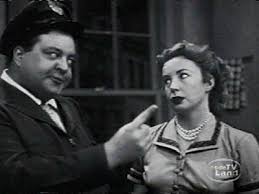
Out of desperation, I often watched a show called The Honeymooners at eleven o’clock at night, while I waited for Johnny Carson’s monologue to start. I cringed at all of the screaming from Jackie Gleason who played Ralph Kramden, a New York City bus driver living with his long suffering wife in a gritty Brooklyn apartment building. He was always getting into trouble and blaming other people for his problems, especially his wife. He would scream at her, “One of these days, POW!!! Right in the kisser!” He didn’t actually hit her, and he would eventually apologize, saying, “Baby you’re the greatest,” and give her a kiss and a hug. The excuse for his behavior seemed to be that they were working class and struggling to get by. A comment I read online said that there had been arguments about whether or not the show depicted domestic violence, since the threats were always “comical,” and he never followed up. But even back then, for me, the show was very clearly about man’s right to threaten and blame and demean women and call it funny. I’d been trained for The Honeymooners by watching my father’s behavior, which was very similar. He always praised himself for not actually hitting us. I’d actually watched The Flintstones first (basically an animated version of the Honeymooners, set in the Stone Age, appropriately enough), and found that disturbing too.

My other option at eleven o’clock, when The Honeymooners got to be too much, was MASH, a dark comedy about the Korean War, made during the Vietnam and cold war era. It was lauded for its nuance and political commentary, and when I watched it in syndication in the eighties it was only a few years out of date, but for me, MASH was just another show obsessed with women as sex objects and men as the drivers of all action, thought, humor, and pathos.

            I took some, brief, solace in shows like The Facts of life, which, especially early on, showcased a wide range of girls with different body types and personalities and interests. But it was a rarity. Most shows starred men, or boys, and presented women as sex objects, or money hungry, or both.

            Star Wars, one of my mainstays, was also filled with sexism. Princess Leia, who should have been powerful and in charge, always had to be dressed in skimpy clothes. The whole first act of Return of the Jedi was Princess Leia in a push up bra, locked in chains as Jabba the Hut’s sex slave. It didn’t escape me that, of the twins, only the male had the powers of the force.

            And then there was the music, especially the videos on MTV, where Heavy Metal and Hard Rock and Rap videos all featured scantily clad women draped suggestively over cars, for some reason. Madonna was a huge star back then too, in large part because she was willing to exploit her own sexuality instead of leaving it to the men. Neither of those options were going to work for me.

            Things started to change on TV when I was a teenager, I think. Oprah Winfrey revamped her talk show and started to discuss issues like sexual abuse more openly. And China Beach showed that the skinny, sexy, tipsy nurses on shows like MASH had a lot more going on behind the scenes, even if the men refused to see it.

            But change was slow, and inconsistent, and often, like Madonna, moved from the exploitation of women by men to the exploitation of women by women, to show that women could be powerful too. Even now, we still accept an extraordinary amount of misogyny as normal in our movies and on TV, in our books and certainly in our politicians. And we still seem to accept the trope that men can’t be expected to control their desires, but girls as young as ten (no, younger) are held responsible for choosing to wear outfits that men consider provocative, and are assumed to know exactly what impact they are having on men. But girls and women are also judged for being too plain or prudish in the way they dress. A sixteen year old girl who dresses in baggy clothes, or skips makeup, is clearly just not trying to be successful, and she should be ignored, or hated (just take a look at the backlash against Billie Eilish), whereas a sixteen year old boy can wear whatever he had on for soccer practice and become a superstar.

            The backlash against Billie Eilish, by the way, for dressing in baggy clothes, is constant and virulent, as if she’s a thing rather than a person, because she won’t let us judge her breast size. The fact that girls generally hide under so many layers when they have been sexually assaulted barely gets discussed in favor of how freakin’ weird that girl is; so moody.

“I’m moody too. You wanna make something of it?”

Even this past year, post #MeToo, with half a dozen pre-eminently qualified, charming, accomplished, intelligent, and hard working women running in the presidential race, we still ended up with two old white men, in the DEMOCRATIC primary. (And yes, a woman of color has been chosen as Joe Biden’s running mate, but that’s one man’s choice, not the choice of our whole society.)

            And now, during the pandemic, we’re experiencing what media figures are calling a Shecession, because it’s most often women who have had to quit their jobs, or reduce their hours, to take care of the kids. And since women are more likely to work in hospitality and education, where so many of the jobs have been lost due to Covid 19, more women are losing their jobs than men and a decade of employment gains made by women has been eroded. On top of that, the jobs were low paying to begin with, so those women didn’t have the benefit of savings to make it through the recession safely until their jobs can return, if they ever return.

            I’m tired of being told that we solved sexism with #MeToo, just like we solved racism back in 1965, and we should just get over it. The assumption behind both statements is that if women or people of color are still achieving less, or earning less, it must be because they are as inferior as we thought they were, and not because there is still something wrong with the system.

            I’m not sure #MeToo changed much, actually, other than a few men with egregiously long resumes of abusive behavior being fired from their high profile jobs. As a society, we’re not even reading long lists of books exploring systemic prejudice against women, or discussing what it means to try to pull yourself up by bootstraps that don’t exist, because they’ve been ripped off by force.        

            One of the more startling realities of the Black Lives Matter movement is that even though most of the originators of the movement were women, the movement overall barely addresses women’s issues. Women were also at the heart of the Civil Rights movement in the 1960’s, and then too the issues specific to black women were barely discussed.

            I don’t have a solution to this. And watching the backlash against Black Lives Matter protests, including the killing of protesters in the streets, is demoralizing. I’m tired of the ways manipulation of reality has continued, and worsened, in our current environment. I’m tired of all of the ways being female makes me less likely to be believed or even heard, than the average white man. Maybe having Kamala Harris on the big stage will have an impact on our society’s willingness to listen to and respect women. I hope so. Get your ballots in early if you can.

“I’m ready!”

If you haven’t had a chance yet, please check out my Young Adult novel, Yeshiva Girl, on Amazon. And if you feel called to write a review of the book, on Amazon, or anywhere else, I’d be honored.

            Yeshiva Girl is about a Jewish teenager on Long Island, named Isabel, though her father calls her Jezebel. Her father has been accused of inappropriate sexual behavior with one of his students, which he denies, but Izzy implicitly believes it’s true. As a result of his problems, her father sends her to a co-ed Orthodox yeshiva for tenth grade, out of the blue, and Izzy and her mother can’t figure out how to prevent it. At Yeshiva, though, Izzy finds that religious people are much more complicated than she had expected. Some, like her father, may use religion as a place to hide, but others search for and find comfort, and community, and even enlightenment. The question is, what will Izzy find?

The Trump Effect

I haven’t been writing about politics much in here, for a while, partly because I know that I have bloggy friends with very different views from mine and I don’t want to make them feel unwelcome, and partly because I need a place to escape from politics. But I realized recently that I’ve been leaving out a big part of why I feel the way I feel every day. I tell you about school, and religion, and dogs, and grief, all of which are huge parts of my life, but I also watch the news every day, and I am deeply affected by what I see and hear there.

grumpy cricket

“I never watch the news.”

My brother once said to me that, of everyone he knows, I am the least tolerant of liars, as if I have a block against it (which makes the whole writing novels thing pretty hysterical!). So watching a president who is this comfortable with lying really gets to me. The fact is, my father was a liar. He lied so well that he wasn’t sure, eventually, what was true and what was false. He lied to me about me. He used the “lie three times and they’ll believe the lie” rule. He made it so that I could tell the truth a hundred times, and no one would believe me, because his lie sounded better.

Having a president who triggers so many memories of my childhood has been difficult for me, separate from all of the actual, real world consequences of having this man as the president of my country. I grew up living in a reality war, where what I saw in front of me was regularly denied, muted, minimized, or altered completely. It’s hard to hold on to the truth when you feel like you’re the only one seeing it and believing it.


I know that there are good people who think that this president is worth the trouble, maybe because they see his overall goals as worth the methods he uses to reach them, or because they feel that he is laying bare the underbelly of politics, and showing us the real calculations involved, or maybe it’s all about the Supreme Court. I don’t know.

I appreciate the people on TV who try to make it all more bearable and understandable, explaining each time the norms, that I assumed were laws, are being trampled. But they have their limits too. I get very frustrated when people I usually like think it’s funny to laugh at Eric Trump, and his presumed status as the unloved son. If true, it’s nothing to laugh at, and if it’s not true, it’s cruel to suggest such a thing. Criticize him for what he says and does, not for something that is out of his control. The worst thing, recently, was hidden by the hullabaloo around Sam Bee using the C word about Ivanka Trump. When I watched her show, the night before, I was very angry because she said that Ivanka should dress up in her sexiest outfit, and go to her father, to convince him to change his policies. There have been many signs that Ivanka’s father has sexualized his relationship with her: in modeling photos, in interviews, and in how he touches her in public. I don’t know if there’s more to it than that, but all of that is what HE has done to HER. Implying that she is complicit in his abuse of her, and should actively take advantage of it, is cruel, and, fundamentally, unnecessary. Criticize Ivanka for her own moral lapses, and for excusing so much of her father’s behavior in public venues, but don’t use her possible status as a child sexual abuse victim against her. That’s the line that Sam Bee crossed in my mind. I don’t care about an epithet.

Given all of that, I still watch Sam Bee, and John Oliver, and Trevor Noah, and Steven Colbert. I watch Rachel Maddow regularly, because she lets me breathe for a few minutes every night. She’s a storyteller and a historian, and she’s able to put things in context for me in a way that headlines and screaming panels of experts generally can’t do. Though I wish she would stop telling me to “hold that thought” before commercial breaks, because usually it’s a thought I really don’t want to hold onto.

And then I watch Steven Colbert, and he lets me know that I’m not the only one who sees what I’m seeing and knows what I know, and he goes a step further and makes fun of it, making it just a little bit less overwhelming. I live for those moments. I could have used a Steven Colbert narrating my childhood, summarizing the crazy of each day with sympathy and understanding. It wouldn’t have changed the reality, but it could have made it more bearable.

butterfly front feet on floor copy

Company always makes things more bearable.

I believe that there is great power in holding people responsible for their actions, and making the truth visible, so that we can reckon with it. And humor is a great tool for pointing these truths out, and poking holes in the nonsense, and giving people a release valve for all of the anger and fear and stress that has been created. But, please, make fun of people for the things they do, and the things they can control, or choose not to control; don’t make fun of them for things they can’t change. And really, Trump provides plenty of material to choose from.

Cricket, thank god, has no idea what the people on the TV are saying. As long as she has her safe home and good food, she’s pretty sure everything’s going to be okay. I try hard to believe her.

IMG_0522.JPG

“If you hold a stick in your mouth it makes a smile, Mommy. You should try it.”

Hillary is Hermione


Sometime over the past few weeks, after the twentieth or twenty-first media expert complained about how careful and studied Hillary Clinton is, how she plans and researches everything, and she’s so boring compared to Trump’s constant impulsiveness, I started to think that Hillary is Hermione, from the Harry Potter books, all grown up.

I was a Hermione as a kid: the smartest girl in the class, asking for extra homework, and hated for it. We have a lot of nasty, derogatory terms for kids who study a lot: grind, swot, egghead, drudge, etc. My classmates wanted less homework and more recess. I found recess, and the freedom to make endless social mistakes, unbearable. Even J.K. Rowling, clearly a Hermione herself, did not believe the world was ready for a smart girl as a protagonist. She guessed, and she was right, that people would prefer to believe that Harry, a boy, and an average student who never tried very hard, was the ultimate hero.

Even when Bill Clinton told their love story, on Tuesday night at the Democratic National Convention, he focused on Hillary’s oversized glasses and too-big hair, her intelligence and her off putting attitude, instead of her beauty. He was the cool kid, and she was the swot. He didn’t want to work any harder than he had to, and she spent summers volunteering to help those less fortunate. He was more Ron Weasley than Harry Potter, the way he tells it, just without the red hair.

On Monday night, on The Late Show, Steven Colbert finally trotted out a cartoon version of Hillary Clinton to match the cartoon Trump he’s had on staff for months. And his team’s guiding principle in how to create that character seemed to be to assume that she was on the autism spectrum. They may have meant to say that she was two-faced and out of touch, but they managed to portray her as unable to read other people’s emotions, and robotic in her portrayal of her own emotions. It’s an interesting idea. Hillary clearly has had issues fitting in with her peers. She never quite gets the joke. She tries very hard to get social things right and always gets something wrong.

Bill Clinton could be forgiven for having affairs, but Hillary could not be forgiven for having thick ankles, or “cankles.” And then when she wore pants suits to cover those offending ankles, she was criticized for her outfits. She could never find the right hair-do to avoid criticism, or the right clothes, or the right words. And people wonder why she is so private. No, they call it secretive, not private. A man could be private and reserved, but Hillary is secretive and suspicious. A man who thinks he’s qualified to be president is called ambitious and confident. Hillary, for the sin of thinking that she can be a good president, is considered power hungry and out for herself.

Bill Clinton is Teflon. He has had real, proven, character issues and yet people still love him and believe in him. And yet all of his flaws and mistakes stick to Hillary like she’s fly paper. Instead of believing that Hillary loves her husband despite his flaws, people believe that she married him for political gain, and remains married to him for political gain, despite the fact that she would have actually gotten a lot more public praise for divorcing him instead of sticking with him through the Lewinsky scandal. And by the way, why do we call it the Monica Lewinsky scandal and not the Bill Clinton’s penis scandal?

My sense is that, with her awkward social skills, someone like Bill Clinton offers a relief. He does the reaching out. He teaches her how to fit in better; he helps her to relax. No wonder she chose Tim Kaine as a running mate – he does the exact same thing.         But if I had any doubts about Hillary Clinton’s heart, watching Chelsea Clinton’s speech on Thursday night at the Democratic National Convention squashed them. Chelsea loves her Mom, and she is, clearly, deeply loved by her mother.

The question is, can we as a country tolerate a president who is smarter than she is cool? Can we tolerate having a president who has to work at being socially confident? Because there’s no question that she will work her ass off to get things done, and that she has the brain power to do the job. But she’s not Obama, with his soaring rhetoric and self-confidence, and she’s not folksy like Bill or like George W. Bush. Hillary is more like the female version of George H.W. Bush: very serious, studied, hardworking and bright, stiff and careful.

Cricket and Butterfly have not been thrilled with all of the television coverage of the conventions, if only because it keeps them up too late at night. Though, Cricket seemed to be intrigued by Barack Obama’s speech on Wednesday night. She was certain she heard him say “go,” or “out,” or “pee.” She can pick these sounds out of any speech, or just imagine them. But he was talking during prime pee trip time, so that could explain her confusion. Butterfly slept through all of it. She has no interest in speeches or elections or conflict, unless the stress leads me into the kitchen for snacks, and then she’s wide awake and eager to participate. We all have our priorities.

026

“Did he say ‘pee’?”

004

Butterfly didn’t hear a thing.

021

Until there were snacks.

By the way, Butterfly, if she had a chance would be a loyal Hufflepuff, through and through, and Cricket would feel comfortable in Ravenclaw, because she’s very bright, but not especially brave. I’d like to believe that I could be in Gryffindor, like Hermione, and like Hillary, being brave even when it’s the hardest thing to do.

I’m working on it.

001

Loyal Butterfly likes to keep Platypus company when he’s on edge.

010

“I do have claws, Mommy. You will see them very soon.”

The Sweet Relief of Jon Stewart


This has been a rough year for me. Just when Donald Trump took over my television set last summer, Jon Stewart left The Daily Show for parts unknown (or to help his wife rescue animals on their family farm, whatever). I’ve tried to take comfort in Samantha Bee (Full Frontal), Larry Wilmore (The Nightly Show), and Trevor Noah (The Daily Show). I’ve come the closest to finding sustenance with the one-two punch of Rachel Maddow’s comprehensive historical take on the news on MSNBC, and Steven Colbert’s giddy musical review of the news on The Late Show. But no one filled that Jon Stewart void.

IMG_0995

Butterfly sought comfort from Duckie.

IMG_2306

Cricket went for the food.

I’ve watched this year as the Republicans moved from disbelief, to disgust, to acceptance, to an embrace of the post-factual Trumpian world view that we witnessed at the Republican National Convention this past week. Jon Stewart showed up Monday night on The Late Show, as promised, but only to do spit takes and reintroduce Colbert’s alter ego from The Colbert Report. It was not enough.

I watched this week as the media refused to blame Melania Trump for plagiarizing Michelle Obama’s 2008 speech, as if she is a child. But, she speaks, what, five languages, became successful on her own long before meeting Trump, and is, in fact, a forty-six year old adult woman. If Michelle Obama had been caught plagiarizing, would her speechwriter have been blamed? Or would we assume that she is an intelligent human being who can tell the difference between her own words and someone else’s? I wonder if the media think that Melania is a moron because she was a professional model, or because she’s a non-native English speaker, or if it’s because she chose to marry Donald Trump, and they assume that any truly intelligent woman would know better.

Then I watched the media fawn over Trump’s odd waxwork children, none of whom seem to be able to breathe outside of Trump’s sphere. All three of the older children work for their father, and Tiffany seems to be on her way into the organization too, now that she has been indoctrinated and proven her loyalty. How many families do you know where all of the children go into the family business, and no one goes off in another direction? Is it not allowed in this family?

But I almost lost my mind when, after Ivanka gave a lovely speech on Thursday night, seemingly advocating for Hillary Clinton’s and Bernie Sanders’ policies and pretending that her father is just a lovely man, Trump came out and patted her butt with both hands. That just broke me.

People have been joking about his inappropriately sexual relationship with Ivanka for a long time, ever since some disturbing pictures surfaced of her as a very young model sitting in seductive poses on her father’s lap. Trevor Noah on The Daily Show, has been making jokes all year about Trump wanting to have sex with Ivanka. There are interview clips where he talks about her sexy body, and how he would date her if she weren’t his daughter. Ivanka sits there awkwardly in these interviews, as if she isn’t taking it seriously and is just embarrassed by the silly things her father says. I took her lead and didn’t take it very seriously, either. I thought the jokes were in bad taste, actually, and that the things Trump said were just more evidence of his “word salad” problem. But when, on National television, in front of the world, in response to the air kisses she gave him from what looked like a foot away, he grabbed her ass, it all came together. This is an incest family.

In her speech, Ivanka presented her idealized father – who bears very little similarity to her actual father – and she made it clear that she advocates political beliefs that are not in concert with the Republican Party. Either she is delusional about who her father is (which would be a sign of a deeply dissociative state, common among incest survivors), and/or, she was giving a public, lady-like fuck you to that man.

People have talked about how Trump is a dictator and a narcissist and a sociopath, but all week the media have been saying that he can’t be such a bad guy with such wonderful children. Ivanka is his “closest ally and confidant,” and she is the “princess,” (according to one of her brothers), and she is going to be the “real first lady.” But Trump reminded her, in front of everyone, that he can do whatever he wants to her and no one will stop him. He owns her.

How is this man being lauded and supported by a political party that supposedly believes in Christian values? I can’t imagine what kind of moral convolutions Paul Ryan (Republican Speaker of the House of Representatives) must be going through to make this seem okay.

I did not watch the seventy-five minute speech Donald Trump went on to give at the Republican convention that night. I took the dogs out for as long a walk as possible, checked Facebook and Twitter, and then twiddled my thumbs waiting for the after shows to offer some perspective. Alex Wagner, a guest on The Daily Show, commented on the “inappropriate touching.” Larry Wilmore talked about his discomfort in finding that, for one strange moment, he found himself, eek, agreeing with Ted Cruz (“Vote your conscience.”). And then, finally, Steven Colbert came on, live, after Midnight. He looked like he’d slept in his iridescent blue suit, but he was still awake and giddy and dancing, which gave me some energy and some hope.

029

“Did Donald Trump pee here?”

And then, Jon Stewart popped up from under the desk, and gave me the rant I’d been waiting a year for. There’s something about his mix of outrage and earnestness and humor that digs deep into my sternum and makes room for me to breathe again. I have missed him more than I ever thought possible. I have needed his no-bullshit voice all year long and it was such a relief to breathe deeply again. But it’s not enough. It was over too soon.

I know that animal rescue is important, and I understand that Jon Stewart’s kids need his attention, and that the daily grind of the show was getting to be too much for him. But I need rescuing too, Jon. Please, come back soon!


Cricket & Butterfly waiting for Mommy

Cricket and Butterfly are waiting.

Color War

When I went to sleepaway camp as a kid (for five summers, eight weeks at a time) the worst thing that I had to endure was color war. Each bunk, and each age group in the entire camp, was split down the middle. Even the counselors in my own bunk could be on the opposing team. We were either white or blue, and almost all of the competitions that made up the war were fought against the kids we saw every day. There were swim competitions and foot races and trivia contests and ultimate Frisbee. We had to learn songs to cheer for our side, and wear t-shirts with our team colors. And at the end of the war there was a huge tug of war with the whole camp pulling on one or the other side of the rope.

I’m not sure what the purpose of color war was meant to be, maybe a team building exercise, or a chance to compete at the activities we’d just been doing carelessly each day before that, but the unintended consequence, or at least I hope it was unintended, was that we got to feel what it would be like to have to fight with our friends and neighbors, and it was awful.

By my last summer, I actively campaigned against not only my own involvement in color war, but its existence altogether. At thirteen, I could finally articulate the pain in the fact that my counselor, my mommy-substitute for two months, would be actively rooting against me for at least 24 hours. It was shattering.

It would be like splitting my family in half, with Grandma and Butterfly on one team and Cricket and I on the other, and every meal we ate, every TV show we watched, would be a battleground. Cricket would lose her mind.

anger

“Grr!”

This is what I’ve been thinking about lately, with the American presidential election in its long swing through hell. There are two teams, that’s it, and it’s a fight to the death to see who gets to represent each team, even if no one, really, can represent 50% of the country to anyone’s satisfaction.

In a multiparty system like Britain’s parliamentary system, smaller parties can win seats in the parliament and have influence in governing. A party that wins 20% of the votes in a multi-party system, will get 20% of the seats in the legislature, and a voice in parliament. In a two party system like we have in the United States, we can still have third parties, and have had many of them, but they rarely gain traction. Why? Because in winner-takes-all elections, the 20% a third party may be able to muster doesn’t win them any power. This is why Bernie Sanders is running as a Democrat, despite being an Independent, as well as a Democratic Socialist.

Americans seem to be comfortable with our two party split, our black and white dichotomies, not to put too fine a point on it. There are many people who’d like to make the next division Christian versus Moslem, as if everyone in the world is either one or the other. But that assumes that all Christians are one, and all Moslems are one, and that everyone else doesn’t exist. That’s what you have to do to create this two team system. You have to whitewash, or blackwash, everything.

The dichotomy between Republican and Democrat has never been more extreme in my lifetime than it is right now. During the Bill Clinton era, the constant complaint was that both parties were so centrist that choosing one over the other was just about brand loyalty and nothing deeper than that. Today, it’s a deep divide.

I think I’d be more comfortable with proportional representation, just because it fits my world view better. Let me fight with the people I’m actually in disagreement with, instead of a whole team of people who have to be loyal to each other no matter what they actually believe in.

Except, at least with the two party system, Trump has to won a majority (or if there’s a third party candidate by November, a plurality) of the votes in order to get into power. In a multiparty system he could win just 20% of the vote and at least have some power – and I would have to deal with that. Though it’s hard to imagine someone like Trump being interested in that kind of power. He’s an all or nothing kind of guy.

Another benefit of the two party system is that outliers like the Ku Klux Klan, who may still be a presence in certain states, cannot elbow their way into either of the big parties and get to power in the country overall. But, maybe that’s also part of the problem – most of the country had no idea these outliers were there. We didn’t know that there were going to be so many Trump supporters bubbling up, because until they reached a critical mass they were invisible in our winner-takes-all system.

But, I like the idea that in a family, even if there are certain people with more power, the minority voices – like Cricket’s and Butterfly’s – still get heard and still have a vote. They may not have the final vote, or the most heavily weighted vote, but they still count in the delegate math. Maybe Butterfly would be in the “food, glorious food” party, advocating for extra meals and extra treats. And Cricket would be in the “I want to play” party, advocating for extra outings and more interactive time with her people. They could work together on certain tasks, helping each other reach their goals, as long as they are both satisfied by the outcome. And on other issues they wouldn’t work together, but might find common cause with Grandma (“let’s go to the beach”), or with me (“snacks in front of the TV would be nice”). It’s a more flexible system, and allows people to be more honest about their beliefs and motivations.

IMG_1860

“Grandma! It’s time for gardening!”


45 - and salty

“Grandma, aren’t you thirsty?”

008

“Food!”