Tag Archives: rescue

Tzipporah Has Eyes Again

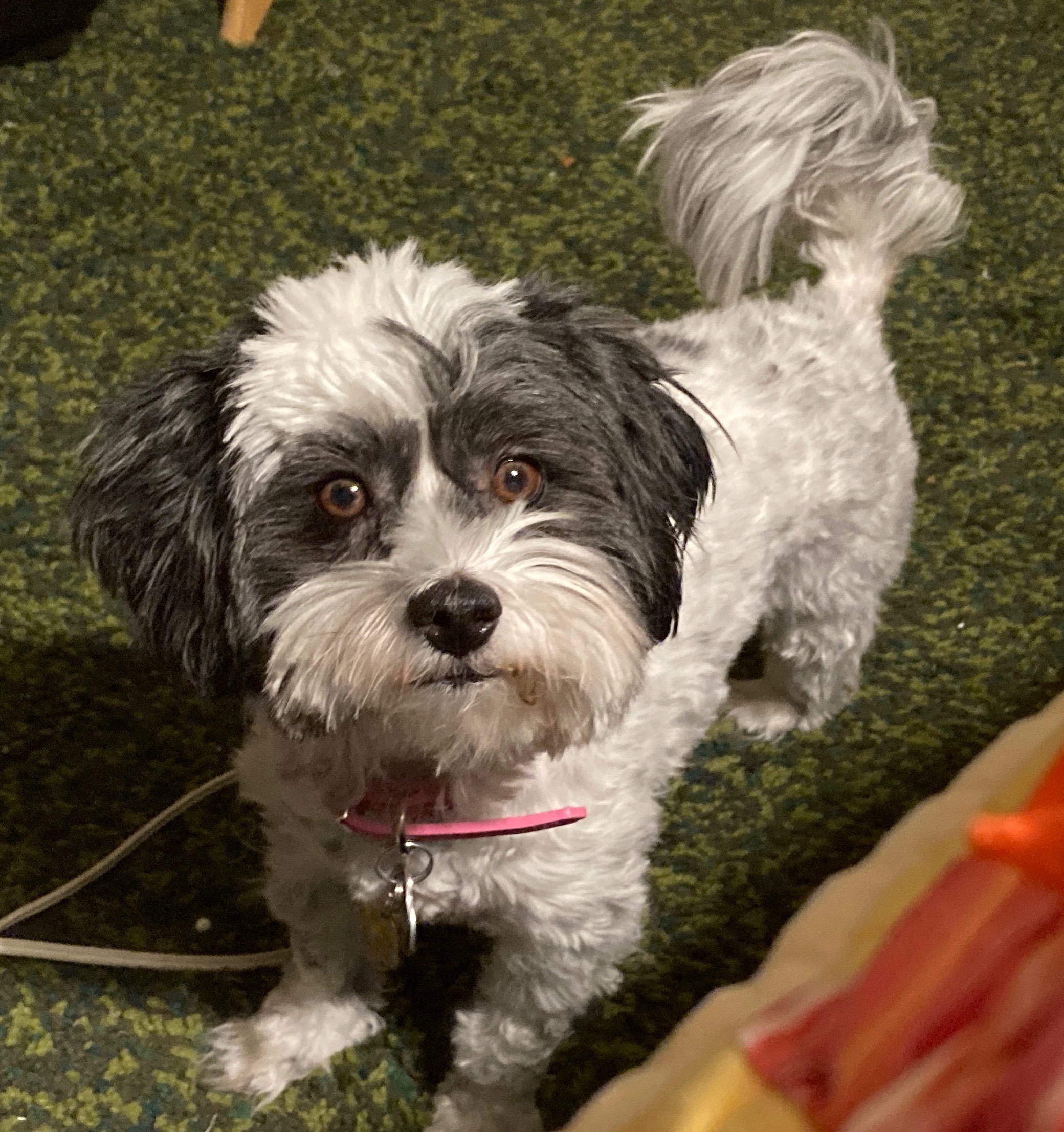
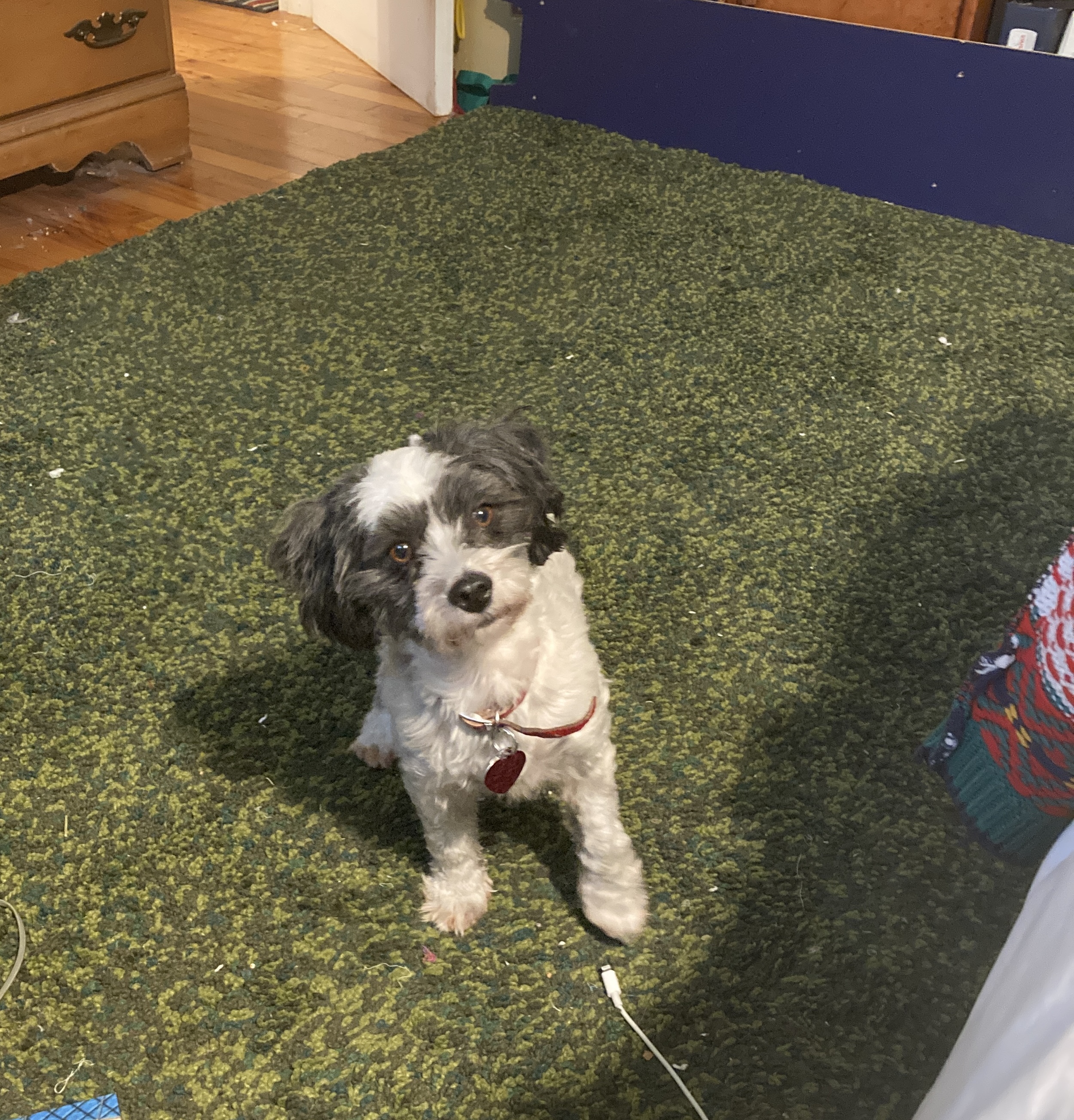
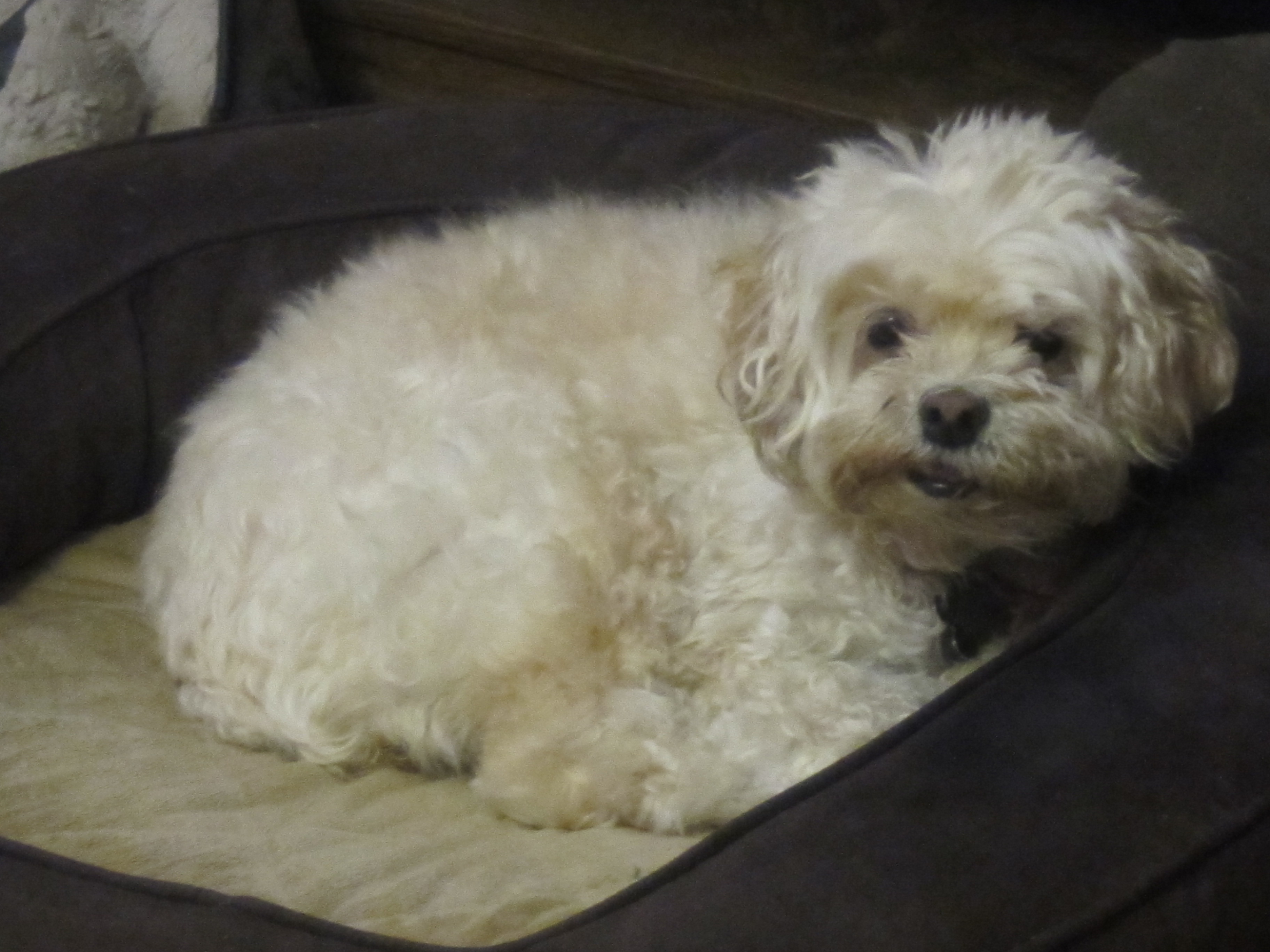
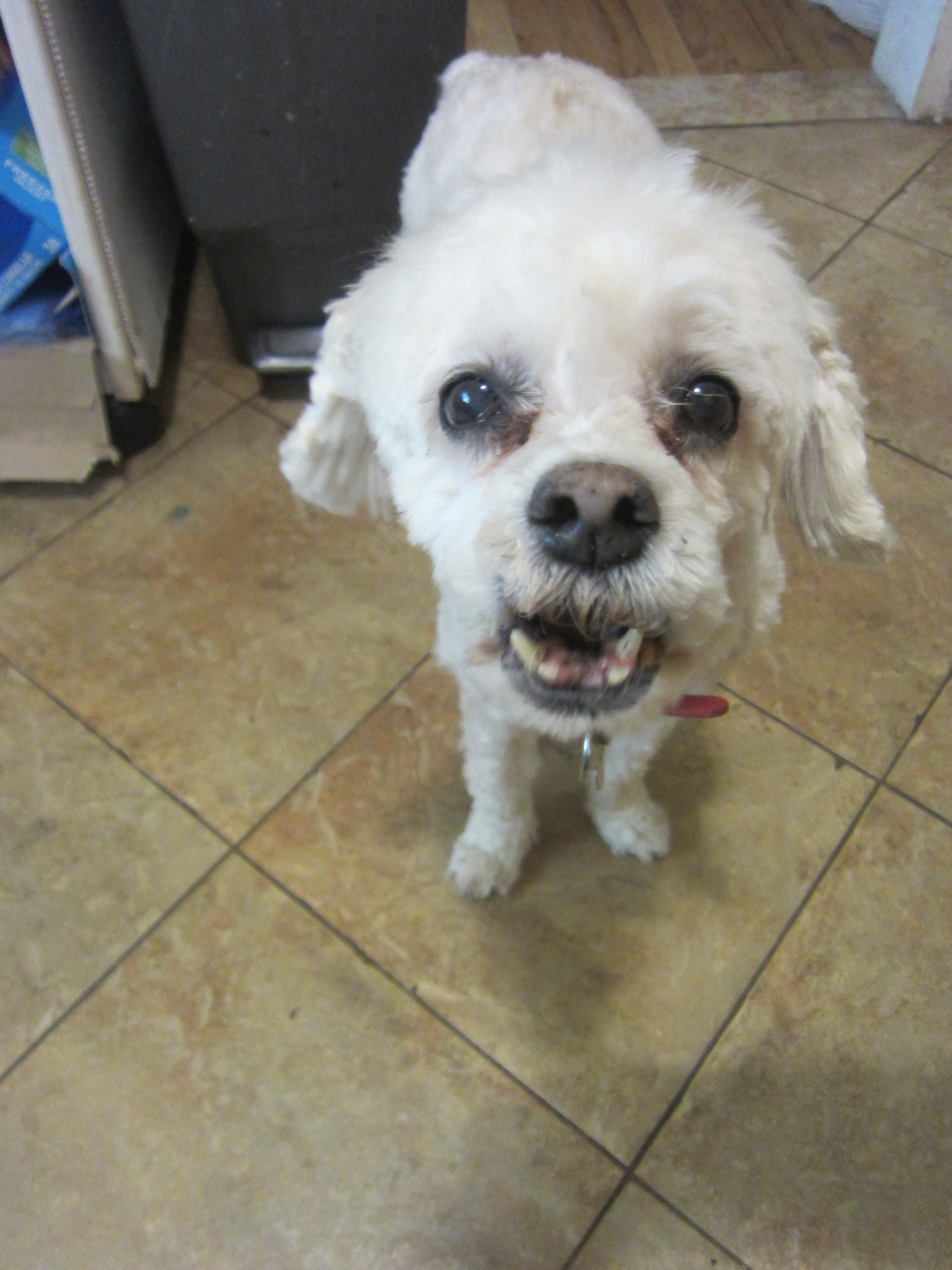
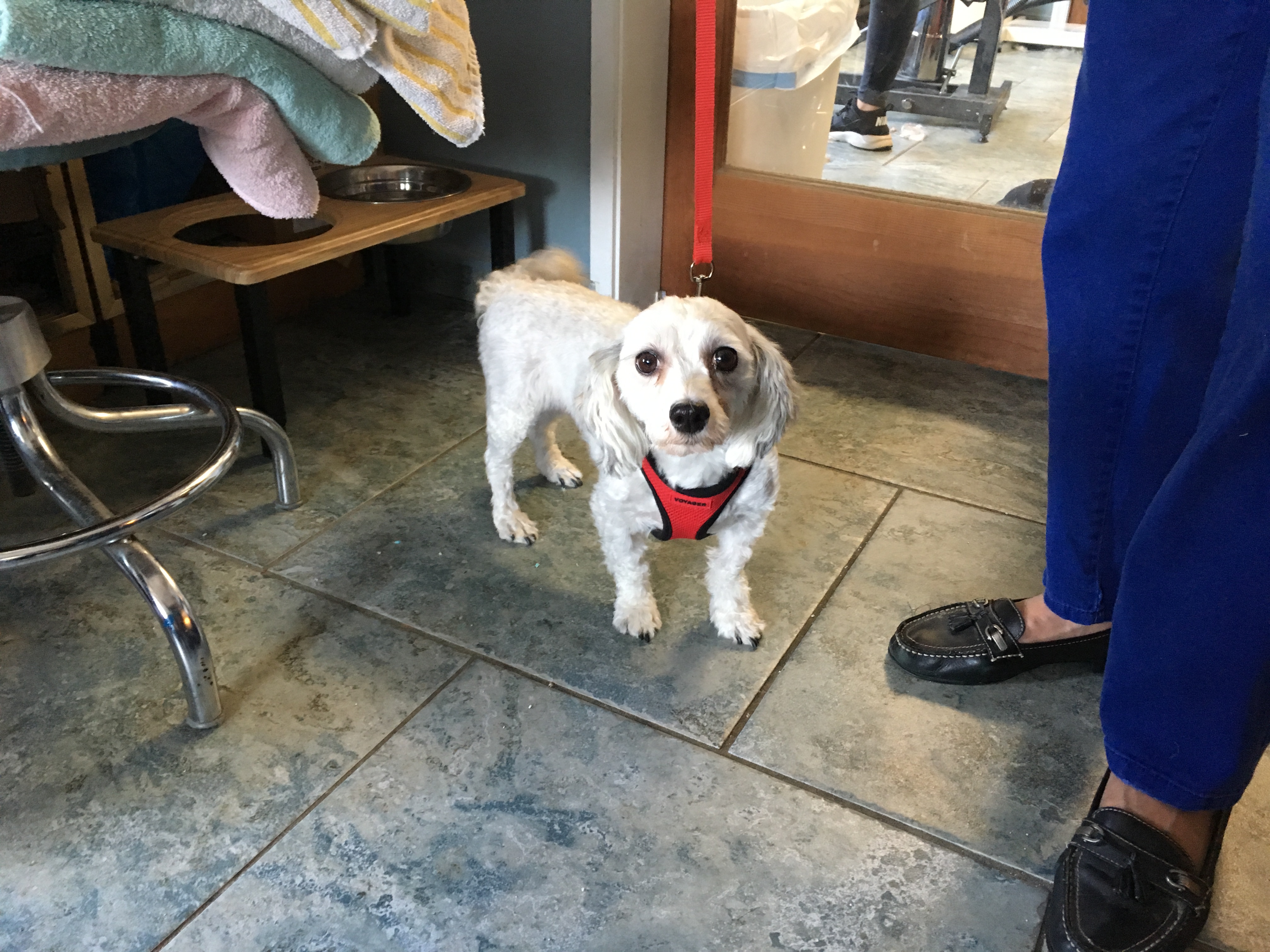
            We finally took Tzipporah to our groomer for the first time, a few weeks ago. I was nervous about how she would manage being with strangers, but other than a small panic attack when the groomer got to her front paws (she told us to pre-medicate Tzipporah with doggy Xanax next time), she did surprisingly well. The best part is that I can see her eyes again, and that means I can see how much her facial expressions have changed since she first came home. She looks curious and interested now, instead of frightened and exhausted.

“I see you. Mommy!”

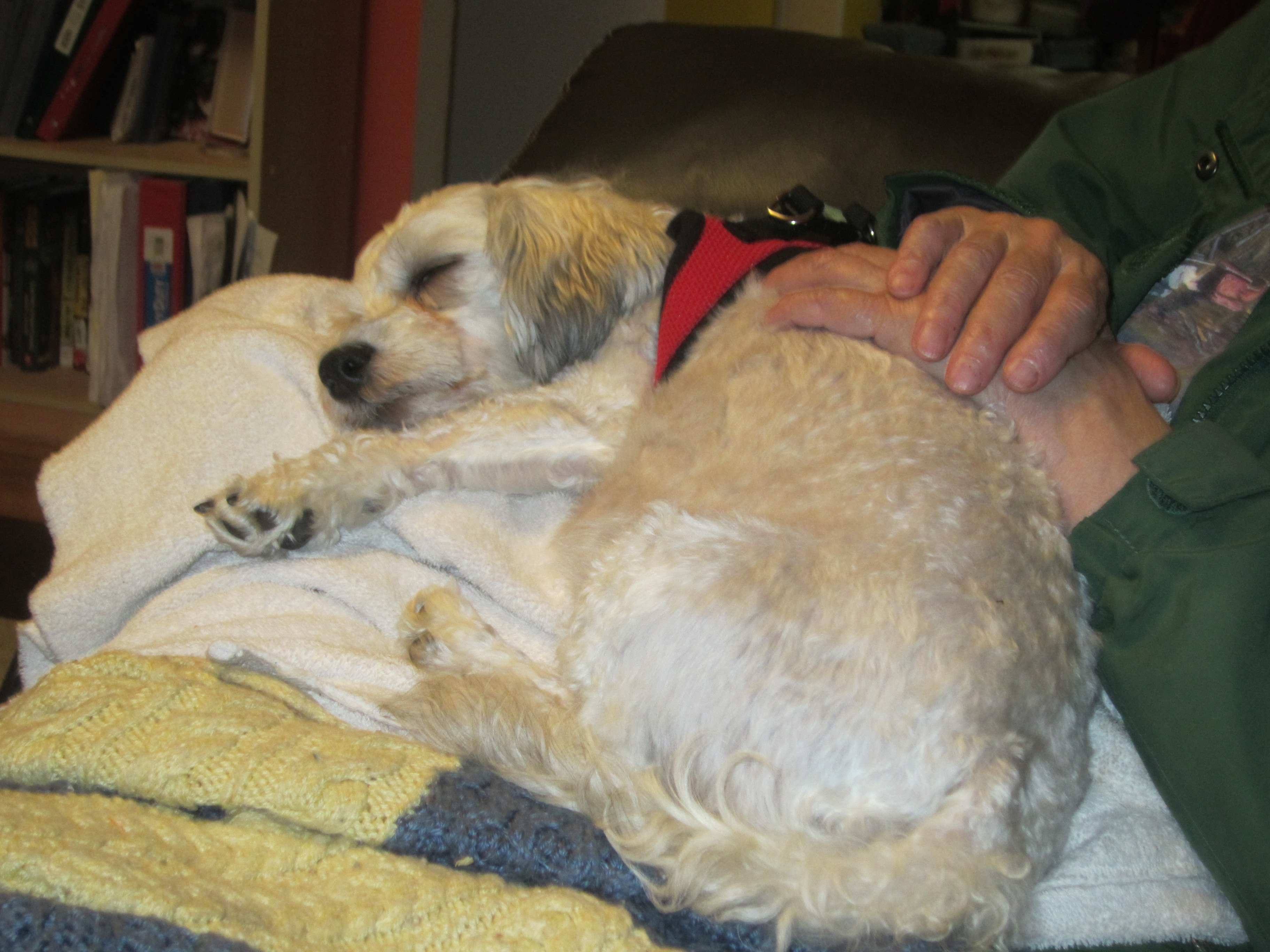
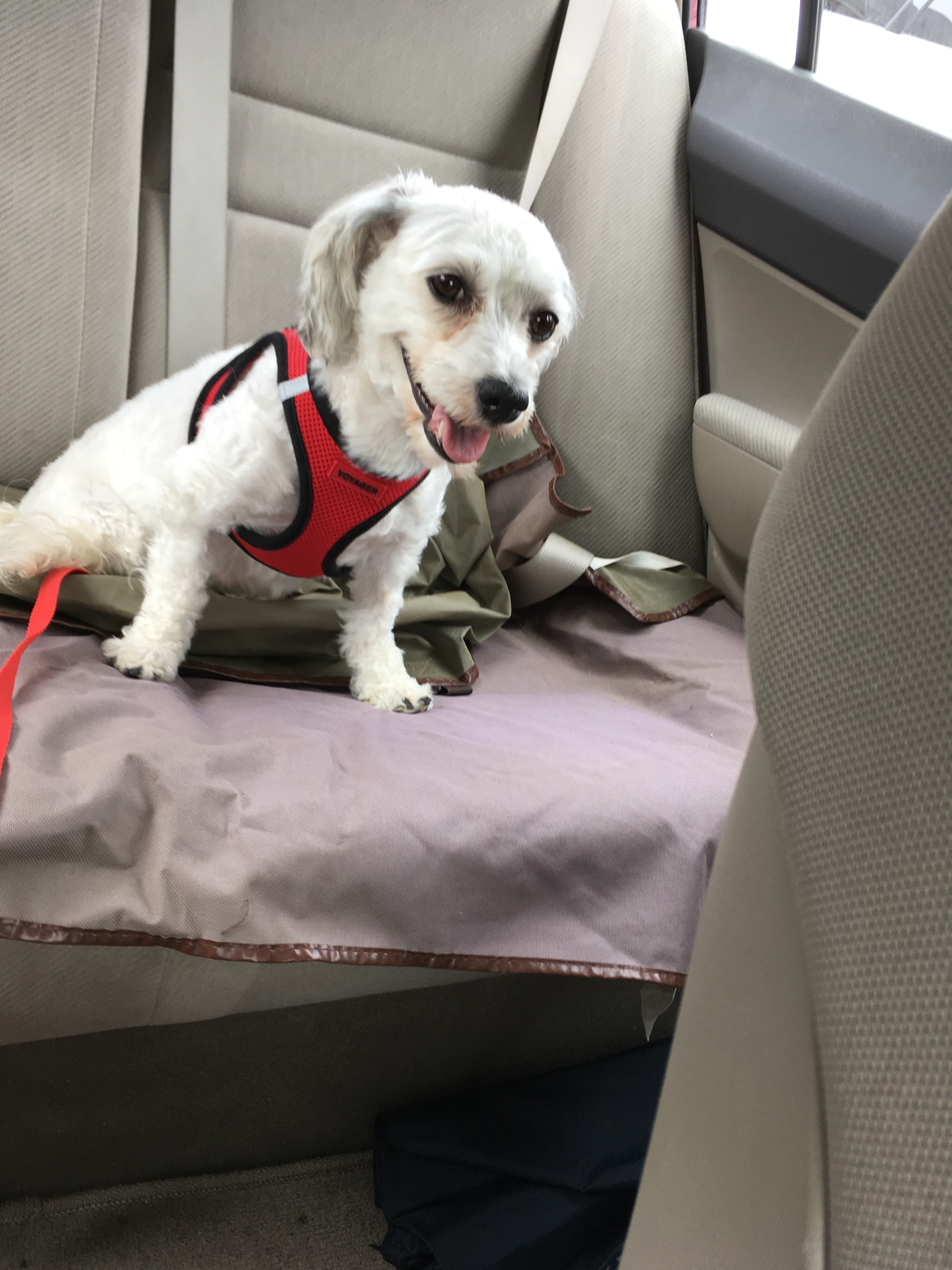
I was so inspired by how well Tzipporah did at the groomer, that I brought her to therapy with me the next day, to show off her new haircut and to test her ability to sit in the car by herself (instead of with Grandma holding her). She survived the short trip by flattening herself on the backseat, totally unlike Cricket’s habit of climbing every which way while I was driving (though I’m still planning to get a car harness for her, just in case), and then she sat on my lap during therapy, and listened intently to what ended up being a long conversation about how freakin’ cute she is.

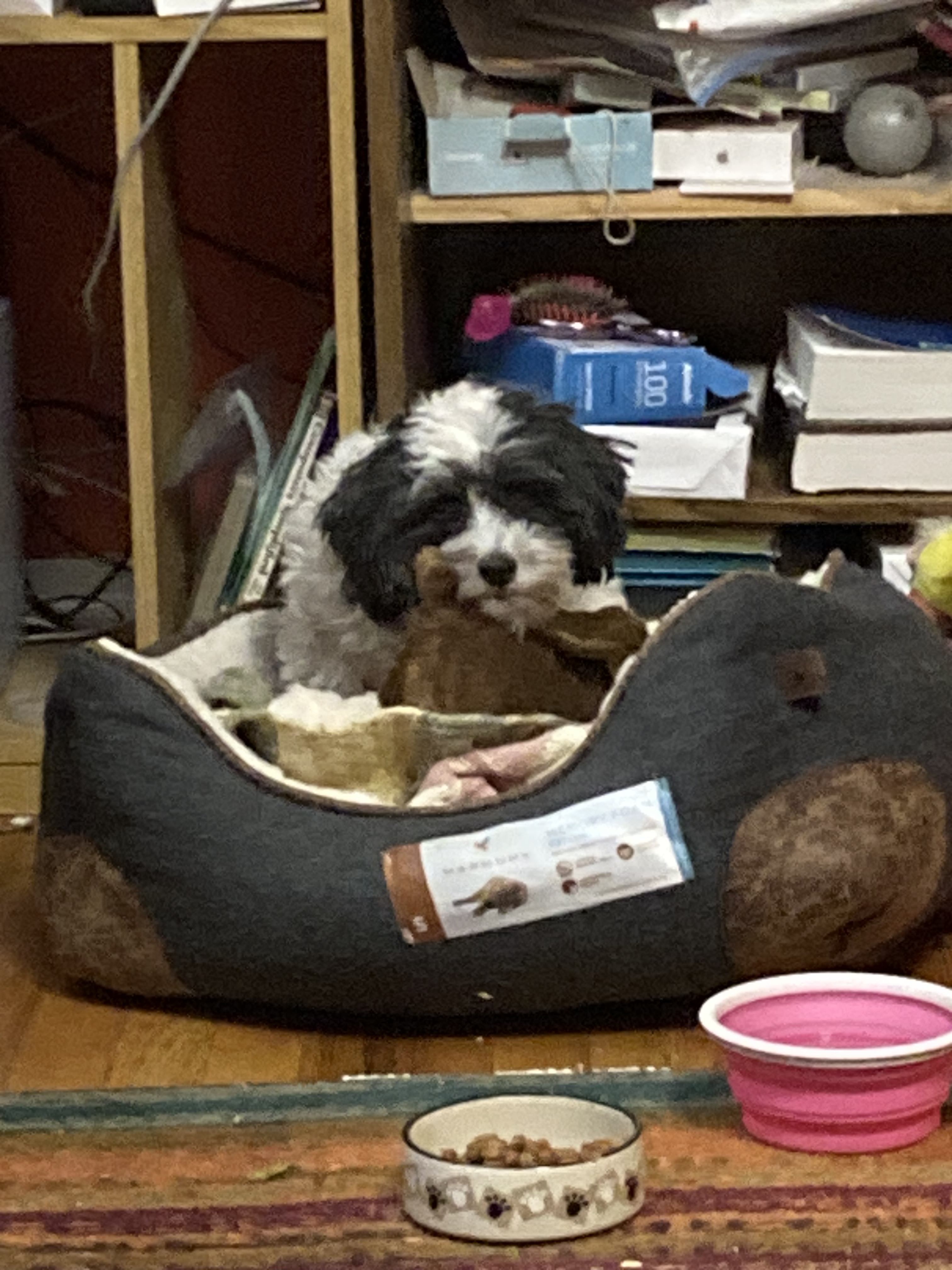
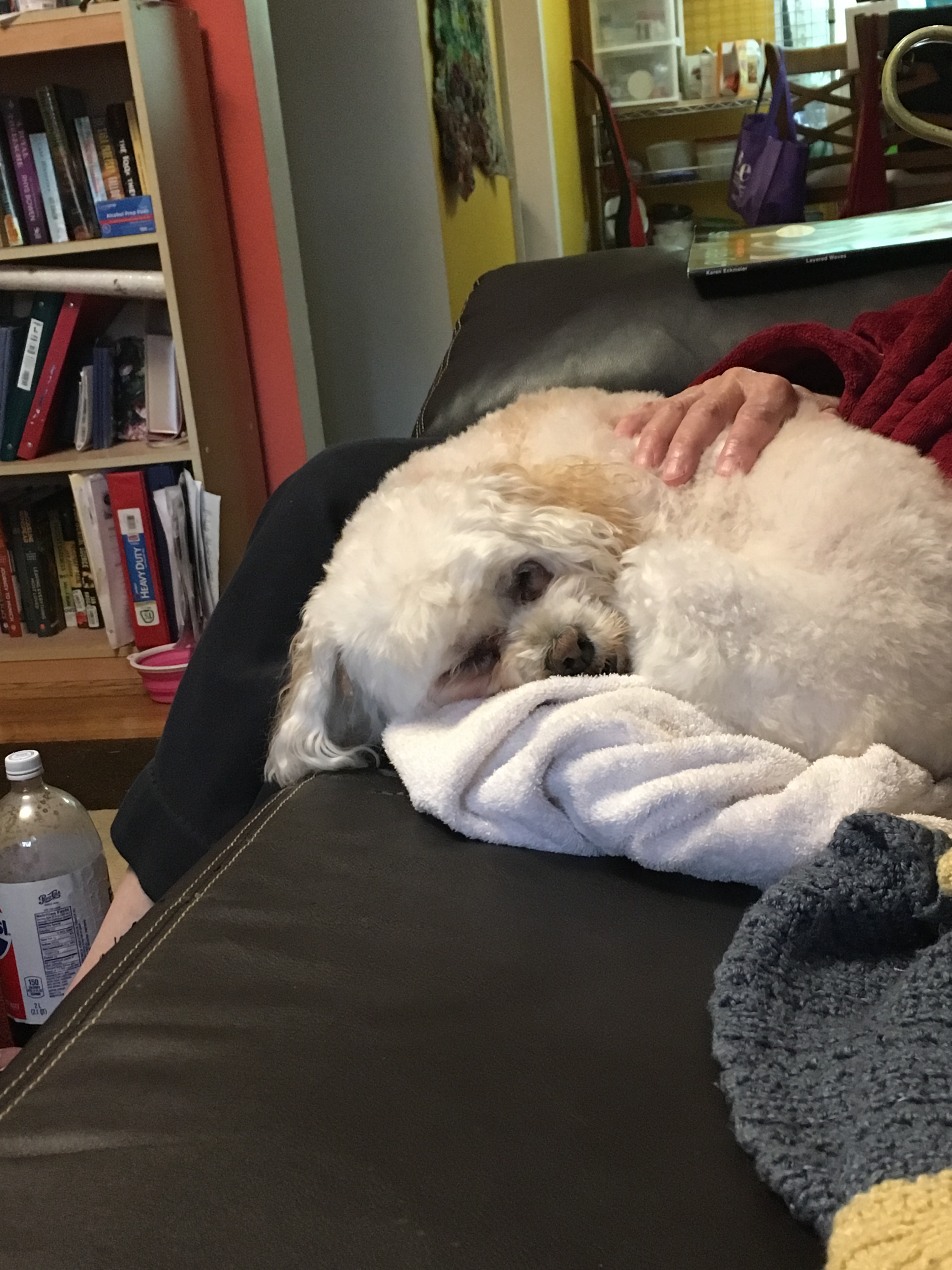
And, yes, she is still spending most of her time marinating in her bed, but she’s usually awake now and looking around intently for clues about her new world. She even twists around in her bed to watch me when I leave the room, or, God forbid, leave the apartment altogether. She still hasn’t barked, but she makes the most of her soft voice, waking us up in the morning with her persistent cry, like a tiny car alarm. She’s usually looking for Grandma, to give her breakfast or a treat, but sometimes she even comes looking for me, and then she waits until she’s made eye contact and then runs back to the living room, expecting me to follow. 

After her success with the groomer, I decided to move her food and water bowls halfway to the kitchen, rather than near her bed, to encourage her to walk around more often. And I even added toothbrushing into her daily routine (she loves the chicken flavored toothpaste!), and she seems to be tolerating the indignity quite well.

“Wait, that was toothpaste?!”

            As the weather warms up, the next big challenge will be teaching her how to tolerate walks. She still looks at the leash like it’s a boa constrictor about to strangle her, and when I try to put her on the ground out in the yard, she shakes, so there’s a lot of work ahead. Maybe she’ll have to take some doggy Xanax for walks, as well as for the groomer. In my imagination, I see her running along the beach in the wind, and playing with Kevin-the-Golden-Doodle in the backyard, the way Cricket used to do (except without the violence), but that might be asking too much. We’ll see.

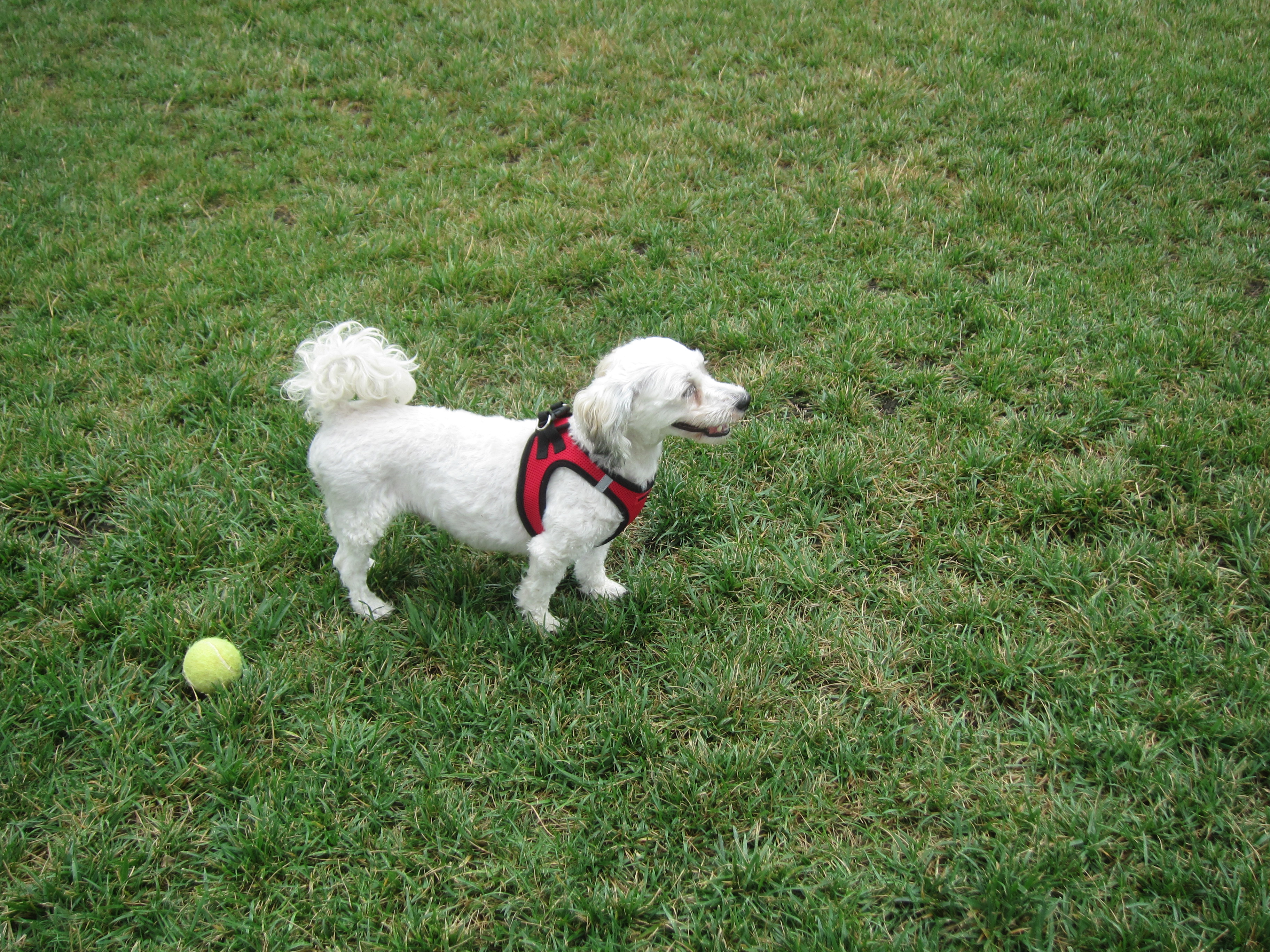
I’m trying to moderate my expectations and just be happy whenever she makes progress, but then I worry that I haven’t challenged her enough or given her enough opportunities for growth. With that in mind, I brought one of Kevin’s squeaky tennis balls into the apartment one day, hoping the smell of him would interest her. I threw the ball a few times, and squeezed it to make it squeak, but Tzipporah just watched intently, with no signs of wanting to participate. She hasn’t quite figured out that life is supposed to be interactive, instead of a movie to be watched from the cozy seats, but I have the same problem, so really, who am I to criticize?

“These are the best seats in the house!”

If you haven’t had a chance yet, please check out my novel, Yeshiva Girl, on Amazon. And if you feel called to write a review of the book, on Amazon, or anywhere else, I’d be honored.

            Yeshiva Girl is about a Jewish teenager on Long Island, named Isabel, though her father calls her Jezebel. Her father has been accused of inappropriate sexual behavior with one of his students, which he denies, but Izzy implicitly believes it’s true. As a result of his problems, her father sends her to a co-ed Orthodox yeshiva for tenth grade, out of the blue, and Izzy and her mother can’t figure out how to prevent it. At Yeshiva, though, Izzy finds that religious people are much more complicated than she had expected. Some, like her father, may use religion as a place to hide, but others search for and find comfort, and community, and even enlightenment. The question is, what will Izzy find?

Tzipporah Got Sick

            We don’t know what set it off, but Tzipporah was sick for a week. One afternoon she had a loose poop, and the next poop was even more liquidy, and the next was all liquid, and then she was vomiting, in her bed. Right away, I was having flashbacks to the last few months of Cricket’s life, when she was suffering from kidney disease and we had to spread wee wee pads everywhere. But I tried to stay calm, and when I gave Tzipporah her first bath-at-home, and she hated it, the energy with which she fought off the washcloth and the water made me hopeful. And then we gave her some Pepto Bismol, enrobed in peanut butter, to see if we could stop the flow in its tracks, and she ate the newly crunchy peanut butter gleefully, and then threw it all up. The next morning, she didn’t eat her breakfast at all, so we called the animal shelter’s clinic and they gave us an emergency appointment. Tzipporah needed to have her butt washed one more time before her appointment, which she hated, again, and then we wrapped her in a towel and brought her to the car.  

“I don’t feel so good.”

She sat shaking in my arms in the waiting room at the clinic, leaning her head under my chin to hide. When we were called into the examination room, she let me place her on the exam table, but she stayed as close to me as possible, and then, when the vet came in to examine her, she tried to climb me like a tree. But she survived, and even let me hand her off to the vet tech, who took her away for blood tests and an x-ray, and then brought her out to us in the waiting room wrapped in a wee wee pad, because she’d had another accident during the x-ray.

I held her close and whispered to her and scratched her ears, and she started to relax. And I realized that somewhere along the way Tzipporah has decided that I am her Mommy. There was no one moment that clinched it for her, as far as I could tell, it was just a gradual realization that I can be trusted to feed her, and wash her, and comb her hair, and to comfort her when things go wrong.

When we were called back into the exam room, the vet told us that there was nothing in the blood tests to worry about, except some small elevations caused by stress, but the x-ray showed that Tzipporah’s large intestine was swollen, which could be a sign of a blockage, or not. The vet wanted us to come back the next day for a follow up x-ray, hopefully to find that the swelling had reduced, but if not, she said, we might need to think about surgery. She sent us home with a few medications (all in liquid form, in case Tzipporah still wasn’t up to eating solid food), and a lot of anxiety.

When we got home, I gave Tzipporah yet another bath while Mom cooked up her newly prescribed bland diet (boiled chicken and rice), and then we gave her the prescribed appetite stimulant and she gobbled up her lunch and even let me give her the rest of her meds, sort of. And then she and Mom rested while I went out to teach.

Tzipporah happily ate her dinner later that night, and there was no more vomiting, but she did continue to have diarrhea overnight. The next morning, we were only allowed to give her a little bit of food to go with her meds, because the doctor wanted the second x-ray to be as clear as possible. And then I gave her yet another half-bath and we were off to the vet again.

These visits to the animal shelter clinic, the same one where we used to take Butterfly (our first puppy mill mama), were bringing up a lot of grief and fear, and it was hard to remember that this was probably just a blip, not an illness, yet, and not fatal. When Butterfly came to us, she was eight years old and had significant health issues, so we spent a lot of time in and out of that clinic, especially towards the end of her life, almost five years later. That clinic was a god-send, honestly, and helped us keep Butterfly for much longer than we’d ever have expected, but the grief has never really faded. And watching Tzipporah, another puppy mill mama, going into those same exam rooms, was a lot.

Miss Butterfly

Tzipporah’s second x-ray was better than the first one, with signs that the inflammation was passing, but the vet said to keep an eye out and if she vomited again, we should take her to the emergency vet for an ultra-sound, all of which sounded terrifying and expensive. Thank God, Mom had thought ahead and bought health insurance for Tzipporah the day we adopted her, which, after a deductible, would give us 80% of the cost back.

Before we left the clinic for the day, two vet techs gave Tzipporah subcutaneous fluids and a B12 shot (which also reminded me way too much of Cricket’s final months), and the doctor prescribed another medication to add to her cocktail, and we went home.

Miss Cricket

I spent the rest of that day doing laundry (both dog beds, a whole pile of towels and blankets and toys, and all of the clothes I’d worn to the vet and while giving Tzipporah her many baths), and Tzipporah spent the rest of the day eating and sleeping.

By the next day, there were no more signs of diarrhea or vomiting. It still took her a few more days for her to get back to normal (AKA running down the hall to beg Grandma for chicken treats), and even longer for us to stop watching her anxiously, but we eventually began to add some kibble back into her diet, and she had the energy and presence of mind to toss the kibble out of the bowl and focus in on the chicken and rice.

The whole experience was overwhelming, especially because of the memories it brought up, but something good came out of it too: when Tzipporah was sick and needed help, I had to help her, whether she liked it or not. I’d been so careful with her through her first few months with us, because I didn’t want to re-traumatize her, and I wanted to give her time to acclimate to life with people, and because I was afraid of making mistakes. But when she was sick, I stopped worrying about all of that and gave her the care she needed, and she responded by leaning on me, and asking to be picked up, and looking to me for reassurance. She’s still suspicious of me, of course, but she seems to understand that I can be trusted. I’m also realizing that I was probably too careful, worried that she would reject me or worried that I would love her and lose her too soon. Cricket and Ellie’s deaths last year, within months of each other, left a deep mark on me, and I think some part of me was holding Tzipporah at arm’s length, just like she was holding me at paw’s length for her own reasons.

Cricket and Ellie

But she looks at me now, and communicates in her own unique way, and even recognizes me as a particular person, who she might even like. We still don’t know what set all of this in motion, maybe a stray piece of chocolate or a dropped pill or something else she managed to find on the floor during her nightly wanderings. But whatever it was, it passed, and she seems more confident in the aftermath. And I think we’re more confident too, and willing to be more proactive with her, even when she looks at us with suspicion. It’s still a work in progress, and we still have a long way to go, but we’re finally getting somewhere, and she even seems to be a little bit happy to be here. Sometimes.  

“But only sometimes, Mommy.”

If you haven’t had a chance yet, please check out my novel, Yeshiva Girl, on Amazon. And if you feel called to write a review of the book, on Amazon, or anywhere else, I’d be honored.

            Yeshiva Girl is about a Jewish teenager on Long Island, named Isabel, though her father calls her Jezebel. Her father has been accused of inappropriate sexual behavior with one of his students, which he denies, but Izzy implicitly believes it’s true. As a result of his problems, her father sends her to a co-ed Orthodox yeshiva for tenth grade, out of the blue, and Izzy and her mother can’t figure out how to prevent it. At Yeshiva, though, Izzy finds that religious people are much more complicated than she had expected. Some, like her father, may use religion as a place to hide, but others search for and find comfort, and community, and even enlightenment. The question is, what will Izzy find?

The Naming of Tzipporah

            The primary reasons why I chose the name Tzipporah for our new dog were the meaning of the name (bird), and the sound of it, but I was also thinking of Moses’s Wife Tzipporah in the Hebrew Bible. There was something about her that resonated for me, but I couldn’t quite remember what it was, so I decided to do a little bit of research.

“Why do I have to share a name? That doesn’t sound right.”

Tzipporah, in the Hebrew bible, was the daughter of a Midianite priest named Jethro (and Reuel and Hobab, for some reason). Jethro himself becomes important to the story after the Exodus from Egypt, when the Israelites are camped out at Mount Sinai and Moses needs help figuring out the nitty gritty of how to lead his new nation.

            But first, the beginning of the story: Moses runs away from Egypt (because he killed an Egyptian slave master who was striking a Jewish slave), and as he is passing through Midian he sits down to rest by a well. While there, he sees that Jethro’s daughters are being bullied by a group of shepherds. Moses steps in to help the girls get water for their flocks, and when they get home, Jethro tells them to invite Moses home for dinner, and then to stay, and then to marry his daughter Tzipporah.

The interesting bit comes later on, after Moses is called by God to save the Israelites from Egypt. Moses and Tzipporah and their sons are staying at a roadside inn, on their way to Egypt, when an angel of God comes to kill Moses (there’s no explanation in the text for why God wants to kill the man he just recruited, but, okay). Tzipporah decides that the only way to dissuade God from killing her husband is to circumcise her son Gershom, and then touch her husband’s leg with the bloody piece of skin (or to fling the foreskin at the angel, the text is unclear on this point). And, Moses is saved!

Putting aside the ick for a second, it’s fascinating to me that Tzipporah is the heroine of this story, rather than Moses. Moses does nothing to protect himself. Tzipporah, on the other hand, grabs a sharp stone and does precise surgery on her baby to save her husband. I read a commentary that says the reason God was so angry at Moses in the first place was because he had failed to circumcise his son by the 8th day, so Tzipporah was just doing the job Moses was supposed to have done earlier. But that seems like a lot of impatience, even for God. The interesting thing, to me, is that circumcising baby boys was seen as a way to protect them from evil spirits (blood in general is seen as a prophylactic against evil in the ancient world), so here’s Tzipporah using the same ritual as a way to protect her husband from God, as if God is playing the role of an evil spirit in this story.

The contradictions in the text, and the sense that we’re missing important details of the story, seem to be a feature rather than a bug in the Hebrew bible. A modern-day text would have had all of these contradictions edited away, and all of the missing details filled in, but instead we have this text that includes multiple versions of the same stories, with conflicting and confusing details that lead to wildly different interpretations; which, intentionally or not, allows each of us to reinterpret the text in our own way, and find layer upon layer of possible meanings.

            It’s this decidedly-lean-on-details aspect of the Hebrew bible that led the rabbis to write Midrash, or stories, to help us try to understand the lessons to be learned. That’s where we get some of the explanations for why Tzipporah was named Bird in the first place: maybe she was named after (or inspired by) the Egyptian Bird goddess, Isis, who also saved her husband’s life (in Egyptian mythology); or maybe she was named Bird simply because birds are beautiful and she is beautiful; or maybe she was named Bird because birds are the animal sacrifice used in the case of a house covered in leprosy, and Tzipporah cleansed her father’s house of idols, which is sort of like cleansing the house of leprosy (though I don’t remember anything in the story where Jethro gives up being a priest of Midian, or any of his idols, so…).

            Sometimes the commentators just come up with things because that’s the story they want to be true. Midrash was never added into the text of the Hebrew bible itself, and we are not supposed to confuse midrash with the text of the Hebrew bible, and yet, the way these stories are often taught to children, and remembered by adults like me, the line between what’s actually in the Hebrew bible itself and what was added by the rabbis in the midrash can become blurry.

            But, even with all of that, the text of the Hebrew bible seems pretty clear that Tzipporah is a fierce protector of her husband and children, and that she is very beautiful, and maybe that fierceness and beauty were what made the name seem right for my own Tzipporah. She survived four years in a puppy mill, and that alone takes a lot of grit, but then she came to a new home and was able to be curious and find new adventures, which suggests that she has a lot of spirit and bravery for such a little girl.

My hope for my own Tzipporah is that she continues to write her own midrash, her own fanciful stories, to create a new life, and that she never has to protect herself from an angel of God, or anyone else, so she can devote all of her fierceness to the goal of living a good life in her new home, and finding as much happiness as her little paws can hold.

If you haven’t had a chance yet, please check out my novel, Yeshiva Girl, on Amazon. And if you feel called to write a review of the book, on Amazon, or anywhere else, I’d be honored.

            Yeshiva Girl is about a Jewish teenager on Long Island, named Isabel, though her father calls her Jezebel. Her father has been accused of inappropriate sexual behavior with one of his students, which he denies, but Izzy implicitly believes it’s true. As a result of his problems, her father sends her to a co-ed Orthodox yeshiva for tenth grade, out of the blue, and Izzy and her mother can’t figure out how to prevent it. At Yeshiva, though, Izzy finds that religious people are much more complicated than she had expected. Some, like her father, may use religion as a place to hide, but others search for and find comfort, and community, and even enlightenment. The question is, what will Izzy find?

Tzipporah’s Midnight Cry

            A new pattern has emerged. Some time in the middle of the night, for three nights now, I have woken up to a plaintive cry. Each time, I have gone to look for Tzipporah, assuming the cry was hers, and found her standing in the middle of the living room, surrounded by stuffies, silent. I guess it’s possible that the cries have been coming from outside, from another animal, or even a person, but most likely it is from Tzipporah. The strange thing is that it is just one cry and that’s it, there’s no long sequence of cries, and no obvious behavior to go along with the cry.

            Tzipporah’s four years at the puppy mill are a mystery to me, but her terror gives me clues. Inside the apartment she has found safe spaces: she likes to switch from one dog bed to the other after a few hours, and then take a nap on the rug in Mom’s room, or on the cushion in my room, for variety; and she will let me pick up her whole bed and bring her into the kitchen at night, though she refuses to stay there; and she even lets me put her leash on and pick her up to take her outside, but once we’re outside she sits on the grass and shivers (even wearing a sweater), and when I try to pick her back up she pulls and jerks at the leash, bucking this way and that like a tiny unbroken horse.

            Despite all of this, Tzipporah seems to be progressing. She stretches out in her bed, and she even rolled onto her back a few times while I was in the room. She accepts food (chicken and peanut butter so far) directly from our hands, sometimes, and she makes eye contact much more than when she first came home. She doesn’t know how to play yet, but when I press on the belly of one of her stuffies and it squeaks, or barks, she listens carefully and leans in to sniff.

            But in two weeks, those ghost-like cries – as if she is just now testing her voice and is still afraid to be heard for long – are the only sounds she’s made.

            I know that she has started to heal, and that her life will continue to improve as she learns that she is safe now, but I don’t know what’s behind her bone deep fear, and I don’t know if it will ever go away. There’s something deeply healing, for me, in bringing home these special dogs and helping them find their way out of the darkness; but there is also, maybe, too much resonance in the realization that some hurts may never fully heal.

If you haven’t had a chance yet, please check out my novel, Yeshiva Girl, on Amazon. And if you feel called to write a review of the book, on Amazon, or anywhere else, I’d be honored.

            Yeshiva Girl is about a Jewish teenager on Long Island, named Isabel, though her father calls her Jezebel. Her father has been accused of inappropriate sexual behavior with one of his students, which he denies, but Izzy implicitly believes it’s true. As a result of his problems, her father sends her to a co-ed Orthodox yeshiva for tenth grade, out of the blue, and Izzy and her mother can’t figure out how to prevent it. At Yeshiva, though, Izzy finds that religious people are much more complicated than she had expected. Some, like her father, may use religion as a place to hide, but others search for and find comfort, and community, and even enlightenment. The question is, what will Izzy find?

The Dog I Want

            My ideal next dog would be a Maltipoo (Maltese/Poodle mix), ten pounds or less (small enough for Mom to be able to pick him or her up), non-shedding and hypoallergenic (as much as possible), and healthy enough so that I would have him or her for a long time (because having less than five years each with Butterfly and Ellie was heartbreaking). Ideally the next dog would also be a rescue, but I may have to accept that the ideal dog for me will have to come from a home breeder again, like Cricket did, rather than a rescue organization.

            My biggest anxiety, dog-wise, is the cost; because I’m not sure I can really afford a dog long term, and all of the vet care and grooming costs involved, on top of the adoption/rescue fees. I still have a lot of medical debt to pay off, and I’m afraid it’s selfish to risk getting another dog without knowing for sure where the money to take care of them is going to come from. And yet, I really need a dog, or two, to make life worth living.

            Back when we got Cricket, sixteen and a half years ago, we were still recovering from the death of our Lab/mix, Dina, who had died half a year earlier, at sixteen years and two months old, after a long but difficult life. She’d had false pregnancies for years, and for the first eight years, while we still lived in my father’s house, he refused to let us get her spayed to relieve her suffering. Either as a result of that, or just along with that, Dina had a lot of fears: separation anxiety that made it very hard for me to leave her home alone; fear of children and other moving objects; and fear of bridges and water and all kinds of sounds and smells. I learned an enormous amount from Dina about how to care for my own limitations with more creativity and compassion, because she couldn’t just “get over it” the way people always insisted I should be able to do, but by the end I was exhausted, and I just wanted an easy dog, a small dog, a happy and healthy dog.

My Dina

            I researched breeds and temperaments and sizes and on and on and decided on a Cockapoo, and we found a home breeder in New Jersey that we liked and went to see the puppies in person, and Cricket chose us. She turned out to be cheaper than we’d expected because she had an underbite, which, the breeder told us, meant that Cricket couldn’t be a show dog. Fine with me.

            Except, I discovered quickly that I am a terrible groomer. I spent two years trying to teach myself how to manage her and her hair, but in the meantime, and then forever after, she needed regular professional grooming, an expense I’d never thought of before. And when Cricket was a year old she started to limp, and we discovered that she needed knee surgery, first on one knee and a year later on the other one.

            But most importantly, Cricket, who was supposed to be our easy dog, ended up having all kinds of behavioral problems, most likely as a result of neurological problems caused by being the runt of her litter. She spent sixteen years teaching me how to love someone who is difficult, someone who is capable of biting the ones she loves over and over again, and someone who needs to be protected from her own impulses most of the time. She taught me that not all of the people who need your help will inspire your sympathy, or even be grateful for your help. And she reminded me that being smart (and Cricket was very very smart) does not protect you from struggling with even the smallest challenges in life. She also taught me that it is possible to be so cute that even the people who know you best will keep forgetting what a jerk you are.

I was adorable. It’s true.

            Maybe the most important lesson I’ve learned from all of the dogs I’ve had is that no matter what you think you are getting when you adopt a dog, each dog who comes into your life will teach you something you didn’t expect. You will be challenged and you will grow, whether you like it or not.

            Butterfly, an eight-year-old breeding momma rescued from a puppy mill, taught me a kind of love I didn’t know I could feel. Even from the first time I saw her, dirty from the newspapers lining her cage in the shelter, and missing teeth, I refused to let her go, even though we’d gone to the shelter that day on a whim, with no intention of bringing a dog home right away. I learned from Butterfly that I can take care of someone else, very well, and with an enormous amount of patience, when necessary. And I credit Cricket, who was six years old by the time we adopted Butterfly, with making it possible for me to believe that I might be able to manage the challenges Butterfly presented, healthwise.

“I knew you were the one, Mommy.”

            Then, Ellie came to us by luck, when Cricket’s groomer called us to say that she’d rescued a dog she couldn’t keep, because her previous rescue and the new one were not getting along. Ellie was four or five years old and had just been spayed, after spending years as a breeding momma at a home-ish breeder. I didn’t have the immediate “love at first sight” reaction to Ellie that I’d had with the other dogs, maybe because I didn’t choose her myself, but Ellie taught me that love can grow and become just as deep and strong, even without that coup de foudre at the beginning. I’m still too close to the loss of Ellie to take a full accounting of all of the things she taught me, but the realization that my heart can stretch and stretch, to sizes I could never have imagined ahead of time, is one of her gifts to me. And I also learned, in losing her, that a stretched out heart needs a lot of time to heal.

“Don’t worry, Mommy. Cricket’s keeping an eye on me.”

            I have no idea what I will learn from my next dog, or how he or she will challenge me. I guess, first, I will need to learn how to feel like I deserve the next dog at all, and to believe that I will be able to live up to the challenges that come along with all of the love and joy and comfort. I hope that this part of the work doesn’t take too long, because life is pretty lonely without a dog.

“There’s always room for another dog.”

If you haven’t had a chance yet, please check out my Young Adult novel, Yeshiva Girl, on Amazon. And if you feel called to write a review of the book, on Amazon, or anywhere else, I’d be honored.

            Yeshiva Girl is about a Jewish teenager on Long Island, named Isabel, though her father calls her Jezebel. Her father has been accused of inappropriate sexual behavior with one of his students, which he denies, but Izzy implicitly believes it’s true. As a result of his problems, her father sends her to a co-ed Orthodox yeshiva for tenth grade, out of the blue, and Izzy and her mother can’t figure out how to prevent it. At Yeshiva, though, Izzy finds that religious people are much more complicated than she had expected. Some, like her father, may use religion as a place to hide, but others search for and find comfort, and community, and even enlightenment. The question is, what will Izzy find?

The Good One

            When we all go outside together for an evening walk (me, Mom, Cricket and Ellie), Ellie has taken it as her job to escort her grandma. She won’t leave the apartment until Grandma is with her, and she won’t go down the stairs until Grandma takes the first step, and often, unless she really, really has to poop, she’ll walk next to her Grandma at a leisurely pace, while Cricket drags me up ahead. It’s a lot of pressure for Ellie’s small shoulders, but she seems to have accepted her role as “the good one.” She really had no choice, though, with Cricket as her sister.

“Are you talking about me?”

            Ellie comes when she’s called, even when she’s busy chasing a squirrel (she came to us like this, that’s why we kept her original name instead of choosing another insect to name her after). And she will give up on a barking campaign (for food, attention, or outings) as soon as she realizes that it’s not helping her get what she wants, whereas Cricket will shriek endlessly no matter how little response she gets, and no matter how little she actually needs whatever she’s begging for.

            Ellie will gladly eat kibble for breakfast, as long as there’s something tasty sprinkled on top to get her started, whereas Cricket will eat off the cheese, from both bowls if possible, and leave the kibble behind (Cricket will finally eat the kibble in the middle of the night, when she thinks no one notices, but we can hear her tags hitting the bowl. Shh.).

            Ellie tolerates me wiping off her eye goop on a daily basis, as long as she then gets head scratchies and a back massage, whereas Cricket will growl and bite if I go anywhere near her eyes (to be fair, Cricket’s eye goop is much more like concrete than Ellie’s softer goop).

            Ellie was a breeding dog for the first four and a half years of her life, and once she got spayed she was thrilled to be done with all of that. So when Kevin, the mini-Golden Doodle, is out, and Cricket hops over to him like a baby goat, Ellie speed walks back to our front door and waits to be let back inside. I think Kevin’s enthusiasm and energy and curiosity freak her out, even though he’s a much nicer and more empathetic dog than Cricket would ever want to be.

            Cricket’s favorite activity, aside from punching Kevin or barking at Grandma, is sniffing the grass (Mom recently found out that Cockapoos in particular need to do a lot of sniffing, for the intellectual stimulation). And Ellie, sweet as she is, has really tried to get interested in sniffing, for her sister’s sake, but it’s just not her thing. She prefers to chase cats, zoom around the yard in figure eights, and then sit and rest with her people until it’s time to go back inside and sleep. Or eat.

            There are times when I worry that Ellie might be missing out on things because she’s so careful to be a good girl, and to please her people, and especially to avoid annoying Cricket. And I worry that having Cricket as her sister has kept her in second place, as the easy one and the good one and the sweet one, and never as the squeaky wheel that gets all of the grease.

            On the other hand, maybe this is who she really is. She loves to stretch out in her own space and rest; she loves to eat; she loves to run; she’s shy around other dogs and people, but has learned how to share space with Cricket and even to cuddle with her people a little bit.

            In fact, Cricket’s the one who taught Ellie how to bark for what she wants, and to try new foods, and to run, and to cuddle. Cricket, who can be a terror, and standoffish, and stubborn, has now made a safe home for two rescued breeding mamas (Miss Butterfly was her first), teaching them how to be dogs, and how to lean on their humans, and how to enjoy snacks and scratchies and always ask for more. Not a bad record for such a curmudgeon. I think Miss Ellie would even agree with me about that, though she’d throw in some side eye too, because Cricket has taught her the joys of sarcasm on top of everything else.

            Oh wait, that might have been me.

“Yep.”

If you haven’t had a chance yet, please check out my Young Adult novel, Yeshiva Girl, on Amazon. And if you feel called to write a review of the book, on Amazon, or anywhere else, I’d be honored.

            Yeshiva Girl is about a Jewish teenager on Long Island, named Isabel, though her father calls her Jezebel. Her father has been accused of inappropriate sexual behavior with one of his students, which he denies, but Izzy implicitly believes it’s true. As a result of his problems, her father sends her to a co-ed Orthodox yeshiva for tenth grade, out of the blue, and Izzy and her mother can’t figure out how to prevent it. At Yeshiva, though, Izzy finds that religious people are much more complicated than she had expected. Some, like her father, may use religion as a place to hide, but others search for and find comfort, and community, and even enlightenment. The question is, what will Izzy find?

Thanksgiving

            Thanksgiving, my birthday, and Ellie’s birthday, all happen around the same time of year, and I’m not sure I’m ready for any of it. I’m not a huge fan of birthdays, especially my own (I keep getting older, even when I’m absolutely sure I pressed the pause button), but also, Ellie will be seven this year and I think that has to be wrong. I think we should count the age of rescue dogs from the date they were rescued, instead of from their actual birth dates. In that case, Ellie would be about two and a half years old, and that sounds much more accurate to me.

“I’m a puppy!”

            And then there’s Thanksgiving. While the idea of a holiday devoted to giving thanks for our good fortune is lovely, it’s hard to look past the origin of the holiday with the Pilgrims taking advantage of the indigenous population of America. As a kid I just drew hand-shaped turkeys and sat through drama-filled family dinners, blissfully unaware of the back story or even the gratitude theme of the holiday. But I’m not sure what to do with it now that I know more.

It’s hard to focus on gratitude when you are busy feeling guilty and ashamed of what your ancestors did to the ancestors of your friends. I much prefer the Jewish holiday of Passover, where we can focus with righteous indignation on the wrongs done to us instead of the wrongs we’ve done to others. Sometimes I try to separate myself out as a more recent immigrant to America (my ancestors started to arrive around the turn of the twentieth century), so maybe I don’t have to own the guilt of those earlier European immigrants to this land. But then I read something like Deborah Fineblum’s article, The attitude of gratitude: Jewish connections to share at the Thanksgiving table published on Jewishworldnews.org, and I find out that the Pilgrims actually modeled their autumn thanksgiving holiday after the Jewish harvest festival of Sukkot, celebrated just a few weeks earlier, and I feel implicated all over again. The fact is, we are all related in one way or another, and we all come from the predators and the victims at some point in our histories.

So the question is, how can we focus on our gratitude for the good things in our lives, without ignoring the things we’ve done wrong, or things that have been done to hurt us? I’ve had to work hard on this one. I was deeply depressed for a large portion of my life, and found it insulting and simplistic when people tried to tell me to focus on my good fortune instead. They seemed to believe that if I could just whitewash my own history and ignore the pain, the way they were doing in their own lives, I would be happy. But it doesn’t work that way. In reality, telling people to smile when they are depressed, or angry, or sad, or frustrated, is DISRESPECTFUL, because you are not offering them kindness, you are bullying them into smiling in order to make you feel better. My smile has to be my choice, my willing gift to you, or else it’s meaningless.

“Harrumph.”

            So, again, given all of the pain of the past, and the pain of this year in particular, with the numbers of Covid deaths rising precipitously in the United States and around the world, is there any healthy way to celebrate Thanksgiving and express gratitude around a table (or a zoom), with our friends and families? Is it healing to talk about gratitude when we’re still hurting so much?

            My answer is: maybe; if we are careful and kind with each other. I wrote about Thank you, but blessings last year, as part of my first blessings writing workshop at my synagogue. The idea is that saying thank you by rote, because it’s what is expected of you, can be not only meaningless but also self-destructive, but if I can acknowledge both my gratitude and my pain, out loud, maybe I can actually feel the gratitude more fully.

            The number one Thank you, but blessing among my students this year was, Thank you God for knowing that I am still a good Jew even thought I eat bacon.

“Bacon!”

            Ellie’s favorite is, Thank you for giving me chicken, but I want more.

“Did you say chicken?”

            And mine: Thank you for my good fortune in having a Mom who loves and believes in me, and a job I love, but I wish I could have more energy, and more focus, so that I could lose weight, and finish two or three novels over winter break.

            I am grateful that Joe Biden won the election, but I wish that half the country didn’t have to feel so left out after each election. I wish we could all find a way to agree on the facts and then listen to each other’s experience of those facts with more compassion.

            I think that these Thank you, but blessings are a way that I can make gratitude possible, and meaningful, for myself. Because if I just said that I am grateful, it would feel hollow and even untrue, but within the context of the all of it, my gratitude is real and I can celebrate it.

            I hope that Thank you, but blessings are helpful to other people, but if nothing else works, I suggest skipping the turkey on Thanksgiving and going straight to the ice cream/chocolate cake/chocolate frosting part of the meal. That’s bound to make things better, at least for a little while.

“We have room for dessert, Mommy. Stretching helps.”

If you haven’t had a chance yet, please check out my Young Adult novel, Yeshiva Girl, on Amazon. And if you feel called to write a review of the book, on Amazon, or anywhere else, I’d be honored.

            Yeshiva Girl is about a Jewish teenager on Long Island, named Isabel, though her father calls her Jezebel. Her father has been accused of inappropriate sexual behavior with one of his students, which he denies, but Izzy implicitly believes it’s true. As a result of his problems, her father sends her to a co-ed Orthodox yeshiva for tenth grade, out of the blue, and Izzy and her mother can’t figure out how to prevent it. At Yeshiva, though, Izzy finds that religious people are much more complicated than she had expected. Some, like her father, may use religion as a place to hide, but others search for and find comfort, and community, and even enlightenment. The question is, what will Izzy find?

Welcome Home, Ellie


We got a call from Cricket’s groomer, last Friday, saying that she had a five-year-old Havanese female and would we want to meet her. She’d rescued the dog from a breeder, but then she realized she didn’t have the time and energy for another dog. We had asked her to keep her eyes open, and so, she thought of us.


My original plan was to wait until the end of my internship, in early August, to start looking for a dog, but the call came on Cricket’s eleventh birthday, about two weeks before the one year anniversary of Butterfly’s death, and I’d like to believe that the timing is a sign that she’s the one for us. Ellie is a breeding dog, like Miss B, with mainly white hair and a compact build, like Miss B, but she doesn’t really remind me of Butterfly. She reminds me more of Dobby, the house elf in Harry Potter, with her big eyes, and her fear of being hit, and her uncertainty about how to manage freedom.

Ellie with Gerry

Miss Ellie

Ellie checked a few boxes for me right away: smaller than Cricket, not a puppy but not a senior either, Havanese (hypoallergenic, non-shedding, good-tempered companion dogs). But we found out that Ellie had had her “barker” removed by the breeder, and was very skittish around humans, for a number of possible reasons. Mom was freaked out by the no “barker” idea, because, what is a dog without a bark?

We decided to go ahead and brought Cricket in for a haircut on Saturday morning, to turn her back into a recognizable dog, and to introduce her to Ellie and see if they could get along. Cricket sniffed Ellie and Ellie sniffed Cricket, and war didn’t break out, so we decided to take her home for a trial visit. The groomer gave us the supplies she’d already bought for Ellie, including cans of wet food, grain-free treats, wee wee pads and a doggy bed, plus her harness and leash. She said that, if we decided to keep her, we could pay her back for her spaying and shots, and then she’d be ours.

She doesn’t respond automatically to “Ellie,” so it’s unclear if that’s been her name all along or not. She has salt and pepper hair on her ears, and I thought “Pepper” might fit her, but Mom worried that it sounds too much like other “P” words, and could cause confusion, so we’re sticking with “Ellie.” She has a long back, and short legs, and her nose is longer than Cricket’s. Her ears sit up like pig tails, and her eyes are huge. She eats very quickly and would seemingly eat everything in the house, if we gave her a chance, so no more leaving kibble out for Cricket all day.


Early on, Ellie paced through the whole apartment, to check things out, and even went under Cricket’s couch, while Cricket watched, horrified. I think some message must have been sent, silently, that Ellie should never go under that couch again, because she has stayed clear.


We still have her in her harness all day, because the process of taking it off and putting it back on freaks her out. Even clipping on her leash for a walk terrifies her. She lets me pick her up, sometimes. Other times she turns away from me as if I am the bogey (wo)man from her nightmares.

Ellie between two beds

“You’re so scary.”

She doesn’t know what to do with herself overnight yet. I’ve put her on my bed, but the slightest sound scares her off and she jumps to the floor and wanders through the apartment, using the living room rug as her wee wee pad, because she can’t remember that her wee wee pad is by the front door. We gently remind her where to pee, and clean up after her, and praise her when she pees outside, but I’m not sure she’s able to take it in yet. She’s started to play with toys, even pouncing on a ball when it was thrown for her. And every once in a while she gives us licks when we pet her head. She’s warmed up to Mom faster than to me, asking for uppies and sitting on her lap for a little while during the day, but I’m catching up.

029

“I love Grandma.”


Ellie is a gift, but I keep worrying that I didn’t choose her, and she just fell into my lap by luck. And I don’t trust luck, or fate, to do right by me. Part of my uneasiness is her uneasiness. She’s very skittish with humans, and when she stares at me, I worry that she’s scared of me, rather than interested. If I turn the page of a book, she stares at me, worried, but then she flops back down into her resting pose, where she looks almost at ease, stretching her legs and lifting her chin onto the rim of her bed.

015.JPG

“Excuse me, I’m stretching here.”


I’m sure I had second thoughts with Butterfly too when she first came home, with her health issues, and her tendency to shut down and not interact at first. But she was the right dog for me at that moment and the fact is, Ellie is going to blossom over time, and she will have her own lessons to teach me, and to teach Cricket. Butterfly taught us unconditional love, persistence, and resilience. I don’t know what Ellie will teach me, but I’m looking forward to finding out.

Ellie in the car

“Me too!”

Mom was right, though, the silence was eerie. Ellie didn’t bark at all at first. She listened to Cricket’s barking with interest, and/or fear, but she didn’t make a sound, just opened her mouth a little bit and closed it again. Mom thought she heard a high pitched bark one day, not from Cricket, but we weren’t sure. Then, Wednesday night, after my long day, I came home to Ellie and Cricket waiting for me at the door, both jumping up to greet me. And then, Ellie barked, again and again and again. Her bark is high pitched and light, as if she has a sore throat, but she has a lot to say and she wants to be heard.

003.JPG

“I just need to practice.”


There was one more sign. The first morning after Ellie’s first night with us, a brown butterfly came flying through the living room, flitting everywhere frantically, seeming to sniff the air, and sniff both dogs, to take stock of the situation. It made me think that maybe Miss Butterfly had sent her, to let us know that Ellie is the right one for us.

So, we wrote the check, and called the vet to have Ellie’s records transferred, and Ellie is officially ours. And I don’t even think Cricket minds, too much.

Cricket is sad

“Oy.”

The Great Dog Search


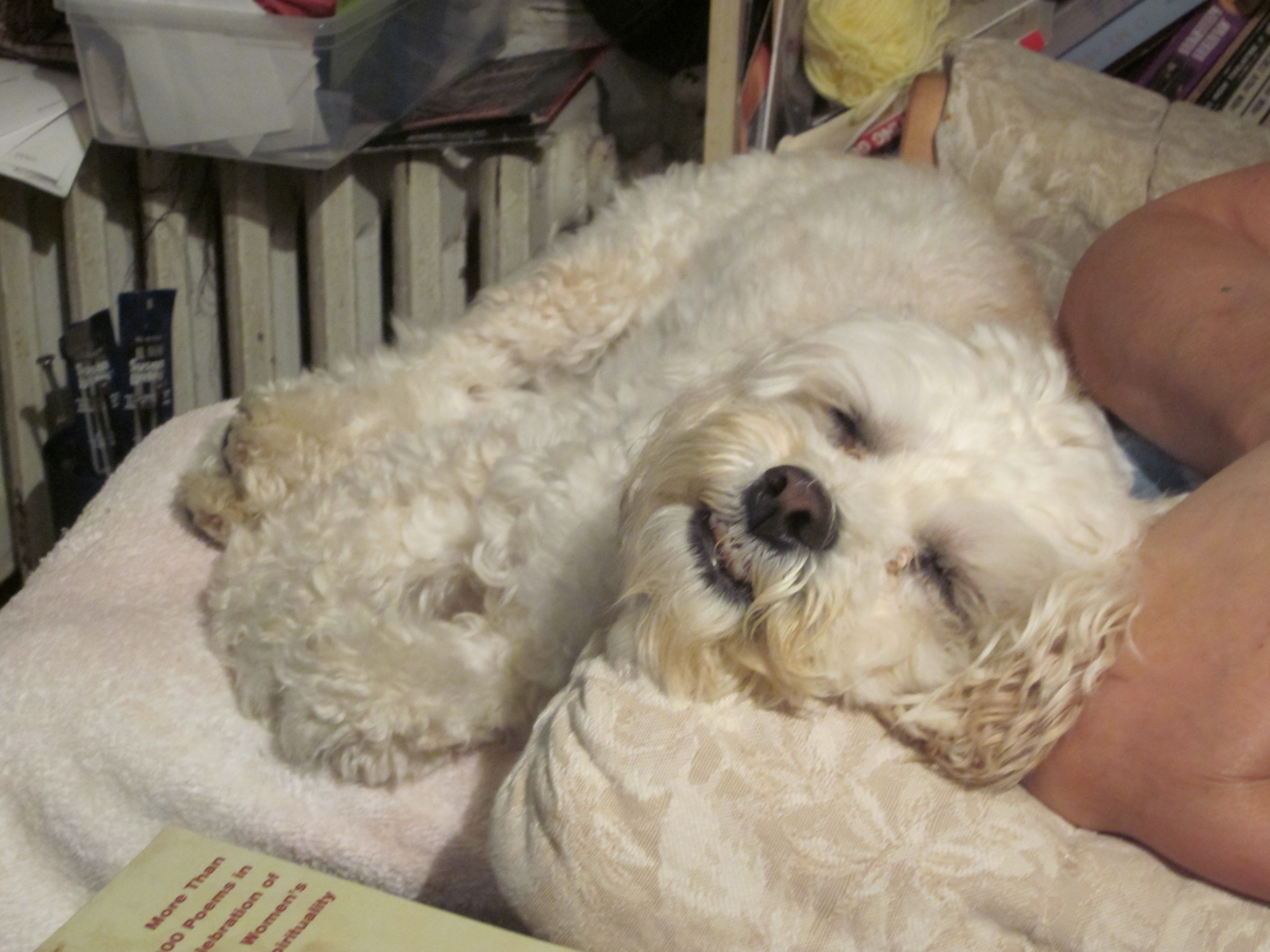
We started the great dog search before Christmas, because this seemed like the best way to use my vacation (as well as naps, lots and lots of naps). I was still experiencing occasional waves of grief over Miss Butterfly, but I felt a desperate need to at least try to find a second dog, someone small and gentle and loving. Cricket loves me, of course, but not like she loves her Grandma. She greets Grandma, and pines for Grandma, and guards Grandma, and, every once in a while, she comes over to visit with me.
IMG_0529_1

Cricket loves her Grandma

The first shelter we visited was about forty minutes away from where we live, with a friendly staff and separate buildings for different groups of dogs and cats. We walked through a hallway of barking dogs who were all a little, or a lot, too big for us, and then we met a Lhasa Apso. She was white-haired, eight years old, and had cataracts in her eyes, and it all made me stop breathing for a moment because she looked so much like Butterfly, with a bad haircut.

butterfly hair askew

But no one is as cute as my Butterfly was, even on a bad hair day

We left that building pretty quickly and were led over to the infirmary, where the little dogs were recovering from spay and neuter surgeries. There were Chihuahuas, a Pomeranian mix, a Dachshund mix, a senior Shih Tzu, and a Puggle. The Pom mix was adorable, but he snapped at the volunteer who opened his cage, so he wasn’t allowed out to meet us. Instead we visited with Ursula, a one-year-old Puggle. She was adorable, but we happened to have arrived just when the vet tech was filling Kongs with peanut butter, and Ursula was utterly distracted. Freed from her crate and on her own feet, she moseyed over to the tech, sat down, and gradually inched her butt closer and closer to the peanut butter. She was the right size, and terribly cute, but she barely looked at me. I felt like I should wait for some kind of spark, some flash of connection. Just being cute couldn’t be enough.

Of course, I felt guilty leaving her behind, even though the staff assured me that she’d be scooped up in minutes. There’s something awful about looking at abandoned dogs, and judging their looks and age and health and character, and then rejecting them as not the one. It makes me long for the days when I didn’t know about puppy mills, and could walk into a pet store and believe that beautiful puppies just grew on trees.

I built up the nerve to try again a few days later, and we decided to visit the shelter where we’d adopted Butterfly. They have an extensive medical program with subsidized care, so there was a safety net if I bonded with a dog who had some health problems. I’d seen a few small dogs on their website, some poodle mixes and dachshund and terrier types who all seemed around the right size and age to deal with Cricket. It was raining and cold, and we ran from the car with our hoods up to get to the adoptions building. But, because of renovations in progress, the adoptions had been moved to a smaller location, and the line of people waiting to see the dogs was outside and down the block. My emotions were still raw, with the guilt of leaving Ursula behind, and the gnawing pain of No-Butterfly, that the disrespect of making people wait outside in the freezing rain just to get a chance to fight over puppies enraged me. I knew the dogs would all be adopted, or fostered, or kept safe and warm and medically cared for, but I felt like the shelter was telling me that I didn’t deserve to be treated well. And I couldn’t accept that. Mom shrugged and followed me back to the car, and the day devolved from there into a huge pool of self-loathing and hopelessness that even chocolate couldn’t fix.

A few more days later, we heard about a shelter, more than an hour further out on the Island, where they had rescued a hundred small dogs from a hoarding situation. The website only had a few blurry pictures of the dogs in their original home, with no description of breeds or ages or health, but with a hundred dogs, we figured it was worth a try.

When we finally walked into the office, the woman at the front desk barely looked up from her computer and told us to look through the photo album on the desk. The pictures of the dogs were blurry and dark, with names under each picture, but no sexes or ages or descriptions. The first five names I mentioned had already been adopted, but then there was Twinkle. A volunteer brought him out and he was so much tinier than I’d expected. She put him in my arms and he shivered, in fear or cold, I don’t know which, but when I sat down and put him onto the bench next to me, he climbed back into my lap and held onto me. I looked into his eyes and he looked right back at me and then licked my nose. He could have been part Rat Terrier, part Chihuahua, part Schnauzer, but they had no idea. He loved the gentle scratches on his matted grey and brown and black coat. He was so much smaller than I was looking for, but I’d felt that spark, and it wasn’t going away. I asked the woman at the desk if she knew anything else about him, and she looked down at a sheet of paper next to her, and said, he’s nine years old. My heart broke. I’d promised myself, and Mom, that we wouldn’t get another senior dog, at least not this soon after Butterfly.

A volunteer came to take Twinkle back to his cage in the back, and I felt his absence immediately. Then someone turned on the lights in the little room next to us, and it was filled with more of the hundred dogs, but these were in the three to five year old age range. We were allowed to go in and sit with the dogs, still in their crates, and they very loudly asked to be let out. Some of them looked more Schnauzer-like, some more Dachshund-like, some with wiry red hair, and others with soft black hair, but they were all, obviously, related. We visited with a few of the dogs individually, and a staffer explained that the woman must have started out with a handful of strays, and then, since she didn’t spay or neuter, the family grew exponentially. They were an incest family. The dogs were all being adopted out to different families, but the backstory made me uncomfortable. The staffer told us that we’d have to bring Cricket in for a meet and greet, if we wanted to adopt one of the dogs (and no one else already had an application in on that dog), and then we’d have to bring the dog back to be spayed or neutered. They gave us the extensive adoption application and we left, to drive the long way home and think it over.

The trip home was, again, painful. All of the other dogs receded in my mind, except Twinkle. But Mom had serious concerns: not only was he a senior dog, but he’d spent nine years as an un-altered male in a house with no rules, and he might not understand that he couldn’t climb on Cricket; and we had no idea what health issues he might have, or how long he could be expected to live; and they had no subsidized medical program, and even if they did, we couldn’t drive more than an hour each way to make use of it.

I kept dreaming about Twinkle, though, and feeling sick at leaving him behind. I couldn’t figure out if the spark was because of his sweetness, or his neediness. I couldn’t separate out my healthy loving instincts from my possibly pathological ones, and I was overwhelmed. Mom hated watching me suffer, so back online she went, to see if there were any other dogs in the area. She found some prospects at another shelter we’d never heard of, about twenty five minutes away from home. This would be our fourth shelter in a very short period of time, but I was still on vacation, so off we went.

One of the dogs we liked was still available: a seven month old, black haired Miniature Poodle named Traveler. When we arrived and asked to see him, a handler took us to what seemed like someone’s living room, and then brought Traveler in on a leash. He had soft, curly black hair and big black eyes and he sniffed the whole room. I asked if I could sit on the floor with him, and within minutes he had brought over a tennis ball to play with, and started licking my face. When he got tired, he rested his head on my leg, tennis ball firmly in his mouth.

The handler warned us that we shouldn’t bond too much, because the application process would take a while, and the staff would decide who they thought was the best match for the dog, but I wasn’t worried. We filled out the two page application, including phone numbers for our vet, and three personal references, and lots of details about how we would raise the dog, and what our other dogs’ lives had been like, and on and on. In the car on the way home I was already planning the new toys we would buy, and the training classes we would take with Traveler, but I was also still thinking about Twinkle, and wishing I could have both of them. They would balance each other out, I said out loud, to which Mom said a big fat no.

Of course we didn’t get Traveler, but it took two weeks for the phone call to come telling us that he’d gone to another family. In the mean time I’d found out that Ursula and Twinkle had both found homes, and I was back in school and busy with work. I wondered if maybe the universe was telling me I wasn’t ready, but then the loneliness hit me again and I went back on Petfinder to look for more possibilities.

We brought Cricket with us to visit one dog at a PetSmart adoption event, but while the dog was adorable, he was completely uninterested in us, and barely even sniffed Cricket, which I took as a personal affront.
003

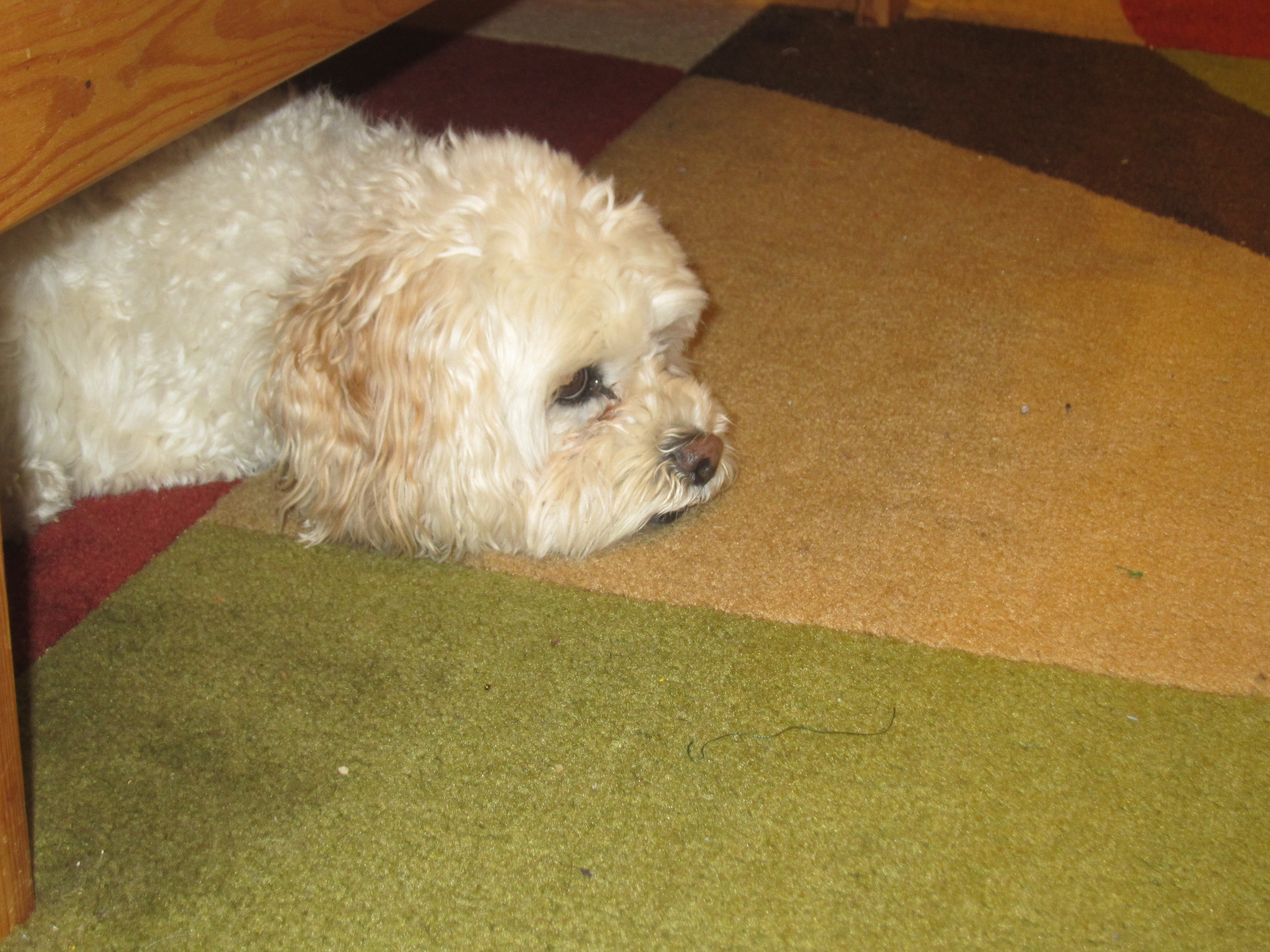
“Harrumph.”

I kept finding dogs at more and more shelters I’d never heard of, all over Long Island and in Queens and the Bronx and Brooklyn and Manhattan, but each rescue had their own application, and each one was more intrusive than the last. One rescue organization, in its online application, asked for a picture of your driver’s license and the names you use as aliases on social media. We applied for another dog in Queens, a black and white Maltese Shih-Tzu mix, but she was adopted before we could even finish the extensive application process.

We didn’t go through any of this when we adopted Miss Butterfly five years ago, because she happened to be eight years old, with health issues, and yet she was the one I wanted. Now that I want a younger, healthier dog, I see how competitive the Rescue market has become, and how much power the Rescues have to determine who qualifies as worthy. Adoption fees are much higher, applications are longer and more intrusive, and you’re still not guaranteed the dog you met and fell in love with, because someone else is, in the eyes of the Rescue’s staff, better suited to care for that particular dog.

In theory, this is progress. It means that people have learned to adopt, not shop, and fewer dogs are ending up in kill shelters; but it also leaves the power to decide who’s worthy of a dog in the hands of fewer people, people who have their own prejudices about what makes a good dog owner (able to afford higher adoption fees, owning a home with a fenced in yard, etc). I wonder if it’s like this across the country, or it’s specific to the northeastern US, or even just to Long Island.

It almost feels like it’s not worth the effort. I look at other people who walk into a pet store and leave with the exact puppy they were looking for, less than an hour later, or I think about Cricket’s breeder, who was friendly and responsible and raised the puppies in her home, with their Mom, and I wonder why I’ve committed to rescue a dog at all. But I know it’s because of Butterfly, and wanting no dog to have to go through what she did for her first eight years, producing puppies in a puppy mill. But all of these applications and rejections feel personal, and my inferiority complex, and guilt complex, and every other complex, is being kicked up like a dust storm that is going to choke me any day now.

I feel like I need twenty-four hour a day therapy to get through this process, or better yet a therapy dog, but Cricket doesn’t want the job. I have a sneaking suspicion that Cricket has been calling the Rescues to say, no, no, we’re not really interested. That would explain a lot.
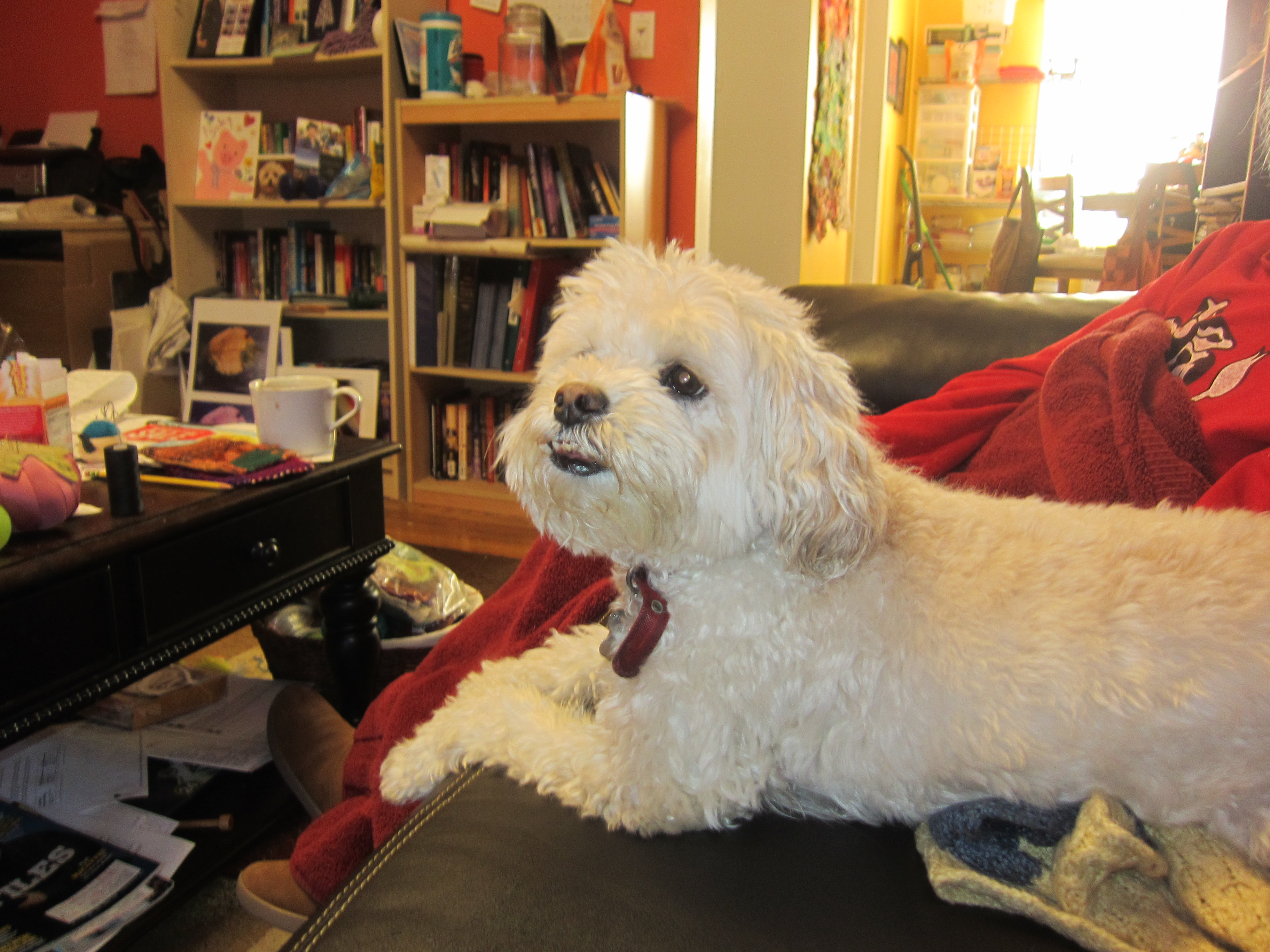
012

“Who me?”

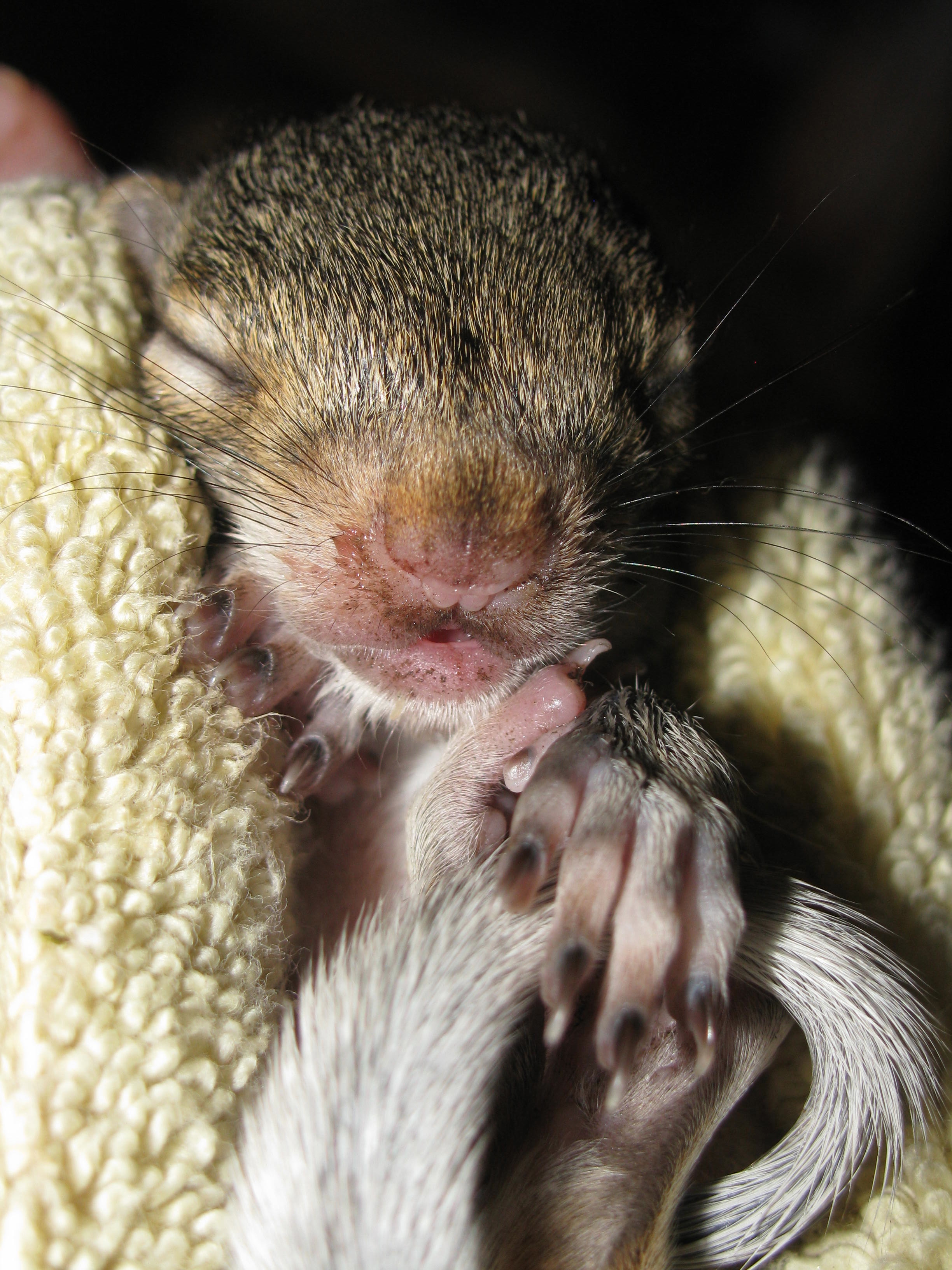
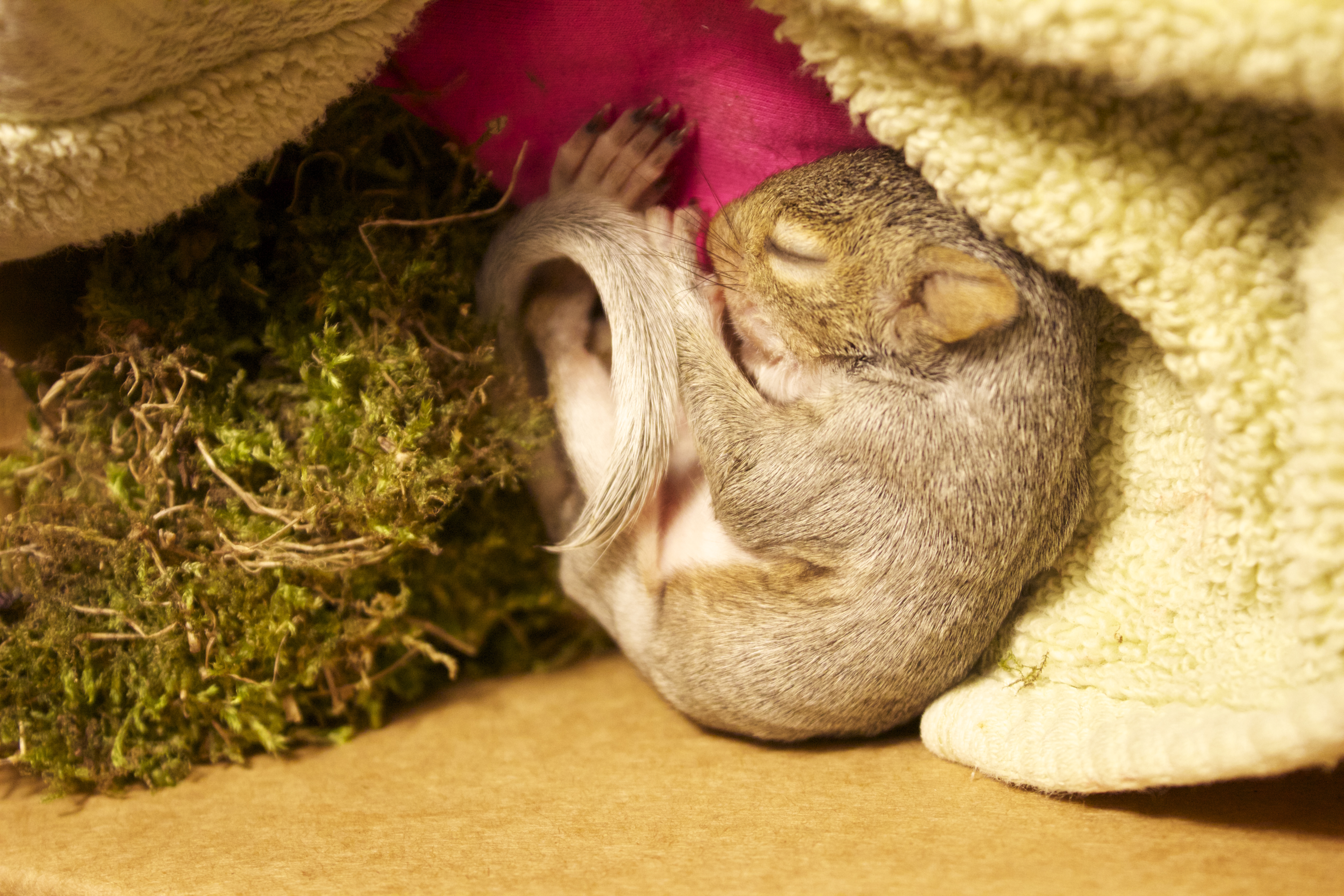
The Baby Squirrel


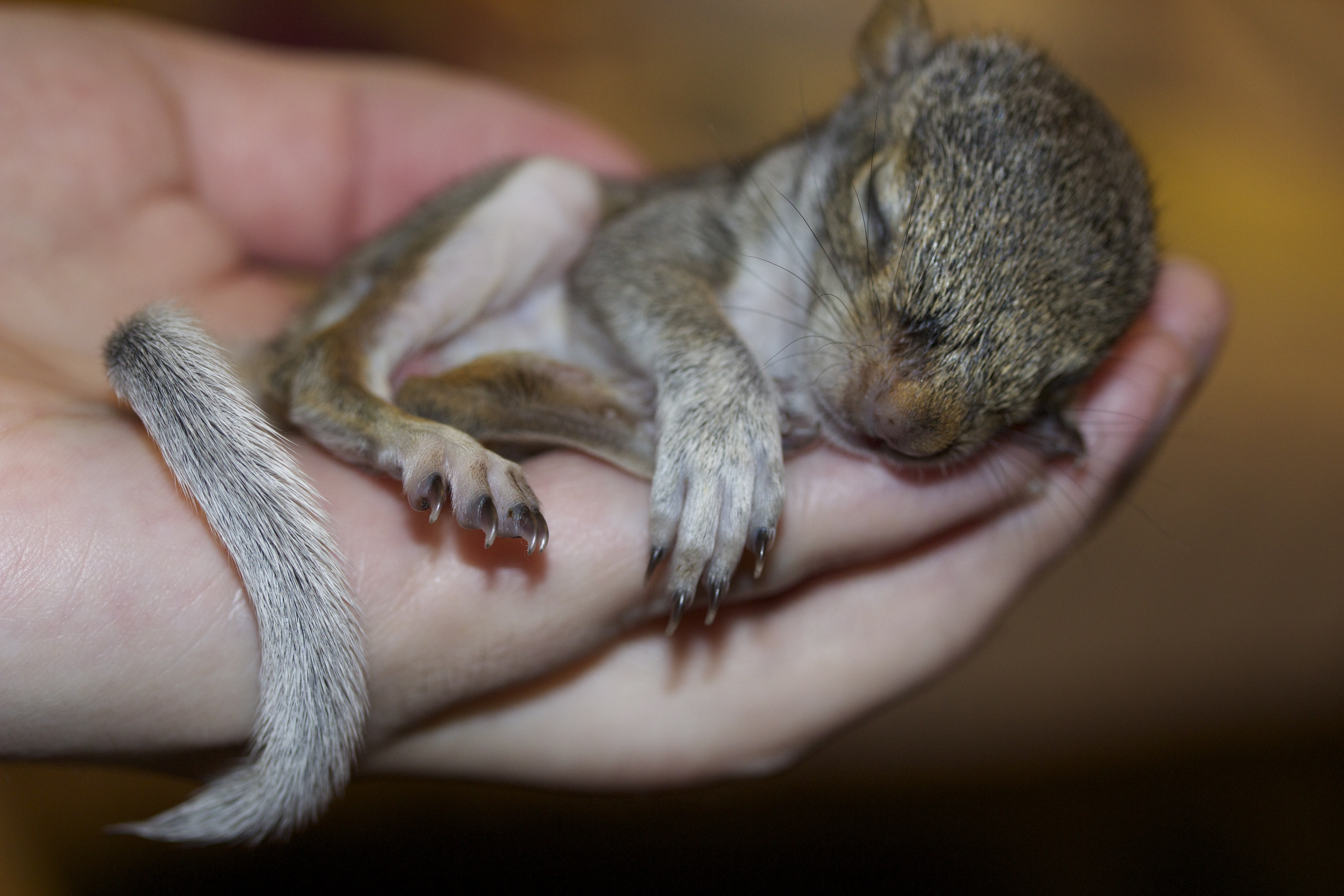
When we went out last Thursday morning for our too-early first walk of the day, Cricket found something. At first I thought it was a dead mouse. Cricket has found dead mice a number of times, because we have feral cats on the property who are allowed to stay because of their great mousing skills. So, I thought it was a dead mouse and I yanked Cricket away from it quickly. It was curled up a few feet away from one of the huge trees on the property, up in the lightly wooded area where we are encouraged to walk the dogs. Butterfly did her usual standing around and listening to the raindrops thing – oh yeah, it was raining, lightly by then, after a night of heavy rain – and it was a lovely sound, the way the rain drops hit the leaves far over our heads. But I was still getting wet. The girls both did their business, and we were on our way back out of the woods when I thought I saw the dead mouse move an arm. I stepped a little bit closer, but I’m afraid of dead things so not too close, and that’s when I realized that it was a tiny squirrel and not a mouse, with a big head, and grey and white fur, and not only was one arm moving, the tiny squirrel was breathing. It was alive.

I wasn’t sure what to do. I had to take the girls back inside, out of the train, first and foremost. I left them standing in the hallway while I went down to the basement to throw away their bag-o-poop, and I looked through the pile of Amazon shipping boxes outside the garbage room. I like ordering things, but I am nothing compared to my next door neighbors (with the new baby) who have ordered so many things that they now have to move into a house to make room for all of it. I chose a small, shallow box, with the new-fangled air-pillow box-filler stuff, and I popped the pillows to use it as a squirrel grabber, in case it really was dead and only seemed to be moving because of the wind and rain, but also as a temporary blanket, in case it was actually alive.

The girls watched me through the glass front door of our building as I went back out into the rain, and up the hill, to where Cricket had found the baby squirrel. It was still there, and still getting rained on, and still faintly breathing and moving an arm, but just barely. I picked it up carefully, all the time worrying that I should leave it there, to die a natural death, or to be found by its Mom after whatever calamity had sent her away. But it was alive, and I couldn’t just leave it there to die.

I took the box of baby squirrel inside to the girls, and we walked up the stairs and into the apartment, and that’s when I realized that I had to wake up my mom. She’s not a fan of early mornings, and I would have let her sleep through the drama, except that I knew I’d have to leave for my internship in less than an hour, and I needed her help.


As soon as Mom saw the baby squirrel, breathing in the shallow box on the dining room table, she was wide awake and in Mommy mode. She took the baby out of the box and wrapped it in warmed up towels and held it while I googled. There are surprisingly specific and comprehensive baby squirrel manuals online. One was long and alarmist – with the basic gist being that I should have left her out there in the rain to die. The other manual was shorter, simpler, and more hopeful.

005

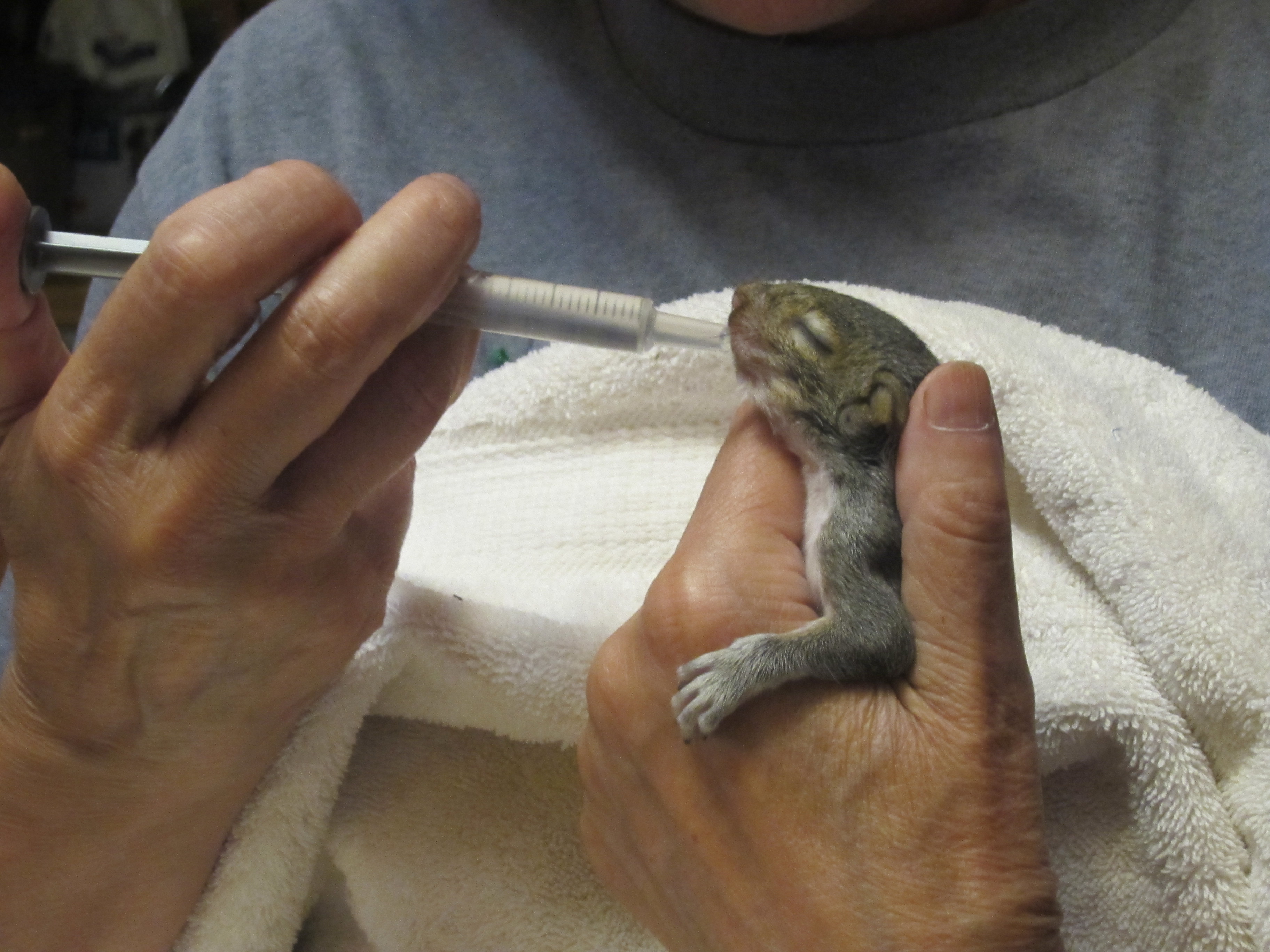
Then Mom called our vet’s office to ask them what to do. The woman who answered the phone said that they’d stopped working with their wildlife specialist and had no other recommendations, and, really, the baby squirrel was going to die. Mom persisted, though, and looked up other wildlife groups she’d heard of in the area, and left messages for them on email and voicemail. In the meantime, we prepared the rehydrating solution recommended in the baby squirrel guide and then and I used Butterfly’s supply of liquid medicine syringes to start bringing the baby back to life.

002

005

By the way, I am not an expert at identifying baby squirrel genitalia, but we later found out that she was a girl, so let’s just pretend I knew that from the beginning. We set her shallow box on a heating pad (on low), and filled the box with fabric from Mom’s quilting closet, because the baby squirrel guide said that regular towels could unravel and choke her.

I took care of Cricket and Butterfly’s morning routine, and made sure they got extra treats for all of their patience, and then I got myself dressed for work, charged my cell phone, and reluctantly left Mom to take on the burden of keeping the baby squirrel alive while I was away.

img_9840

Cricket sniffing the baby

img_9871

Butterfly, worried I’m giving her peanut butter to the baby.

I tried to talk about the baby with a fellow intern, but she looked non-plussed. “You brought a squirrel into your house?” She asked, looking at me like I’d slathered bloody entrails on my door posts. So I focused on being nice and pleasant and helpful all day, and tried to put the baby squirrel out of my mind. The room we work in is filled with windows, and I could see as the rain got heavier and heavier, so I thought, maybe, I’d done the right thing by taking the baby into a dry place. But my mind was still racing, telling me that I’d made a mistake bringing her inside, and she would die and it would be my fault. She had a fractured arm, and probably other injuries, she was cold to the touch, and her mother had abandoned her; who was I to think I could save her?
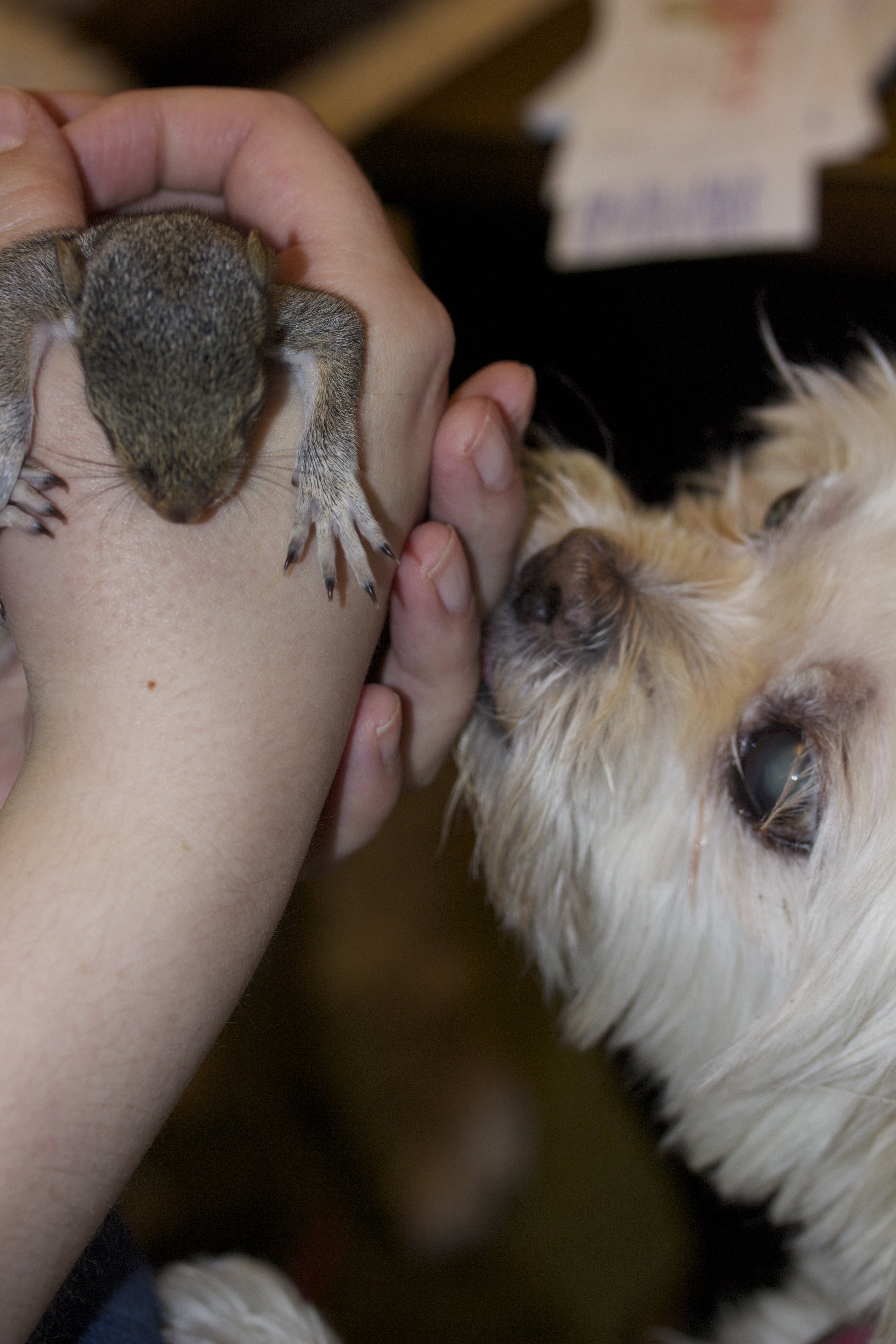
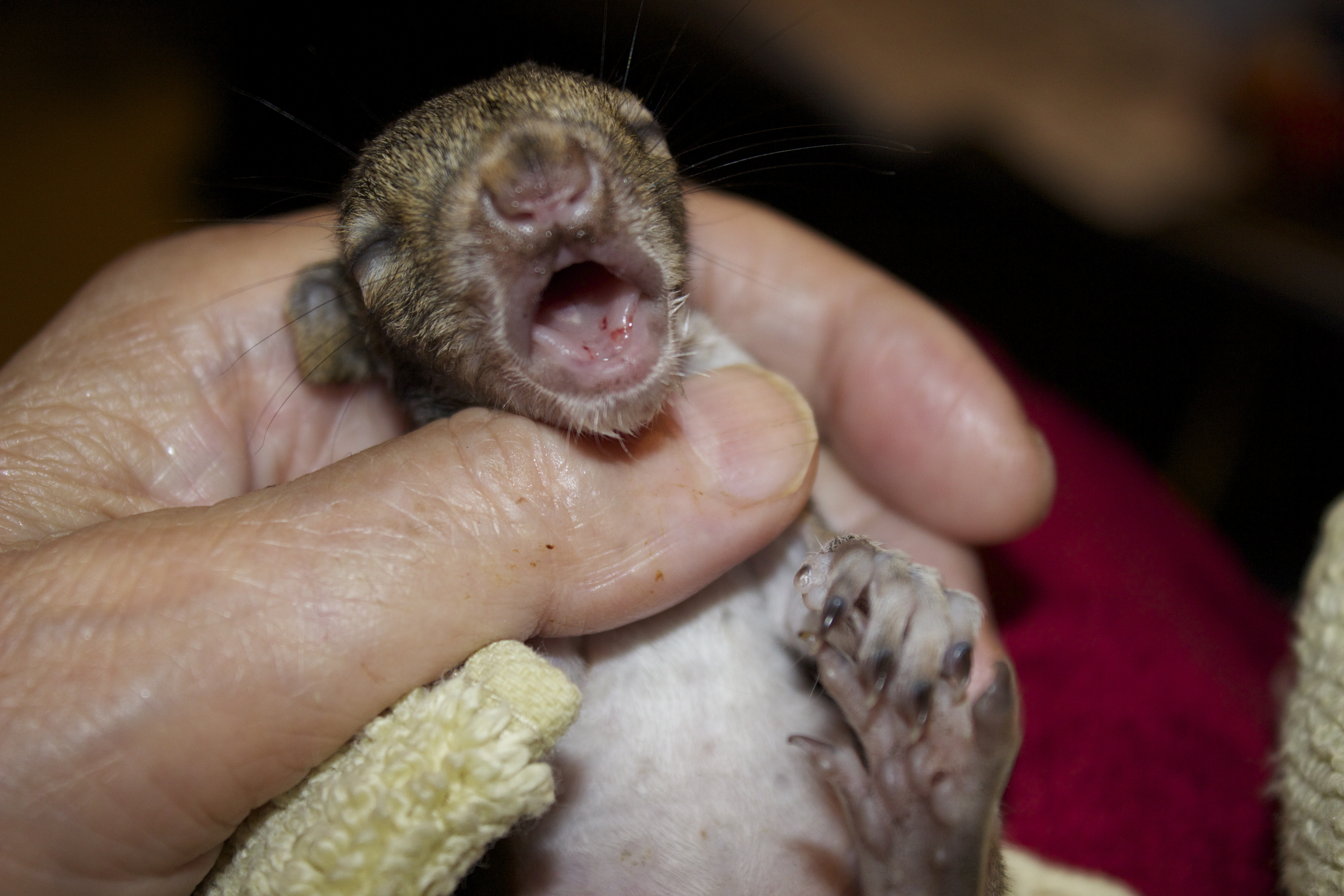
When I got home, Mom was sitting on the couch and the baby squirrel on her chest, squeaking away. Her eyes were still closed, but she was much more alert, climbing on Mom and grabbing her fingers with a paw. The baby had survived eight hours in our care, against all odds, and the next job listed in the baby squirrel guide was to move from rehydration to actual feeding. The guide said we needed Esbilac milk powder for puppies, and we should mix it with water and heavy cream to mimic squirrel mommy milk. I asked Mom if she wanted to go out and have a break from baby care, but she didn’t, so out I went again, in the rain and rush hour traffic, to find the puppy milk powder.

img_9843

“Squeak!!!!!!!!!!”
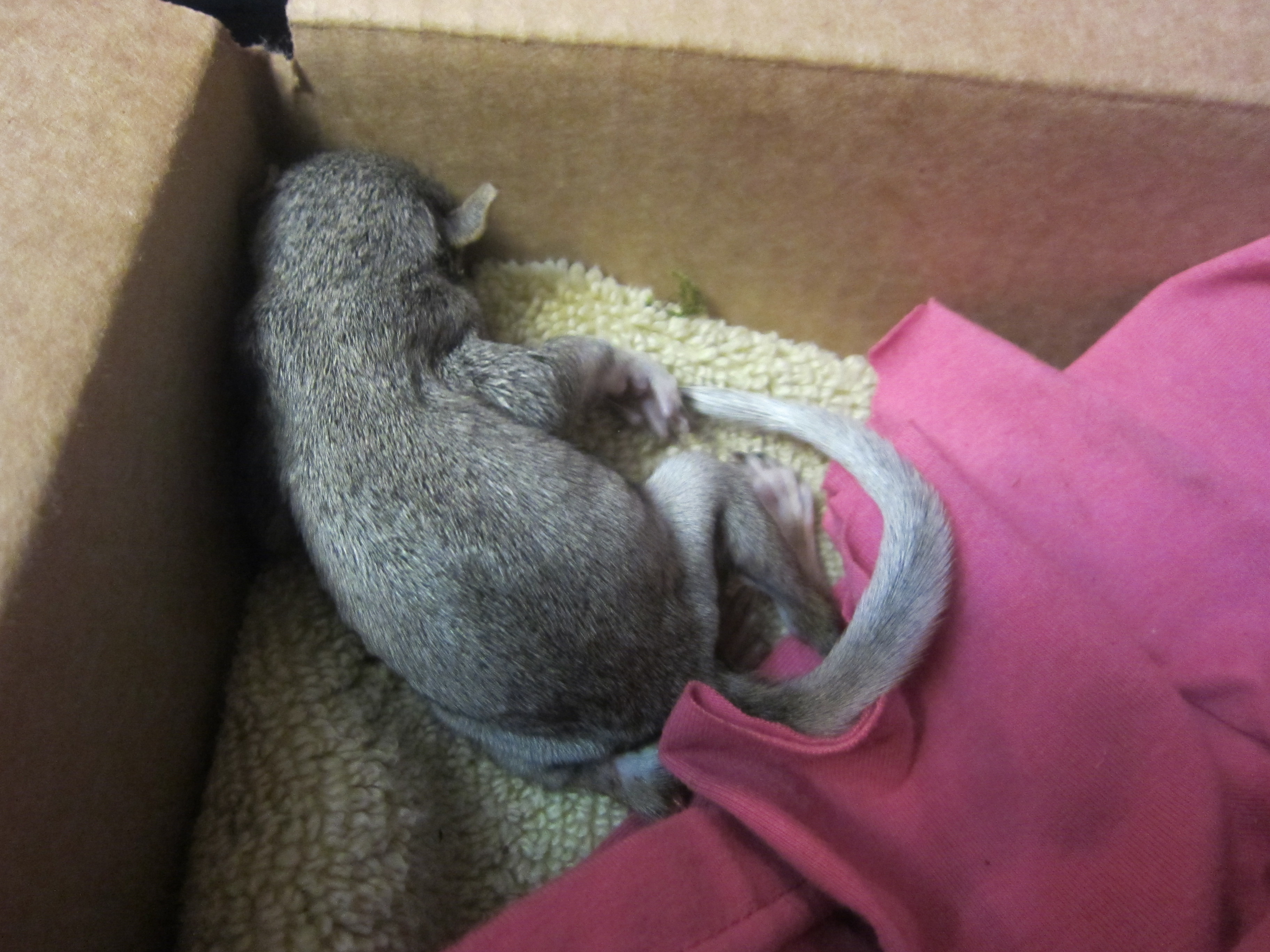
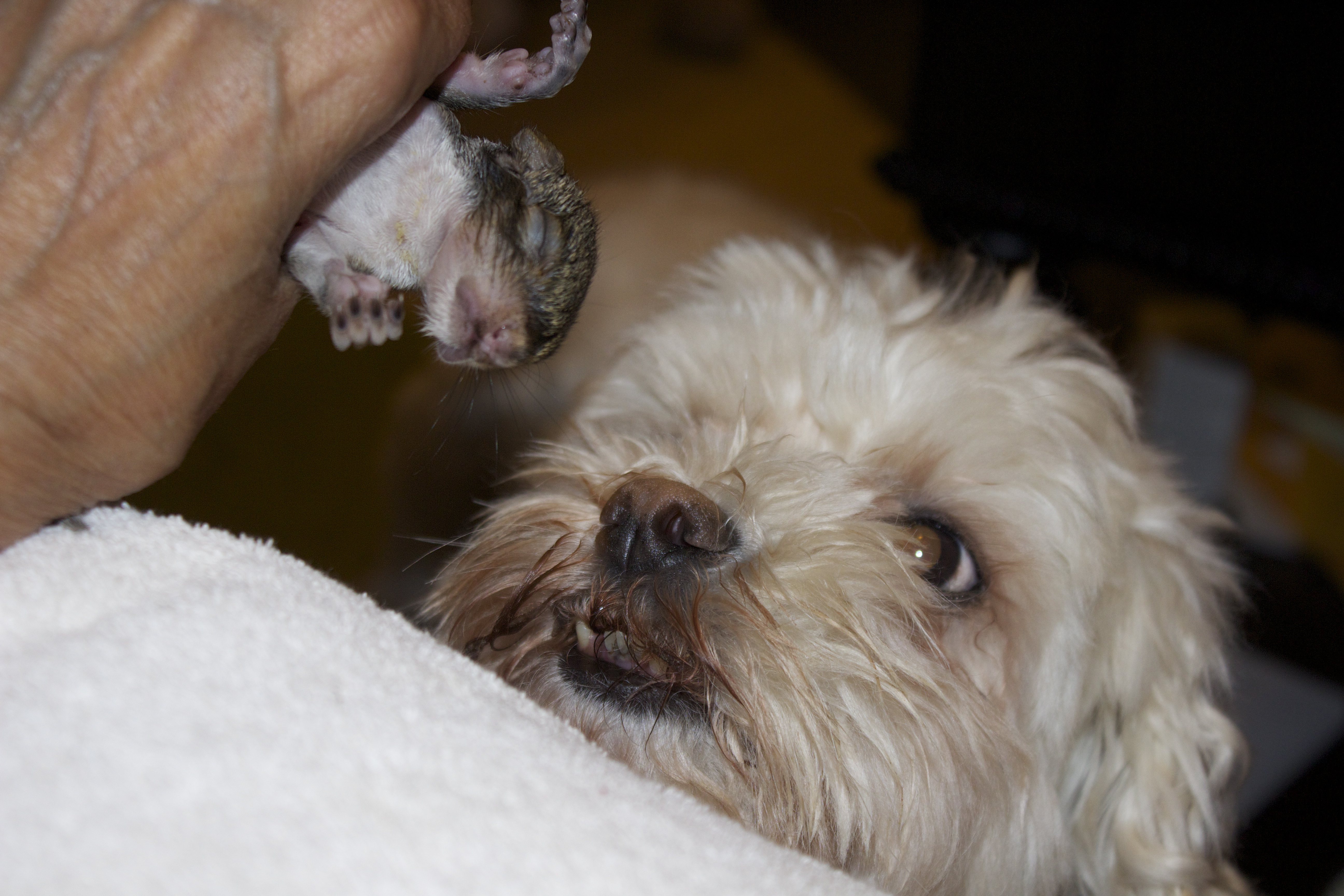
When I came back, it was my turn to watch the baby. Her body temperature kept cooling down between feedings, despite the heating pad under her box, so Mom told me to hold the baby in my hands and try to keep her warm myself. I had to keep Cricket from sniffing too close, but Butterfly was largely uninterested in the baby; as far as she was concerned, there was no squirrel in the house.

007

After another few hours of rehydration, we mixed up a batch of the new squirrel baby milk, and watered it down according to the mathematical formula in the guide, and warmed it in the microwave until it was just right. The baby squirrel swallowed her milk through the syringe dutifully, only pulling her head away a few times.

I woke up every few hours overnight to feed her, and to check that she was still breathing, and when I woke up again at eight o’clock the next morning I realized that she’d survived more than twenty four hours with us. She even seemed to be a little more energetic, though that could have been my wishful thinking. Mom said, pointedly, that we shouldn’t name her and risk becoming too bonded, but she knew it was already too late.

IMG_9857.jpg


We were still waiting for call backs from the wildlife groups a few hours later, when a friend on Facebook recommended calling other vets in the area, to see if they could help. The first one we looked up had the number of a local wildlife rescue, and when we called, they told us to bring the baby over right away.

By noon on Friday, we were on the road, the squirrel baby in her box on my lap, on our way to the rescue hospital. I kept my hand in the box to keep her warm, and she decided to crawl into my hand and snuggle.

IMG_5405.jpg


When we reached the Wildlife center, I filled out forms about where I’d found the baby squirrel and the assumed circumstances of her injury (a fall from the nest in the storm seemed the most likely cause, especially when I found some of the nesting material a few feet away from where I found the baby). They gave me her rescue ID number and their email address and said that I could write to them for an update whenever I wanted, and then they took her away.

I was devastated, but also hopeful. I knew that the rescue hospital would be able to do a much better job than I could at treating her wounds and feeding her correctly. Giving her up was the right thing to do, but it was also awful, and painful, and I was starting to have trouble breathing. I was giving her the best possible chance to survive, though, and I had to hold onto that.

I waited a couple of days to give the wildlife center a chance to do their work, but then I got impatient for good news, and wrote to them.

This was the email I received from them on Monday morning:

Unfortunately, we had sad news about the baby squirrel. We brought her to our veterinarian right away who confirmed that she did have a fractured humerus (one of the bones in her arm). In addition to the fractured arm, she also had lung contusions caused by trauma from the fall. We began treating her right away for the fractured arm and respiratory issue, but sadly, she was so badly injured that she passed away overnight that night.

While not the outcome we had hoped for, we are glad you brought her to us so she was able to get treatment and passed away in a quiet and peaceful place rather than outside in the wild.

Thank you again for caring about her and bringing her to our center.


I read it over again a few times, to take it in, because the words were not making sense at first, and then I just cried until I couldn’t cry anymore.

On Tuesday Morning, Cricket found another squirrel, this time a full grown adult, and this time, it was dead. My first, and enduring, thought was that this must be the baby squirrel’s mother. Maybe they both fell in the storm on Thursday morning, and it took the mother longer to feel the effects.

We dug a hole for her, and covered her with dirt, to keep her safe from predators. I couldn’t think of a prayer to say, all I could think of to say was, “This is for baby squirrel.”

And it was.

IMG_9847.jpg

p.s. Many of these pictures were taken by Naomi Mankowitz (AKA Mom)