Tag Archives: Yiddish

Talking Shpilkes

            Shpilkes is a Yiddish word that literally means “pins,” but has come to refer to “sitting on pins and needles,” or, feeling fidgety and nervous and needing to move.

            When I teach this word to my students, I tend to liken it to the ADHD symptoms they see in so many of their classmates (because even the undiagnosed kids seem to have shpilkes by the end of a long school day, which is when they come to me). This time, I was sitting with a mixed age group of kids, from second to sixth grade, for our twenty-minute elective period at the end of synagogue school for the day, and we were all exhausted and ready to go home.

            I gave them the option of sitting at their desks or on the floor, but most of them chose to sit at their desks, except for the one girl who chose to sit in my rolling chair, so I sat on the floor by myself. Whatever. As a warm up, I asked them to repeat the word “shpilkes” with me, over and over, because it’s just fun to say. We’d already done a session on Kvetching (complaining) before the holiday break, and I knew we weren’t ready to move straight to Kvelling (expressing joy at someone else’s accomplishments), so shpilkes was the next step on our Yiddish ladder.

“Kvelling sounds terrible.”

            Once they’d giggled through the word a few times, I asked them if they had ever experienced having shpilkes themselves, or if they knew someone else who struggled to sit still, and they told stories about friends who couldn’t sit still, or couldn’t shut up, though no one was willing to jump in yet and admit that they themselves might struggle with sitting still. Then, one girl raised her hand shyly and said, I know someone who’s the opposite. She can get so focused on reading a book that she doesn’t hear what’s going on around her.

I asked if anyone else knew someone who could get so caught up, or if they’d experienced something like that themselves, and the stories kept coming. And then one of them asked, do you know the feeling when a song gets stuck in your head and you can’t get it out! Which led to an in-depth discussion of earworms and what causes them and how to treat them. One girl had developed a whole theory, saying that earworms are caused when you forget some of the lyrics to a song you like, so your brain just keeps repeating the song to try and remember the lost words. Her suggested treatment was to go to Spotify and listen to the song until the earworm crawled away in defeat, which, she said, worked every time.

            Aren’t our brains fascinating?! I said, from my seat on the floor. By then, one of the students had joined me on the floor, because all this talk of shpilkes had reminded him that chairs and desks are confining and it’s much more comfortable to stretch out.

            But, what about when one friend has shpilkes and the other friend has to deal with the consequences? Because, my friend keeps getting us into trouble when she talks in class, and she can’t help it, but we’re going to get kicked out and I really like that class.

To which one of the younger boys said, Yeah, it’s hard when you can’t understand why someone acts the way they do, even though you still like them and want to spend time with them. I’m paraphrasing, but only a little.

            And with minutes left to go, and so many more stories to tell and hands raised and legs swinging, I asked them if they’d ever seen a show called Glee (a few of them had, actually. Streaming makes everything new again). Glee was a TV show about a high school glee club, where they often took two songs from different genres and mashed them toegther, and sometimes, not all the time, the mash-up allowed us to hear each song in a new way because of how the two songs spoke to each other. The kids didn’t even need me to hammer the point home. They already had their hands up with stories to share about their friends who are really different from them but make life so interesting.

            Of course, my most literal student asked if I could supply examples, and I did try to find something from Glee on my phone, but the dismissal announcement interrupted me, and then we had to focus on listening to the walkie talkie calling out names one by one. But even then, more stories were spilling out, and each story reminded someone of another story, and another.

            It doesn’t always go like this. My current regular class has so much collective shpilkes that it feels like we’re hiking through a tornado just to get from the beginning of a sentence to the end. But sitting on the floor, listening to the stories flow around the room, reminded me that they all have so much going on inside of them, and sometimes, if I’m very lucky, they will share their stories with me in a way I can hear them.

“I only get Shpilkes in the middle of the night, when everyone else is sleeping.

If you haven’t had a chance yet, please check out my novel, Yeshiva Girl, on Amazon. And if you feel called to write a review of the book, on Amazon, or anywhere else, I’d be honored.

            Yeshiva Girl is about a Jewish teenager on Long Island, named Isabel, though her father calls her Jezebel. Her father has been accused of inappropriate sexual behavior with one of his students, which he denies, but Izzy implicitly believes it’s true. As a result of his problems, her father sends her to a co-ed Orthodox yeshiva for tenth grade, out of the blue, and Izzy and her mother can’t figure out how to prevent it. At Yeshiva, though, Izzy finds that religious people are much more complicated than she had expected. Some, like her father, may use religion as a place to hide, but others search for and find comfort, and community, and even enlightenment. The question is, what will Izzy find?

Yiddish Storytelling

(This post was written before today’s attack on Israel by Hamas. I have no words, except to say that I’m sending love and prayers to family, friends, teachers and classmates in Israel right now. I will leave it to politicians and journalists to describe what is happening on the ground, but I decided to post this essay, about the joy of teaching Judaism to Jewish children, because that joy is a big part of what keeps me going and I hope it helps others too.)

            This year for my synagogue school elective, I’m teaching Yiddish, sort of. More like I’m teaching the kids some of the Yiddish words that have become popular among American Jews, so they can feel like they are part of the club when people around them are kvetching (complaining, whining) and kibbitzing (chatting, gossiping) and kvelling (expressing great pleasure and pride in someone else’s achievements) over a nosh (a snack) of bagels and lox.

“I like to nosh!”

            The hardest part of planning the class was trying to limit the number of words I would teach them. I mean, you have to do verklempt (choked up with emotion) and schlep (drag something, or drag yourself somewhere) and chutzpah, but how can you leave out farshtunkene (stinking, rotten, contemptible) or bupkes (nothing, literally “goat droppings”)?

            At first, I thought I would use video clips of famous comedy routines or movie scenes to help them get a feel for how the words are said, but most of the clips were way too grown up in content, or so chock full of Yiddish words that the kids would have been overwhelmed. So I decided to go with theme days, and have the kids tell their own stories using Yiddish words on that theme. For Chutzpah Day, I decided to leave it at just the one word, because everyone has chutzpah stories: times when they had the chutzpah to speak up or take action, times when they didn’t have the chutzpah to do something they wanted to do, and plenty of times when someone else had the chutzpah to do something crazy nearby. And for Oy Vey Day, of course, we start with Oy Vey, the classic expression of dismay and then plotz (exploding or fainting with emotion) and shpilkes (restlessness, or “sitting on pins”), which pretty much every child in synagogue school experiences everyday.

Oy Vey.”

            But I started with Kvetch Day, because I knew the kids would have a ton of complaints that they needed to get out, and the chance to vent, while saying funny words that make you spit or cough, is priceless. They go through so much tzuris (troubles, worries, suffering) in their daily lives, and there are so many times when brothers or sisters are nudniks, interfering with games or bothering them endlessly, and of course when your friend gets a new iPhone for Hanukah and you get socks, which is worse than bupkes, it stings.        

“Every day is a Kvetch day.”

My own adventures in Yiddish have been meaningful to me, which is why I wanted to bring it to the kids, at least in a lighthearted way. The language itself is a history of where Jews lived over a thousand years, picking up new words from each new town and city they lived in, a lot from medieval German, but also from Polish and Russian, and plenty from Hebrew itself.

            I wish I knew more about Ladino, the language of Jews from the Iberian Peninsula, who had to leave during and after the Spanish Inquisition. Ladino is based on an old version of Spanish, mixed with Hebrew, and just like Yiddish, picked up words as the people who spoke it traveled to new homes in Amsterdam, and South America and the Ottoman Empire, again with Hebrew laced through it like the blue thread woven through the tzitzit.

            There are so many other Jewish languages, from all the different places where Jews have lived, because the Hebrew from prayer and study bled into the language of the market place automatically as they lived their daily lives.

            We’re living through a period, now, where diversity is celebrated, and it’s ok, with most people, that Jews often maintain their own customs and languages as well as becoming full-fledged members of the communities where they live. But historically, that wasn’t the case. Even when Jewish separateness was enforced by the local governments, keeping Jews out of certain neighborhoods and professions, it still bothered the locals that the Jews had their own ways of living, and their own languages in which to do it, because you never knew what they were saying to each other.

            But right now, when everyone is allowed to celebrate their unique cultures, of food and music and language and fashion, Jews are feeling freer to celebrate it too, and to celebrate all of the different cultures that have been woven through Judaism over the millennia. There are tons of cookbooks for Jewish foods from the Middle East and Eastern Europe and South America and North America, and Jewish families on Long Island are eating foods from Morocco and Jamaica and Russia and Ethiopia at their Passover Seders, as a way to honor the diversity of the Jewish people, and because they’re really yummy.

            What I want most for my students is that they will gradually grow their idea of what it means to be Jewish, so they aren’t limited to what they see in their own communities on Long Island, but can also see that Judaism has existed and transformed over and over again in a million different forms, and therefore there will always be room for them to bring their own unique ideas to the table. And I want them to know that their own stories are just as important as Abraham and Isaac and Jacob’s and Tevye and Herzl and Golda’s. I especially want them to know that the Jewish people have always been complainers, and have grown and changed and lived good and interesting lives as a result of having their say. I want them to know that their voices are to be celebrated and heard, no matter how much phlegm they cough up along the way.

“Nu, we’re listening.”

If you haven’t had a chance yet, please check out my Young Adult novel, Yeshiva Girl, on Amazon. And if you feel called to write a review of the book, on Amazon, or anywhere else, I’d be honored.

            Yeshiva Girl is about a Jewish teenager on Long Island, named Isabel, though her father calls her Jezebel. Her father has been accused of inappropriate sexual behavior with one of his students, which he denies, but Izzy implicitly believes it’s true. As a result of his problems, her father sends her to a co-ed Orthodox yeshiva for tenth grade, out of the blue, and Izzy and her mother can’t figure out how to prevent it. At Yeshiva, though, Izzy finds that religious people are much more complicated than she had expected. Some, like her father, may use religion as a place to hide, but others search for and find comfort, and community, and even enlightenment. The question is, what will Izzy find?

Chutzpah

            Just the other day, someone described me as having chutzpah, because of some small thing I said in a meeting that no one else seemed willing to say. I wasn’t sure if I was being complimented or not, or even if chutzpah was the right word for such a small thing, but the moment stuck with me.

            According to Wikipedia, chutzpah is a Yiddish word meaning audacity. It has strong negative connotations, but can also be interpreted in a positive way, as courage or guts. It’s originally from the Aramaic/Hebrew root word “Chataph,” meaning insolent or impudent, and is often used to refer to someone who has overstepped the boundaries of polite behavior.

And I can see that in myself, because I’m not especially good at being polite. I’ve often gotten in trouble for saying things I didn’t know I wasn’t supposed to say. Chutzpah, even the saying of it, requires impoliteness, like coughing up phlegm, and not being so lady-like or quiet.

“You should have named me Chutzpah instead of Cricket. This is me!”

            If we stick with the root word, chataph, and define chutzpah as insolence or impudence, both of those words describe the behavior of someone with less power towards someone with more power, and that fits with the origin of my impolite behavior, in childhood. A parent can’t be impudent or insolent towards their child; they can be mean, insensitive, hurtful, etc., but a child can be impudent or insolent towards a parent or other adult, breaking the rules of conduct and risking punishment by ignoring the rules imposed on them.

            Yiddish as a language overall has chutzpah. It’s heretical, and powerful, and antagonistic to the norm, and in my quiet way I am all of these things; not because I want to be, but because my reality is so different from what I’ve been told to expect.

Yiddish almost became a dead language, when the majority of Yiddish speakers were killed in the Holocaust, but it’s coming back to life, and I think that’s because it serves a much needed purpose. Yiddish is about seeing the world from an outsider’s perspective, and poking a finger at those in power, and being subversive, and funny. It’s a language that is used to talk behind someone else’s back (preferably someone who doesn’t understand Yiddish), or to take the stuffing out of a person (who does understand Yiddish), or to complain about a frustrating reality, or to do some truth telling instead of trying to calm the waters.

            As I said in the beginning, my form of chutzpah is generally a willingness to say what no one else in the room will say: that the emperor has no clothes on, or that the elephant in the room is starting to smell. I’ve done that from early childhood, not because I wanted to be disruptive or rude or audacious, but because I couldn’t figure out why no one else was acknowledging the obvious, and it hurt my brain to try to pretend things weren’t happening when they were. I don’t mind politeness in general, I just mind it when it is hiding important truths. Like, let’s not pretend that the guy in the doorway with a gun is just coming over for tea, okay?

“But are there snacks to go with the tea?”

            I read another definition of chutzpah, though, that said that someone with chutzpah is someone who ignores what others think, and denies personal responsibility for their actions, and lacks remorse, regret, guilt, or sympathy. And that’s not me at all. But it’s hard to get a handle on a word that means so many different things to different people. It’s not a word like, say, light bulb, which everyone will understand in pretty much the same way.

            I had an English teacher in High School who made us memorize definitions for our vocabulary words, and if even one word varied from the exact definition she’d given us, we’d lose points. She didn’t test us on our ability to comprehend the word in context, or to use it in a sentence, instead she treated every word as if it had an exact and unchanging meaning. Except, words aren’t like that. Words are adopted and adapted to fit the current needs of the speakers of the language. I see this every week in my online Hebrew class, where words I learned thirty years ago have gone out of style, or picked up new baggage from how they’ve been used on the street or in business or in politics in Israel.

            I’d like to think that if I do have chutzpah, it’s the good kind and not the sociopathic kind, but most of the time I feel like I don’t have enough chutzpah, or self-confidence, or whatever it takes to really make a mark in the world, and make change. It takes so much energy to speak up in a discussion, and argue against the speaker’s certainty, only to find out later that mine was actually the majority opinion in the room but no one else felt free to say anything. I’d rather not have to fight at all, honestly, but that doesn’t seem to be an option. So, maybe next time I have to be chutzpahdik and speak an impolite truth, someone else will stand up and be chutzpahdik with me. God, that would be so much better.

“We’re with you!

If you haven’t had a chance yet, please check out my Young Adult novel, Yeshiva Girl, on Amazon. And if you feel called to write a review of the book, on Amazon, or anywhere else, I’d be honored.

            Yeshiva Girl is about a Jewish teenager on Long Island, named Isabel, though her father calls her Jezebel. Her father has been accused of inappropriate sexual behavior with one of his students, which he denies, but Izzy implicitly believes it’s true. As a result of his problems, her father sends her to a co-ed Orthodox yeshiva for tenth grade, out of the blue, and Izzy and her mother can’t figure out how to prevent it. At Yeshiva, though, Izzy finds that religious people are much more complicated than she had expected. Some, like her father, may use religion as a place to hide, but others search for and find comfort, and community, and even enlightenment. The question is, what will Izzy find?

Duolingo Yiddish

            My Duolingo adventure started a few years ago, when I was looking for a way to learn Yiddish online. I wasn’t up to going to an in-person class, and the Yiddish for Dummies book didn’t do much for me, but I couldn’t find a good, free Yiddish app. Instead, I decided to brush up on my Hebrew and learn German on Duolingo, in the hopes that the two languages would mush together in my brain and magically become Yiddish (The Yiddish language is written in Hebrew letters, but is largely based on German, with words also borrowed from many other Eastern European languages, like Polish and Russian).

“Voof.”

Earlier this year, after I wrote a blog post on my difficulties with visual learning and “reading” pictures, someone suggested that I could try learning an ideographic language, to see if that would be a useful step for me. I’d actually spent a semester in college learning Egyptian Hieroglyphics, but since Duolingo didn’t have a course in that, I decided to try Chinese, just to see if the pictures really could help me to remember the sounds and meanings of words in a way “regular” letters could not.

            And I discovered that Chinese is really, really hard. I don’t know if it’s the unfamiliar ideograms or the wide variety of subtly different sounds in Chinese that make it so hard for me, but I kept trying.

            Not long after I started my struggles with Chinese, Duolingo started to advertise a new Yiddish program, and I was thrilled! I immediately had plans to read Sholem Aleichem in the original Yiddish and connect to my Eastern European Jewish roots and maybe even work on my Yoda impression. But every time I checked through the language options on the Duolingo app on my iPhone, Yiddish wasn’t there. Finally, I went to the Duolingo site on my computer, and there it was: Yiddish. It seemed that the Yiddish program was still in the Beta phase of development and that meant it only worked on my computer for some reason.

            I tend to do my Duolingo practice in bed, as a way to relax before going to sleep, so the idea of having to sit up at the computer to study just seemed wrong. But I did it. And I found that my Hebrew/German mishmash really had helped me, because I was able to test out of a bunch of the early lessons of Yiddish, despite the fact that letters that were silent in Hebrew were used as vowels in Yiddish, and vowels that made one sound in Hebrew made another in Yiddish (though I found out later that that may not be universal, but specific to the dialect of Yiddish taught on Duolingo).

“Oy.”

            Despite all of the differences, the lessons were addictive, and I was racking up points on my Duolingo account that I was ready to spend on Chinese lessons, except, when I went back to my iPhone app that night the system got confused and logged me out. I had to reset my password just to get back onto the app, and I realized that, for some reason, using the Beta Yiddish program on the computer made my iPhone angry, or jealous, or something, and discombobulated the whole system.

“Grr.”

            So, I’ve been staying away from the Yiddish program, mostly because I’m too lazy to sit up at the computer to study when it’s so much easier to lie down, but also because I’m too lazy to come up with yet another new password when I inevitably have to reboot the app on my phone. In the meantime I’m still practicing my German and my Hebrew, and French, and Spanish, and every once in a while I get up the nerve to try another lesson in Chinese, but only when I have a lot of points saved up so I can make a thousand mistakes and still finish a whole lesson.

            Continuing to study German has its own benefits too, beyond prepping for Yiddish, because I discovered that there are a lot of German language murder mysteries on Hoopla, the streaming service I get through my library. I was running out of English language mysteries to watch, so being able to tap into all of the shows in German has been a life saver.

My hopes are still high, though, that once I can do the Yiddish lessons on my phone, in comfort, I will progress quickly to spouting yiddishisms everywhere I go and annoying everyone I meet. I’m a patient person, if not an energetic one. I can wait.

“Me too!”

If you haven’t had a chance yet, please check out my Young Adult novel, Yeshiva Girl, on Amazon. And if you feel called to write a review of the book, on Amazon, or anywhere else, I’d be honored.

            Yeshiva Girl is about a Jewish teenager on Long Island, named Isabel, though her father calls her Jezebel. Her father has been accused of inappropriate sexual behavior with one of his students, which he denies, but Izzy implicitly believes it’s true. As a result of his problems, her father sends her to a co-ed Orthodox yeshiva for tenth grade, out of the blue, and Izzy and her mother can’t figure out how to prevent it. At Yeshiva, though, Izzy finds that religious people are much more complicated than she had expected. Some, like her father, may use religion as a place to hide, but others search for and find comfort, and community, and even enlightenment. The question is, what will Izzy find?

Learning German


A few weeks ago I went on my regular online search for a way to learn Yiddish. I keep looking for a program that will start where I am (at the beginning), and maybe give me some idea of why Yiddish seems to be filled with words I still feel too young to use. But none of the free language learning sites offer Yiddish, and the sites that charge a fee for each lesson are often too advanced for a beginner like me. Then I came across someone who suggested learning some Hebrew and German first, before starting one of the difficult Yiddish classes. So I added German to my Duolingo and Lingvist accounts, and tried to reassure Cricket that she would not have to learn yet another language along with me. She was not convinced.

001

“Je ne comprend pas.”

The first time I heard German words coming out of the speaker on my phone, though, I felt like I needed to lower the volume, to hide some hideous crime; I didn’t realize how emotionally loaded the German language would be for me. Like when they taught me the word for “work”: Arbeit. My mind automatically finished the sentence to Arbeit Macht Frei, “Work will make you free,” the motto on the gates to Auschwitz.

So many German words were familiar to me, even though I was sure I knew no German ahead of time. Some were familiar because they are pretty much the same in English, like perfekt for perfect, Haben for have, ist for is, etc. Some were familiar from the last names of so many Jews: Blume (flower), Berg (mountain), Stern (star), Baum (tree), Schreibe (write).

Essen and Fressen were also familiar words, because some time in my childhood my father tried to make a joke about people who eat like animals, and I didn’t get it, so he had to explain that Essen is eat, for people, and Fressen is eat, for animals. I don’t remember who he was trying to insult at the time. Schmutzig, for dirty, was familiar too, as in, you have some schmutz on your face. Then there was schmuck, which Duolingo said was the German word for “jewelry,” despite the fact that, for my whole life, I knew it as the Yiddish word for a part of the male anatomy.

One early discovery was that in the German language words can be capitalized in the middle of sentences. I used to get in a lot of trouble for throwing in unnecessary capital letters in High School English classes (this was back when assignments were handwritten, and not spell checked and grammar checked and emailed to the teacher). I realized that I may not have been making up my own rules out of thin air, as one teacher had suggested, and instead was just using the grammar rules of the wrong language.

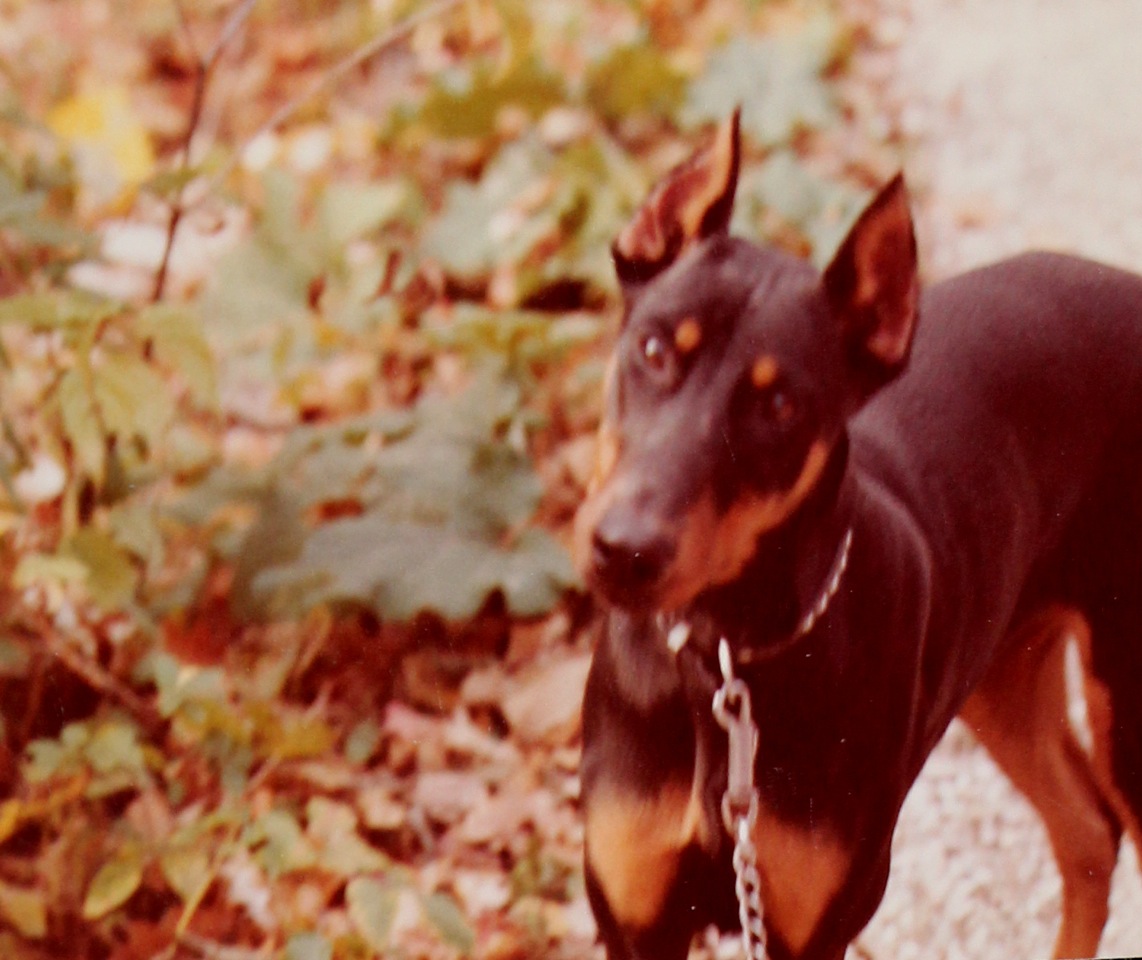
I may have taken in more German than I’d realized in my childhood. My father did have a habit of speaking to our dog in his high school German, and I heard random Yiddish words whenever I was around older Jewish people (which was often), and I watched plenty of Holocaust and WWII movies over the years.

IMG_0560

“Ich bin ein Doberman Pinscher?”

It’s a funny thing. Politically, Germany has managed the aftermath of the Holocaust better than most other countries (certainly better than Poland, where they recently made it illegal to even suggest that Poland had any connection to the Holocaust). In Germany they educate their kids from an early age about what their grandparents and great grandparents did, and why it should never happen again. Yes, they still have neo-Nazis and white supremacists and fascists, but so does the United States. But despite all of that, I can just barely listen to a computerized voice speaking simple German words, and I’m still overwhelmed with words that remind me of things I wish I could forget.

I grew up with kids whose parents would never have bought a BMW or a Mercedes, because they were German-made cars, and Germans would benefit. I grew up with Holocaust survivors telling their stories, at school, and synagogue, and in books. This is my history. But maybe learning some German will help me come to more peace around this history, or at least help me to articulate what still resonates in my bones. One thing I know for sure is that German will give me a bridge to Yiddish, which is worth a lot to me.


IMG_0876

“Danke”

Talking To Dogs


My father used to yell at our Doberman Pinscher in German. It’s possible that he added in some Yiddish, but he made a point of saying that you should speak to a German dog in German. The rest of us spoke to her in English, though, and she seemed to be fine with that.

"Huh?"

“Huh?”

I have a habit of dropping into Hebrew or French for a word or two, rarely for a whole sentence, because I’m not fluent in either language. I don’t know why I do it. Maybe I’m just pretentious and annoying, but I like the way the different languages sound, with the hard square letters of Hebrew, and the rolling curlicues of French. Cricket can understand up to the number three in French, because that’s how I taught her to jump up onto the bed, Un, deux, trois, Jump! (See, I can’t even stay in French for four words!) With Hebrew I tend to stick to short phrases, like “Where is…?” or “Thank you” Or “Why?” And Cricket tilts her head and nods. She’s a savant.

"I understand everything you say. I just disagree."

“I understand everything you say. I just disagree.”

Butterfly has a whole different vocabulary. It’s as if the girls speak, or at least comprehend, two different languages. I can’t use the same words to communicate with both of them at the same time. I’ve noticed that they choose the words or signals they will respond to more than I do. It’s like they are flipping through a book of fabric swatches until they find one that speaks to them. Just because I repeat something a hundred times doesn’t mean they will pick it up, but I can do something just once, and it clicks forever.

"Mommy?"

“Mommy?”

I wonder if, given a chance, this is how people would be too, if forcing everyone to use the same language, while very convenient, is cutting off huge swaths of natural language.       What if I was born to speak Hindi and my whole life I will be missing pieces of my soul because I can’t capture them in English. Is that possible?

Butterfly responds best to touch. She calms when I pet her, she stills when I hold her in place for her insulin shot, she turns to look at me when I tug on her leash. She believes in eye contact and body language and leaves most of the English stuff to Cricket.

"I have Mommy's sock and that means I have Mommy."

“I have Mommy’s sock and that means I have Mommy.”

I tend to speak to Butterfly in a higher tone of voice, and fewer words overall. She responds best to facial expressions and body language. If I reach a hand out to her, she comes over to get scratches. She watches me very carefully. Sometimes I wonder if she’s partially deaf, but I think it’s more the deafness that comes from not understanding the words I am saying to her.

I tried to teach her “Down,” but she responds better to “Stop.” And I have to be right there, not across the room, for it to make sense to her. She understands when I pick up her blood testing kit, and she understands when leashes are taken off the hook at the door, but she doesn’t understand “sit,” maybe because it took her almost a year to build the muscle strength to sit on her back legs the way Cricket does, so when I was trying to build her vocabulary, she didn’t have any physical corollary for “sit.”

Cricket responds to tone of voice more than anything else. If she hears someone yelling outside, she barks. If I whisper, she wakes up from a dead sleep and assumes I was taking about her and planning an outing for her. If I, god forbid, say the word chicken, all hell breaks loose.

"Chicken!"

“Chicken!”

She learned her commands as a puppy. She knows sit and stay and down and turn, but she also knows walk, go, outside, shoes, leash, food, toy, platypus, chewy, poop, bath.

Cricket and her platypus.

Cricket and her platypus.

Those are the obvious things, but I’ve also noticed that she can understand context, even when her usual words aren’t in use. Even without the words “poopie butt” or “bath,” she can figure out that I’m planning to wash her in the sink, and she runs under her couch to safety.

"You can't catch me!"

“You can’t clean my poopie butt!”

My therapist’s Golden Retriever is six years old and just now studying to be a service dog. She needs her license so that she can help her dad, but this means that she has to learn a whole new set of signals, different from what she learned in her obedience classes way back when. This has become a problem. She is a very bright girl, but she is getting confused. Her poor forehead crinkles and she can’t decide if she’s supposed to sit, stay, turn around, or leave the room.

"Help me, please."

“Help me, please.”

No wonder dogs use smell and yips and nips to communicate with each other; they must think that the human world is a tower of babel, with all of our different languages creating utter confusion. For dogs, the smell of “female, spayed, eats a lot of chicken,” is the same around the world.