My father used to yell at our Doberman Pinscher in German. It’s possible that he added in some Yiddish, but he made a point of saying that you should speak to a German dog in German. The rest of us spoke to her in English, though, and she seemed to be fine with that.
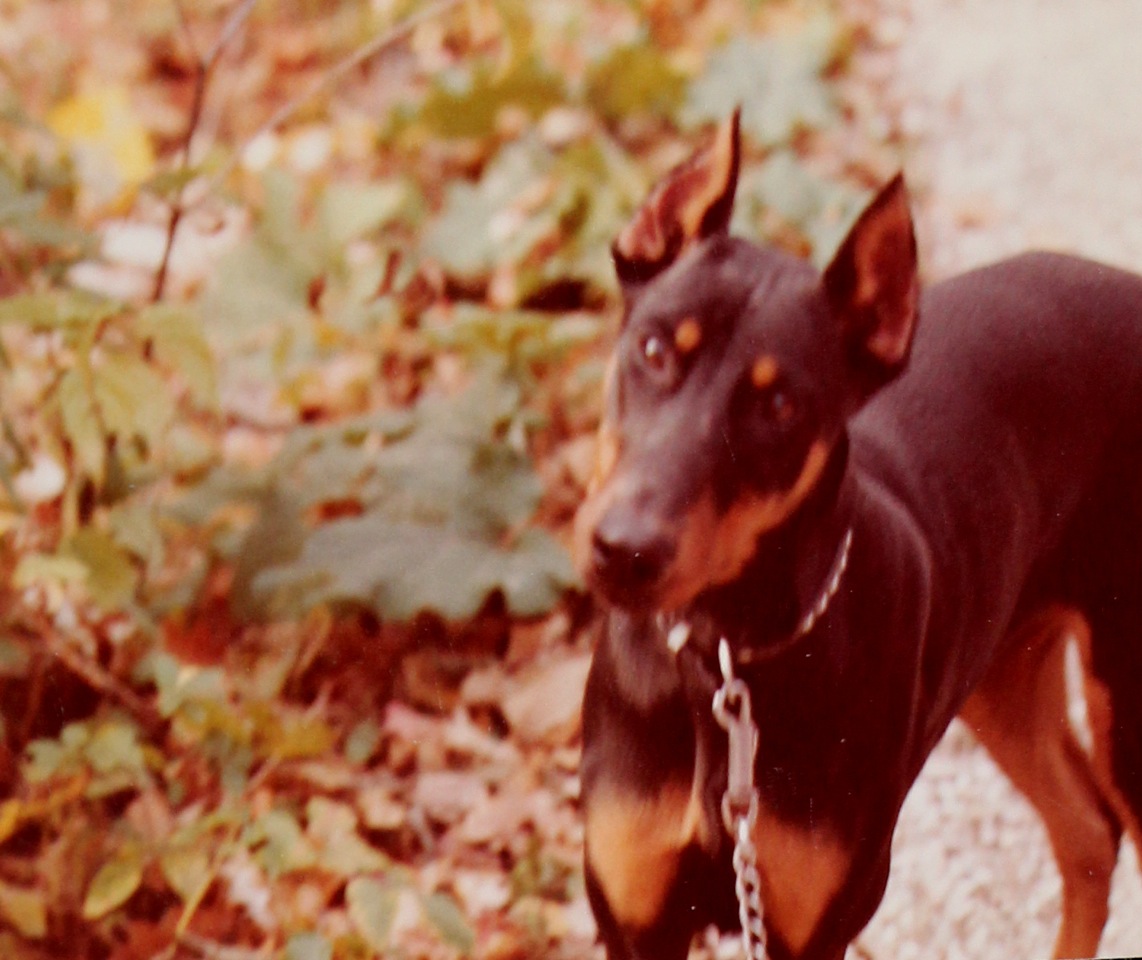
“Huh?”
I have a habit of dropping into Hebrew or French for a word or two, rarely for a whole sentence, because I’m not fluent in either language. I don’t know why I do it. Maybe I’m just pretentious and annoying, but I like the way the different languages sound, with the hard square letters of Hebrew, and the rolling curlicues of French. Cricket can understand up to the number three in French, because that’s how I taught her to jump up onto the bed, Un, deux, trois, Jump! (See, I can’t even stay in French for four words!) With Hebrew I tend to stick to short phrases, like “Where is…?” or “Thank you” Or “Why?” And Cricket tilts her head and nods. She’s a savant.

“I understand everything you say. I just disagree.”
Butterfly has a whole different vocabulary. It’s as if the girls speak, or at least comprehend, two different languages. I can’t use the same words to communicate with both of them at the same time. I’ve noticed that they choose the words or signals they will respond to more than I do. It’s like they are flipping through a book of fabric swatches until they find one that speaks to them. Just because I repeat something a hundred times doesn’t mean they will pick it up, but I can do something just once, and it clicks forever.

“Mommy?”
I wonder if, given a chance, this is how people would be too, if forcing everyone to use the same language, while very convenient, is cutting off huge swaths of natural language. What if I was born to speak Hindi and my whole life I will be missing pieces of my soul because I can’t capture them in English. Is that possible?
Butterfly responds best to touch. She calms when I pet her, she stills when I hold her in place for her insulin shot, she turns to look at me when I tug on her leash. She believes in eye contact and body language and leaves most of the English stuff to Cricket.

“I have Mommy’s sock and that means I have Mommy.”
I tend to speak to Butterfly in a higher tone of voice, and fewer words overall. She responds best to facial expressions and body language. If I reach a hand out to her, she comes over to get scratches. She watches me very carefully. Sometimes I wonder if she’s partially deaf, but I think it’s more the deafness that comes from not understanding the words I am saying to her.
I tried to teach her “Down,” but she responds better to “Stop.” And I have to be right there, not across the room, for it to make sense to her. She understands when I pick up her blood testing kit, and she understands when leashes are taken off the hook at the door, but she doesn’t understand “sit,” maybe because it took her almost a year to build the muscle strength to sit on her back legs the way Cricket does, so when I was trying to build her vocabulary, she didn’t have any physical corollary for “sit.”
Cricket responds to tone of voice more than anything else. If she hears someone yelling outside, she barks. If I whisper, she wakes up from a dead sleep and assumes I was taking about her and planning an outing for her. If I, god forbid, say the word chicken, all hell breaks loose.

“Chicken!”
She learned her commands as a puppy. She knows sit and stay and down and turn, but she also knows walk, go, outside, shoes, leash, food, toy, platypus, chewy, poop, bath.

Cricket and her platypus.
Those are the obvious things, but I’ve also noticed that she can understand context, even when her usual words aren’t in use. Even without the words “poopie butt” or “bath,” she can figure out that I’m planning to wash her in the sink, and she runs under her couch to safety.
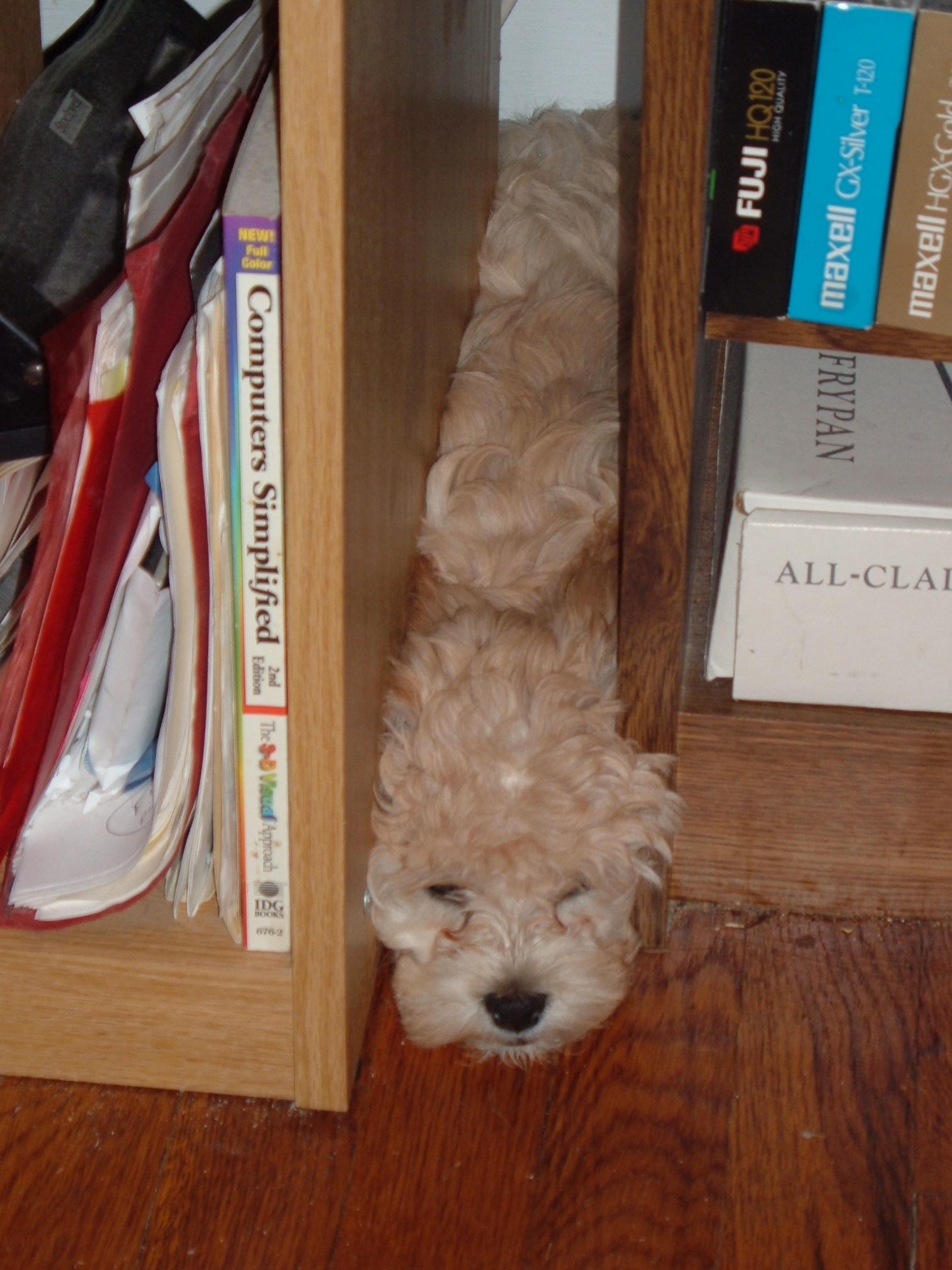
“You can’t clean my poopie butt!”
My therapist’s Golden Retriever is six years old and just now studying to be a service dog. She needs her license so that she can help her dad, but this means that she has to learn a whole new set of signals, different from what she learned in her obedience classes way back when. This has become a problem. She is a very bright girl, but she is getting confused. Her poor forehead crinkles and she can’t decide if she’s supposed to sit, stay, turn around, or leave the room.

“Help me, please.”
No wonder dogs use smell and yips and nips to communicate with each other; they must think that the human world is a tower of babel, with all of our different languages creating utter confusion. For dogs, the smell of “female, spayed, eats a lot of chicken,” is the same around the world.

 rachelmankowitz
I think you are neither pretentious nor annoying but filled with wonder.
Thank you! But I think Cricket would beg to differ.
This is so true!
We have had to teach Red and Pepper some Korean commands, just in case they ever get lost… But we use the same tone as the English version, so it looks more impressive than it really is!
Cricket would love to learn Korean. I’m just worried she’d choose only the curse words.
I have heard of people talking to their dogs in the language the breed originated but I’m not that clever! I agree that it depends on the tone of your voice whether they listen or not! Just try praising them in a stern voice…..
I met an Italian Water Dog a few months ago, and he did look at me strangely when I spoke to him in English. I wonder…
When we lived in Mexico, the first mare I got learned English. I yelled at her when she got on the porch!
I love that the mare was on the porch, probably trying to sit in a rocking chair for a spell.
No rocking chair, but I could see her butt through the glass door! I was afraid she’d spook, kick it and shatter the whole thing!
Probably just resting her butt on something cool.
I love all your photo captions! I used to sometimes talk to my Max in a quiet tone when in truth I wanted to kill him for turning over the garbage- he knew he was guilty, and my soothing voice evoked more guilt I think! Just running the bath would send both Max & Sammy running for cover! They are so clever!
Cricket is never fooled by a soft tone of voice from me. She looks deep into my soul and sees the word “bath” floating around in there.
When we moved to Richmond (7 years ago), I found the dogs parks here totally sucked and I elected instead to walk the dogs around the subdivision and at the park on leashes. I realized quickly I needed several new commands, including “turn” to change directions and “stop!” for when something was wrong. Stop also worked really well on our neighbor who rocketed out to her car, turned it on and started slamming out of the driveway without looking behind her. She really put the brakes on when she heard me yell that at the dogs.
I know those aren’t normal dog commands, but they sure worked for us. Each time I say turn, they look up to see what’s happening next. And if I stay stop, they usually sit down right away without yanking at me.
I love how different your two dogs are and how attuned you are to that. It makes for a much more successful household with that.
Nancy
Ooh! I would love to try commands on my neighbors! They work well on nephews too.
I talk to my dogs all the time. I was watching Cesar Milan and he told a client don’t humanize your dog! I laughed because I talk to my three like they understand everything I say. Thanks for sharing. I have two Maltese Poodles that look like your babies. 🙂
I don’t really watch Cesar Milan. I can’t think why not. It’s possible that Cricket keeps changing the channel.
Rachel, you should be a dog whisperer. What a great post. I always talked to my dogs and still talk to my cats. They never have had a clue what I am saying in words; they go by the tone of my voice. And I can never get mad at them so for all they know, every time I say something to them, the probably think I am saying, treats!’
That would be Cricket’s dream conversation!
Love the picture with the platypus!
Well, no matter what the nationality of your dogs, just tell them “Ich liebe dich”. Works pretty well for dads, too.
Awww.
Obligatory:
Two cats were crossing a river.
One was French named Un Deux Trois
The other one was American named One Two Three
Only one made it across alive.
Which one?
The American one, of course.
Why?
Because Un Deux Troix cat sank.
Oh my.
I speak to my dog mostly in English but sometimes I let a Spanish word slip here and there. For example instead of saying “Come here” I say “Ben” well the proper term is “Ven Aca” but i’m not use to speaking ‘proper Spanish’ haha funny thing he knows and comes running!
I’m sure there’s dictionary hidden under a mat somewhere, translating spanglish into doglish. You’ll be fine.
lol i’ll have to look around for that!
Spayed? What’s that? I’m guessing de-egged.. Your life would be better if you all got on the same page. Cricket and Butterfly-you have to agree with this.
The question is, can birds and dogs understand each other if they are not speaking English?
ÌClaro que si!
Je ne comprends pas.
I can somewhat see a certain advantage to raising a bi-lingual dog. Maybe there are certain commands or requests you will want to make that you would not want them to respond to if coming from someone else.
The one problem a dog lover could have a problem overcoming is the same one parents encounter when speaking around their children. Speaking about something they don’t want to speak about in front of their children. Like when my folks would start breaking out the Yiddish.
I could have done that with our kids, but my wife knows no Yiddish whatsoever. She is Spanish and Apache, so her folks used to break out an entire vocabulary with which I was never familiar.
And then you’d have to be able to determine when is the appropriate time to go all Berlitz on the dog or the kids or the people three booths down from you at McDonald’s who are in their thirties but still have yet to learn to use their inside voice.
Those types just switch gears right in the middle of a sentence.
“SO I GOT RIGHT IN THAT BORRACHA PUTA’S FACE AND TOLD HER VOY A ROMPER UN NUEVO RECTO SI ELLA ME MIRA OTRA VEZ, BEEEEYOTCH AND THAT GOES FOR SU NOVIO FEO TOO!!!!!”
I’m perfectly content having my Boxer ignore me in the most inopportune moments in one language.
So what I hear you saying is, I should work on adding another language to the mix.
It might be worth considering.
I’d suggest Latin.
You’d have Mamaloshen for any old Jews within earshot, and Latin would cover any really, really old Italians.
That could be handy.
Last I recall you live on Long Island, so ….
I think that it must be mostly the tone, pitch and body language that speak to dogs and since dogs are all different; some are more verbal, more visual or more tactile. Each of our dogs was different and I commnicated with them in ways that worked. Jack knows a lot of words but his two favorite words are vittels and chipmunks lol! Jack would most definitely love conversing with your two girls. He and Lulu are getting along very well, they have been kissing each other a lot lately. 😀
Kissing?!!!!! So soon?
Well apparently Jack isn’t a gentleman, he is more of a casanova. lol
Oh my!
😀
Nice post about human “speak” and dog “understanding.” Your photos are great and I really like the captions.
I think all dogs are smarter than their owners. I know that mine are. 🙂
Cricket has always known this. She accepts me, despite my inferior brain capacity.
🙂 🙂 :-).
I wrote a post about “code switching” not too long ago, but I had never thought about switching back and forth between human and dog languages. When dogs communicate with each other, they seem to rely (with, as you alluded to, a great deal of accuracy) on nonverbal forms of communication. Perhaps we humans would be better off if we took a cue from our canine friends, shut up for once and communicated by sight, touch and smell. It sounds kind of strange, I know, but that may be more because of the paradigm shift than anything inherently inferior in communicating using senses other than hearing. This is something the deaf community knows well. I felt this yesterday when one of my employees finished a project and held up her hand for a high-five. It meant more than anything she could have said about it.
I always think about this when I watch dancers on TV. Some dancers seem to have such a clear, articulate sense of how the body speaks and I feel like they’ve told me a whole, multi-layered and nuanced story in three minutes. But for the life of me, I couldn’t translate it back into English.
This post made me laugh so hard! Lots of similarities in this household. Chicken tops the list of words immediately understood, followed by out, food, walk. Bath is not in Bumble’s vocabulary. Like you, I use bits and pieces of my languages with him, and he gets it. Like “mamma kommer snart” Swedish for mom will be back soon…he knows I’ll be back in 4 hours or so.
I’ll bet he starts checking the clock at three hours and fifty-five minutes.
Animals talk – we just have to learn their language – Im glad there is someone else in the world who bothers..
Butterfly has been developing even more specific sounds and murmurs to try and communicate with me. She is very patient. Cricket just rolls her eyes.
Humans ARE very stupid aren’t they? We have so much to learn from animals. I am very blessed to have been brought up with lots of animals around me – I know I am going to end up as one of those grannies with blond dog hair in my sweaters a gazzilion cats all over the place. I’m very pleased to report, the first thing both our kids did when they moved into their new homes, got pets…I love hearing about your little guys – I love their smiles and happy faces
Dogs do learn your language. My dogs knew English, Hindi and my mother tongue Telugu! I guess any other language would be deciphered by them via the tone and gestures.
I have a feeling the dogs learn languages much faster than I would. I spent a summer watching movies in French to try to learn more, and by the third movie Cricket was mumbling and growling with a French accent.
True! 🙂
I would ask my dog “where’s the squirrel?” and she would run to a certain window (always the same one) and look outside. If there wasn’t a squirrel there, she would look back at me as if to say “you’ve lost your mind, there’s no squirrel here!”
Ha! I love it!
We looked after a Dalmatian for a while. His owner was from Argentina. He’d been trained in English. So: his basic commands – sit, stay, heel, down – he knew in English. More complex ones – put that down, let’s go there etc – he knew in Spanish. She gave us a phrase book of them to tell him in Spanish! He was bilingual. People used to think Dalmatians were stupid, but that was because there was a congenital deafness that they were often born with 😦
I love that he had his own phrase book! Any minute now Cricket is going to demand an ipad with a translator app.
Our previous dog could ‘SIT!’ in a variety of languages thanks to our German, French, Italian, Spanish and Lithuanian students. These days Maggie is selectively deaf, but knows certain actions mean walk time (even if to us they don’t at the time!) The latest recognition is turning off my laptop and removing the cables! Dogs ain’t daft. Great post as always Rachel.
Cricket has a whole system: if I’m wearing my pajamas and slip on shoes, she’s going out; if I’m wearing outdoor clothes and, god forbid, sneakers, all is lost.
Oh, bless her!
I use Chinese and English with Moli, but I don’t think she understands very much.. However, she’s very good at schedules and knowing when it’s time for something to happen. She also knows when it’s bath time and scuttles off to hide under the bed.
I’ve always wondered if Cricket is wearing a watch under her fur.
I think your father was right… maybe that’s the reason that I ignore all commands, because they aren’t in german? that’s an interesting theory and I like it :o)
I see Rosetta Stone in your parents’ future.
My dogs appear to know what I mean when I use a number of different words. Sometimes though I wonder if it is the words or the tone. Dogs are experts at tone and nuance in human speech. They also pay a lot of attention to gestures and signs.
Clearly dogs should be teaching some college level classes on communication. But, exactly how many chicken treats would they want to be paid?
My own kids know a LOT of words…it’s odd how they know the synonyms for “walk” or “car ride” such as “go”, “out”, “boogie” (blame my hippy husband for that one), “trot”, “car”, and a bunch of others. Since they are both chihuahuas, they seem to “speak” the same language, but my boy (who is 14) knows more nuances of words than the girl (who is 7). With age comes a form of wisdom. They both know “vet” though. I guess that’s universal!
The scary thing is when Cricket can spell words out!
I am pretty sure that all species have selected intelligence when it comes to deciding what they are going to listen to, regardless of the language.. Our species being the worst; you want what? Hmmm, I do not understand….(lol)
The art of communication with our dogs is always evolving and though I’m never sure exactly why, as long as Sam ‘gets it’ that’s ok with me. It’s good to adjust for each canine personality just like with bipeds, you can’t always communicate the same way and that’s ok. Guess we’re all different and that’s what makes us so special. 🙂
I’m still waiting for the doglish translator, because I can understand Cricket when she speaks in short sentences, but once she gets going, it all goes over my head.
I used to live with a cat who could be on the other side of the apartment, but if someone quietly said the word kiwi, he would come running like blazes to beg for some.
Kiwi?! I’m kind of the same way, but for me the word is “frosting.”
Although not a dog person, I do know that these faithful creatures understand a great deal more than most of us know. Your father’s stance reminds me of the time I was woken by a dog investigating the black bin bag outside my house in France. I called out to it in English to go away. It ignored me until I cried ‘va t’en’
Ha!
Pearl and I communicate by smellepathy, and we’ve taught Annabelle to translate it into English – though this system falls down when Pearl rolls in fox poop because the stench overpowers all the more subtle nuances. The only message coming over when Pearl rolls in fox poop is ‘I’m bigger and bolder and rougher and tougher, in other words sucker there is no other,’ and no one else can get a word in. 😉 Millie xx
All of our dogs know what Go for a ride means! I am not so sure that they can’t spell either. Even when we spell it, of spell the word go, there ears twitch. 🙂
My animals have all been good with English. One of my cats used to even say “Mom.” But one day he forgot how to say it and never said it again. And if you don’t believe me, my kids are witnesses to it. He used to say it all the time! It’s interesting how you can see a difference between the girls because presumably you speak just as much to one as to the other, although you say you change your voice. I think I talk differently to different of my cats, too. Some of them need the higher pitch “babying.”
I wonder if some of Butterfly’s more recent vocalizations are attempts to say, “Mom, I need more chicken treats!”
Great post, Rachel. I am a firm believer in the need for diversity. There’s a lot of subtlety and cultural expression through language and what I quite often notice across a range of languages is that a translator will comment about how there is no direct translation. Language can also reflect the particular climate or environmental context so that some languages have many words for snow, for example, while others have none.
I read an interesting post that links up with this last night and I’ll try to find it and paste a link xx Rowena
Here’s the link, Rachel: https://iamthemilk.wordpress.com/2015/02/28/carving-your-own-path-as-different/
xx Rowena
<3. Pure and simple
Thank you!
Hi there, I am Italian,I live between Germany and Spain,my wife is German,we speak to our 3 dackels in Italian,English,German,Spanish and Catalunian andthe understand more or less 100 words in all these languagestraining is the best ?
From: rachelmankowitz Reply-To: rachelmankowitz Date: domenica 1 marzo 2015 00:58 To: Stefano Padovan Subject: [New post] Talking To Dogs
WordPress.com rachelmankowitz posted: ” My father used to yell at our Doberman Pinscher in German. It¹s possible that he added in some Yiddish, but he made a point of saying that you should speak to a German dog in German. The rest of us spoke to her in English, though, and she seemed”
Wonderful stuff. We are still working on ‘drop’ with Ollie, our cockapoo, who knows jolly well what it means. ‘Drop’ works best when accompanied by a very stern ‘no!!’. ‘Treats!!’ and, specifically, ‘sausage’, are a whole other matter 🙂
Cricket doesn’t believe in “drop” or “give” either. If I want that toy, I’m gonna have to fight for it.
I’m repeatedly amazed at how my animals react to my voice, touch, movements…. a certain shift in breathing in bed and our springer gets her tail wagging. If I say “Okay” a certain way then everyone is flying off the bed to get the day going. Fun reading your kids’ take on that, too!
Cricket stares at me, for a long time, and I can’t quite tell if she’s trying to read my mind, or trying to change my mind.
I love the way dogs don’t need words to talk. With their eyes and facial expressions they can say everything.
Though Cricket does have trouble with the four syllable words. Four letter words are her specialty.
It is a scary thing, how well I can “speak” dog. Flower’s face does say it all. She’s not human? Surely, you must be mistaken. As a Therapy Dog, she mixes with patients, staff and residents on our visits – and so many love her.
Yes, Flower, you ARE a dog !
Great share, I know exactly what you mean !!
Dogs may not be human, but they ARE people. And therapy dogs, well, they are the Phds of the dog world.
I have a dog on either side of me on the couch. Charlie, my old man of 15 years and Flower. Such unconditional love and happiness. How can anyone not own a dog? Love a dog? Nurture a dog?
Flower is just better trained for giving “comfort” – but I can honestly say that I think she was born to serve. I could be partial – but her sweet spirit is undeniable.
LOL She earned her Ph.D – lots of training !
I shed a tear while reading your post, only because I miss my husky. Lady loved bath time (the only dog I’ve known that does) She knew heel, sit, lay down, stay, bath, jog and hike. She loved jogging and going on hikes with me. Lady was wonderfully perceptive.
She sounds wonderful! Have you seen those videos of a Golden retriever relaxing in a bathtub?
No I haven’t, but I’m going to look it up.
Our Chicki seems to pick up those messages without words, best of all. She know ‘sit’ but takes her own good time about it. Like many dogs, she likes to turn everything into a game. 🙂
By the way, I’ve tweeted this and three other posts, just now. 🙂
Thank you! Cricket remembers commands best when there is a food reward nearby, otherwise, she looks at me like I’m crazy.
Our Chicki is so spoiled that she won’t even eat her dinner unless she is given a treat… Anyway, I’ve tweeted this and six more of your lovely posts just now. 🙂
Cricket always looks for treats, and human food, before she gives in and eats the kibble. She tries her best to only eat kibble when we’re not looking, so we won’t know.
Zush and Kasia also know the meaning of poopy butt…lol…Zosia learned some Polish commands from me when we had her for maybe the first 2 years, in homage to my godmother, whose dogs knew Polish, because, my aunt claimed, they were down my grandmothers'(Babci) house all the time. Kasia, well she’s rough…maybe I’ll try some day to teach her one or two. Great post, Rachel.
Thank you!
PS love the shot between the bookshelves….
It’s amazing how different dogs are from one to another. Choppy responds to hand signals and voice commands, but definitely likes the hand signals better. I know she constantly watches me for things I am doing. And the moment Paul pulls out a sweatshirt, she thinks it’s time for a walk, so she’s not just watching me.
Also? Let me echo the previous thoughts on the adorable picture between the bookshelves!
If I tried to use hand signals with Cricket, she would hide her head, look over her shoulder, anything to NOT know what I want. I am very lucky that she can’t cover her ears with her paws.
Sounds like some people I know…
Dogs are smarter than a lot of folks I know and more sensitive too. Yours is a cutie!
Thank you!
So cute, i used to spesk a completly weird language to my dog, mix of italian, english and random words, but i think they understand our intonation and intentions, more than anyone elese
They probably even understood the mix of languages you spoke to them. Dogs are ridiculously smart!
ADORABLE! 🙂