Monthly Archives: March 2023

Passover is Almost Here

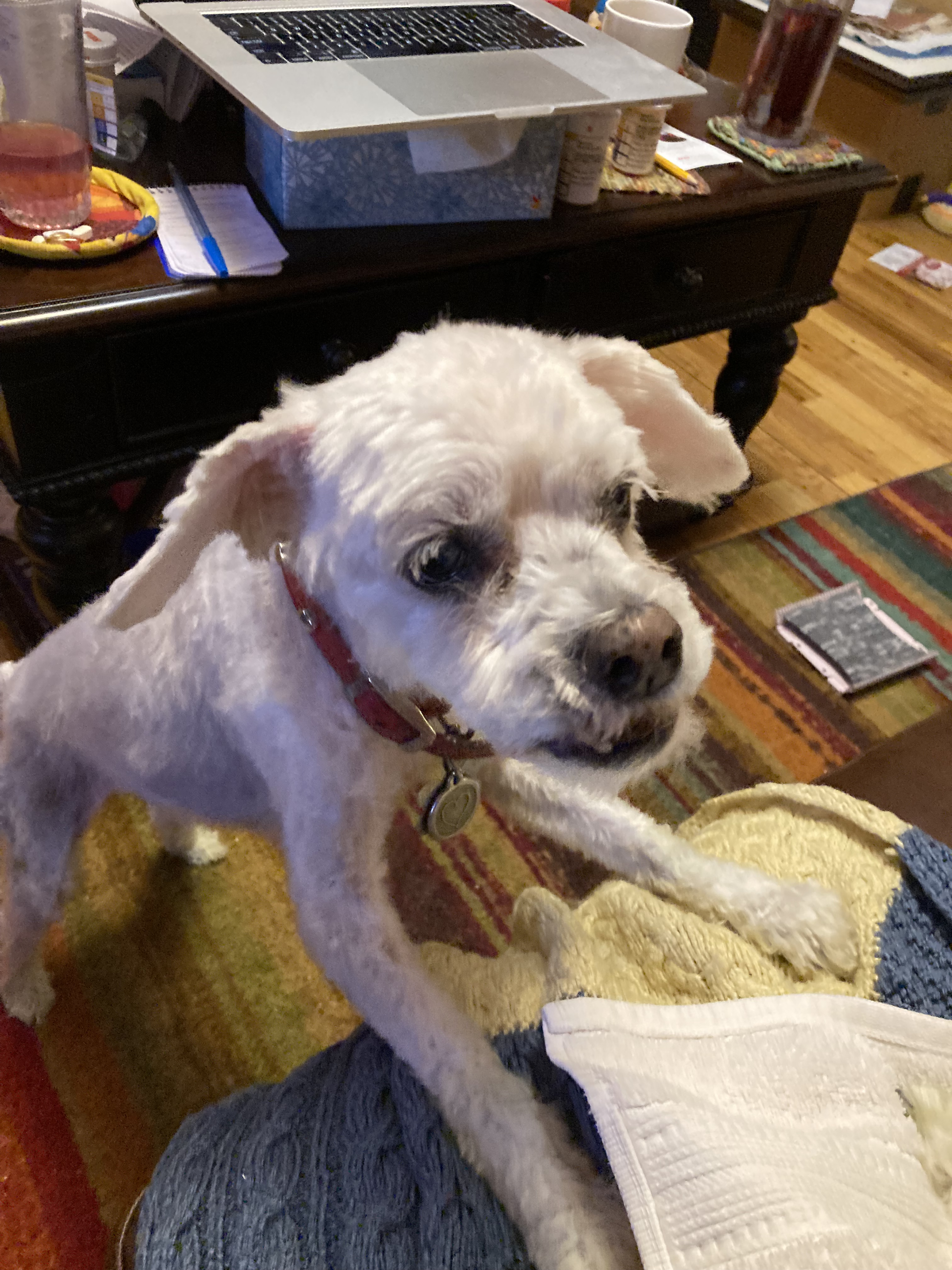
I’m not in the mood for Passover this year, especially because my health has been getting worse and Passover is one of the most preparation heavy holidays on the Jewish calendar, not just because you have to change your entire diet for a week (Matza instead of leavened bread, or anything with leavening in it, or anything with beans or corn or rice in it, if you are of Ashkenazi descent and Orthodox), but you also have to clean the whole house to make sure there’s no leavened bread hidden behind the sofa or between the cushions (Cricket likes to bury her treats for later), and then you have to find a Seder to go to and/or cook for a Seder.

“Wait a minute, were you watching me hide that piece of bread?”

            For most of my adult life I’ve been Passover-averse, in large part because my father made a mess of it. As a little kid, I loved Passover, especially going to Seders at my grandfather’s house (Mom’s father). But as my father became more religious he decided that everything my brother and I had been taught about Judaism was wrong. His new rules were demeaning and punitive and took the joy out of all the holidays, but especially Passover, which, if the rules are followed rigidly, can be something of a nightmare. As an adult, it took me a long time to even be able to walk into a synagogue, let alone go to services again. And even after we joined our current synagogue, eleven years ago, and I started to go to services every week, I still mostly pretended that Passover was just another week of the year. But as a synagogue school teacher, I can’t ignore it, because I have to teach it.

Part of me wishes I had the time to teach my students about Passover the way I learned it as a kid at my Jewish Day School. In first grade, we learned Echad Mi Yodea (Who Knows One?) in Yiddish, and each year we had a model Seder and learned tons of songs and prayers and stories and traditions. And then classes ended a few days before Passover so we could be home to help with the special food shopping, and changing over the dishes, and searching for chametz (leavened bread, like bread crumbs or cereal) with a kit we got from school, made of a small white paper bag, a feather, a wooden spoon, and a candle. The search for chametz is a kid-friendly ritual done in the dark on the night before the first Seder, where the adults hide little piles of chametz for the kids to find (with a candle to see by, and a feather and spoon for collecting the chametz into the paper bag, and then the whole kit is burned), all to symbolize the official transition from a house full of chametz to a house that is kosher for Passover.

Not my picture

            I’d love to share these rituals with my students, but I can’t figure out how to do it in our small classroom and the few minutes we have available between all of the other things they need to learn. I’m hoping that some of the girls in my class will come to the Women’s Seder at the synagogue, which is kind of like a grown-up Model Seder, with all of the handwashing and singing and blessings and rituals you could ask for. It’s scheduled ahead of Passover on the assumption that the actual family Seders will require women to do the cooking and cleaning and serving and therefore not really get the chance to focus on the meaning of the holiday itself. And because it’s a Seder for women, the pronouns in the blessings will be changed (because in the traditional blessings the pronouns are all male), and we will consider the female characters in the story who have generally been left out, and we’ll eat food prepared by someone else and sing songs written by women.

            If I had the energy, and the time, and the money, I would love to have a Model Seder with my students, where we could try dishes from Jewish communities around the world: like Moroccan Dafina stew, and Italian fried artichokes, and Turkish leek meatballs, and especially Ethiopian Matzah made with chickpea flour. And then we could try out different kinds of rituals, like the way the Ethiopians break their dishes before Passover (to avoid any chance of having chametz in their food over Passover), and some Sephardi Jews hit each other with scallions to simulate the way the slaves were beaten (well, maybe not that one), or the tradition where the Seder participants carry a heavy bag around the table to remind them of the burdens of slavery. And then, of course, the kids would obsess together over what they should ask for from their parents as rewards for finding the hidden piece of Matza (the Afikomen) at their own Seders.

“What will you give me for this Matzah thing?”

            That’s what I’d like to do, but I don’t have the classroom time to do it. And, more importantly, I really don’t have the energy. When I’m not in school with my students lately, I’m generally home in my pajamas, resting, or at least trying to. To be honest, I’ve spent most of my time recently binging past seasons of the Great British Baking Show on Netflix (because I finally have access to all of the seasons I missed after they moved from PBS to Netflix in the States).

            If I get a magical spurt of energy before Passover, I might do some vacuuming and search through the couch cushions for Cricket’s hidden crumbs, but once synagogue school goes on vacation, it’s likely that I will spend most of the holiday just resting, and hoping that that will be enough to give me the strength to finish out the synagogue school year with my kids.

            And, really, if I can do that, I’ll be happy.

If you haven’t had a chance yet, please check out my Young Adult novel, Yeshiva Girl, on Amazon. And if you feel called to write a review of the book, on Amazon, or anywhere else, I’d be honored.

            Yeshiva Girl is about a Jewish teenager on Long Island, named Isabel, though her father calls her Jezebel. Her father has been accused of inappropriate sexual behavior with one of his students, which he denies, but Izzy implicitly believes it’s true. As a result of his problems, her father sends her to a co-ed Orthodox yeshiva for tenth grade, out of the blue, and Izzy and her mother can’t figure out how to prevent it. At Yeshiva, though, Izzy finds that religious people are much more complicated than she had expected. Some, like her father, may use religion as a place to hide, but others search for and find comfort, and community, and even enlightenment. The question is, what will Izzy find?

Singing the Psalms

            The part-time musical director/rabbinical student at our synagogue decided to do something different for our monthly musical services this year. Usually we would have a Shabbat band, made up of professionals and congregants, set up next to the Cantor, and making the service feel like a rousing concert. But this year, the sanctuary has been set up in concentric circles, with the congregant singers and musicians in the middle and the rest of the congregation spreading out from there. It’s more intimate without the professional musicians, and there’s more of a focus on meditation and silence between the songs. And, maybe most important, the new songs we learned for these services were from the Book of Psalms, excerpted and used like chants, with lots of repetition and rhythm.

            It’s been an interesting experiment, especially for me as one of the singers, because it’s made me feel more like a participant in making the music, instead of an observer on the sidelines. And it feels really good to sing again, even though I’m still struggling with my breathing. It feels good to be a part of a whole group making music together.

“But we want to sing too!”

            The Psalms have always been a part of the traditional Friday night service, but we haven’t always sung them at my synagogue, and certainly not all six of the Psalms that are included in the prayer book as part of Kabbalat Shabbat (the Welcoming of Shabbat, or the warm up before the official evening service).

We studied the book of Psalms a few years ago in Bible Study, but I don’t think I paid a lot of attention. I was probably still in graduate school for social work at that point, and struggling to pay attention to anything other than school, but I do remember the Rabbi saying that many of the Psalms are “macaroni songs,” or songs that can easily be sung to different tunes, and that opens them up to many different musical interpretations that can give a whole new energy to familiar words.

“I like macaroni!”

            The Psalms, as opposed to most of the rest of the Hebrew Bible, were created to be sung by the Levites in the Temple in Jerusalem. Some of the Psalms even tell you which instruments you should play to accompany them. The Greek word Psalmos means “a song accompanied by a stringed instrument,” and the Hebrew word for the Book of Psalms is Tehillim, which means “songs of praise,” though not all of the Psalms are about praising God. There are one hundred and fifty individual Psalms, and some are communal laments, and others express individual grief and anger at God, and some are thanksgiving and praise songs, but the value of the Psalms is that they give voice to a range of emotions, like joy and fear and rage and gratitude, and they appear in daily and weekly Jewish services, and holidays and funerals, because they can help us to express things when we have no words of our own.

            The Psalms used for Kabbalat Shabbat on Friday night are Psalms 95-99, plus Psalm 29, and there are a few versions that I really like:

            (From Psalm 96) Shiru L’Adonai by Nigunim Ensemble https://youtu.be/yM6_49gQmXw

       (Also from Psalm 96) Ya'aloz Sadai by Nava Tehilla https://youtu.be/QwGksNJixtc
       (From Psalm 98) Zamru L’Adonai by Nava Tehila - https://youtu.be/XQe7vqnCZmU
 

            One of the Psalms we sang all the time, without realizing it was a Psalm, was By the Waters of Babylon. I think we first learned it to sing at a school concert, or maybe at camp, but I knew an English version and a Hebrew version and only in my research for this essay did I realize it came from Psalm 137: By the waters of Babylon, there we sat, sat and wept, as we remembered Zion. It’s a communal lament at the loss of home after the first Temple in Jerusalem was destroyed and the Israelites were exiled to Babylon. We always sang the first lines, but the Psalm goes on to another saying we learned in school: If I forget you, or Jerusalem, let my right hand wither. It always sounded so strange to me, especially on it’s own, because I was clearly an American kid, not longing to go anywhere else, and yet I was supposed to feel so guilty at not longing for Jerusalem that I would lose my right hand. And I’m a righty, so it bothered me a lot. The Psalm also includes a revenge fantasy against the enemies of Israel, and we can read it as literal – that we want to kill those who wronged us or took things from us, or we can read it as a moment of catharsis, to get our yayas out, that is not meant to be acted upon. I guess we get to choose how we read it, like a choose-your-own-adventure story. But the song I learned as a child focused only on the grief, not on the guilt or the desire for revenge, and I wonder if we excerpt these Psalms as a way to avoid the more complicated parts of who we are and how we feel, or the more complicated parts of peoplehood, so that we can just focus on the joy for a little while.

            But the Psalms are everywhere, not just in the Friday night service, and I never really noticed them before. I don’t think we studied the book of Psalms, either in elementary school or high school, probably because we were saying them daily in our prayers and our teachers assumed we knew them and understood them already. But we didn’t. Or, I didn’t.

               Psalm 137- Waters of Babylon by Don McLean - https://youtu.be/uTnspbSjKVc
               Psalm 137 - By the Waters of Babylon by Joey Weisenberg https://youtu.be/24SJuRGPpTI

            The Psalms can also be downright hopeless at times, like Psalm 90 – We spend our years like a sigh; the span of our life is seventy years, or given the strength, eighty years, but the best of them are trouble and sorrow, they pass by speedily and we are in darkness. It’s depressing, sure, but it’s also a chance to acknowledge the dark places in our lives, and in our world, and show them to God, and ask God to care that we are suffering, and, most importantly, to give ourselves permission to care that we are suffering.

“Hey! I suffer too!”

            The most famous Psalm I know of is Psalm 23 – The lord is my shepherd I shall not want. Yea though I walk through the valley of the shadow of death, I will fear no evil, for you are with me. I like to think of it as an aspirational Psalm, a Psalm describing how we want life to be and to feel. It’s phrased in the present tense, as if all of these good things are already here, and I am already comforted, and I already feel safe, and will only experience goodness and love from now on. But I think the idea of a prayer like this is to help us hold onto a vision of a better world, even when that’s not how things are for us right now, which is why it’s often said at funerals. I found a really beautiful version of this one, in Hebrew and English, by one of the Jewish-male-acapella groups who usually sing silly holiday songs to the tunes of popular American music.

            Psalm 23 – Gam Ki Elech – Six13 –  https://youtu.be/bezjJbBkWkg

            But along with the pain, the Psalms can also teach us how to celebrate when things go right, and how to express our gratitude for answered prayers – not because we’re ungrateful creeps who wouldn’t thinking to say thank you on our own, but because celebration and expressing gratitude is just as cathartic as expressing doubt and pain and anger. These Psalms allow us to feel like what we feel and say and do in the world has inherent value, not just to us but to God, who is our clearest personification of the world at large.

            The last of the one hundred and fifty Psalms is Hallelujah and it’s all about praising God, here and there, for his acts and greatness, with horn and lyre and dance and lute and pipe and cymbals. There are a lot of beautiful versions of this one, but I picked two of my favorites.

            Psalm 150 – Halleluya – by Nava Tehilla - https://youtu.be/RV3xV9NJgss
            Psalm 150 – Halleluya – by Nigunim Ensemble - https://youtu.be/ngybRjtv-dk

            Some people learn best through reading, or doing; I learn best through music. So getting the chance to hear the Psalms, and feel them, through music, finally made them seem like more than just words on a page. My hope is that even when we go back to the rowdier version of musical services at my synagogue next year, we can keep the new takes on the Psalms, and add more as they are created, because each new variation seems to capture another feeling that I didn’t notice before, adding more joy and insight and space without ever taking anything away.

Some more songs I love that are taken from the Psalms:

Psalm 92 - Tov L'Hodot by Joey Weisenberg - https://youtu.be/cXwoXKDDGmw

Psalm 118 – Min Hameitzar by Deborah Sacks Mintz – https://youtu.be/EMe4-ggSkdY

Psalm 121 – Esa Einai by Nefesh Mountain – https://youtu.be/aLTt2HytfXQ

“Can you please turn the music down? We’re trying to sleep over here.”

If you haven’t had a chance yet, please check out my Young Adult novel, Yeshiva Girl, on Amazon. And if you feel called to write a review of the book, on Amazon, or anywhere else, I’d be honored.

            Yeshiva Girl is about a Jewish teenager on Long Island, named Isabel, though her father calls her Jezebel. Her father has been accused of inappropriate sexual behavior with one of his students, which he denies, but Izzy implicitly believes it’s true. As a result of his problems, her father sends her to a co-ed Orthodox yeshiva for tenth grade, out of the blue, and Izzy and her mother can’t figure out how to prevent it. At Yeshiva, though, Izzy finds that religious people are much more complicated than she had expected. Some, like her father, may use religion as a place to hide, but others search for and find comfort, and community, and even enlightenment. The question is, what will Izzy find?

Planning My (Eventual) Trip to Israel

            Ever since my High School best friend visited from Israel, back in January, I’ve been thinking about what we’ll do when I finally get to Israel. I think the biggest result of my almost two years of online Hebrew classes from Tel Aviv, and watching so many Israeli TV shows to practice my Hebrew, is that I’m much more interested in visiting smaller neighborhoods and meeting the people than I am in going to the traditional tourist sites. For example, I really don’t want to get up early in the morning to hike Masada, or even take a cable car to the top to watch the sunrise, because I’ve seen more than enough pictures of the view, and because I’m not sure I want to celebrate a place where so many Jews felt like their only option was to commit suicide in order to avoid being captured.

I’m reluctant to go to the Dead Sea (Yam HaMelach in Hebrew), because… bathing suits, and because I usually have one wound or another and the salt stings. But I wouldn’t mind going further south, to Eilat, because there’s supposed to be a spectacular underwater preserve, where you can snorkel or go on a glass bottom boat ride to see fish and coral, and then you can go to the Dolphin Reef to swim with dolphins. But again, bathing suits, or a wet suit, which is just as bad.

Of course, I’ll need to go to Jerusalem for a few days, just to see if I fall under its spell. I’m kind of hoping I will, because it sounds like an incredible high the way people describe it, though I don’t want to get the official version of Jerusalem Syndrome, which includes psychotic breaks and believing you are Moses or Jesus or someone like that. More likely than not, I’ll get to the Wailing Wall, look around, realize I’ve seen it all in pictures and videos already, and then spend the rest of my time at the Mahane Yehuda Market.

“Do they have food?”

            Time of year will make a huge difference in what kind of trip I can take, because if I have to go in the summer I will not be able to spend much time outdoors. I’ll just go from one taxi/bus/train to another, and one hostel to another, carrying buckets of ice to toss over my head in case of emergencies.

            I found an Israeli tour guide on YouTube, named Oren, who does tons of videos: on how to plan trips to Israel in general; and how to manage public transportation, and how to navigate the weather, and the people, and the supermarkets, etc. He’s an opinionated guy, and I don’t always agree with his point of view on politics, but he’s knowledgeable and detailed, and funny, and he really loves Israel.

Some things I’ve learned from Oren: they don’t stamp passports in Israel, because then it would be difficult for people to travel on to Arab countries, so instead you get a paper called an Electronic Gate Pass that you have to keep track of; the New Israeli Shekel, Known as NIS or “Shach,” equals about thirty to thirty five American cents; you need an adapter for any American electronics (hair dryer, electric toothbrush, etc,); you will need an Israeli provider’s sim card for your cellphone in order to have Wi-Fi, outside of a hotel/hostel that provides it for you; March and April are the best time to go to Israel, but any time after October is okay, because the winters are mild; The preflight security interview at El Al can be intimidating and annoying, but you’ll survive; buy traveler’s insurance; keep the Jewish holidays in mind when planning your trip, because there’s no public transport on Shabbat and holidays in most of the country, and flights into the country are more expensive leading up to the big holidays; only go to the Negev in the winter, otherwise you will burn to a crisp; you need a guide of some kind in order to visit the old city of Jerusalem, but there are group tours, apps, and guide books if private tours are too expensive, and keep in mind that Jewish and Christian tours are very different; in an emergency dial 101; don’t be surprised to find yourself standing next to an Israeli soldier carrying an Uzi.

            Recently, I’ve been getting really interested in seeing the north of Israel, because I know so much less about it, and because it is not as hot as the south, but Oren has fewer videos about the north, so far, so I had to go to Wikipedia and other sites for information.

            Haifa is the big city in the north of Israel, and there’s an Israeli saying that goes, “Haifa works, Jerusalem prays, and Tel Aviv plays,” which doesn’t make it sound very exciting, but it has the only underground rapid transit system in Israel, called the Carmelit (Tel Aviv is in the process of building its own). And it’s also one of Israel’s mixed cities, with a significant population of Arabs and Jews living in the same place, with Arab Christians, Arab Muslims, Druze and Bahai communities, plus a lot of immigrants from the former Soviet Union, and even an ultra-orthodox minority. So it seems like it’s worth a visit, and it could be a good jumping off point for visiting other parts of the North. Haifa is also one of the few cities in Israel where buses operate on Shabbat.

I want to see Tsfat (Safed), which is known for art and mysticism; and Akko (Acre), which is an ancient city with remnants from the Hellenistic-Roman period, and the Crusader period, and the Ottoman period; and then there’s Tiberius, which was founded in 20 CE by Herod Antipas, the son of Herod the Great, and became a hub for Jews after the destruction of the second temple (and where the Jerusalem Talmud was put together); and there’s Mount Hermon, bordering Lebanon, which is the one place in Israel that gets enough snow for skiing in the winter (but since I don’t ski I’m not sure why I’d go there, except to cool off); and then there are a lot of Kibbutzim and Moshavim to visit, with fruits and vegetables and cheeses and mushrooms galore.

“I like cheese!”

But it’s all still up in the air, especially when it’s so much easier to watch videos of all of these places on TV. And I’m still dragging my feet about getting my passport renewed, though, partly because of my reluctance to have my picture taken, and partly because it’s one more appointment I’ll have to make and organize and get to. And the thing is, I don’t really want to go to Israel alone, or plan a whole trip by myself, and I can’t expect my friend to abandon her family for weeks at a time just to keep me entertained. My synagogue is planning an Israel trip next year, in the spring I think, but it’s bound to be expensive and involve a lot of walking, and visiting places I don’t particularly want to go, and it would require me to make up my mind far in advance, which I seem incapable of doing.  So, in the meantime, I’m watching Israeli movies and TV shows: on my Kan 11 app, or the Izzy streaming channel, or just on YouTube. At the very least, by the time I get to Israel I’ll know the best places to go for Chummus.

“Have them send all of the food here!”

Some of Oren’s Israel videos:

The 10 Most ISRAELI Things You Don't See On the News (14:33) https://youtu.be/q4lmXwqGDHg
The Israeli Supermarket (11:54) https://youtu.be/OFUximyJ3rI
Running the Dead Sea Marathon (10:14) https://youtu.be/THKJDJQUww4

If you haven’t had a chance yet, please check out my Young Adult novel, Yeshiva Girl, on Amazon. And if you feel called to write a review of the book, on Amazon, or anywhere else, I’d be honored.

            Yeshiva Girl is about a Jewish teenager on Long Island, named Isabel, though her father calls her Jezebel. Her father has been accused of inappropriate sexual behavior with one of his students, which he denies, but Izzy implicitly believes it’s true. As a result of his problems, her father sends her to a co-ed Orthodox yeshiva for tenth grade, out of the blue, and Izzy and her mother can’t figure out how to prevent it. At Yeshiva, though, Izzy finds that religious people are much more complicated than she had expected. Some, like her father, may use religion as a place to hide, but others search for and find comfort, and community, and even enlightenment. The question is, what will Izzy find?

I Want My House Back

            I keep having dreams that I’m back in the house I grew up in, and I discover all of these extra rooms and higher floors, and walls full of windows, and I start to have all kinds of ideas for how to make the house more stable and welcoming and beautiful, and then the dreams introduce  obstacles: my father still lives there and I can’t afford to buy him out, or the house is under attack and there are bombs hidden in the basement/attic/bathrooms/backyard, or there are random people living behind secret doors and eating all the food in the house.

“It’s me, hi, I’m the one who ate all the food.”

            Dream interpreters tend to say that houses stand in for our bodies in our dreams, and I can see how that could be one explanation, especially given all of my health issues and my endless wish to be healthier and feel more secure. But I think the dreams are about more than my body. I think they’re trying to tell me something about my self, or my soul, because what I really want is to feel like there’s more light coming into my life, and more of a sense of possibility and security, and the obstacles to reaching those goals just refuse to go away.

            I’ve been watching this new show called “The Way Home,” on the Hallmark channel, about a teenage girl who time travels, through the pond on her grandmother’s property, and finds out what her mother’s family was like before their big tragedy changed them. And the idea that I could go back to my childhood, or even my mother’s childhood, with everything I know now, and fix the past, is enchanting, and, of course, frustrating in its impossibility. But changing the past isn’t really what I want. I want to feel like I belong somewhere in the present day, and have ownership over my identity, and feel more completely myself, instead of still feeling so fragile and unfinished.

            I want to wake up in the morning and feel secure in my goals and values, and look in the mirror and recognize myself as a specific person and not just a blob (though that last problem could be because I sometimes forget to put my glasses on before looking at myself in the bathroom mirror).

“You look blurry to me all the time, Mommy.”

            I think the dreams are trying to help me figure out how to get to a better life, and also trying to remind me of all of the work I’ve done already, building my internal structures, and breaking down walls and raising ceilings, despite all of the obstacles that have always been in my way. I just wish the dreams could be a little bit more prescriptive sometimes, like, telling me which directions to go in, or maybe writing my novels for me so I won’t have to break my head over the plot points ad infinitum before I can even get a draft on paper.

            It would also be nice if I could have transcripts of my dreams already written out for me when I wake up, because trying to remember all of the details before they disappear is an impossible task.

            But maybe the dreams can’t really tell me more than I already know, which is that houses and selves don’t just renovate themselves overnight; it takes work, and time. And if I keep doing the work, and breaking through my internal walls, and searching for the hidden bombs, and defusing them, I will eventually get to a good place. Wherever that may be.

“Wherever you go, we go.”

If you haven’t had a chance yet, please check out my Young Adult novel, Yeshiva Girl, on Amazon. And if you feel called to write a review of the book, on Amazon, or anywhere else, I’d be honored.

            Yeshiva Girl is about a Jewish teenager on Long Island, named Isabel, though her father calls her Jezebel. Her father has been accused of inappropriate sexual behavior with one of his students, which he denies, but Izzy implicitly believes it’s true. As a result of his problems, her father sends her to a co-ed Orthodox yeshiva for tenth grade, out of the blue, and Izzy and her mother can’t figure out how to prevent it. At Yeshiva, though, Izzy finds that religious people are much more complicated than she had expected. Some, like her father, may use religion as a place to hide, but others search for and find comfort, and community, and even enlightenment. The question is, what will Izzy find?