I’ve been reading through piles and piles of notebooks, and files and files on the computer, to see which of my writing projects still spark my interest; and unfortunately, they all do. I can sort of prioritize one, or two (or five) above the rest, but it’s like trying to choose my favorite dog and having to ignore all of the others. How can you look away from that sweet, lonely, hungry little dog?! What kind of monster are you?!
There are novel ideas in the notebooks, and novel drafts on the computer, and drafts of long essays and short essays, and children’s stories, and short stories, and mysteries, and even a science fiction story or two. And along with all of the writing projects, I also have lesson plans to write, and a ton of therapy work I still need to do in order to become the kind of functional adult who doesn’t need to crawl under the bed and hide (which hurts my back, honestly).
This is what happens when I try to open the creaky, dusty, long-closed doors in my brain. I know I have to do this every once in a while, if only to make sure I’m not leaving something important behind, but it’s overwhelming. And, of course, there are endless internal arguments over which ideas have the best chance of getting published, and which ones will be an exhausting waste of time, and why do I have to be a writer at all when I really should be doing something more useful with my life, or at least more practical. But I’ve been a writer since I first learned how to hold one of those fat red pencils in nursery school, and if I stopped writing it would feel like I’d stopped breathing. And, really, even if it looks like I’m standing still, I am frantically kicking my feet under the surface, like a duck; and yet I judge myself only by what other people can see.
At some point, hopefully soon, I will finish this reassessment period and be able to choose a few manageable goals to work towards and put the rest aside. And then maybe I can put off the next reassessment for a while, or at least make sure I’m better medicated by then.
“Chicken fixes everything.”
If you haven’t had a chance yet, please check out my novel, Yeshiva Girl, on Amazon. And if you feel called to write a review of the book, on Amazon, or anywhere else, I’d be honored.
Yeshiva Girl is about a Jewish teenager on Long Island, named Isabel, though her father calls her Jezebel. Her father has been accused of inappropriate sexual behavior with one of his students, which he denies, but Izzy implicitly believes it’s true. As a result of his problems, her father sends her to a co-ed Orthodox yeshiva for tenth grade, out of the blue, and Izzy and her mother can’t figure out how to prevent it. At Yeshiva, though, Izzy finds that religious people are much more complicated than she had expected. Some, like her father, may use religion as a place to hide, but others search for and find comfort, and community, and even enlightenment. The question is, what will Izzy find?
I’ve been watching videos in Hebrew for a while now, to practice my listening skills and to get a wider sense of Israeli culture, and one of the richest sources for short (2-15 minute) videos is Kan Digital, the online section of the public broadcasting channel in Israel. I have no idea how many of these videos actually end up on TV in Israel, but there are tons of them available on YouTube; along with a really great interview series by Orit Navon that delves into serious subjects (mental illness, living with disability, bullying, grief, having one Jewish and one Muslim parent), there are also videos by a variety of reporters/performers from different segments of Israeli society (religious and secular, Ethiopian and Russian, Israeli Arab, Jewish, Muslim, Christian, etc.), on a wide range of subjects, from serious, fact-based pieces on how Israeli elections work, to slice of life videos about working from home during Covid, to a dance video on how to choose a watermelon.
Orit Navon
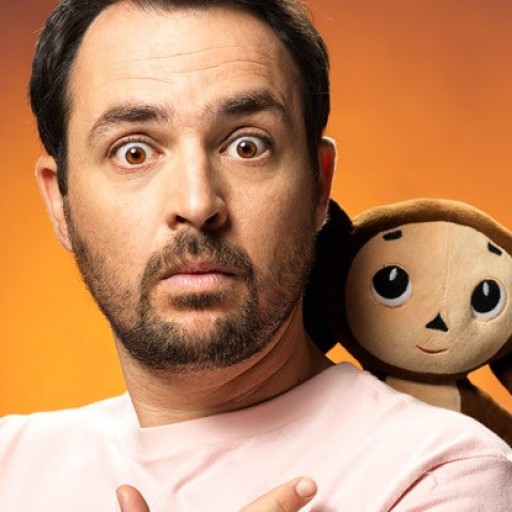
Recently, I saw a video from one of the usually less serious performers/reporters (he did the watermelon video), where he’s sitting in what looks like a real therapy session, or a very close facsimile thereof, and both the reporter (Ehud Azriel Meir) and the therapist seem to be from the Religious Zionist community (roughly equivalent to Modern Orthodox in America – which you can tell from their crocheted kippot and casual clothes, as opposed to the more formal clothing and black hats worn by Haredim/ultra-orthodox). I’d seen a lot of videos from Ehud before; he did a whole series where he was supposedly sent to work with the Arabic language division at Kan to create educational videos about Jewish holidays and rituals, and each video in the series poked fun at all of the assumptions Jews and Muslims and Christians in Israel make about each other. It was silly and light, but also allowed for a pretty deep exploration of social conflicts Israelis grapple with on a daily basis. In general, Ehud’s videos are like this, characterized by humor and a willingness to show his own flaws and mistakes, but the video with the therapist had a much more serious tone than I was used to from him.
Ehud Azriel Meir
The therapy session starts with Ehud’s feelings of guilt at wanting to vote for someone other than the Religious Zionist candidate in the coming election. He believes that if he votes for “the other” candidate, he’s not only letting his own side down, he’s letting the other side win (though in Israel’s multi-party system there are always more than two options). This led to a discussion of the moment he started to feel some alienation from his own political party, which is also his religious community, way back in the 1990’s, when Prime Minister Yitzhak Rabin was assassinated. Before the assassination, Ehud, as a teenager, took part in a lot of the demonstrations against Rabin’s push for the Oslo Accords. He and his fellow Religious Zionists believed strongly that the accords would lead to more terrorism rather than to peace, and they were loud and vehement in their opinions, calling Rabin a traitor and a murderer. And then, Yigal Amir, also a Religious Zionist, shot and killed Rabin at a peace rally.
For Ehud, Rabin’s murder was a moment of awakening. It truly devastated him that this man, who was like a father to him and to the country as a whole, had been killed by someone on “his side.” He had never considered the possibility that people were taking those screamed epithets literally, but when he and his friends tried to go to the vigils to mourn Rabin with the rest of Israel, they were turned away. And, still today, he resented that the secular Israelis blamed him for Rabin’s death, and he felt like it would be disloyal to his own group, and to himself, to vote with them on anything, even when he agreed with their policies.
The therapist pushed Ehud to acknowledge that his strong feelings around all of this might mean that he did feel somewhat responsible for Rabin’s murder, and that maybe he was uncomfortable in both the Religious and the secular worlds because he was still trying to avoid facing those feelings of guilt. Ehud bristled at that idea, but the therapist persisted, suggesting that in order for him to be at peace with having one foot in each camp, he needed to wrestle with the ways he himself believed that his actions long ago may have done harm, and to acknowledge that no matter how much he treasured his identity as a Religious Zionist, that wasn’t all of who he was.
There was something really powerful for me in watching this usually very un-serious guy, now grumbling and uncomfortable, being willing to share his discomfort and uncertainty with the public, in case it might do some good. And his internal conflict resonated with me too, even more so because he used the words Gam ve Gam (Both/And) to describe his feeling of being both a Religious Zionist, and something else as well.
Whenever I start a new semester of online Hebrew classes, I’m asked if I prefer my name to be pronounced the English way or the Hebrew way, and I always say Gam ve Gam, both because I grew up going to Jewish day schools where half the day I was one and half the day I was the other, but also because the feeling of having different parts of me that fit in with different groups is a big part of my everyday life. It can be really hard to live in the Both/And. I’m never sure if I should stand with one foot in each camp, or hop from one side to the other, or stand in the middle all by myself. More often than not, I feel like I have to hide parts of myself, or act in ways that feel wrong to me in order to fit in.
“I like both chicken treats AND Greenies.”
Watching this video reminded me of the traditional Ashamnu prayer that we say during the Jewish high holidays each year, where we pound our chests and admit to all of the possible sins that may have been done by a member of our community. That level of exaggerated responsibility has always bothered me, because I work so hard to make sure I do no harm, and it doesn’t seem fair that I should have to take responsibility for Joe Schmo over there who couldn’t care less who he hurts. It’s not even clear which community the prayer is referring to: does it include all Jews? All Jews on Long Island? All human beings on earth?
But now I wonder if the prayer is trying to get at the collective guilt we tend to feel when someone from our own political party, or tribe, or family, does something wrong. Even if we are not directly responsible for an evil act, we may have played a role in creating the conditions for that evil act to take place; or maybe our strongly held beliefs led us to encourage someone in the direction that led them astray; or maybe we were silent when we knew we should speak up, because we were afraid of being kicked out of the group; or maybe we felt responsible simply because outsiders told us that we were responsible, because they see our group as a single entity rather than a collection of individuals.
Once a year, this prayer gives us the opportunity to acknowledge those complex feelings of communal guilt, and reminds us that we need to recognize the impact we can have on the people around us, whether we intend that impact or not. And maybe most of all, the prayer reminds us that even when we disagree with our fellow community members, and speak up against them, we are still part of that community and that community is still a part of us.
I had a Creative Non-fiction teacher back in graduate school who told us that in order to write a good essay (for her class, at least), we needed to write about two seemingly unrelated subjects at once. For example, if you’re writing about pizza, you could also write about existential philosophy; or if you are writing about fashion, you could also look back at a memory from a childhood dance class, or a nature walk, or a chess game. Because, she said, the most interesting material comes from the way those two unrelated topics brush up against each other and create something new. And I think that’s true of more than just a good essay. When I live my life in both A and B (and often in C and D and E as well), the friction that comes from those mashups creates a lot of sparks, and what would our lives be like without all of those sparks to help light the way forward?
“You said pizza. I didn’t hear anything after that.”
If you haven’t had a chance yet, please check out my novel, Yeshiva Girl, on Amazon. And if you feel called to write a review of the book, on Amazon, or anywhere else, I’d be honored.
Yeshiva Girl is about a Jewish teenager on Long Island, named Isabel, though her father calls her Jezebel. Her father has been accused of inappropriate sexual behavior with one of his students, which he denies, but Izzy implicitly believes it’s true. As a result of his problems, her father sends her to a co-ed Orthodox yeshiva for tenth grade, out of the blue, and Izzy and her mother can’t figure out how to prevent it. At Yeshiva, though, Izzy finds that religious people are much more complicated than she had expected. Some, like her father, may use religion as a place to hide, but others search for and find comfort, and community, and even enlightenment. The question is, what will Izzy find?
One of the things I’ve been enjoying a lot lately in my online Hebrew classes is watching Israeli stand-up comedy routines. Even a year ago, I would have found it really difficult to follow what they were saying because they speak so quickly, but now, as long as the videos include subtitles in Hebrew, I can pretty much follow what’s going on. And I’ve found that I’m learning a lot about Israeli culture from these short videos on YouTube, because a comedian’s job is to comment on, and laugh at, all of pompous, ridiculous, or just plain wrong things the politicians, the media, and regular people are saying and doing every day.
“I prefer give-me-a-treat-comedy.”
One of my favorite Israeli comedians is Giora Zinger. He and his family made Aliya (immigrated to Israel) from Ukraine when he was five or six years old (he has a whole bit about how he, and many other Jewish boys from the former Soviet Union, had to be circumcised when they arrived in Israel, and getting circumcised as a newborn is a completely different experience from getting circumcised when you are old enough to know what’s going on). A lot of his humor is about the cultural divide between his Ukrainian parents and the Israeli culture he grew up in. And his version of his mother’s accent, in Hebrew, is probably my favorite thing in his act, both because his version of his mother speaks much more slowly than most Israelis, so I can understand what she’s saying, and because his version of her says all of the things you’re not supposed to say out loud.
Giora Zinger
Israeli humor is, overall, less politically correct than American humor, so some comedians can come across as a little mean, but most of the time they are refreshingly honest and give me a lot of insight into how people in Israel really feel.
Another comedian I started watching recently is Yuval HaGanan, which translates to Yuval the Nursery School Teacher, and his act comes straight out of his day job as a, yes, nursery school teacher. He does a lot of impressions of his three- and four-year-old students, sharing their responses to the war, or a death in the family, young love and, of course, poop. And, like Giora Zinger’s mother, they tend to tell it like it is. Yuval also talks about all of the times when he had no idea what he was supposed to say to the kids’ very direct questions and just went with whatever came out of his mouth, and I can relate.
Yuval HaGanan
But my favorite Israeli comedian at the moment is Udi Kagan. His humor is often very silly, and filled with bodily noises, and jokes at his own expense, and at his failures as a husband and as a father and as an adult male in general. He is also a musician and often plays the piano and sings as part of his act. There was one video about re-hearing the Aerosmith song “I don’t want to miss a thing,” (from the movie Armageddon), years after it became a hit, and suddenly realizing how disturbing the lyrics are (I could stay awake just to hear you breathing…). He plays a lot with that space between Hebrew and English, where Israelis often find themselves, because they watch a lot of American TV, and listen to a lot of American music, and study English much more seriously in school than Americans study any second language.
Udi Kagan
But the reason why he’s my favorite right now is because of a 20-minute clip that was recently posted on YouTube where he talked about suffering from PTSD after his army service, and how it came roaring back after the Hamas attacks on October seventh. In Israel they either say “PTSD,” in English, or they use the Hebrew translation of “Battle Shock,” which is an old term for PTSD, and maybe more to the point in this case. In the video, he talks about all of the ways he and his friends tried to ignore their symptoms, or mute them with drugs and alcohol, until he finally asked for help and started to get better. And something about his vulnerability, and silliness, and self-deprecating honesty, allowed the audience to really go there with him. And not just the in-person audience, because I’ve already seen a bunch of videos of young Israeli men responding to his performance and opening up about their own experiences with PTSD.
I was getting frustrated that I couldn’t share these Israeli comedians with my friends and readers, because their acts are in Hebrew with only Hebrew subtitles, but when I went back to watch Udi Kagan’s “Battle Shock” video again, I found a version with English subtitles. None of his other videos, that I could find, had been translated, but maybe someone recognized that this one needed to be shared with as many people as possible.
There are, of course, many other voices in Israeli comedy. There are even Israelis who perform in English, like Yohai Sponder, who has become a huge presence online (for the Jewish world at least) since October 7th. His broken English is a big part of his act, as is the giant star of David he wears around his neck. He’s not gentle and sweet like Udi or Yuval or Giora; he has the macho style that is more often identified with Israeli men. But a lot of Diaspora Jews have found comfort in his confidence, and his pride in being Jewish, in the face of the renewed wave of antisemitism.
There is still something amazing to me about the existence of a country, however small, where being Jewish is the norm, and therefore where the music and the art and the drama and the comedy all either come from a Jewish perspective or are in conversation with Jewish history, without apology. My hope is that this war will end soon, and the hostages are returned, and a road to peace with the Palestinians can be found, and that peace will make it possible for the lighter, softer side of Israelis to become more visible, both so people can see them more fully, and because I think Israelis have wisdom to share about resilience and how to find humor and love and hope even under difficult circumstances.
If you haven’t had a chance yet, please check out my novel, Yeshiva Girl, on Amazon. And if you feel called to write a review of the book, on Amazon, or anywhere else, I’d be honored.
Yeshiva Girl is about a Jewish teenager on Long Island, named Isabel, though her father calls her Jezebel. Her father has been accused of inappropriate sexual behavior with one of his students, which he denies, but Izzy implicitly believes it’s true. As a result of his problems, her father sends her to a co-ed Orthodox yeshiva for tenth grade, out of the blue, and Izzy and her mother can’t figure out how to prevent it. At Yeshiva, though, Izzy finds that religious people are much more complicated than she had expected. Some, like her father, may use religion as a place to hide, but others search for and find comfort, and community, and even enlightenment. The question is, what will Izzy find?
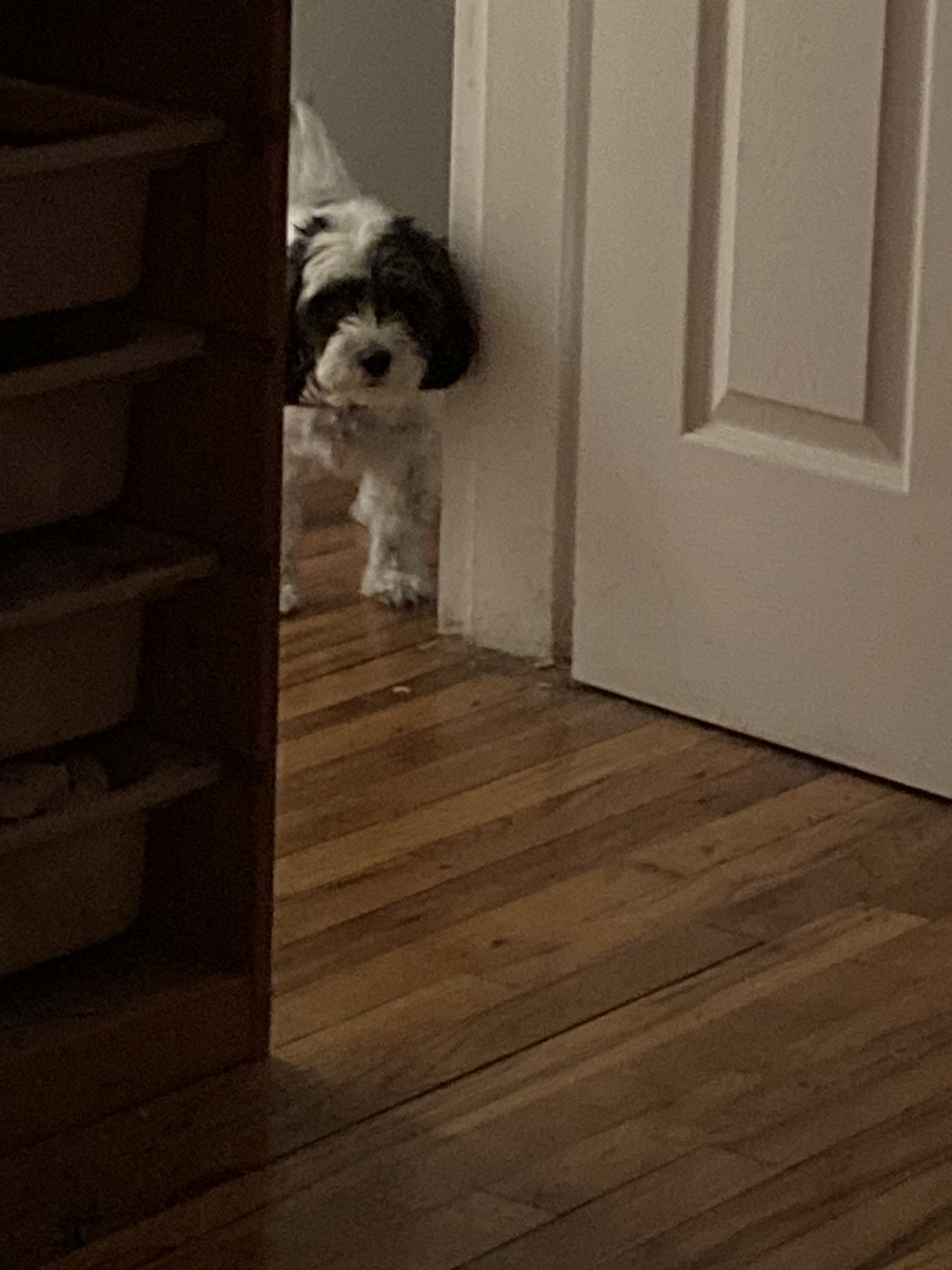
You might remember that a while back I decided to set out a trail of treats for Tzipporah, to encourage her to spend more time in my room. Well now, multiple times during the day and night, Tzipporah sneaks into my room like a phantom, ignoring me completely, looking for her trail of treats; even after she’s eaten all of the treats I’ve carefully placed around the room, she comes back again and again, hoping, expecting, that new treats will have sprouted from the floor. But even though she had a traumatic early life in the puppy mill, I’m pretty sure she’s not living a double life as a murderous phantom taking out her trauma on unsuspecting victims, though one can never be sure.
“Where’d you hide the treats?”
I wish I could convince her that I am friendly and harmless, but I’m also the one who insists on cleaning her tushy when she has an accident, and combs through her hair when she has knots, so she has legitimate reasons for doubt. But even though she doesn’t play with me, or sing at me, like she does with her grandma, she does watch me carefully and sit by my side at the computer, so even if I’m scary, I seem to be fascinating too, which is nice.
She sat with me this summer while I sent out my query letters to potential agents, and while I collected the rejections; and she sat with me as I watched The Rachel Maddow Show each Monday night, and tried to believe her when she said that we can survive the current situation in the United States; and Tzippy was with me when I found out that The Late Show with Stephen Colbert got cancelled (though the show isn’t over until next May, so there’s still some comfort left); and she was with me while I watched the news of the Catholic school shooting in Minnesota, which felt dangerously close to home because I teach in a synagogue that has been under threat for years now, with ever increasing security measures as antisemitism and violence in general have continued to grow.
I’ve been overwhelmed with anxiety this summer, from every direction, but the biggest anxiety seems to come up around planning and packing for my trip to Israel in November. Somehow, I’ve become obsessed with the fear that I’m going to overpack and have my suitcases taken away at the airport, or that I’ll forget to pack something essential that can’t be bought in Israel, though I have no idea what that might be. But my automatic response, when it feels like there are too many things outside of my control, is to try to control the little things, like making sure I have everything I could possibly need for the trip, which means I’ve been spending a lot of time scrolling through Amazon, looking for things I definitely need but have never heard of before.
Now that September has arrived, I’m going to have less time to spend on Amazon, and focus more of my energy on my students, and trying to come up with ways to make my classroom fun and welcoming, so we can keep the world at bay for a couple of hours at a time. I wish I could bring Tzipporah with me to class, but her anxiety skyrockets as soon as she leaves the apartment.
When I think about it, I’m not sure if Tzipporah is the Phantom of the apartment, or if I am, or if there’s some invisible threat that we both feel radiating from the world around us. I’m not even sure if I’m really more anxious than usual, or if there are just so many more echoes of my anxiety in the world around me that it all seems louder and more pervasive.
There was one nice break from the anxiety last week. The weather was nice enough that I was able to take Tzipporah outside to socialize with the neighbors, and Kevin the mini-Goldendoodle did his best to reassure her that he’s a nice boy and only wanted to sniff her nose and invite her to play. She wasn’t any more convinced by him than by me, at the beginning, but by the end of the visit she had relaxed on my lap, and stopped shaking, and she was able to watch Kevin run across the lawn chasing his favorite ball. It was only a few moments, but it was progress, though I’m pretty sure Tzippy’s favorite part of the outing was when we returned to the apartment, and she ran straight to her bed, and, magically, found a chicken treat sitting there waiting for her. That apartment phantom knows my little girl very well.
“I’m not that complicated, Mommy.”
If you haven’t had a chance yet, please check out my novel, Yeshiva Girl, on Amazon. And if you feel called to write a review of the book, on Amazon, or anywhere else, I’d be honored.
Yeshiva Girl is about a Jewish teenager on Long Island, named Isabel, though her father calls her Jezebel. Her father has been accused of inappropriate sexual behavior with one of his students, which he denies, but Izzy implicitly believes it’s true. As a result of his problems, her father sends her to a co-ed Orthodox yeshiva for tenth grade, out of the blue, and Izzy and her mother can’t figure out how to prevent it. At Yeshiva, though, Izzy finds that religious people are much more complicated than she had expected. Some, like her father, may use religion as a place to hide, but others search for and find comfort, and community, and even enlightenment. The question is, what will Izzy find?












 rachelmankowitz