The Day My Grandfather Died

I was eight years old and we’d just gotten back from visiting him in the hospital the day before. Memorial Day weekend. We’d stayed at a campground near the hospital in Mount Kisco, New York, as if it was just another adventure, not pancreatic cancer.

I think we were only there one night, and then visited him in the hospital in the morning, but I don’t remember much. It was the phone call the next morning, as the bus was arriving for school that stuck with me.

Mom answered the phone on the wall in the kitchen, next to the yellow and orange wallpaper that was starting to peel. The skin around Mom’s eyes turned dark purple and if she said anything I don’t remember it, but I knew that Grandpa was dead.

I was in a fog. My grandpa was the first of my four grandparents to die, and the one I needed the most. He was the one who loved us. He was the one who could fix everything, or at least that’s what I wanted to believe. His death meant that we were on our own.

We had to go to school anyway, me and my brother. He was ten years old and I was eight, and he didn’t talk to me on the bus or in the hallway at school, ever. My friend Alex noticed that I wasn’t my usual self in the one class we had together, art. He chatted to try to get me to smile, and listened when I remembered how to talk, but mostly he just watched me, to make sure I was okay and not shattering into tiny pieces.

My parents picked my brother and me up from school at noon, and took us to the deli where our father picked up too many sandwiches, and chatted with the counterman, and drank Dr. Brown’s celery soda, (really gross), before we drove up to Westchester to see Grandma.

The funeral had to be planned. Relatives had to arrive. Decisions about the future had to be made. But I just remember sour pickles and pastrami sandwiches and the utter emptiness of that house without Grandpa in it.

My grandfather was my idea of God – a little bit frail and not especially powerful but full of love and joy. I knew he loved me, and my brother, and my cousins, and I knew there was enough love for all of us. My grandfather was the only person in the world who seemed to have power over my father, though he rarely used it.

One of my aunts spoke at the funeral, but I don’t remember much about that day. A lot of funerals seem to mush together from those years: the funeral parlor, the pine box, the black ribbons, the cemetery, the prayers, and all of those grey stones. What stays with me is the grief; the void of no-Grandpa that we were left with after that.

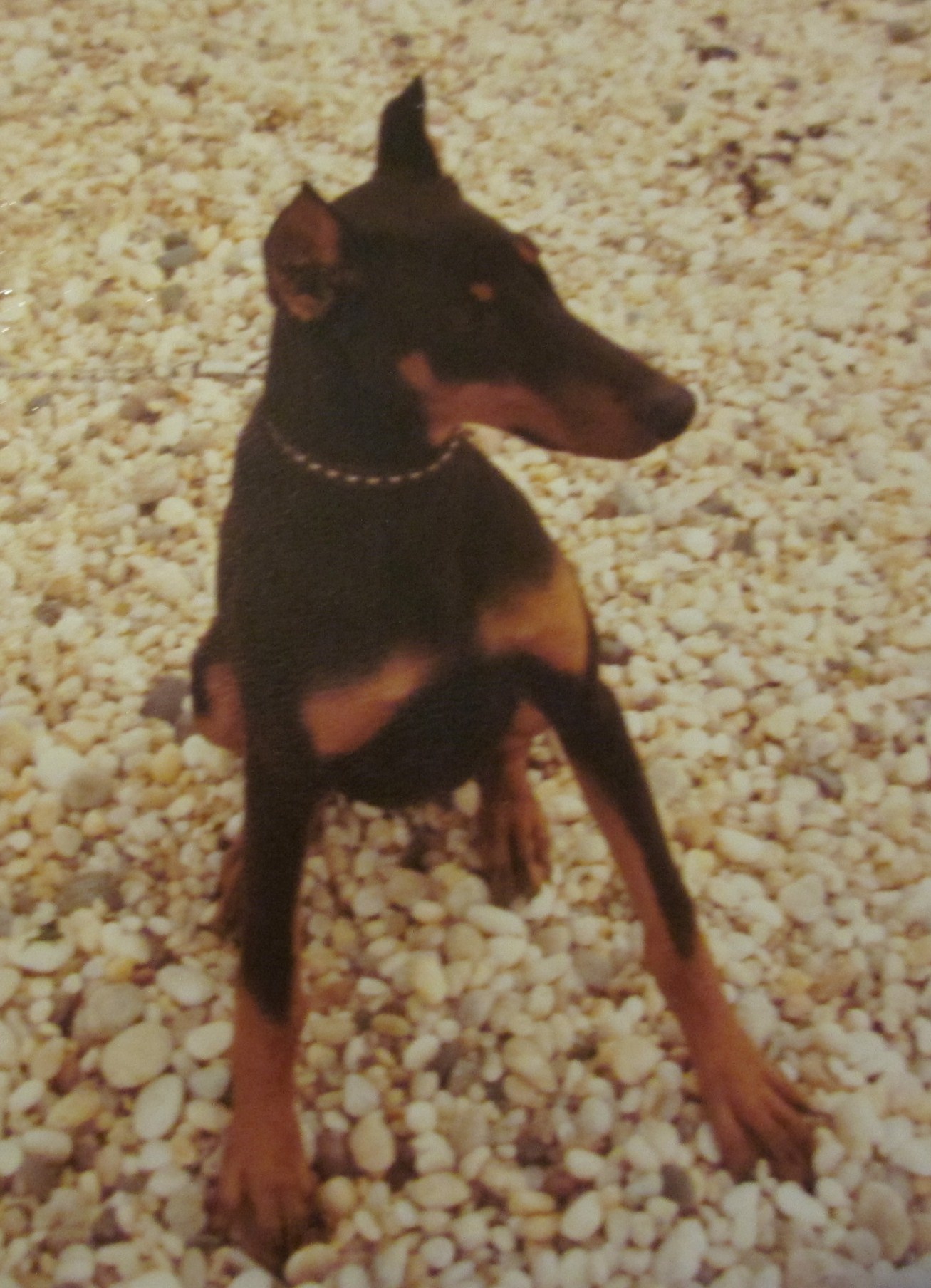
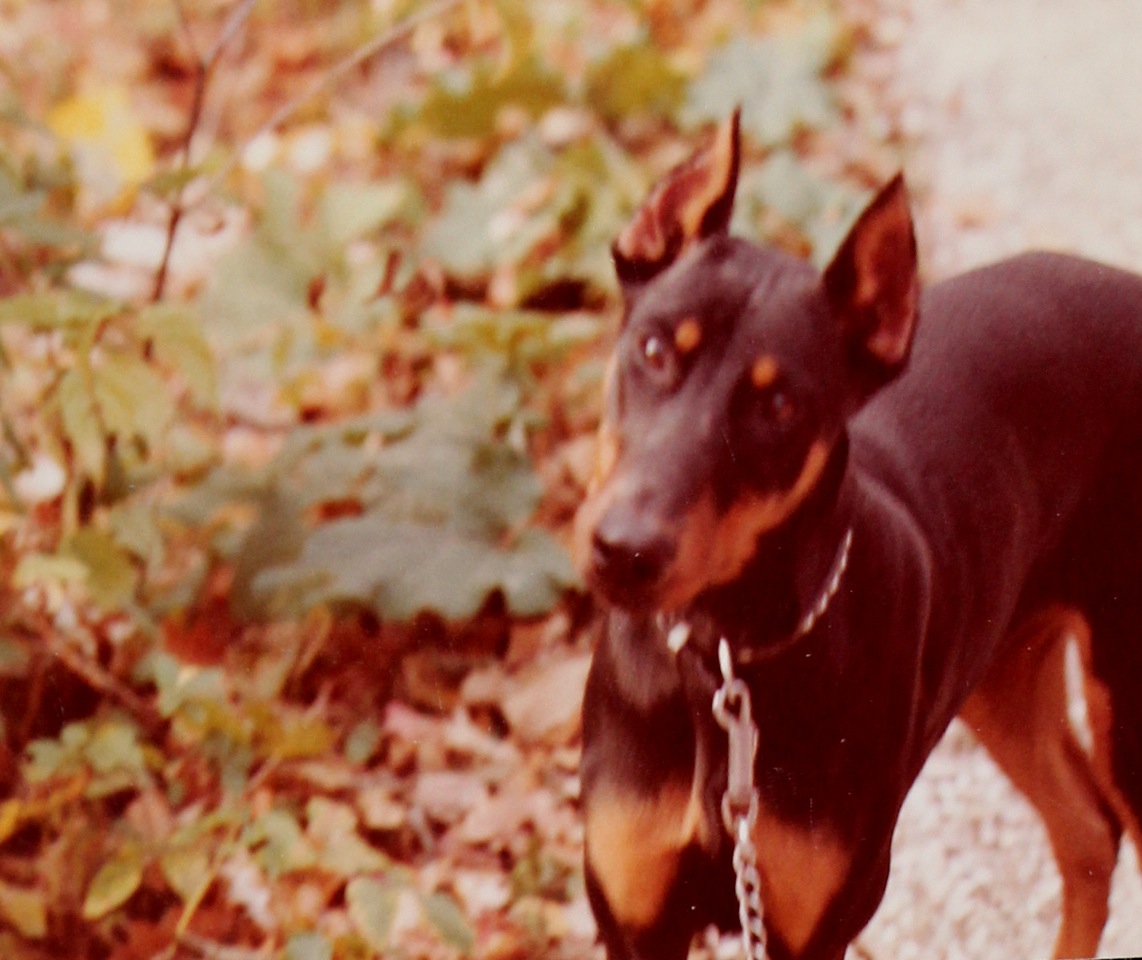
I don’t remember Delilah, our Doberman Pinscher, being a part of things. Did she come with us camping that weekend? Did she sleep on my feet after the funeral? Was she there in the kitchen when the phone rang? I don’t know. But I do know that I would have talked to her about all of it, like I learned to talk to Grandpa after he died, and like I used to talk to God. I never considered it talking to myself, because I always knew that someone was listening.
Delilah.

Delilah.

Delilah and my brother, comforting each other.

Delilah and my brother, comforting each other.

And Delilah, who loved me in her own quiet way, was always willing to listen.
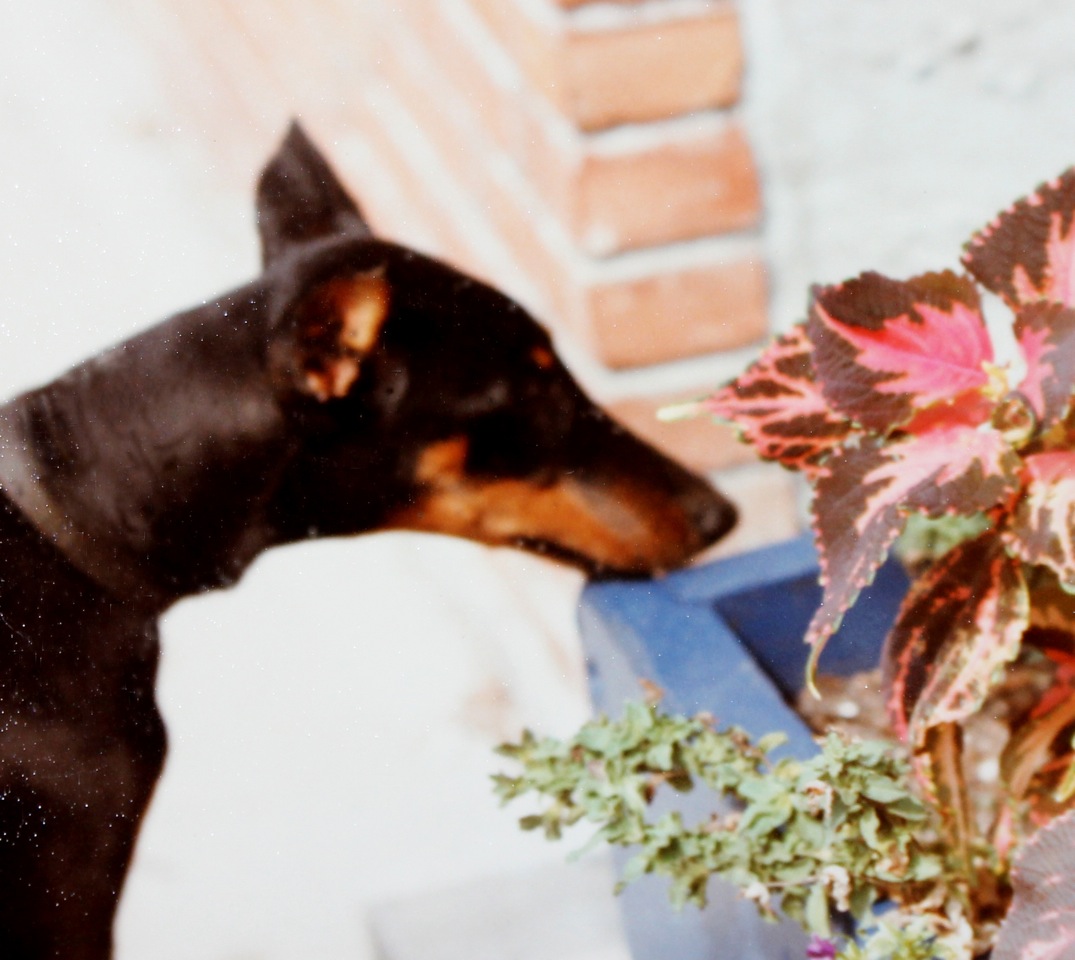
Delilah's favorite form of listening.

Delilah’s favorite form of listening.

Nature Poetry

My rabbi adds poetry to Friday night services. Scratch that, he adds poetry to every service he leads, but the services we go to every week are on Friday nights. I am not really a poetry person. I wrote poetry and songs as a teenager, but I felt like I didn’t belong with the other poets. I wrote poems just to get the glitchy thoughts out of the corners of my mind, not to be profound. I just wanted to say what I meant without having to think about rhythm or rhyme, or “the right word,” or what was going to impress people. So much of the poetry I was told to admire was incomprehensible. I love Mark Doty’s prose, but we spent two hours in a graduate class trying to diagram one of his poems, and I still did not understand what he was getting at.

So it was a surprise to me when I realized that I looked forward to the poetry every Friday night. That’s not to say I love all of it, I don’t. But sometimes it says exactly what I needed to hear, that I didn’t know I needed to hear.

“Mmm poetry.”

The other night there was a poem from Yehuda Amichai, an Israeli poet, with the Hebrew version and the English translation both printed on the page. My Hebrew is clumsy, and if I’d tried to just read the poem in the original, it would have been a struggle. It was pretty and melancholy in the English, about the conflicted feeling of being in Jerusalem in 1967, where you expect joy and transcendence, and instead get grief and complication.

In the English the words were bland, plain, clear and practical, but in the Hebrew, the words themselves were onomatopoetic, they bounced. The Hebrew words were playful and full and carried some of those sprouts of joy that were missing from the plain meaning of the poem.

It wasn’t even one of the nature poems, intentionally. It was one of the “Israel is complicated” poems that we get every once in a while, because our rabbi does not believe in making everything nice and simple; he believes in seeing things as they are and still trying to have hope anyway. This is why he is my rabbi.

There was also a poem by Mary Oliver, called “What Gorgeous Thing,” about the beautiful, and incomprehensible, song of the bluebird in the morning. She describes it as “the only thing in the world that is without dark thoughts,” or at least seems so.

“Really?”

I keep thinking that I’ll go to the library and pick up a stack of poetry books and find poems that speak to me, but I never do. I often have to re-read a poem to really get it, even on a basic level (forget about depth, or historical references, or coded language, then I’m clueless). If I like the sound of the poem, or the image it leaves in my mind, or the feeling it creates in me, then I’m in.

It helps that someone else is reading the poem out loud and I’m not just stuck with how the words appear to me on the page. We have some very good readers at my synagogue who can bring out the rhythm or pacing of the language in a way that doesn’t occur to me on my own.

For sentimental reasons, I always like when a dog shows up in a poem, but most dogs make more sense as storytellers than as poets. Cats could be poets. Cats are terse, with a well-chosen gesture or expression saying everything that needs to be said.

A genius at work.

A poet at work.

Actually, I think Butterfly might be writing nature poetry all the time, but her medium is pee, and I am too human to understand it. She is a nature poem all by herself when she stands out in the yard listening to the birds and contemplating the world around her, and then she becomes two poems intertwined, when her sister jumps over her still, contemplating body, to catch a falling leaf before it hits the ground.

My nature poem!

A nature poem!

Cricket, a poem in process.

Searching for a poem…

There it is!

and there it is!

Zoe and George

We noticed, first, that our new neighbor had a parrot. The parrot’s cage is next to the front window, so when the shades are up, the parrot is on full view, and looking out into the backyard full of potential birdy friends. The parrot’s name is Isabel, and she has an anxiety disorder that makes her pluck out her own feathers, so she’s a little scruffy.

Isabel behind bars.

Isabel behind bars.

Isabel.

Isabel is giving me the beak.

The first bark could have even been mistaken for a parrot squawk, but not the six barks after that. There were dogs in that there apartment. Two dogs.

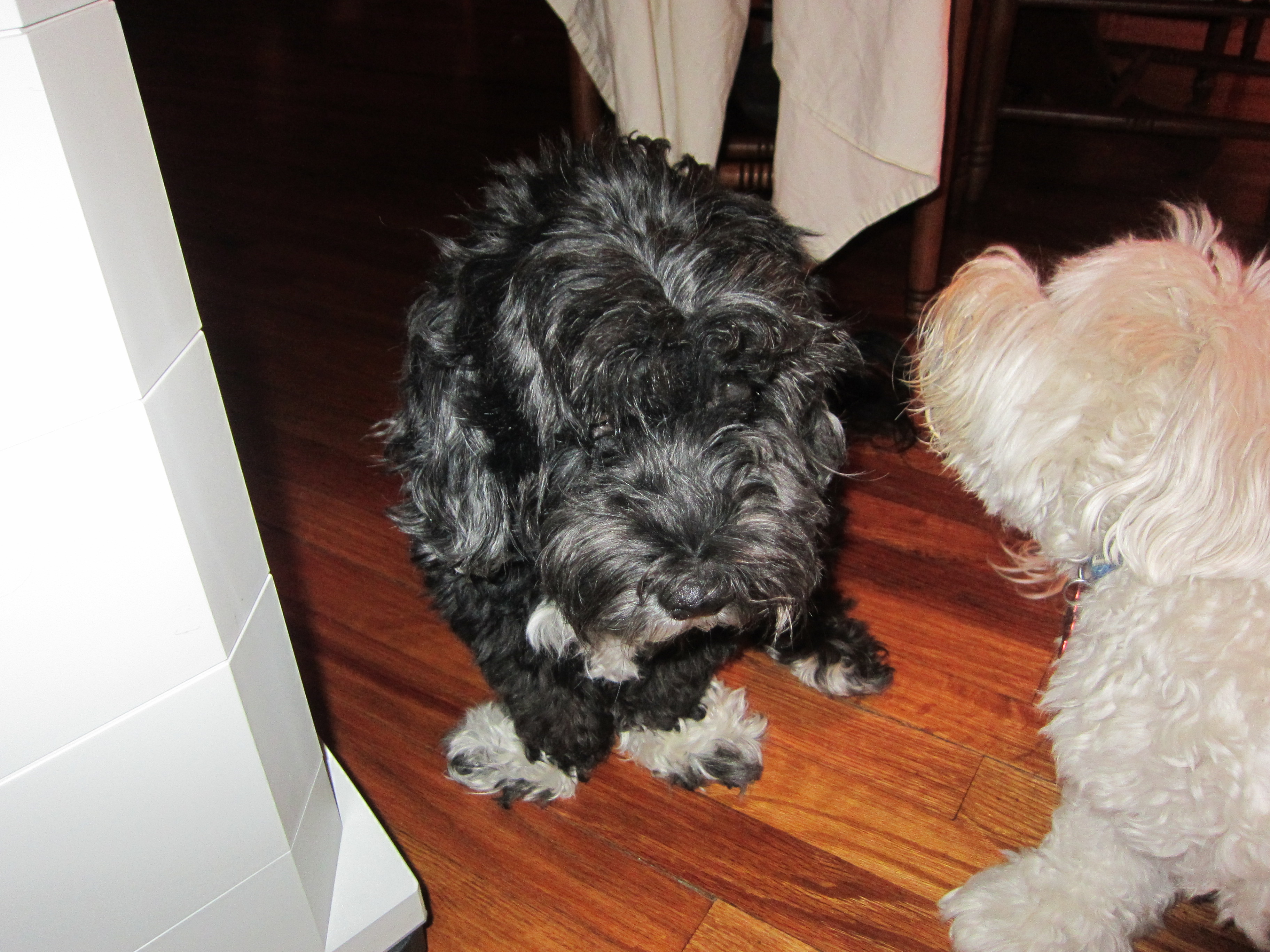
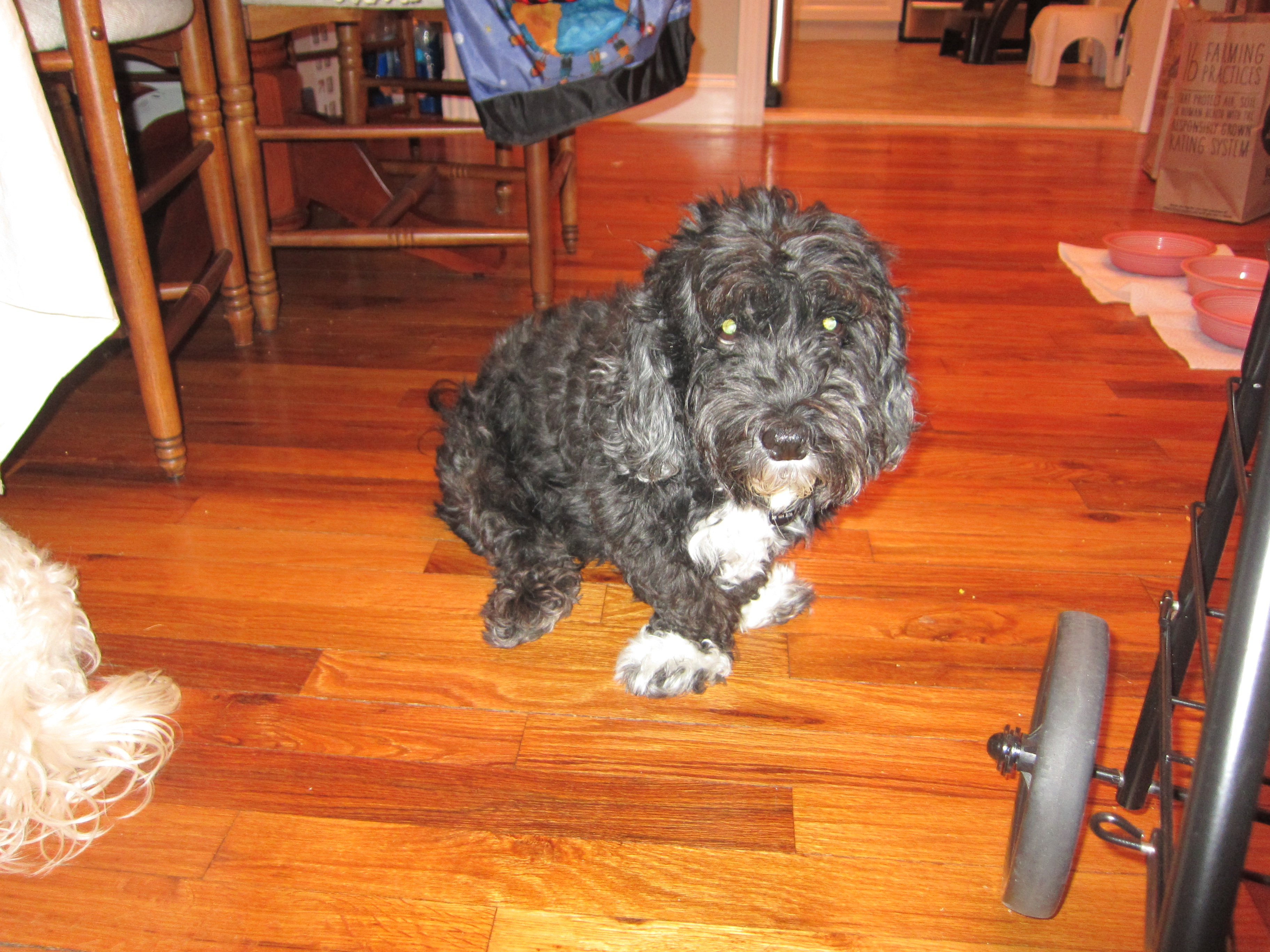
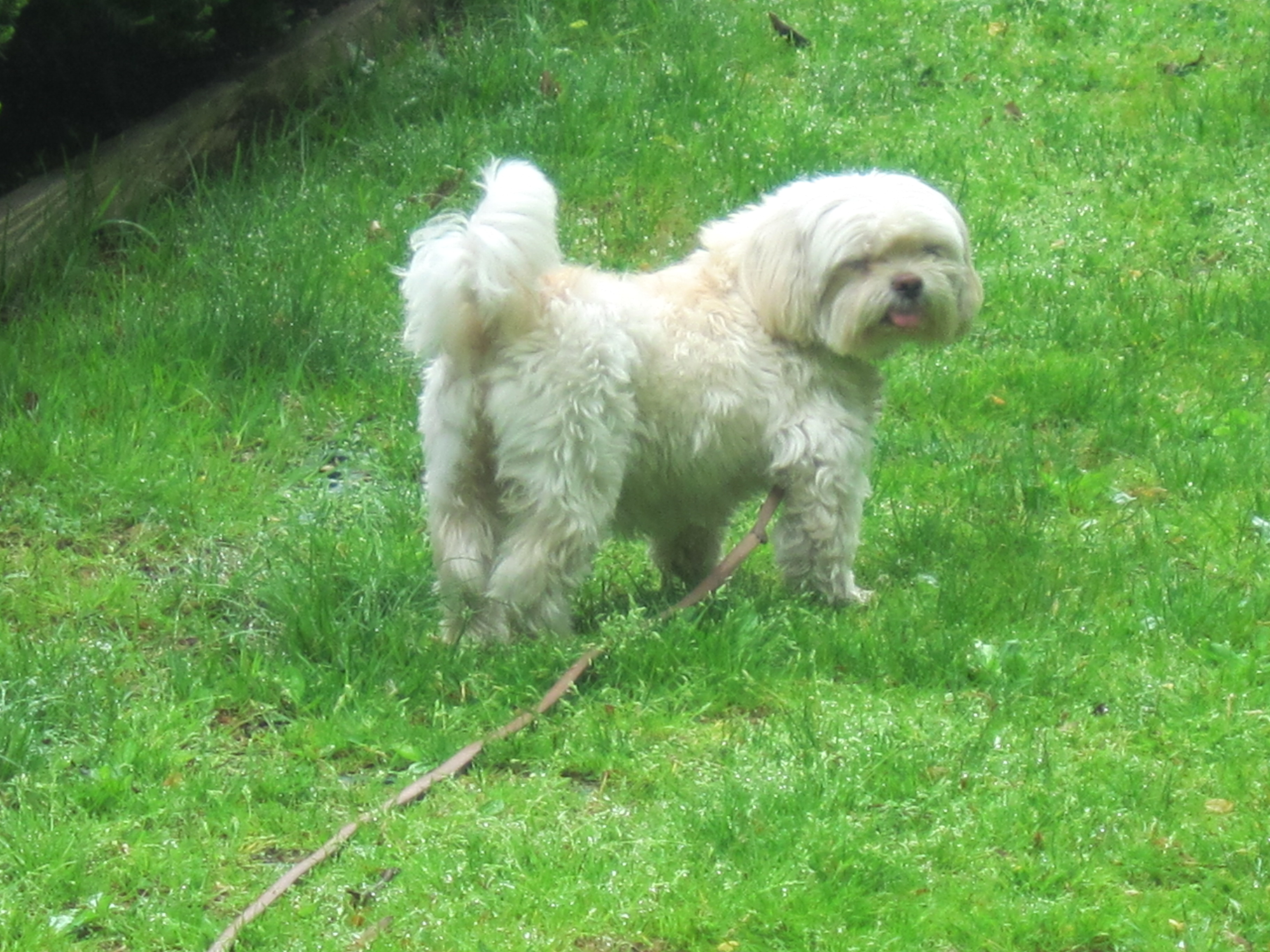
It was at least a month before I met them in person. George and Zoe are a little bit bigger than Cricket and Butterfly, but not by much. George is a white Havanese with a very outgoing personality. He likes to wave his front paws in the air to ask for attention. He’s very curious and keeps trying to go up the stairs to a stranger’s apartment to say hello. His older sister, Zoe, is a black and white Poodle mix, with an almost Dachshund length back that seems to have extra hinges in it. She is more demure than her brother, a bit more reserved and circumspect, but she will climb over him to get her share of scratchies.

That's George!

That’s George!

Zoe needs more light, but George is a glutton!

Zoe needs more light, but George is a glutton!

George and Zoe are both in middle age, or late middle age, like Cricket and Butterfly, and have their share of complaints: a hip here, a back muscle there; but they are still full of beans.

Whenever we walk past their building, my girls start sniffing feverishly. Butterfly seems to think that she must go inside, but she’s pretty shy when the real life dogs are around. Zoe and George had a little trouble with Cricket at first, because they’re all alphas and none was willing to cede power. Butterfly just stood by looking innocent and uninterested and let everyone sniff her butt.

Puppies? Where?!

“Puppies? Where?!”

I was able to take George and Zoe for a walk and it was pure joy for all of us. They are much better behaved that Cricket and Butterfly and appreciate any and all attention. Zoe has ballerina-like turn out in all four feet and almost gallops. George keeps his feet facing forward and sniffs everything and pees on everything he sniffs, and then he smiles like it’s the best day of his life.

“More walkies? We’re ready!”

There should be a puppy place in the backyard where all of the dogs who live here can hang out, so that I’ll never run out of my doggy vitamins. If I could just sit on the lawn and play with puppies for a few hours a day, I’d never have to take anti-depressants again!

Zoe finally gets her moment in the spotlight!

Zoe finally gets her moment in the spotlight!

Family Photo Albums

Earlier this summer, when one of my cousins came to visit from Paris, it occurred to me that she might like to look at the two or three family photo albums we have at our house that I’d been organizing and reorganizing obsessively. Both my French and American cousins spent hours poring over the pictures, and requesting copies, and Mom spent the next few days at the library scanning the pictures and downloading them to drop box, for everyone in the family to share.

My grandmother was the keeper of the family photo albums, and showed them to us as the only form of entertainment she could offer when we visited her. I loved the black and white pictures of serious people and children in sailor suits. I loved knowing that I was connected to this ongoing story and I wasn’t just a solitary blip in time.

I don’t know what it means that my grandmother created and kept the photo albums. She wasn’t a storyteller, she was a collector: colored glass, interesting people, recipes, and photo albums full of disconnected moments in time. When we looked through the photo albums at her house, she stood at a distance, and when we asked questions, she answered in one or two words, or not at all. She could only offer us the pictures, not the lives behind them.

After her death, my aunts divided up the photo albums and furniture and books. I don’t know if they looked through the boxes and made conscious decisions, or if they just put things where there seemed to be room. My French aunt took the blue and white sofas and put them in her country house, I have the old rocking chair with red cushions and a few photo albums, and the largest box of family photo albums was in my other aunt’s attic in Queens. Untouched. And after my cousin’s visit, I had to go get that box. I spread the photo albums out on the floor of the living room: a lot of them were falling apart at the binding, or had lost their stickum, and pictures were falling out the sides.

It was exciting to finally see so many pictures of my cousins as children, because they were all together each summer at my grandparents’ house in Lake Placid, even my brother was there one summer as a baby, but the house was sold the summer before I was born. We were rarely anywhere at the same time after that. One set of cousins or the other would visit, or my brother and I would visit our grandparents, but there were no big family gatherings again like those summers in Lake Placid.

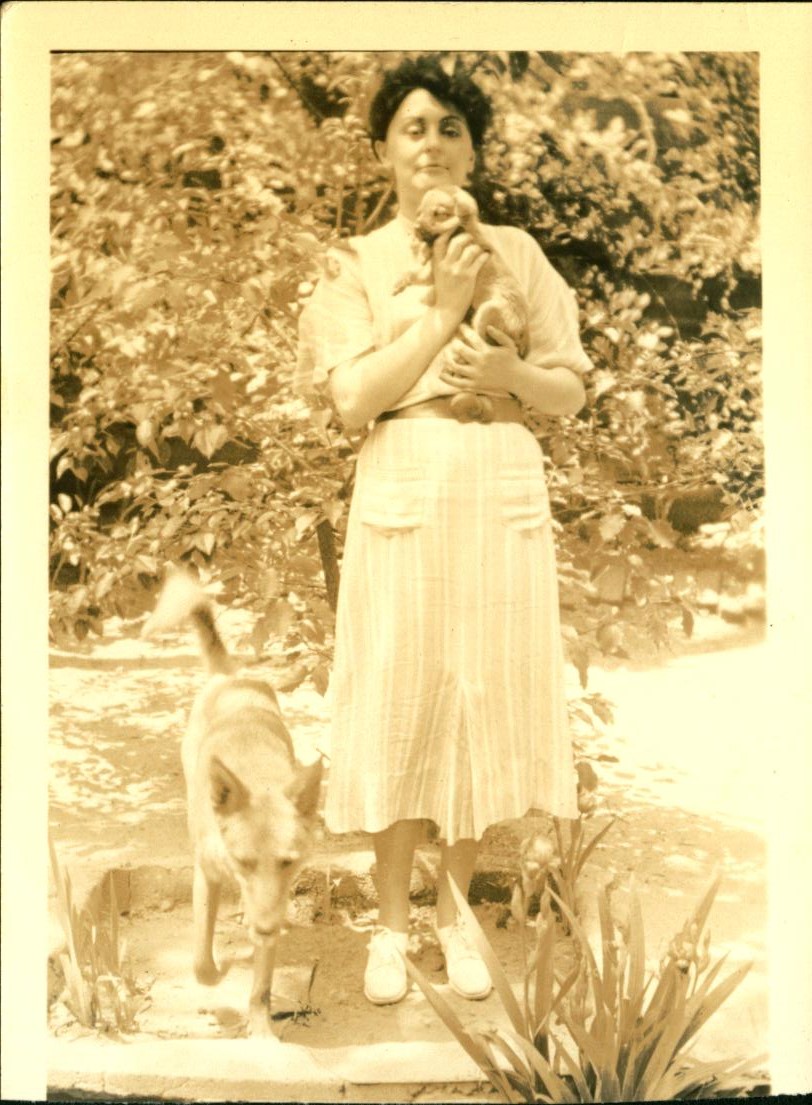
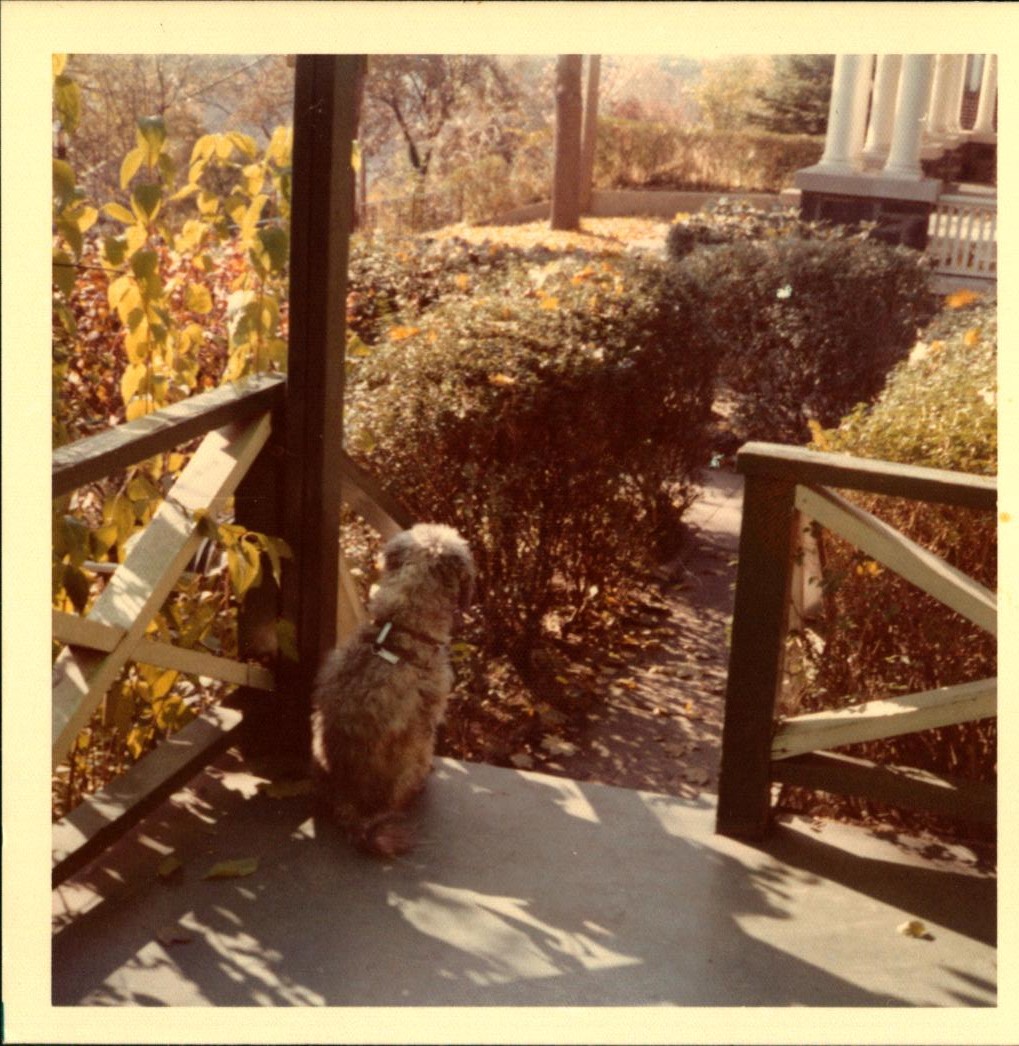
But the great discovery was the dogs! All of these dogs I’d heard about over the years were finally visible. We are a dog family, no matter what else we are. My Grandmother, severe and moody, loved Rufus. My mom, skinny and lonely, had Minky by her side. Even the housekeeper, dour and apart, had Chihuahuas – given to her by my grandfather, for company – dogs that really did make her a part of the family. Dogs have magical powers to soften the harsh edges of life, and people. There was Lady, and Minky, and Rufus, and Hercules, and Bijou, and Sarika. The dogs were much easier to love than the people, but all of the people loved the dogs.

That's my aunt, mind-melding with a family dog.

That’s my aunt, mind-melding with a family dog.

Annie, the housekeeper, with Herculina.

Annie, the housekeeper, with Herculina.

Grandma with a puppy.

Grandma with a Momma and her puppy.

Mommy and Minky.

Mommy and Minky.

Rufus, guarding the house.

Rufus, guarding the house.

Through all of this, Cricket and Butterfly wandered around and sniffed. I don’t think they could identify which particular pictures were of their doggy relatives, but there were interesting smells everywhere nonetheless.

After-sniffing exhaustion.

After-sniffing exhaustion.

It’s going to take a while to scan all of these pictures, but it will be worth it, to keep the family narrative intact so that we all know where we came from and that we are different strands of the same complicated family story.

Shiny Poop


Recently, Mom has had a lot to deal with. Her sister hasn’t been well, and there’s been a lot of doubt and worry and conflict and hospital visits and family discussions, which means we have needed to resort to the heavy weaponry of comfort: chicken wings.

For some reason, chicken wings are my mother’s perfect comfort food. I’m not talking about fried chicken, or, God forbid, Buffalo chicken wings. These are tossed with some salt and pepper and chili powder and baked in the oven. It’s a plan ahead meal, because the wings need to be defrosted, and then baked for more than an hour, and then cooled so they won’t burn off your fingers. But it’s also a family meal, because the dogs think I’ve made it just for them.

I’ll make a salad or something to go with it, but that’s really beside the point.

As an antidepressant, nothing beats chicken wings and watching the dogs hop up and down, and salivate, and smile, and run in circles waiting for their share. While the chicken wings are cooking in the oven, the dogs gradually become twitchier and glassy eyed, until they are drawn to the stove like magnets, staring at it from the kitchen doorway. I tend to share a lot of my chicken, because I don’t like the skin, and they love it. But when the chicken is all gone, they don’t really believe it. They will dig into the corners of every room looking for left overs, and then get angry and start barking in disbelief. Butterfly, especially, looks high, and crazed, after she’s eaten her chicken. She’s jonesing for more, and out of her mind. I don’t understand why I’ve never seen a warning sticker on a package of chicken wings – “Danger, Addictive Substance, Keep away from young children and dogs!”

“I need chicken!”

“Chicken?!”

I myself do not have that reaction to chicken. In fact, lately, I’ve started to wonder if I’m allergic to the stuff. I’ve noticed feeling nauseous a few times and not being able to finish eating, both with chicken and with eggs. Chicken is supposed to be the universal meat – the one that everything else tastes like (squirrel, frog, whatever else people are trying to get you to eat), but it’s not really my thing.
The problem with baking the chicken wings is the mess they make. I go to a lot of trouble to cover the whole baking pan with aluminum foil, and cover the aluminum foil with parchment paper. The idea is to wait until the pan cools and then fold the aluminum foil up and put the whole mess into the garbage can so we only need to rinse the baking pan for its trouble. But no. Mom does not believe in this. She believes that the dogs should have the benefit of every drop of fat that drips onto the pan, and insists on putting the pan, paper and foil and all, onto the floor for their delectation.

One Friday night, I made emergency chicken wings before Friday night services and didn’t have time to organize the clean up before we left. Without my knowledge, Mom had put the pan on the floor and left it with the dogs while we were out, for two hours. By the time we got home, the kitchen was a storm of tiny bits of aluminum foil and large swathes of parchment paper, and Butterfly’s face was dark with oil. Cricket was standing far away from it all, to make it clear that this was not her fault. I should have taken a picture, but at the time I was too shocked, and too busy corralling the dogs outside, and telling Mom that she would be the one to clean it all up.

Bath time after chicken.

Bath time after chicken.

“But I wanted to smell like chicken forever, Mommy.”

I worried, for days, that there would be shiny poop, and when there wasn’t, I started to worry that Butterfly’s internal organs were filled with aluminum foil decorations. A few weeks have passed now though, and Butterfly is still running and hopping and pooping as usual, so, fingers crossed, there’s no shiny poop waiting around in there.

“I could eat some more chicken.”

Unrequited Love

I hate the word unrequited, because we assume it to mean that there is only one person in love, and the other person is indifferent or even ignorant of that love. We use the term to cover almost any relationship that does not come to fruition: from stalker-like crushes on celebrities, to unequal love affairs, to love that is not actively returned but is still felt on both sides.

“Where are you?”

Cricket has had a few unrequited loves in her life. Usually with cats. Cats are not sure about Cricket, with her fast moving feet and her high pitched bark, but that doesn’t mean that the cats were never interested in her; they preferred to lurk and watch her from a distance.

Cricket and the cat

Cricket and the cat

Butterfly is less intimidating, and more approachable, but as yet she has not shown any persistent interest in any particular dog, or animal, other than her sister. Cricket only pretends indifference to Butterfly. At the very least, she loves having access to a Scent-O-Pee dispenser at all hours of the day and night.

Self explanatory.

Self explanatory.

I used to watch Hugh Grant movies, and a friend told me, you know, life is not really like a romantic comedy. And I said, of course I know that – but maybe I didn’t. I knew that Hugh Grant was not like the characters he played, but I figured someone must be, for the script to be written in the first place. I may have too much faith in my fellow writers.

I’ve had my share of crushes on TV characters, but most of my unrequited loves have been more complicated in one way or another, and yet still, finally, unrealized. I often feel like I’m pressing my nose up against the glass at a department store window, to stare at all of the things I can’t have.

IMG_1829            The dogs are my experiment in love requited, because they really do love me as much as I love them (even if they can be moody and need their own space sometimes). They are my lesson in the routines of love: the gifts given whether you’re in the mood or not, tasks accomplished and needs met even if I feel resentful about it. And I’ve found that I’m pretty good with all of this, and I miss them when they’re at the groomer for a few hours, and I’m happy to see their smiling faces each time I come home. I learned a lot about the dailiness of love from Mom: that love is action as well as feeling, and if you love someone, you take care of them, even if they are annoying you at this moment (I can be very annoying).

"I love you anyway, Mommy."

“I love you anyway, Mommy.”

I’ve learned about how to invest in love from writing, because I invest in it every day, even when weeks go by without inspiration, or years without external signs of success. I feel the security of making that daily investment. But romantic love – I don’t know how to build that or even to seek it out in a productive way. My parents’ marriage was scary, and maybe that’s what I expect romantic love to turn into, no matter how it begins.

I’m tired of seeing everything I do as pathological, even when it is, actually, pathological. The thing about unrequited love, is that there is an endless sense of possibility. Something exciting is always around the corner, even if it never actually arrives.

“What’s next?”

Mourner’s Kaddish

I have felt, for a long time now, that I have mourning to do, without the rituals with which to do it. My grandfather died when I was eight years old and I was not required, or even allowed, to say the Mourner’s Kaddish for him. I have lost dogs, but there is no ritual of Jewish mourning for a dog. There is also no mourning ritual after a betrayal or divorce. There are rituals for birth, coming of age, marriage, and death, but there are more events in life than that.

Delilah at the beach.

Delilah at the beach.

IMG_0547

Dina loved peanut butter.

The Mourners Kaddish is not actually about death, it is about reiterating faith in God. The prayer is mostly in Aramaic, rather than Hebrew. I never studied ancient Aramaic, so I only really understand this prayer because of the English translation. But the sound of the words, sung or spoken, has power, maybe because it sounds different from the largely Hebrew prayers in the rest of the service. It’s almost like the words have magic because of their otherness, as if secrets are hidden within them.

My favorite line of the prayer is a long list of the types of praise we offer. From the Artscroll Siddur: “Blessed, praised, glorified, exalted, extolled, mighty, upraised, and lauded be the name of the Holy One, blessed is He beyond any blessing and song, praise and consolation that are uttered in the world.”

It sounds better in the Aramaic, but it’s this long list of the ways we express love. And yes, we say them about God, but I think of them as being about us, about each other. These are all of the ways we experience and express our love for each other – with glory or comfort, with praise or song, and yet we can never capture all of that love in words because it is beyond the words we have available to describe it. So, yes, we are being reminded to have faith in God at our lowest moment, when we might feel as if God has forsaken us, but for me, it is a moment to acknowledge the love we still feel for the person we have lost, and for the people we still have.

Cricket, giving thanks for a leaf.

Cricket, giving thanks for a leaf.

Butterfly, in silent prayer, for chicken.

Butterfly, in silent prayer, for chicken.

The Mourner’s Kaddish can only be said with a quorum (ten Jews, some congregations still count only men) as part of the service. People who would otherwise say a hasty version of their morning prayers at home before work, will, for the year of mourning, make a point of finding an early service at their own or another synagogue, and hope that at least ten people will show up in time.

The Mourner’s Kaddish is said at the end of the service, not at the beginning, and I can think of a couple of reasons for this: one, so that the mourners will stay for the whole service in order to maintain the quorum and allow for all of the communal prayers to be said; and two, because there is healing energy in being there for the regular daily prayers, with your community, and in deep mourning you may not be able to believe that and choose it for yourself if it were not required.

At my current congregation the custom is, basically, for mourners to stand and the rest of us to sit, for the Mourner’s Kaddish. But over the years the instructions have become more convoluted and the rabbi has had to come up with a paragraph-long list of instructions: if you are in a period of mourning, or have a yahrzeit (the anniversary of the death of a loved one), or are supporting a friend who is in mourning, or think this is a good time to stand and remember…

Earlier in the service, a shortened version of the same prayer is sung, rather than spoken (as it is for the Mourner’s Kaddish) and the feeling is more joyful and light, with the same exact words. It seems to me that using the same prayer for both purposes is a way to gently remind mourners that they used to sing this song, and some day they will again. Until then, they will speak the words with the community, be part of and apart from them, and know that they are seen and that they are not alone.

Most of Jewish ritual is meant to be practical. When it’s not practical, it is either out of date for its original purpose, or the practical purpose is a little more hidden and requires some time and repetition to discover. So I wonder what the ancient rabbis meant by leaving other losses unritualized and unmourned. Maybe some of the prayers just didn’t make it into the canon, or were lost along the way. Maybe one day there will be an excavation of a little town outside of Jerusalem, and inside of an ancient stone dog house they will find the lost book of prayers for how to mourn a beloved dog. I think a lot of people would appreciate that.

I found this stone dog house online. I especially like the potted plant in the window.

I found this stone dog house online. I especially like the potted plant in the window.

Cricket Saves The World

Cricket has the weight of the world on her shoulders, and they are very skinny shoulders. She wakes up in the morning believing that she has, single-handedly, kept her Grandma safe over night from all manner of insidious evil. Sometimes she curls up on Grandma’s head to protect her from bad dreams (though not from headaches, clearly).

Cricket thinks she is enormous.

Cricket thinks she is enormous.

“I’ve got you, Grandma.”

When Mom is quilting or making a pair of camouflage pants for one of her grandsons, or his raccoon, I always suggest the she use some of the material to make a superhero cape for Cricket. It wouldn’t be hard to make, but Mom does not believe that Cricket would be willing to wear a cape, or a poncho, or a sweater, or even a sari (we had some lovely diaphanous apricot colored material that I thought would look heavenly on her – but no).

A suitcase is sort of like a cape. Right?

A suitcase is sort of like a cape. Right?

As soon as Cricket has finished guard duty over the sleeping Grandma, she sets her sights on the front door of the apartment, where she senses that there are shadows lurking on the other side, trying to slide through the keyhole. She has been known to race down the hall, with her knees locked and her back feet barely touching the ground, to yell at some vague sound or another.

Cricket believes that every time she hears a noise she needs to make as much and, if possible, more noise in answer. So, one bark from a dog outside equals ten barks from Cricket. Ten footsteps on the stairs equals twenty barks from Cricket. It’s a rule as important as gravity, or conservation of energy. It’s not a form of communication so much as an energy matching plan, to keep us afloat. It keeps the world spinning. And if she can get her sister to bark with her, so much the better.

“What are we barking at, Cricket?”

The big test comes when we leave the building and her feet touch public space. Then she must be even more watchful; so many dangers lurk in the backyard! One of the worst, beyond the daily horror of mail delivery, is the man who walks up the Forbidden hill, at 6:45 in the morning, carrying newspapers!!!!!!

Cricket finds this horrifying. She barks, and pulls at the leash and tries to get her paws up into the air to fight. I drag her, and a bewildered Butterfly, up the Good hill (the one the co-op says we are allowed to walk on, and therefore does not weed or mow), until Cricket can no longer see the offending newspaper man. But she still barks at him in absentia. She barks much longer than any reasonable dog could think it might take for the man to walk down our block of buildings and out of sight.
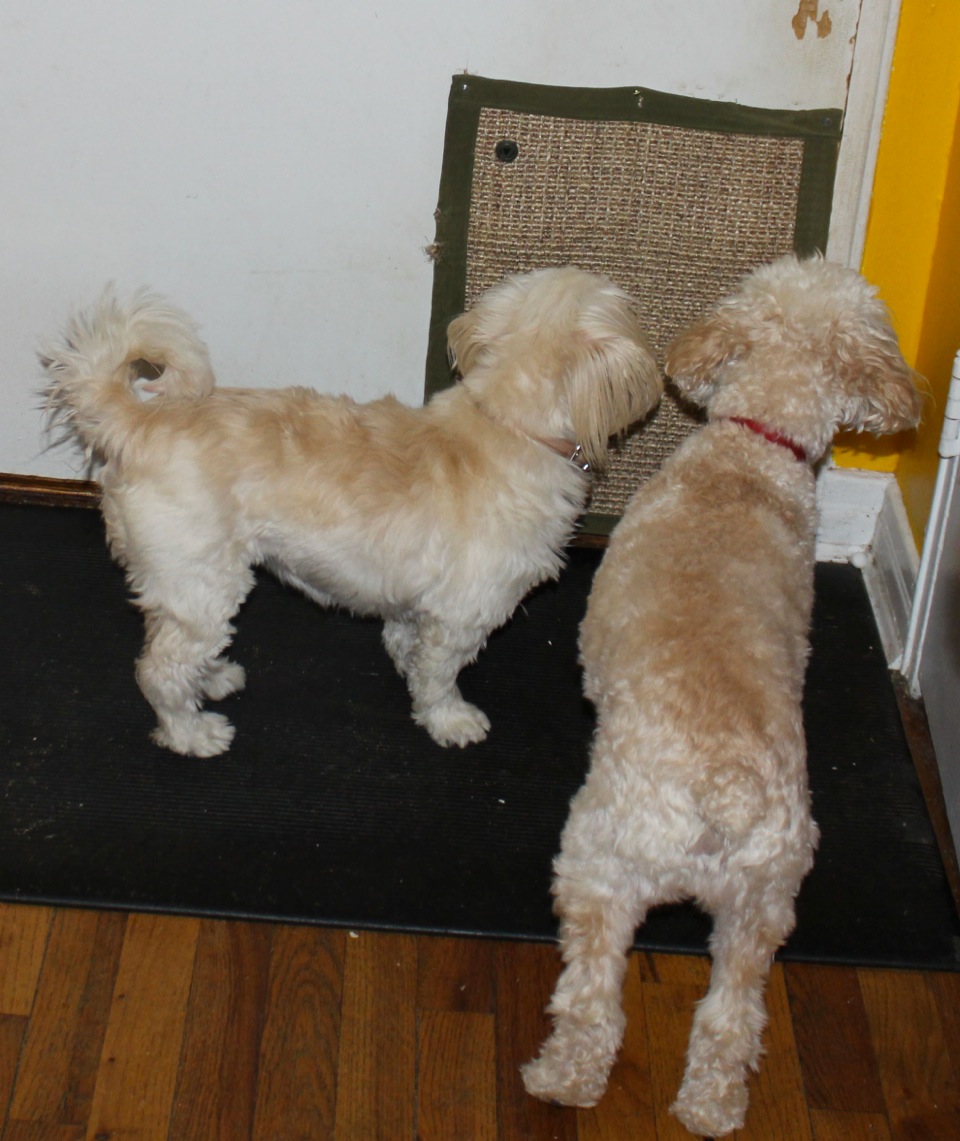
When I take the dogs back down the hill, Butterfly strolls along but Cricket is still pulling to get to the invisible interloper. She has come very close to hurting herself any number of times by leaping into the air while her leash stays still, because I’m in the middle of picking up her sister’s poop.

Most of the time when we are out in the backyard, Cricket is so busy trying to save the world (from work men, mailmen, neighbors and squirrels) that she forgets to poop. Inside the apartment she was hopping and climbing on me and scratching at my arm or leg in desperation, but outside, there’s too much going on to focus on something as boring as having to poop.

Butterfly’s job is to follow Cricket, to back her up in a worthy cause, or to get in her face and offer some calming doggy breaths when the hysteria has gone on too long. But Butterfly NEVER forgets to poop, or pee, or listen to the birds, or meditate for a bit, or check out the cat food left out for the local feral cats. Butterfly’s priorities are internal. She hears the rhythms of her own body loud and clear and only focuses externally once those needs are taken care of.

“I’m meditating, and it could take a while.”

We finally make our way back to our building, and Cricket is still blinking, and checking from side to side, and imagining newspaper men hiding behind bushes and around corners. The girls have to stand in the lobby of the building while I bring the bag of poop down to the garbage cans in the basement (we have no outdoor garbage cans at the co-op, as a matter of policy that I still don’t understand). I can hear Cricket pacing and checking and sniffing under our neighbor’s door, to make sure that she is safe and sound.

Finally we get back to the apartment, and Butterfly begs for a treat and drinks three buckets worth of water, and Cricket’s throat is sore, and she’s out of breath, and she starts to look around and check in with herself and you can see that moment of confusion when she gives herself a sniff and realizes she forgot to poop.

Being a super hero is hard work, and requires a few sacrifices; just ask Cricket.

“Oy.”

My Online Class

This is how Butterfly feels about school.

This is how Butterfly feels about school.

I spent the whole summer freaking out about the first online class for my masters in social work, as some of you know. I’m a very anxious student. I always worry that I won’t finish my work in time, and rush and rush, until I’ve finished everything by Tuesday, when it’s not due until Sunday. There is a lot of work for my online Human Rights and Social Justice Class: first of all, because it’s a graduate class, and second because it’s all in eight weeks, so each week is like two weeks of a regular semester. I take notes on everything: the chapters from the terrible textbooks, the scholarly articles, the radio programs, and the video lectures. Even when the information is duplicated and quadruplicated, I take notes each time, just in case I missed something.

I hope this will calm down soon and I will start to trust myself a bit with this new school format. I’m kind of enjoying arguing with all of these authors as I read their work – and one of our weekly assignments for class is a reflection journal to “process” what we’ve learned, so I can rant and go off on tangents and have my say and, eventually, the teacher has to read it.

Human Rights and Social Justice as a title for a class sounds daunting. It suggests a seriousness and a comprehensive-thousand-page-thesis vision of learning, but the reality of the class has been more down to earth. The Professor focuses on manageable doses of vocabulary and ideas, rather than expecting the TRUTH to come down from heaven and infuse us with a burning light.

There is an acceptance that these terms are so big as to be almost meaningless, or to carry many meanings within them. We each use these terms, and every term we learn in the jargon of social work, to mean specific things that they may not mean to other people: words like distributive justice, and equal rights, and positionality, and intersectionality, and internalized oppression, and on and on.

Cricket has already let me now her feelings about my watching the video lectures on the computer. She’s used to me reading quietly, or looking at blogs and pictures on line, but for the computer to talk, and for so long, makes her very angry. She had a big bad case of Barking Tourette’s during the longer of the two lectures, and I almost lost my mind.

“What the heck is that?”

“I must bark it to death!”

We have twenty one or twenty two students in our class and I read everything they write, because a lot of my classmates are already working at social service agencies and have valuable experiences to share, and because it’s nice to know someone’s out there reading and thinking about the same things I am. The online format is surprisingly intimate, and thorough, compared to in-person classes, because everyone gets a chance to have their say, and to respond to each comment that interests them. We don’t have to compete for attention, or fit our comments into a limited time period. We have all week to think and write and read at our own pace – and the professor can hear and respond to everyone, with no need to pick only one or two voices to speak for all of us.

Most of the work for the class is reading and then writing responses, but some percentage of the final grade will come from the final exam – a forty question multiple choice test that I will take on my home computer. Their answer to how to make sure we are not cheating is a service called ProctorU, where you sign in and someone sits there and watches you on your web cam, and talks to you, and checks out your environment, and makes sure you have no unacceptable resources. It looks really creepy. I am much more anxious about the process of being proctored online than I am about the final exam itself.

Maybe Butterfly could sit in front of the computer for me. Do you think they'd notice the difference?

Maybe Butterfly could sit in front of the computer for me. Do you think they’d notice the difference?

With my luck, Cricket will take an instant dislike to the proctor talking at us from my computer screen, and will spend the whole test barking, until my head splits open and all of that studiously gathered information spills out all over the floor.

“Cricket is ready.”

A Cardinal’s Song

We have a lot of birds in our backyard. There are the Baltimore Orioles and the Blue Jays and the Cowbirds and the Phoebes and the Starlings and these tiny little birds that seem like extra-large flies that crowd together in groups, and the Robins, and the Cardinals.

There was a Cardinal, back in the spring, whose song was like a Rosh Hashanah shofar blast – three long notes and nine short blasts, shvarim truah.

A Cardinal, but maybe not the singer.

A Cardinal, but maybe not the singer.

This is someone else's picture of a shofar.

This is someone else’s picture of a shofar.

This is someone's picture of a puppy blowing a shofar.

This is someone’s picture of a puppy blowing a shofar.

The cardinal came before the heat and humidity, when I didn’t mind spending extra time outdoors, just to catch the end of a song or hear it repeated. We might as well call the backyard of the co-op a wild life preserve, given the feral cats, birds, raccoons, squirrels, and random humans who hang out back there. The retaining wall is a massive overgrown hill, full of various plantings and weeds and trees and flowers, and the birds have found plenty of places to live in there. Mom tossed out some quilting scraps to help them build their nests, and the fabric disappeared, so someone made use of it. It’s possible that the squirrels are fantastically well dressed this summer.

A local squirrel.

A local squirrel, not noticing me, yet.

Feral cat.

Feral cat, yawning.

When I went inside and reenacted a whistled version, Butterfly went nuts barking in response. It’s possible she was objecting to my rusty whistling technique, but maybe she understands bird, and I was singing a very offensive song.

Butterfly, offended.

Butterfly, offended.

My mom can pick out a few birds accurately by their songs, and what she’s not sure of, she can check with Google. (Google sounds like something a bird might say, after all, or it’s what Cricket says when she sees a bird and tries to run after it and her leash stops her.) But Mom had never heard a bird sound like a shofar before, and neither had Google.

Cricket, mid-google.

Cricket, mid-google.

The shofar blowing is supposed to be a wakeup call, or a call to arms, but at our synagogue it ends up being a competition between the shofar blowing guys for who can hold the long note (the tekiyah gedolah) the longest. By that point in the service, I’m starving and feeling faint and I wish they had just a bit less lung capacity so I could go home and go to sleep.

I’m not a fan of the high holidays (Rosh Hashanah and Yom Kippur), which start the Jewish calendar each year with a heavy dose of guilt and atonement. They probably throw in the apples and honey because otherwise we’d all shoot ourselves halfway through. The services are longer than usual, the clothes are more formal, the rabbis actually give speeches, and the synagogue is full to bursting with people I’ve never seen before.

When I was a kid I resented that we couldn’t sit in our regular seats for the high holidays, because someone else was already there, someone I’d never seen before who should really not be allowed to sit in my seat. Instead, I ended up in the folding chairs in the way back, because we were always late.

I would much rather have a bird service and sit outside on the lawn, and listen to the birds talking to each other. I wouldn’t have to dress up for that, or even comb my hair, if I didn’t want to. I wonder what the bird calls would wake me up to, the way the shofar wakes us up to do penance or atone or forgive or ask for forgiveness. Maybe the bird calls would simply be there to remind me to sing to someone, or to speak my piece to someone who will listen? Wouldn’t that be a great idea for a holiday? Cricket would love that! But she would probably spend all day singing and forget to listen to anyone else.

The birds are in there, somewhere.

The birds are in there, somewhere.

Cricket loves to sing for an audience.

Cricket loves to sing for an audience.

Lately we’ve had the cricket and katydid chorus blasting at us each night in the backyard when we take the girls out for their final pee, and Cricket thinks that’s as it should be.