Tag Archives: books

The Hidden Room

            Each year, I read Behind the Bookcase: Miep Gies, Anne Frank, and the Hiding Place (by Barabara Lowell and Valentina Toro) with my synagogue school students for Holocaust Remembrance Day (Yom HaShoah). This picture book is a retelling of the Anne Frank story, through the eyes of Miep Gies, one of the women who helped to hide her and her family from the Nazis. I love the gentle way the book introduces difficult themes to young children, and the way the pictures allow my students to connect to real people and how they feel; but I think the biggest reason why I chose this particular book, out of a pile of just-as-good books on the subject, is because the idea of a bookcase that hides a secret door has always resonated with me. Because, in the house I grew up in, we actually had a bookcase that hid a secret door.

The secret room in my house, wasn’t an attic, or a place to hide Jews, it was actually just a workroom for my mom’s home graphics business. I guess it’s possible that we could have hidden in our secret back room off of the living room, if robbers or Nazis, had entered the house, except that we rarely closed the bookcase door. Generally, it stood partly open, connecting the back room to the living room in general, which was filled with built-in bookcases on every wall, a grand piano in the corner, and a huge fireplace that we rarely used, even after the home business closed a decade later.

My father, who planned out our living room himself as part of a years’ long renovation, was a fan of hiding places and secrets in general, to the point of paranoia. I found out later that he hid all kinds of things around the house, in his sacred books, and in ceiling tiles; things he didn’t want us to find, or didn’t want to know about himself.

The deep resonance of hiding places and secret doors has stayed with me, to the point where I envision my brain as being made up of hidden tunnels and secret passageways that need to be explored and excavated. Hidden rooms show up in my dreams all the time, with lost puppies and long-lost toys and treasure troves of documents, and, you know, treasure, hidden behind secret doors and only discovered years later. Hidden rooms and crawl spaces are also a constant theme in the mysteries I like to read, including priest holes, where catholic priests were hidden from priest hunters in 1500’s England, and the hiding places used by the underground railroad in the US, that hid escaping slaves on their way to freedom, and, of course, the basements and attics and barns and holes in the wall where Jews were hidden by their neighbors during the Holocaust.

My feelings about these hidden rooms teeters between a desire to be hidden away and a desire to open every secret door to the light. I remember when I first read the Harry Potter books, I couldn’t understand why Harry hated his cupboard room under the stairs. Yes, it was tiny, and he was being treated like a pile of rags while his cousin had two bedrooms upstairs for his own use, but the idea of that tiny space, with low ceilings, and very little light, always seemed comforting to me.

There’s still so much hidden away in my memory, cordoned off because it feels too dangerous for me to look at, or held safely in isolation, where it won’t have to face the harsh light, or both at the same time. I can see shadows under the floorboards and cozy blankets piled high in corners, and I know that there’s more that I need to discover, but also that some of it can wait, while the frightened parts of me stay in their safe, warm corners a little bit longer.

The whole idea of the hidden rooms came back to me when I watched videos of Israeli families in their safe rooms, during the recent 12-day war with Iran, and I thought of the room behind the bookcase in my old house, and how useless it would have been as a saferoom, because there were tons of windows and anyone could have seen in from the outside, and bombs would have shattered those thin walls from miles away.

            My ideal of a secret room, or a safe room, would have been one that I could have accessed from the closet in my childhood bedroom. I would have been able to push the clothes aside, pull a rope that released a hidden stairway, and then I would have climbed up to my hidden room, filled with stuffed animals, and piles of books, and a freezer full of ice cream just for me, and finally, I would have felt safe.
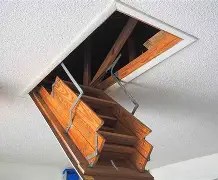
Not my picture
“But, what about me?!”

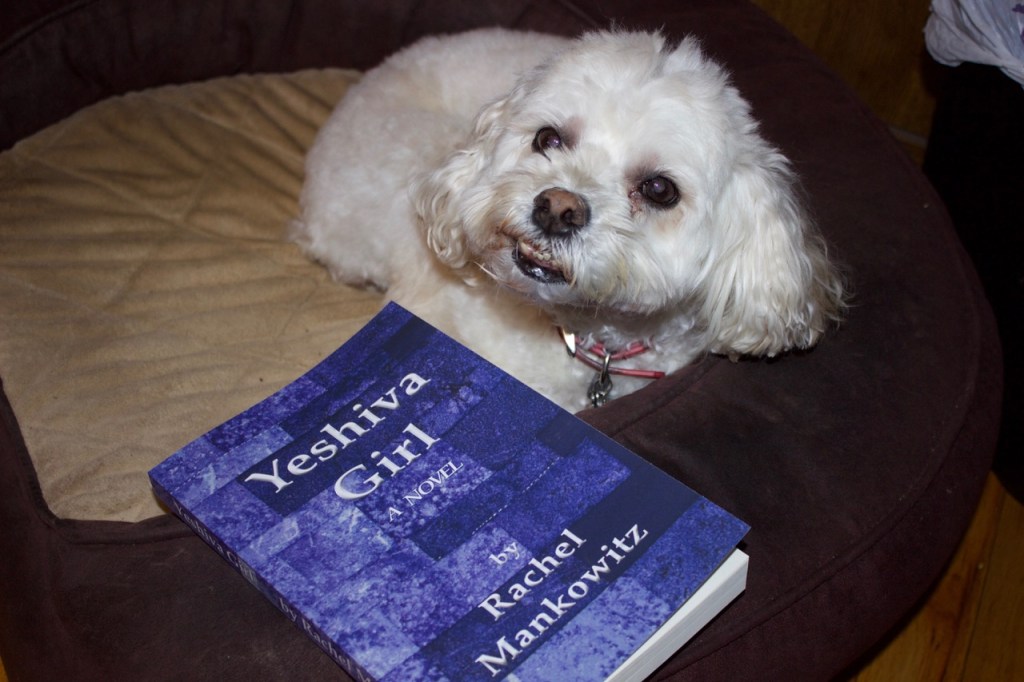
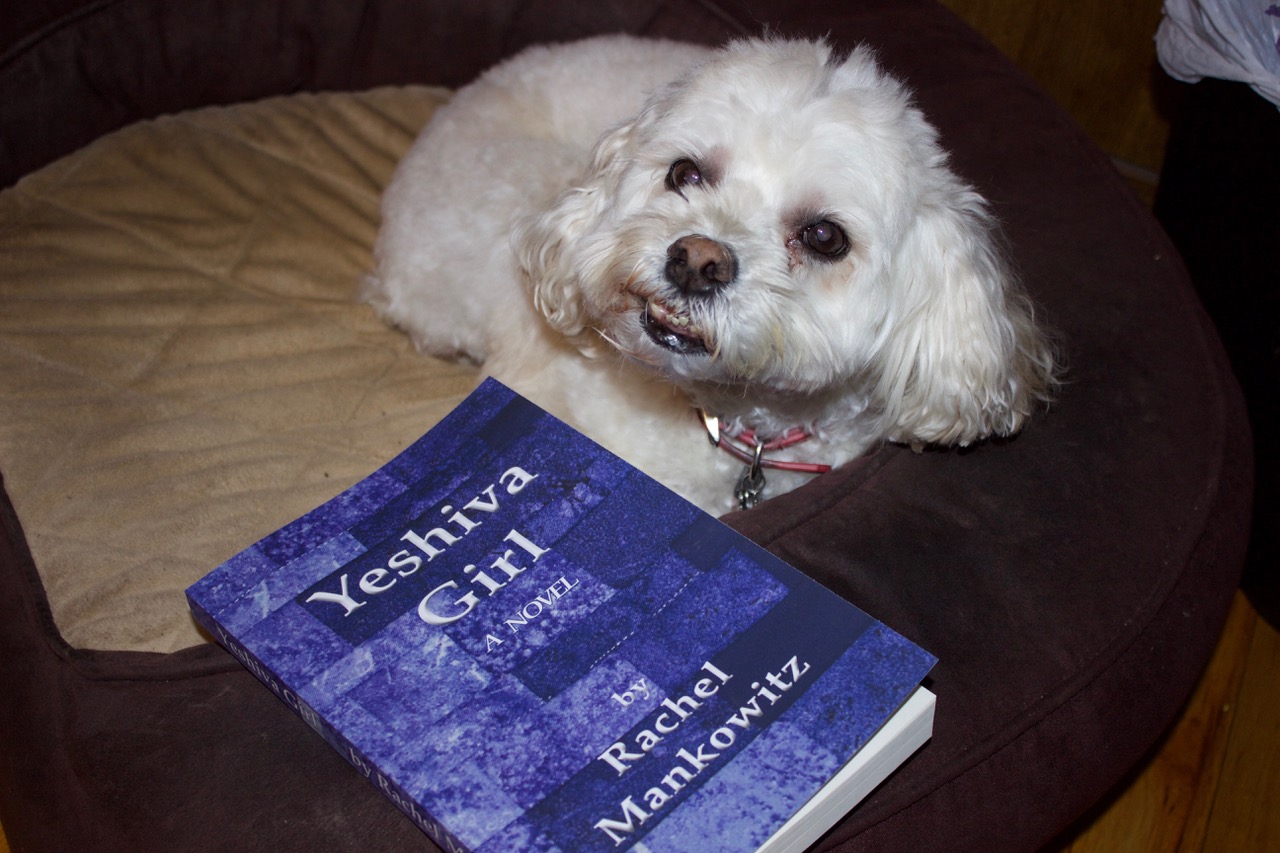
If you haven’t had a chance yet, please check out my novel, Yeshiva Girl, on Amazon. And if you feel called to write a review of the book, on Amazon, or anywhere else, I’d be honored.

            Yeshiva Girl is about a Jewish teenager on Long Island, named Isabel, though her father calls her Jezebel. Her father has been accused of inappropriate sexual behavior with one of his students, which he denies, but Izzy implicitly believes it’s true. As a result of his problems, her father sends her to a co-ed Orthodox yeshiva for tenth grade, out of the blue, and Izzy and her mother can’t figure out how to prevent it. At Yeshiva, though, Izzy finds that religious people are much more complicated than she had expected. Some, like her father, may use religion as a place to hide, but others search for and find comfort, and community, and even enlightenment. The question is, what will Izzy find?

Therapy Pages

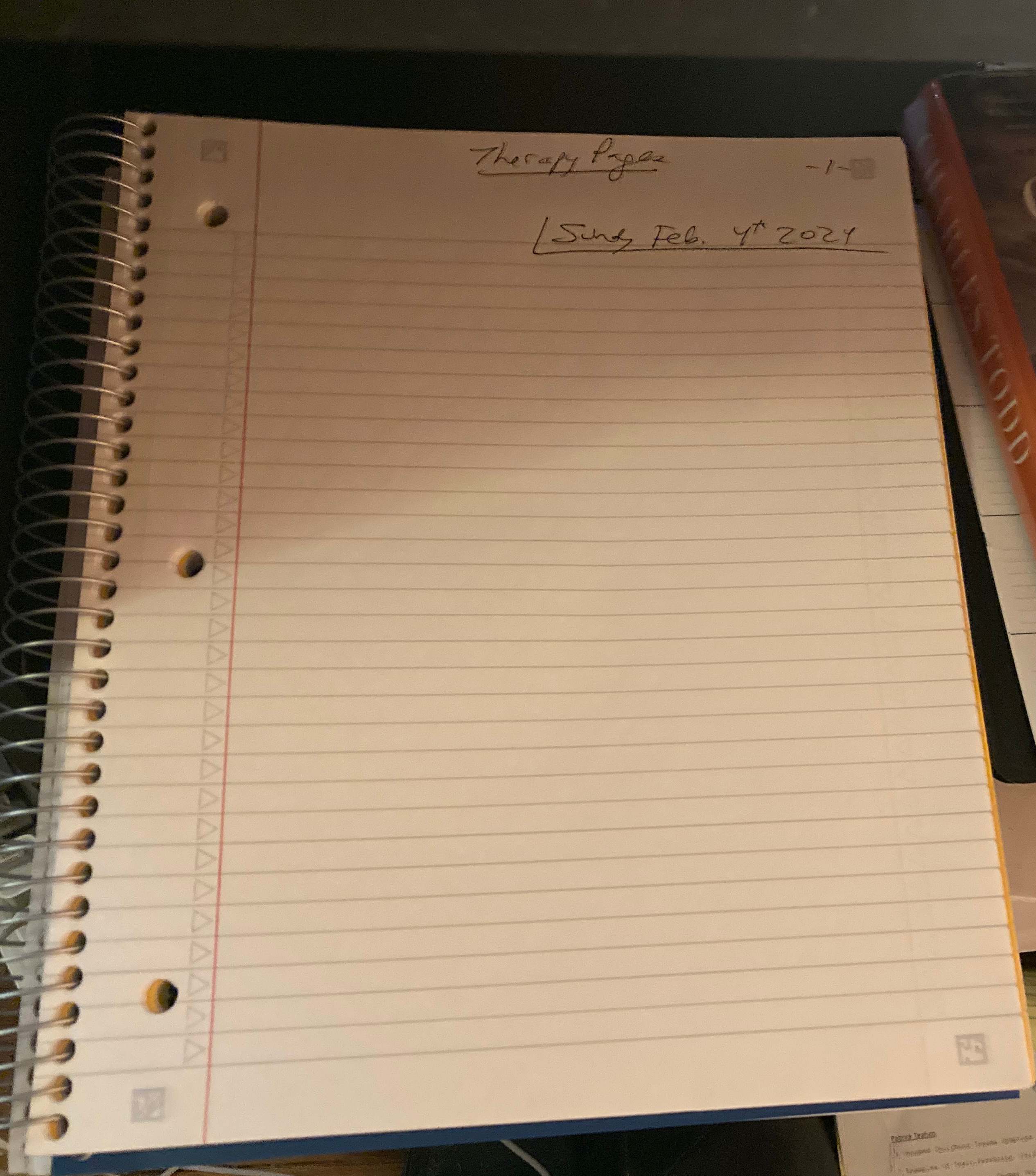
            About a million years ago, I read Julia Cameron’s The Artist’s Way for the first time and committed to doing Morning Pages every day (writing three stream of consciousness pages as soon as you wake up). I didn’t always do them in the morning, and I almost never stopped at three pages, so instead of calling them morning pages I called them my therapy pages, and I have a stack of boxes in my closet filled with old notebooks to show for it. But at some point, I stopped the practice, in all but name. I kept the notebooks nearby – there’s also always a five subject college ruled spiral bound notebook on my bedside table, with the day and date at the top of the page, but some days I forget to write anything, and others I just write a paragraph or two about my day before going to sleep, like sending a postcard to a good friend to keep up the connection, but not sitting down for a good long chat.

            I was actually proud of myself for taking longer to finish each notebook, because it seemed so self-absorbed to keep writing so much just for myself, and because I have no more room in my closet to stack boxes of notebooks.

            There’s also the thing I did early on that is a big no-no in Morning Pages, according to Julia Cameron. I started writing my Therapy Pages around the same time as I started seeing my therapist, and when I got frustrated by how little I could tell her in forty-five minutes per week that I told her about my Therapy Pages and she asked if she could read them and I said yes.

            On one hand, my therapist got to know me really well really quickly, because I didn’t go back to edit the pages before handing them to her, but inevitably, knowing that she would be reading them, my internal editor took over and stopped me from writing things I didn’t feel comfortable having her read. And one more thing happened: my therapist told me that my Therapy Pages were better than anything else I’d written, because I’d also made the mistake of giving her my short stories to read and she wasn’t impressed; just like she wasn’t impressed years later with my novels, or essays. But she loved my Therapy Pages and she wanted me to publish them – this was before Amazon self-publishing became a thing – and she would not listen to me when I said, a) no one would publish them and b) I wouldn’t want to publish them, because they were supposed to just be for me.

            I built up the nerve to stop showing her my pages pretty early on (probably also because I felt guilty for giving her so much work to do outside of our regular sessions), but the feeling of having someone reading over my shoulder, and judging me, never went away. Neither did the feeling that I was an utter disappointment as a writer, and/or a coward, and/or ten other horrible things.

            Recently, I found out that Julia Cameron had actually continued to write more books after The Artist’s Way, and I ordered one of them, called The Listening Path. I can’t remember why Julia Cameron came up as a recommendation on Amazon that day: maybe someone had mentioned her name to me, or there was some random confluence of events in the Amazon algorithm while I was looking for something else. But even then, I just put the book on my pile of books to read and went on with whatever else I was doing. I was kind of reluctant to open the book, honestly. I’m so tired of advice on how to be better and I’m tired of being told to do something other than what I’m already doing. I’m just really, really tired, full stop.

            But when I finished the latest book on my reading pile – an odd little middle grade fantasy about kabbalah, set at a Jewish sleepaway camp, by Ari Goelman – the next book on the pile was The Listening Path and I couldn’t avoid the book without openly acknowledging, to myself, that I was trying afraid of it. So I started reading. And within the first few pages of the introduction, reminding the reader about Morning Pages and Artist’s Dates and other advice from previous books, some part of my brain perked up and said, hey, why am I not doing Therapy Pages anymore?

            I won’t go through the whole grumpy internal argument that ensued, but, after a few more pages of reading, and grumping, I picked up my five subject spiral bound notebook and started to write again, telling myself that I couldn’t stop writing until I’d done three pages, instead of the three or four lines I’d gotten used to. And it felt right. Not easy, or comfortable, to be honest, but right.

            I still haven’t finished reading the introduction to The Listening Path, so I can’t say anything meaningful about the book itself, and already her insistence on the magical power of Morning Pages to get you unstuck and help you hear your inner self and blah blah blah is annoying the crap out of me, because where does she get off telling me what to do and acting like everyone is the same and can follow the same prescription to a better life, and on and on and on. Except, I think, for me, for this, she’s 100% right. I need this kind of stream-of-consciousness/required writing in order to hear myself again.

            I need it for me, not for my novels, though it could also help me get back on track with writing the damned novels. But I’m terrified of what will come up in these Therapy Pages of mine – which is probably the real reason why I started letting myself avoid them in the first place. I’m afraid of all of the crummy things I might say to myself, and all of the ways I will feel challenged, and not good enough, and pushed to do things I’m not ready to do; and I’m really worried about turning that spigot back on. But somewhere along the way I stopped listening to myself, and even if it has made me feel safer, it has also made me feel less, of everything.

            So, we’ll see how it goes. If a week’s worth of three pages a day re-opens the hellmouth in my brain, at least I’ll know what not to do.

            Wish me luck.

If you haven’t had a chance yet, please check out my Young Adult novel, Yeshiva Girl, on Amazon. And if you feel called to write a review of the book, on Amazon, or anywhere else, I’d be honored.

            Yeshiva Girl is about a Jewish teenager on Long Island, named Isabel, though her father calls her Jezebel. Her father has been accused of inappropriate sexual behavior with one of his students, which he denies, but Izzy implicitly believes it’s true. As a result of his problems, her father sends her to a co-ed Orthodox yeshiva for tenth grade, out of the blue, and Izzy and her mother can’t figure out how to prevent it. At Yeshiva, though, Izzy finds that religious people are much more complicated than she had expected. Some, like her father, may use religion as a place to hide, but others search for and find comfort, and community, and even enlightenment. The question is, what will Izzy find?
The Broken Bookcase

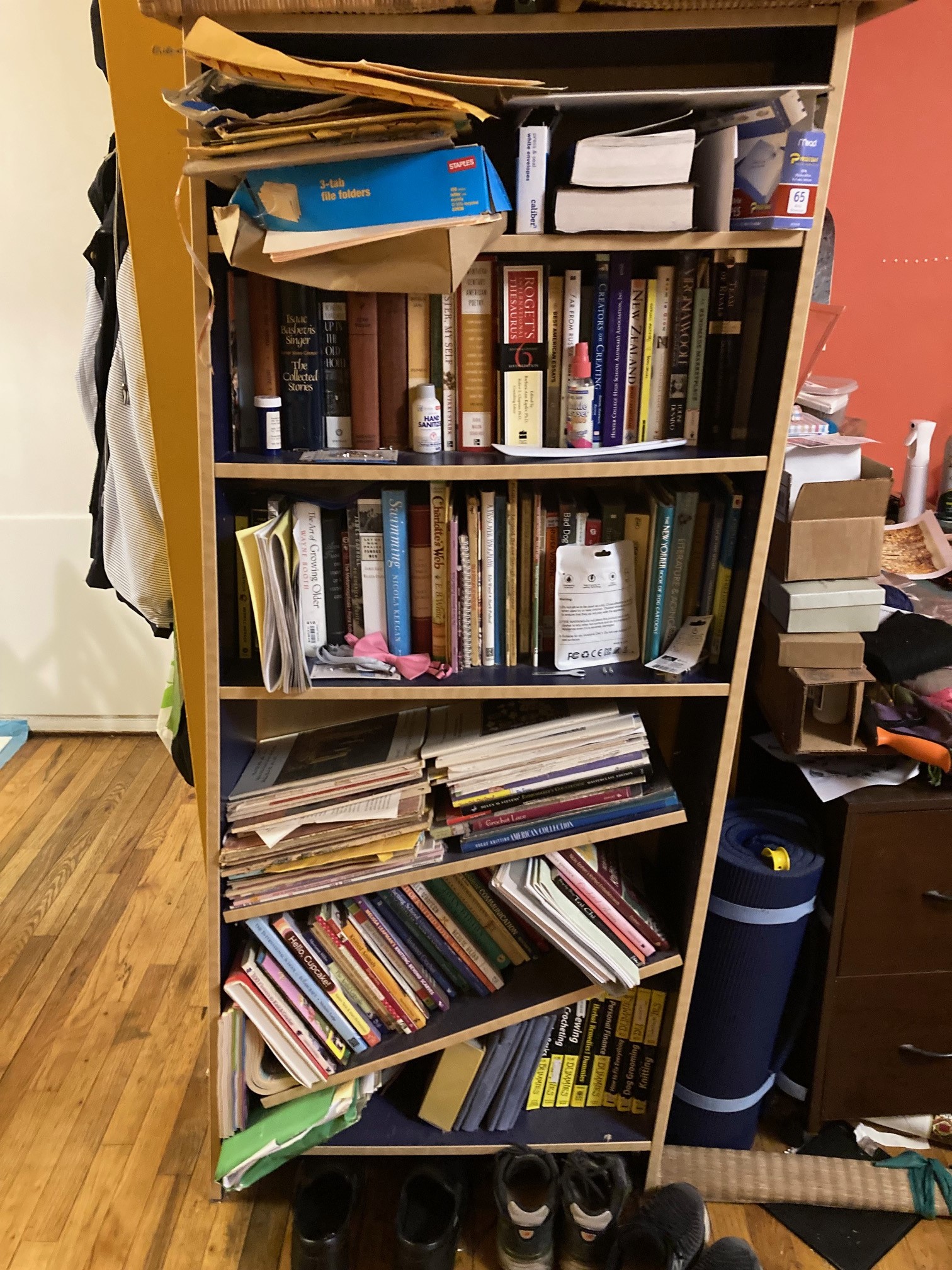
We have a blue Ikea bookcase in the hall that has been tilting for a long time now, but there’s been so much else going on that it never seemed important enough to try to fix it or replace it. We have bookcases everywhere, and I have five in my room alone, so one tilting bookcase didn’t seem like an emergency; until one of the shelves fell, and even then we just put “shelf pins” on the shopping list and eventually bought some, and of course, forgot to put them in. And then another shelf fell. And I still can’t be bothered to deal with the damned thing.

The Broken Bookcase

It’s not that a bookcase is such an expensive thing to replace, especially if we get another one from Ikea, its more that we’d have to actually go to Ikea, carry the heavy box to the car and from the car to the apartment, and then put the thing together, oh, and also empty the broken bookcase and take the broken pieces down to the garbage and refill the new bookcase.

I don’t have the energy for any of that, let alone all of it.

I’ve been trying to clear out the “extra books” from my collection for years now (so that we wouldn’t need so many bookcases), by re-reading the books that I’m on the fence about. I’ve already filled two boxes with books I no longer need, but giving books away is harder than you’d think. The library never wants them, and finding a place that wants the books, on the third Thursday of the month, at twilight, still requires carrying heavy boxes of books out to the car. So at this point I still have a box of discarded books on the floor, next to the bookcases, and I still have three shelves full of books to read through. I also have a bad habit of ordering more books all the time.

“She’s going to throw out our toys to make room for books, isn’t she?”

This feels like a metaphor for the way my brain has been lately: overwhelmed with ideas to follow up on, all resting on iffy shelves and waiting for me to start culling through them; but I can’t even think straight enough to do the culling before another ten or twenty ideas pile on. I feel like every day I’m looking at these tilting shelves in my brain, knowing that it’s all going to overflow at any moment, with no idea how to stop it.

I decided to take a break from going to online Hebrew classes for a few months, because I’ve been struggling to stay focused during the classes this past semester, and because the time I spend in those classes and doing the homework for them has kept me from doing other important things on my to-do list. I’m hoping to get back to the classes over the summer, when I have more free time to focus, but I feel the loss of the socializing and the Hebrew already. I still don’t even know what to do with all of the Hebrew I’ve learned so far, or why it’s been such an obsession for at least two years, if not my whole life.

I feel like there’s a path I should be on, and a long term goal I should be working towards, and that Hebrew language learning is part of it; but I don’t know what that goal is. I don’t want to move to Israel, and I don’t particularly want to go back to school full-time to become a translator or a rabbi or a cantor. I would like to go deeper into Jewish education, if I can, working with teens, maybe, as well as with the younger kids, and maybe even doing curriculum development. But I don’t know of a path to get there, and I don’t want all of that to be instead of writing my novels – the notes for which have filled up a bunch of shelves of their own.

I feel like there’s a whirlwind in my brain, pushing me in different directions all the time, keeping me confused and off kilter, and I’m worried that my internal bookshelves are as wonky as the ones in the broken bookcase in the hall, and it will all tumble down at any moment.

My hope is that once synagogue school is over for the year, I’ll be able to concentrate on all of those ideas whirling around in my brain, and organize them, and maybe even choose some to work on. But I’m afraid I’ll be as busy with doctors and tests this summer as I was last summer, without much improvement in my health to show for it, and those wonky internal shelves will just keep tilting.

But I keep slowly reading through my piles of books, and writing down all of my ideas, and sorting and discarding when I can, because this is how I move forward. It’s not especially practical, or fast, but it’s the way my mind works, so it will have to do for now.

“It’s important to just be yourself, Mommy.”

If you haven’t had a chance yet, please check out my Young Adult novel, Yeshiva Girl, on Amazon. And if you feel called to write a review of the book, on Amazon, or anywhere else, I’d be honored.

            Yeshiva Girl is about a Jewish teenager on Long Island, named Isabel, though her father calls her Jezebel. Her father has been accused of inappropriate sexual behavior with one of his students, which he denies, but Izzy implicitly believes it’s true. As a result of his problems, her father sends her to a co-ed Orthodox yeshiva for tenth grade, out of the blue, and Izzy and her mother can’t figure out how to prevent it. At Yeshiva, though, Izzy finds that religious people are much more complicated than she had expected. Some, like her father, may use religion as a place to hide, but others search for and find comfort, and community, and even enlightenment. The question is, what will Izzy find?
Reading Donna Leon

            Lately I’ve been reading Donna Leon’s Commissario Guido Brunetti books: police procedurals set in Venice, Italy. She is a master of place: the specifics of transportation, and weather, and neighborhood cultures that change every few streets. And she’s a master at the bureaucracies and corruption and duplicities her characters have to deal with, and the ways they try to manage to do good despite all of it.

            I keep hoping that the next mystery I read, or the next episode of Murder, She Wrote I watch, will unlock the secret of how to write a mystery, without having to pound my head against the wall a thousand (more) times, but each time I think, no, I couldn’t do that: I can’t be as confident as Jessica Fletcher; and I don’t know enough police procedure to write about a detective; and I’m just not clever enough to come up with a good puzzle, and then solve it.

“I can solve it!”

            But even though reading these books and watching these shows hasn’t made me feel more capable of writing a mystery novel myself, I do feel like it helps me fill up on the possibility of justice and the hope that there really are good people in the world who are trying to make things better.

“Like me?”

            I actually started writing my first mystery novel this summer, instead of just endlessly plotting it on tiny pieces of paper the way I’ve been doing for the past few years, but the pages have come in fits and starts, especially because I’m also working on the continuing Yeshiva Girl saga, and blog posts, and trying to fit it all in between various crises. But even though it’s been difficult, it IS progress. And my only choice is to keep writing, and reading, whenever I can, and learning from other writers about how they’ve untangled their plots to see if they can give me new ideas for how to untangle the plot points in my own mystery that still have me wrapped up in knots.

“Hurry up, Mommy!”

Even if I never get to Venice and experience the flooding of the Acqua Alta in person, or ride a boat from one crime scene to another, or sit in the overheated office of the Commissario, I feel like I’ve been there and learned from him, and from Donna Leon, and Jacqueline Winspear, and Agatha Christie, and P.D. James. I’m hoping that, however slowly, my own pages will continue to add up into something I can be proud of.

“Will the chicken treats add up too?”

p.s. I want to thank Leslie Bowman, from The Adventures of Bitey Dog (at https://theadventuresofbiteydog.com) for her beautiful portraits of Cricket and Ellie.

Cricket
Ellie

If you haven’t had a chance yet, please check out my Young Adult novel, Yeshiva Girl, on Amazon. And if you feel called to write a review of the book, on Amazon, or anywhere else, I’d be honored.

            Yeshiva Girl is about a Jewish teenager on Long Island, named Isabel, though her father calls her Jezebel. Her father has been accused of inappropriate sexual behavior with one of his students, which he denies, but Izzy implicitly believes it’s true. As a result of his problems, her father sends her to a co-ed Orthodox yeshiva for tenth grade, out of the blue, and Izzy and her mother can’t figure out how to prevent it. At Yeshiva, though, Izzy finds that religious people are much more complicated than she had expected. Some, like her father, may use religion as a place to hide, but others search for and find comfort, and community, and even enlightenment. The question is, what will Izzy find?

I Miss Going to the Library

            I used to go to the library at least once a week, to browse the videos, or check out new books, or pick up a few crossword puzzles from the research librarian’s desk. There was usually a book or two that had to go back to the library, or a book someone told me I had to read, and, once there, I could always find something on the recommended-book cart, or in the seasonal display where they set out books on different themes, like biographies of athletes for the Olympics, or scary stories for Halloween, or beach reads for the summer, or political thrillers for election day.

            But I haven’t been to the library since the world shut down in March. Sometime early in the summer, I think, my local library began to allow pick up and drop off of books: you could order a book online and they’d call when it was ready and schedule a time for you to pick it up. But I haven’t done that. At first I didn’t need any books, because I still had a pile of paperbacks that I had, coincidentally, ordered right before the shutdown (there was a mysteries series I was binging and I couldn’t find the earliest books in our local library system). But when those books ran out, I still didn’t think of browsing for library books online.

            I can’t seem to browse for fiction online. Non-fiction is easier, because I either know which author I want to read, or I’m looking for research books on a specific topic and my expectations for great art or entertainment are limited, especially because I read non-fiction a few pages at a time rather than in a binge, the way I tend to read fiction.

“Is fiction another word for chicken?”

            The other reason I didn’t go looking for books at the library is because I’ve been re-reading a lot of the books on my shelves for a while now, in an attempt to see which ones I don’t really need anymore, so that I can make room for new books. A project I thought would take a few months has turned into years, because to do the project justice, of course, I’ve had to re-read each book from beginning to end before deciding to let it go.

            Most of the fiction in my life lately comes in the form of movies and television, and that’s been fine, but at some point, I really will need my local library to open back up. I’ll need to wander past the shelves of books and let a cover catch my eye, or trigger my memory of an author I read years ago and lost track of. I’ll need to see a pile of books waiting to be shelved and remember a book I’ve long wanted to read and never got around to. I’ll need to see cover art to give me a hint about what kind of book the author, or her publisher, thinks she’s written. Is it a cozy mystery? An intellectual tome? A romance? A fantasy? Or maybe I’ll just be in a blue mood, and any book with a blue cover will suddenly glow at me and call out for my attention (I’ve found some really good surprises that way over the years, and a lot of crap too. It’s not a perfect system).

“Can I eat your book now?”

            There’s something to be said for having a book with a time limit. A two-week book has to be read right away, even if you have a lot of work to do, which gives the reading more urgency and importance. A pile of three- or four-week books feels like a luxury at first, but then starts to cause anxiety and turns into an emergency by the end of the second week of leisurely meandering through the first book on the pile.

            I wonder, now that I think of it, if it’s only my local library that’s still closed. Maybe in other parts of the country, or other parts of Long Island, they left their libraries open the whole time, or opened them sooner than in my town. I think bookstores must have reopened by now, but I rarely go, because a new hard-cover book is way too expensive for me, unless I’m absolutely sure I will love it.

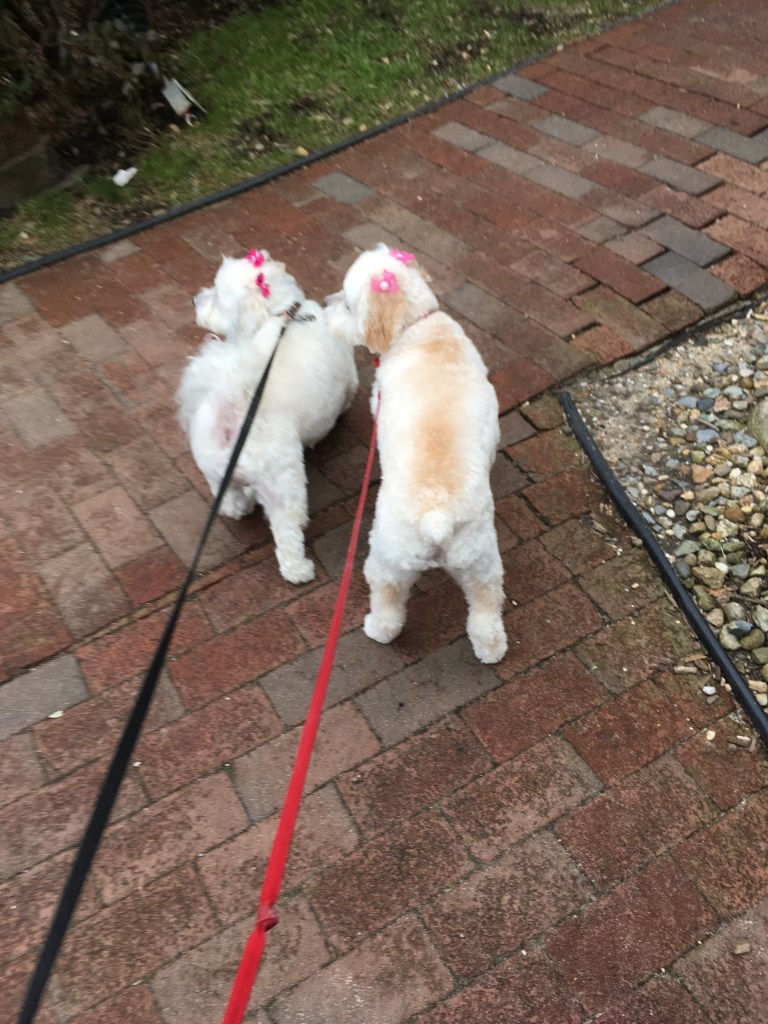
            Luckily, the dogs haven’t been lacking for “reading” material. They get their stories by sniffing the grass in the backyard, and that local library never closed, even in the early days of the Covid shutdown when people were afraid to go outside. The girls have never had to wear a mask that could block their ability to sniff, and they’ve never had to avoid familiar places in order to practice social distancing. Their lives have been pretty idyllic, actually. The only activity that’s been delayed, for them, is a yearly visit to the vet.

“When I say run, we run!”

            It’s probably a good thing for me that the library is still closed, though. The temptation to wander, and touch all of the books, would be too strong. I would forget about Covid and meander too close to someone without a mask, or, even more dangerous, I’d find a pile of books and fall into a wormhole and forget to come back out in time to teach my students, or walk the dogs. And I know two dogs who just wouldn’t stand for that. They don’t understand why I can’t sniff the grass for stories the way they do, and I have to say, it’s one of the many disappointments of being born human.

“Being a dog IS better, Mommy.”

If you haven’t had a chance yet, please check out my Young Adult novel, Yeshiva Girl, on Amazon. And if you feel called to write a review of the book, on Amazon, or anywhere else, I’d be honored.

            Yeshiva Girl is about a Jewish teenager on Long Island, named Isabel, though her father calls her Jezebel. Her father has been accused of inappropriate sexual behavior with one of his students, which he denies, but Izzy implicitly believes it’s true. As a result of his problems, her father sends her to a co-ed Orthodox yeshiva for tenth grade, out of the blue, and Izzy and her mother can’t figure out how to prevent it. At Yeshiva, though, Izzy finds that religious people are much more complicated than she had expected. Some, like her father, may use religion as a place to hide, but others search for and find comfort, and community, and even enlightenment. The question is, what will Izzy find?

I Am Struggling with the Sequel to Yeshiva Girl

For years I thought I had a solid draft of the second Yeshiva Girl book tucked away, just waiting for the first book to be published so I could neaten it up and publish it soon after. But last year, when I opened the file on my computer and looked at the draft, I was underwhelmed. It was a mess. There were at least three competing versions of the story running around, all incomplete. I had added to, and revised, the file over the years without remembering most of what I’d done.

001

“Like I forget that I already ate breakfast?”


Reading through what I had, finally, I realized that I was still undecided about where the book should even be set, in time or space. Parts were set in high school, parts were set in college, parts were set in Izzy’s grandparents’ house, and parts were set in a skating rink.

One of the dangers of writing autobiographical fiction is that it’s hard to know which details from real life to keep, and which ones to change. The second Yeshiva Girl book will have to be even less memoir than book one, because I made such a point of giving Izzy a soft place to land in book one, something I didn’t have in real life.

003

Happy girl!

I want Izzy to have a better life than I’ve had, with love and children and professional success, but I don’t want to downplay the impacts of trauma, because I know better. I want to find a way to let Izzy struggle, so that other survivors can be validated and recognize their own struggle in hers. I want people to know that child abuse, of every kind, leaves deep scars, and that expecting victims to recover on their own, without support, is unrealistic. That’s just not how humans work. But, I still want Izzy to have a happier life than I’ve had. That’s why I gave her a living grandfather, even though my own grandfather died when I was eight years old. And I want to play that out for her, how having that safe place at age sixteen makes a difference in her life, but also, I want to show that it won’t be a magical cure either.

132

“I prefer magic, Mommy.”

It feels like there are at least ten ways to write the second book, and I almost need to write out all ten in order to feel like I’ve done the work and gotten as much as I need to get out of the process of writing it. In the end, that’s what I did with the first book. I was satisfied with what was on the page because I’d had the chance to write, and delete, every other possible version of the story.

One of the decisions I have to make is about using flashbacks. I have been told, too many times, about the danger of telling stories in flashback. I had a fiction teacher in graduate school who was fierce about the things we shouldn’t use in our writing. Like, no dreams, no flashbacks, and no stories about girls getting their periods.

I really think the second Yeshiva Girl book would benefit from flashbacks, so that I can set the book further in the future without losing good details from the in-between years. And I want to use dreams. I have found dreams to be incredibly vivid in their ability to show how things feel.

IMG_1068

“Like when I catch the squirrel?!”

Also, for my own wish fulfillment, I want Izzy’s father to go to jail, or die, or get some fair comeuppance, because my real father did not. I joke that God sent at least ten plagues his way, but none of them worked. The fact is that he has never acknowledged his guilt, or responsibility, for anything.

067

“Grrr.”

It’s these endless inner conflicts that keep getting in my way, but they are also the reason why I need to write this book in the first place. I’m just not sure how to speed up the work, so that I’ll still have time to write everything else I need to write before I run out of energy. Or time.


YG with Cricket

If you haven’t had a chance yet, please check out my Young Adult novel, Yeshiva Girl, on Amazon. And if you feel called to write a review of the book, on Amazon, or anywhere else, I’d be honored.

Yeshiva Girl is about a Jewish teenager on Long Island, named Isabel, though her father calls her Jezebel. Her father has been accused of inappropriate sexual behavior with one of his students, which he denies, but Izzy implicitly believes it’s true. As a result of his problems, her father sends her to a co-ed Orthodox yeshiva for tenth grade, out of the blue, and Izzy and her mother can’t figure out how to prevent it. At Yeshiva, though, Izzy finds that religious people are much more complicated than she had expected. Some, like her father, may use religion as a place to hide, but others search for and find comfort, and community, and even enlightenment. The question is, what will Izzy find?


The Children Inside


Generally when I write in my blog, or anywhere else, I’m writing from the point of view of my most grown up, most presentable self, because that’s what people do. When I leave the house to interact with other people I generally dress up in a certain way and use certain words and facial expressions, and I pay close attention to how I present myself. Am I being nice enough? Mature enough? Responsible enough?

But when I’m at home, watching TV, doing puzzles, or playing with the dogs, other parts of me are allowed to surface and have their say. There’s a lot of arguing about food (Why can’t I have the whole container of ice cream right now?) and clothes (I want to wear pajamas all the time!) and entertainment (Cartoons! No, wait, mysteries! No, episodes of Law & Order on an endless loop!). Most of this doesn’t fit my image of who I’m supposed to be at my current age, and therefore I try to keep it at home where no one can see and judge.

257

The girls don’t seem to care what we watch, as long as everyone’s together.

Or I bring it to therapy. Though it’s still hard for me to bring my whole self to therapy, even after twenty-five years. Generally, I report the hard stuff from my notes, or I keep it to myself.

Over winter break, I watched the HBO miniseries version of Phillip Pullman’s His Dark Materials, and it reminded me all over again of the thing I loved about the first book when I read it a few years ago (someone said to me, if you like Harry Potter, you’ll love this): each character, in this alternative universe, has an animal dæmon; not just an animal companion, but a part of their soul that exists outside of their body and takes an animal form. Up until puberty the dæmon is able to take many different forms (ferret, mouse, bird, turtle, cat, etc.), to meet many different needs, and then at puberty the dæmon takes the shape of one specific animal for the rest of the character’s life. That last part was the only thing that didn’t ring true for me when I read the first book. Only ONE animal companion? Only one aspect of the soul? Unlikely. My dæmon has never settled. My self has never come together into one definite and unchanging thing. I still flit and switch and change.

I would say that, for my most grown up self, the part of me that goes out into the world, my dæmon would be a Yellow Labrador Retriever – not quite as trusting and fluffy as a Golden Retriever, but playful and loyal and gentle, and smart, rather than clever.

278

“A yellow Lab. Really?”

My writing self is more like an eagle, soaring above it all and observing, feeling the wind in her feathers and finding her way; mostly isolated, but able to be part of a congregation, when necessary.

But the little ones, the ones who live in pajamas and think chocolate covered pretzels make a great breakfast, they’re different; both from the adult version of me and from each other. After watching the HBO miniseries, I tried to come up with a list of animal familiars, to help me recognize each internal child part more clearly, but that just set off a lot of internal noise and a sort of buzzing that sounded like a table saw, so I had to stop for a while and rest before trying again.

281

“It was so loud I could hear it too, Mommy.”

I think there must be a porcupine, and a fluffy brown rabbit, and a black Lab puppy, and a Starling or a Sparrow, and a bee (though nobody likes the bee).

I don’t have anything like a tiger or a bear or a lion in there, and I feel the lack of that protection.

This feels like a project I should take on: get out a huge animal encyclopedia and see which ones resonate with me and which ones don’t. I should draw pictures and write stories and figure out everyone’s favorite foods and colors and music. But just the thought of it exhausts me.

Like Walt Whitman said: “I am large, I contain multitudes.” I’m just too tired to count them right now.

277

Clearly, everyone’s exhausted.


If you haven’t had a chance yet, please check out my Young Adult novel, Yeshiva Girl, on Amazon. And if you feel called to write a review of the book, on Amazon, or anywhere else, I’d be honored.

Yeshiva Girl is about a Jewish teenager on Long Island, named Isabel, though her father calls her Jezebel. Her father has been accused of inappropriate sexual behavior with one of his students, which he denies, but Izzy implicitly believes it’s true. As a result of his problems, her father sends her to a co-ed Orthodox yeshiva for tenth grade, out of the blue, and Izzy and her mother can’t figure out how to prevent it. At Yeshiva, though, Izzy finds that religious people are much more complicated than she had expected. Some, like her father, may use religion as a place to hide, but others search for and find comfort, and community, and even enlightenment. The question is, what will Izzy find?


How the Book Signing Went

yeshiva girl with dogs

I have discovered that three out of four writers can stand for two hours at a book signing event, and I am the fourth writer. I did stand for the short presentations, where each of us described our books, though I had to lean on random pieces of furniture while the others spoke, and then I almost tripped myself when it was my turn. For the rest of the time we were set up at four small tables, side by side, though, again, I was the only one actually sitting at my table, with everyone else sort of floating nearby. I chose the table with a Picasso-like picture of a girl with brown hair, because it looked like I felt, and sat behind a copy of Yeshiva Girl set up in a Lucite holder. It occurred to me that I should have made some kind of display – two crocheted dragons, maybe, like the YA Fantasy writer, or a blow up of the cover photo on the book, like the memoir writer – but, too late. All I had was me.

I was the newbiest of the newbies there, because the fantasy writer had been doing signings for her book since 2016, and the other two were classroom teachers, but I found that as long as I was able to sit down, and people could come over to me to ask their questions or tell me their stories, I did really well. I’ll have to practice my standing-and-speaking skills, though, for the future. People seemed to actually be interested in the premise of my book, which surprised me. I walk around assuming that no one will be interested in anything I have to say, though, of course, desperately hoping that they’ve been waiting all their lives just to meet and hear from me.

Each person I met had a story, or a thousand stories, to tell and I was awed by them and curious about them, and a little bit overwhelmed, as in, who’s going to notice my star in the midst of such a starry sky. I met a local humor columnist, who bought my book, and we talked about wanting to write mysteries, and the books we’ve read, and writing inspirations, and I had to be careful not to geek out too much and ignore the rest of the potential readers in the room. I met one woman who wanted to read my book, but was afraid it would be too painful, though she encouraged her friends to read it, and talked to me about the importance of people feeling safe to speak up and tell their stories. And there was a woman who’d gone to a tiny catholic school in Bedford Stuyvesant, Brooklyn, way back when, and had plenty of stories to tell about the experience. And another woman who had worked for a Chassidic-run company and felt her otherness acutely.

I’d only started to get nervous two nights before the book signing event, and the anxiety only became acute that morning, with an internal voice telling me that it would all turn to shit, and I was completely unprepared, and I didn’t have the right clothes or makeup, and I would fall into a deep depression after the inevitable and complete failure.

But I did it! I signed books! I stood in front of strangers and presented my book! I didn’t hide under my bed – the way I wanted to – or pretend to be someone I’m not.

I sold four books and signed five (my aunt came with her own copy, and she stayed for the whole two hours for moral support! Yay Aunt Debbie!). And the woman who ran the event, Robin, one of the owners and the superstar event coordinator at Dolphin Books in Port Washington, NY, asked me to sign two extra copies for the store. Here’s hoping I get more chances to try it again, and next time bring one or both of the dogs for moral support, or to scream at people to buy Mommy’s book.

IMG_0913

“Let’s go, Mommy!”

img_0510

“Buy my Mommy’s book!”

I want to thank the other authors at the event:

A high school history teacher/coach (Billy Mitaritonna, Last of the Redmen: Memoir of a St. John’s Walk-on) who wrote about the power of perseverance, and said that the secret was in how his coaches and his father encouraged and supported him no matter how many times he failed. He said that his students were the ones who told him to write his memoir, to share his story with others because it had been so inspiring to them.

Then there was the Dragon Girl (Elana A. Mugdon, Dragon Speaker: The Shadow War Saga, Book One), who was brave beyond my capacity to imagine. She dressed as the protagonist in her young adult fantasy series, wearing a long white wig, in pig tails, a corset, and leather armor. Her protagonist is the only non-magical person in her world, and yet she is the heroine of the story.

The fourth author was a graphic designer (Beth Costello, The Art of the Process: establishing good habits for successful outcomes) with a workbook to help people through the process of design. She had the confidence of a practiced teacher, and the social media skills to have a roomful of supporters waiting to hear from her and buy her book (which meant that I had an audience too!).

I could have used a vat of chocolate frosting in the aftermath of the event, to soothe my frayed nerves, but as soon as we got home the girls needed to go out to pee and that helped with the depressurization process. They squealed their excitement at having their humans back home and raced around the yard with their famous author slash pooper scooper Mommy, and then we settled in on the couch to watch something silly and romantic on television. Overall a successful day.

010

“Can we watch something else?”

If you haven’t had a chance yet, please check out my Amazon page and consider ordering the Kindle or Paperback version (or both!) of Yeshiva Girl. And if you feel called to write a review of the book on Amazon, or anywhere else, I’d be honored.

Yeshiva Girl is about a Jewish girl on Long Island named Izzy (short for Isabel). Her father has been accused of inappropriate sexual behavior with one of his students, which he denies, but Izzy implicitly believes that it’s true. Izzy’s father decides to send her to an Orthodox yeshiva for tenth grade, out of the blue, as if she’s the one who needs to be fixed. Izzy, in pain, smart, funny, and looking for people she can trust, finds that religious people are much more complicated than she had expected. Some, like her father, may use religion as a place to hide, but others search for and find comfort, and community, and even enlightenment.


The Bookstore Event


The bookstore signing event is coming up on Saturday March 9th from 2-4 pm at the Dolphin Bookshop and Café, in Port Washington, on Long Island, and the promotional materials have been sent out (see below). Mom also made up her own poster, just for my book, and put it up around town. Fingers crossed there will be a good crowd and I won’t be too terrified.

032

“You’ll be okay, Mommy.”

Mom is doing an amazing job as my agent, calling around to get the bookstore signing in the first place, asking permission to put up posters, getting the local library to order a few copies, and talking the book up all over the place. I would like to think that this is the job she spent her whole life training for, but that might be a little bit narcissistic of me.

My expectation is that the bookstore event will be a lot of schmoozing and signing books, not a reading, but I marked out a few sections of the book to read, just in case. I have a lot of questions about how to sign the book, though. I assume it should be something more than just signing my name, and something less than a three page soliloquy, but I’m not sure where it should fall in that spectrum. A lot will probably depend on if the people who come to the event are strangers or people I already know.

I think I’ll be leaving Ellie at home this time, even though her presence would be a comfort to me, because Cricket needs her more than I do. I can’t even imagine the panic Cricket would be in if we all left without her. No amount of treats would make that bearable. When I imagined Ellie as an emotional support dog. I didn’t realize she would turn out to be Cricket’s Emotional support.

IMG_0887

Cricket needs a lot of emotional support

I’m a little bit uncomfortable that the book signing event is on a Saturday, given that the book is called Yeshiva Girl and religious Jews don’t go to bookstores on the Sabbath, but then again, maybe this will be one more way to reach out to a new audience that wouldn’t ordinarily read about religious Jewish life. I haven’t met the other three authors, so that will also be something to look forward to, and maybe our very different audiences will cross over and provide each of us with new readers. We’ll see. Wish me luck!

IMG_0747

“Good luck, Mommy!”

If you haven’t had a chance yet, please check out my Amazon page and consider ordering the Kindle or Paperback version (or both!) of Yeshiva Girl. And if you feel called to write a review of the book on Amazon, or anywhere else, I’d be honored.

Yeshiva Girl is about a Jewish girl on Long Island named Izzy (short for Isabel). Her father has been accused of inappropriate sexual behavior with one of his students, which he denies, but Izzy implicitly believes that it’s true. Izzy’s father decides to send her to an Orthodox yeshiva for tenth grade, out of the blue, as if she’s the one who needs to be fixed. Izzy, in pain, smart, funny, and looking for people she can trust, finds that religious people are much more complicated than she had expected. Some, like her father, may use religion as a place to hide, but others search for and find comfort, and community, and even enlightenment.

multi mar 9 media


Required Reading


In a recent New York Times article, Alice Walker was quoted as praising an author whose works are notoriously and outrageously anti-Semitic. First this brought up the question, Can you judge a person by what she reads? But, as a result of the publicity, many people went looking back at Alice Walker’s previous works, and found that she had her own history of anti-Semitic writings.

Prior to all of that, I had, of course, read The Color Purple as part of my American education, and the rabbi at my synagogue had used a number of Alice Walker’s poems in religious services over the years. Most likely we won’t be reading her work in our services from now on, but the question is, Should we continue to read her books, or any books by authors that disturb us? My own answer is yes, with the caveat that I always want the chance to speak out about those things that disturb me, or disturb others. I don’t want to shove everything that offends me into the back of a dark closet, where I can’t do anything about it.

But, I still find it very difficult to push myself to read, and watch, things that disturb me. Over the years, I’ve had to develop a way to manage that sort of difficult reading. I’ve put together a pile of books by my bedside that I read a little bit at a time, mixing together books that challenge me and books that I enjoy, as a brain cleanser, so that I don’t have to feel overwhelmed by other people’s points of view, at least when I don’t want to be. I’ve pushed myself to read all sorts of political tomes, including books about the Israeli Palestinian conflict, and when the emotions (anger, frustration, confusion, and often fear), get to be too much, I just switch over to a chapter of something else, to balance the scales.

I’m in a bit of a quandary, though, now that my official schooling is over, to decide which books to put on my required reading pile. I know that I need to continue to challenge myself going forward, but in which particular areas? And exactly how challenging do these books need to be?

010

“Can’t we just watch TV?”


As of now I have about twelve books on my reading pile, with another thirty on standby. I’m still plodding through Harry Potter in Hebrew, though I’m not sure why it’s so much harder for me to read than the Harry Potter books in French. It undermines my confidence in all of those years of Jewish education that I never learned the Hebrew word for magic wand. I’ve also been reading through the Hebrew bible, in Hebrew, for years now, a page at a time. Biblical Hebrew is even harder to understand than Harry Potter Hebrew.


When that gets too frustrating, I can move over to my Beginning Spanish Reader, though that has recently become too hard for me, and I had to go back fifty pages or so for remedial reading. And then there’s a Spanish vocabulary and phrase book for Social Workers, but most of that just flies over my head.

I’m also reading the review book for the social work licensing exam, slowly, because it’s so freaking tedious, and balancing that out by reading a book of essays by David Rakoff that is even funnier than I remembered. Then there are the psychology books, most recently on Addiction and Body Therapy and Non-Directive Play Therapy, which sometimes interest me and other times make me very angry, and then books on Jewish philosophy by Martin Buber and Abraham Joshua Heschel, and others, which I don’t really understand. I’ve been trying to cushion that particular torment with a book of dog essays that I got as a present for my birthday.

006

Ellie prefers being a dog to reading about them. Weird.

Oh, and I am very proud of myself for finally finishing Hamilton, by Ron Chernow. It only took me three and a half years. And as a reward for that effort I let myself add a book of memoir essays to the pile, by fellow blogger Sheila Morris, called Deep In The heart. Unfortunately I finished that one too quickly for my own good, and I will need to go and buy her new book to fill the void.

Of course I’m also reading mysteries, but they don’t go on the study pile; they get pride of place next to my writing notebooks, because I can read whole chapters of them at a time without wanting to scream at anyone. I take as much time as possible to revel in books by writers like Rhys Bowen, and Louise Penny, and Jacqueline Winspear, and Donna Andrews, and Ellen Crosby, and Charles Todd, and Robert Galbraith (aka J.K. Rowling). And more recommendations are welcome!!!!

I’m not quite sure why I need to have such a tall pile of books to read at any given time, except that there are too many parts of my brain that need to be satisfied. Having a brain that likes to run in twenty directions at once is kind of inconvenient, but I don’t really want to go back to having someone else tell me what to read either. I’m sure Cricket would agree with me on the subject of reading autonomy, if she could read. As it stands, she finds all of my reading annoying, and time consuming, and she thinks I would much prefer sniffing individual blades of grass with her for hours at a time. At the very least, she would enjoy that more. Ellie would too, come to think of it. Though she’s more of a squirrel chaser than a grass sniffer.

015

“This is the only grass I could find!”

008

“There was a squirrel! I had to go!”


While we’re on the topic of required reading, if you haven’t had the chance yet, please check out my Amazon page and consider ordering the Kindle or Paperback version (or both!) of Yeshiva Girl. And if you feel called to write a review for the book, I’d be honored!

YG with Cricket

Yeshiva Girl is about a Jewish girl on Long Island named Izzy (short for Isabel). Her father has been accused of inappropriate sexual behavior with one of his students, which he denies, but Izzy implicitly believes that it’s true. Izzy’s father decides to send her to an Orthodox yeshiva for tenth grade, out of the blue, as if she’s the one who needs to be fixed. Izzy, in pain, smart, funny, and looking for people she can trust, finds that religious people are much more complicated than she had expected. Some, like her father, may use religion as a place to hide, but others search for and find comfort, and community, and even enlightenment.