Tag Archives: dogs

More Doctors

            For a few weeks, recently, my mother was worried about me. Okay, she’s always worried about me, but more worried than usual, because my blood pressure was high. My blood pressure has been relatively high since December, but my primary care doctor wasn’t especially worried, so I ignored it. But then I went to the gastroenterologist, to finally see about my first colonoscopy, he said I’d need an okay from the cardiologist before he could move forward; so I went to the front desk and made an appointment with a cardiologist in the same office, where the wait is approximately an hour and a half and the doctor generally ignores whatever I say.

            But while I was waiting for that appointment to arrive, my blood pressure (measured on a home blood pressure monitor), kept going up and up, especially the bottom number. And Mom said I couldn’t wait for my scheduled appointment and instead made me an appointment with her own cardiologist, for the next morning.

“I could ignore you without all the waiting!”

            I got up early and grumbled as she drove me to the doctor’s office, and then I grumbled through the tech taking my blood pressure four times, twice on each arm, and then through an especially thorough EKG, and then there was an Echocardiogram in another room and blood tests in a lab down the hall. I was exhausted from the whole ordeal, but I had to go to work afterwards, so I grumbled as much as I could at home and then switched into teacher mode on the drive to the synagogue and tried not to grumble for the rest of the day.

“Unsuccessful, Mommy.”

The next day, after tests showed I didn’t have a blood clot or heart damage, the cardiologist prescribed a diuretic and told me to call my gynecologist to see if she could change or just stop my birth control pills (prescribed for Polycystic Ovarian Syndrome and painful periods), because they could be raising my blood pressure and adding to the risk of blood clots.

            I started the diuretic the next day, and stopped taking the daily birth control pills, and after a week, my blood pressure was back to normal, but I was dizzier than usual, and in more pain and still dealing with all of the other long term issues no one has been able to explain (headaches and dizziness and exhaustion and muscle pain and intermittent walking problems and nausea and belly pain).

            Then I had to go for more blood tests and an echo stress test (which is a beast of a combination, with a treadmill and a thousand wires and a torture device rammed into my rib cage at random intervals), and I was told that my Normetanephrine and Aldosterone numbers were off kilter, both related to the adrenal glands in some way, and a possible cause for the high blood pressure, and I’d need to see an Endocrinologist and a Nephrologist for further testing. No, wait, not an Endocrinologist but a Gastroenterologist, but not the Gastroenterologist doing the colonoscopy…oy. So I had to put off the colonoscopy, which means I’ll have to go for an extra consult closer to the colonoscopy or else the insurance won’t cover it, and then there’s the new Gastroenterologist, who is hopefully the right doctor and not a miscommunication, and then I may still have to go to a Nephrologist, and who knows how many tests and appointments will come from all of that, or if I even have an issue with my adrenal glands, or if it’s at all related to the rest of my symptoms or yet another tangent.

And, yes, I know I have to do all of it, of course. But I’m so tired, and I’m in more pain than I was before, and I still have to teach, and the weather is getting warmer, which makes everything worse, and… I clearly have a whole lot more grumping to do before this is over.

Harrumph.

“Harrumph.”

If you haven’t had a chance yet, please check out my Young Adult novel, Yeshiva Girl, on Amazon. And if you feel called to write a review of the book, on Amazon, or anywhere else, I’d be honored.

            Yeshiva Girl is about a Jewish teenager on Long Island, named Isabel, though her father calls her Jezebel. Her father has been accused of inappropriate sexual behavior with one of his students, which he denies, but Izzy implicitly believes it’s true. As a result of his problems, her father sends her to a co-ed Orthodox yeshiva for tenth grade, out of the blue, and Izzy and her mother can’t figure out how to prevent it. At Yeshiva, though, Izzy finds that religious people are much more complicated than she had expected. Some, like her father, may use religion as a place to hide, but others search for and find comfort, and community, and even enlightenment. The question is, what will Izzy find?
The Big Birthday

            My Mom turned eighty this year. We didn’t celebrate much on the day itself, because I had to go to work, and since it was just before Passover my brother couldn’t come in person – though he made sure to send lots of gifts. When I went to work that day, I really wanted to whine and complain to someone that I couldn’t take my Mommy out for pancakes (because breakfast for lunch or dinner is her idea of Nirvana), but I didn’t tell anyone. In a way, I felt like if I didn’t tell anyone, and avoided the official celebration of the big birthday, the evil eye wouldn’t be able to find us.

“Hurry! We have to hide!

            I’m not usually a superstitious person, but it comes up when I’m faced with things I can’t control.

            My grandfather, Mom’s father, died at 80. And her mother died at 85, after hip surgery.

            I guess I figured that as long as Mom was still in her seventies, everything would be okay. But eighty?

            Mom had a rough time last summer, with hip surgery, and hip revision surgery, and a third hospital stay when the two surgeries and sleeping on only one side for months, led to her left lung filling up with fluid. Pretty much every day of last summer was filled with anxiety that I would lose my Mommy.

            But then things got better. She recovered from the surgeries, and found better doctors, and committed to physical therapy, and even started to take daily walks on her own without any nagging from me. So I focused on other things for a while and forgot to be anxious about her health. I barely even registered the big birthday coming up, until it arrived and the number just walloped me.

            I rely so much on my mom – for my emotional health, for practical advice and support, for dinner. And I want to celebrate her successes, and her obstinate and energetic love of life, and I want to celebrate how lucky I am to have the mother I have, but I’m so afraid of what will happen if I say the word eighty out loud.

“Shhhh!”

            I was in a bad place, but then I started to comfort myself with the fact that Mom has an aunt, her father’s sister, who is now 107 years old and still clever and opinionated and loving; and my mom is the youngest of three sisters, all still alive and kicking. So maybe the evil eye isn’t interested in our family anymore; maybe we’ve had enough trouble for both of our lifetimes.

            And then I heard Mom cough. It was a random cough, probably because the trees on both sides of our building are filled with allergens and we had the fans on, but it sent me back to last summer when she was struggling to breathe. The fear is always there in the back of my mind, asking me if I should worry when she forgets that she already told me the story about the friend I don’t even know, or if I should worry when she gets tired, or grumpy, or when she isn’t up to walking the dogs with me (more often than not, I’m the one who’s not up to walking the dogs, but that’s a whole other story).

“You’re not coming out with us?”

            I’m torn. Do I tiptoe around this birthday and just pretend that Mom is turning seventy-nine every birthday from now on? Or should we celebrate BIG this year, and go on trips and eat pancakes for dinner, and buy enough books and fabric and yarn that it will take her twenty years just to organize all of it?

            But I think the best idea is what Mom’s cousin is doing: buying expensive concert tickets for her 107 year old mother, months in advance, to guilt her into sticking around. Because, really, what kind of mother would want her child to waste so much money?

“Do whatever you have to do!”

If you haven’t had a chance yet, please check out my Young Adult novel, Yeshiva Girl, on Amazon. And if you feel called to write a review of the book, on Amazon, or anywhere else, I’d be honored.

            Yeshiva Girl is about a Jewish teenager on Long Island, named Isabel, though her father calls her Jezebel. Her father has been accused of inappropriate sexual behavior with one of his students, which he denies, but Izzy implicitly believes it’s true. As a result of his problems, her father sends her to a co-ed Orthodox yeshiva for tenth grade, out of the blue, and Izzy and her mother can’t figure out how to prevent it. At Yeshiva, though, Izzy finds that religious people are much more complicated than she had expected. Some, like her father, may use religion as a place to hide, but others search for and find comfort, and community, and even enlightenment. The question is, what will Izzy find?

The Broken Bookcase

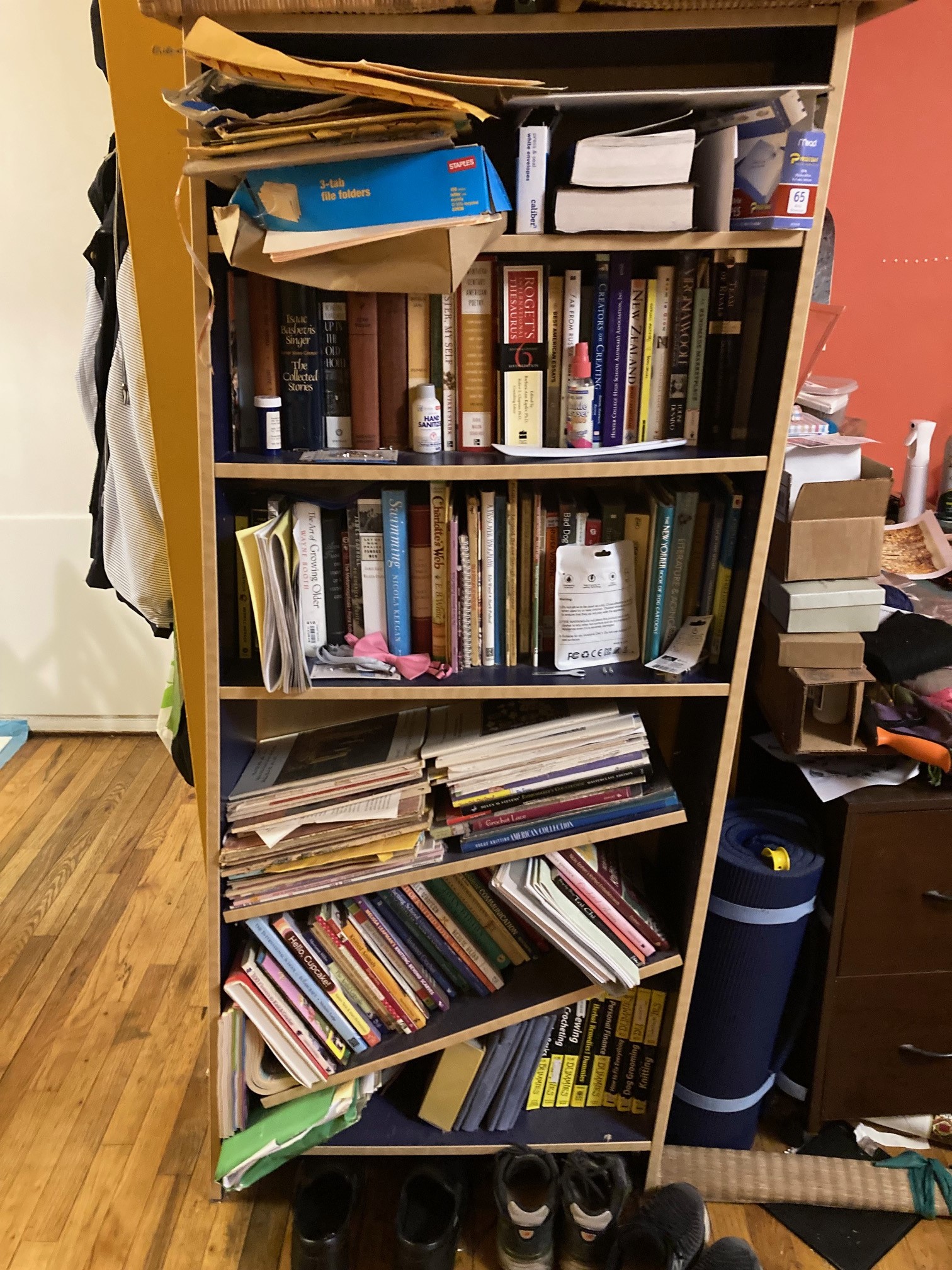
We have a blue Ikea bookcase in the hall that has been tilting for a long time now, but there’s been so much else going on that it never seemed important enough to try to fix it or replace it. We have bookcases everywhere, and I have five in my room alone, so one tilting bookcase didn’t seem like an emergency; until one of the shelves fell, and even then we just put “shelf pins” on the shopping list and eventually bought some, and of course, forgot to put them in. And then another shelf fell. And I still can’t be bothered to deal with the damned thing.

The Broken Bookcase

It’s not that a bookcase is such an expensive thing to replace, especially if we get another one from Ikea, its more that we’d have to actually go to Ikea, carry the heavy box to the car and from the car to the apartment, and then put the thing together, oh, and also empty the broken bookcase and take the broken pieces down to the garbage and refill the new bookcase.

I don’t have the energy for any of that, let alone all of it.

I’ve been trying to clear out the “extra books” from my collection for years now (so that we wouldn’t need so many bookcases), by re-reading the books that I’m on the fence about. I’ve already filled two boxes with books I no longer need, but giving books away is harder than you’d think. The library never wants them, and finding a place that wants the books, on the third Thursday of the month, at twilight, still requires carrying heavy boxes of books out to the car. So at this point I still have a box of discarded books on the floor, next to the bookcases, and I still have three shelves full of books to read through. I also have a bad habit of ordering more books all the time.

“She’s going to throw out our toys to make room for books, isn’t she?”

This feels like a metaphor for the way my brain has been lately: overwhelmed with ideas to follow up on, all resting on iffy shelves and waiting for me to start culling through them; but I can’t even think straight enough to do the culling before another ten or twenty ideas pile on. I feel like every day I’m looking at these tilting shelves in my brain, knowing that it’s all going to overflow at any moment, with no idea how to stop it.

I decided to take a break from going to online Hebrew classes for a few months, because I’ve been struggling to stay focused during the classes this past semester, and because the time I spend in those classes and doing the homework for them has kept me from doing other important things on my to-do list. I’m hoping to get back to the classes over the summer, when I have more free time to focus, but I feel the loss of the socializing and the Hebrew already. I still don’t even know what to do with all of the Hebrew I’ve learned so far, or why it’s been such an obsession for at least two years, if not my whole life.

I feel like there’s a path I should be on, and a long term goal I should be working towards, and that Hebrew language learning is part of it; but I don’t know what that goal is. I don’t want to move to Israel, and I don’t particularly want to go back to school full-time to become a translator or a rabbi or a cantor. I would like to go deeper into Jewish education, if I can, working with teens, maybe, as well as with the younger kids, and maybe even doing curriculum development. But I don’t know of a path to get there, and I don’t want all of that to be instead of writing my novels – the notes for which have filled up a bunch of shelves of their own.

I feel like there’s a whirlwind in my brain, pushing me in different directions all the time, keeping me confused and off kilter, and I’m worried that my internal bookshelves are as wonky as the ones in the broken bookcase in the hall, and it will all tumble down at any moment.

My hope is that once synagogue school is over for the year, I’ll be able to concentrate on all of those ideas whirling around in my brain, and organize them, and maybe even choose some to work on. But I’m afraid I’ll be as busy with doctors and tests this summer as I was last summer, without much improvement in my health to show for it, and those wonky internal shelves will just keep tilting.

But I keep slowly reading through my piles of books, and writing down all of my ideas, and sorting and discarding when I can, because this is how I move forward. It’s not especially practical, or fast, but it’s the way my mind works, so it will have to do for now.

“It’s important to just be yourself, Mommy.”

If you haven’t had a chance yet, please check out my Young Adult novel, Yeshiva Girl, on Amazon. And if you feel called to write a review of the book, on Amazon, or anywhere else, I’d be honored.

            Yeshiva Girl is about a Jewish teenager on Long Island, named Isabel, though her father calls her Jezebel. Her father has been accused of inappropriate sexual behavior with one of his students, which he denies, but Izzy implicitly believes it’s true. As a result of his problems, her father sends her to a co-ed Orthodox yeshiva for tenth grade, out of the blue, and Izzy and her mother can’t figure out how to prevent it. At Yeshiva, though, Izzy finds that religious people are much more complicated than she had expected. Some, like her father, may use religion as a place to hide, but others search for and find comfort, and community, and even enlightenment. The question is, what will Izzy find?

Cricket and the Doggy Steps

            Cricket has been having trouble jumping up on the beds recently, but instead of resting on the floor or calmly asking for help (Butterfly used to snuffle at my hand to ask for uppies), Cricket shrieks endlessly. It’s not just barking, it’s at the top of her vocal range, where glass really should be shattering all around her.

            She takes CBD oil to manage the regular pains of aging, and DES for her previous incontinence issues, which have both helped her tremendously, but they haven’t stopped the aging process altogether. She’s thin, and she has to wear sweaters because she’s lost a lot of hair, and her vision is blurry and her hearing is, let’s say, imaginative. But she is still the complicated, demanding diva she always has been. So when she started to struggle more to get herself up onto Grandma’s bed, after her middle of the night visit to the wee wee pad, she would stand next to Grandma’s bed at three or four or five in the morning and bark her head off, demanding to be lifted back up onto the bed.

            Mom’s answer was to cover her head with a blanket and try to ignore the noise, because that’s how she’s managed Cricket’s long-time habit of trying to bark her awake in the mornings, but I could not ignore the noise. After I’d been woken up two or three nights in a row to lift Cricket back up onto “her” bed, I insisted that we give the old doggy steps a try.

            We bought the doggy steps for Butterfly, way back when, because her legs were too short for jumping onto and off of the beds. She was eight years old and fresh from her last pregnancy at a puppy mill when we first brought her home, and she had heart problems and diabetes and lumps and bumps and broken teeth, so I wanted her to have the best life possible in the years she had left, and I thought the doggy steps would help. I also assumed she’d just know how to use them, magically, but it took weeks of training, and each step required a new chicken treat. Cricket’s contribution to training was that she would try to steal the chicken treats before Butterfly could reach them, though she used every possible machination to get to the treats without ever putting a paw on those doggy steps. By the end of training, Butterfly was only okay with walking down the steps, and not up, but at least it gave her a little more independence. Cricket, on the other hand, continued to treat the steps like hot lava to be avoided at all costs.

            So it made sense that Mom was skeptical about Cricket being willing to use the steps now, at almost sixteen years old. And my first attempt was a predictable disaster. I put the doggy steps at the end of my bed, while both dogs were napping, and when they woke up to the smell of whatever Grandma was having for lunch, they acted as if a scary dragon had arrived to stop them from reaching the floor and they maneuvered so far around the steps that they slammed into the dresser when they jumped off the bed.

But I wasn’t willing to give up. I thought, maybe the problem was that Cricket’s desperate need was to be on her grandma’s bed, not mine. So I put the doggy steps at the end of Mom’s bed, and the next time Cricket wanted to go up, instead of lifting her straight onto the bed, I lifted her onto each step, one at a time, making sure all of her feet made contact, until she reached the top and walked off onto the bed. And then I did it again, and again. And then Mom, still skeptical, put a chicken treat up at the top of the steps, and showed it to Cricket, and Cricket walked up the steps on her own. And ever since then, Cricket walks up those steps whenever she wants to, even when Grandma isn’t on the bed to welcome her. There was almost no learning curve at all.

            And I realized, once again, that with Cricket motivation is everything. And I think I might be more like Cricket than I realized. I don’t try to be stubborn or be a lot of trouble, but when my anxiety is high and there are no rewards big enough to overcome it, I can’t learn anything. I can just shake, or cry, or shout for help. I don’t mean to be like this. In fact, I’ve done everything I know to fix it. But nothing really works, until it works. Once the anxiety recedes enough, and the motivation is strong enough, suddenly things that seemed impossible become possible. But I never know when that turning point will be reached. So, like Cricket, I stand right outside of the Promised Land, wailing, begging for entrance, sometimes not even knowing who I’m crying to, waiting for the steps forward to finally become clear.

            I hope that when my doggy steps, or the equivalent, finally appear, I will be able to learn how to use them as quickly as Cricket has. She is, as always, my best teacher.

“What about me?”

If you haven’t had a chance yet, please check out my Young Adult novel, Yeshiva Girl, on Amazon. And if you feel called to write a review of the book, on Amazon, or anywhere else, I’d be honored.

            Yeshiva Girl is about a Jewish teenager on Long Island, named Isabel, though her father calls her Jezebel. Her father has been accused of inappropriate sexual behavior with one of his students, which he denies, but Izzy implicitly believes it’s true. As a result of his problems, her father sends her to a co-ed Orthodox yeshiva for tenth grade, out of the blue, and Izzy and her mother can’t figure out how to prevent it. At Yeshiva, though, Izzy finds that religious people are much more complicated than she had expected. Some, like her father, may use religion as a place to hide, but others search for and find comfort, and community, and even enlightenment. The question is, what will Izzy find?

The Gang of Cats

            There is a group of cats that has taken to visiting the backyard of my co-op. So far I know there are at least three of them, a grey one with white feet, and a white one with black markings, and a black one with white markings, though there may be more. It’s hard to count them because they often come around one at a time during the day. When they see Ellie coming out of our door they start to run, and Ellie chases them until they jump up into the retaining wall, out of her reach. For some reason, they have a habit of “hiding” on the third or fourth tier of the retaining wall, behind a single flimsy branch, as if Ellie would be able to see them up there if they weren’t camouflaged by this wondrous work of nature. Except, Ellie can’t see them at all, because she’s a dog and has limited vision and can’t really see things unless they are nearby and/or moving. Generally, Ellie prowls around at ground level searching for clues of the cat’s whereabouts, while I stand right in front of the hidden cat and try to make conversation.

Not one of the current cats, but probably an ancestor.

            The cats never answer my questions, though, which is very disappointing. I keep asking them where they live, and how they’re doing, and they just ignore me and watch the dreaded Ellie down below. Cricket isn’t interested in the cats at all at this point in her life. In fact, she has given up on cats and squirrels and birds altogether and has focused all of her attention on trying to get Kevin, the Mini-Golden-Doodle who lives two buildings over, to play with her.

            Eventually, after Ellie has forgotten about the cat in the retaining wall, and Cricket has, reluctantly, accepted that Kevin isn’t going to come out to play, the dogs let me take them back inside and the cats go back to what they were doing before, usually hanging out under the bushes in front of my building, because it’s the best place from which to spy on the mourning doves, who spend a lot of time near there (my neighbor is very generous with bird seed). A few times we’ve found piles of grey and white feathers in the yard, with no sign of the bird who used to wear them. I try to believe that the bird has survived the attack from the cats, somehow, because there’s no sign of the body or bones or blood, but half a bird’s worth of feathers is a lot, especially when there’s so much of the soft fluff that comes from the layer closest to the bird’s body.

“I didn’t do it. I was sleeping the whole time.”

I don’t know if these cats have homes, or humans to take care of them, and I don’t know if they are really hungry, or if they are more like Ellie, who feels like she’s starving two minutes after a breakfast of kibble, cheese, and chicken treats. They look pretty healthy, so it’s possible that they are house cats who are allowed out whenever they want, either that or there are a lot of people in my neighborhood who like to feed stray cats. It would be easier for me to accept the cats’ hunting behavior if they are feral, though it would still be hard to forgive. Those mourning doves are so awkward and well-fed that they really don’t stand a chance against a gang of cats.

One of the Mourning Doves searching for snacks.

            And yet, despite all of that, I still look forward to seeing the cats. Part of me even wishes that the cats would realize that Ellie isn’t a threat to them, and would see her as a potential friend, because she needs one (Cricket doesn’t count as a friend; she’s a sister, which, if you ask Cricket, is a whole other thing). Ellie would love to catch up to one of the cats and have a loud conversation with them, or teach them one of her special dances (hop, hop, slide, hop, twirl, prance, jump, spin). But they don’t know that Ellie would never hurt another creature and is no threat to them; though she’s been known to hurt Kevin’s feelings when she “hides” on our stoop every time Kevin comes around.

“I wasn’t hiding, I was waiting for you to let me back into the house so I could escape from, Kevin.”

I’m allergic to cats, so I can’t have one of my own, either for my sake or for Ellie’s, but I wish I could. I miss my old friend Muchacho, the cat who lived here when we first moved in about ten years ago. He lived in one of the apartments nearby, with his human, but he came and went through the window as he pleased. He was so friendly that he’d let me pet him, and even pick him up once or twice. It was a real loss when he died, because even though I still have neighbors with cats, they are all indoor cats and I rarely see them. These visiting cats are nothing like Muchacho, of course, and they are unlikely to let me get anywhere near petting them, but part of me believes that if I’m friendly enough they will change their minds. I even worry about them when they’re not here, almost as much as I worry about the wellbeing of the birds when the cats are here. I wonder what the cats are thinking, and where they go when they aren’t in our yard, and if they have human families, or feline ones, or enough food or shelter. I haven’t, yet, tried to chase them up into the retaining wall the way Ellie does, hoping for answers to all of my questions. But I’ve been tempted.

Muchacho

If you haven’t had a chance yet, please check out my Young Adult novel, Yeshiva Girl, on Amazon. And if you feel called to write a review of the book, on Amazon, or anywhere else, I’d be honored.

            Yeshiva Girl is about a Jewish teenager on Long Island, named Isabel, though her father calls her Jezebel. Her father has been accused of inappropriate sexual behavior with one of his students, which he denies, but Izzy implicitly believes it’s true. As a result of his problems, her father sends her to a co-ed Orthodox yeshiva for tenth grade, out of the blue, and Izzy and her mother can’t figure out how to prevent it. At Yeshiva, though, Izzy finds that religious people are much more complicated than she had expected. Some, like her father, may use religion as a place to hide, but others search for and find comfort, and community, and even enlightenment. The question is, what will Izzy find?

Passover is Almost Here

I’m not in the mood for Passover this year, especially because my health has been getting worse and Passover is one of the most preparation heavy holidays on the Jewish calendar, not just because you have to change your entire diet for a week (Matza instead of leavened bread, or anything with leavening in it, or anything with beans or corn or rice in it, if you are of Ashkenazi descent and Orthodox), but you also have to clean the whole house to make sure there’s no leavened bread hidden behind the sofa or between the cushions (Cricket likes to bury her treats for later), and then you have to find a Seder to go to and/or cook for a Seder.

“Wait a minute, were you watching me hide that piece of bread?”

            For most of my adult life I’ve been Passover-averse, in large part because my father made a mess of it. As a little kid, I loved Passover, especially going to Seders at my grandfather’s house (Mom’s father). But as my father became more religious he decided that everything my brother and I had been taught about Judaism was wrong. His new rules were demeaning and punitive and took the joy out of all the holidays, but especially Passover, which, if the rules are followed rigidly, can be something of a nightmare. As an adult, it took me a long time to even be able to walk into a synagogue, let alone go to services again. And even after we joined our current synagogue, eleven years ago, and I started to go to services every week, I still mostly pretended that Passover was just another week of the year. But as a synagogue school teacher, I can’t ignore it, because I have to teach it.

Part of me wishes I had the time to teach my students about Passover the way I learned it as a kid at my Jewish Day School. In first grade, we learned Echad Mi Yodea (Who Knows One?) in Yiddish, and each year we had a model Seder and learned tons of songs and prayers and stories and traditions. And then classes ended a few days before Passover so we could be home to help with the special food shopping, and changing over the dishes, and searching for chametz (leavened bread, like bread crumbs or cereal) with a kit we got from school, made of a small white paper bag, a feather, a wooden spoon, and a candle. The search for chametz is a kid-friendly ritual done in the dark on the night before the first Seder, where the adults hide little piles of chametz for the kids to find (with a candle to see by, and a feather and spoon for collecting the chametz into the paper bag, and then the whole kit is burned), all to symbolize the official transition from a house full of chametz to a house that is kosher for Passover.

Not my picture

            I’d love to share these rituals with my students, but I can’t figure out how to do it in our small classroom and the few minutes we have available between all of the other things they need to learn. I’m hoping that some of the girls in my class will come to the Women’s Seder at the synagogue, which is kind of like a grown-up Model Seder, with all of the handwashing and singing and blessings and rituals you could ask for. It’s scheduled ahead of Passover on the assumption that the actual family Seders will require women to do the cooking and cleaning and serving and therefore not really get the chance to focus on the meaning of the holiday itself. And because it’s a Seder for women, the pronouns in the blessings will be changed (because in the traditional blessings the pronouns are all male), and we will consider the female characters in the story who have generally been left out, and we’ll eat food prepared by someone else and sing songs written by women.

            If I had the energy, and the time, and the money, I would love to have a Model Seder with my students, where we could try dishes from Jewish communities around the world: like Moroccan Dafina stew, and Italian fried artichokes, and Turkish leek meatballs, and especially Ethiopian Matzah made with chickpea flour. And then we could try out different kinds of rituals, like the way the Ethiopians break their dishes before Passover (to avoid any chance of having chametz in their food over Passover), and some Sephardi Jews hit each other with scallions to simulate the way the slaves were beaten (well, maybe not that one), or the tradition where the Seder participants carry a heavy bag around the table to remind them of the burdens of slavery. And then, of course, the kids would obsess together over what they should ask for from their parents as rewards for finding the hidden piece of Matza (the Afikomen) at their own Seders.

“What will you give me for this Matzah thing?”

            That’s what I’d like to do, but I don’t have the classroom time to do it. And, more importantly, I really don’t have the energy. When I’m not in school with my students lately, I’m generally home in my pajamas, resting, or at least trying to. To be honest, I’ve spent most of my time recently binging past seasons of the Great British Baking Show on Netflix (because I finally have access to all of the seasons I missed after they moved from PBS to Netflix in the States).

            If I get a magical spurt of energy before Passover, I might do some vacuuming and search through the couch cushions for Cricket’s hidden crumbs, but once synagogue school goes on vacation, it’s likely that I will spend most of the holiday just resting, and hoping that that will be enough to give me the strength to finish out the synagogue school year with my kids.

            And, really, if I can do that, I’ll be happy.

If you haven’t had a chance yet, please check out my Young Adult novel, Yeshiva Girl, on Amazon. And if you feel called to write a review of the book, on Amazon, or anywhere else, I’d be honored.

            Yeshiva Girl is about a Jewish teenager on Long Island, named Isabel, though her father calls her Jezebel. Her father has been accused of inappropriate sexual behavior with one of his students, which he denies, but Izzy implicitly believes it’s true. As a result of his problems, her father sends her to a co-ed Orthodox yeshiva for tenth grade, out of the blue, and Izzy and her mother can’t figure out how to prevent it. At Yeshiva, though, Izzy finds that religious people are much more complicated than she had expected. Some, like her father, may use religion as a place to hide, but others search for and find comfort, and community, and even enlightenment. The question is, what will Izzy find?

Singing the Psalms

            The part-time musical director/rabbinical student at our synagogue decided to do something different for our monthly musical services this year. Usually we would have a Shabbat band, made up of professionals and congregants, set up next to the Cantor, and making the service feel like a rousing concert. But this year, the sanctuary has been set up in concentric circles, with the congregant singers and musicians in the middle and the rest of the congregation spreading out from there. It’s more intimate without the professional musicians, and there’s more of a focus on meditation and silence between the songs. And, maybe most important, the new songs we learned for these services were from the Book of Psalms, excerpted and used like chants, with lots of repetition and rhythm.

            It’s been an interesting experiment, especially for me as one of the singers, because it’s made me feel more like a participant in making the music, instead of an observer on the sidelines. And it feels really good to sing again, even though I’m still struggling with my breathing. It feels good to be a part of a whole group making music together.

“But we want to sing too!”

            The Psalms have always been a part of the traditional Friday night service, but we haven’t always sung them at my synagogue, and certainly not all six of the Psalms that are included in the prayer book as part of Kabbalat Shabbat (the Welcoming of Shabbat, or the warm up before the official evening service).

We studied the book of Psalms a few years ago in Bible Study, but I don’t think I paid a lot of attention. I was probably still in graduate school for social work at that point, and struggling to pay attention to anything other than school, but I do remember the Rabbi saying that many of the Psalms are “macaroni songs,” or songs that can easily be sung to different tunes, and that opens them up to many different musical interpretations that can give a whole new energy to familiar words.

“I like macaroni!”

            The Psalms, as opposed to most of the rest of the Hebrew Bible, were created to be sung by the Levites in the Temple in Jerusalem. Some of the Psalms even tell you which instruments you should play to accompany them. The Greek word Psalmos means “a song accompanied by a stringed instrument,” and the Hebrew word for the Book of Psalms is Tehillim, which means “songs of praise,” though not all of the Psalms are about praising God. There are one hundred and fifty individual Psalms, and some are communal laments, and others express individual grief and anger at God, and some are thanksgiving and praise songs, but the value of the Psalms is that they give voice to a range of emotions, like joy and fear and rage and gratitude, and they appear in daily and weekly Jewish services, and holidays and funerals, because they can help us to express things when we have no words of our own.

            The Psalms used for Kabbalat Shabbat on Friday night are Psalms 95-99, plus Psalm 29, and there are a few versions that I really like:

            (From Psalm 96) Shiru L’Adonai by Nigunim Ensemble https://youtu.be/yM6_49gQmXw

       (Also from Psalm 96) Ya'aloz Sadai by Nava Tehilla https://youtu.be/QwGksNJixtc
       (From Psalm 98) Zamru L’Adonai by Nava Tehila - https://youtu.be/XQe7vqnCZmU
 

            One of the Psalms we sang all the time, without realizing it was a Psalm, was By the Waters of Babylon. I think we first learned it to sing at a school concert, or maybe at camp, but I knew an English version and a Hebrew version and only in my research for this essay did I realize it came from Psalm 137: By the waters of Babylon, there we sat, sat and wept, as we remembered Zion. It’s a communal lament at the loss of home after the first Temple in Jerusalem was destroyed and the Israelites were exiled to Babylon. We always sang the first lines, but the Psalm goes on to another saying we learned in school: If I forget you, or Jerusalem, let my right hand wither. It always sounded so strange to me, especially on it’s own, because I was clearly an American kid, not longing to go anywhere else, and yet I was supposed to feel so guilty at not longing for Jerusalem that I would lose my right hand. And I’m a righty, so it bothered me a lot. The Psalm also includes a revenge fantasy against the enemies of Israel, and we can read it as literal – that we want to kill those who wronged us or took things from us, or we can read it as a moment of catharsis, to get our yayas out, that is not meant to be acted upon. I guess we get to choose how we read it, like a choose-your-own-adventure story. But the song I learned as a child focused only on the grief, not on the guilt or the desire for revenge, and I wonder if we excerpt these Psalms as a way to avoid the more complicated parts of who we are and how we feel, or the more complicated parts of peoplehood, so that we can just focus on the joy for a little while.

            But the Psalms are everywhere, not just in the Friday night service, and I never really noticed them before. I don’t think we studied the book of Psalms, either in elementary school or high school, probably because we were saying them daily in our prayers and our teachers assumed we knew them and understood them already. But we didn’t. Or, I didn’t.

               Psalm 137- Waters of Babylon by Don McLean - https://youtu.be/uTnspbSjKVc
               Psalm 137 - By the Waters of Babylon by Joey Weisenberg https://youtu.be/24SJuRGPpTI

            The Psalms can also be downright hopeless at times, like Psalm 90 – We spend our years like a sigh; the span of our life is seventy years, or given the strength, eighty years, but the best of them are trouble and sorrow, they pass by speedily and we are in darkness. It’s depressing, sure, but it’s also a chance to acknowledge the dark places in our lives, and in our world, and show them to God, and ask God to care that we are suffering, and, most importantly, to give ourselves permission to care that we are suffering.

“Hey! I suffer too!”

            The most famous Psalm I know of is Psalm 23 – The lord is my shepherd I shall not want. Yea though I walk through the valley of the shadow of death, I will fear no evil, for you are with me. I like to think of it as an aspirational Psalm, a Psalm describing how we want life to be and to feel. It’s phrased in the present tense, as if all of these good things are already here, and I am already comforted, and I already feel safe, and will only experience goodness and love from now on. But I think the idea of a prayer like this is to help us hold onto a vision of a better world, even when that’s not how things are for us right now, which is why it’s often said at funerals. I found a really beautiful version of this one, in Hebrew and English, by one of the Jewish-male-acapella groups who usually sing silly holiday songs to the tunes of popular American music.

            Psalm 23 – Gam Ki Elech – Six13 –  https://youtu.be/bezjJbBkWkg

            But along with the pain, the Psalms can also teach us how to celebrate when things go right, and how to express our gratitude for answered prayers – not because we’re ungrateful creeps who wouldn’t thinking to say thank you on our own, but because celebration and expressing gratitude is just as cathartic as expressing doubt and pain and anger. These Psalms allow us to feel like what we feel and say and do in the world has inherent value, not just to us but to God, who is our clearest personification of the world at large.

            The last of the one hundred and fifty Psalms is Hallelujah and it’s all about praising God, here and there, for his acts and greatness, with horn and lyre and dance and lute and pipe and cymbals. There are a lot of beautiful versions of this one, but I picked two of my favorites.

            Psalm 150 – Halleluya – by Nava Tehilla - https://youtu.be/RV3xV9NJgss
            Psalm 150 – Halleluya – by Nigunim Ensemble - https://youtu.be/ngybRjtv-dk

            Some people learn best through reading, or doing; I learn best through music. So getting the chance to hear the Psalms, and feel them, through music, finally made them seem like more than just words on a page. My hope is that even when we go back to the rowdier version of musical services at my synagogue next year, we can keep the new takes on the Psalms, and add more as they are created, because each new variation seems to capture another feeling that I didn’t notice before, adding more joy and insight and space without ever taking anything away.

Some more songs I love that are taken from the Psalms:

Psalm 92 - Tov L'Hodot by Joey Weisenberg - https://youtu.be/cXwoXKDDGmw

Psalm 118 – Min Hameitzar by Deborah Sacks Mintz – https://youtu.be/EMe4-ggSkdY

Psalm 121 – Esa Einai by Nefesh Mountain – https://youtu.be/aLTt2HytfXQ

“Can you please turn the music down? We’re trying to sleep over here.”

If you haven’t had a chance yet, please check out my Young Adult novel, Yeshiva Girl, on Amazon. And if you feel called to write a review of the book, on Amazon, or anywhere else, I’d be honored.

            Yeshiva Girl is about a Jewish teenager on Long Island, named Isabel, though her father calls her Jezebel. Her father has been accused of inappropriate sexual behavior with one of his students, which he denies, but Izzy implicitly believes it’s true. As a result of his problems, her father sends her to a co-ed Orthodox yeshiva for tenth grade, out of the blue, and Izzy and her mother can’t figure out how to prevent it. At Yeshiva, though, Izzy finds that religious people are much more complicated than she had expected. Some, like her father, may use religion as a place to hide, but others search for and find comfort, and community, and even enlightenment. The question is, what will Izzy find?

Planning My (Eventual) Trip to Israel

            Ever since my High School best friend visited from Israel, back in January, I’ve been thinking about what we’ll do when I finally get to Israel. I think the biggest result of my almost two years of online Hebrew classes from Tel Aviv, and watching so many Israeli TV shows to practice my Hebrew, is that I’m much more interested in visiting smaller neighborhoods and meeting the people than I am in going to the traditional tourist sites. For example, I really don’t want to get up early in the morning to hike Masada, or even take a cable car to the top to watch the sunrise, because I’ve seen more than enough pictures of the view, and because I’m not sure I want to celebrate a place where so many Jews felt like their only option was to commit suicide in order to avoid being captured.

I’m reluctant to go to the Dead Sea (Yam HaMelach in Hebrew), because… bathing suits, and because I usually have one wound or another and the salt stings. But I wouldn’t mind going further south, to Eilat, because there’s supposed to be a spectacular underwater preserve, where you can snorkel or go on a glass bottom boat ride to see fish and coral, and then you can go to the Dolphin Reef to swim with dolphins. But again, bathing suits, or a wet suit, which is just as bad.

Of course, I’ll need to go to Jerusalem for a few days, just to see if I fall under its spell. I’m kind of hoping I will, because it sounds like an incredible high the way people describe it, though I don’t want to get the official version of Jerusalem Syndrome, which includes psychotic breaks and believing you are Moses or Jesus or someone like that. More likely than not, I’ll get to the Wailing Wall, look around, realize I’ve seen it all in pictures and videos already, and then spend the rest of my time at the Mahane Yehuda Market.

“Do they have food?”

            Time of year will make a huge difference in what kind of trip I can take, because if I have to go in the summer I will not be able to spend much time outdoors. I’ll just go from one taxi/bus/train to another, and one hostel to another, carrying buckets of ice to toss over my head in case of emergencies.

            I found an Israeli tour guide on YouTube, named Oren, who does tons of videos: on how to plan trips to Israel in general; and how to manage public transportation, and how to navigate the weather, and the people, and the supermarkets, etc. He’s an opinionated guy, and I don’t always agree with his point of view on politics, but he’s knowledgeable and detailed, and funny, and he really loves Israel.

Some things I’ve learned from Oren: they don’t stamp passports in Israel, because then it would be difficult for people to travel on to Arab countries, so instead you get a paper called an Electronic Gate Pass that you have to keep track of; the New Israeli Shekel, Known as NIS or “Shach,” equals about thirty to thirty five American cents; you need an adapter for any American electronics (hair dryer, electric toothbrush, etc,); you will need an Israeli provider’s sim card for your cellphone in order to have Wi-Fi, outside of a hotel/hostel that provides it for you; March and April are the best time to go to Israel, but any time after October is okay, because the winters are mild; The preflight security interview at El Al can be intimidating and annoying, but you’ll survive; buy traveler’s insurance; keep the Jewish holidays in mind when planning your trip, because there’s no public transport on Shabbat and holidays in most of the country, and flights into the country are more expensive leading up to the big holidays; only go to the Negev in the winter, otherwise you will burn to a crisp; you need a guide of some kind in order to visit the old city of Jerusalem, but there are group tours, apps, and guide books if private tours are too expensive, and keep in mind that Jewish and Christian tours are very different; in an emergency dial 101; don’t be surprised to find yourself standing next to an Israeli soldier carrying an Uzi.

            Recently, I’ve been getting really interested in seeing the north of Israel, because I know so much less about it, and because it is not as hot as the south, but Oren has fewer videos about the north, so far, so I had to go to Wikipedia and other sites for information.

            Haifa is the big city in the north of Israel, and there’s an Israeli saying that goes, “Haifa works, Jerusalem prays, and Tel Aviv plays,” which doesn’t make it sound very exciting, but it has the only underground rapid transit system in Israel, called the Carmelit (Tel Aviv is in the process of building its own). And it’s also one of Israel’s mixed cities, with a significant population of Arabs and Jews living in the same place, with Arab Christians, Arab Muslims, Druze and Bahai communities, plus a lot of immigrants from the former Soviet Union, and even an ultra-orthodox minority. So it seems like it’s worth a visit, and it could be a good jumping off point for visiting other parts of the North. Haifa is also one of the few cities in Israel where buses operate on Shabbat.

I want to see Tsfat (Safed), which is known for art and mysticism; and Akko (Acre), which is an ancient city with remnants from the Hellenistic-Roman period, and the Crusader period, and the Ottoman period; and then there’s Tiberius, which was founded in 20 CE by Herod Antipas, the son of Herod the Great, and became a hub for Jews after the destruction of the second temple (and where the Jerusalem Talmud was put together); and there’s Mount Hermon, bordering Lebanon, which is the one place in Israel that gets enough snow for skiing in the winter (but since I don’t ski I’m not sure why I’d go there, except to cool off); and then there are a lot of Kibbutzim and Moshavim to visit, with fruits and vegetables and cheeses and mushrooms galore.

“I like cheese!”

But it’s all still up in the air, especially when it’s so much easier to watch videos of all of these places on TV. And I’m still dragging my feet about getting my passport renewed, though, partly because of my reluctance to have my picture taken, and partly because it’s one more appointment I’ll have to make and organize and get to. And the thing is, I don’t really want to go to Israel alone, or plan a whole trip by myself, and I can’t expect my friend to abandon her family for weeks at a time just to keep me entertained. My synagogue is planning an Israel trip next year, in the spring I think, but it’s bound to be expensive and involve a lot of walking, and visiting places I don’t particularly want to go, and it would require me to make up my mind far in advance, which I seem incapable of doing.  So, in the meantime, I’m watching Israeli movies and TV shows: on my Kan 11 app, or the Izzy streaming channel, or just on YouTube. At the very least, by the time I get to Israel I’ll know the best places to go for Chummus.

“Have them send all of the food here!”

Some of Oren’s Israel videos:

The 10 Most ISRAELI Things You Don't See On the News (14:33) https://youtu.be/q4lmXwqGDHg
The Israeli Supermarket (11:54) https://youtu.be/OFUximyJ3rI
Running the Dead Sea Marathon (10:14) https://youtu.be/THKJDJQUww4

If you haven’t had a chance yet, please check out my Young Adult novel, Yeshiva Girl, on Amazon. And if you feel called to write a review of the book, on Amazon, or anywhere else, I’d be honored.

            Yeshiva Girl is about a Jewish teenager on Long Island, named Isabel, though her father calls her Jezebel. Her father has been accused of inappropriate sexual behavior with one of his students, which he denies, but Izzy implicitly believes it’s true. As a result of his problems, her father sends her to a co-ed Orthodox yeshiva for tenth grade, out of the blue, and Izzy and her mother can’t figure out how to prevent it. At Yeshiva, though, Izzy finds that religious people are much more complicated than she had expected. Some, like her father, may use religion as a place to hide, but others search for and find comfort, and community, and even enlightenment. The question is, what will Izzy find?

Chutzpah

            Just the other day, someone described me as having chutzpah, because of some small thing I said in a meeting that no one else seemed willing to say. I wasn’t sure if I was being complimented or not, or even if chutzpah was the right word for such a small thing, but the moment stuck with me.

            According to Wikipedia, chutzpah is a Yiddish word meaning audacity. It has strong negative connotations, but can also be interpreted in a positive way, as courage or guts. It’s originally from the Aramaic/Hebrew root word “Chataph,” meaning insolent or impudent, and is often used to refer to someone who has overstepped the boundaries of polite behavior.

And I can see that in myself, because I’m not especially good at being polite. I’ve often gotten in trouble for saying things I didn’t know I wasn’t supposed to say. Chutzpah, even the saying of it, requires impoliteness, like coughing up phlegm, and not being so lady-like or quiet.

“You should have named me Chutzpah instead of Cricket. This is me!”

            If we stick with the root word, chataph, and define chutzpah as insolence or impudence, both of those words describe the behavior of someone with less power towards someone with more power, and that fits with the origin of my impolite behavior, in childhood. A parent can’t be impudent or insolent towards their child; they can be mean, insensitive, hurtful, etc., but a child can be impudent or insolent towards a parent or other adult, breaking the rules of conduct and risking punishment by ignoring the rules imposed on them.

            Yiddish as a language overall has chutzpah. It’s heretical, and powerful, and antagonistic to the norm, and in my quiet way I am all of these things; not because I want to be, but because my reality is so different from what I’ve been told to expect.

Yiddish almost became a dead language, when the majority of Yiddish speakers were killed in the Holocaust, but it’s coming back to life, and I think that’s because it serves a much needed purpose. Yiddish is about seeing the world from an outsider’s perspective, and poking a finger at those in power, and being subversive, and funny. It’s a language that is used to talk behind someone else’s back (preferably someone who doesn’t understand Yiddish), or to take the stuffing out of a person (who does understand Yiddish), or to complain about a frustrating reality, or to do some truth telling instead of trying to calm the waters.

            As I said in the beginning, my form of chutzpah is generally a willingness to say what no one else in the room will say: that the emperor has no clothes on, or that the elephant in the room is starting to smell. I’ve done that from early childhood, not because I wanted to be disruptive or rude or audacious, but because I couldn’t figure out why no one else was acknowledging the obvious, and it hurt my brain to try to pretend things weren’t happening when they were. I don’t mind politeness in general, I just mind it when it is hiding important truths. Like, let’s not pretend that the guy in the doorway with a gun is just coming over for tea, okay?

“But are there snacks to go with the tea?”

            I read another definition of chutzpah, though, that said that someone with chutzpah is someone who ignores what others think, and denies personal responsibility for their actions, and lacks remorse, regret, guilt, or sympathy. And that’s not me at all. But it’s hard to get a handle on a word that means so many different things to different people. It’s not a word like, say, light bulb, which everyone will understand in pretty much the same way.

            I had an English teacher in High School who made us memorize definitions for our vocabulary words, and if even one word varied from the exact definition she’d given us, we’d lose points. She didn’t test us on our ability to comprehend the word in context, or to use it in a sentence, instead she treated every word as if it had an exact and unchanging meaning. Except, words aren’t like that. Words are adopted and adapted to fit the current needs of the speakers of the language. I see this every week in my online Hebrew class, where words I learned thirty years ago have gone out of style, or picked up new baggage from how they’ve been used on the street or in business or in politics in Israel.

            I’d like to think that if I do have chutzpah, it’s the good kind and not the sociopathic kind, but most of the time I feel like I don’t have enough chutzpah, or self-confidence, or whatever it takes to really make a mark in the world, and make change. It takes so much energy to speak up in a discussion, and argue against the speaker’s certainty, only to find out later that mine was actually the majority opinion in the room but no one else felt free to say anything. I’d rather not have to fight at all, honestly, but that doesn’t seem to be an option. So, maybe next time I have to be chutzpahdik and speak an impolite truth, someone else will stand up and be chutzpahdik with me. God, that would be so much better.

“We’re with you!

If you haven’t had a chance yet, please check out my Young Adult novel, Yeshiva Girl, on Amazon. And if you feel called to write a review of the book, on Amazon, or anywhere else, I’d be honored.

            Yeshiva Girl is about a Jewish teenager on Long Island, named Isabel, though her father calls her Jezebel. Her father has been accused of inappropriate sexual behavior with one of his students, which he denies, but Izzy implicitly believes it’s true. As a result of his problems, her father sends her to a co-ed Orthodox yeshiva for tenth grade, out of the blue, and Izzy and her mother can’t figure out how to prevent it. At Yeshiva, though, Izzy finds that religious people are much more complicated than she had expected. Some, like her father, may use religion as a place to hide, but others search for and find comfort, and community, and even enlightenment. The question is, what will Izzy find?
Watching Therapy Videos

            Early in the school year I went searching for information on ADHD and Autism, to try to understand behaviors I was seeing in some of my students at synagogue school. I didn’t learn much about either diagnosis in my three and a half years in graduate school for social work, or even during the two years prior to that, when I was studying psychology in hopes of applying to a doctoral program in clinical psychology. And I certainly didn’t learn much about how to teach kids with those learning differences.

            I watched a lot of short, explanatory videos on ADHD and Autism that left too much unexplained and undescribed, and then I watched a lot of videos made by adults with ADHD and Autism who could describe the neurological differences they experienced, but still couldn’t give me, as a teacher, a clear idea of how to be helpful. And then I watched a bunch of videos about the blurry lines between ADHD, Autism, and trauma responses in children and adults, many of which validated my own experience of the mental health field, which is that there’s a lot we don’t know, but there are a lot of people who like to sound certain anyway, which is just annoying.

“So annoying.”

            But while I was looking into ADHD and Autism for my students, I kept finding videos that resonated with me, and I realized that I’ve been hitting a wall in therapy, in large part because the plans I had for my life have been derailed by my health issues and that has left even my therapist stymied as to how to help me. So even though the ADHD and Autism videos weren’t panning out, I thought I would keep looking though YouTube to see if I could find some ideas to try out in therapy, or even just ways to help me accept where I’m at and find some peace.

            I took a deep dive into the big names in Psychology, and especially in Trauma and Sensorimotor therapies and Attachment, thinking I must have missed some important ideas along the way that could have healed me by now, but I realized quickly that I’d heard all of it, and studied it, and parsed it for all of the helpful morsels of wisdom long ago. In almost thirty years of therapy, I realized, I’ve learned at least a doctorate’s worth of information/wisdom on the impact of trauma, even though I struggle to feel confident in what I know.

            But then I found a relatively young therapist/social worker named Patrick Teahan who had made a lot of videos about dealing with the impacts of a traumatic childhood in really down to earth, practical ways. And while he wasn’t telling me things that were new to me in theory, he had a way of talking, especially when sharing his own stories, that was validating and made me feel less alone. He shares a lot of concrete examples about what it feels like to have your sense of reality constantly challenged, and he’s able to describe situations and put things into words that often remain blurry for me.

            He can be a bit verbose at times, though not in an academic way, more like if a friend were telling you a story and kept interrupting himself to tell you about another aspect of the story, and then getting back to the main idea only to go off on another tangent. I decided to take notes when I watched his videos, to help me follow the main through lines of what he was saying, and to give myself permission to take the videos more seriously, and to take my time with them, because the real value I was getting was a sense of his basic kindness as he worked to remove the shame that comes with a difficult childhood and from the lifelong dysregulation it can cause.

            He works in a form of therapy I’d never heard of, called the Relationship Recovery Program, and I have no idea how commonly it’s practiced or where it’s practiced, but I like the way he seems to respect each person’s life story, and I like that he doesn’t profess to have all of the answers. Most of all I like his sense of hope, that with time and effort people can come out of therapy feeling better and seeing things more clearly than before.

            I haven’t watched all of his videos, but I have a long list of the ones I want to watch carefully, taking notes and absorbing the material without overwhelming myself too much. And whenever I watch one of his videos, YouTube recommends a handful of other videos on similar topics, with other therapists, and even if I don’t watch them right away, there’s this reassuring sense that they’ll be there for me, some day, when I need them.

            The biggest gift from all of this video research, though, has been the reminder of how much I already know, about myself, and my students, and how valuable it is to just be a witness to what others are going through and to validate their experiences instead of evaluating or diagnosing them. Attention and kindness really can help people heal. I just have to keep reminding myself of that.

“I’ll remind you!”

If you haven’t had a chance yet, please check out my Young Adult novel, Yeshiva Girl, on Amazon. And if you feel called to write a review of the book, on Amazon, or anywhere else, I’d be honored.

            Yeshiva Girl is about a Jewish teenager on Long Island, named Isabel, though her father calls her Jezebel. Her father has been accused of inappropriate sexual behavior with one of his students, which he denies, but Izzy implicitly believes it’s true. As a result of his problems, her father sends her to a co-ed Orthodox yeshiva for tenth grade, out of the blue, and Izzy and her mother can’t figure out how to prevent it. At Yeshiva, though, Izzy finds that religious people are much more complicated than she had expected. Some, like her father, may use religion as a place to hide, but others search for and find comfort, and community, and even enlightenment. The question is, what will Izzy find?