The latest experiment in my journey to convince Tzipporah that I’m not so bad, has been to place chicken treats at the entrance to my room at bedtime, trying to catch her attention while she’s on her way to or from her Midnight Snack with Grandma. It is an attempt at bribery, pure and simple, but so is most of the clicker training I learned back when we were trying to convince Cricket that she was not the boss of everyone (unsuccessfully, of course).
There is an old Jewish tradition of giving honey to young students when they first start studying the Hebrew Bible, so that they’ll pair study with sweetness forever after (though the version I heard had the rabbis putting honey on the student’s slates, and the student would lick off the honey with the chalk of the Hebrew letters, which does not sound delicious, or sanitary, so I tend to give my students lollipops instead), and since Tzipporah is much more of a savory girl than a sweets aficionado, I have built my current experiment on the treats she most craves – chicken jerky.
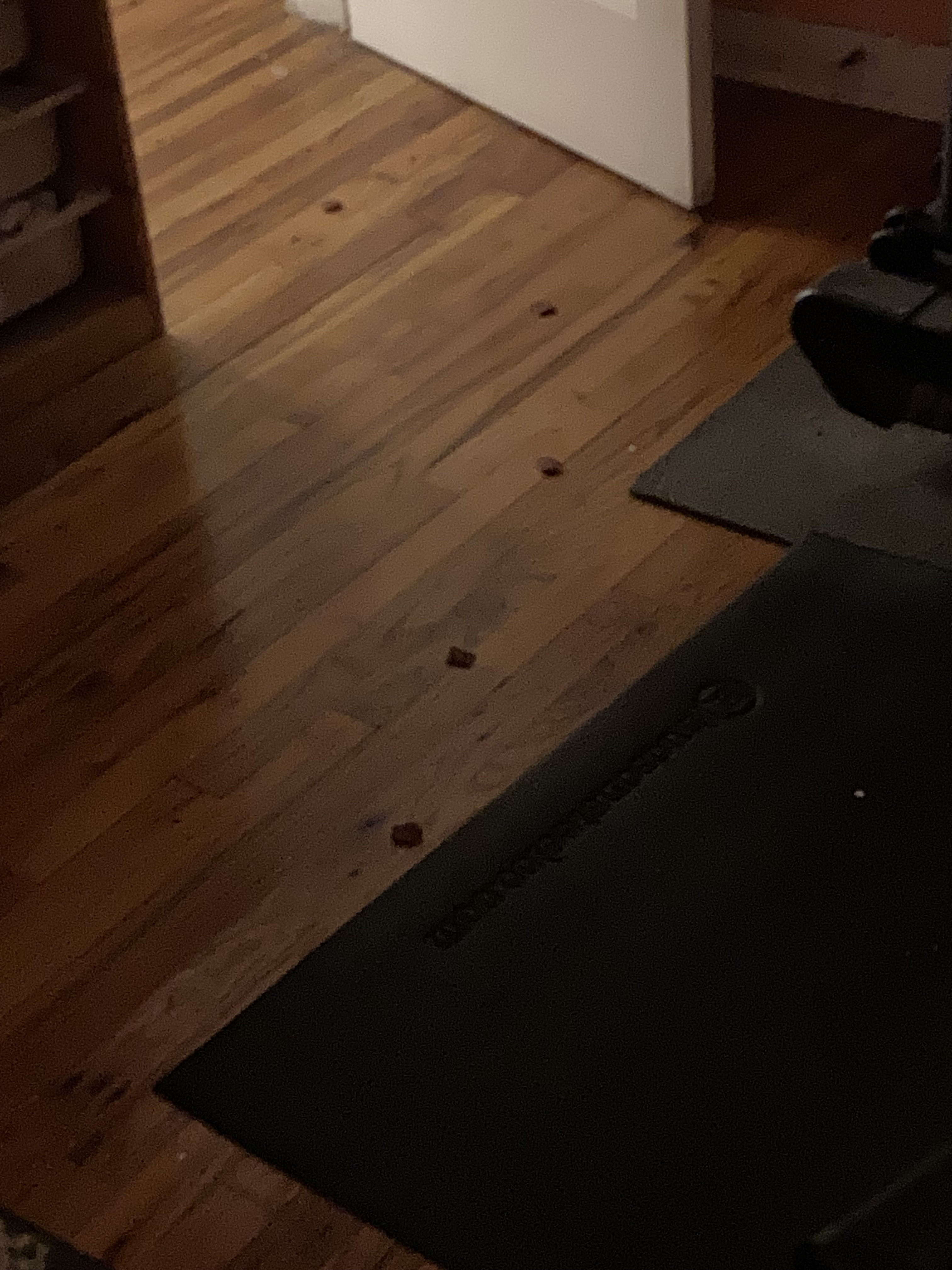
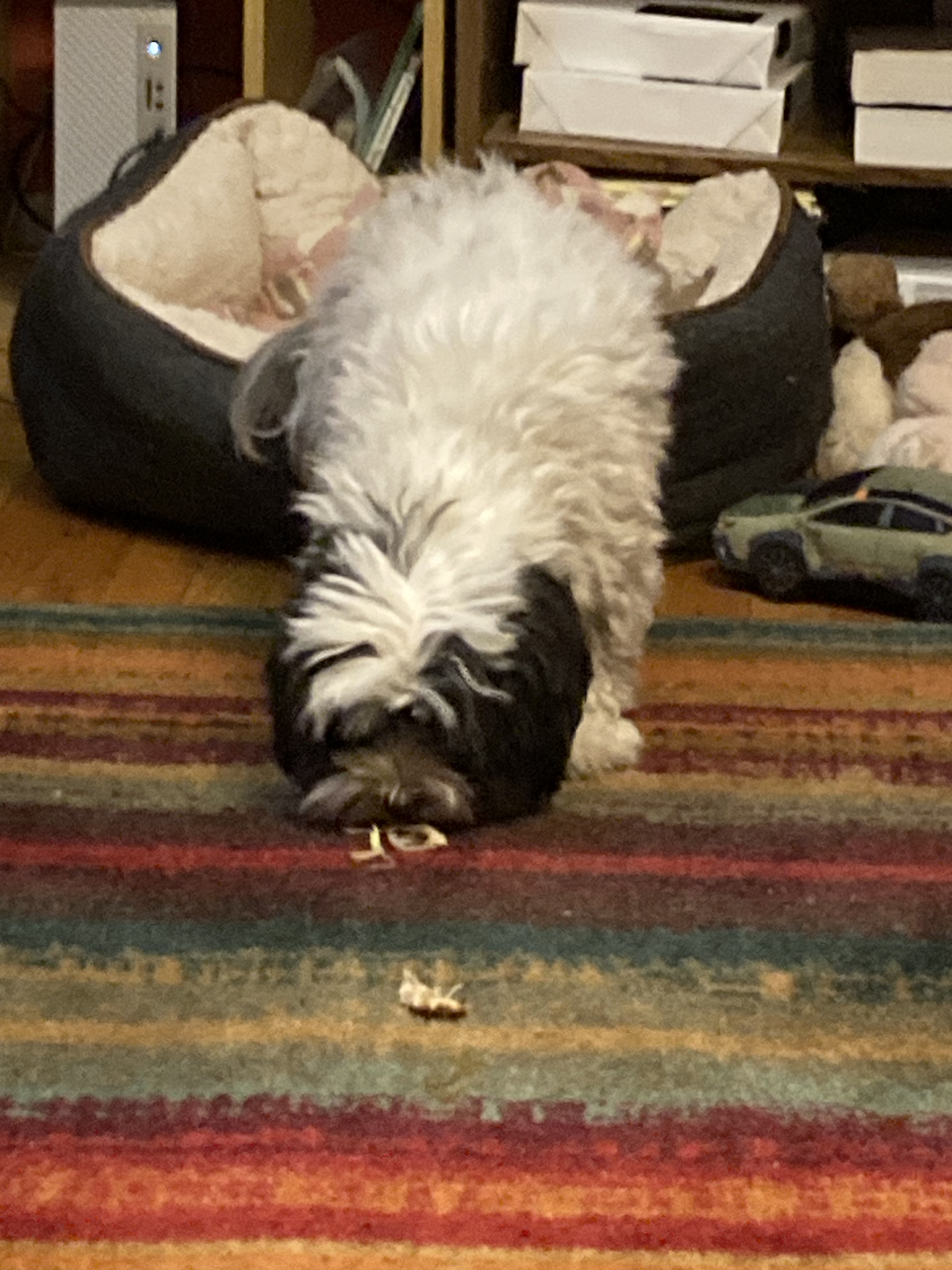
Each night, I break one piece of chicken jerky into smaller and smaller pieces, and spread them further apart so she has to actually walk into my room to find them all. And since she believes in only taking one treat at a time, no matter how small they may be, she now comes in at least five times to get through the whole trail, usually more than five, because she’s ever hopeful that more will appear. She’s still not looking up and acknowledging my presence, but we both know I’m there.
The trail of treats
The elusive Tzippy, caught on camera
There may need to be a second part to this experiment, because getting her into the room doesn’t equal coming directly to me for treats, or thinking of me as a safe person, but I haven’t thought that far ahead.
But at least now, she has learned to stop and check my doorway as she passes by, and even to linger and check more carefully in case she missed something, rather than just taking a cursory sniff and moving on. She does this at least once at night and once during the day (if I’m in my room instead of sitting in the living room with her). Not only do the chicken treats draw her attention, but they also seem to help mute her anxiety at entering my room while I am present. In the past (last week), Tzipporah would come to my door, see me seeing her, and immediately bolt; but with her nose to the ground searching for treats, she’s less concerned, or at least less aware, of where I am and what I’m doing (I am, of course, watching her and trying to get pictures).
It’s hard not to compare how much farther along Tzipporah has gotten in her relationship with my mom (her grandma) than in her relationship with me. Mom can even hold out a treat, sometimes, and Tzipporah will gently take it from her hand. But, I figure, why not learn the lesson, and tap into the thing that has been working for them all along (being super generous with treats) and see if I can catch up. So far, Tzipporah doesn’t seem to mind.
“Where are the rest of my treats?”
If you haven’t had a chance yet, please check out my novel, Yeshiva Girl, on Amazon. And if you feel called to write a review of the book, on Amazon, or anywhere else, I’d be honored.
Yeshiva Girl is about a Jewish teenager on Long Island, named Isabel, though her father calls her Jezebel. Her father has been accused of inappropriate sexual behavior with one of his students, which he denies, but Izzy implicitly believes it’s true. As a result of his problems, her father sends her to a co-ed Orthodox yeshiva for tenth grade, out of the blue, and Izzy and her mother can’t figure out how to prevent it. At Yeshiva, though, Izzy finds that religious people are much more complicated than she had expected. Some, like her father, may use religion as a place to hide, but others search for and find comfort, and community, and even enlightenment. The question is, what will Izzy find?
According to Google, cognitive dissonance is a “psychological phenomenon where a person holds two or more conflicting beliefs, attitudes, or behaviors simultaneously. This inconsistency creates discomfort and tension, motivating the individual to resolve the dissonance.”
This concept came to mind recently while I was watching the first season of 911 (after a marathon binge of the show, starting in season three, that left me really curious about how the series began). I was especially interested in the romance between Abby, a 42-year-old 911 operator, and Buck, a 26-year-old rookie firefighter, because it set up the whole structure of the show, where they follow 911 calls through to their resolutions. But almost immediately, I felt queasy about the age difference between the two characters. I had to remind myself that, even though he was immature, Buck was an adult, and even though Abby was 42, she was at a vulnerable stage in her life and not in a position to take advantage of any perceived power differences between the two of them. They were both so obviously in need of love, and specifically in need of the kind of love the other had to offer, but…
Maybe because of the low stakes (it’s a TV show after all), I was able to sit with the dissonance and let it simmer for a while (a day or two, actually, because I watched the first season all in one go), and I realized that even though these moments of cognitive dissonance can be uncomfortable, or worse, they are also an opportunity for deeper understanding, of ourselves and of others.
When we see this kind of cognitive dissonance in our politicians, we tend to call it hypocrisy. How can you say you care about the poor and then fight so hard to cut Medicaid?How can you say you are an advocate for survivors of sexual abuse and then ignore the sexual offences of your favorite politician? In our private lives, it can show up maybe as wanting to save money for retirement, and then going on Amazon to buy ten things we don’t need.
“I needed all of it, Mommy!”
Like many psychological terms and theories, cognitive dissonance feels like a judgement being made on other people, a negative way of naming how we behave, without bothering to understand why we do it or having compassion for the struggle. Psychologists and therapists, and many other helping professionals, tend to feel overwhelmed by the chaos their patients or clients bring into the room and rely heavily on the intellectual distance of naming things to keep the chaos from seeping into their own lives.
The emphasis in the cognitive dissonance articles I was able to find, was on how we tend to resolve our dissonances, often with defense mechanisms, like: avoiding the dissonance altogether by staying away from discussions or situations that bring it up; delegitimizing the person or group or situation that highlighted the dissonance (this is fake news!); or minimizing the impact by telling yourself that you didn’t really go against your beliefs, or you just did it one time. Rarely, the articles seemed to suggest, do we actually choose to change our behavior or reassess our value systems in order to resolve the dissonance.
I’m not comfortable with the judgment (name calling) underlying all of this, and the assumption that we are all lying to ourselves all the time in order to resolve our discomfort, but I still think Cognitive Dissonance can be a useful concept, if we use it as a way to identify a problem that needs further attention. Ideally, if I feel guilty for doing something I didn’t plan to do, I can be curious instead of judgmental. And if I find myself minimizing, rationalizing, ignoring new information, or dismissing research out of hand, I can be curious rather than self-loathing. I can choose to look at the dissonance as a mystery worth exploring, a part of myself that deserves more of my attention and respect, rather than my judgment or impatience.
Just like in music, dissonance can catch your attention in a way that harmony may not, and it can tell you that something important is happening: it could be a mistake (you played the wrong note); or it could be the entrance of a new character, or a change in mood; or it could be the start of a disaster.
The Abby and Buck story on 911 tapped into two of my strongly held, and in this case opposing, beliefs: 1) that age/power/status differences between people can lead to abuse if we’re not careful about setting clear boundaries, and 2) love is a wonderful and healing thing. The way the show dealt with the dissonance in the relationship was both to minimize the weirdness of the age difference (by rarely mentioning it), and, in the end, by sending Abby off on a trip around the world until Buck could get over her. The un-stated conclusion was that two people who are at two very different places in their lives (either because of age or status or something else) may be able to spend time together and do each other good, but only for so long. The creators of the show chose not to sit with the discomfort inherent in such an age difference for more than a season, maybe because it made them that uncomfortable, or maybe because they discovered that it made their audience uncomfortable. And in season two, they replaced Abby’s character in the ensemble with Jennifer Love Hewitt, playing Buck’s older sister, suggesting that Buck was drawn to Abby in the first place in part because he was missing his sister, or missing the supportive role she played in his life, helping to ground him and give him perspective.
Even though I really liked the character of Abby, and especially the actress who played her (Connie Britton), I was relieved when she left the show and the void was filled with two new characters, Maddie (Buck’s sister) and a separate love interest. The dissonance that Abby and Buck’s relationship brought up for me, and for others, it turned out, was fundamentally not resolvable. I do wonder, though, what would have happened if the writers had made a different decision, and allowed that relationship to play out over a longer period of time. Would that have offered me an opportunity to delve more deeply into my own beliefs and feelings about power gap relationships, or would I have had to stop watching the show because it just made me too uncomfortable? (It’s also worth considering how the storyline would have been treated differently if the 42-year-old character had been male and the 26-year-old female. Would they have even told us their ages? Would I have thought to be bothered by it?)
While I was researching cognitive dissonance, I also came across the related quote, attributed to F. Scott Fitzgerald, that “Intelligence is the ability to hold two opposing ideas in mind.” The quote suggests that it’s a sign of intelligence to be able to entertain conflicting theories or facts without becoming overwhelmed or paralyzed, but I think the ability to face your cognitive dissonance is more about emotional strength, or intellectual bravery, rather than intelligence itself. I know a lot of highly intelligent people who, when faced with opposing ideas or desires within themselves, or facts in contradiction to a well-loved theory, resort to ever more inventive defense mechanisms to try to deny the existence of the conflict.
And I am no different. Recently, I was listening to a podcast by Haviv Rettig Gur, an Israeli journalist who writes and speaks in English to reach an audience outside of Israel. He was responding to an article in Haaretz (Israel’s venerable left-wing newspaper), that claimed Israeli soldiers were intentionally shooting at Gazans seeking aid. My first response, when I saw the article in my newsfeed, was disbelief, and then anger that they would even repeat such claims. How dare they suggest that the IDF would deliberately kill civilians, especially after telling me over and over again that the IDF does its best to avoid civilian casualties. But Haviv Rettig Gur, as a journalist, was able to sit with the dissonance (between believing that the IDF tries to avoid killing civilians and the reports that they were doing just that), and what he came to understand, or believe, was that, yes, the shootings were happening (though probably not in the numbers reported by Hamas), not because the soldiers intended to randomly kill civilians, but rather because these young soldiers were being tasked with protecting aid locations without being trained for the task. Most of the soldiers involved had been taken from nearby battlegrounds, where they were under attack from Hamas soldiers wearing civilian clothes, facing booby-trapped buildings and roadside bombs and all kinds of dangers around every corner, and then suddenly they were told to guard aid sites, where the signage was unclear and it was inevitable that civilians would go the wrong way at the wrong time and the soldiers were going to see them as a threat.
The problem, as Haviv Rettig Gur saw it, was caused both by the presence of Hamas in the aid areas and by the expectation of Israeli politicians that these soldiers could be tasked with protecting the aid sites without adequate training or support. Those politicians, especially the ones with little to no military experience (which is a significant deficit in Israel, where army service or an equivalent form of civil service is required for the majority of the population, but the fight over whether or not the ultra-orthodox have to serve is ongoing), probably thought they could order the army to do whatever they wanted, like ordering a special hamburger off menu. And when the army’s leadership said they couldn’t do it, the politicians probably assumed that they were lying for some reason, because that’s what the politicians themselves would have done. Are some of those politicians okay with killing civilians? Yeah. Some of the far-right politicians have basically stated their disinterest not only in the lives of Palestinian civilians but in the lives of Israeli soldiers and Israeli hostages as well. Should they still have their jobs? Not at all, but Netanyahu appeases them in order to keep his coalition government afloat. Is this the best way to run a country, especially during a war? Not even a little. But when the attorney general or the supreme court in Israel have tried to intervene, the government has threatened to dismantle the whole system of checks and balances (this is what led to the year long protests across Israel in the year leading up to October seventh), and being attacked by Hamas didn’t fix the underlying hypocrisy and graft in the government that is now tasked with protecting its people from further attacks.
The dissonance between Israel’s stated dual values of protecting civilian lives and eliminating Hamas has been there from the beginning, and ideally those conflicts would have been openly addressed and debated, with deep discussions as to the value of human life and the needs of a populace to feel secure, but instead the conflicts have been minimized and denied, to disastrous effect.
Another example. When it became obvious to the people around Joe Biden that he was losing his faculties, yet still insisted on running for President again, they could have been open, with him and with the American people (or at least with the higher ups in the Democratic party), about their concerns. There could have been discussions about how to prevent a Trump presidency (with all of its inherent dangers to democracy), while also pursuing an open Democratic primary, and a contest of ideas leading to the best possible candidate, or at least an open acknowledgment that our country is still not ready for a woman of color as our president; but instead, they rationalized and made excuses and got defensive, and therefore they could not solve the problem at all, until it exploded.
Unfortunately, we are living in a time when defense mechanisms are being chosen over reality, not just by some people but by most people, and especially by those in power. Republican congressmen are ignoring their cognitive dissonance around the “Big, beautiful bill,” with its severe Medicaid cuts and inevitable growth of the national debt, because they seem to be too afraid of Trump to vote their stated values. And many Israelis, at least at the beginning of the war with Hamas, seemed to be willing to ignore the suffering in Gaza because they thought empathy for the civilians would get in the way of their goal of removing Hamas as an existential threat. Most Israelis have, as far as I can tell, grown throughout the war in their empathy and willingness to face a complicated reality, including the realization that removing the threat of Hamas entirely may be impossible.
The acknowledgement of a cognitive dissonance, between what you may have hoped to be true and what is really happening, or who you thought you should be and who you really are, can be painful and frightening, and can lead to hopelessness and despair, which explains why we have found so many creative ways of avoiding the dissonance. At times it can feel like the dissonance is unresolvable, because it may be, and therefore that there’s no point in facing it. And sometimes we really do need the respite that denial and minimization can provide, until we feel strong enough and capable enough and supported enough, to face the truth. But it’s only when we allow ourselves to see all of the facts, and to face all of the conflicting facets of ourselves, that we have any real chance of finding solutions, or at least of processing our grief when solutions are found to be impossible.
“Is it treat time yet?!”
If you haven’t had a chance yet, please check out my novel, Yeshiva Girl, on Amazon. And if you feel called to write a review of the book, on Amazon, or anywhere else, I’d be honored.
Yeshiva Girl is about a Jewish teenager on Long Island, named Isabel, though her father calls her Jezebel. Her father has been accused of inappropriate sexual behavior with one of his students, which he denies, but Izzy implicitly believes it’s true. As a result of his problems, her father sends her to a co-ed Orthodox yeshiva for tenth grade, out of the blue, and Izzy and her mother can’t figure out how to prevent it. At Yeshiva, though, Izzy finds that religious people are much more complicated than she had expected. Some, like her father, may use religion as a place to hide, but others search for and find comfort, and community, and even enlightenment. The question is, what will Izzy find?
I never learned how to play chess. My father tried to teach me at some point, but for a man who made his living as a teacher, he was crap at teaching me: he was impatient, he blew up, he forgot to how to teach and just gave me the instructions you might find on the back of a cereal box. When my older nephews started to play chess, to the point of taking lessons and competing, I still didn’t get involved. I would play a game of make believe with them or go on any nature walk they wanted, but I could not and would not play chess.
But recently, after adding yet another language to my Duolingo list (Arabic), and struggling to figure out the alphabet and how the letters change when they are at the beginning, middle or end of a word, I got a notification that Duolingo now teaches chess, and just as an escape, I decided to try it.
In general, I like the way Duolingo approaches teaching. I like that it’s fun and the lessons are short and that you learn by doing rather than by reading, but they often go too fast for me, jumping through the early stages of a language or skill, and leaving out necessary steps or repetitions. Given all of that, I enjoyed the first few chess lessons, where they showed me what each piece on the chessboard is allowed to do and gave me a chance to practice, but too quickly, they moved on to lessons on strategy (move your knight here to block a potential attack, convince your bishop to die to save his queen, if all else fails run away). Of course, I made a million mistakes, and since I only have the free version of Duolingo, I had to watch a million ads to earn enough lives to redo the lessons, over and over, until they started to make even a little bit of sense.
As with Arabic, and Yiddish and German and Spanish before it, I resent that Duolingo gives me so few points for reviewing lessons, and so many for constantly moving forward. It mimics real life, where speed of progress seems to be more important than knowledge retention, or mastery, or sanity, and just like in real life, it leaves me feeling like a failure.
I was always a smart kid, so people assumed that I could pick up any new material easily, and sometimes I could, but when I needed more time or explanation to figure something out, teachers got impatient with me. I remember loving my math workbooks as a kid, because for each lesson there were pages of exercises, and I could practice until I not only understood what I was being taught but could do it automatically. Ideally, I would have had a stack of workbooks for every skill I’ve needed to learn, like how to open a bank account, or pay bills, or buy a car. Why is it assumed that people will just know how to do all of these things on their own? Even with Professor Google around to give us endless information, we still need support and advice and time to master new skills. Don’t we?
“We also need chicken treats. A lot of them.”
Anyway, the shame I keep feeling at the things I don’t know how to do, and don’t know how to learn how to do, keeps getting in my way, and what I seem to need, whenever a skill seems too complicated or overwhelming, is to be able to break it down into bite-sized lessons and practice all of them until I feel confident enough to move on to the next. So, I’ve been practicing how to give myself that time and compassion with chess: repeating the same lessons over and over again, for very few points, until I feel secure enough to move forward, no matter how little reward Duolingo chooses to give me for my efforts. And, no, I don’t think that learning how to play chess will fix my brain, or my life, but maybe building these habits while learning how to do this thing that in every other way is meaningless to me, might help me figure out how to learn the things that really matter to me, helping me map out the steps I need to take, rather than the steps that other people assume should be enough.
The problem is that, in Duolingo as in life, I keep forgetting my overall goal in favor of wanting to win at the current game. I crave the validation that comes with earning points and rewards, or praise and acceptance, and I forget that that’s not the goal I was shooting for in the first place. It’s kind of like how I can start the day planning to eat the right balance of protein, fat, and carbs and then I’ll see a box of cookies and completely lose my way. But that’s what practice is for, right? So that even if I go off on a cookie tangent every once in a while, I’ll remember how to get back on track. Though, right now, all I can see in my mind is a road paved with chocolate chip cookies, coated in milk chocolate, and colored sprinkles.
“Where is this road?”
If you haven’t had a chance yet, please check out my novel, Yeshiva Girl, on Amazon. And if you feel called to write a review of the book, on Amazon, or anywhere else, I’d be honored.
Yeshiva Girl is about a Jewish teenager on Long Island, named Isabel, though her father calls her Jezebel. Her father has been accused of inappropriate sexual behavior with one of his students, which he denies, but Izzy implicitly believes it’s true. As a result of his problems, her father sends her to a co-ed Orthodox yeshiva for tenth grade, out of the blue, and Izzy and her mother can’t figure out how to prevent it. At Yeshiva, though, Izzy finds that religious people are much more complicated than she had expected. Some, like her father, may use religion as a place to hide, but others search for and find comfort, and community, and even enlightenment. The question is, what will Izzy find?
At long last, after a series of singing cries (because Grandma had run out of treats), Tzipporah barked! She surprised us, but even more than that she surprised herself, and ran back to her bed in the living room empty-pawed. Even the next day, she still seemed exhausted by the whole experience. What was that noise? Did it really come from me? And how is it possible for Grandma to run out of treats?!
It was a lone bark, at least so far, and even her cries have been muted in the aftermath (it’s possible that Grandma has been handing out extra treats without telling me), but it’s good to know that her barking machinery works, should she want to use it at some point.
But I keep getting impatient. She still has no idea why I sometimes pick her up just to hold her for a little while (we watched an episode of a crime drama set among puppy mills in France and it almost broke me, and I needed a hug). But I can hold her for just a little while before she starts looking for any possible escape route. And then, when she finally gets free, she starts running back to her bed, stops and turns around to give me a dirty look, and then continues on her way.
I got a little bit desperate at one point and picked up her stuffed puppy to hold it on my lap for a while. I gave the stuffed puppy some ear-scratches and head pats, and then set it down in the second doggy bed and gently covered it with one of the doggy blankets. Tzipporah found the whole drama fascinating, but I’m not sure what she learned from it, except that her mommy is weird, which she already knew.
I have to keep reminding myself that any progress Tzipporah makes is miraculous and we’re not on a clock here, but I still have no idea what she’s thinking when she stares at me endlessly. Is she watching me so closely because she likes me and wants to know me better? Or because she’s wary of me and needs to be on her guard? Or because I’m just that fascinating? She sees me staring at the TV quite a lot, though, so maybe she’s just mimicking me.
The thing is, Tzipporah really does keep making progress, even if the pace feels slow to me. During her first visit to the groomer, back in the winter, she panicked when they tried to trim the hair on her front paws, so we were told to give her some ACE (doggy Xanax) before her next visit. So this time, before we brought her for her second visit to the groomer last week, Mom broke an ACE in half and stuffed it into a piece of chicken, which Tzipporah ate with gusto. When we went to pick Tzipporah up later in the day, the groomer said everything went well, even though Tzipporah needed a “summer cut” to deal with the knots (I haven’t wanted to bother her with too much combing), which meant she was mostly shaved down to the nubs. And then, instead of handing her directly to us, the groomer put Tzippy on the floor. I was about to say, no, don’t do it, she’ll never come to me and we’ll have to chase her around the room, but Tzippy walked straight over to me without hesitation. I almost cried, because she never does that in real life! She doesn’t respond to her name, or to any other command, but there, given the choice to roam free or find one of her people, she chose a people. Which means she knows who I am, and at least prefers me to the person wielding the scissors. She even showed signs of trying to climb into the front seat of the car on the way home (her doggy seatbelt stopped her from getting too far).
When we got home, I found the half pill of ACE sitting next to her bed, untouched. So, next time we can go with peanut butter, or maybe she doesn’t need the ACE at all. In just those few months, she’s made so much progress that she managed her haircut completely unmedicated, and without panic.
And, since she has very little hair right now, I decided to add hair combing to her daily routine, along with the tooth brushing. She still thinks the toothbrush is a chicken paste delivery system and doesn’t understand why I insist on rubbing it into her teeth, but even combing the hair on her ears made her look at me like I was Cruella Deville. And yet I persisted.
Oh, and there was another big step forward! One night when we had chicken for dinner, I saved some for her, but instead of just handing it all to her at once, I gave her a small piece of chicken in her bed, to hook her, and then I scattered pieces at various distances from her bed. It took her a little while to gather her courage, but eventually she found the pieces of chicken that were within two feet of her bed (three feet away was still too far), and just seeing her get out of bed while I was still sitting there in front of her was exhilarating.
I have to keep reminding myself that all of this effort is worth it, because even if I’m feeling impatient or grumpy, as long as I keep trying, progress keeps happening. For both of us.
If you haven’t had a chance yet, please check out my novel, Yeshiva Girl, on Amazon. And if you feel called to write a review of the book, on Amazon, or anywhere else, I’d be honored.
Yeshiva Girl is about a Jewish teenager on Long Island, named Isabel, though her father calls her Jezebel. Her father has been accused of inappropriate sexual behavior with one of his students, which he denies, but Izzy implicitly believes it’s true. As a result of his problems, her father sends her to a co-ed Orthodox yeshiva for tenth grade, out of the blue, and Izzy and her mother can’t figure out how to prevent it. At Yeshiva, though, Izzy finds that religious people are much more complicated than she had expected. Some, like her father, may use religion as a place to hide, but others search for and find comfort, and community, and even enlightenment. The question is, what will Izzy find?
I must have glanced past the listing for 911 in the TV Guide a hundred times without really seeing it, or maybe I assumed it was a documentary show about chasing criminals or something else I didn’t want to watch. But a few weeks ago, I saw a short interview with Angela Bassett (What’s Love Got to Do with It, Waiting to Exhale, How Stella Got Her Groove Back, etc.), about losing her costar in the final episode of 911 for the season, and I got curious. Angela Bassett is on a TV show? And her co-star died? Or just the character he played on the show? I can’t even remember if I saw this information on YouTube or in the “news” on my phone, but I was interested enough to go a-googling and found out that, yes, Angela Bassett has a TV show, called 911, and it had just finished its eighth season, and her husband on the show, played by Peter Krause (Parenthood, Six Feet Under), had been killed off and “everyone” was shocked.
I was intrigued enough to look for episodes of 911 in the Free on Demand section of my DVR, but there were only five episodes available, from the middle of season eight, and I decided that I didn’t want to drop into the show at the last minute with no idea what was going on. I took a minute to be annoyed that the Free on Demand thing has so few episodes available now (it used to have whole seasons and previous seasons), but then I mostly forgot about it. You don’t want me to watch your show? Nu? Fine.
“I don’t think you really mean that, Human Mommy.”
Not long after that, I was looking for coverage of the French Open in the guide on my TV (rather than the hard copy TV Guide that still comes to my house every week), and I checked ESPN and ESPN 2 and the page of channels before and after them, and I noticed the numbers “911” as they passed by. It turned out that WeTV, a channel I don’t generally watch, had a marathon of episodes from 911 all day long, and I thought, eh, why not record a few episodes, and if I’m not interested, I can erase them later.
I set the DVR and then went back to searching for the French Open. Except that the tennis got boring very quickly (I’m not a big fan of clay court tennis, I don’t know why), so I started watching one of the 911 episodes as it was recording, and I was hooked. I raced to set the DVR to record the rest of the episodes in the marathon, and then I spent the next few days watching episode after episode, in between naps. I wasn’t able to start watching from the first episode of the show, or even the first season, so there were a lot of mysteries left unexplained, but I was riveted anyway. Then the next week, I discovered that WeTV does a 911 marathon every Tuesday. So, every week now, I happily spend a couple of days watching a season or more of this show that I didn’t even know existed a few weeks ago.
I’m sure that part of the attraction of this show is that I’m on summer vacation, and with everything going on in the world I’ve needed a good, fictional distraction. But there’s also something about the people that draws me in. First of all, I love the character Angela Bassett plays. She’s a police officer (the 911 call center, the police, and the fire department in Los Angeles are the three focal points of the show), married to a firefighter, and she is never the damsel in distress, but she’s also never made out to be superhuman either. She has her flaws and her strengths, like a real person. Then there’s Aisha Hinds’ character, Hen, a paramedic/firefighter/medical student married to another strong woman (played by Tracie Thoms, from Rent and Cold Case, and a bunch of other things), and I love how these women have created a family together, embracing Hen’s aging mother, mothering an adopted son, taking in foster children and generally being the emotional home base for a lot of the other characters on the show. And then there’s Jennifer Love Hewit, who plays a 911 operator/former nurse/former victim of domestic violence. A million years ago, Jennifer Love Hewit was one of the beautiful up-and-coming actresses in Hollywood, and then she seemed to disappear, or at least I didn’t see her in many things, but now here she is, playing a woman with a lot of resilience and vulnerability, and, maybe most important for me, she’s not a skinny little thing anymore. On this show, women come in all sizes and have real lives, full of love and romance and conflict and drama. Lots and lots of drama. Both the women and the men on this show are portrayed as real people: sometimes confused, always imperfect, but also kind and generous and smart and brave. I love that in a show about unreasonably heroic behavior (and there are some wild storylines that put the heroes in life threatening danger very very frequently), none of the characters is impervious to pain or struggle.
This is not an HBO-type show, where everyone and everything is morally ambiguous; the heroes on 911 are all genuinely heroes and genuinely striving to be better people, though they are often challenged along the way. I’m not a huge fan of all of the gory disasters on the show, and how impossible some of them are (our two heroes go on a cruise to escape their hectic lives and end up being attacked by pirates and almost drowning as the ship sinks into the ocean), and I often find myself covering my eyes during the rescues, just waiting for the worst of it to be over. And, yes, sometimes the plot resolutions on the show are a little too fast, or too simple, for my comfort. But overall, these characters are people who make me feel hopeful about the world, and hopeful about the people who live in it. These people are kind, and funny, and down to earth, and I’m not being asked to identify with bad guys, or to forgive heinous behavior. There’s enough of that in the real world, thank you very much.
“Agreed.”
But now, a few weeks into my 911 marathon, as I get closer and closer to the current season, where I know ahead of time that one of the main characters is going to die, I’m dreading it. I’ve become attached to these people, and I’ve gotten used to how the characters can put their lives at risk multiple times in every episode and still defy death. Of course, it’s unreasonable to believe that people could go through this many life-threatening events and come out relatively unscathed, but season after season that’s what they’ve been able to do, and the idea that reality is coming to get even my fictional friends just sucks. And yet, I’m still watching, because I care about these people, and because, in a weird way, I feel like I need to be there for them in their time of need. It’s kind of like the way I watched videos of Israelis in their safe rooms and underground shelters during the recent war with Iran, because I felt like if I shared in their struggle I could remove some of the pain, or something.
Now that I think about it, I don’t even know if WeTV will be able to show episodes from the latest season of 911, or if I’ll have to piece the story together from the few episodes available on Free on Demand, but either way I will keep going, and maybe hoping that now that I’m watching the show the outcome will be different. I mean, that’s how the world works, right?
“My human mommy is very silly.”
If you haven’t had a chance yet, please check out my novel, Yeshiva Girl, on Amazon. And if you feel called to write a review of the book, on Amazon, or anywhere else, I’d be honored.
Yeshiva Girl is about a Jewish teenager on Long Island, named Isabel, though her father calls her Jezebel. Her father has been accused of inappropriate sexual behavior with one of his students, which he denies, but Izzy implicitly believes it’s true. As a result of his problems, her father sends her to a co-ed Orthodox yeshiva for tenth grade, out of the blue, and Izzy and her mother can’t figure out how to prevent it. At Yeshiva, though, Izzy finds that religious people are much more complicated than she had expected. Some, like her father, may use religion as a place to hide, but others search for and find comfort, and community, and even enlightenment. The question is, what will Izzy find?
During my online Hebrew class last Sunday afternoon, my new teacher had to leave class to go to the safe room in her parents’ house in Haifa. She was given a ten-minute warning on her phone, to let her know that a siren might be coming, and then when the siren actually came her screen went black. She was gone for more than half an hour, waiting in the shelter for the all clear. In the meantime, we kept the class going, reading the article she’d given us and trying to help each other through the Hebrew words we didn’t understand. And when she came back, a little discombobulated (though more worried about her dog, who was very confused), we just went back to reading the article together, which was about the world of doggy fashion, including Dolce and Gabbana, and Versace, and Dolly Parton (according to the article we read, she has a line for dogs called Doggy Parton). It’s not that life continues uninterrupted in a time of war, and under the threat of ballistic missiles, it’s that Israelis have learned that in order to survive you have to find distraction, and joy, wherever you can. And in a way, our class of Hebrew language students from around the world was able to hold the world together for our teacher, so that she had something to come back to when the emergency was over.
“The safest place in the whole world is a doggy bed.”
There were signs ahead of time that this war (on top of a war on top of a war) was coming. First there was the report from the IAEA (The International Atomic Energy Agency, the UN nuclear watchdog) that declared Iran non-compliant with their inspectors. Iran maintains that its nuclear program is peaceful, but it has enriched uranium to levels far beyond any civilian application, and the IAEA has repeatedly warned that Iran has enough highly enriched uranium to make several nuclear bombs, should it choose to do so. Then there were the warnings to American diplomats and their families to leave the Middle East. But most of us were focused on other things: in Israel, there was the immediate threat that the Haredi parties would bring down the government (for not permanently protecting their men from having to serve in the military); and in Gaza, Israeli soldiers were still dying in booby-trapped buildings and Palestinian civilians were still starving, because neither the UN nor the new Israeli/American aid group have been able to figure out how to get aid to the people without causing panic and without being attacked by Hamas; and in the United States, we were thinking about the coming military parade in Washington, DC, and the planned “No Kings” rallies across the country, and the protests against ICE raids in Los Angeles, and the calling in of the National Guard in response, against the governor’s wishes, and then the calling in of the marines; and Jews in the United States were still reeling from the killing of two Israeli embassy workers in DC, and the firebombing of senior citizens at a small weekly march in Colorado meant to remind people of the hostages trapped in Gaza, both seemingly related to the calls to “Globalize the Intifada” that have become a staple at Pro-Palestinian rallies over the past year and a half.
For myself, I was focused on starting my new online Hebrew class, and mourning the end of my previous class (because most of my classmates went off in different directions after our perfect class ended and I felt like I was starting over from scratch, at least socially), and my boss and I went to a Jewish Education Project conference on Israel education, where we spent half a day discussing the best ways to teach young children about Israel, without whitewashing the conflicts or angering parents.
So that’s where things stood for me on Thursday night, June 12th, when I saw a news item that said a siren had gone out across Israel at 3 AM to let people know that the Israeli Air Force had started an attack on Iran’s nuclear facilities and return fire was inevitable. I wrote to my high school friend in Isreal on WhatsApp, to let her know I was thinking of her, and then I sat in front of the television and stared at my phone waiting for more details. From what I could understand early on, Israel didn’t pick this exact moment because the nuclear bombs were imminent but because the Israeli military was ready with a plan of attack and saw a small window of opportunity, having degraded the danger of Hezbollah and Hamas as much as possible.
At first, there were denials that the United States was involved, from Marco Rubio, but it became clear quickly that Donald Trump was proud of his role in “greenlighting” the operation. He was going into his sixth round of talks with Iran and frustrated at the unchanging position of the Iranians on nuclear enrichment and okayed the attack that Irael had been planning ever since their success at decapitating Hezbollah last year, but really since October 7th, when they re-learned the lesson that when people say they are going to kill you, believe them.
Israel has been living under the threat of an Iranian nuclear weapon for a very long time now, but more than that, Iran has been overtly stating that it’s goal is the destruction of Israel, however possible. While they’ve been steadily building their nuclear program, they have also built a ballistic missile arsenal and put their financial and military support behind proxies surrounding Israel (including Hamas, Hezbollah, and the Houthis). There’s a large billboard in Palestine Square in Tehran (where there used to be an Israeli embassy, before the Islamic revolution) that counts down to “the demise of the Zionist regime,” randomly set for 2040.
It’s important to understand that, given the same conditions and opportunities, almost any Israeli government would have greenlit this attack on Iran’s nuclear facilities (as they have done in the past in Iraq and Syria). This is not just about Netanyahu and his quest to stay in power (though, granted, if he could successfully neutralize the Iranian threat, he could sway a lot of voters to his side).
And then, on Saturday, in the midst of everything, came the killing of a Minnesota state representative and her husband, and the shooting of another representative and his wife, plus more protests and more ICE raids and more and more and more. And it seemed as if Trump was taking advantage of the Irael/Iran war to help distract from all of the rest of it, making himself central to the discussion of what would happen next. So now we are waiting for Donald Turmp to decide if the United States will play a more active role in the war, by using the Mother of All Bombs/Bunker Buster to destroy Iran’s nuclear facility in Fordo (or Fordow, I’ve seen it spelled both ways), which is built into a mountain and deep underground. It has been suggested that Israel may have other ways of disabling Fordo, in case America decides not to get involved, but the world seems to be waiting on Trump anyway.
And here I sit in New York, worrying about my friends and teachers in Israel, but also worrying about all of us here in the United States and what will happen with the ICE raids and the national guard and the political violence and the huge bill sitting in the senate right now, that, if passed, will take money and care away from the poorest of us to give more money to the wealthiest. And I have no control. All I can do is continue to educate myself, and try to understand what’s happening, and why, if possible. And then I have to go back to my own life and the things that are actually within my own power, like practicing Hebrew, and writing, and lesson planning for next fall, and reaching out to friends and family, and doing my best to find some solid ground underneath my feet.
Meanwhile, Iran is firing ballistic missiles at Israel, in response to the Israeli attack, and most Israelis are spending their nights in safe rooms and underground shelters, if they have them, or in parking garages, or stairwells. The final week of Israeli school for the year was done on zoom, and parents stayed home and tried to work and watch their kids and function on little to no sleep. And people are dying. While Israel’s stated targets in Iran are military ones (though I’m sure the attack also puts civilians near those targets at risk), Iran is hitting residential areas. Israelis had become used to the rockets coming from Hamas and Hezbollah, but the missiles from Iran are loaded with much more explosive material, and there are so many more missiles being fired at once, so even with a very good rate of interception the missiles that get through are doing a lot more damage, to apartment buildings and schools and even a hospital, and all I can do is watch.
This past Monday evening, in the midst of all of this, I went to my favorite weekly online Hebrew practice group, with an Israeli teacher living in Canada, and he decided that instead of reading an article together (since he couldn’t find any articles in Hebrew online that weren’t about the war), he would play us a song called Yihiye Tov by David Broza (translated roughly it means, “It will be good” or “It will get better”). And we all sat in our little zoom boxes and sang along on mute to the endless refrain of Israeli life: that someday, things will be better. And for now, we just have to keep going until we get there.
If you haven’t had a chance yet, please check out my novel, Yeshiva Girl, on Amazon. And if you feel called to write a review of the book, on Amazon, or anywhere else, I’d be honored.
Yeshiva Girl is about a Jewish teenager on Long Island, named Isabel, though her father calls her Jezebel. Her father has been accused of inappropriate sexual behavior with one of his students, which he denies, but Izzy implicitly believes it’s true. As a result of his problems, her father sends her to a co-ed Orthodox yeshiva for tenth grade, out of the blue, and Izzy and her mother can’t figure out how to prevent it. At Yeshiva, though, Izzy finds that religious people are much more complicated than she had expected. Some, like her father, may use religion as a place to hide, but others search for and find comfort, and community, and even enlightenment. The question is, what will Izzy find?
For the most part, when I walk into the living room, anytime during the day or night, Tzipporah is sitting up in her bed, head tilted, watching me carefully. I knew that she was getting out of her bed when she was alone, to eat and drink and pee, and I knew that she left her bed at night to explore the apartment and to beg for chicken treats from her grandma (I love to hear the tippy tappy sound of her paws dancing down the hallway to get her midnight snacks, and sometimes I get to hear her sing the song of her people when her grandma runs out of treats). But, I thought, as long as there was a human in the living room with her, Tzipporah stayed glued to her bed.
But then Mom started to tell me stories about Tzipporah stretching and running around the living room in the morning, as soon as she heard me getting up. At first, I was skeptical about those reports, thinking Mom must be exaggerating as a way to get me to believe Tzipporah was excited to see me. But then I was hurt. Why was Tzipporah willing to get out of her bed and stretch and relax only when I wasn’t in the room? What’s so great about Mom that she can be trusted and I can’t? (Okay, I know what’s so great about my mom. I’m just jealous.)
After a few days of trying to describe the whole routine to me, while Tzipporah sat staring at me from her bed, Mom was finally able to get some pictures, and even a video; and I was able to see my quiet, solemn little dog dancing and wagging her tail and hopping around, impatiently staring towards the hallway, waiting for me. And yet, as soon as I actually walked into the living room, she would rush back to her bed as if the floor had suddenly turned to lava, and then she would sit in her bed and stare at me again.
I’d like to believe that the new dance is a sign that Tzipporah loves me, since she’s acting the same way I tend to act when I really like someone (desperate to see them and then tongue-tied when I actually get the chance), but I worry that she’s just taking her last opportunity to stretch her legs before I appear. I mean, if I can turn a previously safe and comfortable living room floor into lava, I must be pretty scary.
Honesty, it’s a relief to know that Tzipporah isn’t just staying in her bed all day, though now I feel guilty for ever hanging out in the living room, because it forces her to stay in her bed and not to pee or drink or eat until I leave. My hope is that Tzipporah’s prolonged dance routine each morning is the beginning of a new phase, wherein she is eventually willing to leave her bed while I am still in the room. But, if she decides that only Grandma is allowed to see her dance, at least I’ll know that she has these wonderful moments of joy, and I’ll have the pictures to prove it.
If you haven’t had a chance yet, please check out my novel, Yeshiva Girl, on Amazon. And if you feel called to write a review of the book, on Amazon, or anywhere else, I’d be honored.
Yeshiva Girl is about a Jewish teenager on Long Island, named Isabel, though her father calls her Jezebel. Her father has been accused of inappropriate sexual behavior with one of his students, which he denies, but Izzy implicitly believes it’s true. As a result of his problems, her father sends her to a co-ed Orthodox yeshiva for tenth grade, out of the blue, and Izzy and her mother can’t figure out how to prevent it. At Yeshiva, though, Izzy finds that religious people are much more complicated than she had expected. Some, like her father, may use religion as a place to hide, but others search for and find comfort, and community, and even enlightenment. The question is, what will Izzy find?
Every three months or so, I see my psychiatrist for a few minutes on zoom (or Doxy, actually, a platform specifically for medical appointments), because he decided not to go back to in-person visits after Covid. He asks me how I’m doing with my antidepressant medications, and I say “fine,” and he takes notes and refills my prescriptions and makes a new appointment for three months in the future, and then we’re done. Of course, there have been times when I didn’t say I was fine, and he raised the dose of one or the other of my medications, which led to a one month follow up instead of a three month follow up, but for the most part, everything has been stable for quite a while. To fill out the four- or five-minute appointment, we tend to chat about my teaching, or my other doctors and the new medications they’ve added to my regimen, but for the most part, he asks me if I think I need to raise the dose of my meds, and I say no, and we wish each other well. But at my latest appointment, when I said a variation of my usual “I’m fine,” he said, “but what does that mean?” and I didn’t know how to answer.
“Do you ever talk about me?”
In the end, I must have said something reassuring, because he kept everything the same and we made the usual appointment for three months in the future, but when I closed my laptop, I wasn’t sure if “I’m fine,” was really the truth, or just something I’ve gotten used to saying. I don’t remember if I was more willing to go into details back when I actually had to leave the house for those five-minute session every three months, but there’s definitely something about the virtual appointments that encourages me to keep it simple.
The fact is, I don’t really know if I’m on enough anti-depressant medication, or the right medication. I have no idea if this is the best my mental health can be, or if there are medications or other treatments that could make things better. The few times I’ve been willing to risk changing my medication were when I was feeling so awful that I wasn’t sure I’d be able to function otherwise.
Antidepressant medications are a mystery, and not just to me. Doctors still don’t really understand why they work, or why one medication works for one person and not for another. It’s a lot of trial and error and guesswork, and a little too much Russian roulette for my liking. When I was first trying medications, years ago, the doctors would try a few from each family of drugs, and I had to spend weeks, and even months, dealing with weird side effects while waiting to see if something positive would happen. There was one medication that the psychiatrist (a different one) insisted on trying even though it was meant for bipolar disorder, which I don’t have, and within 24 hours I felt like I was going to jump out of a window, or at least scream until my head exploded, and I refused to take another dose. The doctor didn’t seem to think my reaction to the meds was all that bad, and he wanted me to stick with it for a least a few more weeks to see what would happen, but I felt strongly that I shouldn’t be taking a medication that made me want to kill myself and he reluctantly moved on to another class of drugs.
Psychiatrists, and other doctors who prescribe these medications, also tend to be unusually terrible at diagnosis, because there is almost no consistency in how different doctors interpret the words of the DSM (Diagnostic and Statistical Manual of Mental Disorders), and the words used in the DSM are generally unrelated to the way patients actually experience and describe their own symptoms. Sometimes it feels like the doctors are waiting for certain magic words to be said, and don’t know what to make of the metaphors, sentence fragments, and shrugs that real people use to describe how they feel.
To be fair, medical doctors are just as terrible at diagnosis when they don’t have hard and fast results (from blood tests or scans) to determine what’s going on inside. The pain medication I’ve been on for maybe fifteen years now (after trying a lot of different drugs meant for any number of different diagnoses) has only ever reduced the pain by half, and usually less than that; and the same is true of the psych meds: if they reduce my symptoms by half, that’s a good day.
In an ideal world, I would sit down with each of my doctors and describe in detail how I feel (what hurts, how it hurts, what I’m struggling with, and what I’ve tried) and be answered with curiosity, understanding, respect and investigative questions to help me pinpoint and articulate my symptoms as clearly as possible. But, to be honest, that has never, ever happened. I have certainly attempted it, with dozens of doctors, but they tend not to hear what I’m saying over the noise of their own assumptions, and it ends up being easier to keep things short.
I’ve been on my current anti-depressant medications for more than ten years now, and while they have caused weight gain and nervous system disruptions and a bunch of other side effects, they allow me to function most days, and they give me the leeway to do the therapy work that helps me move forward. And for me, to be able to say on an average day that I am fine, that I am not in a panic spiral or falling into depression or obsessing over this or that awful thing coming up in my life, is huge. It allows me to live my life each day and accomplish some of the things that matter to me, and experience joy, and even do the laundry. It may not be miraculous, but, at the very least, it qualifies as fine.
“Have you tried chicken treats? They really work for me.”
If you haven’t had a chance yet, please check out my novel, Yeshiva Girl, on Amazon. And if you feel called to write a review of the book, on Amazon, or anywhere else, I’d be honored.
Yeshiva Girl is about a Jewish teenager on Long Island, named Isabel, though her father calls her Jezebel. Her father has been accused of inappropriate sexual behavior with one of his students, which he denies, but Izzy implicitly believes it’s true. As a result of his problems, her father sends her to a co-ed Orthodox yeshiva for tenth grade, out of the blue, and Izzy and her mother can’t figure out how to prevent it. At Yeshiva, though, Izzy finds that religious people are much more complicated than she had expected. Some, like her father, may use religion as a place to hide, but others search for and find comfort, and community, and even enlightenment. The question is, what will Izzy find?
It took me three or four years from the first time I printed out a passport application until finally, a few months ago, I went to the post office with my pre-filled-out application, had my official picture taken, and paid all of the fees. The impetus that finally pushed me on my way was the possibility of going on my synagogue’s trip to Israel, and even though I realized that this particular trip was not for me, I realized it was time to apply for my passport anyway, just in case.
And then, a couple of days after I posted about the-trip-I-couldn’t-take on the blog, my best friend from high school renewed her offer to host me at her home in Israel, and take time off from work to travel around the country with me, wherever I wanted to go. I’d actually forgotten that she’d suggested such a trip a few years ago. At the time, I don’t think I believed her offer was real, or I thought it shouldn’t be, because she has her own business, and family, and a full life of her own, and I just couldn’t imagine interrupting all of that. But looking back, I think the real reason I didn’t accept the offer was because I just wasn’t ready. I couldn’t have told you why I wasn’t ready, or what would have to change to make me more ready, but this time, when she offered, I believed her, and I said yes. And, when my passport arrived in the mail a few weeks ago, I realized that I am really, finally, going to Israel.
“You can’t have it, Mommy.”
Of course, being me, now I’m thinking about all of the things that could go wrong on the trip. I printed out a pile of articles on what to pack, and where to go, and what to wear, and I filled my YouTube watchlist with videos on how to pack medications and what to put in your carry on and what to wear on the plane, and yet, I still haven’t scared myself out of going on the trip. It helps that I have some time to prepare. We chose November for my visit because that’s when she has a lighter workload, and the weather is more manageable for me, and flights are cheaper, and there are no big Jewish holidays to complicate things. I feel guilty for planning to go during the school year, and missing one or two classes with my students as a result, but even that guilt hasn’t been enough to derail me, so far.
There’s still so much research to do, and so many decisions to make, and so many opportunities for the panic to overwhelm me. I worry that airport security will want to see all of the prescriptions for my meds, in case I’m hiding opiates in the midst of all of my other pills; and what if I can’t make sense of the Gett app (their version of uber), or the currency exchange rate, or public transportation, and I end up having a panic attack in the middle of the light rail in Jerusalem? And then I wonder if I should make the trip shorter, to reduce the potential causes of anxiety, or if it should be longer, so I can take more time to settle in before trying to do anything too exciting. And then I wonder what I should bring back for my students, and a little voice inside keeps asking, why can’t mommy come with me? And then I think, wouldn’t it be better to win the lottery first, or to wait for a group trip so that someone else can make all of the decisions for me?
With all of my research, I now know that I will need flight insurance, and travel insurance, but I want to know where I can get mental health insurance, or better yet, an app that will figure out when I’m spiraling and send help when I fall apart in the middle of the Carmel market.
I’m trying to keep my expectations for the trip low, so I won’t fall into a deep depression when I inevitably fail to make it the best experience of my entire life. I’d like to think of this more as the first in a series of trips, and a chance to acclimate to the country and plan future adventures. That way, as long as I get the chance to walk through one of the outdoor markets, and shop for new-to-me foods in the supermarket, and sit by the beach or in a café, listening to the different accents swirling all around me, everything beyond that will just feel like a bonus.
The reality is, going on this trip with my good friend is the best part of the plan, because she won’t expect me to suddenly have the energy to climb Masada or swim in the Dead Sea. And if what I really want to do one day is go to the supermarket to search for new snacks and then watch Israeli TV all day, she’ll be right there with me. And, really, if I have a panic attack in the middle of Tel Aviv, I won’t need a mental health app to scoop me up, because she’ll be there to look me in the eye and remind me that the earth not going to swallow me up and with a few deep breaths, and maybe a nap, I really will be okay, and probably better than okay, even on my own power.
Now, back to worrying about what to pack.
“Can I fit in the carry on?”
If you haven’t had a chance yet, please check out my novel, Yeshiva Girl, on Amazon. And if you feel called to write a review of the book, on Amazon, or anywhere else, I’d be honored.
Yeshiva Girl is about a Jewish teenager on Long Island, named Isabel, though her father calls her Jezebel. Her father has been accused of inappropriate sexual behavior with one of his students, which he denies, but Izzy implicitly believes it’s true. As a result of his problems, her father sends her to a co-ed Orthodox yeshiva for tenth grade, out of the blue, and Izzy and her mother can’t figure out how to prevent it. At Yeshiva, though, Izzy finds that religious people are much more complicated than she had expected. Some, like her father, may use religion as a place to hide, but others search for and find comfort, and community, and even enlightenment. The question is, what will Izzy find?
Though Tzipporah, my four-year-old Havanese rescue dog, has learned to pee on the wee wee pads, she often pees just off the edge (my feet are on the pad, though!), or she’ll pee on the rug by the front door, as a form of protest when we dare to go out and leave her behind for more than five seconds. I thought I was doing a good job of keeping up with all of the pee, sopping it up with paper towels and cleaning each spot as quickly as possible, but then came a week of wet weather and the pee smell seemed to rise up from the rugs to fill the air.
“You’re telling everyone?”
I ordered some high-powered anti-pee carpet cleaner, because I can’t for the life of me remember how to use the carpet shampooer we bought ten years ago (and haven’t used since), but before it could even arrive, Mom agreed to get rid of the rugs in the hallway. We’re still crossing our fingers, and paws, that the living room rug is salvageable, but we’ll see.
Unfortunately, Tzipporah is still nowhere near ready to pee outdoors. We’ve been taking her outside a few times a week, to help her get used to the grass, and the leash, but it’s been slow going. I’ve also been taking her with me to therapy once a week, to acclimate her to travelling in the car, if nothing else, and, of course, my therapist decided that if Tzippy was going to come to therapy, she might as well do some therapy work. Her goals for Tzippy are to come when called, to walk on a leash, and to accept treats from a human hand (other than Grandma’s). I was pretty happy with Tzippy’s growing ability to sit calmly in the car, and then on my lap for forty-five minutes in the office, but what do I know.
One very exciting development came when we took Tzipporah outside for one of her get-used-to-the-grass-adventures, and Kevin the mini-Goldendoodle came over and dropped his tennis ball at her feet, four times! Tzipporah had no idea what to do with the ball, but she seemed to recognize that he wasn’t a threat and allowed him to sit next to her on the grass for minutes at a time.
Kevin’s dad took this wonderful picture
Tzipporah is decidedly different from any of the dogs we’ve had before, especially in her insistence on staying in her bed whenever we’re nearby, and never, ever, barking. And yet, I’ve caught myself almost calling her “Ellie” a number of times. It may just be that Ellie’s name comes to mind because she was our most recent dog before Tzipporah, or because Ellie was also a Havanese (though with different coloring). And it shouldn’t bother me so much, but it does. It’s not that I feel guilty for misnaming Tzippy, because I usually catch myself in time, it’s more that I’m afraid I’m forgetting Ellie too quickly, as if she’s so easily replaceable by someone else.
The problem is, while I can never forget Cricket, even for a moment, I sometimes struggle to remember stories and moments from Ellie’s life. My memories of Cricket are so full-bodied that it feels like Cricket is actually in the room with me when I think of her, as if I can summon her at will. Cricket was in my life for sixteen years, from puppyhood, and she imprinted herself deep into every cell of my body, but I only had Ellie for five years, and I’m afraid my memories of her, which are just whispers at this point, will soon disappear.
“Hey, I’m full bodied too.”
But, now that I think about it, we had to get rid of our rugs after Ellie’s first few months with us too, and I took her with me to therapy for two years (more for my sake than for hers, to be honest, but the process seemed to help her relax and bond anyway). So Maybe Ellie’s name comes to mind because she is still here with us, and here with Tzipporah. Cricket was Ellie’s trainer, pushing her to bark and run and beg for treats like a “real” dog, and maybe Ellie is doing her own version of big-sister-ing with Tzipporah from the other side of the rainbow bridge, letting her know it’s okay for things to take time and that she will be loved no matter what.
“I’m still here, Mommy.”
Ellie never became a Velcro dog, like Cricket, but she knew she was loved and safe. So, if even an echo of her is still present in the apartment, whispering in Tzipporah’s ear, maybe everything really will be okay.
“I’m never alone.”
If you haven’t had a chance yet, please check out my novel, Yeshiva Girl, on Amazon. And if you feel called to write a review of the book, on Amazon, or anywhere else, I’d be honored.
Yeshiva Girl is about a Jewish teenager on Long Island, named Isabel, though her father calls her Jezebel. Her father has been accused of inappropriate sexual behavior with one of his students, which he denies, but Izzy implicitly believes it’s true. As a result of his problems, her father sends her to a co-ed Orthodox yeshiva for tenth grade, out of the blue, and Izzy and her mother can’t figure out how to prevent it. At Yeshiva, though, Izzy finds that religious people are much more complicated than she had expected. Some, like her father, may use religion as a place to hide, but others search for and find comfort, and community, and even enlightenment. The question is, what will Izzy find?
















 rachelmankowitz