Over the past year, Tzipporah had successfully mastered the art of peeing and pooping on the wee wee pads; we had to throw out a few rugs early on, and do a lot of scrubbing, but eventually we figured out the right number of wee wee pads, at the right strategic places, to make the whole thing work for her. But then, a few weeks ago, she started to leave tiny pee puddles in my bedroom, out of nowhere.
I was 95% convinced that she was using her pee as a form of criticism, rather than having a health problem, because I noticed that the pee puddles only seemed to appear when there were no more treats left. So, if I took a nap during the day and didn’t remember to put a Greenie in front of the air conditioner, there might be a pee puddle by my door when I woke up, and if I set out a trail of chicken treats at bedtime, but failed to refill it at some point during the night, there might be a pee puddle on my path to the bathroom in the morning.
“Oops.”
Then, one night, while I was sitting with her in the living room, Tzipporah suddenly got up, walked across the room, and disappeared down the hall. I sat very still, in shock, wondering if she’d forgotten I was there, because in her almost-a-year of living with us, she has never gotten out of her bed while I was in the room with her, let alone walked brazenly across the room. When she returned to her bed, I snuck a peek into the hallway and saw that she’d left a poop on the wee wee pad. Good girl! I cleaned up after her and praised her and gave her a treat, dizzy with the belief that we were finally turning a corner in our relationship. But the second and third time she left the room, she went straight to my bedroom and used my rug as her bathroom, overcome with a bout of diarrhea. It’s a cheap rug, so I wasn’t overly upset about that, but the spark of joy I’d felt when I thought she was making progress was immediately flushed down the toilet.
It turned out that during her evening strolls through the apartment, she’d been eating whatever she could find on the floor, whether it was a piece of onion dropped during the preparation of dinner, or a piece of the Siberian Iris leaves Mom was using for weaving. Once we figured out the cause of the problem, we were able to keep the floor safer for her, and the diarrhea and the pee puddles quickly disappeared.
The truth is, though, that she really has been making some progress. She’s become much more present during her once-weekly therapy visits, lifting her head and looking around the room instead of hiding under my elbow. And she’s gotten used to the routine of sitting in the backseat of the car with her seat belt on, and then walking towards the door to be detached and picked up. Most of the time she practically jumps into my arms, whether we’re on our way into therapy or on our way home.
And she has started to express herself more forcefully with me, pawing at my hand when she thinks I’m brushing her hair too much, giving me the evil eye whenever I go near her tail with the comb. She was already letting loose with a bark or two each night, at Grandma, when the treats came too slowly, but recently she actually barked at the TV, pacing back and forth and yelling at a man on the screen, though I wasn’t there in person so I have no idea who she was barking at or how much he deserved it. I still only get to see her adventures when Mom can record them for me, since Tzipporah’s law against leaving her bed while I’m in the room came back into play as soon as her belly problems resolved.
My big hope is that while I’m away in Israel, in a few weeks, she will realize that she can run freely around the apartment without fear of running into Mommy, and then she’ll get so used to her freedom that she won’t want to relinquish it even when I return. It’s my dream, anyway, and I’m allowed to dream. I mean, if peace can come to the Middle East, surely Tzipporah can figure out that I’m not all that scary. Right?
“Mommies are so needy.”
If you haven’t had a chance yet, please check out my novel, Yeshiva Girl, on Amazon. And if you feel called to write a review of the book, on Amazon, or anywhere else, I’d be honored.
Yeshiva Girl is about a Jewish teenager on Long Island, named Isabel, though her father calls her Jezebel. Her father has been accused of inappropriate sexual behavior with one of his students, which he denies, but Izzy implicitly believes it’s true. As a result of his problems, her father sends her to a co-ed Orthodox yeshiva for tenth grade, out of the blue, and Izzy and her mother can’t figure out how to prevent it. At Yeshiva, though, Izzy finds that religious people are much more complicated than she had expected. Some, like her father, may use religion as a place to hide, but others search for and find comfort, and community, and even enlightenment. The question is, what will Izzy find?
After Rosh Hashanah and Yom Kippur – the big Jewish holidays where even unaffiliated Jews go to synagogue, or fast for a day, or at least eat brisket in a nod to tradition – comes Sukkot, the holiday where Jews build huts in their yards and eat under the stars for a week. This used to be the biggest Jewish holiday of the year, back in ancient Israel. It was a celebration of the harvest, with everyone traipsing to Jerusalem to see and be seen. Today, among liberal Jews in America, Sukkot doesn’t get much attention, coming as it does four days after Yom Kippur, when everyone is sick of being Jewish, or at least of going to synagogue. And that’s unfortunate, because Sukkot is meant to be a happy holiday, with Sukkah Hops (visiting everyone else’s sukkot/huts to eat cake and cookies and just hang out and gossip), and waving palm fronds, and sniffing citrons (etrogim), and all kinds of weird traditions that keep things interesting and happily silly.
But a year after the October 7th Hamas attack on Israel, which took place during the later days of the holiday of Sukkot, celebrations of the holiday are more complicated. It’s hard to celebrate when Israel is at war (with Hamas, Hezbollah, the Houthis, and, ultimately, of course, with Iran), 101 hostages are still being held in Gaza, and antisemitism is rising around the world. But celebrating Sukkot is an obligation, and one of the other names for this holiday is Zman Simchateinu (the time of our happiness), so we are obligated not only to go through the motions of erecting a sukkah and saying the blessings over the Lulav and Etrog, but to find moments of true joy as well.
Lulav and etrog
At my synagogue, we build a sukkah each year (well, someone builds it), and we try to have as many services and events and classes as possible in the sukkah, in order to give everyone a taste of the holiday, since most of us aren’t building our own sukkot at home. And at the synagogue school, we try to make a big deal out of the sukkah in the courtyard, and to engage the students in seeing the holiday through different perspectives. This year’s theme is looking at the connection between the sukkah we build for the holiday of Sukkot, and the more figurative Sukkat Shalom, or Canopy of Peace, that we sing about each week in the Hashkivenu prayer at Friday night services. The most obvious connection is the word “sukkah,” which can be translated to mean booth or hut, as it is for the holiday of Sukkot, or canopy, as it is in the Hashkivenu prayer, where we ask God to cover us with a canopy of peace; but even more so this year, we are looking for a connection, or hoping for a connection, between these days of Sukkot and peace.
In Leviticus 23:41-43, we are told that living in a sukkah for a week each year is a reminder of the Exodus from Egypt, and the forty years our ancestors spent in the desert afterwards before entering the promised land. But, given that we remember the splitting of the Sea of Reeds in our daily prayers, and spend the whole week of Passover remembering the Exodus from Egypt, the fact that Sukkot is also a time for remembering the Exodus is often forgotten, in favor of the lulav and the etrog and the sukkah and all of the food. But this is a Jewish holiday, and there is no such thing as a simple Jewish holiday; even at a Jewish wedding we manage to remind ourselves of tragedy (stepping on the glass to remember the destruction of the temple in Jerusalem, and/or to scare away evil spirits). So, it’s not surprising that even during this holiday of happiness, even during a year when we’re not in mourning, we are still called to reexperience suffering.
The sukkah, which really looks ridiculous if you think about it, with its open door and barely covered roof, is a representation of the fragility of life and our imperfect safety in the world, and in both of those ways it is meant to remind us of our dependance on God. And yet, we are commanded to enjoy life in this sukkah, and invite friends and strangers inside to eat with us. We are called to practice creating joy even in the midst of difficulty, because that’s a time when it feels unnatural but is essential to remember that joy is possible.
a sukkah
And I think that may also be the lesson with our Sukkat Shalom, our figurative canopy of peace: that even with God’s protection our lives will be imperfect, and our experience of peace will be imperfect, and temporary.
And that sucks. I have always wanted to believe in a future filled with an idyllic peace – a world full of comfort and kindness and all of our needs being met – despite never actually experiencing such a thing; even the hope of such peace in the future has been enough to keep me going. But what if this imperfect peace, filled with moments of suffering and fear and open doors and leaky roofs, is the only kind of peace that’s really possible? What if our prayers for peace have already been answered, but because we were looking for something more perfect we can’t recognize it?
We tend to think of peace as an absolute: we are either at peace or at war. But what if peace is complicated, or exists along a spectrum? American Jews are facing a dramatic rise in antisemitism, and grief and confusion and anger over what’s happening in Israel, but even before October 7th peace in Israel and for American Jews was never perfect (Israel was in the middle of yet another ceasefire with Hamas when the attack occurred, after all, and the past few years in America have not been free of antisemitic acts by any means). There is no time in history free of all difficulty. And maybe these holidays, which we are obliged to celebrate every year no matter what circumstances we are living through, are not about keeping us on our guard, or depressed about our lack of safety, but to teach us that even in an imperfect world we can, and must, live our lives as joyfully as possible, as fully as possible.
It’s a hard lesson to learn, and even harder to teach, honestly. But Sukkot gives us a yearly opportunity to practice living in and appreciating an imperfect peace. We can sit in our fragile shelter and feel the chill in the air and watch our napkins fly off the table, and still eat good food and laugh with our friends and sing together, feeling gratitude for what we have, and grief for what we don’t have, at the same time.
Feeling multiple things at once isn’t the only lesson of Sukkot, but it might be the most useful one for this particular moment in Jewish history. And, it may actually be the key to all of the other life lessons we want our students to learn. We often think of resilience and mental health as the ability to focus only on the positive, but in reality, resilience is the ability to accept life as it is, and continue on. Like it says in Ecclesiastes, there’s a time for everything, a time to plant and time to uproot, a time to mourn and a time to dance, a time for peace and a time for war. We are meant to live in all of it, eyes open, taking it in and seeing it for what it is. And even, or most importantly, saying a blessing over what we see.
If you haven’t had a chance yet, please check out my novel, Yeshiva Girl, on Amazon. And if you feel called to write a review of the book, on Amazon, or anywhere else, I’d be honored.
Yeshiva Girl is about a Jewish teenager on Long Island, named Isabel, though her father calls her Jezebel. Her father has been accused of inappropriate sexual behavior with one of his students, which he denies, but Izzy implicitly believes it’s true. As a result of his problems, her father sends her to a co-ed Orthodox yeshiva for tenth grade, out of the blue, and Izzy and her mother can’t figure out how to prevent it. At Yeshiva, though, Izzy finds that religious people are much more complicated than she had expected. Some, like her father, may use religion as a place to hide, but others search for and find comfort, and community, and even enlightenment. The question is, what will Izzy find?
Tu Bishvat is a Jewish holiday marking the New Year of the Trees, and this year it took place from sundown Wednesday January 24th to sundown Thursday January 25th. In ancient times, Tu Bishvat, or the fifteenth day of the Hebrew month of Shvat, was simply the day set aside as the birthday of all trees born in that year. This was important information to have, because it was forbidden to eat from a fruit tree in the first three years of its life, and in the fourth year you had to bring the fruit of the tree the Temple in Jerusalem. Only in year five did the fruit belong to the farmer.
Trees have always been important in Judaism: like the tree of Knowledge of Good and Evil in the story of the Garden of Eden, or the Torah itself (the Hebrew Bible) being referred to as a tree of life. I read recently (on Ritualwell) that in ancient Israel a tree was planted when a child was born, and as the child grew he or she would care for their tree and then eventually use its branches for their wedding canopy. Even the Rabbis were tree-centric, with a quote from Rabbi Eliezer saying, “When a tree is wantonly cut down, its voice rings from one end of the earth to another,” which makes me think of my Pawpaw tree, which really did seem to set off communal keening among all of the trees in our backyard when it was cut down, and then sent out saplings to take its place.
Poor Pawpaw
Pawpaw saplings
But it wasn’t until the 16th century that Isaac Luria (a Kabbalist, or Jewish mystic) and his followers in Safed transformed Tu Bishvat from a date on the calendar into a festival celebrating the fruits of Israel. They believed that the spark of the divine was as present in trees as it was in people, and they believed that eating the fruits of those trees would release the divine sparks into the world (I’m pretty sure they did not use the same technique for releasing the divine sparks from people. We have our demons and dybbuks and Golems, but as far as I know cannibalism has never taken off in the Jewish tradition).
The Kabbalists, being good obsessive compulsive Jews, decided to create a Tu Bishvat Seder, modeled on the Passover Seder, to celebrate four types of fruits (and four glasses of wine to go with them). There are many different versions of the Tu Bishvat Seder, but this is one of them: The first fruit is one that is hard on the outside and soft on the inside (like almonds, walnuts or coconuts), and they can remind us of the protection the earth gives us, or the ways we keep ourselves separate and protected from one another, hiding the divine spark within; the second fruit is soft, with a pit in the center (like olives, dates, peaches or cherries) and they can symbolize the spiritual strength within each of us, or the potential inside of us that has not yet been tapped; fruit number three is soft throughout and completely edible (like figs, grapes, blueberries and raspberries) and I’m not sure what mystical significance they have, but they are certainly yummy; the fourth fruit has a tough skin on the outside and sweet fruit within (like mangos, bananas, avocados and pawpaws) and they are all about the mysteries of our world and our hunger to uncover the juicy secrets.
The four cups of wine for the Tu Bishvat Seder are drunk in a specific order and in varying shades of red, pink, and white, to represent the cycle of life and the four seasons, but just like on Passover, you can get away with varying shades of grape juice, in case you need to drive home afterwards.
When I was in elementary school they never mentioned a Tu Bishvat Seder to us, but each class got a tray of fruits and nuts common in Israel, especially carob, which was almost impossible to eat but traditional, because it was one of the few fruits from Israel that could make the long trip to the European shtetls of my Ashkenazi ancestors without spoiling. Oranges and pomegranates were much harder to get.
A Tu Bishvat spread (not my picture)
Carob (not my picture)
Tu Bishvat changed again in the late 19th century, when Jews were able to buy land in Palestine (because the Ottoman Empire ended its ban on selling land to Jews), and European Jews established agricultural settlements and planted trees to re-green the land and plant deep symbolic roots. The Jewish National Fund was established in 1901 to buy property in Palestine, and Tu Bishvat tree planting ceremonies became an annual event.
Today, Tu Bishvat is celebrated in all of those ways, but also as a Jewish Earth day: a chance to celebrate nature and learn how to take care of the earth. It’s celebrated in Israel as a full holiday, with tree planting ceremonies and special ecological awareness programs and, of course, lots of food.
Recently, some of the families whose loved ones were killed by Hamas at the music festival in southern Israel on October 7th joined with the Jewish National Fund to plant trees on the concert site. Around a thousand people came together to plant 200 seedlings, both to celebrate Tu Bishvat, but more importantly to try to bring new life, and hope, to land suffused with death. And so the meaning of the holiday continues to grow and change, as we change.
When I asked my synagogue school students why we would have a special holiday to celebrate the birthday of the trees, they said that it would be very difficult to keep track of the birthday of each individual tree, remembering to send a card or bake a cake, so having one day to celebrate all of the trees is much easier. They took for granted that, of course, you should celebrate trees; that wasn’t even a question.
We also talked about why now? Why celebrate trees in the middle of winter? I told them that the date had been chosen because it was the end of the rainy season in ancient Israel, a propitious time to plant a tree in rich soil, but, really, maybe celebrating trees in winter, when they are at their most naked and vulnerable, and least beautiful, is the perfect time to throw them a party; just like we celebrate light in December when the days are at their shortest and the dark of night feels endless.
And maybe we can learn from this idea of celebrating trees when they are at their most fragile, or light when it is most rare; maybe that’s why we should keep praying for peace even when it seems most impossible. We need to believe that spring and light and peace can return in order for our faith to sustain us through the hard times, and through the hard work that needs to be done to reach peace.
My students have decided that Tu Bishvat should be celebrated by hugging a tree, or singing it a song, or knitting it a sweater to survive the coldest days, though I’m still a fan of eating as celebration myself. Let’s hope the trees feel all of our love this week, and that God hears our prayers, and that we all hear each other and our hopes for a peaceful future.
Pawpaw tree in summer
If you haven’t had a chance yet, please check out my Young Adult novel, Yeshiva Girl, on Amazon. And if you feel called to write a review of the book, on Amazon, or anywhere else, I’d be honored.
Yeshiva Girl is about a Jewish teenager on Long Island, named Isabel, though her father calls her Jezebel. Her father has been accused of inappropriate sexual behavior with one of his students, which he denies, but Izzy implicitly believes it’s true. As a result of his problems, her father sends her to a co-ed Orthodox yeshiva for tenth grade, out of the blue, and Izzy and her mother can’t figure out how to prevent it. At Yeshiva, though, Izzy finds that religious people are much more complicated than she had expected. Some, like her father, may use religion as a place to hide, but others search for and find comfort, and community, and even enlightenment. The question is, what will Izzy find?
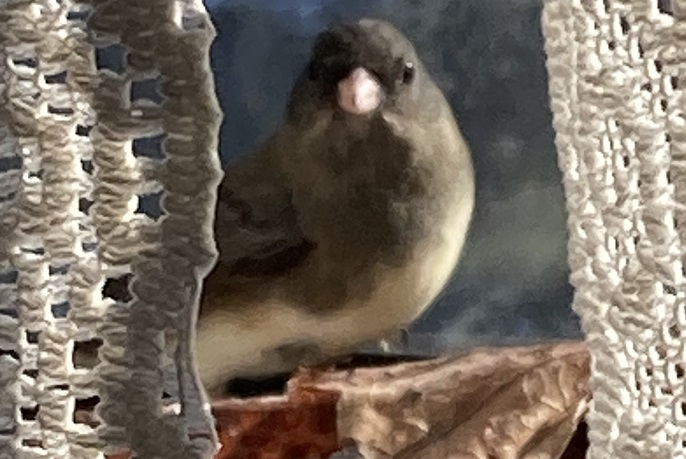
(A Note: A wild bird – a Junco – visited for a few very cold days recently and read the hard copy of my essay before publication, leaving a few responses)
“I have a few notes.”
As the nature of Israel’s war against Hamas changes, becoming more targeted and with fewer soldiers on the ground in Gaza, the conversation in Israel has been moving to the question of what happens the day after the war ends. (Of course there are a hundred other conversations going on at the same time, but my brain can’t process all of it. I can’t make sense of a genocide charge at The Hague, or continued terrorist attacks in Israel, or ongoing calls for Israel to stop fighting even as rockets are being fired at the north and south of Israel and the Houthis are firing on ships in the Red Sea. So, for now, I’m trying to focus on something hopeful.) Recently, I was able to watch a zoom call from the Reconstructionist Rabbinical Association called Holding on to Hope, which hosted leaders from three different Israeli organizations who have been working towards peace and coexistence between Israelis and Palestinians.
One message that came through consistently from these leaders is that the efforts that are most successful are the ones that address self-interest, rather than arguing for peace from a selfless altruism. Another theme was that what happens in Gaza impacts Tel Aviv, in terms of health, and air and water quality, as well as violence, and there are no walls high enough to change that.
“Walls? Pfft.”
One of the organizations on the zoom was a joint Jewish and Arab school in Israel called Hand in Hand. The public school system in Israel separates out Arabs and Jews into separate schools, in large part as a gesture to allow Arabs to maintain their own culture and language and not have to study Jewish subjects, but over time this separation has widened the divide between Jews and Muslims and Christians in Israel. The Hand in Hand schools bring these children together to help them learn to understand each other’s narratives and grapple with how to move society towards coexistence. There are six Hand in Hand schools in mixed Arab and Jewish towns so far: in Jerusalem, Haifa, Jaffa, Kfar Saba, Wadi Ara, and Galilee. And the schools also work at building connections among the adults in the surrounding community.
The representative of the Hand in Hand schools on this zoom was a Palestinian citizen of Israel, with a background in film in particular and the arts in general. His sense of hope for the future came from his belief that education is what will create the next generation of leaders, able to speak each other’s languages and understand each other’s cultures and see each other as companions on the same journey.
“A feather in feather school would be nice.”
Coincidentally, I recently read about a new Israeli TV show (not yet available here) set in a Hand in Hand school (or something like it) in Jerusalem. The review I read in Kveller suggested that, because it’s a comedy, it often wraps up complex issues a little too quickly, but the fact that it can represent those complex issues in an entertaining way could make a big difference in what people begin to see as possible in the future.
The second organization represented on the zoom was Standing Together, a political action organization that brings together Jewish and Palestinian citizens of Israel, and secular and orthodox Jewish Israelis, to work on issues on which they have common cause, as a way to build consensus and community so that over time they can begin to work together on the bigger battles yet to come.
I’d seen a previous zoom, earlier in the Fall, that focused entirely on the Standing Together group, but I found it alienating, maybe because it was so soon after October 7th and everyone’s emotions were still so raw. This time around I heard a lot more acknowledgment of the pain and fear of both Jewish and Palestinian citizens of Israel, and ideas for how to bring both peoples to the table in order to create a sustainable peace.
The third organization represented on the zoom was completely new to me, called A Land for All (previously called Two States, One Homeland). It’s a think tank made up of Jewish and Palestinian citizens of Israel, and Palestinians from outside of Israel, to problem solve the nitty gritty policy issues necessary for peace. The basic idea that they’ve come up with is a two state confederation, where a Jewish State and a Palestinian State live side by side, with open borders and some joint institutions. The specifics of the proposal weren’t discussed in this zoom, but the idea that some people are ready to sit together and seek workable plans for a peaceful future is encouraging.
Except, with Israel being accused of genocide at the International Court for Justice, and Hezbollah and the Houthi rebels attacking from the north and from the sea, and hostages still being held in Gaza, I don’t know how many people within Israel are up to hearing any of this right now, which is probably why this was a zoom for American Jews.
A final peace deal between Israel and a Palestinian state has been so elusive, in part, because the two sides can’t even agree on the preconditions for sitting down to talk. Palestinian leadership wants all new Jewish settlements in the West Bank stopped, and preferably for all of the existing ones to be removed as well, as a precondition for discussing peace with Israel. And Israelis have wanted reliable promises that the terrorism will stop before they discuss the settlements, let alone final agreements on where the borders of a future Palestinian state should be. Many Palestinians and their supporters seem to believe that terrorism is the only way their voices will be heard, by Israel and by the world at large, but every terrorist attack has pushed the Israeli public further away from any belief that peace is possible, and therefore from any willingness to make difficult compromises for that unreachable peace.
When I discussed the concept of peace recently with my synagogue school students, they weren’t thinking about Israel or even peace between countries, instead they looked at peace through the lens of family life, saying that there has to be a lot of room within peace and coexistence for disagreement, and even some bloodshed (their point of reference was fights with their siblings, so, hopefully not too much blood). They spend a lot of their time working towards peace in their daily lives, managing disputes with their friends and family, dealing with hurt feelings, and learning how to compromise, but all of that feels possible for them because they know they are safe in their homes and that people care about them and are listening to them.
In all of the coverage on the news, and in all of the opinion articles that I’ve read and international voices I’ve heard, no one has offered a workable plan for peace that addresses what is actually happening right now. No one has come up with a way to disempower Hamas and destroy the tunnels without causing unacceptable damage to the structures and the people above ground in Gaza. In fact, the UN refuses to call Hamas a terrorist organization, and since Gaza is not considered a state and has not signed agreements to follow international law, they can’t be held officially responsible for their actions, but Israel, which is an acknowledged state and has signed these agreements, is being brought to The Hague for fighting back against Hamas. The international community has not addressed this invisibility of organizations like Hamas, Hezbollah, or the Houthi rebels, who are acting as proxies for Iran’s interests in the Middle East, and Hamas has taken full advantage of its political invisibility to press its war against Israel, which certainly didn’t start on October 7th.
The fact that Israel is under attack from, basically, all sides, has not changed the rhetoric around the world that has portrayed Israel as a lone menace in the Middle East, causing all of the trouble.
All three of these Israeli organizations are working towards long term goals that will require consistent commitment and ongoing efforts and will not be put in place within the next few months, but the world, and the combatants on both sides, are too impatient for that slow growing peace process, and the extremists on both sides keep taking advantage of that impatience and offering apocalyptic solutions that will only work for one side or the other. Every time I watch the news I hear this ticking clock, and the absence of hope, but I know there are people out there who are thinking and breathing and working for peace, and that’s what I want to hear more about, because that’s where a livable future will come from.
If you haven’t had a chance yet, please check out my Young Adult novel, Yeshiva Girl, on Amazon. And if you feel called to write a review of the book, on Amazon, or anywhere else, I’d be honored.
Yeshiva Girl is about a Jewish teenager on Long Island, named Isabel, though her father calls her Jezebel. Her father has been accused of inappropriate sexual behavior with one of his students, which he denies, but Izzy implicitly believes it’s true. As a result of his problems, her father sends her to a co-ed Orthodox yeshiva for tenth grade, out of the blue, and Izzy and her mother can’t figure out how to prevent it. At Yeshiva, though, Izzy finds that religious people are much more complicated than she had expected. Some, like her father, may use religion as a place to hide, but others search for and find comfort, and community, and even enlightenment. The question is, what will Izzy find?
I can’t do choir rehearsals at my synagogue during the school year anymore. I tried.
For the past two years we’ve either had online rehearsals or did recordings on our own, so even if a zoom meeting came up on a day when I had to teach synagogue school, I could still go home, have dinner, unwind for a minute, prep for my next class, maybe even take a shower, and still be in time for the Zoom. But in-person rehearsals are a whole other thing. I have to rush through prep and communicating with parents and dinner then get back in the car, rehearse for an hour and a half, and only get home around ten o’clock at night. When I tried, a few weeks ago, I hit a wall around nine o’clock. I left the rehearsal early, but it still took me days to recover.
“Life is exhausting.”
And I was frustrated. I’d already committed to singing at the Women’s Seder (a yearly event at my synagogue, a few weeks before Passover, to celebrate the women in the Exodus story and modern religious music by women), and I had to tell the musical director, and the Cantor, that I wouldn’t be able to get to the rehearsals, for that or for anything else during the rest of the school year.
When I told the musical director that I wouldn’t be able to get to the rehearsals, he sent me the music (four songs we’d done in the past, and only one with two part harmonies) and said he trusted me to be ready on my own, which was both kind and a lot of pressure.
And when I reached out to the Cantor to tell him that I wouldn’t be able to go to choir rehearsals during the school year any more (after almost a week of working up the nerve to write the email), his response came back quickly and with a lot of understanding and compassion.
But I still felt crummy.
I haven’t been able to go to many in-person Friday night services either. I know I’m not the only one who has fallen out of the habit of going to services in person, but I still feel guilty when I watch the Friday night Zoom and see that only two or three congregants are actually in the sanctuary. And I feel guilty when I choose to attend with my camera off, instead of showing my face on Zoom, even though I know I don’t have the energy to change out of my pajamas or even comb my hair.
“My hair looks perfect.”
I feel guilty when I set limits to protect myself, but I also feel angry, because I’d rather be someone who can do all of these things. I don’t want to be ill.
Hopefully I will be able to manage choir rehearsals over the summer, when I don’t have to teach on the same days, and I’ll be able to prepare for the high holidays and socialize with friends and feel more normal, but we’ll see.
Even though I can’t get to choir rehearsals, I have been able to bring more music into my classroom. Not only does the Cantor come in to sing with the students, but a visiting teacher gave us an idea for another way to bring in more music. He suggested playing different versions of the same prayer for the kids, to give them a chance to see for themselves how well, or badly, the music fits the meaning of the prayer. He chose Oseh Shalom (He Makes Peace) for his example, because it’s a prayer that has been done in so many different ways, and I followed his example. I found seven versions of the prayer and we all sat together on the floor and listened to one version after the other. The choice of song became even more meaningful after the war in Ukraine began, because the kids have been watching the news, along with the rest of us, and singing about peace, and thinking about peace, gave them a way to feel like they were doing something to help.
Some of the kids danced to the faster versions of the song, and others took notes like the serious musicologists they are, talking about how the changes in language and instruments and voices added to our ideas about what peace might actually be: it isn’t just the slow and mournful kind of peace we’re used to singing about, but also the raucous, complicated, dissonant, fast and faster, loud and louder, one voice and many voices cacophony that can encompass everyone, if we let it.
We may have played the music too loud, because one of the kids came back from the bathroom saying they could hear it down the hall, but I don’t think anyone minded. Music has so much power to make us feel heard, and connected, to each other and to ourselves. I never want to lose that connection from my life, or my teaching.
And, maybe inspired by my students, I was able to practice the songs for the Women’s Seder on my own, and when the day came, I was ready to sing with the female members of the choir without too much anxiety. And it felt really good to be a part of things, and to be able to add my voice, and not have to stay home and watch it all on Zoom. I hope this is a sign that there will be ways for me to adapt to circumstances in the future and always find my way forward, but for now, this was enough.
In case you’re interested in trying the experiment:
If you haven’t had a chance yet, please check out my Young Adult novel, Yeshiva Girl, on Amazon. And if you feel called to write a review of the book, on Amazon, or anywhere else, I’d be honored.
Yeshiva Girl is about a Jewish teenager on Long Island, named Isabel, though her father calls her Jezebel. Her father has been accused of inappropriate sexual behavior with one of his students, which he denies, but Izzy implicitly believes it’s true. As a result of his problems, her father sends her to a co-ed Orthodox yeshiva for tenth grade, out of the blue, and Izzy and her mother can’t figure out how to prevent it. At Yeshiva, though, Izzy finds that religious people are much more complicated than she had expected. Some, like her father, may use religion as a place to hide, but others search for and find comfort, and community, and even enlightenment. The question is, what will Izzy find?












 rachelmankowitz