Tag Archives: pets

Talking To Dogs


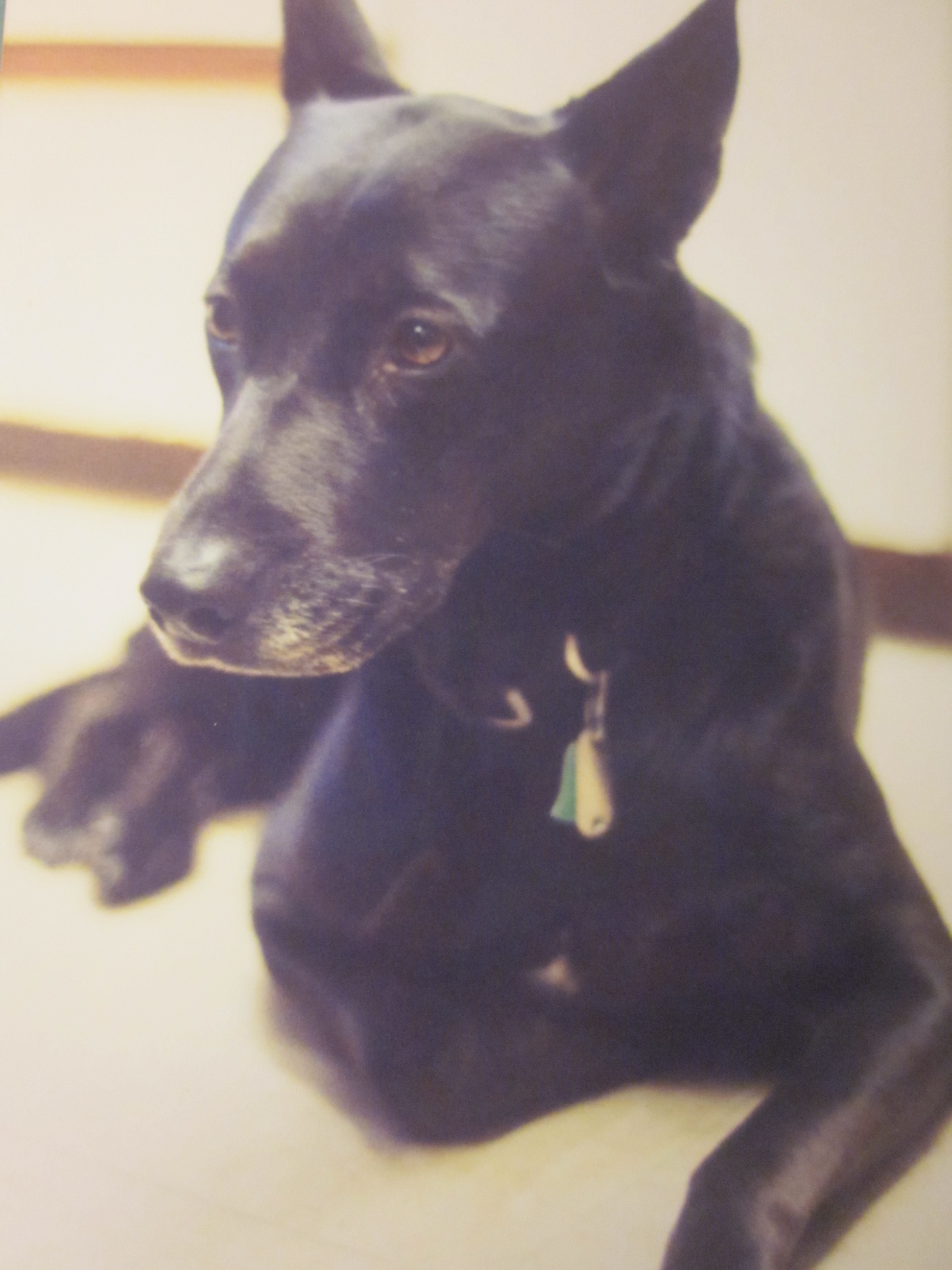
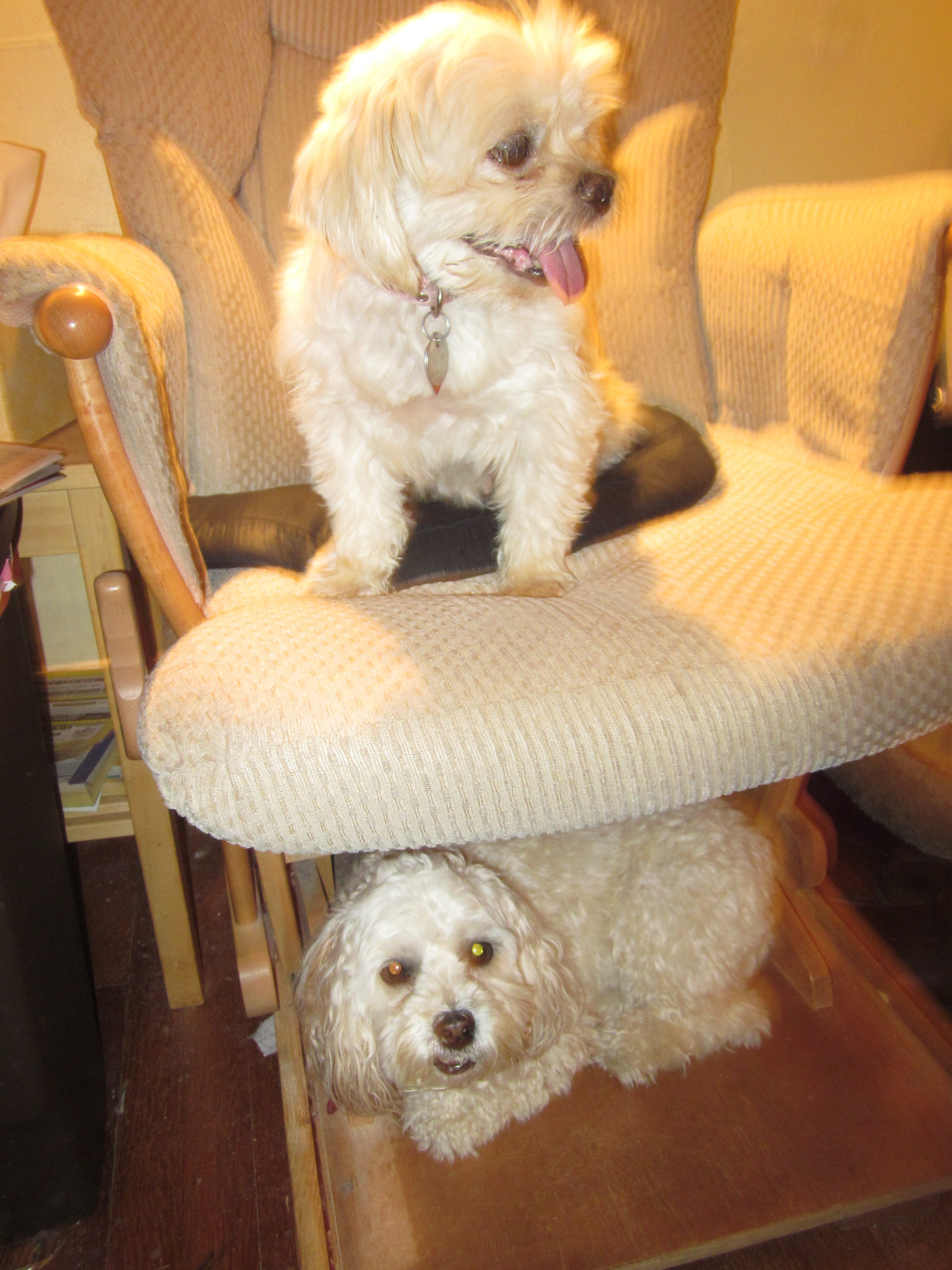
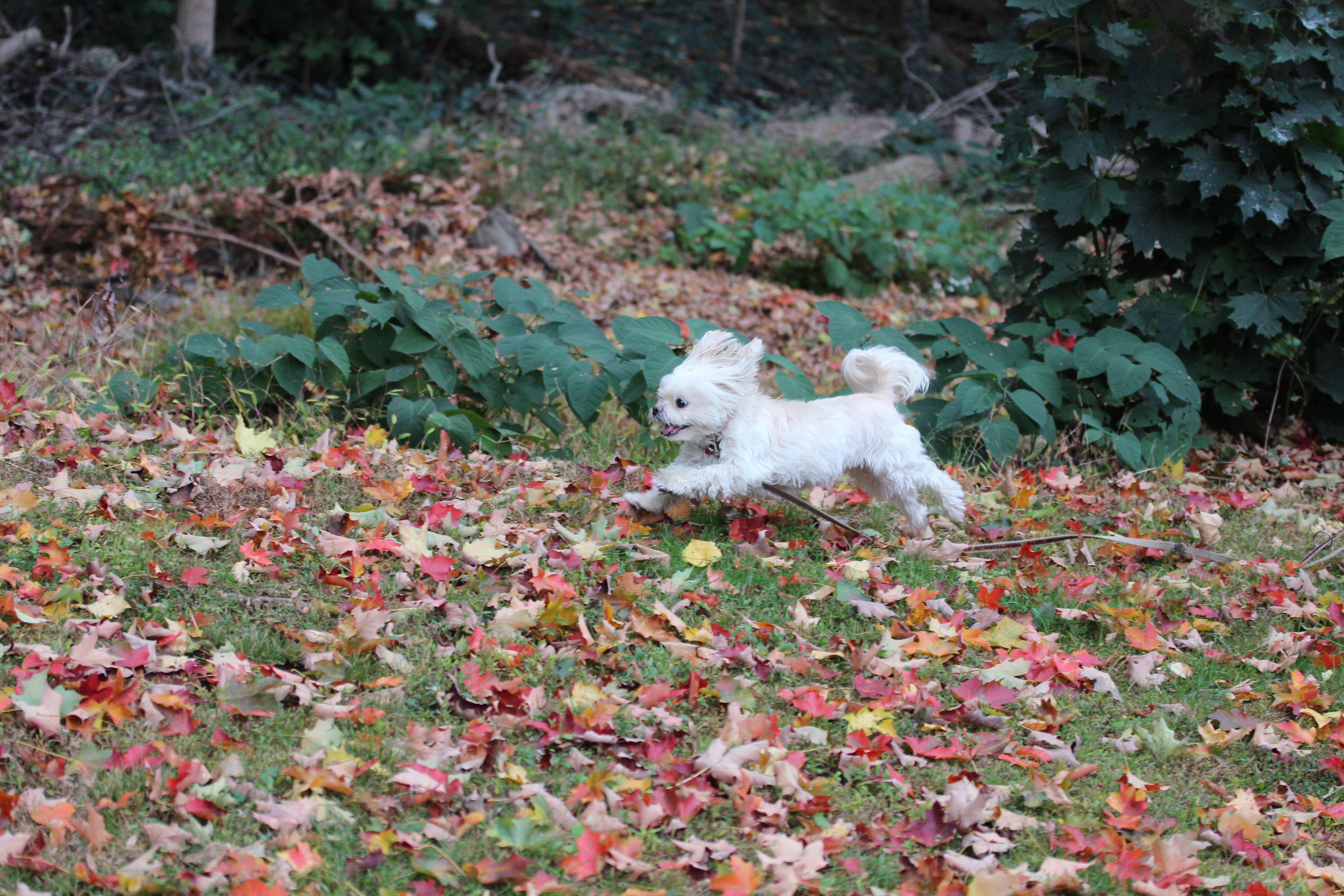
My father used to yell at our Doberman Pinscher in German. It’s possible that he added in some Yiddish, but he made a point of saying that you should speak to a German dog in German. The rest of us spoke to her in English, though, and she seemed to be fine with that.
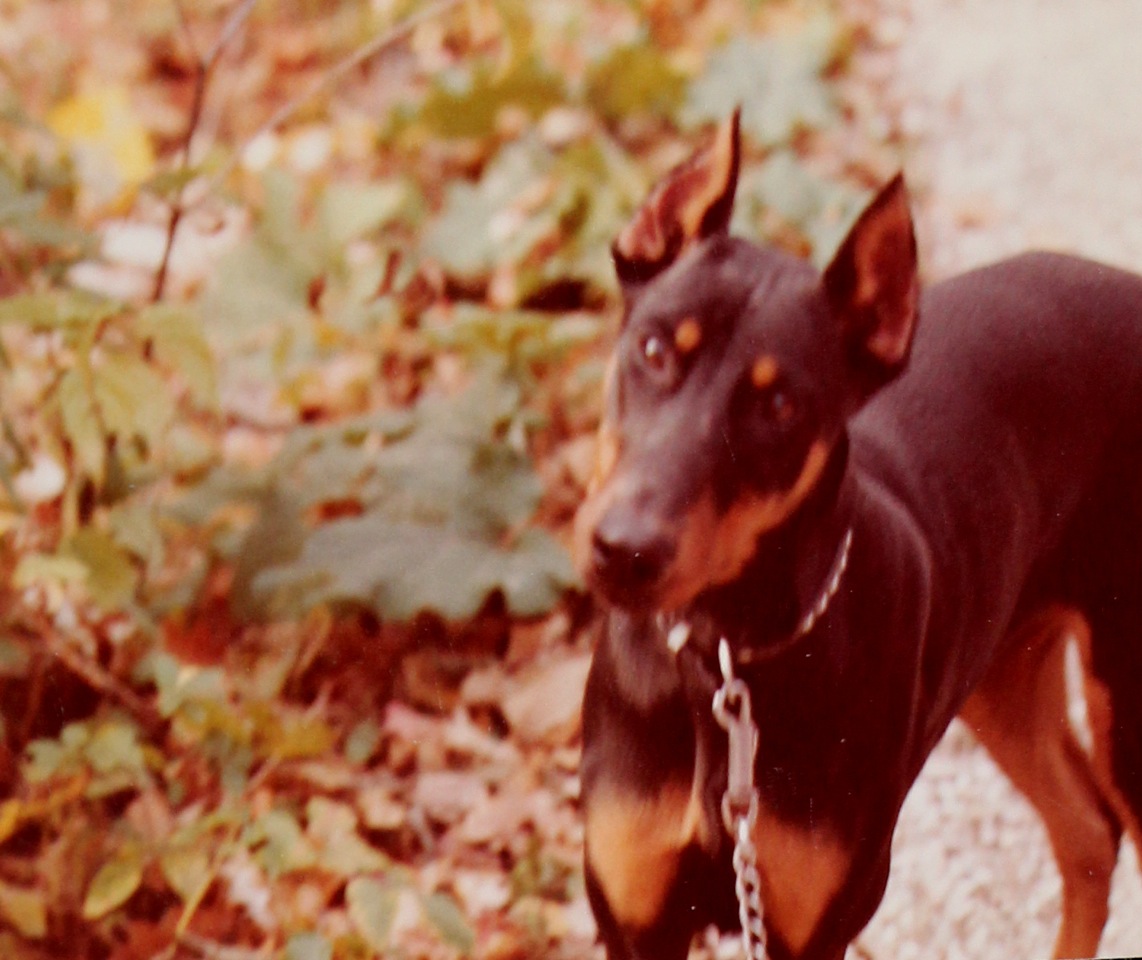
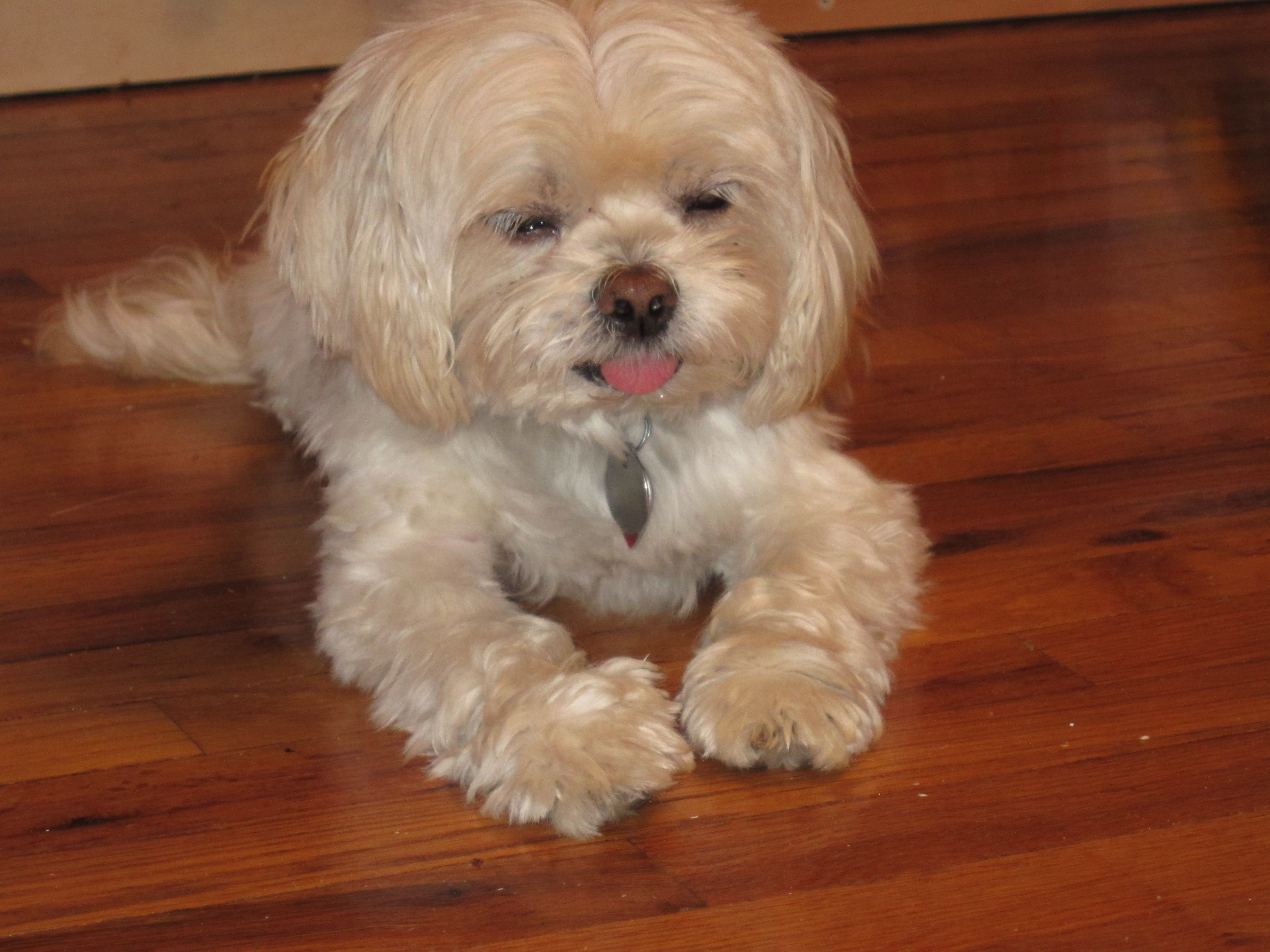
"Huh?"

“Huh?”

I have a habit of dropping into Hebrew or French for a word or two, rarely for a whole sentence, because I’m not fluent in either language. I don’t know why I do it. Maybe I’m just pretentious and annoying, but I like the way the different languages sound, with the hard square letters of Hebrew, and the rolling curlicues of French. Cricket can understand up to the number three in French, because that’s how I taught her to jump up onto the bed, Un, deux, trois, Jump! (See, I can’t even stay in French for four words!) With Hebrew I tend to stick to short phrases, like “Where is…?” or “Thank you” Or “Why?” And Cricket tilts her head and nods. She’s a savant.

"I understand everything you say. I just disagree."

“I understand everything you say. I just disagree.”

Butterfly has a whole different vocabulary. It’s as if the girls speak, or at least comprehend, two different languages. I can’t use the same words to communicate with both of them at the same time. I’ve noticed that they choose the words or signals they will respond to more than I do. It’s like they are flipping through a book of fabric swatches until they find one that speaks to them. Just because I repeat something a hundred times doesn’t mean they will pick it up, but I can do something just once, and it clicks forever.

"Mommy?"

“Mommy?”

I wonder if, given a chance, this is how people would be too, if forcing everyone to use the same language, while very convenient, is cutting off huge swaths of natural language.       What if I was born to speak Hindi and my whole life I will be missing pieces of my soul because I can’t capture them in English. Is that possible?

Butterfly responds best to touch. She calms when I pet her, she stills when I hold her in place for her insulin shot, she turns to look at me when I tug on her leash. She believes in eye contact and body language and leaves most of the English stuff to Cricket.

"I have Mommy's sock and that means I have Mommy."

“I have Mommy’s sock and that means I have Mommy.”

I tend to speak to Butterfly in a higher tone of voice, and fewer words overall. She responds best to facial expressions and body language. If I reach a hand out to her, she comes over to get scratches. She watches me very carefully. Sometimes I wonder if she’s partially deaf, but I think it’s more the deafness that comes from not understanding the words I am saying to her.

I tried to teach her “Down,” but she responds better to “Stop.” And I have to be right there, not across the room, for it to make sense to her. She understands when I pick up her blood testing kit, and she understands when leashes are taken off the hook at the door, but she doesn’t understand “sit,” maybe because it took her almost a year to build the muscle strength to sit on her back legs the way Cricket does, so when I was trying to build her vocabulary, she didn’t have any physical corollary for “sit.”

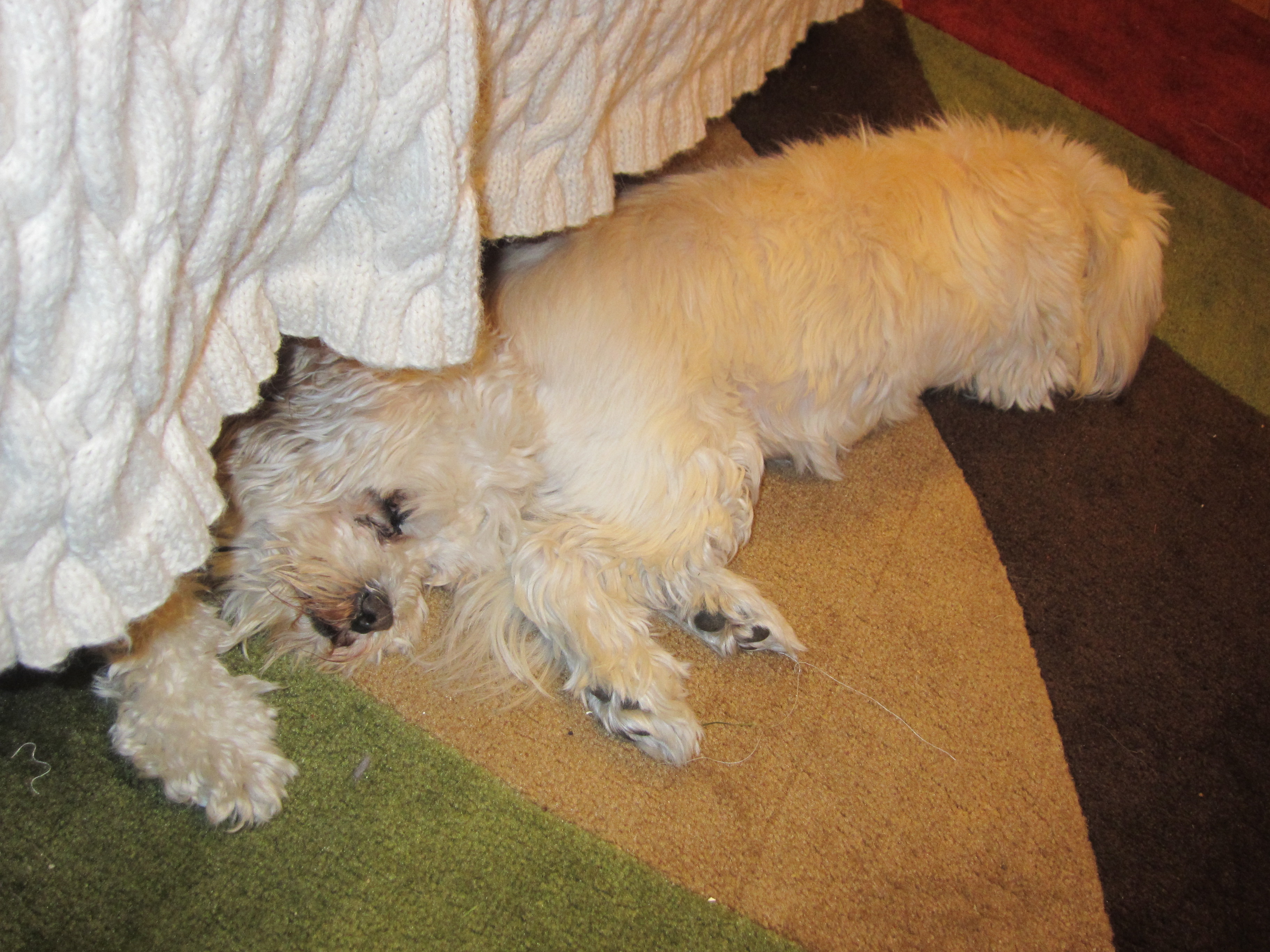
Cricket responds to tone of voice more than anything else. If she hears someone yelling outside, she barks. If I whisper, she wakes up from a dead sleep and assumes I was taking about her and planning an outing for her. If I, god forbid, say the word chicken, all hell breaks loose.

"Chicken!"

“Chicken!”

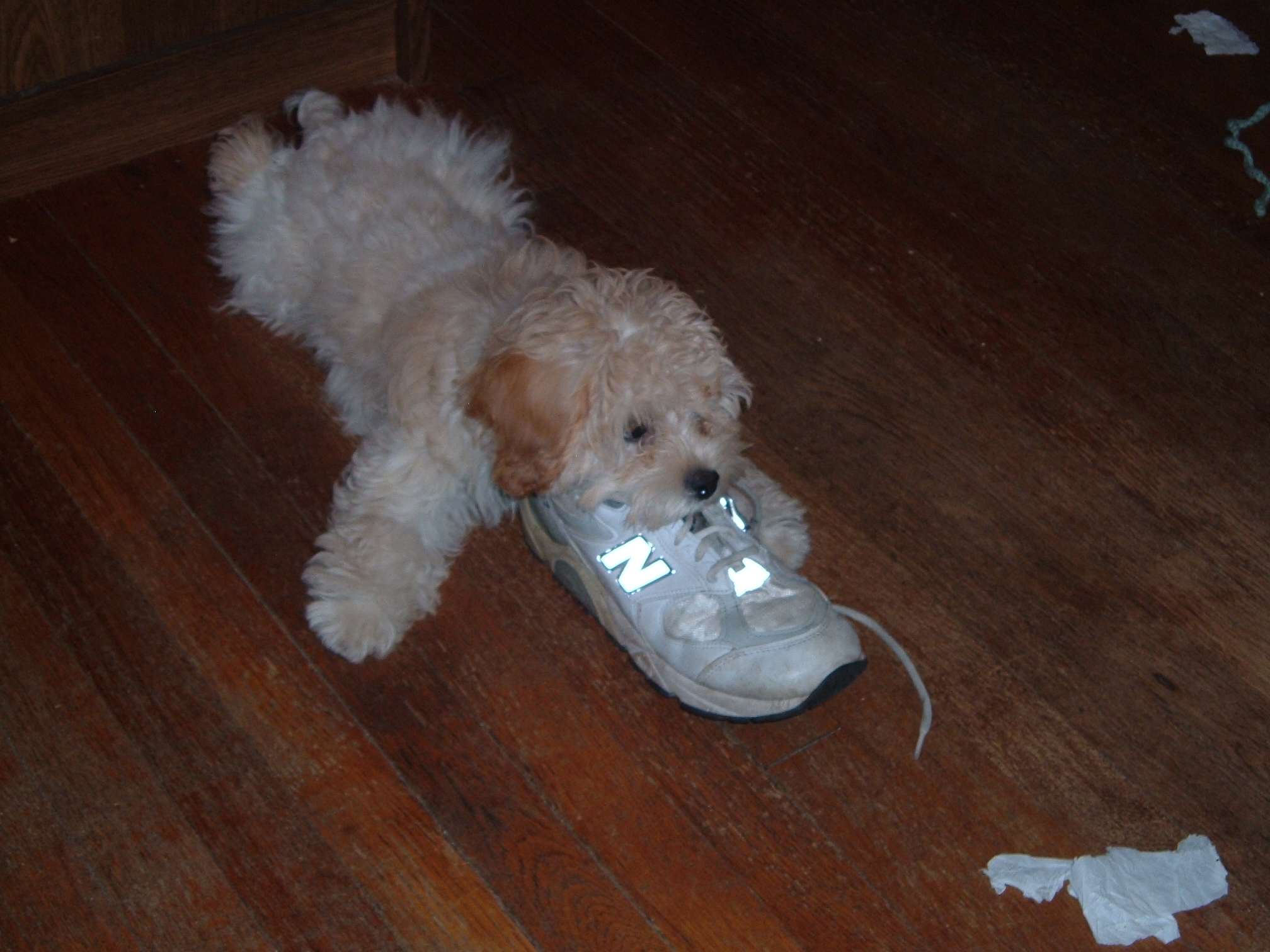
She learned her commands as a puppy. She knows sit and stay and down and turn, but she also knows walk, go, outside, shoes, leash, food, toy, platypus, chewy, poop, bath.

Cricket and her platypus.

Cricket and her platypus.

Those are the obvious things, but I’ve also noticed that she can understand context, even when her usual words aren’t in use. Even without the words “poopie butt” or “bath,” she can figure out that I’m planning to wash her in the sink, and she runs under her couch to safety.
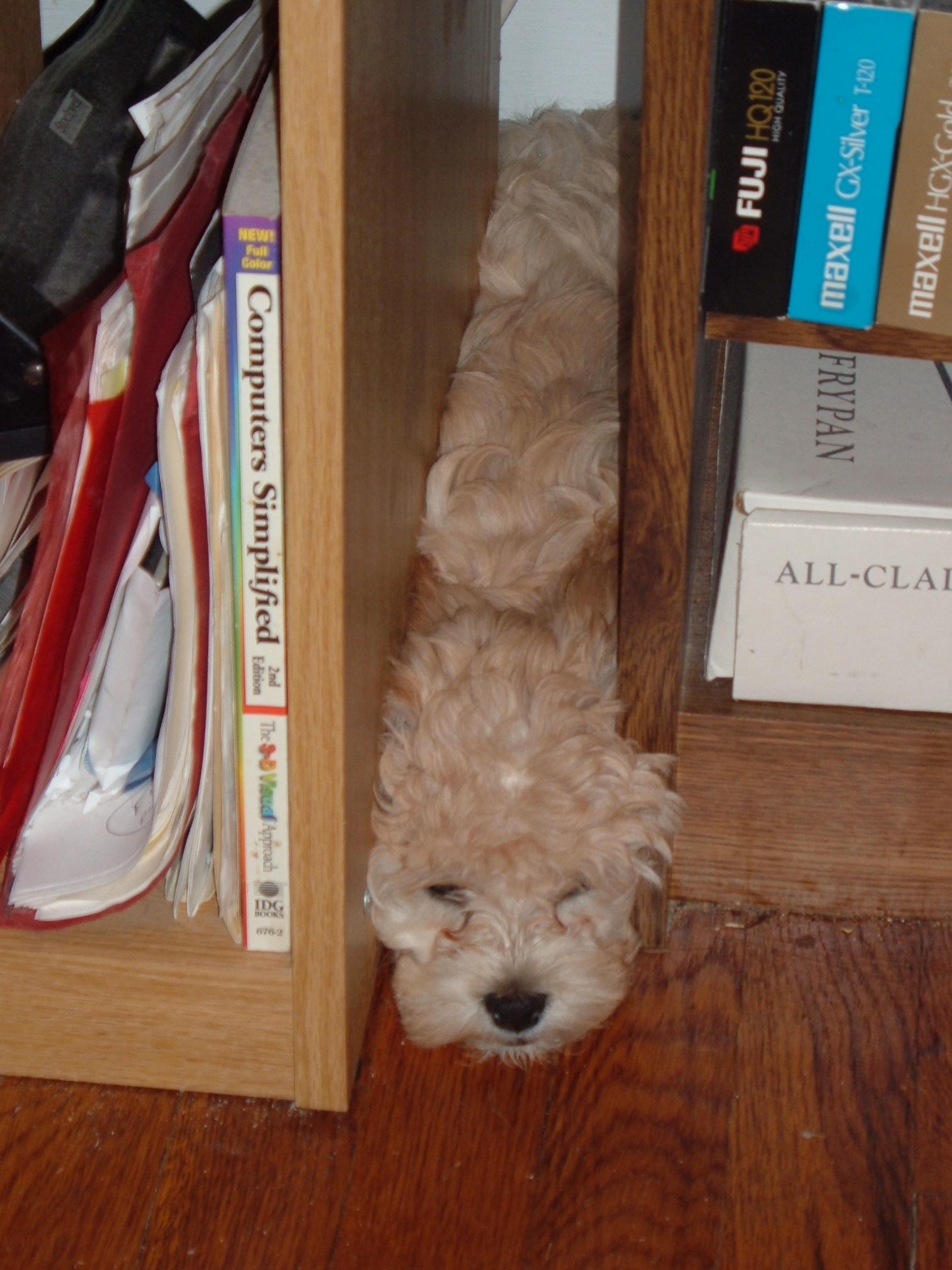
"You can't catch me!"

“You can’t clean my poopie butt!”

My therapist’s Golden Retriever is six years old and just now studying to be a service dog. She needs her license so that she can help her dad, but this means that she has to learn a whole new set of signals, different from what she learned in her obedience classes way back when. This has become a problem. She is a very bright girl, but she is getting confused. Her poor forehead crinkles and she can’t decide if she’s supposed to sit, stay, turn around, or leave the room.

"Help me, please."

“Help me, please.”

No wonder dogs use smell and yips and nips to communicate with each other; they must think that the human world is a tower of babel, with all of our different languages creating utter confusion. For dogs, the smell of “female, spayed, eats a lot of chicken,” is the same around the world.

The Snow Opera


When we are expecting a blizzard or snowpocalypse, the news shows start to take over the airwaves, covering each snowflake as it falls from the sky. And it’s exciting! It’s as if we’re all in the middle of a soap opera, waiting for each new drama to pop up. It makes me feel important when what’s going on outside my window has made national news. It’s something like what would happen if aliens invaded the earth. The level of drama and rhetorical hysteria is pretty similar.

The subways have stopped!

Don’t leave your house!

All of the bread is gone!

It's snowing!!!!!

It’s snowing!!!!!

Mom’s favorite thing about snowy days is the opportunity to watch our neighbors through the blinds of the living room windows. We can see the maintenance guys plowing the parking lot with their little golf cart, and neighbors shoveling their cars out with what look like plastic beach shovels. There’s a lot of yelling, from the louder of the two maintenance men, because people dare to walk on the walkways before they’ve been shoveled and salted, or try to drive to work before the parking lot is completely cleaned.


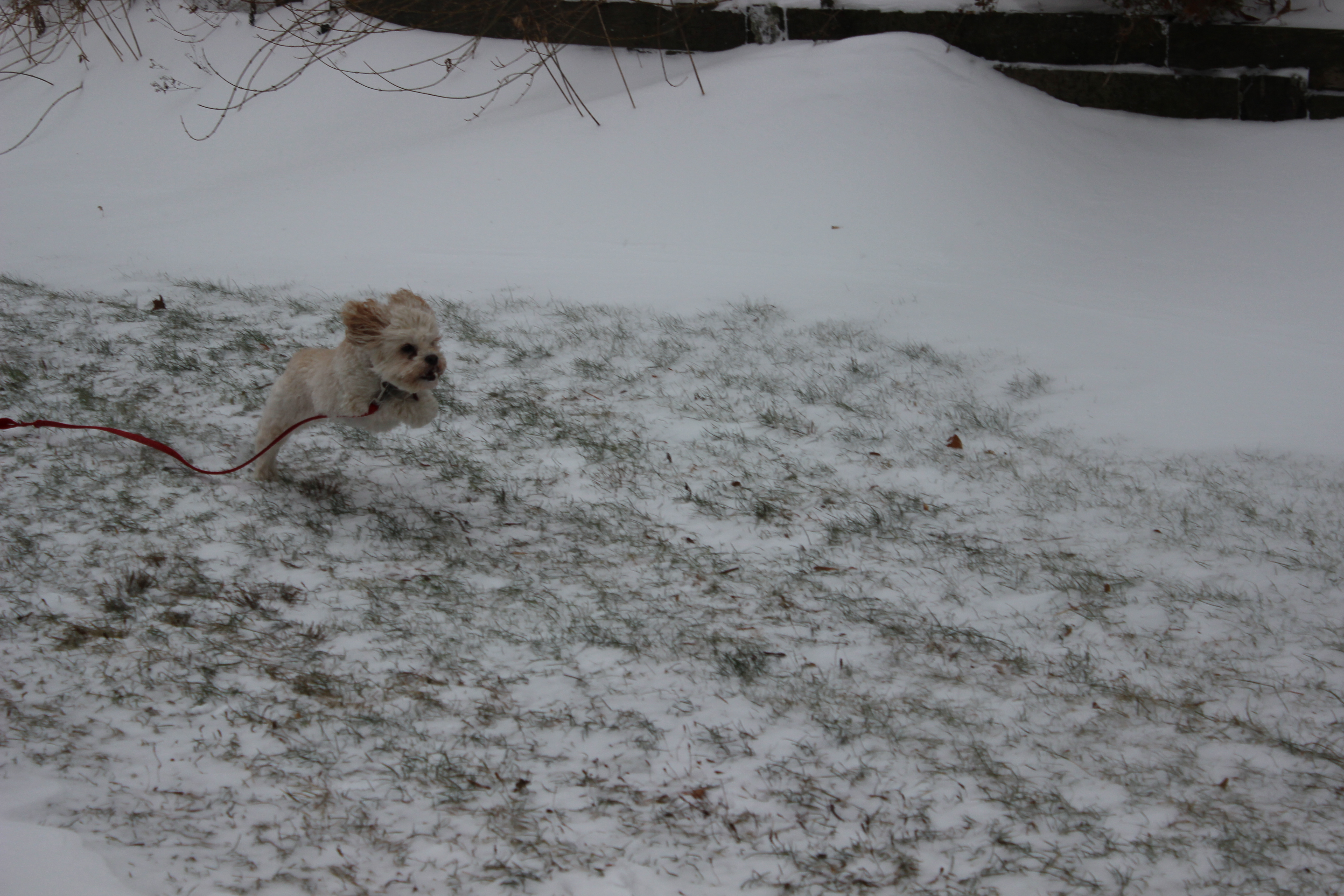
Butterfly is flying!

Butterfly is flying!

Because Cricket is coming after her!

Because Cricket is coming after her!

Mom finds it all very entertaining. There was the night when one of our neighbors shoveled out her car, for hours, even though it was expected to snow two times as much over night and her car was buried again by morning. Then there’s the woman who thinks that as long as she bundles up, she should be able to walk to the library in any blizzard. Some of the men help with the shoveling. One even has a plow on the front of his pickup truck and helps out when they need him. Then there are the alcoholics. We don’t see much of them in the winter.

Cricket, dressed up for the snow party.

Cricket, dressed up for the snow party.

The first snow day of the season was exciting. The whole world was planning to shut down for a day or two, and mayors and governors were on the news, with dramatic sign language interpreter’s doing modern dance routines at their sides. Suddenly, I had to make chicken soup, and bread, and cookies. I wasn’t even that hungry, but it reminded me of weather events from my childhood, spent in the kitchen with my mother and brother, drinking hot cocoa after building an igloo on the front lawn. Of course the food outlasted the snow by days.

"Where's the rest of the snow?"

“Where’s the rest of the snow?”

I remember a book called Smilla’s Sense of Snow, a mystery, I think, but what I remembered most were all of the different words for snow in Smilla’s mother’s language. So far this winter there’s been: a heavy, wet snow that comes from a rain/snow mix, and makes each shovel full almost impossible to lift; there’s been icy rain that lands in hard pellets on my head and then creates black ice within seconds so I can’t figure out where to put my feet; there’s been soft, powdery snow; and snow that develops a hard crack surface, so that the dogs seem to be breaking pieces of candy with each step; we’ve had tall, hard piles of snow; and lacy, bumpy layers of ice; and then there’s the slush, where it feels like someone poured their sorbet onto the sidewalk and it’s turning into soup as I walk through it.

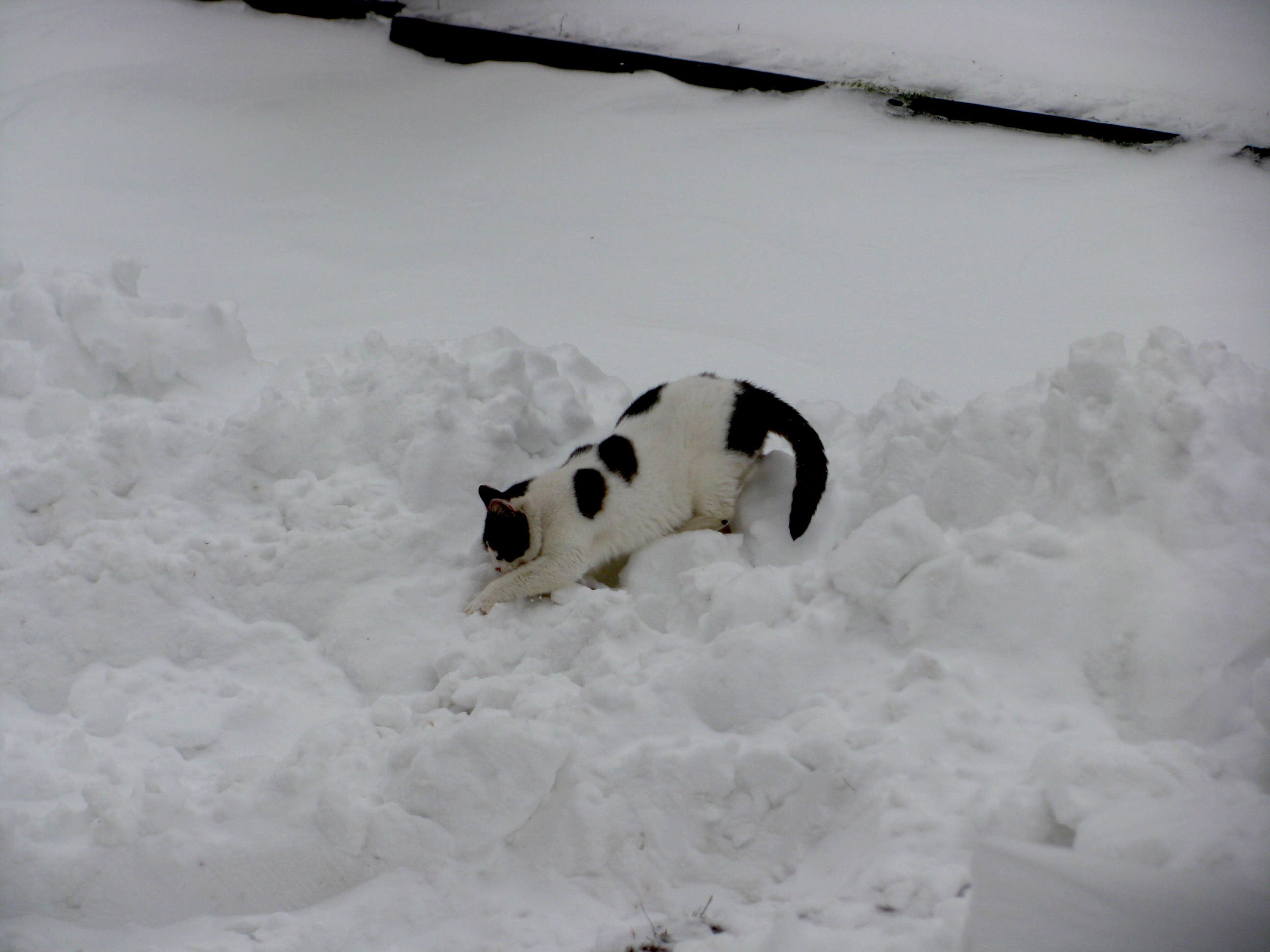
Cricket has discovered a wonderful new game this winter – it is the cat poop treasure hunt. One of the feral cats has taken to climbing onto the snow mountains in the backyard, pooping, and then burying the poop with a little extra pile of snow. Cricket, with her very effective sniffer, discovered the first of these magic pellets before I knew anything about it. She came in from a walk with Grandma, jumped up onto my bed to wake me up, and pawed my face with cat pooped paws. It certainly woke me up – and then shocked her, because she landed in the bathtub immediately, along with my bed linens and pajamas. She was horrified, and confused. Here she’d brought me this wonderful gift and I was angry? Why?

Hershey, placing the treasure.

Hershey, placing the treasure,

and burying it.

and burying it.

Each time we go outside now, I watch Cricket carefully, and if that nose gets too interested in one spot or another, yank goes the leash. She tries to jump up onto the snow mountains herself, and then falls down the side when her paws fail to grip. She’s tried to poop on top of the cat poop, but she doesn’t think to hide her poop, and anyway, I’m always watching, and ruining her fun, removing her poop before she can bury it and create her own treasure hunt for later.

Someone tossed birdseed onto the back lawn one day and then it snowed, just a dusting, and you could see hundreds of bird footsteps in the snow, and now Cricket can’t stop sniffing. Those little feet must smell good.

The most upsetting thing this winter has been when they’ve promised me a snowmageddon, and it ends up being a little bit of rain. Rain?! What happened to all of that promised snow? I feel bereft. Now what am I going to do for entertainment?

"What's next?"

“What’s next?”


Drawing Pictures of Dogs


When I was in graduate school for fiction writing, one of my teachers complained that my work was too “heady” and not placed enough in down to earth details. She wanted descriptions of rooms, clothing, weather, anything to make it more believable that these scenes were happening somewhere outside of my loopy brain.

I had a lot of respect for that teacher, so during the summer I signed up for a local adult education class in drawing. I had hopes that I would immediately be able to capture scenes and squeeze depths of emotion from stale memories. I would suddenly understand color and shading, and line and texture, and I could design the clothes I always wanted to wear, and draw complicated murals on my walls.

The adult education art teacher was a little bit ethereal and not quite as down to earth as I’d hoped. Even her white hair seemed to be reaching up to the sky, unwilling to stay tacked down with barrettes. But I bought my supplies anyway: pencils and chalk and paper and erasers. I sat in the classroom and listened to lectures about shading, and perspective, and complementary colors. It was all a struggle, though. I had to push myself to go to class, and push myself to practice at home. My brain resisted each lesson with a ferocity I had not expected.

After six weeks of drawing lessons, it was time to move on to painting. I thought I would be excited, instead I was tense and short tempered when Mom and I went to the art store and scoured the aisles for all of the new items on the syllabus. I was uncomfortable with all of the money I was spending on supplies, but that did not really explain the panic rising up in me.

The night of the next class, Mom had to drive me, because otherwise I would not have been able to even start the car. The bag of art supplies felt like heavy bricks, and the school building cast a shadow like a haunted castle. When I reached the door of the classroom, where I’d safely entered six times before, I could not go in. I could barely even breathe. My body felt like it was filled with poison darts. I raced out of the building to the safety of the car and I couldn’t explain any of it to Mom as she dutifully drove me home. I couldn’t even tolerate keeping the paints – it all had to go back to the store. I never went back to the class.

I spent the rest of the summer working on the revisions for my novel, and deepening and dressing up the interior of the scenes as best I could, but I felt sick, and guilty, for having failed, inexplicably, to finish the adult education class.

I am prone to panic. Usually, if I feel twinges of that whirlwind going off in my head, it’s a sign that something is buried in that particular corner of my brain that needs to be excavated. Over the years I’ve been able to excavate a lot of those corners and draw off the panic, but certain land mines remain potent, and unexplained, no matter how many times I’ve tried to clean them out. And painting is one of those land mines. Maybe it’s just that I’m not talented in this particular area and, being a perfectionist, I hate that. Or maybe there’s something deeper and I’m not ready to see it yet. I don’t know.

I would love to be able to paint a picture of Butterfly’s eyes, and capture her moods more thoroughly than I can manage with a camera. I want to put Cricket down on paper, though she’s unlikely to actually stay there.

Butterfly's eyes speak volumes.

Butterfly’s eyes speak volumes.

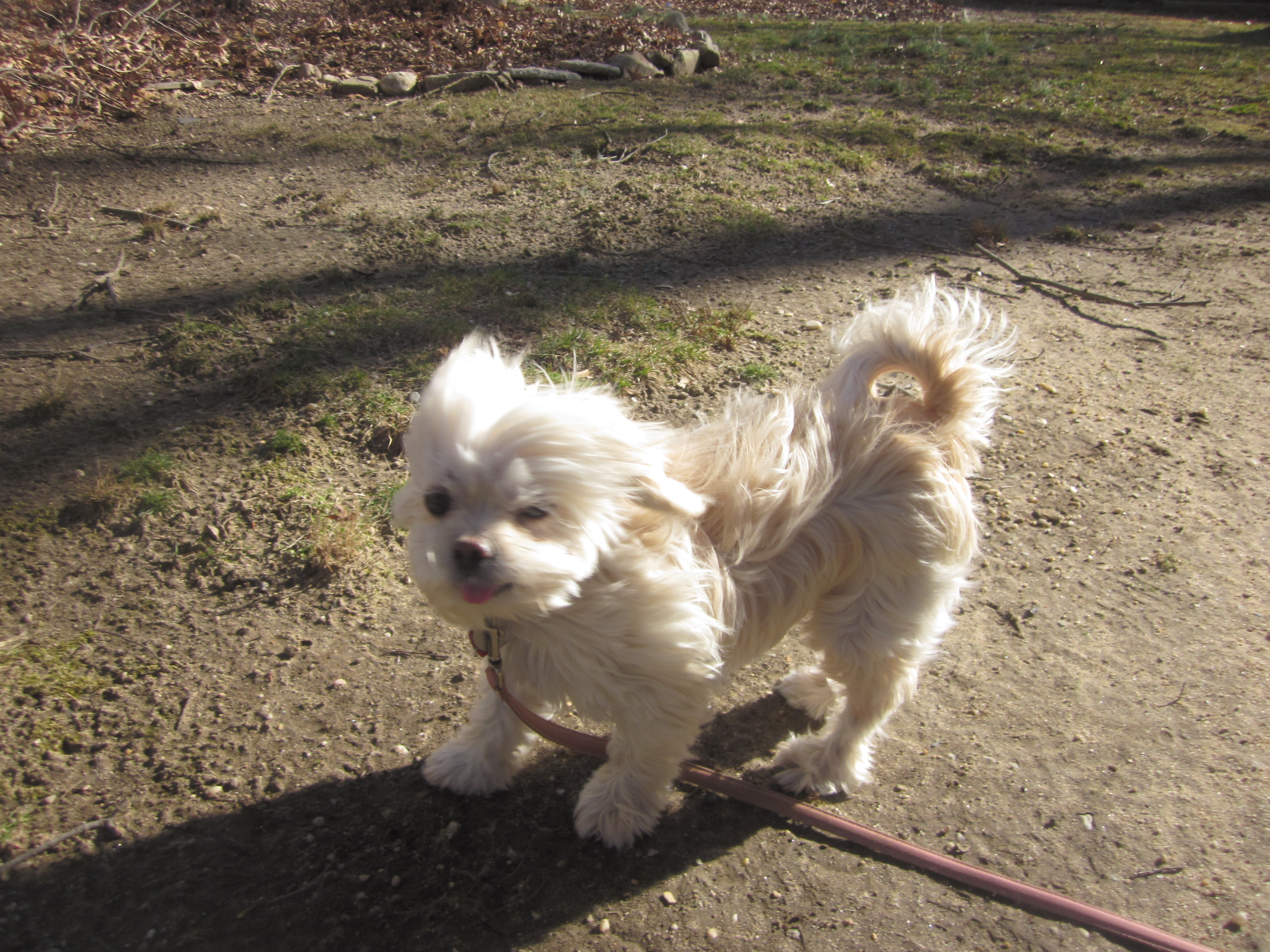
Cricket is a blur.

Cricket is a blur.

I spent a lot of time last year just coloring, with pencils, working on a brain coloring book because it made me feel slightly less silly than the Little Mermaid coloring book I really wanted. Maybe what I should really do is print out pictures of Cricket and Butterfly in black and white and try to color them in. Cricket would look great in orange, with a blue Mohawk. And Butterfly could really come to life with a few touches of pink!

My coloring book.

My coloring book.

Cricket!

Cricket!

Butterfly!

Butterfly!

Maybe drawing pictures of the dogs would be a safe place to start.

The Smell of a Dog


We were in Queens one day, visiting my cousin, and she suggested a walk in the park. We must have gone to the wrong side of the park, though, because the only options we found were a playground, where dogs were not allowed, and a horse trail, marked by huge piles of horse poop in case we missed the sign.

Horses!

Horses!

We walked down the path and back, dodging horses and as many piles of poop as we could, and then we did our best to wipe the soles of our shoes before returning to the car. But no one told Cricket to do the same, so when she, inevitably, climbed up my neck and stretched out behind my head, she left horse poop aroma on my hair, on my coat, on the headrest, and on the seat belt.

"Um, Cricket, what's that smell?"

“Um, Cricket, what’s that smell?”

It was the seat belt that became a problem.

Even after putting everything I had been wearing into the laundry, and scrubbing the seat belt and seat and head rest with different cleansers, the smell refused to go away.

I don’t know if I am especially sensitive to smell, or if horse poop is especially offensive, but I had to hold the seat belt away from my body, with a paper towel, just to sit in the car for a ten minute ride. It was either that or not use the seat belt at all and tolerate the constant beeping of the seat belt alarm.

I was enraged and impatient. I felt like I was being punished by God, for something.

Mom couldn’t smell it. I don’t think this is simply a factor of aging – it’s always been this way. Smells bother me more than they bother her.

Mom thinks that my sensitivity to smell might be related to my other neurological problems, and since nothing has been diagnosed yet, despite too many tests, anything seems possible. But I think I’ve always been sensitive like this. I knew people by their smells even as a kid, and I was naïve enough to think it was okay to tell them that. No one wants to know that they smell, by the way, especially if they smell like blue cheese, but even if they smell like cookies. It’s like telling someone that you recognize them by the bumpy red rash on their face, when they were hoping to God that no one would notice, or at least that no one would ever mention it.

Smell is one of the most direct routes to memory, because of the way the brain is wired. One sniff of mildew can send me back to my grandparents’ house in Chappaqua, which had its own pond within feet of the garage. Turpentine is a memory slide back to my father’s Industrial Arts classroom, and the communal sink where we scrubbed ink and paint from our hands. Newsprint always gives off the faint smell of puppy diarrhea to me, because we used newspaper to fill the whelping box when we had a litter of puppies when I was a kid.

Puppies + Newspaper!

Puppies + Newspaper

When we finally took the car in to have the interior professionally cleaned, because of the horse poop, and the lingering smell of dog vomit in the back seat from an earlier trip, I felt like a weight had been lifted.

Mom thinks it was too expensive, I think it was worth ten times what we paid.

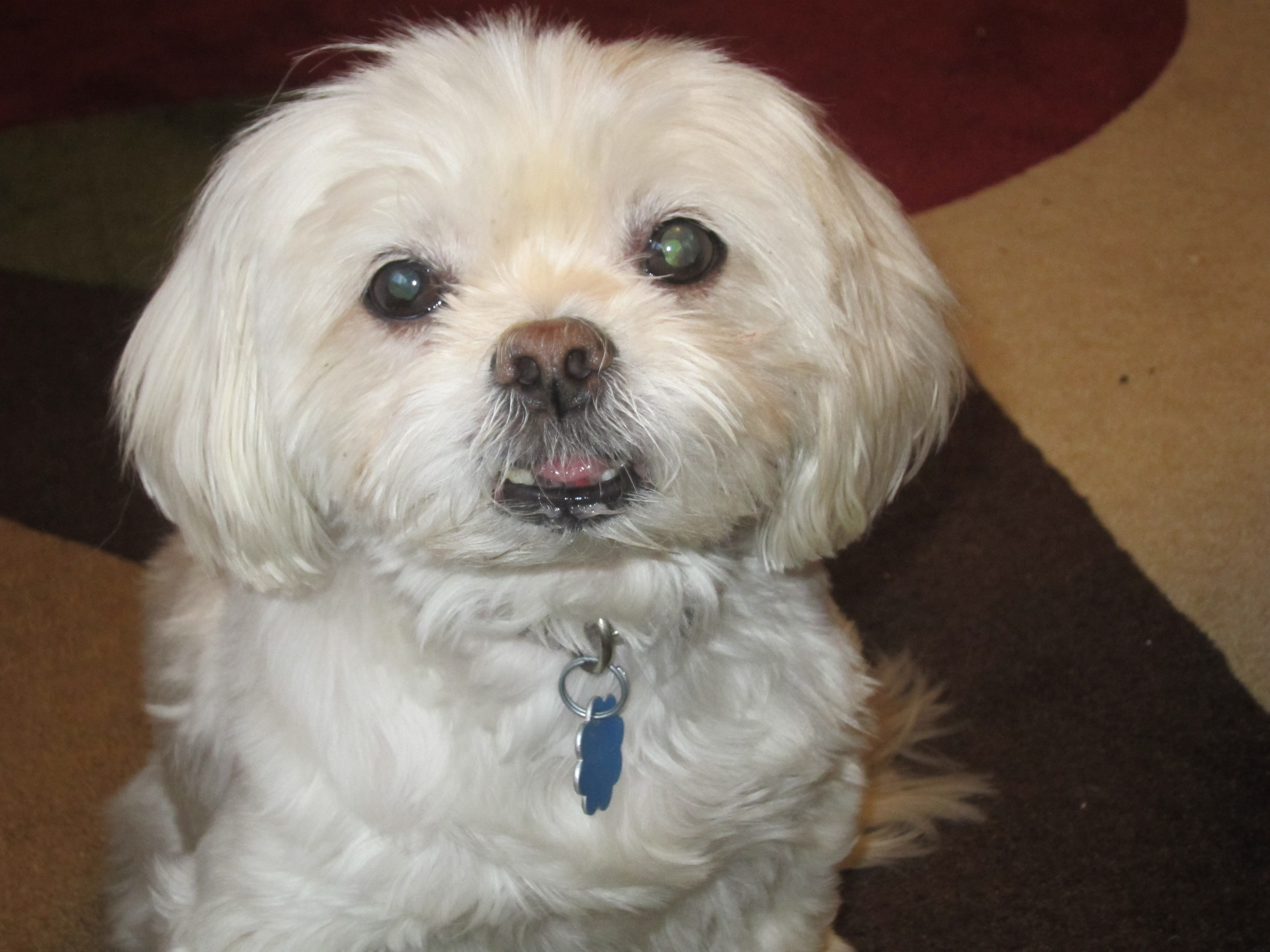
Not all dog related smells have the same extreme effect on me, though. Cricket smells of snot, and it’s not a totally unpleasant smell. Within hours after a trip to the groomer, the white hair under her eyes starts to turn brownish and then black with tears. I have plenty of occasions to smell Cricket’s face up close, because she likes to climb on me and stare into my eyes to compel scratches. I get a close up view, and sniff, of the salty, gummy, black goop that she does not want removed by human hands, or wash cloths, or scissors. It should be an offensive smell, but instead it’s a cozy, Cricket-y smell.

Cricket getting clean against her will.

Cricket getting clean against her will.

Butterfly has a whole chorus of smells: there’s some pretty bad breath from her not-so-good teeth; there’s the stale chicken smell that starts to waft from the top of her head once the shampoo smell dissipates; there’s the corn chip smell of her feet; and the generally dogly smell she develops as she runs and sweats and sniffs around the back yard. It’s amazing the smells I can get used to, and even look forward to, when they mean my puppies are nearby. I’ve realized that when a smell is attached to someone I love, it is easier to bear. Though I do have to be careful not to breathe in too deep.

"I smell?"

“I smell?”

When we’ve been away too long (say, more than an hour) the smell at the front door is of doggy drool, and it wafts up at me as soon as I open the door. The smell is the accumulation of hours of impatient waiting by the door; a cloud of moist unhappiness and dread. And yet, it makes me feel loved, and surrounded by dog, as if their leftover breath is embracing me as they jump and squeal to welcome me home.


The heavy breathing puppies at the door.

The heavy breathing puppies at the door.

The girls greet Mom with joy!

The girls greet Grandma!


A Butterfly Companion


Butterfly flits around like a ladybug. I always think she should be wearing ballet slippers and a tutu, the way she twirls and flies. She is gossamer. Her wings are so ethereal that they are almost invisible. Almost.

My Butterfly

My Butterfly

She doesn’t seem to be like any other dog I’ve known. I’m used to moody dogs, dogs with personality problems, dogs who use guilt to push me around, dogs who could be diagnosed using the DSM V. But Butterfly is a different. She poops and barks and begs for treats, yes, but she’s also untouchable in a way, so sweet as to be unreal.

"Gimme some sugar!"

“Gimme some sugar!”

In a way her butterfly-ness is upsetting, because she is always a bit out of reach. Cricket will jump on me and curl up on my chest, or my hip, while I’m sleeping. She scratches me and shrieks in my ear. She is solid and real and in vivid color. Butterfly is something other than that, an enigma at times, in deep thought about something I can’t know.

When Butterfly’s sugar is very low, she seems as light and airy as a butterfly; within moments she seems to lose most of her body weight; this is the most frightening thing, both for her and for me. Her eyes bulge and she alternates between staring into space and looking at me and shaking. She doesn’t know what to do. Even she thinks this is too much lightness to bear.

I feel so much safer when she is solid in my arms, or galloping down the hill. Then she is real and alive and none of her paws are reaching towards another world. But there is always this tendency to unreality with her. She drifts away, either because her physical health is shaky, or, more often, because she is lost in another state of mind, thinking of some other place, or thinking of nothing at all.
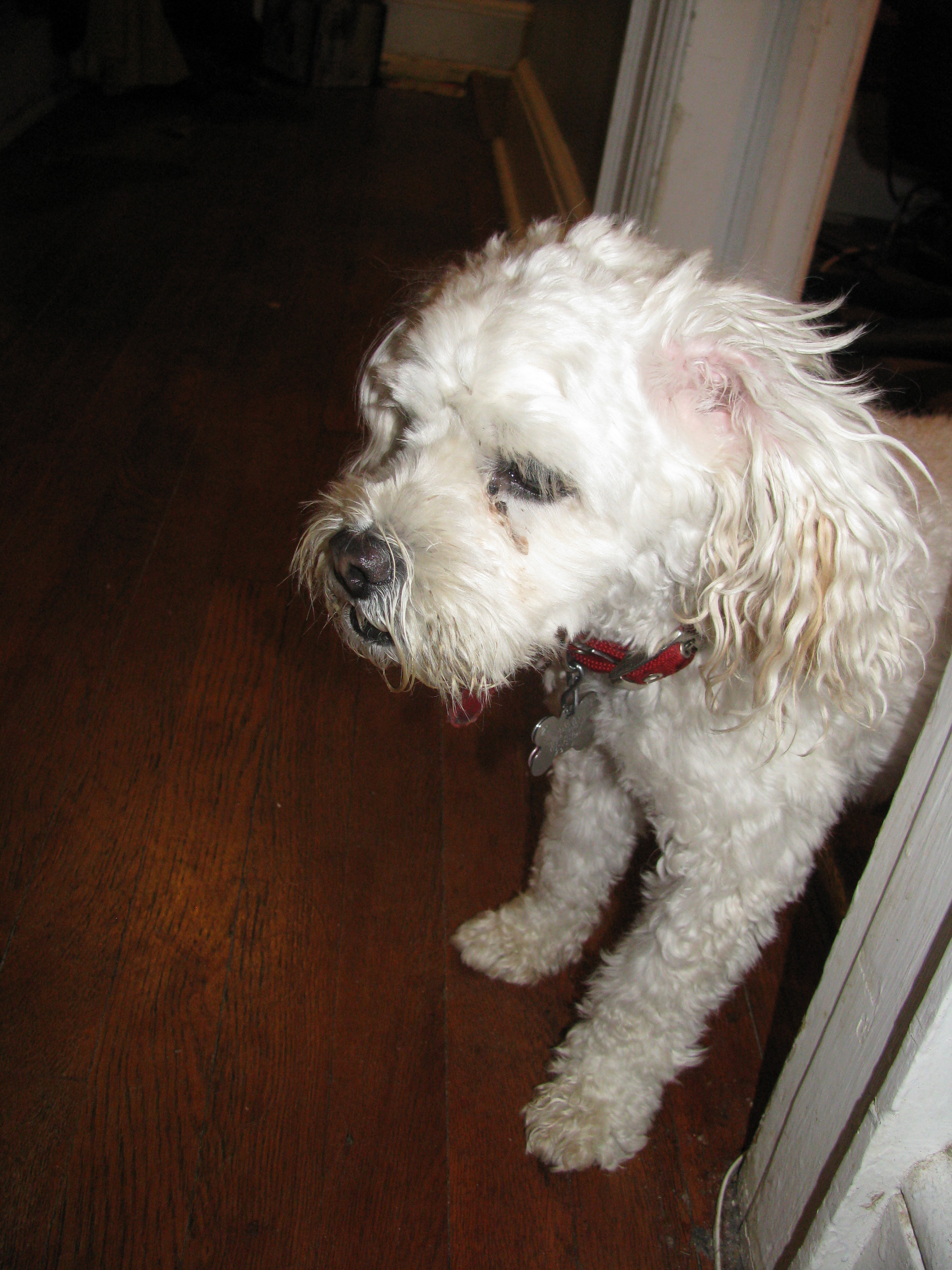
I wonder what she's thinking.

I wonder what she’s thinking.

My mom was kind of like this when I was growing up. When she was present, her love was obvious and full of joy, but then she would disappear, either leaving the house or just leaving her body, and there was no way to reach her. I always wanted to hug her, or yell at her, to bring her back to life, and to me. Mom also has the same sweetness and generosity of spirit as Butterfly, where you can’t quite believe how lucky you are to be loved so much.

I know that Butterfly loves me. When we go outside and she runs off for a minute and turns back, the joy in her face at seeing me, and the flying run she takes to return to me, is extraordinarily good for my self-esteem.

But she can be very independent. If she doesn’t want to be crowded, she’ll just walk away and find a place to be alone. When Cricket does this, she chooses a place nearby, where she can stare at me, and let me know that I have disappointed and annoyed her. But when Butterfly wants to be alone, it’s not about me; she’s not angry at me, or jealous of Cricket, or pouting, she just wants to be alone: on the mat by the front door, on the rug in my room when I’m not there, on the bathmat in the bathroom.

When Cricket is grumpy, she wants me to know about it.

When Cricket is grumpy, she wants me to know about it.

Butterfly prefers to keep her thoughts to herself.

Butterfly prefers to keep her thoughts to herself.

It would almost be better if she was reacting to something I’d done, because at least then I’d feel like I mattered.
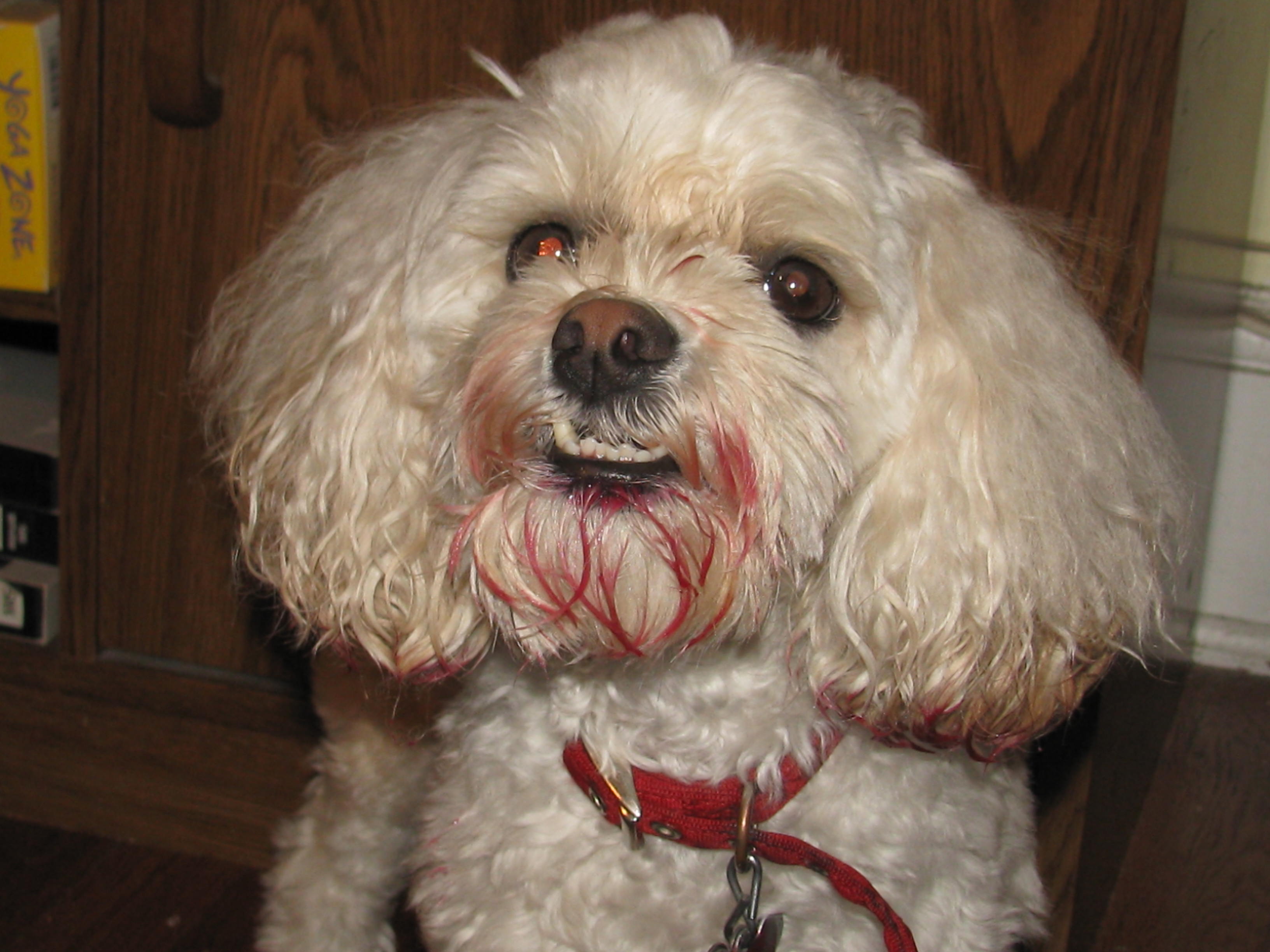
It’s possible that a lot of things in my life have had this fleeting, ethereal quality to them, and I write it all down to capture it and remind myself that it was real and not just my imagination. I worry about that, about losing wisps of my life into the air as if they never happened, losing people and memories and emotions because I wasn’t quick enough to tie them down and secure them before the rains came.

I love Butterfly all the time, whether she is close and present, or dreamy and far away. But the pull of grief when she’s flitting away can be incredibly painful. There’s a reason why most people don’t have butterflies as pets.

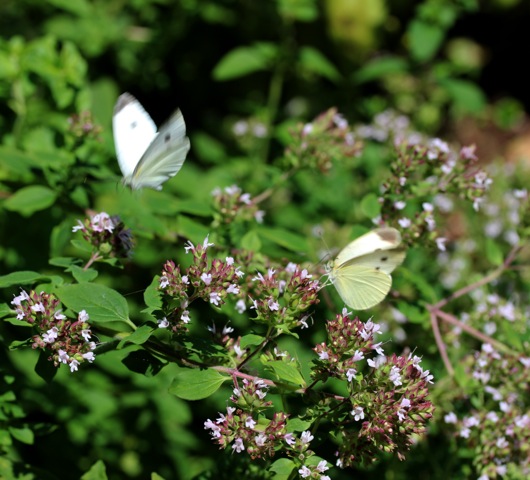
White butterflies.

Butterfly’s white butterflies.

Looking For My Song


I used to write songs. This was a long time ago. I bought a Casio keyboard with my leaf-raking money when I was eleven or twelve, and tried to remember my years of piano lessons to pick out a melody. But I never felt like I could catch the song I was looking for.

I feel like being a musician, for me, is as impossible as being a dog. I don’t have the right internal organs to get there, no matter how much I might want to. I don’t have the right brain, the right ears, and the right fingers. I’m just not that person and I feel the loss acutely. Cricket and Butterfly have their own unique songs. They have particular patterns and rhythms and pitches that really get their message across, but I feel muted. I can write and speak my story, but I can’t sing it, and that leaves something essential unexpressed.

Cricket likes the sound of her own voice and uses it very specifically to express different emotions and needs. She rasps and squeaks, and cries and screams, she barks from her gut and shrills through her nose. She is a diva. She sings variations of the same song, using the same instrument, all day long.

Cricket, mid-Aria.

Cricket, mid-Aria.

Butterfly listens very closely when we’re outside. She collects sounds: like an airplane flying overhead, leaves rustling, a garbage truck rolling down the hill, geese chattering to each other, birds whooshing through the trees. I wonder if she’s looking for her song too, and sampling all of these sounds to see what resonates for her.

Butterfly, listening.

Butterfly, listening.

In college, in one of my early attempts at jumping around the curriculum, I took a class in music composition. I’d taken voice lessons and piano and felt like there was a whole segment of the musical world that I was missing, huge parts of the language that I could not understand. I did well in the class, because it was basically math with musical notes, but I felt like I was being starved for the real stuff, the “aha” stuff, because I couldn’t connect the math to the music. Maybe if I’d tried to stick it out and become a music major I’d have eventually found what I was missing, but most schools require proficiency in a musical instrument and a willingness to perform and I didn’t have either one.

I have a cousin who plays the cello professionally. She plays a regular cello and a baroque cello (don’t ask me what makes them different). She has spent her whole life becoming the cello and limiting the space between her body and the music until the music really does come through her and the cello at once. She inspired me, and I spent a year and a half trying to teach myself how to play the guitar, but I couldn’t make my fingers tolerate the work. My knuckles kept clicking and jamming, because, as one doctor told me forever ago, my ligaments are too loose to hold my bones together. And you would not believe how painful it is to press your soft fingertips against heavy guitar strings.

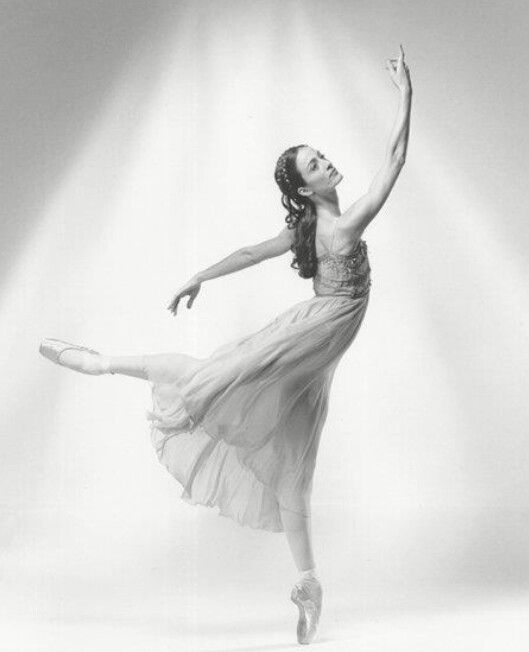
The most electric experience I’ve ever had with music is when ice skaters have been able to skate as if the music is coming through their bodies, Michelle Kwan could do this, and Kurt Browning and Torvill and Dean. I remember watching Julie Kent at American Ballet Theater, just watching her arms as if the music was living in her body and she was setting it free.

Julie Kent

Julie Kent

Michelle Kwan

Michelle Kwan

Music just seems so forlorn and naked without visual accompaniment. I feel lost, like I’m swimming in too-deep water, when I listen to music sometimes, as if the ground has fallen out from under me. I feel like I will be trapped in an emotional state I can’t identify, can’t tolerate, and can’t get out of. How is the music doing this?

Music is one of the most powerful things I know, and I feel this great need to create it, and control it, and I can’t do either one. I can just sample it, like Butterfly, and pick a sound from here and there to add to my collection. I think this might be enough, for now.

The girls are thinking about it.

The girls are thinking about it.

Yin and Yang, or, How We Resonate


Some people resonate with each other, not because they are objectively the same but because they complement each other in interesting ways. We often talk about yin and yang, where two people create a whole circle, but I tend to think more of melody and harmony. It’s not a circle with no holes, it’s a song that resonates and echoes.

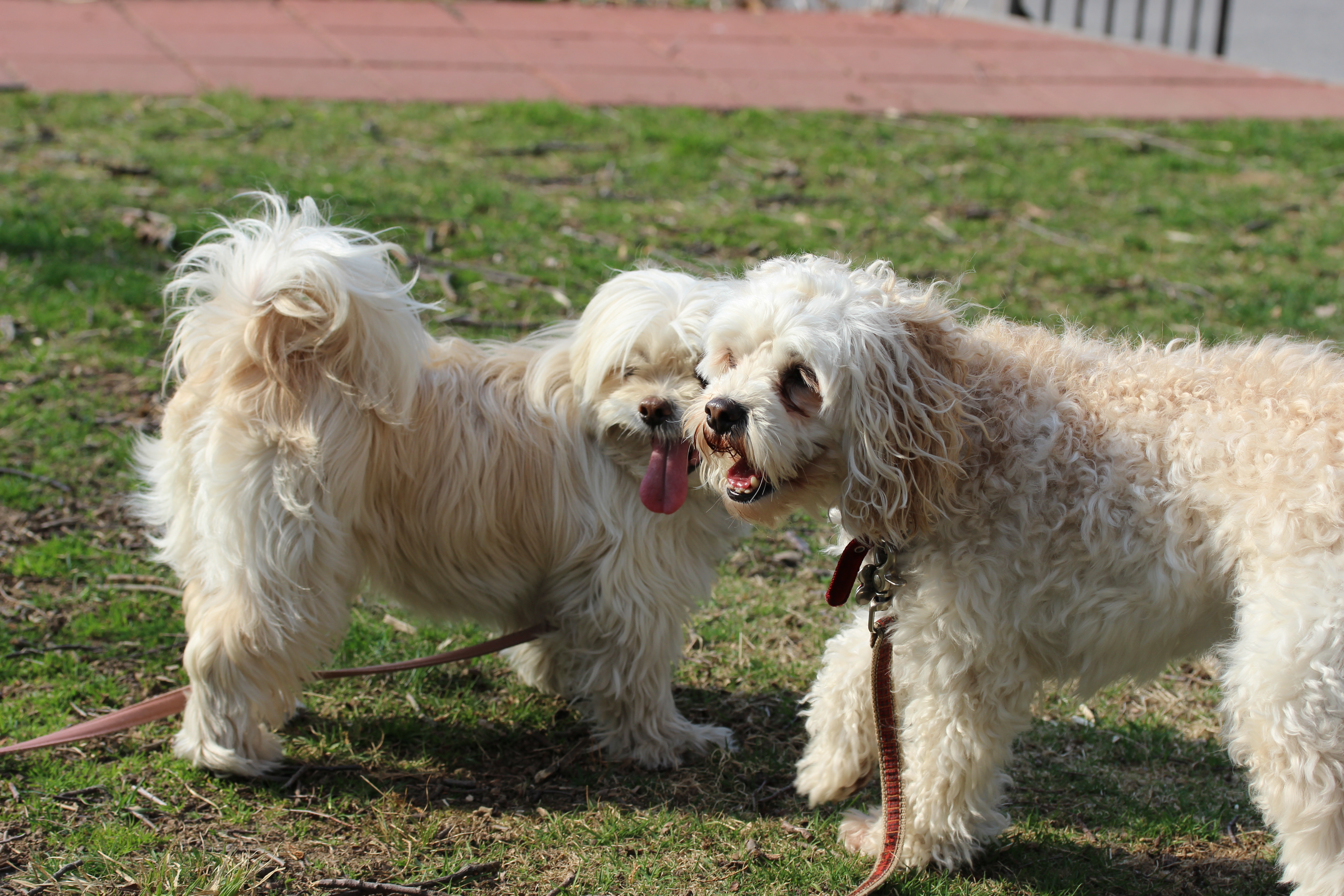
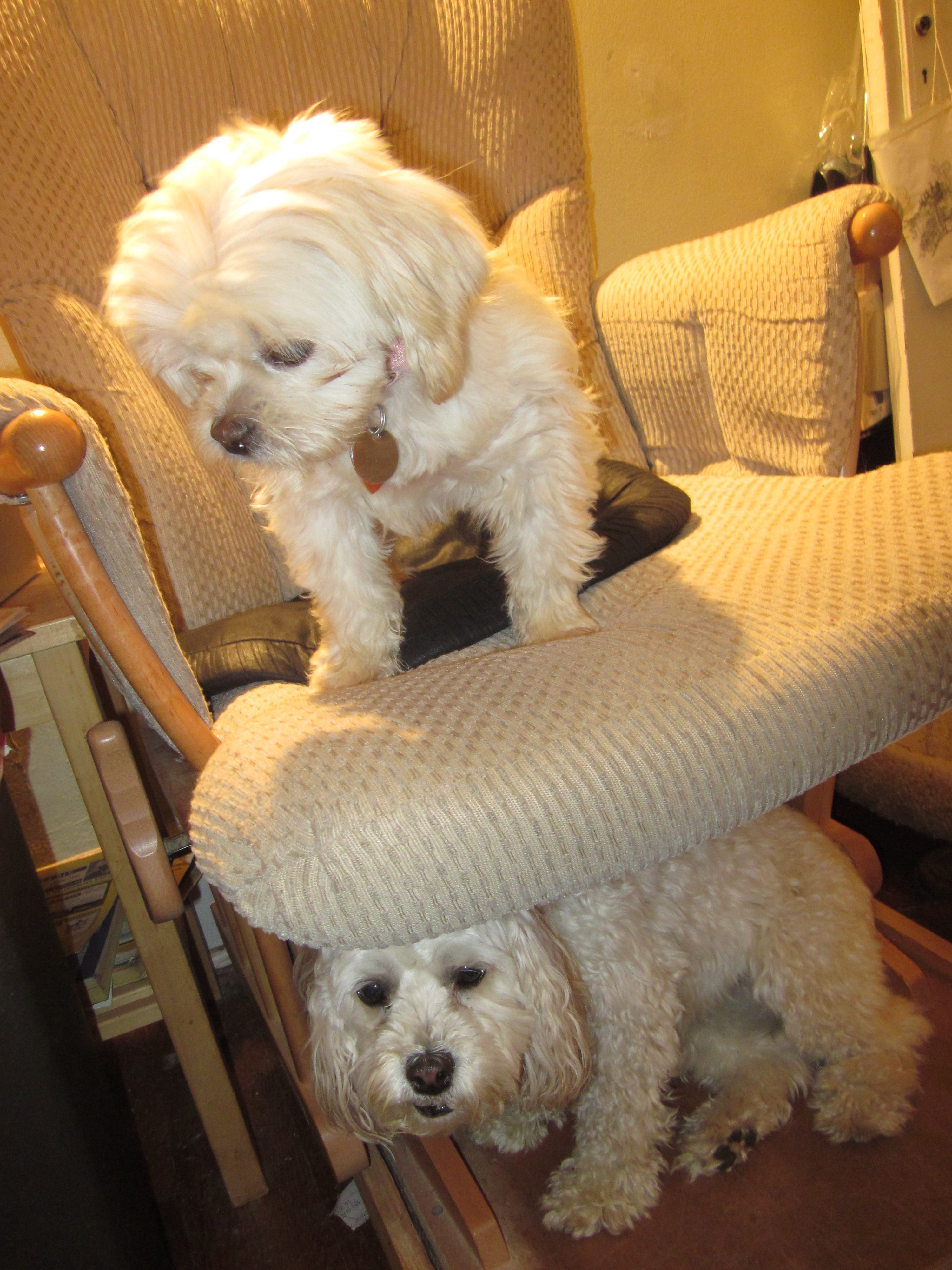
Cricket and Butterfly are not a perfect match. First of all, they look too much alike. They have the same color hair, both white with apricot markings in mostly the same places. And they both bark, at different pitches, but not in a harmony of beautiful sound; they are not a choir, they are a cacophony of noise. They are not the same height, but also not opposites, like big and small or fat and skinny. They are just small and smaller. They don’t fill all of the possible spaces in the world with their two personalities, but sometimes they harmonize in interesting and beautiful ways.

Butterfly was very excited to meet Cricket on her first day home.

Butterfly was very excited to meet Cricket on her first day home.

Cricket was less excited.

Cricket was less excited.

"Okay, maybe she's not so bad."

“Okay, maybe she’s not so bad.”

Cricket is much more of a protector, wild with noise and ready to lunge at friends and strangers alike, and Butterfly is more of a conciliator, but not always. She is not always slow and Cricket is not always fast. But they have worked out, as sisters. They have not camped out at opposite sides of the apartment, hissing at each other like cats. They do not ignore each other. Sometimes they snuggle or sleep close by each other. Sometimes they don’t. Sometimes one is going crazy and the other stands by with a lifted eyebrow, but then the roles reverse.

Cricket, protecting the world from the inherent violence of sticks.

Cricket, protecting the world from the inherent violence of sticks.

Butterfly, meditating on the absence of chicken treats.

Butterfly, meditating on the absence of chicken treats.

They often like to walk in opposite directions, to see how far my arms can stretch away from my body.

Sometimes the girls even work together.

Sometimes the girls even work together.

I think we have this unreachable ideal of perfection in love, of black and white, all or nothing, that two people either match perfectly or they don’t match at all. But what if it’s not supposed to be just two people completing each other? Maybe no one person is the perfect and whole complement to any other person, because that wouldn’t leave room for anything or anyone else. Even the happiest couples crave children, or friendships, or dogs, teachers, or coworkers, or clergy. There has to be some room left over in a couple for the rest of the world to filter in – not like a great flood whooshing through the relationship and wiping everything out, but room for more people, more ideas, more emotions. There are so many couples at my synagogue who have lasted 40, 50, and 60 years together and they still leave room for other people and activities and ideas. They accept that there are unfilled spaces between them, and that that’s a good thing.

Both of my dogs resonate with me (I did choose them after all). Cricket’s Sturm und Drang and high drama and need for closeness speak of the volume of emotion coursing through me all my life. The noise of her happiness and pain and excitement and rage, and her unbearable joy in love and curiosity and new things, resonates with me. And the way she studies the things she loves so carefully and with such attention, is just like me.

"Food!!!!!!!!"

“Food!!!!!!!!”

Butterfly is this sweet grief, this place of joy and pain mixed together that I remember from visiting my grandfather, and going out for ice cream sundaes at six in the morning because Grandma couldn’t stand to wake up to children in her house. Butterfly is joy tempered by patience, and when she knows what she needs, endless stubbornness and knowledge that she is right. We are the same! This is me! Well, not all of me, but some. And I could make room for more soul mates like these, because there is more of me to be met.

"I think I can...I think I can."

“I think I can…I think I can.”

I am always on the lookout for people who will resonate with me and I’ve had to learn to give the chemistry more time to grow – but there are still people who, right away, glow for me; people whose energy reaches across the room to me so that I can feel it in my fingers and on my face. I don’t understand this. I worry that I can’t live without this kind of glow.

What if, in two or three ways, you have that full on orchestral sound in your ears with someone, but on the fourth note: cacophony? Or, you’re both in sync, but your families hate the sound of each other? Or what if your families like each other and you have no major cacophonies, but the harmonies between you are only middling, is that better?

I don’t know. Maybe I should just leave it to Cricket to decide.

She's ready.

She’s ready.

The Writing Workshop on Aging


I started a writing workshop on aging at my synagogue. I didn’t plan to do this. I just went to a meeting on aging because it looked interesting. I had the idea that this could lead to visiting people at the hospital, or reading to patients at nursing homes, and could count on my application for graduate school. My ideal would be to walk dogs at the animal shelter, but I don’t think they’d count that as social work. I could be wrong.

So I sat in the meeting and listened. Stories flooded the room: of women at sea after the death of a spouse of fifty years; women manipulated by insurance companies while signing papers at the hospital; women looking for help for their parents; women wondering how to help their friends. The meeting was very low on men.

I took notes and listened and felt the chaos roll over me.

The decision at the end of the first meeting was to have a second meeting, and a third, and a fourth if necessary, until some ideas could start to coalesce.

I went home, exhausted, and fell asleep, and then went on with my life, writing for the blog, going to class, writing my research paper, studying math for the GRE (because not only did I forget every bit of math learned in high school, but I have even lost my short term math memory and I forget it all over again each day.)

I don’t remember looking over my notes from the meeting. I just thought about one of my synagogue friends, recovering from back surgery, and I thought about my great aunt Ellen and the interviews I did with her a few years back to try and catch some of her magic on paper, and I thought about the short memoir my grandfather started before he died, giving us a glimpse into his childhood. Bits and pieces of the stories people had told me over the past few years of Friday nights at synagogue started to bubble up. I wrote a few notes to myself about people whose stories I’d want to read, but told myself it was just a passing idea, and I’d never have to follow through and actually talk to people.

I’ve learned so much from keeping a blog and writing memoir. It forces me to really deepen into my life, to settle into the crevices of it, and not just feel like I’m a character in my own imagination. I feel like I am taking good care of myself by writing about my life, instead of letting the moments disappear into the ether. I especially like that I have a chronicle of my dogs’ lives. I don’t worry that I will forget important things about them, the way I did with previous dogs. It felt so painful to forget things about Dina and Delilah, as if I was disrespecting them, and the value of their lives to me.

Delilah the Doberman

Delilah the Doberman

Dina, pensive.

Dina, pensive.

Butterfly and Cricket

Butterfly and Cricket

I found myself writing notes for an idea of a Friday night service where people read their own stories to the congregation. And I thought about how I could make that happen, or at least help people to write some of their own stories down.

I wrote a proposal, feeling very self-conscious and a bit like I was walking into a black hole from which I would never be able to return. I would be shunned from my synagogue. They’d hate me for thinking I was so special that I could teach anyone how to write; they’d resent me for thinking I had anything to offer. I could barely breathe.

I sent the proposal to the woman who runs the aging meetings, and she loved it! And then she sent it to the social worker helping the congregation, and she loved it too. And when I read it to the group in person at the next meeting, face turning purple, hands shaking, I got applause, and six people signed up to take a writing class with me on the spot.

I think I could be good at this, but I’m still terrified. Every step forward feels like jumping from one cliff to another. I’m thinking about how to help people who have trouble seeing, or trouble with arthritis so that writing or typing is difficult. I’m thinking about how to help people who are not natural writers, but would be great interviewees. I’m thinking so much that I have little pieces of paper floating around my room like confetti. Butterfly is loving that.

Butterfly even listens with her tongue!

Butterfly, full of joy!


An Elephant In The Living Room


My brother and I had a fascination with elephants when we were little. It’s possible this started when we went on an elephant ride. You had to climb up to a platform and be placed on the elephant. It was not like a horse; the elephant almost didn’t know I was there, like I was a fly on his back, but the idea that the elephant was alive, and moving, and not a bus or train but a real live being, seemed magical to me.

Happy elephant! (not my picture)

Happy elephant! (not my picture)

I might have been four years old, because I can’t place when or where it happened. I don’t know if it was at a circus or an elaborate petting zoo, near home or away. I just remember the moments of elephant, and the plan that started to form: we wanted an elephant to live at our house.

We never wanted chickens, that I know of. I thought about a goat, but Mom said no right away, because of the smell, and the inevitable destruction. She knew from goats and didn’t want to live near one again.

I really wanted an elephant, or another big animal, someone who could take up more space than my father and fight off any monsters who dared to invade my room.

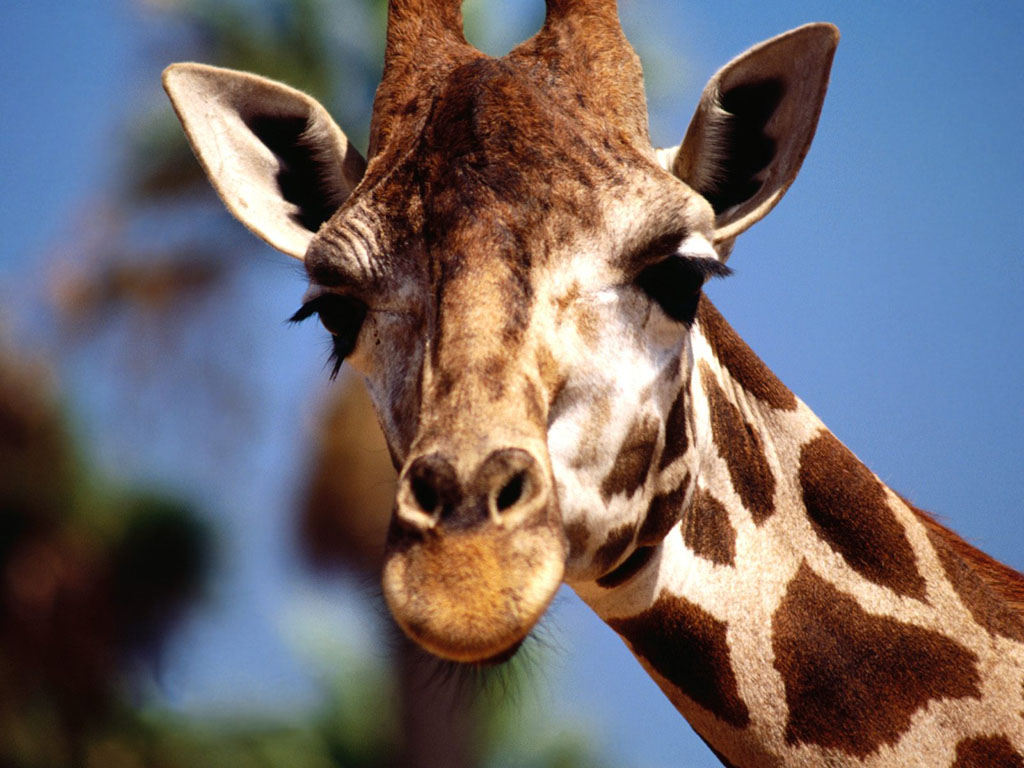
I didn’t want a lion, really, or any kind of cat. They struck me as a little too changeable. I never really thought of having a cow. They just didn’t seem that interactive, and, they were steak. I didn’t want a pet who could be confused with food. A giraffe would have worked great. She could have hung her head out of my bedroom window to snack on trees and keep watch over the neighborhood, and then she could rest her head on the porch roof whenever she got tired. I think my brother would have been okay with a giraffe, but for some reason Mom said no to that too. Something about the ceilings.

A lion would be a bit much. (not my picture)

A lion would be a bit much. (not my picture)

A cow would always have been suspicious around dinner time. (not my picture)

A cow would always have been suspicious around dinner time. (not my picture)

A giraffe would have been wonderful! (not my picture)

A giraffe would have been wonderful! (not my picture)

We had an eighty pound Doberman Pinscher named Solomon when I was little, but even though he towered over me I never thought of him as a good elephant substitute. A friend had a slobbering blue mastiff named Bruno that was more what I was looking for; someone slow, and friendly, and soft, and smiling at me. I wanted him to go to school with me and sit at the next desk during spelling tests. I wanted him to go to summer camp with me and do the doggy paddle while I tried to stay afloat.

A blue Mastiff, just like Bruno. (not my picture)

A blue Mastiff, just like Bruno. (not my picture)

My therapist, and, from what I gather, many other therapists as well, uses the elephant in the living room metaphor, i.e., there’s an elephant in the middle of the room and everyone is acting as if it isn’t there. The elephant could be incest or alcoholism or mental illness or domestic abuse, but whatever it is, the family denial is so potent that it makes something the size and weight of an elephant invisible.

I hadn’t heard this metaphor when I was little, there was just something about an elephant, so majestic, with rough skin, not trying to be colorful or beautiful, that felt right to me. They are matriarchal, and have long memories, neither of which I knew at the time, but maybe I sensed it. There was something about elephants that calmed me. I could maybe ride my elephant to school, and slide down her trunk, and set her up under a tree while I was in class, and bring her milk and cookies during snack time.

There was a book I read all the time about a boy who had a dinosaur as a friend, and I thought an elephant would be more practical.

Danny-Dinosaur

The biggest argument against an elephant was, how would you get it up to the second floor so it could sleep in your room? So that’s when we started planning the elevator. We started scouting locations where the elevator could go without disrupting the floor plan too much. When my father complained about the cost of electricity, we thought about a dumbwaiter contraption, but we’d need a second elephant to help us lift the weight. Two elephants. One for each of us!

Of course, sadly, our parents prevailed, and we never built an elevator or brought home a baby elephant to raise in the backyard. I know we would have been willing to share the chores, and take turns having her sleep in our bedrooms at night, but it’s possible we wouldn’t have known how to handle the poop. That’s probably what made the decision. Everything else about an elephant living in a house on Long Island would have worked out fine; but not the poop.

I had to settle for two mini-poopers!

I had to settle for two mini-poopers!

Behavioral Therapy


My Abnormal Psychology teacher pooh poohed the idea of long term psychotherapy as something only rich people could indulge in. He saw cognitive behavioral therapy as the answer, because of its short duration and ease of insurance coverage. Often, a course of behavioral therapy will last only six to eight weeks, and focus on a single problem, without taking the time to delve into the history and long term problems of the client.

I disagree with him. I think that, for some issues, long term psychotherapy is the only real solution. But within that construct, or for people who don’t need long term help, I’d rather use a version of role modeling, rather than cognitive behavioral therapy, because there are some skills you can’t learn by talking or reading instructions. Dancing, for example. It’s a thousand times easier to stand behind another person doing a dance step and follow their lead than to try to learn the steps through words. And I think this applies to a lot of the behaviors we want to change; if they really are behavioral deficits, rather than deeper conflicts.

The learning becomes so much easier when someone stands in front of you and slowly shows you each step of how it’s done. The “slowly” part is important, because just watching someone zoom easily through a task does not make me feel like I can follow along and do the same.

There are so many skills that would be easier to learn this way, especially social skills, and hands on skills. I remember trying to make sense of a list of instructions in the biology lab in college and having no idea what to do, but if I could watch someone else do each task first, it made sense and my anxiety receded.

I saw a TV show once, where an older dog taught a younger dog that it was safe to step into the lake, by stepping into the lake himself. That moment resonated deeply with me, because just telling the dog, or me, to do something frightening doesn’t make it possible, but seeing a friend do it in front of me, or, better yet, having a friend do it with me, makes all the difference.

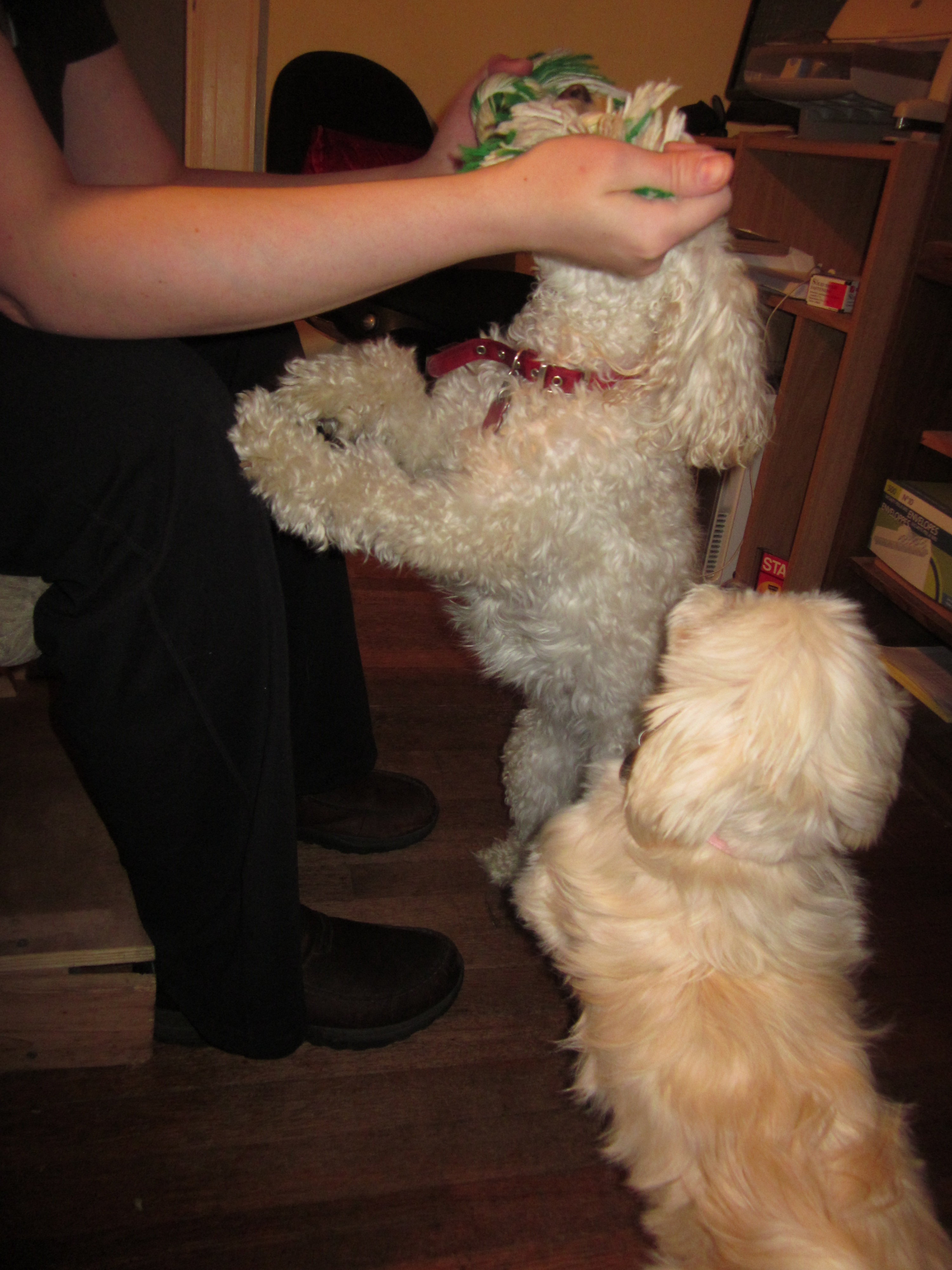
Too often behavioral therapy is not done this way. It’s more like the clicker training we suffered through with Cricket. Here I had this wriggly little puppy who wanted to explore and play and chew things, and the best guidance I could offer her was to sit on command. It made me feel like an ogre. What I really wanted was a better way to communicate with her. I wanted a class in sign language for dogs that would start to close the gap between the language she spoke with her brothers and sisters and the language she was hearing from me.

"I think I will jump out of this bathtub and run around the apoartmetn and roll on all of the clean laundry. Yeah, that's what's next."

“I think I will jump out of this bathtub and run around the apartment and roll on all of the clean laundry. Okay?”

"You don't mind if I chew on this lovely snack, right?"

“You don’t mind if I chew on this lovely snack, right?”

"Why doesn't Mommy understand me?"

“Why doesn’t Mommy understand me?”

It didn’t help that I hated the sound of the clicker, and resented the over use injury to my thumb from having to press the damned thing over and over again. I didn’t mind giving her the treats, though, that part I could understand.

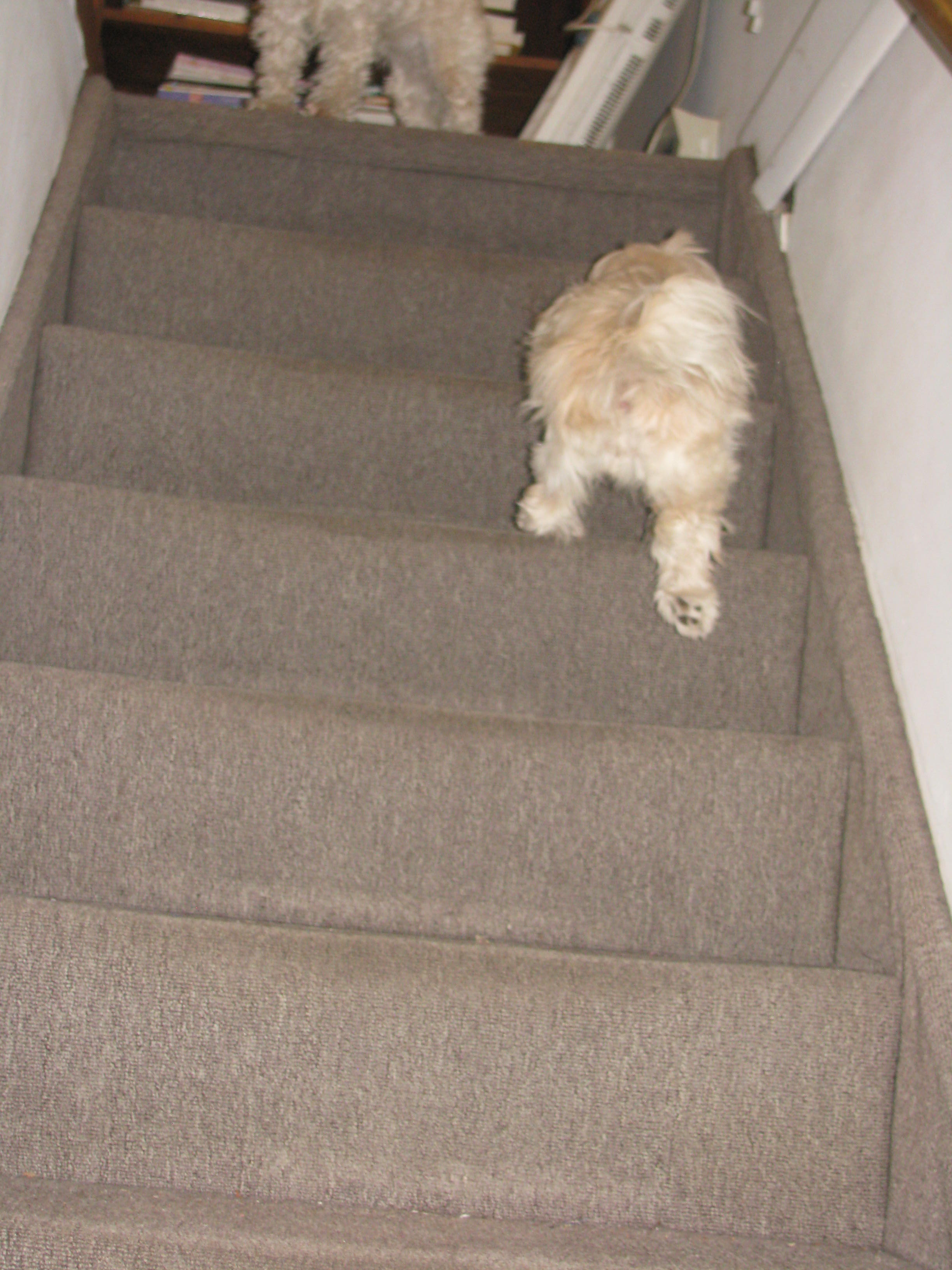
When Butterfly came home from the shelter, we didn’t use clicker training, or commands, to show her where to poop or how to climb the stairs, we gave her Cricket as a role model, and we gave her our love and attention. Cricket taught Butterfly all kinds of behaviors by doing them in front of her. She showed her that the food bowls weren’t filled with poison, by eating from them. She showed her that dogs pee outside instead of in the kitchen. Cricket taught Butterfly how to beg for food, and demand outings, and be a nuisance until she gets what she wants. Butterfly has tried to pick up other behaviors, like jumping up on Grandma, but her legs aren’t long enough or strong enough to do that.

"Cricket? Can I jump too?"

“Cricket? Can I jump too?”

Cricket? Are you upstairs?"

Cricket? I’ll be right there!”

"Cricket? Where are you hiding?"

“Cricket? Where did you go?”

And Butterfly has been doing her own version of long term therapy, showing me the things that scare her – like packing tape being ripped, or thunderstorms, or street noises – and she comes to me, and I hold her, and smooth her hair, and let her know it’s all right. It’s alright that she’s scared, and it’s alright that there are things she cannot do. It’s alright that she needs attention and comfort. It is all alright.

Butterfly in the wind!

” I am a butterfly!”