I hate the high holidays. I hate the focus on repentance, and the large crowds at the synagogue, and all of the standing, and having to dress up, and the depressing Eastern European music, and the endless communal guilt. I would much rather spend the time watching a Father Brown marathon.
But I pushed myself to join the choir anyway (which, at my synagogue, mostly sings during Rosh Hashanah and Yom Kippur and not much the rest of the year), and each year I push myself to go to as many of the rehearsals as possible, even though I’m tired by 8 pm (which is when choir rehearsals always start). And I push myself to get up early for the morning services on Rosh Hashanah and Yom Kippur, and wear something other than a t-shirt and jeans, and stand and sit and stand for hours. And, I resent it, every year. I especially hate the emphasis on all of the sins we are presumed to have committed over the past year, as if I wasn’t already spending many hours each day combing through my life for my actual sins and trying to correct them.
So, why do I go? Because it’s an obligation; because of FOMO (fear of missing out); because this is the one time each year when I get to see all of the people who rarely come to Friday night services; because I’d be lonely sitting at home knowing everyone else is there.
And, because I love to sing. Music is such a mystery to me, because even when it’s imperfect or depressing, it is still, also, transcendent. It connects me with other people; even with people I might otherwise have nothing in common.
Do I believe, or agree with, every word in every prayer we sing over the high holy days? Not at all. Is it meaningful to me to think of God as a judge or a king, doling out forgiveness for sins I’ve never even committed? Nope. But when those words that mean so very little to me, and even piss me off, are put to music, they are transmogrified into something new and my body becomes one of the instruments producing and receiving and echoing sound. This imperfect body of mine, that feels so much pain and that I feel so self-conscious about, becomes a vessel for transcendent sound for a little while every year, and that only works if my body is in the room with all of the other bodies.
I wish we could all come together for happier occasions, and sing Israeli pop songs, or just tell stories and laugh together, but for some reason, when everyone sat down to decide which holidays were going to be the most important ones on the Jewish calendar, they chose Rosh Hashanah and Yom Kippur (at least after the destruction of the second temple in 70 CE, before then the most important holidays were Sukkot, Passover and Shavuot, weeklong festivals to celebrate harvests – more about Sukkot next week). So, why did my ancestors decide that the most important days of the year were the ones where we have to pound our chests and asks for forgiveness and beg God for another chance? I have no idea. But most of the Jews who go to synagogue on Rosh Hashanah and Yom Kippur, and not once the rest of the year, pay expensive yearly dues for the privilege. And they seem to think it’s worth the cost.
Maybe they’re there for the music too, and how it feels to be in a room full of people singing together, no matter what they happen to be singing. Or maybe they don’t realize that there are (much) happier holidays on the Jewish calendar that they could be celebrating with their congregation. Or maybe my people just really love repentance. It doesn’t matter. The decision has already been made, and I can either be there with them, or stay home alone. So, I go. Every year. And I sing, every year. And I whine and complain and need long naps to recover afterwards every year. And I wouldn’t miss it for the world.
If you haven’t had a chance yet, please check out my novel, Yeshiva Girl, on Amazon. And if you feel called to write a review of the book, on Amazon, or anywhere else, I’d be honored.
Yeshiva Girl is about a Jewish teenager on Long Island, named Isabel, though her father calls her Jezebel. Her father has been accused of inappropriate sexual behavior with one of his students, which he denies, but Izzy implicitly believes it’s true. As a result of his problems, her father sends her to a co-ed Orthodox yeshiva for tenth grade, out of the blue, and Izzy and her mother can’t figure out how to prevent it. At Yeshiva, though, Izzy finds that religious people are much more complicated than she had expected. Some, like her father, may use religion as a place to hide, but others search for and find comfort, and community, and even enlightenment. The question is, what will Izzy find?
I was dreading Rosh Hashanah. I was already exhausted from the first week back teaching synagogue school, and I hadn’t even tried on my High Holiday clothes from the year before, just crossing my fingers that they still fit. I’d survived the two hour choir rehearsal in the midst of the crazy first week of school, but just barely, and I still had to go to the vet for Cricket’s fluids and Ellie’s heart meds, and do the food shopping, and at the last minute, we had to do three loads of laundry because Cricket had peed on everything, and by the time we were done I had just enough time to take a shower and get dressed in order to get to the synagogue on time.
“All your fault.”
Almost as soon as I sat down in the choir seats, the senior rabbi came over to tell me I would be doing the second reading – a Mary Oliver poem about her dog. I hadn’t seen the rabbi in person in a while, because I’d been going to services online, so I guess this was his first chance to tell me that he wanted me to read this poem – though I do have email, and a phone. I mentioned that it would be difficult for me to get to the Bima from the choir seats, especially in between songs, and he turned to my mom and complained about how much people like to complain.
I didn’t know exactly when my reading would come up, just that it would be relatively soon. Maybe. And that I couldn’t say no.
The choir was busy for the first part of the service, rarely sitting down. I’d forgotten how much standing was involved in singing with the choir because we were allowed to sit during rehearsals, and then I heard the junior rabbi give the intro for the poem I was going to read, so I put down my music and scooted past Mom and found my way down the aisle and up the stairs to the podium, and I read about Percy, the loving dog who looks up at his person as if she is everything.
As soon as I was done reading, I had to hurry back to the choir section for the next song, but I felt, in that moment, the reason why I kept saying yes – to singing, to rehearsing, to reading in public, to teaching and exhausting myself – it feels really good to be part of a community, and to be known. Because not only the rabbis, but many of the other people in the room knew why I’d been chosen to read that particular poem. And they knew that I sang with the choir and they knew that I taught in the synagogue school, and they knew my Mom and her photography and quilt work and asked after her when she wasn’t there. They may not all have known how hard it was for me to do all of it, but they saw me, and cared about me, and congratulated me, and it felt good.
I always dread the high holidays, knowing the work involved and how self-conscious I’ll feel going up on the podium and dressing up and singing into microphones, and all of the extra-long services one after the other after the other. And I always forget how meaningful it is, and how satisfying it is, to be surrounded by so many people sharing the same experience.
There are, of course, times when I feel like I don’t belong, and when I feel like parts of me are invisible. During the Torah service, for example, our community calls up groups of congregants for the honors instead of calling up individuals, and they’re all in life-cycle related categories: everyone who will be driving a car in the next year; everyone who is newly married or celebrating an important anniversary; everyone with a new baby or grandbaby.
There are also categories that could apply to me; I’m dreading the time when I can go up for the first Aliyah on Rosh Hashanah, for those who have lost a loved one in the past year. But mostly I feel this otherness, endlessly, because to be a member of the Jewish community often means to focus on the family as the unit of measurement, and I don’t really fit. There’s no Aliyah for people who had to go to more than ten doctors’ appointments in the past year, or people who are pre-emptively grieving the loss of a senior dog, or people who want to do more with their lives, but can’t.
In a way, I prefer the darkness of Yom Kippur: the focus on what has been difficult and painful over the past year; the focus on what we regret. It’s not that I want to revel in the pain, but there’s relief in knowing that everyone is sitting a second longer than usual with what went wrong, and what was missing, instead of focusing solely on the Instagram-ready celebrations.
But I made it through the marathon of Rosh Hashanah services, even forcing myself out to Tashlich on the afternoon of the first day of the holiday, when our community has its dog-friendly service out by the water, where we sing and throw away our sins (even the babies seem to revel in throwing their sins, in the shape of bird seed, out to the ducks), and meet all of the canine members of the community who’ve been out of view, but still there with us in spirit, over the past year.
“I don’t mind napping while you go to shul.”
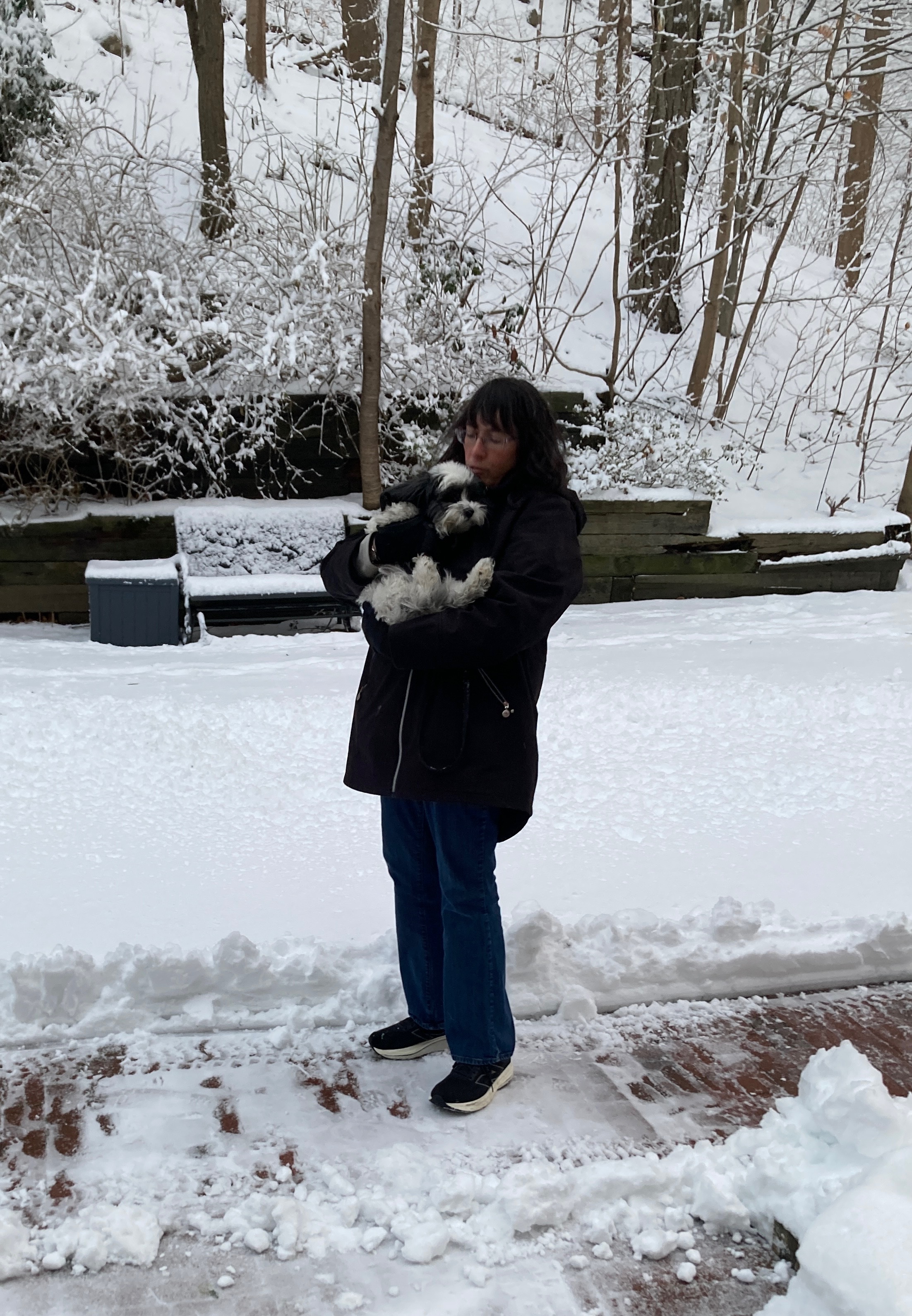
I pushed myself to go to the outdoor service because I wanted Cricket to be there one more time. She’s never been the most outgoing or friendly dog, and she wasn’t feeling all that well on that day in particular, but I wanted her to know that she was still part of our community, still known and seen and loved.
And even if it’s hard to live up to the work of being in community, even if sometimes it feels like more than I can do, there are also moments when it all comes together and my sixteen year old dog, and I, know we belong.
If you haven’t had a chance yet, please check out my Young Adult novel, Yeshiva Girl, on Amazon. And if you feel called to write a review of the book, on Amazon, or anywhere else, I’d be honored.
Yeshiva Girl is about a Jewish teenager on Long Island, named Isabel, though her father calls her Jezebel. Her father has been accused of inappropriate sexual behavior with one of his students, which he denies, but Izzy implicitly believes it’s true. As a result of his problems, her father sends her to a co-ed Orthodox yeshiva for tenth grade, out of the blue, and Izzy and her mother can’t figure out how to prevent it. At Yeshiva, though, Izzy finds that religious people are much more complicated than she had expected. Some, like her father, may use religion as a place to hide, but others search for and find comfort, and community, and even enlightenment. The question is, what will Izzy find?

It’s a summer ritual to have choir rehearsals at the synagogue to prepare for the fall Jewish holidays (Rosh Hashanah and Yom Kippur), but I haven’t been able to get to most of them this year. I went to one rehearsal early in the summer, but then there was surgery and car issues and doggy doctors’ appointments and human doctors’ appointments and on and on. Choir rehearsals are always at eight o’clock at night, so even when I wasn’t sick at home or busy somewhere else, I was just too exhausted to drive out to the synagogue at night, in the heat. I finally got to a rehearsal this week, but the next one will be on the night of my first day back teaching synagogue school, and I don’t know if I’ll be up to it.
“We’re exhausted for you, Mommy.”
I feel torn. I’ve worked so hard over the years to learn the music, and even harder to teach myself how to sing the alto part while the bases and tenors roar behind me. And being in the choir makes me feel like I’m part of the service instead of just following along. But, of all of the things on my schedule right now, choir is the only one I can realistically let go of; I can’t stop going to doctors’ appointments, or driving Mom or the dogs to their doctors’ appointments, and I can’t give up on teaching, both because it’s my only paying job, and because it’s the way I feel most useful in the world.
But, I feel like if I drop choir I’ll be letting people down, and separating myself even more from my community. All summer long I was only able to go to Friday night services online, instead of in person, because I just didn’t have the energy to get dressed again and go out. But while everyone else was there in person, I was just watching whatever parts were visible on screen, and I felt the loss.
My hope is that I’ll be able to get to the rest of the rehearsals, because I don’t want to keep losing things that matter to me, but I also need to be able to give myself a break when things are too hard. I’ve put in so much work to improve my life and my health and I’m hoping it will start to pay off soon. I especially have my fingers crossed that finally getting back into the classroom will bring me enough joy to help me get through everything else.
With all of the chaos going on, I’ve been trying to focus on the things that are working: like revising my lessons plans and getting excited to teach again; and watching Cricket stubbornly insist on staying alive; and watching Ellie thrive on her new heart meds; and reading books and watching TV and listening to the birds. I’m trying to stop and appreciate every good moment that comes along, and not let the not-so-good moments bully the good ones out of the way. But it’s a battle.
“We’re helping, Mommy.”
If you haven’t had a chance yet, please check out my Young Adult novel, Yeshiva Girl, on Amazon. And if you feel called to write a review of the book, on Amazon, or anywhere else, I’d be honored.
Yeshiva Girl is about a Jewish teenager on Long Island, named Isabel, though her father calls her Jezebel. Her father has been accused of inappropriate sexual behavior with one of his students, which he denies, but Izzy implicitly believes it’s true. As a result of his problems, her father sends her to a co-ed Orthodox yeshiva for tenth grade, out of the blue, and Izzy and her mother can’t figure out how to prevent it. At Yeshiva, though, Izzy finds that religious people are much more complicated than she had expected. Some, like her father, may use religion as a place to hide, but others search for and find comfort, and community, and even enlightenment. The question is, what will Izzy find?
The part-time musical director/rabbinical student at our synagogue decided to do something different for our monthly musical services this year. Usually we would have a Shabbat band, made up of professionals and congregants, set up next to the Cantor, and making the service feel like a rousing concert. But this year, the sanctuary has been set up in concentric circles, with the congregant singers and musicians in the middle and the rest of the congregation spreading out from there. It’s more intimate without the professional musicians, and there’s more of a focus on meditation and silence between the songs. And, maybe most important, the new songs we learned for these services were from the Book of Psalms, excerpted and used like chants, with lots of repetition and rhythm.
It’s been an interesting experiment, especially for me as one of the singers, because it’s made me feel more like a participant in making the music, instead of an observer on the sidelines. And it feels really good to sing again, even though I’m still struggling with my breathing. It feels good to be a part of a whole group making music together.
“But we want to sing too!”
The Psalms have always been a part of the traditional Friday night service, but we haven’t always sung them at my synagogue, and certainly not all six of the Psalms that are included in the prayer book as part of Kabbalat Shabbat (the Welcoming of Shabbat, or the warm up before the official evening service).
We studied the book of Psalms a few years ago in Bible Study, but I don’t think I paid a lot of attention. I was probably still in graduate school for social work at that point, and struggling to pay attention to anything other than school, but I do remember the Rabbi saying that many of the Psalms are “macaroni songs,” or songs that can easily be sung to different tunes, and that opens them up to many different musical interpretations that can give a whole new energy to familiar words.
“I like macaroni!”
The Psalms, as opposed to most of the rest of the Hebrew Bible, were created to be sung by the Levites in the Temple in Jerusalem. Some of the Psalms even tell you which instruments you should play to accompany them. The Greek word Psalmos means “a song accompanied by a stringed instrument,” and the Hebrew word for the Book of Psalms is Tehillim, which means “songs of praise,” though not all of the Psalms are about praising God. There are one hundred and fifty individual Psalms, and some are communal laments, and others express individual grief and anger at God, and some are thanksgiving and praise songs, but the value of the Psalms is that they give voice to a range of emotions, like joy and fear and rage and gratitude, and they appear in daily and weekly Jewish services, and holidays and funerals, because they can help us to express things when we have no words of our own.
The Psalms used for Kabbalat Shabbat on Friday night are Psalms 95-99, plus Psalm 29, and there are a few versions that I really like:
One of the Psalms we sang all the time, without realizing it was a Psalm, was By the Waters of Babylon. I think we first learned it to sing at a school concert, or maybe at camp, but I knew an English version and a Hebrew version and only in my research for this essay did I realize it came from Psalm 137: By the waters of Babylon, there we sat, sat and wept, as we remembered Zion. It’s a communal lament at the loss of home after the first Temple in Jerusalem was destroyed and the Israelites were exiled to Babylon. We always sang the first lines, but the Psalm goes on to another saying we learned in school: If I forget you, or Jerusalem, let my right hand wither. It always sounded so strange to me, especially on it’s own, because I was clearly an American kid, not longing to go anywhere else, and yet I was supposed to feel so guilty at not longing for Jerusalem that I would lose my right hand. And I’m a righty, so it bothered me a lot. The Psalm also includes a revenge fantasy against the enemies of Israel, and we can read it as literal – that we want to kill those who wronged us or took things from us, or we can read it as a moment of catharsis, to get our yayas out, that is not meant to be acted upon. I guess we get to choose how we read it, like a choose-your-own-adventure story. But the song I learned as a child focused only on the grief, not on the guilt or the desire for revenge, and I wonder if we excerpt these Psalms as a way to avoid the more complicated parts of who we are and how we feel, or the more complicated parts of peoplehood, so that we can just focus on the joy for a little while.
But the Psalms are everywhere, not just in the Friday night service, and I never really noticed them before. I don’t think we studied the book of Psalms, either in elementary school or high school, probably because we were saying them daily in our prayers and our teachers assumed we knew them and understood them already. But we didn’t. Or, I didn’t.
The Psalms can also be downright hopeless at times, like Psalm 90 – We spend our years like a sigh; the span of our life is seventy years, or given the strength, eighty years, but the best of them are trouble and sorrow, they pass by speedily and we are in darkness. It’s depressing, sure, but it’s also a chance to acknowledge the dark places in our lives, and in our world, and show them to God, and ask God to care that we are suffering, and, most importantly, to give ourselves permission to care that we are suffering.
“Hey! I suffer too!”
The most famous Psalm I know of is Psalm 23 – The lord is my shepherdI shall not want. Yea though I walk through the valley of the shadow of death, I will fear no evil, for you are with me. I like to think of it as an aspirational Psalm, a Psalm describing how we want life to be and to feel. It’s phrased in the present tense, as if all of these good things are already here, and I am already comforted, and I already feel safe, and will only experience goodness and love from now on. But I think the idea of a prayer like this is to help us hold onto a vision of a better world, even when that’s not how things are for us right now, which is why it’s often said at funerals. I found a really beautiful version of this one, in Hebrew and English, by one of the Jewish-male-acapella groups who usually sing silly holiday songs to the tunes of popular American music.
But along with the pain, the Psalms can also teach us how to celebrate when things go right, and how to express our gratitude for answered prayers – not because we’re ungrateful creeps who wouldn’t thinking to say thank you on our own, but because celebration and expressing gratitude is just as cathartic as expressing doubt and pain and anger. These Psalms allow us to feel like what we feel and say and do in the world has inherent value, not just to us but to God, who is our clearest personification of the world at large.
The last of the one hundred and fifty Psalms is Hallelujah and it’s all about praising God, here and there, for his acts and greatness, with horn and lyre and dance and lute and pipe and cymbals. There are a lot of beautiful versions of this one, but I picked two of my favorites.
Some people learn best through reading, or doing; I learn best through music. So getting the chance to hear the Psalms, and feel them, through music, finally made them seem like more than just words on a page. My hope is that even when we go back to the rowdier version of musical services at my synagogue next year, we can keep the new takes on the Psalms, and add more as they are created, because each new variation seems to capture another feeling that I didn’t notice before, adding more joy and insight and space without ever taking anything away.
Some more songs I love that are taken from the Psalms:
“Can you please turn the music down? We’re trying to sleep over here.”
If you haven’t had a chance yet, please check out my Young Adult novel, Yeshiva Girl, on Amazon. And if you feel called to write a review of the book, on Amazon, or anywhere else, I’d be honored.
Yeshiva Girl is about a Jewish teenager on Long Island, named Isabel, though her father calls her Jezebel. Her father has been accused of inappropriate sexual behavior with one of his students, which he denies, but Izzy implicitly believes it’s true. As a result of his problems, her father sends her to a co-ed Orthodox yeshiva for tenth grade, out of the blue, and Izzy and her mother can’t figure out how to prevent it. At Yeshiva, though, Izzy finds that religious people are much more complicated than she had expected. Some, like her father, may use religion as a place to hide, but others search for and find comfort, and community, and even enlightenment. The question is, what will Izzy find?
I made it through the Jewish high holidays. It was touch and go there for a while, because I couldn’t go to the last few choir rehearsals, and because three of the other synagogue school teachers got Covid at the same time, including the Cantor! So I was relying heavily on my KN95 mask to get me through.
I made sure to wear my sneakers (because there’s a lot of standing at the high holiday services, especially on Yom Kippur), and I practiced the music as much as possible on my own, and I even started to do breathing exercises (there’s an app for that!), to build up my breath capacity after months of not singing much at all.
“I breathe all the time without an app, Mommy.”
The surprising thing was how much fun it was to sing with the choir again. I’d forgotten that it was more than just work. When, after missing Rosh Hashana with Covid, the Cantor made his triumphant return for Yom Kippur, it was truly joyous to hear him sing again, and to be able to sing along with all of the tunes the choir doesn’t lead, and realize how much of the music that we only hear once a year is actually familiar and comforting and really powerful.
It was fun to be with a crowd again; to have so many people in one place, at one time, experiencing the same things, hearing the same stories and singing the same songs and laughing at the same jokes, and it was wonderful to see the children of the congregation (many of whom have been my students over the past few years) go up to the bima and take pride in opening the ark, where the Torah scrolls are kept, but even more so at just being seen.
The high holidays are still a lot of work, don’t get me wrong. And waking up early, and dressing up, and singing and praying and standing and sitting, over and over and over again, was grueling. And the dogs really hated the constant coming and going (mostly the going), especially when we had more than one service to go to in a single day.
“Harrumph.”
But it was worth it. Beforehand, I was so focused on how hard it would all be, and how much pain I would be in, and how tired I would get, that I forgot how extraordinary it can feel to be surrounded by a community I truly like, and share history with, and can sing with, and even sometimes dance with.
I’m sure I will forget all of this again by next summer, when it’s time to rehearse with the choir again and build up to the high holiday services again. I’ll probably spend hours, and days, and weeks, dreading the whole thing and resenting the choir rehearsals and worrying about what to wear, but so far, I can still feel the joy, and it’s wonderful. There are so many difficult things in life that really don’t feel worth all of the effort and pain and anxiety; but some things, like this, are totally worth the effort. Thank God!
“Sleep is always worth the effort.”
If you haven’t had a chance yet, please check out my Young Adult novel, Yeshiva Girl, on Amazon. And if you feel called to write a review of the book, on Amazon, or anywhere else, I’d be honored.
Yeshiva Girl is about a Jewish teenager on Long Island, named Isabel, though her father calls her Jezebel. Her father has been accused of inappropriate sexual behavior with one of his students, which he denies, but Izzy implicitly believes it’s true. As a result of his problems, her father sends her to a co-ed Orthodox yeshiva for tenth grade, out of the blue, and Izzy and her mother can’t figure out how to prevent it. At Yeshiva, though, Izzy finds that religious people are much more complicated than she had expected. Some, like her father, may use religion as a place to hide, but others search for and find comfort, and community, and even enlightenment. The question is, what will Izzy find?
I can’t do choir rehearsals at my synagogue during the school year anymore. I tried.
For the past two years we’ve either had online rehearsals or did recordings on our own, so even if a zoom meeting came up on a day when I had to teach synagogue school, I could still go home, have dinner, unwind for a minute, prep for my next class, maybe even take a shower, and still be in time for the Zoom. But in-person rehearsals are a whole other thing. I have to rush through prep and communicating with parents and dinner then get back in the car, rehearse for an hour and a half, and only get home around ten o’clock at night. When I tried, a few weeks ago, I hit a wall around nine o’clock. I left the rehearsal early, but it still took me days to recover.
“Life is exhausting.”
And I was frustrated. I’d already committed to singing at the Women’s Seder (a yearly event at my synagogue, a few weeks before Passover, to celebrate the women in the Exodus story and modern religious music by women), and I had to tell the musical director, and the Cantor, that I wouldn’t be able to get to the rehearsals, for that or for anything else during the rest of the school year.
When I told the musical director that I wouldn’t be able to get to the rehearsals, he sent me the music (four songs we’d done in the past, and only one with two part harmonies) and said he trusted me to be ready on my own, which was both kind and a lot of pressure.
And when I reached out to the Cantor to tell him that I wouldn’t be able to go to choir rehearsals during the school year any more (after almost a week of working up the nerve to write the email), his response came back quickly and with a lot of understanding and compassion.
But I still felt crummy.
I haven’t been able to go to many in-person Friday night services either. I know I’m not the only one who has fallen out of the habit of going to services in person, but I still feel guilty when I watch the Friday night Zoom and see that only two or three congregants are actually in the sanctuary. And I feel guilty when I choose to attend with my camera off, instead of showing my face on Zoom, even though I know I don’t have the energy to change out of my pajamas or even comb my hair.
“My hair looks perfect.”
I feel guilty when I set limits to protect myself, but I also feel angry, because I’d rather be someone who can do all of these things. I don’t want to be ill.
Hopefully I will be able to manage choir rehearsals over the summer, when I don’t have to teach on the same days, and I’ll be able to prepare for the high holidays and socialize with friends and feel more normal, but we’ll see.
Even though I can’t get to choir rehearsals, I have been able to bring more music into my classroom. Not only does the Cantor come in to sing with the students, but a visiting teacher gave us an idea for another way to bring in more music. He suggested playing different versions of the same prayer for the kids, to give them a chance to see for themselves how well, or badly, the music fits the meaning of the prayer. He chose Oseh Shalom (He Makes Peace) for his example, because it’s a prayer that has been done in so many different ways, and I followed his example. I found seven versions of the prayer and we all sat together on the floor and listened to one version after the other. The choice of song became even more meaningful after the war in Ukraine began, because the kids have been watching the news, along with the rest of us, and singing about peace, and thinking about peace, gave them a way to feel like they were doing something to help.
Some of the kids danced to the faster versions of the song, and others took notes like the serious musicologists they are, talking about how the changes in language and instruments and voices added to our ideas about what peace might actually be: it isn’t just the slow and mournful kind of peace we’re used to singing about, but also the raucous, complicated, dissonant, fast and faster, loud and louder, one voice and many voices cacophony that can encompass everyone, if we let it.
We may have played the music too loud, because one of the kids came back from the bathroom saying they could hear it down the hall, but I don’t think anyone minded. Music has so much power to make us feel heard, and connected, to each other and to ourselves. I never want to lose that connection from my life, or my teaching.
And, maybe inspired by my students, I was able to practice the songs for the Women’s Seder on my own, and when the day came, I was ready to sing with the female members of the choir without too much anxiety. And it felt really good to be a part of things, and to be able to add my voice, and not have to stay home and watch it all on Zoom. I hope this is a sign that there will be ways for me to adapt to circumstances in the future and always find my way forward, but for now, this was enough.
In case you’re interested in trying the experiment:
If you haven’t had a chance yet, please check out my Young Adult novel, Yeshiva Girl, on Amazon. And if you feel called to write a review of the book, on Amazon, or anywhere else, I’d be honored.
Yeshiva Girl is about a Jewish teenager on Long Island, named Isabel, though her father calls her Jezebel. Her father has been accused of inappropriate sexual behavior with one of his students, which he denies, but Izzy implicitly believes it’s true. As a result of his problems, her father sends her to a co-ed Orthodox yeshiva for tenth grade, out of the blue, and Izzy and her mother can’t figure out how to prevent it. At Yeshiva, though, Izzy finds that religious people are much more complicated than she had expected. Some, like her father, may use religion as a place to hide, but others search for and find comfort, and community, and even enlightenment. The question is, what will Izzy find?
I recently found out that my synagogue’s choir will be singing in-person at High Holiday services in September. Up through most of June, we thought we’d be recording one or two more videos (to add to the collection we made last year) and using them for services – both online and on screens in the sanctuary. But with the changes to the protocols in New York, our plans have changed.
“Am I singing?”
In-person choir performances mean rehearsals all summer, starting right away, and also early morning services for Rosh Hashanah and Yom Kippur – which I’m really not looking forward to. Instead of waking up late and eating breakfast and leisurely strolling with the dogs and then getting to synagogue for the 11:30 AM service, the way Mom and I used to do before I joined the choir, I will have to be up and dressed and ready to sing by 8:45 in the morning.
I’d actually gotten pretty comfortable with the distance singing – making the videos and singing along to a voice in my ear – and now I will have to re-acclimate to four-part harmonies, and ignoring what someone else is singing (loudly, next to me).
“Grr.”
I’m also anxious about what to wear for services, and which shoes to wear for all of the standing; and I’m worried that I won’t have enough time to get all of my planned writing done this summer, with my Hebrew classes and choir rehearsals and doctors’ appointments and on and on.
Before the first choir rehearsal could take place, though, a former choir member (whose wife still sings with the choir) died, at age 95. It wasn’t unexpected, given his age and overall health, but it was still a shock. He was full of life, and jokes and opinions, and participated in all of our study sessions and services over zoom during Covid. Almost as soon as the congregational email went out, letting us know of his death, the Cantor wrote to the choir members to ask if we’d want to reschedule our first choir rehearsal and instead go as a group to the first night of Shiva, to sing for our friend. And we all agreed.
This was our first communal funeral since Covid began – the first time we could fill up the sanctuary and sit side by side to mourn one of our own. And it was very sweet. We were able to hear from the children and grandchildren of our lost friend, and share their memories and jokes and tears. And then at Shiva that night, the choir members gathered around his wife, arm in arm, to sing Oseh Shalom (a prayer for peace), which we sing together at the end of every choir rehearsal.
I’d forgotten the power of this, I think, in my fear of the social obligations that come with returning to an in-person world. And maybe I hadn’t even realized what a big part the choir played in these connections – these physical, in-person connections, where we sing to each other and come together.
Sometimes I worry that my social anxiety, and the holes in my social skills, mean that I can’t be a real part of a community, and can’t be a good friend. I worry that I don’t have the gregariousness or the generous instincts other people have by nature. But these are the times when I feel the power of ritual, of having a scaffolding to hold me up as I figure out how to be of use.
It shocks me every once in a while that I’ve found this community, and that I can find a place in it for myself, despite my fear of doing or saying the wrong thing. I’ve learned, slowly, over a long period of time, that everyone says or does the wrong thing sometimes, maybe even all the time, and the world doesn’t end as a result. I still keep a mental list of all of my gaffs and awkward encounters and missed opportunities, but I’ve also collected enough memories of others doing the same things that I’ve learned that it’s okay. We’ve survived a bad joke, or a social misstep, or an inappropriate story, or a missed connection thousands of times, and we are still here.
“How bad are these bad jokes?”
Community can be a fragile thing and requires a lot of work and commitment, and a willingness to speak up when you feel hurt, and to apologize when you are the one who hurts others; but I’ve learned that communities are the safety nets that keep us afloat when our jobs and families and friendship groups can’t quite catch us.
“I will always love you, Mommy!”
When Mom and I first joined the synagogue, nine years ago, I felt the power of going to Friday night services every week and hearing the list of people who had died over the past year, even though I didn’t recognize any of the names. I felt the sanctity in the idea that we mourn together; that these deaths matter to all of us and not just to the close relatives and friends. Over time, more of the names have become familiar, as people I knew, or the loved ones of people I knew, or people I’ve heard stories about from way-back-when have been added to the list. In a way, it feels like an honor to be able to help create a container for the grief, to be able to take on a small part of the weight of memory for someone else, knowing they will do the same for me.
So, I will listen for my friend’s name every week for the next year, and remember how much he valued this community and would want it to survive after his death, if only so we can continue to tell his stories to the next generation. And, as long as the current vaccinations can keep the Delta variant at bay, I will try to embrace the shorter than usual choir rehearsal period, and the earlier-than-heck morning services, because being an active part of this community means that I can help create a safe container for so many different feelings, including joy.
If you haven’t had a chance yet, please check out my Young Adult novel, Yeshiva Girl, on Amazon. And if you feel called to write a review of the book, on Amazon, or anywhere else, I’d be honored.
Yeshiva Girl is about a Jewish teenager on Long Island, named Isabel, though her father calls her Jezebel. Her father has been accused of inappropriate sexual behavior with one of his students, which he denies, but Izzy implicitly believes it’s true. As a result of his problems, her father sends her to a co-ed Orthodox yeshiva for tenth grade, out of the blue, and Izzy and her mother can’t figure out how to prevent it. At Yeshiva, though, Izzy finds that religious people are much more complicated than she had expected. Some, like her father, may use religion as a place to hide, but others search for and find comfort, and community, and even enlightenment. The question is, what will Izzy find?
I’m on the Ritual Committee at my synagogue and we were tasked with deciding whether or not (but really when) to go back to Friday night services in person. The re-opening committee (a group with health and building expertise, brought together by Covid) gave us the go ahead, saying that we could safely have one hundred people in the sanctuary – as long as they are masked and socially-distanced. Our job was to decide whether to take them up on the offer, and if so, how to manage the transition, especially whether to do a hybrid service or not.
We’ve had in-person Bar and Bat Mitzvah services all along, adapting to changing protocols as necessary, with limited in-person guests and a lot of Zooming and masks and social distancing and temperature taking. They even started to have food trucks outside of the synagogue, to allow for some kind of celebration. But most of our congregational events have been on Zoom for the past year. We had a few hybrid beach services last summer, but the Zoom side of those services was not very good. And while the hybrid synagogue school classes have been acceptable, they haven’t really been successful.
But now, with so many congregants vaccinated, and planning for High Holiday services in September underway, it seemed like the right time to consider in-person Friday night services, for those who would want them.
“I’m ready!”
(By the way, I had my second vaccine shot a few weeks ago and survived; there was that one day when I felt like I was on a creaky rowboat in the middle of a thunderstorm, but the feeling passed. Sort of.)
“Ugh. I’m gonna vomit.”
We decided immediately that, if we returned in person, we would have to do a hybrid service, including interactions on Zoom, because we couldn’t go back to a one way/streaming style for online services, with a single camera catching the service from a distance and no chance for online folks to participate in discussions. Over the past year of zoomed services, congregants who wouldn’t usually be able to get to the synagogue on a Friday night, because they were out of town or not feeling well or not up to driving at night, have been able to attend by Zoom and feel like full members of the community. We’ve had members who were wintering in Puerto Rico or Vermont, or living full-time in New York City or Albany zooming in on a regular basis and participating in ways that used to be impossible. We couldn’t go back to what we used to do and leave those members out.
The problem is, in order to do this right, we are going to need better technology – like overhead microphones to capture the in-person audience singing and speaking, and more cameras placed around the sanctuary, and someone to keep track of the tech, and…it’s a lot.
“Oy.”
Given the difficulties involved in hybrid services, and the fact that we still can’t have an Oneg (coffee and cake and schmoozing in the social hall) after services, and we’ll still have to wear masks and social distance in the sanctuary, and we may not even be allowed to sing indoors, it’s hard to get excited about returning to in person services again. And going in person will mean leaving the dogs at home, and actually having to get dressed, and drive. These are definite downsides. I get tired by eight o’clock at night and just want to sit around in my pajamas and watch TV, not get dressed up and drive and worry about how my hair looks from the back. And spending most of the service on mute means I can try out new harmonies without feeling self-conscious that someone will hear me and object, and I can turn to Mom and make snide comments about whatever I’m seeing on screen, as long as I cover my mouth to avoid the lip readers. But, there’s something special about getting to see people in person, and I feel an obligation to at least try to make it work.
“People are over-rated.”
And yet, chances are high that people will be impatient and obnoxious, out of frustration with the inevitable glitches, and online folks may unmute themselves in the middle of the service to tell us that they can’t hear what’s going on, or to complain that they are being neglected. And the in-person folks may get angry about all of the pauses, and having to repeat themselves. We are not a quiet, what-will-be-will-be sort of congregation, so the complaints will be plentiful. And a lot of the stay-at-home people still haven’t figured out zoom etiquette, so we will have big screens in the sanctuary full of people’s foreheads or ceilings, and I will definitely get seasick from the constantly moving iPhones.
I don’t really want to go back yet, honestly, but I feel like I should. I can’t donate thousands of dollars to a fund drive to pay for new technology, but I can sacrifice a few hours to be a Guinea pig and help figure out how to make the hybrid services work a little better. And I miss being in an actual space with other people, instead of just a virtual one. But, the singing part really is a deal breaker for me. If we can’t sing in person I’d much rather be on Zoom. Progress be damned.
But, despite all of that, we decided to go ahead with the experiment, even with the costs and complications involved, even though I will miss being able to turn off the computer and instantly be at home, without having to make awkward small talk or try to signal Mom across the social hall that I really want to go home, even though she is in the middle of a fascinating discussion of how best to protect her plants from the insect hordes. She has a tendency to “misunderstand” my signals, or ignore them entirely, when a conversation really interests her.
I’m not sure I’m optimistic about how this will turn out, but I am determined to try. And we’ll see how it goes. It might be terrible, but it could also be the first step on the road back to normal. Whatever that might be.
“We have no idea.”
If you haven’t had a chance yet, please check out my Young Adult novel, Yeshiva Girl, on Amazon. And if you feel called to write a review of the book, on Amazon, or anywhere else, I’d be honored.
Yeshiva Girl is about a Jewish teenager on Long Island, named Isabel, though her father calls her Jezebel. Her father has been accused of inappropriate sexual behavior with one of his students, which he denies, but Izzy implicitly believes it’s true. As a result of his problems, her father sends her to a co-ed Orthodox yeshiva for tenth grade, out of the blue, and Izzy and her mother can’t figure out how to prevent it. At Yeshiva, though, Izzy finds that religious people are much more complicated than she had expected. Some, like her father, may use religion as a place to hide, but others search for and find comfort, and community, and even enlightenment. The question is, what will Izzy find?

One of the more nerve wracking parts of my summer has been the process of rehearsing for and recording choir videos. Since my synagogue will be all virtual for the high holidays, and singing in a group over zoom is a non-starter, the cantor and the musical director came up with a plan to create ten choir videos to add to the Zooms, cutting together individual videos of all of the singers and musicians. This means that I listen to a guide track on my headphones, and sing at my computer screen, day after day. It is awful.
“Oh God, she’s singing again.”
I hate looking at myself. I look like Mrs. Potato Head, but when I tried to look just over the computer screen to stare at the wall instead of at my face, the videos came out disturbing. I deleted one attempt after another until I finally decided to ask my mom to help me decide when it was good enough to send in (because left to my own devices it was clearly never going to be good enough).
The first song took twenty rehearsals and ten to fifteen deleted videos, the second was not that much better, but by the third, maybe because we were finally singing just the Alto part and I could sing along with the head Alto on the guide track, I did the video in one shot. Three days of rehearsal leading up to it, of course, but even with the Mrs. Potato Head thing still going strong, I was happy with my vocal and willing to send it in.
We’ve been having zoom rehearsals every two weeks, to familiarize us with the two or three pieces we need to perform before the following rehearsal, and to review the technological issues, like accessing the google drive folder where all of the music is hiding, and how to send in the oversized videos. I was so proud of myself after I finished the first batch of videos, and even had two days to go back to ukulele practice before the next rehearsal, but then, of course, the next set of songs were harder than the first.
My favorite pieces are the ones where I can sing along with the head Alto, both because it’s comforting to hear her voice and because I can focus on the best parts of my vocal range. When we sing along with the cantor I’m usually singing an octave above him, so the notes that are easy for him are tough for me, and it feels more like harmony than unison. There’s something magical about singing the exact same note as someone else, as if there’s a sort of “ding” that goes off in my head that tells me I got it just right.
“Ding!”
We won’t be doing much communal singing this year at my synagogue. During a normal year we would have a choir rehearsal every other week, just to hang out and learn new music, but with the average age of the choir members in the seventies, and the extra danger of passing Covid while singing, we’ll be staying on Zoom for the foreseeable future, which means we can learn a song, but we can’t sing it together. So I’m trying to make the most of the singing I get to do this summer. There’s some small sense of community from the Zoom rehearsals, but the real power comes from singing along with one other singer and the piano on the guide tracks, and knowing that, eventually, all of the voices will come together, somewhere in the cloud. And if that means I have to sit in front of a computer and stare at my potato head for minutes at a time, so be it.
Cricket and Ellie have been kind enough not to laugh.
“It’s hard work.”
If you haven’t had a chance yet, please check out my Young Adult novel, Yeshiva Girl, on Amazon. And if you feel called to write a review of the book, on Amazon, or anywhere else, I’d be honored.
Yeshiva Girl is about a Jewish teenager on Long Island, named Isabel, though her father calls her Jezebel. Her father has been accused of inappropriate sexual behavior with one of his students, which he denies, but Izzy implicitly believes it’s true. As a result of his problems, her father sends her to a co-ed Orthodox yeshiva for tenth grade, out of the blue, and Izzy and her mother can’t figure out how to prevent it. At Yeshiva, though, Izzy finds that religious people are much more complicated than she had expected. Some, like her father, may use religion as a place to hide, but others search for and find comfort, and community, and even enlightenment. The question is, what will Izzy find?

For my birthday, Mom bought me a recorder: the same instrument everyone learns to play in elementary school. Mom has a brown plastic one, like the one I had in fourth grade music class, and she uses it occasionally to soothe Cricket’s savage breast, but she wanted me to have a better one, with more resonance, so mine is a blond wood.
Ellie likes the recorder.
I was kind of hoping for a new iPhone, or a new President, for my birthday. This present, instead, required me to work.
I hadn’t played recorder, or any other wind instrument, since fourth grade. I used to play the Melodica at my grandparents’ house (a tiny version of the wind keyboard Jon Batiste plays on the Late Show with Steven Colbert) but that was even longer ago.
So, along with my ukulele lessons on Yousician, and occasional choir practices, and daily breathing exercises, I took on the task of relearning how to play the recorder. My new recorder came with a book to teach me which holes to cover to play which notes, and exercises to practice for each new note. It was a pretty basic book and I assumed I’d get through it quickly; three months later I’ve finally made it through one octave. The breathless feeling I had at the beginning, even half-way through a four measure exercise, shocked me. I skimped on whole notes, pretending they were only half or quarter notes, just to get through a single page. I felt like my lungs were, at best, two tiny desiccated walnuts.
“You should breathe like me, Mommy.”
I had started doing regular breathing exercises in the fall, after listening to the opera singer in the choir at my synagogue, who stood behind me when we sang for the high holidays. His voice sounded like it was supported by a huge reservoir of oxygen, and mine sounded like I was sucking oxygen through a tiny straw, so I looked up some breathing exercises for singers and started to do a set of them every day. But not much was changing, and I continued to feel like I was suffocating each time I tried to extend the counts on my breathing exercises. That’s when Mom decided to buy me a wind instrument for my birthday, thinking it could help me train myself to breathe better.
When I learned how to play the low C on the recorder, a few weeks ago, I realized that I was finally giving four counts to each whole note, but it didn’t feel like much of a success. It’s possible that I keep moving the goal posts, so that instead of recognizing the progress I’ve made, I’m much more aware of how far behind I still am. That sounds like me.
When the choir got together to rehearse for another performance this winter (Shabbat Shira at our synagogue, to celebrate the crossing of the Sea of Reeds when it comes up in the yearly cycle of Torah readings), I worked very hard to learn all of the songs and find the right places to breathe, but I still couldn’t hold the longer notes as long as I was supposed to (four counts, yes, six counts, no).
At the last rehearsal, our opera singer came in and learned the music by sight and held the notes for what felt like hours at a time. To be fair, he’s been working at this for his whole professional life, so comparing my five to ten minutes every other day with his lifetime of practice is pretty silly, but I do it anyway.
I want to feel the way he sounds – as if I could sing for hours without any friction or effort, as if the sound is just floating on a pillow of air. There’s something so reassuring about hearing that voice behind me, but it also makes me feel like a mouse, with barely a squeak to my name.
“Sing like me, Mommy!”
The opera singer actually brought his whole company to perform at the synagogue the next day, as a fundraiser to support immigrants at the border. They did an hour of songs in English and Italian and German, from operas and musicals, in solos, duets, and group numbers. They, of course, didn’t need microphones. I had a sneaking suspicion that they all had lungs the size of hot air balloons hidden somewhere nearby, but I couldn’t prove it. (They’re called the New Camerata Opera Company, by the way, and you should look them up if you have a chance.)
I’m not sure if all of my sporadic efforts to improve my breathing are leading anywhere, and I still feel like a ne’er do well, but I’m realizing, more and more, how much I love music. Even when I’m exhausted, and driving to choir rehearsal feels like torture, I still love to sing; even when I struggle to understand how harmony works, or can’t hold the note long enough, I still want to try. And I’m enjoying learning how to play the ukulele, and the recorder; and I like the possibility that I might get up the nerve to write my own songs again someday, and sing them out loud, where people can hear me. But in the meantime, even though it makes me feel lazy and incompetent and silly, I keep practicing. And maybe someday I’ll be proud of myself for that.
“Don’t bet on it.”
If you haven’t had a chance yet, please check out my Young Adult novel, Yeshiva Girl, on Amazon. And if you feel called to write a review of the book, on Amazon, or anywhere else, I’d be honored.
Yeshiva Girl is about a Jewish teenager on Long Island, named Isabel, though her father calls her Jezebel. Her father has been accused of inappropriate sexual behavior with one of his students, which he denies, but Izzy implicitly believes it’s true. As a result of his problems, her father sends her to a co-ed Orthodox yeshiva for tenth grade, out of the blue, and Izzy and her mother can’t figure out how to prevent it. At Yeshiva, though, Izzy finds that religious people are much more complicated than she had expected. Some, like her father, may use religion as a place to hide, but others search for and find comfort, and community, and even enlightenment. The question is, what will Izzy find?