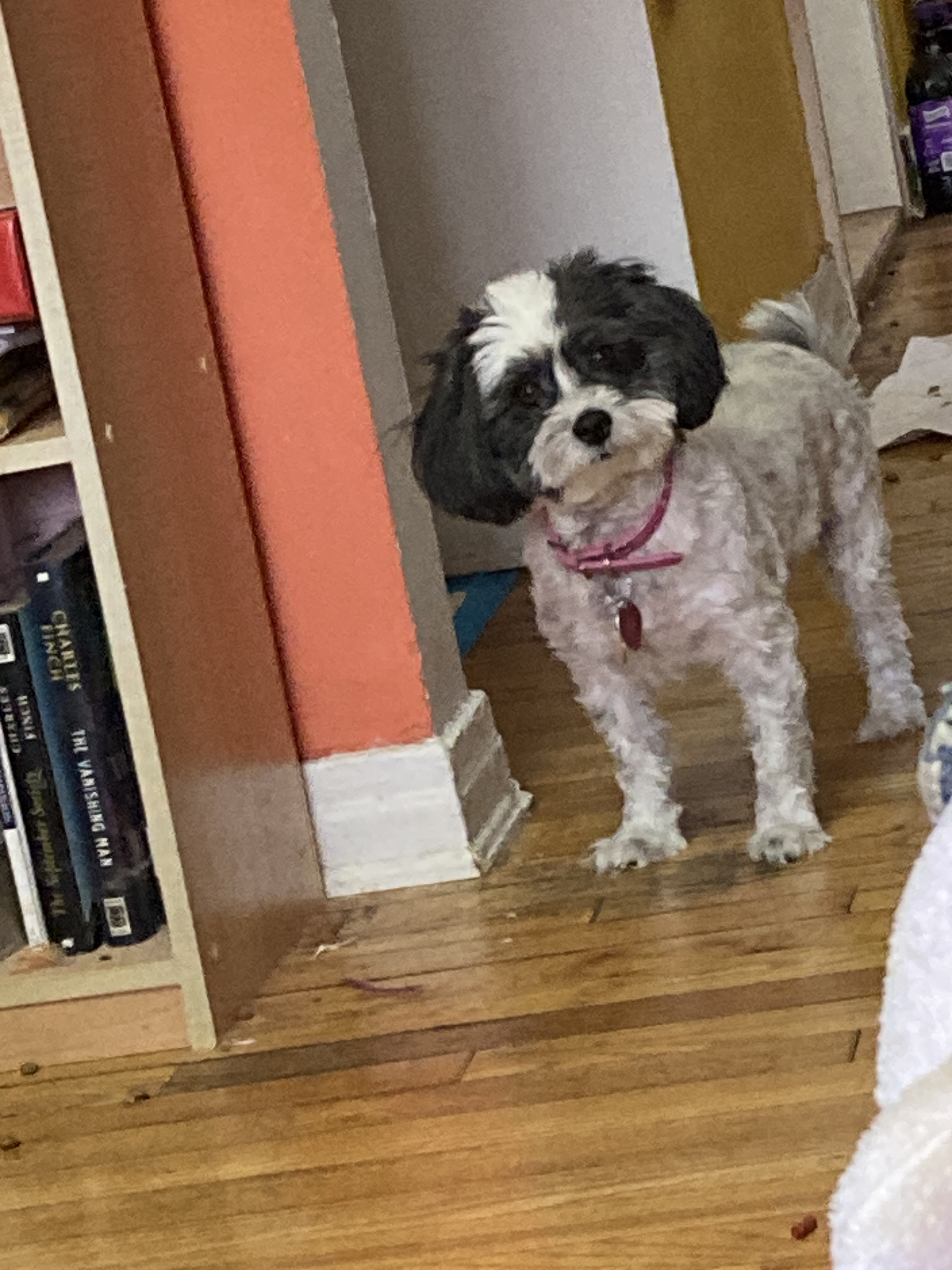
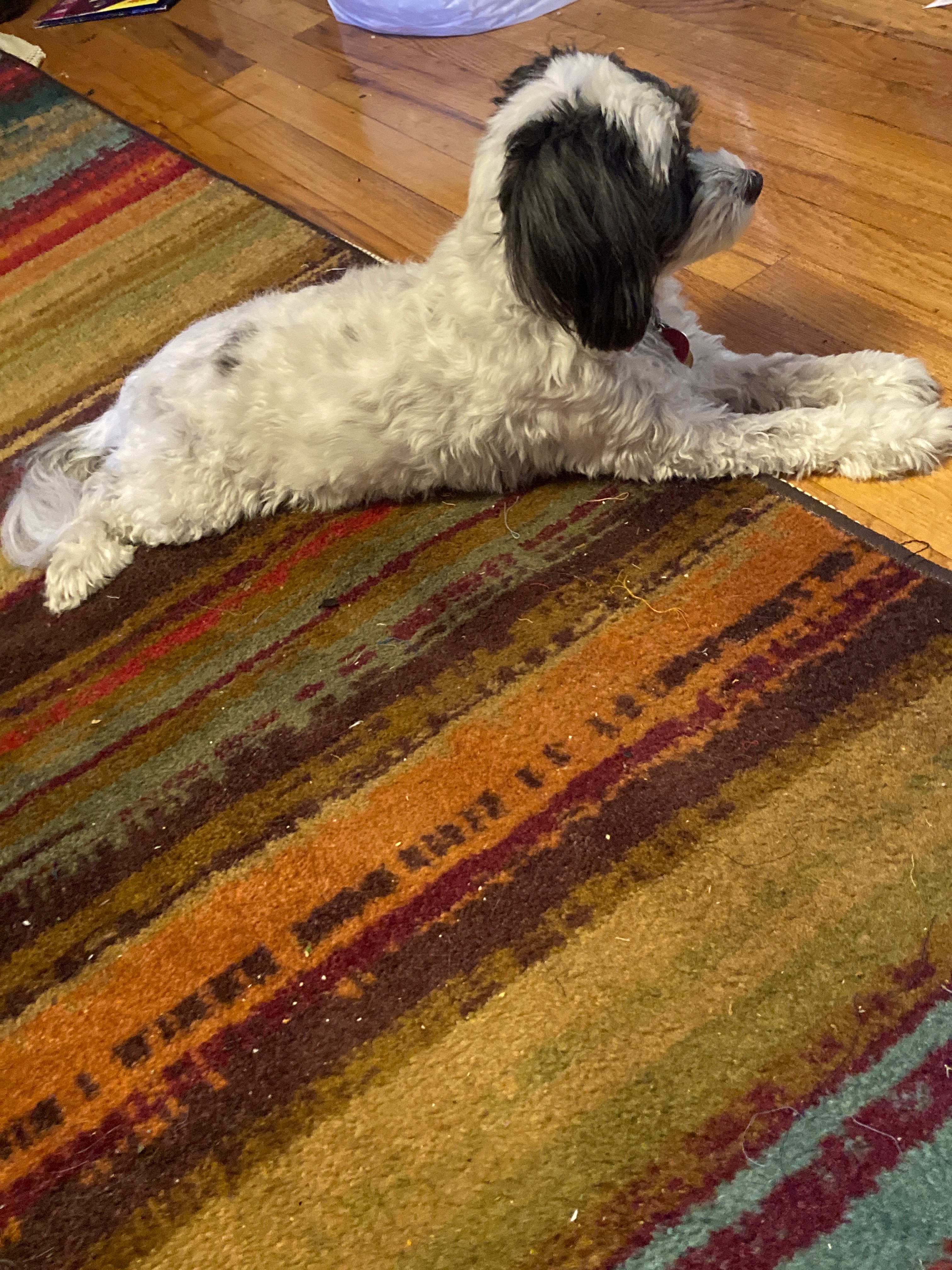
In the past, when I’ve tried to take Tzipporah for a walk she just sat on the ground and shivered, and if I dared to tug on her leash she fought like a wild animal to get away, burrowing under the bench by the retaining wall or trying to climb the wall itself. I was still taking her with me to therapy once a week, but I hadn’t tried putting her toes on the ground in months, and then last weekend something changed. Usually when we return home from therapy, Tzippy is exhausted, waiting just long enough to eat her chicken treat before stretching out in her bed for a long nap, but the day before the big blizzard she seemed more awake and aware, as if she was waiting for her next adventure.
I’m not sure what convinced me to try again, maybe just knowing that we would be snowed in for the next few days, but I bundled her back up in her winter coat, and put her leash back on, and carried her down the stairs and outside. At first, when I put her down on the walkway, she just sat down and waited as usual, shivering and looking around in alarm. But when Grandma started to walk ahead of us, Tzippy actually followed her. She only took a few steps before sitting back down again, but when I gave her some head scratches and encouragement, she took another few steps, and then a few more and a few more.
We managed the equivalent of one block – between our front door and the next building in the complex – and then she sat down more firmly and refused to go any further. I was sure I’d have to carry her, but when I turned back towards home Tzippy stood up and followed me, taking five steps at a time instead of three. She finally hit her limit about ten feet away from our front door, and then she sat down in front of me and refused to go another step. I picked her up and gave her kisses and so much praise for her amazing accomplishment, and she seemed to understand that she’d done something special, but she was also exhausted. As soon as I carried her upstairs and gave her a treat, she ran back to her bed to eat it and then stretched out for a long nap.
I’m sure it sounds like the tiniest of accomplishments, but it felt like a huge breakthrough. I’d almost given up on the possibility of change after more than a year of trying everything, and I have no idea what made this breakthrough possible; maybe it was all of those hours in therapy, or maybe her new food changed something, or maybe she was just ready.
The next day, after the snow had started to fall but before the real blizzard kicked in, we decided to try another walk just to see if the first one was a fluke. Tzippy was not at all sure about putting her paws down on the snowy walkway, but once again, when Grandma walked ahead of her, Tzippy followed. We walked twice as far, because Grandma insisted, but Tzippy wasn’t thrilled with the extra distance and kept trying to crawl under and through my legs to convince me to pick her up. With frequent breaks for head scratches and encouragement, we made it all the way back to our building, but the two steps up to the door were a no-go. When I picked her up, I touched her toes to each step to show her how it was done, but she was not at all interested and just wanted to get back inside.
Once the blizzard kicked in, we were content to stay indoors for the duration, and we didn’t go back outside until all of the shoveling and plowing had been done (by other people). But then we tried walking again. The third walk was short, and Tzippy was not enthusiastic, but she did it, so as the snow melts, I see a lot of short walks in Tzippy’s future. And if she needs to complain, I’m sure my therapist is ready to listen, and Grandma will hand out chicken treats by the handful as needed. I just hope it doesn’t take another year before Tzippy is ready to try the stairs.
If you haven’t had a chance yet, please check out my novel, Yeshiva Girl, on Amazon. And if you feel called to write a review of the book, on Amazon, or anywhere else, I’d be honored.
Yeshiva Girl is about a Jewish teenager on Long Island, named Isabel, though her father calls her Jezebel. Her father has been accused of inappropriate sexual behavior with one of his students, which he denies, but Izzy implicitly believes it’s true. As a result of his problems, her father sends her to a co-ed Orthodox yeshiva for tenth grade, out of the blue, and Izzy and her mother can’t figure out how to prevent it. At Yeshiva, though, Izzy finds that religious people are much more complicated than she had expected. Some, like her father, may use religion as a place to hide, but others search for and find comfort, and community, and even enlightenment. The question is, what will Izzy find?
I’ve been reading through piles and piles of notebooks, and files and files on the computer, to see which of my writing projects still spark my interest; and unfortunately, they all do. I can sort of prioritize one, or two (or five) above the rest, but it’s like trying to choose my favorite dog and having to ignore all of the others. How can you look away from that sweet, lonely, hungry little dog?! What kind of monster are you?!
There are novel ideas in the notebooks, and novel drafts on the computer, and drafts of long essays and short essays, and children’s stories, and short stories, and mysteries, and even a science fiction story or two. And along with all of the writing projects, I also have lesson plans to write, and a ton of therapy work I still need to do in order to become the kind of functional adult who doesn’t need to crawl under the bed and hide (which hurts my back, honestly).
This is what happens when I try to open the creaky, dusty, long-closed doors in my brain. I know I have to do this every once in a while, if only to make sure I’m not leaving something important behind, but it’s overwhelming. And, of course, there are endless internal arguments over which ideas have the best chance of getting published, and which ones will be an exhausting waste of time, and why do I have to be a writer at all when I really should be doing something more useful with my life, or at least more practical. But I’ve been a writer since I first learned how to hold one of those fat red pencils in nursery school, and if I stopped writing it would feel like I’d stopped breathing. And, really, even if it looks like I’m standing still, I am frantically kicking my feet under the surface, like a duck; and yet I judge myself only by what other people can see.
At some point, hopefully soon, I will finish this reassessment period and be able to choose a few manageable goals to work towards and put the rest aside. And then maybe I can put off the next reassessment for a while, or at least make sure I’m better medicated by then.
“Chicken fixes everything.”
If you haven’t had a chance yet, please check out my novel, Yeshiva Girl, on Amazon. And if you feel called to write a review of the book, on Amazon, or anywhere else, I’d be honored.
Yeshiva Girl is about a Jewish teenager on Long Island, named Isabel, though her father calls her Jezebel. Her father has been accused of inappropriate sexual behavior with one of his students, which he denies, but Izzy implicitly believes it’s true. As a result of his problems, her father sends her to a co-ed Orthodox yeshiva for tenth grade, out of the blue, and Izzy and her mother can’t figure out how to prevent it. At Yeshiva, though, Izzy finds that religious people are much more complicated than she had expected. Some, like her father, may use religion as a place to hide, but others search for and find comfort, and community, and even enlightenment. The question is, what will Izzy find?
I’ve been watching videos in Hebrew for a while now, to practice my listening skills and to get a wider sense of Israeli culture, and one of the richest sources for short (2-15 minute) videos is Kan Digital, the online section of the public broadcasting channel in Israel. I have no idea how many of these videos actually end up on TV in Israel, but there are tons of them available on YouTube; along with a really great interview series by Orit Navon that delves into serious subjects (mental illness, living with disability, bullying, grief, having one Jewish and one Muslim parent), there are also videos by a variety of reporters/performers from different segments of Israeli society (religious and secular, Ethiopian and Russian, Israeli Arab, Jewish, Muslim, Christian, etc.), on a wide range of subjects, from serious, fact-based pieces on how Israeli elections work, to slice of life videos about working from home during Covid, to a dance video on how to choose a watermelon.
Orit Navon
Recently, I saw a video from one of the usually less serious performers/reporters (he did the watermelon video), where he’s sitting in what looks like a real therapy session, or a very close facsimile thereof, and both the reporter (Ehud Azriel Meir) and the therapist seem to be from the Religious Zionist community (roughly equivalent to Modern Orthodox in America – which you can tell from their crocheted kippot and casual clothes, as opposed to the more formal clothing and black hats worn by Haredim/ultra-orthodox). I’d seen a lot of videos from Ehud before; he did a whole series where he was supposedly sent to work with the Arabic language division at Kan to create educational videos about Jewish holidays and rituals, and each video in the series poked fun at all of the assumptions Jews and Muslims and Christians in Israel make about each other. It was silly and light, but also allowed for a pretty deep exploration of social conflicts Israelis grapple with on a daily basis. In general, Ehud’s videos are like this, characterized by humor and a willingness to show his own flaws and mistakes, but the video with the therapist had a much more serious tone than I was used to from him.
Ehud Azriel Meir
The therapy session starts with Ehud’s feelings of guilt at wanting to vote for someone other than the Religious Zionist candidate in the coming election. He believes that if he votes for “the other” candidate, he’s not only letting his own side down, he’s letting the other side win (though in Israel’s multi-party system there are always more than two options). This led to a discussion of the moment he started to feel some alienation from his own political party, which is also his religious community, way back in the 1990’s, when Prime Minister Yitzhak Rabin was assassinated. Before the assassination, Ehud, as a teenager, took part in a lot of the demonstrations against Rabin’s push for the Oslo Accords. He and his fellow Religious Zionists believed strongly that the accords would lead to more terrorism rather than to peace, and they were loud and vehement in their opinions, calling Rabin a traitor and a murderer. And then, Yigal Amir, also a Religious Zionist, shot and killed Rabin at a peace rally.
For Ehud, Rabin’s murder was a moment of awakening. It truly devastated him that this man, who was like a father to him and to the country as a whole, had been killed by someone on “his side.” He had never considered the possibility that people were taking those screamed epithets literally, but when he and his friends tried to go to the vigils to mourn Rabin with the rest of Israel, they were turned away. And, still today, he resented that the secular Israelis blamed him for Rabin’s death, and he felt like it would be disloyal to his own group, and to himself, to vote with them on anything, even when he agreed with their policies.
The therapist pushed Ehud to acknowledge that his strong feelings around all of this might mean that he did feel somewhat responsible for Rabin’s murder, and that maybe he was uncomfortable in both the Religious and the secular worlds because he was still trying to avoid facing those feelings of guilt. Ehud bristled at that idea, but the therapist persisted, suggesting that in order for him to be at peace with having one foot in each camp, he needed to wrestle with the ways he himself believed that his actions long ago may have done harm, and to acknowledge that no matter how much he treasured his identity as a Religious Zionist, that wasn’t all of who he was.
There was something really powerful for me in watching this usually very un-serious guy, now grumbling and uncomfortable, being willing to share his discomfort and uncertainty with the public, in case it might do some good. And his internal conflict resonated with me too, even more so because he used the words Gam ve Gam (Both/And) to describe his feeling of being both a Religious Zionist, and something else as well.
Whenever I start a new semester of online Hebrew classes, I’m asked if I prefer my name to be pronounced the English way or the Hebrew way, and I always say Gam ve Gam, both because I grew up going to Jewish day schools where half the day I was one and half the day I was the other, but also because the feeling of having different parts of me that fit in with different groups is a big part of my everyday life. It can be really hard to live in the Both/And. I’m never sure if I should stand with one foot in each camp, or hop from one side to the other, or stand in the middle all by myself. More often than not, I feel like I have to hide parts of myself, or act in ways that feel wrong to me in order to fit in.
“I like both chicken treats AND Greenies.”
Watching this video reminded me of the traditional Ashamnu prayer that we say during the Jewish high holidays each year, where we pound our chests and admit to all of the possible sins that may have been done by a member of our community. That level of exaggerated responsibility has always bothered me, because I work so hard to make sure I do no harm, and it doesn’t seem fair that I should have to take responsibility for Joe Schmo over there who couldn’t care less who he hurts. It’s not even clear which community the prayer is referring to: does it include all Jews? All Jews on Long Island? All human beings on earth?
But now I wonder if the prayer is trying to get at the collective guilt we tend to feel when someone from our own political party, or tribe, or family, does something wrong. Even if we are not directly responsible for an evil act, we may have played a role in creating the conditions for that evil act to take place; or maybe our strongly held beliefs led us to encourage someone in the direction that led them astray; or maybe we were silent when we knew we should speak up, because we were afraid of being kicked out of the group; or maybe we felt responsible simply because outsiders told us that we were responsible, because they see our group as a single entity rather than a collection of individuals.
Once a year, this prayer gives us the opportunity to acknowledge those complex feelings of communal guilt, and reminds us that we need to recognize the impact we can have on the people around us, whether we intend that impact or not. And maybe most of all, the prayer reminds us that even when we disagree with our fellow community members, and speak up against them, we are still part of that community and that community is still a part of us.
I had a Creative Non-fiction teacher back in graduate school who told us that in order to write a good essay (for her class, at least), we needed to write about two seemingly unrelated subjects at once. For example, if you’re writing about pizza, you could also write about existential philosophy; or if you are writing about fashion, you could also look back at a memory from a childhood dance class, or a nature walk, or a chess game. Because, she said, the most interesting material comes from the way those two unrelated topics brush up against each other and create something new. And I think that’s true of more than just a good essay. When I live my life in both A and B (and often in C and D and E as well), the friction that comes from those mashups creates a lot of sparks, and what would our lives be like without all of those sparks to help light the way forward?
“You said pizza. I didn’t hear anything after that.”
If you haven’t had a chance yet, please check out my novel, Yeshiva Girl, on Amazon. And if you feel called to write a review of the book, on Amazon, or anywhere else, I’d be honored.
Yeshiva Girl is about a Jewish teenager on Long Island, named Isabel, though her father calls her Jezebel. Her father has been accused of inappropriate sexual behavior with one of his students, which he denies, but Izzy implicitly believes it’s true. As a result of his problems, her father sends her to a co-ed Orthodox yeshiva for tenth grade, out of the blue, and Izzy and her mother can’t figure out how to prevent it. At Yeshiva, though, Izzy finds that religious people are much more complicated than she had expected. Some, like her father, may use religion as a place to hide, but others search for and find comfort, and community, and even enlightenment. The question is, what will Izzy find?
According to Google, cognitive dissonance is a “psychological phenomenon where a person holds two or more conflicting beliefs, attitudes, or behaviors simultaneously. This inconsistency creates discomfort and tension, motivating the individual to resolve the dissonance.”
This concept came to mind recently while I was watching the first season of 911 (after a marathon binge of the show, starting in season three, that left me really curious about how the series began). I was especially interested in the romance between Abby, a 42-year-old 911 operator, and Buck, a 26-year-old rookie firefighter, because it set up the whole structure of the show, where they follow 911 calls through to their resolutions. But almost immediately, I felt queasy about the age difference between the two characters. I had to remind myself that, even though he was immature, Buck was an adult, and even though Abby was 42, she was at a vulnerable stage in her life and not in a position to take advantage of any perceived power differences between the two of them. They were both so obviously in need of love, and specifically in need of the kind of love the other had to offer, but…
Maybe because of the low stakes (it’s a TV show after all), I was able to sit with the dissonance and let it simmer for a while (a day or two, actually, because I watched the first season all in one go), and I realized that even though these moments of cognitive dissonance can be uncomfortable, or worse, they are also an opportunity for deeper understanding, of ourselves and of others.
When we see this kind of cognitive dissonance in our politicians, we tend to call it hypocrisy. How can you say you care about the poor and then fight so hard to cut Medicaid?How can you say you are an advocate for survivors of sexual abuse and then ignore the sexual offences of your favorite politician? In our private lives, it can show up maybe as wanting to save money for retirement, and then going on Amazon to buy ten things we don’t need.
“I needed all of it, Mommy!”
Like many psychological terms and theories, cognitive dissonance feels like a judgement being made on other people, a negative way of naming how we behave, without bothering to understand why we do it or having compassion for the struggle. Psychologists and therapists, and many other helping professionals, tend to feel overwhelmed by the chaos their patients or clients bring into the room and rely heavily on the intellectual distance of naming things to keep the chaos from seeping into their own lives.
The emphasis in the cognitive dissonance articles I was able to find, was on how we tend to resolve our dissonances, often with defense mechanisms, like: avoiding the dissonance altogether by staying away from discussions or situations that bring it up; delegitimizing the person or group or situation that highlighted the dissonance (this is fake news!); or minimizing the impact by telling yourself that you didn’t really go against your beliefs, or you just did it one time. Rarely, the articles seemed to suggest, do we actually choose to change our behavior or reassess our value systems in order to resolve the dissonance.
I’m not comfortable with the judgment (name calling) underlying all of this, and the assumption that we are all lying to ourselves all the time in order to resolve our discomfort, but I still think Cognitive Dissonance can be a useful concept, if we use it as a way to identify a problem that needs further attention. Ideally, if I feel guilty for doing something I didn’t plan to do, I can be curious instead of judgmental. And if I find myself minimizing, rationalizing, ignoring new information, or dismissing research out of hand, I can be curious rather than self-loathing. I can choose to look at the dissonance as a mystery worth exploring, a part of myself that deserves more of my attention and respect, rather than my judgment or impatience.
Just like in music, dissonance can catch your attention in a way that harmony may not, and it can tell you that something important is happening: it could be a mistake (you played the wrong note); or it could be the entrance of a new character, or a change in mood; or it could be the start of a disaster.
The Abby and Buck story on 911 tapped into two of my strongly held, and in this case opposing, beliefs: 1) that age/power/status differences between people can lead to abuse if we’re not careful about setting clear boundaries, and 2) love is a wonderful and healing thing. The way the show dealt with the dissonance in the relationship was both to minimize the weirdness of the age difference (by rarely mentioning it), and, in the end, by sending Abby off on a trip around the world until Buck could get over her. The un-stated conclusion was that two people who are at two very different places in their lives (either because of age or status or something else) may be able to spend time together and do each other good, but only for so long. The creators of the show chose not to sit with the discomfort inherent in such an age difference for more than a season, maybe because it made them that uncomfortable, or maybe because they discovered that it made their audience uncomfortable. And in season two, they replaced Abby’s character in the ensemble with Jennifer Love Hewitt, playing Buck’s older sister, suggesting that Buck was drawn to Abby in the first place in part because he was missing his sister, or missing the supportive role she played in his life, helping to ground him and give him perspective.
Even though I really liked the character of Abby, and especially the actress who played her (Connie Britton), I was relieved when she left the show and the void was filled with two new characters, Maddie (Buck’s sister) and a separate love interest. The dissonance that Abby and Buck’s relationship brought up for me, and for others, it turned out, was fundamentally not resolvable. I do wonder, though, what would have happened if the writers had made a different decision, and allowed that relationship to play out over a longer period of time. Would that have offered me an opportunity to delve more deeply into my own beliefs and feelings about power gap relationships, or would I have had to stop watching the show because it just made me too uncomfortable? (It’s also worth considering how the storyline would have been treated differently if the 42-year-old character had been male and the 26-year-old female. Would they have even told us their ages? Would I have thought to be bothered by it?)
While I was researching cognitive dissonance, I also came across the related quote, attributed to F. Scott Fitzgerald, that “Intelligence is the ability to hold two opposing ideas in mind.” The quote suggests that it’s a sign of intelligence to be able to entertain conflicting theories or facts without becoming overwhelmed or paralyzed, but I think the ability to face your cognitive dissonance is more about emotional strength, or intellectual bravery, rather than intelligence itself. I know a lot of highly intelligent people who, when faced with opposing ideas or desires within themselves, or facts in contradiction to a well-loved theory, resort to ever more inventive defense mechanisms to try to deny the existence of the conflict.
And I am no different. Recently, I was listening to a podcast by Haviv Rettig Gur, an Israeli journalist who writes and speaks in English to reach an audience outside of Israel. He was responding to an article in Haaretz (Israel’s venerable left-wing newspaper), that claimed Israeli soldiers were intentionally shooting at Gazans seeking aid. My first response, when I saw the article in my newsfeed, was disbelief, and then anger that they would even repeat such claims. How dare they suggest that the IDF would deliberately kill civilians, especially after telling me over and over again that the IDF does its best to avoid civilian casualties. But Haviv Rettig Gur, as a journalist, was able to sit with the dissonance (between believing that the IDF tries to avoid killing civilians and the reports that they were doing just that), and what he came to understand, or believe, was that, yes, the shootings were happening (though probably not in the numbers reported by Hamas), not because the soldiers intended to randomly kill civilians, but rather because these young soldiers were being tasked with protecting aid locations without being trained for the task. Most of the soldiers involved had been taken from nearby battlegrounds, where they were under attack from Hamas soldiers wearing civilian clothes, facing booby-trapped buildings and roadside bombs and all kinds of dangers around every corner, and then suddenly they were told to guard aid sites, where the signage was unclear and it was inevitable that civilians would go the wrong way at the wrong time and the soldiers were going to see them as a threat.
The problem, as Haviv Rettig Gur saw it, was caused both by the presence of Hamas in the aid areas and by the expectation of Israeli politicians that these soldiers could be tasked with protecting the aid sites without adequate training or support. Those politicians, especially the ones with little to no military experience (which is a significant deficit in Israel, where army service or an equivalent form of civil service is required for the majority of the population, but the fight over whether or not the ultra-orthodox have to serve is ongoing), probably thought they could order the army to do whatever they wanted, like ordering a special hamburger off menu. And when the army’s leadership said they couldn’t do it, the politicians probably assumed that they were lying for some reason, because that’s what the politicians themselves would have done. Are some of those politicians okay with killing civilians? Yeah. Some of the far-right politicians have basically stated their disinterest not only in the lives of Palestinian civilians but in the lives of Israeli soldiers and Israeli hostages as well. Should they still have their jobs? Not at all, but Netanyahu appeases them in order to keep his coalition government afloat. Is this the best way to run a country, especially during a war? Not even a little. But when the attorney general or the supreme court in Israel have tried to intervene, the government has threatened to dismantle the whole system of checks and balances (this is what led to the year long protests across Israel in the year leading up to October seventh), and being attacked by Hamas didn’t fix the underlying hypocrisy and graft in the government that is now tasked with protecting its people from further attacks.
The dissonance between Israel’s stated dual values of protecting civilian lives and eliminating Hamas has been there from the beginning, and ideally those conflicts would have been openly addressed and debated, with deep discussions as to the value of human life and the needs of a populace to feel secure, but instead the conflicts have been minimized and denied, to disastrous effect.
Another example. When it became obvious to the people around Joe Biden that he was losing his faculties, yet still insisted on running for President again, they could have been open, with him and with the American people (or at least with the higher ups in the Democratic party), about their concerns. There could have been discussions about how to prevent a Trump presidency (with all of its inherent dangers to democracy), while also pursuing an open Democratic primary, and a contest of ideas leading to the best possible candidate, or at least an open acknowledgment that our country is still not ready for a woman of color as our president; but instead, they rationalized and made excuses and got defensive, and therefore they could not solve the problem at all, until it exploded.
Unfortunately, we are living in a time when defense mechanisms are being chosen over reality, not just by some people but by most people, and especially by those in power. Republican congressmen are ignoring their cognitive dissonance around the “Big, beautiful bill,” with its severe Medicaid cuts and inevitable growth of the national debt, because they seem to be too afraid of Trump to vote their stated values. And many Israelis, at least at the beginning of the war with Hamas, seemed to be willing to ignore the suffering in Gaza because they thought empathy for the civilians would get in the way of their goal of removing Hamas as an existential threat. Most Israelis have, as far as I can tell, grown throughout the war in their empathy and willingness to face a complicated reality, including the realization that removing the threat of Hamas entirely may be impossible.
The acknowledgement of a cognitive dissonance, between what you may have hoped to be true and what is really happening, or who you thought you should be and who you really are, can be painful and frightening, and can lead to hopelessness and despair, which explains why we have found so many creative ways of avoiding the dissonance. At times it can feel like the dissonance is unresolvable, because it may be, and therefore that there’s no point in facing it. And sometimes we really do need the respite that denial and minimization can provide, until we feel strong enough and capable enough and supported enough, to face the truth. But it’s only when we allow ourselves to see all of the facts, and to face all of the conflicting facets of ourselves, that we have any real chance of finding solutions, or at least of processing our grief when solutions are found to be impossible.
“Is it treat time yet?!”
If you haven’t had a chance yet, please check out my novel, Yeshiva Girl, on Amazon. And if you feel called to write a review of the book, on Amazon, or anywhere else, I’d be honored.
Yeshiva Girl is about a Jewish teenager on Long Island, named Isabel, though her father calls her Jezebel. Her father has been accused of inappropriate sexual behavior with one of his students, which he denies, but Izzy implicitly believes it’s true. As a result of his problems, her father sends her to a co-ed Orthodox yeshiva for tenth grade, out of the blue, and Izzy and her mother can’t figure out how to prevent it. At Yeshiva, though, Izzy finds that religious people are much more complicated than she had expected. Some, like her father, may use religion as a place to hide, but others search for and find comfort, and community, and even enlightenment. The question is, what will Izzy find?
Though Tzipporah, my four-year-old Havanese rescue dog, has learned to pee on the wee wee pads, she often pees just off the edge (my feet are on the pad, though!), or she’ll pee on the rug by the front door, as a form of protest when we dare to go out and leave her behind for more than five seconds. I thought I was doing a good job of keeping up with all of the pee, sopping it up with paper towels and cleaning each spot as quickly as possible, but then came a week of wet weather and the pee smell seemed to rise up from the rugs to fill the air.
“You’re telling everyone?”
I ordered some high-powered anti-pee carpet cleaner, because I can’t for the life of me remember how to use the carpet shampooer we bought ten years ago (and haven’t used since), but before it could even arrive, Mom agreed to get rid of the rugs in the hallway. We’re still crossing our fingers, and paws, that the living room rug is salvageable, but we’ll see.
Unfortunately, Tzipporah is still nowhere near ready to pee outdoors. We’ve been taking her outside a few times a week, to help her get used to the grass, and the leash, but it’s been slow going. I’ve also been taking her with me to therapy once a week, to acclimate her to travelling in the car, if nothing else, and, of course, my therapist decided that if Tzippy was going to come to therapy, she might as well do some therapy work. Her goals for Tzippy are to come when called, to walk on a leash, and to accept treats from a human hand (other than Grandma’s). I was pretty happy with Tzippy’s growing ability to sit calmly in the car, and then on my lap for forty-five minutes in the office, but what do I know.
One very exciting development came when we took Tzipporah outside for one of her get-used-to-the-grass-adventures, and Kevin the mini-Goldendoodle came over and dropped his tennis ball at her feet, four times! Tzipporah had no idea what to do with the ball, but she seemed to recognize that he wasn’t a threat and allowed him to sit next to her on the grass for minutes at a time.
Kevin’s dad took this wonderful picture
Tzipporah is decidedly different from any of the dogs we’ve had before, especially in her insistence on staying in her bed whenever we’re nearby, and never, ever, barking. And yet, I’ve caught myself almost calling her “Ellie” a number of times. It may just be that Ellie’s name comes to mind because she was our most recent dog before Tzipporah, or because Ellie was also a Havanese (though with different coloring). And it shouldn’t bother me so much, but it does. It’s not that I feel guilty for misnaming Tzippy, because I usually catch myself in time, it’s more that I’m afraid I’m forgetting Ellie too quickly, as if she’s so easily replaceable by someone else.
The problem is, while I can never forget Cricket, even for a moment, I sometimes struggle to remember stories and moments from Ellie’s life. My memories of Cricket are so full-bodied that it feels like Cricket is actually in the room with me when I think of her, as if I can summon her at will. Cricket was in my life for sixteen years, from puppyhood, and she imprinted herself deep into every cell of my body, but I only had Ellie for five years, and I’m afraid my memories of her, which are just whispers at this point, will soon disappear.
“Hey, I’m full bodied too.”
But, now that I think about it, we had to get rid of our rugs after Ellie’s first few months with us too, and I took her with me to therapy for two years (more for my sake than for hers, to be honest, but the process seemed to help her relax and bond anyway). So Maybe Ellie’s name comes to mind because she is still here with us, and here with Tzipporah. Cricket was Ellie’s trainer, pushing her to bark and run and beg for treats like a “real” dog, and maybe Ellie is doing her own version of big-sister-ing with Tzipporah from the other side of the rainbow bridge, letting her know it’s okay for things to take time and that she will be loved no matter what.
“I’m still here, Mommy.”
Ellie never became a Velcro dog, like Cricket, but she knew she was loved and safe. So, if even an echo of her is still present in the apartment, whispering in Tzipporah’s ear, maybe everything really will be okay.
“I’m never alone.”
If you haven’t had a chance yet, please check out my novel, Yeshiva Girl, on Amazon. And if you feel called to write a review of the book, on Amazon, or anywhere else, I’d be honored.
Yeshiva Girl is about a Jewish teenager on Long Island, named Isabel, though her father calls her Jezebel. Her father has been accused of inappropriate sexual behavior with one of his students, which he denies, but Izzy implicitly believes it’s true. As a result of his problems, her father sends her to a co-ed Orthodox yeshiva for tenth grade, out of the blue, and Izzy and her mother can’t figure out how to prevent it. At Yeshiva, though, Izzy finds that religious people are much more complicated than she had expected. Some, like her father, may use religion as a place to hide, but others search for and find comfort, and community, and even enlightenment. The question is, what will Izzy find?
I had this past week off, like most teachers in the United States, for Presidents’ week, and I really needed the break. But one week of vacation was just long enough to remind me of all of the things I wanted to get done, and not long enough to actually do them. Especially since the first thing on my to-do list really took over.
My to do list: SLEEP; put the new rugs down; think through all of the requirements for our next dog(s), and look for rescue organizations that will let us adopt without a fenced in yard; finish three novels and start two more, though one or more may end up being a memoir instead of fiction; read through my ten boxes of Therapy Pages notebooks and plan how to use them; start exercising again (for the fiftieth time); clean the kitchen and get back to cooking (instead of microwaving); read all of the books on my bedside table and piled haphazardly on my shelves; buy more bookcases; finish translating another ten Israeli pop songs and try not to add more to the list right away; work on lesson plans for the rest of the school year; get a haircut (or find a good excuse for why I shouldn’t have to ever cut my hair again); read through my hundred-page-plus draft of an “essay” on the history of the modern state of Israel, and see how many more books I will need to read before I can convince myself that I’m in over my head; watch every webinar I’ve downloaded from YouTube, on writing and therapy and music and Israel and whatever else; oh, and don’t fall into a deep depression as a result of the isolation and loneliness, if possible.
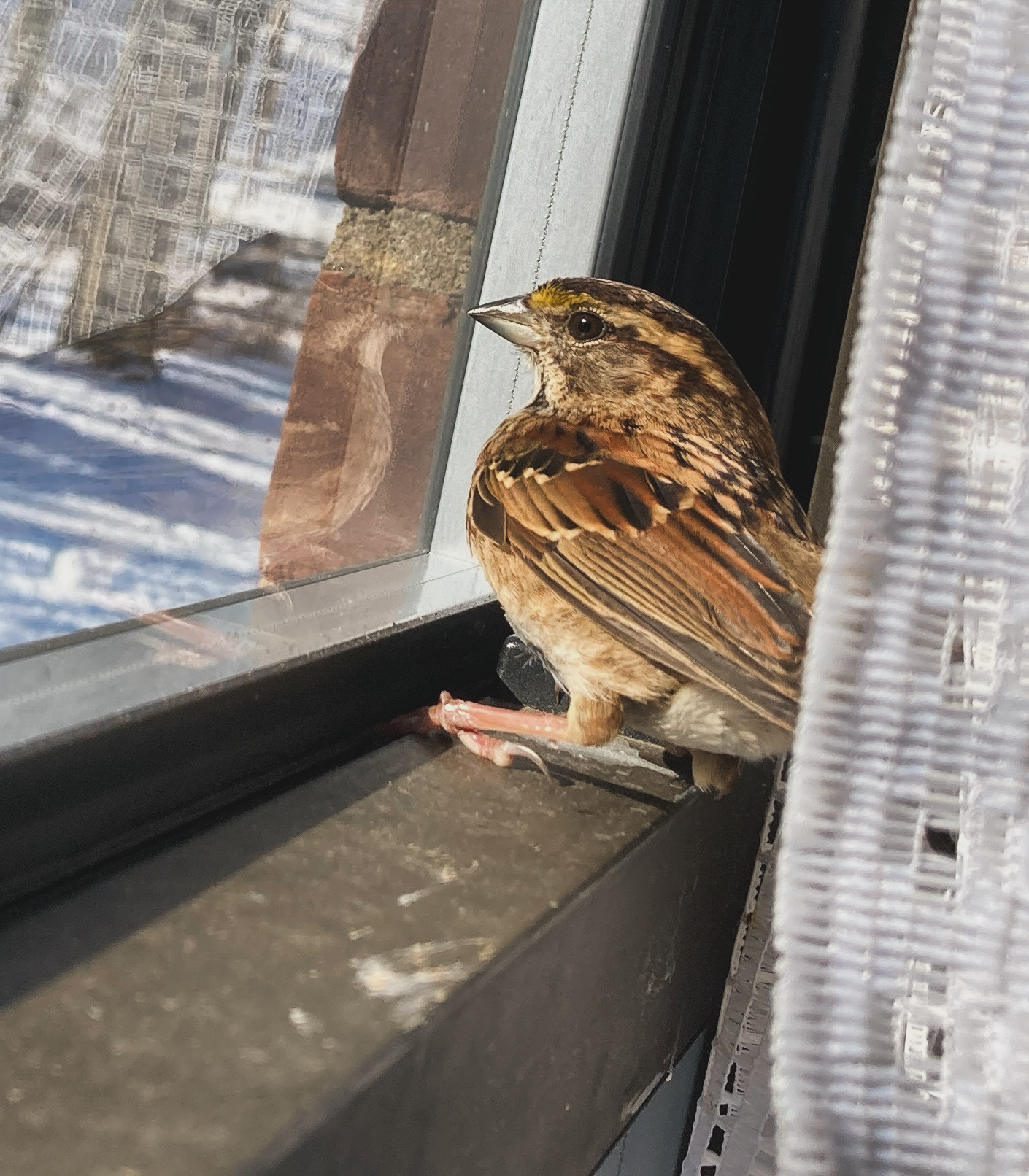
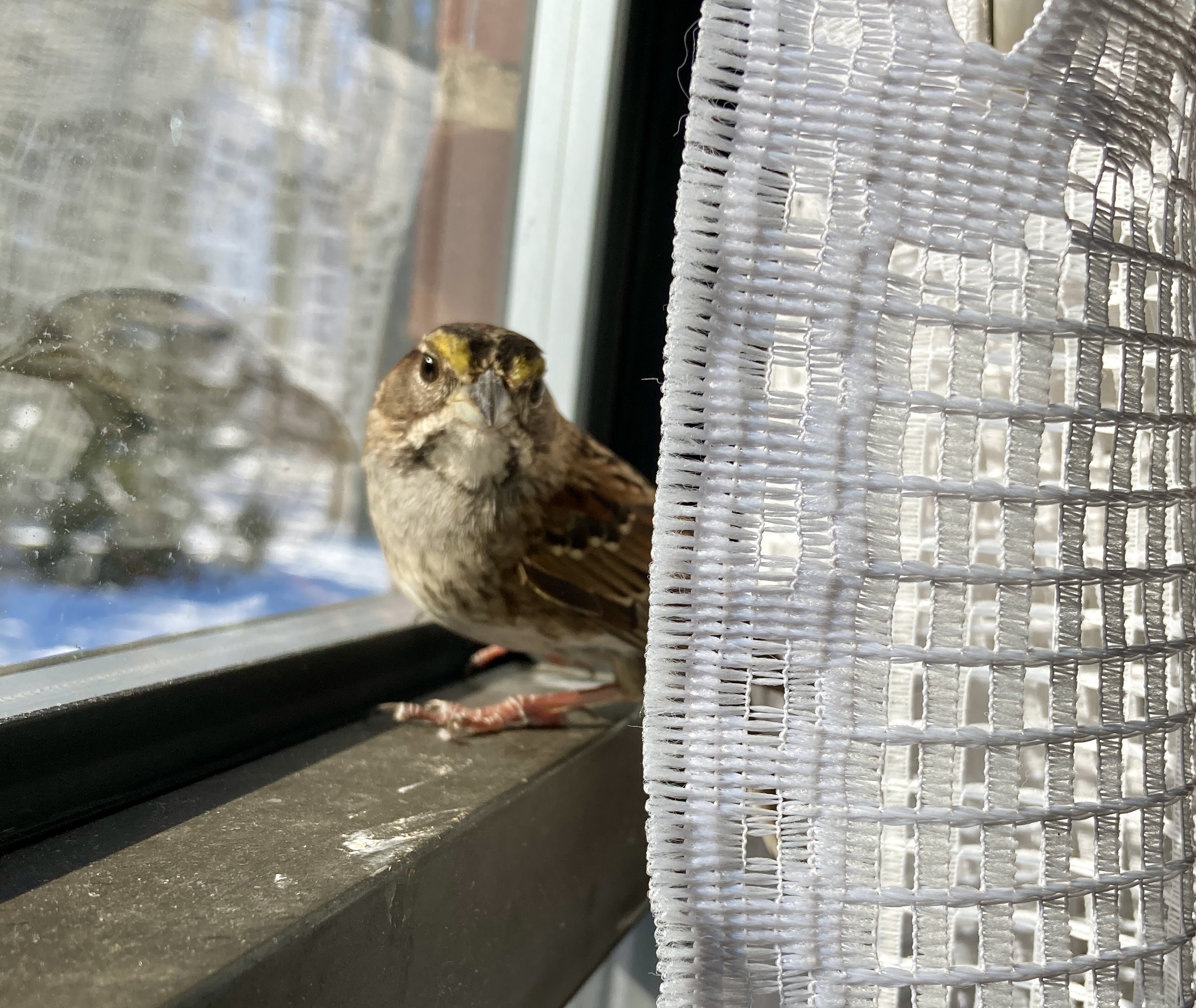
One nice thing happened before the actual vacation started which gave me hope: we had another birdie visitor. This time it was a young white-throated sparrow who either had ADD or a panic disorder and kept flying and pacing relentlessly around the apartment. Mom got some great pictures of him in the few moments when he was able to remain still.
But then, right after the bird left, I heard from my pharmacy that the FDA is clamping down on off label prescriptions for Ozempic (anything other than a type-two diabetes diagnosis), and then my doctor told me that my insurance won’t cover any of the other weight loss medications (Wegovy, etc.), so if I wanted to keep taking weight loss medication it would cost at least $1,000 per month. So, after six months of slow weight loss, the experiment is suddenly over. There’s a bill in the US congress to try to get weight loss medications covered by health insurance, but who knows how long it will take to get it approved; relying on the smooth workings of the United States government has never been a good life strategy.
If the weight I’d already lost had improved my overall health, then maybe I would feel better about stopping here, but, if anything, I’m more exhausted now than I was six months ago. Which is why the first thing on my to-do list overwhelmed everything else I wanted to accomplish this week, and most of my vacation was spent sleeping, or at the very least, lying down. I also watched a bunch of webinars (and managed to download even more), and got some reading and writing and typing done. But vacation is almost over and my to-do list is, if anything, longer than it was at the beginning of the week. How is that even possible?
Here’s hoping that the rest I’ve been able to get this week will help me get through until the next short vacation, and that somewhere along the way some more birdies will come along to remind me that all of this is worth the effort – even if my to-do list never, ever, gets done.
If you haven’t had a chance yet, please check out my Young Adult novel, Yeshiva Girl, on Amazon. And if you feel called to write a review of the book, on Amazon, or anywhere else, I’d be honored.
Yeshiva Girl is about a Jewish teenager on Long Island, named Isabel, though her father calls her Jezebel. Her father has been accused of inappropriate sexual behavior with one of his students, which he denies, but Izzy implicitly believes it’s true. As a result of his problems, her father sends her to a co-ed Orthodox yeshiva for tenth grade, out of the blue, and Izzy and her mother can’t figure out how to prevent it. At Yeshiva, though, Izzy finds that religious people are much more complicated than she had expected. Some, like her father, may use religion as a place to hide, but others search for and find comfort, and community, and even enlightenment. The question is, what will Izzy find?
Early in the school year I went searching for information on ADHD and Autism, to try to understand behaviors I was seeing in some of my students at synagogue school. I didn’t learn much about either diagnosis in my three and a half years in graduate school for social work, or even during the two years prior to that, when I was studying psychology in hopes of applying to a doctoral program in clinical psychology. And I certainly didn’t learn much about how to teach kids with those learning differences.
I watched a lot of short, explanatory videos on ADHD and Autism that left too much unexplained and undescribed, and then I watched a lot of videos made by adults with ADHD and Autism who could describe the neurological differences they experienced, but still couldn’t give me, as a teacher, a clear idea of how to be helpful. And then I watched a bunch of videos about the blurry lines between ADHD, Autism, and trauma responses in children and adults, many of which validated my own experience of the mental health field, which is that there’s a lot we don’t know, but there are a lot of people who like to sound certain anyway, which is just annoying.
“So annoying.”
But while I was looking into ADHD and Autism for my students, I kept finding videos that resonated with me, and I realized that I’ve been hitting a wall in therapy, in large part because the plans I had for my life have been derailed by my health issues and that has left even my therapist stymied as to how to help me. So even though the ADHD and Autism videos weren’t panning out, I thought I would keep looking though YouTube to see if I could find some ideas to try out in therapy, or even just ways to help me accept where I’m at and find some peace.
I took a deep dive into the big names in Psychology, and especially in Trauma and Sensorimotor therapies and Attachment, thinking I must have missed some important ideas along the way that could have healed me by now, but I realized quickly that I’d heard all of it, and studied it, and parsed it for all of the helpful morsels of wisdom long ago. In almost thirty years of therapy, I realized, I’ve learned at least a doctorate’s worth of information/wisdom on the impact of trauma, even though I struggle to feel confident in what I know.
But then I found a relatively young therapist/social worker named Patrick Teahan who had made a lot of videos about dealing with the impacts of a traumatic childhood in really down to earth, practical ways. And while he wasn’t telling me things that were new to me in theory, he had a way of talking, especially when sharing his own stories, that was validating and made me feel less alone. He shares a lot of concrete examples about what it feels like to have your sense of reality constantly challenged, and he’s able to describe situations and put things into words that often remain blurry for me.
He can be a bit verbose at times, though not in an academic way, more like if a friend were telling you a story and kept interrupting himself to tell you about another aspect of the story, and then getting back to the main idea only to go off on another tangent. I decided to take notes when I watched his videos, to help me follow the main through lines of what he was saying, and to give myself permission to take the videos more seriously, and to take my time with them, because the real value I was getting was a sense of his basic kindness as he worked to remove the shame that comes with a difficult childhood and from the lifelong dysregulation it can cause.
He works in a form of therapy I’d never heard of, called the Relationship Recovery Program, and I have no idea how commonly it’s practiced or where it’s practiced, but I like the way he seems to respect each person’s life story, and I like that he doesn’t profess to have all of the answers. Most of all I like his sense of hope, that with time and effort people can come out of therapy feeling better and seeing things more clearly than before.
I haven’t watched all of his videos, but I have a long list of the ones I want to watch carefully, taking notes and absorbing the material without overwhelming myself too much. And whenever I watch one of his videos, YouTube recommends a handful of other videos on similar topics, with other therapists, and even if I don’t watch them right away, there’s this reassuring sense that they’ll be there for me, some day, when I need them.
The biggest gift from all of this video research, though, has been the reminder of how much I already know, about myself, and my students, and how valuable it is to just be a witness to what others are going through and to validate their experiences instead of evaluating or diagnosing them. Attention and kindness really can help people heal. I just have to keep reminding myself of that.
“I’ll remind you!”
If you haven’t had a chance yet, please check out my Young Adult novel, Yeshiva Girl, on Amazon. And if you feel called to write a review of the book, on Amazon, or anywhere else, I’d be honored.
Yeshiva Girl is about a Jewish teenager on Long Island, named Isabel, though her father calls her Jezebel. Her father has been accused of inappropriate sexual behavior with one of his students, which he denies, but Izzy implicitly believes it’s true. As a result of his problems, her father sends her to a co-ed Orthodox yeshiva for tenth grade, out of the blue, and Izzy and her mother can’t figure out how to prevent it. At Yeshiva, though, Izzy finds that religious people are much more complicated than she had expected. Some, like her father, may use religion as a place to hide, but others search for and find comfort, and community, and even enlightenment. The question is, what will Izzy find?
This past summer was very difficult, with Mom’s two surgeries and one of my own, and it became clear to me that my reluctance to ask for help when I needed it – or even to accept it when it was offered – made things much harder than they had to be. I know that there are people in my life who would be happy to help me, and who have offered to help many times, but I always say something like, no, I’m fine, thanks anyway.
“Sure you are.”
I knew some of the reasons why it was hard for me to ask for help: it’s embarrassing to try to explain what I need versus what other people expect me to need; I’m afraid of being judged for the things I can’t do; I don’t believe I deserve help; I’m afraid of what I will owe in return; I often have no idea of what kind of help would help me; and, often, what I really need is so much bigger than what people can give me: I want to feel safe and loved; I want to pay off all of my debts; I want to be healthy and have the energy to go to work more often; I want to be published by a major publisher; I want a house with a yard, and ten dogs, and a horse; I want children. And if I can’t have what I really want, whatever I get instead ends up feeling disappointing, no matter how kindly and generously it is given.
So, I said no to the offers of help this summer, whether they were offers to make meals, or give rides, or just be a supportive listener; even though I was terrified while Mom was in the hospital, and for the first few weeks after she came home. I worried that she would die, and then I worried that something would go wrong and I wouldn’t know how to help her, and then I worried that something would break in the apartment and I wouldn’t know how to fix it. Through all of it, I just kept saying, No, I’m fine, thanks anyway.
I’ve been practicing my asking-for-help skills with Mom for years, because she always wants to help me and never judges me for being needy. And I’ve learned that when what I ask for is impossible (aka, take out your magic wand and fix everything, Mommy), she will search for ways that she can help that I couldn’t have thought of myself. And more often than not, that help is what gets me to the solid ground I need in order to take the next small step by myself. But that practice hasn’t translated very well into asking for help from other people, maybe because I don’t trust them to help without judging me.
“I will always judge you.”
When I told my therapist about this essay, she told me that I was conflating two kinds of help: practical help and emotional support. But for me, those two things have to come together or else neither one really works. Emotional support feels empty without some kind of practical help that gets me over the void in my own abilities, and practical help feels unsafe and alienating if it’s not accompanied by emotional understanding and sympathy for why I need help in the first place.
To be fair, to me, I’ve gotten better at asking for help than I used to be, and to be fair to other people, there have been plenty of times when I have received meaningful help, without being talked down to or treated like a lesser being. But I never expect it to go that way.
I was reading a scene in a Rhys Bowen novel recently, where the protagonist had injured her collarbone and needed help carrying her bag up the stairs (needless to say, this was not the dramatic peak of the novel), and she wasn’t embarrassed, or feeling guilty, or trying to muscle through it. She just asked for the help she knew she needed and moved on. And I was gobsmacked! This otherwise unimportant scene stayed with me, because I kept asking myself how it was possible that she didn’t feel embarrassed, and didn’t imagine that she was exaggerating her injury, and didn’t see herself as a failure for needing support. I take all of those feelings for granted, as the cost of living, but wouldn’t it be amazing not to feel that way?
“I always trust you to help me, Mommy.”
I was almost done with this essay, I thought, when another facet of this fear of asking for help came up; one that I hadn’t recognized before: I had to reach out to my dentist, between appointments, because one of my bottom teeth was loose and causing a lot of pain. I’d been putting off calling her, telling myself that I’d just seen her recently, and she knew my situation, and there was no point in being dramatic about it, and the pain wasn’t so bad. But Mom, who knew how hard I’d been working on this essay, told me that I needed to ask for help, and I felt sufficiently scolded to push myself to reach out to the dentist. The dentist called me right back and said she wanted to fit me in for an appointment as soon as possible, because she’d been worried about that tooth since my last visit, and she already had a plan for removing and replacing it. I made the appointment and then grumbled to myself about the unfairness of life, and how annoying it was that she’d called back so quickly and already had a plan in mind. And I realized, that’s why I didn’t want to reach out to her in the first place: I didn’t want to know that my lower teeth were in such bad shape, so soon after the trauma of replacing the upper teeth.
I keep wanting to believe that asking for and receiving help will be some kind of magical elixir, where the pain disappears and life feels easy; that is often the kind of help I’m craving. But if getting help actually means having to face the harsh realities of life, the ones that I can’t handle on my own, then no wonder I’m reluctant to ask for help. Maybe putting off asking for the help I know I need allows me stay in La La land for a little while longer.
“I like La La Land!”
I have no idea how to overcome this desire to stay in La La land. Intellectually, I know that I have to, but I also know, deep in my body, that I’m not ready. I think part of my belief that I can’t get the kind of help I want from other people comes from knowing how hard it has been to give myself the compassion and support I need when I’m struggling. I figure, if I can’t give that to help myself, why should I believe that anyone else would be willing or able to give it to me?
“Oy.”
If you haven’t had a chance yet, please check out my Young Adult novel, Yeshiva Girl, on Amazon. And if you feel called to write a review of the book, on Amazon, or anywhere else, I’d be honored.
Yeshiva Girl is about a Jewish teenager on Long Island, named Isabel, though her father calls her Jezebel. Her father has been accused of inappropriate sexual behavior with one of his students, which he denies, but Izzy implicitly believes it’s true. As a result of his problems, her father sends her to a co-ed Orthodox yeshiva for tenth grade, out of the blue, and Izzy and her mother can’t figure out how to prevent it. At Yeshiva, though, Izzy finds that religious people are much more complicated than she had expected. Some, like her father, may use religion as a place to hide, but others search for and find comfort, and community, and even enlightenment. The question is, what will Izzy find?
Sometimes I just can’t force myself to do certain things, even if I don’t understand why not, and no one else can understand why not. But I’ve learned to trust that internal voice telling me that I’m not ready, or that I’m going down the wrong path, or that I won’t be able to do what’s being asked of me. I’ve learned to listen for the intensity of the I Don’t Wanna voice, because that can help me figure out if I can overcome it, or if I shouldn’t even try to overcome it.
“What took you so long?”
The problem has been that my therapist (and teachers and friends) can’t hear that voice, and they don’t trust me to assess its accuracy on my own, and they tell me, meaning well, that I should ignore it and do what needs to be done, whether I want to or not, and whether I think I can do it or not. They think I can and should ignore the I Don’t Wanna voice, because they think of it as selfish, or self-destructive, or weak, or whatever else they say to themselves about their own I Don’t Wanna voices. And I hear their judgements and their impatience and their distrust of me, and it feels bad, but that doesn’t change what I can and can’t do.
But I’ve noticed, over time, that the better I get at hearing and trusting the I Don’t Wanna voice, the more clearly I can begin to hear the I Wanna voice. It turns out that I wanna teach synagogue school, even though I don’t know why. I can’t explain it, especially after spending three and a half years and a lot of money getting a degree in social work. And I wanna take online Hebrew classes, even though I can’t see the logic in it, or make a good argument for why this is the right good step forward in my life. I just know that the I wanna voice keeps getting stronger the more that I listen to it and trust that it knows what it’s talking about.
“I wanna have chicken treats!”
I was better at hearing these voices when I was a kid: when I knew I wanted chocolate frosting but not the cake it was sitting on, or I knew I wanted to do more math homework, even if I never got extra credit for it. But I was told so many times not to listen to myself and just do what I was supposed to do: eat what I was supposed to eat, take the classes I was supposed to take, accept the friendships I was offered; and never trust my feelings to tell me what was best. And as a result, I lost track of the I Wanna and I Don’t Wanna voices, and for a long time all I could hear was what other people wanted me to do, and their endless judgments when I couldn’t live up to those expectations, and my own confusion about why I couldn’t do what I was supposed to be able to do.
It has been a very long road back to hearing, and trusting, my own internal voices, and it’s still a struggle. There’s so much more than the I Wanna and I Don’t Wanna voices to listen to, but they all seem to crash around in my head at once, becoming noise without much meaning. I’ve been working so hard on Intuitive Eating for the past year and a half, endlessly trying to hear these subtle voices of hunger and fullness before they become shouts, instead of relying on what I think I should eat to please the diet gods, whoever they may be on a given day. But I still fall into the abyss, almost every day, thinking that my own feelings are untrustworthy and selfish and self-destructive and should be ignored. But, in favor of what?
I guess I’ve reached the point in the journey where I know there’s no other path to follow, even though I still feel all of the guilt and self-loathing for not being able to do what I’m supposed to do. I’ve accepted that I have real limitations and I’ve learned to trust them, instead of pushing forward anyway and just waiting for the inevitable disaster. One sign that I’m on the right track is that even though I still have a lot of anxiety, it’s been a long time since I’ve had an actual panic attack, or even a deep dive into depression.
Part of the internal noise I keep having to fight with is that I so desperately want to be a rational creature, with explanations for everything I do and don’t do, but given how much I don’t understand (about myself, about the world, about science and math and the energies in the universe), sometimes my gut feelings are the only map I have left to follow. I wish I could say that I understand how all of the levers and pulleys of my brain work, and that I know for sure that I’m interpreting my thoughts and feelings correctly, but I can’t. All I can do is keep listening for the I Wanna and I Don’t Wanna voices, as they whisper to me, and show them, through my actions, that I am trustworthy, and that if I choose to ignore them, I have good reasons.
“There is no good reason to ignore me.”
I wish the guilt and self-loathing would shut up already, but I guess they count as internal voices too, at this point. They may have come from the outside to start with, but they are part of my gears and wires now and I need to find a way to respect them too.
Ugh.
“Ugh.”
If you haven’t had a chance yet, please check out my Young Adult novel, Yeshiva Girl, on Amazon. And if you feel called to write a review of the book, on Amazon, or anywhere else, I’d be honored.
Yeshiva Girl is about a Jewish teenager on Long Island, named Isabel, though her father calls her Jezebel. Her father has been accused of inappropriate sexual behavior with one of his students, which he denies, but Izzy implicitly believes it’s true. As a result of his problems, her father sends her to a co-ed Orthodox yeshiva for tenth grade, out of the blue, and Izzy and her mother can’t figure out how to prevent it. At Yeshiva, though, Izzy finds that religious people are much more complicated than she had expected. Some, like her father, may use religion as a place to hide, but others search for and find comfort, and community, and even enlightenment. The question is, what will Izzy find?
My father created chaos in our house when I was little, intentionally and unintentionally, because it worked for him, but living in his house made me feel like the floor was going to drop out from underneath me at any moment. He resented closed doors, even though he wanted to keep his own door closed; and he used all of the bathrooms in the house, even when he could easily get to his own private bathroom in time, almost like a male dog marking his territory. He set the rules, and often broke them, and then yelled at us for breaking rules he’d never told us about. All of that has left me handicapped when I try to figure out what “normal” boundaries should be, and when I have the right to enforce them.
“I always enforce my boundaries. Preferably with my teeth!”
And when I realized, recently, how hard (impossible!) it was for me to set boundaries with my doctors, and limit the damage they could do with their comments about my weight and their minimization of my symptoms, I decided that I needed to do some more basic research on boundaries, and figure out what the hell they are.
First and foremost, when I think of the word “boundaries,” I think of something like a fence or a wall, something solid and visible, but interpersonal boundaries aren’t supposed to be either. I think they’re supposed to be more like the semi-permeable cell membranes we learned about in High School Biology class, the ones that allow some molecules in and not others. But those molecules supposedly got through based on their size, rather than something more vague, and the cell walls were visible, at least under a microscope, and interpersonal boundaries just aren’t.
Each article I’ve read seems to have a different idea of how to set interpersonal boundaries, and even what they’re good for. One said that boundaries are a way to set a clear line between what is me and what is not me. For example: my father’s feelings, needs, crimes, etc., are not my responsibility, no matter how many times he told me that they were. Another article focused on how boundaries are a way to determine which behaviors you will accept from other people, and which ones you won’t (though they didn’t explain how to not accept behaviors you don’t like, and the assumption that I can just walk away from a bad situation feels dismissive, of me). The articles also talked about different kinds of boundaries: physical, emotional, material (stuff), time, intellectual (this one was blurry to me), sexual, etc.
My most obvious boundaries are the ones around my body, if only because my internal alarm system is so loud when my physical boundaries are crossed.
“Even I can hear it,”
I remember going to a new doctor when I was nineteen years old, probably transitioning from a pediatrician to my first official grown up doctor, and the nurse came into the exam room before I’d even met the new doctor and told me to take all of my clothes off and put on a paper robe. And I said, well, can I meet the doctor first, because I’m not comfortable taking off my clothes right now. I didn’t think I was being unreasonable at the time, or even setting a boundary, but the nurse got mad at me and brought in someone else from the office to yell at me and tell me I was being obstructive and if I didn’t take off my clothes I would not be allowed to see the doctor. So I jumped off the exam table and walked out. I didn’t choose to set a boundary, I just knew I physically couldn’t take my clothes off. I felt the boundary; though afterwards, of course, I felt guilty for being so immature and uncooperative.
Covid’s social distancing and zoom meetings have been a godsend for me, because finally everyone else’s physical boundaries have had to be more like mine (no touching and at least three feet away, I don’t know anyone who managed the six foot distance), but I’ve also become more aware of how much less personal space other people seem to need or want, and I’m worried about how I will deal with that again once the Covid precautions end.
I’m also a big fan of time boundaries – like the ones created by a forty-five minute session with my therapist, or an hour and a half limit for a class, but I’m not good at setting those time boundaries myself, like for phone calls or conversations that I wish were much shorter than they turn out to be.
“I think the phone should never ring.”
I’ve been told, many times, that my boundaries are too rigid and keep me isolated from other people, but my rigid physical boundaries are there to protect me from my more blurry emotional boundaries: like my inability to recognize what’s my fault and what’s not, or what’s my responsibility and what isn’t, and my fear of telling people to stop hurting me when their weapons are words instead of hands.
It seems like, in order to relax my rigid physical boundaries, I’ll need to learn how to say no to conversations I don’t want to have, and to believe that I have the right to my own feelings and beliefs and opinions even when someone else disagrees with me. But it all feels so uncomfortable. I struggle with navigating the gradual boundary crossings required for building friendships, because each small step closer to another person feels like I’m losing control over my boundaries completely.
I remember when we adopted Butterfly (an eight-year-old Lhasa Apso rescued from a puppy mill after many litters), and her boundaries almost glowed around her. When she was in the cage at the shelter, she was desperate for contact and outgoing, licking me through the bars of her cage, but as soon as she was taken out of the cage she was terrified and unsure where to look or what to do. She healed so much in the almost five years we had with her, but she never became like Cricket, who always needs to be physically attached to, preferably suffocating or pinning down, her people.
Miss Butterfly
Butterfly knew she had a home, and enough to eat, and a lot of love, but she was never quite sure that the people who were being kind to her one day would still be kind to her the day after that, and she seemed to wake up each morning needing to test the air, just to make sure her world hadn’t changed again. And that resonated with me. I still do that, unconsciously but consistently, every day, worrying that my good fortune is about to run out.
Ellie, who came to us from a home breeder, instead of a puppy mill, and was retired from breeding at age four instead of eight, is still unwilling to stand up to Cricket’s boundary crossings and bullying, choosing to walk away rather than fight. And I see myself in her too: the way I can be overly accommodating, at times, because I’m afraid of what will happen if I say no.
“Uh oh!”
It’s interesting, though, that I am comfortable sharing so much of myself in my writing. It’s as if the writing itself acts as my most secure boundary, allowing me the time I need to choose what to share and what to keep to myself. If I could take a time out during a conversation, in real time, and think about what I want to say instead of saying the first thing that comes to mind, I’d feel a lot safer. But I haven’t figured out how to stop time, yet. It’s been a lifelong goal, though, and at this point I have about equal faith in my ability to develop magical powers as to figure out how to set healthy boundaries and enforce them.
“Could we have magical powers too?”
If you haven’t had a chance yet, please check out my Young Adult novel, Yeshiva Girl, on Amazon. And if you feel called to write a review of the book, on Amazon, or anywhere else, I’d be honored.
Yeshiva Girl is about a Jewish teenager on Long Island, named Isabel, though her father calls her Jezebel. Her father has been accused of inappropriate sexual behavior with one of his students, which he denies, but Izzy implicitly believes it’s true. As a result of his problems, her father sends her to a co-ed Orthodox yeshiva for tenth grade, out of the blue, and Izzy and her mother can’t figure out how to prevent it. At Yeshiva, though, Izzy finds that religious people are much more complicated than she had expected. Some, like her father, may use religion as a place to hide, but others search for and find comfort, and community, and even enlightenment. The question is, what will Izzy find?





























 rachelmankowitz