Tag Archives: writing

Translating Israeli Music

            I’ve been obsessively listening to Israeli music for a few years now, but the obsession went into overdrive after October 7th, when I needed to feel a connection to Israel that wasn’t all about the news. And as the months have passed, Israeli musicians have been creating more and more music, and finding new meaning in songs that came out before October 7th, as performers have crisscrossed their small country singing at soldiers’ last minute weddings, at hospital bedsides, for evacuees from the south and the north of Israel, and really for whoever has needed comfort. David Broza and Hanan Ben Ari and Shiri Maimon and Ishai Ribo and Sarit Hadad and Omer Adam and Keren Peles and Benaia Barabi and so many others have been singing at small parties and huge vigils and everything in between with a generosity and humility that’s hard to imagine in American superstars. It’s as if the whole music industry in Israel has mobilized to try to help people put their feeling into words, and to fight off the isolation of grief.

            I wish the outside world could hear what I’m hearing, but because most of the songs are in Hebrew, they just don’t reach across the divide. And, despite listening to all of this music out of a desire to connect, I’ve actually felt even more isolated, because so few people around me are listening to the same music. Even at my synagogue, where the situation in Israel is top of mind, there are very few people who understand enough Hebrew to listen to this music and enjoy it. So, a few weeks ago, I started trying to translate some of the songs into English, in the hopes that I could close some of that divide.

            My goal was to try to make the music accessible to people who don’t know Hebrew and for me to understand the songs better myself. I’m certainly not the first person to feel called to do this; there are multiple sites online where amateur translators can upload their translations of songs from other languages (my favorite is lyricstranslate.com).

Some Israeli pop songs have been professionally translated: there’s a popular video on YouTube of Tamir Greenberg on Kochav HaBah singing an English version of Hanan Ben Ari’s Shvurei Lev/The Broken Hearted. And there’s a lovely half English/half Hebrew version of an Ishai Ribo song (with the Solomon Brothers) that manages to capture something of the original magic.

Hanan Ben Ari – Shvurei Lev/Broken Hearts – the original Hebrew - https://youtu.be/z27MZP_4P_U?si=Pbl5l_VobYY3pDop
Tamir Greenberg Singing Hanan Ben Ari’s Shvurei Lev/Broken Hearts - in English - https://youtu.be/Je6LCZH_wF8?si=6mLVIw-G1vnpnDH3
Ishai Ribo &The Solomon Brothers – My Way Back Home – English and Hebrew - https://youtu.be/WZ6HvzFh7js?si=fVRJ2guZL--PlP9e

            But more often than not, the English translations are awkward. The problem is that Hebrew has so many internal rhymes and rhythms, and English is so chaotic and free form that you can’t make the songs sound alike. So, when I approached my own translations I didn’t even bother trying to rhyme, and focused instead on capturing the rhythm and the emotion of the original Hebrew, to the best of my ability.

            The first song I chose is called Zeh Beseder/It’s Okay and it was a collaboration between an Israeli singer named Benaia Barabi and survivors of the Nova Music festival. It’s written in simple Hebrew, so I didn’t have to spend too much time on Google Translate, and it’s all about survivor’s guilt and needing to heal at your own pace, so it felt pretty universal.

Benaia Barabi and the Nova Singers – Zeh Beseder - https://youtu.be/WlBWOrLqErI?si=jNANaBBvWK4LWMza
 

Zeh Beseder/It’s Okay – Written and performed by: Benaia Barabi, et al.

(My Translation)

It’s okay that we’re not okay now

It’s okay to sing when it hurts

It’s okay to cry every morning

And even then to choose to rise

It’s okay to not feel normal

It’s okay not to say a word

It’s okay to dance ‘til morning

In a darkness full of hope

It’s easier to hide my face

To keep the pain in for a thousand years

The voices that keep screaming in my head

To pray for those small moments

When life is normal and we start to change

Only for my broken heart, I’ve tried to keep the faith

I want most of all to be together

To never have to be alone

To choose to sing at the top of my voice

And to reach out for your hand

We want most of all to live without fear

It’s okay to laugh just like that

Most of all I want to hug you close

Is it okay for me to love?

Most of all I want to hug you close

It’s okay for me to love

It’s okay to put on make-up and dress well

It’s okay to start to lose direction

Life keeps moving forward

So who am I not to go along?

It’s okay not to find the answer

It’s okay to need to pray for faith

It’s okay to ask a thousand questions

Of whether to be or not to be

It’s easier to hide my face

To keep the pain in for a thousand years

The voices that keep screaming in my head

I want most of all to be together

To never have to be alone

To choose to sing at the top of my voice

And to reach out for your hand

We want most of all to live without fear

It’s okay to laugh just like that

Most of all I want to hug you close

Is it okay for me to love?

            The second song I chose is called Habayta, which literally means, “Towards Home,” about wanting the hostages to come home. The performance of the song, by Raviv Kaner, captures everything, even if you don’t understand any of the words, honestly. And if it were a song in English, about Americans being held hostage, it would probably be on American radio 24/7.

Raviv Kaner – HaBayta - https://youtu.be/Kgv7LNME33s?si=msXRuCH4nT_RSgo5

HaBayta/Return Them Home – Written by: Raviv Kaner and Elnatan Shalom

(My translation)

My father’s up, he’s already awake

My mother’s here, her pain just never ends

Mom and Dad go back to sleep again

Maybe it’s Shabbat and not Sunday

Surrounded by the noise and the chaos

There’s nothing left, there’s no point

Return him home to me right this moment

There’s nothing left, there’s no point

Return her home to me right this moment

Return them home

It’s dark now, turn off all the lights

Maybe for a day or two, at least

Because between despair and hope, I dream

When it’s over, I will breathe again

Surrounded by the noise and chaos

There’s nothing left, there’s no point

Return him home to me right this moment

There’s nothing left, there’s no point

Return her home to me right this moment

Return them home

There’s nothing left, there’s no point

Return them home to me right this moment

There’s nothing left, there’s no point

Return them home to me right this moment

Return them home

            Maybe, in the end, I’m just doing these translations as a way to spend more time with music I love, but it would be really nice to share it with other people.

            Let me know what you think.

Bonus: Two versions of a Jewish prayer (that didn’t need translation) that has become popular for months now, because it asks for the release of captives:

Acheinu Kol Beit Yisrael – With English Subtitles - https://youtu.be/MYXr6wk19rA?si=tEZqQMmv4_LhyVIu

Lior Narkis and Avi Ohayon’s version (my favorite) – https://youtu.be/vYoQpKNt4II?si=LDwqbZrereSKGP73

If you haven’t had a chance yet, please check out my Young Adult novel, Yeshiva Girl, on Amazon. And if you feel called to write a review of the book, on Amazon, or anywhere else, I’d be honored.

            Yeshiva Girl is about a Jewish teenager on Long Island, named Isabel, though her father calls her Jezebel. Her father has been accused of inappropriate sexual behavior with one of his students, which he denies, but Izzy implicitly believes it’s true. As a result of his problems, her father sends her to a co-ed Orthodox yeshiva for tenth grade, out of the blue, and Izzy and her mother can’t figure out how to prevent it. At Yeshiva, though, Izzy finds that religious people are much more complicated than she had expected. Some, like her father, may use religion as a place to hide, but others search for and find comfort, and community, and even enlightenment. The question is, what will Izzy find?

Therapy Pages

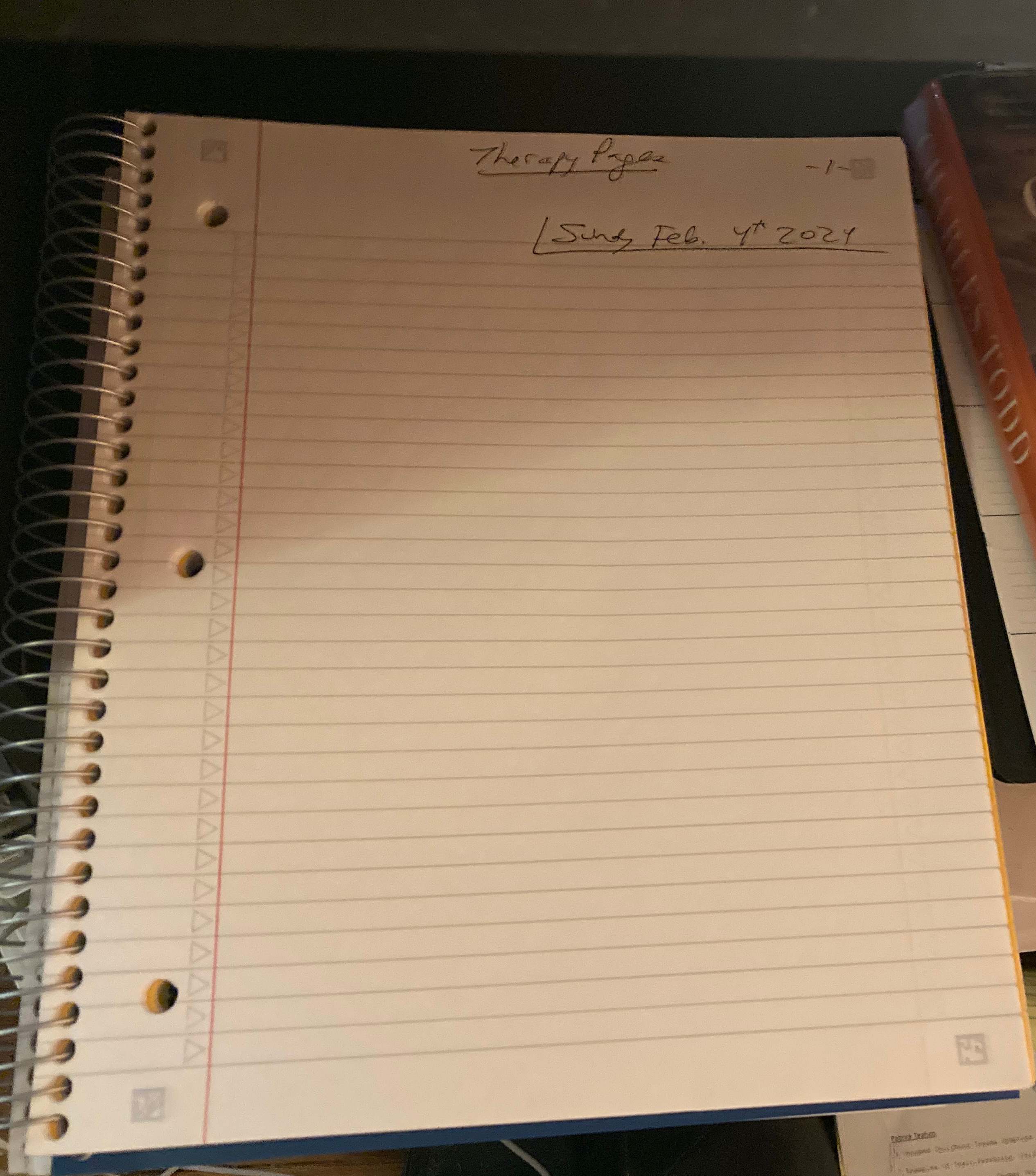
            About a million years ago, I read Julia Cameron’s The Artist’s Way for the first time and committed to doing Morning Pages every day (writing three stream of consciousness pages as soon as you wake up). I didn’t always do them in the morning, and I almost never stopped at three pages, so instead of calling them morning pages I called them my therapy pages, and I have a stack of boxes in my closet filled with old notebooks to show for it. But at some point, I stopped the practice, in all but name. I kept the notebooks nearby – there’s also always a five subject college ruled spiral bound notebook on my bedside table, with the day and date at the top of the page, but some days I forget to write anything, and others I just write a paragraph or two about my day before going to sleep, like sending a postcard to a good friend to keep up the connection, but not sitting down for a good long chat.

            I was actually proud of myself for taking longer to finish each notebook, because it seemed so self-absorbed to keep writing so much just for myself, and because I have no more room in my closet to stack boxes of notebooks.

            There’s also the thing I did early on that is a big no-no in Morning Pages, according to Julia Cameron. I started writing my Therapy Pages around the same time as I started seeing my therapist, and when I got frustrated by how little I could tell her in forty-five minutes per week that I told her about my Therapy Pages and she asked if she could read them and I said yes.

            On one hand, my therapist got to know me really well really quickly, because I didn’t go back to edit the pages before handing them to her, but inevitably, knowing that she would be reading them, my internal editor took over and stopped me from writing things I didn’t feel comfortable having her read. And one more thing happened: my therapist told me that my Therapy Pages were better than anything else I’d written, because I’d also made the mistake of giving her my short stories to read and she wasn’t impressed; just like she wasn’t impressed years later with my novels, or essays. But she loved my Therapy Pages and she wanted me to publish them – this was before Amazon self-publishing became a thing – and she would not listen to me when I said, a) no one would publish them and b) I wouldn’t want to publish them, because they were supposed to just be for me.

            I built up the nerve to stop showing her my pages pretty early on (probably also because I felt guilty for giving her so much work to do outside of our regular sessions), but the feeling of having someone reading over my shoulder, and judging me, never went away. Neither did the feeling that I was an utter disappointment as a writer, and/or a coward, and/or ten other horrible things.

            Recently, I found out that Julia Cameron had actually continued to write more books after The Artist’s Way, and I ordered one of them, called The Listening Path. I can’t remember why Julia Cameron came up as a recommendation on Amazon that day: maybe someone had mentioned her name to me, or there was some random confluence of events in the Amazon algorithm while I was looking for something else. But even then, I just put the book on my pile of books to read and went on with whatever else I was doing. I was kind of reluctant to open the book, honestly. I’m so tired of advice on how to be better and I’m tired of being told to do something other than what I’m already doing. I’m just really, really tired, full stop.

            But when I finished the latest book on my reading pile – an odd little middle grade fantasy about kabbalah, set at a Jewish sleepaway camp, by Ari Goelman – the next book on the pile was The Listening Path and I couldn’t avoid the book without openly acknowledging, to myself, that I was trying afraid of it. So I started reading. And within the first few pages of the introduction, reminding the reader about Morning Pages and Artist’s Dates and other advice from previous books, some part of my brain perked up and said, hey, why am I not doing Therapy Pages anymore?

            I won’t go through the whole grumpy internal argument that ensued, but, after a few more pages of reading, and grumping, I picked up my five subject spiral bound notebook and started to write again, telling myself that I couldn’t stop writing until I’d done three pages, instead of the three or four lines I’d gotten used to. And it felt right. Not easy, or comfortable, to be honest, but right.

            I still haven’t finished reading the introduction to The Listening Path, so I can’t say anything meaningful about the book itself, and already her insistence on the magical power of Morning Pages to get you unstuck and help you hear your inner self and blah blah blah is annoying the crap out of me, because where does she get off telling me what to do and acting like everyone is the same and can follow the same prescription to a better life, and on and on and on. Except, I think, for me, for this, she’s 100% right. I need this kind of stream-of-consciousness/required writing in order to hear myself again.

            I need it for me, not for my novels, though it could also help me get back on track with writing the damned novels. But I’m terrified of what will come up in these Therapy Pages of mine – which is probably the real reason why I started letting myself avoid them in the first place. I’m afraid of all of the crummy things I might say to myself, and all of the ways I will feel challenged, and not good enough, and pushed to do things I’m not ready to do; and I’m really worried about turning that spigot back on. But somewhere along the way I stopped listening to myself, and even if it has made me feel safer, it has also made me feel less, of everything.

            So, we’ll see how it goes. If a week’s worth of three pages a day re-opens the hellmouth in my brain, at least I’ll know what not to do.

            Wish me luck.

If you haven’t had a chance yet, please check out my Young Adult novel, Yeshiva Girl, on Amazon. And if you feel called to write a review of the book, on Amazon, or anywhere else, I’d be honored.

            Yeshiva Girl is about a Jewish teenager on Long Island, named Isabel, though her father calls her Jezebel. Her father has been accused of inappropriate sexual behavior with one of his students, which he denies, but Izzy implicitly believes it’s true. As a result of his problems, her father sends her to a co-ed Orthodox yeshiva for tenth grade, out of the blue, and Izzy and her mother can’t figure out how to prevent it. At Yeshiva, though, Izzy finds that religious people are much more complicated than she had expected. Some, like her father, may use religion as a place to hide, but others search for and find comfort, and community, and even enlightenment. The question is, what will Izzy find?
The Amaryllis

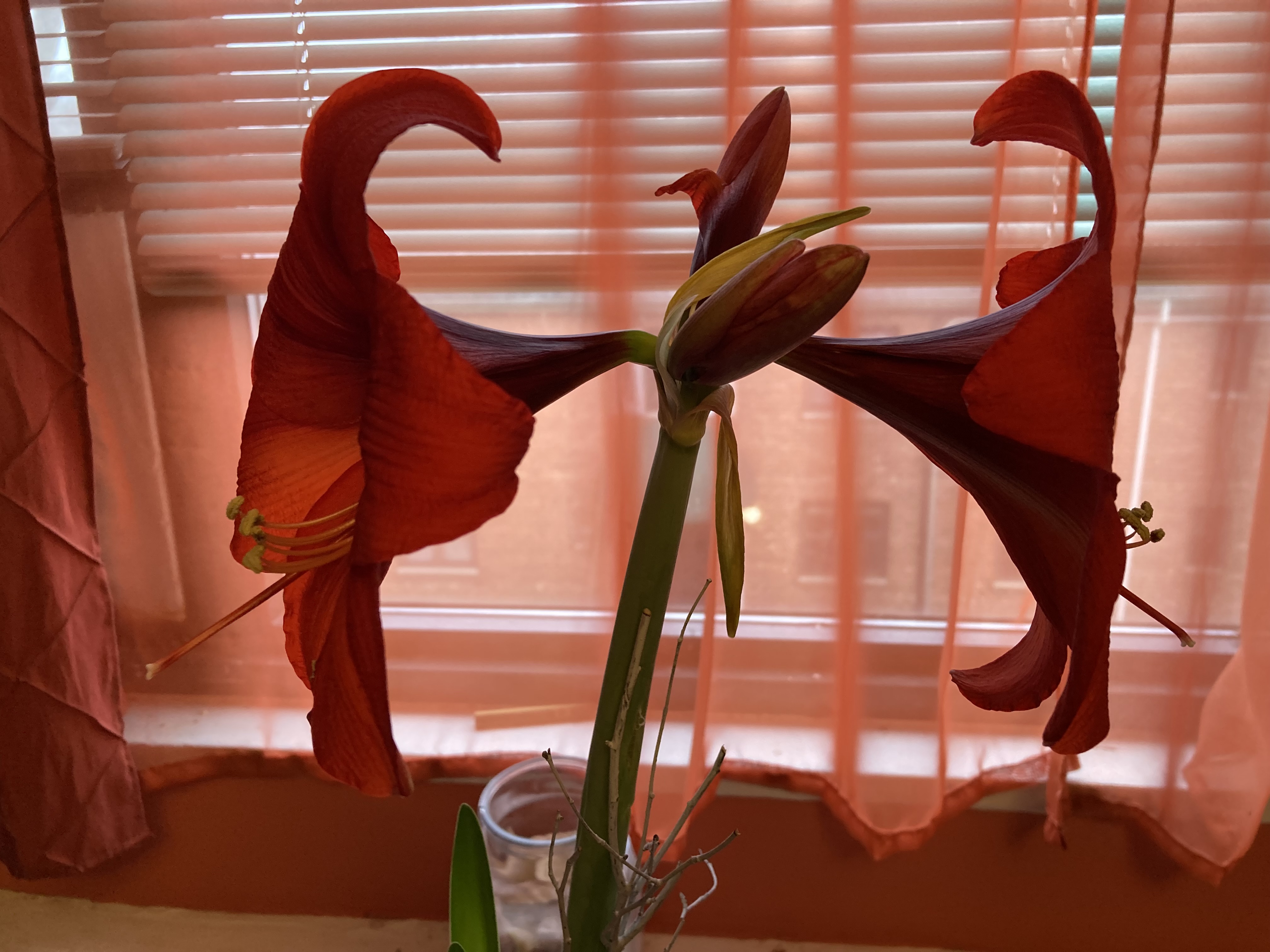
            After Ellie died one of the many practical, and depressing, things we had to do was to contact Chewy and cancel our standing dog food delivery. A few days later an Amaryllis appeared at our front door, with a card from the Chewy team sending their condolences.

            For a while the plant looked kind of sad sitting on the coffee table in the living room, with no flowers and a bend in its green spine. The plant came with a brace (with a twig and some twine), and Mom moved it into place above the curve, and gradually, the spine of the plant started to straighten, and then, slowly, the flowers started to bloom. The red of the petals is so vivid and the size and number of the blossoms keeps growing so there’s no way to ignore it now.

            The shape of the flowers, like a speaker on an old Victrola, makes it seem like the plant has something to say, though try as I might I can’t hear the words. And while there are no new puppies growing from this magical plant, there is life: beautiful, bright, and temporary.

            I know that I will always miss Cricket and Ellie, but this little (or not so little) plant has given me hope that my heart will be able to make room for new love, when the time comes.

“We still get veto power.”

If you haven’t had a chance yet, please check out my Young Adult novel, Yeshiva Girl, on Amazon. And if you feel called to write a review of the book, on Amazon, or anywhere else, I’d be honored.

            Yeshiva Girl is about a Jewish teenager on Long Island, named Isabel, though her father calls her Jezebel. Her father has been accused of inappropriate sexual behavior with one of his students, which he denies, but Izzy implicitly believes it’s true. As a result of his problems, her father sends her to a co-ed Orthodox yeshiva for tenth grade, out of the blue, and Izzy and her mother can’t figure out how to prevent it. At Yeshiva, though, Izzy finds that religious people are much more complicated than she had expected. Some, like her father, may use religion as a place to hide, but others search for and find comfort, and community, and even enlightenment. The question is, what will Izzy find?

Cold Case

            I’ve been re-watching a show called Cold Case on the Roku streaming channel. When I saw it on there a few months ago I remembered feeling safe in the hands of the writers and actors on the show, so when I needed reassurance, with the grief of losing Cricket and watching the recent events unfold in Israel, I started watching the episodes from the beginning, often instead of watching the news.

The magical Cricket

The premise of Cold Case is that this particular Philadelphia homicide squad focuses on cases that have been left unsolved for years, even decades. More often than not, the storylines hold secrets that couldn’t have been told in their own time, either because of the prejudices of the day or the inability of the traumatized people involved to speak up. Music helps to set each episode at a particular place and time, and we see the scenes play out both in the past and the present to bring the story to life, but the real power of the show is in the way the detectives genuinely care about what happened to these people, even so many years later, as if they really believe that every life matters and every story deserves to be told.

            I remember so many times in graduate school, both for writing and for social work, when the lesson was the opposite: that no one life really matters that much. In social work, the focus was on the collective – the family, community, institution, etc. – as opposed to the individual. And in writing workshops it was all about the beauty or cleverness of the writing, or the complexity of the plot or the nuances of the sentence structure or variety of descriptions; there was a lot of active disrespect for people whose telling of their own stories was still raw or full of emotion, and there was even more anger at people who wanted to tell stories that “have all been told before,” which often referred to stories about rape, sexual abuse, domestic violence, and eating disorders, not coincidentally stories that are often told by women.

“What?!”

            But on Cold Case every story matters. It matters what happened to a young woman who dressed as a man during prohibition; and it matters what happened to an autistic boys’ parents, even if he can’t tell his story in words; and it matters who shot a little black girl on the playground, and how a teenage boy who was thought to be a criminal was killed on a rooftop. It matters who loved who, and what went wrong and why. It has been such a relief to sit on the couch with Mom and Ellie and watch this show and feel that our sympathy can be unlimited, and that there are endless stories that can and should be told.

            I don’t think I recognized, when I watched this show the first time around, more than fifteen years ago, that it resonated so deeply with my own story; my childhood has often felt like a cold case, moldering in a file box somewhere. So much of the drama of my adult life has resulted from a crime that never received justice, and I’ve had to fight off the insistence (from others but also from within myself) that my story doesn’t deserve the attention I give to it, and that what happens to me, or people like me, is inconsequential. I still speak up because I know that there is healing in being seen and heard, but the fight has been exhausting. Except, when I watch the detectives connecting with each victim, through their own troubled lives, I feel reassured that they would have cared about what happened to me too. And for a few hours at a time, I don’t have to fight, because I know I matter; I know that we all matter.

“I matter too. Right, Mommy?”

If you haven’t had a chance yet, please check out my Young Adult novel, Yeshiva Girl, on Amazon. And if you feel called to write a review of the book, on Amazon, or anywhere else, I’d be honored.

            Yeshiva Girl is about a Jewish teenager on Long Island, named Isabel, though her father calls her Jezebel. Her father has been accused of inappropriate sexual behavior with one of his students, which he denies, but Izzy implicitly believes it’s true. As a result of his problems, her father sends her to a co-ed Orthodox yeshiva for tenth grade, out of the blue, and Izzy and her mother can’t figure out how to prevent it. At Yeshiva, though, Izzy finds that religious people are much more complicated than she had expected. Some, like her father, may use religion as a place to hide, but others search for and find comfort, and community, and even enlightenment. The question is, what will Izzy find?

Another Summer of Hebrew

            I started a new online Hebrew class for the summer, and my new Hebrew teacher is down to earth and clear and friendly, so I am hopeful that the class will be good and productive. But this is going to be my last Hebrew class for a while, because it’s expensive, and with another oral surgery coming up, and the pause on student loan debt repayment ending in August, I need to keep costs down; but also, I feel like I can’t focus on the classes during the school year anymore. I need more rest days, in order to recover from my work days, or else I won’t be able to work much longer.

“You should just stay home with us all the time.”

            I still love learning Hebrew, and I’m hoping that this last class will give me more confidence to continue learning new vocabulary on my own. Maybe I’ll even start writing in Hebrew and see how my voice translates.

            Writing in Hebrew is one of the few things we haven’t worked on in these classes from Tel Aviv, where the focus is on conversation skills and reading newspapers and watching TV. I think I would write poetry in Hebrew, because the language is so conducive to poetry, with all of the rhyming words and onomatopoeia and the leanness of the language overall. I gave up on writing poetry in English after too many discouraging teachers telling me to write like someone else, but maybe with Hebrew I could start again with a blank slate.

            I still want to become fluent in Hebrew, but I think if I take more classes I’d like to move towards Jewish learning in general, rather than Hebrew in particular. The focus in these classes has been on how Hebrew is spoken in Tel Aviv, with very little discussion of things that are recognizably Jewish, rather than Israeli. For me, Hebrew and Judaism are deeply intertwined, but Modern Hebrew has become a secular language, used for every mundane and profound purpose in daily life in Israel, and it feels like, as a result, some of the meaning has been stripped away.

I still want to learn more vocabulary, but I wonder if the words I really want to understand are the ones in the Hebrew Bible, or in the prayers, so that I don’t have to rely on someone else to tell me what they mean. I don’t want to lose sight of Modern Hebrew, and the way it has embraced so many different cultures and absorbed words from Arabic and English and French and Russian and more, I just want to re-invest in the connection to the past, where it all comes from.

I’m still not sure where all of this learning and exploring will take me, or how, or if, I will make use of it in my writing or my teaching, but sometimes learning is worth the effort just for its own sake, for the way it challenges our perceptions and widens our vision of the world and ourselves.

And maybe next summer, or when/if I start feeling better and have more energy, it will lead me to something more.

“Just make sure you take us with you wherever you go.”

If you haven’t had a chance yet, please check out my Young Adult novel, Yeshiva Girl, on Amazon. And if you feel called to write a review of the book, on Amazon, or anywhere else, I’d be honored.

            Yeshiva Girl is about a Jewish teenager on Long Island, named Isabel, though her father calls her Jezebel. Her father has been accused of inappropriate sexual behavior with one of his students, which he denies, but Izzy implicitly believes it’s true. As a result of his problems, her father sends her to a co-ed Orthodox yeshiva for tenth grade, out of the blue, and Izzy and her mother can’t figure out how to prevent it. At Yeshiva, though, Izzy finds that religious people are much more complicated than she had expected. Some, like her father, may use religion as a place to hide, but others search for and find comfort, and community, and even enlightenment. The question is, what will Izzy find?

Longmire

My latest Netflix binge is a show called Longmire. It first aired on A&E (a basic cable channel in the US) and I really liked it back then, despite being anything but a Western fan, which was the genre the show seemed to fit into, though it’s also a crime drama. Walt Longmire (based on books by Craig Johnson) is a Sherriff in the fictional Absaroka County, Wyoming. His wife died the year before the show starts, seemingly of cancer, but we find out that no, she was murdered. We meet his best friend, Henry Standing Bear, from the nearby Cheyenne reservation, and his daughter, a lawyer, and his deputies, and we learn about the kinds of crimes that a Sherriff in Wyoming might have to deal with, and the politics, and so much more.

“Any dogs in the show?”

            After two or three seasons on A&E the show was cancelled, for having too old of an audience supposedly. I don’t know if I realized at the time that Longmire had been picked up by someone else, but since I didn’t have Netflix back then it was over for me, and I mourned the loss.

            Maybe I’m an old soul, as I have often been told, but a lot of the shows that have been designated as being for older people have been favorites of mine since childhood – like Murder, She Wrote and Matlock and Law & Order. The assumption that we all only watch shows that reflect our current age and situation in life is silly, and something that, if true, should be challenged.

            The sixth and final season of Longmire aired on Netflix back in 2017, so there’s really no hope of them going back and doing more seasons now, damn it, especially because the show’s final episode wrapped things up in a way that kind of cuts off the blood supply for possible future seasons. But all of those knots could be untied – like when you knit a sweater and realize it’s too short, so you pull out the last row or two and add on – and it could be done seamlessly. Almost. But for now, I only have these six seasons to watch and re-watch to try to figure out why it burrowed so deeply into my psyche in such a short amount of time.

On second viewing I’m noticing more details, more places where they foreshadowed the future plot twists, and how they used music to create tension, and how they developed certain themes on a slow burn. I thought it might be too soon to watch it all again and that I would get bored, but that just hasn’t happened. I feel like I’m getting to know these people better, and seeing how much more detail was there in the first place, helping me to understand how their minds work and where they are strong and where they are weak and what they know about themselves and what they don’t.

The relationships between the characters are so deeply explored, often through just the tone of voice or a look between two people. And I love that every strong character in the show has weaknesses and grey areas and confusions over what is right and wrong. And even the best of friends disagree about what’s right in any given situation.

I love Lou Diamond Phillips in his role as Henry Standing Bear. He’s able to capture the easy charm of a bartender, and the deep loyalty of a best friend, and the spirituality and anger of a Cheyenne warrior, all without seeming to pivot from one part of himself to another. And Vic, the female Sherriff’s deputy from Philadelphia who goes from flirty to sarcastic to frightened to defiant to deeply loyal with the same seamlessness.  

“She sounds like Cricket.”

And then there’s Walt, the strong, silent Sheriff, who can be childlike and confused and then strong and formidable, and whose moral compass is in constant motion, not always leading him in the right directions but showing us that he is always searching for what is right. His bravery and endurance feel almost unbelievable, the way he pushes himself to the brink to help other people, but we get to see all of the damage it causes and all of the pain he’s trying to hide and all of the disappointment and the fear, so that his strength seems deeply human after all.

Nothing is simple on Longmire, but instead of the last minute plot twists of a show like Law & Order, each surprising development in the plot has been laid into the fabric of the show and feels believable and even inevitable, though still shocking.

I love that I’m addicted to a show set in the cowboys and Indians world of Wyoming, a world I wasn’t really curious about before this. I can’t find myself in these places or these people and yet their stories resonate deeply with me, maybe because, bottom line, I trust their values. I trust them to care about me. I believe that Walt and Henry and Vic would care what happened to me, and find ways to protect me if I needed protection. Despite all of the violence and tension in their world, I feel safe with them.

            I wish I could write like this. I wish I could write the next season of the show and make the actors come back to shoot it. But maybe most of all, I want to be strong the way these people are strong, while always still acknowledging my fears and weaknesses and confusions. I want to be clear about my values and goals, while still being open to learning something new about the world and about myself. And I want to be able to stick to what is true for me, even while respecting what is true for someone else, unless they’re delusional, in which case, fuck them.

            I think Walt would agree.

“Watch your language, Mommy.”

If you haven’t had a chance yet, please check out my Young Adult novel, Yeshiva Girl, on Amazon. And if you feel called to write a review of the book, on Amazon, or anywhere else, I’d be honored.

            Yeshiva Girl is about a Jewish teenager on Long Island, named Isabel, though her father calls her Jezebel. Her father has been accused of inappropriate sexual behavior with one of his students, which he denies, but Izzy implicitly believes it’s true. As a result of his problems, her father sends her to a co-ed Orthodox yeshiva for tenth grade, out of the blue, and Izzy and her mother can’t figure out how to prevent it. At Yeshiva, though, Izzy finds that religious people are much more complicated than she had expected. Some, like her father, may use religion as a place to hide, but others search for and find comfort, and community, and even enlightenment. The question is, what will Izzy find?
Disarray

            I’m so disoriented. The synagogue school year ended and that means I can focus on my writing, so of course I’m at loose ends. Generally I need to spend a few weeks tying up those loose ends before I can find my footing, and maybe this is just the same as always, but it feels even looser than usual. My brain feels like a kaleidoscope, but the colored pieces of paper never land in any particular shape, they just keep swirling.

            I’ve started six or seven blog posts in the past few days and each one has ended with balled up paper in the garbage can (yes, I still write longhand on legal pads). I’m not quite sure why each essay self-destructs, sometimes it’s because I thought I had a new idea and two pages in I realize I’ve said it all before, and sometimes I get two paragraphs in and realize I really don’t want to look in that particular dark corner right now. Part of it is probably that I have a very long to-do list for the summer and I can’t figure out what to focus on first, or why. But really, I can’t focus at all. Usually, when I’m writing an essay I feel like I can find an invisible container for it in my head, and with palpable edges, so that I can write and edit within that general area, without feeling too overwhelmed.

“You should try pee mail, its the best form of communication.”

            But suddenly there are no available containers, or I forgot how to create one, because I feel like I’m just aimlessly writing words on a page, and I can’t sense the parameters of the idea, and the sentences just go on without shape or purpose. And if I can’t shape an essay, how can I even imagine shaping a novel, which requires a container bigger than anything else.

            I know I’ve felt this way before, but I don’t remember when, or why, or how I got out of it.

            I feel like I need to prepare for the next school year right now and solve every problem that came up over the past school year in order to think clearly, but I’m also taking another online Hebrew class, and going to new doctors, and planning for another oral surgery, and I feel like I should get back on track with seeing the eye doctor and foot doctor and dermatologist, which I’ve been putting off as non-essential for the past few years. And I have a pile of books that I’ve read over the past year, filled with little pieces of paper marking sections I want to read over and take notes on, and I have a new pile of books to mark up, and I need to get back on track with exercise, and go to choir practices to prepare for the high holidays, again, and I want to keep up with blog posts and therapy appointments, and all of that seems to come before working on the novels I expected to have finished by now.

            I can feel the looseness coming over me right now, and with it the desire to rip up pages, but I can’t keep writing and ripping and writing and ripping all the time. I need to land somewhere, so I am forcing myself to keep writing this essay, even if I can’t imagine the shape it will ultimately take. I am not comfortable in this state of mind, but I have to keep persisting and doing the work and writing the sentences I can write, until the shape and texture and purpose of the essay comes into being, or else I’ll never be able to move on to the bigger projects that are swirling in my brain.

“We’re going to rest while you do that.”

If you haven’t had a chance yet, please check out my Young Adult novel, Yeshiva Girl, on Amazon. And if you feel called to write a review of the book, on Amazon, or anywhere else, I’d be honored.

            Yeshiva Girl is about a Jewish teenager on Long Island, named Isabel, though her father calls her Jezebel. Her father has been accused of inappropriate sexual behavior with one of his students, which he denies, but Izzy implicitly believes it’s true. As a result of his problems, her father sends her to a co-ed Orthodox yeshiva for tenth grade, out of the blue, and Izzy and her mother can’t figure out how to prevent it. At Yeshiva, though, Izzy finds that religious people are much more complicated than she had expected. Some, like her father, may use religion as a place to hide, but others search for and find comfort, and community, and even enlightenment. The question is, what will Izzy find?

The Mother’s Day Mushrooms

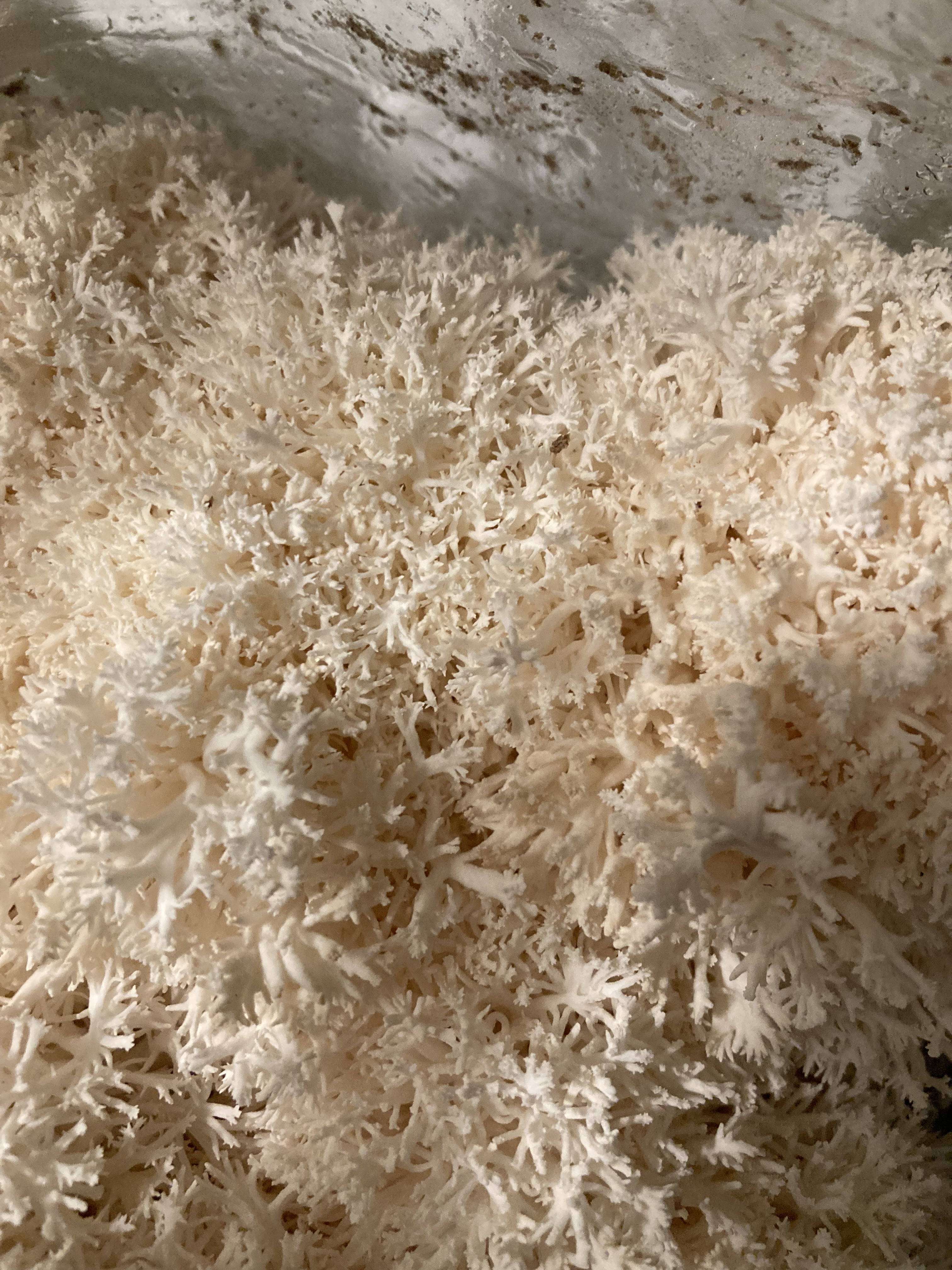
            Mother’s day traditionally marks the beginning of the gardening season, even when the gardening has already been going on for a while, and most years Mom and I spend Mother’s day morning at a gardening store, filling up the trunk of the car with all of the plants and seeds and mulch and tools she might need, at least for the next week or two. But for Mother’s day breakfast this year, my brother and his eldest son came to visit, with bagels and cream cheese and lox, to celebrate Mom. My brother brought a bouquet of colorful yarn, and my nephew brought a big box of mushroom starters: three huge white blocks, one for Blue Oyster mushrooms, one for Lion’s Mane, and one for something called Piopino, each in their own bags, with a special instruction booklet.

The yarn bouquet, after some of the yarn had already been unwound.

            When my brother’s kids were younger we used to go for nature walks all the time, with Mom in the lead, and then the kids, and then me. We’d walk down by the river near their house, and the kids would climb trees, and collect rocks and leaves and whatever else they could find, unless Grandma warned them off of something yucky or poisonous. And when it was too cold to be outside, she taught them how to make little boats out of empty walnut shells and float them in a bowl of water; just because. As a result, my oldest nephew has his own vegetable and herb garden, with birds who call it their home, and for Mother’s day, he thought the best gift he could give his Grandma would be the chance to watch mushrooms grow, and he was right.

            And after breakfast, my nephew and his Dad braved the woods behind our building, and the uncertain ground under a huge fallen tree trunk, to pluck two giant mushrooms, still connected to each other, just so Mom could see them up close and then put them in her garden, to inspire the other plants to grow big and strong.

Mushrooms on the dead tree trunk

            My Mom’s love of gardening came from her father, whose yard was filled with flowers, and birds, and dastardly squirrels, and contraptions to keep the squirrels away from the bird feeders. But she didn’t do much gardening at the house I grew up in, partly because she was busy working and doing other creative things, but also because it just didn’t feel like a place where good things would blossom. Almost as soon as she divorced my father, and we moved to a new home, she started to garden. She planted her father’s lilies, and then strawberries and tomatoes and marigolds, and one year she planted pumpkins that took over the whole yard. And now she gardens all year long, planting seeds indoors and seedlings outdoors, and if she’s not planting, she’s weeding or preparing the ground for more planting later on. And she loves it! And Cricket loves it! And Ellie and I sit on the bench and watch them, and listen to the birds, and shrug, happy for them, though mostly bewildered.

“What’s your problem?”

            Within days of the Mother’s day visit, the new mushrooms were sprouting, magically, from those plain white blocks, and our neighbor was deep cleaning her bird bath to accommodate all of the birds returning to the yard, and there were pink and orange tulips, and magenta rhododendrons, and purple irises, and red azaleas, and green everywhere, including on the pawpaw tree.

Piopino
Lion’s Mane
Blue Oyster

            We are now in pawpaw counting season. First the red flowers had to appear on the tree, and darken to crimson and then to a reddish dark brown, and then, as the flowers died and fell away, the baby pawpaws appeared from the wreckage. So now starts the long summer of watching the pawpaws grow, and worrying that they will be eaten by passing birds, or squirrels, or that they’ll fall off in the rain, or die off for lack of nutrition. The counting becomes even more difficult as the leaves grow to their full size and obscure the growing pawpaw fruit, but I try to accept it, because the leaves are doing their best to protect those baby pawpaw fruits from disaster.

Baby pawpaw fruit

            It’s funny, just as Mom spends her summers tending her garden, I kind of do the same with my writing. We plant our seeds and nurture them and weed out the overgrowth and anything that’s getting in the way, and hope that something comes of all of the worry and the work. And each year we overplan, and barely get through half of what we hoped to accomplish. I can’t make the summer expand to give me the time and patience to do everything I want to do, just like Mom can’t use the whole yard, and then some, to plant all of the flowers and vegetables she dreams of harvesting in the fall. But we do what we can do.

“Isn’t it nap time yet?”

If you haven’t had a chance yet, please check out my Young Adult novel, Yeshiva Girl, on Amazon. And if you feel called to write a review of the book, on Amazon, or anywhere else, I’d be honored.

            Yeshiva Girl is about a Jewish teenager on Long Island, named Isabel, though her father calls her Jezebel. Her father has been accused of inappropriate sexual behavior with one of his students, which he denies, but Izzy implicitly believes it’s true. As a result of his problems, her father sends her to a co-ed Orthodox yeshiva for tenth grade, out of the blue, and Izzy and her mother can’t figure out how to prevent it. At Yeshiva, though, Izzy finds that religious people are much more complicated than she had expected. Some, like her father, may use religion as a place to hide, but others search for and find comfort, and community, and even enlightenment. The question is, what will Izzy find?

The Broken Bookcase

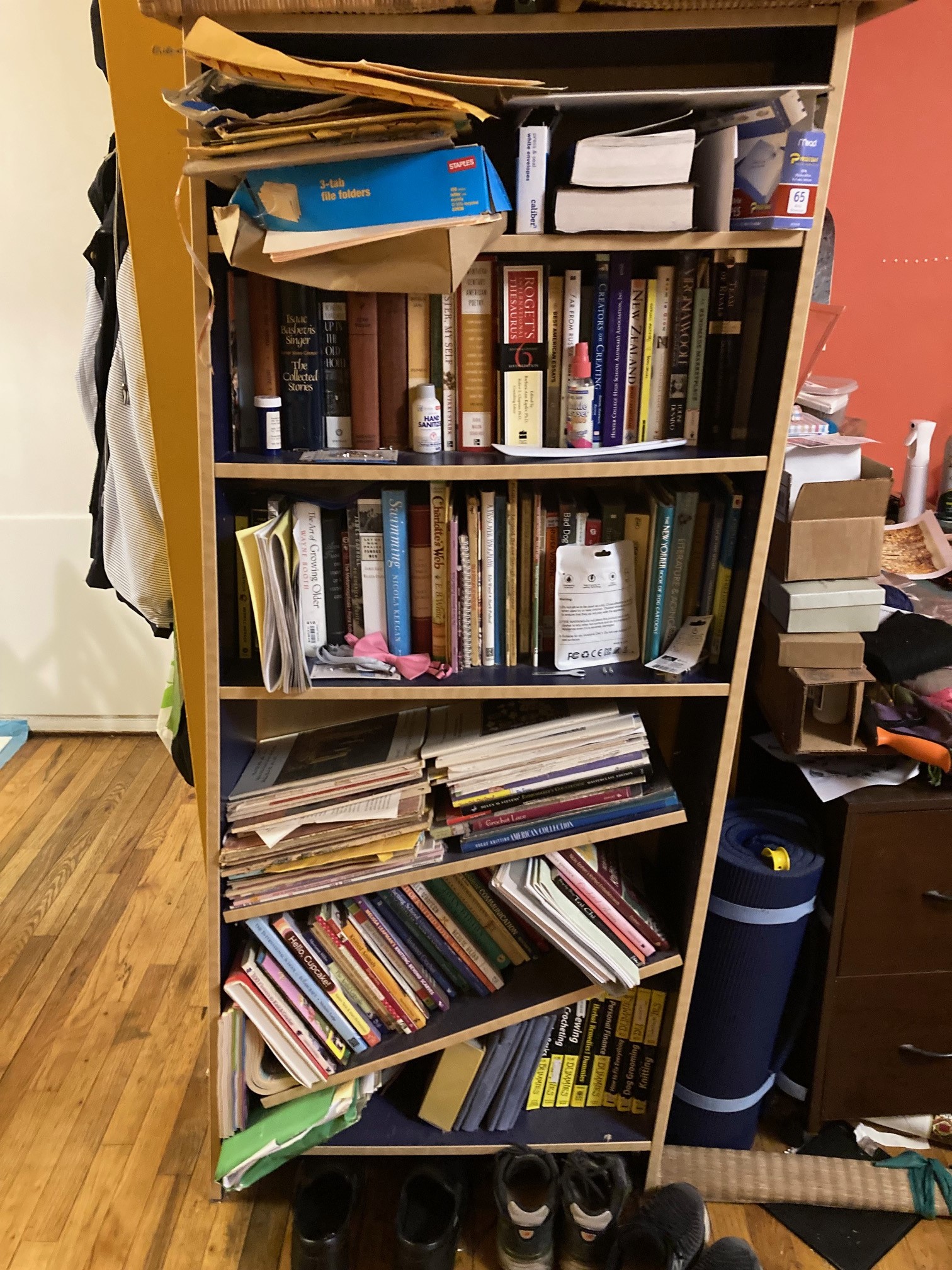
We have a blue Ikea bookcase in the hall that has been tilting for a long time now, but there’s been so much else going on that it never seemed important enough to try to fix it or replace it. We have bookcases everywhere, and I have five in my room alone, so one tilting bookcase didn’t seem like an emergency; until one of the shelves fell, and even then we just put “shelf pins” on the shopping list and eventually bought some, and of course, forgot to put them in. And then another shelf fell. And I still can’t be bothered to deal with the damned thing.

The Broken Bookcase

It’s not that a bookcase is such an expensive thing to replace, especially if we get another one from Ikea, its more that we’d have to actually go to Ikea, carry the heavy box to the car and from the car to the apartment, and then put the thing together, oh, and also empty the broken bookcase and take the broken pieces down to the garbage and refill the new bookcase.

I don’t have the energy for any of that, let alone all of it.

I’ve been trying to clear out the “extra books” from my collection for years now (so that we wouldn’t need so many bookcases), by re-reading the books that I’m on the fence about. I’ve already filled two boxes with books I no longer need, but giving books away is harder than you’d think. The library never wants them, and finding a place that wants the books, on the third Thursday of the month, at twilight, still requires carrying heavy boxes of books out to the car. So at this point I still have a box of discarded books on the floor, next to the bookcases, and I still have three shelves full of books to read through. I also have a bad habit of ordering more books all the time.

“She’s going to throw out our toys to make room for books, isn’t she?”

This feels like a metaphor for the way my brain has been lately: overwhelmed with ideas to follow up on, all resting on iffy shelves and waiting for me to start culling through them; but I can’t even think straight enough to do the culling before another ten or twenty ideas pile on. I feel like every day I’m looking at these tilting shelves in my brain, knowing that it’s all going to overflow at any moment, with no idea how to stop it.

I decided to take a break from going to online Hebrew classes for a few months, because I’ve been struggling to stay focused during the classes this past semester, and because the time I spend in those classes and doing the homework for them has kept me from doing other important things on my to-do list. I’m hoping to get back to the classes over the summer, when I have more free time to focus, but I feel the loss of the socializing and the Hebrew already. I still don’t even know what to do with all of the Hebrew I’ve learned so far, or why it’s been such an obsession for at least two years, if not my whole life.

I feel like there’s a path I should be on, and a long term goal I should be working towards, and that Hebrew language learning is part of it; but I don’t know what that goal is. I don’t want to move to Israel, and I don’t particularly want to go back to school full-time to become a translator or a rabbi or a cantor. I would like to go deeper into Jewish education, if I can, working with teens, maybe, as well as with the younger kids, and maybe even doing curriculum development. But I don’t know of a path to get there, and I don’t want all of that to be instead of writing my novels – the notes for which have filled up a bunch of shelves of their own.

I feel like there’s a whirlwind in my brain, pushing me in different directions all the time, keeping me confused and off kilter, and I’m worried that my internal bookshelves are as wonky as the ones in the broken bookcase in the hall, and it will all tumble down at any moment.

My hope is that once synagogue school is over for the year, I’ll be able to concentrate on all of those ideas whirling around in my brain, and organize them, and maybe even choose some to work on. But I’m afraid I’ll be as busy with doctors and tests this summer as I was last summer, without much improvement in my health to show for it, and those wonky internal shelves will just keep tilting.

But I keep slowly reading through my piles of books, and writing down all of my ideas, and sorting and discarding when I can, because this is how I move forward. It’s not especially practical, or fast, but it’s the way my mind works, so it will have to do for now.

“It’s important to just be yourself, Mommy.”

If you haven’t had a chance yet, please check out my Young Adult novel, Yeshiva Girl, on Amazon. And if you feel called to write a review of the book, on Amazon, or anywhere else, I’d be honored.

            Yeshiva Girl is about a Jewish teenager on Long Island, named Isabel, though her father calls her Jezebel. Her father has been accused of inappropriate sexual behavior with one of his students, which he denies, but Izzy implicitly believes it’s true. As a result of his problems, her father sends her to a co-ed Orthodox yeshiva for tenth grade, out of the blue, and Izzy and her mother can’t figure out how to prevent it. At Yeshiva, though, Izzy finds that religious people are much more complicated than she had expected. Some, like her father, may use religion as a place to hide, but others search for and find comfort, and community, and even enlightenment. The question is, what will Izzy find?
Jury Duty

            When I first received a jury questionnaire in the mail, back in the spring, I wrote in the space provided about my various health issues and why it would be difficult for me to manage a full day of jury duty, let alone several days of a trial, and asked to be excused. When I didn’t hear back from them with a request for more information, I thought I’d done enough to be let off the hook. But the jury summons came anyway, on the same day that I’d gotten clearance from the Pulmonologist for my oral surgery, and the summons was dated for the week of the surgery itself.

“Oh, come on, people!”

I was able to postpone the summons for a few weeks, but I didn’t even try to get out of it completely; partly because I felt guilty trying to get out of jury duty, and partly because I didn’t want to go through the humiliation of trying to prove to my doctor that my disabilities are significant. I’d gotten out of jury duty a while back with a doctor’s note, when they were going to send me to Brooklyn (an hour and a half trip each way, by train, in the summer), but I had a doctor I trusted back then, and I knew for sure that I wouldn’t have been able to handle that trip, no matter how hard I’d tried. But this time, it was different, or I kept thinking it was.

            I told myself that I’d only have to drive twenty minutes each way, because the court complex is nearby, and I knew the route, and even if the weather was disgusting, I’d be inside most of the time, and sitting. And then my surgery was postponed too, with jury duty coming first instead of second, so I really didn’t see any way out of it.

            One of the more stressful things about jury duty, in my area at least, is that instead of being told to come in on a specific day, you are put on call for a week, meaning that every day at five o’clock you have to check the website to see if your number has been called for the following day. But I was lucky, this time, because when I checked the website the Friday before my summons week, I found out that I was being called for Monday, which meant I had the whole weekend to prepare: do the food shopping and the laundry, take extra naps, fill up my book bag with all of the things I’d need, and thank god I didn’t have to wait until five o’clock each day, for the rest of the week, to find out if I’d have to go in the next morning.

“But who’s gonna take me out to pee?!”

            I feel like I should be one of the people who is actively interested in every part of the justice system, and in doing my civic duty, and I keep thinking that I should use jury duty as a way to research future novels and learn about police procedure and all that. And, beyond that, I feel like jury duty is an obligation, like voting, and I don’t want to be one of the people who lies to get out of jury duty and then laughs about how juries are all made up of the stupid people who can’t get out of it. But I don’t have much energy, and I have a lot of social anxiety issues that make things like this ten times harder than they should be, and, whenever I’m near a police officer or inside of a court building, I think I’m going to be arrested.

            My mom has only been called for jury duty once in her life, and, so far, I’ve been called five or six times. I don’t know how I got so lucky. The first time I’d just graduated from college, and I was really nervous, but also kind of excited. I went through the voir dire, where the lawyers ask potential jurors all kinds of questions to see if they’ll be a good juror for the case, and when they asked if I’d ever been the victim of a crime, I had to say, uh, yeah, and the guilty party got away with it. I thought about saying no, just to see what it would be like to be chosen for a jury, but I’m not a good liar. Another time, I vaguely remember that we were given damp sandwiches and bused to another location that looked like a repurposed elementary school, but I was scratched, again, when they got to the victim-of-a-crime question. There was another time when I had to call in each day, for a week, to find out if they needed me, and they never did. That was probably the worst.

“Waiting sucks.”

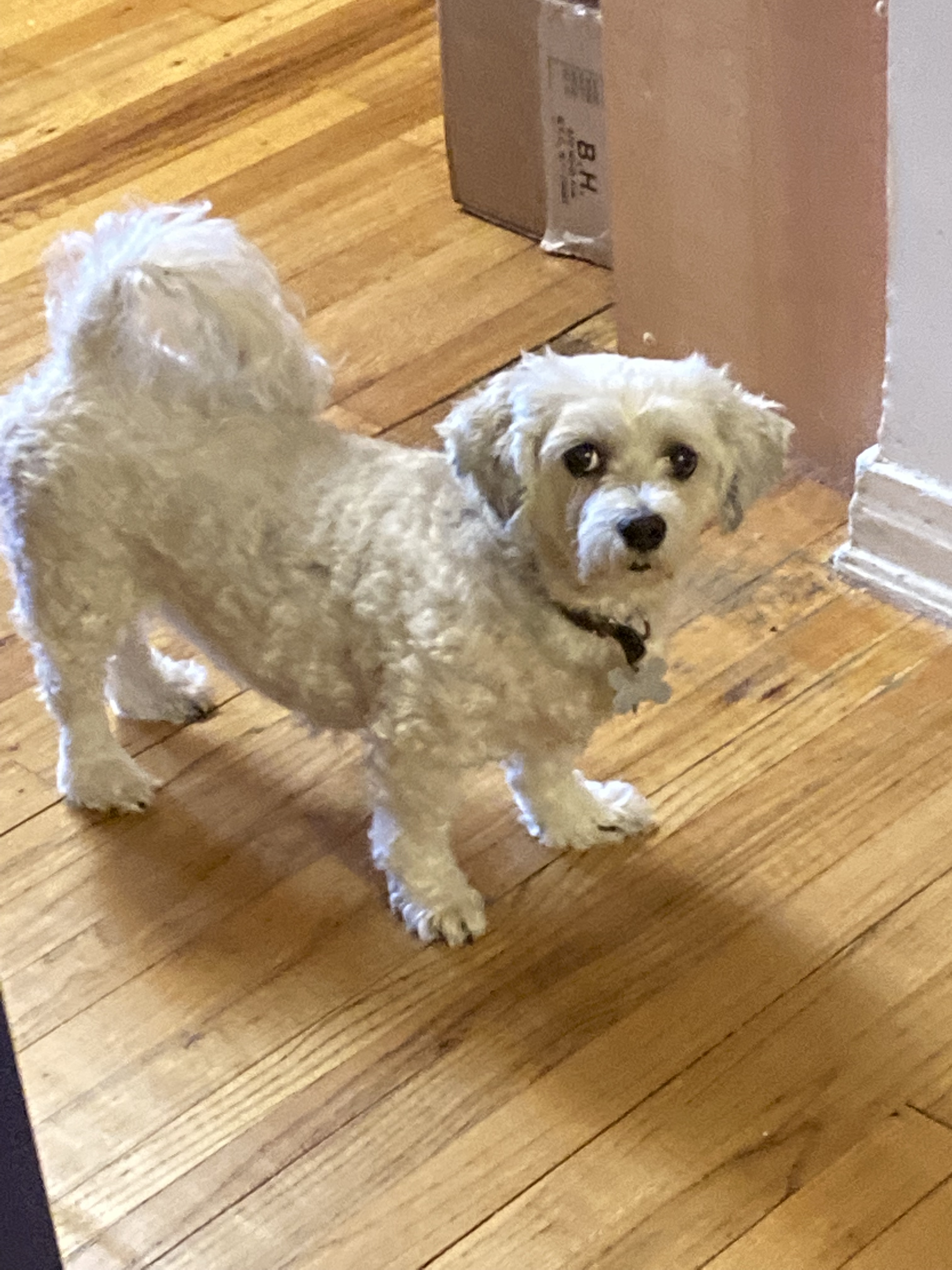
            Even during my short stints at jury duty, though, it’s become clear that the lawyers just aren’t as interesting as the ones on TV, and the cases aren’t as dramatic or convoluted, and there’s almost never a twist ending, which is just disappointing. Instead it’s a lot of sitting around and waiting. If only I could bring one of the dogs with me for company – though there’s a very good chance that Cricket would get me arrested.

            I should have asked for a doctor’s note, because I’m just so tired all the time, and because Mom was still recovering from her second hip surgery, and because the dogs needed me, and because I needed to keep the apartment relatively livable, but I was too chicken. So I went.

            I packed diligently: phone, phone charger, jury summons, extra mask, book to read for fun, book to read for serious, notebooks and pens, oatmeal in a thermos (with a spoon), gingerale (in case of nausea caused by anxiety), and wet wipes.

            I got to the courthouse a few minutes early and found a seat in a corner of the central jury room, which was, thankfully, well air-conditioned and big enough to leave room for social distancing. Most people wore face masks, even though we were allowed to show our vaccination cards to get out of it, and after a little while of sitting there and staring around the room at each other, we watched a few videos: about jury service in New York and about implicit bias (how we fill in a picture when it is incomplete, based on assumptions that may not be true). And then we waited. A bunch of names were called while I played with my phone: sent an email and a text, did some water sorting and some Duolingo. And then we waited some more. I finished reading my book-for-fun (Rhys Bowen’s God Rest Ye Royal Gentlemen) and another group of names were called, and then we waited again. My phone was running out of power, but I was too scared to go wandering around looking for a place to charge it, so I got some writing done, and read some of the serious book (Karen Armstrong’s The Case for God), and then some more names were called and then we waited again. It was getting close to lunch time by then, and my neck and back hurt, and I was wondering if we would be sent to a cafeteria or let out for the hour and a half for lunch, and wishing I could go home and take a nap. And then my name was called. A whole group of us were led into a smaller, less well air-conditioned room, and I was really worried that we would be sent to do a voir dire right away and miss our lunch break altogether, and my headache would keep getting worse and I’d end up crying, or yelling at someone, or getting myself arrested, somehow. And then a non-descript man came into the room with a big pile of papers and told us that the rest of the cases for the day had been settled, and we would be going home early. There were quite a few hoots and hollers and Praise Gods and then we were called up one by one to get our printed sheet confirming that we had completed our jury service. And that was it.

            It had rained at some point while we were deep inside the court building, far from any windows, but the air outside still felt wet and thick as I walked across the street to my hot car, but…I was free!

            But even as I was driving home, hours earlier than expected, I wasn’t quite able to process what had happened. Time had slowed down so thoroughly in that big, isolated, jury room, with all of the empty spaces filled with anxiety about what might happen next, and not trusting myself to know how to answer the lawyers’ questions if I was called in to try out for jury and worried I would end up on a five week trial because I was too scared to say no. And then, suddenly, I was free, and I was still awake and aware enough to drive home without needing to pull over to rest, and even though I was a little bit shaky with fatigue, I was actually okay.

            And then I was home. Mom and the dogs met me at the door and I was able to take a nap in my own room, with puppies for company, and eat whatever I wanted to eat instead of whatever I could fit into a thermos. It wasn’t the easiest day of the summer, but it wasn’t the hardest one either, after all. All summer long there’s been one challenge after another, and even if it hasn’t been easy, each challenge has been met, somehow. And even though I’d much rather not be in survival mode endlessly, it’s good to know that if I need to survive, I can do it. I just hope I won’t get another jury summons too soon, and Mom won’t need another new hip for a while, and things will start to calm down a little bit.

But…I’m not holding my breath.

If you haven’t had a chance yet, please check out my Young Adult novel, Yeshiva Girl, on Amazon. And if you feel called to write a review of the book, on Amazon, or anywhere else, I’d be honored.

            Yeshiva Girl is about a Jewish teenager on Long Island, named Isabel, though her father calls her Jezebel. Her father has been accused of inappropriate sexual behavior with one of his students, which he denies, but Izzy implicitly believes it’s true. As a result of his problems, her father sends her to a co-ed Orthodox yeshiva for tenth grade, out of the blue, and Izzy and her mother can’t figure out how to prevent it. At Yeshiva, though, Izzy finds that religious people are much more complicated than she had expected. Some, like her father, may use religion as a place to hide, but others search for and find comfort, and community, and even enlightenment. The question is, what will Izzy find?