A few weeks ago, I drove Mom to the bank in our old neighborhood in order to open a new account, because one of her checks had been stolen (through the mail) and “washed,” meaning that someone took a check, erased what was written on it, and wrote in a new receiver and a new dollar amount and cashed it. The bank’s solution to all of this was to have Mom close her old bank account and open a new one, in person, and then deal with all of the hassle of rerouting automatic deposits and bill pay to the new account. I was, of course, angry that Mom had to spend weeks going here and there and making a thousand phone calls and doing endless paperwork to clean up someone else’s crime, but my more lasting feeling from this incident was the fear that if this had happened to me, I would have been lost.

As it was, I sat there next to Mom at the bank and listened as the bank manager explained all of the necessary steps going forward, and I couldn’t make sense of half of the things she was saying. I could hear the words clearly, and I was able to remember most of them later, but I couldn’t understand them enough in the moment to answer her questions, or even to know which questions to ask. When I told my therapist about the whole experience, and how familiar and upsetting it was, and how it made me feel like I must have some kind of learning disability to still be struggling after so many years of effort, she said, You’re too smart to have a learning disability. Period.
So, as I’ve done so many times in the past when I wanted to understand something that no one could explain to me, I went a-googling, and I found two related learning disabilities that could describe some, though not all, of my learning difficulties: Dyspraxia, which is a motor skill disorder that affects coordination and movement, and Visual Spatial Disorder, which is a disorder that affects how the brain interprets and manipulates visual information. The symptoms and descriptions of the two disorders overlap so much that I could barely tell them apart, which suggests that we are still at the beginning stages of understanding the brain. Not only do the symptom lists of these two disorders crossover with each other, they also crossover with a number of other disorders (ADHD and Dyslexia and Autism, for a start), and it feels like the experts might be conflating a lot of different issues in an attempt to come up with a theory of everything too soon. But this is what we have for now.
People with these two disorders may struggle to judge how near or far away an object may be, or to understand directions (like make a right in three blocks), or to coordinate hand and eye movements. These issues can be developmental (present from early childhood) or emerge due to a neurological condition later on, or both really, and since visual spatial processing relies heavily on the brain’s right hemisphere, particularly the parietal lobe, damage to this area of the brain could be a causal factor in the symptoms.
Common symptoms include clumsiness, poor handwriting, frustration with building blocks and problem-solving games, difficulty figuring out left versus right, struggling to read maps, struggling with sports and drawing. And a lot of that sounds like me. I was always picked last for teams in elementary school, and my ability to draw a tree has remained at about the same level since kindergarten, and I struggle with problem solving tasks of all kinds. I remember vividly how hard it was for me to learn how to tell the difference between my left and my right in first grade, and how often I struggled to read a clock (not digital, thank you). I even struggled with hopscotch in kindergarten, which made recess a problem.

I’ve been trying to learn how to play chess on Duolingo for quite a while now, and I’m noticing that I still can’t think more than one move ahead and can’t see patterns that the app thinks should be obvious to me. The same was true when I used to play tennis. I could hit the ball well, but I couldn’t plan ahead and strategically move my opponent around the court. I also had a lot of trouble reading recipes and learning how to drive. Interestingly, I can actually put together IKEA furniture pretty well, so I don’t struggle with all visual spatial tasks equally, and I love doing jigsaw puzzles. I actually spent years, as an adult, obsessively putting together jigsaw puzzles until the pieces fell apart, which may be a clue to the therapeutic interventions that might be worth exploring in the future.
There are plenty of signs of these disorders that don’t fit me, though. I wasn’t late hitting developmental milestones, and I never had trouble climbing stairs, and I didn’t have a short attention span, or struggle with math or with writing stories, and I didn’t have a hard time copying from the board, (once I had glasses). They also say that kids with Dyspraxia may get lost navigating through their school building, and I never struggled with that, but then again, I went to very small schools as a kid. I did, and do, struggle with reading maps, and I have had thousands of dreams about getting lost in school buildings, just not the school buildings I actually went to in real life.
There was an achievement test, in ninth grade, that included three sections instead of two; along with math and reading, there was a whole section on spatial relations. And while I scored in the 99th percentile for math and reading for my grade level, in spatial relations my score plummeted down to the 50th percentile. One of the skills I struggled with the most on that test was something called Mental Rotation, which is the ability to rotate 2D and 3D objects in your mind, and then unfold them, or look at them from different perspectives and identify how the shapes fit together. No one followed up on my scores on that test or even seemed to see them as worthy of attention, since we didn’t study spatial relations in school. And then, when I was seventeen years old and had to drop out of college with severe panic attacks, my therapist at the time sent me for IQ testing (I’m not sure why, looking back), and despite years of scoring really well on tests and being told how smart I was, this test decided that I was of average intelligence. I specifically remember the block test they used for the quantitative part of the test and how long it took me to match the patterns on the blocks to the pre-set designs.
At some point, as an adult, I was diagnosed with Intermittent Exotropia during an eye exam (trouble keeping both eyes focused at the same time), and when I went for vision therapy, they used the block test and other visual spatial games as part of the therapy, specifically to improve my eye coordination, so there could be some physical component to this disorder, at least for me, and it could have worsened over time because of neurological changes resulting from my autoimmune issues. But it’s hard for me to tease apart what I struggle with for mechanical reasons (needing glasses, needing vision therapy, needing physical therapy), and for neurological reasons (interpreting the information from my senses incorrectly), and for emotional or psychological reasons (anxiety and trauma).
Interestingly, I saw a paper that said there’s a correlation between Agoraphobia and Visual Spatial Disorder, since struggling to make visual sense of crowded environments can make you anxious in those spaces. And fear of heights has also been associated with Visual Spatial Disorder, possibly because people with this disorder may misjudge vertical distances and assume the ground is much further away than it really is. And I’ve struggled with both of those issues.
I’m still not sure if Dyspraxia or Visual Spatial Disorder explains the way I struggle with more abstract intellectual tasks, like finances and long-term planning, because I haven’t seen much written about that, possibly because most of the material I’ve seen relates to school age children rather than adults.
My therapist has often complained that I work too hard on each task and that I could get so much more done if I was less of a perfectionist, which never sounded right to me. And now I’m wondering if all of the effort I put into each lesson plan, essay, novel, etc., is how I’ve learned to compensate for this fundamental learning disability that has never been diagnosed. I have to work very hard to find the shape of each project and understand how the pieces fit together, not because I’m trying to make it perfect but because I’m trying to make it whole. The most frustrating part of all of this is, though, is that even if this is my diagnosis, it’s still just one small piece of the puzzle, and I’m left to figure out that puzzle with a brain that struggles to see patterns clearly.
Harrumph.
If you haven’t had a chance yet, please check out my novel, Yeshiva Girl, on Amazon. And if you feel called to write a review of the book, on Amazon, or anywhere else, I’d be honored.
Yeshiva Girl is about a Jewish teenager on Long Island, named Isabel, though her father calls her Jezebel. Her father has been accused of inappropriate sexual behavior with one of his students, which he denies, but Izzy implicitly believes it’s true. As a result of his problems, her father sends her to a co-ed Orthodox yeshiva for tenth grade, out of the blue, and Izzy and her mother can’t figure out how to prevent it. At Yeshiva, though, Izzy finds that religious people are much more complicated than she had expected. Some, like her father, may use religion as a place to hide, but others search for and find comfort, and community, and even enlightenment. The question is, what will Izzy find?

 rachelmankowitz
I’ve never heard of these disorders. They seem to check a few of the boxes I’ve noticed about me–especially sports play. hmm.
It’s definitely worth looking into further, if only for validation.
I gave up on chess. My husband kept telling me to look ahead and plan my move. Well, I could not even remember the moves for each piece, so planning my moves was ridiculous. But jigsaw puzzles? Now you’re talking!
The benefit of Duolingo is that the app won’t let you make an illegal move, so even if you don’t remember the rules, the overlord remembers.
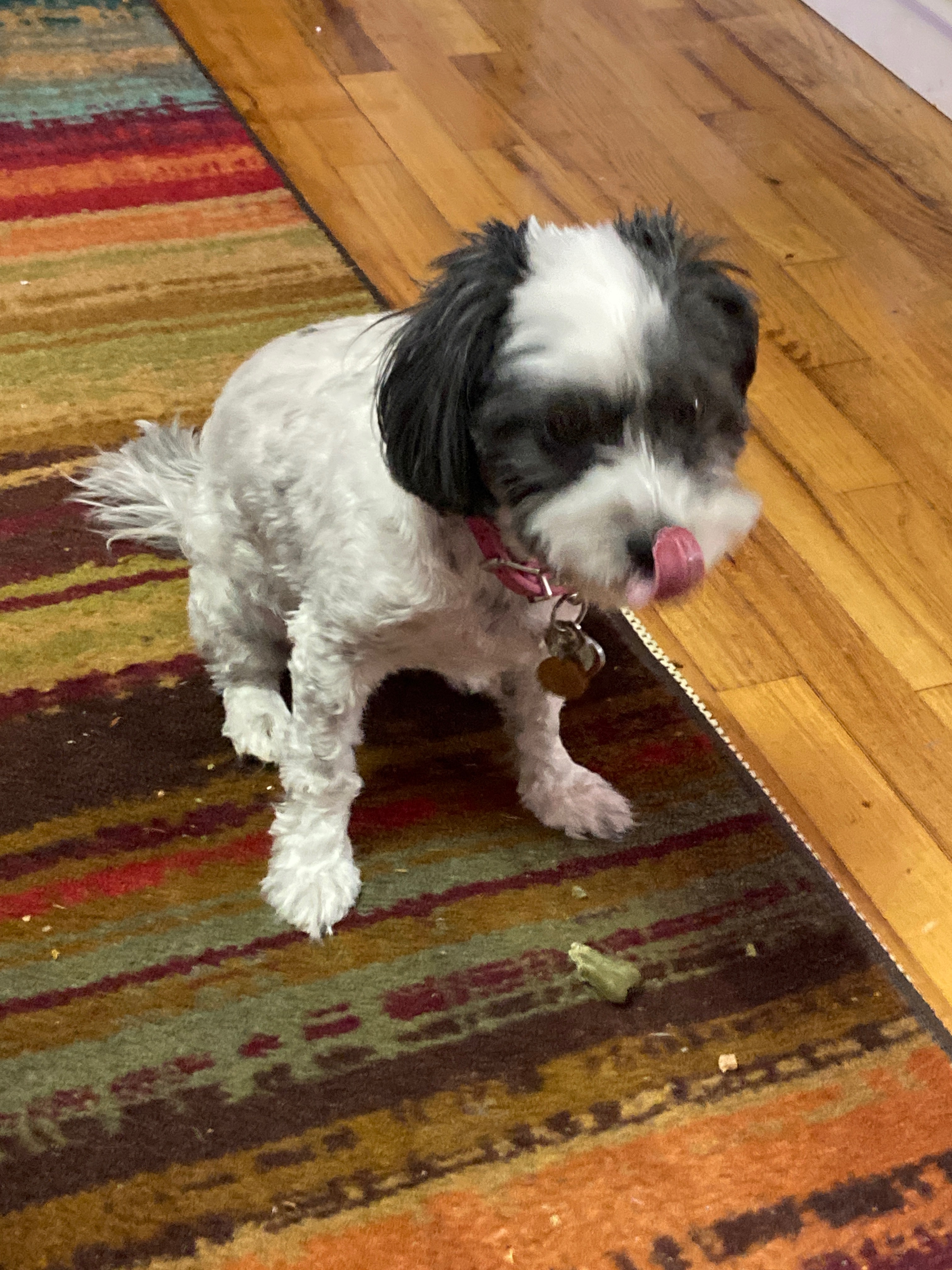
Don’t worry about things that aren’t perfect, Rachel. You’re the perfect dogmother to a perfect dog. She’s SO sweet!
First, having a learning disability does not make anyone stupid! Your brain just does not work that way! Also, just because you’re smart, doesn’t mean you don’t have a learning disability. That seems so backwards to me! We all struggle with different things and I truly believe that most of us have no idea why we are the way we are (nor do the onlookers who will readily offer advice, wanted or not!)
Life is a journey. If you stop seeking answers, does that mean you have given up, or that you are just accepting yourself for who you are, different brains and all? No idea. My journey is not finished yet either!
Here’s hoping for a fascinating journey!
Thank you!
I think the last time I used my cheque book was 30 years ago. I didn’t realise they are still used in the United States. I’m sorry to read what happened to your Mum.
Thank you!
You’re right. After all that, it is time for a snack.
Definitely!
Yikes, so scary. But I feel paying online is easy to hack as well. When I do write checks, I use the kind of ink that doesn’t wash or is the hardest to wash. I forget which. So sorry. I think everyone needs a good movie and lots of treats.
I’ve heard stories of this magical ink, but I don’t know which one it is, alas.
You have to be very sharp with your accounts. A friend of mine had someone open up an account at another bank in his name. The only way he was alerted was because the bank was on it and did its job. They thought something looked funny about it. It was done online and with ID! However, sometimes you are not alerted and they might use the account to launder money. That is scary.
My Mom found out about the check because she was checking her account online and saw that this fake check was pending. She’s much better at keeping an eye out than I am.
In a way, you are fortunate. When I was concerned over some cognition and learning issues I described them to AI. It responded by saying “Howdy there Forrest, how’s the shrimp business these days? Seen Lieutenant Dan lately?”
Hmmm.
I suggest don’t get hung up on the symptoms that don’t fit. These diagnoses are written up by people who don’t have them. My brain doesn’t function the same way every day. Some days I can clearly verbalize my thoughts and understand what others are saying. Other days I struggle. Same could be true with you. Or it could be your brain figured out a way to rewire itself so stairs were no longer a problem but didn’t figure out the spatial issue.
Very interesting! Brains are truly fascinating!
No different than what happens with stroke survivors.
You are very good at studying things and figuring them out. If this CAN be figured out, I have no doubt you will do it!
Thank you!
Congratulations 🙌🏻 . Well shared
Fascinating connections which you’ve discovered and exposed. Your mother’s experience was certainly a terrible thing for you both to endure; her response about your being ‘too smart’ to have those problems was illuminating in its own way. I respect how your pursue greater understanding in a methodical and practical way. Yes, there are more puzzles…
That’s the thing. No matter how much we learn and understand, there always seem to be more pieces.
Cheers
Thank you!
The text is a personal reflection on learning difficulties and how a person tries to understand their own mind. Using examples from their life, it shows how certain problems can go unnoticed for years and how, despite the difficulties, effort and perseverance allow one to move forward. It is an honest account of the search for answers and self-knowledge.
I admire how much you work to figure it all out on your own. Here’s a bit of my history with learning.
I was unable to excel at algebra, however geometry was easy when I was in high school (gradation 1967).
Reading was my passion, though I had to read every word. The only C I received in HS was in speed reading!
When I was taking coursework for my Masters degree in counseling, a lesson on identifying students with dyslexia opened my eyes. 👀
I was able to both write and read upside and backwards. Dyslexic all my life, I had learned to read every word, and reread as necessary to understand what I was reading. It’s what makes me a good proof reader, and Jumble puzzle pro!
Algebra was a mix of numbers, letters and symbols that kept moving all around, and I couldn’t find order to it.
The more we understand about our own conditions, the better able we are to thrive and to nurture others .
I love that story! Thank you!